1. Introduction
Driven by carbon neutrality targets and the high penetration of renewable energy, the voltage stability support capability of cross-regional transmission corridors and receiving-end grids has become a critical factor in enhancing energy system security and resilience. Due to its large capacity, low losses, and favorable economics, thyristor-based line-commutated converter HVDC (LCC-HVDC) remains widely used for long-distance bulk power transmission. However, in multi-infeed and weak receiving-end scenarios, AC-DC coupling is significantly enhanced. Existing studies have shown that commutation failure (CF) risk is closely correlated with system strength [
1,
2], and that fault types and receiving-end voltage stability levels can significantly alter the CF triggering boundary [
3,
4]. CF not only causes DC power dips and recovery delays but may also affect adjacent AC and secondary systems through measurement errors, feature distortion, and protection coordination actions, further reducing transmission corridor availability and power supply continuity [
5]. Therefore, enhancing the CF immunity and recovery resilience of LCC-HVDC under weak receiving-end fault conditions, without violating equipment protection constraints, has become a research problem of both theoretical significance and engineering urgency.
To suppress CF risk, existing research can broadly be divided into two categories. The first focuses on improving system strength and commutation voltage conditions. For example, synchronous condensers and series voltage regulation have been used to enhance voltage support during faults [
6,
7], sending-end voltage fluctuation suppression helps improve the commutation environment and mitigate adverse post-fault effects [
8]. In addition, synchronized phasor measurement has been used to improve risk identification in multi-infeed scenarios [
9]. The second category focuses on control and protection. Existing work has reduced the occurrence and propagation of subsequent commutation failures through DC current prediction and suppression control [
10,
11], adaptive current control [
12], and chain reaction suppression [
13]. Notably, the mechanism of sending-end voltage fluctuation and its suppression methods have been further extended in recent studies [
14]. Meanwhile, CF prediction, detection, and identification methods continue to evolve. Prediction methods for asymmetric faults and predictive detection methods considering voltage harmonics have been reported [
15,
16], detection methods based on the energy change rate and high-accuracy identification algorithms have further improved fault identification capability [
17,
18], improved prediction methods for subsequent commutation failures are also being refined [
19]. These studies provide an important foundation for CF risk assessment and control, but most still focus on system enhancement or event identification, with insufficient discussion of how protection input features are reshaped after active reactive power support intervention and how protection logic should be adaptively adjusted based on device states.
In recent years, with the development of power electronic auxiliary commutation, hybrid DC topologies, and intelligent protection technologies, HVDC protection research has been shifting from single quantity criteria toward multi-feature fusion and state-awareness. Regarding auxiliary commutation and topology innovation, some studies have pointed out that active support devices may introduce new coupling paths and side effects under specific fault types or control configurations [
20]. Other work has shown that certain active commutation support devices or topological innovations can significantly mitigate or even eliminate CF risk [
21,
22]. In addition, recovery and suppression strategies after active support have provided new ideas for subsequent CF mitigation [
23]. However, these works mainly focus on improving commutation performance itself, with limited discussion of how active support reshapes protection criteria.
In HVDC line protection, Xiao et al. proposed a disturbance blocking criterion for differential protection of LCC-HVDC lines [
24]. Liu et al. proposed a non-unit protection method suitable for long-distance LCC-HVDC lines based on voltage traveling-wave waveform characteristics [
25]. S. Deb et al. proposed an improved protection algorithm based on the transient energy signum function to enhance fault detection and classification for monopolar HVDC lines [
26]. Lei et al. proposed a single-end line protection method based on boundary characteristic frequency band energy ratio for hybrid HVDC systems [
27]. These works reflect the trend of HVDC protection transitioning from traditional amplitude-based criteria toward multi-feature combined criteria that integrate boundary characteristics, transient energy, and frequency band information. However, they primarily focus on line fault discrimination or transient feature extraction, which addresses a different problem dimension from the converter station protection mismatch under SVF active support studied in this paper.
In the data-driven direction, Liang et al. proposed a hybrid HVDC fault identification method based on wavelet packet energy spectra and convolutional neural networks (CNN), demonstrating that data-driven methods have good feature extraction capability under complex boundary conditions [
28]. Such methods expand the feature space but likewise do not address the coordination between device state and protection thresholds.
In summary, the above studies have not yet systematically answered the following questions: when SVF active support causes valve-side voltage amplitude, phase, and harmonic characteristics to change simultaneously, why does conventional fixed threshold protection exhibit the concurrent mismatch of misblocking and failure to operate; and when SVF zone internal faults can be locally isolated, how should protection logic avoid unnecessary pole-level escalation?
From an engineering perspective, at least three research gaps exist in SVF active support scenarios. First, existing commutation risk criteria mostly rely on conventional quantities such as voltage magnitude or extinction angle and cannot directly characterize the nonlinear compensation mechanism of SVF fast reactive power injection on the commutation voltage time integral. Second, existing protection methods generally assume stable statistical properties of input features and rarely incorporate control mode, health status, and reactive power margin explicitly into protection threshold and time window tuning. Third, for SVF zone local faults, existing research lacks a unified coordination framework that jointly addresses local isolation priority, derated ride-through, and pole-level action escalation conditions. These shortcomings indicate that the protection problem for weak receiving-end SLCC-HVDC is no longer simply a discrimination problem of whether CF occurs but a comprehensive problem of how commutation physics, device state, and protection action logic work together.
To address the above issues, this paper takes the symmetric single-pole LCC-HVDC system with valve-side SVF under weak receiving-end conditions as the research subject and studies the commutation boundary changes, protection criteria mismatch, and local fault escalation under SVF active support. Unlike existing research that mainly focuses on system strength enhancement, CF detection and identification, or line fault discrimination, this paper aims to establish a unified coordinated protection framework integrating commutation physical quantities, device state quantities, and protection decision logic. Specifically, the main contributions of this paper are as follows:
- (1)
A normalized commutation margin index is proposed based on the commutation voltage time integral to characterize the nonlinear extension of the CF boundary under SVF active support, and its intrinsic relationship with and essential differences from conventional voltage magnitude and extinction angle indices are clarified from a physical mechanism perspective.
- (2)
A state-conditioned threshold modification method is proposed, incorporating SVF control mode, health status, and reactive power margin as explicit conditioning variables to achieve adaptive adjustment of protection thresholds and time windows, thereby reducing the risk of misblocking and failure to operate of fixed threshold protection during state transitions.
- (3)
A local isolation derated ride-through–pole-level action staged response strategy is proposed for SVF zone internal faults to limit the fault impact range and improve system operational continuity.
The remainder of this paper is organized as follows.
Section 2 analyzes the commutation boundary extension mechanism under SVF active support and explains the distinction between the normalized commutation margin index and conventional indices.
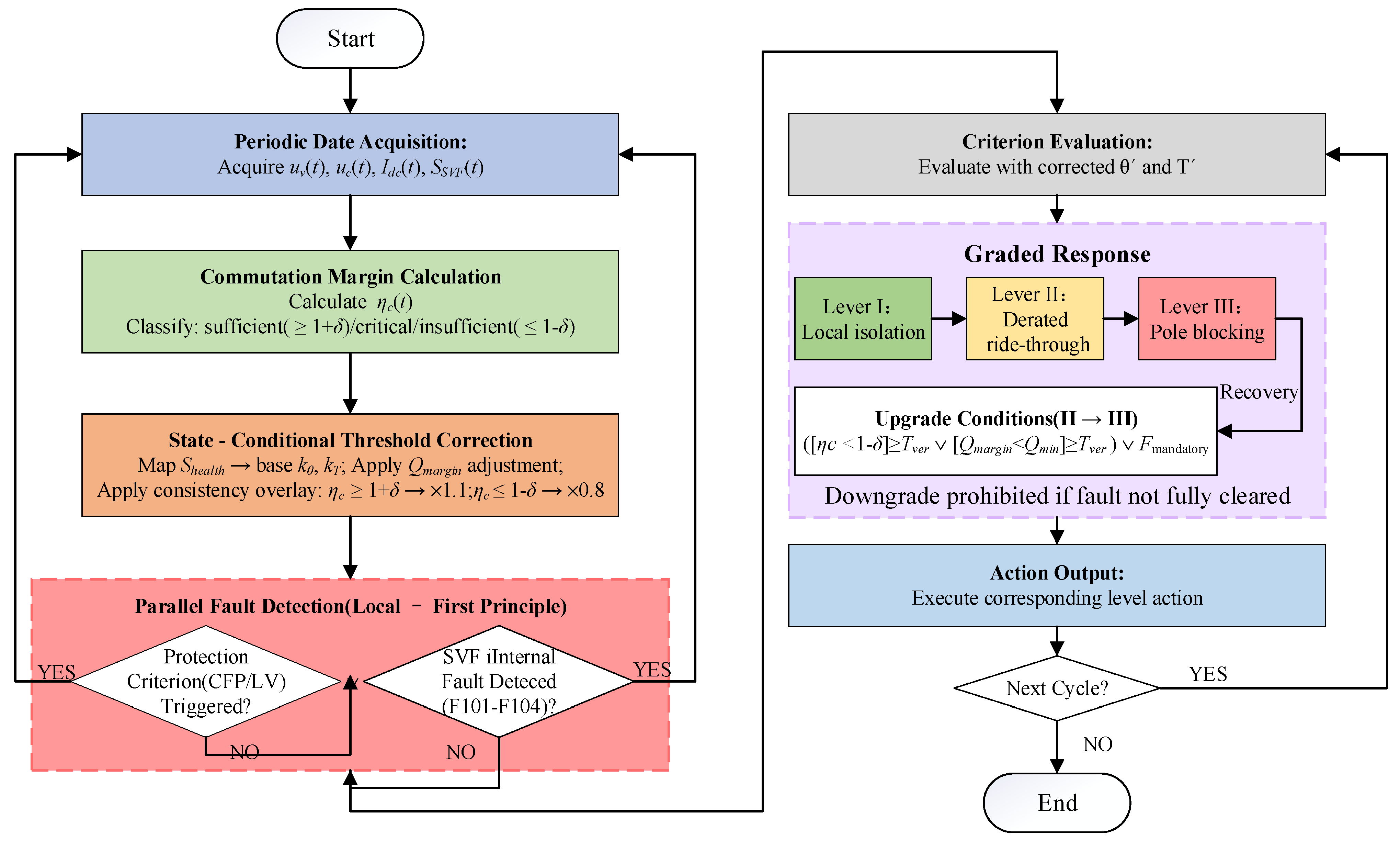
Section 3 presents the state-conditioned threshold modification method and the staged response strategy.
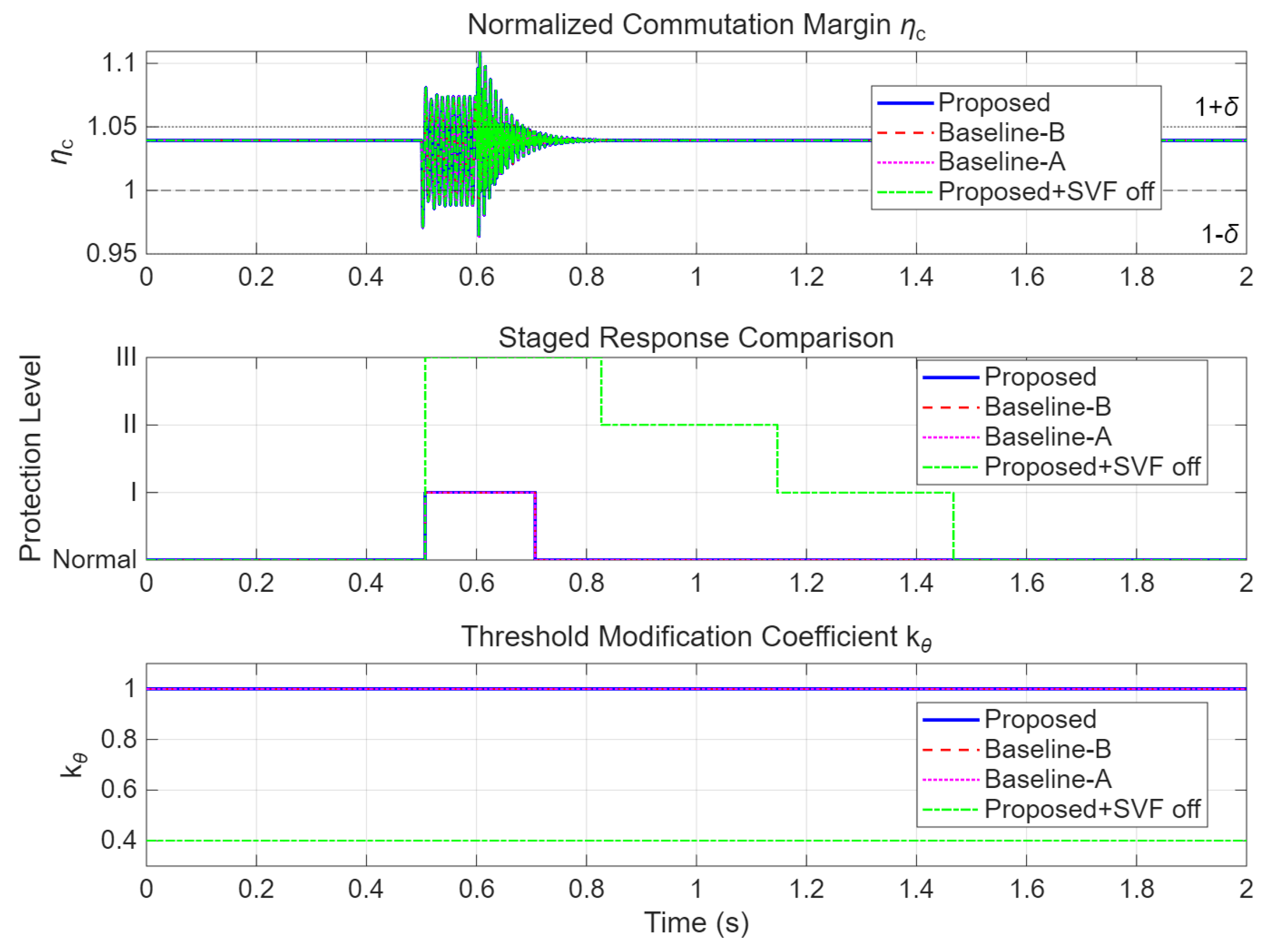
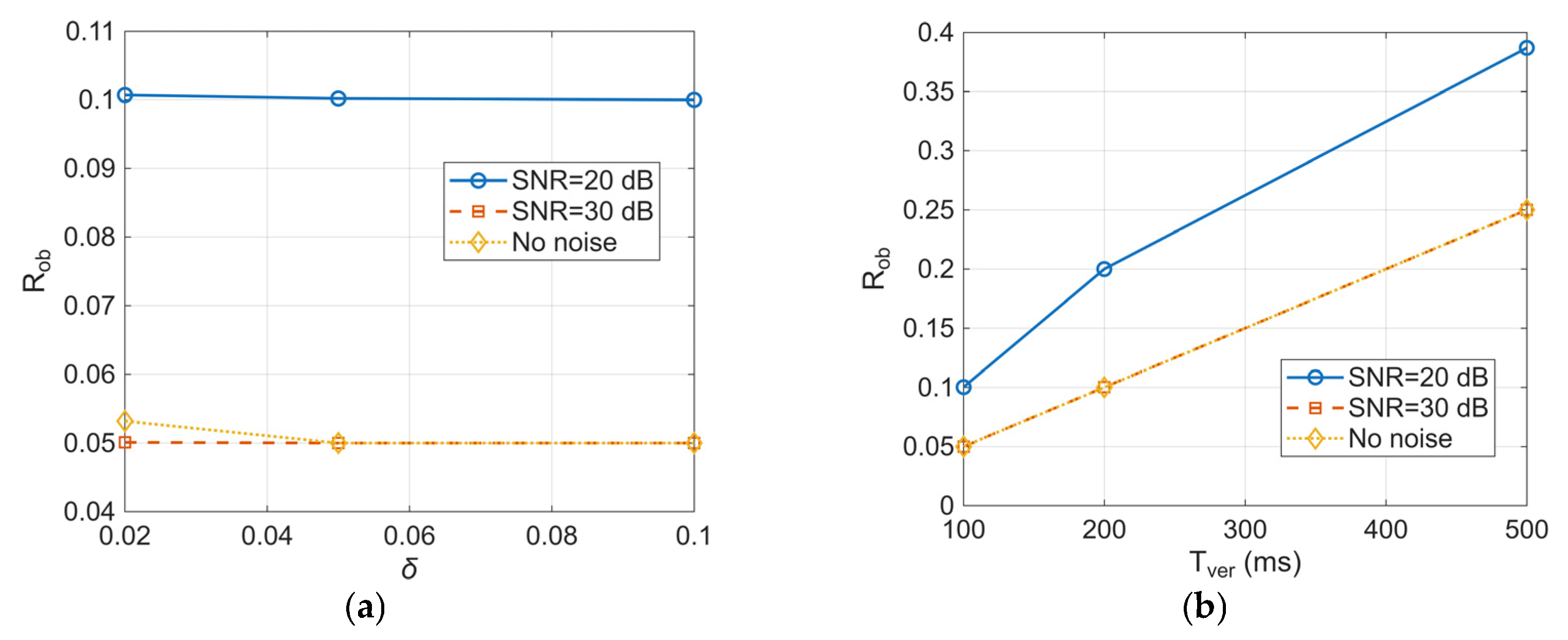
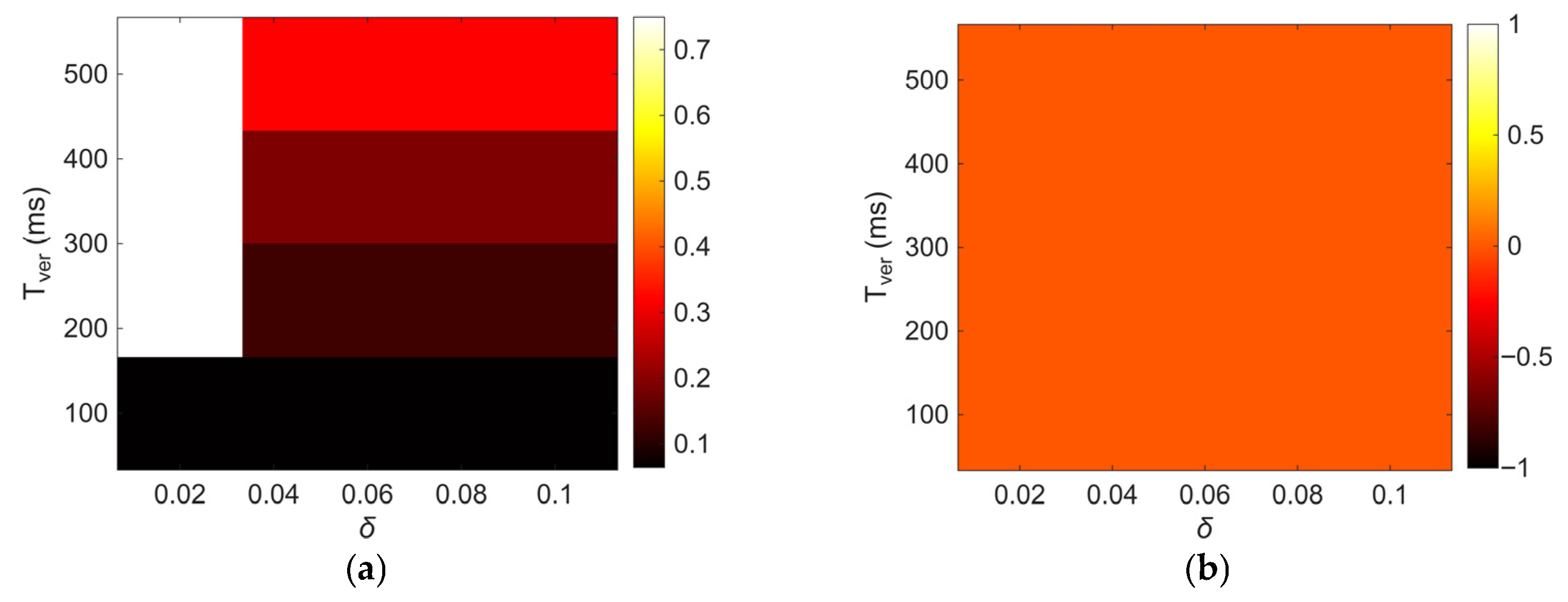
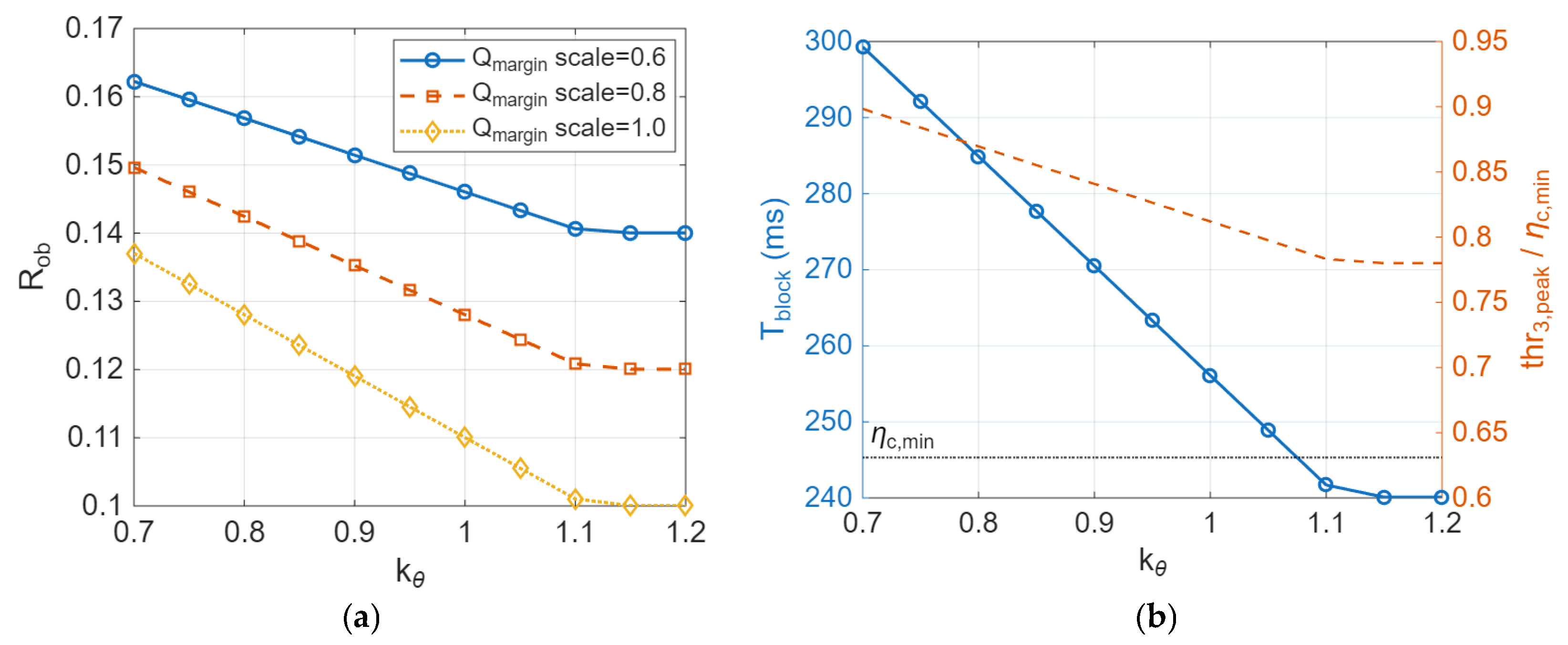
Section 4 validates the effectiveness and robustness of the proposed method through engineering SoE records and EMT–protection logic co-simulation replay.
Section 5 provides conclusions and directions for future work.
2. Commutation Failure Boundary Analysis and Protection Mismatch Mechanism Under SVF Active Support
2.1. SVF Active Support, Commutation Boundary, and Normalized Margin Index
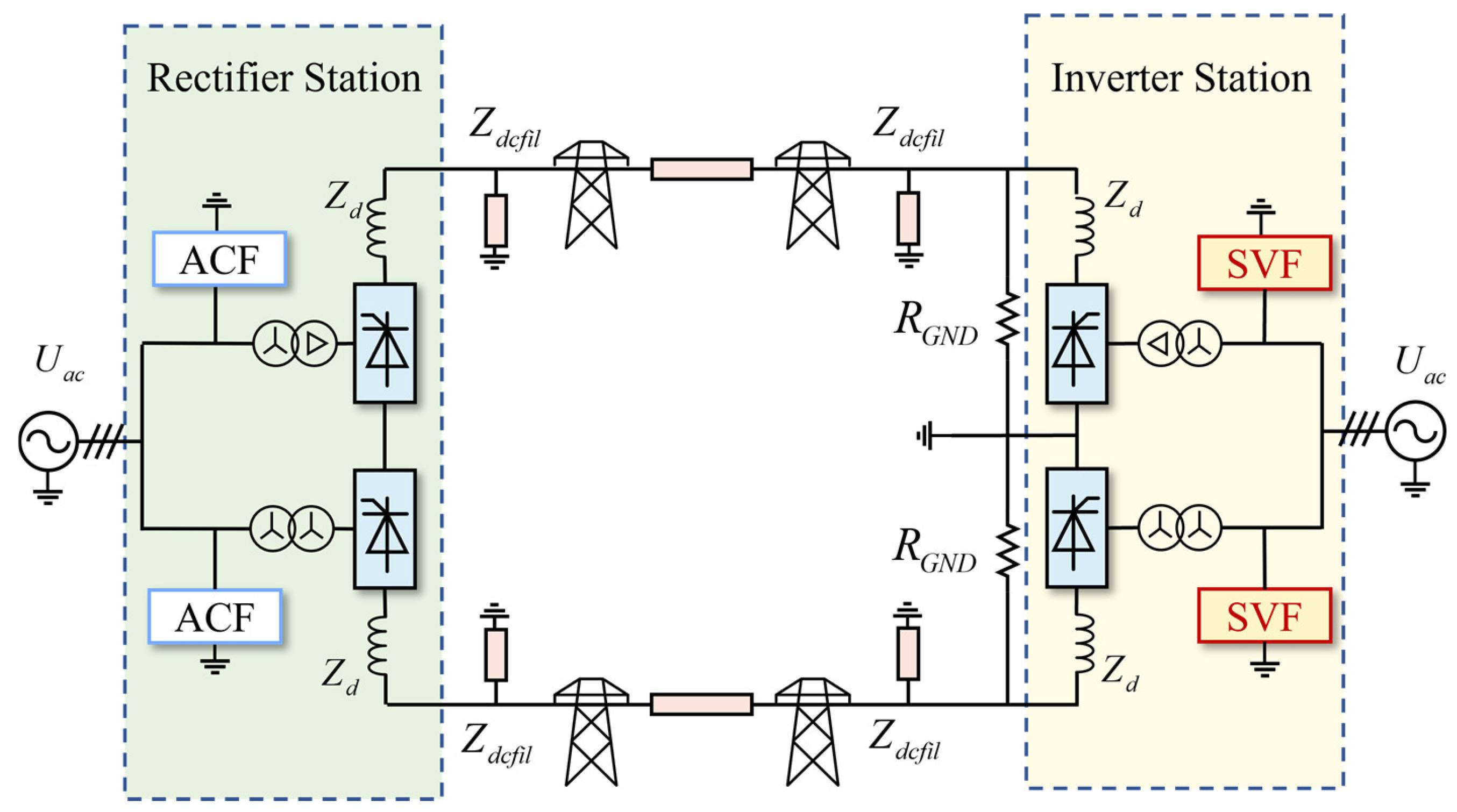
A symmetric single-pole SLCC-HVDC system comprises an LCC converter and a valve-side parallel SVF, which provides both reactive power support and filtering. During fault ride-through, the SVF modifies the valve-side voltage waveform and harmonic characteristics, influencing both the physical commutation process and the observable inputs to the protection system.
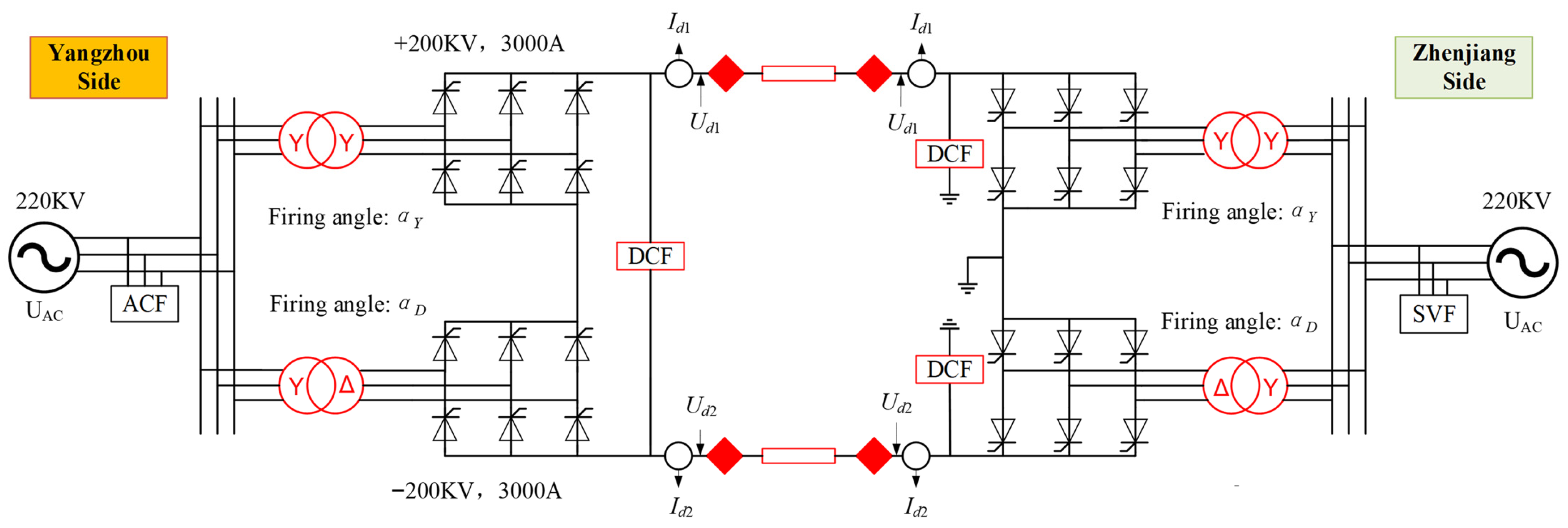
Figure 1 illustrates the configuration of the studied symmetric monopole HVDC system with a single-side SLCC retrofit.
Commutation theory traditionally describes the commutation margin and CF risk using the overlap and extinction angles. Successful commutation fundamentally depends on whether the commutation voltage time integral (or commutation voltage time area) within the commutation window is sufficient to complete the DC current transfer. The commutation voltage time integral is defined as:
where
uc(
t) is the commutation voltage and
Tw is the commutation evaluation window. The normalized commutation margin is further defined as:
where
Lc is the equivalent commutation reactance,
Idc(
t) is the DC current, and ε is a small regularization constant (typically 10
−6) to prevent division by zero during fault transients. When
ηc(
t) approaches or falls below 1, the commutation voltage time integral is insufficient, and CF risk increases. This quantity can be extracted directly from electromagnetic transient waveforms and is suitable as a quantifiable index linking waveform observation and commutation physics.
In SLCC, the SVF’s fast reactive power injection reshapes the valve-side voltage waveform:
where
uv(
t) is the valve-side bus voltage and Δ
uSVF(
t) is the voltage component injected by SVF. Under quasi-steady-state (QSS) conditions, the voltage boost from SVF reactive power injection can be approximated as follows:
where
QSVF(
t) is the reactive power injected by SVF,
Xeq is the equivalent system reactance seen from the SVF connection point, and
Uv(
t) denotes the RMS value of the valve-side bus voltage. The SVF simultaneously changes the amplitude, phase, and distortion characteristics of the valve-side voltage, thereby altering
Jc(
t) and
ηc(
t), and nonlinearly extending the CF boundary toward weak receiving-end conditions.
Remark 1 (Applicable Scope of the QSS Approximation)
. The QSS approximation in Equations (3) and (4) is primarily intended to analyze the influence of SVF active support on the commutation boundary and threshold modification trends, rather than for precise real-time margin calculation under extreme transients. Under severe voltage sags, strong harmonic distortion, or significant phase jumps, rapid voltage variations and harmonic reconstruction may reduce the numerical accuracy of the approximation. However, as long as it correctly captures the boundary trend (sufficient–critical–insufficient), its theoretical value for protection criteria design remains valid. Accordingly, this paper employs the QSS model only for deriving protection threshold boundaries and analyzing parameter influence mechanisms. The real-time protection quantity ηc is computed directly from sampled commutation voltage and DC current via time-domain integration, ensuring that approximation errors do not enter the online protection action chain. A detailed analysis of QSS approximation error sources and protection decision consistency is provided in Appendix B.
The minimum margin over the fault interval [tf, tc] is defined as:
The CF boundary is correspondingly defined on the parameter plane as:
Compared with conventional extinction angle or voltage magnitude indices, the proposed normalized commutation margin emphasizes the physical consistency among the commutation voltage time integral, DC current, and system reactance. It provides a stable nonlinear characterization of commutation capability under SVF active support.
Comparison with Conventional Indices
The normalized commutation margin index ηc is inherently consistent with conventional extinction angle and commutation voltage magnitude indices, as all three attempt to characterize the converter’s ability to complete current commutation. However, their physical focus differs. The voltage magnitude index is an amplitude-type indicator reflecting voltage support strength. The extinction angle index is an angle-type indicator reflecting the safety margin during thyristor turn-off. In contrast, ηc is a time area indicator that integrates the effects of commutation voltage, current, and reactance. It focuses on whether a sufficient voltage time integral has accumulated within the commutation window, aligning more directly with the physical constraints of the commutation process.
Under SVF active support, these differences are amplified. SVF reactive power injection alters the amplitude, phase, and harmonic characteristics of the valve-side voltage; its effect manifests through changes in the effective voltage time integral. When the SVF enters current limiting, saturation, withdrawal, or bypass states, the effective voltage time integral may decrease significantly even if the voltage magnitude remains relatively stable. Since
ηc is constructed directly from the commutation voltage time integral, it more naturally captures this nonlinear compensation effect. Conversely, the conventional voltage magnitude index is susceptible to sliding-window smoothing, and its response to rapid state transitions often lags behind the true commutation process. The extinction angle index may be maintained near its setpoint by the controller, weakening its sensitivity to intermediate risk regions. Thus,
ηc is better suited for characterizing the nonlinear deviation between voltage magnitude and commutation capability, as summarized in
Table 1.
2.2. Mismatch Mechanism of Traditional Protection Criteria
Traditional LCC-HVDC protection assumes a stable positive correlation between voltage dip depth, DC disturbance, harmonic characteristics, and commutation margin. SVF active support breaks this statistical consistency in three respects.
First, voltage magnitude and commutation margin become decoupled. The SVF can rapidly raise measurable voltage during a fault, but due to phase jumps and waveform distortion, the time integral within the commutation window may still be insufficient. Thus, a voltage increase does not necessarily correspond to a synchronous enhancement of commutation capability.
Second, SVF state transitions cause feature non-stationarity. Current limiting, blocking, and control loop withdrawal alter uv(t), THD, and Q(t) at the millisecond level. Fixed threshold criteria cannot distinguish between fault-induced distortion and control loop mutations, leading to misblocking or failure to operate. The most affected elements are the commutation failure protection (CFP), low-voltage blocking criteria, and auxiliary criteria relying on harmonic or voltage features.
Third, local faults may be excessively escalated. SVF zone internal faults can generally be managed through local isolation or bypass. However, if protection logic cannot distinguish the fault impact range, these faults may be escalated to pole blocking or isolation, causing unintended outages.
In summary, voltage magnitude/commutation-margin decoupling, feature non-stationarity due to SVF state transitions, and excessive local fault escalation collectively constitute the starting point for the method design in this paper.
Section 3 will propose state-conditioned threshold modification and staged response methods to address these issues.