A Methodology for Quantitative Security Evaluation of Operating Systems: Scenario-Based Comparison of Qubes OS and Windows 11



Abstract
1. Introduction
2. Related Works
3. Security Architectures of Operating Systems
3.1. Qubes OS Security Architecture
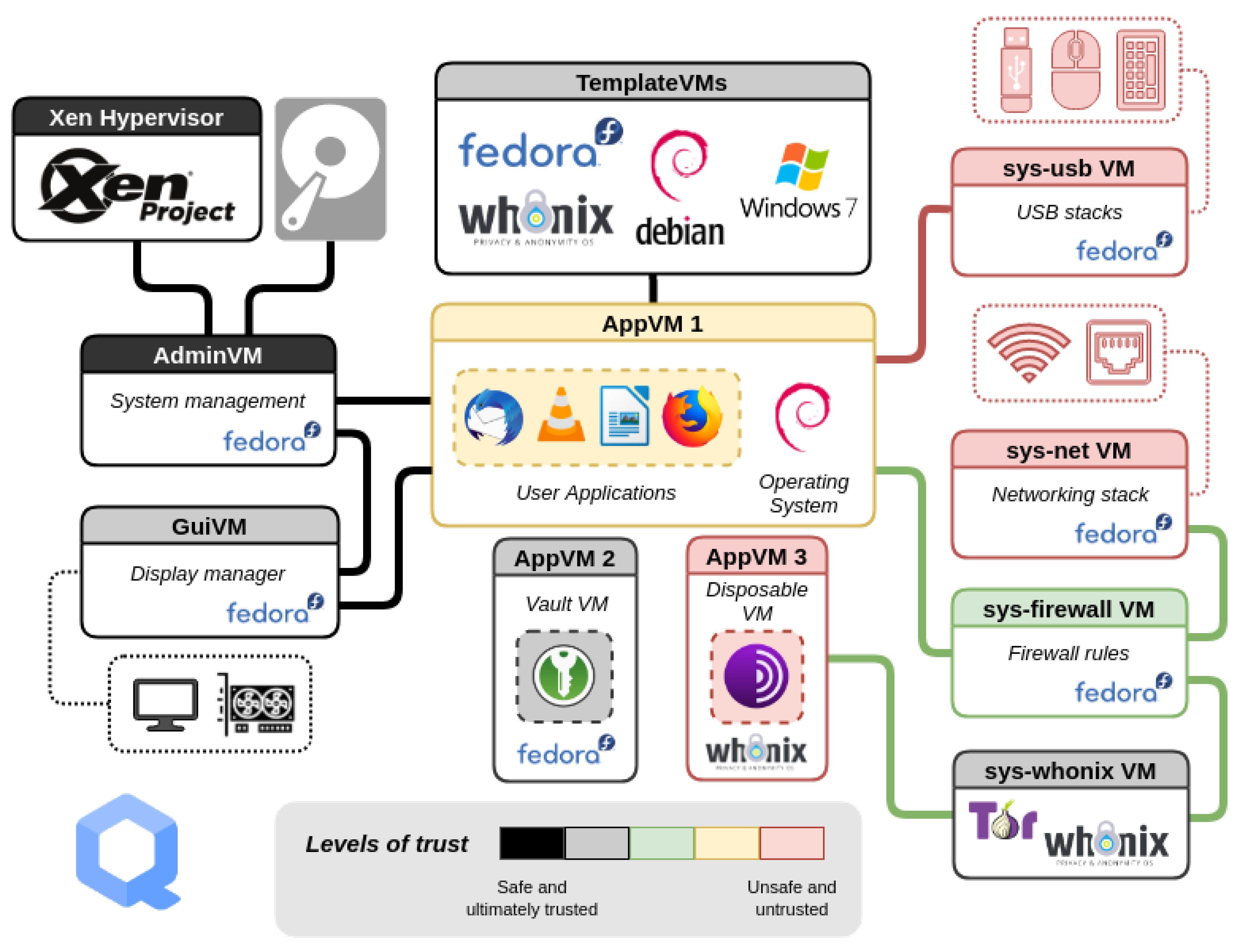
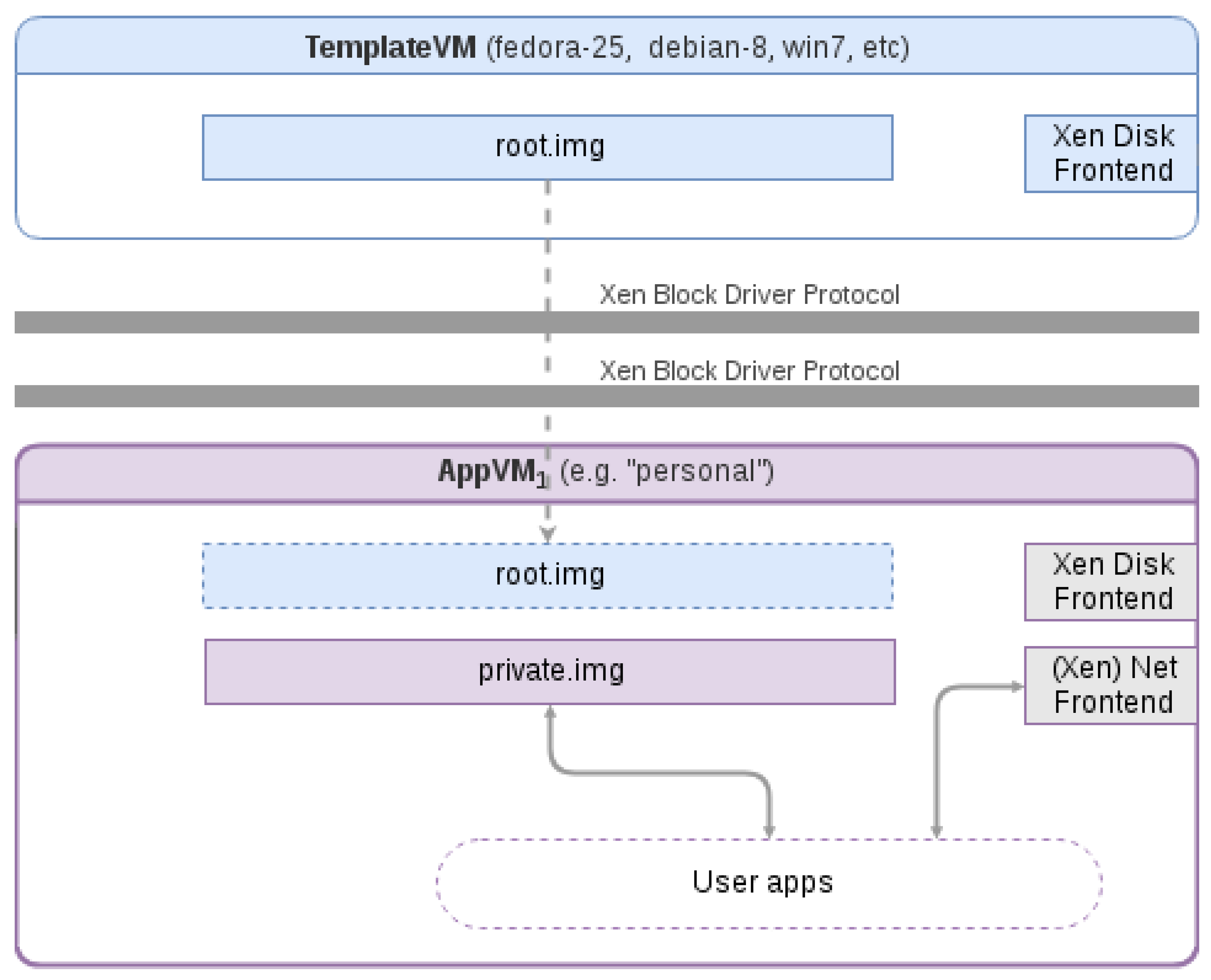
- Security. Using the template system makes it significantly easier to apply system updates to many virtual machines at once. AppVMs also do not have write access to the templates’ original root images, which means that any malware infections occurring in an AppVM should be contained to just that qube.
- Performance. Using a common root file system and initially empty private images allows for very rapid creation of new AppVMs.
- Storage. Having just one root file system per template significantly cuts down on the storage requirements of running a large number of virtual machines.
3.2. Windows 11 Security Architecture
- Virtualization-based security (VBS) utilizes hardware virtualization features to create an isolated environment for hosting certain security-critical features and lays the groundwork for other features based on itself.
- Hypervisor-Protected Code Integrity (HVCI) is based on VBS and runs Kernel Mode Code Integrity (KMCI) isolated in the containment of VBS to reduce the likelihood of attacks on kernel-mode code.
- Local Security Authority (LSA) Protection, also called RunAsProcessProtectedLight (RunAsPPL), utilizes VBS to protect the Local Security Authority Subsystem Service (LSASS) from certain types of attacks, such as process injection.
- Credential Guard uses VBS to protect Active Directory (AD) credentials from attacks such as Pass-the-Hash or Pass-the-Ticket [33] (pp. 10, 51).
3.3. Architectural Comparison
4. Methodology
4.1. Mitigations
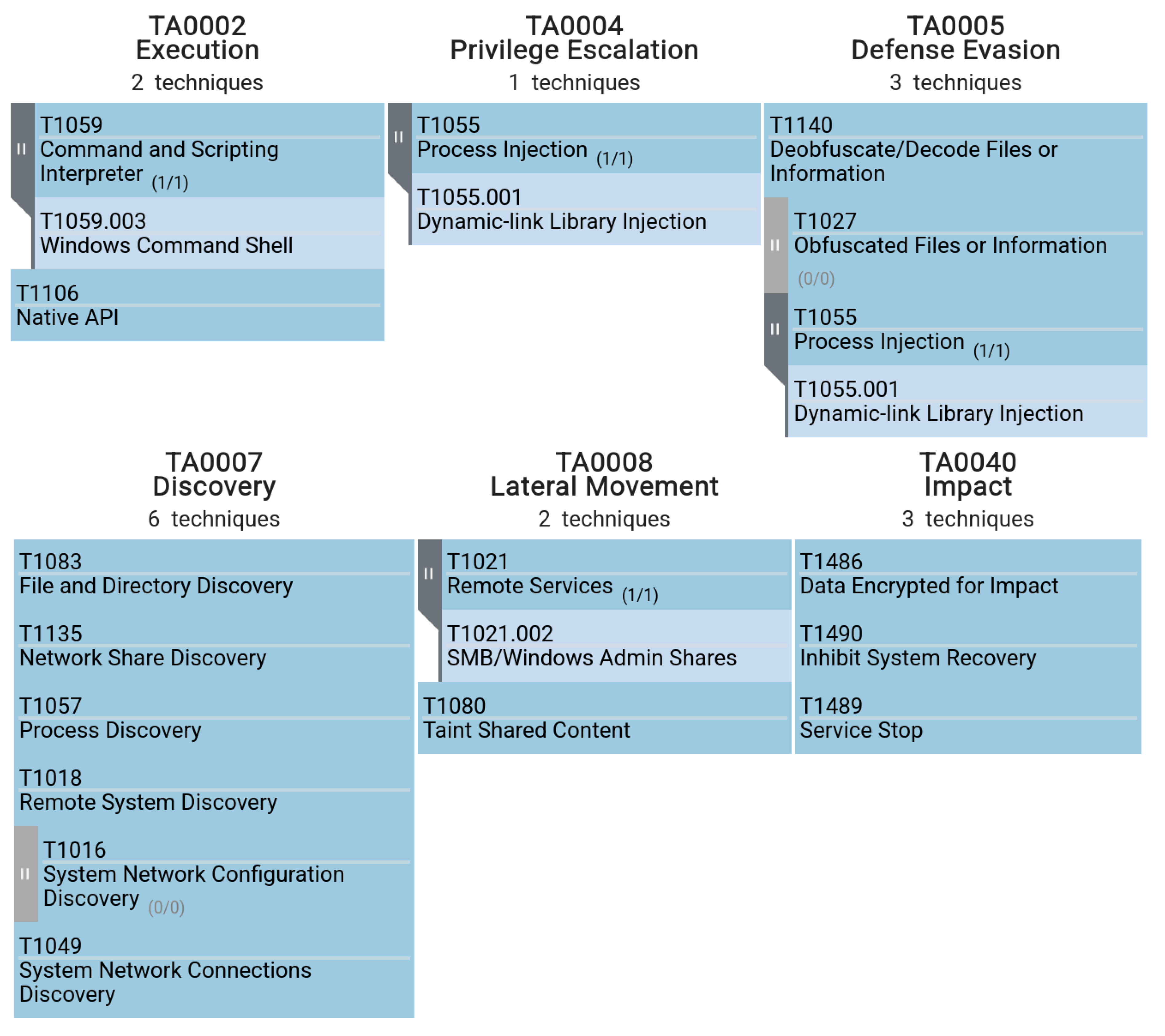
- The MITRE technique definition was consulted from the official MITRE website, including sub-techniques, procedure examples, mitigations, and detection strategies.
- Official documentation sources, technical reports, and scientific articles were consulted in order to describe the details of how an operating system mitigates the specified technique.
- If such sources proved inadequate, practical attack simulations utilizing specific tactics were performed on live installations of the chosen operating systems.
- Based on the information gathered, a mitigation score and the corresponding description were assigned to the technique for each of the operating systems.
- It was assumed that the user is using Qubes OS correctly (for example separating work, email, and miscellaneous browsing into appropriate AppVMs), but overall they use the default configuration (meaning only sys-usb and sys-firewall were configured as disposable; the user does everything else in AppVMs). (AppVMs are virtual machines that, in short, have an ephemeral root file system taken from a TemplateVM and a persistent /home directory. Disposable VMs have all of their block storage devices configured as ephemeral.) We believe that this assumption is reasonable on the basis of the research findings of Issa et al. [11], discussed in Section 2.
- Mitigation scores were defined so that Low represents next to no mitigation or measures that are trivially easy to bypass. Medium represents reasonable mitigation efforts that may still be bypassable under certain circumstances or complete mitigation via domain isolation but without specific in-domain mechanisms. High is taken to mean complete or near-complete mitigation that would be difficult to circumvent without significant user interaction.
- Critically, it was assumed that threat actors are sophisticated and are able to bypass standard detection-based security measures (such as through the use of polymorphic malware and indirect execution), but do not use zero-day exploits.
Mitigation Score Calculation
4.2. Scenarios
5. Results
5.1. Mitigations
5.2. Scenarios
6. Discussion
7. Conclusions
7.1. Limitations
- (1)
- Operating systems that rely on detective security measures to a significant degree, such as Windows 11, would be able to successfully block many more classes of attacks.
- (2)
- Unsophisticated adversaries are less likely to write malware targeting GNU/Linux-based desktop operating systems.
7.2. Future Directions
Author Contributions
Funding
Data Availability Statement
Conflicts of Interest
Abbreviations
| ABE | App-Bound Encryption |
| AD | Active Directory |
| API | Application Programming Interface |
| APT | Advanced Persistent Threat |
| ASLR | Address Space Layout Randomization |
| ATT&CK | Adversarial Tactics, Techniques, and Common Knowledge |
| BYOVD | Bring Your Own Vulnerable Driver |
| C2 | Command and Control |
| CDDC | Cross Domain Desktop Compositor |
| CFG | Control Flow Guard |
| CG | Credential Guard |
| CISA | Cybersecurity and Infrastructure Security Agency |
| CV | Coefficient of Variation |
| DEP | Data Execution Prevention |
| DLL | Dynamic-Link Library |
| DLP | Data Loss Prevention |
| DMA | Direct Memory Access |
| DPAPI | Data Protection Application Programming Interface |
| EDR | Endpoint Detection and Response |
| EPP | Enhanced Phishing Protection |
| ESS | Enhanced Sign-in Security |
| FDE | Full-Disk Encryption |
| FOSS | Free and Open-Source Software |
| GNU | Gnu’s not Unix |
| GUI | Graphical User Interface |
| HKLM | HKEY_LOCAL_MACHINE |
| HVCI | Hypervisor-Protected Code Integrity |
| HfB | Hello for Business |
| IDPS | Intrusion Detection/Prevention System |
| IOMMU | Input–Output Memory Management Unit |
| ISO | International Organization for Standardization |
| LNK | Link (Windows Shortcut) |
| LSA | Local Security Authority |
| LSASS | Local Security Authority Subsystem Service |
| MLS | Multi-Level Secure |
| OS | Operating System |
| PAM | Pluggable Authentication Modules |
| PC | Personal Computer |
| PPL | Protected Process Light |
| RD | Remote Desktop |
| RPC | Remote Procedure Call |
| SAC | Smart App Control |
| SCM | Service Control Manager |
| SDSM | Software-Defined Secure Memory |
| SMB | Server Message Block |
| TPM | Trusted Platform Module |
| TT | Tactics and Techniques |
| TTPs | Tactics, Techniques and Procedures |
| UAC | User Account Control |
| UEFI | Unified Extensible Firmware Interface |
| URL | Uniform Resource Locator |
| USB | Universal Serial Bus |
| VBS | Virtualization-Based Security |
| VM | Virtual Machine |
| VSS | Volume Shadow Copy Service |
| WRP | Windows Resource Protection |
| WinRE | Windows Recovery Environment |
Appendix A. MITRE ATT&CK Technique Mitigation Comparison Table
| Tactic | Tech. ID | Technique Name | Qubes OS | Qubes OS Mitigation Details | Win. 11 | Windows 11 Mitigation Details |
| TA0001: Initial Access | T1659 | Content Injection | Medium | Impact localized to single VM | Low | No specific protections assuming signature-based detection is bypassed |
| T1189 | Drive-by Compromise | Medium | Impact localized to single VM | Low | No specific protections assuming signature-based detection is bypassed. DEP, ASLR, CFG assumed bypassable | |
| T1133 | External Remote Services | High | Remote access disabled by default. If enabled, would be contained to one VM | High | Remote access disabled by default | |
| T1200 | Hardware Additions | Medium | USB, Thunderbolt protection provided via IOMMU/VT-d and USB isolation, but no Secure Boot support by default | Medium | Secure Boot by default, but no USB isolation | |
| T1566 | Phishing | Medium | Impact localized to single VM | Low | No specific protections assuming signature-based detection is bypassed | |
| T1091 | Replication Through Removable Media | Medium | Removable media contained to sys-usb by default. Can still infect VMs media is passed through to | Low | No specific protections assuming signature-based detection is bypassed | |
| T1195 | Supply Chain Compromise | Medium | Template VM compromise affects a sizeable chunk of the system, but dom0 utilizes separate package sources and multiple templates reduce overall impact | Low | Supply chain compromise means whole-OS compromise | |
| T1199 | Trusted Relationship | High | No trusted relationships by default. Otherwise localized to single VM/VM group | High | No trusted relationships with outsize systems by default | |
| T1078 | Valid Accounts | Medium | Impact localized to single VM. Valid user account = valid root account for one VM | Medium | Microsoft Account set up by default. No default local admin credentials | |
| T1669 | Wi-Fi Networks | High | Network driver compromise made not very effective via IOMMU isolation to sys-net. Separate firewall qube | Medium | Most attempts blocked by firewall. Network driver compromise is fatal | |
| Total | 13/20 | 7/20 | ||||
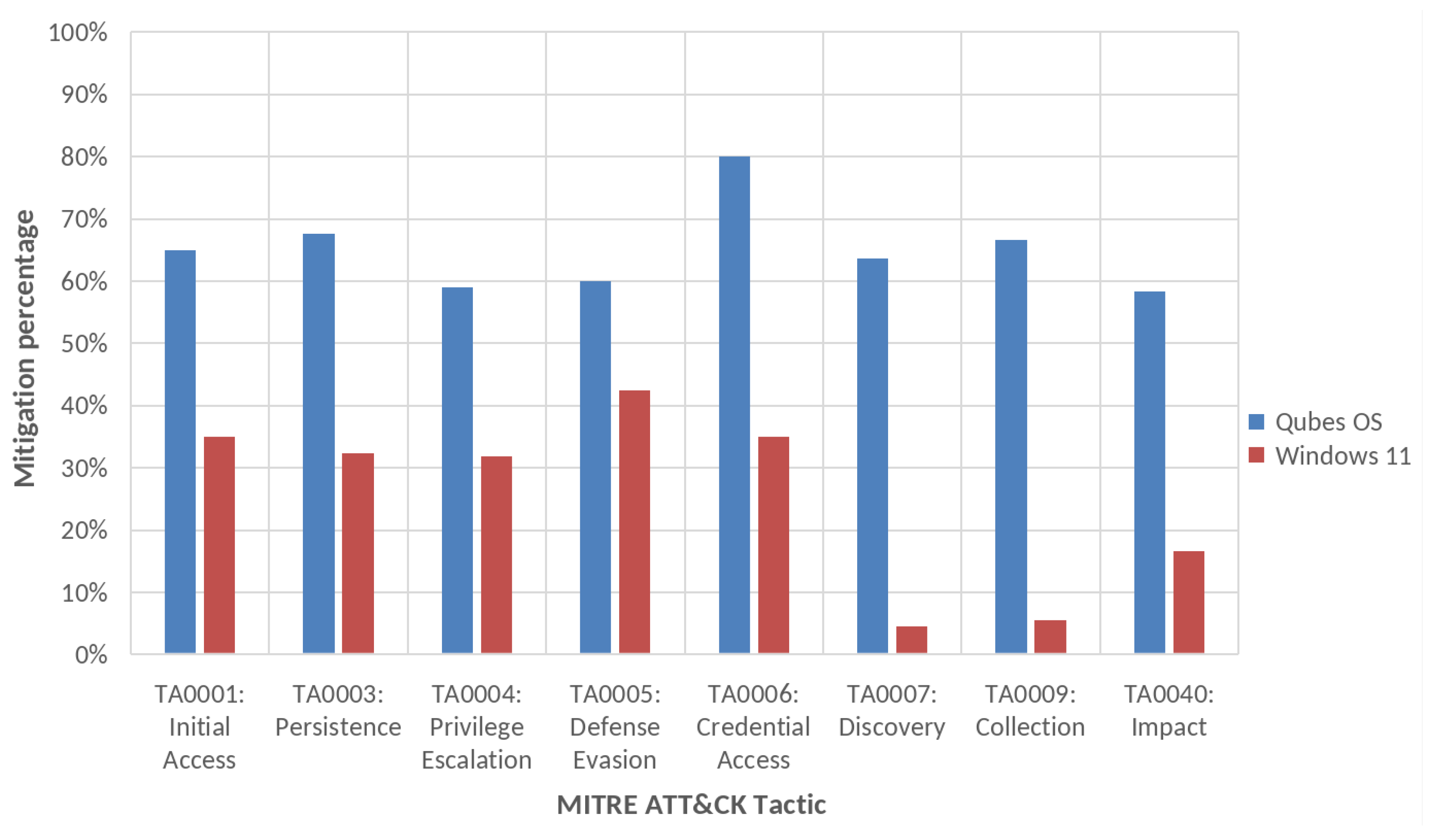
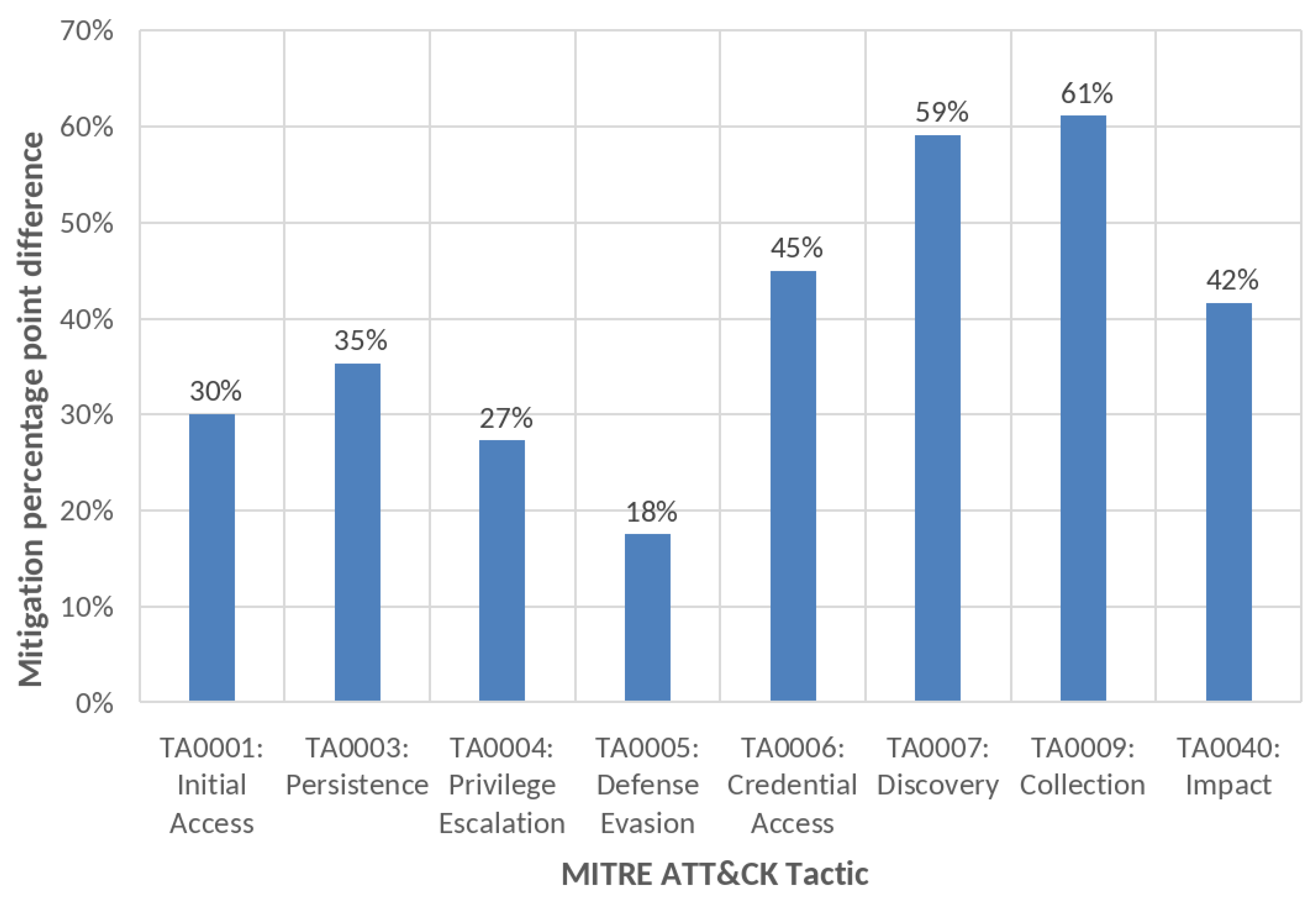
| Perc. | 65.0% | 35.0% | ||||
| TA0003: Persistence | T1098 | Account Manipulation | High | Accounts are not persistent across AppVM reboots | Medium | LSA PPL protects credential storage partially. Microsoft Account modification needs additional credentials |
| T1547 | Boot or Logon Autostart Execution | Medium | Impact localized to single VM. Many vectors closed off by root non-persistence | Low | Abuse of legitimate system feature | |
| T1037 | Boot or Logon Initialization Scripts | Medium | Impact localized to single VM. Many vectors closed off by root non-persistence | Low | Abuse of legitimate system feature | |
| T1554 | Compromise Host Software Binary | Medium | Impact localized to single VM. Many vectors closed off by root non-persistence | Medium | Windows Resource Protection enabled by default | |
| T1136 | Create Account | High | Accounts are not persistent across AppVM reboots | Low | UAC is click-through for most users | |
| T1543 | Create or Modify System Process | Medium | Impact localized to single VM | Medium | SCM permissions protect, requires UAC prompt, PPL can help | |
| T1546 | Event-Triggered Execution | Medium | Impact localized to single VM. Many vectors closed off by root non-persistence. | Low | Abuse of legitimate system feature | |
| T1668 | Exclusive Control | Medium | Patching is done via TemplateVMs exclusively by default | Low | Abuse of legitimate system feature | |
| T1133 | External Remote Services | High | Remote access disabled by default. If enabled, would be contained to one VM | High | Remote access disabled by default | |
| T1574 | Hijack Execution Flow | Medium | Impact localized to single VM | Medium | Certain mechanisms (SDSM, WRP, KnownDLLs) exist, but user applications are easily bypassable. Abuse of legitimate system feature | |
| T1556 | Modify Authentication Process | High | No real authentication process to modify in AppVMs, cannot modify dom0 authentication from within VM | Medium | LSA PPL enabled by default, requires UAC | |
| T1653 | Power Settings | High | Host power settings cannot be controlled from an AppVM | Low | Abuse of legitimate system feature | |
| T1542 | Pre-OS Boot | Medium | AppVM’s pre-boot environment cannot be modified from within an AppVM. No Secure Boot by default | High | Secure Boot by default | |
| T1053 | Scheduled Task/Job | Medium | Impact localized to single VM | Low | Abuse of legitimate system feature | |
| T1176 | Software Extensions | Medium | Impact localized to single VM | Low | Abuse of legitimate system feature | |
| T1205 | Traffic Signaling | High | Ports cannot be opened externally from a non-netVM. NAT traversal out of scope | Medium | Windows Firewall blocks unsolicited inbound traffic by default | |
| T1078 | Valid Accounts | Medium | Impact localized to single VM. Valid user account = valid root account for one VM | Medium | Microsoft Account set up by default. No default local admin credentials | |
| Total | 23/34 | 11/34 | ||||
| Perc. | 67.6% | 32.4% | ||||
| TA0004: Privilege Escalation | T1548 | Abuse Elevation Control Mechanism | Medium | Elevation control deemed irrelevant for VMs | Medium | UAC mostly works, but is click-through and has bypasses |
| T1098 | Account Manipulation | High | Accounts are not persistent across AppVM reboots | Medium | LSA PPL protects credential storage partially. Microsoft Account modification needs additional credentials | |
| T1547 | Boot or Logon Autostart Execution | Medium | Impact localized to single VM. Many vectors closed off by root non-persistence | Low | Abuse of legitimate system feature | |
| T1037 | Boot or Logon Initialization Scripts | Medium | Impact localized to single VM. Many vectors closed off by root non-persistence | Low | Abuse of legitimate system feature | |
| T1543 | Create or Modify System Process | Medium | Impact localized to single VM | Medium | SCM permissions protect, requires UAC prompt, PPL can help | |
| T1546 | Event-Triggered Execution | Medium | Impact localized to single VM. Many vectors closed off by root non-persistence | Low | Abuse of legitimate system feature | |
| T1068 | Exploitation for Privilege Escalation | High | Privilege escalation out of VM unlikely, Xen’s attack surface is significantly smaller than other hypervisors’ | Medium | Multiple protection mechanisms that may be helpful: HVCI, DEP, ASLR, CFG, SEHOP, VBS | |
| T1574 | Hijack Execution Flow | Medium | Impact localized to single VM | Medium | Code Integrity Guard is not enabled by default, DLL-sideloading possible | |
| T1055 | Process Injection | Medium | Impact localized to single VM | Medium | Arbitrary Code Guard is not enabled by default. LSASS and antimalware use PPL | |
| T1053 | Scheduled Task/Job | Medium | Impact localized to single VM | Low | Abuse of legitimate system feature | |
| T1078 | Valid Accounts | Medium | Impact localized to single VM. Valid user account = valid root account for one VM | Medium | Microsoft Account set up by default. No default local admin credentials | |
| Total | 13/22 | 7/22 | ||||
| Perc. | 59.1% | 31.8% | ||||
| TA0005: Defense Evasion | T1548 | Abuse Elevation Control Mechanism | Medium | Elevation control deemed irrelevant for VMs | Medium | UAC mostly works, but is click-through and has bypasses |
| T1006 | Direct Volume Access | High | Virtual block device access irrelevant, otherwise no access to raw volumes | Medium | Possible, though requires UAC | |
| T1211 | Exploitation for Defense Evasion | High | In-VM exploits irrelevant to security model. Xen attack surface significantly smaller than other hypervisors | Medium | Multiple protection mechanisms that may be helpful: HVCI, DEP, ASLR, CFG, SEHOP, VBS | |
| T1222 | File and Directory Permissions Modification | High | Largely irrelevant due to security model | Medium | Possible, though requires UAC | |
| T1564 | Hide Artifacts | Medium | No specific safeguards, but forensic analysis made significantly easier due to VM-based model | Low | No specific safeguards or improvements | |
| T1574 | Hijack Execution Flow | Medium | Impact localized to single VM | Medium | Certain mechanisms (SDSM, WRP, KnownDLLs) exist, but user applications are easily bypassable. Abuse of legitimate system feature | |
| T1562 | Impair Defenses | Medium | Impact localized to single VM | Medium | Antimalware tamper protection, PPL. Admin privileges allow for full disabling of security measures | |
| T1070 | Indicator Removal | Low | No specific safeguards, no logging outside AppVMs | Medium | Certain log clearing operations require UAC | |
| T1202 | Indirect Command Execution | Low | No specific safeguards | Low | No specific safeguards | |
| T1036 | Masquerading | Medium | Window management in dom0 prevents many masquerading attacks | Low | Protections for UAC and loginwindow. Significant anti-pattern: hiding file extensions by default. LNK-based attacks easy and effective | |
| T1556 | Modify Authentication Process | High | No real authentication process to modify in AppVMs, cannot modify dom0 authentication from within VM | High | LSA PPL enabled by default, requires UAC | |
| T1542 | Pre-OS Boot | Medium | AppVM’s pre-boot environment cannot be modified from within an AppVM. No Secure Boot by default | High | Secure Boot by default | |
| T1055 | Process Injection | Medium | Impact localized to single VM | Medium | Arbitrary Code Guard is not enabled by default. LSASS and antimalware use PPL | |
| T1620 | Reflective Code Loading | Medium | No specific safeguards, impact localized to single VM | Low | Powershell’s Assembly.Load() unrestricted | |
| T1014 | Rootkit | Medium | Impact localized to single VM, hypervisor, boot and SMM rootkits not possible from within AppVM. Lack of Secure Boot allows for rootkits embedded via evil-maid attacks | Medium | HVCI should help significantly in combination with Secure Boot. BYOVD attacks still possible | |
| T1553 | Subvert Trust Controls | Medium | Impact localized to single VM | Medium | SmartScreen exists, though warnings are click-through. Smart App Control is enabled by default in some regions and for some configurations | |
| T1221 | Template Injection | Medium | Impact localized to single VM | Medium | Protected View helps, although user interaction for bypass is common and highly impactful | |
| T1205 | Traffic Signaling | High | Ports cannot be opened externally from a non-netVM. NAT traversal out of scope | Medium | Windows Firewall blocks unsolicited inbound traffic by default | |
| T1078 | Valid Accounts | Medium | Impact localized to single VM. Valid user account = valid root account for one VM | Medium | Microsoft Account set up by default. No default local admin credentials | |
| T1497 | Virtualization/ Sandbox Evasion | High | No specific “safeguards”, malware refusing to run in VMs is beneficial | Low | No specific safeguards, malware prefers to run on “bare-metal” | |
| Total | 24/40 | 17/40 | ||||
| Perc. | 60.0% | 42.5% | ||||
| TA0006: Credential Access | T1110 | Brute Force | High | Default LUKS/dm-crypt settings make brute-force attacks infeasibly time-consuming. Same for PAM | High | Account lockout enabled by default. BitLocker is often enabled by default |
| T1555 | Credentials from Password Stores | Medium | Impact localized to single VM. Default Qubes set-up includes dedicated “Vault” VM | Low | Mechanisms exist, but are bypassable in the user context (DPAPI), not enabled (CG) or rarely used (ABE) | |
| T1212 | Exploitation for Credential Access | Medium | App exploits localized to single VM. Xen attack surface significantly smaller than other hypervisors | Medium | Multiple protection mechanisms that may be helpful: HVCI, DEP, ASLR, CFG, SEHOP, VBS | |
| T1056 | Input Capture | Medium | Impact localized to single VM | Low | No specific safeguards or disabled by default (ESS) | |
| T1556 | Modify Authentication Process | High | No real authentication process to modify in AppVMs, cannot modify dom0 authentication from within VM | Medium | LSA PPL enabled by default, requires UAC | |
| T1111 | Multi-Factor Authentication Interception | High | Qubes u2f-proxy mechanism for U2F available, USB isolation by default, separate e-mail/vault qube | Low | Mechanisms exist, but are disabled by default (HfB + TPM, EPP is in audit mode by default) | |
| T1040 | Network Sniffing | High | Non-proxy VMs cannot sniff other VMs’ network traffic | Medium | Capturing traffic requires administrator access. SMB signing does not provide secrecy | |
| T1003 | OS Credential Dumping | High | OS-level credentials specifically do not exist in AppVMs by default | Medium | LSA PPL helps, Credential Guard may help but is not always enabled by default | |
| T1539 | Steal Web Session Cookie | Medium | Impact localized to single VM | Medium | App-Bound Encryption enabled by default for Edge | |
| T1552 | Unsecured Credentials | High | Credentials are stored in isolated Vault VMs assuming correct usage | Low | Mechanisms exist, but are bypassable in the user context (DPAPI), not enabled (CG) or rarely used (ABE) | |
| Total | 16/20 | 7/20 | ||||
| Perc. | 80.0% | 35.0% | ||||
| TA0007: Discovery | T1087 | Account Discovery | Medium | Impact localized to single VM | Low | No specific safeguards |
| T1010 | Application Window Discovery | Medium | Impact localized to single VM | Low | No specific safeguards | |
| T1217 | Browser Information Discovery | Medium | Impact localized to single VM | Low | No specific safeguards | |
| T1652 | Device Driver Discovery | High | Little to no hardware information in VM | Low | No specific safeguards | |
| T1083 | File and Directory Discovery | Medium | Impact localized to single VM | Low | No specific safeguards except permissions. On endpoint desktop systems, the user context is where most files will be accessible | |
| T1680 | Local Storage Discovery | High | Local storage virtualized | Low | No specific safeguards | |
| T1654 | Log Enumeration | Medium | Impact localized to single VM | Medium | Certain logs, like Security, are inaccessible without elevation | |
| T1040 | Network Sniffing | High | Non-proxy VMs cannot sniff other VMs’ network traffic | Medium | Capturing traffic requires administrator access. SMB signing does not provide secrecy | |
| T1201 | Password Policy Discovery | Medium | No local passwords = no useful information in VM. Otherwise no safeguards, but impact localized to single VM | Low | No specific safeguards | |
| T1120 | Peripheral Device Discovery | High | Unless devices are connected specifically to that VM, not possible. USB drives connect via block driver, not USB | Low | No specific safeguards | |
| T1069 | Permission Groups Discovery | High | No useful information in VM | Low | No specific safeguards | |
| T1057 | Process Discovery | Medium | Impact localized to single VM | Low | No specific safeguards | |
| T1018 | Remote System Discovery | Low | No specific safeguards | Low | No specific safeguards | |
| T1518 | Software Discovery | Low | Localized to specific template-derived VMs. Assumed consistent across all VMs | Low | No specific safeguards (users can query HKLM/…/Uninstall and use WMI queries to Win32_Product | |
| T1082 | System Information Discovery | High | No useful information in VM | Low | No specific safeguards | |
| T1614 | System Location Discovery | Medium | No location provider in VMs, timezone/IP location available for networked VMs | Low | Desktop apps using older APIs can bypass permission dialogs without user interaction, timezone/IP location data always available | |
| T1016 | System Network Configuration Discovery | Medium | VMs cannot see network configuration, some enumeration attacks possible through NAT | Low | No specific safeguards | |
| T1049 | System Network Connections Discovery | High | No useful information in VM | Low | No specific safeguards | |
| T1033 | System Owner/User Discovery | High | No owner information in VMs, unless provided externally | Low | No specific safeguards | |
| T1007 | System Service Discovery | Medium | Localized to specific template-derived VMs | Low | No specific safeguards | |
| T1124 | System Time Discovery | Low | System time in sync across machine | Low | No specific safeguards | |
| T1497 | Virtualization/ Sandbox Evasion | High | No specific “safeguards”, malware refusing to run in VMs is beneficial | Low | No specific safeguards, malware prefers to run on “bare-metal” | |
| Total | 28/44 | 2/44 | ||||
| Perc. | 63.6% | 4.5% | ||||
| TA0009: Collection | T1123 | Audio Capture | High | Microphone devices contained within sys-usb or dom0 by default | Low | Desktop apps using older APIs can bypass permission dialogs without user interaction |
| T1185 | Browser Session Hijacking | Medium | Impact localized to single VM | Medium | ABE helps protect Microsoft Edge’s sessions | |
| T1115 | Clipboard Data | Medium | Impact localized to single VM | Low | No specific safeguards | |
| T1005 | Data from Local System | Medium | Impact localized to single VM | Low | No specific safeguards except permissions. On endpoint desktop systems, the user context is where most files will be accessible | |
| T1025 | Data from Removable Media | High | Removable devices contained within sys-usb by default | Low | No specific safeguards | |
| T1114 | Email Collection | Medium | Impact localized to single VM | Low | No specific safeguards except for Edge ABE usage | |
| T1056 | Input Capture | Medium | Impact localized to single VM | Low | No specific safeguards, except for UAC/loginwindow protection | |
| T1113 | Screen Capture | Medium | Impact localized to single VM | Low | Desktop apps using older APIs can bypass permission dialogs without user interaction | |
| T1125 | Video Capture | High | Camera devices contained within sys-usb by default | Low | Desktop apps using older APIs can bypass permission dialogs without user interaction | |
| Total | 12/18 | 1/18 | ||||
| Perc. | 66.7% | 5.6% | ||||
| TA0040: Impact | T1531 | Account Access Removal | Medium | Impact localized to single VM | Medium | UAC required, though click-through. Microsoft Account more difficult to modify, though with wider-ranging consequences |
| T1485 | Data Destruction | Medium | Impact localized to single VM | Low | No specific safeguards, VSS copies absent by default | |
| T1486 | Data Encrypted for Impact | Medium | Impact localized to single VM | Low | No specific safeguards, VSS copies absent by default | |
| T1565 | Data Manipulation | Medium | Impact localized to single VM | Low | No specific safeguards, VSS copies absent by default | |
| T1561 | Disk Wipe | Medium | Impact localized to single VM | Low | No specific safeguards, VSS copies absent by default | |
| T1499 | Endpoint Denial of Service | Medium | Impact localized to single VM | Low | No specific safeguards, apps in user context can easily cause DoS through resource exhaustion | |
| T1495 | Firmware Corruption | High | AppVMs cannot affect firmware without PCI passthrough | Medium | Certain types of corruption (non-destructive) stopped by Secure Boot | |
| T1490 | Inhibit System Recovery | High | AppVMs cannot affect backups (dom0-controlled) | Medium | WinRE/VSS modifications require UAC elevation | |
| T1498 | Network Denial of Service | Medium | Non-proxy AppVMs should not be able to cause DoS for other AppVMs. | Low | Windows is vulnerable to both internal and external Network DoS | |
| T1496 | Resource Hijacking | Medium | Impact localized to single VM | Low | No specific safeguards | |
| T1489 | Service Stop | Medium | Impact localized to single VM | Medium | Stopping most services require UAC elevation | |
| T1529 | System Shutdown/Reboot | Medium | Impact localized to single VM | Low | Users granted SeShutdownPrivilege by default | |
| Total | 14/24 | 4/24 | ||||
| Perc. | 58.3% | 16.7% |
Appendix B. Scoring Process Examples
Appendix B.1. T1542: Pre-OS Boot
Appendix B.2. T1110: Brute Force
Appendix B.3. T1123: Audio Capture
References
- Kapera, A.; Niemiec, M. Dynamic Risk Thresholds for SIEM Alerting Based on Machine Learning. IEEE Access 2025, 13, 121034–121047. [Google Scholar] [CrossRef]
- Kurek, T.; Niemiec, M.; Lason, A. Taking back control of privacy: A novel framework for preserving cloud-based firewall policy confidentiality. Int. J. Inf. Secur. 2015, 15, 235–250. [Google Scholar] [CrossRef][Green Version]
- Maglaras, L.; Kantzavelou, I.; Ferrag, M.A. Digital Transformation and Cybersecurity of Critical Infrastructures. Appl. Sci. 2021, 11, 8357. [Google Scholar] [CrossRef]
- Marusak, P.; Nebeluk, R.; Wojtulewicz, A.; Cabaj, K.; Chaber, P.; Ławryńczuk, M.; Plamowski, S.; Zarzycki, K. Efficient Cyberattack Detection Methods in Industrial Control Systems. Sensors 2024, 24, 3860. [Google Scholar] [CrossRef] [PubMed]
- The MITRE Corporation. Enterprise Matrix v18|MITRE ATT&CK®. 2025. Available online: https://attack.mitre.org/versions/v18/matrices/enterprise/ (accessed on 12 March 2026).
- Cyber, T.; Institute, C. Multi-Source Analysis of Top MITRE ATT&CK Techniques; Technical Report; Cyentia Institute: Leesburg, VA, USA, 2023. [Google Scholar]
- Ahmed, M.; Panda, S.; Xenakis, C.; Panaousis, E. MITRE ATT&CK-driven Cyber Risk Assessment. In Proceedings of the ARES ’22: 17th International Conference on Availability, Reliability and Security, New York, NY, USA, 23–26 August 2022; pp. 1–10. [Google Scholar] [CrossRef]
- Oruc, A.; Amro, A.; Gkioulos, V. Assessing Cyber Risks of an INS Using the MITRE ATT&CK Framework. Sensors 2022, 22, 8745. [Google Scholar] [CrossRef] [PubMed]
- Mohamed, I.; Hefny, H.A.; Darwish, N.R. Enhancing cybersecurity defenses: A multicriteria decision-making approach to MITRE ATT&CK mitigation strategy. Int. J. Comput. Netw. Commun. 2024, 16, 17. [Google Scholar] [CrossRef]
- Sharma, A.; Khilji, N. Imperative Observation of Security in Qubes Operating System and User Anonymity in Digital Epoch. In Proceedings of the 2024 3rd Edition of IEEE Delhi Section Flagship Conference (DELCON), New Delhi, India, 21–23 November 2024; pp. 1–4. [Google Scholar] [CrossRef]
- Issa, A.; Murray, T.; Ernst, G. In search of perfect users: Towards understanding the usability of converged multi-level secure user interfaces. In Proceedings of the 30th Australian Conference on Computer-Human Interaction, Melbourne Australia, 4–7 December 2018; pp. 572–576. [Google Scholar] [CrossRef]
- Lefeuvre, H.; Dautenhahn, N.; Chisnall, D.; Olivier, P. SoK: Software Compartmentalization. In Proceedings of the 2025 IEEE Symposium on Security and Privacy (SP), San Francisco, CA, USA, 12–15 May 2025; pp. 3107–3126. [Google Scholar] [CrossRef]
- Beaumont, M.R. Cross Domain Desktop Compositor. AU AU2016262117B2, 24 June 2021. [Google Scholar]
- Singh, G.K.; Somani, G. Cross-VM Attacks: Attack Taxonomy, Defense Mechanisms, and New Directions. In Versatile Cybersecurity; Conti, M., Somani, G., Poovendran, R., Eds.; Springer International Publishing: Cham, Switzerland, 2018; pp. 257–286. [Google Scholar] [CrossRef]
- Motiee, S.; Hawkey, K.; Beznosov, K. Do Windows Users Follow the Principle of Least Privilege? Investigating User Account Control Practices. In Proceedings of the CHI ’10 Extended Abstracts on Human Factors in Computing Systems, Atlanta, GA, USA, 10–15 April 2010; pp. 4129–4134. [Google Scholar] [CrossRef]
- Escritt, T. Europeans seek ‘digital sovereignty’ as US tech firms embrace Trump. Reuters, 23 June 2025. Available online: https://www.reuters.com/business/media-telecom/europeans-seek-digital-sovereignty-us-tech-firms-embrace-trump-2025-06-21/ (accessed on 12 March 2026).
- Free Software Foundation Europe. Public Money, Public Code. 2025. Available online: https://publiccode.eu/en/ (accessed on 12 March 2026).
- Saunders, M. Danish Ministry Switching from Microsoft Office/365 to LibreOffice. 2025. Available online: https://blog.documentfoundation.org/blog/2025/07/08/danish-ministry-switching-from-microsoft-office-365-to-libreoffice/ (accessed on 12 March 2026).
- Gesellschaft für Informatik e.V. Präsidiumsarbeitskreis “Digitale Souveränität”. 2025. Available online: https://pak-digs.gi.de/ (accessed on 12 March 2026).
- Krempl, S. Goodbye, Microsoft: Schleswig-Holstein relies on Open Source and Saves Millions. Heise Online, 7 December 2025. Available online: https://www.heise.de/en/news/Goodbye-Microsoft-Schleswig-Holstein-relies-on-Open-Source-and-saves-millions-11105459.html (accessed on 12 March 2026).
- Qubes OS Project. Software License. 2025. Available online: https://doc.qubes-os.org/en/latest/developer/code/license.html (accessed on 12 March 2026).
- McMahon, P. When Security Matters: Working with Qubes OS at the Guardian. 2024. Available online: https://theguardian.engineering/blog/info-2024-apr-04-when-security-matters-working-with-qubes-os-at-the-guardian (accessed on 12 March 2026).
- Freedom of the Press Foundation. SecureDrop Workstation. 2025. Available online: https://securedrop.org/ (accessed on 12 March 2026).
- Weck, G. SYS.bd.2.8: Qubes OS Clients. 2022. Available online: https://www.bsi.bund.de/SharedDocs/Downloads/DE/BSI/Grundschutz/Hilfsmittel/Benutzerdefinierte_BS/BS_Clients_unter_Qubes_OS_EN.html?nn=943082 (accessed on 12 March 2026).
- Qubes OS Project. Introduction. 2025. Available online: https://doc.qubes-os.org/en/latest/introduction/intro.html (accessed on 12 March 2026).
- Mansfield-Devine, S. Security through isolation. Comput. Fraud. Secur. 2010, 2010, 8–11. [Google Scholar] [CrossRef]
- Qubes OS Project. Qubes Windows Tools (QWT). 2025. Available online: https://doc.qubes-os.org/en/latest/user/templates/windows/qubes-windows-tools.html (accessed on 12 March 2026).
- MirageOS. Mirage/Qubes-Mirage-Firewall. 2025. Available online: https://github.com/mirage/qubes-mirage-firewall (accessed on 12 March 2026).
- Qubes OS Project. Templates. 2025. Available online: https://doc.qubes-os.org/en/latest/user/templates/templates.html (accessed on 12 March 2026).
- Rutkowska, J. Introducing the Next Generation Qubes Core Stack. 2017. Available online: https://www.qubes-os.org/news/2017/10/03/core3/ (accessed on 12 March 2026).
- Qubes OS Project. How to Use Disposables. 2025. Available online: https://doc.qubes-os.org/en/latest/user/how-to-guides/how-to-use-disposables.html (accessed on 12 March 2026).
- Qubes OS Project. Standalones and HVMs. 2025. Available online: https://doc.qubes-os.org/en/latest/user/advanced-topics/standalones-and-hvms.html (accessed on 12 March 2026).
- Microsoft Corporation. Windows 11 Security Book. 2023. Available online: https://www.microsoft.com/content/dam/microsoft/final/en-us/microsoft-brand/documents/MSFT-Windows11-Security-book_Sept2023.pdf (accessed on 12 March 2026).
- Microsoft Corporation. Credential Guard Overview. 2025. Available online: https://learn.microsoft.com/en-us/windows/security/identity-protection/credential-guard/ (accessed on 12 March 2026).
- Microsoft Corporation. Exploit Protection Reference—Microsoft Defender for Endpoint. 2025. Available online: https://learn.microsoft.com/en-us/defender-endpoint/exploit-protection-reference (accessed on 12 March 2026).
- Afonin, O. Browser Forensics in 2026: App-Bound Encryption and Live Triage. 2026. Available online: https://blog.elcomsoft.com/2026/01/browser-forensics-in-2026-app-bound-encryption-and-live-triage/ (accessed on 12 March 2026).
- Smith, C.; Kanthak, S. Abuse Elevation Control Mechanism: Bypass User Account Control, Sub-Technique T1548.002. 2025. Available online: https://attack.mitre.org/techniques/T1548/002/ (accessed on 12 March 2026).
- Invisible Things Lab. Contributors. Qubes OS: A Reasonably Secure Operating System. 2025. Available online: https://www.qubes-os.org/ (accessed on 12 March 2026).
- Microsoft Corporation. Windows 11. 2025. Available online: https://www.microsoft.com/en-us/windows/windows-11 (accessed on 12 March 2026).
- Qubes OS Project. Endorsements. 2025. Available online: https://www.qubes-os.org/endorsements/ (accessed on 12 March 2026).
- StatCounter. Operating System Market Share Worldwide. 2025. Available online: https://gs.statcounter.com/os-market-share (accessed on 12 March 2026).
- Cybersecurity and Infrastructure Security Agency; United States Secret Service. Conti Ransomware. 2022. Available online: https://www.cisa.gov/news-events/alerts/2021/09/22/conti-ransomware (accessed on 12 March 2026).
- Naeem, D.; BT Security. Conti, Software S0575. 2025. Available online: https://attack.mitre.org/software/S0575/ (accessed on 12 March 2026).
- The MITRE Corporation Contributors. Mitre-Attack/Attack-Navigator. 2025. Available online: https://github.com/mitre-attack/attack-navigator (accessed on 12 March 2026).
- The MITRE Corporation. SolarWinds Compromise, Campaign C0024. 2025. Available online: https://attack.mitre.org/campaigns/C0024/ (accessed on 12 March 2026).
- LinuxBoot Project. About Heads. 2025. Available online: http://osresearch.net/ (accessed on 12 March 2026).
- 3mdeb; Gołaś, F. Dasharo TrustRoot Fusing. 2025. Available online: https://docs.dasharo.com/guides/cpu-fusing/ (accessed on 12 March 2026).
- The MITRE Corporation. Pre-OS Boot, Technique T1542—Enterprise|MITRE ATT&CK®. 2025. Available online: https://attack.mitre.org/techniques/T1542/ (accessed on 25 April 2026).
- Weiss, J. Secure Boot Support. 2025. Available online: https://github.com/QubesOS/qubes-issues/issues/4371 (accessed on 25 April 2026).
- Microsoft Corporation. Windows 11 System Requirements. 2026. Available online: https://support.microsoft.com/en-us/windows/windows-11-system-requirements-86c11283-ea52-4782-9efd-7674389a7ba3 (accessed on 25 April 2026).
- The MITRE Corporation. Brute Force, Technique T1110—Enterprise|MITRE ATT&CK®. 2025. Available online: https://attack.mitre.org/techniques/T1110/ (accessed on 25 April 2026).
- Fruhwirth, C.; Broz, M.; Wagner, A. Cryptsetup(8). 2025. Available online: https://www.man7.org/linux/man-pages/man8/cryptsetup.8.html (accessed on 25 April 2026).
- Mraz, T.; Ward, B. Faillock.conf(5). 2026. Available online: https://man7.org/linux/man-pages/man5/faillock.conf.5.html (accessed on 25 April 2026).
- Listek, A. Default Account Lockout Policies in Windows 11. 2025. Available online: https://specopssoft.com/blog/default-account-lockout-policies-in-windows-11/ (accessed on 25 April 2026).
- The MITRE Corporation. Audio Capture, Technique T1123—Enterprise|MITRE ATT&CK®. 2025. Available online: https://attack.mitre.org/techniques/T1123/ (accessed on 25 April 2026).
- Qubes OS Project. Audio Virtualization. 2025. Available online: https://doc.qubes-os.org/en/latest/developer/system/audio.html (accessed on 25 April 2026).
- Microsoft Corporation. Windows Camera, Microphone, and Privacy. 2026. Available online: https://support.microsoft.com/en-us/windows/windows-camera-microphone-and-privacy-a83257bc-e990-d54a-d212-b5e41beba857 (accessed on 25 April 2026).



| Metric | Qubes OS | Windows 11 |
|---|---|---|
| Total | 143/222 | 56/222 |
| Total (%) | 64% | 25% |
| Min | 58 pp | 5 pp |
| Median | 64 pp | 32 pp |
| Max | 80 pp | 43 pp |
| 65 pp | 25 pp | |
| 7 pp | 14 pp | |
| CV | 10% | 52% |
Disclaimer/Publisher’s Note: The statements, opinions and data contained in all publications are solely those of the individual author(s) and contributor(s) and not of MDPI and/or the editor(s). MDPI and/or the editor(s) disclaim responsibility for any injury to people or property resulting from any ideas, methods, instructions or products referred to in the content. |
© 2026 by the authors. Licensee MDPI, Basel, Switzerland. This article is an open access article distributed under the terms and conditions of the Creative Commons Attribution (CC BY) license.
Share and Cite
Kapera, A.; Niemiec, M. A Methodology for Quantitative Security Evaluation of Operating Systems: Scenario-Based Comparison of Qubes OS and Windows 11. Electronics 2026, 15, 2110. https://doi.org/10.3390/electronics15102110
Kapera A, Niemiec M. A Methodology for Quantitative Security Evaluation of Operating Systems: Scenario-Based Comparison of Qubes OS and Windows 11. Electronics. 2026; 15(10):2110. https://doi.org/10.3390/electronics15102110
Chicago/Turabian StyleKapera, Artur, and Marcin Niemiec. 2026. "A Methodology for Quantitative Security Evaluation of Operating Systems: Scenario-Based Comparison of Qubes OS and Windows 11" Electronics 15, no. 10: 2110. https://doi.org/10.3390/electronics15102110
APA StyleKapera, A., & Niemiec, M. (2026). A Methodology for Quantitative Security Evaluation of Operating Systems: Scenario-Based Comparison of Qubes OS and Windows 11. Electronics, 15(10), 2110. https://doi.org/10.3390/electronics15102110