Article

Fault Section Location for Resonant-Grounded Distribution Networks by DC Attenuation Components of Grounding Wire Currents and Transient Polarity of Zero-Sequence Currents

1
School of Automation Science and Engineering, Xi’an Jiaotong University, Xi’an 710049, China
2
Suqian Power Supply Branch, State Grid Jiangsu Electric Power Co., Ltd., Suqian 223800, China
3
Electric Power Research Institute, State Grid Jiangsu Electric Power Co., Ltd., Nanjing 211103, China
4
Department of Electrical Engineering, North China Electric Power University, Baoding 071003, China
5
Jilin Power Supply Branch, State Grid Jilin Electric Power Co., Ltd., Changchun 130012, China
*
Author to whom correspondence should be addressed.
Electronics 2026, 15(10), 2092; https://doi.org/10.3390/electronics15102092
Submission received: 15 March 2026 / Revised: 29 April 2026 / Accepted: 8 May 2026 / Published: 14 May 2026
(This article belongs to the Special Issue Security Defense Technologies for the New-Type Power System)

Abstract

Fault section location in distribution networks is a key technology for enhancing power supply reliability and fault recovery efficiency. However, the existing fault section location techniques all have certain limitations, such as being affected by fault types and working conditions. Therefore, to achieve fault section location in different fault types for resonant-grounded distribution networks, such as grounding faults and arc faults, this paper proposes a comprehensive method based on DC attenuation components of grounding wire currents and transient polarity of zero-sequence currents. Firstly, by analyzing the cable distribution model, it is found that the DC attenuation components of grounding wire currents in healthy and fault lines are different. The transient polarities of zero-sequence currents of healthy and fault lines are opposite. Based on this, a fault section location method using DC attenuation components is proposed. Meanwhile, to improve the accuracy of the location method, a fault section location method based on transient polarity is also developed. Then, a high-reliability fault section location method is formed by complementing each other through two methods. Finally, 10 kV distribution network fault simulation models are established using PSCAD/EMTDC and RTDS. The experimental results show that the proposed method can accurately locate the fault section under different fault types, fault angles, fault resistances and noise conditions.

1. Introduction

With the development and application of distribution network technology, the safe and reliable operation of the distribution network is of great significance to social production and operation as well as people’s daily life. Among the faults that occur in the distribution network, single-phase grounding faults are the most common. If such faults are not detected in time and located and isolated, they may evolve into more serious faults, leading to large-scale power outages and affecting social production and people’s daily life [1,2]. Compared with ordinary transmission lines, distribution network lines are more complex in distribution. Therefore, when troubleshooting, it is necessary to have a method that can quickly and accurately locate the faulty section, which is of great significance for improving the safety and reliability of distribution network power supply.
The currently commonly used methods for fault section location can be mainly classified into steady-state methods, transient methods and artificial intelligence-based methods [3]. Among them, the steady-state methods mainly rely on the steady-state characteristic signals in the lines for fault section location, which have the advantages of low computational complexity and strong anti-interference ability. Among them, the impedance-based methods mainly locate faults based on the voltage and current measurement values and different factors [4,5]. For example, the method in reference [6] locates the fault section range in a distribution network with multiple buses based on the measured current compression and calculates the fault section based on the node impedance matrix; the method in reference [7] realizes fault section location by deriving the relationship matrix between the fault location and the line current. Different from the impedance method, the signal injection method mainly relies on the transmission characteristics of characteristic signals in the distribution network to extract the measurement of specific frequency injected signals, thereby achieving fault section location [8]. However, the steady-state methods also have disadvantages such as ignoring the transient characteristics of the lines and being sensitive to fault types, which are not applicable to arc faults and high-resistance faults [9]. As mentioned in reference [10], this method not only has high requirements for the sensors of each section of the lines, but also is only applicable to low-resistance faults and is not applicable to high-resistance grounding faults and dynamic changing arc faults.
Compared with the steady-state method, the transient method not only applies to various types of faults but also has the advantages of fast response and strong anti-interference ability. According to the type of transient signal, they can be further divided into two types: the method based on a traveling wave and the method based on a non-traveling wave [11]. Among them, the traveling wave method realizes location by detecting the arrival time, polarity or amplitude characteristics of the traveling wave head. For example, the literature [12] realizes the identification of the fault section of the mixed line based on the amplitude of the initial traveling wave and the line mode. A method is proposed in [13], based on the slope of the waveform of the zero-sequence current after the fault occurs, to realize the location of the fault section. Ref. [14] selects the descending periodic component of the zero-sequence current to realize the location of the fault section for high-impedance grounding faults. However, the traveling wave method also has disadvantages such as synchronous measurement and reliance on high-precision measurement equipment. Therefore, Ref. [15] improves the location accuracy by compensating for the measurement error and does not apply to the situation where the amplitude of the traveling wave is low. Ref. [16] realizes the location of the fault section based on the amplitude, angle, and sequence component of the voltage on the low-voltage side, reducing the demand for synchronous measurement, but this method is only applicable to the distribution networks with a large number of substations and has significant limitations.
Compared with the traveling wave method, the non-traveling wave method mainly locates the fault section based on the transient signal spectrum and other characteristics [17]. For example, Ref. [18] realizes the phase compensation and fault section identification of the thyristor in the line based on the high-frequency component of the fault current. At the same time, to improve the accuracy of fault section location, Ref. [19] combines the transient method with the steady-state method and establishes a fault section location method based on multiple time scales. In [20], a method using the natural discharge of the transmission line current for accurate fault location has been proposed, but it is only applicable to the location of pole-to-ground faults in high-voltage direct current transmission lines.
Furthermore, artificial intelligence is also highly valued as an emerging method for fault location. For instance, as described in [21], a multi-agent system is utilized to estimate multiple fault sections. In [22], fault section identification is achieved by calculating the probability of fault occurrence in each section based on the collected fault information from multiple sources. As mentioned in [23], fault section identification is conducted using a fault identification model based on Petri-net technology. In [24,25], fault sections are identified using fuzzy algorithms. However, fault section location methods based on artificial intelligence require a large amount of high-quality data to ensure the accuracy and reliability of the algorithm, and they also have disadvantages such as poor adaptability and robustness.
To sum up, for different types of faults and fault conditions, this paper proposes a comprehensive fault section location method based on DC attenuation components and transient polarity. The main contributions of this paper are as follows:
(1)
Based on the distributed parameter model of three-core cables, this paper reveals the differential characteristics of DC attenuation components of grounding wire currents between healthy and faulty lines, and establishes a dedicated fault section location method using such DC attenuation features.
(2)
To mitigate potential misjudgments under complex fault conditions, a hybrid fault location scheme is proposed by fusing the grounding wire current DC attenuation-based method with the zero-sequence current transient polarity-based method. A decision-making framework that employs DC attenuation as the primary criterion and transient polarity as a supplementary constraint is designed, and its rationality is theoretically demonstrated.
(3)
The practical feasibility of the proposed method is systematically investigated, including its robustness against measurement noise, parameter uncertainty, and real distribution network environments. Comprehensive simulation validations under various fault scenarios and comparisons with existing methods verify the effectiveness and superiority of the proposed approach.

2. A Comprehensive Section Location Algorithm Based on Attenuation DC and Transient Polarity

2.1. Three-Core Cable Structure for Distribution Network

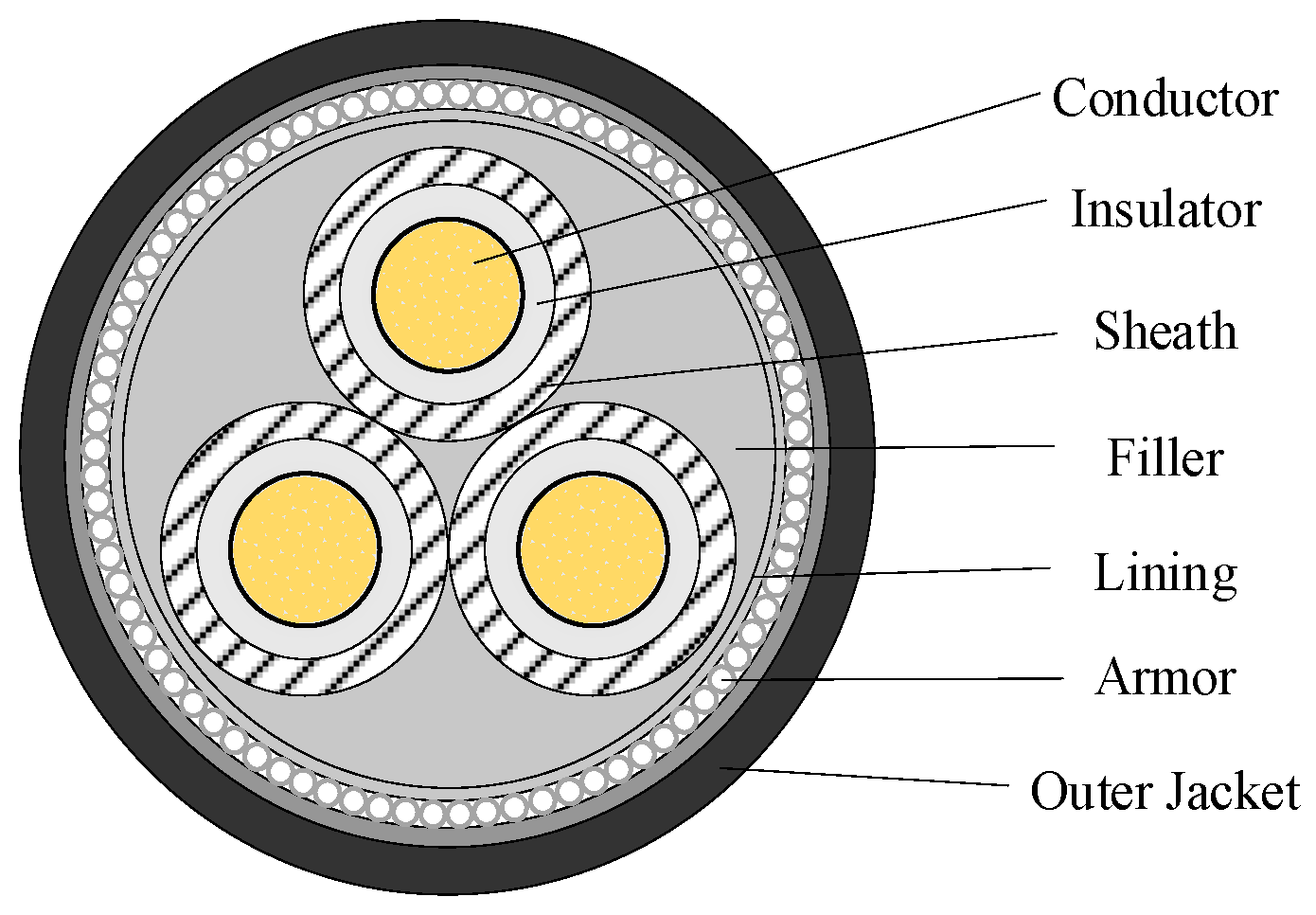
Firstly, the typical three-core cable structure of a distribution network is shown in Figure 1. Its structure mainly consists of the core wire, insulation layer, shielding layer, filler layer, inner liner, armor layer and outer sheath.
For three-core cables, their voltage levels are usually relatively low. The grounding methods include single-ended grounding, double-ended grounding and no grounding. Moreover, for low-voltage and medium-voltage distribution systems, the grounding method of cables is generally selected as single-ended grounding. Thus, the distribution network single-phase grounding faults involved will be studied in accordance with the single-ended grounding method.

2.2. Analysis of the Formation Mechanism of Grounding Wire Current

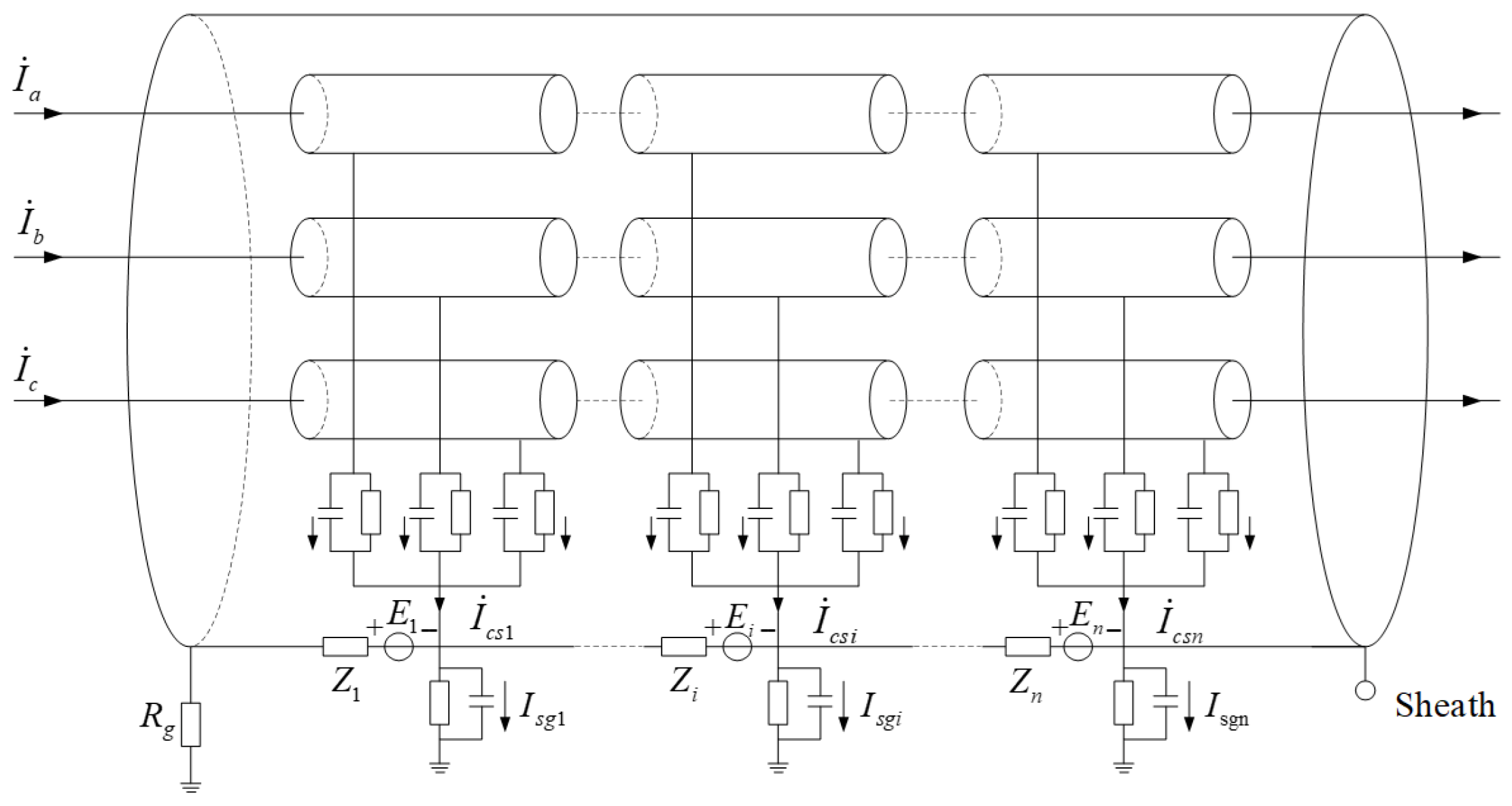
Then, based on the geometric structure characteristics and electromagnetic relationship of the above-mentioned three-core cable, a distributed current model as shown in Figure 2 was established to realize the analysis of the grounding current of the distribution cable.
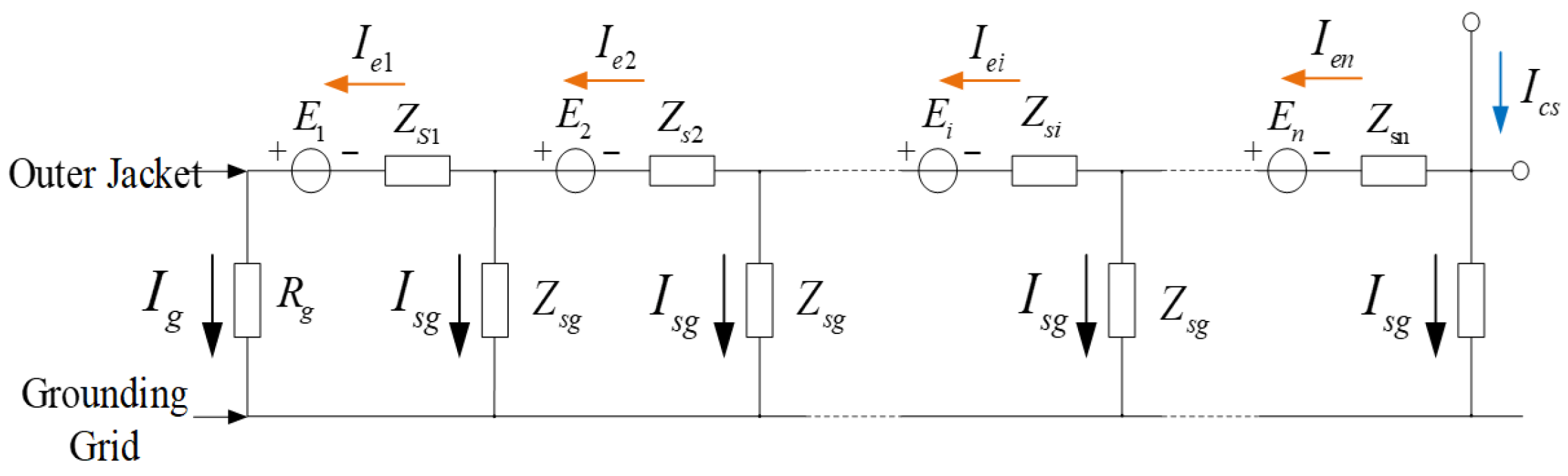
In Figure 2, for the ith small section on the metal sheath, it can be considered that there are two external excitation sources: the leakage current Ics flowing through the insulation and the voltage source Ei induced by the mutual inductance between the core and the sheath. According to the superposition theorem, the two excitation sources act alone on the loop formed between the metal sheath and the earth as shown in Figure 3. In Figure 3, the orange arrow represents the component of the current generated by the induced voltage, while the blue arrow indicates the leakage current between the core and the sheath.
From the analysis in the above figure, it can be concluded that the current Ig measured by the grounding wire current transformer can be divided into the capacitive component Icsm caused by the leakage between the core and the sheath and the induced current component Imm as shown in Equation (1).
I g = I m m + I c s m
I c s m I c s = ( j ω C c s + g c s ) ( U a + U b + U c )                             = Y c s L 3 U 0
I m m = i = 1 n I s g i
I s g i = 3 j ω M c s I 0 Y s g l
where Ycs is the unit admittance between each phase conductor and the metal sheath; Isgi is the distributed current on the sheath of the ith section of the sheath relative to the ground; Mcs is the mutual inductance between each phase conductor and the sheath; Ysg is the distributed admittance between the sheath and the earth; and l is the distance between the ith cable section and the starting end of the line.
Fault current is composed of a direct current (DC) component and alternating current component. For healthy lines, whether it is the current component generated by the induced voltage or the leakage current between the core and the sheath, the current component is mainly capacitive. In the fault line, due to the breakdown of the insulation layer, the fault current flows into the sheath through the transition arc, and the fault current contains both capacitive current and resistive current. The amplitude of the DC component flowing through the faulty line is generally much larger than that in other sections and the amplitude when no fault occurs. This will cause the difference in the DC components of the grounding wires between the healthy line and the non-healthy line, and this difference can be used as a fault feature for locating the fault section.

2.3. Fault Section Location Method Based on the Characteristics of DC Attenuation Components

Firstly, regarding the extraction method of the DC component, this paper employs the Fast Fourier Transform (FFT) method to extract the DC component from the fault. Since the attenuation time of the DC component in a resonant grounding system typically ranges from one cycle to several cycles, and the DC content is relatively high within the first cycle after the fault occurs, the zero-sequence current signal within one power frequency cycle after the fault is subjected to FFT. The DC component extracted from the signal within this one-cycle period after the fault is denoted as A d c i 0 .
The DC component is generated by the discharge of the line capacitance through the fault resistance, and the amplitude attenuation is caused by the ‘R/L’ time constant of the cable sheath grounding circuit, which is exponential. Considering that after a fault occurs, the sections through which the decaying DC component flows are limited, there will always be sections that have not been affected by the decaying DC component. By comparing the amplitude of the DC component in each section with the minimum measured DC component, and by setting a threshold to determine whether the DC component in that section is abnormal, i.e., whether there is a DC component flowing through it, the threshold setting method can be determined through short-circuit experiments to measure the DC component or based on historical fault data. Let the threshold current ratio of the zero-sequence current DC component be Rset. If Equation (5) is satisfied, it indicates that the section has detected the DC component.
R d c i = A d c i i 0 A d c min i 0 R s e t
The thresholds for DC component attenuation can be determined based on the fault experiments or historical data. In the fault experiments, the fault resistance is set between 1 Ω and 1000 Ω and the fault inception angle is set between 0° and 90°. The steady-state, intermittent arc and continuous arc faults are considered. The minimum amplitudes of zero-sequence and grounding wire currents are listed in Table 1.
In the table, IFDC_min represents the minimum value of the DC component in the zero-sequence current of the fault cable. IHDC denotes the maximum value of the DC component in the zero-sequence current of any healthy cable. IFGW_min and IHGW represent the minimum and maximum values of grounding wire currents of the fault cable and any healthy one, respectively. R0DC represents the ratio of IFDC_min to IHDC. RGW denotes the ratio of IFGW_min to IHGW. It can be seen that the minimum values of R0DC and RGW exceed 10. If the value of Rset is set to be excessively large, the sensitivity of the faulty section location method will decrease; conversely, if it is set too small, it may lead to misjudgment of the faulty section. Thus, the threshold for DC component attenuation Rset is set as 10, which is fixed. Moreover, to prevent misjudgment due to small measurement values, a preliminary detection of the amplitude of the DC component is required. If the condition A d c i i 0 ≤ 0.1 A is satisfied, it is considered that the section does not contain a DC component. For the faulty section, the DC components of the grounding wire current and the zero-sequence current satisfy A d c i s = A d c 3 i 0 . Therefore, the DC difference coefficient is defined as follows:
K d c = A d c i s 3 A d c i 0 3 A d c i 0
Within the normal detection range of DC faults, when the condition A d c i i 0 > 0.1 A is satisfied, the ratio of the DC components of the three times zero-sequence current to the grounding wire current approaches a certain degree:
K d c = A d c i s 3 A d c i 0 3 A d c i 0 K s e t
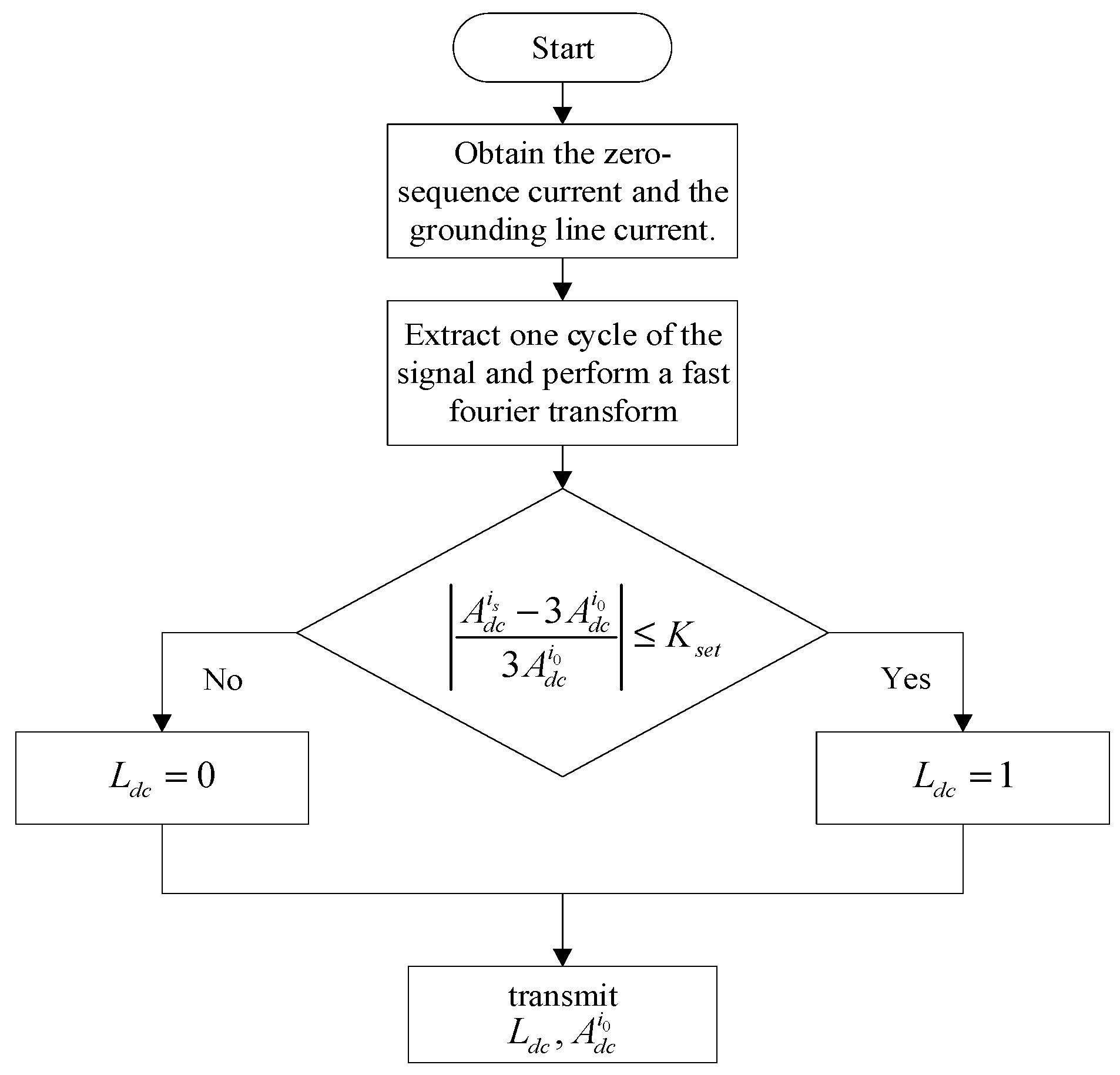
where Kset is the setting value, indicating the degree of similarity between the two fault current signals. The DC component characteristic label is denoted as Ldc. According to the above criteria, the faulty section can be categorized into three types: upstream of the fault section, the fault section itself, and other sections. The calculation process of the DC fault characteristic quantities is shown in Figure 4.
The sensor is triggered by a threshold, which is set according to the zero-sequence current or grounding current value during normal operation. To ensure that the trigger is not mistakenly triggered, the trigger threshold is the value of the zero-sequence current or the ground wire current value during normal operation multiplied by 1.5. A preliminary determination is made on the DC component characteristic Ldc, and the characteristic values Ldc and A d c i 0 are transmitted to the main station for further processing. However, under the resonant grounding mode, relying solely on the amplitude of the grounding wire current or the zero-sequence current for section locating may lead to misjudgment of the faulty section. Therefore, it is more reasonable to adopt a method that refines the fault characteristics and combines multiple features for section locating. Consequently, this paper also proposes a section locating method based on the polarity of characteristic frequency-band currents.

2.4. Signal Polarity Discrimination Method

Firstly, by extracting the waveform data of half a cycle, which consists of N points, we detect whether there is a zero-crossing point m within half a cycle, satisfying the condition i(mi(m + 1) ≤ 0. If no zero-crossing point is detected, then m = N. The polarity characteristic Lp is calculated as follows:
L p = k = 1 m s i g n ( i ( k ) )
As for transient polarity, there is no threshold since the polarities of the signals are obtained by determining the signs of the samples. In Equation (8), sign( ) is the function for determining the sign of the data points:
s i g n ( i ( k ) ) = 1 , i ( k ) > 0 0 , i ( k ) = 0 1 , i ( k ) < 0
Upload the polarity feature to the main station and calculate the difference ΔLp between the polarity features of the upstream and downstream sections:
Δ L p = L p u p L p d o w n
If the difference in polarity features exceeds a certain threshold, it indicates that the section is the faulty section.
Δ L p K r e l T h
where Krel is the reliability coefficient for determining the faulty section, with a value range between 0.5 and 0.8. Similar to Rset, an excessively large value of Krel will reduce the sensitivity of the location method, whereas an excessively small Krel may result in misjudgment of the faulty section. Therefore, the value of Krel should be determined on the basis of multiple sets of fault experiments and historical data [26]. In this paper, Krel is taken as 0.6. Th is the minimum value of the data window length for the upstream and downstream fault waveforms:
T h = min { m 1 , m 2 }
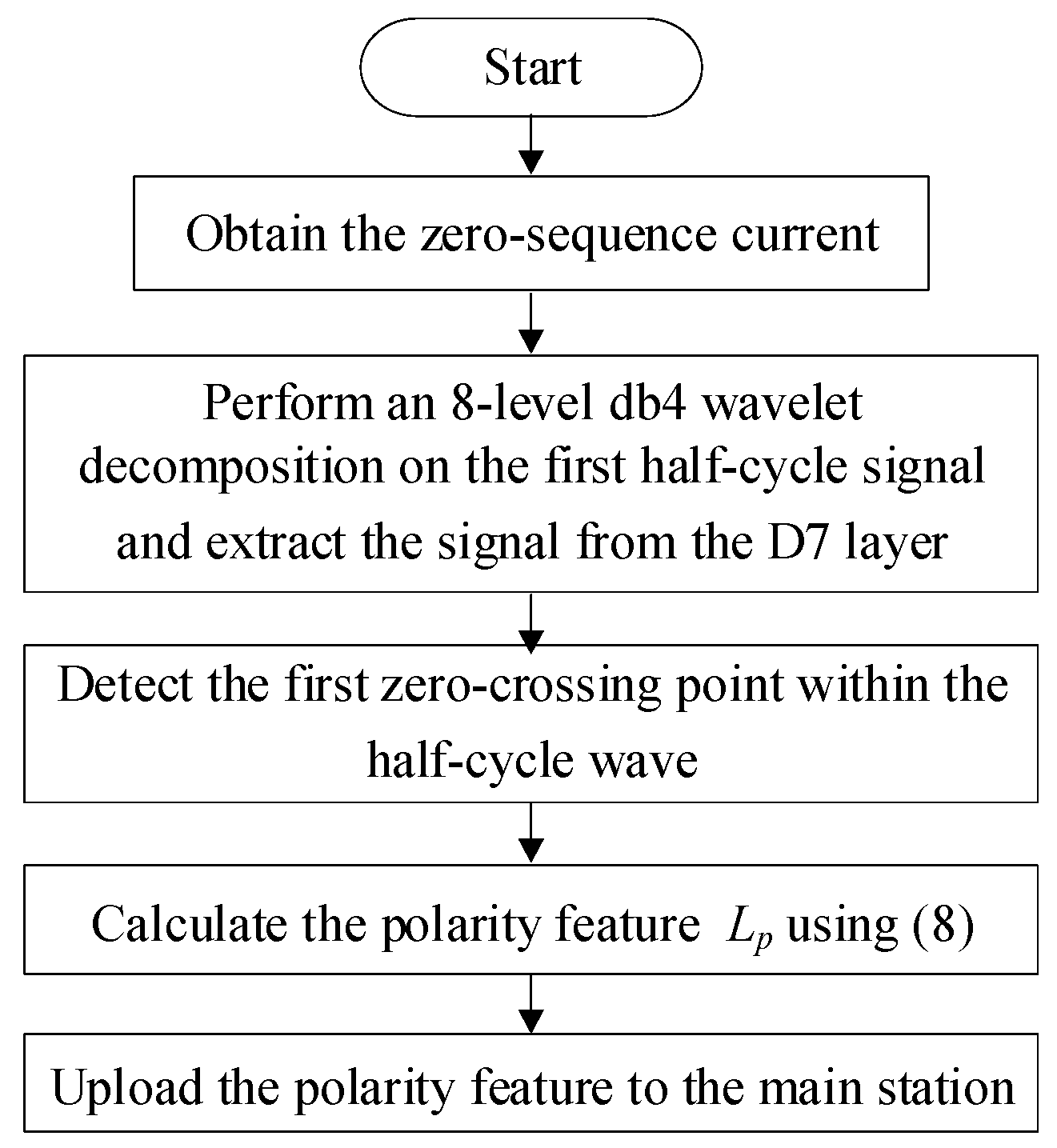
Considering that the DC component in the resonant grounding system may affect the polarity determination, this section will make certain improvements based on the aforementioned methods. Wavelet transform is employed to decompose the fault signal and extract the transient current component for polarity determination. Given the performance of sensors and data transmission units within the general distribution network, the signal sampling frequency is set to 50 kHz, ensuring no significant increase in investment for upgrades. The zero-sequence fault current is decomposed using a 10-level wavelet decomposition with the db4 wavelet. Moreover, appropriate characteristic frequency bands for signal extraction should be selected according to different power systems. The flowchart of the polarity-based identification method is shown in Figure 5.

2.5. Comprehensive Section Location Algorithm Based on Decaying DC and Transient Polarity

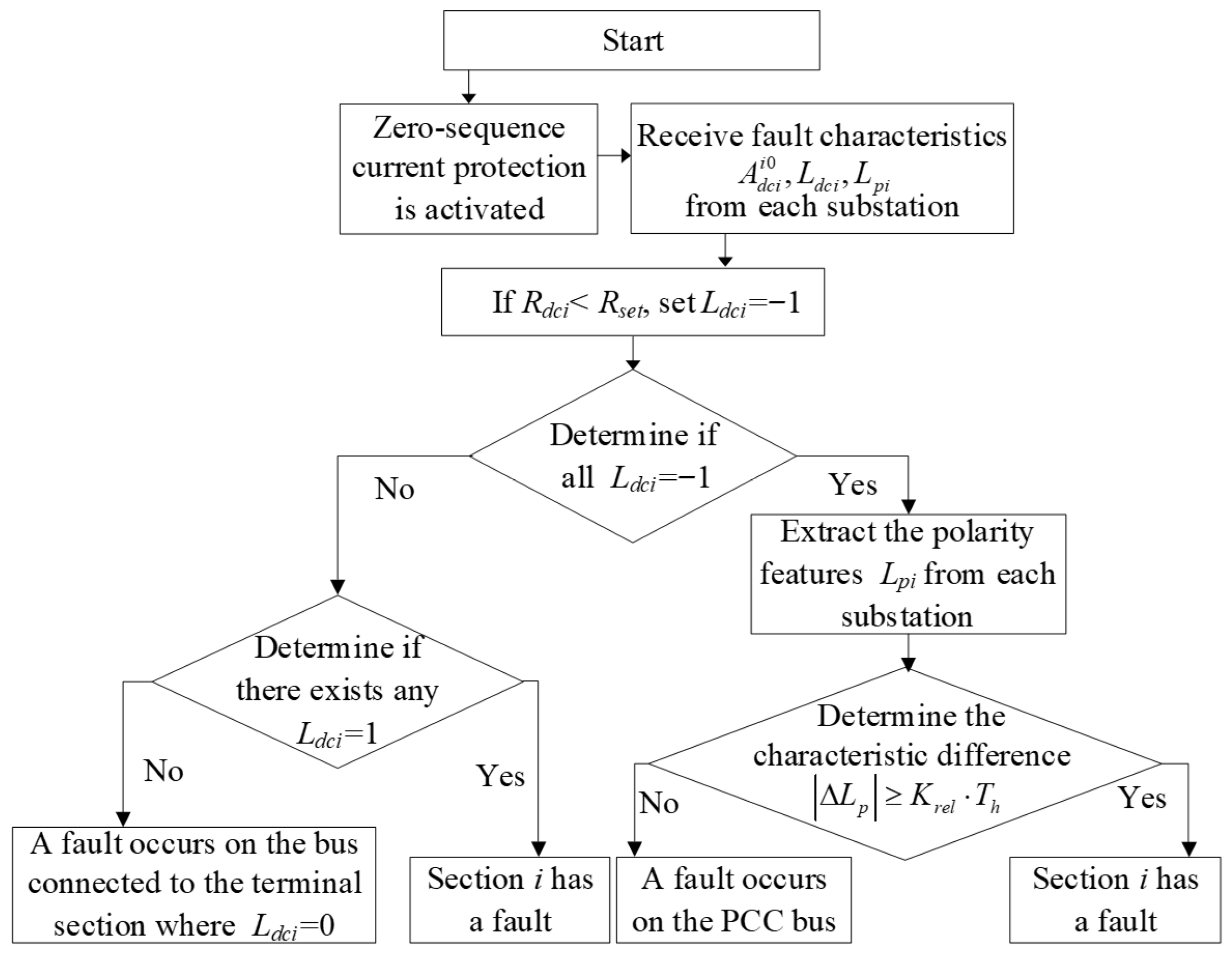
Combining the two fault section location methods, a comprehensive fault section location method is summarized, with the specific steps as follows:
First, the main station receives A d c i 0 , Ldc, and Lp from the sub-stations of each section.
Second, compare the amplitude A d c i 0 from each sub-station with 0.1 A to determine if the DC calculation value is valid. Then, calculate the zero-sequence current DC component ratio Rdc using Equation (5). If all conditions are satisfied, Ldc remains unchanged and proceed to the next steps. If any condition is not met, set Ldc= −1.
Third, detect whether all sections have Ldc = 1. If there is any section where Ldc≠ −1, this is used as the initiation criterion for the decaying DC feature method. Further, check if there are any sections with Ldci = 1. If such sections exist, they are identified as the fault sections. If no sections with Ldci = 1 are found, extract all sections with Ldc = 0, sort them according to the line sequence, and select the last section. At this point, it is determined that the fault has occurred on the branch bus connected to this section.
Fourth, if all Ldc = 1 in the above steps, then switch to the section location algorithm based on polarity. For non-terminal sections, calculate the difference between Lpi and its downstream Lpi+1; for terminal sections’ Lpj, calculate the difference with the polarity of other terminal sections’ Lpk. Use Equation (10) from the above steps to determine whether each section has a fault.
According to the implementation steps of the fault location method shown in Figure 6, it is impossible that both the DC attenuation and polarity indicators produce conflicting results during fault location. The reason is that the DC attenuation and polarity indicators work in sequence during fault location. The DC attenuation indicator is firstly used to locate the fault section. If it does not work, the polarity indicators will be activated to locate the fault. Thus, there is no need to propose mitigation strategies to address this issue.
The proposed method uses the polarity features of the zero-sequence currents of distribution lines. The flowing directions of zero-sequence currents of fault and healthy lines in a radial distribution network are different from those in non-radial or meshed distribution systems. Thus, the proposed approach cannot be directly applied to non-radial or meshed distribution systems where current paths are less distinct. The current research has discussed the direction features of the zero-sequence currents when a fault occurs in non-radial or meshed distribution systems [27]. By using the existing fault location criteria, the fault can be located.
In distribution networks, the cables are commonly short in length. For cable parameters and topology modeling, the lumped-parameter model has lower accuracy when compared with the distributed-parameter one. The lump-parameter model is widely employed in establishing the equivalent circuit of the power distribution cable due to its advantages of simplicity and low costs. Since the accuracy of the proposed fault section location method is only related to signal processing (DC attenuation components and signal polarity extraction), the accuracy of fault section location does not rely much on the modeling of cable parameters and topology. For different cable parameters and radial topologies, the accuracies of fault section location are almost unchanged.
The computations of the proposed algorithm include fault feature (polarity and DC component characteristics) extraction and implementation of the fault section criteria. Since these computations are all algebraic or comparative operations rather than circulative searching operations, the computational requirement for the proposed algorithm is low. The total computational time for implementing the algorithm is only about 60 ms based on a computer whose processor is Core i3 1120G4@3.5GHz. For a real-time protection system, the computational time ranges between 10 ms and 120 ms depending on the hardware conditions. It is worth noting that the proposed algorithm does not provide a protection method for power distribution networks. Instead, it only works after the real-time protection system is activated. Thus, the computational requirement for the algorithm, especially the computational time, can meet the timing constraints of real-time protection systems.

2.6. The Rationale Underlying the Superiority of the Proposed Method over the Aforementioned Single Fault Section Location Methods

The fault section location method based on DC attenuation components realizes fault section identification by utilizing the DC attenuation component in resistive current. This method performs satisfactorily for fixed-value resistance grounding faults, continuous arc faults, and intermittent arc faults. Nevertheless, it is not applicable under conditions with a large fault inception angle. Meanwhile, the fault section location method based on transient polarity determines the fault section according to the polarity of zero-sequence current transient signals of adjacent lines. This method also achieves favorable performance in identifying various fault types. However, since it involves algorithmic processing of signal polarity, it suffers from the drawback of relatively long time consumption for fault location.
In this paper, the DC attenuation components of grounding wire currents in faulty and healthy sections were obtained by varying the fault inception angle, with the results presented in Table 2. It can be observed from the comparison that under large fault inception angles, such as 90°, the DC attenuation components are relatively small in both the faulty and non-faulty sections, making it difficult to distinguish the fault section using only the DC attenuation component. Meanwhile, for the same fixed-resistance grounding fault, the fault section location method based on the DC attenuation component takes 35 ms, whereas the method based on transient polarity takes 78 ms. Compared with the DC attenuation components-based method, the transient polarity-based method requires FTUs to upload signal waveforms and conduct additional algorithmic processing, which may result in slower fault section location.
Therefore, this paper integrates the two methods. In most fault scenarios, the DC attenuation components-based fault section location method only needs to perform FFT processing on the first cycle signal, ensuring rapid fault section location. Meanwhile, the transient polarity-based method is adopted as a supplementary criterion, thereby extending the application scope of the overall fault section location scheme.

2.7. Practical Implementation Considerations

2.7.1. Considerations for Measurement Noise

In practical distribution networks, the acquired raw current signals are inevitably contaminated by environmental and instrumental noise. Such background interference can potentially obscure the weak transient fault characteristics, particularly the DC attenuation components. Therefore, evaluating the sensitivity of the proposed method to noise interference is a critical prerequisite for its practical implementation. As comprehensively analyzed in the subsequent Section 3.6, the proposed method exhibits robust to typical noise levels. Specifically, under varying noise intensities with signal-to-noise ratios (SNRs) ranging from 10 dB to 40 dB, the algorithm consistently maintains a high location accuracy of over 95%.
Furthermore, in extreme industrial environments where the noise intensity is exceptionally high, the reliability of the feature extraction can be further safeguarded through systematic signal pre-processing. Given that modern signal filtering techniques are well-developed, various digital filtering methods (such as standard low-pass digital filters) can be readily deployed in intelligent distribution terminals, so such methods can be used to process the raw signals. However, it must be explicitly pointed out that the application of these filters requires a balance. The cutoff frequency must be tuned to effectively eliminate high-frequency wideband noise without inadvertently suppressing the critical DC attenuation components and the initial transient polarity. By applying such filtering treatments to process the raw signals prior to executing the Fast Fourier Transform (FFT) and wavelet decomposition, the detrimental effects of electromagnetic interference can be effectively mitigated, ensuring the stable operation of the proposed location method.

2.7.2. Considerations for Parameter Uncertainty

In practical distribution networks, exact cable impedance parameters are rarely constant; they fluctuate due to manufacturing tolerances, environmental temperature variations, and long-term insulation aging. Consequently, a critical implementation consideration is ensuring that the fault location method remains valid across the entire potential range of parameter deviations. When deploying the proposed method, it is necessary to evaluate the effectiveness of the proposed method with different cable parameters (e.g., the deviation analyzed in Section 3.7). Because this algorithm fundamentally relies on transient signal features—DC attenuation and transient polarity—rather than explicit distributed parameter equations, the implementation strategy shifts from precise physical parameter matching to robust signal feature bounding.
Although the proposed method is not significantly affected by parameter uncertainty in principle, a rigorous engineering implementation still requires a systematic strategy to explicitly account for potential parameter deviations. Considering the inevitable uncertainty of field parameters, the operational thresholds for the comparison logic can be calibrated via rigorous boundary condition simulations during the initial commissioning stage. Specifically, by simulating the worst-case parameter corner scenarios (e.g., maximum cable aging combined with extreme operating temperatures), engineers can establish static decision thresholds equipped with adequate safety margins. Consequently, the system can reliably distinguish between faulted and healthy sections using these pre-calibrated boundaries without requiring complex, real-time parameter online-updating algorithms.

2.7.3. Applicability to Complex Network Topologies

The proposed method uses the polarity features of the zero-sequence currents of distribution lines. The flowing directions of zero-sequence currents of fault and healthy lines in a radial distribution network are different from those in non-radial or meshed distribution systems. Thus, the proposed approach cannot be directly applied to non-radial or meshed distribution systems where current paths are less distinct.
To adapt the proposed method for meshed systems, the reliably extracted transient features can be integrated with the superposition-based fault analysis theory for closed-loop networks. As systematically investigated in [27], when a single-phase-to-ground fault occurs in a loop network, the closed-loop system currents can be analytically decomposed into grounded (predominantly zero-sequence) and ungrounded (positive and negative sequence) components utilizing the superposition principle. Building upon this theoretical framework, the transient polarities extracted by the proposed algorithm can be utilized to determine the flow directions of the zero-sequence currents at various monitoring nodes. By subsequently analyzing the specific changes in these zero-sequence current directions across the loop network, according to the criteria established in [27], the faulted section within a complex meshed topology can be effectively located.

2.7.4. Considerations for Real-Time Implementation

Real-time implementation of the proposed method in practical distribution networks requires consideration of the capabilities for data acquisition, the efficiency of data transmission within the communication network, and the computational latency required to process fault features and make localization decisions.
Regarding real-time data sampling, accurately capturing the high-frequency transient characteristics of zero-sequence and grounding wire currents necessitates an appropriate sampling frequency. For the proposed method, a sampling rate of 50 kHz is highly recommended to accurately extract the DC attenuation components and transient polarity features. Consequently, when implementing this method, utilities should prioritize the deployment of advanced feeder terminal units (FTUs) or phasor measurement units (PMUs) capable of higher sampling capacities. However, practical engineering implementation must also account for the existing measurement infrastructure, which often includes legacy devices with significantly lower sampling rates. To address this, the performance of the proposed method under restricted hardware conditions is explicitly validated in Section 3.5. The results demonstrate that the proposed algorithm exhibits adaptability, maintaining high fault section location accuracy even under lower sampling rates.
In terms of data communication, transmitting high-frequency raw current waveforms from various measurement nodes to a centralized master station can impose significant bandwidth pressure and transmission delays. To address this, a “local feature extraction and global comparison” architecture should be adopted during implementation. Local terminals only need to process the raw data and upload lightweight feature variables, such as the polarity state and DC amplitude indicators. This strategy significantly minimizes the data payload, allowing standard fiber-optic or 5G distribution communication networks to achieve millisecond-level transmission latency.
Finally, the computational efficiency of the algorithm must be evaluated to satisfy the timing constraints of distribution management systems. The core computations of the proposed algorithm involve fundamental signal processing techniques, such as the Fast Fourier Transform and wavelet decomposition, alongside algebraic comparative operations, rather than computationally heavy iterative searching. Based on a standard processor, the total computational time for executing the algorithm is approximately 60 ms. Since this method functions as a fault section location tool following the activation of the primary protection system, this sub-second execution time demonstrates that the computational requirements are well within the acceptable limits for real-time fault isolation and service restoration.

2.7.5. Impact of Distributed Energy Resources (DERs) on the Proposed Method

According to current research, DERs do affect the amplitude and direction characteristics of fault currents when short-circuit faults occur in distribution networks. The winding configuration of DER grid-connected transformers is a delta-star connection with the star side ungrounded [17]. When a single-phase-to-ground fault occurs in a distribution network with DERs, zero-sequence currents are blocked at the delta side of the grid-connected transformers and have no flow path [11]. Therefore, DERs exert negligible influence on the zero-sequence current in the line. In addition, the high-frequency harmonic components generated by DER inverters only affect the high-frequency harmonics in the line, but not the DC attenuation component. Thus, the DC attenuation and polarity-based criteria proposed in this paper, which are only applicable to single-phase-to-ground faults, remain valid.

3. Simulation Verification

3.1. Establishment of the Cable Arc Model

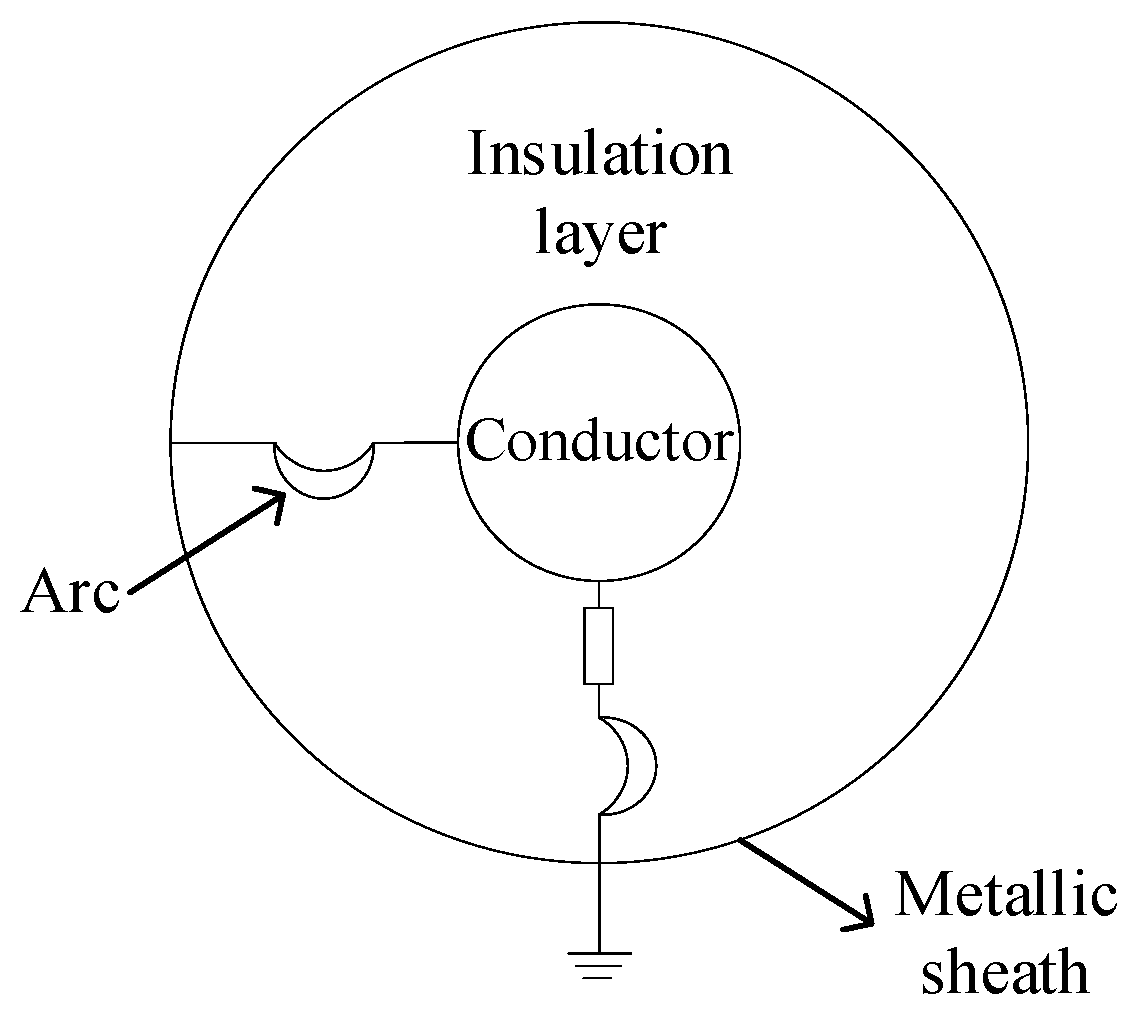
For the equivalent electrical model of arc discharge in a dielectric medium, a variable resistor is commonly used to represent it, with its resistance value exhibiting a regular alternation between high and low resistance states. During one cycle, when the arc resistance reaches its minimum value, considering that the transition resistance will not be exactly zero, the fault resistance between the cable core and the shielding layer is represented as a series combination of a fixed resistance and a variable arc resistance to characterize the resistance variation during a fault. This paper employs the Mayr arc model, which is suitable for low-current grounding systems, to simulate arc faults. As shown in Figure 7, the Mayr arc model is established as the model for the transition resistance arc part between the core and the sheath, and the fault transition resistance in the cable is equivalently represented as a series combination of a fixed resistance and an arc resistance.

3.2. Establishment of the Fault Model

After determining the arc model, a distribution network model is established. A three-core cable model for the distribution network is built in the PSCAD/EMTDC software (version 4.6.2). The geometric dimensions and electrical parameters of the three-core cable are set accordingly. In this paper, the specific dimensions and parameters of the three-core armored cable (type: MYJV22-8.7/10-3 × 240 mm2) used in this paper are shown in Table 3.
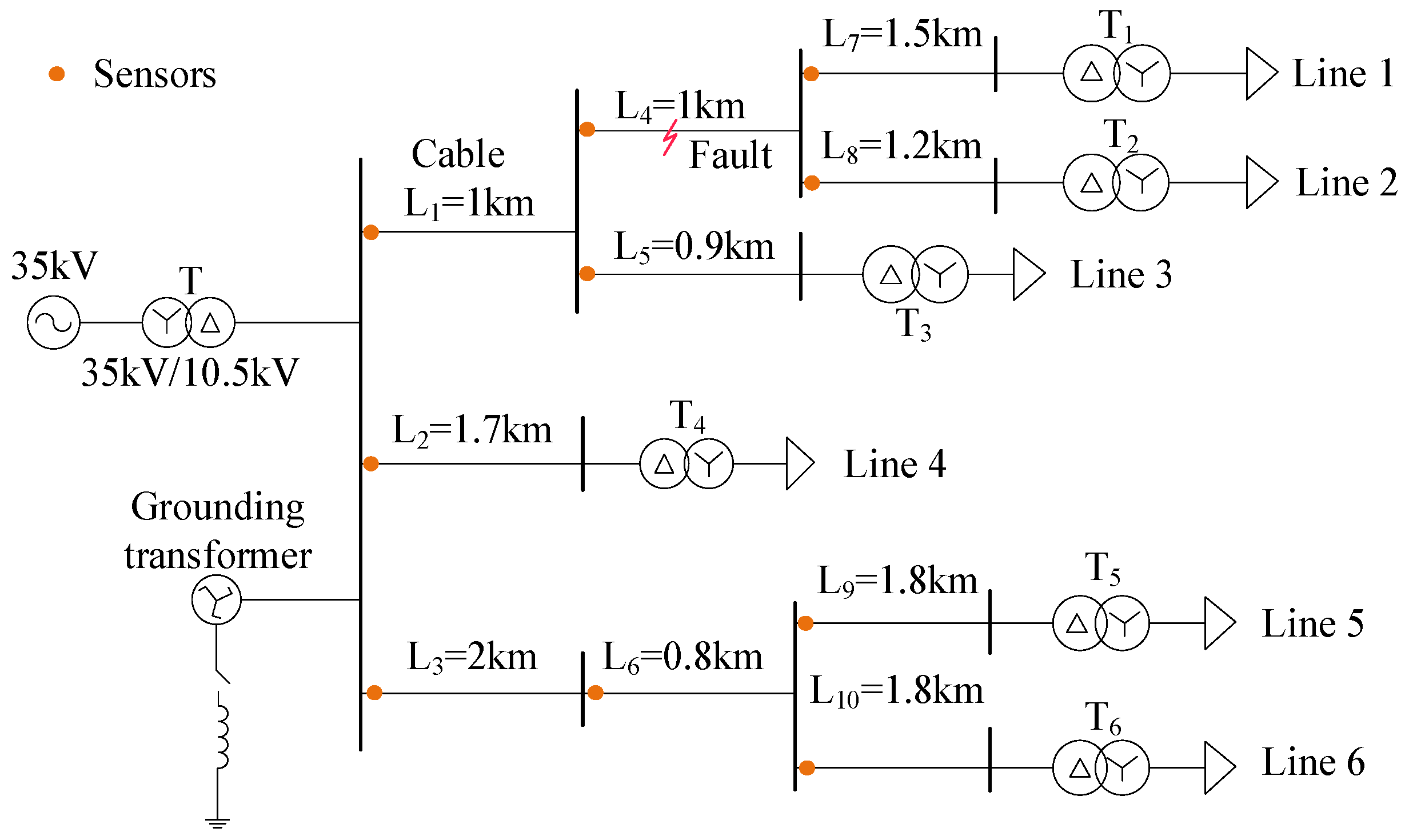
The distribution network model built based on the corresponding material parameters is shown in Figure 8. The supply voltage is set at 35 kV, the arc suppression coil inductance is 0.3886 H, and the line lengths are set as follows: L1 = 1 km, L2 = 1.7 km, L3 = 2 km, L4 = 1 km, L5 = 0.9 km, L6 = 0.8 km, L7 = 1.5 km, L8 = 1.2 km, L9 = 1.8 km, and L10 = 1.8 km. The fault section upstream is selected as L1, the fault section as L4, the fault section downstream as L7, and the healthy section for reference as L10. The load is set at 0.68 MW and 0.082 MVAR. The orange dots indicate the sensor position.

3.3. Experimental Verification

Firstly, the parameters in the algorithmic steps were configured as follows: the threshold values were set to Rset = 10 Ω and Kset = 0.4, with Lpi/Lpj defined as the comparative polarity ratio. Following the procedures outlined in Section 2.4, Section 1 was configured to compare Lp1/Lp4, Section 4 utilized Lp4/Lp7, and Section 3.7 and Section 3.10 were cross-referenced as mutual control groups. The experimental fault types were sequentially simulated and validated under the following configurations.

3.3.1. Constant Resistance Grounding Fault

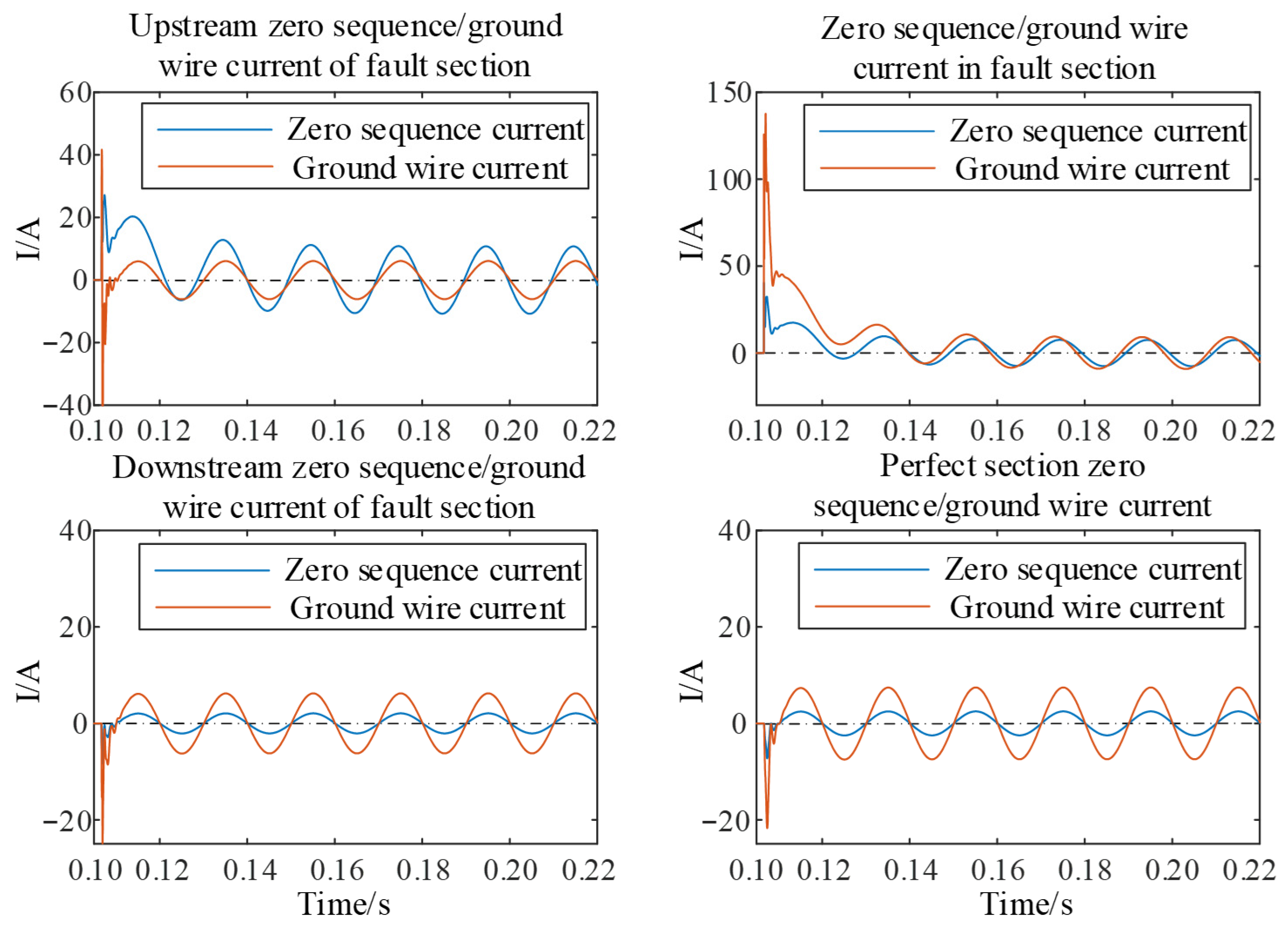
Firstly, the fault resistance is set as 10 Ω, and the fault angle is selected as 30° for simulation experiment. The time domain waveforms of ground wire current and zero-sequence current are shown in Figure 9. The dotted–dashed lines in the figure represent the zero reference for the currents, serving as a baseline for comparison with the measured zero-sequence and ground wire currents.
As evident from the figure, following the fault occurrence, the zero-sequence current in the upstream fault section contains a significant decaying DC component. Due to the normal insulation resistance between the cable core and sheath, the grounding wire current at this stage comprises only capacitive components, which block the DC content. In contrast, both the zero-sequence and grounding wire currents in the fault-affected section exhibit decaying DC components and transient current characteristics. The downstream line of the fault section shows no discernible DC component, and similarly, other healthy sections in the network also lack notable DC components. Under these conditions, the DC characteristic-based algorithm effectively achieves fault section localization. The localization results, summarized in Table 4, align precisely with the configured fault scenarios.
Then, set the fault resistance as 100 Ω and 1000 Ω, respectively, and select the fault angle as 30° and then carry out the experiment in turn. The experimental results are shown in Table 5. When the fault angle is 30° and the transition resistance is low, such as 10 Ω or 100 Ω, the fault location method based on the DC attenuation component has a good effect. However, when the transition resistance is large, such as 1000 Ω, the DC feature algorithm alone cannot accurately locate the fault section, so it is necessary to use the polarity feature method as a candidate. The location results are shown in Table 6. It can be seen that the section location based on the polarity feature method is more accurate under high transition resistance, and it also shows that the integrated section location algorithm based on decaying DC and transient polarity can effectively deal with the fixed resistance grounding fault under different fault resistance.

3.3.2. Continuity and Intermittent Arc Fault

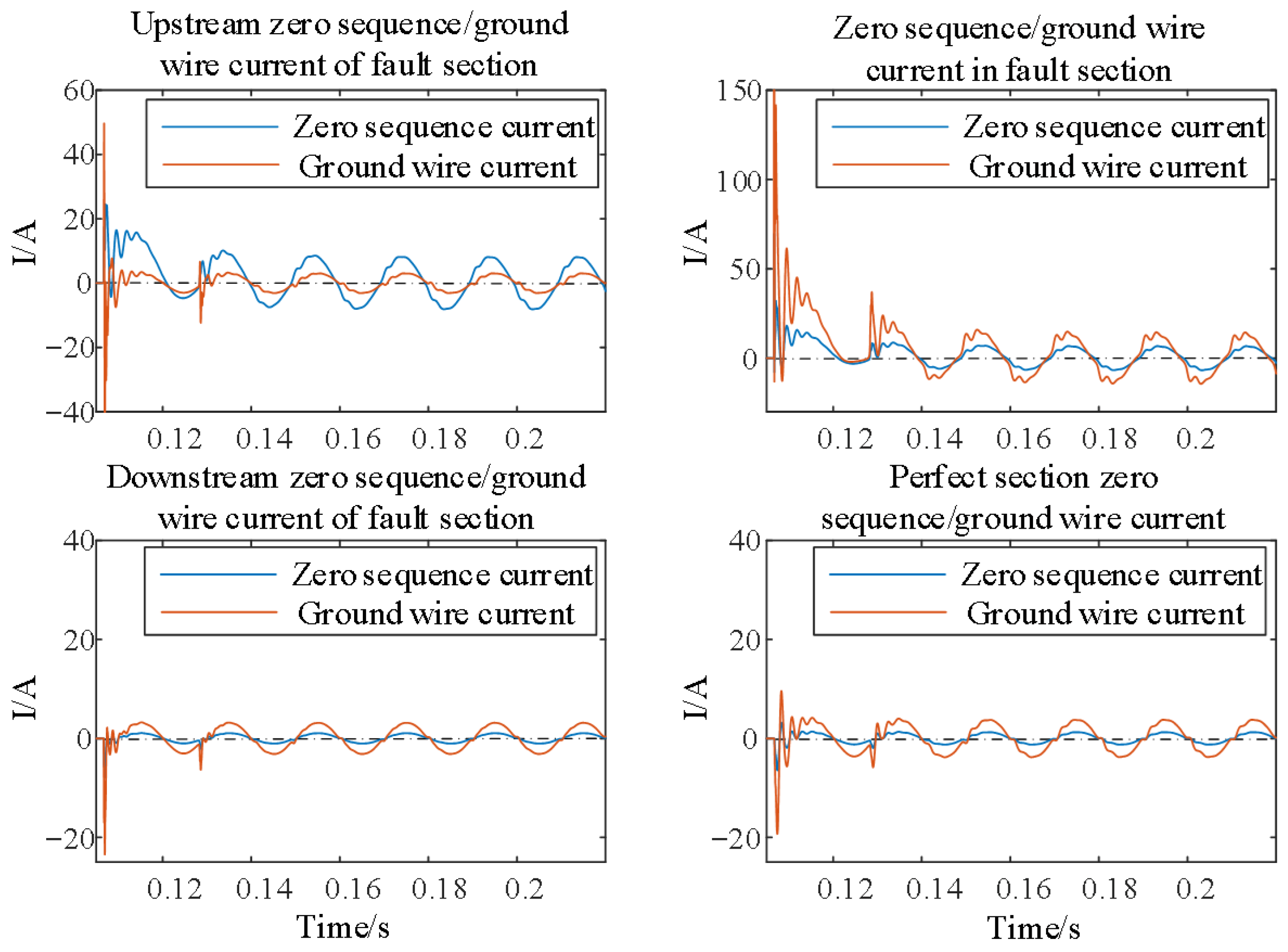
A continuous arc fault is set at the same fault location, in which the fault angle is set to 30° at the same time and the simulation experiment is carried out. The maximum resistance of the arc resistance is 65 Ω. The time domain waveforms of the ground wire current and zero-sequence current are shown in Figure 10.
From the time domain, the distribution law of the decaying DC component in the upstream and downstream sections of the fault is similar to that when the fixed resistance value is grounded, so the arc fault is also applicable to the section location method based on decaying DC characteristics, and the location results are shown in Table 7.
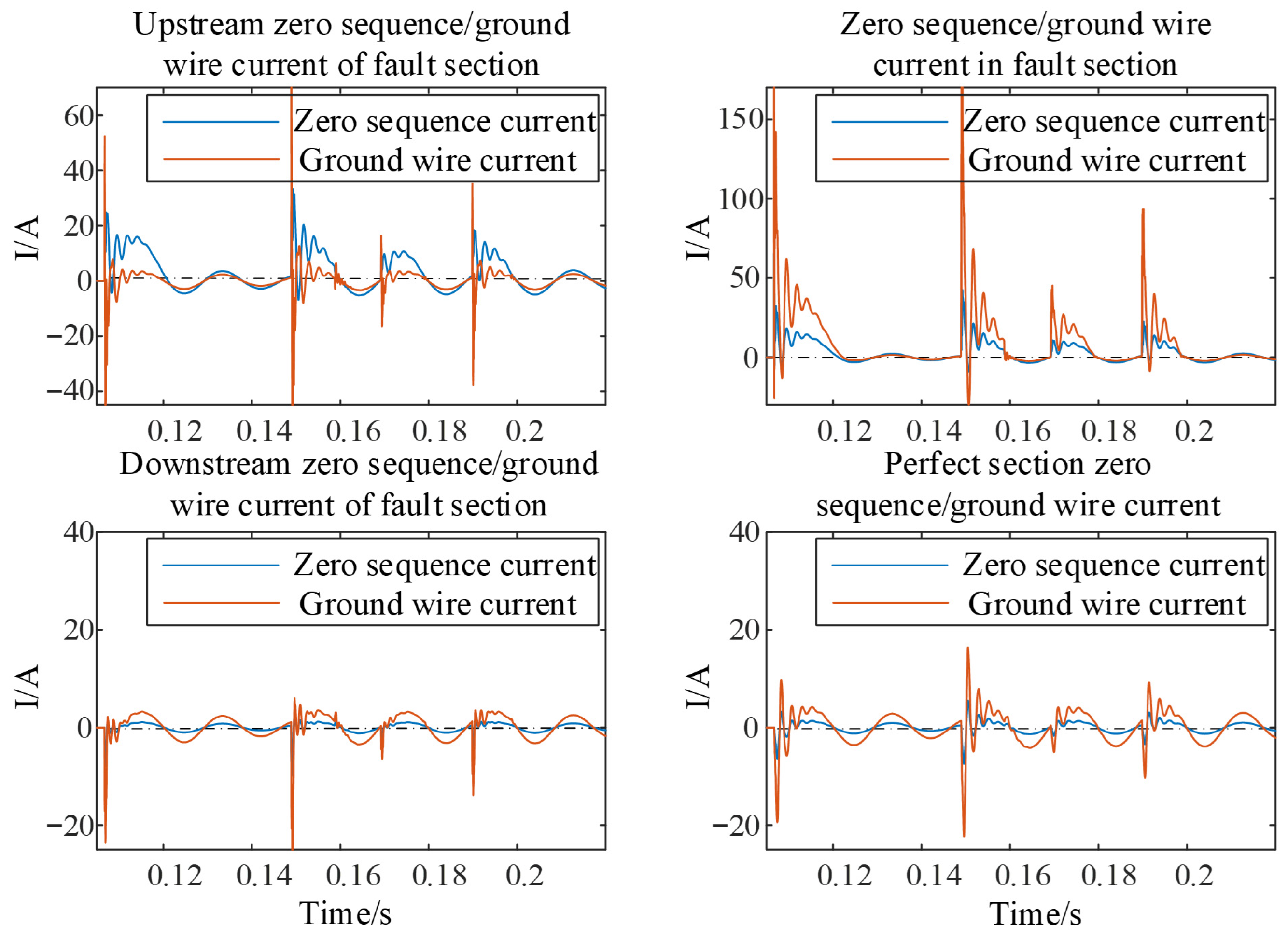
Then, the fault type is changed to intermittent arc fault. As shown in Figure 11, the ground wire of the intermittent arc is compared with the zero-sequence current signal. It can be seen that the intermittent arc process is still equivalent to a transient process after each arc, and the attenuated DC component will be generated at this time. Therefore, the current characteristics based on the DC attenuation characteristics are still applicable when the intermittent arc occurs. The location results are shown in Table 8.
When the fault angle is 30°, because the transient process is not obvious, and because of the fixed resistance grounding fault with low transition resistance and the continuous and intermittent arc fault, the DC attenuation component has a good effect on fault section location, and only the fixed resistance grounding fault with high transition resistance needs to be located based on the transient polarity. Different fault angles may have some influence on the location results of DC attenuation sub-fault section, so the influence of fault angle on the section location results is studied below.

3.4. Study on the Influence of Fault Angle on Section Location Results

With the fault location unchanged, the selection range of the fault angle is changed to 30°, 45°, 60°, and 90°, and simulation experiments are carried out for constant resistance grounding fault, continuous arc fault and intermittent arc fault, and the fault section is located.

3.4.1. Fixed Resistance Grounding Fault Under Different Fault Angles

The fault resistance is set to 10 Ω, and the fault angle selection range is set to 30°, 45°, 60°, and 90°, respectively. Firstly, the method based on the DC attenuation component is used to locate the fault section. The experimental results are shown in Figure 12.
It can be seen that when the fault angle is 30°, 45° and 60°, the fault section location method based on DC attenuation has a better effect. However, when the fault angle is too large, such as 90°, the fault section and non-fault section cannot be distinguished by this method, which shows that the fault angle will affect the fault section location results based on DC attenuation. At this time, the fault section location method based on transient polarity needs to be used as a complementary method to locate the fault section. The location results are shown in Table 9.
When the fault angle is 90°, this method can effectively locate the fault section. It also further explains that the comprehensive method obtained by the fusion of the two methods can effectively deal with the constant resistance grounding fault under different fault angles and realize the fault section location.

3.4.2. Continuous and Intermittent Arc Faults Under Different Fault Angles

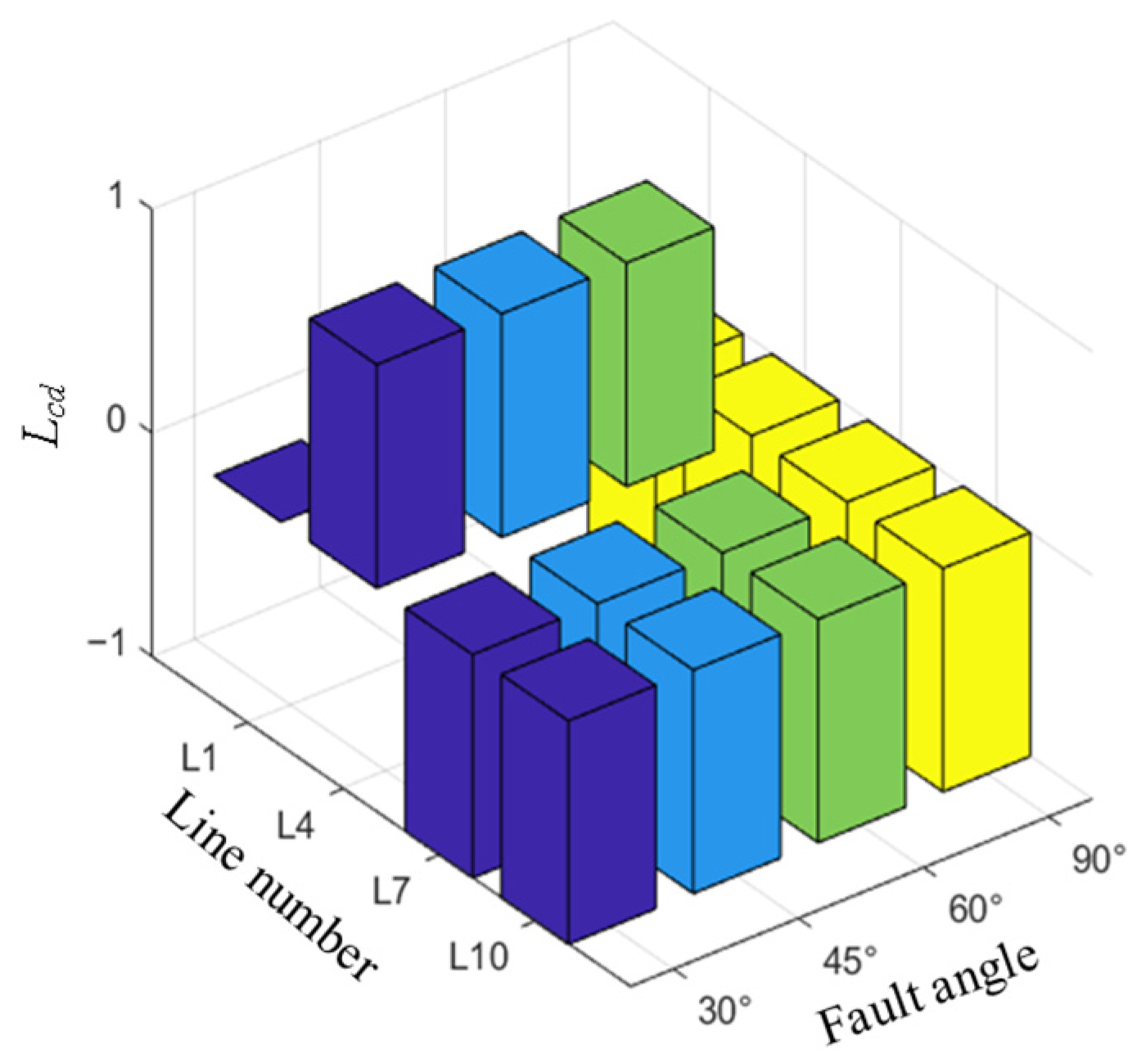
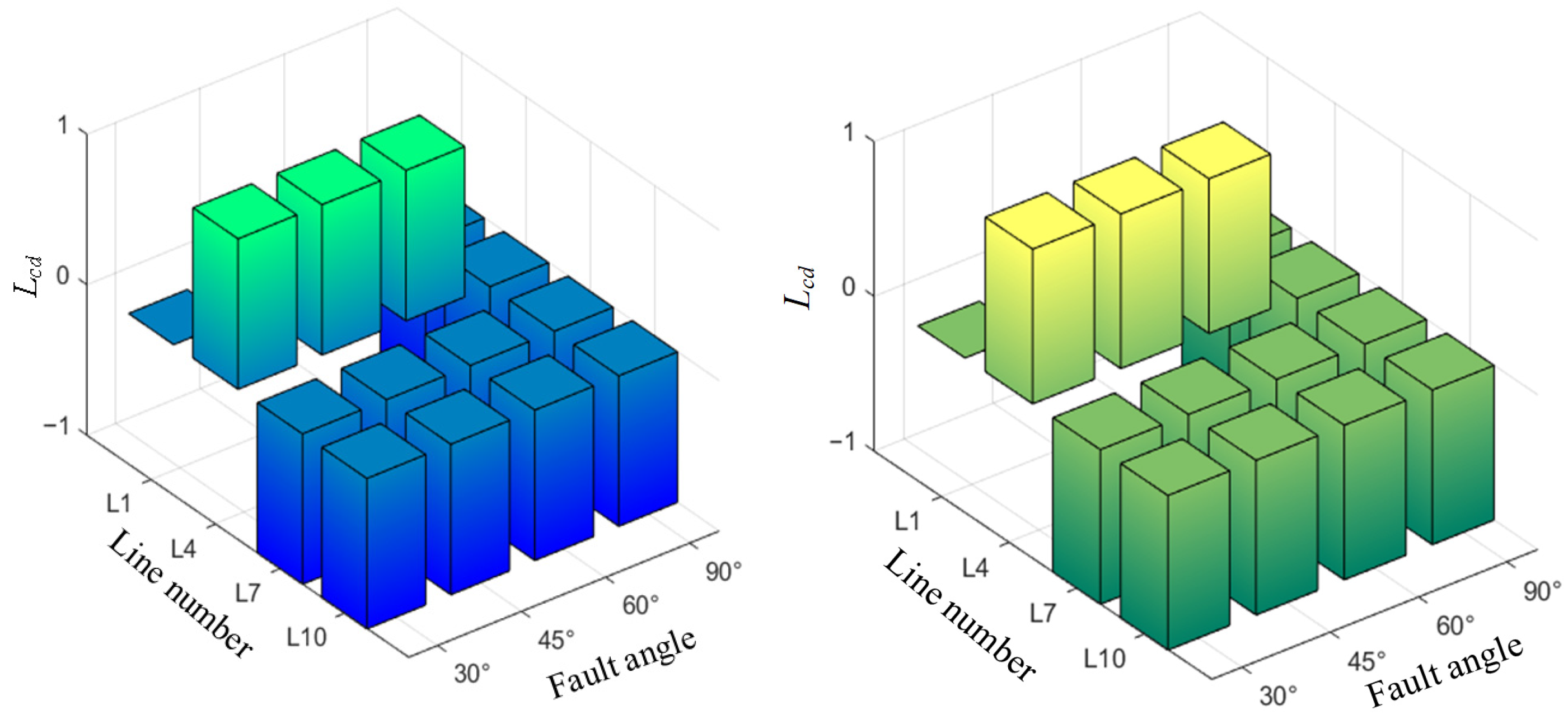
In the case of continuous arc fault and intermittent arc fault, the fault angle selection range is set to 30°, 45°, 60° and 90°, respectively, and the experiment is carried out. Similarly, firstly, the fault section location method based on DC attenuation is used to locate the fault section. The location results are shown in Figure 13. The different colors in the figure represent the value of Lcd, where lighter colors indicate values closer to 1, while darker colors indicate values closer to −1.
It can be found that the method is also reliable and accurate when the fault angle is 30°, 45° and 60° under continuous arc fault and intermittent arc fault. However, when the fault angle is 90°, the accuracy of this method decreases. It can be seen that under the condition of arc fault, the larger fault angle will also have a greater impact on the results of the DC characteristic algorithm.
The continuous and intermittent arc fault section location results of the fault section location method based on transient polarity under the fault angle of 90° are shown in Table 10. It can be seen that the locating result of this method is also more accurate for the continuous arc fault and intermittent arc fault, and it further shows that the comprehensive method obtained by the fusion of the two methods can also effectively deal with a continuous arc fault and intermittent arc fault under different fault angles, and realize fault section location, which is of great significance to improve the section location accuracy.

3.5. Study the Influence of Signal Sampling Rate on Section Location Results

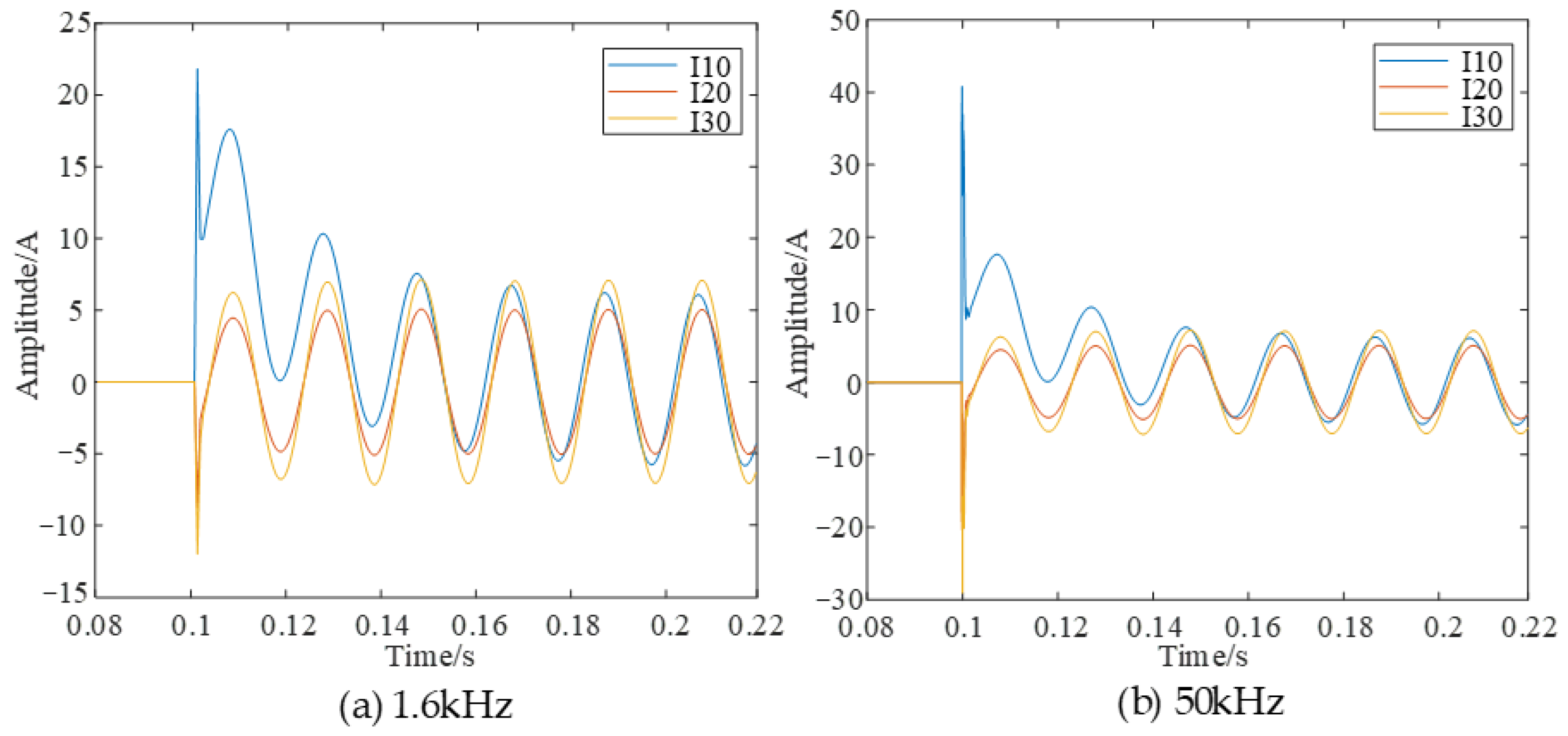
There are many low-resolution or low-sampling-rate measurement devices commonly used in field equipment. For example, the sampling frequencies of fault recorders for feeder terminal units (FTUs) or phasor measurement units (PMUs) generally range between 1.6 kHz and 50 kHz. Since the sampling rate of the signal can affect the fault transient waveform, it may influence the determination of current polarity within the characteristic frequency band, leading to incorrect section location results. Therefore, it is necessary to verify the district chief and section location results at different sampling frequencies. Three sampling frequencies were set: 50 kHz, 10 kHz and 1.6 kHz. Figure 14 shows the zero-sequence currents measured with 1.6 kHz and 50 kHz sampling frequencies. In the figure, I10, I20 and I30 denote the zero-sequence currents at the local ends of L1, L2 and L3 when a fault occurs in L1, respectively. It can be seen that the polarity features of zero-sequence currents remain unchanged with low and high sampling frequencies.
The section location results under different sampling conditions are shown in Table 11. It can be known that the accuracy of the location results is almost 100% when the sampling rate is 50 kHz. When the sampling frequency is reduced, the accuracy rate is reduced to a certain extent, but it remains above 95%. When there is a high resistance fault, because the duration of the transient process is slightly longer than that of the low resistance fault, the location accuracy is somewhat reduced, and the influence of the sampling frequency will be more obvious. Since the sampling rate of 50 kHz is not too high for the data transmission unit, it is recommended to use a sampling rate of 50 kHz to ensure high fault section location accuracy.

3.6. Study Method Performance Under Noise Conditions

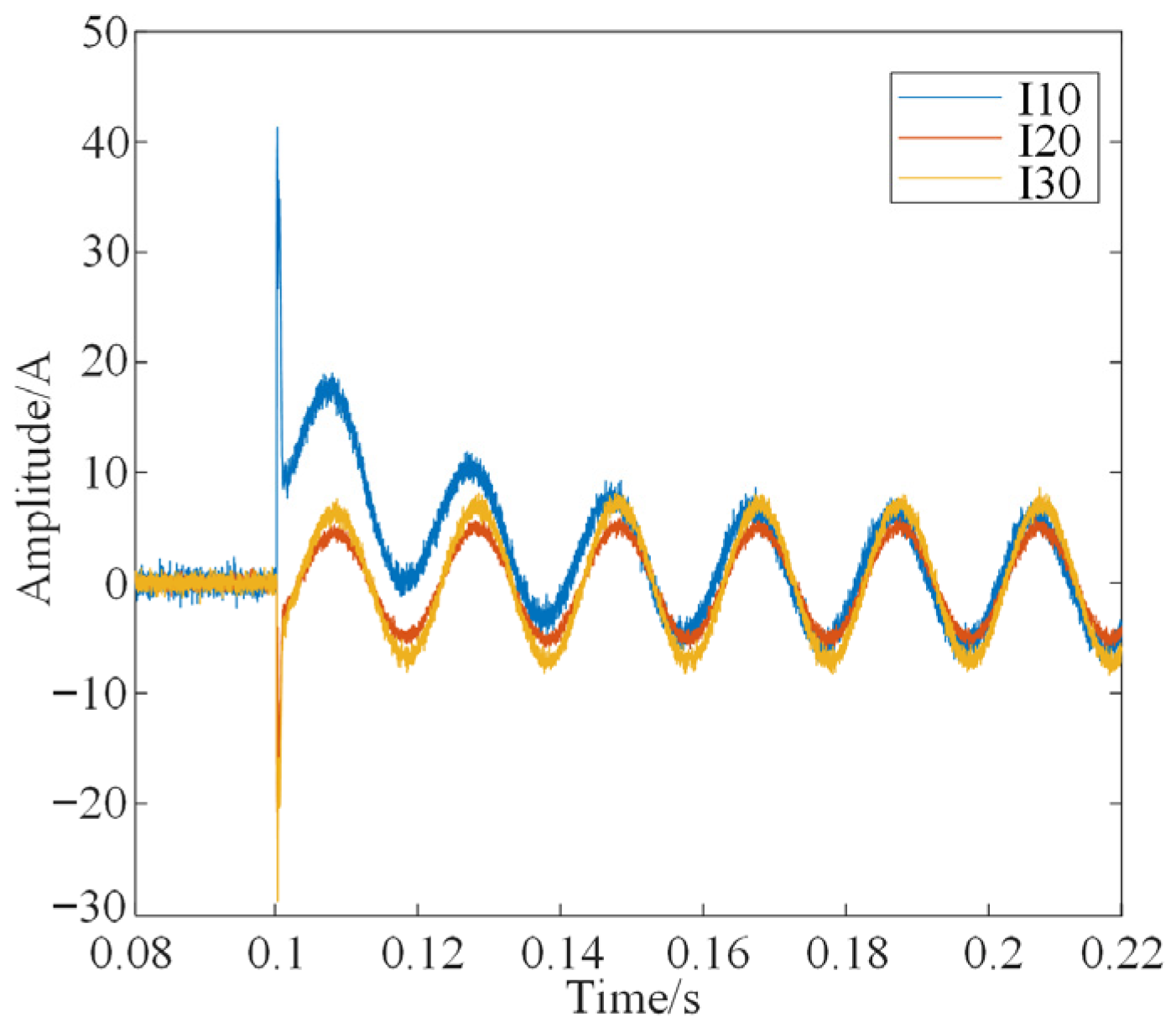
To test the performance of the method under noise interference, noises with different signal-to-noise ratios (SNRs) are added to the current measurements in fault simulations. Figure 15 shows the zero-sequence currents at local ends of L1, L2 and L3 with 20 dB noises when a fault occurs in L1. It can be observed that there exists significant difference between the zero-sequence current of the fault line and that of any healthy line in the case of noise interference.
The information on the fault simulations with noise interference and fault location results using the method under noise conditions is listed in Table 12 and Table 13, respectively. In these tables, ‘SF’, ‘IAF’ and ‘CAF’ represent the steady-state, intermittent arc and continuous arc faults, respectively. It can be seen from the table that the fault distance is set as 5%, 50% and 95% of the total length of the line. ‘Min Accuracy’ and ‘Max Accuracy’ represent the minimum and maximum values of fault location accuracies corresponding to four different levels of noises. It can be observed from the results that the maximum fault location accuracy is 97.9% while the minimum one is higher than 95%. The average accuracy with four different levels of noises exceeds 96%, demonstrating the robustness of the method to noise interference.

3.7. Study Impacts of Cable Impedance Errors on Fault Section Location Results

It is not easy to obtain accurate values of cable impedances in practice since they may vary with types, configurations or working conditions. To test the performance of the proposed method in this case, different cable impedance errors are considered in fault experiments. Table 14 lists the fault location results with different cable impedance errors. In simulation, the impedance of the cable is 0.34 + j1.22 Ω/km. In practice, cable impedance parameter ranges between +5% and −5% of the theoretical value due to the impact of environment, measurement or computation errors. It can be seen that the fault section location accuracy is barely affected by cable impedance errors. The minimum fault section location accuracy is higher than 95% even with ±5% cable impedance error.

3.8. Study Sensitivity of the Proposed Method to Misidentification

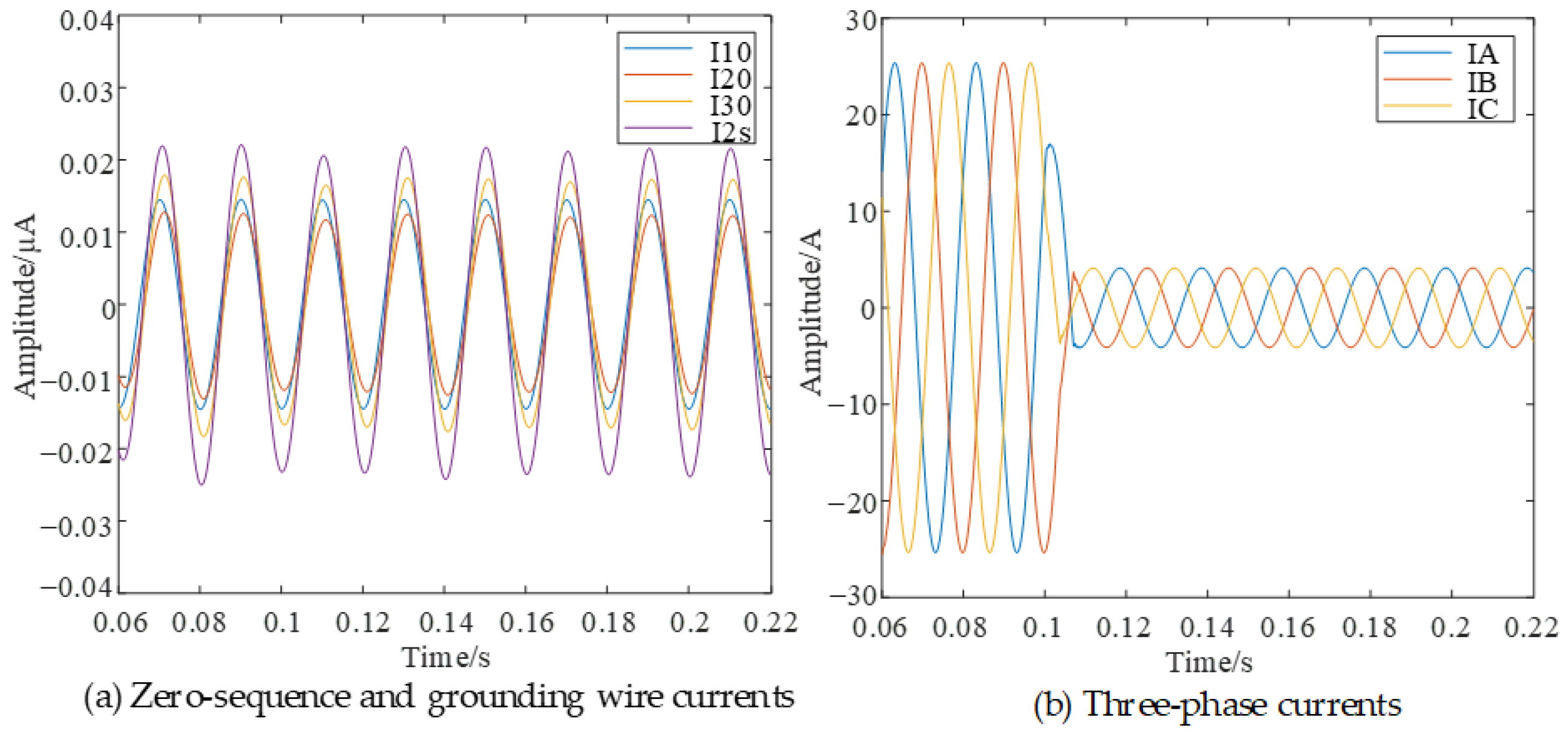
In practice, some transient events unrelated to faults, such as load switching or transformer inrush currents, may occur in distribution networks. To evaluate the susceptibility of the proposed method to misidentification in this case, the load switching is simulated in the experiments. The load connected to transformer T4 in L2 is shed at 0.1 s. The zero-sequence and grounding wire currents in load-switching events are depicted in Figure 16a. In the figure, ‘I2s’ represents the grounding wire current at the local end of L2. The three-phase currents at the local end of L2 are displayed in Figure 16b. It can be seen that the amplitude of the zero-sequence and grounding wire currents prior to and after the load switching are almost unchanged. The three-phase current reduces significantly prior to and after the load switching. The maximum value of the zero-sequence or grounding wire currents does not exceed 0.03µA, which is very small and can be neglected in practice.
Table 15 lists the fault section location results with load switching. In the table, ‘LST’ represents load-switching type. The ratio of load switching denotes the ratio of the switching load to rated load. The rate of misidentification can be obtained by computing the ratio of the number of misidentifications to that of all experiments. The results demonstrate that the proposed method is not affected by load switching.

3.9. Discussion on Method Performance Under Variations in Fault Resistance, Especially for High-Impedance Faults

Since the proposed method uses the time-domain features (DC attenuation amplitude and polarity) of transient components in zero-sequence and grounding wire currents, it is robust to variations in fault resistance to a certain extent. In theory, the larger the fault resistance, the smaller the amplitudes of zero-sequence and grounding wire currents, which may induce large errors to extraction of the time-domain features employed in the fault section location algorithm.
To quantitatively evaluate this limitation under extreme high-impedance faults, additional simulations were conducted. Table 16 lists the extraction results of the zero-sequence and grounding wire current amplitudes, along with the corresponding fault location success rates, when the fault resistances are set from 1000 Ω to 4000 Ω.
As observed in the data for the distribution network fault experiments, the amplitudes of zero-sequence and grounding wire currents are approximately 3.12 A and 5.86 A when the fault resistance is 1000 Ω, maintaining a high location success rate of 95%. However, the amplitudes decrease to less than 1 A when the fault resistance reaches 3000 Ω. Under severe signal attenuation, the fault current may be similar to the unbalanced current under normal operation, which significantly reduces the effective signal-to-noise ratio of the fault signal. Consequently, the feature extraction becomes unreliable, causing the location success rate to decline significantly to 91% at 3000 Ω, and further plummet to 74% at 4000 Ω. Considering the measurement accuracy of existing measurement units (fault recorders, fault indicators or phasor measurement systems) in distribution networks, when the fault resistance exceeds 3000 Ω, the existing measurement units cannot accurately detect fault signals, which may result in the failure of the proposed method.

3.10. Study on the Influence of Complex Fault Scenarios on Section Location Results

The verification cases presented above focus on single-point, single-phase-to-ground faults. To comprehensively evaluate the algorithm’s operational boundaries, additional tests were conducted for complex scenarios, specifically developing faults and multi-point faults. For the developing fault scenario, an initial single-phase ground fault was set at L6 with a fault resistance of 50 Ω, which subsequently evolved into a two-phase-to-ground short circuit. For the multi-point fault scenario, simultaneous single-phase ground faults were simulated at multiple locations (L4 and L7, as well as L1 and L7,), all with a fault resistance of 50 Ω. The extracted algorithm parameters and the corresponding location results under these specific scenarios are summarized in Table 17.
For the developing fault scenario, as shown in Table 17, the algorithm accurately locates L6 during the initial single-phase stage. However, as the fault evolves into a phase-to-phase short circuit, both the zero-sequence current and the grounding wire current become virtually undetectable. Consequently, the extracted Rdc drops drastically to a near-zero level, failing to exceed the fundamental activation threshold. Simultaneously, the transient polarity of the zero-sequence current cannot be obtained due to the lack of sufficient signal energy. As a result, the proposed fault section location method will be completely ineffective when the fault enters the phase-to-phase short-circuit stage. This indicates that the proposed method is only applicable to single-phase earth faults in the initial stage of the fault, and it will fail once the fault develops and evolves into a phase-to-phase short-circuit fault.
In contrast, for the multi-point fault scenarios, the proposed method demonstrates excellent extended capabilities. When simultaneous ground faults occur at multiple locations, the transient zero-sequence currents generated by multiple fault sources superimpose within the network. Consequently, the DC attenuation component Rdc can be clearly detected across all sections (both healthy and faulty). However, the ratio of the DC components of the three-times zero-sequence current to the grounding wire current Kdc can effectively distinguish between the fault section and the non-fault section. For actual faulty sections, such as L4 and L7 in Case 1 or L1 and L7 in Case 2, the Kdc values remain extremely low, ranging from 0.12 to 0.16, which satisfies the fault criterion. For healthy sections, such as L1 in Case 1 or L4 in Case 2, their Kdc values reach 0.88 and 0.92, respectively, which do not meet the fault criterion. This accurately identifies them as non-faulty regions. This confirms that the proposed method can successfully solve multi-point fault location problems by using this specific ratio.

3.11. Fault Location Performance of the Proposed Method Under Different Rset Values

Rset is determined for different distribution network structures on the basis of multiple sets of fault experiments and historical data. For the network structure shown in Figure 8, this paper sets Rset to 10 through experimental verification and calculation. To analyze the influence of different Rset values on the method proposed in this paper, a sensitivity analysis is carried out by varying Rset under the condition that the faulty section is set as L4 and the fault type is specified as a 500 Ω fixed-value grounding fault. In accordance with the flow chart in Figure 6, the proposed method first locates the faulty section based on the DC attenuation component. Therefore, by successively setting Rset to 1, 10 and 100, the fault section location results based on the DC attenuation component are presented in Table 18.
It can be seen from Table 18 that when Rset = 1, according to the fault section location procedure, L4, L7 and L10 are all identified as faulty sections, which is inconsistent with the preset fault condition. Thus, an excessively small Rset tends to cause misjudgment of the faulty section. Meanwhile, when Rset = 100, all values of Ldc are −1. Although further fault section location can be subsequently performed using the transient polarity method, as shown in Table 5 and Table 6, it reduces the sensitivity of the fault section location scheme based on the DC attenuation component, thereby increasing the time consumed for fault section location. Therefore, to ensure the reliability and sensitivity of the proposed method, it is concluded through experiments and calculations that setting Rset to 10 is the most appropriate choice in this paper.

3.12. Comparison with Other Methods

3.12.1. Comparison with Existing Methods

To objectively evaluate the practical advantages and engineering applicability of the proposed method, a comprehensive comparison with existing state-of-the-art fault section location methods was conducted. It should be noted that all of the selected methods were reproduced and validated within the same simulation model established in the preceding sections. The selected benchmark methods encompass fundamental frequency impedance-based approaches [6], active signal injection methods [8], traveling wave techniques [12], transient signal-based methods [19], and data-driven algorithms [25]. The comparison is evaluated across five critical practical dimensions: the main principle, the required sampling frequency, the requirement for extra hardware equipment, and the applicability to arc faults. The detailed comparative results are summarized in Table 19. Note that in Table 19, “Yes” and “No” indicate whether extra equipment is required or whether the method is applicable to arc faults, while “-“ denotes that the specific parameter is not mentioned in the corresponding literature.
As illustrated in Table 19, traditional impedance-based methods [6] and data-driven methods [25] do not require extra equipment, but they fail to maintain reliability under arc fault conditions due to the highly non-linear and fluctuating nature of arc resistance, resulting in lower overall accuracies of 78% and 84% in complex scenarios. Active signal injection methods [8] enhance reliability to achieve an accuracy of 86%, but strictly require the installation of additional injection equipment, and they still struggle with the intermittent nature of arcing. Traveling wave methods [12] offer exceptional precision (97%) and can effectively handle arc faults. However, they rely on extremely high sampling frequencies (up to 1 MHz) and specialized high-frequency sensors, which limits their wide deployment in distribution networks. Furthermore, while conventional transient-based methods [19] operate at lower sampling frequencies (6.4 kHz) without extra equipment, their reliance on overall waveform morphology makes them susceptible to the severe distortions caused by intermittent arc, rendering them inapplicable to arc faults and limiting their comprehensive accuracy to 82%.
In contrast, the method proposed in this paper extracts the DC attenuation amplitude and transient polarity features to achieve a highly competitive accuracy of 99%. This approach operates effectively at a sampling frequency of 50 kHz, bridging the gap between accuracy and hardware limits by eliminating the need for expensive MHz-level measurement units. More importantly, unlike general transient methods, the specific time-domain features utilized in this paper possess adaptability to arcing. For continuous arc faults, the spatial distribution law of the decaying DC component remains highly similar to that of fixed-resistance grounding. For intermittent arc faults, each arc reignition is equivalent to a new transient process, which consistently generates the required attenuated DC component. This allows the proposed method to demonstrate better applicability and robustness against both continuous and intermittent arcing characteristics. Consequently, the proposed method achieves a highly cost-effective and reliable performance.

3.12.2. Comparison with the Hybrid and Multi-Feature Approaches

Compared with other fault section location methods based on multi-method and multi-feature fusion criteria, the proposed method in this paper exhibits certain advantages and innovation. Table 20 presents a comparison between the method in this paper and other methods in terms of minimum sampling frequency, fault types, transition resistance, maximum fault angle and noise level.
As can be seen from Table 20, Ref. [19] implements fault section location based on fault current polarity combined with fault current waveform similarity comparison and a genetic algorithm, but this method exhibits poor adaptability. When the power grid structure changes, the genetic algorithm must be updated. It also reduces the universality of the method. In this paper, fault section location is mainly carried out using DC attenuation components, with the transient polarity-based method as a supplement. In contrast, this design ensures the rapidity of fault section location.
Ref. [28] also showed good performance. It shows a comprehensive fault section location method based on DC attenuation components, transient current waveform synthesis, and wavelet packet energy entropy. Since these three features are designed for different types of faults, when processing fault characteristics, three different normalization processing methods may be required. The fault section location process and calculation procedure are rather complicated. In addition to the relevant thresholds, the fault measurement membership function and weight coefficients of integrating these three methods also need to rely on human experience or neural networks, reducing the universality of this method. In contrast, the method described in this paper has certain advantages in terms of minimum sampling frequency, fault types, transition resistance, etc. The method prioritizes the fault section location method based on DC attenuation components to locate the fault section, and then uses the method based on transient polarity as a supplement. The decision logic is simpler, and the efficiency of fault section location is improved.

4. Hardware-in-the-Loop Validation

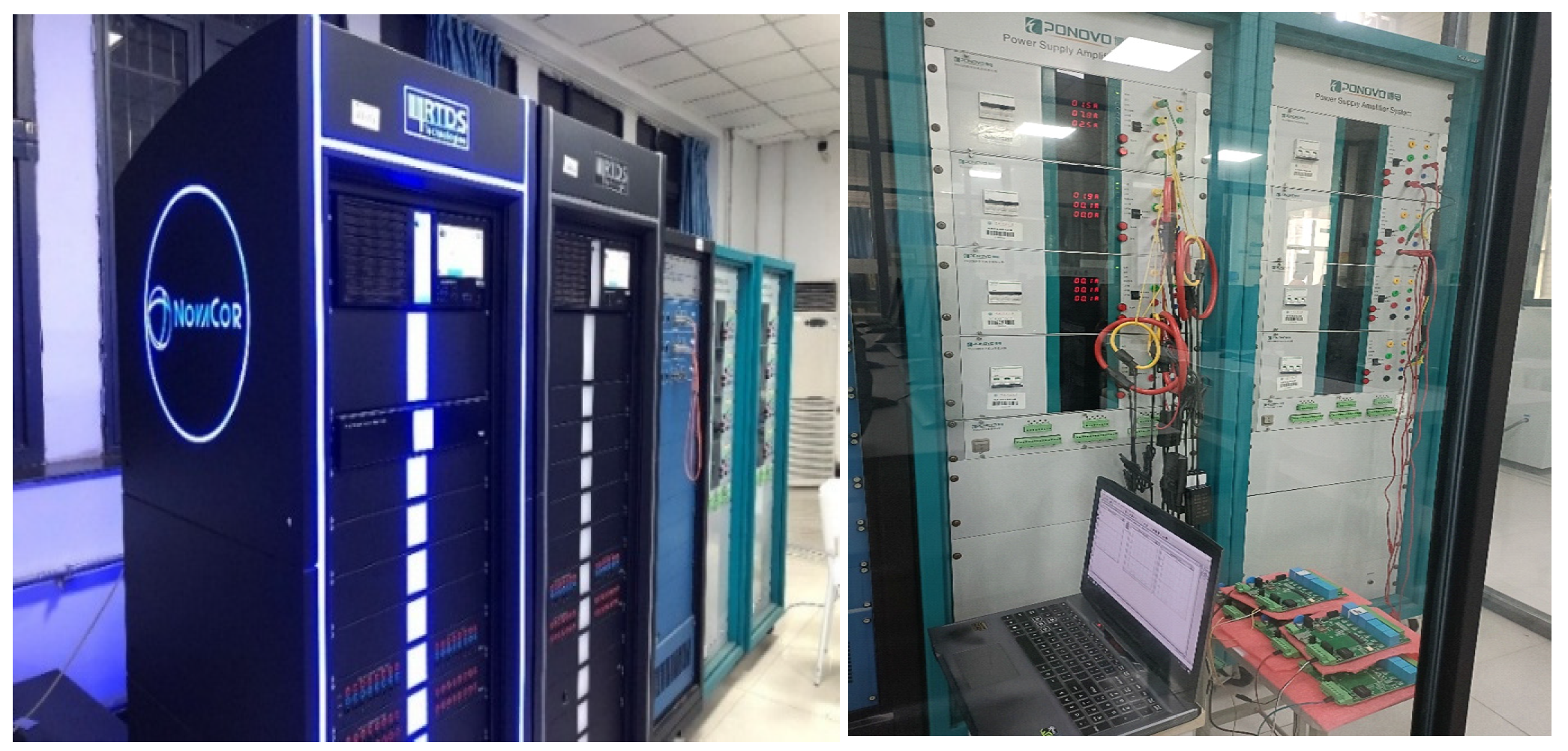
To confirm the effectiveness of the proposed method outside simulation environments, the hardware-in-the-loop validation based on a real-time digital system (RTDS) is conducted. The RTDS experiment platform is displayed Figure 17. The same topology and parameters of the distribution network in Figure 8 are employed in the hardware-in-the-loop experiment. Various faults are simulated at different locations in the distribution network. The information on the fault experiments is listed in Table 21.
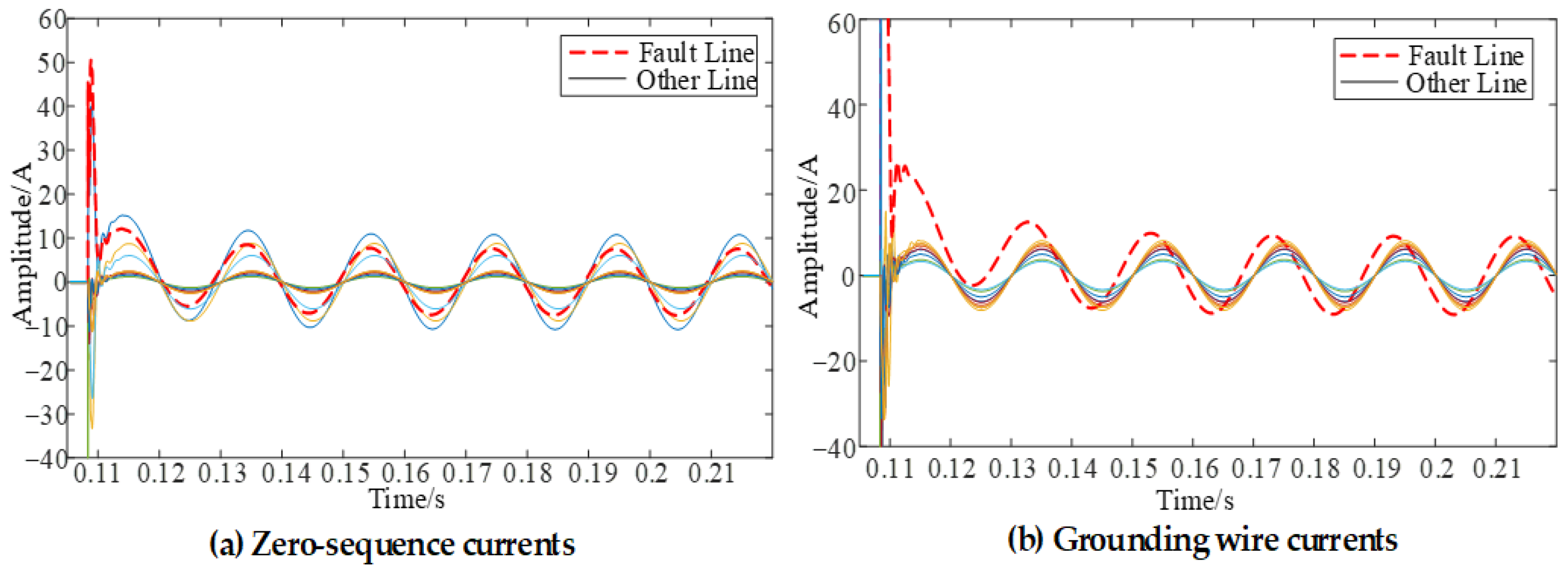
The zero-sequence and grounding wire currents of all lines when a fault occurs at 0.1 s are depicted in Figure 18, where the red dashed line represents the faulted line, while the solid lines in other colors represent the healthy (non-faulted) lines. It can be observed that the amplitudes and phases of zero-sequence and grounding wire currents of the fault line are close to those of any healthy line. By using the proposed method, the attenuation DC components in the zero-sequence and grounding wire currents are extracted.
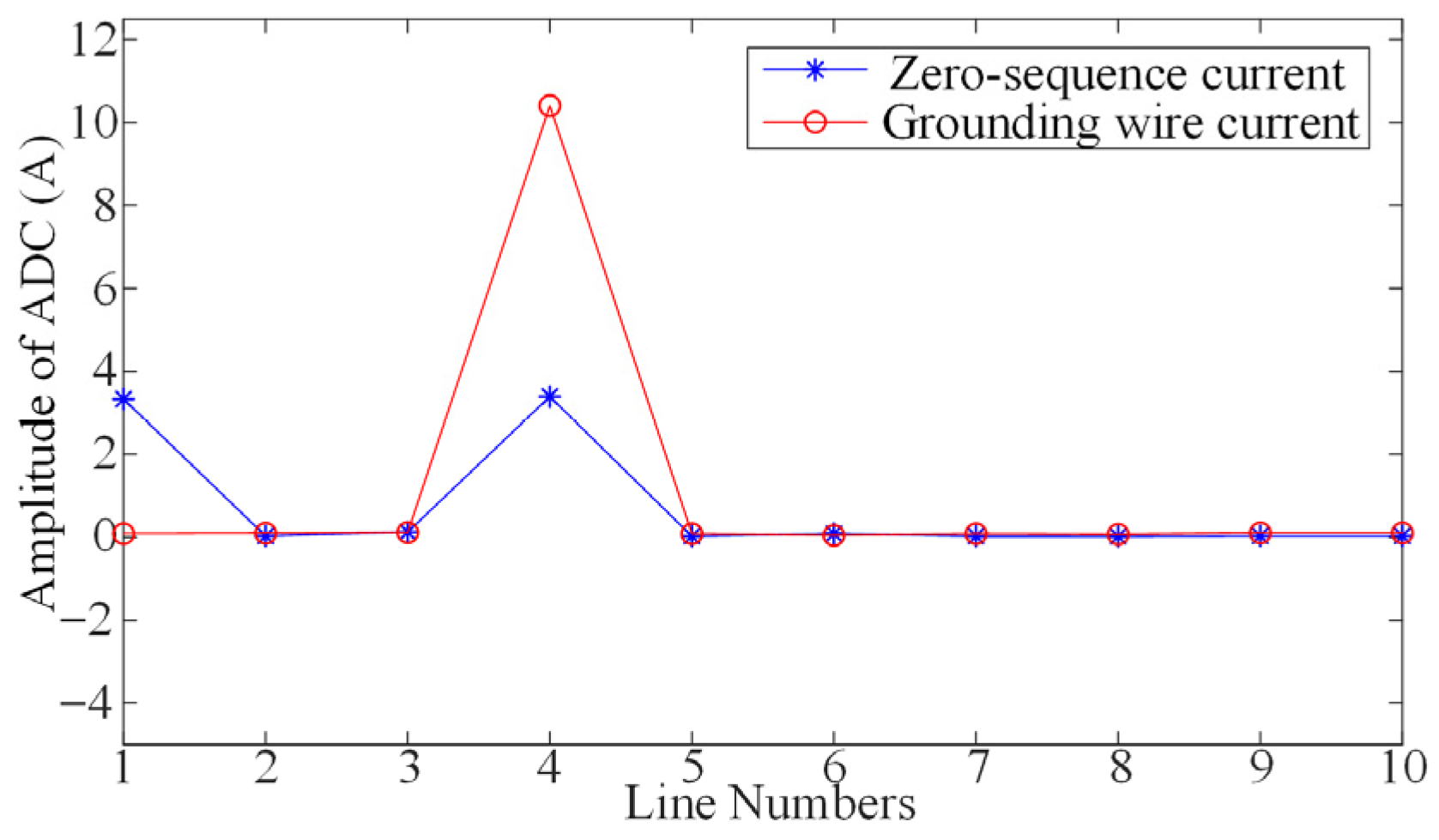
The extracted attenuation DC components when the fault occurs in L4 are displayed in Figure 19. It is obvious that the amplitudes of attenuation DC components in zero-sequence and grounding wire currents of the fault line (L4) are larger than those of any healthy line. The fault location results of all of the experiments are listed in Table 22. In the table, Min Accuracy and Max Accuracy represent the minimum and maximum values of fault location accuracies corresponding to three fault types. It can be seen that the maximum fault location accuracy reaches 99.8% while the minimum exceeds 96%. The average accuracy with three fault types is about 98%, which verifies the effectiveness of the method.

5. Conclusions

In this paper, a method for locating the fault section of distribution network cables is proposed, which is based on the DC component attenuation of the grounding wire current and the transient polarity of the zero-sequence current. The main conclusions drawn from this study are as follows:
(1)
Through the analysis of the grounding wire currents of faulty lines and healthy lines, it is found that the DC attenuation component in the faulty line is significantly larger than that in the healthy line. Based on this finding, a fault section location method and its corresponding implementation process are established, which are based on the DC attenuation component. Simulation results verify that this method exhibits high accuracy under certain operating conditions.
(2)
Considering that the DC component of the grounding wire current is almost zero under special circumstances, this paper proposes a section location method based on the zero-sequence current polarity in the characteristic frequency band and summarizes its corresponding implementation process. Simulation results also confirm that this method can effectively address fault section location under conditions of high transition resistance and a large fault angle.
(3)
By combining the two aforementioned methods, a comprehensive fault section location method based on the DC attenuation component and transient polarity is proposed, where the two methods complement each other. The simulation and hardware-in-the-loop test results demonstrate that this method can effectively handle resistive grounding faults, continuous arc faults, and intermittent arc faults under various fault conditions, achieving accurate fault section location.
There exist diverse fault scenarios, such as multi-phase or evolving faults, in actual distribution networks. Although multi-phase or evolving faults are not considered in the proposed algorithm, the fast and reliable fault detection or location methods for these complex fault scenarios will be explored in the future work.

Author Contributions

Conceptualization, W.M. and X.W.; methodology, W.M.; experiment, H.Z., W.M. and J.S.; formal analysis, H.Z.; investigation, R.F.; resources, Y.Z.; data curation, X.W.; writing—original draft preparation, H.Z.; writing—review and editing, S.Z. and Z.L.; visualization, J.S.; supervision, Z.L.; project administration, X.W. All authors have read and agreed to the published version of the manuscript.

Funding

This research received no external funding.

Data Availability Statement

The datasets and simulation models generated and analyzed during the current study are not publicly available due to the ongoing nature of related research, but are available from the corresponding author upon reasonable request.

Conflicts of Interest

Authors Wangqing Mao, Hangyu Zhao, Xiuru Wang and Yuanming Zhang were employed by Suqian Power Supply Branch, State Grid Jiangsu Electric Power Co., Ltd., author Jian Sun was employed by State Grid Jiangsu Electric Power Co., Ltd., Electric Power Research Institute, Nanjing, author Rao Fu was employed Jilin Power Supply Branch, State Grid Jilin Electric Power Co., Ltd. The remaining authors declare that the research was conducted in the absence of any commercial or financial relationships that could be construed as a potential conflict of interest.

References

  1. Sana, H.; Mohammad, A.; Mohamed, R. Advancements in grid resilience: Recent innovations in AI-driven solutions. Results Eng. 2025, 26, 105042. [Google Scholar] [CrossRef]
  2. Lin, J.; Guo, M.; Zheng, Z. Active Location Method for Single-Line-to-Ground Fault of Flexible Grounding Distribution Networks. IEEE Trans. Instrum. Meas. 2023, 72, 3524712. [Google Scholar] [CrossRef]
  3. Yin, Z.; Zheng, Y.; Wei, Z. High-Impedance Fault Section Location for Distribution Networks Based on T-Distributed Stochastic Neighbor Embedding and Variable Mode Decomposition. J. Mod. Power Syst. Clean Energy 2024, 12, 1495–1505. [Google Scholar] [CrossRef]
  4. Dashti, R.; Salehizadeh, S.M.; Shaker, H.R. Fault location in double circuit medium power distribution networks using an impedance-based method. Appl. Sci. 2018, 8, 1034. [Google Scholar] [CrossRef]
  5. Dashti, R.; Daisy, M.; Shaker, H.R.; Tahavori, M. Impedance-Based Fault Location Method for Four-Wire Power Distribution Networks. IEEE Access 2018, 6, 1342–1349. [Google Scholar] [CrossRef]
  6. Li, C.; Wu, Q.; Zhang, L. Two-stage fault section location for distribution networks based on compressed sensing with estimated voltage measurements. Electr. Power Syst. Res. 2023, 223, 109702. [Google Scholar] [CrossRef]
  7. Teng, J.H.; Huang, W.H.; Luan, S.W. Automatic and fast faulted line-section location method for distribution systems based on fault indicators. IEEE Trans. Power Syst. 2014, 29, 1653–1662. [Google Scholar] [CrossRef]
  8. Li, Z.; Ye, Y.; Ma, X. Single-phase-to-ground fault section location in flexible resonant grounding distribution networks using soft open points. Int. J. Electr. Power Energy Syst. 2020, 122, 106198. [Google Scholar] [CrossRef]
  9. Xu, H.; Zhang, X.; Sun, H. Faulty section location method for high impedance grounding fault in resonant grounding system based on discrete Fréchet distance. Electr. Power Syst. Res. 2025, 238, 111147. [Google Scholar] [CrossRef]
  10. Gaur, V.K.; Bhalja, B. A new faulty section identification and fault localization technique for three-terminal transmission line. Int. J. Electr. Power Energy Syst. 2017, 93, 216–227. [Google Scholar] [CrossRef]
  11. Peng, N.; Zhang, P.; Liang, R. Fault section identification of the power cables in urban distribution networks by amplitude differences between the zero-sequence currents and those flowing in cable sheaths and armors. IEEE Trans. Smart Grid 2023, 14, 2593–2606. [Google Scholar] [CrossRef]
  12. Nayak, K.; Pradhan, A.K.; Terzija, V. Faulted section identification in mixed conductor circuits using traveling wave magnitudes. IEEE Trans. Power Deliv. 2023, 38, 1990–1999. [Google Scholar] [CrossRef]
  13. Zhang, X.; Guo, A.; Hu, C. A fault section location method based on the slope similarity of zero-sequence current waveform for the non-effectively grounding system. Int. J. Electr. Power Energy Syst. 2025, 165, 110470. [Google Scholar] [CrossRef]
  14. Li, J.; Wang, G.; Zeng, D. High-impedance ground faulted line-section location method for a resonant grounding system based on the zero-sequence current’s declining periodic component. Int. J. Electr. Power Energy Syst. 2020, 119, 105910. [Google Scholar] [CrossRef]
  15. Nayak, K.; Pradhan, A.K. Faulted Section Identification in Mixed Lines Using One End Current Traveling Waves. IEEE Syst. J. 2023, 17, 1443–1452. [Google Scholar] [CrossRef]
  16. Bountouris, P.; Guo, H.; Tzelepis, D. MV faulted section location in distribution systems based on unsynchronized LV measurements. Int. J. Electr. Power Energy Syst. 2020, 119, 105882. [Google Scholar] [CrossRef]
  17. Zhang, P.; Jin, M.; Liang, R. Faulty Cable Segment Identification of Low-Resistance Grounded Active Distributions via Grounding Wire Current-Based Approach. IEEE Trans. Ind. Inform. 2024, 20, 7708–7718. [Google Scholar] [CrossRef]
  18. Dash, P.K.; Samantray, S.R. Phase selection and fault section identification in thyristor controlled series compensated line using discrete wavelet transform. Int. J. Electr. Power Energy Syst. 2004, 26, 725–732. [Google Scholar] [CrossRef]
  19. Pang, Q.; Ye, L.; Gao, H. Multi-timescale-based fault section location in distribution networks. IEEE Access 2021, 9, 148698–148709. [Google Scholar] [CrossRef]
  20. Mitra, B.; Debnath, S.; Chowdhury, B. Fault Location Using the Natural Frequency of Oscillation of Current Discharge in MTdc Networks. IEEE Access 2021, 9, 49415–49423. [Google Scholar] [CrossRef]
  21. Costa, G.B.; Damiani, J.S.; Marchesan, G. A multi-agent approach to distribution system fault section estimation in smart grid environment. Electr. Power Syst. Res. 2022, 204, 107658. [Google Scholar] [CrossRef]
  22. Bian, Y.; Sun, S.; Li, G. A generic Bayesian method for faulted section identification in distribution systems against wind-induced extreme events. IEEE Trans. Smart Grid 2024, 15, 1821–1836. [Google Scholar] [CrossRef]
  23. Ku, T.T.; Li, C.S.; Lin, C.H.; Chen, C.S.; Hsu, C.T. Faulty Line-Section Identification Method for Distribution Systems Based on Fault Indicators. IEEE Trans. Ind. Appl. 2021, 57, 1335–1343. [Google Scholar] [CrossRef]
  24. An, J.G.; Song, J.U.; Oh, Y.S. A fuzzy-based fault section identification method using dynamic partial tree in distribution systems. Int. J. Electr. Power Energy Syst. 2023, 153, 109344. [Google Scholar] [CrossRef]
  25. Kiaei, I.; Lotfifard, S. Fault section identification in smart distribution systems using multi-source data based on fuzzy Petri nets. IEEE Trans. Smart Grid 2020, 11, 74–83. [Google Scholar] [CrossRef]
  26. Liu, P.; Du, S.; Sun, K. Single-Line-to-Ground Fault Feeder Selection Considering Device Polarity Reverse Installation in Resonant Grounding Syste. IEEE Trans. Power Deliv. 2021, 36, 2204–2212. [Google Scholar] [CrossRef]
  27. Deng, X.; Yuan, R.; Xiao, Z. Fault location in loop distribution network using SVM technology. Int. J. Electr. Power Energy Syst. 2015, 65, 254–261. [Google Scholar] [CrossRef]
  28. Yuan, J.; Jiao, Z.; Feng, G. Study on fault line detection methods based on multi-feature fusion in distribution systems. IET Gener. Transm. Distrib. 2021, 15, 860–869. [Google Scholar] [CrossRef]
Figure 1. Structure of three-core cable.
Electronics 15 02092 g001
Figure 2. Current distribution diagram of three-core cable.
Electronics 15 02092 g002
Figure 3. Leakage current distribution of metal sheath.
Electronics 15 02092 g003
Figure 4. Steps of DC component feature extraction.
Electronics 15 02092 g004
Figure 5. Flow chart for calculation of polar characteristics.
Electronics 15 02092 g005
Figure 6. Flow chart of comprehensive section location algorithm.
Electronics 15 02092 g006
Figure 7. Schematic diagram of cable arc fault.
Electronics 15 02092 g007
Figure 8. PSCAD simulation model of 35 kV distribution network.
Electronics 15 02092 g008
Figure 9. Waveform comparison of zero-sequence and ground wire current of 10 Ω ground fault.
Electronics 15 02092 g009
Figure 10. Waveform comparison of zero-sequence and ground wire current of continuous arc fault.
Electronics 15 02092 g010
Figure 11. Waveform comparison of zero-sequence and ground wire current of intermittent arc fault.
Electronics 15 02092 g011
Figure 12. Simulation results of grounding fault section based on transient polarity 10 Ω constant resistance under different fault angles.
Electronics 15 02092 g012
Figure 13. Continuity (left) and intermittent (right) arc fault location results based on transient polarity under different fault angles.
Electronics 15 02092 g013
Figure 14. Zero-sequence currents measured with low and high sampling frequencies.
Electronics 15 02092 g014
Figure 15. Zero-sequence currents at local ends of L1, L2 and L3 with 20 dB noise when a fault occurs in L1.
Electronics 15 02092 g015
Figure 16. Zero-sequence currents at local ends of L1, L2 and L3 with a fault in L1.
Electronics 15 02092 g016
Figure 17. RTDS-based hardware-in-the-loop platform.
Electronics 15 02092 g017
Figure 18. Zero-sequence and grounding wire currents of all lines.
Electronics 15 02092 g018
Figure 19. Attenuation DC components in zero-sequence and grounding wire currents of all lines when the fault occurs in L4.
Electronics 15 02092 g019
Table 1. Maximum and minimum amplitudes of zero-sequence and grounding wire currents.
Fault TypeIFDC_minIHDCIFGW_minIHGWR0DCRGW
IAF5.01 A0.49 A8.680.3210.2227.1
SF3.16 A0.28 A5.470.1711.2932.2
CAF4.87 A0.46 A8.350.2810.5829.8
Table 2. Grounding wire currents for faulty and healthy sections under various fault inception angles.
Fault Angles30°45°60°90°
Grounding wire currents for healthy sections/A0.03820.26430.39510.49650.5969
Grounding wire currents for faulty sections/A16.688614.987012.50559.24450.9972
Table 3. Parameters of the cable.
LocationMaterialThickness/mmResistivity
/(Ω·m)
Relative Permeability
/(H·m−1)
CoreCopper9.21.7241 × 10−81
InsulationXLPE10.51 × 10141
ShieldingCopper0.21.7241 × 10−81
LinerPVC2.01 × 10141
ArmorSteel0.81.71 × 10−7300
SheathPVC4.51 × 10141
Table 4. Simulation results of 10 Ω constant resistance ground fault and section location.
Fault ResistanceLine NumberRdcKdcLdc
10 ΩL193.4850.9843L4
L495.9660.0362
Table 5. Based on attenuated DC component, ground fault simulation and section location results for 100 Ω and 1000 Ω constant resistance values.
Fault ResistanceLine NumberRdcKdcLdcResult
100 ΩL1858.270.99820×
L4861.270.00351
L71.25650.005−1×
L101.40980.0075−1×
1000 ΩL117.7750.9187−1×
L420.3060.1690−1×
L71.48360.0021−1×
L101.64180.003−1×
“√” indicates a correct or successful result. “×” indicates an incorrect or unsuccessful result.
Table 6. Results of 1000 Ω constant resistance ground fault and section location.
Fault ResistanceLine NumberLpi/LpjResult
1000 ΩL1−49/−49L4
L4−49/47
L747/50
L1050/47
Table 7. Continuous arc fault simulation and section location results.
Fault ResistanceLine NumberRdcKdcLdcResult
Continuous arc faultL193.4850.98430L4
L495.9660.03621
L71.47660.0001−1
L101.76830.0001−1
Table 8. Intermittent arc fault simulation and section location results.
Fault ResistanceLine NumberRdcKdcLdcResult
Continuous arc faultL1111.2340.98890L4
L4113.6030.02531
L71.22110.0015−1
L101.46330.0002−1
Table 9. The fault section location results of 10 Ω constant resistance ground fault at 90° fault angle.
Fault AngleLine NumberLpi/LpjLocation Results
90°L156/54L4
L454/−52
L7−52/−57
L10−57/−52
Table 10. Location results of continuous and intermittent arc grounding fault at 90° fault angle.
Fault AngleFault TypeLine NumberLpi/LpjLocation Results
90°ContinuityL1−42/−43L4
L4−43/57
L757/33
L1033/57
IntermittentL152/51L4
L451/−48
L7−48/−54
Table 11. Location results at different sampling rates.
Fault TypeSampling RateFault ResistanceAccuracy
Continuity50 kHz100 Ω100%
Intermittent10 kHz100 Ω99%
1.6 kHz100 Ω99%
1.6 kHz1000 Ω96%
50 kHz100 Ω100%
10 kHz100 Ω100%
1.6 kHz100 Ω98%
1.6 kHz1000 Ω95%
Table 12. Information on the fault simulations with noise interference.
Noise LevelFault TypesFault Line NumberFault DistanceNumber of Faults
SNR = 10 dB, 20 dB, 30 dB, 40 dBSF, IAF, CAFL1, L45%, 50%, 95%144
L7, L10
Table 13. Location results of fault simulations under noise conditions.
Noise LevelMin AccuracyMax AccuracyAverage Accuracy
10 dB, 20 dB, 30 dB, 40 dB95.1%97.9%96.4%
Table 14. Fault location results with different cable impedance errors.
Cable ImpedanceCable Impedance ErrorsFault Line NumberFault TypeAccuracy
0.34 + j1.22 Ω/km0L1, L4SF, IAF, CAF96.1%
±2%95.9%
±3%95.8%
±4%95.5%
±5%95.4%
Table 15. Location results with load switching.
LSTRatio of Load SwitchingLocationRate of Misidentification
Single-phase10%, 30%, 50%L2, L5, L80%
Two-phase10%, 30%, 50%L2, L5, L80%
Three-phase10%, 30%, 50%L2, L5, L80%
Table 16. Location success rates and current amplitudes under high-impedance faults.
Fault Resistance (Ω)Zero-Sequence Amplitude (A)Grounding Wire Amplitude (A)Accuracy
10003.125.8695%
20001.852.9294%
30000.880.9691%
40000.350.4874%
Table 17. Key parameters and location results under complex fault scenarios.
Complex ScenarioFault StageLine NumberRdcKdcLdcResult
Developing faultInitial single-phase stageL335.240.980L6
L638.850.101
L93.280.88−1
Evolved phase-to-phase stageL30.050.42−1failure
L60.082.61−1
L90.030.04−1
Multi-point faultSingle-phase fault at L4 and L7L145.360.880L4, L7
L451.280.121
L748.330.161
Single-phase fault at L1 and L7L168.670.151L1, L7
L461.530.920
L765.460.131
Table 18. Fault section location results based on DC attenuation component under different Rset.
RsetLine NumberRdcKdc[Ldc1, Ldc4, Ldc7, Ldc10]Localization Results
1L1, L4,
L7, L10
87.5620.9574[0, 1, 1, 1]L4, L7, L10
1085.7030.0830[0, 1, −1, −1]L4
1001.3780.0025[−1, −1, −1, −1]——
1.7180.003
Table 19. Comparison between the proposed method and existing methods.
MethodMain PrincipleSampling FrequencyExtra EquipmentApplicability to Arc FaultsAccuracy
[6]Impedance calculation-NoNo78%
[8]Active signal injection-YesNo86%
[12]Traveling wave magnitudes1 MHzYesYes97%
[19]Multi-timescale transient signals6.4 kHzNoNo82%
[25]Data-driven-NoNo84%
Proposed methodDC attenuation & polarity50 kHzNoYes99%
Table 20. Comparison of the proposed method with existing methods.
MethodsMinimum Sampling FrequencyFault TypesTransition ResistanceApplicability to Arc FaultsNoise Level
[19]6.4 kHzSF10 ΩNo——
[28]4 kHzSF, CAF, IAF2000 ΩYes30 dB
Proposed method1.6 kHzSF, IAF, CAF2000 ΩYes40 dB
Table 21. Information on the fault experiments in the RTDS platform.
Fault TypeFault Line NumberFault AngleFault DistanceNumber of Faults
SF, IAF, CAFL2, L430°, 60°, 90°5%, 50%, 95%108
L6, L9
Table 22. Location results of fault experiments in the RTDS platform.
Fault TypeMin AccuracyMax AccuracyAverage Accuracy
SF, IAF, CAF96.3%99.8%98.1%
Disclaimer/Publisher’s Note: The statements, opinions and data contained in all publications are solely those of the individual author(s) and contributor(s) and not of MDPI and/or the editor(s). MDPI and/or the editor(s) disclaim responsibility for any injury to people or property resulting from any ideas, methods, instructions or products referred to in the content.