1. Introduction
High-speed railway (HSR) communications are required to support both reliable railway operation and high-capacity passenger services under extreme mobility [
1]. In OFDM-based HSR systems, channel state information (CSI) estimation is particularly challenging due to severe Doppler spread, rapid time variation, and frequency-selective fading [
2,
3]. Moreover, recent investigations have shown that rapidly changing channels in HSR scenarios demand considerable pilot overhead, with Inter-Carrier Interference (ICI) significantly undermining the performance of traditional linear and interpolation-based estimators [
4].
Despite extensive research on high-mobility channel estimation, many studies still rely on simplified assumptions, such as Rician fading in [
5,
6], Rayleigh fading in [
7], and simplified cascaded time-varying channel modeling in [
8]. Even in HSR-specific studies, benchmark or simulation-oriented channel models are still commonly used. The WINNER II D2a scenario is adopted in [
1,
2,
9], whereas studies [
10,
11] employ 3GPP-based channel settings. More recently, the extended vehicular A channel model and a quasi-stationary channel spreading function (CSF) assumption have also been used for CSF-inspired channel transfer function estimation in high-mobility OFDM systems [
12]. While these models are useful for standardized evaluation, they may not fully capture the strong LoS component [
13], non-stationary behavior [
14], and scenario-dependent Doppler characteristics [
10,
14] observed in practical HSR propagation. This motivates the use of a non-stationary wideband HSR channel model parameterized using measurement data, so that the resulting performance evaluation can better reflect practical HSR propagation conditions.
Another important challenge lies in pilot design. In rapidly time-varying channels, dense pilot insertion is often required to maintain channel tracking quality [
4,
9], but this directly increases pilot overhead and reduces spectral efficiency [
15,
16,
17]. Therefore, channel estimation in HSR-OFDM systems should be studied not only from the perspective of estimation accuracy but also from the trade-off between channel reconstruction performance and pilot resource consumption.
In the category of conventional approaches, estimators such as Least Squares (LS), Linear Minimum Mean Square Error (LMMSE), Enhanced LMMSE (E-LMMSE), DFT-based LS/LMMSE, and various interpolation methods remain widely adopted because of their clear structure and ease of implementation [
5,
18], while E-LMMSE has been further developed as an enhanced variant of LMMSE [
11]. Specifically, the work in [
11] exploits multi-path Doppler Frequency Offset (DFO) estimation to refine the correlation matrix of the LMMSE filter in a two-tap High-Speed Railway (HSR) channel with severe Doppler effects. However, the method still exhibits an error floor at high Signal-to-Noise Ratio (SNR) levels because Inter-Carrier Interference (ICI) is not fully eliminated. Similarly, studies comparing LS, LMMSE, and SVD-MMSE with spline interpolation in high-speed channels show that, although LMMSE provides good estimation accuracy, its computational complexity remains high, while LS degrades significantly as the Doppler shift increases in the absence of an effective ICI mitigation mechanism [
5]. These conventional estimators are typically assessed under simplified benchmark channels, which facilitate algorithm comparison but do not fully capture the non-stationary and scenario-dependent nature of practical HSR propagation.
Alternatively, recent research has shifted toward deep learning models such as cGAN [
1], 1D-CNN [
2], Bi-GRU, GCE-RNN [
19], CNN-BiLSTM-Attention [
10], MAML [
6], SRDnN [
20], or hybrid architectures like Attention-Aided MMSE [
21] to enhance channel estimation performance in high-mobility environments. These methods often outperform LS/MMSE under conditions of high Doppler shifts, limited pilot overhead, or complex non-linear channel structures. For instance, N2N-cGAN and 1D-CNN approaches for HSR utilize the WINNER II D2a benchmark and demonstrate significant accuracy improvements over traditional LS [
1,
2]. However, recent AI surveys have also identified several common drawbacks of this class of methods, including strong dependence on training data, the risk of overfitting, limited interpretability [
22,
23], high resource consumption, difficulty in edge deployment [
10], and degraded generalization when the SNR or propagation environment deviates from the training domain [
10,
22]. Furthermore, some models require strict pilot synchronization [
10] or periodic retraining when the environment changes [
2].
From the perspective of pilot design, several studies have proposed adaptive pilot patterns for doubly selective non-stationary channels [
17] or combined sparse pilot structures with deep learning/LSTM-based estimators [
24,
25]. However, these works typically assume ideal synchronization or focus on pilot reduction with the support of complex AI-based models. As a result, there is still a lack of studies that investigate an adaptive pilot mechanism together with time-domain estimators that are structurally transparent, do not require large-scale offline training, and still provide sufficient diversity in processing principles.
These limitations motivate the investigation of lower-complexity alternatives that can operate effectively under sparse pilot observations without relying on extensive offline training. Within this scope, three representative time-domain channel estimation (TDCE) methods are selected for comparison: piecewise cubic Hermite interpolation (PCHIP), symbol-domain autoregressive tracking (AR), and Gaussian process regression (GPR). These methods represent three distinct reconstruction paradigms, including deterministic interpolation, statistical signal tracking, and probabilistic machine learning, respectively. As highlighted by recent survey-based evidence, complex neural-network-based estimators often suffer from a strict reliance on large datasets and a lack of interpretability [
23]. To overcome these issues, Gaussian Process Regression (GPR) emerges as an effective alternative that is especially suitable for sparse pilot observations, as it works efficiently with small datasets and retains a transparent model-based structure while still providing competitive performance [
26].
This paper develops a practical evaluation framework for HSR-OFDM channel estimation that combines realistic channel modeling, pilot-resource adaptation under high mobility, and comparative estimator evaluation. In contrast to data-driven neural estimators that require offline training and architecture-specific tuning, this work focuses on transparent, training-free estimators for pilot-assisted channel reconstruction. Specifically, a measurement-based non-stationary wideband HSR channel model is adopted [
27,
28], the proposed channel-aware adaptive pilot insertion (CA-API) mechanism is introduced to adjust pilot density according to channel variation, and an LMMSE shrinkage refinement is further applied to enhance the reliability of pilot-domain channel estimates. Based on this refined pilot-domain information, three TDCE methods are comparatively evaluated for HSR-OFDM systems: PCHIP, AR, and GPR. The framework is then assessed under the RA, CEA, and CA conditions, which correspond to different propagation environments and multipath characteristics, ranging from sparse LoS-dominant propagation to more severe delay dispersion and richer multipath effects [
29].
The main contributions of this paper are summarized as follows:
An HSR-OFDM evaluation framework is established based on a measurement-based non-stationary channel model, instead of simplified Rayleigh/Rician assumptions or standardized benchmark models.
A pilot-domain enhancement strategy is developed by combining the proposed channel-aware adaptive pilot insertion (CA-API) mechanism with LMMSE shrinkage refinement in order to reduce pilot overhead while improving the reliability of channel observations under high-mobility conditions.
Three TDCE methods, PCHIP, AR, and GPR, are comparatively evaluated under the same adaptive pilot framework to clarify their trade-offs in estimation accuracy and implementation complexity.
The proposed framework is evaluated under three representative HSR scenarios to clarify how different propagation conditions affect the trade-off between estimation accuracy and pilot overhead.
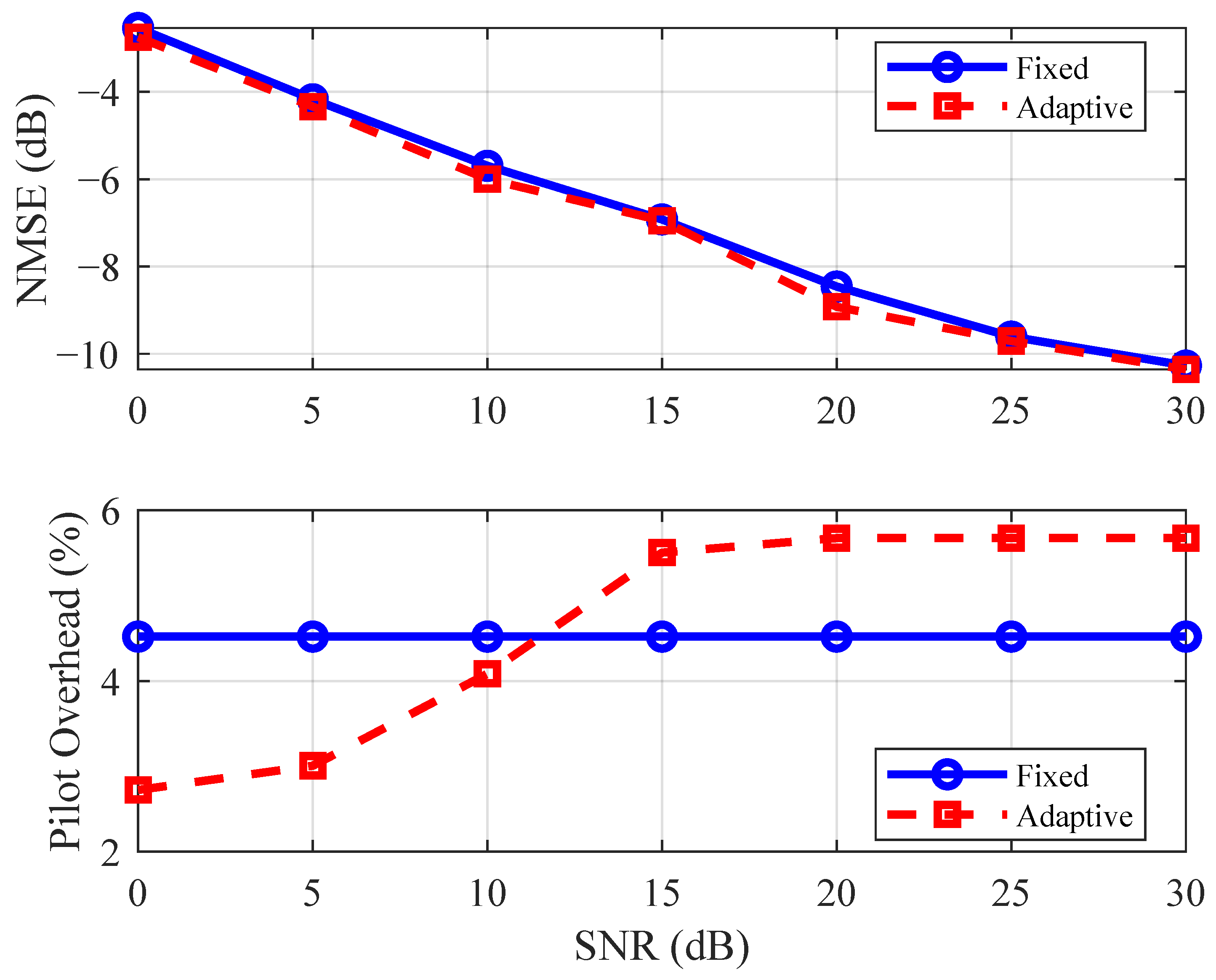
The results show that the benefit of adaptive pilot scheduling is highly scenario-dependent. The most favorable trade-off is obtained in the RA scenario, where the NMSE remains close to that of the fixed-pilot scheme while the pilot overhead is significantly reduced. In the CEA scenario, adaptive pilot insertion is still beneficial, but the overhead-saving gain gradually decreases as the SNR increases. By contrast, in the CA scenario, the adaptive scheme becomes less attractive because the pilot overhead approaches, or even exceeds, that of the fixed scheme, while the NMSE improvement remains limited.
In terms of channel estimation, GPR delivers the best NMSE in all scenarios, AR achieves moderate performance, and PCHIP is the most robust when pilot density is reduced. These results indicate that pilot scheduling and channel estimation should be jointly designed to achieve a favorable trade-off between estimation accuracy and pilot overhead in HSR-OFDM systems.
The remainder of this paper is organized as follows.
Section 2 presents the non-stationary wideband HSR channel model and the OFDM system configuration.
Section 3 describes the adaptive pilot-assisted mechanism and the three evaluated TDCE methods.
Section 4 analyzes the numerical results under the RA, CEA, and CA scenarios. Finally,
Section 5 concludes the paper.
4. Simulation Results and Discussion
Table 1 summarizes the main OFDM system parameters used in the simulations. To configure the HSR channel model, we adopt measurement-based PDP settings for the considered scenarios (RA/CEA/CA). In particular, the CA scenario represents the most dispersive condition, featuring the largest number of significant taps and the maximum delay spread
. For the CA scenario, the train-projected distance is set to
m with the initial value
m, and the Rician factor is set to
. The PDP is further used to determine the spacing between different confocal ellipses in the geometry-based stochastic model. Moreover, the initial AoA is set to
, and the angular spread is controlled by the von Mises concentration parameter
, while the movement angle is set to
. The train speed is set to
to represent a stringent high-mobility HSR condition with strong Doppler variation. This setting is also consistent with the adopted non-stationary HSR channel model [
27], whose reference ACF comparison is reported at 350 km/h with
. These parameters are used to generate the time-varying wideband HSR channel realizations for performance evaluation.
To ensure a fair comparison among the three estimators, performance is evaluated using the normalized mean square error (NMSE) of channel reconstruction. The NMSE is then defined as
where
and
are the true and estimated channel responses for the
l-th tap and the
m-th symbol.
To comprehensively evaluate the system performance, we employ both NMSE and SER (Symbol Error Rate) metrics to assess the end-to-end communication performance of the considered estimators. While NMSE quantifies the reconstruction accuracy of the estimated channel response, the SER reflects the practical impact of channel estimation on symbol detection. As a point of comparison, the DFT-LMMSE estimator is utilized as a robust baseline. This benchmark is selected because it effectively combines transform-domain denoising with LMMSE-based weighting, making it a well-established reference in OFDM channel estimation.
4.1. Discussion on Adaptive Pilot Results
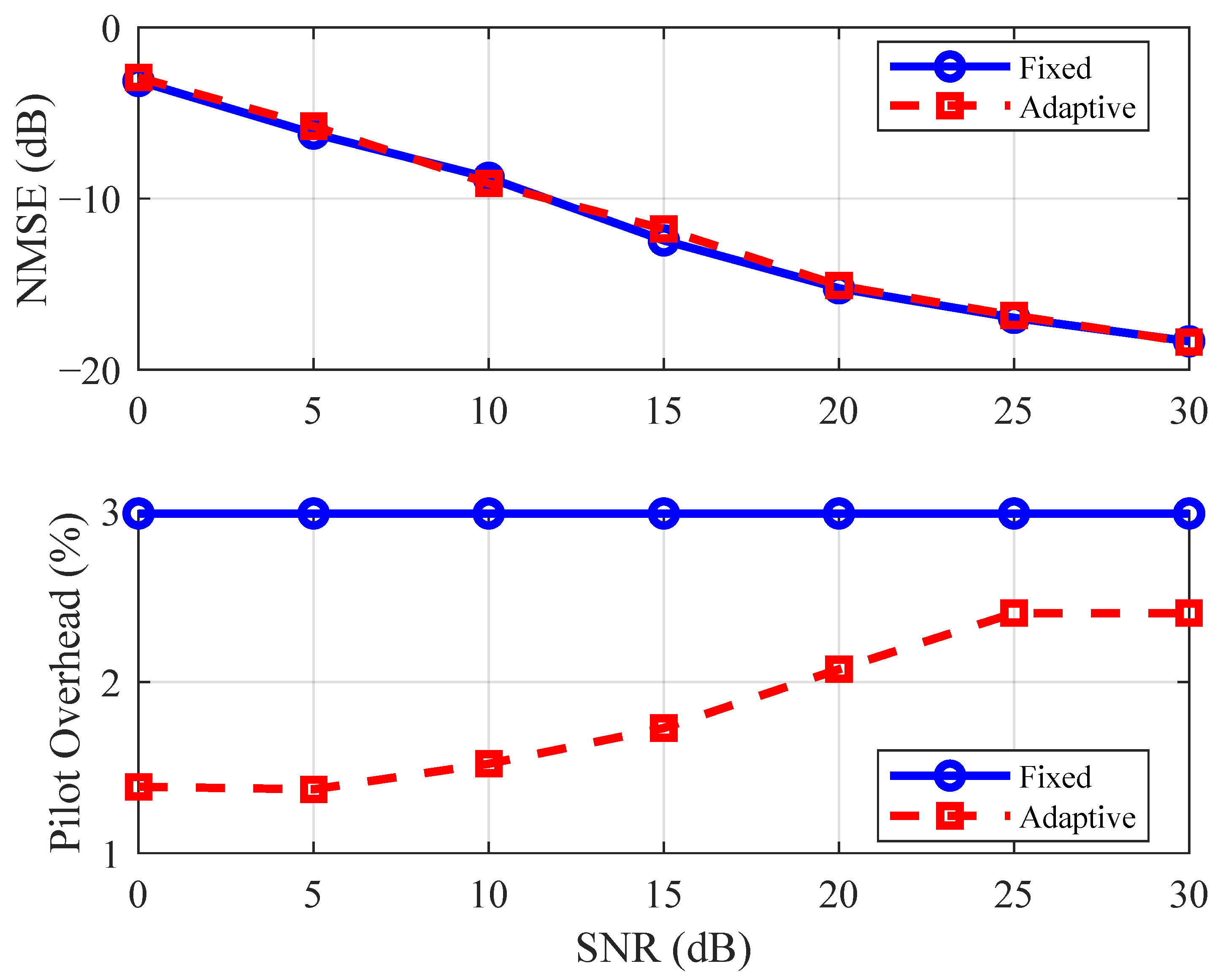
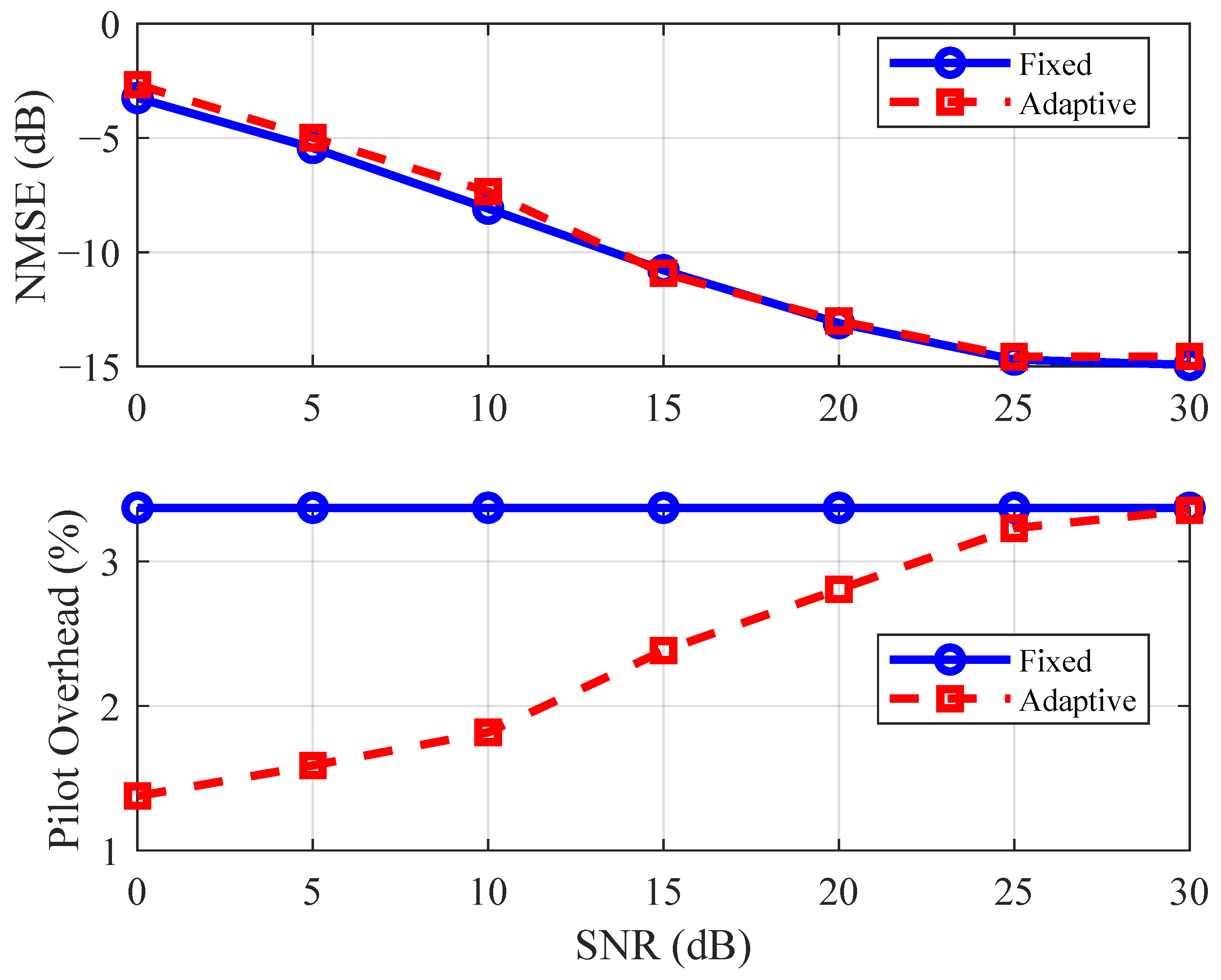
The results in
Figure 3,
Figure 4 and
Figure 5 indicate that the proposed CA-API scheme maintains NMSE performance close to that of the fixed-pilot baseline in all three scenarios, confirming its reliability in tracking channel state information (CSI). In terms of resource efficiency, the pilot overhead is adjusted according to the channel condition. In the RA scenario, the adaptive scheme achieves the most significant efficiency, keeping overhead between 1.4% and 2.4%, well below the 3% fixed baseline. This represents an overhead reduction of approximately 38%. In the CEA scenario, the benefit remains visible in the low-to-medium SNR regions but gradually diminishes as SNR increases. The average overhead reduction is approximately 30%. In the CA scenario, the CA-API scheme is forced to increase pilot density (up to 5.8% at 30 dB) to combat severe fast fading and strong ICI. Consequently, the pilot overhead of the adaptive scheme exceeds that of the fixed baseline (4.5%) in the high-SNR regime, indicating that the system prioritizes estimation stability over resource saving in extreme mobility conditions. Overall, by employing an innovation metric refined by LMMSE shrinkage, the proposed method can achieve a peak pilot-overhead reduction of up to
in the low-SNR region while preserving reliable estimation performance, particularly in RA and CEA environments.
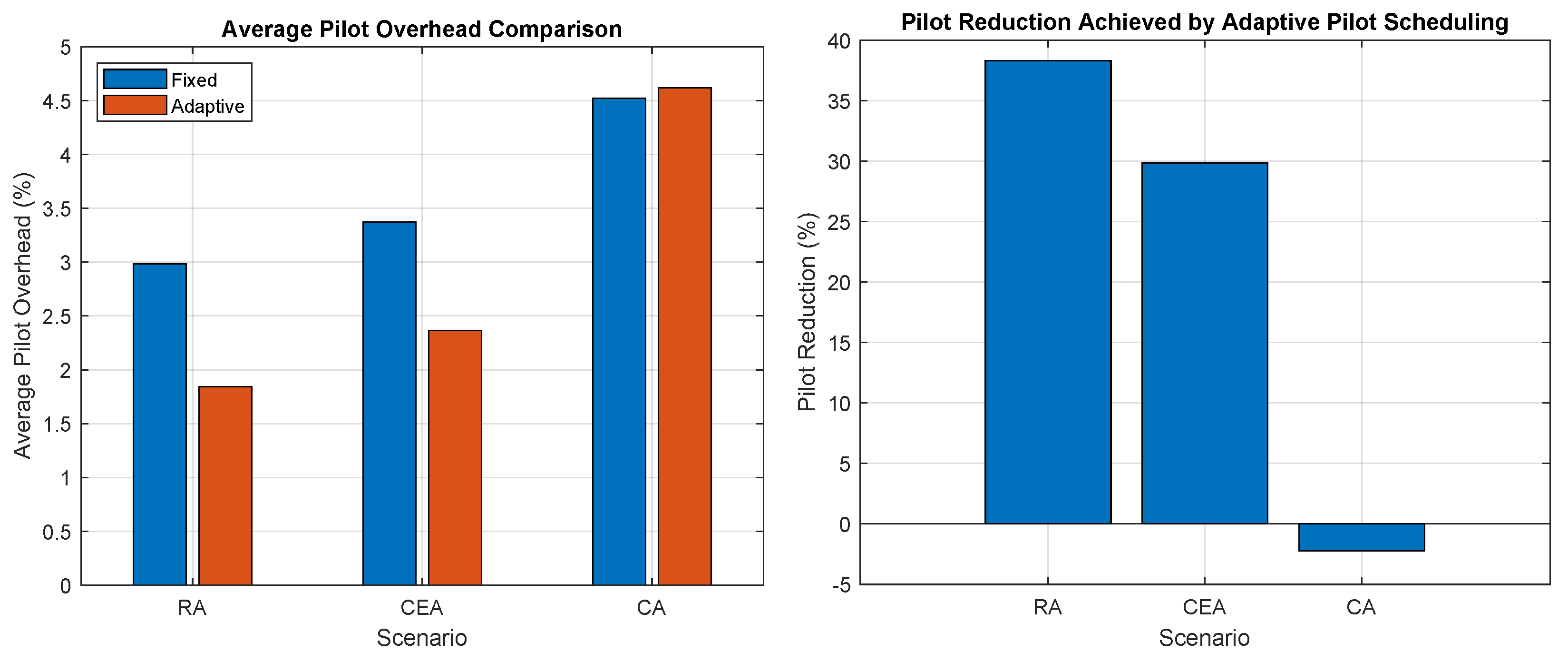
This trend is more clearly illustrated in
Figure 6, which compares the average pilot overhead across the three scenarios. Specifically, the average overhead of the adaptive scheme in the RA scenario is significantly lower than that of the fixed scheme, corresponding to an overhead reduction of about
. In the CEA scenario, the average overhead of the adaptive scheme is reduced by about
compared with the fixed scheme. Meanwhile, in the CA scenario, the average overhead of the adaptive scheme is slightly higher than that of the fixed scheme, by about
to
. These results confirm that adaptive pilot insertion is beneficial only when the pilot adjustment mechanism can effectively reduce the pilot density without causing a significant loss in estimation quality. In more challenging channel conditions, such as the CA scenario, the system is forced to increase the pilot density in order to maintain channel tracking capability, thereby losing the main advantage of the adaptive scheme.
Therefore, the proposed CA-API mechanism should not be viewed as an overhead-minimization scheme under all propagation conditions. In relatively stable environments such as RA and, to a lesser extent, CEA, it reduces pilot overhead while preserving estimation quality. Under the more dispersive CA condition, however, the adaptive controller shifts to a reliability-oriented mode and intentionally selects denser pilot insertion to maintain robust channel tracking.
4.2. Results and Discussion of Channel Estimation Algorithms
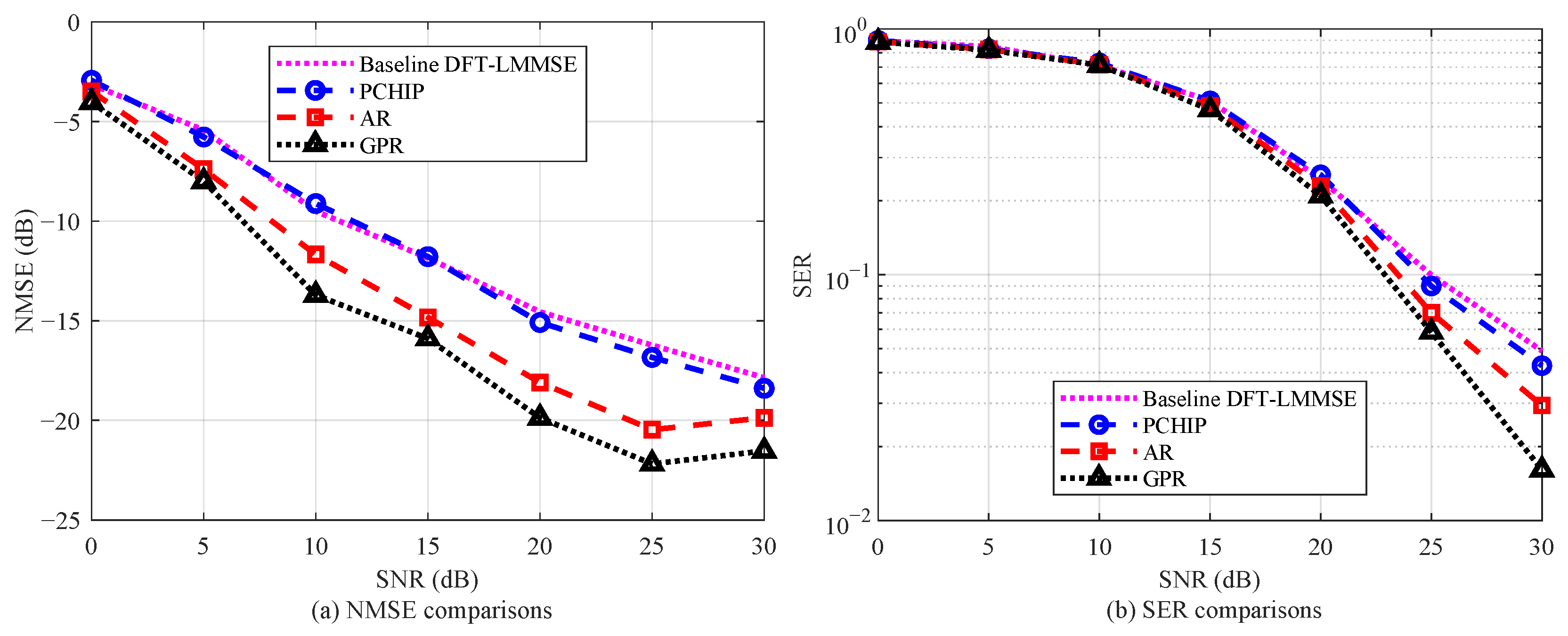
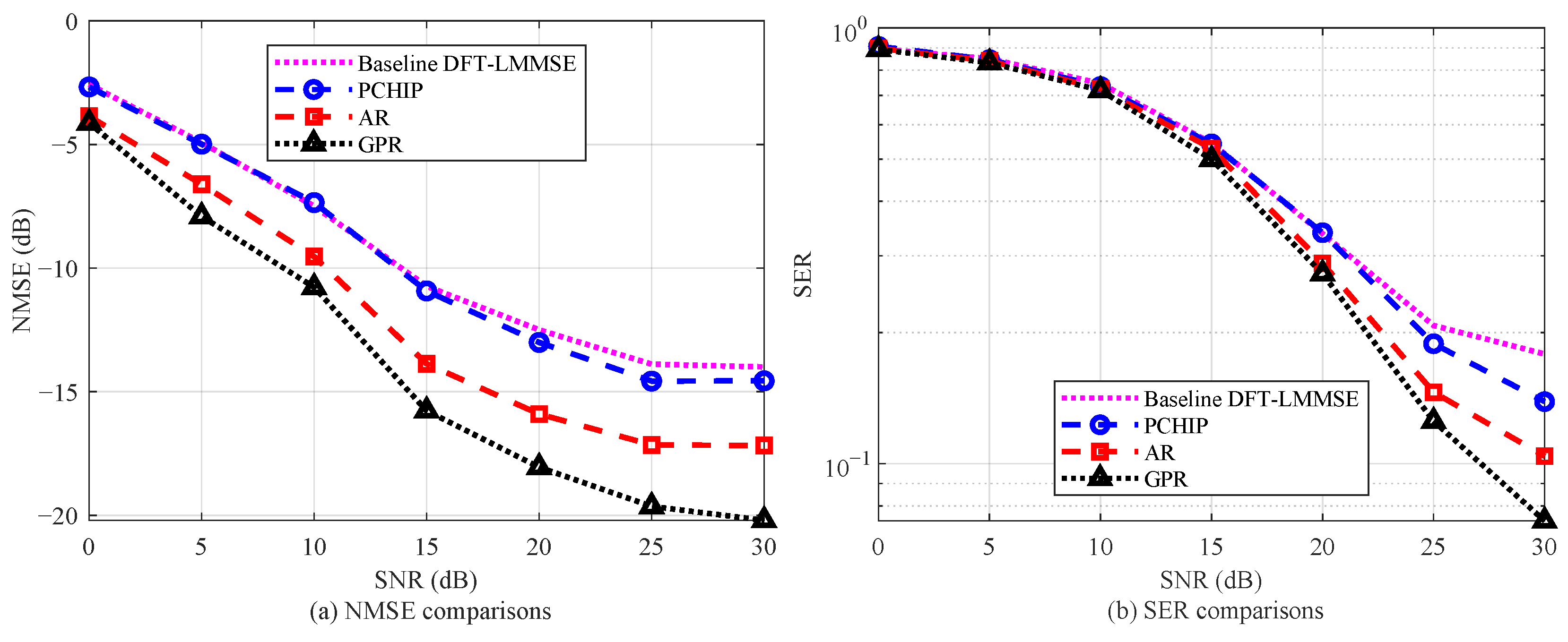
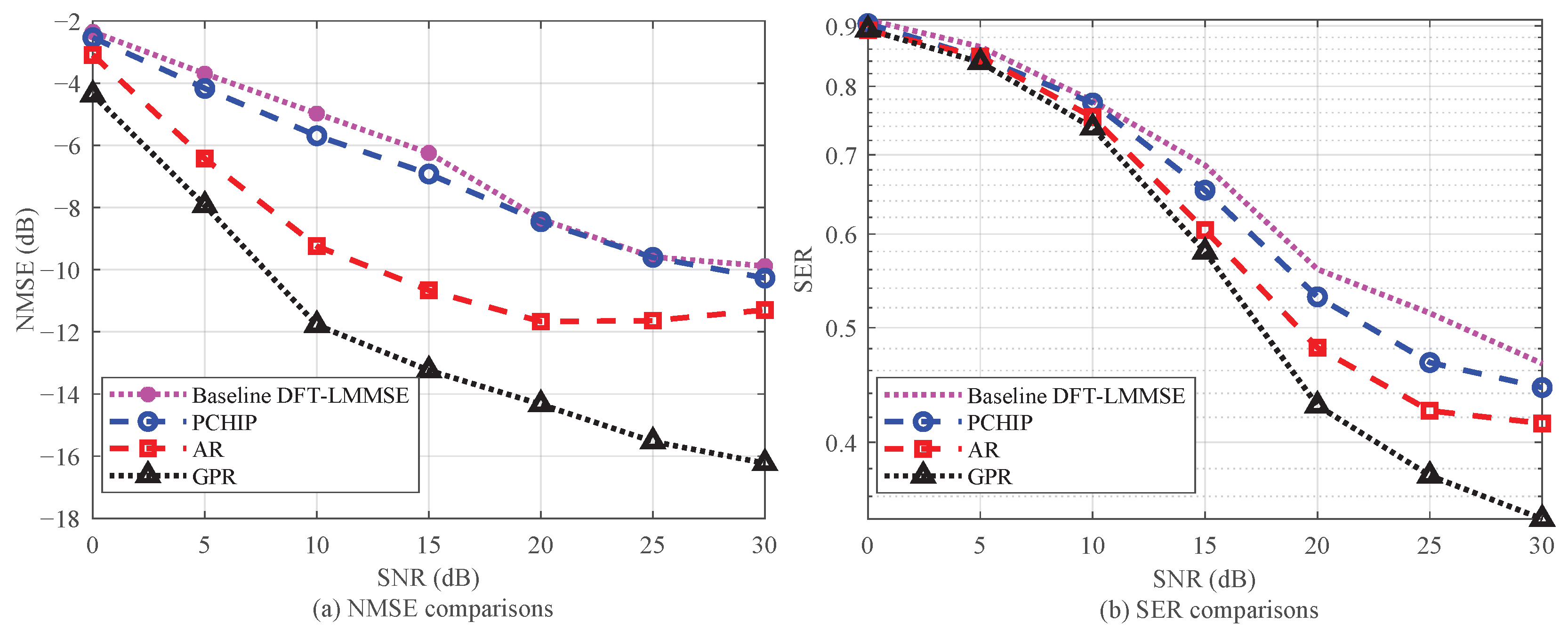
Figure 7,
Figure 8 and
Figure 9 illustrate the NMSE and SER performance of the considered channel estimation algorithms under the RA, CEA, and CA conditions, respectively. Along with the three time-domain estimators, DFT-LMMSE is included as a conventional baseline. Overall, consistent trends are observed across both reconstruction and communication metrics: GPR provides the best performance, AR yields intermediate results, and PCHIP remains competitive as a low-complexity solution, while DFT-LMMSE serves as a reliable conventional reference. These results indicate that exploiting temporal channel correlation is essential for accurate channel reconstruction in rapidly time-varying HSR environments. Since PCHIP primarily relies on local shape-preserving interpolation between pilot observations, its ability to capture fast channel fluctuations is limited. By contrast, AR enhances the estimation accuracy by tracking the symbol-to-symbol channel evolution, whereas GPR offers the most effective reconstruction due to its probabilistic regression capability and superior modeling flexibility.
In the RA scenario shown in
Figure 7, the evaluated algorithms exhibit a relatively stable separation across the SNR range. At low SNR, their NMSE values are closely aligned since the estimation accuracy is primarily noise-limited. However, as the SNR increases, the performance gap becomes more evident. At high SNR, GPR achieves an NMSE of approximately
dB, outperforming AR and PCHIP, which reach roughly
dB and
dB, respectively, whereas the DFT-LMMSE baseline delivers a comparable yet slightly lower precision. This result indicates that, even in a mildly varying channel, the statistical learning capability of GPR still offers a meaningful gain over both deterministic interpolation and linear prediction. AR also maintains a clear advantage over PCHIP and the DFT-LMMSE baseline, demonstrating that temporal modeling is already beneficial even when channel variation is not severe. The SER results confirm the same ranking, with GPR consistently achieving the lowest error rates across the entire SNR range. Furthermore, AR continues to surpass both PCHIP and DFT-LMMSE, while PCHIP performs similarly to the conventional baseline despite its significantly reduced structural complexity.
The superiority of GPR becomes more pronounced in the CEA scenario in
Figure 8. As the channel variation becomes more complicated, PCHIP begins to lose effectiveness more rapidly. This is particularly evident in the medium-SNR region (10 to 20 dB), where its NMSE curve exhibits a slower rate of improvement compared with those of AR, GPR, and the DFT-LMMSE baseline. By contrast, AR continues to track the channel evolution effectively, maintaining a moderate but consistent gain over PCHIP. GPR remains the best-performing method over the entire SNR range and achieves an NMSE of about
dB at 30 dB SNR, compared with roughly
dB for AR, about
dB for PCHIP, while the DFT-LMMSE baseline performs at a comparable yet slightly lower accuracy. The same ordering is also observed in SER results, where GPR achieves the lowest SER, AR outperforms both PCHIP and DFT-LMMSE, and PCHIP remains competitive despite its lower structural complexity. This behavior suggests that the CEA scenario already requires a more flexible estimator capable of describing non-stationary channel fluctuations beyond what deterministic interpolation can offer.
The CA scenario in
Figure 9 represents the most challenging case among the three evaluated environments. Under these conditions, the NMSE performance of all methods degrades compared with the RA and CEA scenarios, reflecting the impact of more rapid fast fading and severe channel dynamics. Nevertheless, GPR still demonstrates remarkable robustness and maintains superior performance across the entire SNR range. At an SNR of 30 dB, GPR maintains an NMSE below approximately
dB, whereas AR and PCHIP only achieve around
dB and
dB, respectively. Meanwhile, the DFT-LMMSE baseline exhibits comparable yet slightly inferior performance. Another notable observation is the performance saturation encountered by both PCHIP and AR at high SNRs, indicating that their reconstruction capability becomes the dominant limiting factor once the noise level is sufficiently reduced. In contrast, GPR preserves a significant estimation gain, implying that its kernel-based statistical structure is better suited to capturing the strong Doppler-induced temporal correlations inherent in this severe scenario. This ranking is further supported by the SER results, where GPR consistently achieves the lowest SER. Furthermore, AR outperforms both PCHIP and DFT-LMMSE, while PCHIP remains competitive despite its lower computational complexity. These findings further confirm that in the CA scenario, estimators that explicitly exploit temporal channel evolution offer a clear advantage over standalone transform-domain denoising, with GPR’s superiority evidenced in both NMSE and end-to-end communication performance.
Overall, the results in all three scenarios lead to two main conclusions. First, the relative gain of advanced estimators becomes increasingly visible as the SNR grows, because the impact of noise gradually diminishes and the intrinsic reconstruction capability of the algorithm becomes dominant. Second, the advantage of GPR becomes larger as the channel environment becomes more challenging, demonstrating its stronger adaptability to complex HSR propagation conditions in both NMSE and SER. Therefore, among the considered methods, GPR is the most effective channel estimator, the symbol-domain AR estimator provides a robust intermediate solution with better accuracy than interpolation and a clear advantage over the DFT-LMMSE baseline, and PCHIP mainly serves as a low-complexity benchmark, offering the simplest structure despite its weaker NMSE performance.
4.3. Computational Complexity Analysis
Table 2 summarizes the computational complexity of the considered channel estimation methods, including DFT-LMMSE as a conventional baseline along with the three TDCE methods. The complexity is expressed in terms of the number of pilot observations
, the number of channel taps
, the number of OFDM symbols
, and the number of reconstructed time-domain samples
. It should be noted that
Table 2 summarizes the dominant asymptotic order only. In particular, for GPR, the practical implementation cost is also affected by kernel evaluation, hyperparameter handling, repeated regression fitting, and memory usage, which are not fully captured by the simplified order expression alone.
For the three considered TDCE methods, PCHIP and AR have comparable computational order, whereas GPR is significantly more complex. Specifically, PCHIP reconstructs each channel tap directly from the pilot-domain samples over the full time grid, resulting in a complexity of . Similarly, AR first performs channel tracking on the OFDM symbol grid and then interpolates over the complete time grid, leading to . Meanwhile, GPR requires covariance matrix inversion for the pilot observations and prediction over the reconstructed samples, which yields a higher complexity of .
Although PCHIP and AR have the same asymptotic order, PCHIP remains the least computationally demanding method because it only performs direct interpolation over the reconstructed time grid. AR has a slightly higher practical cost due to the additional symbol-domain tracking stage before interpolation. Regarding the DFT-LMMSE baseline, a higher practical computational burden is observed compared with PCHIP, as it involves transform-domain processing and LMMSE-based filtering in conjunction with pilot-domain estimation. Its dominant complexity arises from FFT/IFFT operations and transform-domain weighting, denoted as in this simplified implementation. Notably, GPR is significantly more complex because of the covariance matrix inversion term , which becomes dominant when the number of pilot observations increases. Therefore, PCHIP is the most attractive choice for low-complexity implementation; AR provides a favorable balance between complexity and tracking capability, whereas GPR is better suited to accuracy-oriented settings where higher computational cost can be tolerated.
To complement the complexity analysis, the practical runtime of the evaluated estimators was assessed. For a fair comparison, all algorithms were evaluated under the adaptive pilot scheme in the RA scenario at SNR = 20 dB using identical simulation conditions. The average runtime per estimator call was ms for PCHIP, ms for the DFT-LMMSE baseline, ms for AR, and ms for GPR. These results are consistent with the theoretical complexity analysis. PCHIP is the most computationally efficient method, with a runtime slightly lower than that of the DFT-LMMSE baseline while providing comparable performance. AR incurs a moderate computational overhead, whereas GPR shows substantially higher latency due to the repeated regression fitting and prediction steps.
Although GPR achieves the best estimation accuracy, its direct implementation is computationally demanding due to covariance–matrix inversion and repeated regression fitting. Therefore, GPR is considered in this work mainly as an accuracy-oriented estimator rather than a lightweight real-time solution. Several lightweight GPR strategies, such as sparse approximations, inducing-point methods, nearest-neighbor GPR, and distributed/local approximations, have been reported to reduce the computational and memory burden of standard GPR [
32]. Integrating such accelerated GPR variants into the proposed HSR framework will be considered in future work.