1. Introduction
Modern electric power systems are undergoing significant transformation due to the increasing penetration of DG, renewable energy sources, and distribution network automation. Traditionally, medium-voltage (MV) distribution networks were designed as passive radial systems with unidirectional power flow from the primary substation to end consumers, and protection coordination in such systems was relatively straightforward, typically based on time-coordinated overcurrent relays, fuses, and automatic reclosing (AR) devices arranged along feeders [
1]. These schemes assume faults are supplied only from the primary substation and that power flows downstream, so relay settings and fuse–recloser coordination can be established once and remain valid over time [
2,
3].
However, the integration of DG changes the operating conditions of distribution networks, introducing bidirectional power flows and additional sources of short-circuit current (SCC), which complicates protection coordination and affects system reliability [
1,
4].
Particularly, additional fault sources and reverse currents injected by DG can cause protection blinding, false/sympathetic tripping, loss of selectivity, and fuse–recloser miscoordination [
2,
5]. Unsuccessful AR is reported when DG keeps feeding a faulted section [
3]. These issues may reduce both protection sensitivity and overall network reliability.
Automatic circuit reclosers are among the key devices used to improve reliability in radial distribution networks. They are widely applied in MV overhead feeders for sectionalizing, automatic fault isolation, and service restoration after transient faults. Since a large fraction (often >70%) of overhead distribution faults are temporary, AR significantly reduces interruption duration and improves reliability indices such as the system average interruption duration index (SAIDI), system average interruption frequency index (SAIFI), and energy not supplied (ENS) [
6,
7]. Numerous optimization-based studies show that proper placement and coordination of reclosers in radial systems significantly improve these indices and utility profit, often with modest investment, by isolating only the faulted section while maintaining supply to healthy sections of the network [
6,
8,
9].
In modern MV feeders, optimizing recloser placement solely for reliability without considering protection sensitivity can lead to counterproductive results, where actual protection failures offset theoretical reliability gains. Therefore, when DG is connected to radial distribution networks, protection coordination and recloser placement must be re-evaluated [
5]. The authors of [
10] used PowerFactory simulations to investigate how integrating DG of different types, sizes, and locations into a distribution network affects fault behaviour and recloser-fuse protection coordination. In [
11], it is demonstrated how a reverse power relay and a unidirectional SCC limiter can mitigate reverse power flow and increase fault current caused by DG in a 15 kV feeder model. A classification-based approach to evaluate and mitigate the impact of DG penetration on recloser–fuse coordination by adjusting recloser settings is presented in [
12], validated on the IEEE 37-node test feeder. In [
13], the authors assessed the effect of the photovoltaic (PV) generation penetration on the coordination of protection devices, using the IEEE 13-node test feeder. The paper [
14] analyzed the SCC contributions of small-scale PV inverters under grid-connected operation. Experimental tests of eight single-phase PV inverters and application to a real feeder show that, while their fault-current contribution is limited, massive penetration can alter relay operating times, with noticeable effects particularly for high-impedance faults [
14].
A significant body of research addresses optimal relay coordination in active distribution networks, often formulating the overcurrent coordination problem as a constrained optimization in which time-dial and pickup settings are chosen to minimize total operating time while maintaining primary-backup selectivity under different DG operating modes [
5,
15]. Parallel research addresses optimal DG placement and sizing with explicit protection-coordination constraints, so that DG penetration is maximized without violating existing relay settings [
11,
15]. The paper [
16] proposes a multi-objective optimization model for a simultaneous allocation of DG and control and protection devices in unbalanced power distribution systems to minimize costs and system losses, while enabling islanded operation. The approach introduced in [
17] uses a modified greedy optimization algorithm that automatically adjusts reliability weights at each iteration to determine the optimal placement and composition of switching and protective devices in overhead distribution networks. A methodology for the optimal allocation of reclosers in MV networks utilizing the bio-inspired Grey Wolf Optimizer to reduce system interruption indices is proposed in [
18].
The paper [
19] uses the hosting capacity concept to evaluate how increasing penetration of distributed energy resources affects over-current protection performance in radial distribution networks via an analytical method and simulations. The article [
20] proposes a self-adaptive protection system that automatically adjusts recloser time dial settings to improve fuse coordination and protection performance, demonstrating better coordination and performance than conventional protection through PSCAD simulations.
Previous studies have addressed relay coordination in networks with DG, optimal placement of generation units, and allocation of reclosers for reliability improvement. However, most existing studies consider reliability improvement and protection coordination separately. Only a smaller subset explicitly considers recloser placement with DG presence and reliability in a unified framework. For example, some formulations consider recloser optimization in radial systems with DG and bidirectional power flow [
6], and others jointly optimize DG and recloser locations under a composite reliability objective [
21]. Comprehensive reviews highlight that the combined problem of optimal recloser placement and permissible DG capacity, considering both reliability indices and protection sensitivity, is comparatively underexplored, relative to the large separate studies on DG allocation and sizing and on protection/reliability alone [
2,
5,
22].
While the existing literature [
6,
8] has explored recloser placement to improve reliability, these formulations often neglect the degradation of protection sensitivity caused by bidirectional power flows. For instance, refs. [
6,
9,
16,
18] use metaheuristics to find locations that minimize energy not supplied, but overlook the fact that high penetration of DG can lead to protection mal-operation. The method applied in [
4] optimizes DG sizing to minimize power losses, but ignores constraints on protection maloperation. The technique presented in [
12] is based on testing after placement and lacks optimization. Conversely, protection-focused studies often demand complex, hardware-intensive solutions. Particularly, using unidirectional fault current limiters, as suggested in [
11], adds significant capital cost to the network. Also, the work [
20] is focused on “self-adaptive protection”, which requires sophisticated intelligent electronic devices and communication infrastructure.
The objective of this paper is to develop a method for optimal recloser placement in radial distribution networks with DG, ensuring proper relay protection operation and maintaining acceptable reliability indices. The proposed approach is based on a multi-criteria objective function that includes reliability indices and protection sensitivity constraints, as well as analytical evaluation of SCCs in networks with DG. In contrast to some previous studies, it ensures protection robustness without requiring hardware-intensive solutions.
The main contributions of this work are
assessment of the impact of DG on fault currents in radial distribution networks;
classification and analysis of protection problems caused by DG;
development of a multi-criteria method for optimal recloser placement considering reliability indices and protection sensitivity;
determination of the critical DG capacity that preserves protection sensitivity.
The remainder of this paper is organized as follows.
Section 2 presents an analysis of the impact of DG on the operation of protection and switching devices in PDSs, including SCC analysis and protection coordination issues.
Section 3 describes the proposed methodology for optimal recloser placement and determination of permissible DG capacity.
Section 4 presents the case study and discusses the obtained results.
Section 5 extends the discussion, explains the limitations of the method and future work. Finally,
Section 6 concludes the paper.
2. Impact of Distributed Generation on Protection and Recloser Operation in Radial Distribution Networks
2.1. Reclosers in Distribution Networks
A recloser is a combination of a switching device (typically a vacuum circuit breaker), protection relay functions, AR logic, and communication equipment integrated into a single device. The sectionalizing capability of reclosers significantly improves reliability. When a fault occurs downstream of the recloser, only the consumers located after the device are disconnected, while upstream consumers remain energized. In addition, AR allows restoring supply after transient faults, which constitute the majority of faults in overhead lines (e.g., conductor contact due to wind, lightning, or temporary insulation breakdown). After tripping, the recloser performs one or several AR attempts. If the fault is transient, the line remains energized; otherwise, the recloser locks out and waits for manual intervention [
23].
Modern reclosers are equipped with microprocessor-based protection terminals that provide several protection and automation functions, including time-delayed overcurrent protection, instantaneous overcurrent protection, undervoltage protection, and AR [
23]. They can be integrated into distribution automation systems via SCADA using communication protocols such as IEC 60870-5-104 [
24] or Modbus, enabling remote control, monitoring (e.g., of current and voltage), and adaptive protection settings.
2.2. Short-Circuit Currents with Distributed Generation
The integration of DG fundamentally changes the operating conditions of distribution networks: it can contribute to fault currents and alter both the magnitude and direction of current flows during faults. As a result, protection devices may operate incorrectly or lose sensitivity.
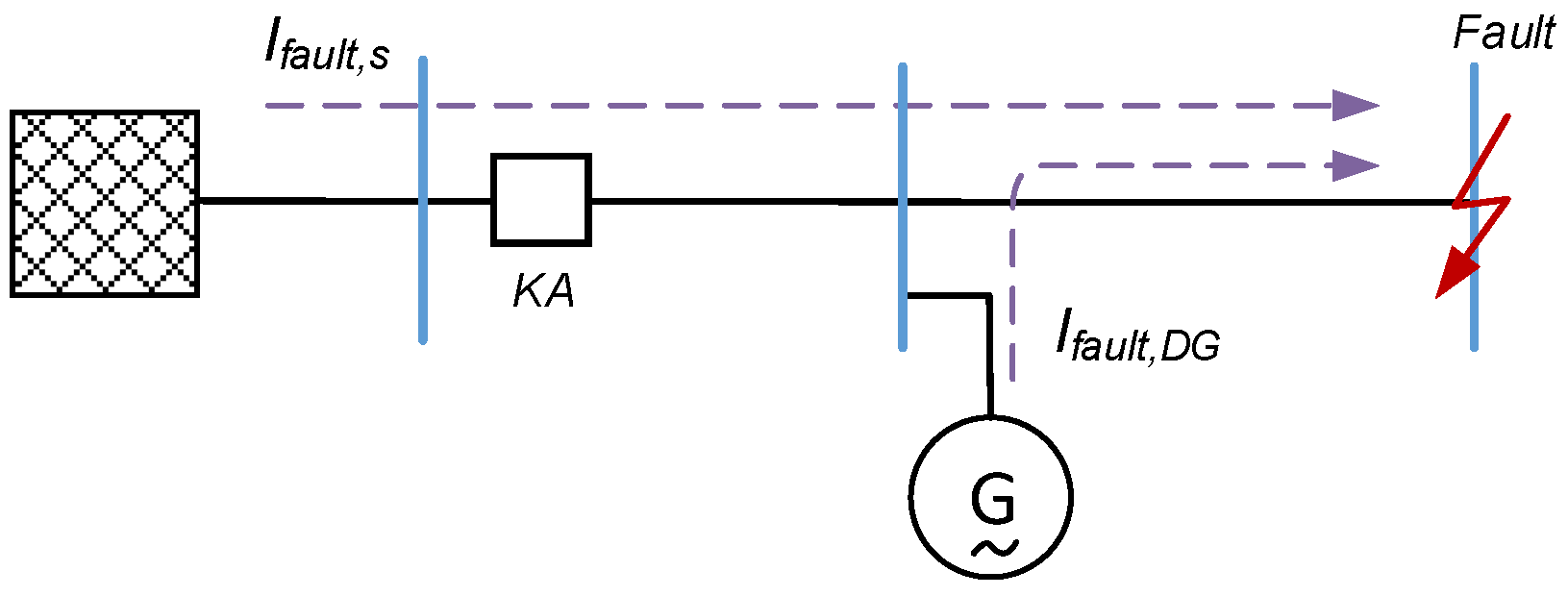
The impact of DG on protection systems is primarily related to changes in SCCs. When a DG is connected to a feeder between the substation relay, KA, and the fault location, the total fault current becomes the sum of the contributions from the utility system and the DG, as shown in
Figure 1. Depending on the generator’s location and capacity, this can either increase or decrease the fault current seen by a particular protection device.
For a fault at the location shown in
Figure 1, the total SCC,
, can be expressed as:
where
is the portion of the SCC feed from the system;
is the portion of the SCC feed from the DG.
Different types of DG have different impacts on SCCs. Synchronous generators provide sustained fault current contributions and significantly affect protection coordination. Induction generators contribute to fault current only for a short period due to rapid demagnetization. Inverter-based generators, such as PV systems, usually limit fault current to levels close to the rated current and therefore have a smaller impact on SCCs, although they can still affect protection operation in weak distribution networks. Steady-state fault current values for grid-connected PV inverters are commonly modelled in the range of 1–3 p.u. [
14].
2.3. Protection Blinding
Protection blinding occurs when the contribution of DG reduces the fault current seen by an upstream protection device. When a DG is connected as in
Figure 1, part of the fault current is supplied locally by the DG. Consequently, the current contribution from the utility system,
, decreases. Due to this reduction, the current through the upstream relay KA may never reach the pickup current setting, leaving the fault undetected.
Overcurrent relays and reclosers are designed to detect abnormal current levels. Therefore, any protection system based on overcurrent detection may fail to operate correctly when the current contribution from the main grid decreases due to DG. This phenomenon, known as protection blinding, falls under the category of fault detection problems.
Protection blinding is particularly likely when
the distributed generator is located between the substation relay and the fault,
the feeder is long and has high impedance,
the minimum fault current at the feeder end is close to the relay pickup current,
the distributed generation capacity is large relative to the feeder load.
2.4. Sympathetic Tripping (False Tripping)
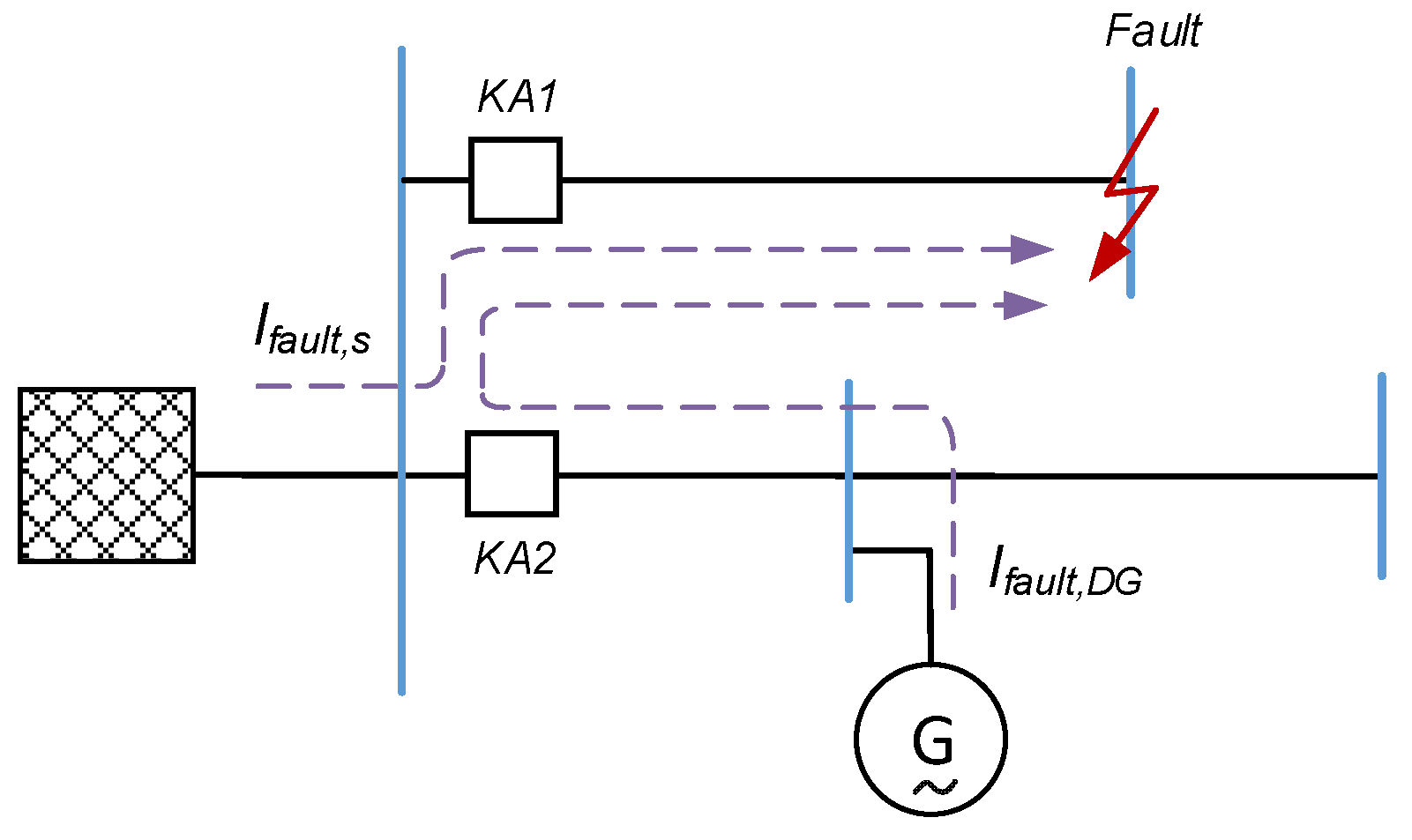
Sympathetic tripping, also referred to as false tripping, may occur when a generator installed on one feeder contributes to a fault on a neighbouring feeder connected to the same substation [
14]. In this case, the SCC contribution from the DG may exceed the pickup current of the overcurrent relay on the healthy feeder. As a result, the feeder with the DG may be disconnected instead of the feeder where the fault actually occurred, or it may trip before the protection on the faulted feeder operates [
19]. This mechanism belongs to the category of protection selectivity problems. The principle of the sympathetic tripping is shown in
Figure 2.
The influence of a generator on fault current is particularly significant when the generator and/or the fault location are close to the substation. In weak distribution networks with long feeders and relatively low fault currents at the feeder ends, sympathetic tripping is more likely. In such networks, relay settings must be sensitive enough to detect faults at the end of the feeder, which results in relatively low pickup current settings and increases the risk of false tripping.
In some cases, sympathetic tripping can be mitigated by adjusting relay settings. In practice, this usually means increasing the relay operating time rather than increasing the pickup current [
1]. Increasing the pickup current reduces the sensitivity of the feeder protection and may result in failure to detect faults at the feeder end. Therefore, increasing operating time improves protection selectivity but may reduce the speed of fault-clearing.
If selectivity cannot be achieved by adjusting relay settings, applying directional overcurrent protection can solve the problem. However, directional sensing is more complex, more expensive, and typically not a standard solution in many distribution networks.
2.5. Recloser Operation Problems in Networks with Fuses and Distributed Generation
Due to coordination between reclosers and fuses, temporary faults are cleared selectively without unnecessary fuse operation. However, the integration of DG into feeders protected by reclosers and fuses introduces several protection problems simultaneously [
17,
22]:
DG affects SCCs due to its fault current contribution, which may lead to fault detection problems during reclosing operations;
coordination between reclosers and fuses may be disrupted, resulting in protection selectivity problems.
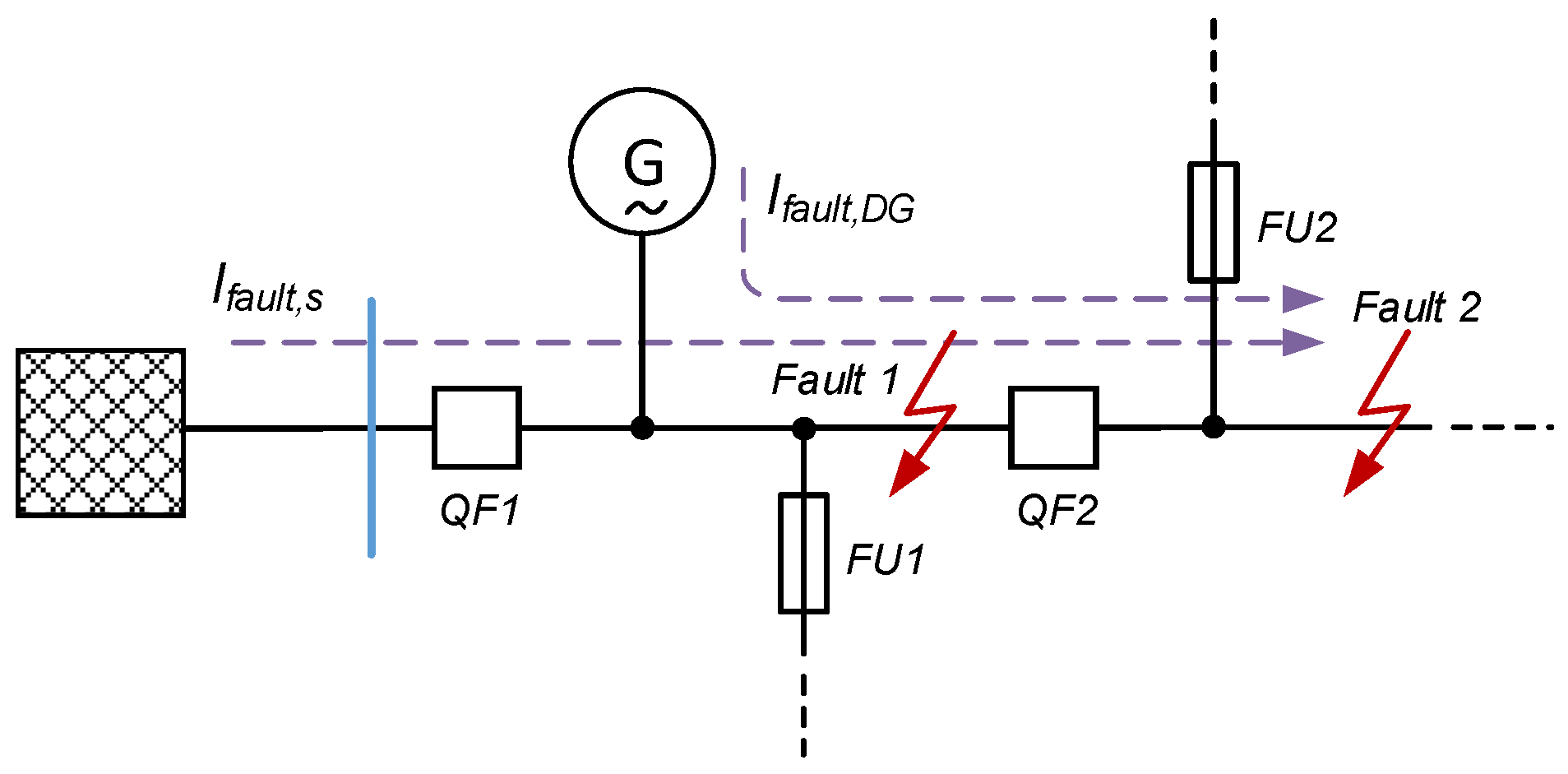
The emergence of a fault detection problem during reclosing operations can be explained with
Figure 3.
For Fault 1, the total fault current, , can be determined by Formula (1). For this fault location, the current flowing through the recloser QF1 is only the current contribution from the utility system. As discussed earlier, the system contribution decreases due to the presence of DG, potentially leading to delayed fault detection or even failure to detect it.
For Fault 2, the fault current through recloser QF2 is the total fault current, which is higher than the current through QF1. Since most reclosers use inverse time-current characteristics, coordination between QF1 and QF2 can still be maintained in this case.
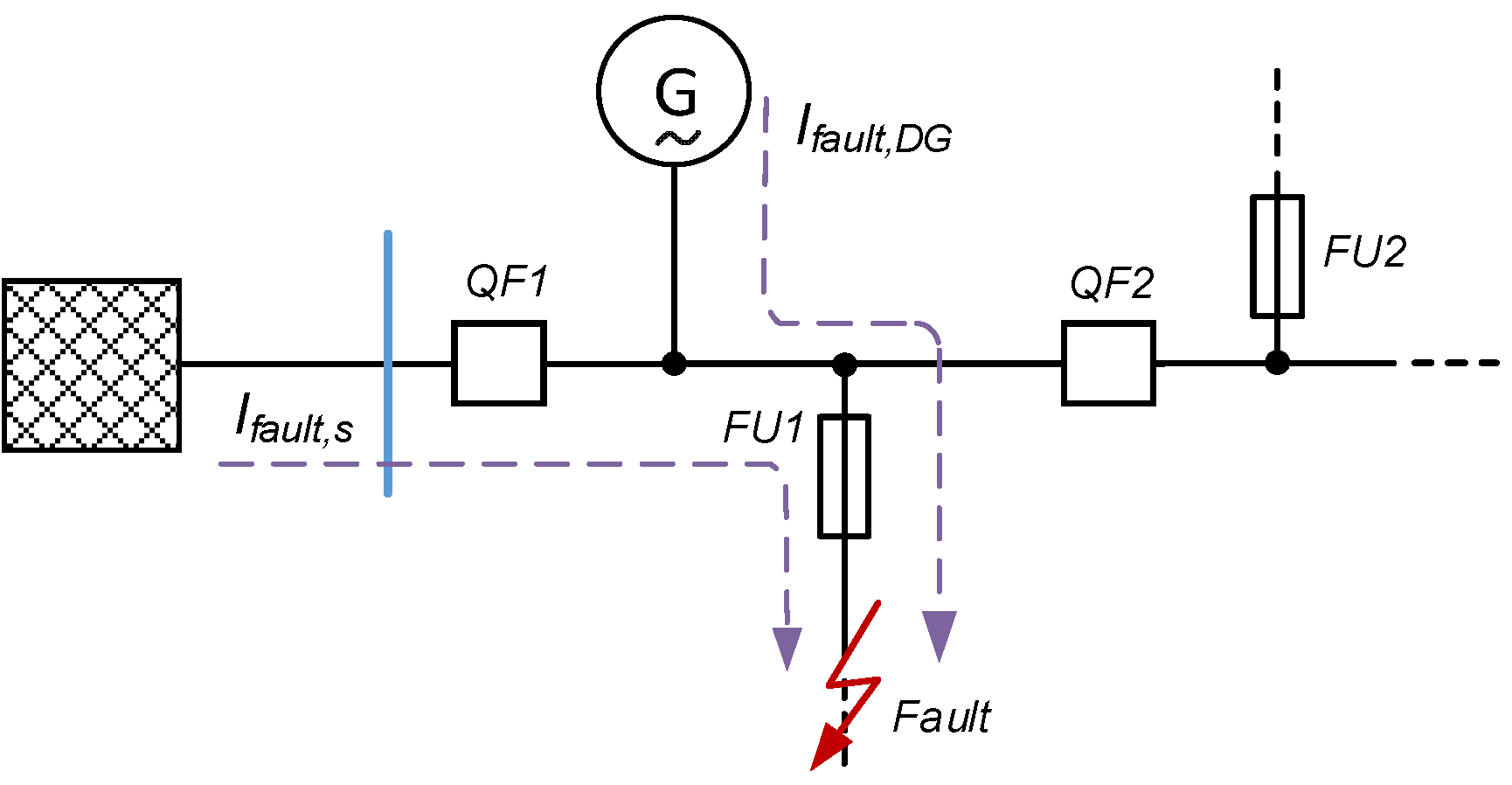
Possible coordination problems between a fuse and a recloser can be explained with
Figure 4.
Under normal coordination conditions, the fuse and recloser are coordinated such that:
where
and
are the minimum and maximum SCCs at the end of the protected zone, respectively.
When DG is connected, the total fault current may increase above the coordination limit:
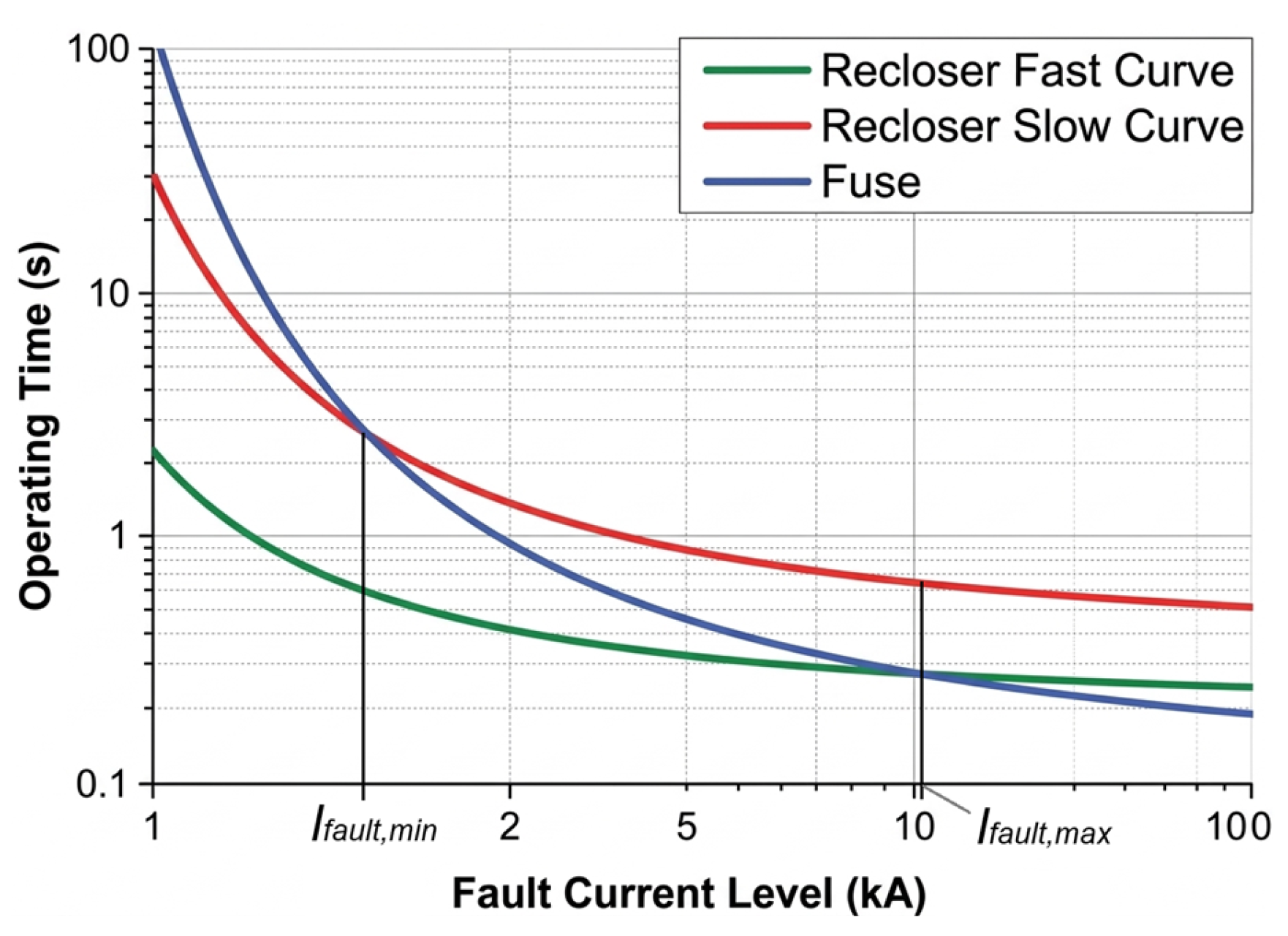
In this case, the fuse time-current characteristic curve may lie below the recloser curve, causing the fuse to operate before the recloser, as shown with the example selectivity curves in
Figure 5. As a result, faults that could have been cleared by the recloser QF1 and AR will instead be cleared by the fuse FU1, leading to unnecessary fuse operation and longer supply interruptions.
In addition to fault detection and coordination problems, DG may also cause unsuccessful reclosing or out-of-synchronism reclosing. During the reclosing dead time, part of the feeder is disconnected from the main system to allow arc deionization. However, a connected DG may continue operating and feeding the fault. Furthermore, due to an imbalance between local load and generation, the generator may lose synchronism with the main grid. Reclosing under out-of-synchronism conditions may cause severe mechanical stress on rotating machines and high transient currents and voltages in the network [
17].
A summary classification of protection problems caused by DG is provided in
Table 1.
2.6. Solutions and Alternative Protection Methods
Protection problems associated with DG can be mitigated using several approaches, including adaptive protection, directional protection, improved recloser–fuse coordination, fast disconnection of distributed generators, and islanding detection methods.
2.6.1. Mitigation of Selectivity and Detection Problems
Fault detection and selectivity issues depend strongly on the number, capacity, and location of DG units, as well as the network’s short-circuit strength. A conventional approach to maintaining protection sensitivity is the adjustment of relay and recloser settings. Since DG reduces the fault current contribution from the upstream network, relay pickup currents are often lowered to ensure fault detection.
However, reducing pickup currents may increase the risk of sympathetic tripping and compromise overall protection selectivity, particularly in weak networks where even small DG units can significantly affect fault current levels [
22].
One possible solution is the introduction of an additional time delay in feeders with DG, allowing protection devices on the faulted feeder to operate before adjacent feeders are disconnected [
25]. While this improves selectivity, it may increase fault clearing times.
A more advanced approach is adaptive overcurrent protection, in which relay settings are continuously adjusted according to the operating conditions of DG units. In this scheme, the pickup current is modified as a function of DG output power, thereby maintaining protection sensitivity while reducing the likelihood of false tripping. Adaptive protection is considered a promising solution for networks with high DG penetration.
2.6.2. Improvement of Fuse–Recloser Coordination
The presence of DG may disrupt coordination between reclosers and downstream fuses due to changes in fault current magnitude. To restore coordination, modern microprocessor-based reclosers can be configured with multiple time-current characteristic curves.
Typically, reclosers operate using both fast and slow tripping characteristics. The fast characteristic is coordinated with downstream fuses and is applied during the first tripping operation to clear transient faults without unnecessary fuse operation. During subsequent reclosing cycles, the recloser switches to a slow characteristic coordinated with downstream protection devices, enabling selective fault clearing [
26].
An alternative approach involves limiting the fault current contribution from DG or modifying feeder protection schemes. In some cases, fuses in sections with DG are replaced with reclosers, allowing improved coordination. The reclosers are then coordinated such that the device closest to the DG operates first, reducing the impact of DG on upstream protection devices.
Another effective solution is the fast disconnection of DG during fault conditions. Rapid DG isolation restores the network to a radial configuration and prevents adverse effects on protection coordination. This approach is supported by interconnection standards such as IEEE 1547 [
27], which require DG disconnection under abnormal conditions [
28]. Fast disconnection can be achieved using high-speed switching devices, enabling DG to be isolated before fuse or recloser operation.
2.6.3. Prevention of Out-of-Synchronism Reclosing and Islanding
Out-of-synchronism reclosing is one of the most critical issues in networks with DG, particularly in feeders protected by reclosers. This phenomenon is closely related to unintentional islanding.
During the reclosing dead time, a section of the feeder may remain energized by DG while disconnected from the main grid, forming an islanded system. If there is a mismatch between local generation and load, voltage and frequency may deviate from acceptable limits. Reclosing under such conditions may result in severe transient currents and mechanical stress on equipment. To prevent this, DG must be disconnected before reclosing. Therefore, reliable and fast islanding detection is essential.
Islanding detection methods can be classified into three main categories [
28,
29]:
Passive methods, which monitor local electrical parameters such as voltage, frequency, and harmonic distortion. A widely used example is Rate of Change of Frequency (RoCoF) protection. While effective under significant power imbalance, passive methods may fail when generation and load are closely matched.
Active methods, which introduce controlled disturbances into the system and observe the response. These methods can detect islanding even under balanced conditions, but are generally slower due to their reliance on system dynamics [
28].
Communication-based methods, which use signals exchanged between the utility and DG units. For example, breaker status information or communication signals transmitted via SCADA or power line carrier (PLC) can be used to trigger DG disconnection. These methods are highly reliable but require additional communication infrastructure [
28].
Different causes of protection problems and possible solutions are summarized in
Table 2.
3. Methodology
3.1. Optimization Task Formulation
When implementing targeted reliability improvements, the number and duration of customer interruptions are commonly used as the primary performance criteria. Optimization is typically formulated as the minimization of reliability-related indices for specific groups of customers. In this study, the optimization parameters are defined for individual load points along the feeder section using the following methodology.
The proposed method requires standard network data available to distribution system operators (DSOs), including feeder topology, impedance parameters, load data, protection settings, and DG characteristics. The optimization is performed by evaluating candidate recloser locations and DG capacities using analytical fault-current calculations and protection sensitivity criteria. The computational complexity is low and scales linearly with the number of network segments, allowing application to larger systems through selective evaluation of candidate locations or network reduction techniques.
Consider a radial distribution network with a set of nodes , a set of lines , possible recloser installation locations ⊂ , and possible DG connection locations ⊂ .
For this network, it is required to determine the following:
the optimal recloser placement r ∈ ,
the permissible DG capacity, PDG ∈ ,
So as to minimize reliability indices and ensure correct protection operation.
The total annual energy not supplied is calculated with the formula
where ω
0 is the average failure rate of 10 kV overhead lines (failures per 100 km per year);
T is the average restoration time for a single sustained fault;
Li is the length of the branch of a feeder upstream the
i-th node;
Sl,i is the apparent power consumption at the
i-th node; cosφ
l,i is the power factor at the
i-th node;
kl,i is the load factor at the
i-th node.
The number of consumer outages per year, 1/year, is determined by the system average interruption frequency index:
where
Ni is the number of customers affected by the
i-th interruption event.
The duration of consumer outages per year, hours/year, is determined by the system average interruption duration index:
In a distribution network protected with a recloser, a protection sensitivity margin can be calculated as
where
is the recloser pickup current.
The analysis of fault current dependencies complements the optimization by providing insight into the protection-constrained DG hosting capacity. The critical DG capacity,
, is determined from the boundary condition:
This yields an analytical expression for the maximum admissible DG capacity that preserves protection sensitivity.
A multi-criteria objective function is proposed for optimization:
where
and
are the ENS and SAIDI for the base case scenario;
is the binary penalty function for violation of sensitivity or selectivity of the relay protection system:
where
δ is the minimum acceptable sensitivity margin.
The penalty function is introduced enforce protection-related constraints within the optimization. In practical implementation, for a given recloser location r and DG capacity PDG, the minimum fault current is calculated. This is the lowest anticipated SCC (usually at the end of a radial feeder), used to ensure protective devices trip. The protection sensitivity margin is computed using (7). If , the configuration is considered feasible and . Otherwise, the configuration is infeasible and , resulting in an increased value of the objective function.
Since the objective function combines criteria with different physical units and magnitudes, normalization is embedded in (9) to ensure comparability of the terms and meaningful weighting.
The overall optimization task is
subject to
3.2. Optimization Procedure
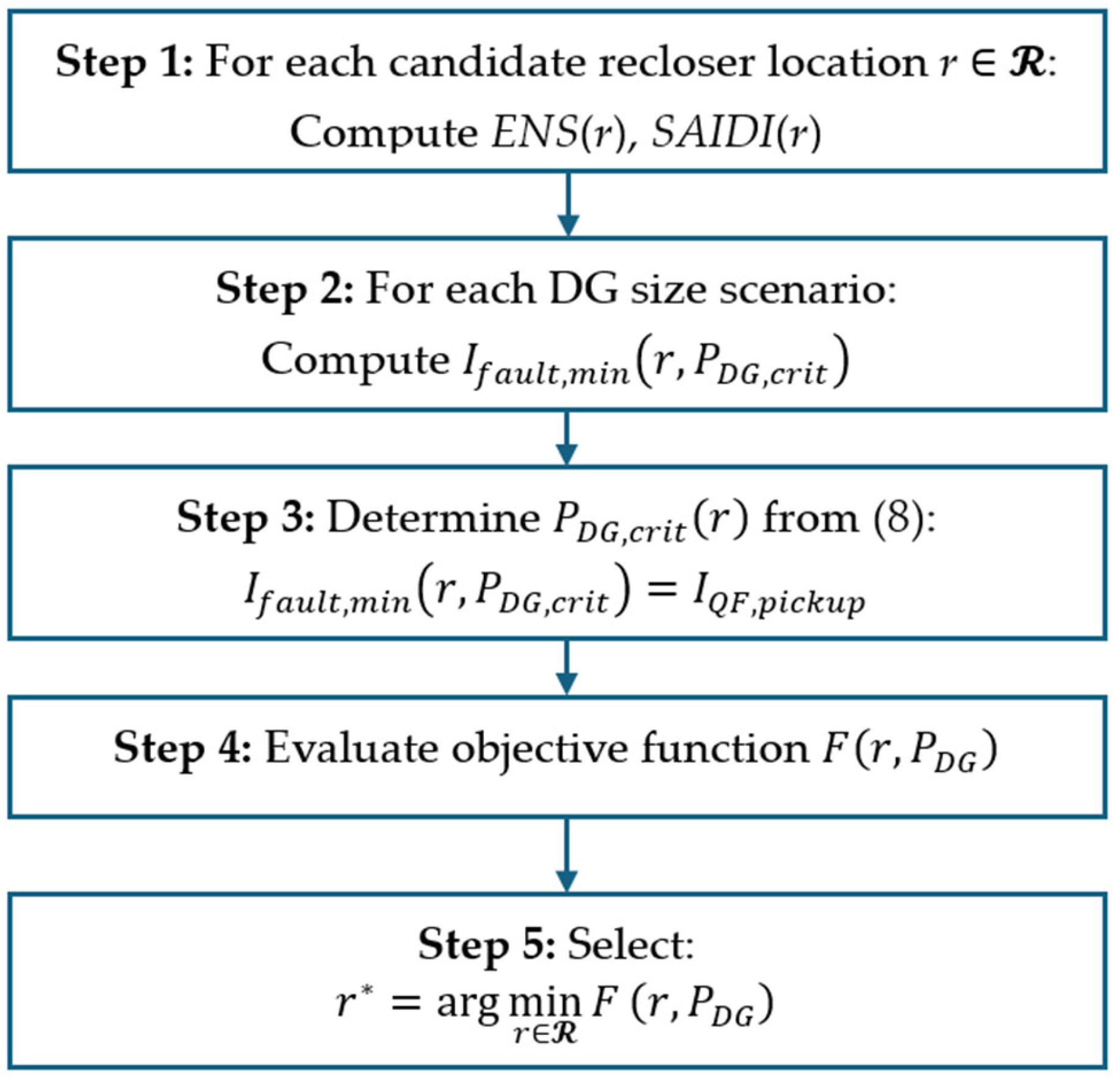
The formulated problem (9) represents a coordinated optimization task, in which both the recloser location and DG capacity influence protection performance and reliability indices. Although this problem can be solved as a simultaneous (co-optimization) task, such an approach increases computational complexity and reduces the transparency of the results. In this work, the optimization procedure is performed in a sequential manner and consists of three main stages: (1) determining an initial optimal location for recloser placement; (2) determining the critical DG capacity and comparing it with the planned DG capacity; (3) calculating the objective function and updating the optimal recloser location, if necessary. In this formulation, the DG size can be a scenario parameter in the first stage, while its admissible value is evaluated in the second stage based on protection sensitivity constraints. This approach is engineeringly justifiable and readily implementable in practical system planning by DSOs.
If a DG of a particular capacity must be deployed (connected to the grid), the task of a DSO would be to evaluate the objective function for all candidate recloser locations
r ∈
to determine the optimal location:
From the condition (8),
can be obtained by solving the equation for the minimum fault current with respect to the DG power. Since the fault current depends on the system impedance,
, line impedance,
, and DG internal impedance (which is related to DG capacity), the function can be expressed as
The feasible region of the optimization problem is defined by the condition (12).
The proposed analytical derivation of
offers several advantages over some existing methods. In contrast to a hardware-centric approach that relies on expensive fault current limiters [
11], this method takes a planning perspective and requires no additional capital expenditure. This is more cost-effective for utilities with limited budgets. Additionally, while reliability-focused models [
6,
8] identify limits through computationally expensive iterative simulations, the analytical solution establishes a direct mathematical relationship between protection sensitivity and permissible DG penetration. Therefore, the computational intensity is lower.
4. Case Study and Results
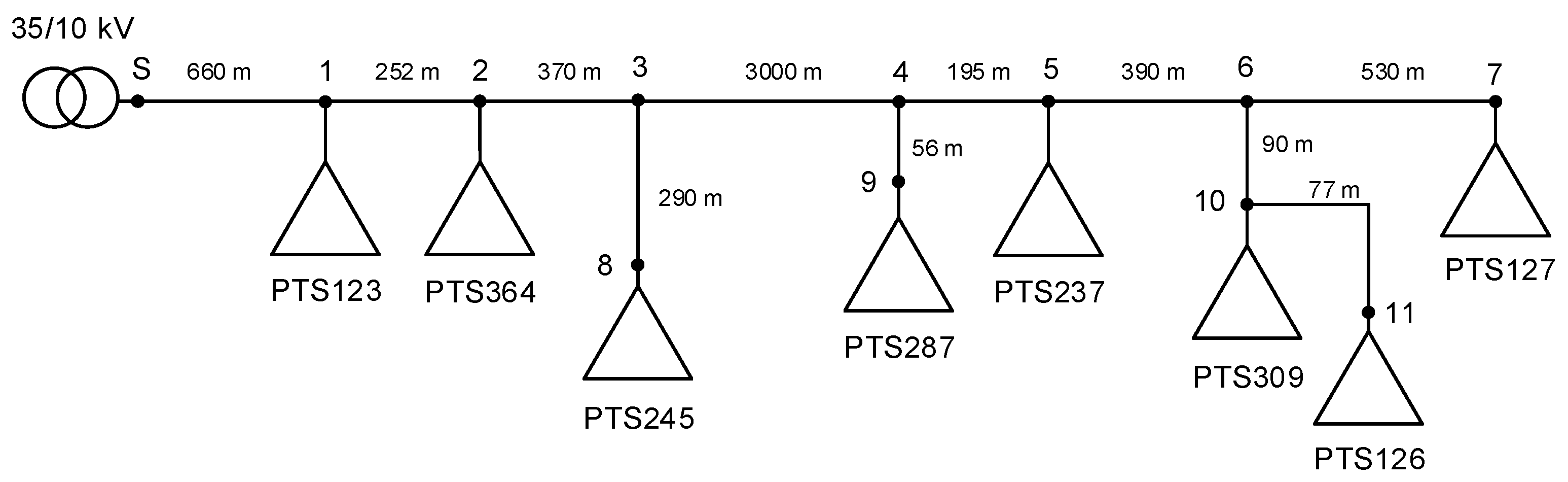
A 35/10 kV rural distribution network is selected as the case study. The network consists of seven branches and eight 10/0.4 kV portable distribution transformer substations supplying a variety of loads, including residential, industrial, and public consumers. The single-line diagram of the network is presented in
Figure 7.
Based on the existing network data, the following input values are used: ω0 = 25, T = 6 h, the total feeder’s load, Stot = 509.64 kVA, cosφl = 0.92, and kl = 0.95. The assumed sensitivity margin is δ = 0.2. The network is protected by a current relay, KA, installed after the 35/10 kV substation, with a pickup current of 0.79 kA. A recloser, QF, is assumed to be installed on the main feeder, in a line segment between buses S and 7.
The weighting coefficients in the objective function are selected to reflect the relative importance of reliability and protection performance in distribution system operation. A higher weight is assigned to ENS (
w1 = 0.5), as it directly corresponds to economic losses. SAIDI is given moderate importance (
w2 = 0.3), as it reflects customer interruption duration and service quality. A lower weight is assigned to the protection penalty term (
w3 = 0.2), as it is a constraint enforcement mechanism rather than a performance metric. The robustness of this selection is further verified through sensitivity analysis in
Section 5.
The case study follows the sequential optimization procedure described in
Section 3. To account for the recloser’s fault isolation effect, interruption indices are first calculated separately for upstream and downstream consumers. The system-wide SAIFI and SAIDI values are then obtained by combining these contributions based on the number of affected consumers.
The baseline scenario corresponds to the network configuration without additional sectionalizing devices or DG. In this configuration, a fault on the main feeder causes an outage of all downstream customers, resulting in high ENS values.
The optimization algorithm was then applied to determine the optimal locations for recloser installation and DG placement. First, reliability indices were calculated for different recloser locations, and the results are summarized in
Table 3. The third column shows the percentage reduction in ENS compared to the baseline for each recloser location.
In the next step, scenarios with different DG locations are evaluated. A gas-fired DG unit equipped with a synchronous generator is considered, as such units are commonly used for backup and emergency power supply. The DG is characterized by a SCC ratio of 5.0 p.u. and a power factor of 0.9. It is assumed that the unit can be
The distribution network protection is calibrated based on a symmetrical fault at bus 7. With the integration of DG, the total fault current consists of two main components: the contribution from the utility system, , and the contribution from the DG unit, . The analysis indicates that the total fault current, , increases as the DG unit is installed closer to the feeder end.
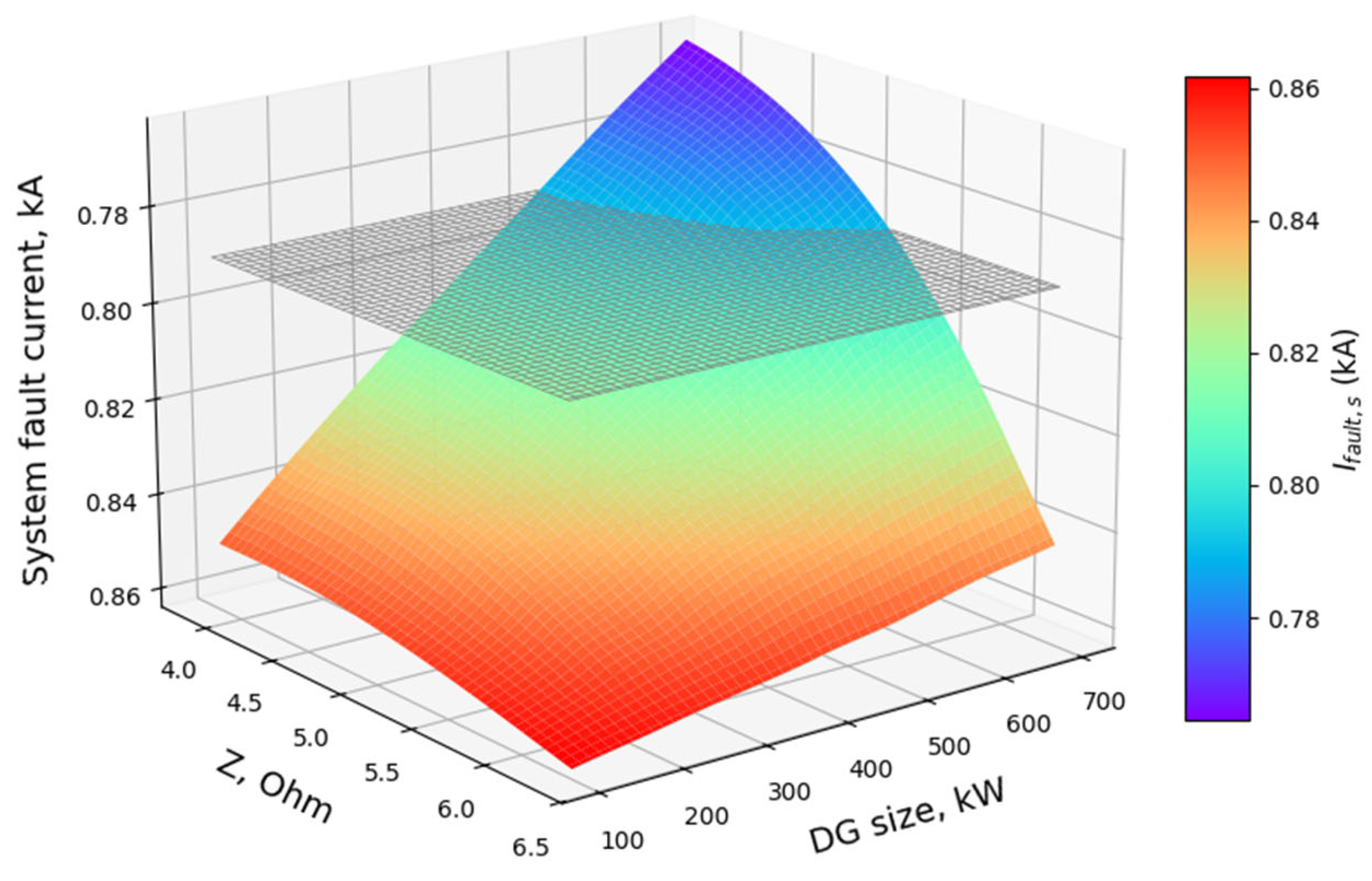
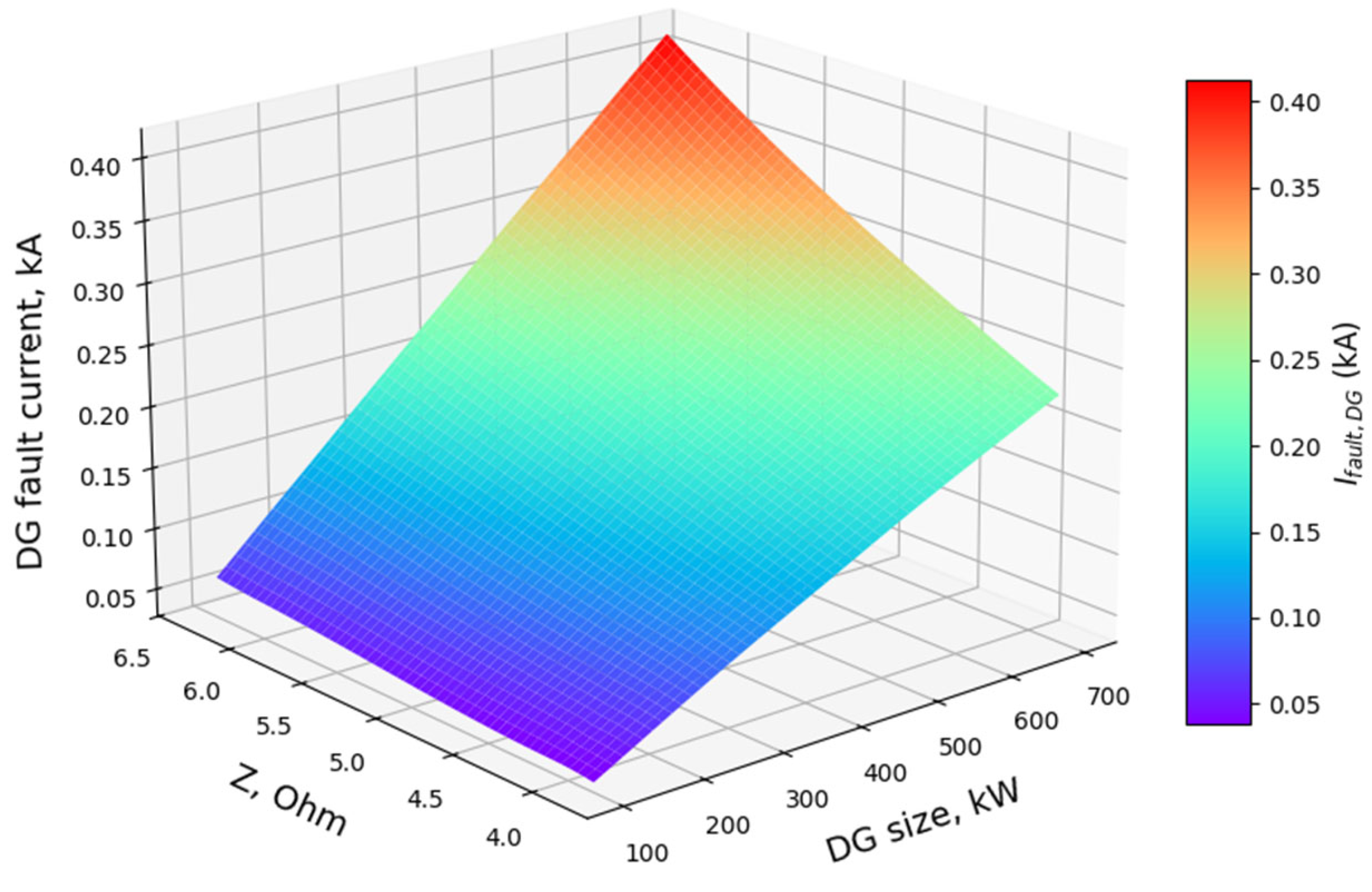
The dependence of the portion of the SCC feed from the utility system on DG location and capacity is illustrated in
Figure 8, where the cumulative line impedance from the substation to the fault location is denoted by
Z. The results show that the
contribution decreases with both increasing cumulative impedance and increasing DG capacity. The reduction is more pronounced for faults located farther from the 35/10 kV substation (bus S), where the feeder impedance is higher. In such conditions, the DG contributes a larger portion of the fault current, reducing the current seen by the upstream protection. Also, the rate of increase of
becomes steeper for higher DG capacities.
The intersection between the fault current surface and the protection threshold plane defines the maximum permissible DG capacity for reliable protection operation, depending on the fault location. From
Figure 8 it is seen that coordination issues in the relay protection scheme may arise when the DG capacity exceeds the critical threshold of 500 kW, if the unit is installed at buses 1, 2, or 3. Beyond this level, there is a risk of protection blinding, whereby the relay may fail to detect a fault due to the significant contribution of
, which reduces the fault current seen by the substation relay. If a larger DG unit is to be installed, the relay protection system must be redesigned. The dependence of the SCC feed from the DG on its location and capacity is shown in
Figure 9.
When the DG unit is located closer to the fault, the impedance between the DG and the fault decreases, resulting in a higher DG fault current contribution. Consequently, the DG contribution becomes increasingly limited by the generator’s internal reactance, and further increases in rated capacity lead to proportionally smaller increases in the total fault current. This means that the allowable DG size decreases as the fault location moves farther from the substation.
The results shown in
Figure 8 and
Figure 9 allow for evaluating both the optimal recloser location for a given DG capacity and the maximum admissible DG capacity for each location. The DG hosting capacity is limited by protection sensitivity, not by thermal limits of the studied network.
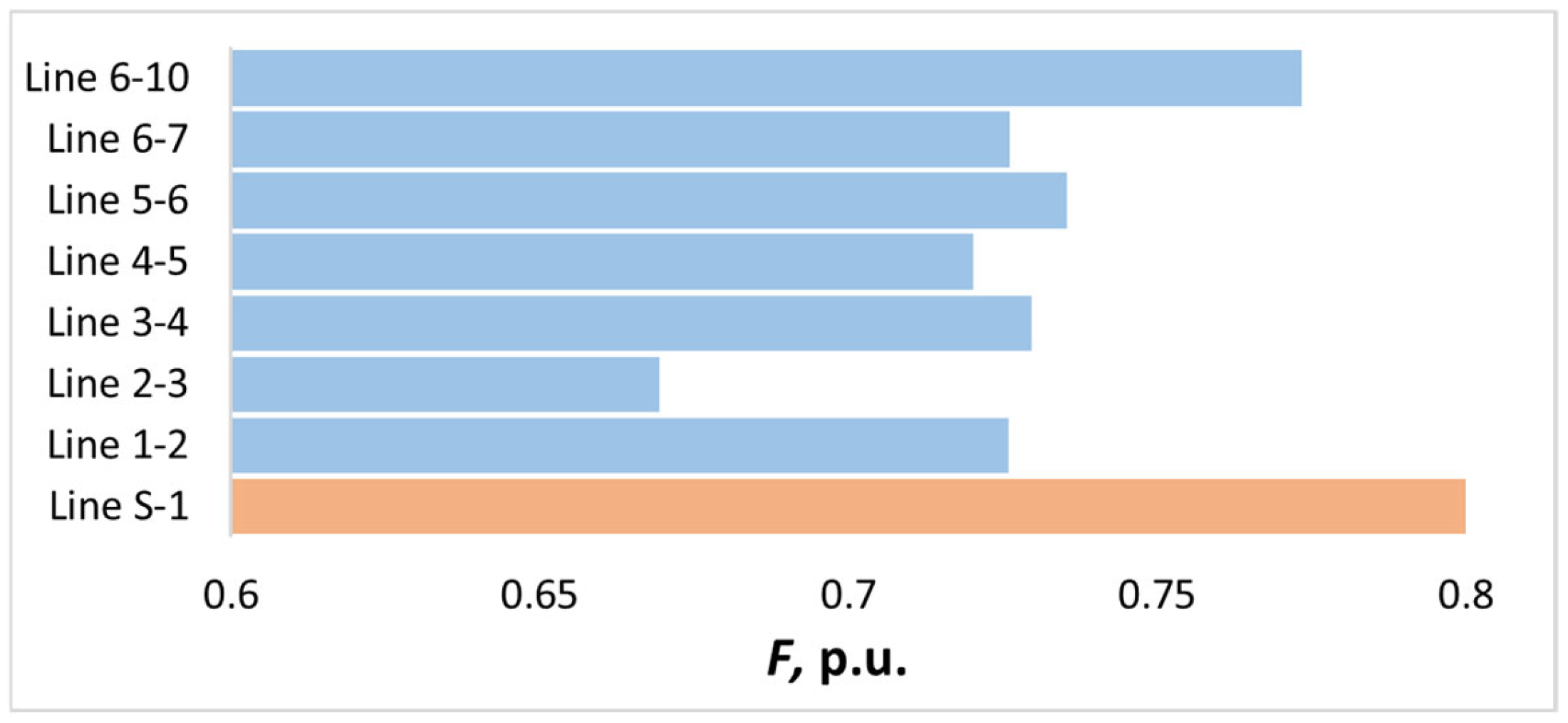
Assuming a planned DG capacity of 400 kW, the multi-criteria objective function
was evaluated according to (9) for each candidate line segment for recloser placement. Given the small network size, an exhaustive search was used to determine the optimal recloser location. The results are presented in
Figure 10. The recloser should be placed at line 2–3, which corresponds to the minimum value of
, satisfying (11) and (12) This represents a notable improvement compared to the base case (orange bar—without a recloser), where
.
The installation of a recloser on the line 2–3 resulted in improved network reliability. With no DG installed, sectionalizing the feeder allows to reduce ENS by 14.3%. In addition, the outage duration for customers in unaffected feeder sections was reduced due to the automatic isolation of the faulted section by the recloser. The integration of a 400 kW DG at bus 3 further improves supply reliability and can eliminate the annual energy deficit.
Planning of the distribution networks should consider optimal DG placement and sizing, adaptive relay setting strategies, and robust anti-islanding algorithms to ensure that the transition toward decentralized energy systems does not compromise the safety and reliability of the power system.
5. Discussion, Limitations, and Future Work
While the proposed coordinated optimization improves the reliability and protection sensitivity, some limitations must be acknowledged to guide future research.
First, the optimization problem in
Section 3 is formulated as a coordinated task involving both recloser placement and DG capacity. However, the case study in
Section 4, a sequential solution approach is adopted, where the optimal recloser location is pre-determined first, followed by the comparison of the planned DC capacity with
and checking if the optimal location has changed. This approach is consistent with practical planning procedures used by some DSOs, but does not necessarily guarantee a globally optimal solution. A simultaneous optimization of both variables could identify configurations in which alternative recloser locations enable higher admissible DG capacity or improved reliability indices.
This highlights the trade-off between computational simplicity and global optimality when applying the proposed method. Future work may focus on fully coupled optimization frameworks that enable simultaneous decision-making. In this context, a dynamic arithmetic optimization algorithm similar to [
30] could be employed to identify optimal DG locations and sizes. Alternatively, single-stage multi-objective formulations may be used to determine the global Pareto frontier.
Second, the case study evaluates optimal recloser placement for a specific rural distribution network. While this demonstrates the applicability of the proposed method, the optimal solution is dependent on both DG size and feeder impedance characteristics. Rural networks, typically characterized by long lines and low fault levels, differ significantly from urban power systems in terms of load density and protection coordination requirements. Therefore, the obtained results may not be directly transferable to urban or highly meshed networks. The case study should therefore be interpreted as a proof-of-concept demonstration. Future work will extend the methodology to a wider range of network topologies and DG penetration levels, including standard benchmark systems such as the IEEE networks.
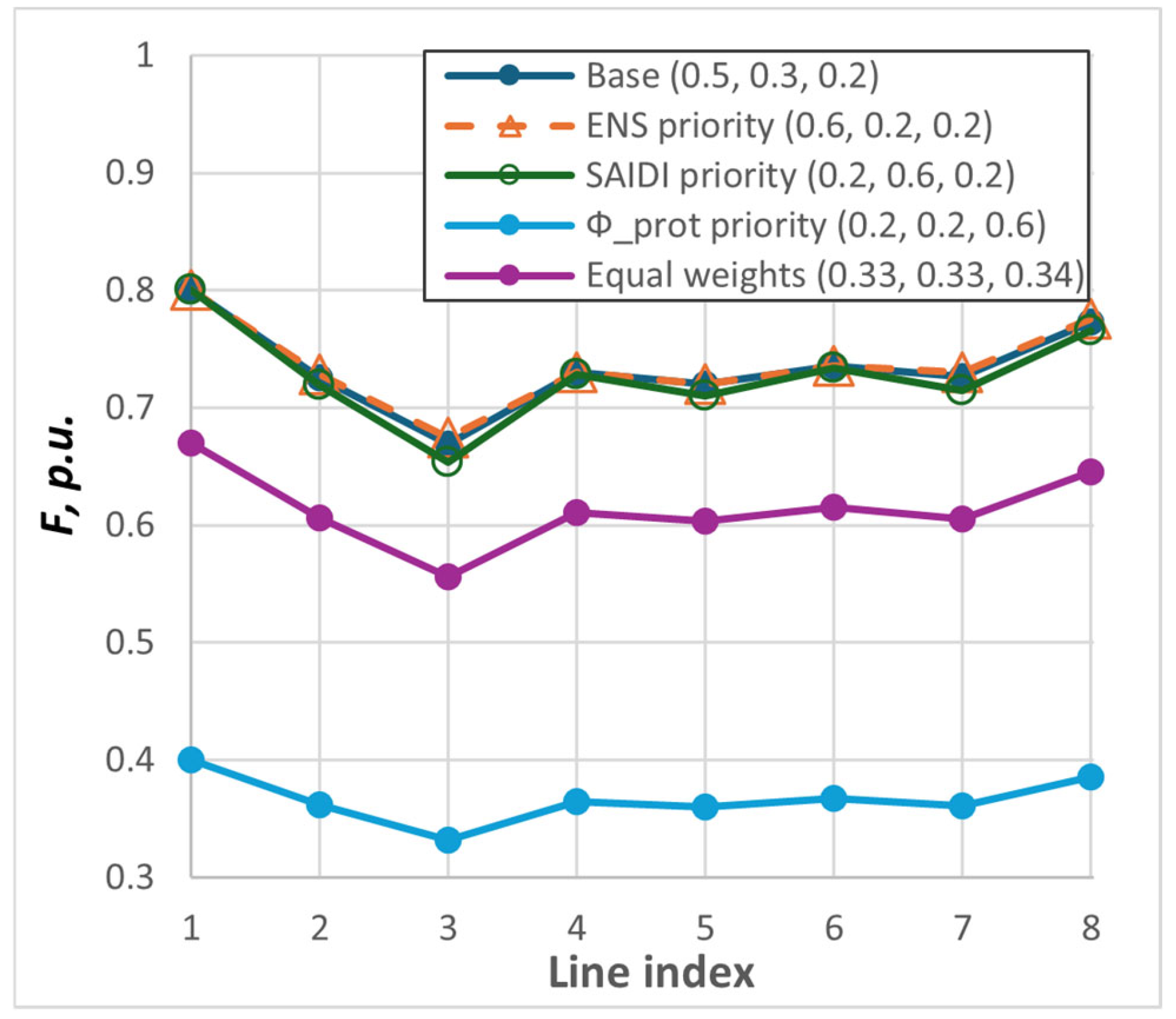
Third, the weighting factors in the objective function are user-defined, with ENS prioritized as the primary reliability metric, followed by SAIDI and protection sensitivity. Different weighting schemes may influence the optimal solution, particularly when trade-offs exist between reliability improvement and protection constraints. To assess this effect, a sensitivity analysis was conducted, in which several weight combinations were evaluated, reflecting different prioritization scenarios for ENS, SAIDI, and protection performance. The selected scenarios and weights are shown in
Table 4. For each case, the objective function was recalculated and the ranking of candidate recloser locations was compared.
For a DG capacity of 400 kW, the results (
Figure 11) indicate that the ranking of candidate solutions remains stable across a wide range of weighting combinations. The line 2–3 (line index 3) is consistently identified as the optimal recloser location. At this operating point, all protection constraints are satisfied and the penalty term equals 0 (i.e., has no influence on the ranking).
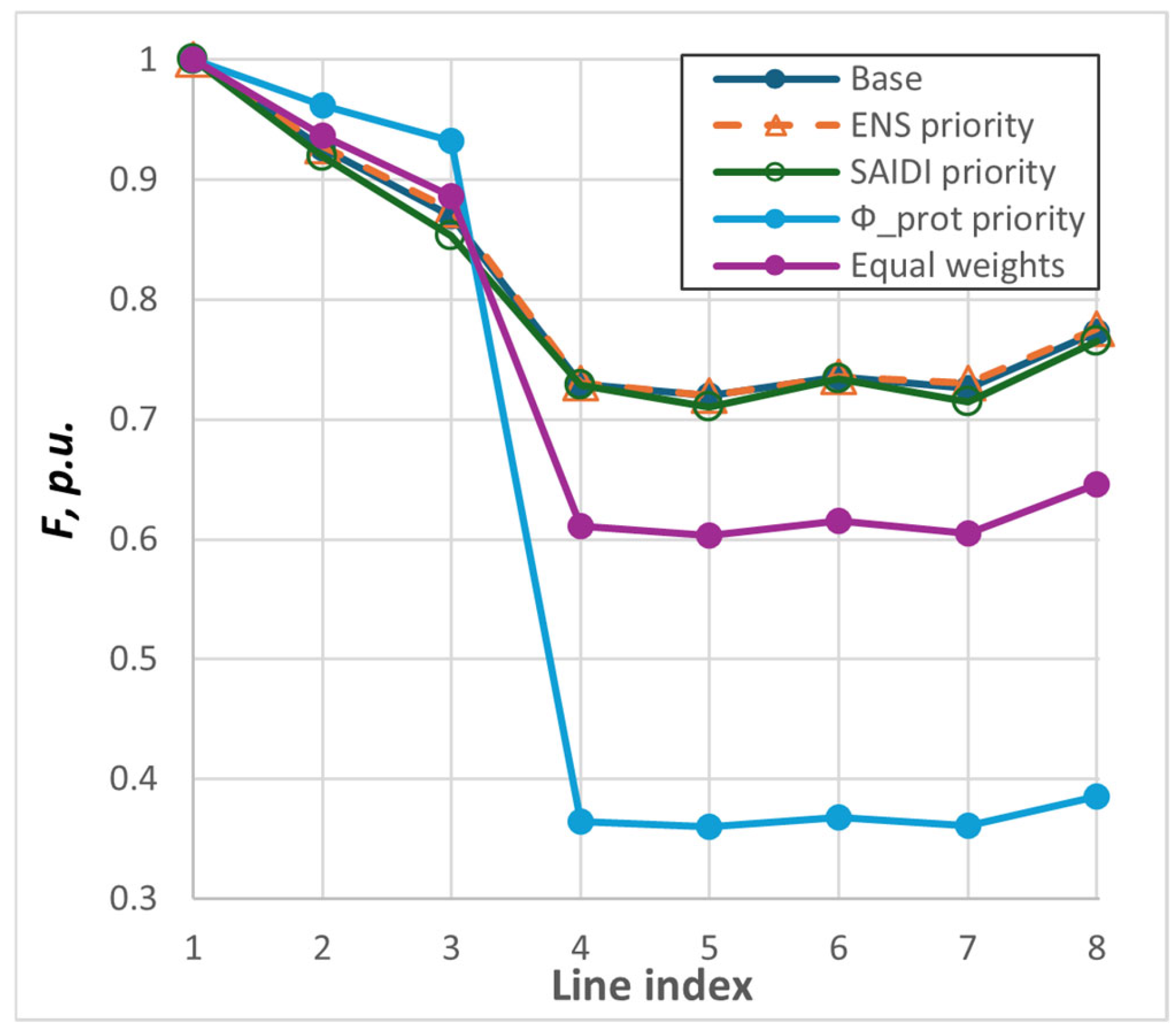
When the DG capacity exceeds the previously identified
threshold of 500 kW, the protection violations can occur at buses 1, 2, and 3, activating the penalty term (
). As a result, the objective function is modified and the ranking changes. The sensitivity analysis results are shown in
Figure 12. Due to the contribution of
, the line 2–3 is not optimal for recloser placement anymore. The new preferable location is the line 4–5 (line index 5), which corresponds to the lowest objective function values across all the scenarios.
Overall, the sensitivity analysis confirms that the proposed framework provides consistent results under normal operating conditions, while appropriately penalizing infeasible solutions when protection constraints are violated. In practical applications, the selection of weighting factors should reflect DSO priorities, regulatory requirements, and economic considerations.
Finally, the case study assumed a synchronous generator model with a SCC contribution of 5.0 p.u. However, modern distribution systems are often characterized by inverter-based resources (IBRs), such as PV systems, which typically limit their fault current contribution to 1.1–1.5 p.u. Due to this inherent limitation, the impact of IBRs on protection blinding is significantly reduced compared to synchronous generation. For the considered case study, additional estimations show that an IBR with a SCC contribution of 1.2 p.u. would require a capacity of approximately 3 MW to produce a comparable effect on fault current levels as a 400 kW synchronous generator with a 5.0 p.u. contribution.
This indicates that the critical DG capacity associated with protection sensitivity constraints is substantially higher for IBRs, making protection blinding less likely at typical penetration levels. The proposed method remains applicable, as it can accommodate different DG technologies through appropriate modelling of their fault current characteristics.