Enhancement of Fault Ride-Through Capability in Wind Turbine Based on a Permanent Magnet Synchronous Generator Using Machine Learning


Abstract
1. Introduction
- Machine learning algorithms have been extensively applied to improve FRT performance in a wind turbine based on a PMSG system. Two basic approaches to machine learning are used: classification and regression.
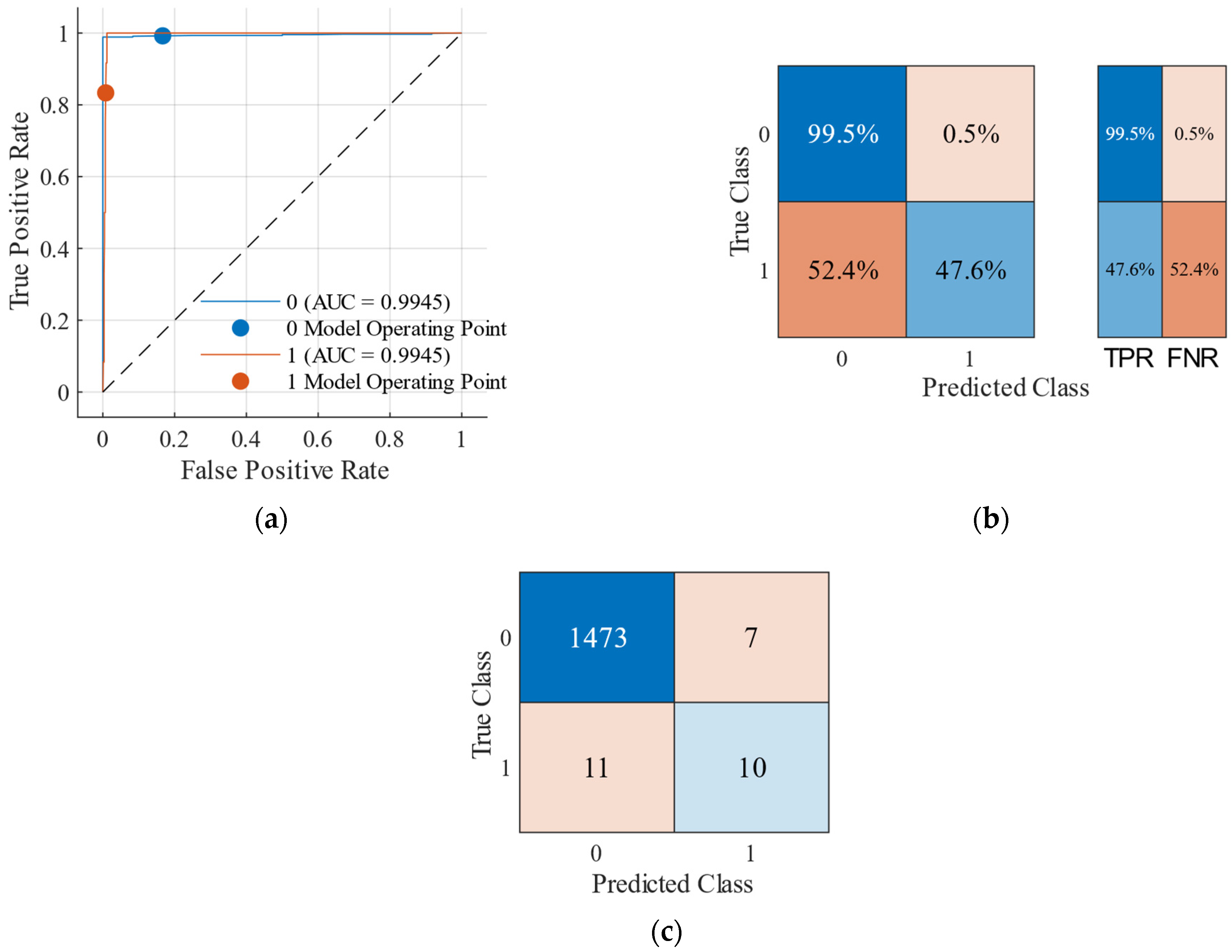
- More than 20 classifiers for each approach to machine learning have been systematically compared. The ensemble boosted tree classifier has the highest F1-score (99.39%) and accuracy (98.8%) for both protection methods.
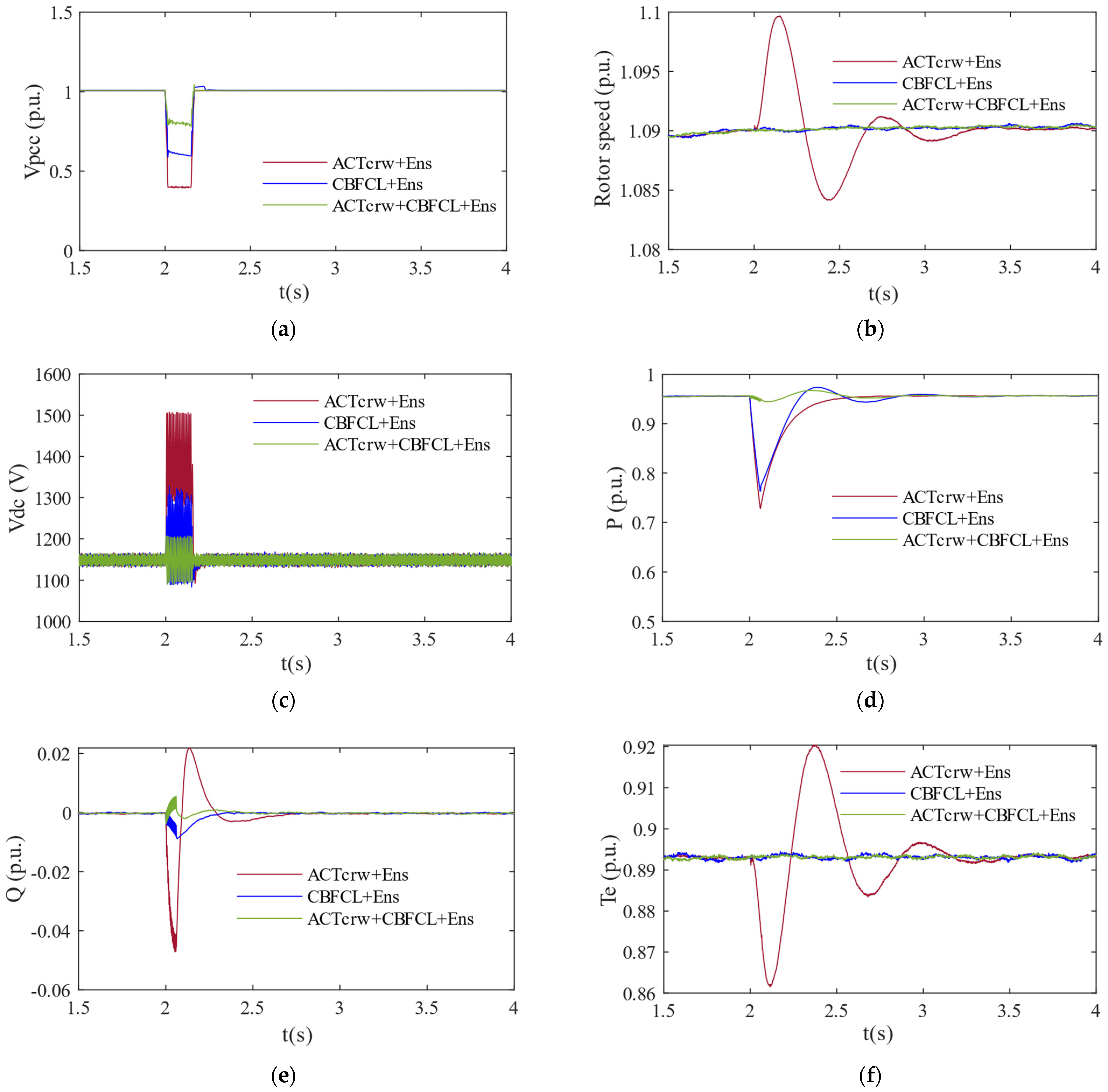
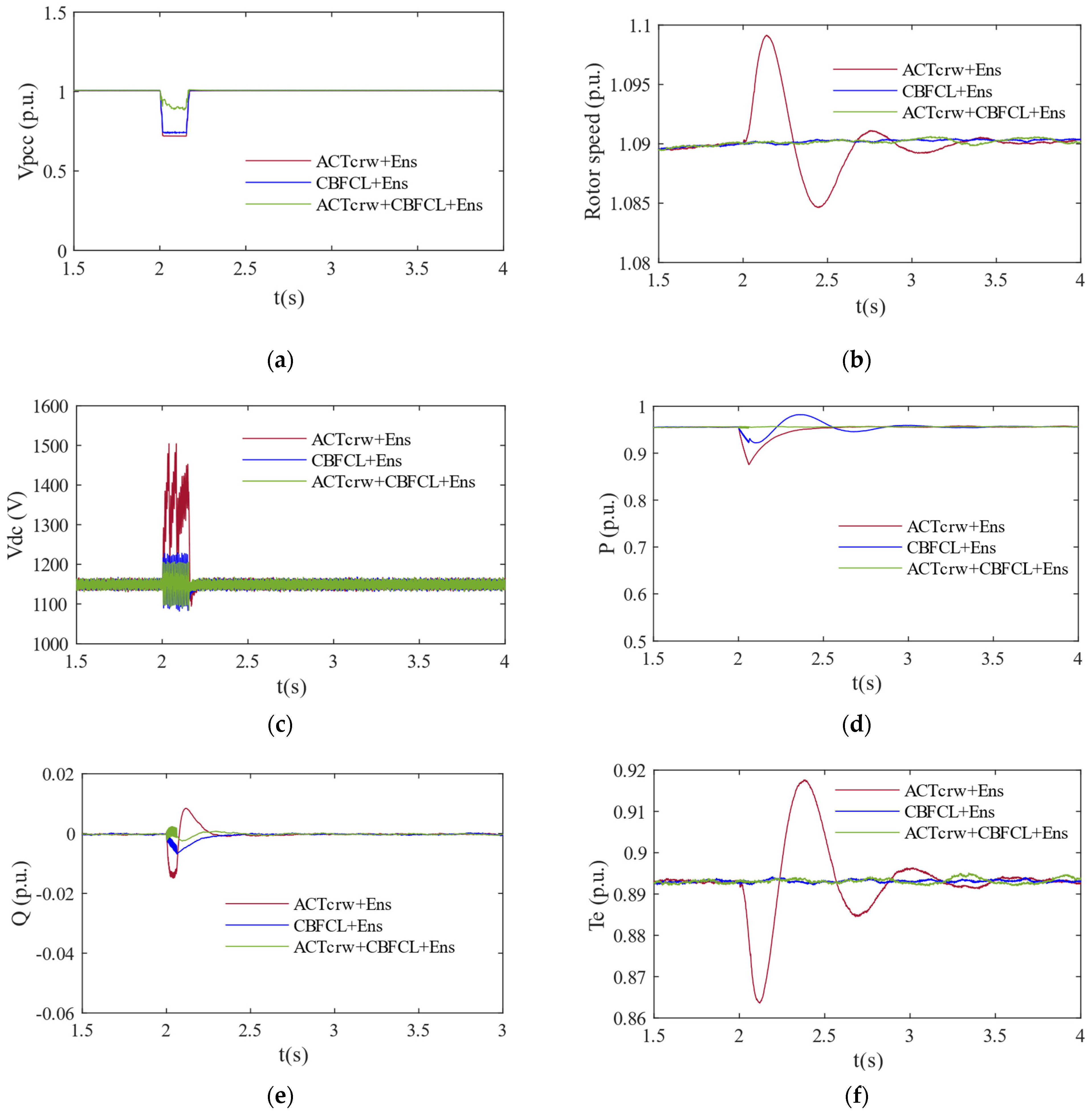
- Three-phase symmetrical, two-phase asymmetrical, and single-phase asymmetrical faults are analyzed in this study. This comprehensive comparison reveals the performance behavior of protection and controller systems under different grid fault scenarios.
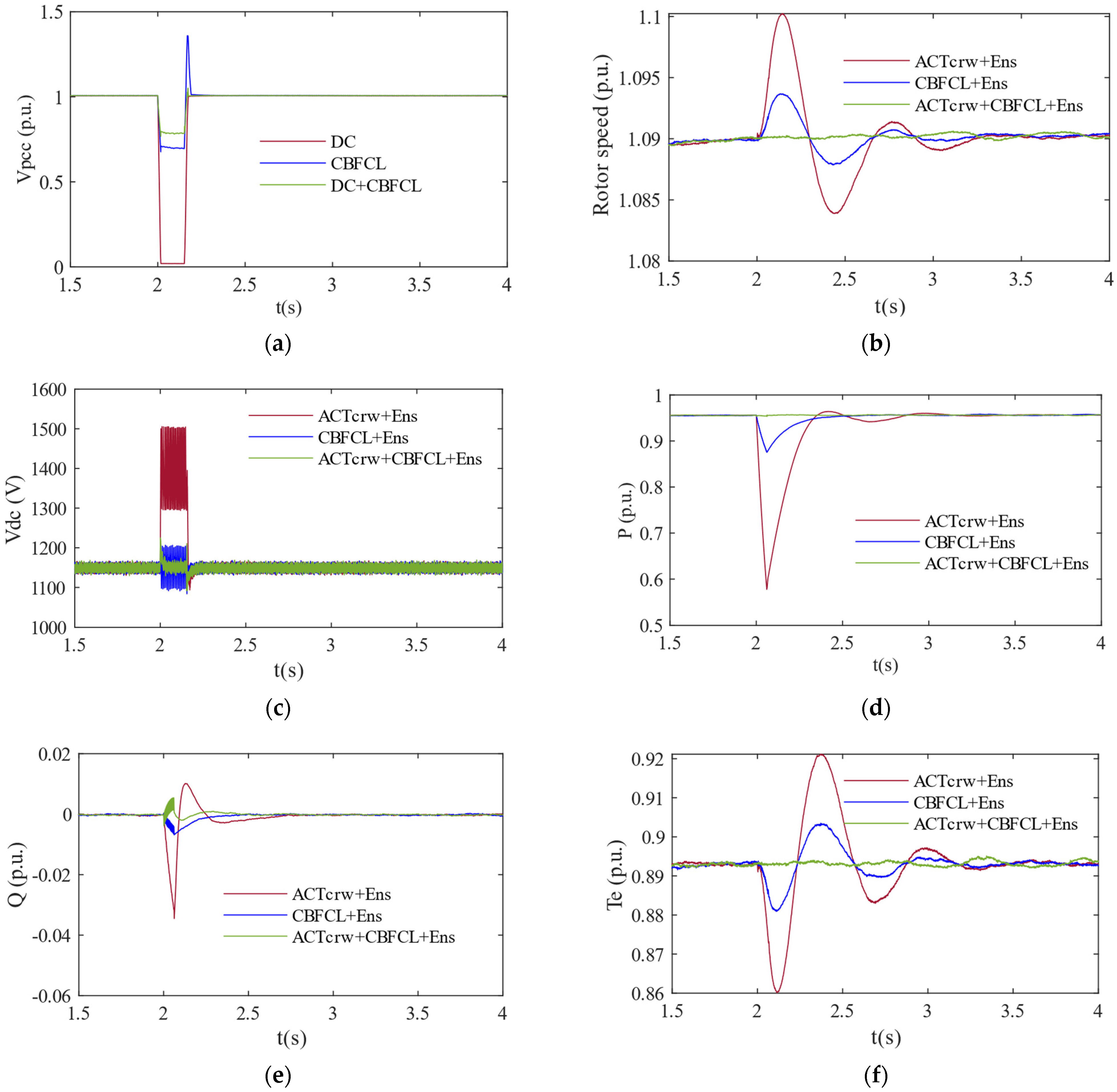
- The hybrid protection method reduces the Vdc oscillations by 25% during a three-phase symmetrical fault. The ML control method has illustrated exceptional capability in accurately detecting grid faults and dynamically adjusting ACTcrw and CBFCL to protect a wind turbine based on the PMSG system under all grid fault scenarios.
- The simulation results in this study demonstrate that the hybrid protection method based on an ML algorithm provides lower amplitude transient responses and quicker recovery times for both electrical and mechanical parameters compared to other protection methods.
2. Mechanical Drive and Mathematical Model of Wind Energy Conversion System
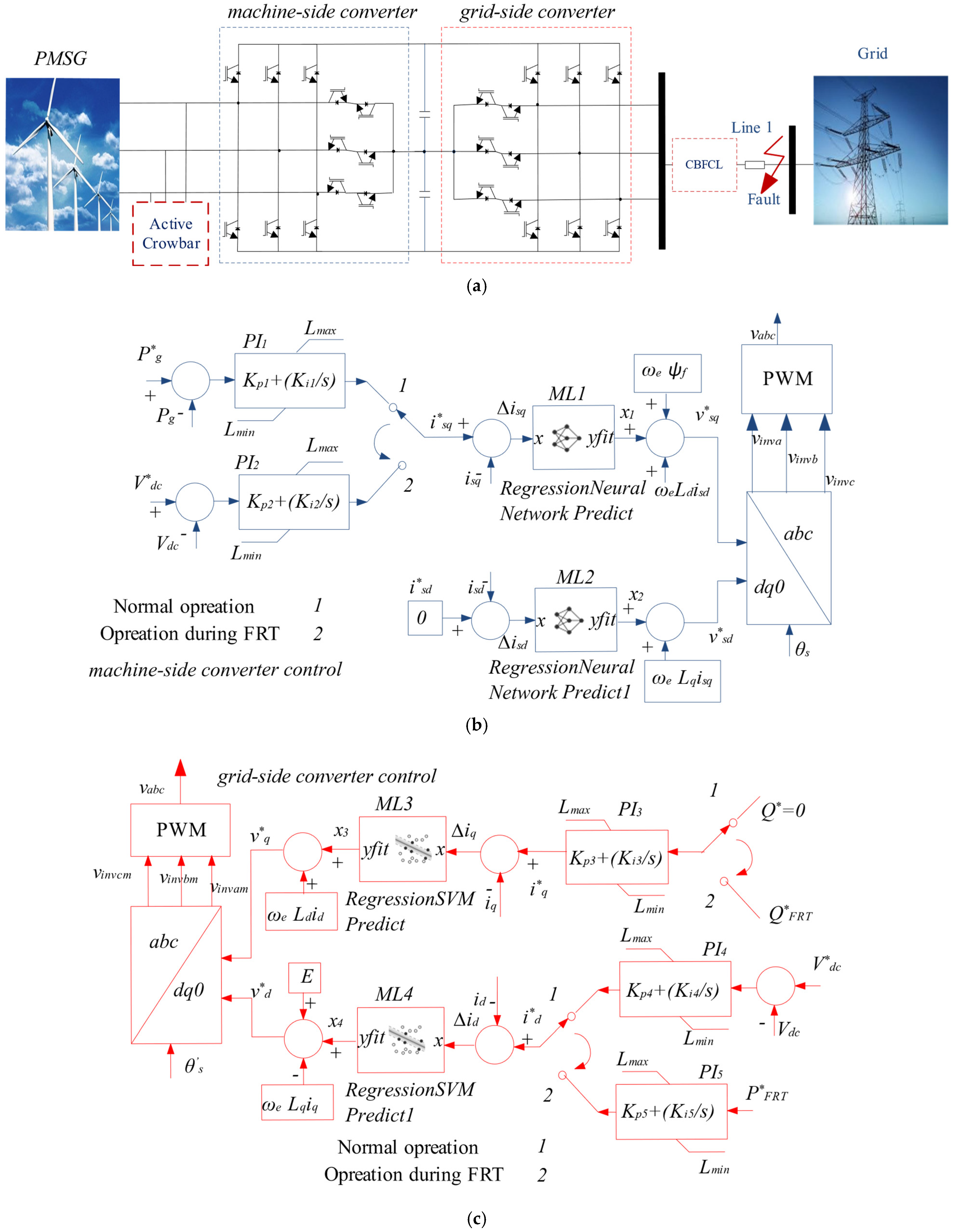
3. Power Converter Topology and Control Method of WECS
3.1. Control Algorithm of MSC
3.2. Control Algorithm of GSC
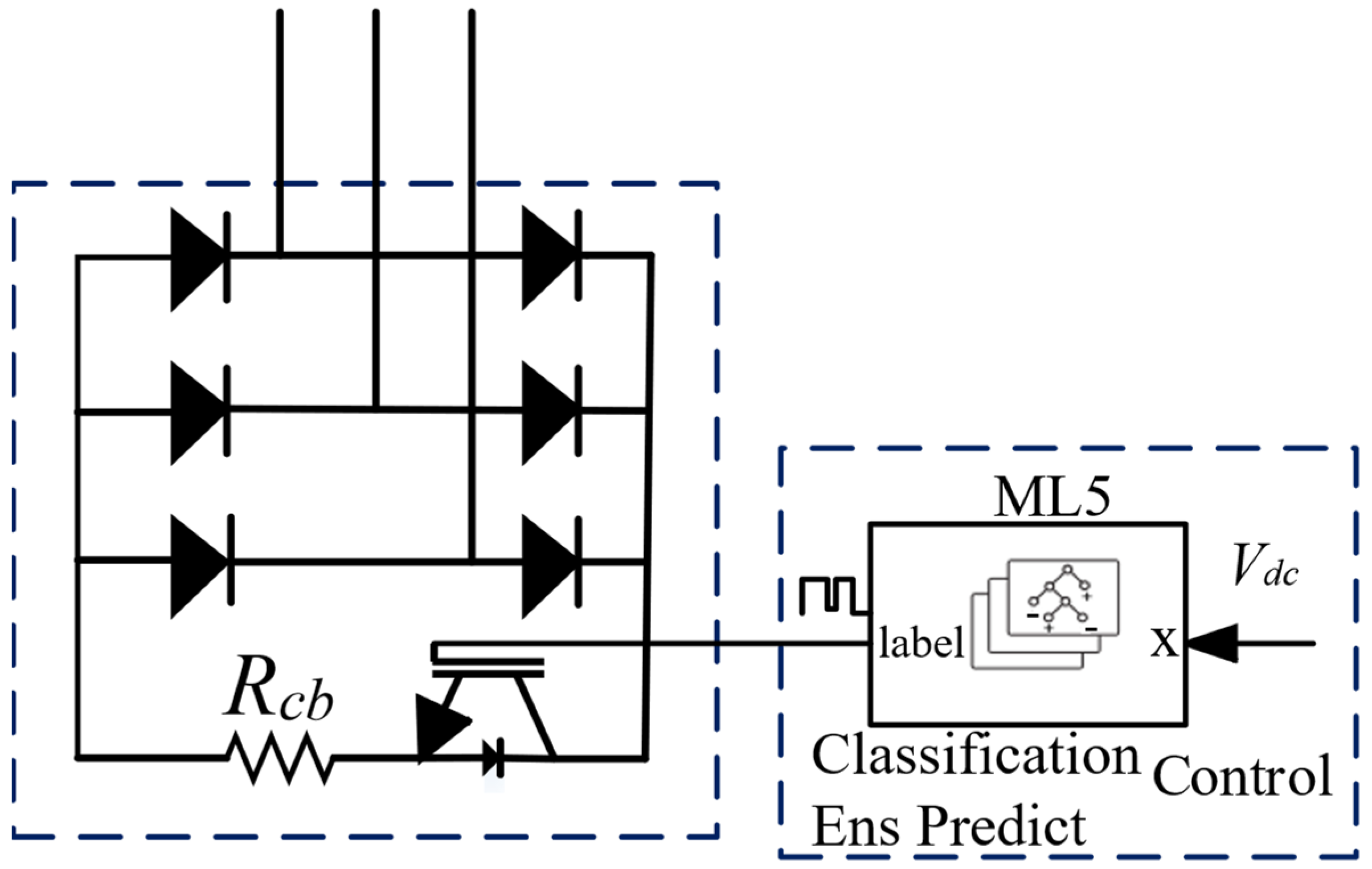
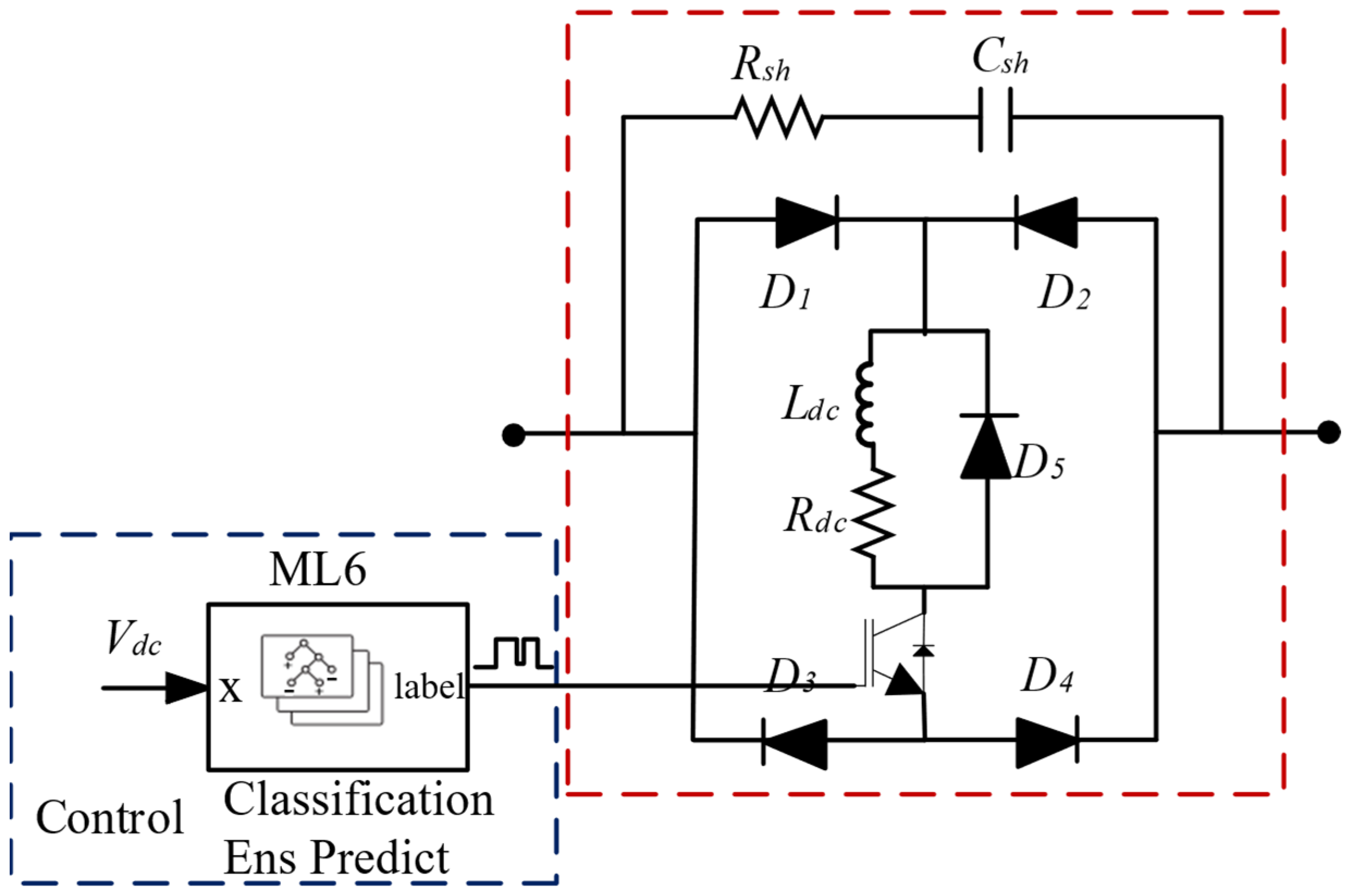
4. Structure and Control of Protection Methods
5. Simulation Results
5.1. Scenario 1
5.2. Scenario 2
5.3. Scenario 3
6. Conclusions
Funding
Data Availability Statement
Conflicts of Interest
Abbreviations
| SVM | Support Vector-based Classification/Regression Technique |
| SPWM | Sinusoidal PWM Modulation Strategy |
| MSE | Mean Squared Error Metric |
| FNR | Rate of False–Negative Decisions |
| TPR | True Positive Identification Ratio |
| ROC | Receiver–Operating Curve |
| D-STATCOM | Distribution-Level Static Compensator |
| STATCOM | Static Synchronous Compensator |
| GSC | Converter Connected to the Grid Side |
| MSC | Machine-Side Converter |
| PMSG | Permanent-Magnet Synchronous Generator |
| WECS | Wind Energy Conversion Systems |
| FRT | Fault Ride-Through |
| ML | Machine learning |
| CBFCL | Capacitive-Bridge-Type Fault Current Limiter |
References
- Palanimuthu, K.; Mayilsamy, G.; Lee, S.R.; Jung, S.Y.; Joo, Y.H. Fault Ride-Through for PMVG-Based Wind Turbine System Using Coordinated Active and Reactive Power Control Strategy. IEEE Trans. Ind. Electron. 2023, 70, 5797–5807. [Google Scholar] [CrossRef]
- Zheng, Z.; Xie, Q.; Huang, C.; Xiao, X.; Li, C. Superconducting Technology Based Fault Ride Through Strategy for PMSG-Based Wind Turbine Generator: A Comprehensive Review. IEEE Trans. Appl. Supercond. 2021, 31, 5403106. [Google Scholar] [CrossRef]
- Dai, T.; Xiao, X.; Xie, Q.; Ren, J.; Zheng, Z. Hybrid Grid-Forming and Grid Following PMSG-SMES Architecture with Enhanced FRT Capability. IEEE Trans. Appl. Supercond. 2024, 34, 5402304. [Google Scholar] [CrossRef]
- Xie, Q.; Zheng, Z.; Xiao, X.; Dai, T.; Ren, J.; Xu, B. Synchronization Stability Constrained SFCL-Based Fault Ride-Through Strategy for PMSG. IEEE Trans. Appl. Supercond. 2024, 34, 5601905. [Google Scholar] [CrossRef]
- Xie, Q.; Zheng, Z.; Huang, C.; Dai, T. Coordinated Fault Ride Through Method for PMSG-Based Wind Turbine Using SFCL and Modified Control Strategy. IEEE Trans. Appl. Supercond. 2021, 31, 5402805. [Google Scholar] [CrossRef]
- Kinnunen, P.; Lindh, P.; Zadorozhniuk, D.; Pyrhönen, J.; Parviainen, A. Parameter Selection Guidelines for Direct-on-Line Permanent Magnet Generators Contemplating Fault-Ride-Through Capability. IEEE Access 2022, 10, 128166–128176. [Google Scholar] [CrossRef]
- Sheng, Y.; Li, C.; Jia, H.; Liu, B.; Li, B.; Coombs, T.A. Investigation on FRT Capability of PMSG-Based Offshore Wind Farm Using the SFCL. IEEE Trans. Appl. Supercond. 2021, 31, 5604704. [Google Scholar] [CrossRef]
- Ramachandran, V.; Pitchaimuthu, R.; Selvan, M.P. Systematized Active Power Control of PMSG-Based Wind-Driven Generators. IEEE Syst. J. 2020, 14, 708–717. [Google Scholar] [CrossRef]
- Zhang, Q.; He, J.; Xu, Y.; Hong, Z.; Chen, Y.; Strunz, K. Average-Value Modeling of Direct-Driven PMSG-Based Wind Energy Conversion Systems. IEEE Trans. Energy Convers. 2022, 37, 264–273. [Google Scholar] [CrossRef]
- Peng, Y.; Li, Y.; Lee, K.Y.; Tan, Y.; Cao, Y.; Wen, M. Coordinated Control Strategy of PMSG and Cascaded H-Bridge STATCOM in Dispersed Wind Farm for Suppressing Unbalanced Grid Voltage. IEEE Trans. Sustain. Energy 2021, 12, 349–359. [Google Scholar] [CrossRef]
- Ranjan, S.; Das, D.C.; Latif, A.; Sinha, N.; Hussain, S.M.S.; Ustun, T.S. Maiden Voltage Control Analysis of Hybrid Power System with Dynamic Voltage Restorer. IEEE Access 2021, 9, 60531–60542. [Google Scholar] [CrossRef]
- Silva, T.C.; Antunes, F.A.S.; Teixeira, J.C.; Contreras, R.C. Correlation Between Wind Turbine Failures and Environmental Conditions: A Machine Learning Approach. IEEE Access 2025, 13, 50043–50058. [Google Scholar] [CrossRef]
- Aslam, L.; Zou, R.; Awan, E.S.; Hussain, S.S.; Asim, M.; Chelloug, S.A. Dynamic Optimization of Recurrent Networks for Wind Speed Prediction on Edge Devices. IEEE Access 2025, 13, 114520–114541. [Google Scholar] [CrossRef]
- Huang, C.L.; Wu, Y.K.; Phan, Q.T.; Tsai, C.C.; Hong, J.S. Enhancing Wind Power Forecasts via Bias Correction Technologies for Numerical Weather Prediction Model. IEEE Trans. Ind. Appl. 2025, 61, 5406–5419. [Google Scholar] [CrossRef]
- Chen, T.; Yang, C.; Xiao, Y.; Yan, C.; Lei, M.; Photong, C. Energy-Efficient Wind Turbine Operation via Multi-Class Blade Icing Recognition Using Mutual-Information Feature Selection and Ensemble Methods. IEEE Access 2025, 13, 156008–156020. [Google Scholar] [CrossRef]
- Li, X.; Cheng, C.; Peng, Z. Frequency-Assisted Contrastive Learning With Cyclic Fine-Tuning for Rotating Machinery Fault Diagnosis Under Limited Labeled Data. IEEE Trans. Inst. Meas. 2025, 74, 3510611. [Google Scholar] [CrossRef]
- Zhang, X.Y.; Yu, H.; Zheng, X.; Wang, H.; Mu, C.; Guo, P. Hybrid Deep Reinforcement Learning for UAV Inspection in Large-Scale Wind Farms: Deployment and Routing Optimization. IEEE Trans. Ind. Inf. 2025, 21, 9011–9021. [Google Scholar] [CrossRef]
- Dheda, D.; Albertyn, J.; Adetunji, K.; Liu, Z.; Mahfouz, A.M.A.; Cheng, L. Techno-Economic, Environmental, and Social Multi-Objective Optimization of a Grid-Connected Hybrid Renewable Energy System Using Metaheuristic Algorithms. IEEE Access 2025, 13, 164859–164882. [Google Scholar] [CrossRef]
- Grataloup, A.; Jonas, S.; Meyer, A. Wind Turbine Condition Monitoring Based on Intra- and Inter-Farm Federated Learning. IEEE Access 2025, 13, 146617–146629. [Google Scholar] [CrossRef]
- Malik, H.; Almutairi, A. Modified Fuzzy-Q-Learning (MFQL)-Based Mechanical Fault Diagnosis for Direct-Drive Wind Turbines Using Electrical Signals. IEEE Access 2021, 9, 52569–52579. [Google Scholar] [CrossRef]
- Shahbaz, N.; Chen, Y.; Liang, F.; Zhang, S.; Zhao, S.; Ma, Y. Diagnosis of Demagnetization Faults in PMSGs Based on Performance Evaluation of Machine Learning Algorithms Through Flux and Current Signals. IEEE Trans. Instr. Meas. 2025, 74, 2505110. [Google Scholar] [CrossRef]
- Minaz, M.R.; Akcan, E. An Effective Method for Detection of Demagnetization Fault in Axial Flux Coreless PMSG With Texture-Based Analysis. IEEE Access 2021, 9, 17438–17449. [Google Scholar] [CrossRef]
- Alsafran, A.S.; Ullah, S.; Ullah, A.; Hafeez, G.; Babar, M.Z.; Alghamdi, B. A Robust Fractional-Order Nonsingular Terminal Sliding Mode Control With Deep Learning-Based Lie Derivative Estimation for Maximum Power Point Tracking in Wind Turbine. IEEE Access 2025, 13, 127423–127435. [Google Scholar] [CrossRef]
- Hadi, F.M.A.; Aly, H.H.; Little, T. Harmonics Forecasting of Wind and Solar Hybrid Model Based on Deep Machine Learning. IEEE Access 2023, 11, 100438–100457. [Google Scholar] [CrossRef]
- Hernandez, C.; Campos, B.; Diaz, L.; Lara, J.; Arjona, M.A. Electromagnetic Design Optimization of a PMSG Using a Deep Neural Network Approach. IEEE Trans. Magn. 2025, 61, 8100304. [Google Scholar] [CrossRef]
- Singh, B.; Niwas, R.; Dube, S.K. Load Leveling and Voltage Control of Permanent Magnet Synchronous Generator-Based DG Set for Standalone Supply System. IEEE Trans. Ind. Inf. 2014, 10, 2034–2043. [Google Scholar] [CrossRef]
- Suni, J.C.P.; Paredes, M.G.S.P.; Paula, M.V.; Filho, E.R.; Velasco, J.A.M. Fault Section Identification in Distribution Networks with DFIG and PMSG Generators Using Current Transients. IEEE Lat. Am. Trans. 2025, 23, 487–496. [Google Scholar] [CrossRef]
- Hong, C.M.; Chen, C.H.; Tu, C.S. Maximum power point tracking based control algorithm for PMSG wind generation system without mechanical sensors. Energy Convers. Manag. 2013, 69, 58–67. [Google Scholar] [CrossRef]
- Yao, J.; Yu, M.; Gao, W.; Zeng, X. Frequency regulation control strategy for PMSG wind-power generation system with flywheel energy storage unit. IET Renew. Power Gener. 2017, 11, 1082–1093. [Google Scholar] [CrossRef]
- Eltamaly, A.M.; Farh, H.M. Maximum power extraction from wind energy system based on fuzzy logic control. Electr. Power Syst. Res. 2013, 97, 144–150. [Google Scholar] [CrossRef]
- Prado, A.C.; Alepuz, S.; Bordonau, J.; Cortes, P.; Rodriguez, J. Predictive control of a back-to-back NPC converter-based wind power system. IEEE Trans. Ind. Electron. 2016, 63, 4615–4627. [Google Scholar] [CrossRef]
- Gencer, A. Analysis of fault ride through capability improvement of the permanent magnet synchronous generator based on WT using a BFCL. In Proceedings of the 2019 1st Global Power, Energy and Communication Conference (GPECOM), Nevsehir, Turkey, 12–15 June 2019; pp. 353–357. [Google Scholar]



| Description | Symbol | Numerical Value | Unit |
|---|---|---|---|
| Filter inductance of grid-side | Lf | 1.65 | mH |
| Filter resistance of grid-side | Rf | 0.027 | Ω |
| DC-link voltage | Vdc | 1150 | V |
| DC-link capacitance | Cdc | 10,000 | μF |
| Description | Symbol | Value | Unit |
|---|---|---|---|
| Optimal tip–speed ratio | λopt | 6.9 | |
| Maximum achievable power coefficient | Cp,max | 0.4412 | |
| Cut-in wind speed | νc | 3 | m/s |
| Nominal wind speed | Ν | 12 | m/s |
| Rotor swept area | A | 4775.94 | m2 |
| Density of air | Ρ | 1.225 | Kg/m3 |
| Description | Symbol | Value | Unit |
|---|---|---|---|
| Maximum flux linkage of permanent magnets | ψf | 1.48 | wb |
| Stator phase inductance | Ls | 0.000835 | H |
| Stator phase resistance | Rs | 0.006 | Ω |
| Rated line voltage | Vabc | 1 | p.u. |
| Rated electrical rotor speed | ωr | 1 | p.u. |
| Generator rated output power | Pg | 1 | p.u. |
| Number of pole pairs | np | 48 | |
| Fundamental electrical frequency | fb | 60 | Hz |
| Base line voltage | Vb | 690 | V |
| Base apparent power | Pb | 1.5 | MVA |
| Switch Statutes | Output Voltage | ||
|---|---|---|---|
| Vdc/2 | 0 | −Vdc/2 | |
| SR1 | 1 | 0 | 0 |
| SR2 | 1 | 1 | 0 |
| SR3 | 0 | 1 | 1 |
| SR4 | 0 | 0 | 1 |
| Classification Methods | Classifiers | Accuracy (%) | TPR (%) | FPR (%) | Recall (%) | Precision (%) | F1-Score (%) |
|---|---|---|---|---|---|---|---|
| Tree | Fine Tree | 98.33 | 98.92 | 57.14 | 98.9 | 99.39 | 99.15 |
| Medium Tree | 98.334 | 98.92 | 57.14 | 98.9 | 99.39 | 99.15 | |
| Coarse Tree | 98.53 | 99.12 | 57.14 | 99.12 | 99.39 | 99.26 | |
| SVM | Linear SVM | 98.26 | 99.39 | 19.05 | 99.39 | 99.39 | 99.12 |
| Quadratic SVM | 98.13 | 99.32 | 14.29 | 99.32 | 98.79 | 99.06 | |
| Cubic SVM | 39.97 | 39.86 | 47.62 | 39.86 | 98.79 | 56.7 | |
| Fine Gaussian SVM | 98.46 | 98.38 | 84.95 | 98.38 | 99.51 | 98.95 | |
| Medium Gaussian SVM | 98.46 | 99.12 | 52.38 | 99.12 | 99.41 | 99.22 | |
| Coarse Gaussian SVM | 98.33 | 99.39 | 23.81 | 99.39 | 98.92 | 99.16 | |
| KNN | Fine KNN | 98.73 | 99.26 | 61.9 | 99.26 | 98.92 | 99.36 |
| Medium KNN | 98.53 | 99.29 | 23.81 | 99.51 | 98.93 | 99.26 | |
| Coarse KNN | 98.6 | 100 | 0 | 100 | 98.93 | 99.3 | |
| Cosine KNN | 92.47 | 92.36 | 100 | 92.36 | 100 | 96.03 | |
| Cubic KNN | 98.53 | 99.51 | 23.81 | 99.51 | 100 | 99.26 | |
| Weighted KNN | 98.8 | 99.32 | 61.9 | 99.32 | 99.46 | 99.39 | |
| Ensemble | Boosted Trees | 98.8 | 99.53 | 47.61 | 99.53 | 99.46 | 99.39 |
| Bagged Trees | 98.67 | 99.26 | 57.14 | 99.26 | 99.39 | 99.32 | |
| Subspace Discriminant | 98.67 | 98.65 | 100 | 98.65 | 99.39 | 99.32 | |
| Subspace KNN | 98.73 | 99.26 | 61.9 | 99.26 | 99.46 | 99.36 | |
| RUSBoostedTrees | 98.6 | 98.58 | 100 | 98.58 | 99.46 | 99.29 | |
| Neural Network | Narrow | 98.4 | 99.19 | 42.86 | 99.19 | 99.19 | 99.19 |
| Medium | 98.53 | 99.19 | 52.38 | 99.16 | 99.32 | 99.26 | |
| Wide | 98.66 | 99.26 | 57.14 | 99.26 | 99.39 | 99.32 | |
| Bilayered | 98.73 | 99.46 | 47.62 | 99.46 | 99.26 | 98.51 | |
| Trilayered | 98.73 | 99.26 | 61.9 | 99.26 | 99.46 | 99.35 |
| Classification Methods | Classifiers | RMSE | R2 | MSE | MAE |
|---|---|---|---|---|---|
| Linear | Linear | 0.0084996 | 0.92 | 7.2244 × 10⁻⁵ | 0.0034363 |
| Interactions | 0.0084996 | 0.92 | 7.2244 × 10⁻⁵ | 0.0034363 | |
| Robust | 0.0089104 | 0.91 | 7.9395 × 10⁻⁵ | 0.0022772 | |
| Stepwise Linear Regression | Stepwise Linear | 0.0084996 | 0.92 | 7.2244 × 10⁻⁵ | 0.0034363 |
| Tree | Fine Tree | 0.0080409 | 0.93 | 6.4655 × 10⁻⁵ | 0.0027811 |
| Medium Tree | 0.0080971 | 0.93 | 6.5562 × 10⁻⁵ | 0.0027153 | |
| Coarse Tree | 0.0080494 | 0.93 | 6.4792 × 10⁻⁵ | 0.0027873 | |
| SVM | Linear SVM | 0.0087947 | 0.91 | 7.7346 × 10⁻⁵ | 0.0046044 |
| Quadratic SVM | 0.009121 | 0.91 | 8.3193 × 10⁻⁵ | 0.0058097 | |
| Cubic SVM | 0.31355 | −109.69 | 0.098312 | 0.17222 | |
| Fine Gaussian SVM | 0.0094959 | 0.90 | 9.0172 × 10⁻⁵ | 0.0045293 | |
| Medium Gaussian SVM | 0.008087 | 0.93 | 6.54 × 10⁻⁵ | 0.0035667 | |
| Coarse Gaussian SVM | 0.0084916 | 0.92 | 7.2108 × 10⁻⁵ | 0.0040551 | |
| Ensemble | Boosted Trees | 0.0079832 | 0.93 | 6.3731 × 10⁻⁵ | 0.0033731 |
| Bagged Trees | 0.0077577 | 0.93 | 6.0183 × 10⁻⁵ | 0.0025456 | |
| Gaussian | Squared Exponential GPR | 0.0090304 | 0.91 | 8.1548 × 10⁻⁵ | 0.0026437 |
| Matern 5/2 GPR | 0.008537 | 0.92 | 7.2881 × 10⁻⁵ | 0.0025289 | |
| Exponential GPR | 0.0075355 | 0.94 | 5.6784 × 10⁻⁵ | 0.0025168 | |
| Rational Quadratic GPR | 0.0079515 | 0.93 | 6.3227 × 10⁻⁵ | 0.002498 | |
| Neural Network | Narrow | 0.0080123 | 0.93 | 6.4196 × 10⁻⁵ | 0.0031189 |
| Medium | 0.007542 | 0.94 | 5.6881 × 10⁻⁵ | 0.0028244 | |
| Wide | 0.0075436 | 0.94 | 5.6906 × 10⁻⁵ | 0.0025442 | |
| Bilayered | 0.0076074 | 0.93 | 5.7873 × 10⁻⁵ | 0.0027141 | |
| Trilayered | 0.0070887 | 0.94 | 5.025 × 10⁻⁵ | 0.0025165 | |
| Kernel | SVM Kernel | 0.031882 | −0.14 | 0.0010165 | 0.025429 |
| Least Squares Regression Kernel | 0.029802 | −0.00 | 0.00088815 | 0.027271 |
Disclaimer/Publisher’s Note: The statements, opinions and data contained in all publications are solely those of the individual author(s) and contributor(s) and not of MDPI and/or the editor(s). MDPI and/or the editor(s) disclaim responsibility for any injury to people or property resulting from any ideas, methods, instructions or products referred to in the content. |
© 2025 by the author. Licensee MDPI, Basel, Switzerland. This article is an open access article distributed under the terms and conditions of the Creative Commons Attribution (CC BY) license.
Share and Cite
Gencer, A. Enhancement of Fault Ride-Through Capability in Wind Turbine Based on a Permanent Magnet Synchronous Generator Using Machine Learning. Electronics 2026, 15, 50. https://doi.org/10.3390/electronics15010050
Gencer A. Enhancement of Fault Ride-Through Capability in Wind Turbine Based on a Permanent Magnet Synchronous Generator Using Machine Learning. Electronics. 2026; 15(1):50. https://doi.org/10.3390/electronics15010050
Chicago/Turabian StyleGencer, Altan. 2026. "Enhancement of Fault Ride-Through Capability in Wind Turbine Based on a Permanent Magnet Synchronous Generator Using Machine Learning" Electronics 15, no. 1: 50. https://doi.org/10.3390/electronics15010050
APA StyleGencer, A. (2026). Enhancement of Fault Ride-Through Capability in Wind Turbine Based on a Permanent Magnet Synchronous Generator Using Machine Learning. Electronics, 15(1), 50. https://doi.org/10.3390/electronics15010050