A BFS-Based DEVS Simulation Kernel for HDL-Compatible Simulation

Abstract
1. Introduction
1.1. Motivation
1.2. Related Works
1.3. Research Contributions
2. Background
2.1. Classical DEVS Formalism and Abstract Simulator
2.1.1. Classical DEVS Atomic Model
- X: set of possible inputs
- Y: set of possible outputs
- S: set of sequential states
- Ta: S → —time advance function
- Q ∈ {(s,e) | s ∈ S, 0 ≤ e ≤ ta(s)}: the total state set, e is the time elapsed since last transition
- δ ext: Q × X → S: external transition function,
- δ int: S → S: internal transition function.
- λ: S → Y: output function.
2.1.2. Classical DEVS Coupled Model
- X: set of possible inputs
- Y: set of possible outputs
- D: set of references to the DEVS submodules in , each refers to an atomic (or coupled) model (e.g., ).
- : influencing model set for each model and the coupled model
- an i-to-d output translation with : if i = N and : if d = N and and : otherwise
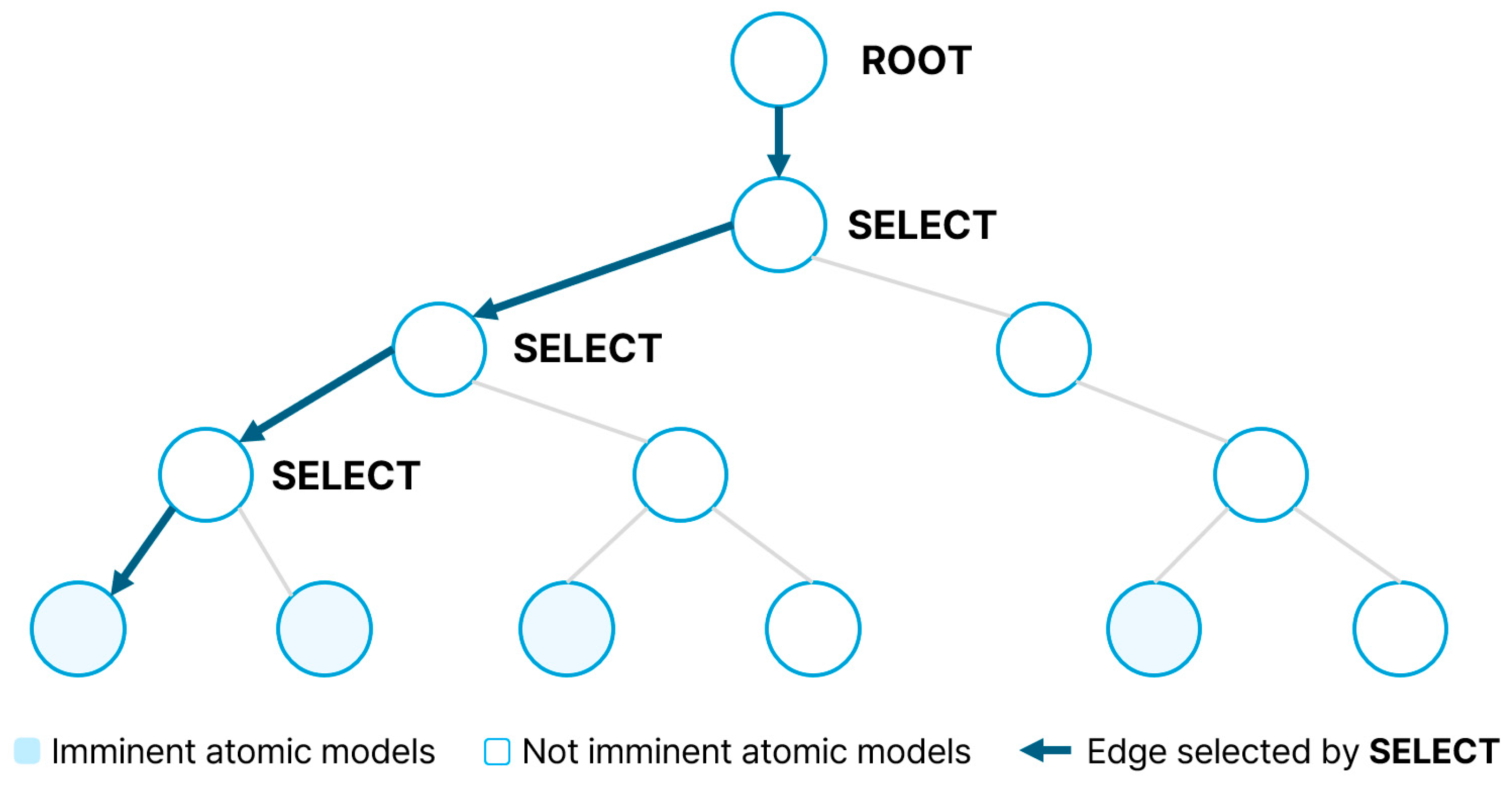
- Select: —tie-breaking function
2.2. Event Scheduling Method in HDL
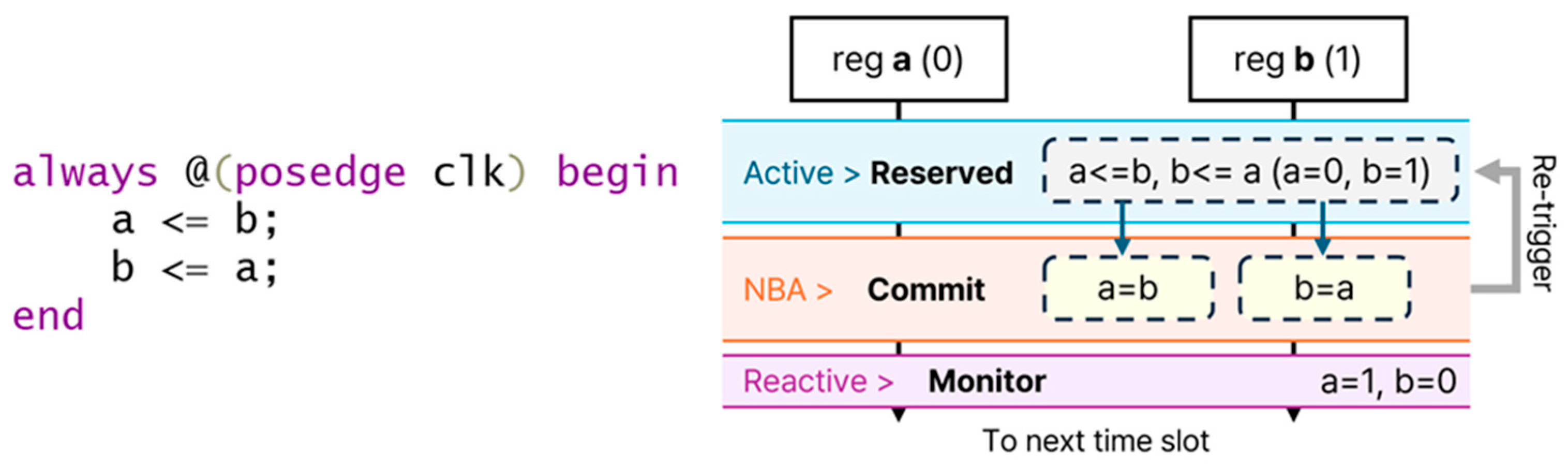
- Active phase: All blocking assignments (=) and combinational evaluations execute immediately. For non-blocking assignments (<=), only the right-hand side (RHS) is evaluated, and the left-hand side (LHS) update is deferred.
- NBA phase: The non-blocking assignments scheduled in the Active phase are applied in a single batch, causing all related signals to update simultaneously. This mechanism realizes the concurrent-update semantics of hardware.
- Reactive phase: Processes that observe or verify the newly updated signals are executed in this phase, including monitors, assertions, and output display tasks such as the Verilog/SystemVerilog system task $display.
2.3. Parallel-DEVS (P-DEVS)
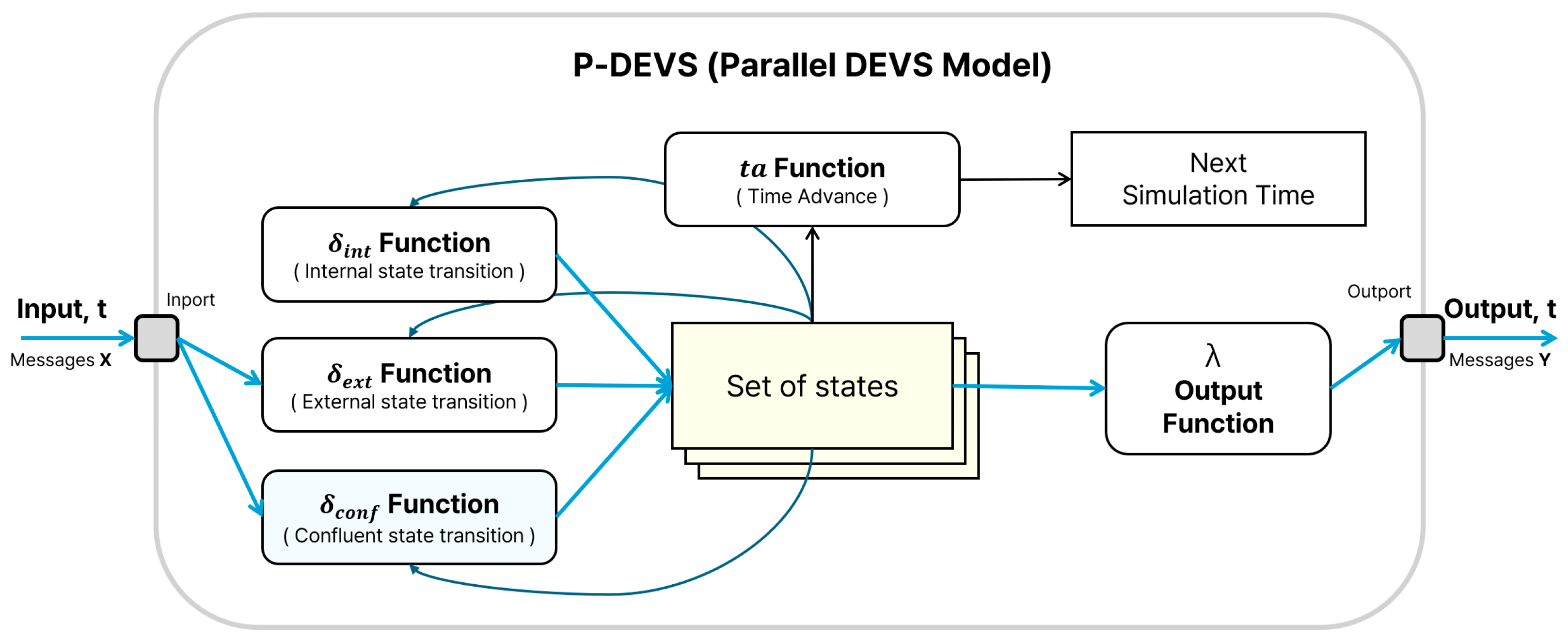
2.4. HDL and P-DEVS
3. Problem Statement
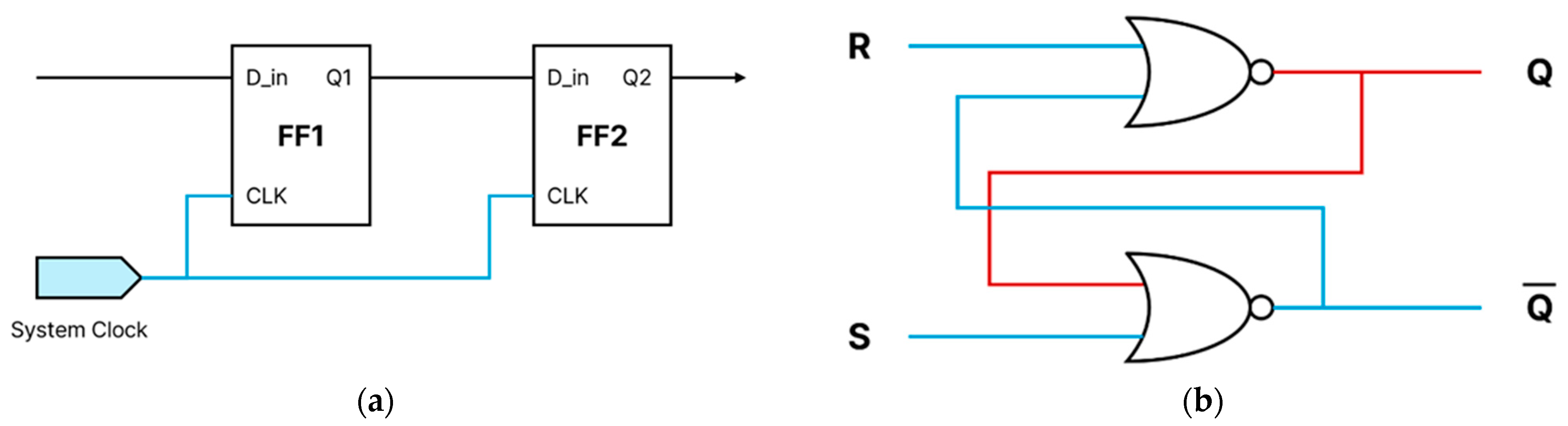
3.1. Pipeline Skew
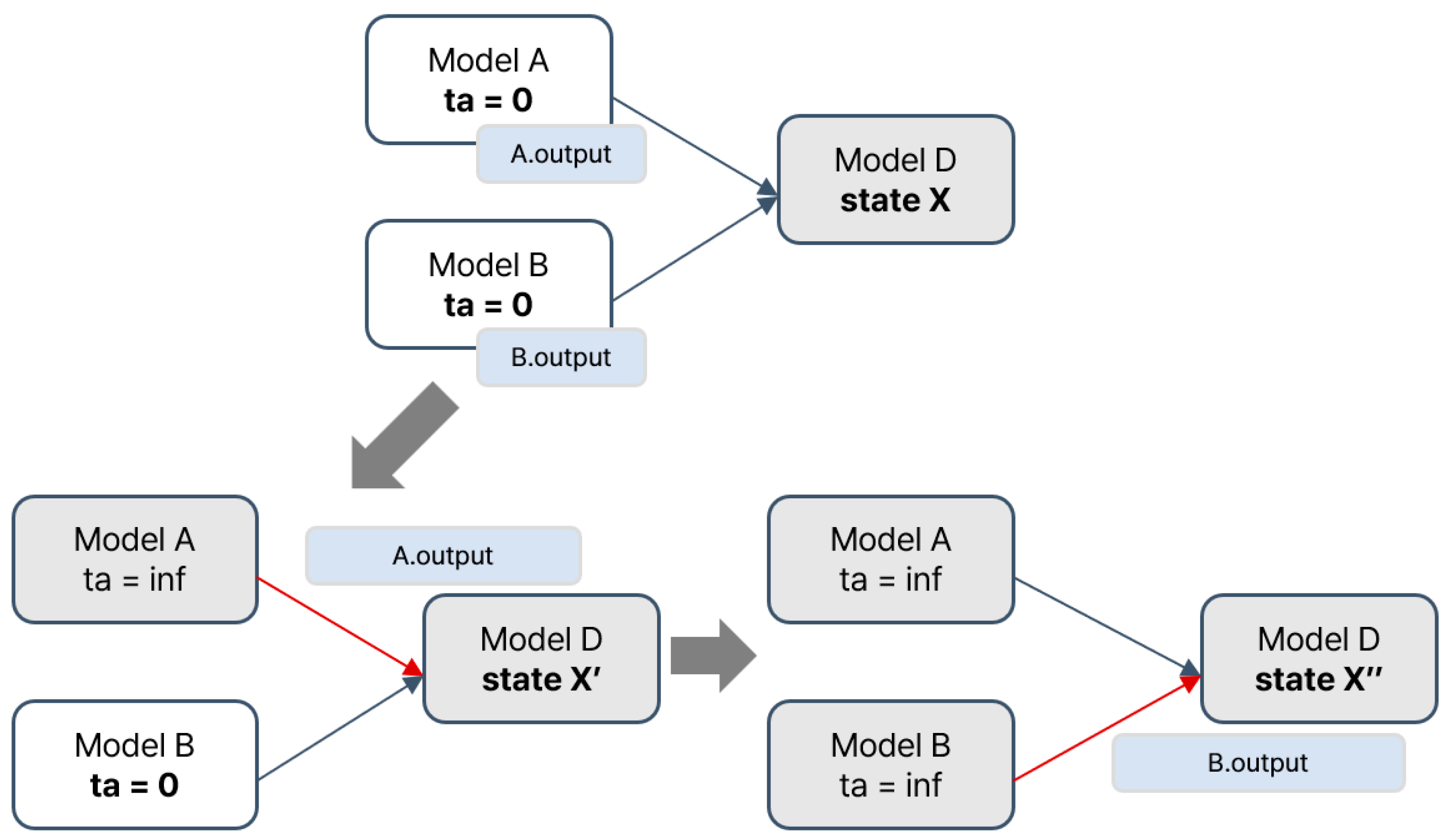
3.2. Infinity Loop
4. BFS-Scheduled DEVS Simulation Kernel
4.1. Level-Synchronous BFS
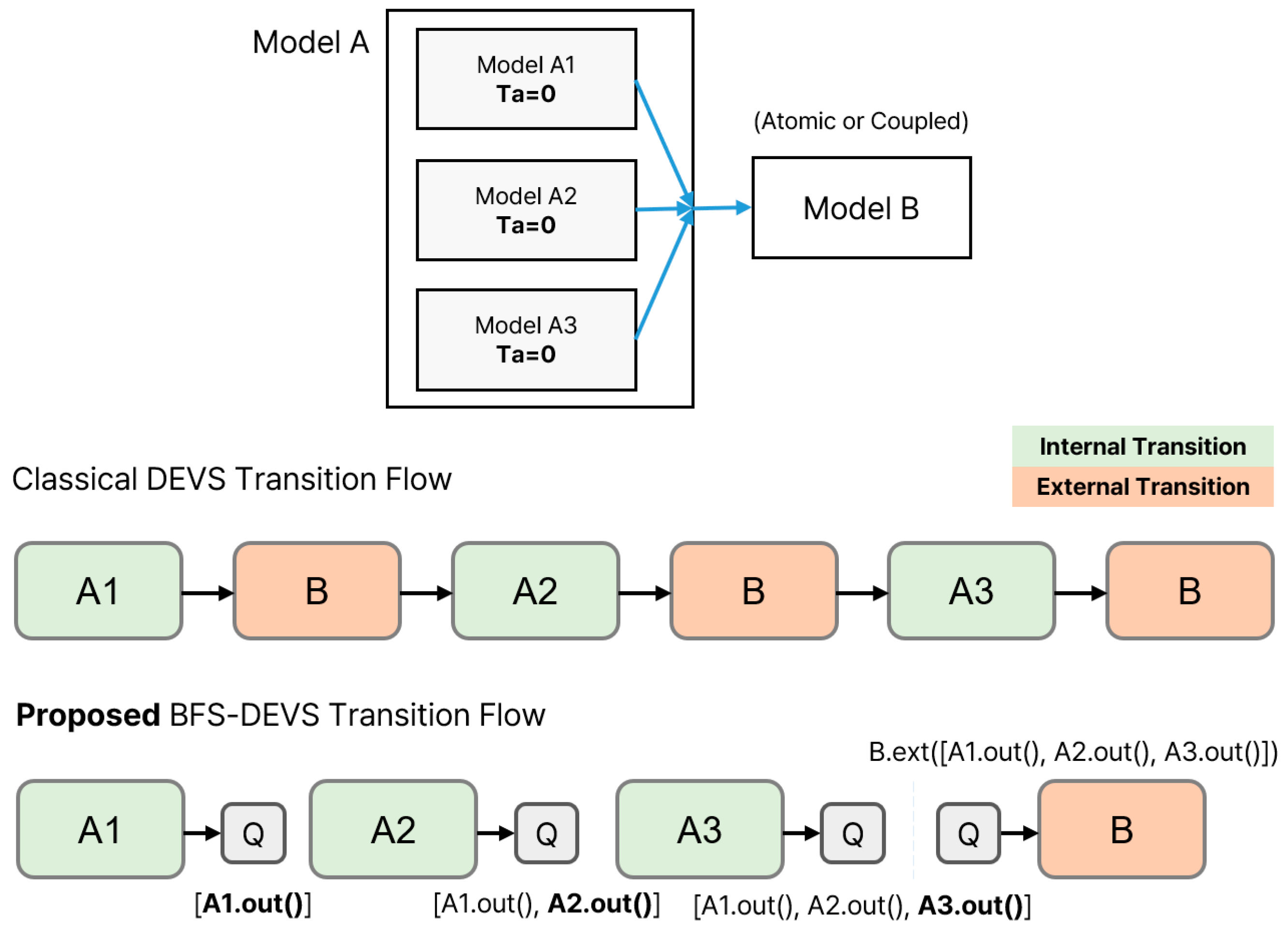
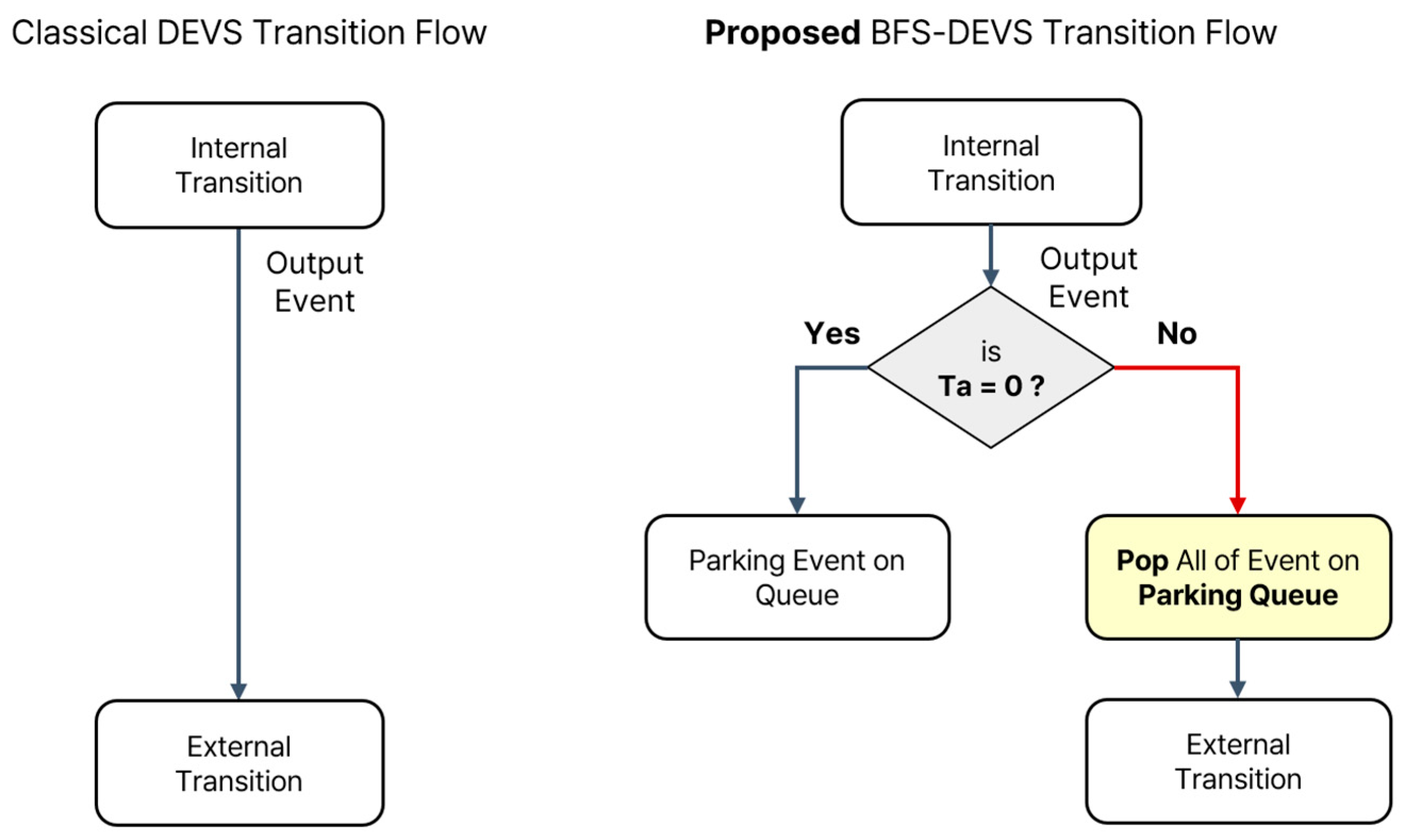
4.2. Event Parking
4.3. Delta-Round
4.4. Comparison of Classic DEVS Kernel and Proposed Kernel
4.5. Quantitative Analysis of Event Scheduling Complexity
4.5.1. Conventional Snapshot Method with a Clock Atomic Model
- Clock phase (clk.int):→→→
- Snapshot phase (clk.int after ε-delay):←←←
4.5.2. Model-Level Emulation in RTL-DEVS
- Receives the clock via an external transition and moves from wait to operation.
- Performs RHS evaluation via an immediate internal transition, computing the next state and RHS values.
- Commits the LHS update and produces output in another internal transition, moving to the out state and then back to wait.
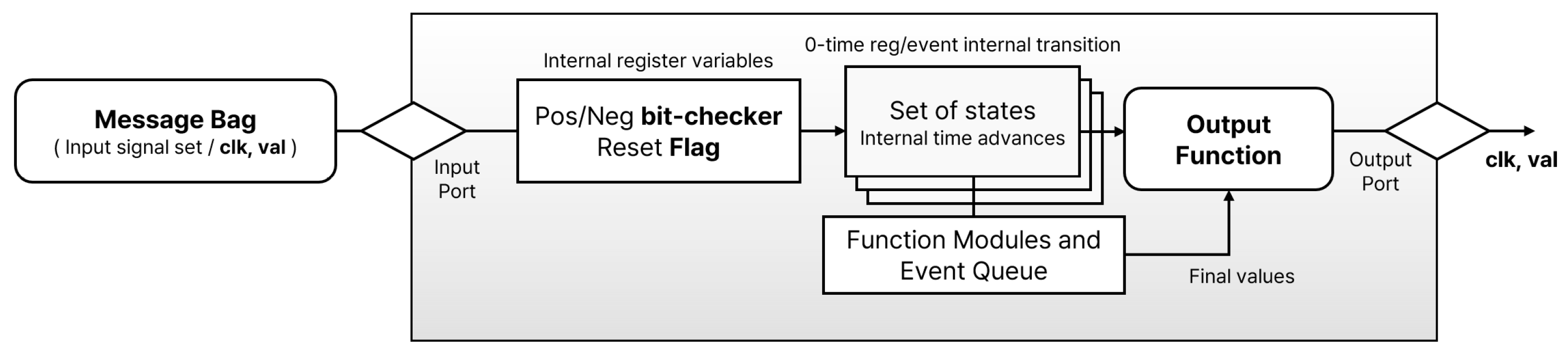
4.5.3. Proposed BFS-Based Kernel with Event Parking
- Evaluation:ininin
- Commit:When the slot terminates (sim.ta > 0), the kernel pops all parking queues once and invokes a single per target model to apply the accumulated inputs. No additional snapshot messages or model-level micro-states are needed. Under the assumption of a stable synchronous pipeline, each register executes one external transition per cycle. Then, per-cycle scheduling cost is .
5. Case Studies and Discussions
5.1. Case of Pipeline Skew
- Flip-flop FF1 evaluates the input and immediately applies within the same time slot
- The updated value of is then propagated in the same slot as the input to FF2.
- Consequently, FF2 performs its computation using the updated instead of the original that should have been observed at . As a result, the output of FF2 appears one slot earlier than expected, producing a pipeline skew effect.
- In the time slot , both FF1 and FF2 compute their outputs by referring only to their initial states . Computations are defined as FF1: and FF2:
- The resulting outputs and are temporarily collected in target-specific parking queues.
- When the current time slot concludes, these results are collectively applied to update the final states . Because FF1 and FF2 do not reference each other’s updated values within the same slot , no skew occurs.
5.2. Case of Infinity Loop
5.3. Discussion
6. Conclusions and Future Work
Author Contributions
Funding
Data Availability Statement
Conflicts of Interest
References
- Tavanpour, M.; Kazi, B.U.; Wainer, G. Discrete Event Systems Specifications Modelling and Simulation of Wireless Networking Applications. J. Simul. 2022, 16, 1–25. [Google Scholar] [CrossRef]
- Zeigler, B.P.; Praehofer, H.; Kim, T.G. Theory of Modeling and Simulation: Integrating Discrete Event and Continuous Complex Dynamic Systems, 2nd ed.; Academic Press: San Diego, CA, USA, 2000; pp. 37–75. ISBN 0-12-778455-1. [Google Scholar]
- Wainer, G.A.; Mosterman, P.J. (Eds.) Discrete-Event Modeling and Simulation: Theory and Applications; CRC Press: Boca Raton, FL, USA, 2011; pp. 3–73. ISBN 978-1-4200-7233-4. [Google Scholar]
- Risco-Martín, J.L.; Mittal, S.; Fabero Jiménez, J.C.; Zapater, M.; Hermida Correa, R. Reconsidering the Performance of DEVS Modeling and Simulation Environments Using the DEVStone Benchmark. Simulation 2017, 93, 459–476. [Google Scholar] [CrossRef]
- Capocchi, L.; Zeigler, B.P.; Santucci, J.-F. Simulation-Based Development of Internet of Cyber-Things Using DEVS. Computers 2025, 14, 258. [Google Scholar] [CrossRef]
- Concepcion, A.I.; Zeigler, B.P. DEVS Formalism: A Framework for Hierarchical Model Development. IEEE Trans. Softw. Eng. 1988, 14, 228–241. [Google Scholar] [CrossRef]
- Zeigler, B.; Wainer, G. DEVS Closure Under Coupling, Universality, and Uniqueness: Enabling Simulation and Software Interoperability from a System-Theoretic Foundation. Computers 2025, 14, 514. [Google Scholar] [CrossRef]
- Zeigler, B.P. Closure under Coupling: Concept, Proofs, DEVS Recent Examples (WIP). In Proceedings of the 4th ACM International Conference of Computing for Engineering and Sciences (ICCES’18), Kuala Lumpur, Malaysia, 14–16 July 2018; pp. 1–6. [Google Scholar] [CrossRef]
- Hamri, M.; Driouche, N. Modeling and Simulation of Logic Gates Using DEVS. In Proceedings of the 5th International Conference on Simulation and Modeling Methodologies, Technologies and Applications (SIMULTECH 2015), Colmar, France, 21–23 July 2015; SCITEPRESS—Science and Technology Publications: Setúbal, Portugal, 2015; pp. 194–200. [Google Scholar] [CrossRef]
- Chen, B.; Vangheluwe, H. Symbolic Flattening of DEVS Models. In Proceedings of the 2010 Summer Computer Simulation Conference (SCSC ’10), Ottawa, ON, Canada, 11–14 July 2010; Society for Computer Simulation International: San Diego, CA, USA, 2010; pp. 209–218. [Google Scholar]
- Santucci, J.-F.; Capocchi, L.; Zeigler, B.P. System Entity Structure Extension to Integrate Abstraction Hierarchies and Time Granularity into DEVS Modeling and Simulation. Simulation 2016, 92, 747–769. [Google Scholar] [CrossRef]
- Saghir, A.; Pearce, T.; Wainer, G. Modeling Computer Hardware Platforms Using DEVS and HLA Simulation. Simul. Ser. 2004, 36, 218. [Google Scholar]
- Lee, C.-H.; Bae, J.W.; Paik, E. GO-DEVS: Storage and Retrieval System for DEVS Models Using Graph and Ontology Representation. Sensors 2021, 21, 6771. [Google Scholar] [CrossRef]
- Van Tendeloo, Y.; Vangheluwe, H. Classic DEVS Modelling and Simulation. In Proceedings of the 2017 Winter Simulation Conference (WSC), Las Vegas, NV, USA, 3–6 December 2017; IEEE: Piscataway, NJ, USA, 2017; pp. 644–658. [Google Scholar] [CrossRef]
- Kwon, S.J.; Sung, C.; Song, H.S.; Kim, T.G. Integrated Hybrid Modeling Methodology and Simulation Engine Design Based on HDEVS Formalism. J. Korea Soc. Simul. 2013, 22, 21–30. [Google Scholar] [CrossRef][Green Version]
- Wainer, G.; Govind, S. 100 Volumes of SIMULATION—20 Years of DEVS Research. Simulation 2024, 100, 1297–1318. [Google Scholar] [CrossRef]
- Ayadi, A.; Frydman, C.; Laddada, W.; Imbert, I.; Zanni-Merk, C.; Soualmia, L.F. Combining DEVS Simulation and Ontological Modeling for Hierarchical Analysis of the SARS-CoV-2 Replication. Simulation 2023, 99, 1011–1039. [Google Scholar] [CrossRef]
- Sung, J.-H.; Ju, S.-H.; Cho, S.-W.; Joo, H.-J.; Seo, K.-M.; Kang, B.-G. Modeling and Exploratory Analysis of Discrete Event Simulations for Optimizing Overhead Hoist Transport Systems and Logistics in Semiconductor Manufacturing. Mathematics 2025, 13, 1167. [Google Scholar] [CrossRef]
- Maatoug, A.; Belalem, G.; Mahmoudi, S. A Location-Based Fog Computing Optimization of Energy Management in Smart Buildings: DEVS Modeling and Design of Connected Objects. Front. Comput. Sci. 2023, 17, 172501. [Google Scholar] [CrossRef]
- Kwon, B.S.; Han, Y.S.; Lee, J.S. DEVS-Based CDC Synchronizer Design for Fast Debugging of Metastability. Electronics 2024, 13, 5048. [Google Scholar] [CrossRef]
- Kwon, B.-S.; Jung, S.-W.; Noh, Y.-D.; Lee, J.-S.; Han, Y.-S. RTL-DEVS: HDL Design and Simulation Methodology for DEVS Formalism-Based Simulation Tool. Telecom 2023, 4, 15–30. [Google Scholar] [CrossRef]
- Cárdenas, R.; Henares, K.; Arroba, P.; Wainer, G.; Risco-Martín, J.L. A DEVS Simulation Algorithm Based on Shared Memory for Enhancing Performance. In Proceedings of the 2020 Winter Simulation Conference (WSC), Orlando, FL, USA, 14–18 December 2020; IEEE: Piscataway, NJ, USA, 2020; pp. 2184–2195. [Google Scholar] [CrossRef]
- Ashenden, P.J. The Designer’s Guide to VHDL, 3rd ed.; Morgan Kaufmann: Burlington, MA, USA, 2008; pp. 559–583. [Google Scholar]
- Grötker, T.; Liao, S.; Martin, G.; Swan, S. SystemC: Methodologies and Applications; Springer: Boston, MA, USA, 2002. [Google Scholar]
- Thomas, D.E.; Moorby, P.R. The Verilog Hardware Description Language, 5th ed.; Springer: New York, NY, USA, 2008; pp. 109–142. [Google Scholar]
- IEEE Std 1800-2017 (Revision of IEEE Std 1800-2012); IEEE Standard for SystemVerilog—Unified Hardware Design, Specification, and Verification Language. IEEE: New York, NY, USA, 2018; pp. 1–1315.
- Cummings, C.E. Nonblocking Assignments in Verilog Synthesis, Coding Styles That Kill! In Proceedings of the SNUG (Synopsys Users Group) 2000, San Jose, CA, USA, 13 March 2000. [Google Scholar]
- Pifer, T.J. DEVS-Based Hardware Design, Synthesis, and Power Optimization Using Explicit Time Specifications and Deterministic Path-Based Latency. Master’s Thesis, University of Arizona, Tucson, AZ, USA, 2012. [Google Scholar]
- Chow, A.C.H.; Zeigler, B.P. Parallel DEVS: A Parallel, Hierarchical, Modular Modeling Formalism. In Proceedings of the Winter Simulation Conference (WSC), Lake Buena Vista, FL, USA, 11–14 December 1994; IEEE: Piscataway, NJ, USA, 1994; pp. 716–722. [Google Scholar] [CrossRef]
- Ewald, R. Simulation of Load Balancing Algorithms for Discrete Event Simulations. Ph.D. Thesis, University of Rostock, Rostock, Germany, 2006. [Google Scholar]
- Preyser, F.J.; Heinzl, B.; Kastner, W. RPDEVS: Revising the Parallel Discrete Event System Specification. In Proceedings of the 9th Vienna International Conference on Mathematical Modelling (MathMod 2018), Vienna, Austria, 21–23 February 2018; pp. 242–247. [Google Scholar]
- Junglas, P. NSA-DEVS: Combining Mealy Behaviour and Causality. Simul. Notes Eur. 2021, 31, 73–80. [Google Scholar] [CrossRef]
- Wainer, G.A. An Introduction to Cellular Automata Models with Cell-DEVS. In Proceedings of the 2019 Winter Simulation Conference (WSC), National Harbor, MD, USA, 8–11 December 2019; pp. 1534–1548. [Google Scholar]



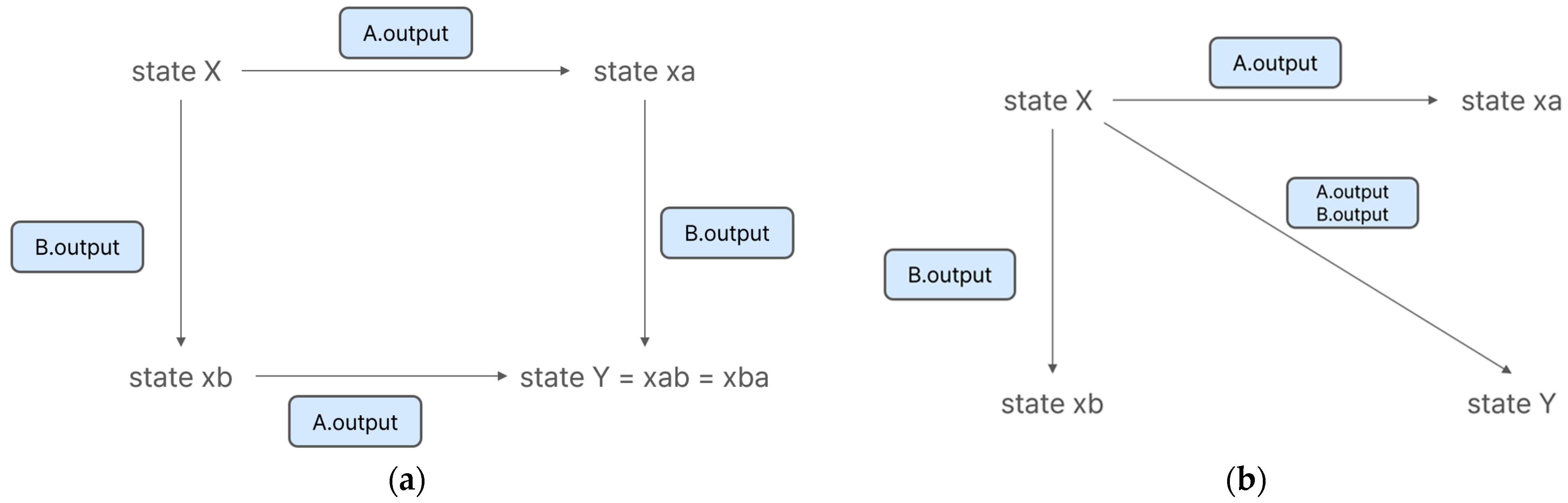
| Aspect | HDL | P-DEVS |
|---|---|---|
| Event-processing scheme | Active–NBA–Reactive (delta-cycle) | Internal/External/Confluent transition |
| Separation of evaluation and commit | Clearly separated (Evaluate→Commit) | Not separated (Evaluate→Propagate) |
| Feedback handling | Stable | May exhibit cyclic propagation (0-time feedback possible) |
| Order dependency | None (slot-level deterministic) | Partially present (confluent transition) |
| Simulation granularity | Time-slot based | Event based |
| Target Event Region (HDL) | Proposed DEVS Kernel | Key Features |
|---|---|---|
| Active | Level-Synchronous BFS (evaluate phase) | Prevents interference among models within the same slot by evaluating all outputs simultaneously without immediate propagation. Each result is stored only in the target-specific parking queue. |
| NBA | Event parking and commit | Preserves concurrent inputs from multiple senders by holding RHS values in queues, then performs simultaneous LHS commits, mimicking the non-blocking assignment semantics of HDL. |
| Reactive | Delta-round detection | After commit, recalculates the new state and next event time for each model. Depending on slot conditions, either proceeds with another delta-cycle or terminates the slot and updates simulator outputs. |
Disclaimer/Publisher’s Note: The statements, opinions and data contained in all publications are solely those of the individual author(s) and contributor(s) and not of MDPI and/or the editor(s). MDPI and/or the editor(s) disclaim responsibility for any injury to people or property resulting from any ideas, methods, instructions or products referred to in the content. |
© 2025 by the authors. Licensee MDPI, Basel, Switzerland. This article is an open access article distributed under the terms and conditions of the Creative Commons Attribution (CC BY) license.
Share and Cite
Kwon, B.S.; Han, Y.S.; Lee, J.S. A BFS-Based DEVS Simulation Kernel for HDL-Compatible Simulation. Electronics 2026, 15, 48. https://doi.org/10.3390/electronics15010048
Kwon BS, Han YS, Lee JS. A BFS-Based DEVS Simulation Kernel for HDL-Compatible Simulation. Electronics. 2026; 15(1):48. https://doi.org/10.3390/electronics15010048
Chicago/Turabian StyleKwon, Bo Seung, Young Shin Han, and Jong Sik Lee. 2026. "A BFS-Based DEVS Simulation Kernel for HDL-Compatible Simulation" Electronics 15, no. 1: 48. https://doi.org/10.3390/electronics15010048
APA StyleKwon, B. S., Han, Y. S., & Lee, J. S. (2026). A BFS-Based DEVS Simulation Kernel for HDL-Compatible Simulation. Electronics, 15(1), 48. https://doi.org/10.3390/electronics15010048