1. Introduction
With the rapid growth of connected devices and advancements in wireless communication technologies, enhancing indoor network coverage and achieving high-speed connectivity remain significant challenges [
1]. Visible light communication (VLC), which uses light-emitting diodes (LEDs) to provide both illumination and data transmission, has emerged as a highly promising technology [
2]. VLC provides several outstanding advantages, such as unlicensed spectrum, large bandwidth, immunity to radio frequency interference, and high data rates for indoor environments [
3]. It is increasingly considered as a strong candidate for 5G and beyond, as it meets the growing demands for high data rates, low latency, and efficient spectrum utilization [
4]. Beyond indoor networking, VLC also holds significant potential for a wide range of applications including underwater communication, healthcare, military systems, and aviation while enabling advanced multimedia services [
5,
6].
High-speed wireless technologies such as 4G and 5G widely employ Orthogonal Frequency Division Multiplexing (OFDM), and its use is also anticipated to continue in Beyond 5G (B5G) systems [
7]. In VLC systems, OFDM is preferred because of its high spectral efficiency and its strong capability to mitigate inter-symbol interference (ISI) caused by multipath propagation. These advantages make it particularly effective for enhancing indoor data rates and overall bandwidth efficiency [
8].
In VLC systems, communication typically relies on intensity modulation and direct detection (IM/DD), where LEDs encode information by varying light intensity, and photodiodes convert the received optical signal into electrical form [
9]. Because light intensity cannot assume negative values, conventional complex and bipolar OFDM signals must be transformed into real, non-negative signals commonly achieved by applying Hermitian symmetry prior to the IFFT [
10]. To address these requirements, multiple optical OFDM variants have been proposed. Direct-Current Biased Optical OFDM (DCO-OFDM), for example, enforces signal non-negativity by adding a DC bias, while Asymmetrically Clipped Optical OFDM (ACO-OFDM) achieves this through signal clipping, though this approach comes with a reduction in spectral efficiency [
11,
12]. Asymmetrically clipped direct-current biased-optical OFDM (ADO-OFDM) combines the strengths of both approaches, offering improved bandwidth efficiency and lower BER [
13]. In addition, various other techniques have been introduced to produce unipolar signals that are adapted with IM/DD-based VLC systems [
14,
15]. ACO-OFDM offers significant advantages for IM/DD-based VLC systems, including high data rates, strong spectral and power efficiency, and improved BER compared to other optical OFDM variants [
16]. It is also more resilient to LED nonlinearities, enabling reliable transmission across extended distances and in environments with complex optical characteristics [
17]. Due to these strengths, ACO-OFDM is considered one of the most effective schemes for VLC, making it the focus of this work.
A key challenge in ACO-OFDM systems is the inherently high peak-to-average power ratio (PAPR), arising from the superposition of multiple subcarriers. This leads to nonlinear distortion, reduced power efficiency, and degraded BER performance [
18]. To mitigate these issues, numerous PAPR-reduction techniques have been proposed, including clipping, companding transforms, selective mapping (SLM), partial transmit sequence (PTS), and precoding [
19,
20]. Among these methods, nonlinear companding transforms such as μ-law, A-law, and logarithmic companding are particularly appealing due to their simplicity, low computational complexity, and strong PAPR-reduction capability, though they may introduce slight BER degradation [
21,
22]. Additionally, chaotic scrambling techniques have recently gained attention as powerful solutions for PAPR mitigation in OFDM-based VLC systems [
23]. By exploiting chaotic sequences, these methods help enhance signal integrity, reduce nonlinear distortion, and improve overall system performance without compromising transmission efficiency.
On the other hand, securing data transmission in VLC systems has received growing attention, particularly in public environments such as airports, meeting rooms, hospitals, and shopping malls [
24,
25,
26]. Owing to the broadcast nature of optical wireless links, VLC signals are inherently susceptible to eavesdropping and malicious attacks. Recently, physical-layer security techniques have been extensively explored to enhance the protection of OFDM-based VLC communication systems [
27,
28].
Existing research has focused on introducing chaos in VLC systems to secure transmitted data through chaos-based techniques. For instance, a study reported in [
29] employs color modulation combined with a hyper-chaotic map to enhance security in VLC systems. Another approach proposes a chaotic encryption method for OFDM-based VLC systems, aiming to secure image transmission against known- and chosen-plaintext attacks using dynamic ciphertexts and a multiple-fold encryption protocol [
30]. A study also introduced a novel physical-layer security (PLS) algorithm for DCO-OFDM–based VLC systems, designed to protect transmissions from eavesdroppers [
31]. A secure NOMA-VLC approach, integrating the OFDM technique with a two-level chaotic encryption method, was proposed to ensure secure image transmission, safeguard legitimate users from eavesdropping, and maintain user privacy [
32]. Similarly, another study presented a secure OFDM-VLC encryption scheme based on dual chaotic models, combining bitwise XOR encryption with HD constellation rotation to reinforce physical-layer security and prevent unauthorized access [
33]. Additionally, a differential chaotic modulation method was developed for WDM-aided systems to further improve image transmission security over OFDM-VLC systems [
34]. To date, several physical-layer security approaches leveraging digital chaos have been proposed for OFDM-PON systems [
35,
36]. In a related development, a chaos-based IQ encryption scheme with optimal frame transmission was applied in an OFDMA-PON system [
37], with experiments demonstrating its ability to reduce PAPR while enhancing data transmission security.
Based on the review of related studies, numerous methods have been proposed to simultaneously improve transmission security and enhance PAPR and BER performance in VLC systems employing the OFDM technique. Recently, several research efforts have focused on the joint mitigation of PAPR and the enhancement of security in OFDM-based VLC data transmission systems [
38,
39]. Among these, companding-based schemes have received particular attention due to their ability to achieve effective PAPR reduction while preserving signal integrity [
17,
40,
41,
42]. These techniques are widely adopted as they not only reduce PAPR but also improve the BER performance of OFDM-VLC systems.
Meanwhile, many researchers have focused on the physical-layer security and PAPR reduction to enhance the security of image data transmitted via OFDM-VLC systems [
43,
44]. For example, a study proposed a two-layer encryption scheme based on chaos scrambling to enhance image transmission security while simultaneously improving PAPR and BER performance in DCT-precoded OFDM-VLC systems [
43]. Another study by the same authors introduced a combined method using chaos-based inter-block scrambling and DFT precoding for OFDM-based VLC, achieving significant PAPR reduction and enhanced image data security [
44]. In a related study, an efficient masking strategy called PCCM was proposed to simultaneously reduce PAPR and enhance data security in OFDM-based VLC systems [
45]. In this approach, the image is first encrypted using Arnold’s cat map (ACM), followed by PCCM masking, where the mapped symbol sequence is further encrypted with the PCCM chaotic map. This method effectively secures the transmitted data while reducing PAPR, without causing any BER degradation.
In our previous work [
46], we proposed a novel and effective scheme to reduce PAPR for image transmission in ACO-OFDM systems. The approach combines ACMS-based chaotic scrambling with a modified µ-logarithmic transformation (µ-MLCT). This scheme not only effectively reduces PAPR but also improves PSNR and BER, ensuring both high transmission performance and robust security.
Although many studies focus on PAPR reduction, few address security and BER performance simultaneously. Companding transforms are among the most effective methods for reducing PAPR without degrading BER performance, whereas physical-layer security techniques based on chaos scrambling can simultaneously reduce PAPR and enhance data security due to their sensitivity to initial conditions. Therefore, combining the advantages of companding techniques with chaos-based scrambling can simultaneously improve PAPR and BER performance while enhancing the system’s transmission security.
Motivated by the proven effectiveness of chaotic maps in encryption frameworks, this work proposes a secure image transmission scheme for µ-MLCT-ACO-OFDM-based VLC systems that integrates image chaotic encryption with physical-layer encryption techniques. In this study, a new hybrid chaotic system (HCS) with strong chaotic properties is introduced, making it well-suited for encryption applications. The HCS can generate sequences with a wide chaotic range, strong randomness, and high sensitivity to initial conditions, providing robust security. Unlike conventional methods, the HCS is applied to both image encryption and physical-layer symbol scrambling, enabling multi-level protection. The proposed scheme effectively achieves simultaneous PAPR reduction, BER improvement, and secure image transmission in ACO-OFDM-based VLC systems.
The original image is first encrypted using Arnold’s cat map, followed by a second encryption stage employing chaotic sequences generated by the HCS to further enhance data security. The resulting symbols are then scrambled, with their real and imaginary parts additionally encrypted using HCS and logistic chaotic sequences. Prior to ACO-OFDM transmission, a µ-MLCT transformation is applied to mitigate PAPR and improve BER performance. The efficiency of the secured µ-MLCT-ACO-OFDM scheme is extensively evaluated using BER, PSNR, and CCDF of PAPR metrics. Additionally, security assessments are conducted to demonstrate the robustness of the encryption system against unauthorized access. Simulation results demonstrate that the proposed scheme outperforms existing techniques, achieving superior PAPR reduction and enhanced BER performance for secure image transmission. The main contributions of the present study are summarized as follows:
A new hybrid chaotic system (HCS) is proposed, and its chaotic behavior is thoroughly analyzed.
A mathematical model of the VLC system using ACO-OFDM is developed, and its BER performance is analyzed with a random bit source. Results indicate that physical-layer symbol scrambling does not affect the BER of ACO-OFDM systems during image transmission.
The introduction of μ-MLCT transformation in the proposed secure transmission system effectively reduces PAPR while improving BER performance.
Combining chaos-based image scrambling with physical-layer encryption improves the security of transmitted image data and effectively reduces the PAPR in ACO-OFDM systems.
Security performance shows that our image encryption scheme provides a high security level and proves itself against statistical and brute force attacks.
The organization of the paper is outlined as follows.
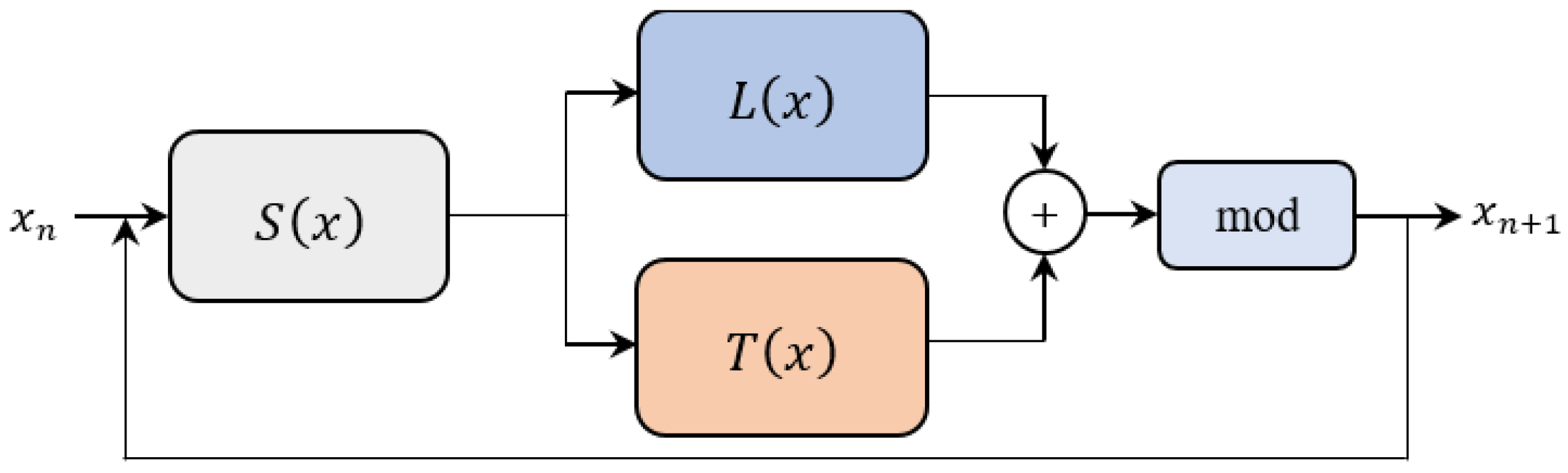
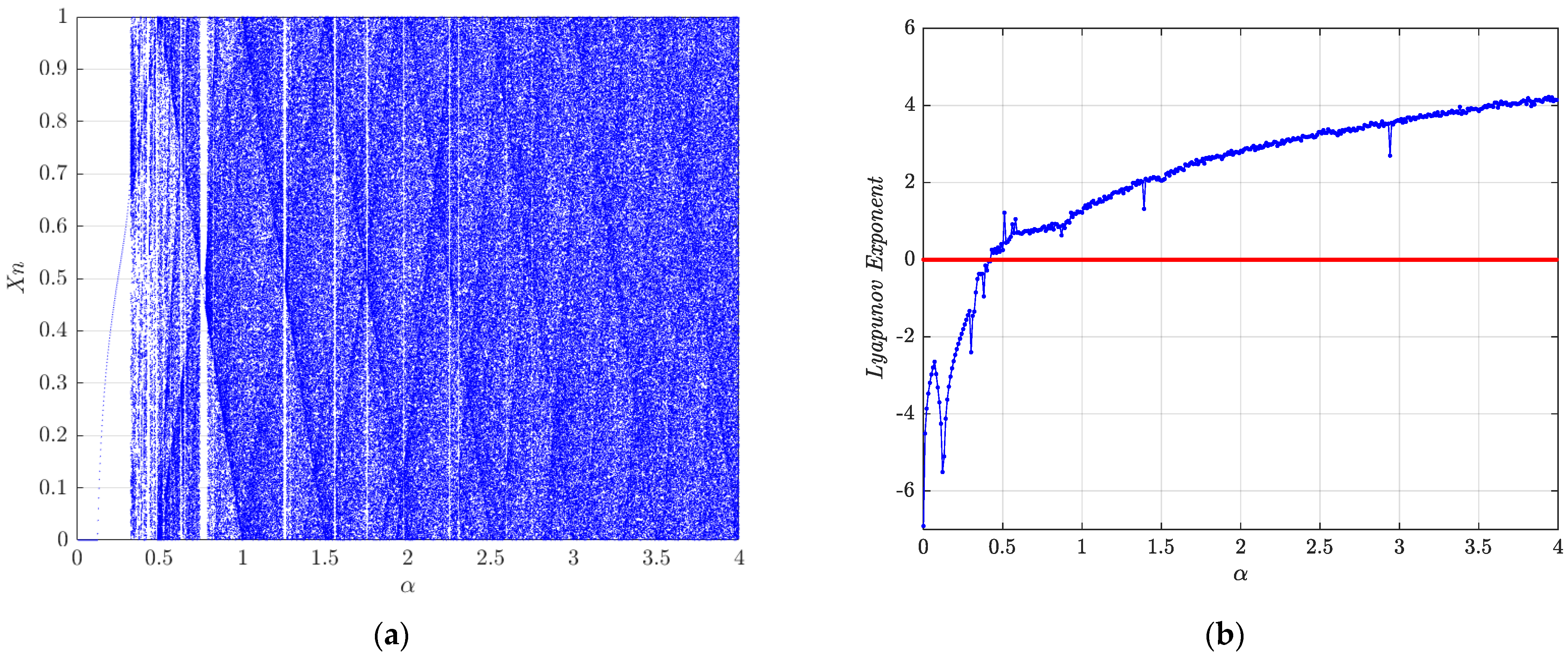
Section 2 introduces the novel chaotic map derived from the HCS. The secured µ-MLCT-ACO-OFDM for image transmission is introduced in
Section 3. Additionally, the mathematical model of the proposed scheme is developed, and the formulation of the μ-MLCT-ACO-OFDM scheme is derived.
Section 4 evaluates and compares the performance of the secure image µ-MLCT-ACO-OFDM transmission system through simulation experiments and presents a comprehensive security analysis. Finally,
Section 5 offers a summary of the work and its main conclusions.
3. Proposed μ-MLCT-ACO-OFDM for Secure Image Transmission
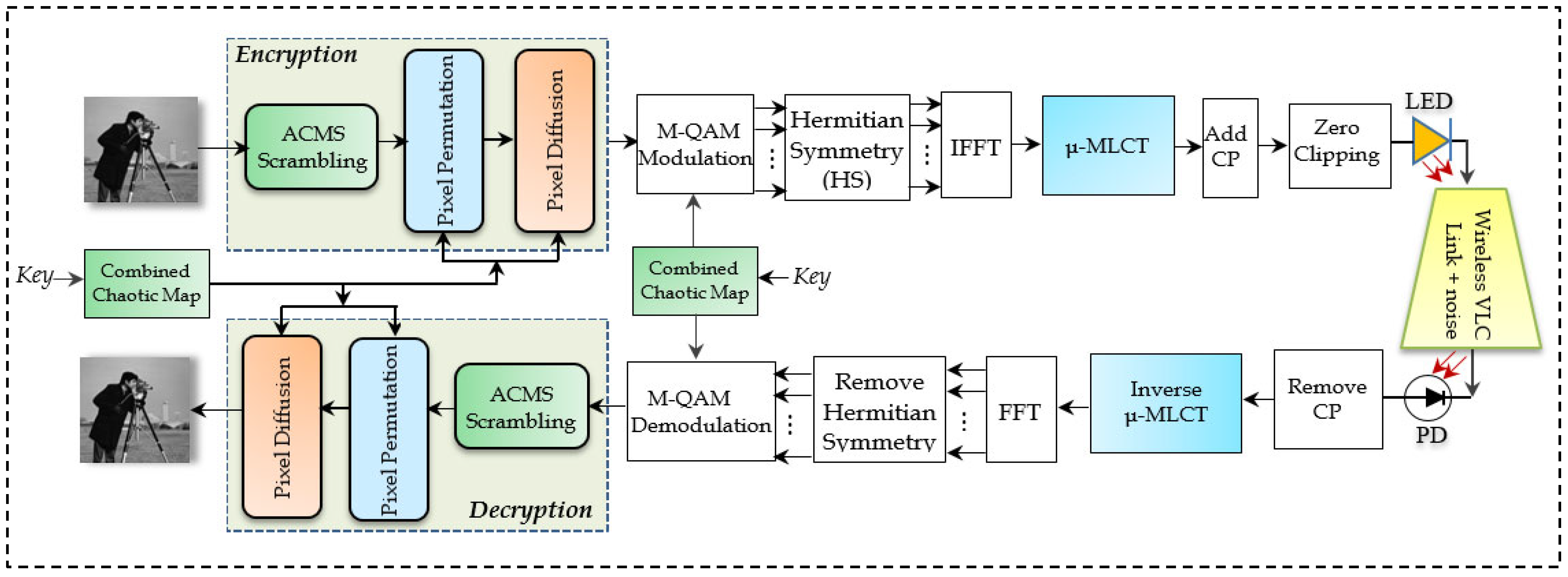
This research focuses on secure image transmission in VLC systems using µ-MLCT-ACO-OFDM modulation. The proposed approach employs a two-level encryption framework, with the first encryption applied at the upper layer and the second implemented at the physical layer, as illustrated in
Figure 3.
3.1. Two Level of Image Encryption Scheme Using HCS and ACM
Unlike random signals, digital images exhibit unique characteristics such as strong pixel correlation and high redundancy. Encrypting the original image prior to wireless transmission can significantly enhance security. To address the issue of strong correlation, a chaos-scrambling sequence derived from a chaotic map is used to rearrange the pixel positions of the image to be transmitted. In our scheme, the image encryption process consists of two steps: the first level of encryption employs a chaotic sequence generated by the HCS, while the second level uses sequences produced by the ACM chaotic map. The two-level image encryption process is described in the following algorithm, comprising the steps outlined below.
- Step 1
Pixel scrambling of the original image using a two-dimensional ACM map. The pixels are shuffled according to the chaotic transformation given in Equation (2).
where
,
and
represent the original pixel locations and the new pixel locations after ACM scrambling, while
and
are positive integer numbers that represent the control parameter used in the transformation. The number of iterations
of the ACM scrambling depends on the values of
,
and
inputs. These parameters act as the legal keys of the encryption scheme.
- Step 2
Pixel permutation is performed by sorting the chaotic sequence generated by the HCS map, This sequence randomly shuffles pixels across rows and columns, rearranging adjacent pixels to new positions according to the HCS chaotic sequence.
- Step 3
Pixel diffusion is achieved by modifying each pixel through an XOR operation involving the previous image pixel and a random value obtained from the HCS chaotic sequence. This ensures that a slight change in the original image propagates across all pixels of the encrypted image.
3.2. Physical Layer Encryption Using an HCS and Logistic Maps
The cipher image produced by the chaos-based image encryption process is initially converted into a binary data stream, which is then mapped onto a sequence of M-QAM symbols. A chaotic scrambling sequence generated by the HCS map is used to encrypt M-QAM symbols. In our scheme, M-QAM symbol encryption is carried out in two stages. The first stage involves shuffling the symbol positions in the M-QAM symbol sequence, while the second stage encrypts both the real and imaginary components of the M-QAM symbols. The first encryption level is driven by a chaotic sequence derived from the HCS, while the second level employs a combination of HCS and logistic chaotic sequences for enhanced security.
Let
denote the vector of M-QAM symbols, where
is the transpose,
is the index vector obtained from the ascending order of the chaotic sequence
generated by the HCS. The shuffled M-QAM symbol vector
with its
ith element is represented by Formula (3):
For the encryption of both the real and imaginary components of the M-QAM symbols, a binary scrambling sequence is generated using the sign function of HCS sequence
with
being the
nth element of sequence
. Here,
and
can be employed as keys. Similarly, another random sequence
is obtained by the logistic map, which can be defined as
where
serves as the control parameter that determines the map’s dynamics, while
denotes the generated chaotic sequence within the interval
. The
nth element
of the binary sequence
is obtained from the following equation:
Both sequences
A and
B, with
, are utilized to separately encrypt the real and imaginary components of the signal in the frequency domain. The resulting encrypted symbol vector is given by Equation (7):
where “·” represents element-wise multiplication among two vectors. Consequently, the two parts of the M-QAM signal are recovered at the receiver through the following decryption process:
3.3. μ-MLCT Companding
In VLC systems utilizing ACO-OFDM, conventional μ-law companding is introduced at the transmitter after the IFFT to mitigate the high PAPR issue associated with LED nonlinearity. This nonlinear transform compresses large amplitudes and expands smaller ones, improving signal characteristics [
47].
where
represents the peak amplitude of the clipped ACO-OFDM signal,
denotes the companding parameter, and
is the signum function. The μ-law companding algorithm in (9) amplifies low-amplitude signals while leaving the peak values unchanged.
Subsequently, to reduce the signal peaks while largely preserving the low-amplitude components, a logarithmic companding technique is employed. This method reshapes the amplitude distribution of the signal and is governed by a companding factor
, which determines the degree of compression applied. It is mathematically expressed as [
17]
Due to the logarithmic nature, this function can decrease the PAPR through the compression of high-amplitude signals while leaving low-amplitude components largely unaffected, preserving signal fidelity. Furthermore, it optimizes power distribution and reduces average transmitted power, enhancing energy efficiency and noise tolerance in VLC systems.
Mehallel et al. proposed in [
46] a novel nonlinear companding transform, called the logarithmic companding transform (μ-MLCT), designed to reduce the PAPR of ACO-OFDM signals. This nonlinear function combines the principles of μ-law and logarithmic companding and can be mathematically expressed as:
The selection of μ values in Equation (11) plays a crucial role in the μ-MLCT transform for a secure ACO-OFDM-based image transmission scheme, significantly influencing the PAPR and BER performance of the transmission system. The key advantage of the μ-MLCT transformation is its ability to balance PAPR reduction with improvements in PSNR and BER performances. Due to the nature of the companding function, this approach effectively reduces PAPR while enhancing both PSNR and BER in the secured ACO-OFDM-based image transmission scheme.
The decompression process is carried out by applying the inverse of Equation (12), referred to as the expansion function, and is expressed as:
In Equation (12), is the time domain discrete ACO-OFDM signal at the receiver.
Because of the exponential form of the expansion function, it can restore the initial dynamic range, enabling accurate demodulation and preserving reliable BER performance.
3.4. System Model for the Proposed Scheme
Figure 4 presents the block diagram of the secured μ-MLCT-ACO-OFDM communication system designed for image transmission. In this framework, the original image to be transmitted is first encrypted through an encryption scheme that uses Arnold’s cat map and the SLST chaotic map, and the obtained cipher image is converted into a binary data sequence. As illustrated in
Figure 2, the layered security scheme operates in two stages: first, encrypted M-QAM symbols are scrambled by shuffling the symbol positions in the M-QAM symbol sequence using a chaotic sequence derived from the HCS map. In the second stage, the real part of the M-QAM symbols is scrambled employing a chaotic sequence obtained using HCS map, while the imaginary part uses the logistic chaotic sequence.
At the transmitter, the original image is initially encrypted using a combined chaotic map, followed by conversion into a binary data stream. The obtained bit stream is mapped into data symbols by using M-QAM modulation. Let denote the transmitted symbol vector with size . After image encryption and separate encryption of the real and imaginary parts employing chaotic sequences generated from the combined chaotic map, the resulting encrypted symbol vector is obtained.
In ACO-OFDM, only the odd subcarriers are modulated and arranged using Hermitian Symmetry (HS), while even subcarriers are set to zero, ensuring that the transmitted signal remains real-valued output when applied to the inverse fast-Fourier transform (IFFT) block. The input symbol vector to the IFFT block, arranged according to HS, is constructed as
where (⋅)* denotes the complex conjugate.
Subsequently, the IFFT operation is applied on the
to obtain its time-domain representation
, thereby producing the real-valued ACO-OFDM signal, which can be expressed as
where
denotes the IFFT matrix of size
, and the
nth element of
is given as:
Prior to data transmission, the bipolar signal obtained from the IFFT operation is clipped to zero, transforming it into a unipolar signal suitable for IM/DD systems. Consequently, the transmitted ACO-OFDM signal
is represented as
In the proposed framework and after the zero-clipping stage, a μ-MLCT transformation is applied to the signal for compressing high amplitudes, amplifying low amplitudes. This transform maintains a constant average power for the signal and then enhances signal efficiency. Following cyclic prefix (CP) insertion and digital-to-analog (DAC) conversion, the LED transforms the resulting electrical signal into an optical form.
After that, the analog OFDM signal drives the LED, and the resulting optical signal propagates through the wireless VLC channel. In this framework, a ceiling-bounced model is adopted in the case of the dispersive wireless VLC communication channel, whose impulse response
is expressed as [
48]
Here, and denote the DC gain and the unit-step function, respectively. Moreover, , represents the height of the ceiling above the transmitter, and represents the speed of light.
At the receiver, the transmitted visible light signal via the optical channel is detected by the photodiode (PD), which converts it into an analog electrical signal. This resulting signal is then digitized by an analog-to-digital (ADC) conversion. Following digitization, the CP is removed, and the resulting data are converted from serial to parallel form. The time domain discrete ACO-OFDM signal
is given by
where
is an additive white Gaussian noise (AWGN) with zero mean and variance
and “*” denotes a convolution operation.
After CP removal, a decompression process is carried out by applying the inverse
-MLCT transform to expand the received ACO-OFDM signal, and then passing it through an FFT block to transform the signal into frequency-domain. Therefore, the received symbol
at subcarrier
is given by
Inserting the multipath channel convolution and noise model from Equation (18) into Equation (19) yields the following form
After applying the IDFT on the time-domain OFDM sample, the received symbol for the
kth subcarrier can be compactly expressed in the frequency domain by
where
represents the frequency-domain channel response of the
kth subcarrier, and
represents the AWGN in the frequency-domain. A zero-forcing (ZF) equalizer is utilized to mitigate channel effects in the received signal. Let
be the pilot symbol corresponding to the
kth subcarrier location. The channel frequency response
is then estimated using the pilot symbols as
Following equalization, the symbol corresponding to the
kth subcarrier is given by
Then, the useful signal
is extracted from
, and it can be defined as
The resulting signal vector
of size
is then transformed by the inverse Hermitian symmetry
to recover the estimated encrypted data. Therefore, the vector of encrypted QAM symbols is given by
where
is an
diagonal matrix.
represents the equalizer coefficient corresponding to the
kth subcarrier.
Finally, after the symbol decryption using HCS and logistic chaotic sequences, the decrypted symbol vector is expressed as
Accordingly, the
kth element of
is given by
Following symbol estimation, the transmitted symbols are demapped back into serial data using the maximum likelihood decision (MLD) criterion. The recovered data is then converted back into a binary data stream and reshaped into a matrix. Finally, the decryption process is applied to this bit stream to reconstruct the transmitted image. The following subsections present the BER and PAPR performance evaluation of the µ-MLCT-ACO-OFDM system designed for secure image transmission.
3.5. Theoretical BER Formula
In order to evaluate the performance of the optical communication system, we derive the formula for the theoretical BER of the proposed scheme. Therefore, the signal-to-noise ratio (SNR) expression for each subcarrier channel
kth in the ACO-OFDM system can be expressed as
After applying the μ-MLCT companding function to the ACO-OFDM signal, additional companding distortions such as clipping, quantization noise, and other nonlinearities are introduced. These distortions are modeled by the distortion variance
(set to 0 if neglected). In addition, when transmitted through a communication channel, the ACO-OFDM signal is also attenuated, which can be modeled as an AWGN signal with zero mean and variance
. Therefore, the received signal after expansion can be modeled as the sum of an attenuated signal component and a companding distortion. The total noise variance can be rewritten as
If the transmitted ACO-OFDM time samples
are modeled as circular complex Gaussian with variance
, per complex sample, then Equation (28) of the SNR at the receiver can be expressed as
In Equation (30),
denotes the SNR at the receiver over an AWGN channel, which is defined as
. The operator
denotes the expectation (i.e., statistical averaging). Accordingly, the BER expression for each subcarrier in the ACO-OFDM system can be described as follows [
49].
Based on Equation (31), it can be inferred that the BER performance of the proposed scheme based on combining µ-MLCT companding and symbol scrambling for secure image transmission offers improved BER performance compared to the conventional ACO-OFDM system. Furthermore, symbol scrambling does not affect the BER performance of ACO-OFDM systems.
4. Simulation and Analysis of Results
In this study, extensive simulations were conducted using the MATLAB R2021b environment to evaluate the proposed µ-MLCT-ACO-OFDM solution for secure image transmission. The primary objective of these simulations is to examine the performance of the proposed scheme under various conditions. Specifically, the impact of image chaotic encryption, physical-layer encryption, and the µ-MLCT transform on PAPR reduction, PSNR, BER performance, and overall system security is evaluated.
In the simulation setup, the HCS map is employed to generate chaotic sequences for both the image encryption and symbol scrambling phases. In the image encryption phase, ACM- and HCS-based chaotic sequences are used to perform image scrambling operations. During the symbol encryption phase, a numerical sequence generated by the 1D-HCS is used to shuffle the M-QAM symbols, producing new symbol positions. The same map, with a different initial condition, is applied to generate a new chaotic sequence for encrypting the real part of the M-QAM symbols, while another sequence derived from the logistic map encrypts the imaginary part. For the simulation experiments, three standard grayscale images, Cameraman, Aerial, and Elaine were used as input sources.
Table 2 lists the other simulation parameters used in our scheme, selected to reflect realistic and commonly adopted settings in ACO-OFDM-based VLC systems. The FFT size, modulation order, and CP length provide a balanced trade-off between spectral efficiency and robustness against multipath effects. The clipping ratio and μ-companding factor follow standard PAPR-reduction practices, effectively mitigating nonlinear distortion. Chaotic map and ACM parameters were chosen to ensure strong chaotic behavior for secure encryption while maintaining low computational complexity. The VLC channel model represents a standard IM/DD optical link, suitable for evaluating BER, PSNR, and PAPR performance.
To assess the effectiveness of the developed μ-MLCT-ACO-OFDM for secure data transmission, three performance metrics are evaluated, such as CCDF of PAPR, PSNR, and BER. These metrics demonstrate the scheme’s ability to ensure secure and reliable image transmission in next-generation wireless networks. The study focuses on the impact of chaos-based image encryption, chaos-based symbol scrambling, and the μ-MLCT transformation on system performance, particularly in terms of PAPR reduction, image quality (PSNR), and transmission reliability (BER).
4.1. Properties of the HCS Chaotic Sequence
Integer chaotic sequences derived from the HCS were employed at two levels: image encryption and physical-layer encryption. Consequently, the analysis focused on the random characteristics of these integer-based chaotic sequences generated by the HCS map. Since the original HCS map produces real-valued outputs, a preprocessing step was applied to convert these values into integer sequences ranging from 0 to 255, making them suitable for cryptographic operations.
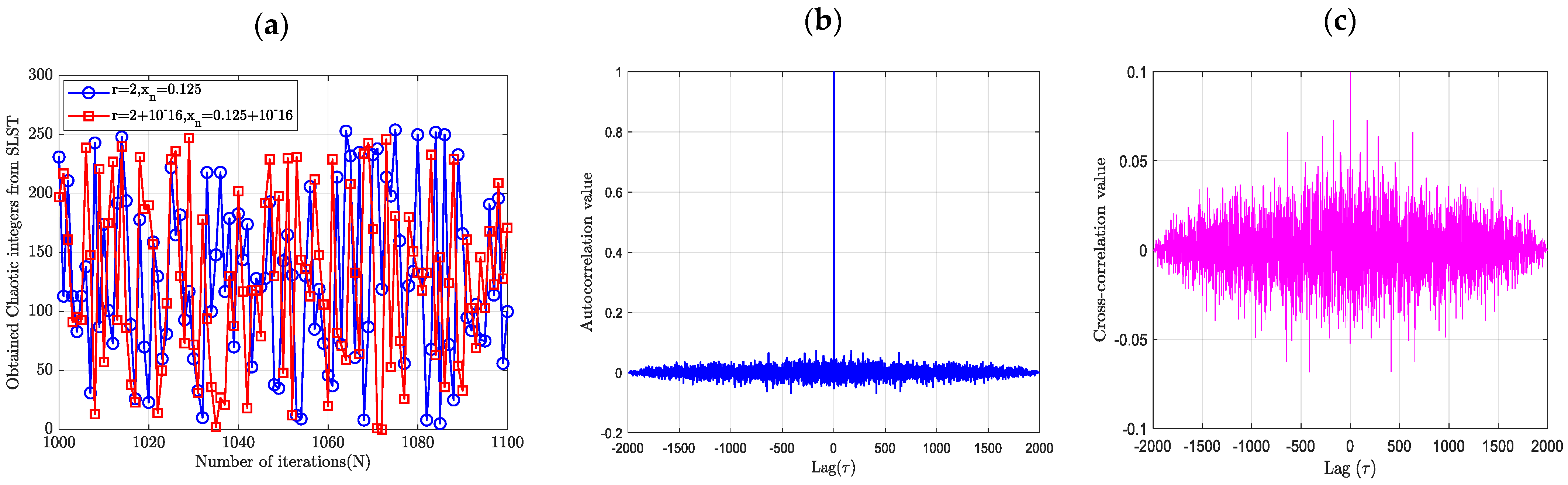
We further assessed the statistical properties of the integer chaotic sequences, including autocorrelation and cross-correlation. To examine the sensitivity of the integer chaotic map defined in Equation (32) to its initial states, a simulation was conducted with control parameter . Two initial values, and + 10−16, were utilized to create distinct integer chaotic sequences.
Figure 4a illustrates the two produced integer chaotic sequences with two slightly different initial conditions:
,
, and
10
−16,
+ 10
−16 and after 1100 iterations. As observed, the significant discrepancies between the two waveforms appear entirely random, confirming that the integer chaotic sequences exhibit high sensitivity to the initial condition
of the HCS map. This property is further confirmed by the autocorrelation and cross-correlation results illustrated in
Figure 4b,c.
Figure 4b illustrates the autocorrelation function of the chaotic sequences, where
reaches its minimum at lag τ = 0. Similarly,
Figure 4c presents the cross-correlation function of two chaotic sequences initialized with α = 2,
= 0.125, and α = 2 + 10
−16,
= 0.125 + 10
−16 for
, showing
values close to zero across all lags. These results confirm that the HCS map produces chaotic sequences and integers with strong randomness properties. Therefore, these sequences can be effectively utilized for image encryption, row scrambling of the QAM symbol vector, and QAM symbol-level encryption as implemented in this work.
4.2. PAPR Performance of Secured μ-MLCT-ACO-OFDM Signal
The
PAPR is a key metric for quantifying instantaneous power variations in multicarrier systems. For an ACO-OFDM transmitted signal
, it is defined as the ratio of the signal’s maximum instantaneous power to its average power [
46], which is expressed as
The complementary cumulative distribution function (CCDF) is commonly utilized to assess the
PAPR, and it can be expressed as
The PAPR performance of a VLC system using ACO-OFDM can be assessed employing the CCDF, which represents the probability that the PAPR defined in Equation (33) exceeds a given level .
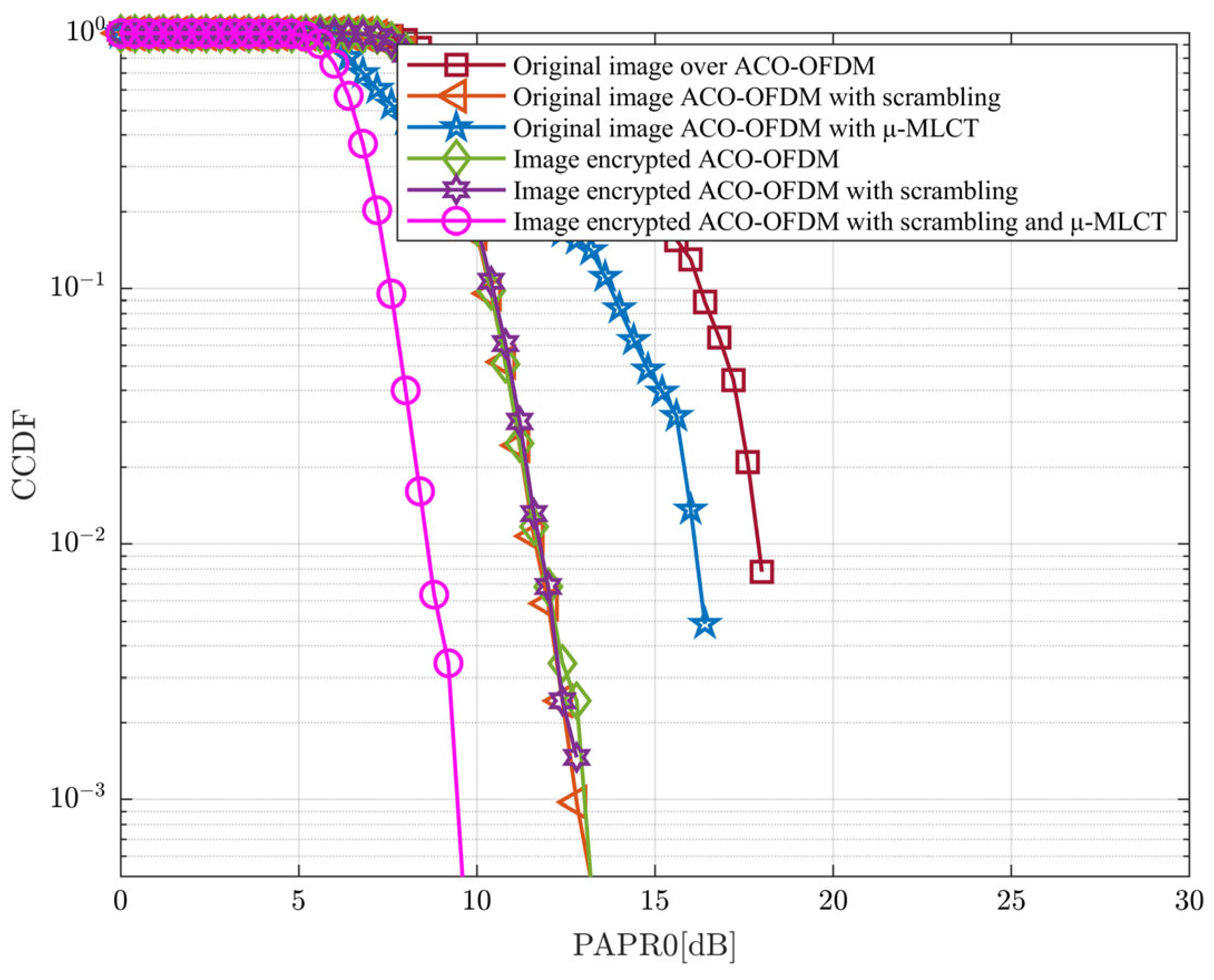
Figure 5 illustrates the CCDF of PAPR for various ACO-OFDM schemes. In this comparative experiment, ACO-OFDM with 16-QAM is used with the 256 × 256 Cameraman image. It can be observed that transmitting the original image without encryption over conventional ACO-OFDM exhibits the highest PAPR values, indicating strong amplitude fluctuations that can lead to nonlinear distortion in the optical transmitter. Introducing symbol scrambling shifts the CCDF curve toward lower PAPR values, demonstrating improved signal uniformity. The use of µ-MLCT companding with the original image further reduces PAPR by compressing large signal peaks. Additionally, the image-encrypted ACO-OFDM scheme shows a noticeable reduction in PAPR compared to the other schemes, confirming that the encryption process also contributes to peak suppression. The combined application of scrambling and encryption enhances this reduction even further. Among all evaluated methods, the proposed image-encrypted ACO-OFDM incorporating both scrambling and µ-MLCT companding achieves the most significant PAPR reduction, as evidenced by the leftmost CCDF curve. This demonstrates that the proposed scheme effectively minimizes peak power occurrences, thereby improving power efficiency and mitigating nonlinear distortion in optical transmitters.
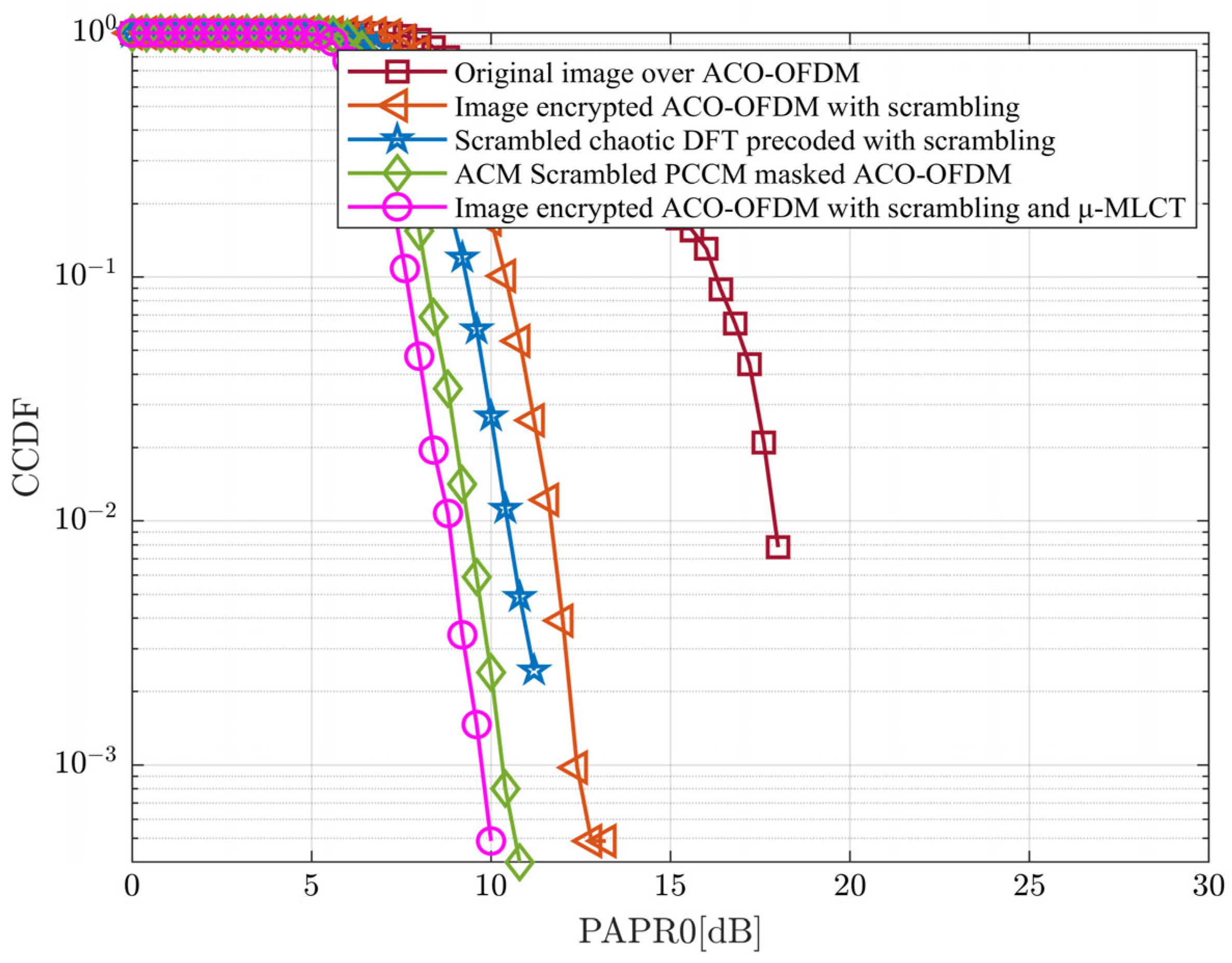
Figure 6 presents the PAPR performance comparison using CCDF curves for various ACO-OFDM schemes when transmitting the Cameraman image. Transmitting the original image without encryption in the conventional ACO-OFDM system exhibits the highest PAPR values, indicating strong amplitude variations that may cause nonlinear distortion in the optical transmitter (LEDs). The image-encrypted ACO-OFDM with scrambling demonstrates a noticeable leftward shift of the CCDF curve, reflecting improved PAPR reduction. The proposed image-encrypted ACO-OFDM system, which combines both symbol scrambling and µ-MLCT companding, achieves even better PAPR reduction performance. Specifically, at a CCDF of 10
−2, the proposed scheme achieves a PAPR of approximately 8.8 dB, compared to about 9.4 dB for the PCCM-masked method [
45], 10.4 dB for the chaotic DFT-based scheme [
44], and 18.8 dB for the conventional ACO-OFDM system. This represents a reduction of approximately 9.2 dB in PAPR, confirming that the proposed scheme effectively suppresses peak amplitudes due to the joint application of chaos-based encryption and the µ-MLCT transform. The leftward position of its CCDF curve clearly demonstrates superior PAPR reduction capability, improved power efficiency, and reduced nonlinear distortion, making it well-suited for secure and reliable image transmission in ACO-OFDM systems.
4.3. BER Performance of Secured μ-MLCT-ACO-OFDM System
4.3.1. BER Performance for a Random Bit Source
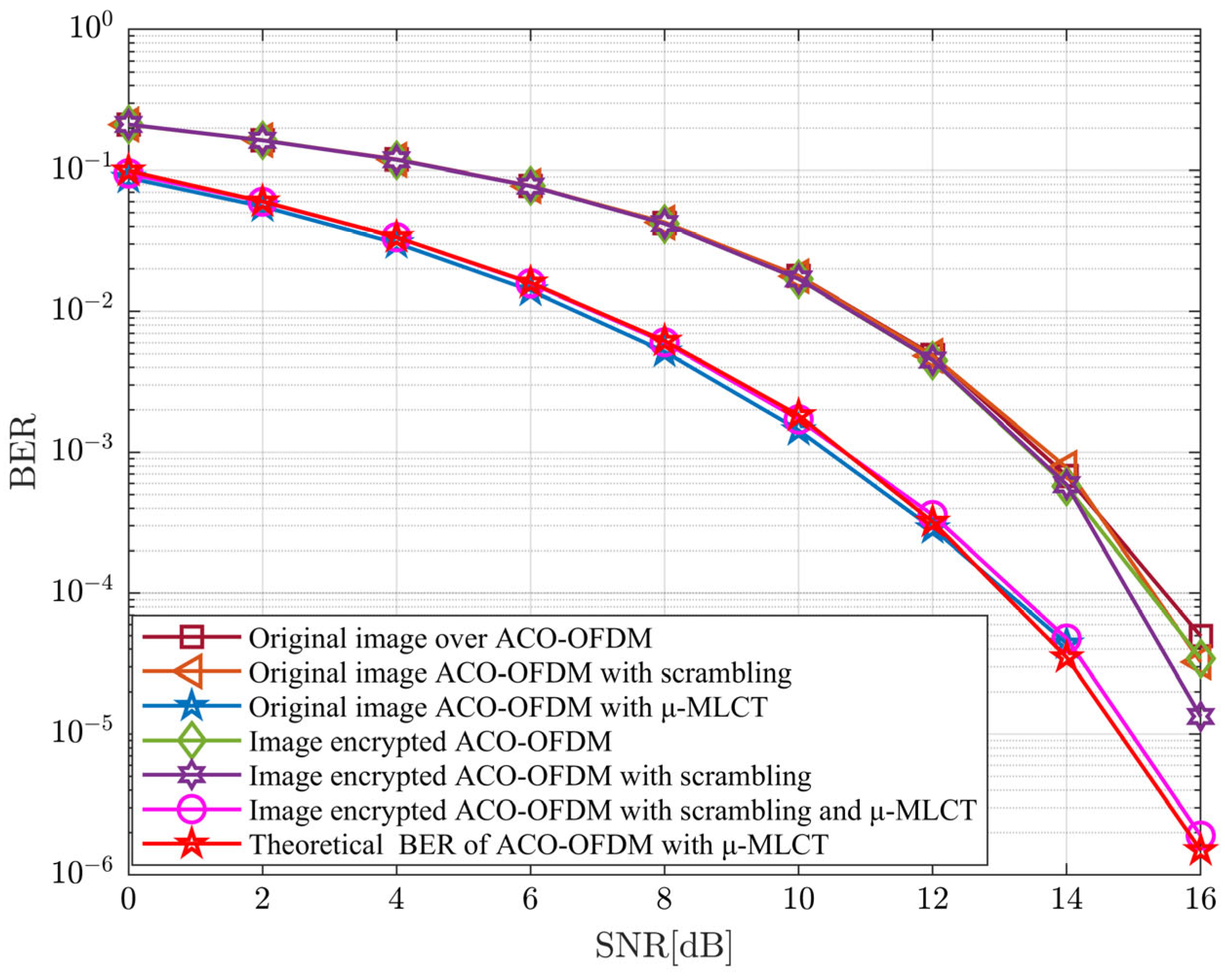
In this subsubsection, we evaluate the BER performance of the proposed secure transmission scheme using a random signal source. The analytical expression derived in Equation (31) is validated through simulation results. In these simulations, a random bit source is employed within the physical-layer security framework, which combines symbol scrambling and µ-MLCT companding. We examine the impact of symbol scrambling and μ-MLCT companding on an ACO-OFDM-based VLC system using a random bit source.
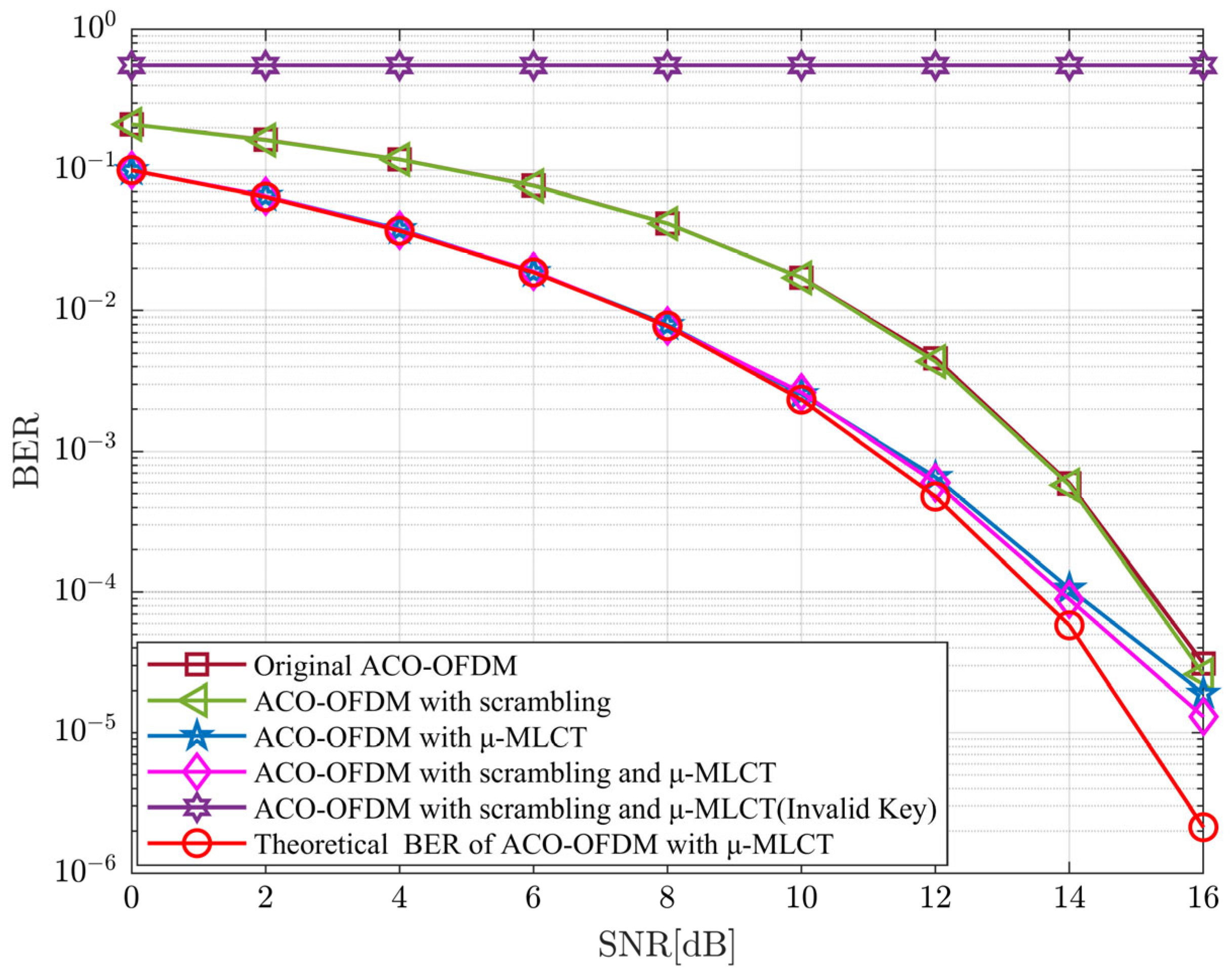
Figure 7 presents the simulation results for the BER performance of the ACO-OFDM-based VLC system with symbol scrambling and µ-MLCT companding. In this simulation, the theoretical BER performance derived from Equation (31) is also shown. It can be observed that the BER performance of the original ACO-OFDM is almost identical to that of ACO-OFDM with symbol scrambling. Moreover, ACO-OFDM with symbol scrambling and µ-MLCT companding achieves a gain of approximately 0.5 dB over the original ACO-OFDM.
The BER curves of ACO-OFDM with symbol scrambling and ACO-OFDM with symbol scrambling combined with µ-MLCT companding show good agreement with the theoretical BER expression in Equation (31), confirming the validity of the analytical formula. From
Figure 7, it is evident that symbol scrambling has almost no effect on the BER of the original ACO-OFDM and only slightly affects the BER when combined with µ-MLCT companding. Furthermore,
Figure 7 shows that a µ-MLCT-ACO-OFDM receiver with symbol scrambling using an incorrect key fails to recover the transmitted signal, resulting in a BER close to 0.5. Therefore, the proposed scheme, which combines µ-MLCT companding with symbol scrambling, enhances the security of the transmitted signal while preserving the benefits of companding, including low PAPR and improved BER performance.
4.3.2. BER Performance for an Image Source
With the increasing dissemination of digital images over the Internet, secure image transmission has become a topic of considerable interest. In this subsubsection, we evaluate the BER performance of the proposed ACO-OFDM scheme for secure image transmission using images as the input source. This evaluation enables analysis of the impact of chaos-based image encryption, symbol scrambling, and μ-MLCT companding on the BER performance of the ACO-OFDM transmission system. For the simulation experiments, three standard grayscale images, Cameraman, Aerial, and Elaine are used as the input sources.
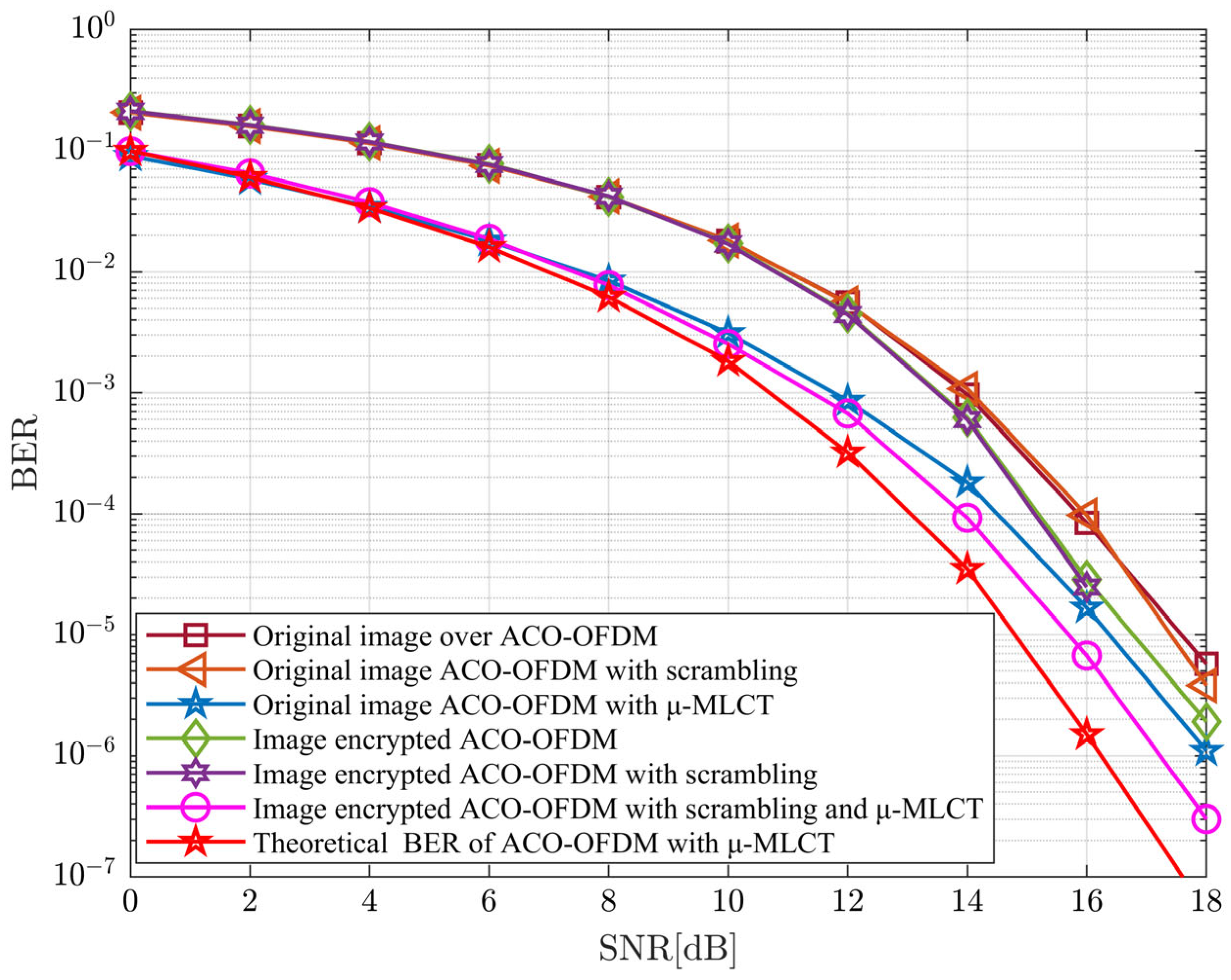
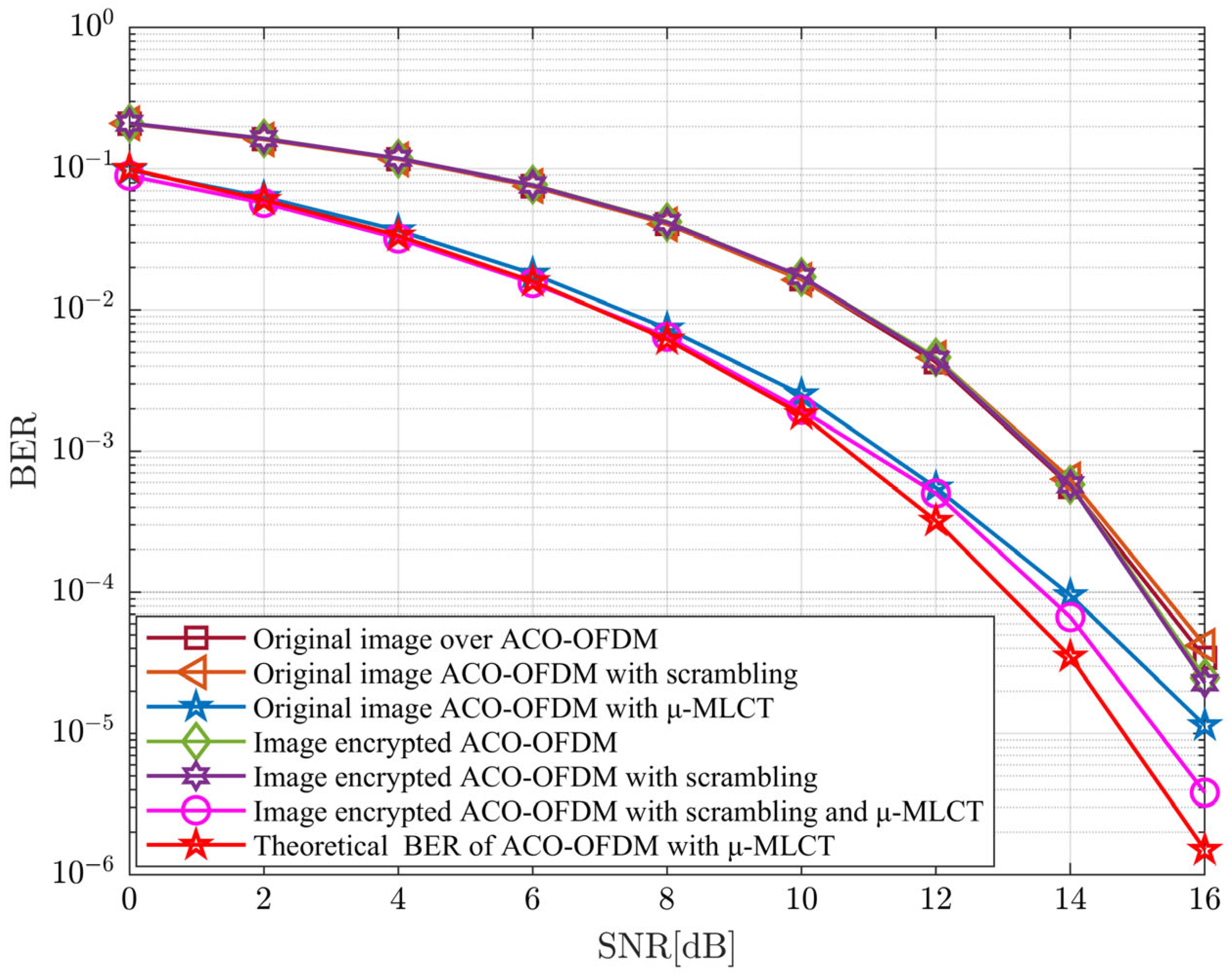
Figure 8 illustrates the BER performance comparison of the conventional ACO-OFDM system and the proposed chaotic-based μ-MLCT-ACO-OFDM schemes under various configurations when transmitting the Cameraman image. The conventional ACO-OFDM exhibits the highest BER across all SNR levels, indicating poorer reliability. Introducing image encryption and symbol scrambling significantly improves BER performance by mitigating the impact of channel impairments. Furthermore, the proposed image-encrypted ACO-OFDM, which combines chaos scrambling and the µ-MLCT transformation, achieves the lowest BER among all tested schemes. Specifically, it provides an improvement of approximately 2 dB in SNR for BER = 10
−4, confirming its superior noise resilience and enhanced error correction capability. These results demonstrate that integrating chaotic encryption, symbol scrambling, and the µ-MLCT transformation enhances both the robustness and reliability of image transmission in ACO-OFDM systems.
Figure 9 and
Figure 10 present the BER results for the Aerial and Elaine images, which are consistent with the observations from
Figure 8 when the Cameraman image was used. The only notable difference is that the µ-MLCT-ACO-OFDM scheme with symbol scrambling achieves slightly better BER performance for the Aerial image compared to the Cameraman image. These theoretical and simulation results confirm that combining physical-layer encryption with µ-MLCT companding enhances data security, reduces the PAPR of the ACO-OFDM signal, and improves BER performance compared to conventional ACO-OFDM without companding.
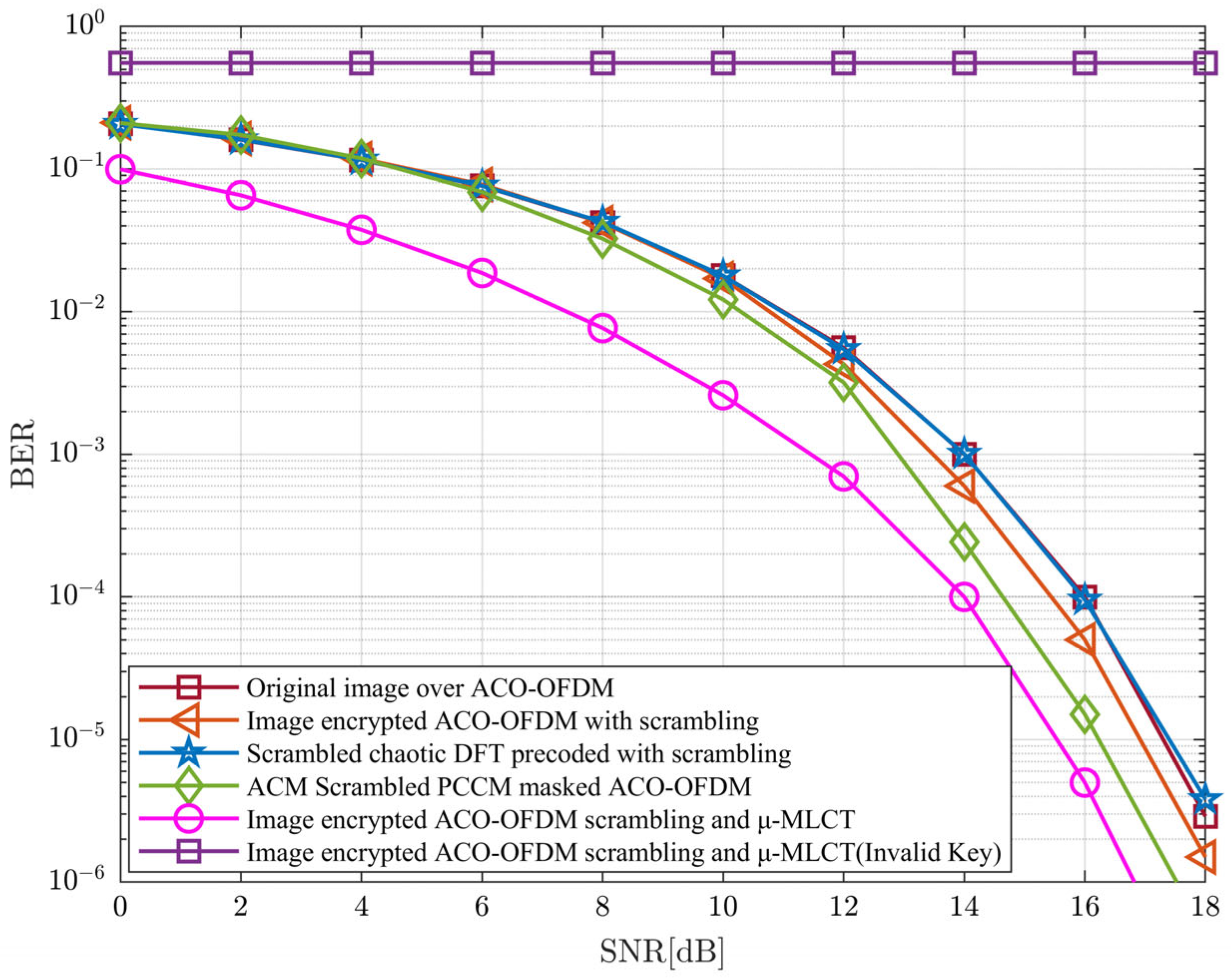
Figure 11 compares the BER performance of conventional ACO-OFDM and various chaos-based encrypted ACO-OFDM schemes under different SNR levels for the Cameraman image. As observed, the conventional ACO-OFDM scheme exhibits inferior performance, requiring an SNR of approximately 16 dB to achieve a BER of 10
−4. When chaos-based symbol scrambling is applied, the required SNR decreases to about 15.2 dB, indicating improved robustness against channel noise. The ACO-OFDM schemes based on chaotic DFT [
44] and ACM-PCCM masking [
45] achieve further gains, reaching the same BER level at roughly 15.5 dB and 14.8 dB, respectively. The proposed image-encrypted ACO-OFDM with scrambling and µ-MLCT demonstrates the best performance, attaining a BER of 10
−4 at approximately 14 dB, which represents an improvement of about 2 dB compared to the conventional ACO-OFDM. In contrast, the invalid-key case exhibits significantly degraded performance, failing to achieve a BER below 10
−2, thereby confirming the strong key sensitivity and robust encryption security of the proposed system. Overall, the noticeable improvement in BER performance for the µ-MLCT-ACO-OFDM enhanced scheme demonstrates its superior noise immunity, improved error-rate performance, and enhanced reliability for secure image transmission in ACO-OFDM-based VLC systems.
4.4. PSNR-Performance of the Secured μ-MLCT-ACO-OFDM Image Transmission
The peak signal-to-noise ratio (PSNR), widely used to evaluate the quality of restored images with respect to the original, is expressed as:
The MSE represents the mean squared error among the original image
and its recovered version
, and is given by:
where
represents the size of the original and reconstructed images.
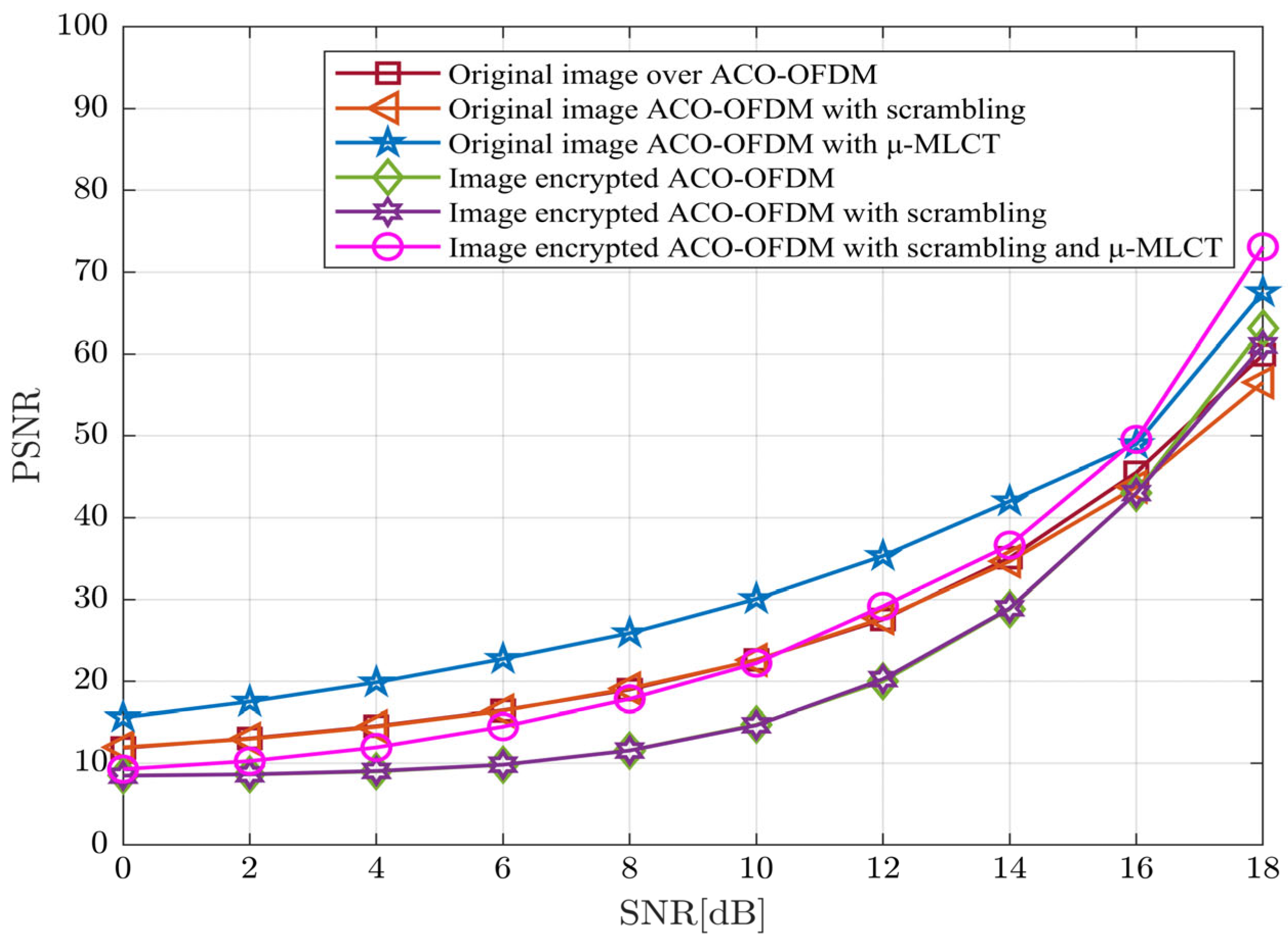
The results depicted in
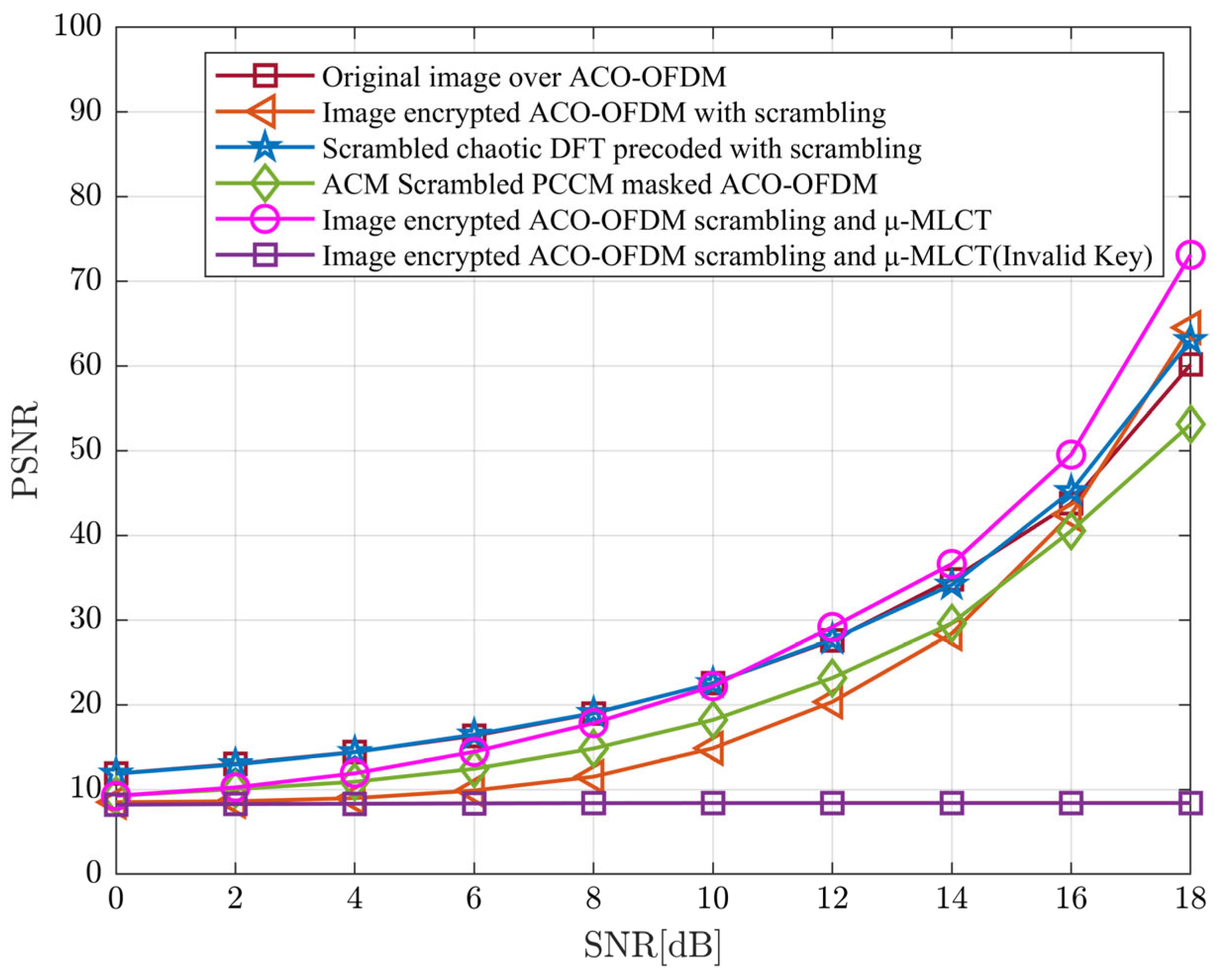
Figure 12 illustrate the variation of PSNR with respect to SNR for different transmission configurations of ACO-OFDM systems, including both original and encrypted image transmission scenarios. It is evident that PSNR curves for all transmission schemes based on ACO-OFDM are highly sensitive to change in SNR, particularly at higher values. The original image transmitted using the conventional ACO-OFDM system attains higher PSNR across the entire SNR range indicating minimal distortion in the reconstructed image. When chaos-based symbol scrambling or μ-MLCT techniques are introduced individually, the PSNR performance remains relatively close to the conventional system, demonstrating that these methods do not significantly degrade signal quality. In contrast, image encryption results in lower PSNR values, especially at lower SNR levels, due to the additional processing that increases signal randomness and impacts error sensitivity.
However, the combination of chaos scrambling and μ-MLCT applied to the encrypted signal provides a noticeable performance improvement compared to encryption alone, particularly at the high SNR value, where the PSNR exceeds 70 dB at SNR = 18 dB. This improvement can be attributed to the joint effect of chaos scrambling, which spreads the signal energy and mitigates peak occurrences, and μ-MLCT, which enhances robustness by reducing the PAPR. Therefore, the proposed chaos-based encryption with PAPR reduction technique in μ-MLCT-ACO-OFDM solution achieves a good trade-off between security and transmission quality, maintaining acceptable PSNR values while improving spectral efficiency.
Figure 13 compares the PSNR performance of original and encrypted images transmitted via ACO-OFDM, with and without physical-layer encryption, across different SNR values. The PSNR increases monotonically with SNR, reflecting improved image reconstruction quality under favorable channel conditions. At an SNR of 18 dB, the conventional ACO-OFDM system achieves a PSNR of approximately 60 dB, while the image-encrypted ACO-OFDM with scrambling attains about 64.5 dB. The scrambled chaotic DFT–precoded ACO-OFDM [
44] and ACM-scrambled PCCM–masked ACO-OFDM [
45] offer further improvements, reaching approximately 63 dB and 53 dB, respectively. The proposed image-encrypted ACO-OFDM with scrambling and μ-MLCT transformation yields the highest PSNR of about 73 dB, demonstrating superior noise resilience and outstanding excellent reconstruction fidelity. In contrast, the invalid-key case maintains a very low PSNR (≈7 dB), confirming that incorrect keys completely prevent meaningful image recovery. These findings clearly indicate that the proposed solution for secure image transmission in the enhanced ACO-OFDM system improves both transmission security and image quality, even under noisy channel conditions.
Therefore, the results obtained from our simulations confirm the effectiveness of integrating the hybrid chaotic system (HCS) into the dual-stage secured µ-MLCT-ACO-OFDM-VLC transmission system, which facilitates both data encryption and physical-layer security. In addition, the introduction of µ-MLCT transformation in ACO-OFDM addresses the high PAPR problem, leading to enhanced system performance. The HCS-based scrambling technique helps reduce PAPR and enhances both BER and PSNR in the ACO-OFDM-VLC transmission system. As a result, our HCS-based image encryption scheme improves the reliability and security of the µ-MLCT-ACO-OFDM without causing any degradation in BER or PSNR performance. This integration of chaos-based encryption and µ-MLCT companding outperforms other techniques dedicated to secure image transmission in PAPR reduction and BER improvement.
4.5. Security Analysis
The proposed µ-MLCT ACO-OFDM cryptosystem operates through two successive encryption phases. In the first phase, image encryption is performed using ACM and HCS maps to secure image transmission. The second phase applies a hybrid chaotic map to encrypt the M-QAM symbols in mapping stage, thereby providing a physical-layer encryption. The first phase employs a single key set for the original image, while the second phase assigns a set of keys to every sub-block to enhance security diversity. To analyze the security of the proposed encryption solution, several grayscale images obtained from the USC-SIPI image database are used as test images. The security analysis encompasses several standard evaluations, including histogram analysis of original and cipher images, correlation analysis between adjacent pixels, entropy measurement, key space estimation, differential attack resistance, and sensitivity assessment with respect to invalid keys [
50]. This section presents a detailed analysis of the proposed HCS-based image encryption scheme using these metrics.
4.5.1. Histogram Analysis
The histogram analysis of the original and encrypted images is used to evaluate the encryption scheme’s ability to achieve uniform pixel distribution.
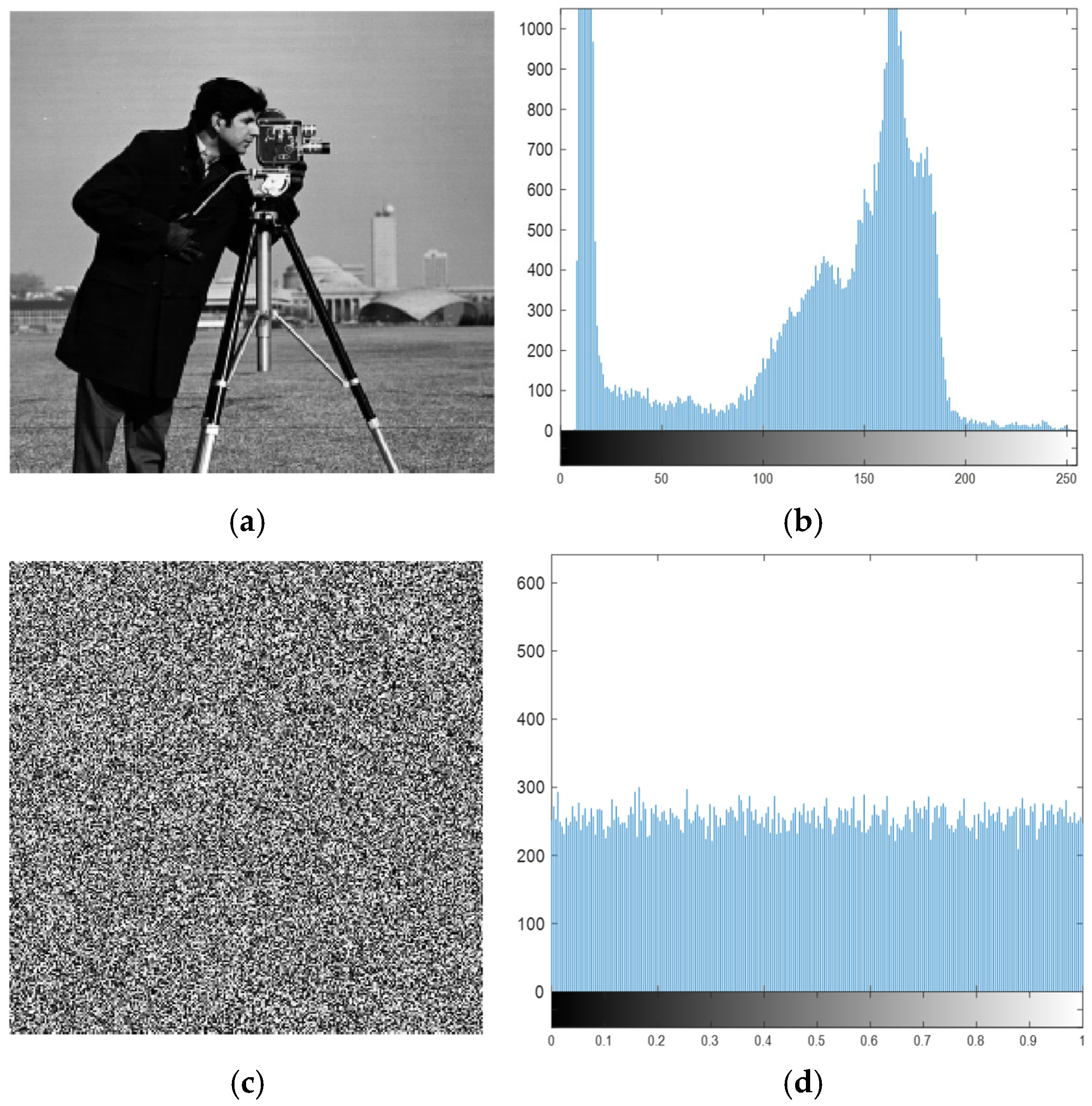
Figure 14 presents the histograms of the original images and their corresponding encrypted versions. As observed, the histograms of the original image (
Figure 14b) exhibit non-uniform distributions, indicating strong pixel intensity correlations. In contrast, the histograms of the encrypted image (
Figure 14d) are nearly flat and uniformly distributed. This uniformity confirms the effectiveness of the proposed scheme in resisting the statistical attacks.
4.5.2. Entropy Analysis
A more uniform gray-level distribution results in higher information entropy, lower predictability, and consequently a more statistically robust cryptosystem.
Table 3 summarizes the results of the information entropy, NPCR, and UACI tests. In this experiment, several grayscale images of different sizes from the USC-SIPI image dataset were used to assess the robustness of the proposed encryption scheme. The results presented in
Table 3 demonstrate the high effectiveness of the proposed method, achieving information entropy, NPCR, and UACI values of 7.9998%, 99.6003%, and 33.4602%, respectively, values that are remarkably close to their theoretical ideals, thereby confirming the strong security and diffusion properties of the encryption process.
4.5.3. Adjacent Pixel Correlation
Analyzing the correlation-between-adjacent pixels in both the original and ciphered images helps determine their spatial distribution characteristics. This correlation is calculated for pixel pairs along the horizontal, vertical, and diagonal directions. A correlation value close to one indicates strong similarity between neighboring pixels, while a value near zero signifies a random, uncorrelated distribution.
Table 4 presents the correlation coefficient values for some images of different sizes and their corresponding encrypted versions. The correlation values are calculated in three directions: horizontal, vertical, and diagonal. As observed, the original images exhibit high correlation coefficients, indicating a strong decorrelation between neighboring pixels. In contrast, the cipher images show correlations close to zero, revealing an almost complete loss of pixel dependency. These results affirm that the encryption scheme effectively eliminates spatial correlations, thereby enhancing the randomness of the encrypted images and strengthening their resistance against statistical attacks.
4.5.4. Key Space Analysis
The proposed cryptosystem employs a two-phase encryption process. The first phase involves image encryption of the input image using combined chaotic maps, while the second phase implements physical-layer security through hybrid chaotic symbol scrambling. In the image encryption stage, the encryption keys are defined as
and
. Based on the IEEE 64-bit floating-point standard [
53], the computational precision of a double-precision number is approximately 10
16. Given that the initial state
in the HCS has a precision step of 10
−16, the resulting key space is estimated to be around 10
16×2 = 10
32.
In the physical-layer-security-phase, the encryption operation involves two sequential stages: symbol encryption and scrambling. During this phase, the two parts of QAM symbols in the ACO-OFDM are encrypted employing HCS and logistic maps. In this phase, the key space is determined by the two initial parameters of the HCS map and . Given a precision step of 10−16 for the HCS, the key space is approximately 1016×2 = 1032. Additionally, the scrambling step contributes another key space of 1016 for the logistic map. Consequently, the total key space of the developed cryptosystem is estimated to be around 1032 × 1032 × 1016 = 1080.
4.5.5. Differential Analysis
A differential attack attempts to extract information about the encryption keys by examining variations in the ciphertexts produced from two plaintext images that differ slightly. To evaluate the impact of a one-pixel modification in the plaintext image encrypted using our algorithm, two quantitative metrics: Number of pixels change rate (NPCR) and unified average changing intensity (UACI) are utilized. As shown in
Table 5, the proposed scheme achieves favorable NPCR and UACI values, outperforming the methods in [
51,
52,
54], which demonstrates its strong resistance to differential attacks.
4.5.6. Efficiency Analysis
In this section, we evaluate the efficiency of the proposed image encryption scheme in terms of computational time and memory consumption. All experiments were carried out in MATLAB R2021b on a system with an Intel
® Core™ i5-7300U CPU @ 2.60 GHz, 8 GB RAM, and Windows 10 operating system.
Table 6 summarizes the computational time and memory usage of our encryption algorithm for different grayscale images. The results indicate that proposed algorithm achieves significantly faster encryption due to: (1) the high chaotic performance and low implementation cost of the new map generated from HCS, and (2) the use of ACM scrambling and only one round of the permutation-diffusion operations ensuring high security, unlike other schemes requiring multiple rounds. These findings demonstrate that the proposed encryption method not only offers enhanced security but also reduces computational time, making it suitable for practical applications.
4.5.7. Ablation Study
To better evaluate the influence of each component of the proposed encryption scheme on the overall system performance, an ablation study was conducted. This analysis aims to assess the effect of removing individual components from the proposed secure transmission system on its security and overall performance. As described earlier, the proposed system integrates three chaotic maps, with each map contributing to both image encryption and physical-layer security. The Cameraman grayscale image of size 256 × 256 pixels was used in all experiments to ensure consistency and reproducibility.
Table 7 presents the ablation results obtained by sequentially removing the ACM map, HCS map, and logistic map while keeping the remaining the system components unchanged. This assessment highlights the contribution of each component to the overall encryption performance. It can be observed that the HCS map used in image encryption and physical layer encryption significantly enhances encryption robustness and the overall system performance. This is due the high randomness and uniform distribution of its output sequences. However, removing the HCS map notably degrades security performance and reduces BER, CCDF of PAPR, and PSNR performance of transmission system. Additionally removing the ACM map significantly affects the entropy, NPCR, and UACI metrics of the system’s security. Overall, the ablation study validates the critical role of the HCS map in both image encryption and physical-layer security within the proposed ACO-OFDM-based secure transmission system.



 ,
,