1. Introduction
In the wave of global digitalization in education, personalized learning has become a central direction for educational reform.
The Education Informatization 2.0 Action Plan [
1] explicitly proposes adhering to the core principle of deeply integrating information technology with education and teaching. China’s
Education Modernization 2035 sets “teaching students in accordance with their aptitude” as an important goal [
2], emphasizing the need to leverage modern technologies to accelerate the reform of talent cultivation models and achieve an organic integration of large-scale education and personalized development. The realization of this goal requires intelligent learning support systems that can provide personalized learning paths tailored to individual learner characteristics. The report of the 20th National Congress of the Communist Party of China [
3] explicitly proposes to “promote the digitalization of education and build a learning society and a leading country in learning where lifelong learning is available to all.” The “Three-Year Achievements and Future Outlook of National Digitalization Strategic Action” [
4] requires that “knowledge graphs and ability graphs cover the entire education system, and AI be deeply integrated into links such as discipline construction and course teaching to meet learners’ personalized learning needs.” These policy initiatives indicate that knowledge graph technology has emerged as a key technical foundation for educational digital transformation. Personalized learning enables the customization of learning content to learners’ cognitive, emotional, and other individual characteristics, thereby improving learning outcomes [
5]. Similarly, the U.S.
2024 National Education Technology Plan [
6] emphasizes addressing opportunities to enhance how students use technology to improve learning outcomes.
With the development of Massive Open Online Courses (MOOCs) and various online learning platforms, the availability of educational resources on digital platforms has experienced explosive growth. While learners have access to unprecedented resources, they also frequently encounter challenges such as information overload and “getting lost in the learning maze,” making it difficult to choose a reasonable learning sequence based on their own foundation and goals [
7]. Traditional standardized instructional models struggle to accommodate learners’ diverse and individualized needs. Against this background, leveraging artificial intelligence technologies to plan personalized learning paths that align with learners’ cognitive development laws has become a critical bridge between large-scale education and individualized cultivation. Traditional learning path recommendation methods that rely solely on click sequences or rating matrices often yield simple resource lists, making it difficult to ensure the pedagogical rationality of the overall path in terms of prerequisite dependencies, difficulty gradients, and time constraints. Moreover, the “black box” nature of many recommendation algorithms undermines trust, as the recommendation process rarely explicitly incorporates learners’ cognitive development principles. In this context, educational knowledge graphs—which explicitly model knowledge concepts, course units, diverse learning resources, and their interrelationships—have gradually become a crucial infrastructure for constructing structured, explainable learning path recommendation systems [
8,
9]. Recent studies further indicate that knowledge graph-based recommendation in online education has evolved from early-stage content retrieval and resource ranking toward multi-level personalized recommendation scenarios, including learning paths, courses, and exercises.
Existing research on learning path recommendation based on knowledge graphs primarily focuses on three interconnected components. First, learners’ knowledge mastery states are mapped onto concept nodes within the graph using techniques such as knowledge tracing and cognitive diagnosis [
10,
11,
12]. Second, the structural information of the knowledge graph is exploited to generate or optimize learning paths [
13]. Third, recommendation quality is evaluated from multiple perspectives, including single-step prediction accuracy, path structure rationality, and learning effectiveness, while explainability is enhanced through explicit graph paths or rule-based mechanisms [
14,
15]. Regarding path generation strategies, one line of research is guided by educational psychology and curriculum theory, encoding pedagogical principles such as prerequisite relationships, difficulty gradients, and review strategies as constraints or heuristic functions, and applying classical optimization algorithms--such as topological sorting, differential evolution, ant colony algorithms, and particle swarm optimization--to search for feasible paths on knowledge graphs [
16,
17]. Another line of work formulates learning path recommendation as a sequential decision-making problem within a knowledge graph environment, employing reinforcement learning, hierarchical reinforcement learning, or set-to-sequence deep models for optimization [
18,
19,
20,
21]. For instance, CSEAL progressively recommends learning items under prerequisite constraints through RNN-style knowledge tracing and actor–critic reinforcement learning [
8]. The multidimensional knowledge graph model constructs a heterogeneous graph among multiple entities such as concepts, learning resources, and learning behaviors, providing structural priors for subsequent path planning [
9]. More recent studies introduce implicit collaborative relationships, similarity relationships, or multi-structural graph representations—beyond explicit prerequisite links—to alleviate path blockage caused by incomplete prerequisite graphs [
22].
Between these two paradigms, an increasing body of research adopts a hybrid strategy. On the one hand, prerequisite relations, difficulty levels, and granularity structures encoded in knowledge graphs are used as hard constraints or as candidate-generation mechanisms. On the other hand, reinforcement learning, graph neural networks, and attention-based models are applied on top of feasible candidate sets to estimate and rank learning gains or mastery improvements, thereby fully exploiting large-scale behavioral data while ensuring pedagogical logic [
11,
23]. Nevertheless, substantial divergences remain across studies regarding several fundamental assumptions. First, some works treat knowledge graphs merely as a representation or embedding space, with recommendation strategies rarely enforcing prerequisite or curriculum structures, whereas others regard educational theories as strict constraints, significantly limiting the degrees of freedom of data-driven models [
9,
13,
16]. Second, the definition of “learning path” is not standardized: some studies focus on the next concept or learning resource, while others aim to generate a complete concept sequence or cross-course path, limiting comparability across methods in terms of task complexity and evaluation criteria [
14,
24]. Third, evaluation standards vary considerably: some works focus on single-step ranking metrics such as Precision, Recall, and NDCG, while others emphasize path-level and outcome-level indicators, including concept sequencing rationality, difficulty smoothness, learning gain, and user retention, yet a widely accepted evaluation framework has not been established [
10,
11,
13,
16,
20,
21,
22].
With the availability of large-scale educational knowledge graph datasets such as MOOCCube, empirical research in MOOC-based learning scenarios has been substantially facilitated. Existing studies have constructed heterogeneous knowledge graphs for course, video, and concept recommendation, as well as for explainable recommendation through path reasoning and reinforcement learning [
8,
14]. However, there remains a lack of integrated frameworks that simultaneously address knowledge graph modeling, learner-personalized feature mining, multi-objective path optimization, and explainability assessment on large-scale datasets.
Bloom’s taxonomy, as a widely recognized theoretical framework in education, categorizes cognitive processes into six progressive levels: remember, understand, apply, analyze, evaluate, and create, providing a scientific foundation for the formulation and assessment of learning objectives [
25]. Knowledge graph technology captures complex semantic relationships among knowledge elements through structured networks, providing explicit, interpretable support for personalized recommendation systems [
26]. Meanwhile, emerging techniques such as graph neural networks continue to push the performance boundaries of recommendation algorithms. However, integrating educational theories with advanced recommendation technologies in an organic way while improving algorithm efficiency and preserving personalization and explainability remains a key challenge for future research. From a methodological perspective, this paper reviews and synthesizes research progress in personalized learning path recommendation based on knowledge graphs.
In the literature collection and screening process, this study adopts a narrative review approach to systematically organize and synthesize relevant research. Literature was retrieved from major academic databases, including Web of Science, Engineering Village Compendex, Google Scholar, and CNKI, with the publication period restricted to January 2014 to May 2025 to ensure both timeliness and relevance. In international databases, combinations of keywords such as “learning path,” “personalized learning,” “learning path recommendation,” and “knowledge graph” were used for retrieval, while in Chinese databases, keywords including “Bloom’s educational objectives,” “learning path recommendation,” “learning path,” and “personalized learning” were employed. Based on the initial search results, a manual screening process was conducted, with particular attention given to studies closely related to knowledge graph–based personalized learning path recommendation methods, the integration of educational theories—especially Bloom’s taxonomy—and the explainability of learning paths. Ultimately, approximately 100 representative Chinese and English studies were selected as the primary corpus for this review. The objective of this study is to provide a conceptual synthesis and methodological overview of the research landscape, core approaches, and emerging trends from the perspective of integrating educational theory with algorithmic methods, rather than to perform quantitative comparisons or statistical inference of algorithmic performance. Therefore, a narrative review methodology is adopted to classify, summarize, and compare existing studies, thereby revealing the intrinsic relationships among different research paradigms and their applicability to personalized learning path recommendation.
This review aims to provide a unified analytical framework for personalized learning path recommendation based on knowledge graphs from a process-oriented perspective, enabling a systematic comparison of educational assumptions, algorithmic paradigms, and their respective roles in learning path generation. The main contributions of this paper are as follows: (i) It systematically reviews the process of personalized learning path recommendation based on knowledge graphs and constructs a complete logical framework for research. (ii) It comprehensively compares research methods for personalized learning path recommendation from different disciplinary perspectives. (iii) It comparatively analyzes the core algorithms used in the research. (iv) It summarizes the characteristics and applicable scenarios of typical online learning datasets.
The remainder of this review is organized as follows:
Section 2 elaborates on the key terms and research framework of knowledge graph-based personalized learning path recommendation;
Section 3 analyzes the overall process of knowledge graph-based personalized learning path recommendation from three aspects: learner feature mining, personalized learning path generation, and path evaluation with explainability;
Section 4 discusses the mainstream core algorithms in this field and their technical evolution;
Section 5 summarizes typical online learning resource datasets and their application scenarios;
Section 6 identifies the shortcomings and challenges existing in current research; and
Section 7 provides a summary of the full paper and an outlook on future research directions.
2. Related Definitions and Research Framework
The development of online education platforms, particularly those represented by MOOCs, has brought unprecedented access to learning resources. However, learners often struggle to determine which resources are most appropriate for their cognitive levels and learning objectives, and the traditional “one-size-fits-all” instructional model is increasingly misaligned with learners’ actual needs. Research in educational psychology indicates that learners differ substantially in cognitive styles, learning motivations, and other individual characteristics, and neglecting these differences can significantly impair learning outcomes. The “Double Reduction” policy emphasizes alleviating students’ burden related to excessive homework and off-campus tutoring. Accordingly, achieving optimal learning outcomes within a limited time for learning has become a new challenge for educators. Personalized learning path recommendation can help learners avoid redundant learning and ineffective practice, thereby improving learning efficiency, and serves as an important technological enabler for implementing the “Double Reduction” policy.
Research on personalized learning path recommendation based on knowledge graphs aims to deeply mine learners’ personalized characteristics by constructing domain-specific knowledge graphs. It seeks to recommend personalized paths that align with cognitive development principles while reflecting learners’ styles and goals, and to provide intuitive, interpretable explanations for recommendations, thereby enhancing both learning effectiveness and user experience.
2.1. Key Definitions
To help readers gain a comprehensive understanding of “personalized learning-path recommendation based on knowledge graphs,” key concepts are defined as follows:
A knowledge graph KG is a semantic network composed of triples:
where E denotes the entity set, and R is the relation set. In educational contexts, entities may include knowledge points, learning resources, or learning objectives, while relations may represent prerequisite, association, or hierarchical relationships.
In existing studies, the formal definition of a knowledge graph is primarily used to provide an abstract, unified description of learning resources, knowledge units, and their dependency relations, rather than serving as a strict mathematical basis for subsequent algorithmic derivations. Substantial differences exist across studies in node types, relation semantics, and attribute modeling choices, which, in turn, influence how prerequisite constraints, cognitive levels, and pedagogical logic are encoded during learning path generation. The formalization of knowledge graphs in this paper primarily serves as an analytical reference for comparison, enabling the examination of differences in representation granularity, constraint strength, and interpretability across methods, rather than as a unified computational model.
A learning goal refers to the cognitive state a learner is expected to achieve within a given time period. According to Bloom’s taxonomy, learning goals can be categorized into six cognitive levels:
where g1 = Remember, g2 = Understand, g3 = Apply, g4 = Analyze, g5 = Evaluate, g6 = Create. They progress gradually from lower-order cognition to higher-order thinking. Bloom’s taxonomy provides a theoretically grounded framework for learning goal design, instructional organization, and assessment formulation.
A knowledge point (kp) represents the smallest unit of a knowledge system and is characterized by the following attributes:
where id is the knowledge point identifier, name is the knowledge point name, level ∈ N+ represents the difficulty level, prerequisite ⊆ kp represents the set of prerequisite knowledge points, and cognitive_level ∈ {g1, …, g6} represents the cognitive level corresponding to the knowledge point.
A learning resource r is defined as an ordered sequence of knowledge points, kp:
Satisfying the constraint:
where tp ∈ {text, image, video} represents the type of resource, s ∈ {course, chapter, knowledge unit, knowledge point} represents the resource granularity, and f(·) represents the dependency function between knowledge points.
Learner personalized features are modeled as a multidimensional attribute vector capturing individual learner differences:
where θ represents learning ability, β represents existing knowledge background, γ represents time/resource constraints, δ represents learning style, and η represents the learning preference vector. In practice, Item Response Theory (IRT) or Deep Knowledge Tracing (DKT) is often used to dynamically estimate learner ability.
It should be noted that the formal representations of learner features and educational objectives in existing studies are highly abstract. Their primary purpose is to support state description and decision modeling in learning path planning, rather than to directly quantify learning achievements. Definitions and combinations of dimensions, such as ability, prior knowledge, and cognitive levels, vary across approaches, indicating that these formalizations mainly reflect modeling assumptions rather than directly comparable numerical indicators. In this review, such formal representations are used to analyze differences in learner modeling depth, feature dependency assumptions, and cognitive objective characterization across methods, rather than serving as a unified evaluative or derivational framework.
A learning path Lp is defined as an ordered sequence optimized to achieve a learning goal g:
With the optimization objective of maximizing learning gain (Lp) while minimizing learning cost (Lp).
In existing studies, formal descriptions of learning paths and optimization objectives are mainly used to characterize abstract conditions such as path feasibility, ordering constraints, or pedagogical coherence. There is considerable in how these objectives are incorporated into algorithms: some approaches explicitly embed them into optimization functions, while others use them as heuristic constraints or conceptual references. When reviewing different algorithms, this paper focuses on how formalized objectives reflect design orientations—such as emphasis on pedagogical consistency, path length, or adaptability—rather than providing unified mathematical derivations or performance analyses. Here, formal expressions primarily support method classification and logical comparison.
In personalized learning path recommendation, explainability refers to the system’s ability to present rationales for recommendations in a manner understandable to human users, enabling learners to comprehend why a particular learning path is recommended. Explainability can be quantified as the similarity between recommendation reason R and learner features e:
The higher the E, the easier it is for the system to gain the learner’s trust.
2.2. Research Framework
The core goal of personalized learning path recommendation is to account for individual differences in learners’ knowledge foundations, cognitive abilities, and learning styles, and to tailor learning plans that are both pedagogically grounded and practically feasible. Such plans aim to reduce unnecessary redundancy and trial-and-error costs, enabling learners to achieve expected outcomes with optimal time and cognitive investment, thereby improving both learning efficiency and effectiveness.
From a theoretical modeling perspective, a personalized learning path is commonly represented as an ordered sequence of knowledge units that supports learners’ progressive advancement across cognitive levels. Existing knowledge graph-based studies generally assume that explicit prerequisite relationships exist among knowledge units, and learners’ cognitive achievements can be indirectly characterized by the organization of these units and their associated cognitive objective levels. Accordingly, learning outcomes are not determined by individual learning resources, but emerge from the structure of the learning path and the dependency relations encoded within it. Most approaches implicitly rely on assumptions of cognitive transitivity and path dependency, whereby lower-level cognitive activities support the achievement of higher-level objectives under prerequisite constraints, and different knowledge orderings may lead to different learning outcomes. Although these assumptions are consistent with educational theories such as Bloom’s Taxonomy, they are typically embedded as implicit premises in learning path generation rather than being explicitly distinguished or formalized. As a result, current methods primarily approximate the mapping between learning paths and cognitive achievements through modeling prerequisite relationships among knowledge units, with their explanatory power constrained by the granularity of knowledge representation and the clarity of dependency assumptions.
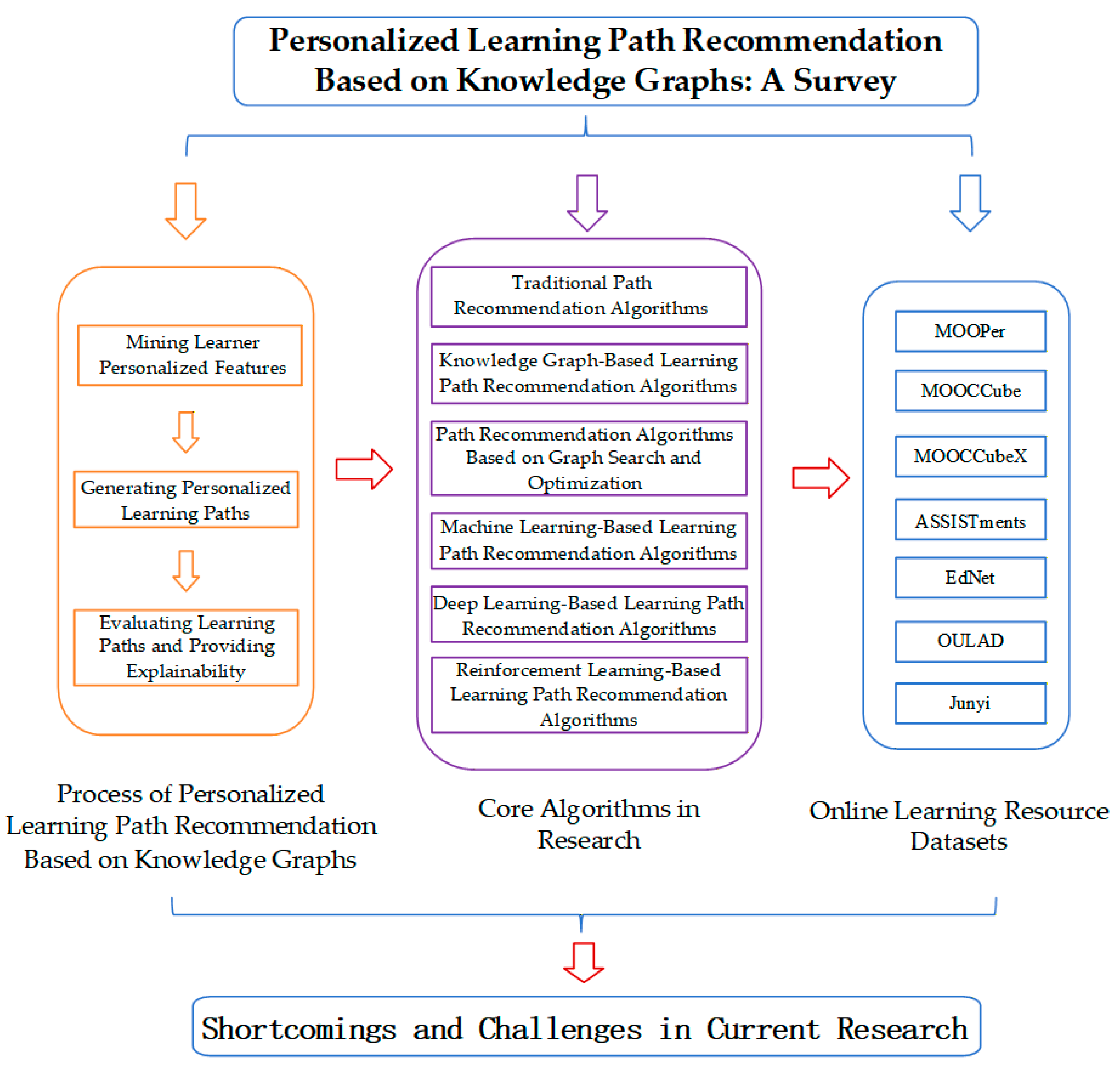
This study constructs a framework for personalized learning path recommendation based on knowledge graphs, as shown in
Figure 1. As shown, the framework consists of three core modules. First, it analyzes the recommendation process from three perspectives: mining learner personalized features, generating personalized learning paths, and evaluating learning paths while providing explainability. Drawing on diverse disciplinary perspectives, this paper analyzes methods for generating personalized learning paths across different fields, systematically reviewing multiple research orientations, including education theory-driven learning analysis methods, data-driven educational big data mining methods, and mixed methods, thereby laying a solid theoretical foundation and methodological support for subsequent research. Secondly, at the core algorithm level, this framework emphasizes comparing and integrating different learning path recommendation methods to construct more accurate and efficient models. Finally, the framework relies on mainstream online learning datasets, such as MOOPer and MOOCCube, to support empirical validation. Through the collaborative operation of these modules, this review identifies key limitations and challenges in existing research and offers reference directions for further advancements in the field.
3. Process of Personalized Learning Path Recommendation Based on Knowledge Graphs
In personalized learning path recommendation, the core challenge lies not merely in recommending appropriate learning resources but in constructing learning paths that follow explicit pedagogical logic under constraints such as learning objectives, knowledge structure, and cognitive progression. Unlike conventional resource recommendation approaches that primarily rely on similarity or preference matching, learning path generation requires explicit consideration of prerequisite relationships, cognitive level progression, and goal alignment. Knowledge graphs provide a structured representation of knowledge units and their semantic relationships, enabling the modeling of learning paths as coherent sequences with instructional meaning rather than simple ranked lists of resources. By explicitly encoding dependencies and semantic relations, knowledge graph-based approaches offer a unified foundation for reasoning over learning processes and support systematic path planning and optimization. From this perspective, this section reviews existing studies on learner modeling, learning path generation methods, and the evaluation of learning paths.
3.1. Mining Learner Personalized Features
Deeply mining learner personalized features is the foundational step for recommending suitable learning paths [
27]. By integrating the PISA [
28] assessment framework with Bloom’s taxonomy, learner personalized features can be analyzed from three complementary dimensions:
Why learn? Learning Goal g: According to Bloom’s taxonomy, learning goals can be categorized into six progressively ordered cognitive levels:
- (a)
Remember: Recognizing or recalling specific information, such as identifying knowledge points or memorizing formulas and theorems.
- (b)
Understand: Interpreting and explaining the meaning of information, such as summarizing concepts or key ideas.
- (c)
Apply: Using acquired knowledge in new contexts, such as solving practical problems.
- (d)
Analyze: Decomposing information and understanding relationships among components, such as distinguishing facts from opinions.
- (e)
Evaluate: Making judgments based on defined criteria, such as assessing the advantages and disadvantages of a solution.
- (f)
Create: Integrating elements to generate new knowledge or products, such as designing innovative solutions or writing academic papers.
Different cognitive goal levels require corresponding learning strategies and path-planning mechanisms. Tang et al. [
29] employed knowledge graphs to represent learning goals at different cognitive levels and designed personalized recommendation algorithms accordingly. By annotating knowledge graph nodes with cognitive level attributes, their approach enables the recommendation of learning paths that align with learners’ cognitive development trajectories.
What to learn? Learner’s Knowledge Background β and Learning Ability θ: Liu et al. [
10] proposed a Deep Knowledge Tracing (DKT) model to capture changes in learners’ latent abilities and analyze their ability development trajectories over time. Learning ability is typically reflected in learners’ mastery and understanding of specific learning resources. Because learning ability cannot be directly observed, various psychometric modeling approaches have been used to estimate it. Item Response Theory (IRT) is a classic framework in educational measurement, and many studies employ IRT-based models to assess learners’ abilities [
30].
How to learn? Learner’s Time Constraints γ and Learning Style δ: Su [
31] designed an adaptive learning path recommendation system based on the Kolb Learning Style Inventory and knowledge graphs, providing personalized learning paths for learners with different learning styles.
In learner modeling for personalized learning path recommendation, features such as learning ability, prior knowledge, learning style, and behavioral preferences are commonly represented as separate dimensions within a learner feature vector. In practice, however, these dimensions are not strictly independent and may exhibit notable correlations or overlaps. For instance, estimated learning ability is often strongly associated with accumulated prior knowledge. In contrast, learning style features may partially capture adaptive behaviors shaped by specific instructional contexts rather than stable learner traits. Under this setting, the identifiability of latent learner characteristics becomes a relevant concern. When multiple features are inferred from overlapping behavioral signals or learning histories, their semantic boundaries may become blurred, making it more difficult to attribute recommendation outcomes to specific learner factors. Such ambiguity at the feature level may further undermine the stability and robustness of learning path recommendations, as minor variations in data or feature estimation can yield different learner representations and, consequently, different path planning decisions.
As a result, existing learner modeling approaches implicitly assume that extracted features are well identifiable and independently informative. In contrast, the dependencies among learner characteristics and their influence on learning path generation remain insufficiently explored. Explicitly considering these dependencies is important for improving the interpretability and reliability of personalized learning path recommendation systems.
In real educational scenarios, learner features evolve dynamically throughout the learning process. Zhu et al. [
32] proposed a multi-constraint learning path recommendation algorithm based on knowledge graphs that updates learner states in real time and adjusts recommendation strategies accordingly. With the development of real-time learning analytics, learner feature extraction is gradually shifting from static profiling to dynamic perception. Hu et al. [
33] employed AI-assisted classroom behavior analysis to model learners’ emotional states and cognitive engagement in real time, suggesting that affective and cognitive features can be continuously updated as dynamic signals. Such studies provide practical insights for incorporating real-time learner characteristics into knowledge graph–based learner modeling, thereby supporting more adaptive personalized learning path construction.
3.2. Generating Personalized Learning Paths
Personalized learning path recommendation is an inherently interdisciplinary research problem that involves education, psychology, computer science, and related fields. From different research perspectives and methodological paradigms, this section reviews existing studies from three major angles: education theory-driven learning analysis methods, data-driven educational data mining methods, and mixed methods.
3.2.1. Education Theory-Driven Learning Analysis Methods
Researchers in education and psychology primarily investigate personalized learning path recommendation through the lens of educational theories. This line of research emphasizes cognitive principles, instructional design strategies, and a goal-oriented learning process. Education theory-driven learning analysis methods focus not only on algorithm performance, but also on the pedagogical coherence between recommendation mechanisms and teaching goals, cognitive stages, and learning strategies.
Su [
31] proposed an Adaptive Learning Path Recommendation System (ALPRS) that introduced learning style as a core factor in personalized recommendation. This study employed the Fuzzy Delphi Method (FDM) to evaluate the quality of the geometry course unit, used the Kolb Learning Style Inventory to classify learners’ styles, and integrated learning style features through the Interpretive Structural Model (ISM). Based on this integration, course path structures corresponding to four learning styles were generated, and personalized recommendation rules were derived using the Repertory Grid Technique (RGT). The recommendation strategies were embedded in a gamified geometry learning platform to validate system effectiveness. Experimental results demonstrated that ALPRS could effectively identify learners’ style characteristics and generate well-matched learning paths, significantly improving learning outcomes. Zheng et al. further proposed a unified learning path recommendation framework [
34] that systematically integrated three core dimensions: learners, learning objects, and knowledge structures. Their dual-level modeling architecture jointly considers semantic relationships among learning objects, prerequisite dependencies among knowledge points, and learners’ cognitive abilities and interest preferences. The study emphasizes that only through collaborative modeling of instructional objectives, knowledge graph logic, and learner profiles can pedagogically meaningful personalized learning be achieved.
Education theory-driven path recommendation research is commonly grounded in frameworks such as Bloom’s taxonomy, constructivist learning theory, and cognitive load theory. As a foundational theory in the cognitive domain, Bloom’s taxonomy of Educational Objectives has been widely used in curriculum design, instructional planning, and learning outcome evaluation [
35,
36,
37], playing a significant role in recent curriculum reforms. In the generation of personalized learning paths based on knowledge graphs, Bloom’s taxonomy also serves as a key guiding framework. By aligning different types of learning resources with cognitive levels (remember, understand, apply, analyze, evaluate, create), a systematic connection between teaching goals and cognitive processes can be achieved [
38].
Table 1 illustrates the specific application of Bloom’s taxonomy in personalized learning path recommendation.
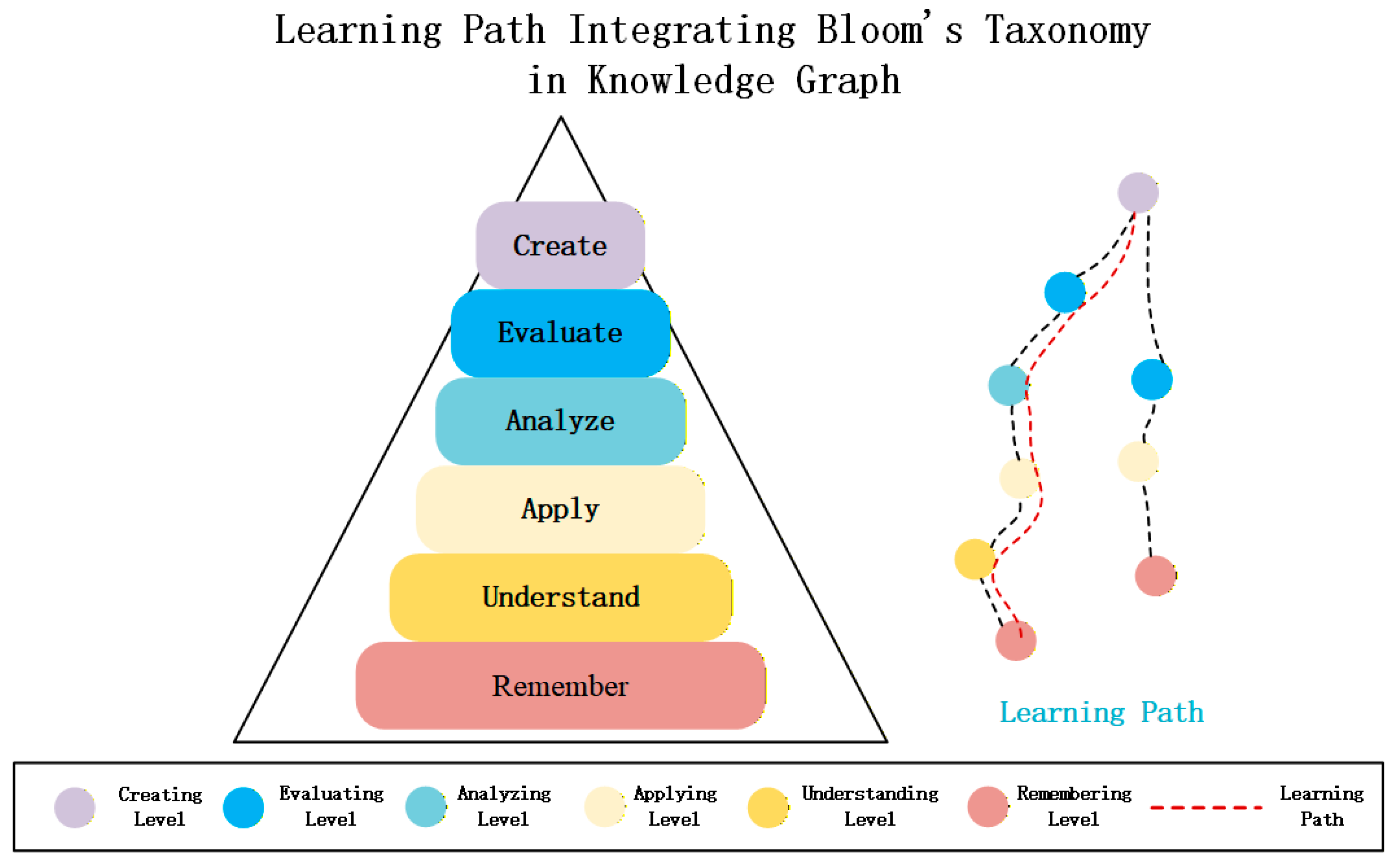
Figure 2 illustrates how to integrate the six cognitive levels of Bloom’s Taxonomy into a knowledge graph to build a learning path that conforms to the laws of cognitive development. The black line is the possible learning path and the red line is a recommended learning path.
In existing studies on knowledge graph-based personalized learning path recommendation, Bloom’s Taxonomy is integrated in markedly different ways, and no unified functional paradigm has yet emerged. Some studies treat cognitive levels as hard structural constraints that restrict the ordering of learning activities to ensure prerequisite consistency and instructional logic, thereby directly shaping the feasible learning path space [
15]. Other works incorporate Bloom-related information as semantic annotations of knowledge graph nodes or learning resources, supporting path organization and evaluation without explicitly constraining the underlying optimization process [
23]. In addition, certain approaches use cognitive progression as an auxiliary guiding signal, implicitly influencing search strategies or decision-making during path planning, while remaining subordinate to the primary optimization objectives [
11]. Overall, Bloom’s Taxonomy in current research primarily serves as a heuristic or supportive educational framework rather than a unified, strictly enforced path-generation standard. These heterogeneous integration strategies differ in terms of theoretical constraint strength, modeling complexity, and interpretability, reflecting the diversity of how educational theories are combined with algorithmic models in personalized learning path research.
Education theory-driven learning path recommendation research provides a solid pedagogical foundation for algorithm design, enabling recommendation systems not only to “predict” learners’ subsequent learning behaviors but also to “understand” learners’ cognitive development patterns, thereby supporting genuinely individualized instruction and personalized learning.
3.2.2. Data-Driven Educational Data Mining Methods
Researchers in computer science and data science primarily use data-driven methods to recommend personalized learning path. The introduction of knowledge graphs offers new approaches to generating personalized learning paths. By integrating knowledge graphs with machine learning technologies, learners’ behavioral patterns and learning trajectories can be deeply mined to generate personalized learning path recommendations. Constructing a domain-specific knowledge graph in conjunction with learners’ personalized features enables the generation of tailored learning paths that closely align with individual knowledge backgrounds and learning needs, while also allowing recommendations to be dynamically adjusted based on learners’ real-time progress. Liu et al. [
10] combined Deep Knowledge Tracing (DKT) with knowledge graphs to develop a highly interpretable adaptive learning system. In their framework, knowledge graphs are used to represent domain knowledge structures, while deep learning models dynamically predict changes in learners’ ability. This integration enables precise personalized recommendations and provides intuitive visual explanations of the recommendation process.
Depending on the research objectives and recommendation strategies, data-driven personalized learning path recommendation methods can be broadly categorized into global-optimal and local-iterative approaches.
- (a)
Global Optimal Learning Path Recommendation (GOLPR): This method usually generates the entire learning path through a single optimization process, aiming to identify the optimal solution among all feasible paths. Zhang et al. [
39] proposed a personalized learning path recommendation approach based on knowledge graphs and graph convolutional networks. This method first constructs a multidimensional curriculum knowledge graph (MCCKG) that organizes courses, knowledge points, learning resources, and their semantic relationships into a unified graph structure. Graph convolutional networks are then employed to model high-order correlations within the knowledge graph, enabling more accurate capture of learners’ preference features. In addition, the importance weights of learning resources are computed based on both graph structural features and learner characteristics. By jointly optimizing learner preference and resource importance, the system generates an optimal learning path for recommendation. Zheng et al. [
23] proposed a Multi-Granularity Learning Path Recommendation (MGLPR) that integrates learning objects at different granularity levels into coherent learning paths. Unlike traditional methods that focus on a single granularity, MGLPR adopts a two-layer modeling structure comprising a knowledge point layer and a learning object layer, and applies an Improved Ant Colony Optimization (IACO) to solve the resulting constrained optimization problem. Experimental results demonstrate significant improvements in learning path coherence and learning efficiency. Hou et al. [
11] introduced the KG-PLPPM method, which plans personalized learning paths by constructing an online learning ontology and knowledge graph, and by evaluating knowledge concept similarity and learner mastery. This approach places particular emphasis on concept sequencing, ensuring that knowledge concepts are organized in accordance with cognitive development principles.
- (b)
Local Iterative Learning Path Recommendation (LILPR): This method focuses on dynamic feedback during the learning process, ensuring that the path fits the learner’s actual needs more closely by continuously optimizing recommendation results. Raj et al. [
40] proposed an adaptive learning path recommendation model driven by real-time learning analytics. By incorporating prerequisite dependency relationships among concept nodes in a domain knowledge graph, the model dynamically recommends learning resources that align with learners’ current mastery levels. Rather than generating a complete learning path in advance, the system continuously monitors learner feedback and performance, updates learner status in real time, and incrementally recommends subsequent learning materials, thereby gradually constructing a personalized learning path. Luo et al. [
41] proposed the HALPR model, which explicitly considers learning goals, prerequisite relationships, and learners’ current states when generating learning sequences. The model first infers learners’ knowledge levels from historical interaction data, then constructs a candidate action space based on prerequisite relationships among learning goals and knowledge items. An actor-critic reinforcement learning framework is employed to select optimal actions that jointly optimize learning performance, learning time, and difficulty transitions. HALPR can dynamically adjust learning paths in response to real-time feedback, enabling closer alignment with learners’ evolving state features.
From a theoretical perspective, global and local learning path generation approaches reflect different trade-offs in modeling assumptions and optimization objectives. Global learning path generation typically plans an entire learning sequence under a complete knowledge graph and predefined learning objectives. Its main advantage lies in explicit consideration prerequisite structures, coherence constraints, and long-term learning goals, thereby theoretically supporting the construction of pedagogically consistent and structurally optimal learning paths. However, such approaches are highly sensitive to the accuracy of learner-state estimation and knowledge-structure modeling. Errors in prerequisite relations or learner ability assessment may propagate through the optimization process and significantly affect the resulting paths. In addition, global optimization often incurs substantial computational overhead, raising scalability concerns in large-scale knowledge graphs or real-time recommendation scenarios.
In contrast, local learning path generation methods make incremental decisions based on the learner’s current state or short-term objectives, emphasizing adaptability to dynamic learning processes. These methods are generally more flexible in handling behavioral fluctuations, uncertain feedback, or online learning settings, and tend to be more robust to local estimation errors. Nevertheless, because they rely on localized information, local approaches may struggle to ensure long-term pedagogical optimality in the absence of global constraints, potentially leading to fragmented learning paths or deviations from overarching cognitive goals.
Accordingly, global and local learning path generation strategies should not be viewed as a simple dichotomy of superiority. Instead, they represent different emphases on pedagogical optimality, adaptability, computational cost, and sensitivity to uncertainty. This inherent trade-off also helps explain the growing interest in hybrid approaches in recent studies, which aim to balance global planning and local adjustment by combining long-term structural guidance with short-term adaptive decision-making.
3.2.3. Mixed Methods
Mixed methods organically integrate educational theory with data mining technology, adhering to pedagogical principles while fully leveraging the analytical power of large-scale educational data.
Zhu et al. [
32] proposed a multi-constraint learning path recommendation algorithm based on knowledge graphs. At the educational theory level, the authors divided the learning process into four scenarios: initial learning, daily review, pre-exam learning, and pre-exam review, and designed eight types of learning paths to accommodate diverse learning needs, reflecting principles of instructional differentiation and cognitive development. At the data mining level, behavioral features such as learning frequency, attention, and centrality were extracted from learning logs to construct a multi-indicator scoring model. Optimal learning paths were generated by minimizing a comprehensive scoring function, and knowledge graph structures and edit-distance methods were used for path generation and verification, enabling intelligent learning path construction guided by educational theory.
Yang et al. [
42] proposed an open learning path construction model based on attention-based graph convolutional networks. They designed a hierarchical graph attention mechanism grounded in Bloom’s taxonomy, assigning differentiated weights to associations among knowledge points at different cognitive levels. The mechanism enables the model to dynamically learn the relative importance of knowledge points across cognitive levels, infer learners’ mastery levels, and generate a personalized learning path that aligns with cognitive development laws. By visualizing attention weights, the model provides intuitive explanations for recommendation outcomes, thereby enhancing system explainability and adaptability while improving recommendation accuracy.
Hybrid approaches typically combine educational theory-driven constraints with data-driven modeling to balance pedagogical soundness and personalized adaptability in learning path generation. While enhancing modeling flexibility, such approaches also introduce increased system complexity in design and implementation [
43]. Hybrid frameworks often consist of multiple interconnected components, including knowledge graph construction, learner modeling, rule-based constraints, and data-driven optimization modules. Consequently, system performance depends not only on individual algorithms but also on component coordination and the calibration of numerous parameters. In practical settings, hybrid methods usually require careful tuning of hyperparameters and rule weights, which relies heavily on domain expertise and high-quality training data. The coupling among different modules further increases the cost of system calibration and maintenance as the deployment scale grows. Moreover, when educational rules and modeling assumptions are finely tailored to specific datasets or instructional contexts, hybrid approaches may exhibit conceptual overfitting, resulting in limited robustness when transferred across courses, disciplines, or learning environments.
From a technical perspective, the complex structure of hybrid models also amplifies their sensitivity to noisy data and incomplete knowledge representations. Inaccuracies in knowledge graph construction or shifts in learner behavior distributions may propagate across modules, leading to compounded errors in recommendation outcomes. Therefore, while hybrid approaches offer a promising direction for integrating pedagogical constraints and data-driven learning, controlling system complexity, reducing maintenance costs, and mitigating conceptual or technical overfitting remain critical challenges for their application in real-world educational scenarios.
Table 2 briefly summarizes the characteristics, advantages, and limitations of the three research methods.
Although existing studies have explored personalized learning path generation from multiple perspectives, including education theory-driven, data-driven, and hybrid approaches, substantial differences remain in their research objectives, modeling assumptions, and evaluation strategies. These differences limit the direct comparability of reported results. In particular, some studies describe educational theories, such as Bloom’s Taxonomy, as playing a critical role in learning path generation; however, such claims are primarily supported by analyses of instructional design rationality rather than by systematic comparisons with non-theory-driven approaches under controlled experimental settings.
In most theory-driven methods, Bloom’s Taxonomy is mainly used as a cognitive-level labeling scheme for knowledge units or learning resources, serving to constrain path structures or guide resource sequencing. This usage typically treats cognitive levels as static attributes, making it difficult to capture the dynamic evolution of learning objectives over time. Moreover, Bloom’s Taxonomy is rarely examined as an independent variable in ablation or comparative studies, making its specific contribution to learning outcomes difficult to empirically distinguish.
By contrast, data-driven approaches offer greater flexibility in path generation and often achieve favorable predictive performance. However, their optimization objectives are often based on short-term behavioral indicators or proxy metrics, such as mastery prediction or immediate rewards, which may not accurately reflect long-term learning effectiveness or the coherence of cognitive development. Hybrid methods attempt to balance educational constraints with data-driven optimization, but the simultaneous introduction of multiple components makes it challenging to clearly identify the contribution of individual factors.
From a review perspective, the differences among existing learning path generation methods are therefore better interpreted as differences in design orientation and underlying assumptions, rather than as definitive performance advantages under a unified evaluation framework. This observation highlights the need for more rigorous comparative studies and standardized evaluation protocols in future research.
3.3. Evaluating Learning Paths and Providing Explainability
The evaluation and explainability analysis of learning paths are critical components for validating both the effectiveness and credibility of personalized learning path recommendation systems. The former focuses on the practical impact of learning paths in supporting learning goal attainment, improving learning efficiency, and enhancing the overall learning experience, while the latter emphasizes uncovering the underlying logic and generation mechanisms behind recommendation outcomes. Scientific and systematic learning path evaluation not only provides quantitative evidence of algorithm performance, but also offers empirical support and theoretical grounding for the design of explainability mechanisms. These two aspects are mutually reinforcing. A well-designed evaluation framework can provide diagnostic feedback and optimization directions for explainability models, while enhanced explainability improves the transparency, interpretability, and comparability of learning path evaluation results. Together, they form a closed-loop mechanism of “evaluation-explanation-optimization,” which is essential for the iterative improvement of personalized learning path recommendation systems.
3.3.1. Learning Path Evaluation
Depending on whether direct tracking and investigation of target learners are required, current mainstream evaluation methods for knowledge graph-based personalized learning path recommendation can be broadly classified into online and offline evaluation.
- (a)
Online Evaluation: Researchers typically integrate real instructional experiments, questionnaire surveys, and learning behavior data to assess the effectiveness of recommendation systems. These approaches can directly reflect the applicability and educational value of recommended learning paths in authentic learning environments. Some studies construct virtual educational simulators based on educational measurement theories, such as Item Response Theory (IRT) and Deep Knowledge Tracing (DKT), to simulate the entire learning process of under-recommended paths. Liu et al. [
52] designed two types of educational simulators. The first simulator is based on cognitive structure, enabling precise matching of learners’ knowledge structures and tracking their development trajectories by following prerequisite relationships among learning resources, and employs a three-parameter IRT model to evaluate learners’ mastery of learning resources. The second simulator is based on cognitive progression, using historical data to train a DKT model for predicting learners’ learning levels. Both simulators support visualization of the learning process and dynamic assessment of learning outcomes, providing an effective means to evaluate the quality of the path quality. Troussas and Krouska [
15] validated the effectiveness of their path-based knowledge graph recommendation system through a semester-long real teaching experiment. In their study, 100 undergraduate students majoring in computer engineering were divided into an experimental group and a control group in a compulsory Java Object-Oriented Programming course. A 10-point Likert-scale questionnaire was used to evaluate three dimensions: user experience, recommendation system effectiveness, and learning impact. The results indicated that the experimental group using knowledge graph path recommendations significantly outperformed the control group on cognitive-level alignment, difficulty appropriateness, and content complexity. By visualizing path connections in a student-learning activity graph, the system not only improved recommendation accuracy but also provided intuitive explanations for its recommendations, thereby enhancing system credibility and learner motivation. It should be noted that although online evaluation methods based on real educational settings offer high ecological validity and strong generalizability, they are costly and heavily influenced by subjective factors.
- (b)
Offline Evaluation: Offline evaluation primarily relies on historical the learning data to assess the quality of learning path recommendation. By computing evaluation metrics such as Precision, Recall, Root Mean Square Error (RMSE), and Mean Absolute Error (MAE), these approaches evaluate the accuracy, stability, and robustness of recommendation algorithms. Zhang et al. [
53] further proposed multidimensional offline evaluation strategies, including evaluation based on exemplary learner paths, similarity-based evaluation, path-difference-based evaluation, and learning-effect-based evaluation. These strategies enable an efficient, systematic comparison of algorithms without requiring real instructional experiments, providing valuable references for model selection and iterative improvement.
Although a variety of evaluation metrics have been adopted in existing studies to assess personalized learning path recommendation methods, most are inherited from traditional recommender systems and focus primarily on outcome-oriented measures such as accuracy, ranking relevance, and user interaction behavior. While these metrics are useful for evaluating the suitability of individual learning resources, they provide limited insight into the pedagogical quality of an entire learning path. From an educational perspective, the quality of a learning path is not only determined by how well recommended items match learner preferences, but also by the internal cognitive coherence of the path, the appropriateness of difficulty progression, and the extent to which the path supports meaningful learning gains. However, these pedagogically grounded attributes are rarely formalized or quantitatively assessed in existing evaluation frameworks, making it difficult to distinguish learning path generation methods based on instructional effectiveness.
This limitation highlights a major methodological gap in current research: where evaluation practices remain poorly aligned with educational objectives. Developing evaluation metrics that explicitly reflect cognitive coherence, difficulty progression, and learning outcomes remains a critical challenge for advancing personalized learning path recommendation toward more educationally meaningful applications.
Overall, learning path evaluation should extend beyond traditional metrics of recommendation accuracy and efficiency, and explicitly incorporate pedagogically meaningful factors, including learning outcomes, cognitive development, and learners’ subjective learning experience. Future evaluation frameworks should shift from an algorithm-centered perspective toward a “learner-centered” orientation, constructing comprehensive evaluation systems that integrate cognitive levels with observable learning behaviors.
3.3.2. Learning Path Explainability
Explainability constitutes a key distinguishing advantage of knowledge graph-based learning path recommendation systems over conventional “black box” algorithms. Its core goal is to reveal the logical basis behind recommendations, enabling learners and teachers to understand why and how the system generates specific paths, thereby enhancing system transparency and trust [
54]. However, substantial variation exists in how explainability is implemented across different studies, and no unified technical paradigm has yet emerged [
55,
56]. From the perspective of research content, explainability mechanisms can be broadly categorized into rule-based explanations, graph-based visual explanations, attention-based explanations, and reasoning-based path explanations.
- (a)
Rule-based explanations typically rely on educational theories or manually defined instructional constraints, providing explicit rationales for path generation. Such explanations are generally intuitive and controllable for teachers, but their expressiveness is limited by the completeness of predefined rules and their adaptability to complex learning scenarios.
- (b)
Graph-based visual explanations leverage the structure of knowledge graphs to illustrate prerequisite relationships and learning paths, which can help students understand the logical organization of learning content. However, when paths are long or the graph structure is complex, visual explanations may become cognitively demanding.
- (c)
Model explainability focuses on revealing the internal decision logic of algorithms and the mechanisms by which features influence recommendation outcomes. Li et al. [
57] proposed the TMER-RL model, which integrates supervised reinforcement learning with attention mechanisms. Unlike approaches that rely solely on user-item paths, TMER-RL explicitly models item-item paths to capture temporal dependencies and improve explanatory power. Through designed path attention units, the model learns distinct importance weights for different candidate paths, which are subsequently used as explicit explanations for recommendation decisions. Combined with knowledge graph visualization, the system can present association networks among knowledge points, clarify the generation logic of learning paths, and provide personalized learning suggestions together with their underlying rationale. Liu et al. [
10] proposed the Cognitive Structure Enhanced Adaptive Learning framework (CSEAL). It uses a knowledge-tracing module to represent learners’ mastery of knowledge points in an observable vector space, making their status intuitively understandable. It uses prerequisite relationships in the knowledge graph to constrain recommended paths, ensuring recommendation decisions possess cognitive logic and path legitimacy. Using the Actor-Critic strategy to learn recommendation strategies based on the aforementioned states and structural constraints, the action space is limited by a clearly structured candidate set, making the recommendation process logically traceable and enhancing explainability at the algorithm level. Attention-based or feature-weight explanations are mainly associated with data-driven models and aim to reveal which features or nodes the model focuses on during decision-making. While useful for analyzing model behavior, these explanations are often technically oriented and may lack clear pedagogical meaning for teachers and students.
- (d)
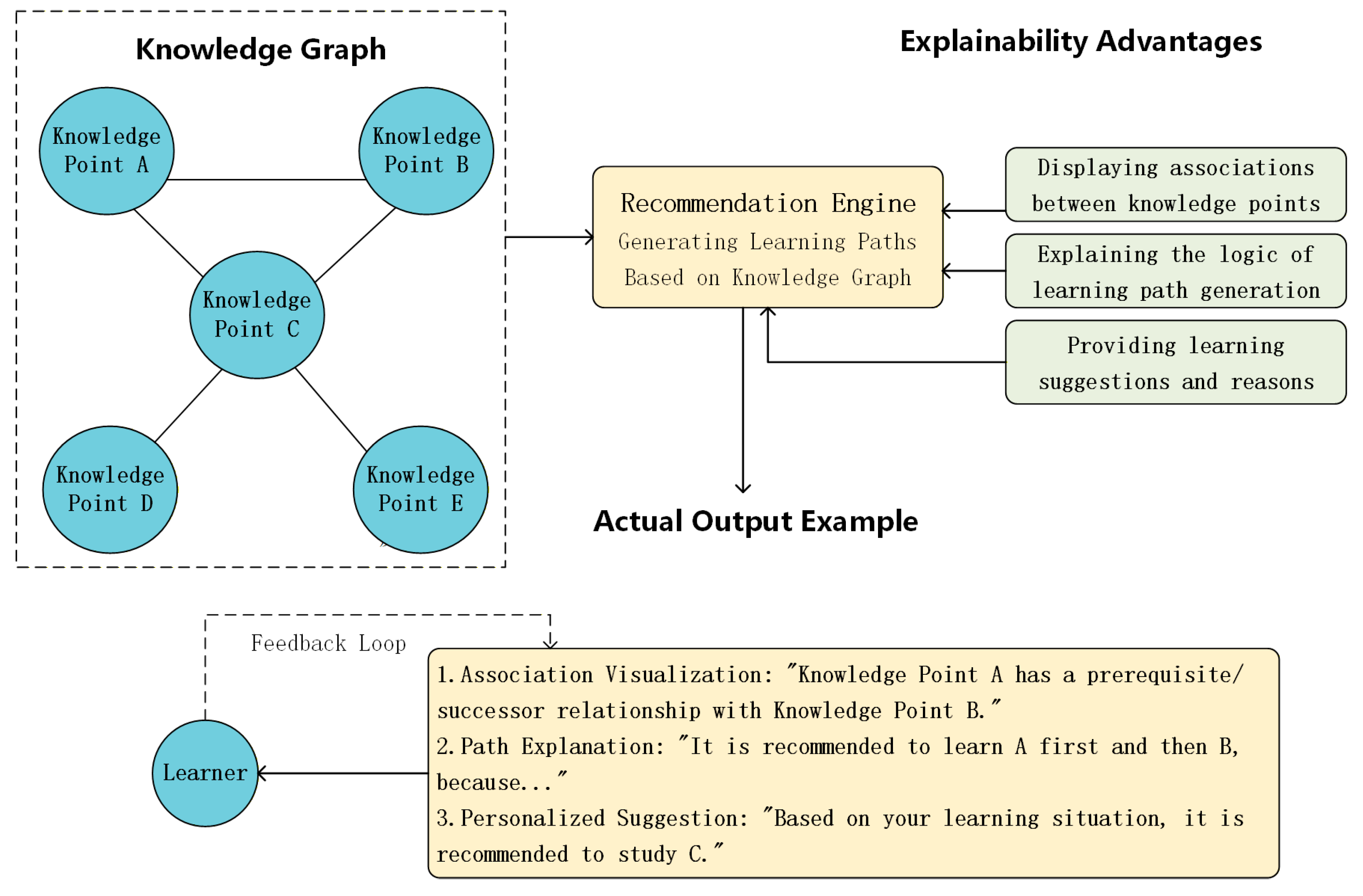
Path explainability focuses on the recommendation result itself, that is, how to clearly and logically explain “why this path is recommended,” as shown in
Figure 3:
Path-based recommendations from knowledge graphs provide greater transparency into the recommendation process. For example, by visually displaying concept associations and learning path planning in the knowledge graph, learners can intuitively understand the logic behind recommendations, thereby enhancing learning motivation and acceptance. Xiong Yu et al. [
58] constructed an explainable learning path recommendation model based on knowledge graphs. This model first uses a neighborhood-labeled graph attention network to characterize knowledge graph semantics and generate candidate path sets, then calculates the fit between learners and paths across different learning scenarios, and finally provides transparent, explainable path recommendations, effectively improving the personalized learning experience. In contrast, reasoning-based path explanations explicitly present intermediate decision steps and search trajectories, thereby facilitating a closer alignment between algorithmic processes and instructional objectives. Nevertheless, such explanations are usually tied to specific model architectures and may involve higher implementation costs, limiting their general applicability.
Overall, different explainability mechanisms emphasize different aspects of transparency, granularity, and educational interpretability. Balancing the needs of teachers and students with model complexity and explanation cost remains an open challenge in the design of explainable personalized learning path recommendation systems.
4. Core Algorithms in Research
In recent years, research on knowledge graph-based personalized learning path recommendation has gradually developed a unified algorithmic framework that integrates semantic constraints and data-driven approaches [
7,
10,
11,
19,
20,
22,
23,
39,
44,
46]. This system mainly comprises two categories of core methods. The first includes traditional recommendation techniques, such as content-based analysis, matrix factorization, and collaborative filtering, which provide generalizable mechanisms for learning resource representation and scoring. The second consists of structured path-planning methods based on Educational Knowledge Graphs (EKGs), which ensure the feasibility and pedagogical validity of learning paths by integrating prerequisite relationships, difficulty levels, learning duration, and diverse semantic associations among knowledge points. Building on these foundations, research studies have further evolved along two major technical directions [
9,
13,
26,
39,
50,
51,
59,
60,
61,
62]. The first direction focuses on combinatorial optimization approaches, including heuristic and evolutionary algorithms, which aim to identify optimal learning paths that satisfy personalized objectives under explicit constraints. The second direction emphasizes sequential decision-making models driven by deep learning and reinforcement learning, which integrate learner knowledge mastery modeling to enable dynamic, end-to-end or semi-end-to-end optimization, while balancing multiple objectives such as learning gain, learning efficiency, and path smoothness.
Current research exhibits strong interdisciplinary characteristics, integrating theoretical foundations from machine learning, educational psychology, and cognitive science [
63]. In particular, advances in knowledge graph construction have introduced entity recognition methods based on pre-trained language models [
64] and large-language-model–driven pipelines for automatically transforming educational materials [
65]. These techniques significantly enhance automation, scalability, and semantic consistency in the construction of educational knowledge graphs.
Overall, the performance of personalized learning path recommendation systems depends critically on the effective coupling of three key components: (1) the completeness and accuracy of semantic relationships within the knowledge graph; (2) the degree of personalization and dynamic adaptability in learner modeling; and (3) the capability of recommendation algorithms to handle multi-objective optimization under complex constraints. Meanwhile, emerging research trends increasingly address multi-modal data fusion [
66], privacy-preserving learning mechanisms [
67], and enhanced explainability [
68,
69].
Existing approaches to personalized learning path recommendation exhibit a clear hierarchical evolution in algorithmic design. This section organizes the reviewed algorithms according to whether knowledge dependencies are explicitly modeled and the functional role of each algorithm in the path-generation process. Specifically, traditional recommendation-based methods without explicit structural modeling are first introduced as baseline approaches. This is followed by knowledge graph-centered path-construction methods, graph search and optimization strategies for path planning, and learning-based enhancement techniques, including machine learning, deep learning, and reinforcement learning, that support adaptive decision-making and performance optimization.
4.1. Traditional Path Recommendation Algorithms
Traditional recommendation algorithms serve as the foundational methods for personalized learning path recommendation. After years of development, they have formed a relatively mature theoretical system and practical paradigm. These algorithms mainly include three categories: content-based recommendation, matrix factorization, and collaborative filtering, each with unique technical characteristics and application scenarios. These methods do not explicitly model prerequisite relations or cognitive dependencies among knowledge units, and thus approximate learning paths as ordered lists of resources. Due to their relatively low implementation cost and limited reliance on structured knowledge representations, such methods were widely adopted in early online learning systems. However, their outputs generally lack explicit instructional structure and are therefore often used as baseline methods or auxiliary recommendation components rather than as complete learning path planning solutions.
Traditional path recommendation algorithms are better suited to content matching or auxiliary recommendation scenarios. However, due to the lack of explicit modeling of knowledge dependencies and cognitive progression, their outputs rarely reflect structured cognitive advancement, and their explainability is largely limited to statistical or similarity-based.
4.1.1. Content-Based Recommendation Methods
Content-based recommendation methods construct personalized recommendation mechanisms by analyzing item attributes and user features [
70,
71]. These approaches extract key characteristics from users’ historical interaction data, such as tags, attribute descriptions, and textual content, to build personalized user profiles and recommend candidate items with similar features. In educational contexts, content-based methods are particularly well-suited to learning resources with rich metadata, such as course syllabi, knowledge annotations, and difficulty levels. In learning path recommendation, these approaches assume a degree of stability in learner preferences and rely on resource similarity to approximate learning needs. However, without explicitly modeling prerequisite constraints or learning objectives, the generated sequences often fail to guarantee pedagogical coherence or cognitive progression.
Recent studies indicate that enhancing content features extraction through multi-source educational data fusion can significantly improve recommendation accuracy. Li et al. [
72] proposed a BERT-based educational entity recognition framework capable of effectively handling domain-specific terminology and hierarchical structures in course descriptions, thereby providing more precise semantic representation for subsequent similarity-based recommendation.
Content-based methods primarily rely on explicit resource attributes, semantic tags, and textual descriptions as core features. By constructing user profiles to perform similarity-based matching, these methods are robust to interaction sparsity and perform well under cold-start conditions. However, their limitation lies in the difficulty of capturing users’ latent interests and cross-topic transitions, which often leads to homogenized recommendations, commonly referred to as the “Filter Bubble” problem. To mitigate this issue, recent studies have explored hybrid recommendation strategies [
73] that integrate content features with collaborative filtering signals, thereby enhancing recommendation diversity while maintaining robustness.
In practical applications, content-based recommendation methods must address two key challenges: feature representation and similarity calculation. Traditional approaches, such as TF-IDF and Bag-of-Words models, struggle to capture semantic-level similarity. With the rapid development of pre-trained language models, researchers have increasingly adopted deep language models such as BERT and GPT for content feature extraction, significantly improving the accuracy of semantic matching and representation.
4.1.2. Matrix Factorization Methods
Matrix factorization is a classical dimensionality reduction technique that decomposes a high-dimensional user-item interaction matrix into the rank matrices, enabling the extraction of implicit user and item features [
74,
75]. Representative methods include Singular Value Decomposition (SVD) and Non-negative Matrix Factorization (NMF). Owing to their solid mathematical foundations, these approaches are effective in handling large-scale sparse data and have been widely applied in recommendation systems.
In educational recommendation scenarios, matrix factorization maps learners and learning resources into a shared latent space, and learners’ preferences are estimated via inner products of latent vectors. Recent advances in deep matrix factorization models further enhance this paradigm by introducing non-linear transformations and multi-layer architectures, enabling the capture of more complex interaction patterns [
76]. The Wide & Deep model proposed by Cheng et al. [
77], which combines linear memorization with deep generalization, provides an influential reference for large-scale online learning platforms. In learning path recommendation scenarios, these methods primarily estimate resource suitability scores. Nevertheless, since inter-resource dependencies and learning order constraints are not directly encoded, matrix factorization techniques primarily support resource ranking rather than structured path construction.
While matrix factorization excels at alleviating data sparsity and uncovering latent patterns from implicit feedback, it is better suited to static recommendation settings. Traditional formulations assume stable user preferences and item characteristics, which do not align well with dynamically evolving knowledge mastery in learning contexts.
To address this limitation, researchers have proposed temporal-aware matrix factorization methods [
78] that incorporate time-decay factors and dynamic embedding updates to model learners’ evolving knowledge states. In addition, incremental matrix factorization algorithms enable efficient processing of streaming learning data, significantly reducing update costs and enabling real-time recommendation on online learning platforms.
4.1.3. Collaborative Filtering Methods
Collaborative filtering remains a foundational technique in recommendation systems due to its simplicity and effectiveness [
79,
80]. Its core principle is to exploit collective behavioral patterns through either user-based or item-based similarity modeling. User-based methods recommend items favored by similar users, while item-based methods suggest items similar to those previously preferred by the target user. The underlying assumption— that similar users exhibit similar preferences and evaluations—is generally reasonable in educational settings, where learners with comparable abilities and learning styles often benefit from similar resources. Accordingly, collaborative filtering can recommend learning paths that have proven effective for peer learners with similar profiles. While such approaches can uncover collective learning patterns, their ability to represent individual learning goals and cognitive development processes is limited. Moreover, issues such as cold-start problems and weak pedagogical guarantees constrain their applicability in comprehensive learning path planning.
Recent research has focused on addressing these challenges in educational contexts. Ustun et al. [
81] applied learning analytics-driven collaborative filtering in flipped classroom environments, demonstrating that integrating behavioral process data and learning outcome feedback can significantly improve recommendation accuracy. Their work highlights the importance of process-level features, such as interaction patterns and time allocation, rather than relying solely on final performance indicators.
To further alleviate data sparsity, researchers have proposed neighborhood extension methods based on learner feature similarity [
82]. By introducing educational psychology variables, such as learning styles and cognitive levels, into similarity calculation, this method extends traditional rating-based similarity to a multi-dimensional feature space, partially mitigating performance degradation caused by sparse data.
Despite their conceptual clarity and practical effectiveness, collaborative filtering methods remain vulnerable to sparsity in interactions and to new user-item scenarios, which constitute major bottlenecks. To address these limitations, recent studies have explored hybrid approaches that combine collaborative filtering with knowledge graph embedding [
83]. By injecting structured prior knowledge from knowledge graphs, these methods effectively compensate for missing collaborative signals, particularly during the cold-start phase, thereby enhancing recommendation robustness.
Traditional recommendation-based approaches for learning path generation typically draw on ideas from content-based or collaborative filtering methods, ranking learning resources based on similarities between learners or items. These methods are relatively simple to implement and require limited data, but they implicitly assume that resource similarity can approximate the pedagogical appropriateness of learning sequences. However, in educational contexts, learning paths are constrained not only by learner preferences but also by prerequisite structures and cognitive progression.
Without explicitly modeling knowledge dependencies or learning objectives, traditional recommendation approaches often fail to ensure pedagogical feasibility. As a result, the generated outcomes are closer to ranked resource lists than to structured learning paths with instructional meaning. Moreover, these methods generally assume stable learner interests and do not adequately capture the dynamic evolution of learner abilities and goals. Consequently, their applicability is largely limited to auxiliary recommendation scenarios rather than comprehensive learning path planning tasks.
4.2. Knowledge Graph-Based Learning Path Recommendation Algorithms
Compared with traditional recommendation approaches, knowledge graph-centered methods offer stronger pedagogical interpretability and structural validity, making them a central direction in current personalized learning path research. A knowledge graph is essentially a graph structure, so graph algorithms have been widely used in this research field. Knowledge graph-based path search and planning methods explicitly model prerequisite relationships among knowledge units, providing strong structural constraints for learning path recommendation. However, their performance largely depends on the completeness and accuracy of the underlying knowledge graph. In practical educational settings, knowledge graphs often suffer from limited coverage, noisy annotations, or delayed updates, which may cause generated paths to deviate from actual instructional needs. Moreover, many studies treat knowledge graphs as static structures and fail to adequately account for curriculum evolution or changes in learning objectives, thereby limiting the long-term adaptability of these methods.
In recent years, research on knowledge graph-based learning path recommendation has evolved from static structural modeling toward dynamic interactions and from single-modality analysis to multi-modal fusion [
84]. By introducing structured domain knowledge and explicit semantic relationships, knowledge graphs transform recommendation systems from purely statistical models into intelligent reasoning frameworks that integrate pedagogical principles and cognitive laws.
Regarding knowledge graph–driven recommendation, Wei and Yao [
85] proposed a personalized learning resource recommendation method that constructs both domain knowledge graphs and learner interest graphs, enabling cross-domain knowledge association discovery and individualized recommendations. Zhang et al. [
86] further introduced an adaptive learning method that achieves real-time responsiveness by dynamically updating knowledge graph weights and path scoring functions in accordance with learners’ progress.
Shi et al. [
9] proposed an online learning path recommendation model based on a multidimensional knowledge graph, addressing fragmented online content and the lack of systematic learning. Learning objects were categorized into “Basic Knowledge,” “Algorithms,” and “Tasks,” and six semantic relations—including Prerequisite, Related, and Contains were defined. Candidate paths were generated via a reverse-greedy search, and final recommendations were obtained by ranking paths based on both structural constraints and learner preferences. This work established an important foundation for subsequent research by extending traditional prerequisite-oriented graphs to a multidimensional knowledge representation framework. Unlike single-dimensional knowledge graphs, this approach incorporates difficulty levels, application scenarios, and cognitive types, enabling the generation of differentiated learning paths tailored to diverse learning goals, such as rapid onboarding, in-depth study, or project-oriented practice.
With the rapid expansion of Open Educational Resources (OER), constructing large-scale and high-quality educational knowledge graphs has become increasingly critical. Yu et al. [
87] proposed MOOCCubeX, a large-scale educational knowledge graph integrating multi-source heterogeneous data, including courses, concepts, learners, and learning behaviors. Maintained by Tsinghua University’s Knowledge Engineering Group and supported by XuetangX, MOOCCubeX is one of the most comprehensive educational knowledge graphs currently available. Its construction follows a semi-automated pipeline that combines natural language processing–based entity and relation extraction, expert validation, and knowledge graph completion techniques, thereby balancing construction efficiency and semantic quality.
Chen and Huang [
88] further proposed an adaptive e-learning system based on co-evolving learner profiles and knowledge graphs. In this framework, learner behavior data is used not only to update individual profiles but also to adjust difficulty annotations and relationship weights within the knowledge graph. This bidirectional update mechanism enables continuous system optimization and improves adaptability to evolving learning content and learner populations.
Modern online learning environments typically contain learning objects of multiple granularities, ranging from atomic knowledge points to complete course structures, posing significant integration challenges. Recent studies have therefore focused on semantic enhancement and multi-granularity modeling of knowledge graphs. The MGLPR framework proposed by Zheng et al. [
23] addresses this issue by incorporating a knowledge-aware embedding layer that uses attention mechanisms to jointly model entities and relations across different granularity levels. By learning attention weights conditioned on head entities, relations, and tail entities, this approach effectively bridges granularity gaps in real-world e-learning scenarios, providing robust support for subsequent multi-granularity learning path planning.
Knowledge graph-based learning path recommendation algorithms explicitly model prerequisite relations and semantic dependencies among knowledge units, embedding instructional objectives and cognitive skill levels into the path structure. These methods are well-suited for systematic knowledge acquisition and staged competency development, while also offering strong structural explainability through graph-based reasoning.
The performance of the above algorithms in practical settings largely depends on the quality of the underlying knowledge graph. In knowledge graph–based personalized learning path recommendation, the quality of the knowledge graph is critical to the reliability and interpretability of path planning outcomes. However, many existing studies implicitly assume that the underlying knowledge graph is complete and accurate, while the potential impact of its imperfections is less explicitly discussed. In practice, educational knowledge graphs inevitably suffer from incompleteness, noise, and semantic biases, each of which can affect learning path generation at different levels. Incompleteness typically manifests as insufficient coverage of knowledge concepts or missing prerequisite relations, which may prevent certain pedagogically reasonable learning paths from being identified or cause path planning to rely excessively on local graph structures, thereby reducing overall instructional coherence. Noise may arise from inaccurate knowledge annotation, imperfect relation extraction, or biased learner interaction data, and such errors can be propagated or amplified during path search and optimization, negatively affecting recommendation stability. When a graph is constructed primarily based on specific curricula, instructional philosophies, or data sources, the resulting knowledge organization may not generalize well across learner populations or educational contexts. Such biases can influence both path-planning decisions and explanation outcomes, potentially reinforcing implicit instructional assumptions and limiting the neutrality and transferability. Addressing issues related to knowledge graph quality is, therefore, essential for improving the robustness and interpretability of personalized learning path recommendation systems.
4.3. Path Recommendation Algorithms Based on Graph Search and Optimization
Once a knowledge graph is constructed, the challenge shifts to efficiently identifying learning paths that satisfy multiple constraints. Graph search and optimization–based methods formulate learning path recommendation as a path-finding or multi-objective optimization problem over a predefined knowledge structure. These approaches focus on search strategies and optimization criteria, such as path length, difficulty progression, coverage, or learning cost, rather than on knowledge representation itself.
Graph search and optimization methods formalize learning objectives as optimization criteria, such as cost minimization or multi-objective trade-offs, under prerequisite constraints. They provide clear representations of instructional goals and path efficiency but typically model learner cognition in a relatively static manner.
Such algorithms typically rely on heuristic rules derived from the structural properties of knowledge graphs to achieve personalized learning path recommendation. Representative approaches include graph search–based methods such as Depth-First Search (DFS), Breadth-First Search (BFS), and heuristic search. To identify learning paths that satisfy personalized constraints, these methods generally enumerate candidate paths under given conditions, prune infeasible or suboptimal paths, and select the best solution within a reduced search space [
30,
89]. Among these strategies, DFS is the most widely adopted due to its flexibility and ease of pruning. Nabizadeh [
90] et al. explicitly considered the space complexity of recommendation algorithms. After determining the starting node, they applied DFS to enumerate feasible paths while incorporating learner time constraints as pruning criteria, thereby significantly reducing computational complexity without sacrificing search completeness.
Building on traditional graph search, recent studies have introduced richer constraint modeling and optimization objectives. Son et al. [
91] applied meta-heuristic optimization algorithms in a MOOC context, jointly considering learner ability assessment, course difficulty, and time management constraints. Their approach demonstrates strong scalability and practicality, enabling efficient personalized path generation for large learner populations.
Evolutionary algorithms have also been explored to address knowledge graph-based path recommendation. Elshani et al. [
92] investigated learning resource sequencing using a genetic algorithm, designing a fitness function that integrates factors such as resource difficulty, semantic relevance, learner ratings, and time cost. The candidate path population was initialized using simulated annealing, and selection and mutation operators were defined following Rothlauf’s theory [
93], resulting in effective optimization of personalized learning paths.
Similarly, Benmesbah et al. [
94] proposed an improved genetic algorithm for constrained learning path adaptation, formulating the task as a multi-objective optimization problem that balances learning effects and time efficiency. The method provides a Pareto-optimal solution set, offering learners multiple feasible path options while ensuring convergence.
More recently, alternative meta-heuristic techniques have been investigated. Xia et al. [
95] proposed a personalized learning path recommendation method based on an improved Ant Colony Optimization algorithm. By introducing learner-preference and knowledge-point-difficulty pheromones, the algorithm effectively incorporates individualized factors into the search process, enabling robust path optimization within knowledge graphs.
Graph search and optimization algorithms aim to generate learning paths by optimizing criteria such as shortest distance, minimal cost, or constraint satisfaction. While theoretically capable of producing valid paths under predefined conditions, these methods face significant computational challenges in large-scale knowledge graphs, where the search space may grow exponentially with graph size. To mitigate computational costs, pruning strategies or heuristic rules are often introduced; however, these strategies are typically manually designed, and their stability across different parameter settings is rarely systematically analyzed. As a result, the scalability and reproducibility of such methods across different application scenarios remain open questions.
4.4. Machine Learning-Based Learning Path Recommendation Algorithms
Machine learning methods are primarily employed to enhance learning path recommendation by supporting learner state modeling, path evaluation, and resource suitability prediction. Unlike rule-based or heuristic approaches, these methods learn latent patterns from data. However, they typically operate on predefined path candidates or graph structures, serving as auxiliary components for decision support rather than generating complete learning paths independently. Machine learning-based approaches focus on learning mappings between learner characteristics and resource effectiveness from data, emphasizing predictive performance and personalization. Pedagogical constraints are often implicit, limiting the interpretability of cognitive skill development.
Traditional machine learning algorithms are widely employed to uncover latent patterns from knowledge graphs and learning data, thereby providing decision-making support for personalized learning recommendation. Representative approaches mainly include clustering-based, classification-based, and sequence analysis-based methods. Niknam et al. [
96] decomposed personalized learning path recommendation into two stages: learner clustering and path optimization. Using learners’ mastery levels as input features, they applied Fuzzy C-Means clustering to generate fuzzy learner groups and corresponding candidate path sets, effectively expanding the search space. An improved genetic algorithm was then used to identify the global optimal learning path within this space. In clustering-based approaches, Kanokngamwitroj and Srisa-An [
97] proposed a personalized learning management system that employs K-means clustering to identify learners with similar learning patterns and designs group-specific learning paths. By integrating the Felder-Silverman Learning Style Model, the method explicitly accounts for learning style diversity, enabling more accurate modeling of learners’ cognitive preferences. Similarly, Essa et al. [
98] introduced a multi-classifier ensemble framework for learning style identification, combining classifiers such as Support Vector Machines (SVMs), Random Forests, and Naive Bayes. By fusing multidimensional features—including online behavioral patterns, performance trends, and interaction preferences—the approach achieves robust, accurate learner profiling.
Sequence analysis techniques are also extensively applied in knowledge graph-based path recommendation, reflecting the fact that learners’ current resource selections are strongly influenced by prior learning steps. Xia [
99] et al. developed the PeerLens system, which models learning paths as triplet sequences and uses Markov Chain-based modeling to recommend different types of paths, including popular, progressive, and challenge-oriented paths. The system enhances explainability through interactive visualizations, allowing learners to compare their historical behavior with peer-group patterns. Empirical results demonstrate that PeerLens outperforms traditional list-based recommendation systems in terms of information richness, decision confidence, and interpretability.
In temporal modeling, Ahmadian Yazdi et al. [
100] proposed a dynamic educational recommendation system based on an improved LSTM architecture. By introducing attention and gating mechanisms, the method effectively captures long-term dependencies in learning sequences and accurately models the evolution of learners’ knowledge states. Experimental results indicate clear advantages in predicting future performance and recommending appropriate learning resources.
More recently, privacy-aware learning paradigms have been introduced into personalized educational recommendation. Chu et al. [
67] proposed an attention-based personalized federated learning framework to mitigate bias in student performance prediction. This approach enables cross-institutional collaborative modeling while preserving learner data privacy, offering a scalable, secure solution for large-scale personalized learning path recommendation.
Traditional machine learning-based approaches enhance learner modeling to some extent, but their effectiveness heavily depends on manual feature engineering. The selection and representation of learner features are often guided by prior assumptions or heuristic rules, which limit the ability to capture complex learning behaviors and cognitive development processes. Furthermore, these methods typically assume relative independence among features and overlook potential interactions between learner behavior, knowledge mastery, and learning objectives, thereby constraining their representational capacity in complex learning scenarios.
4.5. Deep Learning-Based Learning Path Recommendation Algorithms
Deep learning approaches further improve representation learning for learners, knowledge units, and relational structures. When combined with embedding models or graph neural networks, deep learning techniques can capture complex semantic dependencies within knowledge graphs. Nevertheless, these methods are commonly integrated as feature-extraction or scoring modules within broader frameworks rather than functioning as standalone path-planning algorithms. Deep learning-based methods are well-suited for characterizing high-dimensional, multimodal learning features. Nevertheless, their decision processes are less transparent and usually require attention mechanisms or post hoc analyses to improve interpretability.
Deep learning algorithms enable the extraction of high-level representations from complex knowledge graphs, thereby improving both recommendation accuracy and explainability. Representative approaches include Recurrent Neural Networks (RNN), Convolutional Neural Networks (CNN), and Deep Knowledge Tracing (DKT). With the rapid advancement of deep learning techniques, learning path recommendation algorithms based on deep learning have become a major research focus [
101]. Gong et al. [
102] employed Graph Convolutional Networks (GAT) to model educational knowledge graphs, capturing complex dependency relationships among knowledge points to recommend personalized learning paths for learners with different abilities and backgrounds. By introducing multi-head attention mechanisms, the model dynamically adjusts the importance of different knowledge nodes, while attention weights simultaneously serve as interpretable explanations for recommendation decisions.
Multi-granularity modeling has recently emerged as a prominent research direction. The MGLPR framework proposed by Zheng et al. [
23] processes learning objects of varying granularity via a knowledge-aware embedding layer that integrates entity and relation semantics via attention mechanisms. This design effectively addresses granularity mismatches in real-world e-learning environments and supports coherent multi-level path planning.
As a core technique in educational data mining, Deep Knowledge Tracing (DKT) plays a critical role in learning path recommendation. Huang and Wei [
103] proposed the Graph Transformer Fusion Network (GTFN), which combines graph neural networks with Transformer architectures. By leveraging self-attention to capture long-distance dependencies among knowledge points while preserving local structural information through graph convolutions, the model achieves significant performance gains across multiple benchmark datasets.
Recent research also explores multi-modal deep learning for personalized educational recommendation. Sun et al. [
67] proposed a learning path planning approach based on deep generative models and quantum machine learning, integrating Transformer architectures, adversarial training, and quantum state classification to analyze multi-modal data such as text, audio, and video. Experimental results indicate notable improvements in learning engagement, knowledge retention, and recommendation accuracy.
In the application of Graph Neural Networks, Zhang et al. [
39] constructed a heterogeneous knowledge graph comprising concepts, resources, and learners, and applied Graph Convolutional Networks (GCN) to capture high-order neighborhood information for personalized path recommendation. Sun and Liang [
104] further demonstrated the effectiveness of GCN-based models in English learning scenarios by integrating vocabulary knowledge graphs with learner cognitive modeling. Wang et al. [
105] proposed the VGNN algorithm, combining graph neural networks with item-based collaborative filtering, and validated its effectiveness in vocal music theory courses, particularly in knowledge classification and personalized resource recommendation.
Enhancing explainability in deep learning-based recommendation has become an important emerging trend. Raj and Renumol [
40] introduced an adaptive learning path recommendation model driven by real-time learning analytics, incorporating mechanisms for attention visualization and explicit path explanation. By making recommendation logic transparent, the model not only improves learner trust but also provides actionable pedagogical feedback for instructors.
Deep learning approaches demonstrate strong potential in modeling complex learning behaviors through automatic feature representation. However, their application to personalized learning path recommendation is still challenged by limited interpretability. Although some studies introduce attention mechanisms or visualization techniques to explain model decisions, such explanations are often post hoc and difficult to map directly to explicit pedagogical semantics [
106]. Moreover, deep models rely heavily on large-scale, high-quality training data, and their stability and generalization performance may degrade when data are sparse or biased.
4.6. Reinforcement Learning-Based Learning Path Recommendation Algorithms
Reinforcement learning assumes that learners improve their abilities through successive learning experiences, aiming to maximize long-term learning outcomes. Many researchers apply reinforcement learning to solve learning path problems [
107]. Reinforcement learning methods model learning path generation as a sequential decision-making process that optimizes long-term learning outcomes through interaction with the learning environment [
108]. Reinforcement learning-based methods are suitable for goal-oriented and adaptive teaching scenarios and have the advantage of dynamically adapting to learner state changes. The interpretability and stability of their decision-making strategies highly depend on the stability of state modeling, reward design, and environmental feedback. Reinforcement learning is often combined with knowledge graph structures or pedagogical constraints to support adaptive path adjustment rather than being used in isolation.
Tang et al. [
29] developed an explainable personalized learning path recommendation system combining knowledge graphs with Deep Q-Networks (DQN). In this framework, the knowledge graph defines the state space, learning resource selection constitutes actions, and learning outcomes serve as the reward, enabling policy optimization through interaction. Liu et al. [
10] further integrated deep reinforcement learning and knowledge graphs to propose an explainable adaptive learning path framework, in which knowledge graphs support structured state representation and reinforcement learning optimizes long-term learning objectives through cumulative rewards. The decision process is made transparent through visualization, enhancing the interpretability of recommendations. Li et al. [
57] extended RL-based path exploration by proposing the TMER-RL model, which adopts a supervised reinforcement learning paradigm. Unlike unsupervised RL approaches, TMER-RL introduces target nodes as supervision signals, enabling faster convergence and more meaningful discovery of explanatory paths. Cai et al. [
109] combined knowledge tracing models with reinforcement learning, formulating learning path recommendation as a Markov Decision Process (MDP). By explicitly modeling temporal changes in learner knowledge states, the method achieves continuous online optimization of recommendation strategies.
Recent studies have explored multi-agent reinforcement learning (MARL) in collaborative learning contexts. Amin et al. [
110] proposed a smart e-learning framework that models learner group interactions through multiple agents, balancing collective learning patterns with individual personalization. Abu-Rasheed et al. [
111] incorporated pedagogical theories into RL reward design, integrating Bloom’s Taxonomy and Gagné’s Conditions of Learning as constraints to ensure that recommended paths conform to instructional principles.
The fusion of deep reinforcement learning with multi-modal data represents an emerging research trend. Adaptive deep RL approaches [
67] leverage real-time feedback from multi-modal learning data, such as text, images, and audio, to construct richer state representations and dynamically adjust learning paths. Deepa et al. [
112] introduced a dual reward mechanism that jointly optimization recommendation quality and the learning experience on large-scale online platforms, incorporating both learning effectiveness and user satisfaction. Further advances include the Attention-based Deep Reinforcement Learning (ADRL) framework proposed by Wang and Hao [
113], which performs knowledge graph reasoning through attention-enhanced RL, dynamically weighting knowledge entities to model complex semantic relationships. Zhang et al. [
114] proposed a hierarchical reinforcement learning approach for MOOC course recommendation, decomposing the problem into macro-level path planning and micro-level resource selection. This hierarchical design effectively combines coarse-grained and fine-grained decision-making, demonstrating strong scalability and recommendation performance in large-scale educational settings.
Reinforcement learning approaches model learning path generation as a sequential decision-making process, which is theoretically well-suited to capturing the dynamic nature of learning. However, their practical effectiveness largely depends on the design of the reward function. In existing studies, rewards are often defined based on short-term learning performance or proxy indicators, and whether these metrics adequately reflect long-term learning gains remains insufficiently validated. Moreover, reinforcement learning methods typically incur high training costs in real educational environments and impose stringent requirements on sample efficiency and system stability, which may limit their deployment in large-scale educational systems.
Based on the above review, a systematic comparison of core algorithms for knowledge graph-based personalized learning path recommendation in recent years is shown in
Table 3:
In existing research on knowledge graph–based personalized learning path recommendation, graph neural networks (GNNs), reinforcement learning (RL), and various metaheuristic algorithms are widely adopted for path modeling and optimization. However, these algorithmic paradigms exhibit substantial differences in computational cost, scalability, and deployment complexity, which become particularly critical in large-scale online learning environments such as MOOC platforms. GNN-based approaches typically rely on multi-hop message passing over large knowledge graphs, leading to significant computational and memory overhead as graph size and feature dimensionality increase. In scenarios with frequent knowledge updates or large learner populations, such methods may face challenges with real-time recommendations and online inference. Reinforcement learning approaches optimize learning paths by modeling long-term rewards, but their training processes often require extensive interaction data, and their convergence behavior is highly sensitive to the size of the state and action spaces, resulting in considerable computational demands in large-scale settings. In contrast, metaheuristic methods such as ant colony optimization or genetic algorithms offer flexibility in path search, but their iterative optimization procedures are typically associated with high time complexity, limiting their suitability for high-concurrency and low-latency applications.
Accordingly, beyond theoretical performance, scalability and computational cost constitute essential practical considerations for learning path recommendation algorithms. Most existing studies validate their approaches in relatively small-scale experimental settings, while systematic analyses of system-level computational cost and scalability on large-scale learning platforms remain limited, which may hinder the practical adoption of these methods in real-world educational systems.
Based on the above systematic review, it can be seen that knowledge graph-based personalized learning path recommendation algorithms generally follow a trend of developing from traditional methods to deep learning, from static recommendation to dynamic adaptation, and from single technologies to mixed methods. Different algorithms have their own strengths and weaknesses, and in practical applications, selection and combination should be based on specific scenarios, data characteristics, and performance requirements. Future research directions should focus on enhancing algorithmic explainability, optimizing computational efficiency, fusing multi-modal data, and deeply integrating educational theory with artificial intelligence technology to build more intelligent, efficient, and trustworthy personalized learning path recommendation systems [
116].
5. Online Learning Resource Datasets
The design and evaluation of learning path recommendation algorithms are strongly constrained by the types and structural characteristics of available datasets. Variations in knowledge granularity, completeness of behavioral records, and coverage of cognitive annotations directly affect the extent to which algorithms can model educational objectives. Consequently, datasets serve not only as validation resources but also as implicit determinants of the achievable depth of cognitive analysis and explainability in generated learning paths.
With the rapid development of educational informatization and personalized learning, online learning platforms have generated a large-scale, fine-grained learning behavior data. These data record learners’ interactions with instructional resources and provide an essential empirical basis for research on learning path recommendation, knowledge tracing, and intelligent tutoring systems. A systematic review of publicly available online learning datasets helps researchers select appropriate experimental settings and benchmark scenarios, thereby facilitating the development and evaluation of personalized learning path recommendation models.
Online learning datasets constitute the core data foundation for personalized learning path recommendation research. By collecting and analyzing learners’ behavior records, such as video viewing, assignment submission, question answering, and quiz performance, researchers can uncover learning patterns and knowledge mastery dynamics, which are critical for constructing accurate recommendation models. In general, such datasets comprise three major components: learning resource data (e.g., courses, videos, knowledge concepts), learning behavior data (e.g., clicks, viewing logs, submissions), and assessment data (e.g., quiz scores and assignment results). These components jointly support knowledge graph construction, learner modeling, and algorithm evaluation.
5.1. Typical Datasets
5.1.1. MOOPer Dataset
The MOOPer dataset was jointly released by the National University of Defense Technology and the EduCoder platform, covering the period from 2016 to 2019. It focuses on practice-oriented online courses and includes 2.53 million learner interaction records, 21.6 million system feedback records, and 15,000 forum discussion entries. A knowledge graph with 11 entity types (e.g., courses, chapters, tasks, and knowledge points) and 10 relationship types is constructed. MOOPer is widely used in research on learning path recommendation, dropout prediction, and knowledge mastery analysis.
5.1.2. MOOCCube Dataset
MOOCCube was developed in cooperation by Tsinghua University and XuetangX and covers MOOC data from 2014 to 2018. It contains 706 courses, 38,181 instructional videos, 114,563 knowledge concepts, and learning behavior records of 199,199 learners, forming a multi-level semantic network from courses to concepts. MOOCCube is particularly well-suited for course recommendation, discovery of prerequisite relationships, and construction of an educational knowledge graph.
5.1.3. MOOCCubeX Dataset
MOOCCubeX extends MOOCCube in both scale and granularity. It includes 4216 courses, 230,263 videos, 358,265 exercises, 637,572 concepts, and learning behavior data from over 3.3 million learners. With fine-grained concept structures and large-scale behavior data. MOOCCubeX is especially designed to support adaptive learning and personalized learning path recommendation.
5.1.4. EdNet Dataset
EdNet is a large-scale dataset collected from Santa, an AI tutoring service in South Korea. Since 2017, it has recorded over 131 million learner–system interactions from more than 780,000 users, averaging 441 interactions per learner. The dataset includes 13,169 questions, 1021 lectures, and 293 skill tags, and is released in four subsets (KT1–KT4) with varying levels of granularity. EdNet is widely used for knowledge tracing, learning path recommendation, and learning outcome evaluation, and is among the largest public datasets in this domain.
5.1.5. Open University Learning Analytics Dataset (OULAD)
OULAD was released by the UK Open University and covers the 2013–2014 academic year. It contains learning data from 32,593 students across seven courses, including registration records, assessment results, and over 10 million Virtual Learning Environment (VLE) interaction logs. OULAD is a classic benchmark dataset for learning performance prediction, dropout analysis, and learning path recommendation.
5.1.6. ASSISTments Dataset
Provided by the ASSISTments online learning platform in the United States, this dataset spans 2009 to 2017 and records detailed student problem-solving behaviors, including response correctness, time spent, attempt order, and common errors. It also includes learning outcome indicators such as quiz and assignment scores. ASSISTments is widely used to evaluate knowledge tracing models (e.g., BKT, DKT) and to support learning path recommendation research.
5.1.7. Junyi Dataset
The Junyi dataset was released by the Junyi Academy Foundation in Taiwan and covers data from August 2018 to July 2019, comprising over 16 million practice records from 72,000 learners. It includes practice logs, content metadata, and user information, primarily focusing on primary and secondary school mathematics education. The dataset is suitable for knowledge tracing, cognitive modeling, and personalized learning path recommendation in K–12 scenarios.
5.2. Comparative Analysis of Datasets
Existing public online learning datasets differ substantially in scale, data granularity, and research applicability. MOOCCube and MOOCCubeX emphasize rich semantic structures and are well-suited for knowledge graph construction and path reasoning. MOOPer and EdNet provide dense behavioral sequences, supporting dynamic modeling and sequential path recommendation. OULAD and ASSISTments focus more on assessment and performance data, making them suitable for predictive analytics and learning outcome modeling. The Junyi dataset provides large-scale knowledge-tracing data across primary and secondary education contexts. Together, these datasets form a comprehensive empirical foundation for research on personalized learning path recommendation based on knowledge graphs, enabling systematic evaluation and comparison of different modeling approaches. The main characteristics of these datasets are summarized in
Table 4.
6. Shortcomings and Challenges in Current Research
Despite significant progress in personalized learning path recommendation based on knowledge graphs, several challenges persist in various areas. These challenges are not limited to algorithms and technical implementations; there are key issues, especially regarding ethics and practical application, that need to be addressed.
6.1. Integration of Theory and Algorithm
In the short term, effectively integrating educational theories with algorithmic models remains a core challenge in the field. Most existing personalized learning path recommendation methods rely on traditional educational theory frameworks, such as Bloom’s Taxonomy and self-regulated learning theory. However, the effective integration of these theories with learning path generation algorithms has not been deeply explored. Most research uses educational theory as an inspiration or constraint but lacks a clear mapping between theory and algorithm, making it difficult to form effective comparisons and unifications across different studies. Mining accurate learner personalized features is crucial for recommendation quality, but the following problems exist:
- (a)
Feature definitions rely heavily on subjective expertise. In many existing studies, learner features are defined primarily based on expert knowledge or established educational theories, which limits their adaptability to emerging learning behaviors and data patterns. Although Bloom’s Taxonomy offers a well-recognized theoretical framework, standardized and objective methods for quantitatively mapping learners’ observable behaviors to different cognitive levels remain underdeveloped.
- (b)
Insufficient research on correlations between features: The interactive influence between different features is ignored, such as the influence of learning ability on learning style, and research on the mutual promotion relationships between different cognitive levels of Bloom is insufficient. For example, the correlation between “understanding” and “application” ability may differ across learning contexts.
- (c)
Imperfect dynamic feature update mechanisms: Features change dynamically during the learning process, especially learners’ development in Bloom’s cognitive levels, which is not linear but presents a spiraling upward characteristic. However, existing update models struggle to capture this complex law of cognitive development, leading to insufficient explainability.
Therefore, how to flexibly address dynamic cognitive development in the integration of theory and algorithms is an important direction for future research.
6.2. Quality and Scalability of Knowledge Graphs
In the medium term, the quality, scalability, and dynamic updating capabilities of knowledge graphs will pose critical technical challenges.
- (a)
Limited coverage of knowledge graphs: Most existing educational knowledge graphs focus on specific disciplines or domains, with insufficient cross-disciplinary connections.
- (b)
Insufficient representation of knowledge relationships: Current knowledge graphs primarily model prerequisite relations, making it difficult to represent more complex semantics such as analogy and application relations.
- (c)
Difficulty in dynamic updates of knowledge graphs: As educational content evolves continuously, knowledge graphs require timely updates; however, automatic update mechanisms remain underexplored.
- (d)
Challenges in integrating multi-granularity learning objects: E-learning systems contain learning objects at multiple granularity levels, from atomic concepts to complete courses [
23]. Existing studies mainly focus on single-granularity organizations, limiting real-world applicability. How to flexibly and effectively integrate learning objects of varying granularity into coherent, high-quality learning paths remains a pressing challenge.
With the rapid growth of online learning platforms and learning resources, computational efficiency and scalability have become key challenges:
- (a)
Explosion of the path search space: As the knowledge graph scale increases, the number of candidate learning paths grows exponentially. Studies by Hou et al. [
11] and Troussas et al. [
15] both point out that effective pruning strategies are needed to reduce the search space.
- (b)
High computational cost of real-time recommendation: Real-time personalized recommendations for large user populations remain challenging. Optimization-based methods, such as IACO, may encounter performance bottlenecks in large-scale scenarios [
23].
- (c)
Efficiency issues of dynamic updates: Learner status and knowledge graphs are constantly changing. How to efficiently perform incremental updates rather than completely recalculate remains to be further studied.
6.3. Evaluation and Interpretability
In the field of personalized learning path recommendation, although its effectiveness is gaining more attention, several methodological challenges still remain. Especially in terms of evaluation and interpretability, there is a lack of unified standards in current research, making it difficult to compare different methods fairly. While various evaluation metrics are used to assess the effectiveness of recommendation systems, these metrics often have limitations, and the overall evaluation framework remains incomplete [
117]. Discussions on the interpretability of recommendation systems generally remain qualitative, lacking a systematic evaluation framework and standards:
- (a)
Lack of unified explainability evaluation standards: Different studies adopt different metrics, making it difficult to conduct fair comparisons.
- (b)
Insufficient research on explanation forms and learner acceptance: There is relatively little research on the explanation form preferences of different learners.
- (c)
Balance between explanation and recommendation quality: Sometimes, high-quality explanations may affect recommendation efficiency, and how to balance them remains a challenge.
Therefore, designing effective evaluation mechanisms, assessing the effectiveness of personalized learning paths, and improving transparency in the recommendation process remain challenges in current research.
6.4. Algorithm Efficiency and Scalability
As personalized learning path recommendation methods continue to expand in educational settings, potential ethical and practical issues are emerging, yet discussions on these aspects in existing research remain limited. Many studies primarily focus on model design and recommendation effectiveness, with insufficient attention given to the societal and educational impacts that may arise from the application of these technologies.
For instance, data-driven recommendation models rely heavily on historical learning data and behavioral records, which are influenced by the learning environment, resource access, and differences in learner background. Without careful design, models may perpetuate existing differences in path difficulty, learning pace, or resource types, thereby introducing algorithmic bias into the personalized decision-making process. This may amplify differences between learner groups.
The construction of knowledge graphs involves collecting and integrating learner data, educational resources, and knowledge structures, thereby raising concerns about data privacy and security. Existing research often focuses on the technical aspects of knowledge modeling and path generation, with relatively limited discussion on data sourcing, anonymization methods, and data usage boundaries. This may impact the sustainable deployment of the system and user trust in real-world educational environments.
Personalized learning path recommendations aim to provide differentiated support based on learner characteristics, but this differentiation itself raises further concerns about educational equity. When recommendation strategies overly rely on learners’ past performance, they may limit learners’ exposure to diverse learning content and developmental paths, thereby reducing learning diversity.
6.5. Practice and Deployment Challenges
Although knowledge graph-based personalized learning path recommendation has achieved progress in algorithm design and experimental evaluation, its deployability in real educational platforms remains limited. Different approaches vary substantially in computational complexity, data dependencies, and maintenance cost, which directly affect their feasibility in large-scale instructional settings.
Simpler or rule-based path generation methods impose lower requirements on data and computational resources and are therefore easier to deploy, but their ability to model pedagogical objectives, cognitive progression, and dynamic learning processes is limited. In contrast, knowledge graph–based, deep learning–based, and reinforcement learning–based approaches offer stronger representational capacity and personalization, while typically requiring high-quality structured data and stable computational infrastructure.
In practice, data availability constitutes a key constraint. Many models rely on fine-grained prerequisite relations, cognitive objective annotations, or long-term behavioral sequences that are often incomplete or difficult to maintain in real educational systems. Variations in knowledge granularity and cognitive labeling across datasets further affect the robustness and transferability of algorithmic results.
Moreover, excessive reliance on automated path recommendation may lead to rigid learning trajectories, potentially limiting learners’ exposure to diverse content and exploratory learning opportunities. Without adequate instructional intervention and monitoring mechanisms, system support for non-standard learning paths remains constrained. These issues indicate that deployment cost, operational robustness, and long-term pedagogical impact require greater consideration alongside algorithmic performance.