
A Non-Reconstruction Multi-Coset Sampling-Based Algorithm for Frequency Estimation with FMCW Lidar

Abstract
1. Introduction
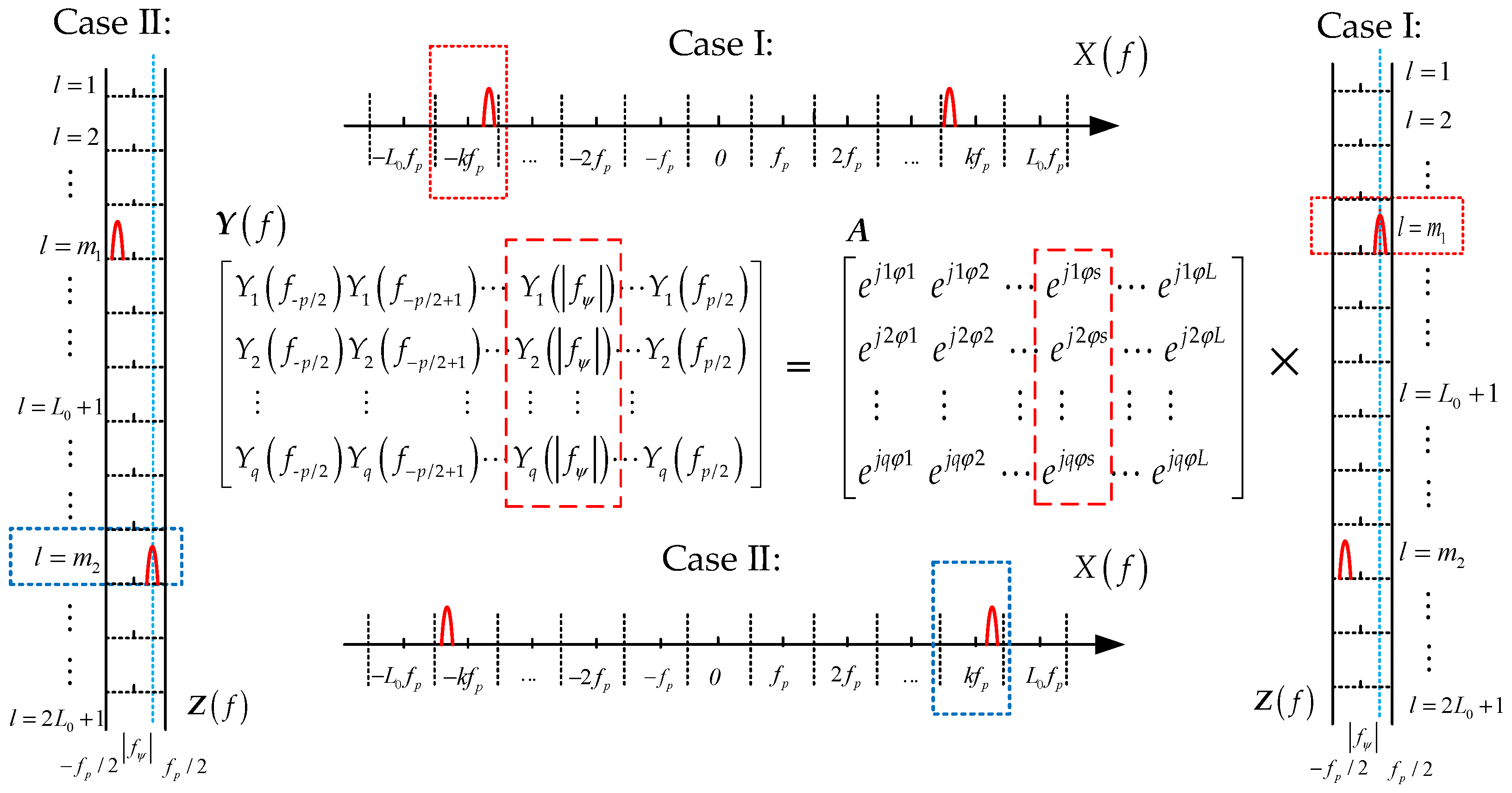
- We propose a non-reconstruction frequency estimation algorithm for FMCW lidar based on the MCS structure. The method exploits the frequency corresponding to the maximum spectral amplitude of the sampled sequences, together with the support set, to locate the frequency position of the original signal, thereby achieving frequency estimation without reconstruction. To solve the ambiguity problem in frequency estimation, we also propose a support set solution method based on the correlation between the spectrum of the sampled sequences and the sensing matrix.
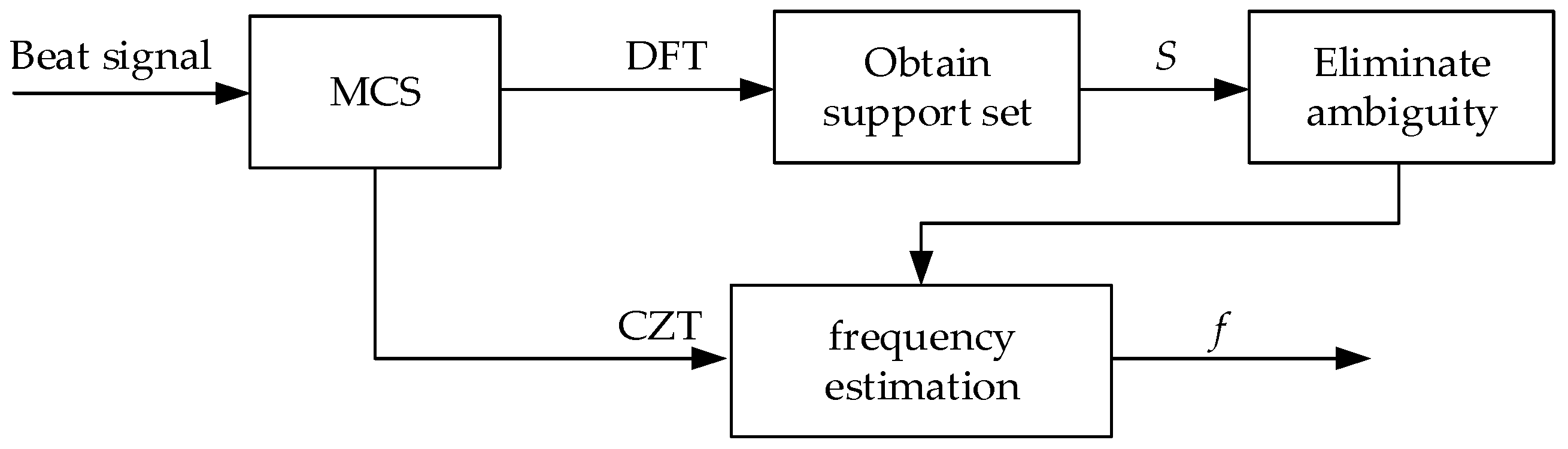
- We employ a two-stage approach for beat signal frequency estimation, comprising initial frequency estimation and spectral refinement. A sampled sequence is first selected to obtain the center frequency, and ambiguity is resolved using the support set to derive a preliminary frequency estimate. High-resolution frequency is obtained by refining the spectral sampled sequence through the CZT. Compared with existing methods, the proposed approach significantly simplifies the algorithmic structure and exhibits enhanced robustness against noise.
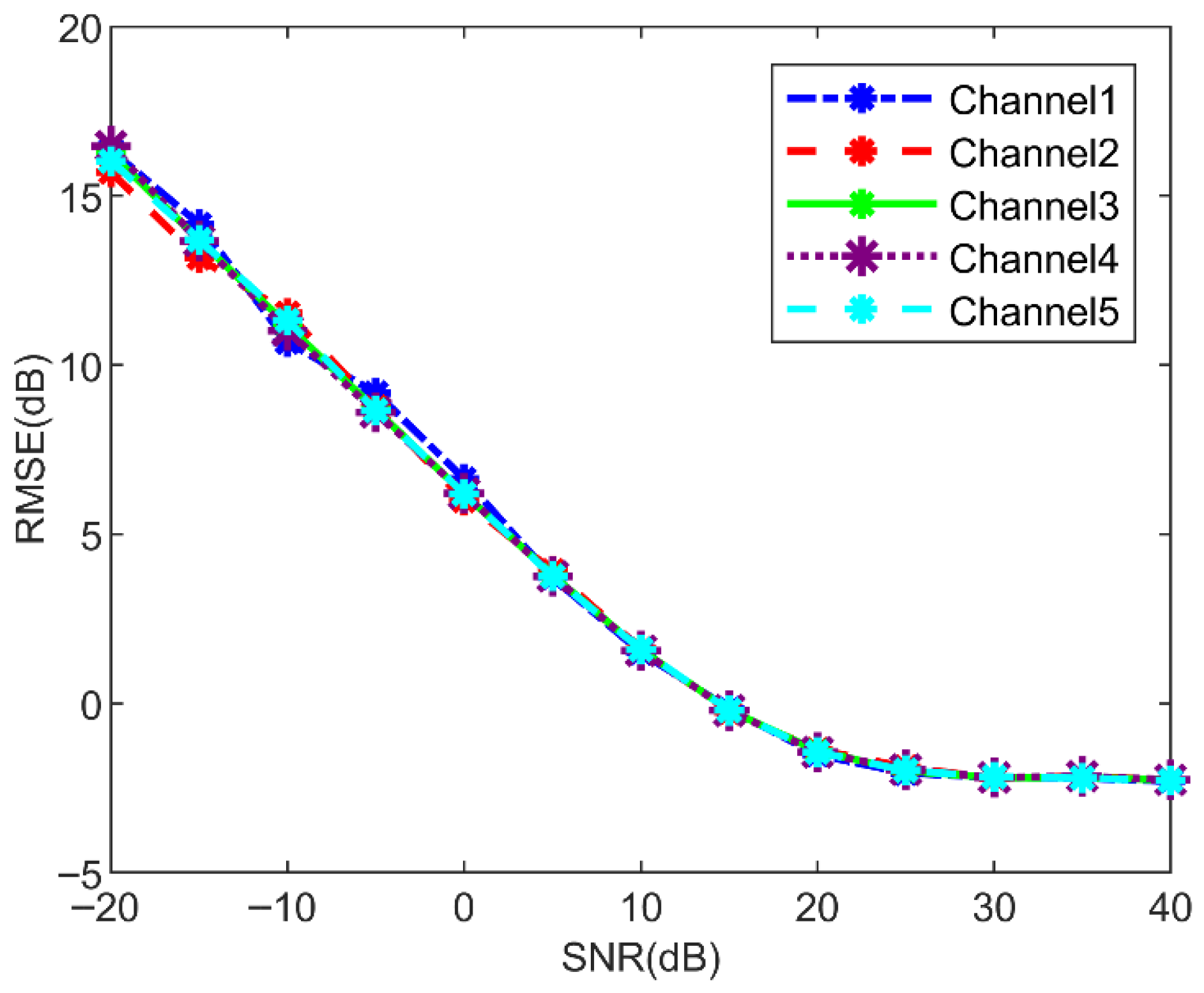
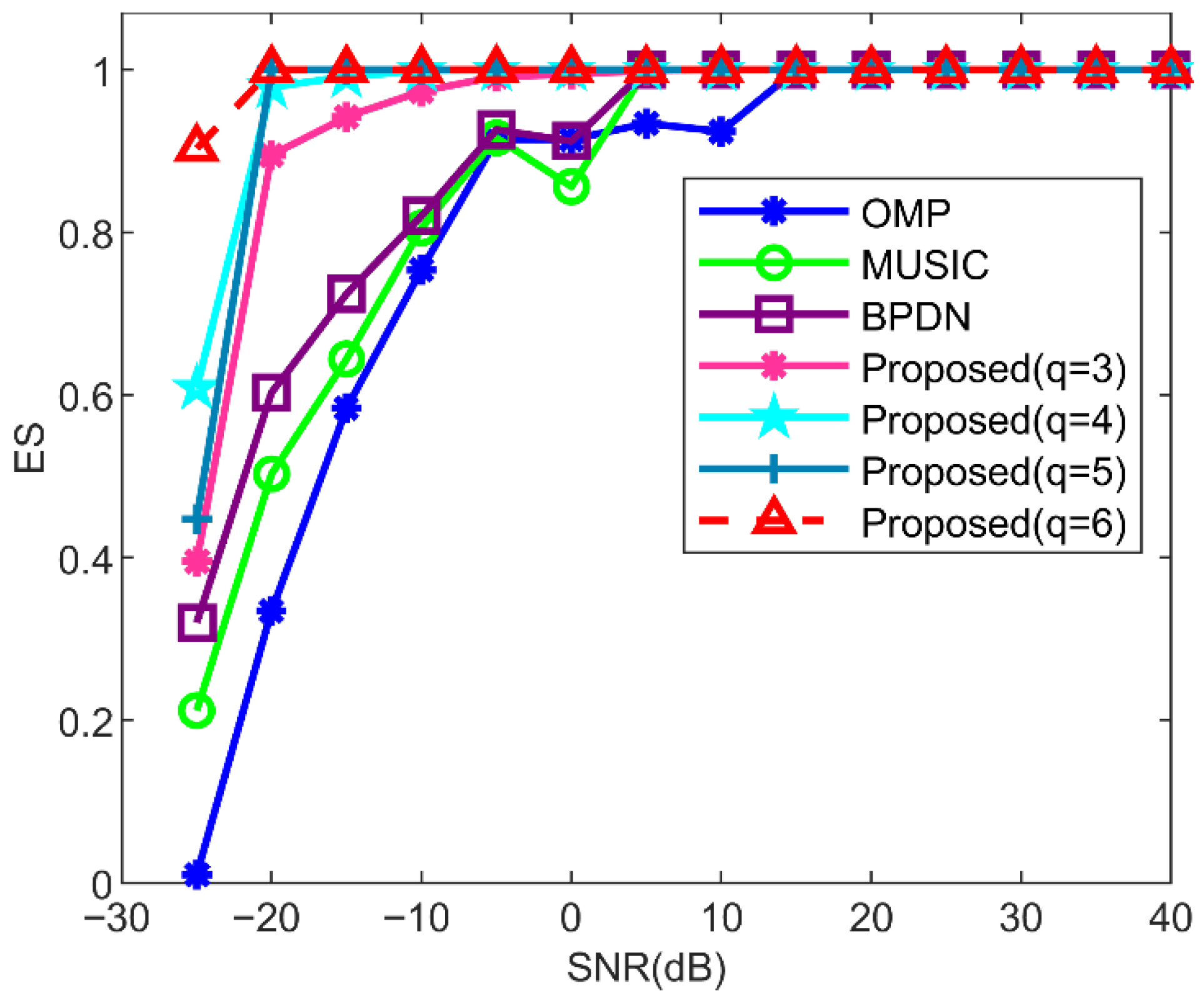
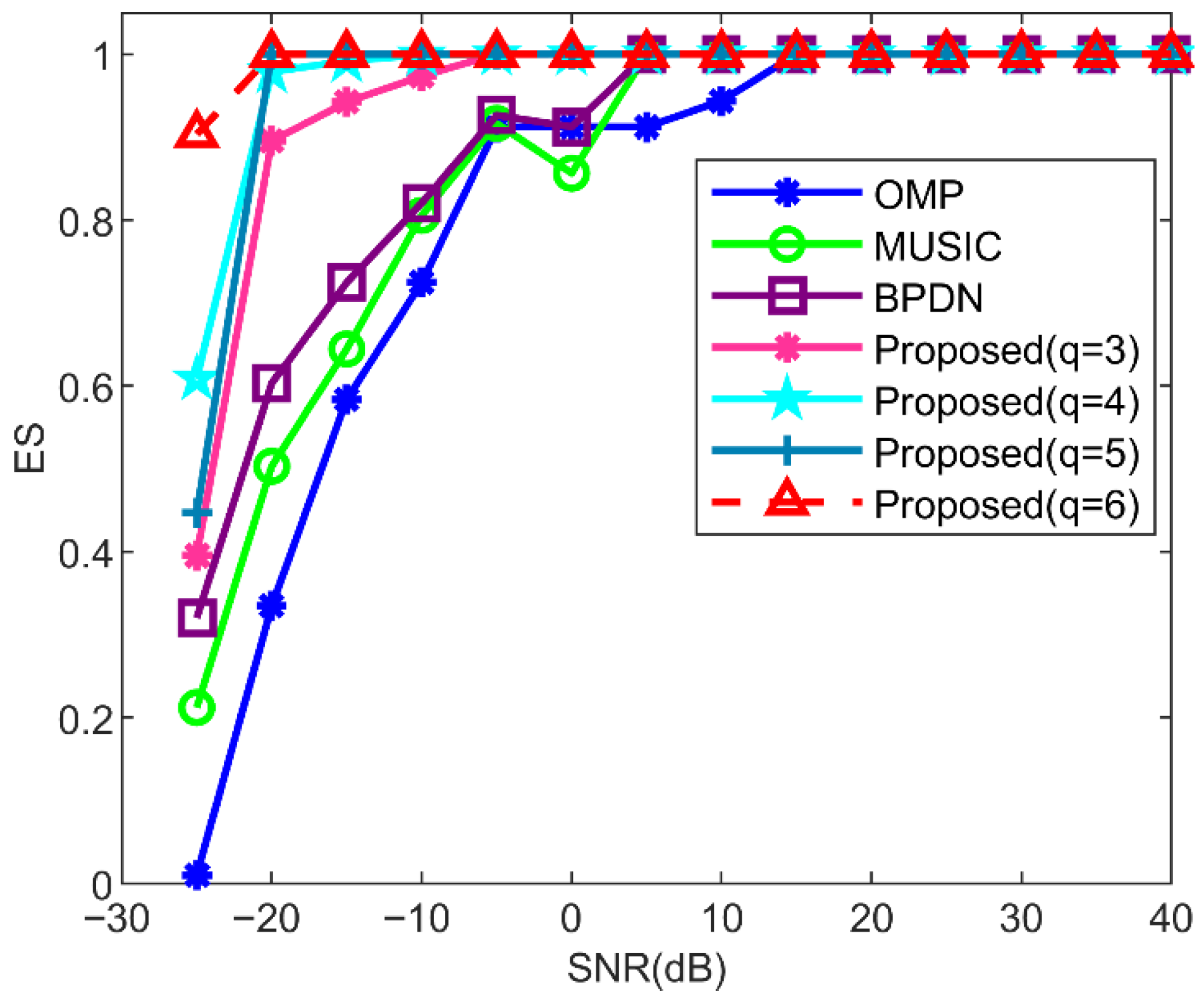
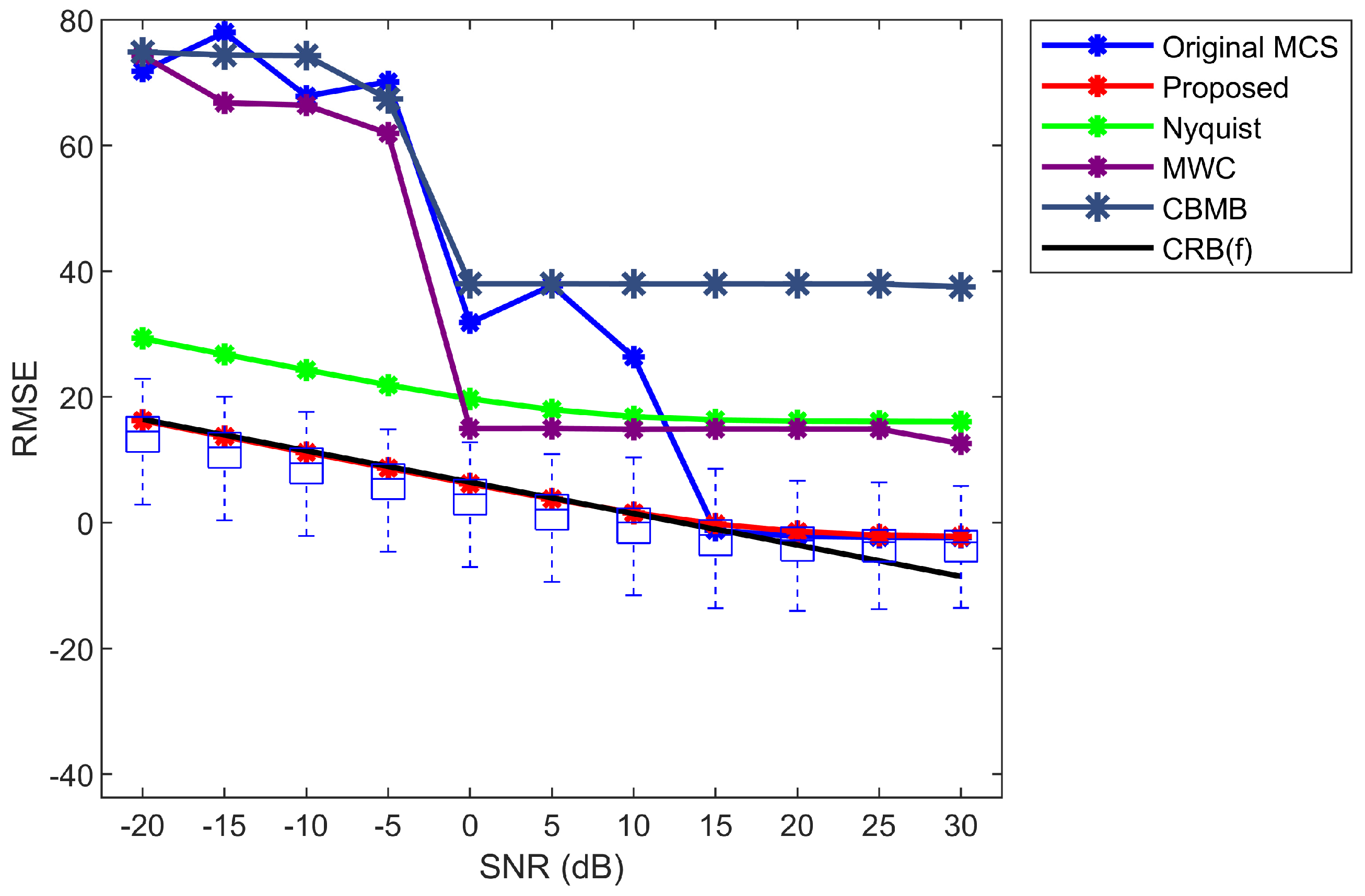
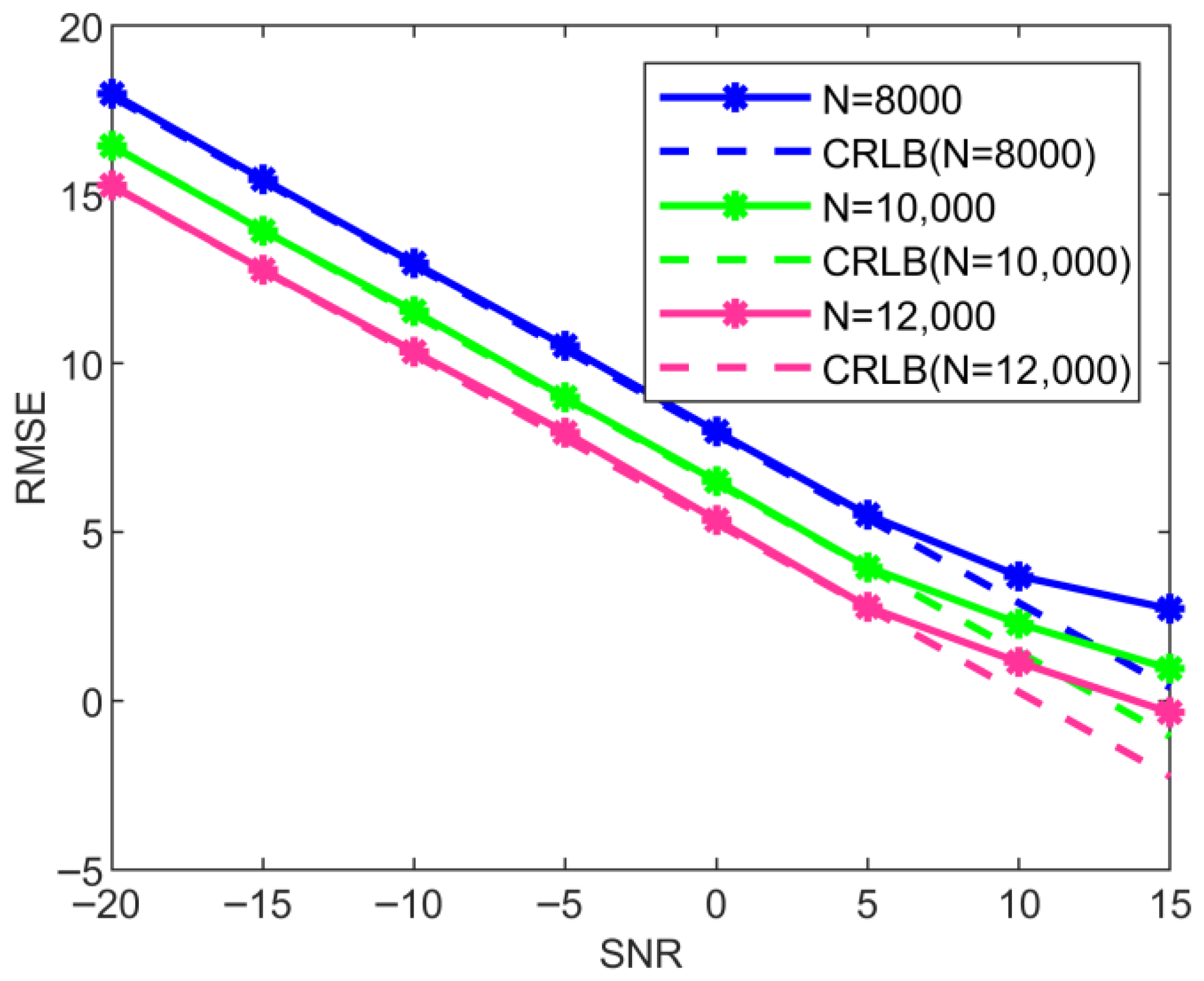
- Extensive simulation experiments were conducted to validate the performance of the proposed algorithm. The results demonstrate that the estimation accuracy of the method outperforms other sub-Nyquist approaches, achieving good performance at an SNR of −20 dB and attaining the Cramér–Rao lower bound under certain conditions.
2. FMCW Lidar and Multi-Coset Sampling Principles
2.1. Principles of FMCW Lidar
2.2. Principles of MCS
3. Proposed MCS Frequency Estimation Algorithm
3.1. Frequency Estimation Mathematical Model
3.2. Support Set Estimation
3.3. Elimination of Frequency Estimation Ambiguity
3.4. Spectral Refinement
3.5. Algorithm and Complexity Analysis
| Algorithm 1: Frequency estimation method based on MCS |
| Inputs: N-point sampled sequences number of channels q, refinement multiplier M |
| Output: preliminary frequency estimate , support set S, frequency estimates |
|
4. Experimental Results and Analysis
4.1. Setting
4.2. Comparison of the Frequency Estimation Performance Across Different Channels
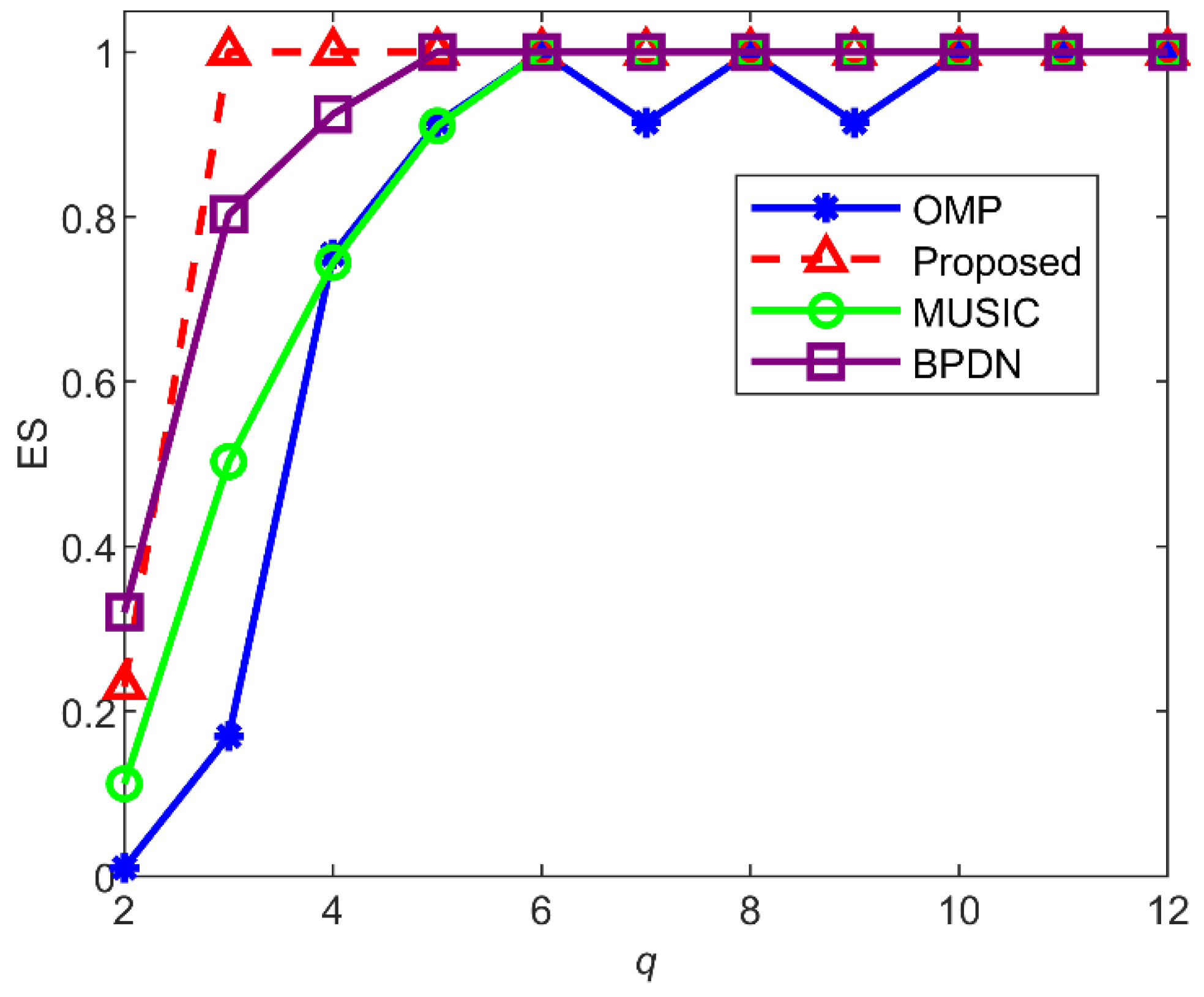
4.3. Minimum Number of Channels Required to Obtain a Support Set
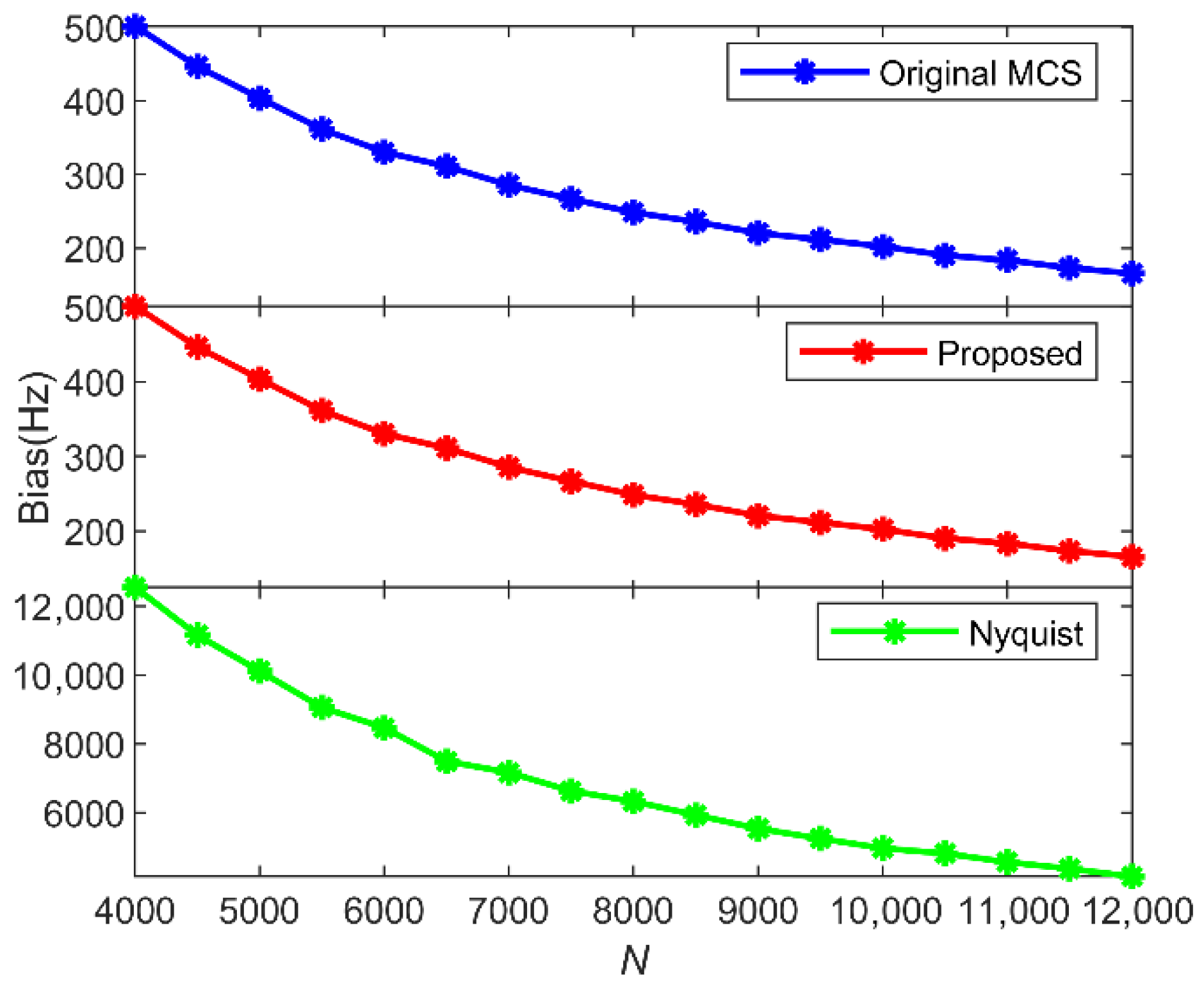
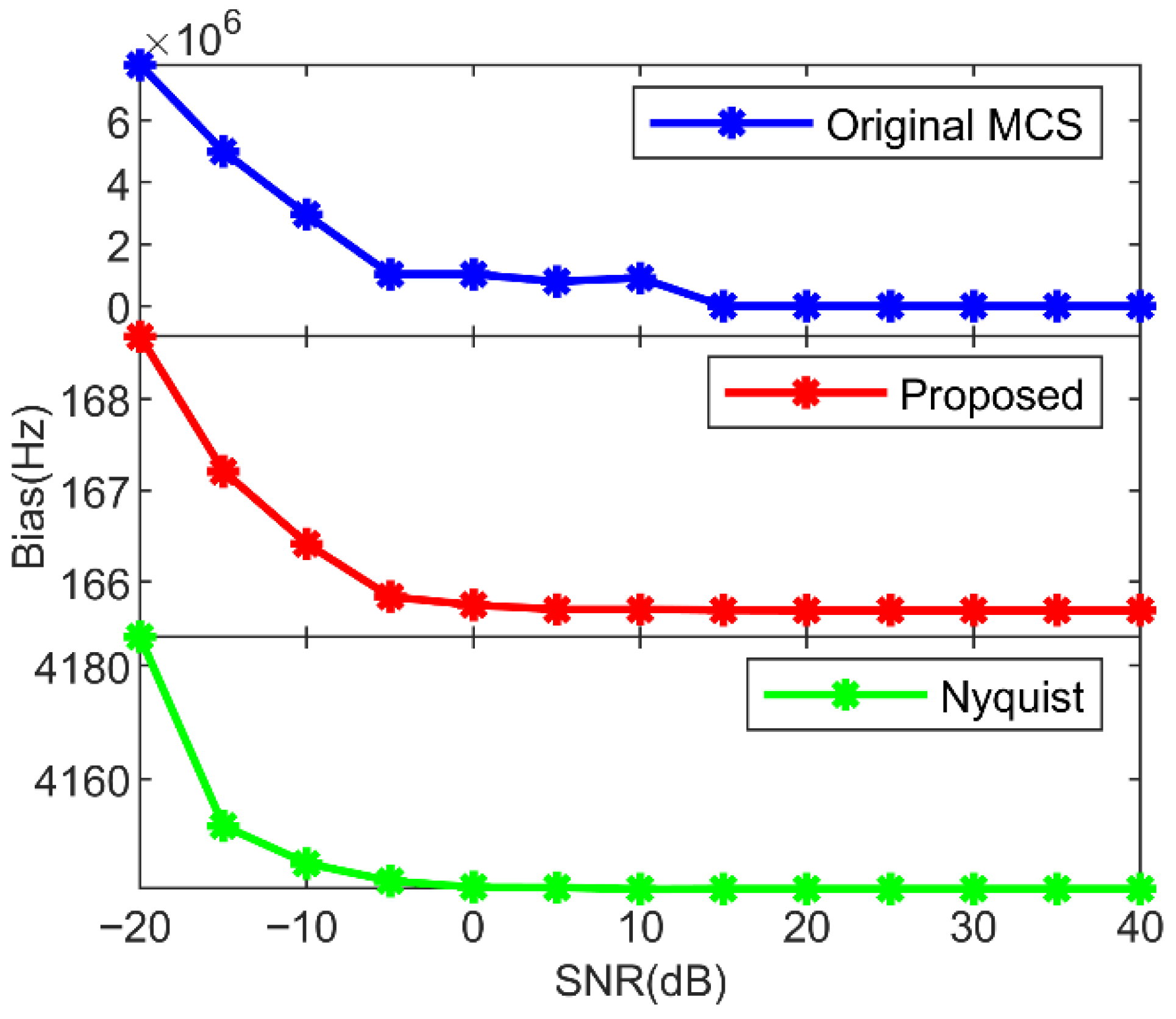
4.4. Experiments on the Bias in Preliminary Frequency Estimates
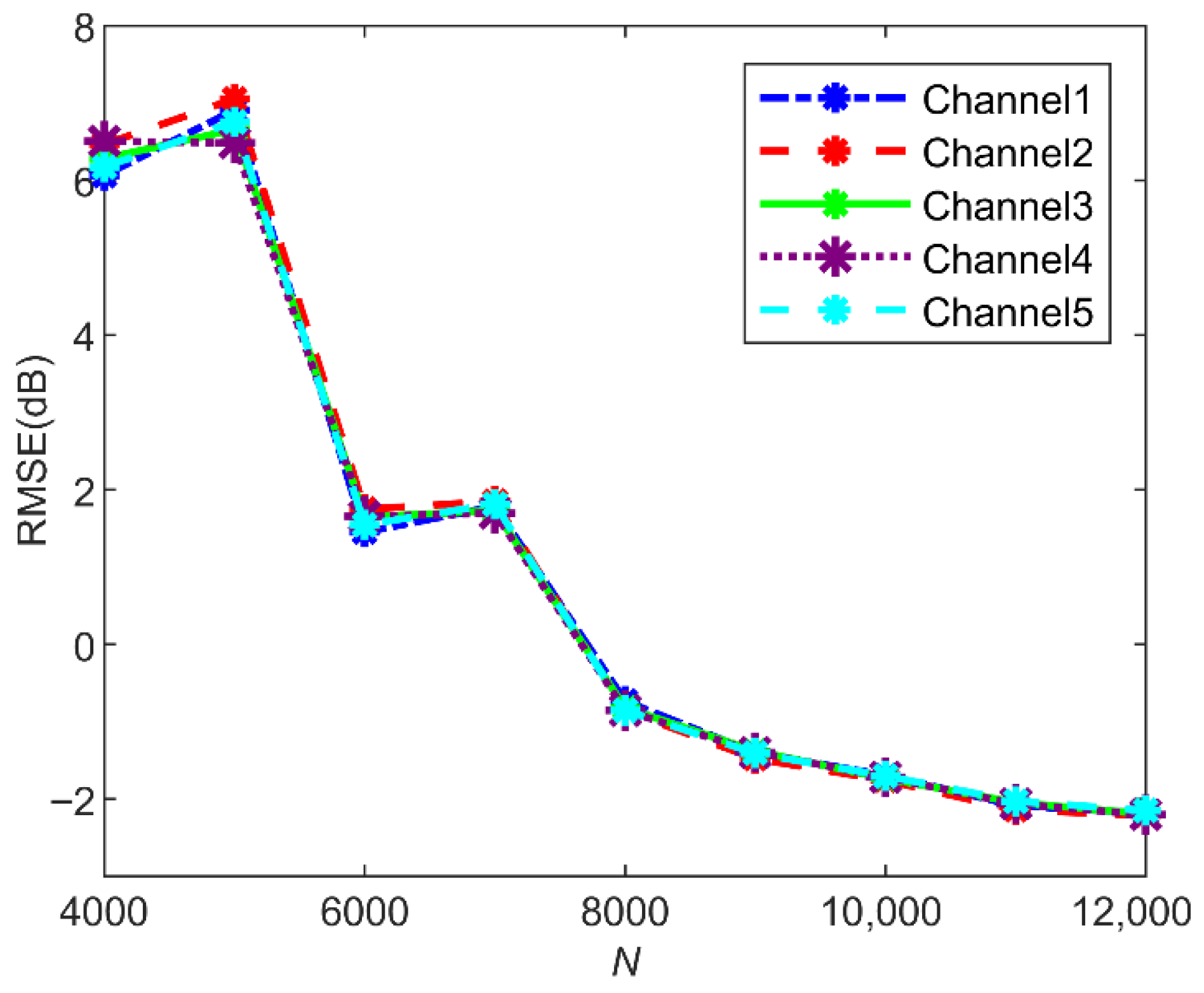
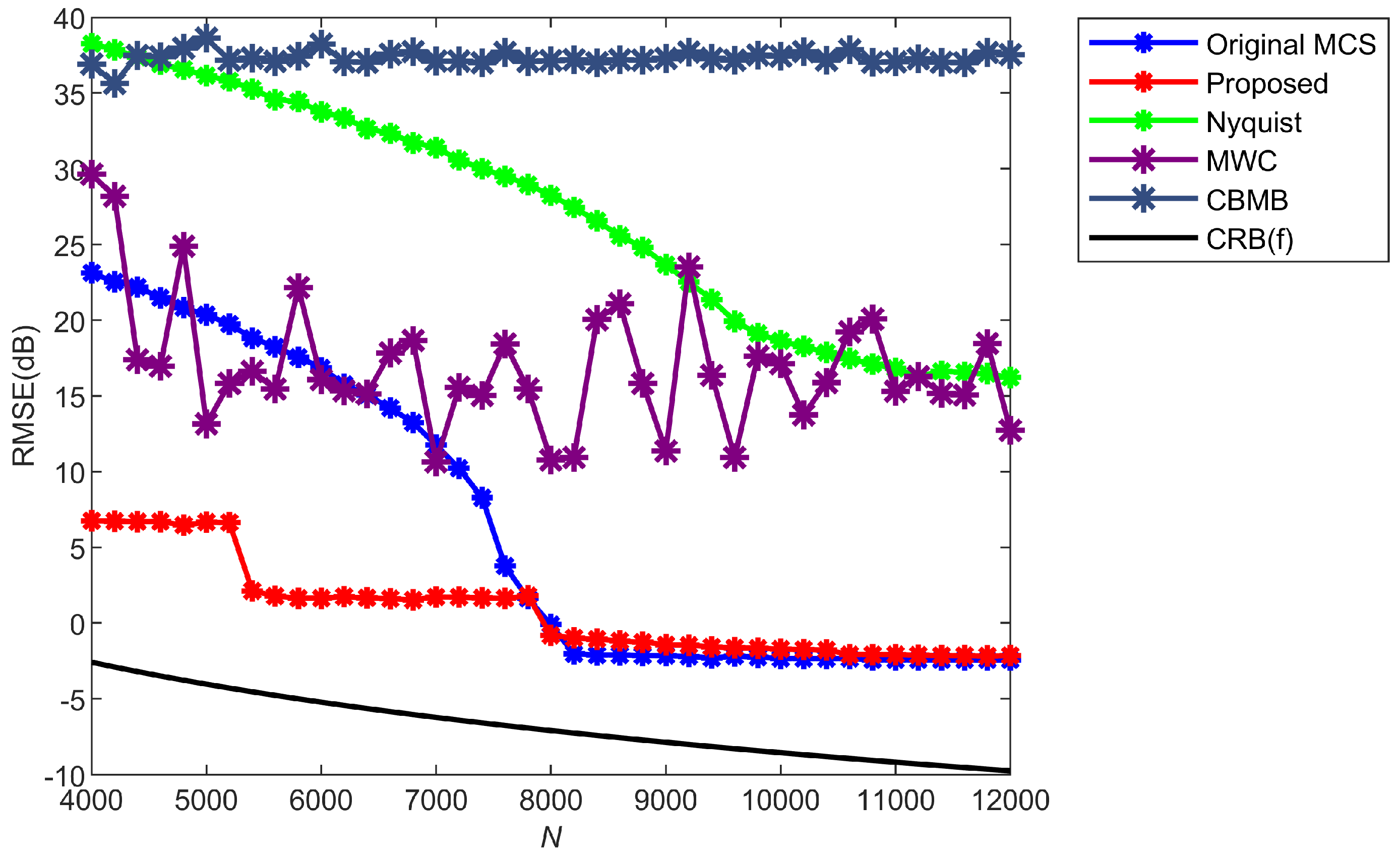
4.5. Minimum Number of Samples to Achieve Frequency Estimation
4.6. Visualization Example of Frequency Estimation Using the MCS Algorithm
4.7. Impact of Channel Mismatch on the Algorithm
5. Conclusions
Author Contributions
Funding
Data Availability Statement
Conflicts of Interest
Notations
| Symbol | Description |
| The frequency of the beat signal and estimation result | |
| A | Sensing matrix |
| L | Number of spectral partition coefficients |
| Q | Number of sampling channels |
| C | Sampling schemes |
| Sample sequence for all channels | |
| the matrix formed by the spectra of the sampling sequences from all channels | |
| Frequency corresponding to the peak of the spectrum of the sampled sequence before and after refinement | |
| Sampling rate of each channel | |
| Support set corresponding to the positive and negative frequency axes of the original signal | |
| are the support set obtained from the positive and negative frequency axis of . the set of obtained support sets | |
| Preliminary estimate of frequency |
References
- Lin, J.J.; Li, Y.P.; Hsu, W.C.; Lee, T.-S. Design of an FMCW radar baseband signal processing system for automotive application. SpringerPlus 2016, 5, 42. [Google Scholar] [CrossRef]
- Liu, Z.Y.; Wu, J.Y.; Yang, S.Y.; Lu, W. DOA estimation method based on EMD and MUSIC for mutual interference in FMCW automotive radars. IEEE Geosci. Remote Sens. Lett. 2022, 19, 3504005. [Google Scholar] [CrossRef]
- Cheng, X.; Liu, J.; Jia, L.; Zhang, F.; Qu, X. Precision and repeatability improvement in frequency-modulated continuous-wave velocity measurement based on the splitting of beat frequency signals. Opt. Express 2021, 29, 28582–28596. [Google Scholar] [CrossRef]
- Li, Z.; Liu, B.; Liao, C.R.; Fu, H. Solid-state FMCW LiDAR with in-fiber beam scanner. Opt. Lett. 2022, 47, 469–472. [Google Scholar] [CrossRef] [PubMed]
- Weiss, U.; Biber, P. Plant detection and mapping for agricultural robots using a 3D LiDAR sensor. Robot. Auton. Syst. 2011, 59, 265–273. [Google Scholar] [CrossRef]
- Hariyama, T.; Sandborn, P.A.M.; Watanabe, M.; Wu, M.C. High-accuracy range-sensing system based on FMCW using low-cost VCSEL. Opt. Express 2018, 26, 9285–9297. [Google Scholar] [CrossRef]
- Laganà, F.; Pellicanò, D.; Arruzzo, M.; Pratticò, D.; Pullano, S.A.; Fiorillo, A.S. FEM-based modelling and AI-enhanced monitoring system for upper limb rehabilitation. Electronics 2025, 14, 2268. [Google Scholar] [CrossRef]
- Huang, G.; Cui, C.; Lei, X.; Li, Q.; Yan, S.; Li, X.; Wang, G. A review of optical interferometry for high-precision length measurement. Micromachines 2024, 16, 6. [Google Scholar] [CrossRef] [PubMed]
- Zhang, F.; Yi, L.; Qu, X. Simultaneous measurements of velocity and distance via a dual-path FMCW lidar system. Opt. Commun. 2020, 474, 126066. [Google Scholar] [CrossRef]
- Luo, J.; Che, Y.; Huang, G. Frequency estimation based on MLE-M-Rife algorithm. In Proceedings of the 12th International Conference on Advanced Infocomm Technology (ICAIT), Taipa, Macao, 23–25 November 2020; pp. 64–67. [Google Scholar]
- Quinn, B.G. Estimation of frequency, amplitude, and phase from the DFT of a time series. IEEE Trans. Signal Process. 1997, 45, 814–817. [Google Scholar] [CrossRef]
- Ge, F.X.; Shen, D.; Sui, A.; Li, V.O. Iterative CZT-based frequency offset estimation for frequency-selective channels. In Proceedings of the IEEE International Conference on Communications (ICC), Seoul, Republic of Korea, 16–20 May 2005; Volume 4, pp. 2157–2161. [Google Scholar]
- Scherr, S.; Ayhan, S.; Fischbach, B.; Bhutani, A.; Pauli, M.; Zwick, T. An efficient frequency and phase estimation algorithm with CRB performance for FMCW radar applications. IEEE Trans. Instrum. Meas. 2015, 64, 1868–1875. [Google Scholar] [CrossRef]
- Wang, K.; Wang, L.; Yan, B.; Wen, H. Efficient frequency estimation algorithm based on chirp-Z transform. IEEE Trans. Signal Process. 2022, 70, 5724–5737. [Google Scholar] [CrossRef]
- Xu, Z.; Qi, S.; Zhang, P. A coherent CZT-based algorithm for high-accuracy ranging with FMCW radar. IEEE Trans. Instrum. Meas. 2023, 72, 8001511. [Google Scholar] [CrossRef]
- Donoho, D.L. Compressed sensing. IEEE Trans. Inf. Theory 2006, 52, 1289–1306. [Google Scholar] [CrossRef]
- Ravelomanantsoa, N.; Rabah, H.; Rouane, A. Compressed sensing: A simple deterministic measurement matrix and a fast recovery algorithm. IEEE Trans. Instrum. Meas. 2015, 64, 3405–3413. [Google Scholar] [CrossRef]
- Pratticò, D.; Di Carlo, D.; Silipo, G.; Laganà, F. Hybrid FEM-AI approach for thermographic monitoring of biomedical electronic devices. Computers 2025, 14, 344. [Google Scholar] [CrossRef]
- Peng, T.; Zhang, K.; Zuo, P.; Dong, C.; Lan, B.; Qian, R.; Cao, L.; Wang, W. An adaptive method based on frequency correlation for wideband spectrum sensing. IEEE Trans. Veh. Technol. 2024, 73, 10301–10315. [Google Scholar] [CrossRef]
- Mishali, M.; Eldar, Y.C.; Tropp, J.A. Efficient sampling of sparse wideband analog signals. In Proceedings of the IEEE 25th Convention of Electrical and Electronics Engineers in Israel, Eilat, Israel, 3–5 December 2008; pp. 290–294. [Google Scholar]
- Mishali, M.; Eldar, Y.C. From theory to practice: Sub-Nyquist sampling of sparse wideband analog signals. IEEE J. Sel. Top. Signal Process. 2010, 4, 375–391. [Google Scholar] [CrossRef]
- Mishali, M.; Eldar, Y.C. Blind multiband signal reconstruction: Compressed sensing for analog signals. IEEE Trans. Signal Process. 2009, 57, 993–1009. [Google Scholar] [CrossRef]
- Liu, L.; Zhang, Z.; Zhang, X.; Wei, P.; An, J.; Li, H. Joint spectrum sensing and DOA estimation based on a resource-efficient sub-Nyquist array receiver. IEEE Trans. Signal Process. 2024, 72, 3450–3465. [Google Scholar] [CrossRef]
- Venkataramani, R.; Bresler, Y. Perfect reconstruction formulas and bounds on aliasing error in sub-Nyquist nonuniform sampling of multiband signals. IEEE Trans. Inf. Theory 2000, 46, 2173–2183. [Google Scholar] [CrossRef]
- Venkataramani, R.; Bresler, Y. Optimal sub-Nyquist nonuniform sampling and reconstruction for multiband signals. IEEE Trans. Signal Process. 2001, 49, 2301–2313. [Google Scholar] [CrossRef]
- Ariananda, D.D.; Leus, G. Compressive wideband power spectrum estimation. IEEE Trans. Signal Process. 2012, 60, 4775–4789. [Google Scholar] [CrossRef]
- Song, Z.; Yang, J.; Zhang, H.; Gao, Y. Approaching sub-Nyquist boundary: Optimized compressed spectrum sensing based on multicoset sampler for multiband signal. IEEE Trans. Signal Process. 2022, 70, 4225–4238. [Google Scholar] [CrossRef]
- Liu, H.; Duan, H. IQ multi-coset sampling and timing skew calibration for wideband spectrum sensing at sub-Nyquist rates. Digit. Signal Process. 2023, 135, 103946. [Google Scholar] [CrossRef]
- Ma, Y.; Gao, Y.; Liang, Y.C.; Cui, S. Reliable and efficient sub-Nyquist wideband spectrum sensing in cooperative cognitive radio networks. IEEE J. Sel. Areas Commun. 2016, 34, 2750–2762. [Google Scholar] [CrossRef]
- Rahayu, E.S.; Ariananda, D.D.; Hidayat, R.; Daniel, G. Compressive signal processing for estimating range–velocity–AoA in FMCW radar applications. IEEE Access 2025, 13, 26008–26026. [Google Scholar] [CrossRef]
- Zhang, W.; Cui, X.; Zhao, Z.; Zhao, X. Sub-Nyquist sampling and gridless frequency estimation based on channelization. IEEE Signal Process. Lett. 2023, 30, 1492–1496. [Google Scholar] [CrossRef]
- Cai, T.T.; Wang, L. Orthogonal matching pursuit for sparse signal recovery with noise. IEEE Trans. Inf. Theory 2011, 57, 4680–4688. [Google Scholar] [CrossRef]
- Pati, Y.C.; Rezaiifar, R.; Krishnaprasad, P.S. Orthogonal matching pursuit: Recursive function approximation with applications to wavelet decomposition. In Proceedings of the 27th Asilomar Conference on Signals, Systems and Computers, Pacific Grove, CA, USA, 1–3 November 1993; pp. 40–44. [Google Scholar]
- Schmidt, R. Multiple emitter location and signal parameter estimation. IEEE Trans. Antennas Propag. 1986, 34, 276–280. [Google Scholar] [CrossRef]
- Lu, W.; Vaswani, N. Modified basis pursuit denoising (modified-BPDN) for noisy compressive sensing with partially known support. In Proceedings of the IEEE International Conference on Acoustics, Speech and Signal Processing (ICASSP), Dallas, TX, USA, 14–19 March 2010; pp. 3926–3929. [Google Scholar]
- Lu, W.; Vaswani, N. Regularized modified BPDN for noisy sparse reconstruction with partial erroneous support and signal value knowledge. IEEE Trans. Signal Process. 2012, 60, 182–196. [Google Scholar] [CrossRef]
- Rife, D.C.; Boorstyn, R.R. Multiple tone parameter estimation from discrete-time observations. Bell Syst. Tech. J. 1976, 55, 1389–1410. [Google Scholar] [CrossRef]



| Relative Error (ppm) | SNR | |||||
|---|---|---|---|---|---|---|
| −20 dB | −10 dB | 0 dB | 10 dB | 20 dB | 30 dB | |
| Nyquist | 100 | 8 | 2 | 0.8 | 0.5 | 0.4 |
| Original MCS | - | - | - | - | 0.018 | 0.015 |
| Proposed | 1.5 | 0.3 | 0.1 | 0.04 | 0.02 | 0.015 |
| Frequency (Hz) | Errors (Hz) | |||
|---|---|---|---|---|
| Three Channels | Four Channels | Five Channels | Six Channels | |
| 61,235,567.890 | −17.109 | −17.109 | −17.109 | −17.109 |
| 61,236,567.890 | 13,526,885.000 | −21.015 | −21.015 | −21.015 |
| 61,237,567.890 | 13,524,901.000 | −36.640 | −36.640 | −36.640 |
| 61,238,567.890 | 13,522,897.000 | −32.734 | −32.734 | −32.734 |
| 61,239,567.890 | −21.015 | −21.015 | −21.015 | −21.015 |
| 61,240,567.890 | −9.296 | −9.296 | −9.296 | −9.296 |
| 61,241,567.890 | 10.235 | 10.235 | 10.235 | 10.235 |
| 61,242,567.890 | 10.235 | 10.235 | 10.235 | 10.235 |
| 61,243,567.890 | −21.015 | −21.015 | −21.015 | −21.015 |
| 61,244,567.890 | 13,510,909.000 | 13,510,909.000 | −44.452 | −44.452 |
| 61,245,567.890 | −17.109 | −17.109 | −17.109 | −17.109 |
| 61,245,667.890 | −23.359 | −23.359 | −23.359 | −23.359 |
| 61,245,767.890 | −29.609 | −29.609 | −29.609 | −29.609 |
| 61,245,867.890 | −28.046 | −28.046 | −28.046 | −28.046 |
| 61,245,967.890 | −18.671 | −18.671 | −18.671 | −18.671 |
| Algorithm | Execution Time (s) | Memory Consumption (kb) | |
|---|---|---|---|
| Mean | Standard Deviation | ||
| Nyquist | 0.1702 | 0.0063 | 11,704.00 |
| MCS | 0.4042 | 0.0158 | 25,036.00 |
| MWC | 0.4613 | 0.0097 | 39,400.00 |
| Proposed | 0.2588 | 0.0082 | 14,104.00 |
Disclaimer/Publisher’s Note: The statements, opinions and data contained in all publications are solely those of the individual author(s) and contributor(s) and not of MDPI and/or the editor(s). MDPI and/or the editor(s) disclaim responsibility for any injury to people or property resulting from any ideas, methods, instructions or products referred to in the content. |
© 2025 by the authors. Licensee MDPI, Basel, Switzerland. This article is an open access article distributed under the terms and conditions of the Creative Commons Attribution (CC BY) license.
Share and Cite
Gai, J.; Liu, B.; Gao, Z. A Non-Reconstruction Multi-Coset Sampling-Based Algorithm for Frequency Estimation with FMCW Lidar. Electronics 2026, 15, 122. https://doi.org/10.3390/electronics15010122
Gai J, Liu B, Gao Z. A Non-Reconstruction Multi-Coset Sampling-Based Algorithm for Frequency Estimation with FMCW Lidar. Electronics. 2026; 15(1):122. https://doi.org/10.3390/electronics15010122
Chicago/Turabian StyleGai, Jianxin, Bo Liu, and Zhongle Gao. 2026. "A Non-Reconstruction Multi-Coset Sampling-Based Algorithm for Frequency Estimation with FMCW Lidar" Electronics 15, no. 1: 122. https://doi.org/10.3390/electronics15010122
APA StyleGai, J., Liu, B., & Gao, Z. (2026). A Non-Reconstruction Multi-Coset Sampling-Based Algorithm for Frequency Estimation with FMCW Lidar. Electronics, 15(1), 122. https://doi.org/10.3390/electronics15010122