Article

An Integrated Scattering Cancellation and Modification Approach for Broadband RCS Reduction of Array Antenna


The 54th Research Institute of China Electronics Technology Group Corporation, Shijiazhuang 050081, China
*
Author to whom correspondence should be addressed.
Electronics 2026, 15(1), 108; https://doi.org/10.3390/electronics15010108 (registering DOI)
Submission received: 28 November 2025 / Revised: 12 December 2025 / Accepted: 19 December 2025 / Published: 25 December 2025
(This article belongs to the Section Microwave and Wireless Communications)

Abstract

This paper presents a design method of integrating scattering cancellation with array-level modification techniques for broadband RCS reduction (RCSR) of an array antenna. Taking a circular patch element as an example to explain how the RCSR method is used, an L-shaped feeding structure is adopted, with a dielectric substrate of Arlon Diclad 880 (tm). First, two elements with equal scattering amplitude but opposite-phase characteristics are proposed by adjusting the radiation patch dimensions and loading slots on the small patch based on characteristic mode analysis (CMA). Through arrangement of these two elements in a 2 × 2 array configuration, effective RCSR is demonstrated across 3.5–9.5 GHz. To further broaden the RCSR bandwidth, the 2 × 2 array is modified again on the ground plane using CMA. Through the integration of scattering cancellation and array-level modification techniques, a broadband RCSR design of the array antenna is realized across 2.5–11 GHz. To demonstrate the universality of the design method, 2 × 2 and 4 × 4 array antennas are designed, fabricated, and tested. The 2 × 2 array antenna can realize an average RCSR of 10.3 dB and a peak RCSR of 22 dB across 2.5–11 GHz. The 4 × 4 array antenna can realize an average RCSR of 8 dB and a peak RCSR of 23 dB across 2.5–10.5 GHz. Meanwhile, the transmission and radiation performance remains basically unchanged. The 2 × 2 array antenna works from 3.76 GHz to 5.45 GHz (36.7%) and the 4 × 4 array antenna works from 3.80 GHz to 5.30 GHz (31.1%). Their gains are 9.9 dBi for the 2 × 2 array antenna and 15.9 dBi for the 4 × 4 array antenna at 4.5 GHz. Measured results show a good agreement with calculated ones, which verifies the effectiveness and correctness of the design method.

1. Introduction

Given the high-gain performance and conformal adaptability, microstrip array antennas have been widely used in communication, navigation, radar, and stealth applications. However, for stealth communication and radar applications, despite the low observable shaping of combat platforms, the array antenna acts as a dominant contributor to the overall radar cross-section (RCS) [1]. Consequently, an RCS reduction (RCSR) design of array antennas becomes very important for the survivability and electromagnetic stealth of modern combat platforms.
Over the past decade, considerable research efforts have been devoted to developing diverse methods for array antenna RCSR design. Radar-absorbing materials (RAMs) [2], frequency selective surfaces (FSSs) [3,4,5], metasurface (MS) [6,7,8,9,10,11], and parasitic resonators [12] have been employed for array antenna RCSR. However, these approaches typically need additional structures, which lead to increased volume, weight, and design complexity. An impedance matching network [13,14,15,16,17,18] is a good solution for in-band RCSR. By optimizing the element’s impedance characteristics, it modulates the array’s antenna scattering components to achieve cancellation with structural scattering components, thereby enabling control of the antenna array’s in-band scattering field. However, the optimum load impedance varies with frequency, which limits the RCSR bandwidth. Shape modification [19,20] is a simple technique for achieving antenna RCSR. Due to the absence of theoretical guidance, it is difficult to design a broadband low-RCS element based solely on the overall scattering current distribution, and the RCSR effect is not good enough. For instance, as presented in [19], low-RCS performance is realized by modifying the radiation patch of the elements and then forming an array. However, since this approach does not account for mutual coupling effects between elements, the low-RCS performance may be compromised after forming an array. Compared with traditional shape modification, characteristic mode analysis (CMA) can provide theoretical guidance for the RCSR design of antennas. Based on CMA [21,22,23,24,25], important scattering modes can be selected and their current can be calculated for element and array antennas. Then, the shape modification of both the element and array level can be implemented according to the scattering current distribution of the important scattering modes. Finally, the RCSR can be realized for the element and array antennas. However, Refs. [21,22,23,24] all focus on element antenna designs, while only [25] addresses array antenna designs. Its RCSR bandwidth remains limited, and further expansion is still required.
Scattering cancellation [26,27,28,29,30] is a good way for achieving RCSR of array antennas. This technique realizes array antenna RCSR by integrating paired elements that exhibit identical scattering amplitudes and opposite phase. However, constrained by phase periodicity limitations, the RCSR bandwidth achieved through scattering cancellation methods remains limited. Hence, the broadband RCSR design method of array antennas needs to be studied.
In this paper, a broadband RCSR design of an array antenna is realized by integrating two techniques: scattering cancellation and array-level shape modification using CMA. Initially, by adjusting the dimension of elliptical patches along the y-axis (vertical to the polarization direction of the antenna radiation), two elements (elements A and B) with equal scattering magnitude and opposite phase are derived across 4.26–6.52 GHz (42%). Subsequently, scattering modal analysis of these two elements is conducted, and the modal currents corresponding to the higher frequency are calculated. Based on the characteristics of the dominant scattering modal current distribution, a slot is applied to element A (small element) to achieve a broader effective scattering cancellation bandwidth (3.8–8.3 GHz, 74%). By using these two new elements (element A with slot and element B) to form a 2 × 2 array, broadband RCSR is realized across 3.5–9.5 GHz (92.3%). Next, an array-level modification on the ground plane is applied to decrease the modal amplitudes of the important scattering modes, which further broadens RCSR bandwidth (2.5–11 GHz, 126%). Finally, a 2 × 2 and a 4 × 4 broadband low-RCS array antenna are designed, manufactured, and tested to verify the design method. This paper provides a new integrated design method for broadband RCSR of array antennas.
The main contributions of this paper are summarized as follows:
(1)
A hybrid approach integrating scattering cancellation with array-level modification techniques for broadband RCSR design of array antennas is proposed, which supports array scale expansion.
(2)
A 2 × 2 low-RCS array antenna is obtained from 2.5 to 11 GHz (126%), with an average RCSR of 10.3 dB and a peak RCSR of 22 dB. A 4 × 4 low-RCS array antenna is also obtained from 2.5 to 10.5 GHz (123%), with an 8 dB mean RCSR value and 23 dB peak RCSR value, verifying the universality of the design method.

2. Theoretical Analysis

2.1. Scattering Cancellation Theory

Figure 1 illustrates the schematic design for the scattering performance of array antennas employing two types of elements. Subarrays A and B have the same number of array elements and identical element spacing.
The scattering performance of array antennas can be explained using standard array antenna theory [31]. For a normally incident plane wave, the path phase difference between the two subarrays is 0°. The scattering field of the entire array can be expressed as:
E s ( θ , φ ) = E a A s ( θ , φ ) · A F a A ( θ , φ ) + E a B s ( θ , φ ) · A F a B ( θ , φ )
where E s ( θ , φ ) is the total scattering field, E a ( θ , φ ) and A F a ( θ , φ ) represent the element pattern and array factor, respectively. ( θ , φ ) is the observation angle. Due to the uniformly arranged elements, A F a A ( θ , φ ) = A F a B ( θ , φ ) = A F ( θ , φ ) . Hence, Equation (1) can be expressed as:
E s ( θ , φ ) = E a A s ( θ , φ ) + E a B s ( θ , φ ) · A F ( θ , φ )
Assuming the scattering fields from two elements have equal amplitude E 0 with a phase difference Δ φ , the scattering fields of the two elements E a A s and E a B s can be expressed as:
E a A s = E 0
E a B s = E 0 · e j Δ φ
It can be seen from Equation (2) that, if the composite field of elements A and B achieves reduction, then RCSR of the entire array can be realized. The magnitude of the composite field of elements A and B can be expressed as:
E t a t a l = E 0 + E 0 · e j Δ φ = E 0 2 + 2 cos Δ φ
To achieve a −10 dB RCS reduction, the following condition must be satisfied:
E t o t a l 2 2 · E 0 2 = 1 + cos Δ φ 2 0.1
It implies that the phase difference Δ φ should be within the range of 143° to 217°, which is defined as the effective phase difference.
When the scattering field amplitudes of the two elements are essentially equal, and their effective phase difference ranges from 143° to 217°, an array antenna composed of these two elements will achieve a −10 dB RCSR.

2.2. Characteristic Mode Theory

According to the characteristic mode theory, the scattering field on the surface of any electromagnetic objects can be decomposed into a superposition of a series of orthogonal complete modes [32]:
E s = n = 1 e ^ n s B n s e j Φ n s
where the B n s and Φ n s are the modal amplitude and phase of the nth mode, respectively, e ^ n s is the unit vector of the scattering field of the nth mode.
B n s = α n s E n s
Φ n s = γ n s + φ n s
where α n s and E n s represent the modal weighting coefficient (MWC) and scattering field of the nth mode, respectively. α n s and γ n s are the amplitude and phase of the MWC, respectively. E n s and φ n s are the amplitude and phase of scattering field of the nth scattering mode, respectively. A larger value of B n s indicates that the nth mode contributes more to the total scattering field.

3. Broadband RCSR Design of Array Antenna

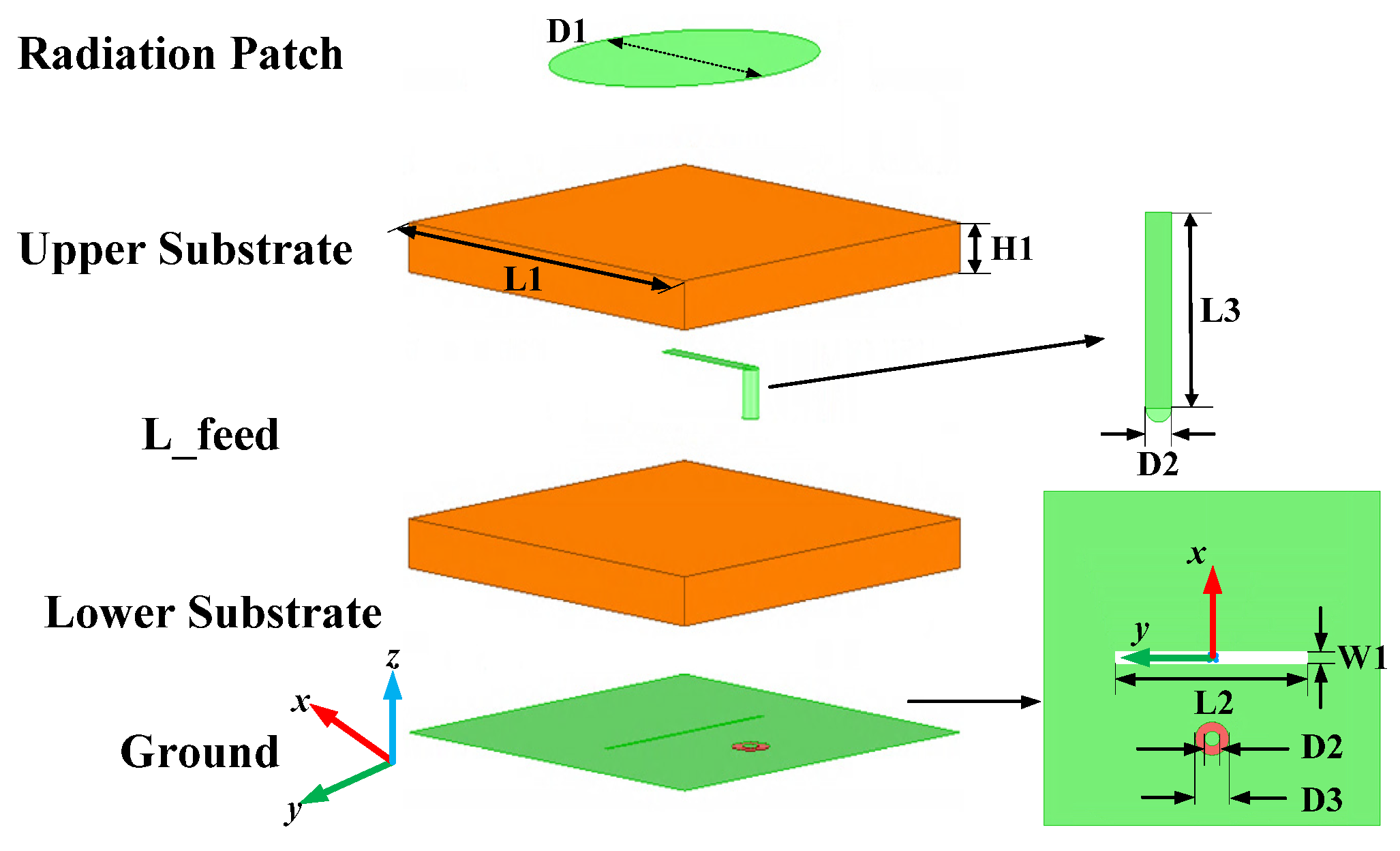
Due to the advantages of higher radiation efficiency and broader operational bandwidth [33], this paper adopts a circular patch antenna as the reference element. The structural schematic diagram of the reference element is shown in Figure 2. The element is structured as: from top to bottom, a radiation patch, an upper dielectric substrate, a microstrip line, a lower dielectric substrate, and a metal ground plane. The radiation patch is excited by an L-shaped feeding structure connected to a 50 Ω SMA connector. This L-shaped feeding structure is embedded within the lower dielectric substrate. The origin of the antenna coordinate system is located at the geometric center of the metal ground plane. The metal microstrip feed line is located along the x-axis, the position of the metallic probe is (−X1, 0, 0), and the height of the coaxial probe is H1. The centerline of the slot in the ground plane coincides with the y-axis. The dielectric substrate Arlon Diclad 880 (tm) with a relative dielectric constant of 2.2 is used for the upper and lower substrate layers with the same thickness H1. The reference element has a circular radiation patch with a diameter of D1. The element has a total size of 30 × 30 × 6 mm3. Its parameters are shown in Table 1.

3.1. RCSR Design Based on Scattering Cancellation

3.1.1. Scattering Cancellation Element Design Based on Reshaping Patch

To achieve scattering cancellation, two elements (a pair of cancellation elements) should meet the following conditions: (1) identical transmission and radiation performance; (2) equal scattering amplitudes and effective phase difference.
In most previous studies, the design of scattering cancellation elements is achieved by loading T-shaped or U-shaped slots on the radiation patches. In this paper, we propose that scattering cancellation design can be realized by adjusting the shape and dimensions of radiation patches. The circular radiation patch of the reference element can be adjusted in both the x-axis and y-axis directions, thus transforming the radiation patch into an elliptical shape by compressing or stretching. The dimension of the radiation patch along the x-axis determines the resonant frequency of the antenna. If altered, it will affect the transmission and radiation performance of the element antenna. Hence, the impact of the radiation patch’s dimension along the y-axis on both radiation and scattering characteristics is studied when fixing its dimension D1 in the x-axis direction. The scale factor for compression or stretching is defined as c, meaning that the size of the element along the y-axis is c × D1.
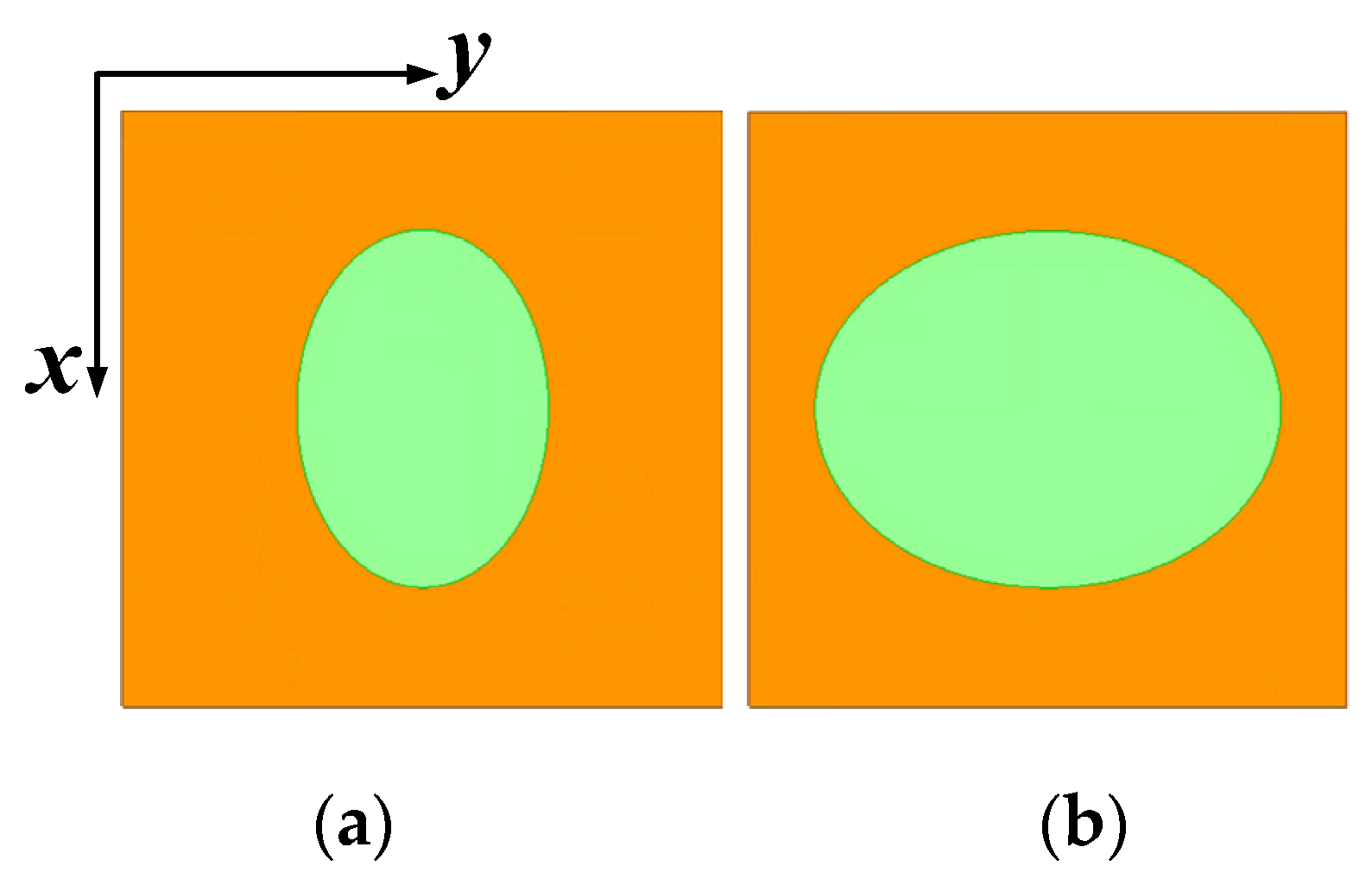
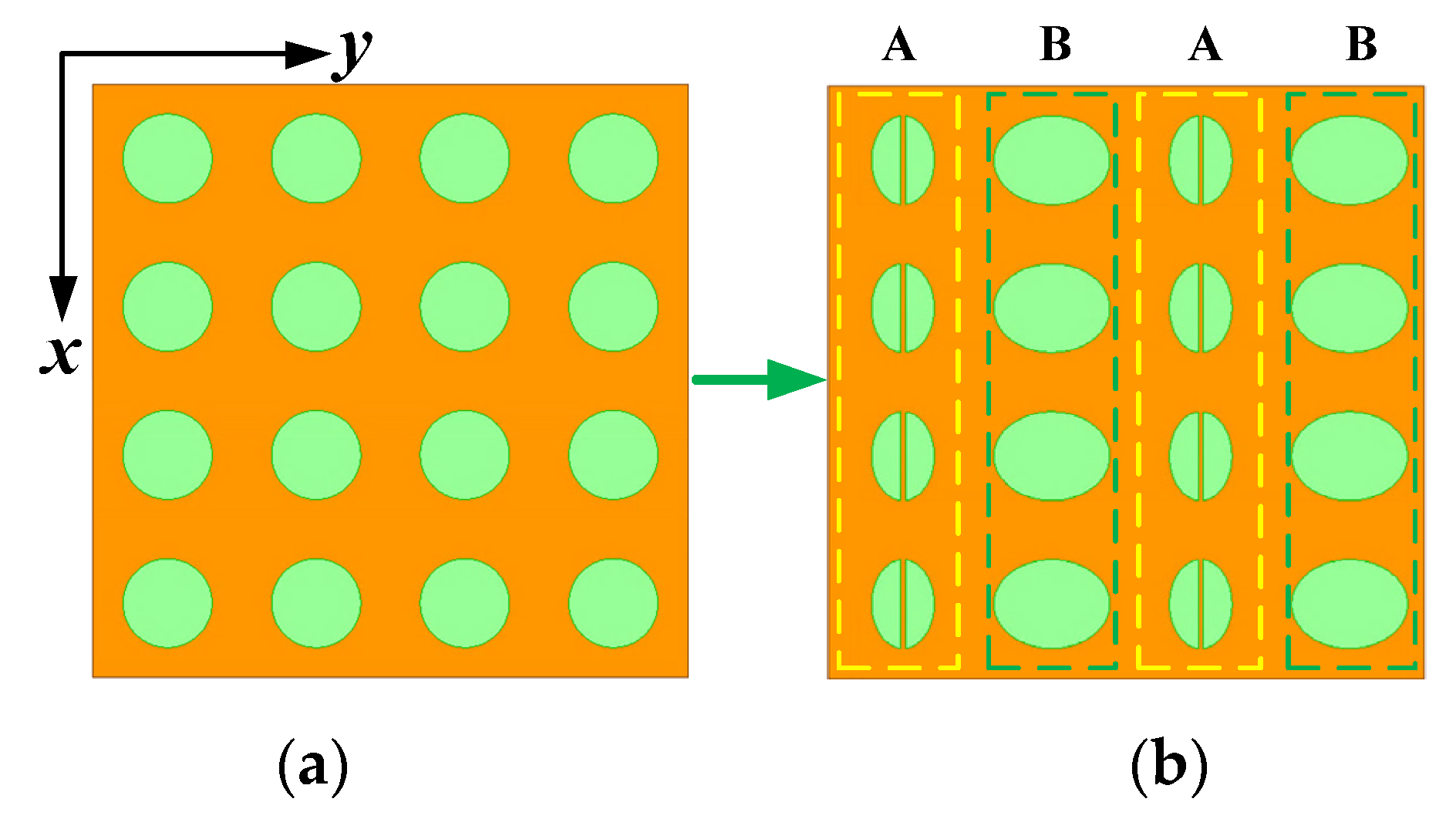
The research and analysis on radiating patches with c values of 0.7, 0.8, 0.9, 1.1, 1.2, and 1.3 are performed, respectively. For radiation performance, these six elements exhibit basically identical characteristics. For scattering performance, we paired the c = 0.7 and 1.3 elements, 0.8 and 1.2 elements, and 0.9 and 1.1 elements into three pairs to investigate the impact of their dimensions on scattering field amplitude and phase. The results indicate that the scattering amplitudes of all six elements are consistent. Furthermore, the effective phase bandwidths corresponding to the three pairs of elements are shown in Table 2. The paired elements (c = 0.7 and 1.3) have the widest effective phase bandwidth (4.26–6.52 GHz, 42%). Figure 3 shows two reshaping elements A and B. The dimension along the x-axis is set as D1, while that along the y-axis is set as c × D1, where c is 0.7 for element A and 1.3 for element B.
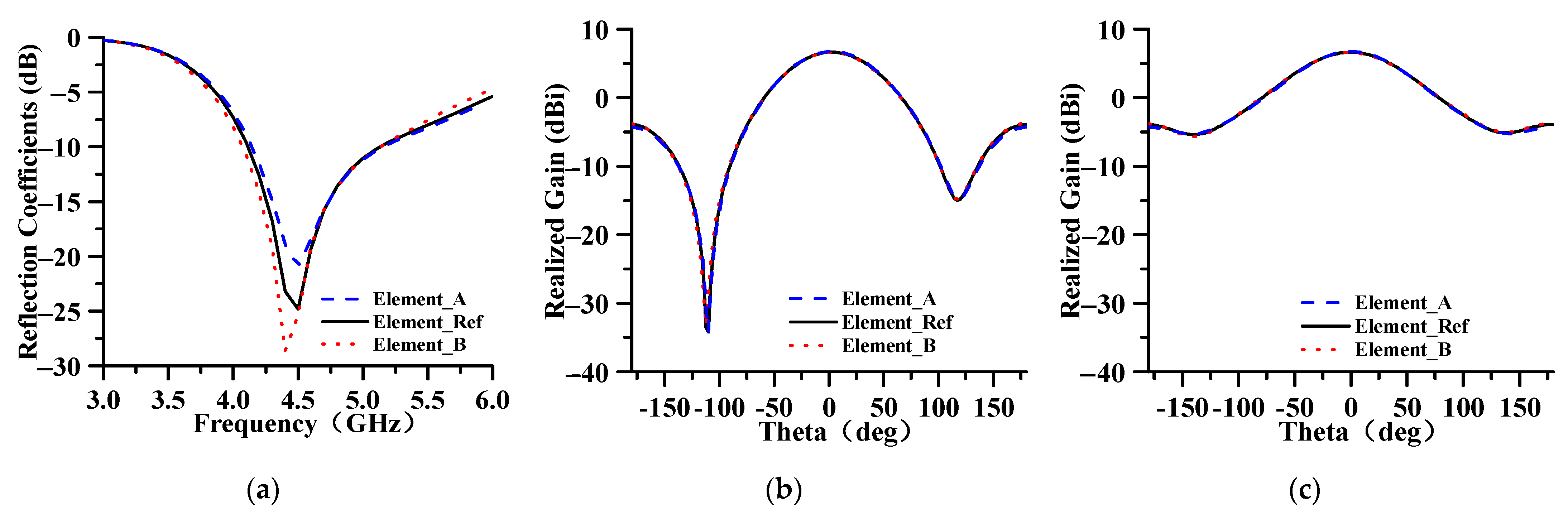
Figure 4a shows the reflection coefficients of the three elements. It can be seen that the reflection coefficients are basically consistent. Figure 4b,c show the radiation patterns of the three elements at the φ = 0° and φ = 90° planes. In conclusion, the transmission and radiation characteristics of the three elements remain essentially identical.
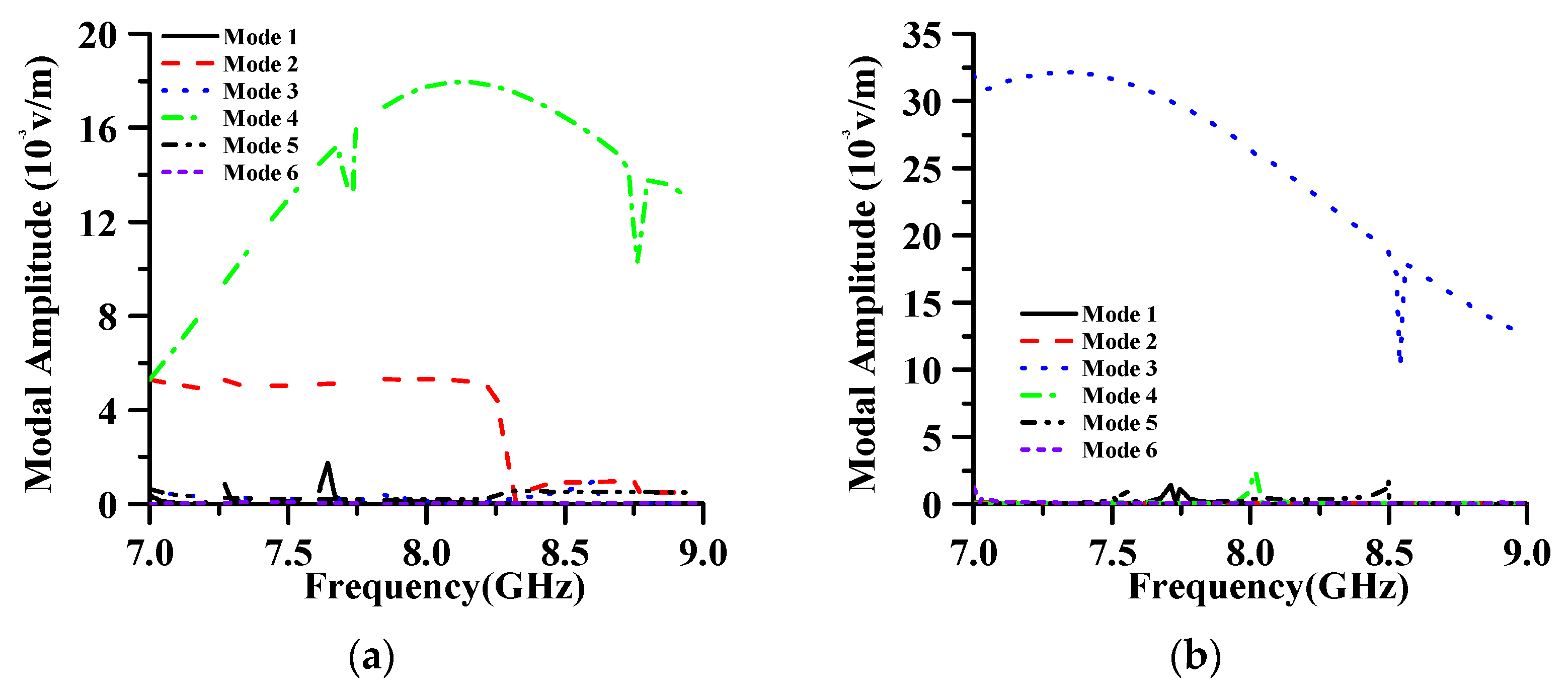
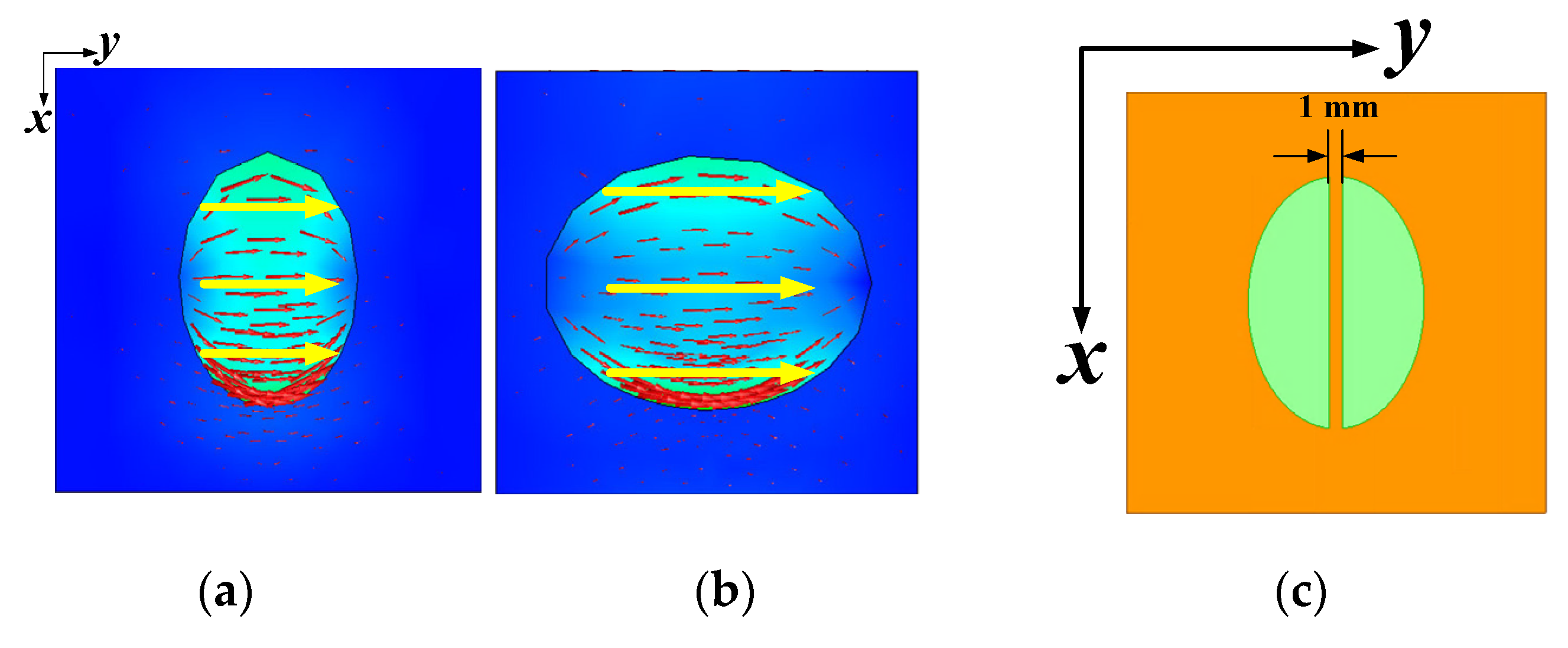
Figure 5 gives the scattering field magnitude of and phase difference between elements A and B. As can be seen, the scattering field magnitudes are basically equal. The effective phase difference is achieved within the range of 4.26–6.52 GHz (42%). Moreover, the scattering modal amplitudes and modal currents for elements A and B are further calculated. Figure 6 and Figure 7 show the scattering modal amplitudes and modal currents of elements A and B, respectively. As shown in Figure 6a, scattering mode 4 operates across 7–9 GHz and scattering mode 2 operates across 7–8.25 GHz for element A. As shown in Figure 6b, scattering mode 3 operates across 7–9 GHz for element B. As shown in Figure 7, the scattering modal currents of modes 3 and 4 are similar, which flow along the y-axis and distribute strongly at the center of the top and bottom edges. For the high-frequency band (at 8 GHz), the smaller size of element A makes its scattering phase more sensitive to structural changes. By introducing a size-optimized slot along the x-axis direction on element A, the scattering phase can be adjusted while keeping the scattering amplitude unchanged. The geometry of element A with a patch-slot is shown in Figure 7c. The patch-slot is located at the center of the radiation patch, with a width of 1 mm.
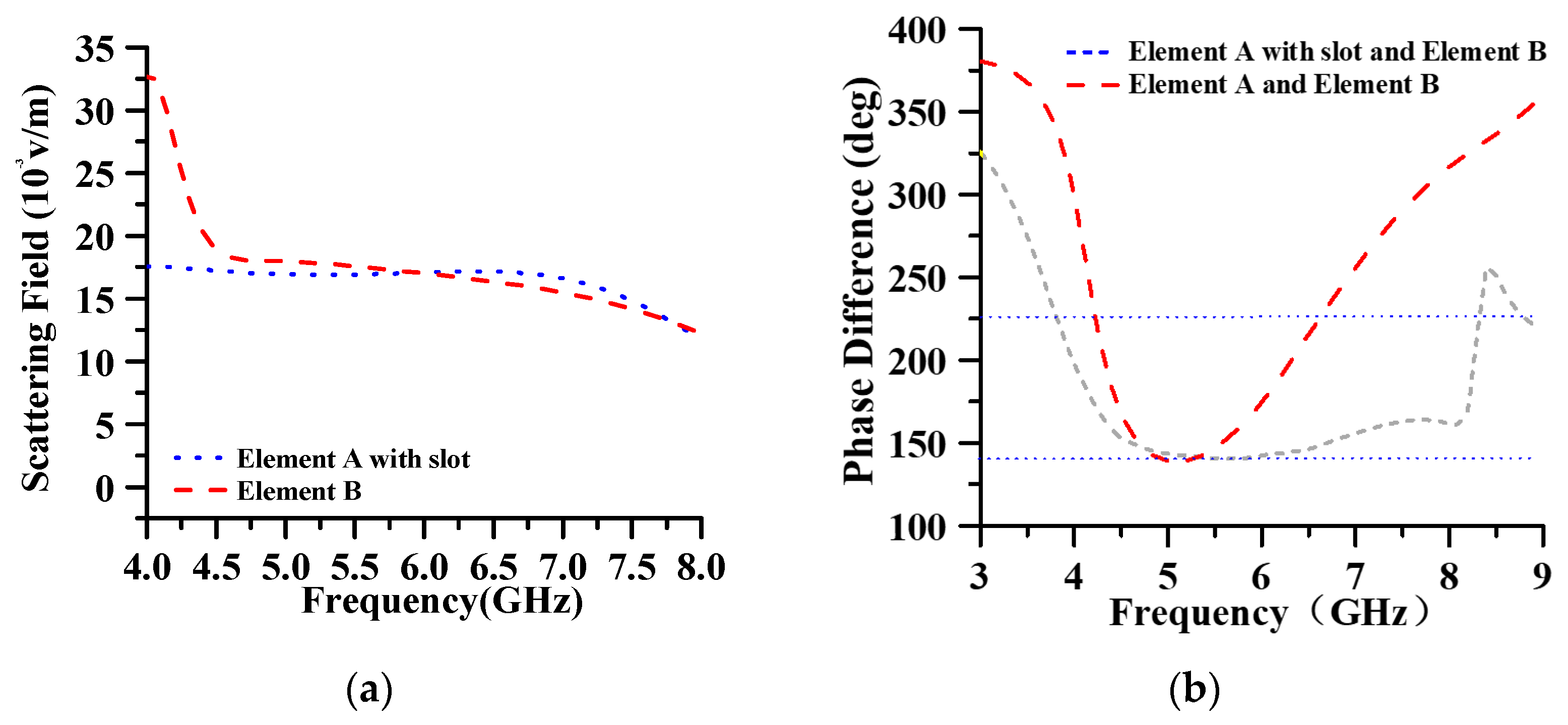
Figure 8a shows the scattering field magnitudes of element A with a slot and element B, and Figure 8b shows the phase difference between element A and element B, as well as element A with a slot and element B. Figure 8a shows that the scattering field magnitudes of both patches are nearly identical. Figure 8b reveals that, after loading the slot, the bandwidth of the effective phase difference between element A with a slot and element B expands to 3.8–8.3 GHz (74%).

3.1.2. Scattering Cancellation Array Design

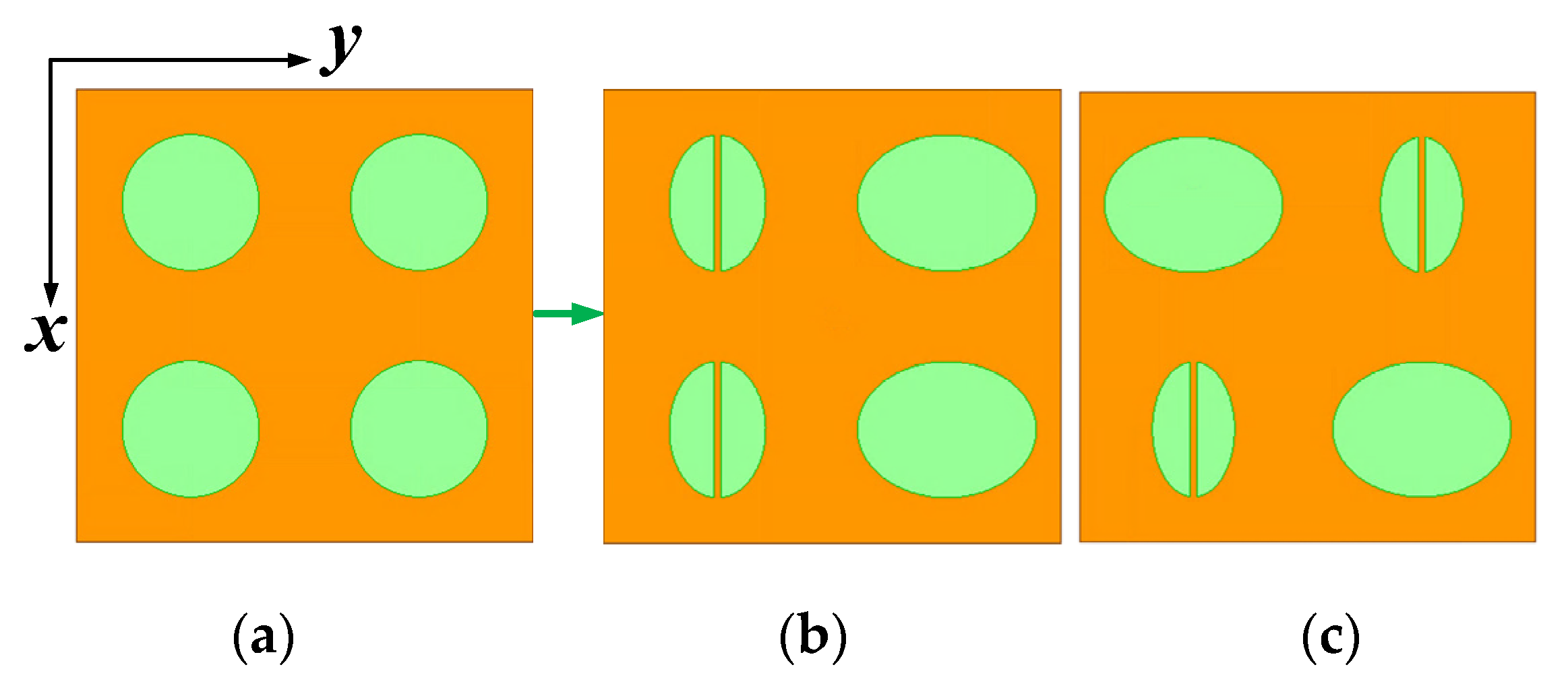
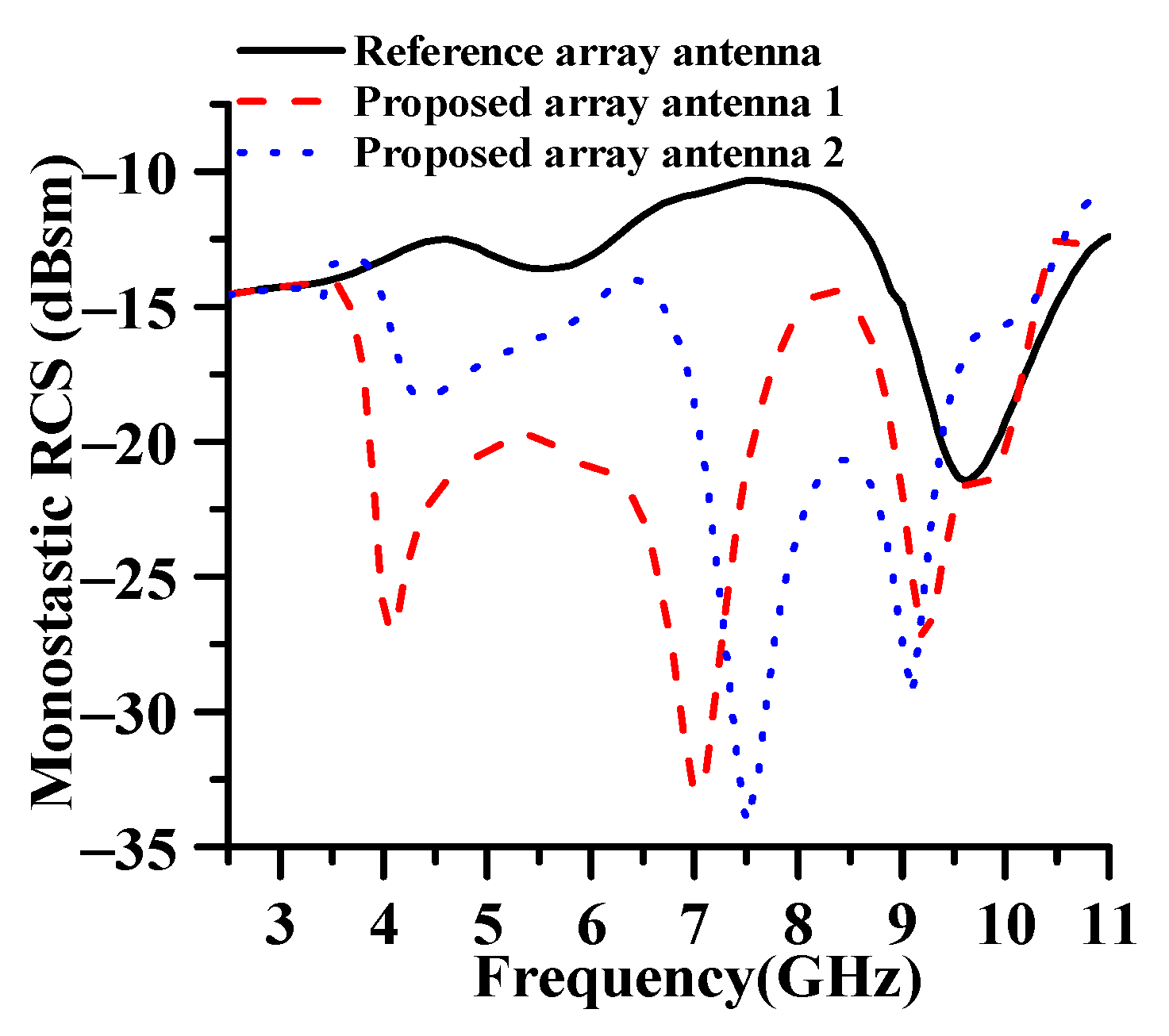
The reference array antenna is formed by configuring the reference elements into a 2 × 2 array, as shown in Figure 9a. Two 2 × 2 arrays, ABAB (proposed array antenna 1) and BAAB (proposed array antenna 2), are constructed using element A with a slot and element B, as shown in Figure 9b,c. Under the plane wave excitation (θ = 0°, y-polarized, f = 2.5–11 GHz), the RCSs of the proposed and reference array antennas are shown in Figure 10. It is observed that proposed array antennas 1 and 2 achieve RCSR across 3.5–9.5 GHz (92.3%) and 4.0–9.2 GHz (78.8%), respectively. The proposed array antenna 1 has a wider RCSR bandwidth than the proposed array antenna 2. However, within the low- and high-frequency bands of 2.5–3.5 GHz and 9.5–11 GHz, it does not have the RCSR effect. In the following, the array-level scattering modal analysis of the proposed array antenna 1 is performed to guide an array-level shape modification design for RCSR in a wider frequency band.

3.2. RCSR Design Based on Array-Level Shape Modification

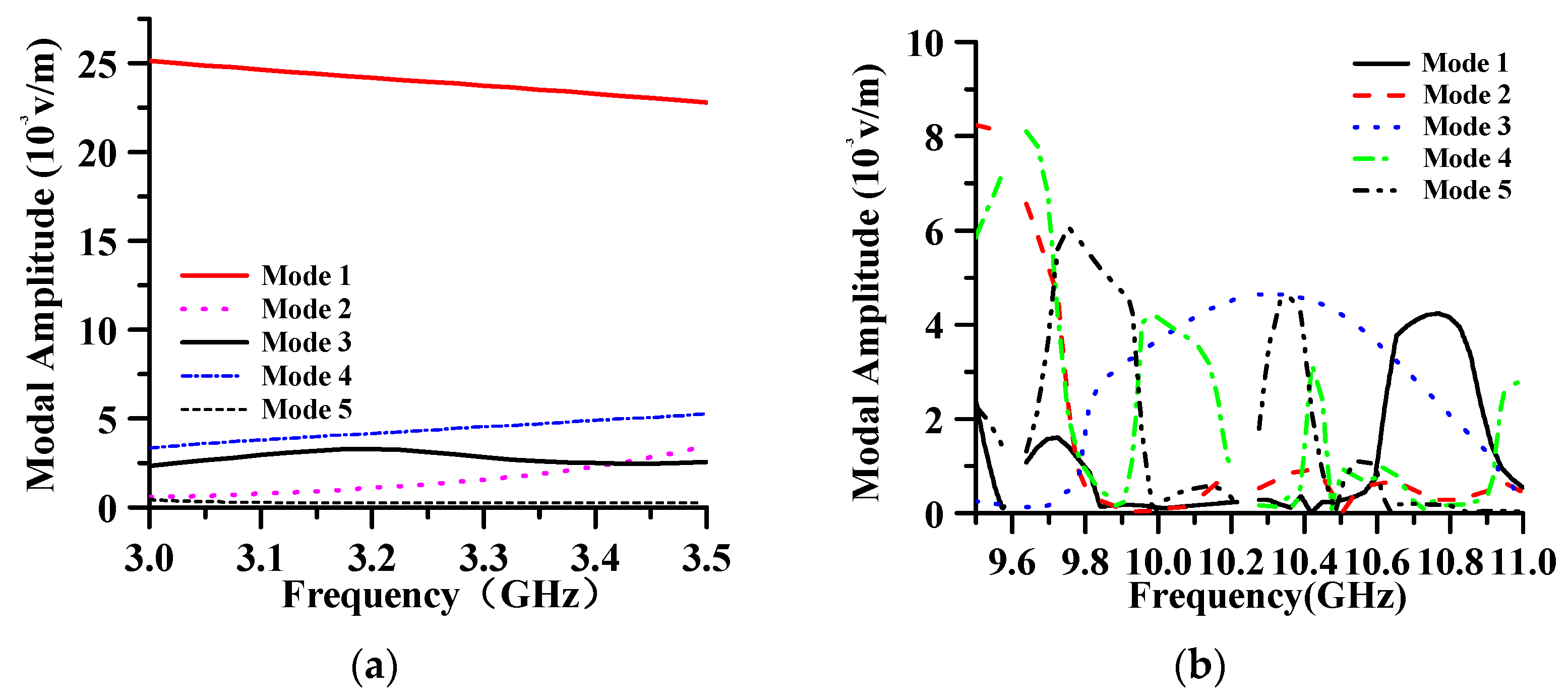
The scattering modes of the proposed array antenna 1 are calculated within the low-frequency band of 3–3.5 GHz and high-frequency band of 9.5–11 GHz, as shown in Figure 11. Figure 11a shows that one dominant scattering mode exists within the 3–3.5 GHz range. Figure 11b shows that five dominant scattering modes exist within the 9.5–11 GHz range.
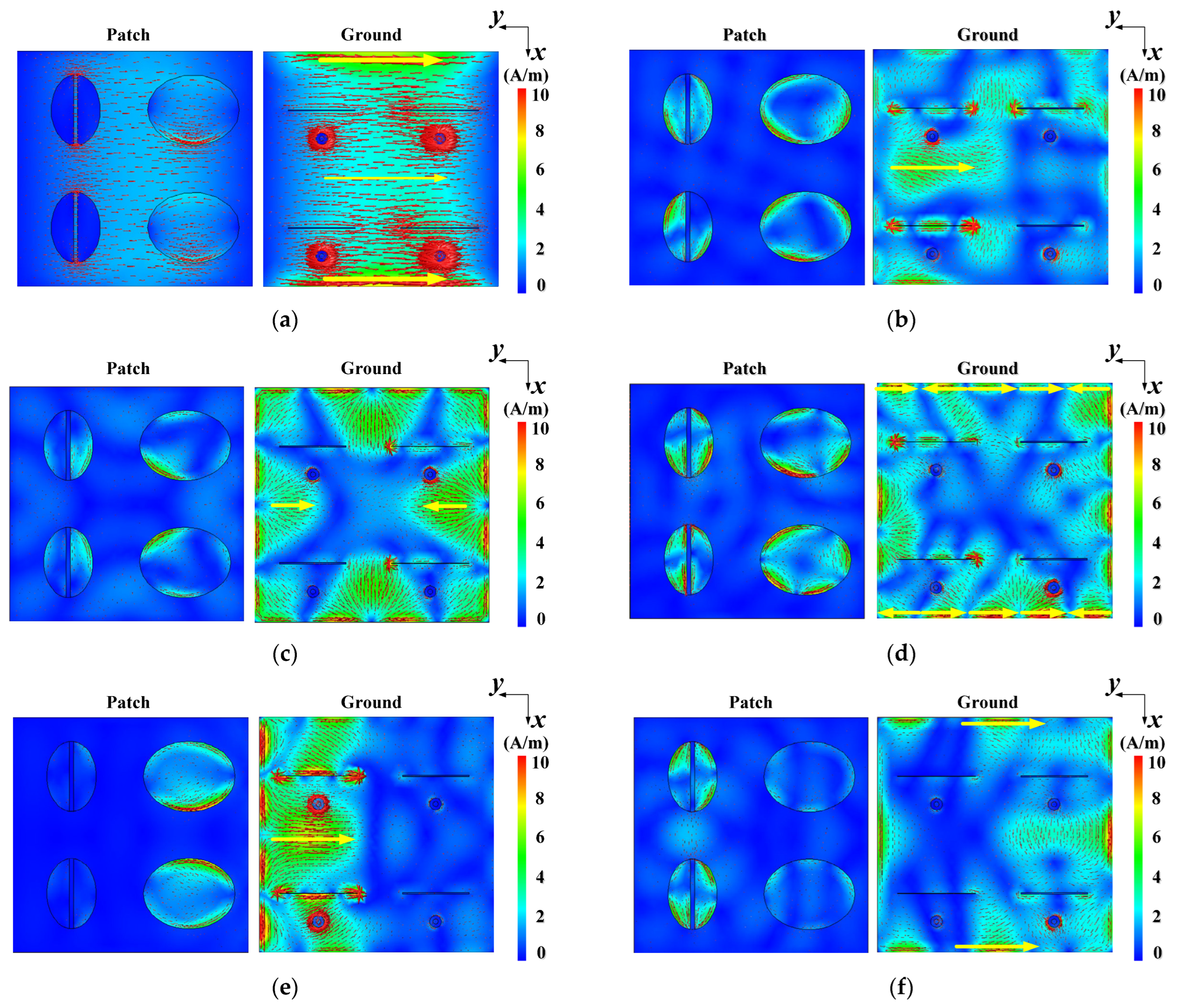
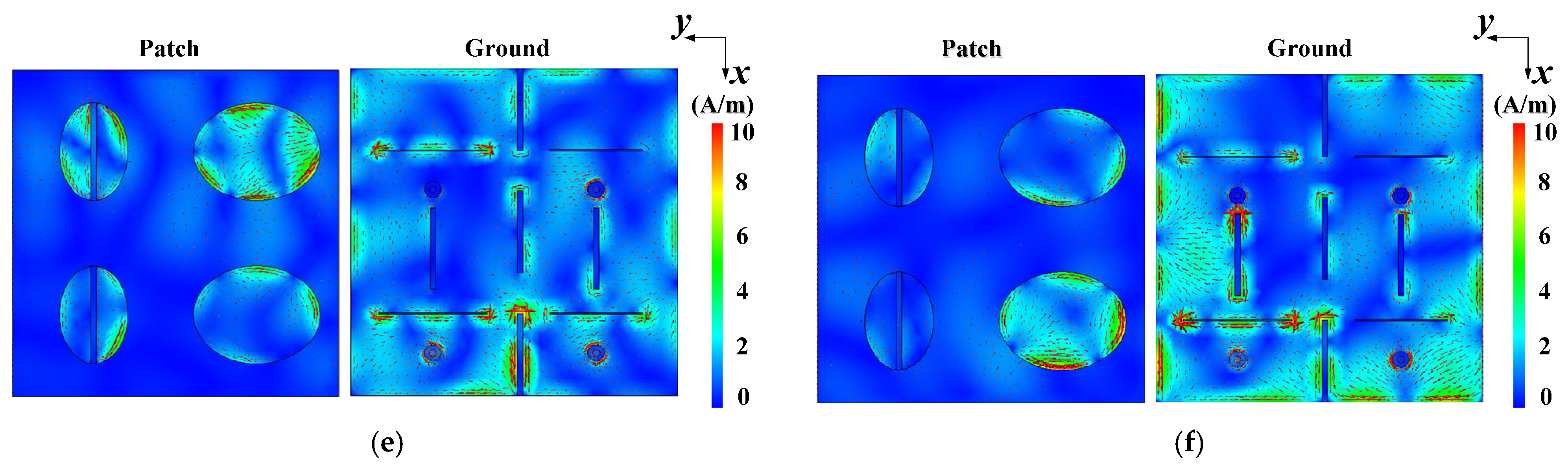
Figure 12a shows the current distribution for scattering mode 1. At 3.25 GHz, it shows the strong modal currents on the ground plane, flowing along the y-axis direction. On the radiation patch, currents also flow along the y-axis direction with relatively weaker intensity. Figure 12b–f show the current distribution for scattering mode 1 at 10.7 GHz, mode 2 at 9.5 GHz, mode 3 at 10.3 GHz, mode 4 at 9.65 GHz, and mode 5 at 9.74 GHz, respectively. Compared to the current distribution in the low-frequency band, the scattering modal current distribution on the ground plane demonstrates higher-order modal currents characteristics.
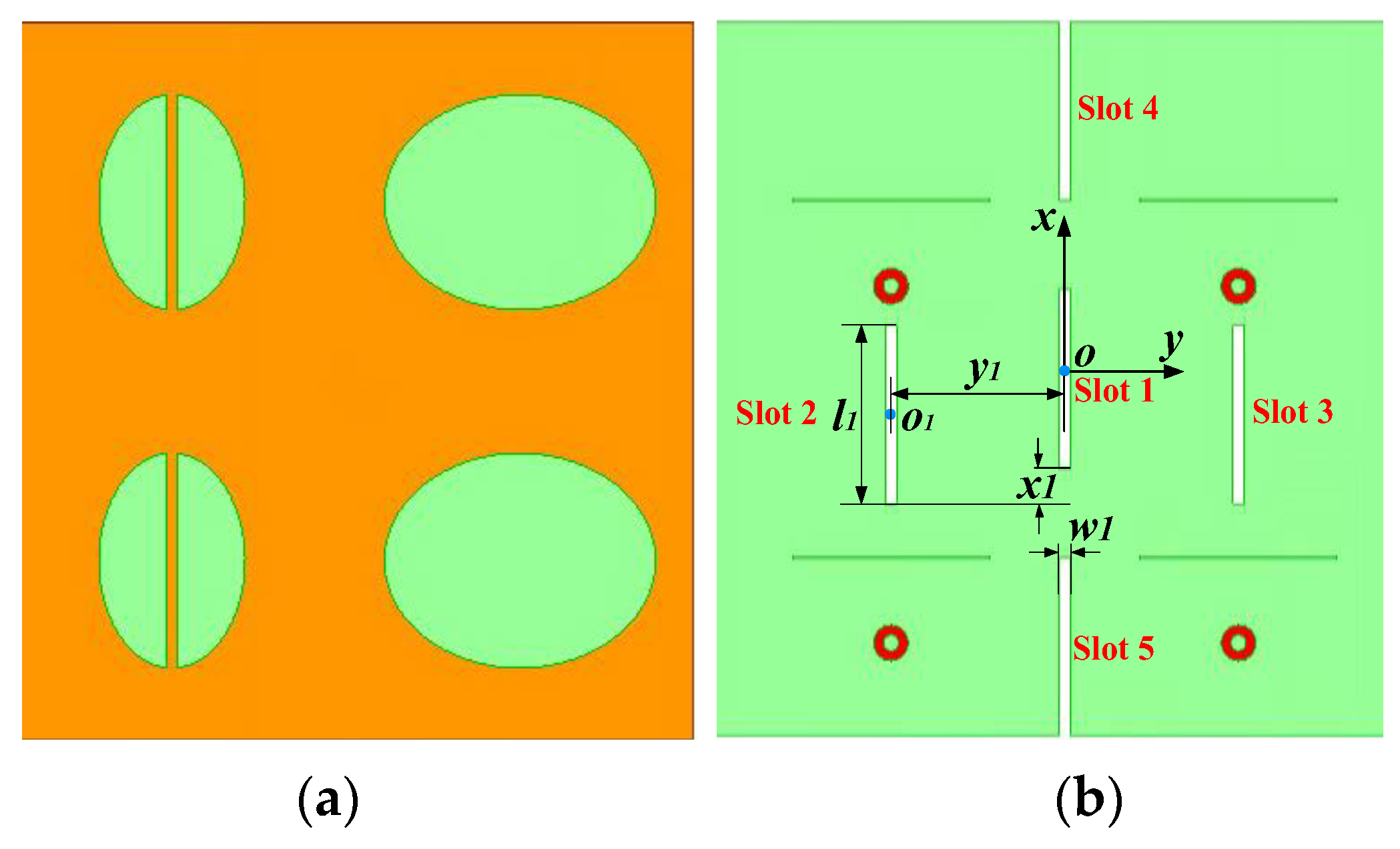
According to the above analysis and current distribution of scattering modes for proposed array antenna 1, the shape modification design introduces five slots along the x-axis direction on the ground plane, and antenna 1 with the reshaped ground is named proposed array antenna 3, as shown in Figure 13. All five slots share identical dimensions, with a length of l1 = 15 mm and a width of w1 = 1 mm. The geometric center of slot 1 coincides with that of the metal ground plane, defined as the coordinate origin O. Slots 2 and 3 are symmetrically arranged about the x-axis. The geometric center O1 of slot 2 is offset from the origin O along the y-axis by y1 = 15 mm and along the x-axis by x1 = 3 mm. Slots 4 and 5 are positioned at the center of the top and bottom edges, respectively. These slots will cut off the currents of important scattering modes, expecting to achieve RCSR in both low- and high-frequency bands.
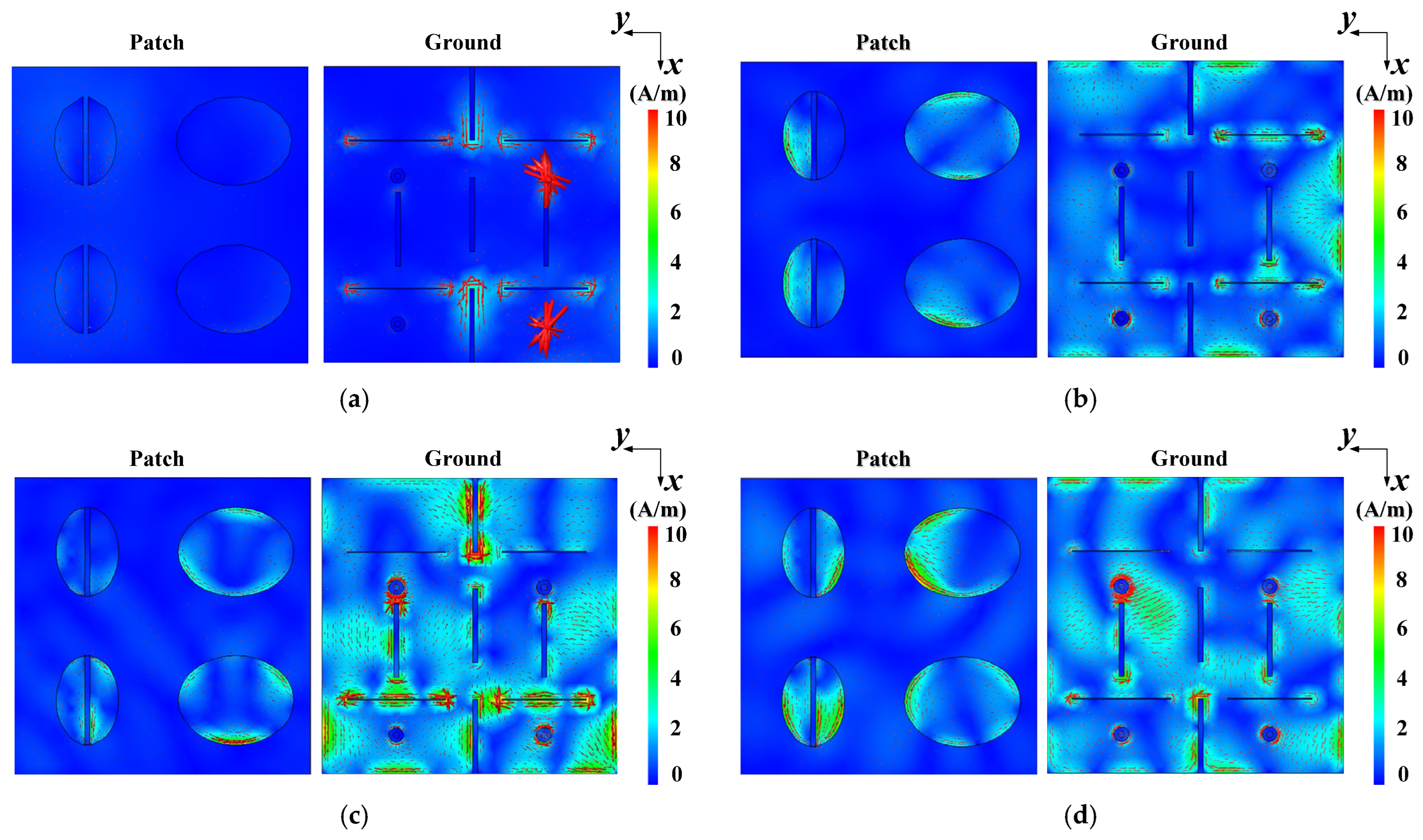
Figure 14 shows the simulated modal amplitudes of these important scattering modes for the proposed array antenna 3. The modal amplitudes of these important scattering modes have all been significantly reduced within 3–3.5 GHz and 9.5–11 GHz. The five slots on the ground plane successfully truncate the scattering modal currents, as illustrated in Figure 15a–f. As shown in Figure 15a–c,e, slots 1, 2, and 3 successfully suppressed the scattering currents of modes 1, 2, and 4 at the center of the ground plane. As shown in Figure 15a,d,f, slots 4 and 5 effectively interrupted the scattering currents of modes 1, 3, and 5 along both upper and lower edges of the ground plane. The scattering modal current intensities exhibited significant reduction for all the important scattering modes.
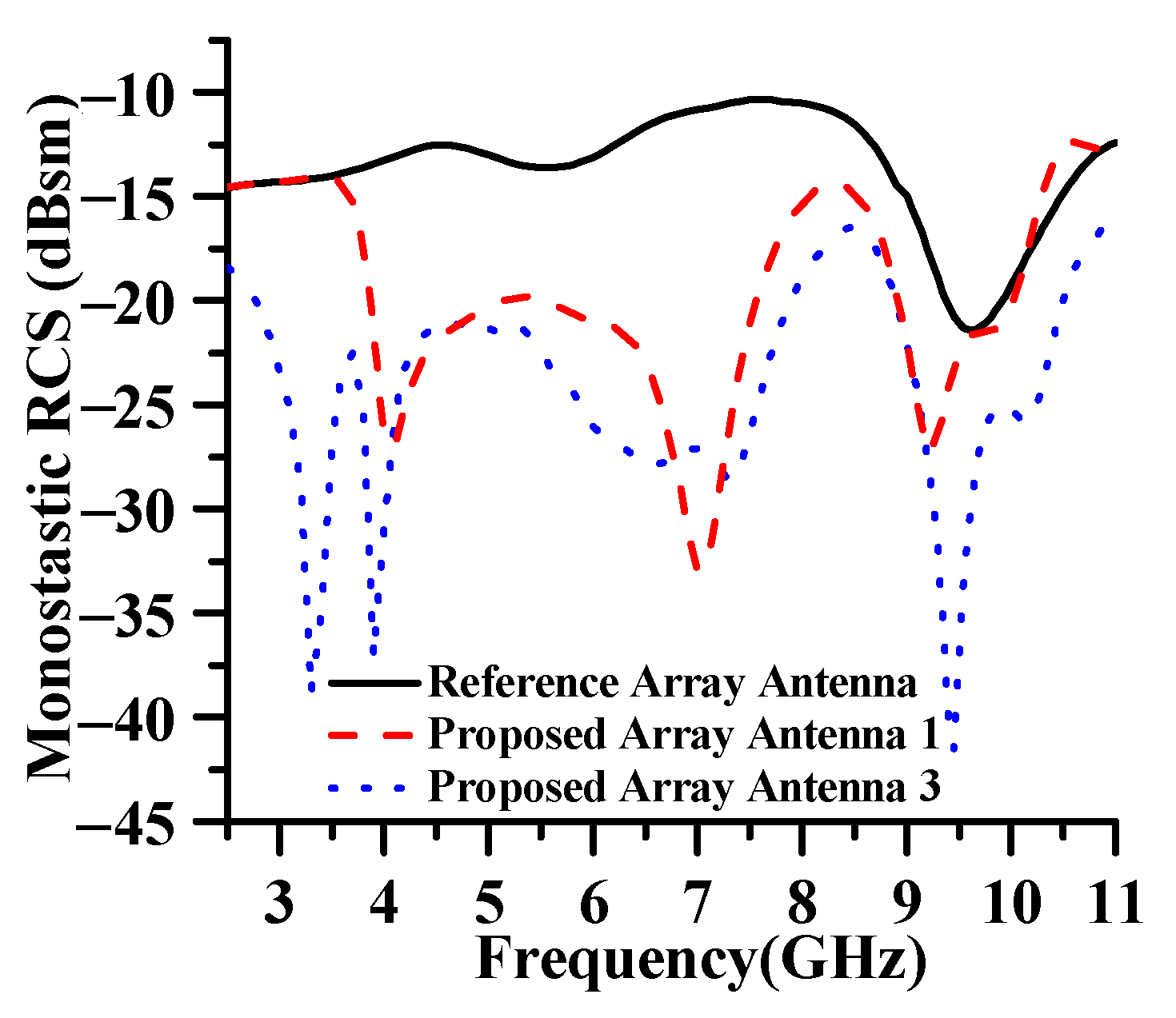
The broadband RCS of proposed array antenna 3 is calculated from 2.5 to 11 GHz, as shown in Figure 16. It can be seen that, by integrating the scattering cancellation and array-level modification methods, a mean 12 dB RCSR value is obtained across 2.5–11 GHz (126%). A comparison of the RCSR performance between the two proposed array antennas is presented in Table 3. It can be observed that the hybrid techniques of scattering cancellation and array-level modification can broaden the RCSR bandwidth and enhance the RCSR level.
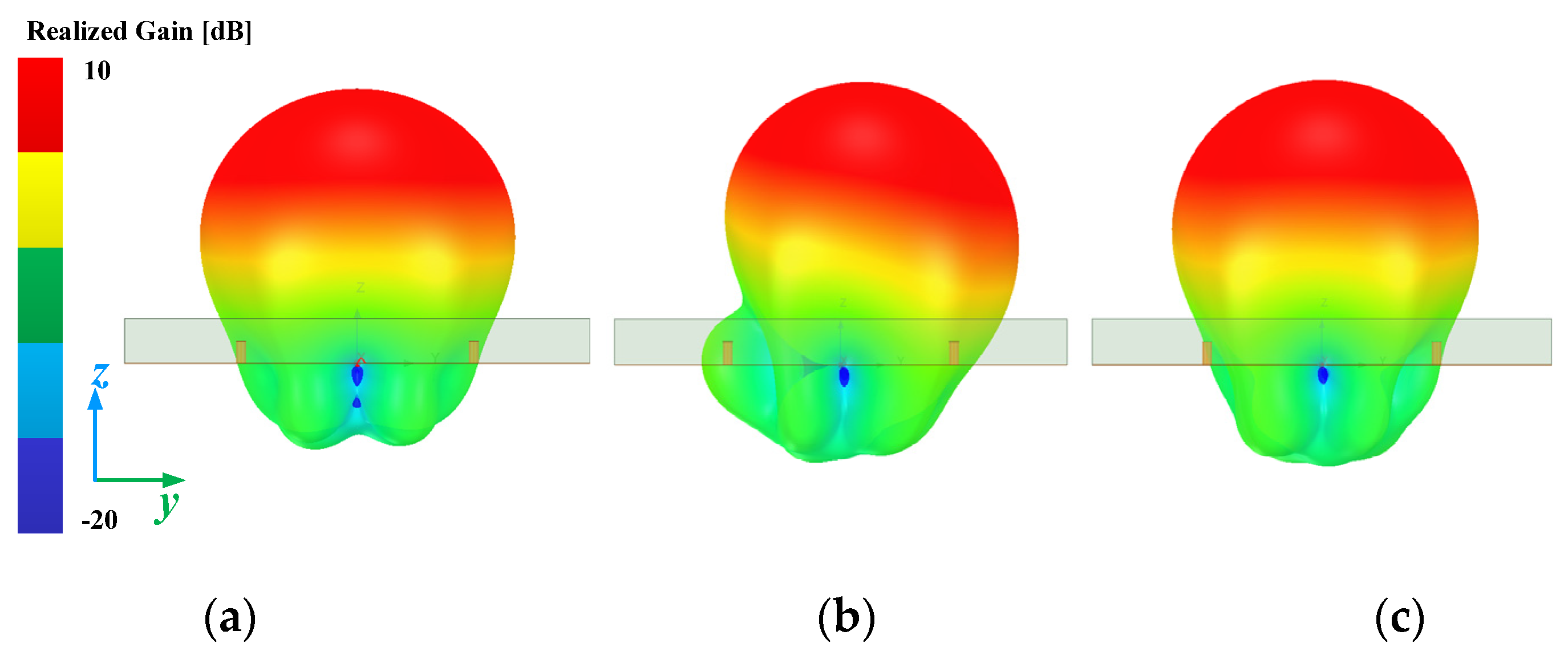
Due to asymmetry of the array structure, the beam of the array antenna radiation pattern in the φ = 90° plane will experience a directional shift θ e r r This deviation can be eliminated by adjusting the excitation phase at the feed port corresponding to element A. Denoting the required phase compensation for the nth element as Δ φ n , the relationship between the beam shift θ e r r and the compensation phase Δ φ n is given by [31]:
Δ φ n = n · k d · ( sin θ e r r sin θ 0 )
where k = 2 π / λ and θ 0 is the ideal direction.
The directional shift θ e r r is 10° for this array antenna, as shown in Figure 17b. After calculation, it indicates that the compensation phase Δ φ n is −28.1°. Hence, the feed phases of element A with a slot and element B are set to be −28.1° and 0°, respectively. The new radiation pattern of the proposed array antenna 3 is shown in Figure 17c, and the main beam direction is adjusted back to the original direction of 0°.
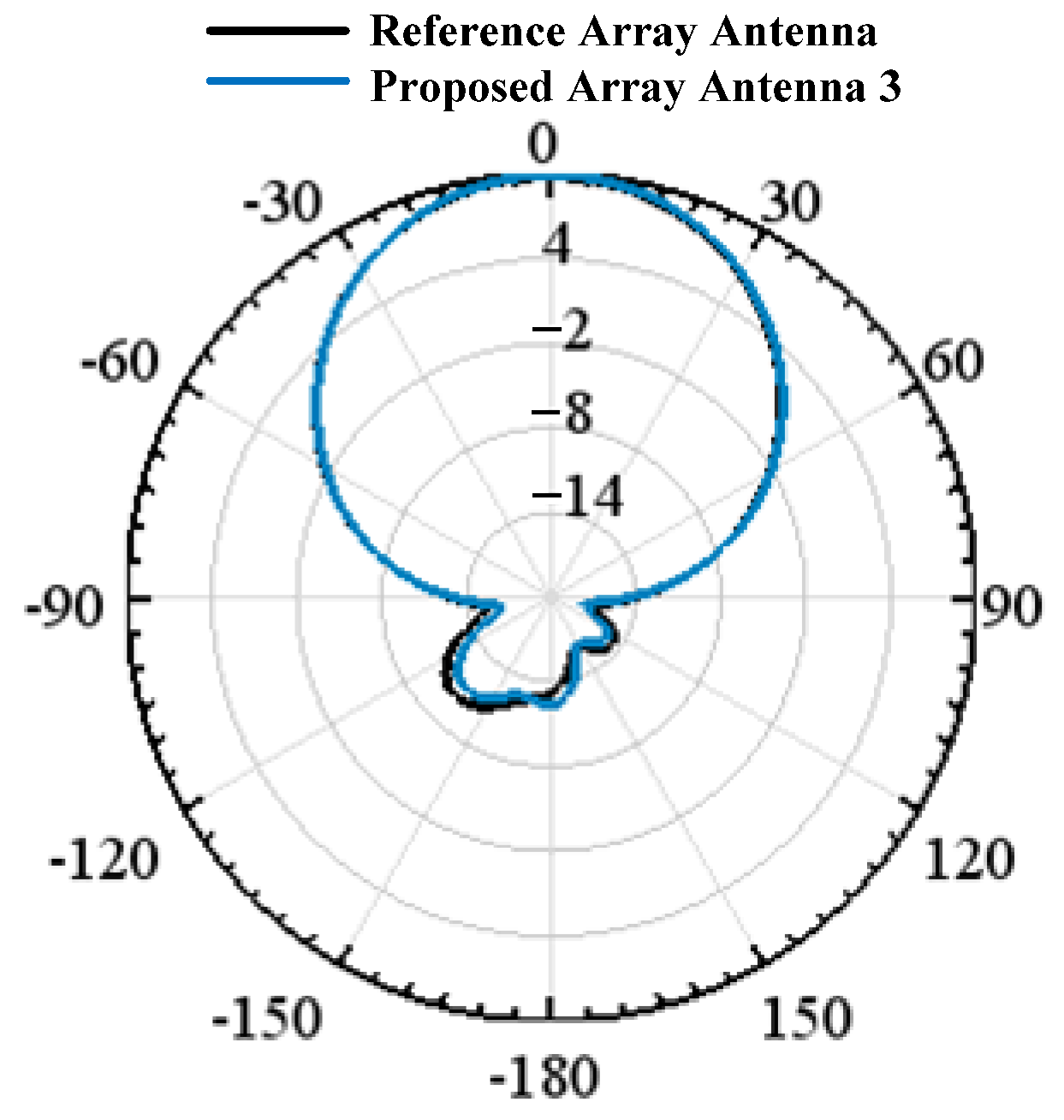
As shown in Figure 18, the proposed array antenna 3 exhibits a front-to-back ratio of 22.7 dB at 4.5 GHz, demonstrating a mere 0.4 dB difference compared to the reference array antenna (22.3 dB). This indicates that the new structure does not impact the front-to-back ratio (FBR) of the antenna.

3.3. Design Verification of 4 × 4 Array Antenna

To demonstrate the universality of the hybrid RCSR method, a 4 × 4 array antenna is also designed. The 4 × 4 array antenna is formed by arranging proposed array antenna 3 with phase compensation as a subarray in a 2 × 2 configuration. The RCSR effects of four 4 × 4 array configurations (ABAB, ABBA, BAAB, BABA) are analyzed and studied, as shown in Table 4. The array antenna with an ABAB configuration (proposed array antenna 4) achieves good radiation and scattering performance, as illustrated in Figure 19b.
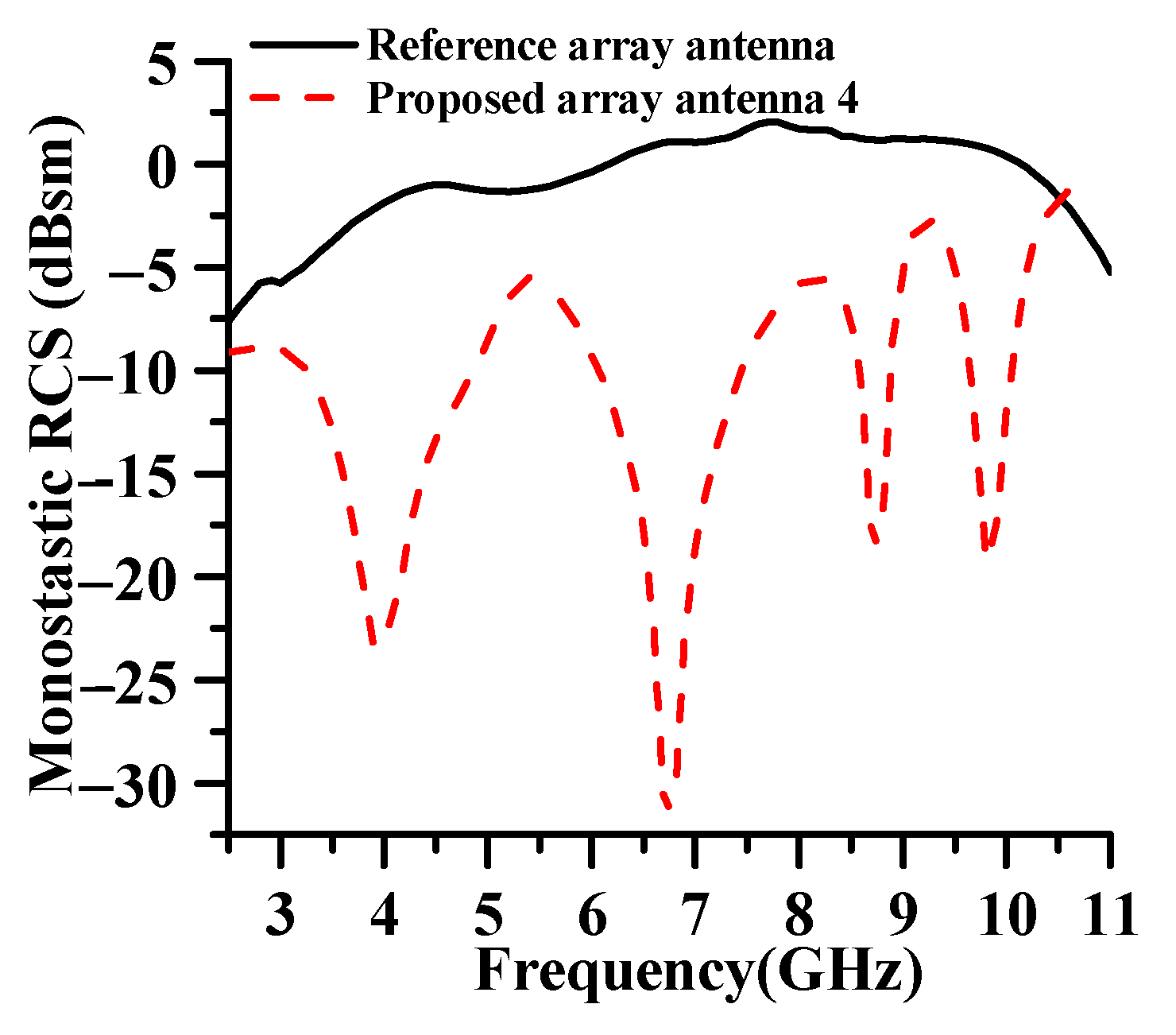
The broadband RCSs of the 4 × 4 reference array antenna and proposed array antenna 4 are shown in Figure 20. It can be seen that, by integrating the scattering cancellation and array-level reshaping methods, a mean 9 dB RCSR value is obtained across 2.5–10.5 GHz (123%).

4. Test and Discussion

We fabricate and test four array antennas: a 2 × 2 reference array antenna, the proposed array 3 with phase compensation, a 4 × 4 reference array antenna, and the proposed array 4 with phase compensation, as shown in Figure 21a–c. The four array antennas are fed by a feeding network when measuring their transmission and radiation performance, and the phase shift is realized through the external phase shifters. The transmission, radiation, and scattering performances of these array antennas are measured in an anechoic chamber, and the test environment is shown in Figure 21d.
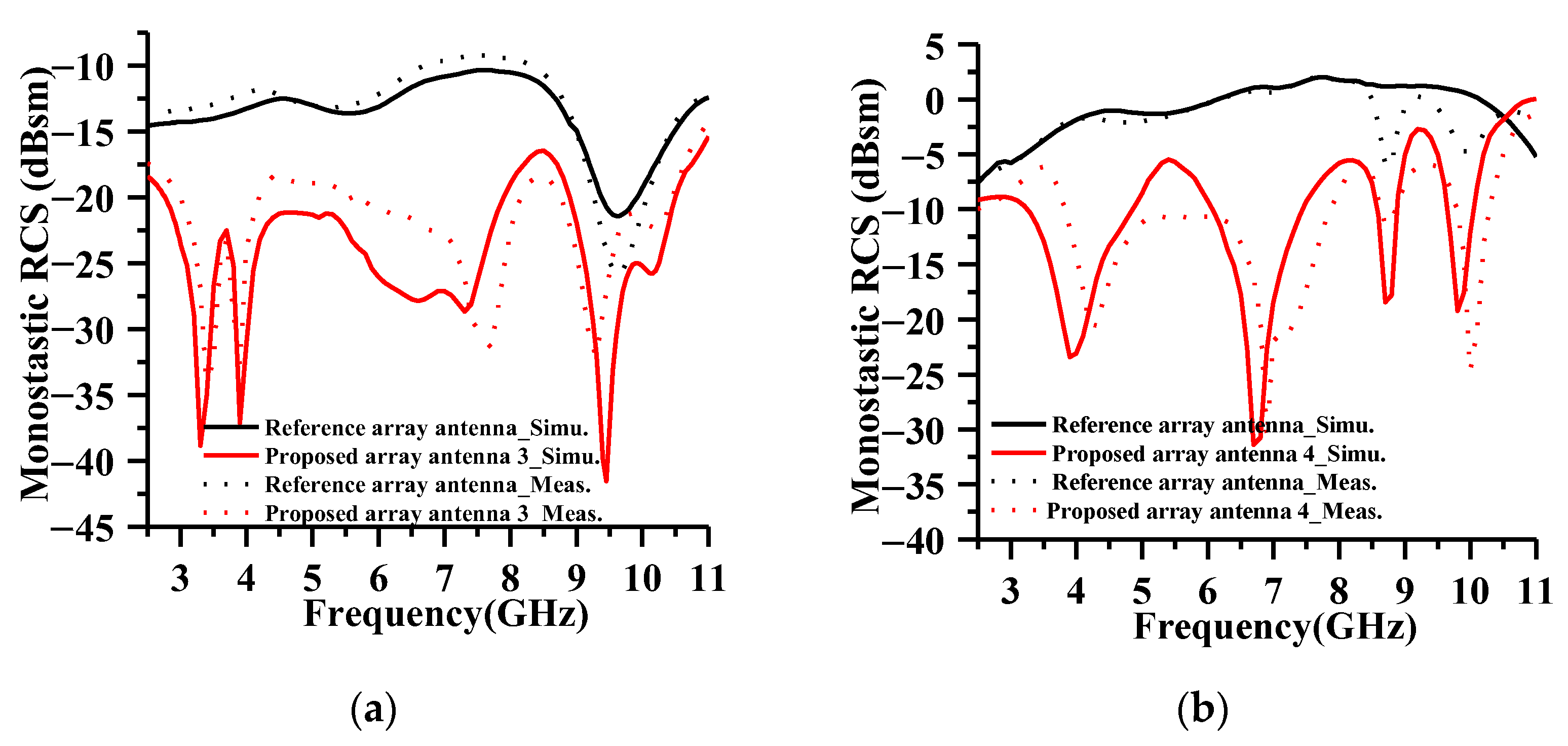
The measured and calculated monostatic broadband RCSs of the 2 × 2 and 4 × 4 reference array antennas and proposed array antennas 3 and 4 are shown in Figure 22. Compared to the reference array antennas, the measured RCSs of the proposed array antenna 3 and array antenna 4 exhibit significant RCSR across 2.5–11 GHz (126%) and 2.5–10.5 GHz (123%), respectively. The average RCSRs of the 2 × 2 and 4 × 4 proposed arrays are 10.3 dB and 8.0 dB. The peak RCSRs of the 2 × 2 and 4 × 4 arrays are 22 dB and 23 dB, respectively. The measured RCS results of these two array antennas show good agreement with their simulated results. The discrepancies between measured and simulated RCS results are primarily attributed to the small fabrication tolerances and background noise in the anechoic chamber.
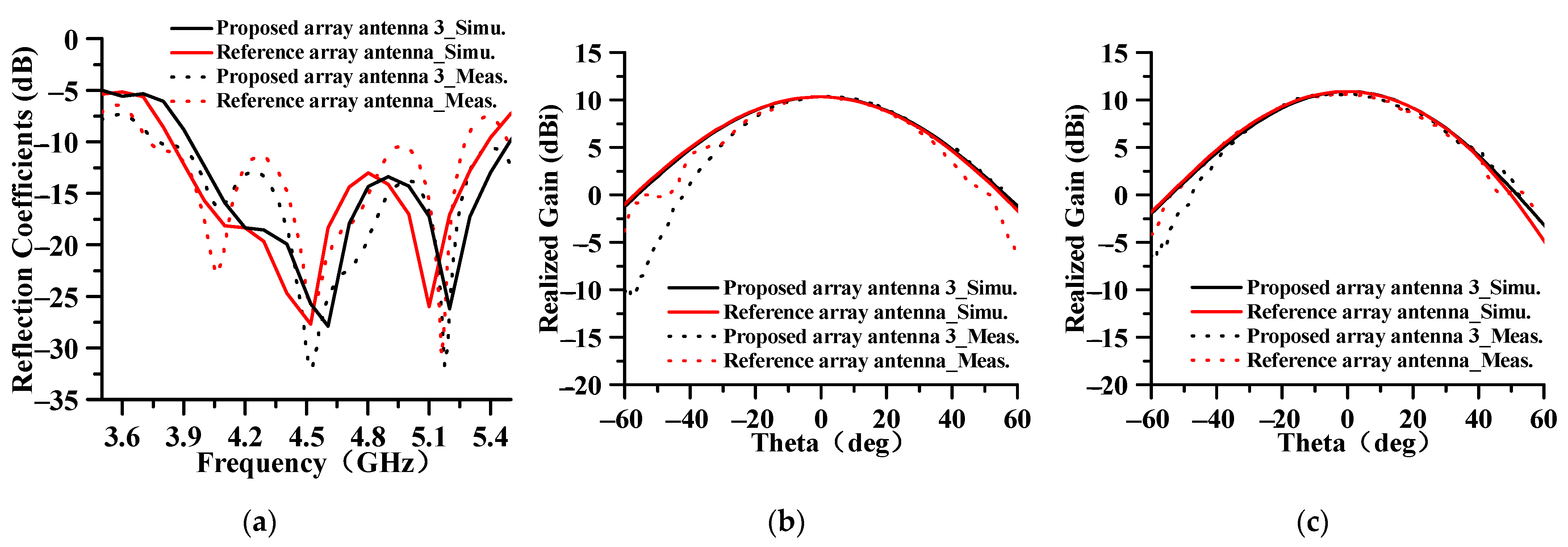
Figure 23 shows the measured reflection coefficients and radiation patterns of the 2 × 2 reference array antenna and proposed array antenna 3 with phase compensation. The reference array antenna operates from 3.71 to 5.22 GHz (33.8%), and the proposed array antenna 3 operates from 3.76 to 5.45 GHz (36.7%). It can be observed that the measured results are basically consistent with the simulated results for the reference and the proposed array antenna 3. The discrepancy primarily arises from the feeding network, external phase shifter, and small fabrication tolerances. The gain is 9.9 dBi for the 2 × 2 reference array antenna and proposed array antenna 3 at θ = 0°. Figure 24 shows the measured reflection coefficients and radiation patterns of the 4 × 4 reference array antenna and proposed array antenna 4 with phase compensation. The reference array antenna and proposed array antenna 4 operate from 3.80 to 5.30 GHz (31.1%). The gain is 15.9 dBi for the 4 × 4 reference array antenna and proposed array antenna at θ = 0°. It can be observed that the measured reflection coefficient and radiation characteristics of the proposed array antennas remain consistent with those of the reference array antennas.
The comparison of the main performance among the previously reported antennas and this work is shown in Table 5. For antenna size, the sizes of the 2 × 2 and 4 × 4 proposed array antennas in this work are the same as or slightly smaller than those of the arrays in Refs. [5,8,11,19,27]. For working bandwidth, the proposed array antennas achieve broader operating bandwidth than those of the arrays in Refs. [5,8,10,11,12,17,18,19,27]. For the radiation performance, the gain of the proposed antennas is not influenced, while the antenna gain in Ref. [19] presents the decline. For RCSR bandwidth, the 2 × 2 and 4 × 4 proposed array antennas realize RCSR reductions from 2.5 to 11 GHz (126%) and 2.5 to 10.5 GHz (123%), respectively, which are broader than those of Refs. [5,8,9,10,11,17,18,19,27]. Although the antenna presented in Ref. [12] achieves a broader RCSR bandwidth (130%), its whole dimension is larger. For RCSR mean value, the proposed array antennas can realize 10.3 and 8 dB mean reductions, which are larger than those of the arrays in Refs. [5,27]. For RCSR peak value, the proposed array antennas can realize 22 and 24 dB peak reductions, which are larger than those of the arrays in Refs. [5,10,11,12,17,27]. For RCSR angle range, the proposed array antennas can realize RCSR over the angle of −15° to 15°, which is broader than those of the arrays in Refs. [11,18,19], but the RCSR angle range is limited.
In conclusion, the proposed array antenna exhibits a broadband RCSR bandwidth advantage compared with the previous works. Meanwhile, its transmission and radiation performances are good. The potential limitation of the proposed array antennas is the limited RCSR angle range, which will be studied further.

5. Conclusions

In this paper, an integrated scattering cancellation and reshaping approach for broadband RCSR design of array antennas is proposed. The key points of this method are the design of two elements with scattering cancellation characteristics and the shape modification design based on CMA for the overall array antenna. A broadband scattering cancellation is achieved by using two elliptical patch elements with identical dimensions along the x-axis but different dimensions along the y-axis and adding a slot on the small elliptical patch. Furthermore, by analyzing the scattering modes of the entire array, a shape modification design with five slots on the ground is given to realize a broader RCSR bandwidth.
The experimental results validate that the 2 × 2 proposed array antenna 3 achieves 10.3 dB average RCSR and 22 dB peak RCSR from 2.5 to 11 GHz, compared with the reference array antenna. Meanwhile, it maintains good transmission and radiation characteristics from 3.76 to 5.45 GHz. The gain is 9.9 dBi for the 2 × 2 proposed array antenna at 4.5 GHz. Measurement results exhibit good agreement with the simulation ones, validating the effectiveness of the design.
Furthermore, this method is also applicable to the RCSR design of larger-scale array antennas. As a verification example, we further applied this method to design a 4 × 4 low-RCS array antenna, achieving an average RCSR of 8 dB and a peak RCSR of 23 dB within the 2.5–10.5 GHz frequency band. The 4 × 4 array antenna works from 3.80 GHz to 5.30 GHz. The gain is 15.9 dBi for the 4 × 4 proposed array antenna at 4.5 GHz.
The proposed broadband low-RCS array antennas are specifically developed for stealth platforms, such as combat aircraft, unmanned aerial vehicles, warships, and missiles. This design method provides a feasible way for the broadband RCSR of array antennas. However, the proposed array antenna has a limited RCSR angle range. Future research could explore approaches to simultaneously achieve broadband and broad-angle RCSR design.

Author Contributions

Conceived and designed the experiments, Y.L.; method guidance, writing—review and supervision, B.D.; funding support, D.J.; radiation and scattering test, X.H. All authors have read and agreed to the published version of the manuscript.

Funding

This research received no external funding.

Data Availability Statement

The data used to support the findings of this study are included within the article.

Conflicts of Interest

Authors Yakun Liu, Biao Du, Dan Jia and Xuchen Han were employed by the company the 54th Research Institute of China Electronics Technology Group Corporation.

References

  1. Yang, H.; Li, T.; Jidi, L.; Gao, K.; Li, Q.; Qiao, J.; Li, S.; Cao, X.; Cui, T. From Metasurface to Low-RCS Array Antenna: A Fast and Efficient Route to Design Stealthy Array Antennas. IEEE Trans. Antennas Propag. 2023, 71, 4075–4084. [Google Scholar] [CrossRef]
  2. Li, Y.-Q.; Zhang, H.; Fu, Y.-Q.; Yuan, N.-C. RCS Reduction of Ridged Waveguide Slot Antenna Array Using EBG Radar Absorbing Material. IEEE Antennas Wirel. Propag. Lett. 2008, 7, 473–476. [Google Scholar] [CrossRef]
  3. Chen, J.-X.; Wang, X.-F.; Yang, L.-L.; Wang, X.-R.; Gu, X.-F.; Yang, W.-W. Asymmetrical Low-RCS FSS-Based Antenna for Tri-Band Shared-Aperture Array. IEEE Antennas Wirel. Propag. Lett. 2024, 23, 1563–1567. [Google Scholar] [CrossRef]
  4. Huang, H.; Omar, A.A.; Shen, Z. Low-RCS and Beam-Steerable Dipole Array Using Absorptive Frequency-Selective Reflection Structures. IEEE Trans. Antennas Propag. 2020, 68, 2457–2462. [Google Scholar] [CrossRef]
  5. Li, Y.; Wang, R.; Ren, P.; Xu, B.; Xiang, Z. Radar Cross Section Reduction of Microstrip Array Antenna Using FSS. In Proceedings of the 2023 IEEE 11th Asia-Pacific Conference on Antennas and Propagation (APCAP), Guangzhou, China, 19–22 November 2023; pp. 1–2. [Google Scholar] [CrossRef]
  6. Al-Nuaimi, M.K.T.; Huang, G.-L.; Whittow, W.G.; Chen, R.-S.; Wong, S.-W. Realization of Single-Layer Fourier Phased Metasurfaces for Wideband RCS Reduction. IEEE Antennas Wirel. Propag. Lett. 2023, 22, 1179–1183. [Google Scholar] [CrossRef]
  7. Wu, H.; Wang, M.; Wang, J.; Liu, F. A Broadband Circularly Polarized Low RCS Metasurface Antenna Array. In Proceedings of the 2025 2nd International Conference on Electronic Engineering and Information Systems (EEISS), Nanjing, China, 23–25 May 2025; pp. 1–4. [Google Scholar] [CrossRef]
  8. Yang, H.; Li, T.; Liao, J.; Gao, K.; Li, Q.; Li, S.; Cao, X. Ultrawideband Low-RCS Array Antenna Based on Double-Layer Polarization Conversion Metasurface. IEEE Antennas Wirel. Propag. Lett. 2024, 23, 4069–4073. [Google Scholar] [CrossRef]
  9. Qi, Y.; Yang, F.; Chen, K.; Chen, Y.; Hu, J.; Yang, S. Low-Scattering Broadband Phased Array With Polarization-Selective Metasurface Using Characteristic Mode Analysis. IEEE Trans. Antennas Propag. 2025, 73, 2979–2989. [Google Scholar] [CrossRef]
  10. Yang, H.; Liao, J.; Li, T.; Gao, K.; Li, Z.; Guo, Z.; Cong, L.; Cui, T. An Efficient Design Method for Metasurface Antenna with Low in-Band RCS and Reconfigurable Scattering Fields. IEEE Trans. Antennas Propag. 2025, 73, 9553–9558. [Google Scholar] [CrossRef]
  11. Ran, D.; Guo, Q.; Jing, S.; Wang, L.; Xu, L.; Zang, T. An Integrated Antenna Array with New Windmill-Arranged AMC Units for RCS Reduction. IEEE Antennas Wirel. Propag. Lett. 2025, 1–5. [Google Scholar] [CrossRef]
  12. Xue, J.; Gong, S.; Jiang, W.; Hong, T. Wideband low RCS antenna based on absorbing surface and microstrip resonators. In Proceedings of the 2017 IEEE International Symposium on Antennas and Propagation & USNC/URSI National Radio Science Meeting, San Diego, CA, USA, 9–14 July 2017; pp. 1917–1918. [Google Scholar] [CrossRef]
  13. Li, P.-F.; Qu, S.-W.; Yang, S.; Hu, J. In-Band SCS Reduction of Microstrip Phased Array Based on Impedance Matching Network. IEEE Trans. Antennas Propag. 2022, 70, 330–340. [Google Scholar] [CrossRef]
  14. Zhao, C.; Jiang, W.; Hu, W.; Gao, Y. In-Band RCS Reduction Method for the Vivaldi Array Antennas Based on the Manipulation of the Antenna Mode Scattering Field. IEEE Trans. Antennas Propag. 2024, 72, 4687–4692. [Google Scholar] [CrossRef]
  15. Jia, Y.; Li, S.; Luo, J.; Shi, G.; Liu, Z.X.; Li, Z.; Liu, Y. In-Band RCS Reduction of Circularly Polarized Microstrip Antenna Array Based on a Novel Feed Network. IEEE Trans. Antennas Propag. 2024, 72, 2181–2188. [Google Scholar] [CrossRef]
  16. Zhao, J.; Peng, X.; Zheng, Y.; Lu, Y.; Sun, J.; Gao, X. Design of Zero-Backtracking Antenna Array with Wide-angle Low-RCS Performance. In Proceedings of the 2024 14th International Symposium on Antennas, Propagation and EM Theory (ISAPE), Hefei, China, 23–26 October 2024; pp. 1–4. [Google Scholar] [CrossRef]
  17. Yue, X.; Liu, J.; Li, Z. Analysis of Scattering Mechanism of Dual-port Antennas and a Low-RCS Array Design. In Proceedings of the 2025 IEEE MTT-S International Wireless Symposium (IWS), Xi’an, China, 19–22 May 2025. [Google Scholar] [CrossRef]
  18. Yang, Z.; Gao, Y.; Hu, W.; Jiang, W. Design of Wideband Wide-angle Low-RCS Quasi-Conformal Array Based on Unit Equivalent Reactance Regulation and Arrangement Optimization. IEEE Trans. Antennas Propag. 2025, 1. [Google Scholar] [CrossRef]
  19. Jiang, W.; Gong, S.X.; Li, Y.; Zhang, K.Z. Novel microstrip antenna array with low RCS. In Proceedings of the 2014 3rd Asia-Pacific Conference on Antennas and Propagation, Harbin, China, 26–29 July 2014; pp. 447–449. [Google Scholar] [CrossRef]
  20. Fan, Q.; Wang, Y.; Yuan, J.; Li, Z. Ultra-wideband Low RCS Conformal Patch Array Antenna with a Modified Ground Plane. In Proceedings of the 2023 International Conference on Microwave and Millimeter Wave Technology (ICMMT), Qingdao, China, 14–17 May 2023; pp. 1–3. [Google Scholar] [CrossRef]
  21. Zhao, J.; Chen, Y.; Yang, S. In-Band Radar Cross-Section Reduction of Slot Antenna Using Characteristic Modes. IEEE Antennas Wirel. Propag. Lett. 2018, 17, 1166–1170. [Google Scholar] [CrossRef]
  22. Liu, Y.; Du, B.; Jia, D. Ultra-wide band radar cross section reduction for ring-shaped microstrip antenna based on characteristic mode analysis. Microw. Opt. Technol. Lett. 2021, 63, 1538–1546. [Google Scholar] [CrossRef]
  23. Shi, G.; Jia, Y.; Liu, Y. Theoretic Study of Antenna Scattering Problems Based on Characteristic Modes and Its Application In Reducing Antenna Scattering. IEEE Trans. Antennas Propag. 2023, 71, 2098–2109. [Google Scholar] [CrossRef]
  24. Jia, Y.; Luo, J.; Ren, X.; Shi, G.; Liu, Y. Design of Low-RCS Vivaldi Antenna Based on Characteristic Mode Analysis. IEEE Antennas Wireless Propag. Lett. 2024, 23, 1246–1250. [Google Scholar] [CrossRef]
  25. Han, J.; Jia, D.; Du, B.; Han, G. Design of Broadband Low-RCS Array Antennas Based on Characteristic Mode Cancellation. Electronics 2023, 12, 1536. [Google Scholar] [CrossRef]
  26. Singh, B.; Dar, U.R.; Zarger, M.M.; Rajput, A. Low RCS Antenna Array Design Using Checkerboard Arrangement of Antenna Elements. In Proceedings of the 2024 IEEE Microwaves, Antennas, and Propagation Conference (MAPCON), Hyderabad, India, 9–13 December 2024; pp. 1–4. [Google Scholar] [CrossRef]
  27. Gao, K.; Cao, X.; Gao, J.; Li, T.; Yang, H.; Li, S. Low-RCS Metasurface Antenna Array Design With Improved Radiation Performance Using Odd- and Even-Mode Analysis. IEEE Antennas Wirel. Propag. Lett. 2022, 21, 421–425. [Google Scholar] [CrossRef]
  28. Gou, Y.; Chen, Y.; Yang, S. RCS Reduction for Wideband Antenna Array. In Proceedings of the 2021 IEEE International Symposium on Antennas and Propagation and USNC-URSI Radio Science Meeting (APS/URSI), Singapore, 4–10 December 2021; pp. 1307–1308. [Google Scholar] [CrossRef]
  29. Huo, K.; Gao, Y.; Jiang, W. An Ultra-Wideband Low-Scattering Tightly-Coupled Dipole Array. In Proceedings of the 2024 IEEE 12th Asia-Pacific Conference on Antennas and Propagation (APCAP), Nanjing, China, 22–25 September 2024; pp. 1–2. [Google Scholar] [CrossRef]
  30. Gu, P.; Cao, Z.; He, Z.; Ding, D. Design of Ultrawideband RCS Reduction Metasurface Using Space Mapping and Phase Cancellation. IEEE Antennas Wirel. Propag. Lett. 2023, 22, 1386–1390. [Google Scholar] [CrossRef]
  31. Stutzman, W.L.; Thiele, G.A. Antenna Theory and Design, 3rd ed.; John Weily: Hoboken, NJ, USA, 2012. [Google Scholar]
  32. Liu, Y.; Du, B.; Jia, D. Design of Broad-Angle Low-RCS Microstrip Antenna for Dual-Polarization Using Characteristic Mode Analysis. Electronics 2025, 14, 2121. [Google Scholar] [CrossRef]
  33. Zhong, S. Antenna Theory and Techniques, 1st ed.; Publishing House of Electronics Industry: Beijing, China, 2011. (In Chinese) [Google Scholar]
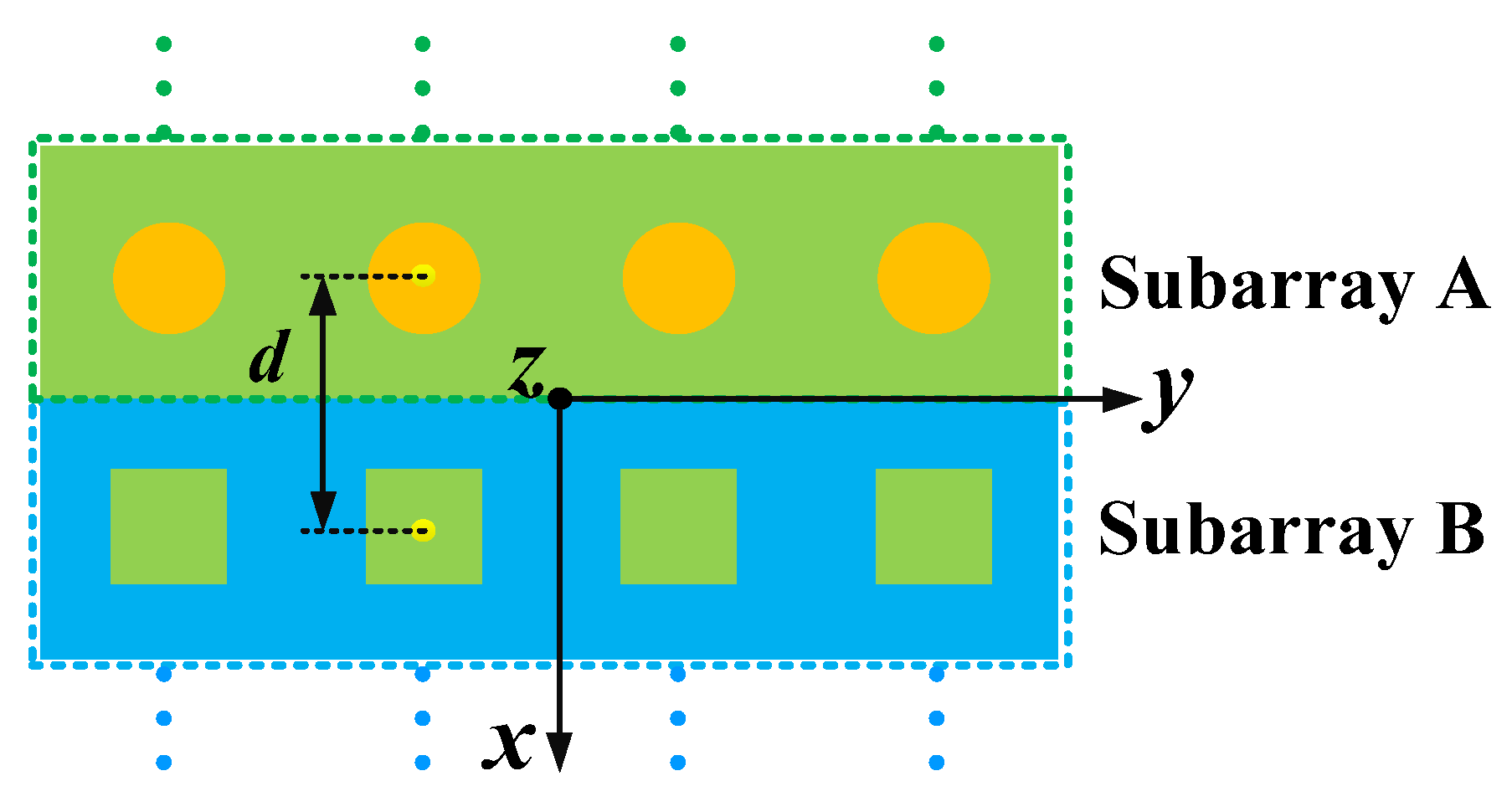
Figure 1. Schematic diagram of an array antenna.
Electronics 15 00108 g001
Figure 2. Geometry of the reference element.
Electronics 15 00108 g002
Figure 3. Schematic diagram of two reshaping elements A and B. (a) Element A (c = 0.7); (b) element B (c = 1.3).
Electronics 15 00108 g003
Figure 4. Transmission and radiation performance of the three elements. (a) Reflection coefficients; (b) Radiation patterns of φ = 0° plane at 4.5 GHz; (c) Radiation patterns of φ = 90° plane at 4.5 GHz.
Electronics 15 00108 g004
Figure 5. Simulated scattering field magnitude and phase difference of the elements with Elements A and B. (a) Scattering field magnitude; (b) Phase difference.
Electronics 15 00108 g005
Figure 6. Scattering modal amplitudes of elements A and B from 7 to 9 GHz. (a) Element A; (b) Element B.
Electronics 15 00108 g006
Figure 7. Important scattering modal currents of elements A and B under normally incident plane wave. (a) Mode 4 of element A at 8 GHz; (b) Mode 3 of element B at 8 GHz; (c) Geometry of element A with slot.
Electronics 15 00108 g007
Figure 8. Simulated scattering field magnitude of element A with slot and element B and phase difference between element A and element B, element A with slot and element B. (a) Scattering field magnitude; (b) Phase difference, where the gray dashed line is the effective phase difference marker.
Electronics 15 00108 g008
Figure 9. Geometry of the 2 × 2 reference and proposed array antennas. (a) Reference array antenna; (b) Proposed array antenna 1; (c) Proposed array antenna 2.
Electronics 15 00108 g009
Figure 10. Simulated monostatic RCSs of the 2 × 2 proposed array antenna 1, 2 and reference array antennas under normally incident plane waves.
Electronics 15 00108 g010
Figure 11. Scattering modal amplitudes of the proposed array antenna 1: (a) 3 to 3.5 GHz; (b) 9.5 to 11 GHz.
Electronics 15 00108 g011
Figure 12. Scattering modal current distribution of the proposed array antenna 1. (a) Mode 1 at 3.25 GHz; (b) Mode 1 at 10.7 GHz; (c) Mode 2 at 9.5 GHz; (d) Mode 3 at 10.3 GHz; (e) Mode 4 at 9.65 GHz; (f) Mode 5 at 9.74 GHz.
Electronics 15 00108 g012
Figure 13. Configuration of the proposed array antenna 3. (a) Top view; (b) Bottom view.
Electronics 15 00108 g013
Figure 14. Scattering modal amplitudes and currents of the proposed array antenna 3. (a) 3–3.5 GHz; (b) 9.5–11 GHz.
Electronics 15 00108 g014
Figure 15. Scattering modal currents of the proposed array antenna 3 for y-polarization. (a) Mode 1 at 3.25 GHz; (b) Mode 1 at 10.7 GHz; (c) Mode 2 at 9.5 GHz; (d) Mode 3 at 10.3 GHz; (e) Mode 4 at 9.65 GHz; (f) Mode 5 at 9.74 GHz.
Electronics 15 00108 g015aElectronics 15 00108 g015b
Figure 16. Simulated monostatic RCSs of the 2 × 2 proposed array antenna 1, 3 and reference array antennas under normally incident plane waves.
Electronics 15 00108 g016
Figure 17. Radiation pattern in the φ = 90° plane of the reference and proposed array antennas at 4.5 GHz. (a) Reference array antenna; (b) Proposed array antenna 3 without phase compensation; (c) Proposed array antenna 3 with phase compensation.
Electronics 15 00108 g017
Figure 18. Simulated radiation patterns of the 2 × 2 proposed array antenna 3 and reference array antenna.
Electronics 15 00108 g018
Figure 19. Configuration of the reference array antenna and proposed array antenna 4. (a) Reference array antenna; (b) Proposed array antenna 4.
Electronics 15 00108 g019
Figure 20. Simulated monostatic RCSs of the 4 × 4 reference array antenna and proposed array antenna 4 under normally incident plane waves.
Electronics 15 00108 g020
Figure 21. Fabricated antennas and measurement system. (a) 2 × 2 Reference array antenna and Proposed array antenna 3; (b) 4 × 4 Reference array antenna; (c) 4 × 4 Proposed array antenna 4; (d) Measurement anechoic chamber.
Electronics 15 00108 g021
Figure 22. Simulated and measured broadband monostatic RCSs of the proposed array antennas 3, 4 and reference array antennas. (a) The 2 × 2 reference and proposed array antenna 3 with phase compensation; (b) the 4 × 4 reference and proposed array antenna 4 with phase compensation.
Electronics 15 00108 g022
Figure 23. Measured reflection coefficients and radiation patterns of the 2 × 2 proposed array antenna 3 with phase compensation and reference array antenna. (a) Reflection coefficients; (b) Radiation patterns of φ = 0° plane at 4.5 GHz; (c) Radiation patterns of φ = 90° plane at 4.5 GHz.
Electronics 15 00108 g023
Figure 24. Measured reflection coefficients and radiation patterns of the 4 × 4 proposed array antenna 4 with phase compensation and reference array antenna. (a) Reflection coefficients; (b) Radiation patterns of φ = 0° plane at 4.5 GHz; (c) Radiation patterns of φ = 90° plane at 4.5 GHz.
Electronics 15 00108 g024
Table 1. Dimension parameters of the reference element.
ParametersValue/mm
D118
D21.3
D33
H13
L130
L217
L310
W10.3
X17.2
Table 2. Effective phase difference bandwidths of three pairs of elements.
Paired ElementsBandwidth/GHz
0.9 and 1.1/ *
0.8 and 1.24.64–5.35
0.7 and 1.34.26–6.52
*: “/” means that effective phase difference bandwidth is unrealizable.
Table 3. Comparison of the scattering performance for the proposed array antennas in this work.
ArrayRCSR Band (GHz)/RB* (%)RCSR Mean Value (dB)RCSR Peak Value (dB)Method
Proposed 13.5–9.5/92620Scattering Cancellation
Proposed 32.5–11/1261224Scattering Cancellation + Array-level Modification
RB*: relative bandwidth.
Table 4. Comparison of the RCSRs for the four 4 × 4 array antennas.
Array ArrangementRCSR Band (GHz)/RB* (%)RCSR Mean Value (dB)RCSR Peak Value (dB)
ABAB2.5–10.5/123932.5
ABBA2.6–10.3/1197.331.4
BAAB3.6–10.7/996.121.5
BABA3.5–10.7/1016.623
RB*: relative bandwidth.
Table 5. Comparison of main performance among previously reported antennas and this work.
Ref.Electrical Size
02)
Array ConfigurationOB* (GHz)/RB* (%)Gain Variation
(dB)
RCSR Band (GHz)/RB* (%)RCSR Mean Value (dB)RCSR Peak Value (dB)RCSR Angle Range (°)Method
[5]1.0 × 1.02 × 24.3/−09–11/20515FSS
[8]1.1 × 1.12 × 26.7–7.6/13+0.36–16/9132PCM
[9]10 × 106–18/10006–24/1201030±20°MS + CMA
[10]3.3 × 3.38 × 84.6–5.25/13.24.0–6.0/401015MS
[11]3.3 × 3.34 × 48.8–12/30.807–13/601021AMC
[12]3.3 × 3.31 × 18.5–10.4/203.2–15/13016Resonator + MS
[17]5 × 510 × 109.7–10.2/59.6–10.4/81220±40°Active Cancellation
[18]8 × 810–11.75/16.105–12/82.3925Unit
Equivalent Reactance Regulation
[19]1.3 × 1.32 × 24.3/-−0.74–16/12026±10°Shape Modification
[27]2.0 × 2.04 × 45.05–5.42/7+2.05.1–6.9/30620±60°Scattering Cancellation
This work1.0 × 1.02 × 23.76–5.45/3702.5–11/12610.322±15°Scattering Cancellation + Array-level Modification Using CMA
2.0 × 2.04 × 43.8–5.3/31.102.5–10.5/1238.024±15°
OB*: operating band; RB*: relative bandwidth.
Disclaimer/Publisher’s Note: The statements, opinions and data contained in all publications are solely those of the individual author(s) and contributor(s) and not of MDPI and/or the editor(s). MDPI and/or the editor(s) disclaim responsibility for any injury to people or property resulting from any ideas, methods, instructions or products referred to in the content.