Article

A Novel Non-Resonant Full-Bridge Multi-Output Topology for Domestic Induction Heating Applications


by
Sezer Aslan
1,2,*,
Ulas Oktay
1,2 and
Nihan Altintas
1
1
Department of Electrical Engineering, Yildiz Technical University, Esenler, Istanbul 34220, Turkey
2
Central R&D Department, Beko Corporate, Tuzla, Istanbul 34950, Turkey
*
Author to whom correspondence should be addressed.
Electronics 2025, 14(3), 596; https://doi.org/10.3390/electronics14030596

Submission received: 17 December 2024 / Revised: 22 January 2025 / Accepted: 1 February 2025 / Published: 3 February 2025
(This article belongs to the Section Power Electronics)

Abstract

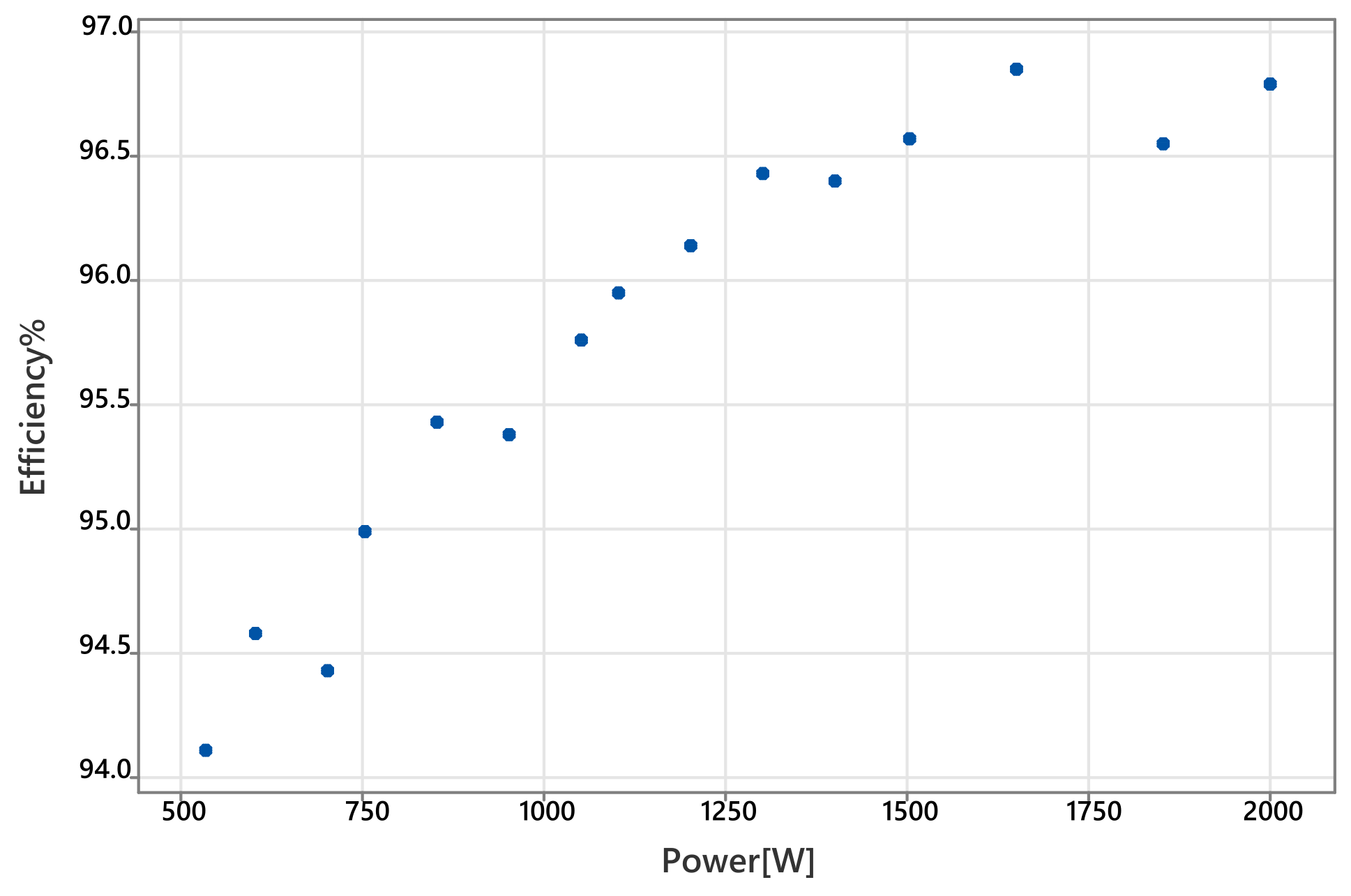
Induction heating technology plays a significant role in heating applications with its high efficiency, fast response, and precise control ability. Traditional resonant inverter-based systems face problems such as complexity, lack of flexibility, and low efficiency in multi-load situations. To overcome these issues, a new non-resonant full-bridge multiple-output inverter topology using silicon carbide (SiC) semiconductor devices is presented. While the system is simplified by eliminating resonant components, efficiency is increased thanks to SiC devices. In the study, a coil design methodology focusing on coil resistance and inductance is presented to optimize energy transfer and maximize system performance. Load-sensing and advanced frequency-modulation techniques are integrated to provide precise and independent power regulation in multi-loads. Thus, the efficiency of energy distribution and system robustness are increased. The proposed topology offers heating performance that provides homogeneous heat distribution. The developed prototype was proven to operate reliably with high efficiency under different load conditions and was suitably applied for domestic induction heating applications. An efficiency of 96.78% was achieved at a 50 kHz operating frequency and 2000 W power level.
Keywords: domestic induction heating; multi-output inverter; non-resonant multi-output induction heating topology domestic induction heating; multi-output inverter; non-resonant multi-output induction heating topology