Construction Method of Knowledge Graph of Chain Disaster in Alpine Gorge Area, China

 , and
, and
Abstract
1. Introduction
2. Construction Process of a Cascading Disaster Knowledge Graph
2.1. Concept and System of Cascading Disasters
2.2. Basic Process of Constructing a Knowledge Graph for Cascading Disasters
3. Construction of the Model Layer of Chain-Generated Disasters Knowledge Graph in High Mountain and Canyon Areas
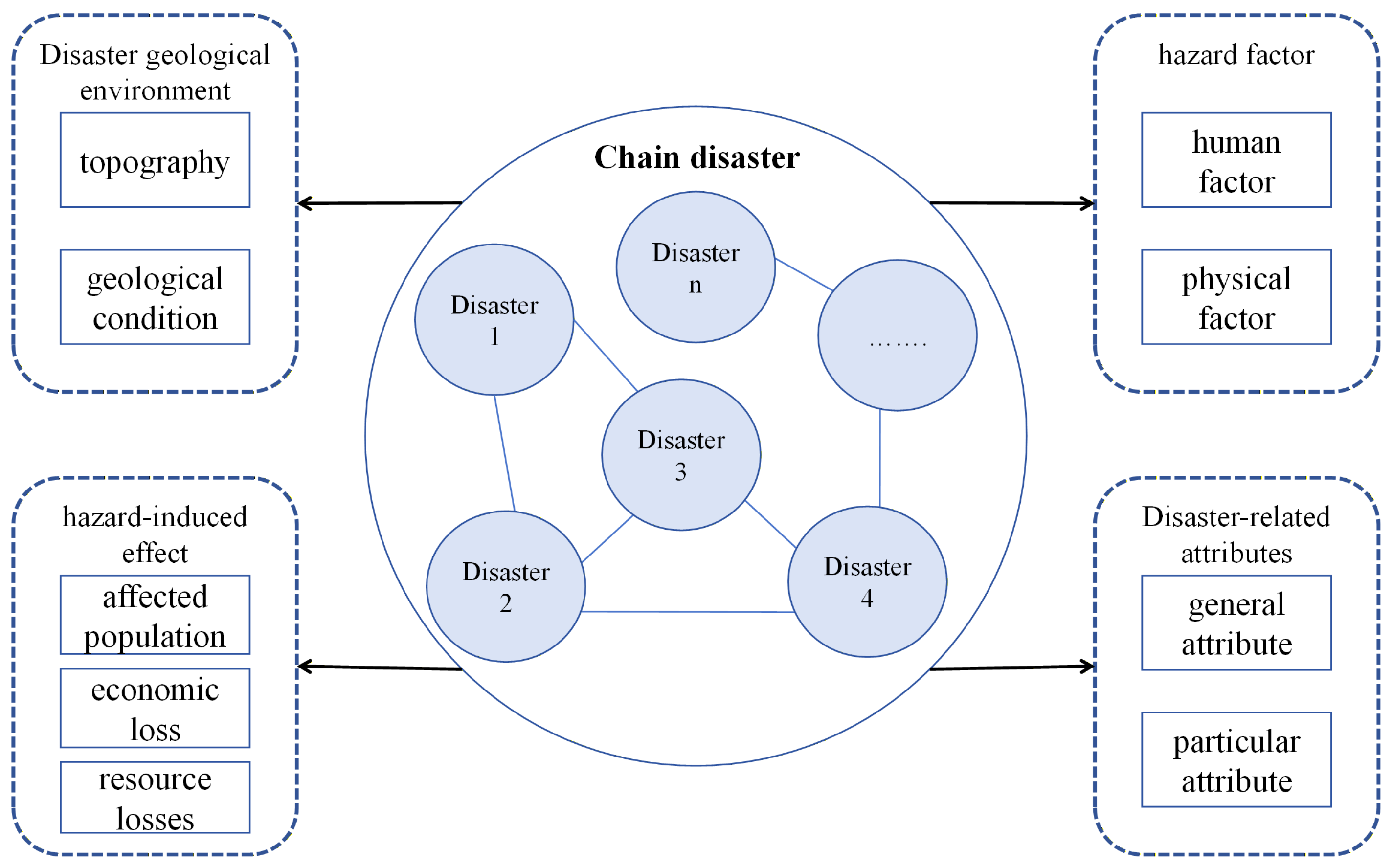
3.1. Conceptual Layer of the Knowledge Graph of Chain-Generated Disasters in High Mountain and Canyon Areas
3.2. Relational Layer of the Knowledge Graph of Chain-Generated Disasters in High Mountain and Canyon Areas
3.2.1. Time Relationship of Chain-Generated Disasters
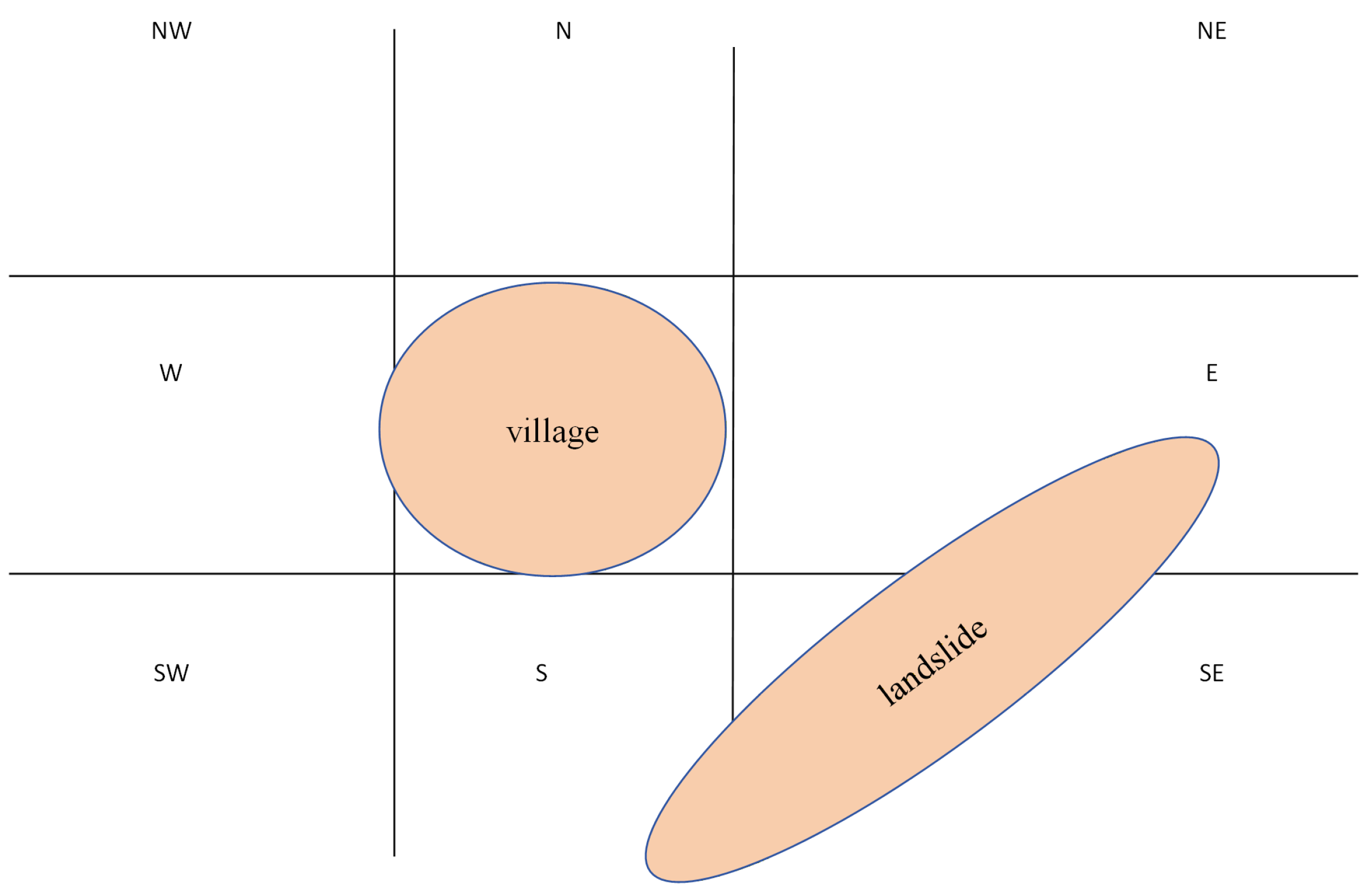
3.2.2. Spatial Relationship of Chain-Generated Disasters
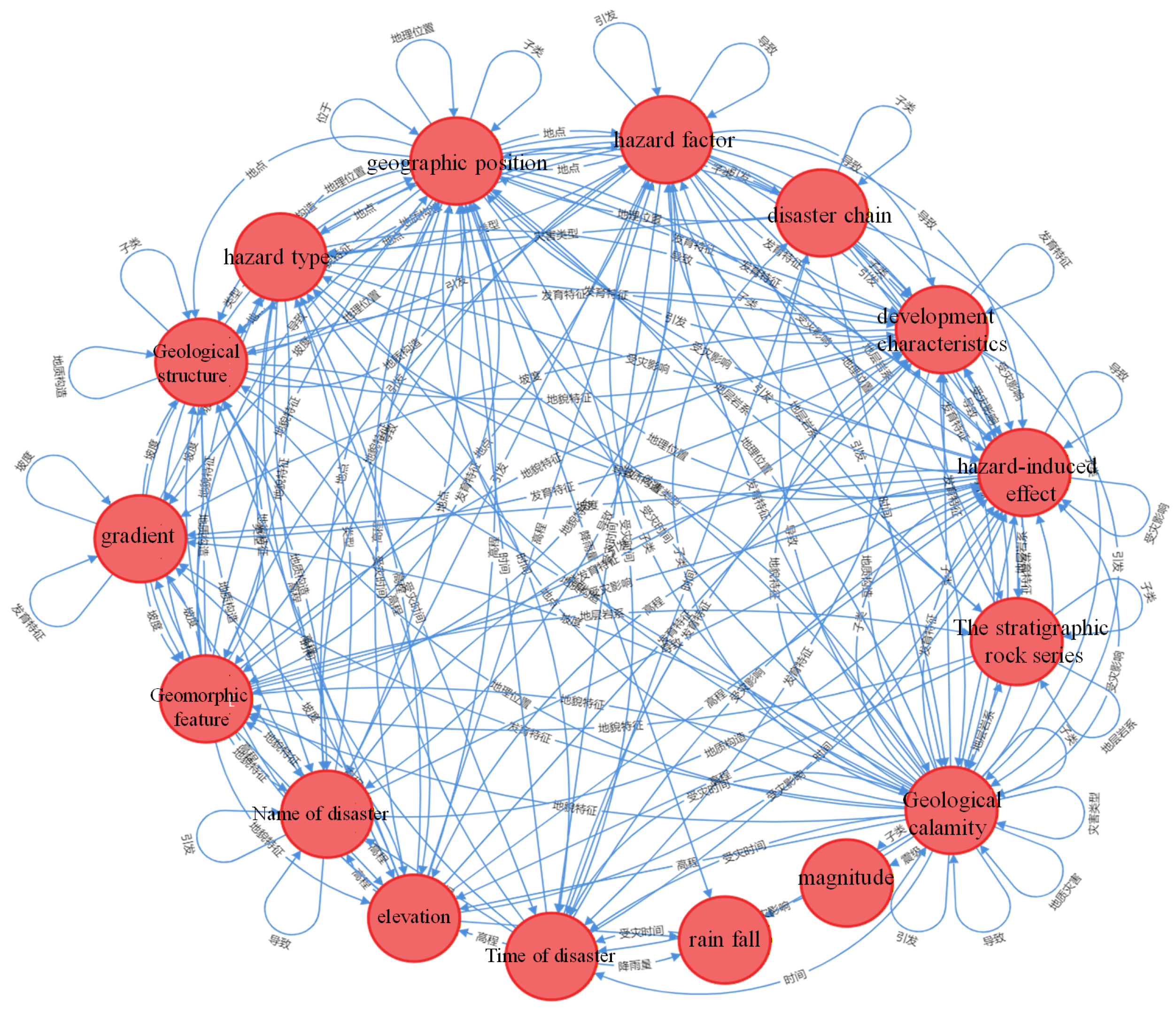
3.2.3. Semantic Relations of Chain-Generated Disasters
3.3. Instance Layer of Chain-Generated Disaster Knowledge Graph in High Mountain and Canyon Areas
4. Construction and Application of Chain Disaster Knowledge Graph in Alpine Canyon Area
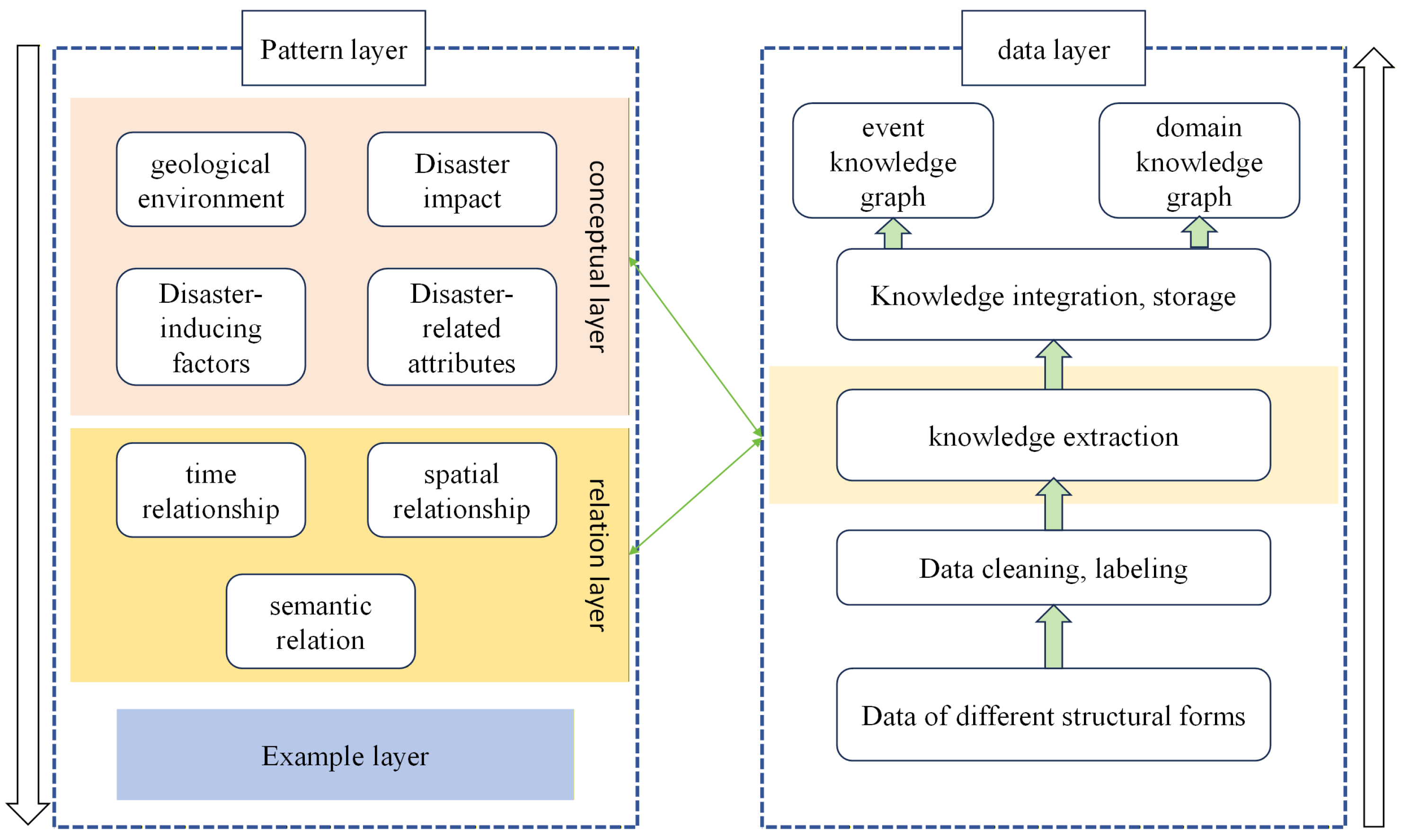
4.1. Pattern Layer of Chain Disaster Knowledge Graph in High Mountain Canyon Area
4.2. Data Layer of Chain Disaster Knowledge Graph in Alpine Canyon Area
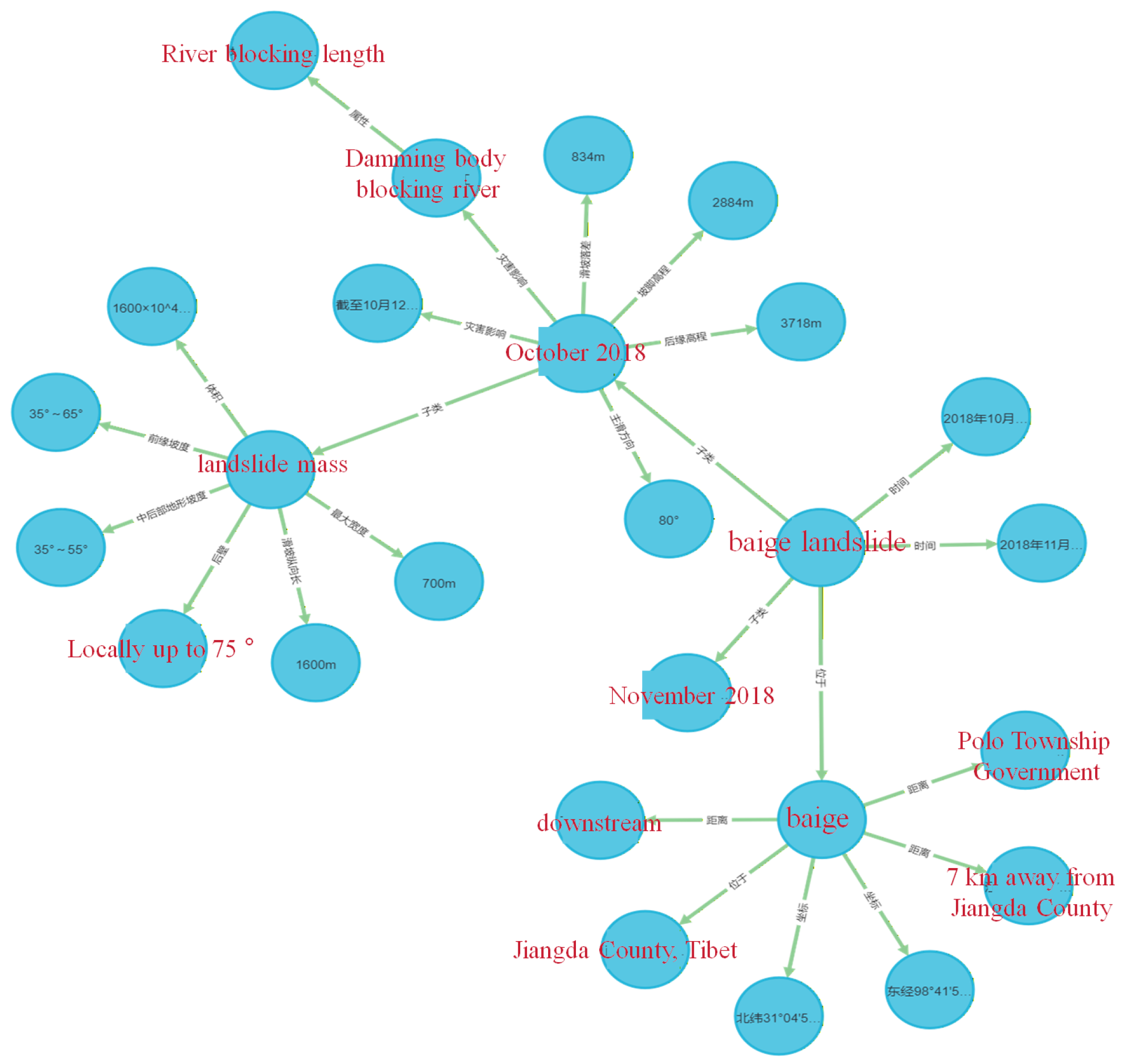
4.3. Event Application of Chain Disaster Knowledge Graph in Alpine Canyon Area
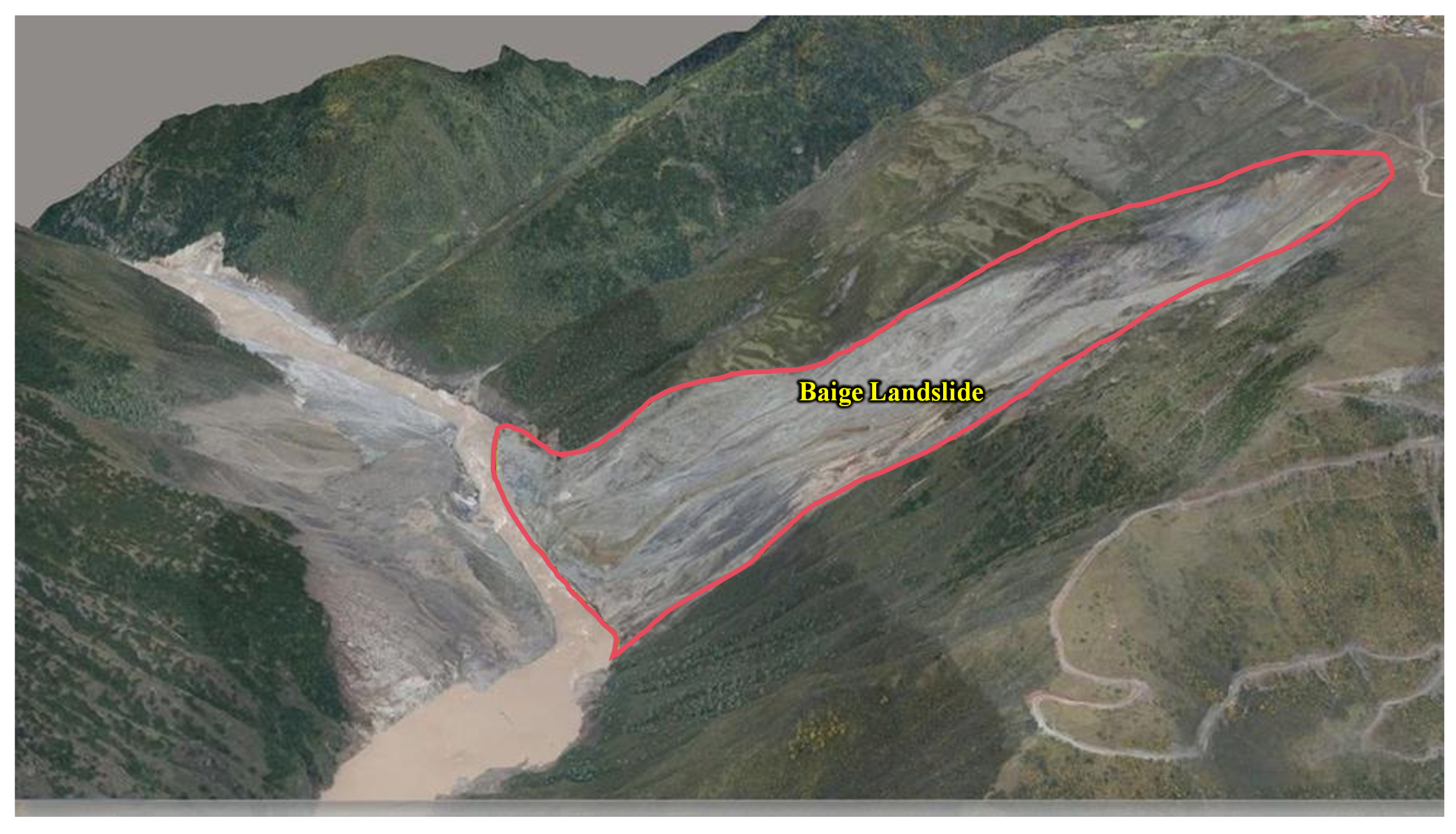
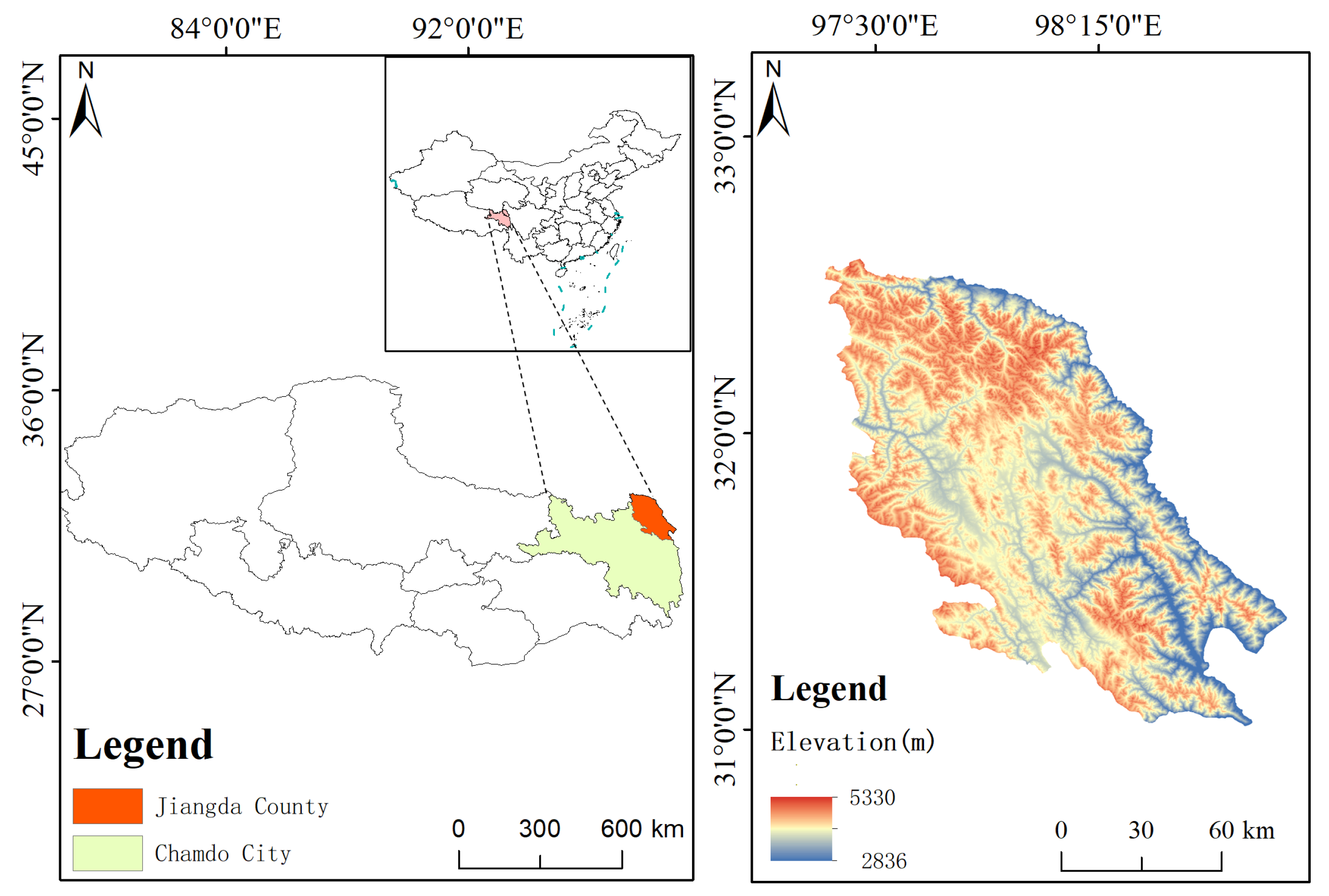
Overview of the Study Area
5. Conclusions
Author Contributions
Funding
Data Availability Statement
Conflicts of Interest
References
- He, N.; Qu, X.; Yang, Z.; Xu, L.; Gurkalo, F. Disaster mechanism and evolution characteristics of landslide–debris-flow geohazard chain due to strong earthquake—A case study of niumian gully. Water 2023, 15, 1218. [Google Scholar] [CrossRef]
- Zhou, W.; Huang, M.; Liu, S.; You, Q.; Meng, F. Research on the Construction and Application of Earthquake Emergency Information Knowledge Graph Based on Large Language Models. IEEE Access 2025, 13, 127742–127757. [Google Scholar] [CrossRef]
- Zhang, B.; Yin, C.; Liu, K.; Zhai, X.; Sun, Y.; Du, M. Research on the construction of geographic knowledge graph integrating natural disaster information. ISPRS Ann. Photogramm. Remote Sens. Spat. Inf. Sci. 2022, 10, 79–85. [Google Scholar] [CrossRef]
- Beniest, A.; Schellart, W.P. A geological map of the Scotia Sea area constrained by bathymetry, geological data, geophysical data and seismic tomography models from the deep mantle. Earth-Sci. Rev. 2020, 210, 103391. [Google Scholar] [CrossRef]
- Ma, X.; Ma, C.; Wang, C. A new structure for representing and tracking version information in a deep time knowledge graph. Comput. Geosci. 2020, 145, 104620. [Google Scholar] [CrossRef]
- Liu, C.; Ji, X.; Dong, Y.; He, M.; Yang, M.; Wang, Y. Chinese mineral question and answering system based on knowledge graph. Expert Syst. Appl. 2023, 231, 120841. [Google Scholar] [CrossRef]
- Qiu, Q.; Ma, K.; Lv, H.; Tao, L.; Xie, Z. Construction and application of a knowledge graph for iron deposits using text mining analytics and a deep learning algorithm. Math. Geosci. 2023, 55, 423–456. [Google Scholar] [CrossRef]
- Ge, X.; Yang, Y.; Chen, J.; Li, W.; Huang, Z.; Zhang, W.; Peng, L. Disaster prediction knowledge graph based on multi-source spatio-temporal information. Remote Sens. 2022, 14, 1214. [Google Scholar] [CrossRef]
- Richens, R.H. Preprogramming for mechanical translation. Mech. Transl. Comput. Linguist. 1956, 3, 20–25. [Google Scholar]
- Yu, C.; Zhang, L.; Hou, M.; Yang, J.; Zhong, H.; Wang, C. Climate paleogeography knowledge graph and deep time paleoclimate classifications. Geosci. Front. 2023, 14, 101450. [Google Scholar] [CrossRef]
- Stokman, F.N.; de Vries, P.H. Structuring knowledge in a graph. In Human-Computer Interaction: Psychonomic Aspects; Springer: Berlin/Heidelberg, Germany, 1988; pp. 186–206. [Google Scholar][Green Version]
- Li, L.; Liu, Y.; Zhu, H.; Ying, S.; Luo, Q.; Luo, H.; Kuai, X.; Xia, H.; Shen, H. A bibliometric and visual analysis of global geo-ontology research. Comput. Geosci. 2017, 99, 1–8. [Google Scholar] [CrossRef]
- Nickel, M.; Murphy, K.; Tresp, V.; Gabrilovich, E. A review of relational machine learning for knowledge graphs. Proc. IEEE 2015, 104, 11–33. [Google Scholar] [CrossRef]
- Liu, W.; He, S. Dynamic simulation of a mountain disaster chain: Landslides, barrier lakes, and outburst floods. Nat. Hazards 2018, 90, 757–775. [Google Scholar] [CrossRef]
- Qiu, Q.; Xie, Z.; Wu, L.; Li, W. Geoscience keyphrase extraction algorithm using enhanced word embedding. Expert Syst. Appl. 2019, 125, 157–169. [Google Scholar] [CrossRef]
- Mezzanzanica, M.; Mercorio, F.; Cesarini, M.; Moscato, V.; Picariello, A. GraphDBLP: A system for analysing networks of computer scientists through graph databases: GraphDBLP. Multimed. Tools Appl. 2018, 77, 18657–18688. [Google Scholar] [CrossRef]
- Liu, J.; Liu, L.; Xue, Y.; Dong, J.; Hu, Y.; Hill, R.; Guang, J.; Li, C. Grid workflow validation using ontology-based tacit knowledge: A case study for quantitative remote sensing applications. Comput. Geosci. 2017, 98, 46–54. [Google Scholar] [CrossRef]
- Zuo, R. Mineral exploration using subtle or negative geochemical anomalies. J. Earth Sci. 2021, 32, 439–454. [Google Scholar] [CrossRef]
- Zhang, S.; Guo, H.; Zhu, K.; Yu, S.; Li, J. Multistage assignment optimization for emergency rescue teams in the disaster chain. Knowl.-Based Syst. 2017, 137, 123–137. [Google Scholar] [CrossRef]
- Han, J.; Wu, S.; Wang, H. Preliminary study on geological hazard chains. Earth Sci. Front. 2007, 14, 11–20. [Google Scholar] [CrossRef]
- Chen, X.; Jia, S.; Xiang, Y. A review: Knowledge reasoning over knowledge graph. Expert Syst. Appl. 2020, 141, 112948. [Google Scholar] [CrossRef]
- Huang, Z.; Xu, W.; Yu, K. Bidirectional LSTM-CRF models for sequence tagging. arXiv 2015, arXiv:1508.01991. [Google Scholar] [CrossRef]
- Xu, P.; Barbosa, D. Neural fine-grained entity type classification with hierarchy-aware loss. arXiv 2018, arXiv:1803.03378. [Google Scholar]
- Le, P.; Titov, I. Improving entity linking by modeling latent relations between mentions. arXiv 2018, arXiv:1804.10637. [Google Scholar] [CrossRef]
- Duan, Y.; Qiu, Q.; Tian, M.; Ma, K.; Xie, Z.; Tao, L.; Liu, J. Geological map-oriented knowledge graph construction and intelligent Q&A application. Chin. J. Geol. 2024, 59, 588–602. [Google Scholar]
- Qiu, M.; Xie, N.; Jiang, L.; Wu, H.; Chen, Y.; Li, Y. Research on the Construction of Knowledge Graphs for Agricultural Meteorological Disasters: A Review. Chin. J. Agrometeorol. 2024, 45, 1216. [Google Scholar]
- Li, X.; Zhang, J.; Fan, L.; Li, X.; Jiang, H.; Lu, N. Construction and analysis of knowledge graphs for multi-source heterogeneous data of soil pollution. Soil Use Manag. 2023, 39, 1036–1039. [Google Scholar] [CrossRef]
- Xie, Y.; Wang, L.; Dong, C.; Kang, F. Research on the construction method of earthquake disaster prevention knowledge graph. Sci. Surv. Mapp. 2021, 46, 219–226. [Google Scholar]
- Xu, Q.; Cui, S.; Huang, W.; Pei, X.; Fan, X.; Ai, Y.; Zhao, W.; Luo, Y.; Luo, J.; Liu, M.; et al. Construction of a landslide knowledge graph in the field of engineering geology. Geomat. Inf. Sci. Wuhan Univ. 2023, 48, 1601–1615. [Google Scholar]
- Qiu, Q.; Xie, Z.; Zhang, D.; Ma, K.; Tao, L.; Tan, Y.; Zhang, Z.; Jiang, B. Knowledge graph for identifying geological disasters by integrating computer vision with ontology. J. Earth Sci. 2023, 34, 1418–1432. [Google Scholar] [CrossRef]
- Lu, Y.; Qiao, S.; Yao, Y. Risk Assessment of Typhoon Disaster Chain Based on Knowledge Graph and Bayesian Network. Sustainability 2025, 17, 331. [Google Scholar] [CrossRef]
- Zhang, X.; Huang, Y.; Zhang, C.; Ye, P. Geoscience knowledge graph (GeoKG): Development, construction and challenges. Trans. GIS 2022, 26, 2480–2494. [Google Scholar] [CrossRef]
- Zhou, C.; Wang, H.; Wang, C.; Hou, Z.; Zheng, Z.; Shen, S.; Cheng, Q.; Feng, Z.; Wang, X.; Lv, H.; et al. Geoscience knowledge graph in the big data era. Sci. China Earth Sci. 2021, 64, 1105–1114. [Google Scholar] [CrossRef]
- Rajabi, E.; Etminani, K. Knowledge-graph-based explainable AI: A systematic review. J. Inf. Sci. 2024, 50, 1019–1029. [Google Scholar] [CrossRef]
- Shen, Y.; Zhang, L.; Zhang, J.; Yang, M.; Tang, B.; Li, Y.; Lei, K. CBN: Constructing a clinical Bayesian network based on data from the electronic medical record. J. Biomed. Inform. 2018, 88, 1–10. [Google Scholar] [CrossRef]
- Guo, X.; Qian, H.; Wu, F.; Liu, J. A method for constructing geographical knowledge graph from multisource data. Sustainability 2021, 13, 10602. [Google Scholar] [CrossRef]
- Zhang, X.Y.; Zhang, C.J.; Zhu, S.N. Annotation for geographical spatial relations in Chinese text. Acta Geod. Et Cartogr. Sin. 2012, 41, 468–474. [Google Scholar]
- Clementini, E.; Sharma, J.; Egenhofer, M.J. Modelling topological spatial relations: Strategies for query processing. Comput. Graph. 1994, 18, 815–822. [Google Scholar] [CrossRef]
- Chen, J.; Liu, W.; Wu, H.; Li, Z.; Zhao, Y.; Zhang, L. Basic issues and research agenda of geospatial knowledge service. Geomat. Inf. Sci. Wuhan Univ. 2023, 44, 38–47. [Google Scholar]



| Time Relation | Explanation |
|---|---|
| Inclusion Relation | Event A encompasses Event B, with A starting before B and ending after B |
| Intersection Relation | Event A ends after Event B starts and before Event B ends |
| Disjoint Relation | Event A ends before Event B starts |
| Connect Relation | Event A ends at the same moment that Event B begins |
| Co-starting Relation | Event A starts at the same time as Event B, but they have different end times |
| Co-ending Relation | Event A and Event B start at different times, but they end at the same time |
| Equality Relation | Event A and Event B start at the same time and also end at the same time |
| Topological Relation | Description |
|---|---|
| Disjoint | There is no contact between event E and event F. |
| Adjacent | Event E and event F touch at a single point. |
| Equal | Event E and event F are completely coincident. |
| Contains | Event E is inside event F. |
| Contained | Event F is inside event E. |
| Intersects | Event E and event F overlap and also have non-overlapping areas. |
| Relationship Type | Meaning | Example |
|---|---|---|
| Causal Relationship | One event leads to the occurrence of another | The earthquake caused a collapse. |
| Homology Relationship | Multiple events are caused by the same reason | Freeze-thaw cycles cause landslides and debris flows |
| Urge Relationship | Multiple events lead to the occurrence of one event | Rainfall and manual excavation led to mudslides |
| Enhancing Relationship | The occurrence of one event triggers a more intense reaction to another | Continuous heavy rainfall has led to the revival of old landslides |
| Subordinate Relationship | One event is part of the process of another event | Landslides belong to the landslide-barrier lake disaster chain |
Disclaimer/Publisher’s Note: The statements, opinions and data contained in all publications are solely those of the individual author(s) and contributor(s) and not of MDPI and/or the editor(s). MDPI and/or the editor(s) disclaim responsibility for any injury to people or property resulting from any ideas, methods, instructions or products referred to in the content. |
© 2025 by the authors. Licensee MDPI, Basel, Switzerland. This article is an open access article distributed under the terms and conditions of the Creative Commons Attribution (CC BY) license (https://creativecommons.org/licenses/by/4.0/).
Share and Cite
Shang, H.; Jia, L.; Xu, J.; Xi, J.; Ren, C. Construction Method of Knowledge Graph of Chain Disaster in Alpine Gorge Area, China. Electronics 2025, 14, 4951. https://doi.org/10.3390/electronics14244951
Shang H, Jia L, Xu J, Xi J, Ren C. Construction Method of Knowledge Graph of Chain Disaster in Alpine Gorge Area, China. Electronics. 2025; 14(24):4951. https://doi.org/10.3390/electronics14244951
Chicago/Turabian StyleShang, Haixing, Lanling Jia, Jiahuan Xu, Jiangbo Xi, and Chaofeng Ren. 2025. "Construction Method of Knowledge Graph of Chain Disaster in Alpine Gorge Area, China" Electronics 14, no. 24: 4951. https://doi.org/10.3390/electronics14244951
APA StyleShang, H., Jia, L., Xu, J., Xi, J., & Ren, C. (2025). Construction Method of Knowledge Graph of Chain Disaster in Alpine Gorge Area, China. Electronics, 14(24), 4951. https://doi.org/10.3390/electronics14244951