Article

Unlocking the Potential of Cd-Free SnS2 Electron Transport Layer for High-Efficiency Sb2(S,Se)3 Solar Cells: A Numerical Simulation Study

1
School of Electronic Information, Dongguan Polytechnic, Dongguan 523808, China
2
Shenzhen Key Laboratory of Advanced Thin Films and Applications, College of Physics and Optoelectronic Engineering, Shenzhen University, Shenzhen 518060, China
3
Peng Cheng Laboratory, Shenzhen 518060, China
4
Portland Institute, Nanjing University of Posts and Telecommunications (NJUPT), Nanjing 210023, China
5
Department of Electrical Engineering, Namal University, Mianwali 42250, Pakistan
*
Author to whom correspondence should be addressed.
Electronics 2025, 14(24), 4926; https://doi.org/10.3390/electronics14244926
Submission received: 14 November 2025 / Revised: 12 December 2025 / Accepted: 13 December 2025 / Published: 16 December 2025
(This article belongs to the Section Optoelectronics)

Abstract

Cadmium-free buffer layers are pivotal for the sustainable development of thin-film photovoltaics. This work numerically investigates SnS2 as a high-performance, environmentally benign alternative to CdS for antimony selenosulfide (Sb2(S,Se)3) solar cells using AFORS-HET software. The SnS2/Sb2(S,Se)3 heterojunction exhibits a significantly lower conduction band offset (CBO ≈ 0.23 eV) than its CdS counterpart (CBO ≈ 0.49 eV), which is identified as the primary factor for suppressed interface recombination and enhanced electron injection efficiency. A comprehensive optimization strategy is presented: tuning the S content in Sb2(S,Se)3 to 40% optimizes the trade-off between band gap widening and hole transport barrier at the ETL/absorber interface; adjusting the absorber thickness to 340 nm balances light absorption and carrier collection efficiency; and elevating the SnS2 carrier concentration to 1021 cm−3 strengthens the built-in potential and induces a beneficial hole-blocking “spike” at the front contact. The synergistically optimized device achieves a power conversion efficiency (PCE) of 10.39%, a substantial improvement over the 7.56% efficiency of the CdS-based reference cell in our simulation framework.

1. Introduction

The transition to sustainable energy systems has made photovoltaic technology a cornerstone of global decarbonization efforts. Among various photovoltaic platforms, thin-film solar cells (TFSCs) offer compelling advantages, including reduced material consumption, compatibility with flexible substrates, and potential for low-cost, large-area fabrication. In this context, antimony selenosulfide (Sb2(S,Se)3) has attracted significant attention as a next-generation absorber material. It features an optimally tunable bandgap (1.1–1.7 eV), a high absorption coefficient (>105 cm−1), and excellent intrinsic stability, all derived from earth-abundant and non-toxic elements [1,2]. These properties not only align with the need for sustainable photovoltaics but also offer practical benefits such as potential application in flexible and lightweight modules, as well as suitability for tandem cell architectures through bandgap adjustment. According to the detailed-balance limit, a single-junction Sb2(S,Se)3 cell with a bandgap near 1.3 eV could theoretically exceed 30% power conversion efficiency (PCE) [3].
Substantial experimental progress has been made in recent years. For instance, efficiencies surpassing 10% have been achieved through interface and light-management engineering, often employing cadmium sulfide (CdS) as the electron transport layer (ETL) [4,5,6]. However, despite these advances, the performance of Sb2(S,Se)3 solar cells remains well below the theoretical ceiling. A key bottleneck lies at the heterojunction interface: the commonly used CdS ETL introduces a significant conduction band offset (cliff), promotes interface recombination, and poses environmental and regulatory concerns due to cadmium toxicity [7,8]. Therefore, replacing CdS with an effective, Cd-free alternative is crucial for the sustainable development of this technology.
Tin disulfide (SnS2) emerges as a promising cadmium-free ETL candidate. As an n-type layered semiconductor, it offers a wide, tunable bandgap (2.1–3.38 eV), high electron mobility, and excellent chemical stability [9,10]. It is noteworthy that SnS2 has been explored as an ETL in other photovoltaic systems such as perovskite and CIGS solar cells [9,10]. Its electrical properties can be controlled via doping (e.g., via Cl or Sb impurities or Sn-rich growth), and it can be deposited by scalable methods such as chemical bath deposition or atomic layer deposition. More importantly, its electron affinity suggests the potential for a more favorable band alignment with Sb2(S,Se)3, which could mitigate interface recombination losses prevalent in CdS-based devices. However, the systematic investigation of SnS2 as an ETL specifically for Sb2(S,Se)3 solar cells, particularly through numerical simulation guiding optimal design, remains limited.
In this work, we systematically investigate the viability of SnS2 as an ETL for Sb2(S,Se)3 solar cells through numerical simulation using the AFORS-HET platform. By solving the coupled Poisson and carrier continuity equations, we model the device performance and analyze the underlying carrier transport and recombination mechanisms. Specifically, we evaluate the impact of (1) sulfur composition in the Sb2(S,Se)3 absorber, (2) absorber layer thickness, and (3) SnS2 doping density on key photovoltaic parameters. Our study not only identifies an optimized device configuration achieving a simulated PCE of 10.39% but also elucidates the design principles for efficient, cadmium-free Sb2(S,Se)3 thin-film solar cells, thereby providing a clear pathway for experimental realization.

2. Numerical Methods and Device Modeling

The photovoltaic performance of Sb2(S,Se)3 solar cells with SnS2 as the ETL was evaluated using AFORS-HET software (Version 2.5). This software solves the fundamental semiconductor equations under various conditions using the finite-difference method. The core system comprises Poisson’s equation governing electrostatic potential distribution and the electron and hole continuity equations describing carrier transport and generation-recombination processes [11]:
J n = q μ n n E F n x ; J p = q μ p p E F p x
x ( ε φ x ) = q ε 0 ( n + p N A + N D + + n t + p t )
n t = G R n + μ n E x n x + D n 2 n x 2 ; p t = G R p + μ p E x p x + D p 2 p x 2
In these equations, ε and q represent the permittivity and elementary charge, respectively. NA and ND are the ionized acceptor and donor concentrations. p and n are the hole and electron concentrations. φ, μp, and μn denote the electrostatic potential, hole mobility, and electron mobility, respectively. Jp and Jn are the hole and electron current densities. EFn and EFp are the electron and hole quasi-Fermi levels. G, Dn, and Dp represent the carrier generation rate, electron diffusion coefficient, and hole diffusion coefficient, respectively. Ex, Rn, and Rp signify the electric field, electron recombination rate, and hole recombination rate, respectively.
The device simulations were carried out under standard AM1.5G spectral illumination (100 mW/cm2) at a temperature of 300 K. The optical generation profile across the multilayer stack was derived using the transfer-matrix method, incorporating the wavelength-dependent absorption coefficient of each layer, while assuming no parasitic absorption in the front transparent layers. The material parameters used in the simulation, such as layer thickness, dielectric constant, electron affinity, bandgap, doping concentrations, carrier mobilities, and defect properties, are compiled in Table 1, Table 2 and Table 3. These values are primarily drawn from established experimental and computational studies in the literature [12,13,14,15,16], ensuring the physical relevance of our model. We acknowledge that these parameters, while representative, may vary under real fabrication conditions. The robustness of our conclusions is assessed in the Result and discussion section through a discussion on the sensitivity of the key findings to these parameters.
It is important to note that our current model assumes ideal interfaces without accounting for specific interface defect states or interdiffusion between the SnS2 ETL and the Sb2(S,Se)3 absorber. These factors, present in real devices, could modify the band alignment and introduce additional recombination channels, potentially leading to an overestimation of performance. This simplification is a limitation of the present study, and future work should incorporate these aspects for more accurate prediction.
To systematically evaluate the effects of key design variables on device performance, we performed a series of parametric sweeps. The sulfur content in the Sb2(S,Se)3 absorber was varied from 0% to 100% in increments of 10%. The absorber thickness was scanned from 100 nm to 500 nm. The doping concentration (ND) of the SnS2 electron transport layer was varied logarithmically from 1015 cm−3 to 1021 cm−3. Interface states at the SnS2/Sb2(S,Se)3 heterojunction were modeled as single-level defects with density Nt and capture cross-sections for electrons and holes as specified in Table 2.
The AFORS-HET software self-consistently solved the coupled Poisson and continuity equations under steady-state conditions. From the converged solutions, we extracted the current density-voltage (J-V) characteristics, energy band diagrams, carrier concentration profiles, and recombination rate distributions. These outputs enabled a detailed analysis of the device performance metrics (VOC, JSC, FF, PCE) and the underlying transport and recombination mechanisms driving the observed trends.
Figure 1 illustrates the two simulated device structures used in this study. To thoroughly investigate the carrier transport mechanisms at the SnS2/Sb2(S,Se)3 heterojunction, our discussion will focus on several key aspects. First, we will conduct a comparative analysis of the interface band alignment, specifically the conduction band offset (CBO) and valence band offset (VBO), at the SnS2/Sb2(S,Se)3 interface against the traditional CdS/Sb2(S,Se)3 interface to evaluate the electron injection barrier and hole blocking capability. Subsequently, we will systematically examine the influence of the absorber layer, including how the sulfur (S) content affects the band gap and interface band alignment, and how the absorber thickness governs optical absorption and carrier collection efficiency. Finally, the role of the SnS2 electron transport layer’s carrier concentration (ND) in modulating the energy band diagram, particularly the built-in potential and interface features, and its impact on carrier extraction and recombination losses will be evaluated. By correlating the simulated electrical parameters (VOC, JSC, FF, PCE) with the underlying energy band structures under these varied conditions, we aim to elucidate the fundamental mechanisms governing carrier transport and collection in SnS2-based Sb2(S,Se)3 solar cells.

3. Result and Discussion

3.1. Superior Interface Band Alignment of the SnS2 Electron Transport Layer

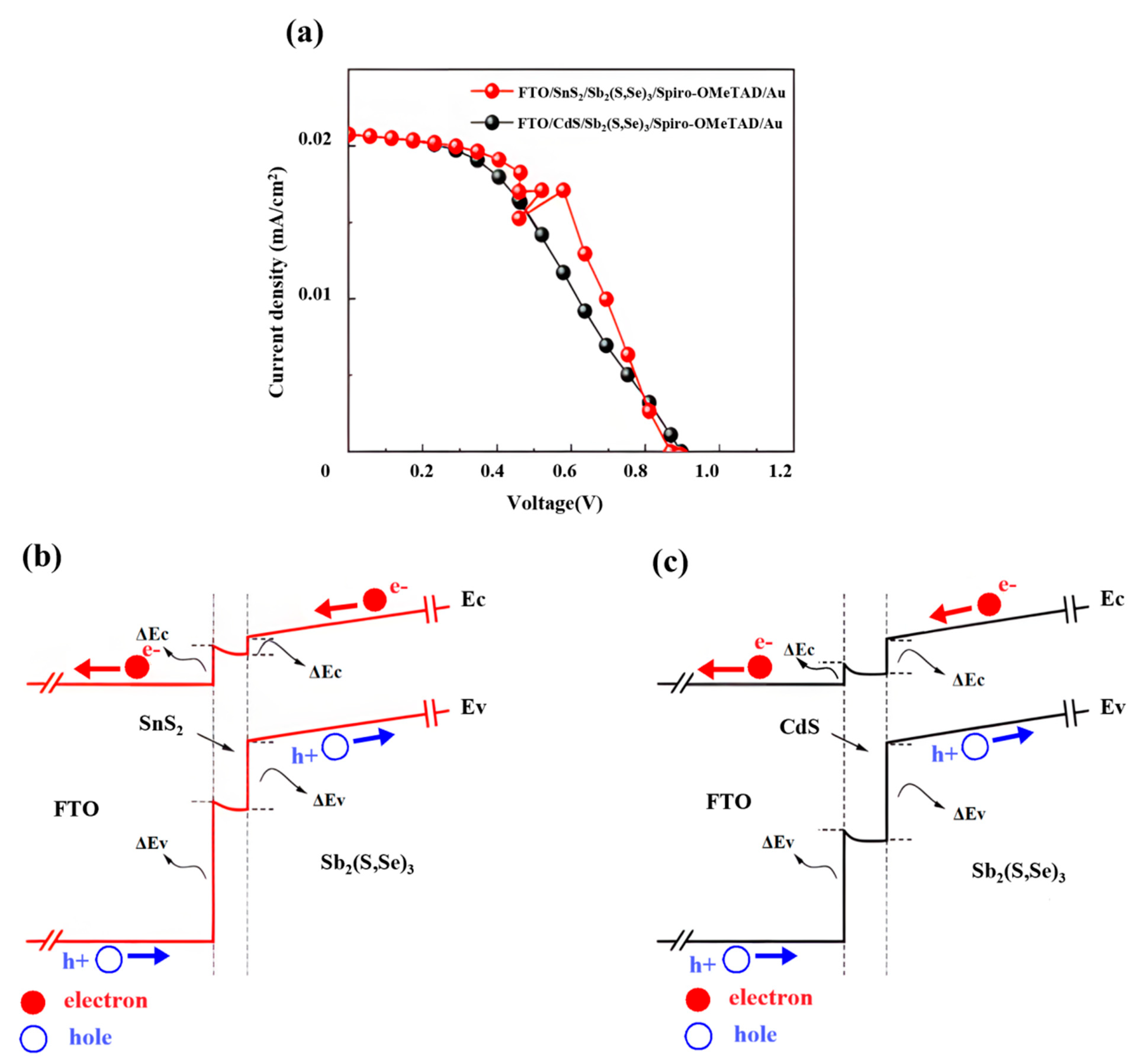
The initial simulation results reveal a fundamental trade-off in the operating principles of CdS and SnS2-based devices. Analysis of the J-V characteristics (Figure 2a,b) shows that the CdS-based reference cell exhibits a marginally higher open-circuit voltage (VOC = 0.896 V) compared to its SnS2-based counterpart (VOC = 0.863 V), consistent with its larger calculated built-in potential. However, the CdS-based solar cell suffers from a severely limited fill factor (FF = 40.61%), yielding a modest power conversion efficiency (PCE) of 7.56%. In contrast, the SnS2-based device achieves a markedly higher FF of 49.38% and a superior PCE of 8.84%, while maintaining an identical short-circuit current density (JSC). This paradoxical result, in which a device with a lower built-in potential achieves higher overall efficiency, directly points to the superior interface properties of the SnS2 electron transport layer.
The underlying mechanism is unequivocally identified through an analysis of the heterojunction band alignment. A comparative analysis of the conduction band offset (CBO), as illustrated in Figure 2b,c, and summarized in Table 4, reveals a critical quantitative difference between the two interfaces. The CdS/Sb2(S,Se)3 junction is characterized by a large CBO of 0.49 eV. A cliff of this magnitude promotes the accumulation of photo-generated electrons at the heterojunction interface. This high carrier concentration significantly enhances the rate of Shockley-Read-Hall (SRH) recombination at the interface [17,18], which degrades the diode ideality factor and increases parasitic shunt paths. This recombination loss is directly reflected in the poor fill factor (FF) observed experimentally.
In contrast, the SnS2/Sb2(S,Se)3 interface features a substantially smaller cliff, with a CBO of 0.23 eV. While the band alignment type remains the same, the reduced offset minimizes carrier accumulation at the interface. This condition effectively suppresses the interface recombination current [19], as the lower electron concentration diminishes the probability of SRH recombination events. This effect is consistent with findings in other chalcogenide systems, where a smaller cliff-type CBO leads to superior device performance by mitigating interface recombination losses [20,21]. The valence band offset (VBO) of SnS2 (0.98 eV), though smaller than that of CdS, remains adequate to block holes effectively. Therefore, the performance enhancement in the SnS2-based device primarily stems from the suppression of interface recombination, achieved by minimizing the cliff-type CBO. This finding highlights that for such heterojunctions, optimizing the CBO magnitude to control interface recombination is a more critical factor for efficiency than the absolute strength of the built-in field.

3.2. Performance Optimization of the Sb2(S,Se)3 Solar Cell

3.2.1. Engineering the Absorber Band Gap via Sulfur Composition

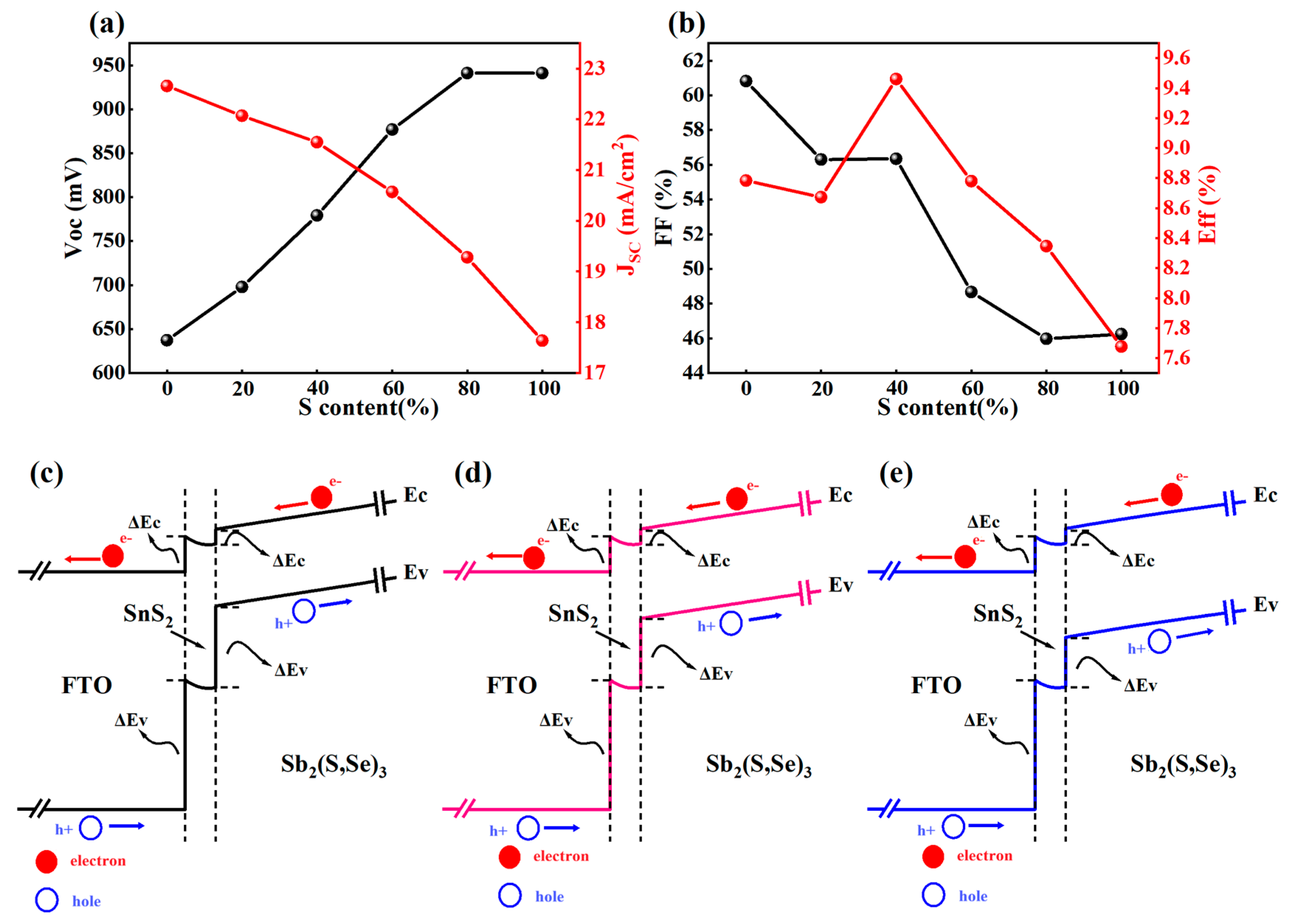
The sulfur content in the Sb2(S,Se)3 absorber directly dictates its electronic landscape, and our simulations elucidate the complex trade-offs involved in its optimization. As expected, increasing the S content from 0% to 100% systematically widens the bandgap (Eg), resulting in a monotonic increase in VOC (from 0.637 V to 0.941 V) due to reduced intrinsic carrier concentration, and a corresponding decrease in JSC (from 22.66 mA/cm2 to 17.64 mA/cm2) due to the loss of photo-current generation from low-energy photons (Figure 3a). However, the non-monotonic behavior of the FF and the resultant PCE, which peaks distinctly at 40% S (Figure 3b), reveals a more profound interplay between bulk and interface properties. The energy band diagrams at different S compositions (Figure 3c–e) provide a mechanistic explanation. The valence band offset (VBO) at the SnS2/Sb2(S,Se)3 interface varies with sulfur content and influences carrier transport and recombination in these solar cells. This variation originates from the different electronic structures of the selenide and sulfide components in the Sb2(S,Se)3 solid solution. As S content increases, the valence band maximum (VBM) of Sb2(S,Se)3 rises, reducing the energy difference with the SnS2 ETL and thereby decreasing the VBO. This decrease reduces the hole-blocking capability of the SnS2 layer [21]. Consequently, photo-generated holes encounter a lower energy barrier for injection into the ETL, where a high electron density exists. This condition promotes interfacial Shockley-Read-Hall recombination, which in our results correlates with a decrease in fill factor (FF) when S content exceeds approximately 40%. The non-monotonic trend in FF and power conversion efficiency (PCE) reflects these changes in interfacial electronic structure.
The maximum PCE at 40% S content occurs at a VBO value that supports both carrier blocking and extraction. At this composition, the VBO is sufficient to limit hole leakage into the ETL and reduce interface recombination, yet not so large as to adversely affect quasi-Fermi level splitting or band bending. This VBO also coincides with a conduction band offset (CBO) that promotes electron extraction from the absorber into the ETL. Together, this alignment allows the interface to block holes while extracting electrons, which is characteristic of a selective contact. These results indicate that controlling composition to achieve this dual function is necessary for device performance. They also show that engineering band alignment, in addition to optimizing the absorber, can improve the performance of Sb2(S,Se)3 thin-film solar cells. Future studies could focus on modifying the ETL properties or incorporating interface passivation layers to further adjust this interface beyond compositional changes in the absorber.

3.2.2. Balancing Absorption and Collection with Absorber Thickness

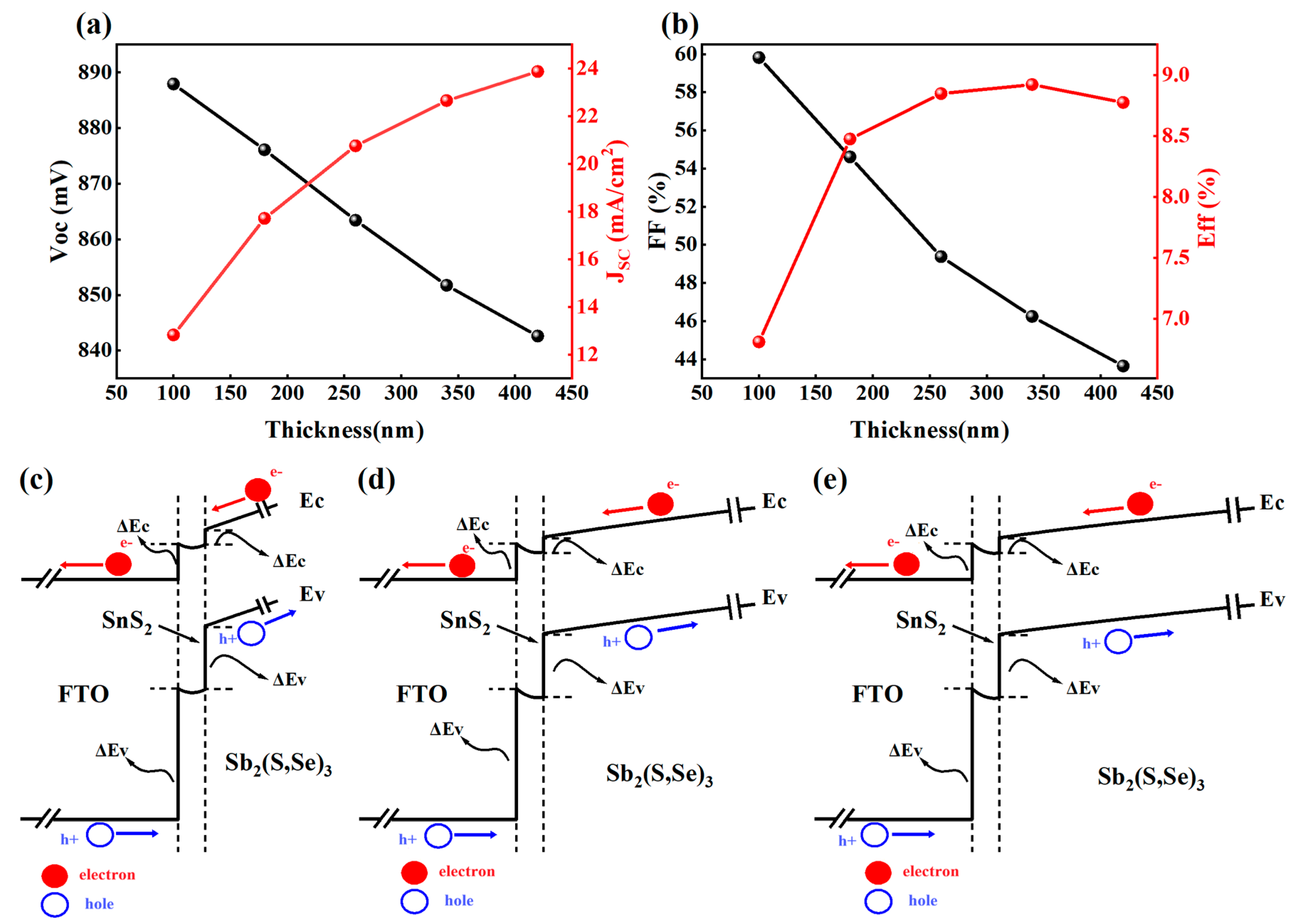
The thickness of the Sb2(S,Se)3 absorber layer governs the fundamental compromise between optical absorption and carrier extraction. Our simulations demonstrate that as the thickness increases from 100 nm to 420 nm, JSC rises super-linearly initially and then begins to saturate as the layer becomes optically thick. Conversely, both VOC and FF exhibit a monotonic decrease, indicating escalating collection losses (Figure 4a,b). The device efficiency reaches a maximum of 8.92% at a thickness of 340 nm.
The evolution of the energy band diagrams with thickness (Figure 4c–e) clarifies the underlying electrostatic origin of these trends. In a thin device (100 nm, Figure 4c), the depletion region can extend across the entire absorber, establishing a strong, uniform electric field. This full-depletion mode promotes nearly ideal charge collection via drift, but suffers from insufficient light absorption, which fundamentally caps JSC [19]. At the optimal thickness of 340 nm (Figure 4d), a critical balance is reached. The absorber is just thick enough to ensure near-complete photon harvesting, while the carrier collection efficiency remains high [22]. This efficiency is determined by a combination of drift in the depletion region near the junction and diffusion in the adjacent quasi-neutral region. This configuration maximizes the product JSC × FF, yielding the peak efficiency.
For a very thick absorber (420 nm, Figure 4e), the device operates in a partial-depletion mode. A significant portion of the absorber far from the junction remains quasi-neutral. Photo-generated carriers created in this neutral bulk must rely solely on diffusion to reach the junction for collection. Given the finite and often short minority-carrier diffusion length in poly-crystalline Sb2(S,Se)3 films, a substantial fraction of these carriers recombine before being collected, as supported by prior studies [23]. This bulk recombination loss directly manifests as the significant drop observed in both FF and VOC, and the increased absorber volume further amplifies the absolute bulk recombination current.

3.2.3. The Pivotal Role of SnS2 Doping in Contact Engineering

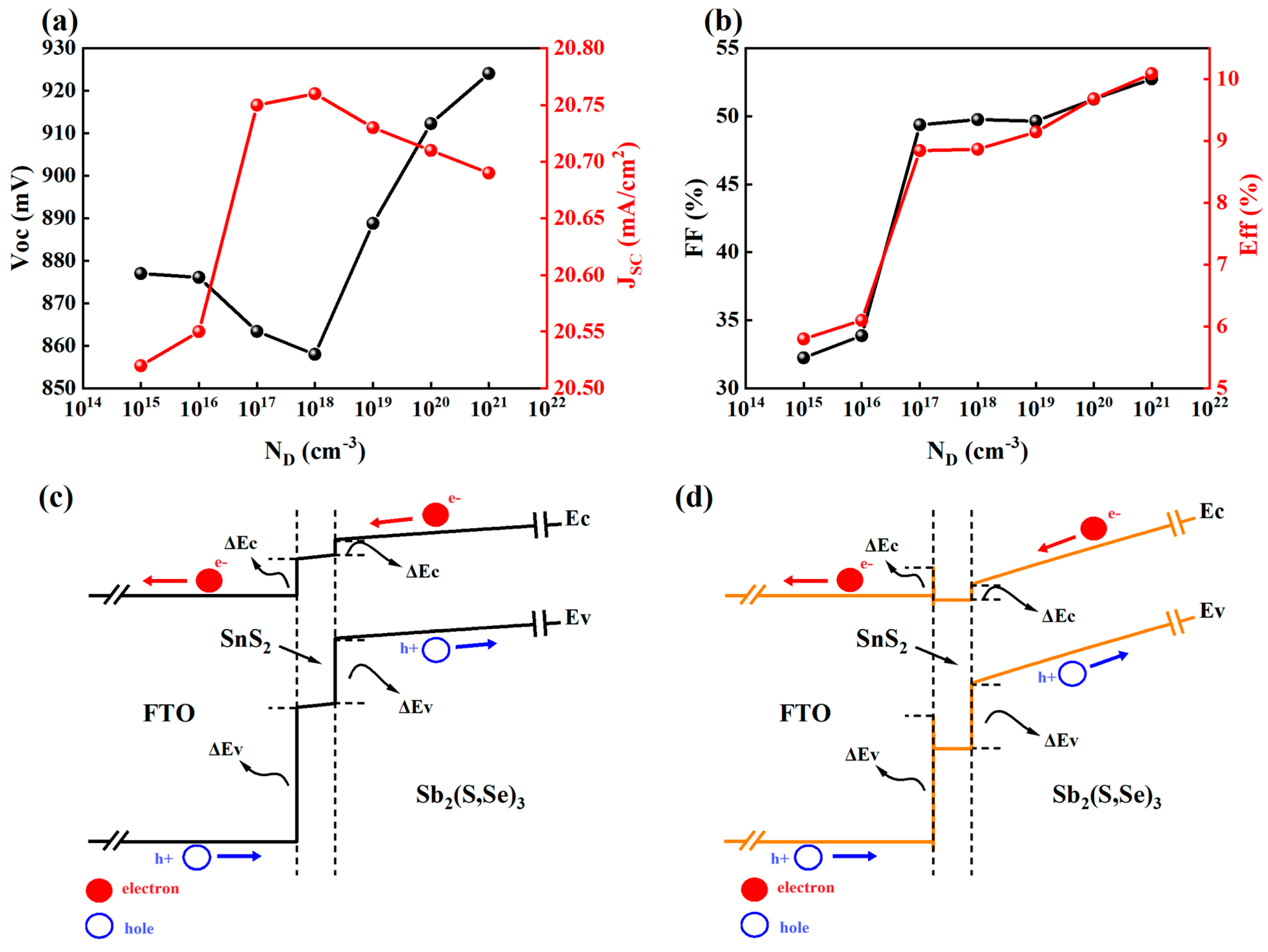
The doping concentration (ND) of the SnS2 ETL emerges as a critical factor governing the device’s electronic structure and overall performance. As illustrated in Figure 5a,b, increasing ND from 1015 to 1021 cm−3 precipitates a substantial enhancement in VOC (from 0.877 V to 0.924 V) and FF (from 32.24% to 52.76%), while JSC remains largely unaffected, culminating in a rise in efficiency from 5.8% to 10.09%. The energy band diagrams at the doping extremes (Figure 5c,d) provide profound insight into the underlying mechanism. At a low ND of 1015 cm−3 (Figure 5c), the SnS2 layer behaves quasi-intrinsically, with its Fermi level positioned near the mid-gap. This results in a minimal Fermi level disparity with the p-type Sb2(S,Se)3 absorber, yielding a weak built-in potential (Vbi) and a correspondingly shallow band bending across the junction. Consequently, the driving force for efficiently separating photo-generated electron-hole pairs and extracting electrons across the SnS2/Sb2(S,Se)3 interface is insufficient, leading to enhanced interface recombination and series resistance, which degrade both FF and VOC. In contrast, at a high ND of 1021 cm−3 (Figure 5d), the SnS2 layer enters a degenerate state, causing its Fermi level to shift high into the conduction band. This dramatically increases the Fermi level disparity with the absorber, thereby significantly strengthening the built-in potential (Vbi) and the associated electric field across the depletion region. The enhanced field promotes more effective drift-driven separation of photo-generated carriers, directly boosting VOC by suppressing bulk recombination [23]. Concurrently, this heavy doping optimizes the critical SnS2/Sb2(S,Se)3 heterojunction interface. The conduction band spike is maintained at an optimal, low magnitude, which facilitates efficient electron extraction from the absorber into the ETL while still effectively suppressing interface recombination [24]. The combination of a strong built-in field and an optimized interface ensures highly selective and efficient electron collection. Furthermore, the highly conductive nature of the heavily doped SnS2 layer substantially reduces the series resistance, contributing markedly to the improved FF. Therefore, high doping density is imperative for maximizing the built-in potential and establishing an efficient, low-recombination electron-selective contact at the heterojunction, which constitutes a fundamental prerequisite for achieving high-performance SnS2-based solar cells in simulation.
However, it must be acknowledged that the optimal doping concentration of 1021 cm−3 identified here is extremely high and may pose significant experimental challenges. Achieving such high doping levels in SnS2 without introducing excessive defects, degrading carrier mobility, or causing Fermi-level pinning is difficult. In practice, trade-offs between doping efficiency, material quality, and interface properties must be considered. Alternative strategies to achieve a similarly strong built-in field and favorable band bending could include employing bilayer ETL structures (e.g., a thin, highly doped SnS2 layer combined with a wider bandgap buffer), advanced interface passivation techniques, or the use of alternative high-electron-affinity materials. These approaches warrant further investigation in future experimental studies.

4. Conclusions

This numerical study demonstrates the promising potential of SnS2 as a cadmium-free electron transport layer for Sb2(S,Se)3 solar cells. Through the optimization of sulfur content (40%), absorber thickness (340 nm), and SnS2 doping concentration (1021 cm−3), a simulated efficiency of 10.39% was achieved, representing a 37% relative improvement over a CdS-based reference (7.56%) within our consistent simulation framework. We clarify that this reference is not representative of state-of-the-art experimental CdS cells, and the required high doping level poses a significant experimental challenge not fully captured in our idealized model, which also neglects interface defects and interdiffusion effects. Despite these limitations, this work provides crucial design insights and establishes SnS2 as a viable, eco-friendly alternative for guiding future experimental development of high-performance, cadmium-free Sb2(S,Se)3 photovoltaics.

Author Contributions

X.Z.: Conceptualization, formal analysis, and writing—original draft; M.I.: data curation, methodology, and writing—review editing; J.A.: methodology, resources, and software; W.A.S.: formal analysis, validation, and writing—review editing. All authors have read and agreed to the published version of the manuscript.

Funding

The research is supported by: 2025 Guangdong Provincial Characteristic and Innovative Project (2025KTSCX375).

Data Availability Statement

Data available on request from the authors.

Conflicts of Interest

The authors declare no conflicts of interest.

References

  1. Khan, T.M.; Hosen, A.; Saidani, O.; Al Ahmed, S.R. Artificial Neural Network Assisted Numerical Analysis on Performance Enhancement of Sb2(S,Se)3 Solar Cell with SnS as HTL. Mater. Today Commun. 2024, 40, 109639. [Google Scholar] [CrossRef]
  2. Qin, D.Y.; Yang, P.P.; Pan, Y.X.; Wang, Y.Y.; Pan, Y.L.; Weng, G.E.; Hu, X.B.; Tao, J.H.; Chu, J.H.; Akiyama, H.; et al. High Efficiency Sb2(S, Se)3 Thin-Film Solar Cells by Substrate-Temperature-Controlled Vapor Transport Deposition Method. Sol. Energy Mater. Sol. Cells 2025, 280, 113232. [Google Scholar] [CrossRef]
  3. Rühle, S. Tabulated Values of the Shockley–Queisser Limit for Single Junction Solar Cells. Sol. Energy 2016, 130, 139–147. [Google Scholar] [CrossRef]
  4. Pan, X.Y.; Pan, Y.L.; Shen, L.Y.; Wang, L.J.; Wang, R.; Weng, G.E.; Jiang, J.C.; Hu, X.B.; Chen, S.Q.; Yang, P.X.; et al. All-Vacuum-Processed Sb2(S,Se)3 Thin Film Photovoltaic Devices via Controllable Tuning Seed Orientation. Adv. Funct. Mater. 2023, 33, 214511. [Google Scholar] [CrossRef]
  5. Dong, J.B.; Gao, Q.Q.; Wu, L.; Yang, J.J.; Liu, H.Z.; Wang, W.H.; Tang, R.F.; Li, J.Y.; Cao, Z.X.; Liu, Y.; et al. Carrier Management through Electrode and Electron-Selective Layer Engineering for 10.70% Efficiency Antimony Selenosulfide Solar Cells. Nat. Energy 2025, 10, 857–868. [Google Scholar] [CrossRef]
  6. Li, J.M.; Zhao, Y.Q.; Li, C.; Wang, S.Y.; Chen, X.L.; Gong, J.B.; Wang, X.M.; Xiao, X.D. Hydrazine Hydrate-Induced Surface Modification of CdS Electron Transport Layer Enables 10.30%-Efficient Sb2(S,Se)3 Planar Solar Cells. Adv. Sci. 2022, 9, 2202356. [Google Scholar] [CrossRef] [PubMed]
  7. Chen, X.L.; Che, B.; Zhao, Y.Q.; Wang, S.Y.; Li, H.; Gong, J.B.; Chen, G.L.; Chen, T.; Xiao, X.D.; Li, J.M. Solvent-Assisted Hydrothermal Deposition Approach for Highly-Efficient Sb2(S,Se)3 Thin-Film Solar Cells. Adv. Energy Mater. 2023, 13, 2300391. [Google Scholar] [CrossRef]
  8. Guo, H.F.; Jia, X.G.; Hadke, S.H.; Zhang, J.Y.; Wang, W.; Ma, C.H.; Qiu, J.H.; Yuan, N.Y.; Wong, L.H.; Ding, J.N. Highly Efficient and Thermally Stable Sb2Se3 Solar Cells Based on a Hexagonal CdS Buffer Layer by Environmentally Friendly Interface Optimization. J. Mater. Chem. C 2020, 8, 17194–17201. [Google Scholar] [CrossRef]
  9. Jahan, N.; Ghosh, A.; Ahmed, F.; Buian, M.F.I.; Ali, M.Y.; Miazee, A.A.; Sajid, M.; Nandi, A.; Emon, M.M.H.; Rahman, M.K.; et al. A Comparative Study of CuO Based Solar Cell with ZnTe HTL and SnS2 ETL Using SCAPS 1D Simulation. J. Opt. 2024, 54, 952–964. [Google Scholar] [CrossRef]
  10. Keshtmand, R.; Zamani-Meymain, M.R.; Fallah, M. Enhanced Performance of Planar Perovskite Solar Cells Using Thioacetamide-Treated SnS2 Electron Transporting Layer Based on Molecular Ink. Energy Fuels 2022, 36, 5897–58909. [Google Scholar] [CrossRef]
  11. Froitzheim, A.; Stangl, R.; Elstner, L.; Kriege, M.; Fuhs, W. AFORS-HET: A computer-program for the simulation of heterojunction solar cells to be distributed for public use. In Proceedings of the 3rd World Conference on Photovoltaic Energy Conversion, Osaka, Japan, 11–18 May 2003. [Google Scholar]
  12. Sunny, A.; Al Ahmed, S.R. Numerical Simulation and Performance Evaluation of Highly Efficient Sb2Se3 Solar Cell with Tin Sulfide as Hole Transport Layer. Phys. Status Solidi B 2021, 258, 2000630. [Google Scholar] [CrossRef]
  13. Dabbabi, S.; Ben Nasr, T.; Kamoun, N.T. CIGS Solar Cells for Space Applications: Numerical Simulation of the Effect of Traps Created by High-Energy Electron and Proton Irradiation on the Performance of Solar Cells. JOM 2018, 71, 602–607. [Google Scholar] [CrossRef]
  14. Saadat, M.; Amiri, O. Fine Adjusting of Charge Carriers Transport in Absorber/HTL Interface in Sb2(S,Se)3 Solar Cells. Sol. Energy 2022, 243, 163–173. [Google Scholar] [CrossRef]
  15. Huang, L.K.; Sun, X.X.; Li, C.; Xu, R.; Xu, J.; Du, Y.Y.; Wu, Y.X.; Ni, J.; Cai, H.K.; Li, J.; et al. Electron Transport Layer-Free Planar Perovskite Solar Cells: Further Performance Enhancement Perspective from Device Simulation. Sol. Energy Mater. Sol. Cells 2016, 157, 1038–1047. [Google Scholar] [CrossRef]
  16. Bhuiyan, M.A.I.; Reza, M.S.; Ghosh, A.; Al-Dmour, H.; Kumar, Y.A.; Rahim, M.I.I.; Aktarujjaman, M.; Yeasmin, F.; Al-Lohedan, H.; Ramalingam, R.J.; et al. Optimized RbPbI3-Based Perovskite Solar Cells with SnS2 ETL and MoO3 HTL Achieving Simulated PCE of 32.72%. Opt. Commun. 2025, 583, 131761. [Google Scholar] [CrossRef]
  17. Wang, H.L.; Zhang, L.S.; Chen, Z.G.; Hu, J.Q.; Li, S.J.; Wang, Z.H.; Liu, J.S.; Wang, X.C. Semiconductor Heterojunction Photocatalysts: Design, Construction, and Photocatalytic Performances. Chem. Soc. Rev. 2014, 43, 5234–5244. [Google Scholar] [CrossRef] [PubMed]
  18. Li, X.B.; Wang, W.W.; Dong, F.; Zhang, Z.Q.; Han, L.; Luo, X.D.; Huang, J.T.; Feng, Z.J.; Chen, Z.; Jia, G.H.; et al. Recent Advances in Noncontact External-Field-Assisted Photocatalysis: From Fundamentals to Applications. ACS Catal. 2021, 11, 4739–4769. [Google Scholar] [CrossRef]
  19. Du, T.; Xu, W.D.; Xu, S.D.; Ratnasingham, S.R.; Lin, C.T.; Kim, J.; Briscoe, J.; McLachlan, M.A.; Durrant, J.R. Light-Intensity and Thickness Dependent Efficiency of Planar Perovskite Solar Cells: Charge Recombination versus extraction. J. Mater. Chem. C 2020, 8, 12648–12655. [Google Scholar] [CrossRef]
  20. Gharibshahian, I.; Orouji, A.A.; Sharbati, S. Efficient Sb2(S,Se)3/Zn(O,S) solar cells with high open-circuit voltage by controlling sulfur content in the absorber-buffer layers. Sol. Energy 2021, 227, 606–615. [Google Scholar] [CrossRef]
  21. Nicolas-Marin, M.M.; Ayala-Mato, F.; Vigil-Galan, O.; Courel, M. Simulation analysis of Cd1-xZnxS/Sb2(Se1-xSx)3 solar cells with n-i-p structure. Sol. Energy 2021, 224, 245–252. [Google Scholar] [CrossRef]
  22. Pisoni, S.; Fu, F.; Widmer, R.; Carron, R.; Moser, T.; Groening, O.; Tiwari, A.N.; Buecheler, S. Impact of Interlayer Application on Band Bending for Improved Electron Extraction for Efficient Flexible Perovskite Mini-Modules. Nano Energy 2018, 49, 300–307. [Google Scholar] [CrossRef]
  23. Shaker, A.; Salem, M.S.; Jayan, K.D. Analysis and Design of p-n Homojunction Sb2Se3 Solar Cells by Numerical Simulation. Sol. Energy 2022, 242, 276–286. [Google Scholar] [CrossRef]
  24. Wang, R.T.; Xie, L.; Wu, T.; Ge, C.H.; Hua, Y. Constructing Spike-like Energy Band Alignment at the Heterointerface in Highly Efficient Perovskite Solar Cells. Chem. Sci. 2023, 14, 2877–2886. [Google Scholar] [CrossRef] [PubMed]
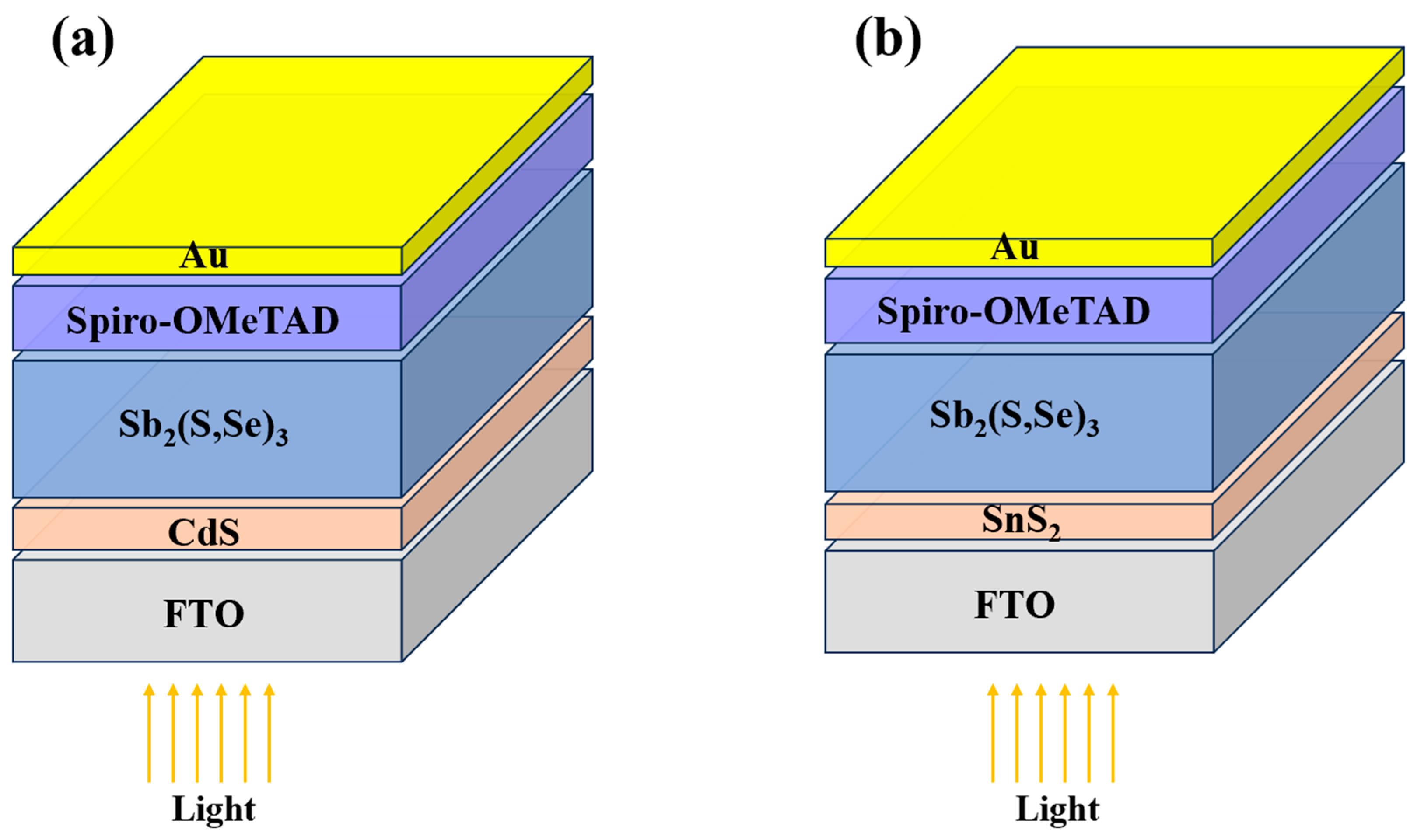
Figure 1. Schematic diagrams of the simulated Sb2(S,Se)3 solar cell with (a) a CdS electron transport layer and (b) an n-type SnS2 electron transport layer.
Electronics 14 04926 g001
Figure 2. Comparative analysis of SnS2 and CdS as ETLs: (a) J-V characteristics; Energy band diagrams of (b) the SnS2-based device and (c) the CdS-based device.
Electronics 14 04926 g002
Figure 3. Influence of sulfur composition on device performance: (a) VOC and JSC, (b) FF and PCE. (ce) The underlying mechanism revealed by energy band diagrams at key S contents (0%, 40%, 100%).
Electronics 14 04926 g003
Figure 4. Evolution of (a) VOC and JSC, and (b) FF and PCE with the thickness of the Sb2(S,Se)3 absorber layer. (ce) Energy band diagrams at key thicknesses of 100 nm, 340 nm, and 420 nm.
Electronics 14 04926 g004
Figure 5. (a) VOC and JSC, and (b) FF and PCE as a function of carrier concentration in the SnS2 layer. (c,d) Energy band diagrams at carrier concentrations of 1015 cm−3 and 1021 cm−3, respectively.
Electronics 14 04926 g005
Table 1. Input parameters for the layers in the modeled Sb2(S,Se)3 solar cell.
ParameterFTOSb2(S,Se)3Spiro-oMeTADCdSSnS2
Thickness (nm)230260906250
εr914.3831010
χ (eV)4.84.0124.54.24
Eg (eV)3.71.4932.42.24
NC (cm−3)2.2 × 10182.2 × 10182.5 × 10182.2 × 10182.2 × 1018
NV (cm−3)1.8 × 10191.8 × 10201.8 × 10191.8 × 10191.8 × 1019
µe [cm2/Vs]20141.0 × 10−410050
µp [cm2/Vs]102.62.0 × 10−42550
NA (cm−3)1.0 × 10145.0 × 1018
ND (cm−3)1.0 × 10204.0 × 10171017
v t h e [cm/s]1.0 × 1071.0 × 1071.0 × 10181.0 × 1071.0 × 107
v t h p [cm/s]1.0 × 1071.0 × 1071.0 × 10181.0 × 1071.0 × 107
Table 2. Simulation parameters for bulk defect properties in the solar cell.
Defect
Parameters
FTOSb2(S,Se)3Spiro-oMeTADCdSSnS2
Defect 1Defect 2
TypeSingle acceptorSingle acceptorSingle acceptorSingle acceptorSingle donorSingle acceptor
Nt1.0 × 10151.3 × 10141.0 × 10151.0 × 10181.0 × 10141.0 × 1012
σe (cm2)1.0 × 10−151.99 × 10−141.99 × 10−141.0 × 10−153.0 × 10−153.0 × 10⁻¹⁵
σh (cm2)1.0 × 10−151.99 × 10−141.99 × 10−141.0 × 10−152.0 × 10−142.0 × 10⁻¹⁴
Table 3. Simulated electrical parameters of series and shunt resistances.
RS (Ω·cm−2)3.7
RSH (Ω·cm−2)751.2
Table 4. CBO and VBO values of the CdS-based and SnS2-based solar cells.
ParameterΔEC (eV)ΔEV (eV)
CdS0.491.40
SnS20.230.98
Disclaimer/Publisher’s Note: The statements, opinions and data contained in all publications are solely those of the individual author(s) and contributor(s) and not of MDPI and/or the editor(s). MDPI and/or the editor(s) disclaim responsibility for any injury to people or property resulting from any ideas, methods, instructions or products referred to in the content.