Article

Dual-Band Dual-Mode Antenna Without Extra Feeding Network Based on Characteristic Mode Analysis for Vehicular Applications

1
School of Information and Communication Engineering, Communication University of China, Beijing 100024, China
2
School of Integrated Circuits, Beijing University of Posts and Telecommunications, Beijing 100876, China
3
School of Information Technology, Beijing City University, Beijing 100083, China
*
Author to whom correspondence should be addressed.
Electronics 2025, 14(24), 4927; https://doi.org/10.3390/electronics14244927
Submission received: 13 November 2025 / Revised: 10 December 2025 / Accepted: 12 December 2025 / Published: 16 December 2025
(This article belongs to the Special Issue AI-Driven IoT: Beyond Connectivity, Toward Intelligence)

Abstract

In this study, a dual-band dual-mode antenna without any complex feeding network is proposed. The proposed antenna is a type of cascaded cavity antenna, which introduces periodically arranged shorting vias. Using characteristic mode analysis (CMA), the modal behaviors of the proposed antenna without external sources, including modal significance, modal radiation patterns, and modal currents, are analyzed in detail. By setting two properly placed coaxial ports based on CMA, a dual-band antenna with different radiation patterns is realized by exciting different modes at low- and high-frequency bands, allowing the proposed antenna to have a pattern diversity characteristic. Meanwhile, when port 1 is excited, the radiation patterns at 3 and 5 GHz are symmetrical to the radiation patterns when port 2 is excited and vice versa. The prototype is fabricated and investigated experimentally. A good agreement between the simulated and measured results proves the effectiveness and practicality of the proposed antenna.

1. Introduction

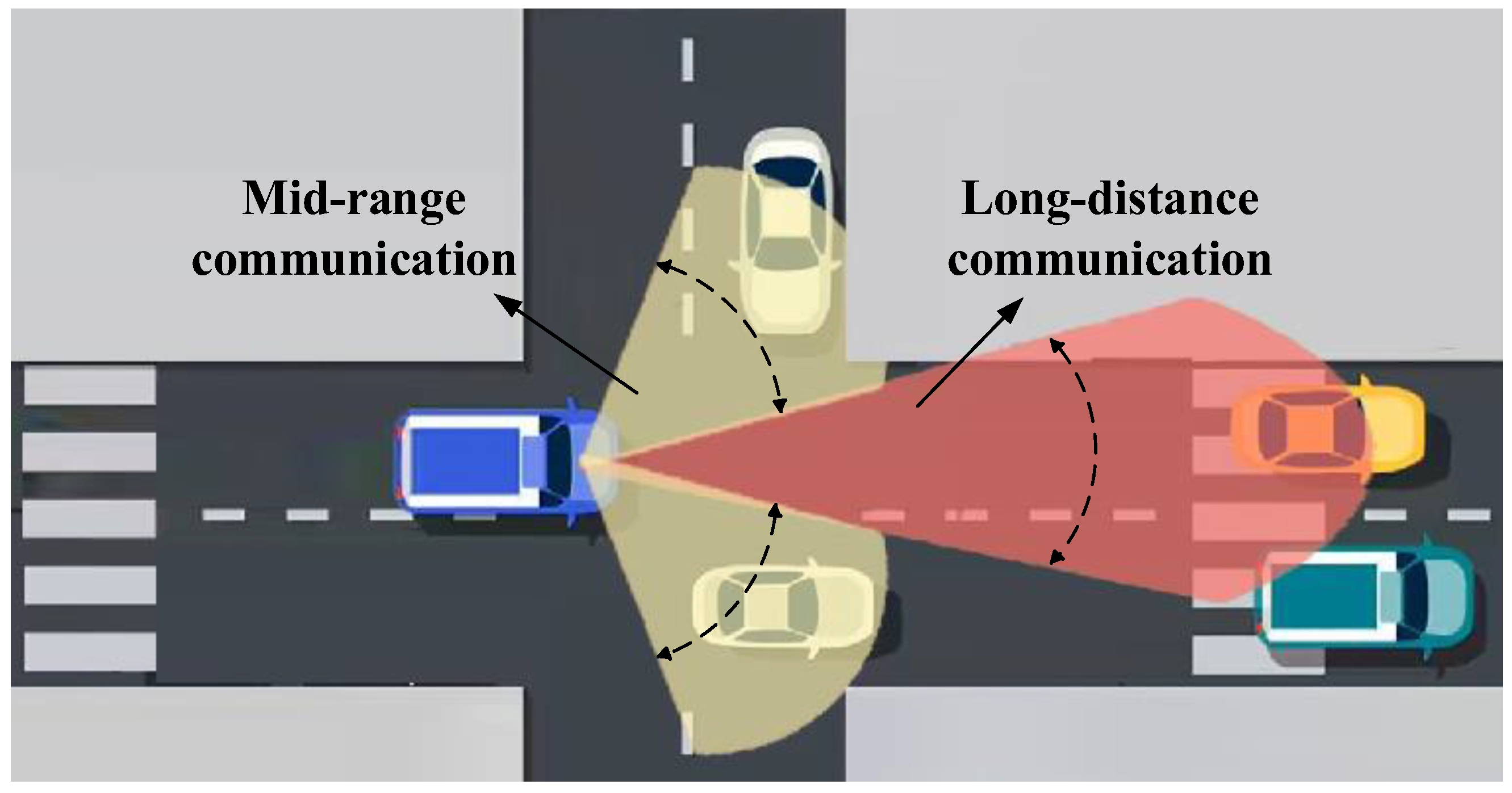
Pattern diversity antennas have attracted more and more attention, since they can reduce channel correlation and increase communication capacity by exploiting multipath effects. For this reason, pattern diversity antennas have great potential to be applied in vehicular communication, as shown in Figure 1 [1,2].
Several methods are reported for making the designed antenna achieve the pattern diversity function. The first method involves combining two identical antennas with endfire radiation patterns. For example, pattern diversity antennas can be realized by placing two Yagi–Uda-type antennas back to back with a common reflector [3,4]. By exciting different feed ports, similar radiation patterns with opposite orientations could be obtained. The second way consists of applying in-phase and out-of-phase signals at feed ports, which can make the antenna achieve pattern diversity. In [5], a planar UWB Vivaldi-type slot antenna could achieve boresight radiation patterns and those in the bilateral direction by applying out-of-phase and in-phase excitation, respectively. A compact two-port feed network was also designed to provide the in-phase and out-of-phase signals to the MIMO antenna to realize pattern diversity [6]. Another method involves the use of different modes of antennas. Ref. [7] proposed a circular patch antenna with pattern diversity. The TM11 mode of the patch could be excited by two feeding loops with in-phase current, which radiates the broadside beam. The TM01 mode could be excited by another set of feeding loops with antiphase current, which radiates a conical beam. In [8], the TM10 and capacitive load monopole radiating modes could be excited, making the single-patch antenna have broadside and conical radiation patterns. A cylindrical pattern diversity dielectric resonator antenna was designed by exciting the HEM11δ and TM modes [9]. By controlling the feeding states of the monopole and dipole elements, a pattern-reconfigurable Yagi antenna with four modes (omnidirectional, broadside, and two tilted patterns) was realized in [10]. Switching two operation modes with PIN diodes, directional and omnidirectional radiation could be achieved [11]. Recently, CMA has also been utilized to design pattern diversity antennas by exciting desired modal currents [12].
Figure 1. Pattern diversity antenna used in vehicular communication scheme.
Electronics 14 04927 g001
Compared with the former two methods, the third method, exploiting different radiation modes, has more design flexibility. However, the biggest disadvantage of the third method is that the structure of the feeding network is more complex for stimulating different radiation modes [7,8,9,10,11,12].
All the aforementioned designs are single-band pattern diversity antennas. Nowadays, dual-band antennas with pattern diversity within both bands draw more and more attention since they can effectively reduce the number and volume of required antennas [13,14,15,16,17] and offer multi-functional services. A single dual-band antenna with different radiation functionalities can be used in globe positioning systems [13], body-centric communications [14], vehicular-to-X communications [15], and so on.
Therefore, this study aims to design a dual-band dual-mode antenna without a complex feeding network. The radiation patterns at two frequency bands are different. The specific theoretical analysis and design steps of the proposed antenna are shown in Section 2. Section 3 describes the simulation and measurement results of the proposed antenna. Finally, a conclusion is drawn in Section 4.

2. Antenna Design

2.1. The Design of the Proposed Antenna

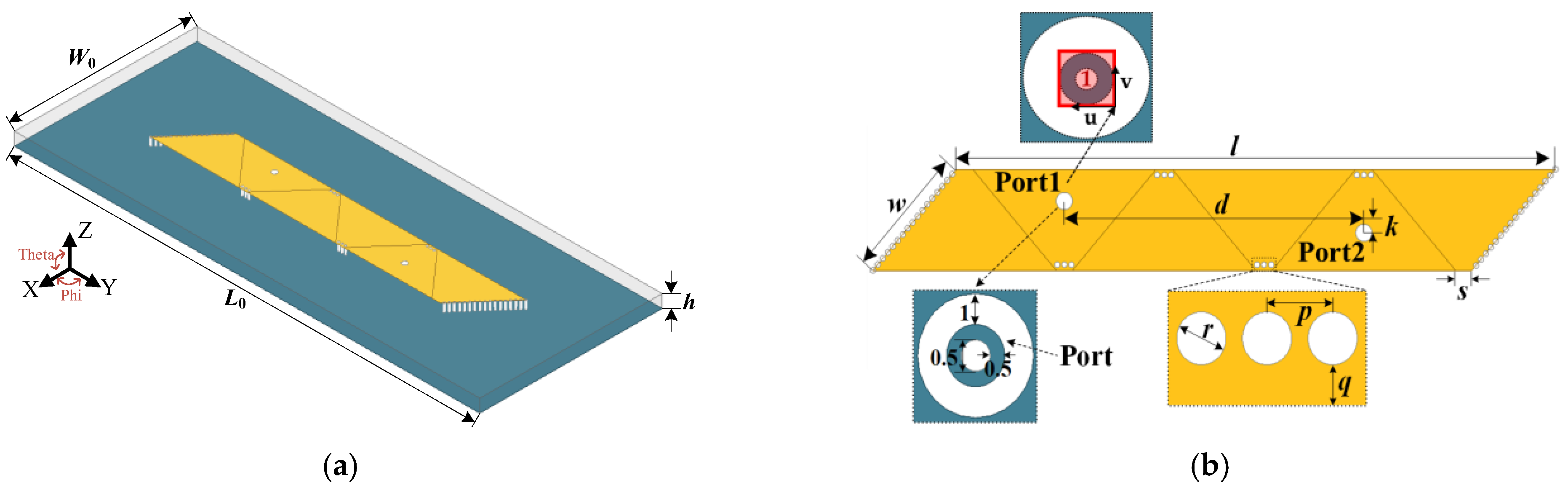
A cascaded cavity antenna is adopted in the proposed design since it has a simple structure, low cost, and high gain features [18,19]. The structure of the proposed antenna is shown in Figure 2a with specific parameters. The proposed antenna is constructed on an F4B substrate with a relative dielectric constant of 3 and thickness of 3 mm. It is composed of a parallelogram-shaped microstrip line, multiple sets of vias, two feeding ports, and a ground plane. The parallelogram-shaped microstrip line is composed of six triangular patch units. Two rows of metal pillars are shorted to the head and tail of the microstrip line, and four groups of vias are alternately distributed on both sides of it, which aims to form a cavity structure and obtain a pure field distribution. The radius of each shorting pillar is 0.35 mm, and the inter-element spacing is 1 mm. The enlarged feeding structure and vias are illustrated in Figure 2b.
Figure 2. Geometry of proposed antenna, (a) perspective view, (b) top view. (Unit: mm; W0 = 100; L0 = 238.52; h = 3; l = 111; w = 23.38; k = 5.4; s = 3; p = 1; q = 0.55; r = 0.7; d = 55.5).
Electronics 14 04927 g002

2.2. CMA of Proposed Antenna

CMA is a powerful method that assists in antenna design and optimization, which can reveal the modal behavior of the radiation structure [20]. Therefore, one can select the best feeding position to excite the required mode based on the resonance and radiation characteristics of different modes. CMA is a source-free analysis method. The induced currents on the object can be written as a superposition of the characteristic currents:
J = n α n J n
where αn is the modal weighting coefficient, and it can be defined as follows [21,22]:
α n = J n , E i 1 + j λ n = V n i 1 + j λ n
The numerator 〈J, E〉 represents the inner product between the nth-order modal current J and the external excitation field E, which is the modal excitation coefficient V n i , used to measure the contribution of mode Jn to the total current. λn is the eigenvalue of Jn, and n denotes the index of the order of each mode. Modal significance (MS) is defined as follows [21]:
M S = 1 1 + j λ n
where the value range of MS is (0, 1]. MS represents the intrinsic radiation capability of each mode and the coupling ability of each mode with external sources. When MS is closer to 1, it means that the mode is closer to the resonance state. When it is farther from 1, it means that the mode is far away from the resonance state and that it is difficult to excite it to produce effective radiation. Note that the CMA results are obtained using the Computer Simulation Technology (CST) eigenmode solver.
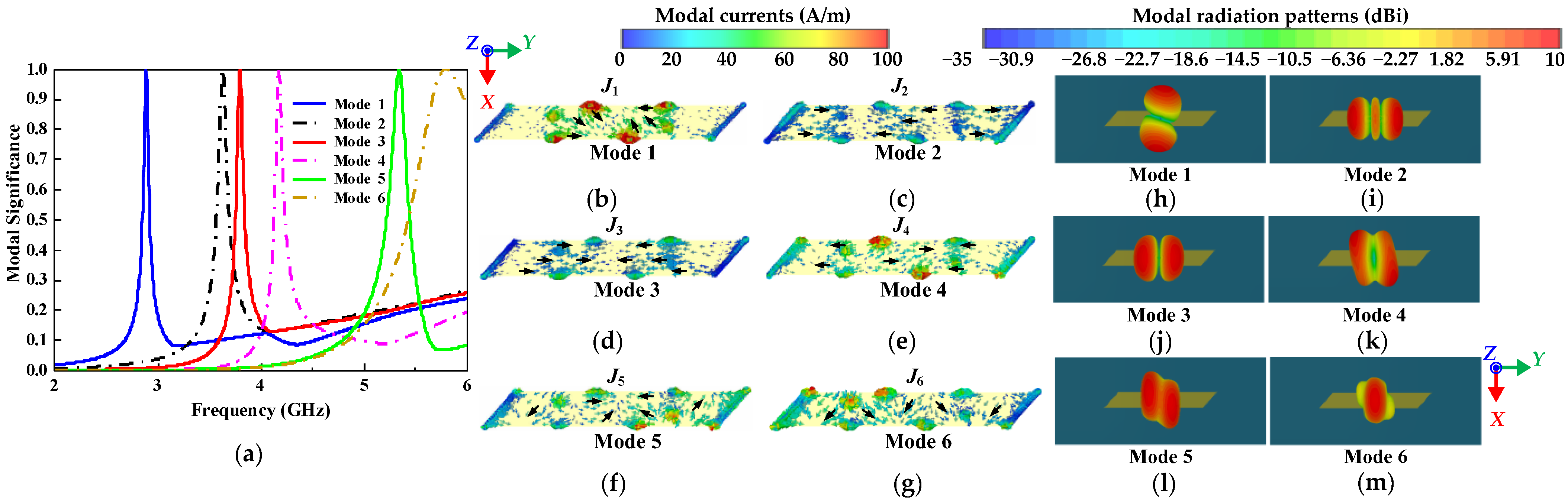
Based on CMA, the MS of the parallelogram patch at 2–6 GHz is calculated. As shown in Figure 3a, the resonance frequencies of the six modes are 2.890, 3.630, 3.798, 4.178, 5.346, and 5.798 GHz. These six modes are significant over the band of interest, and the corresponding resonant modal radiation patterns and modal currents are depicted in Figure 3b–m. As shown, J1 and J3 are almost symmetrical, and two lobes can be observed. For the modes of J5 and J6, the currents converge in the x direction; thus the main lobes are in the normal direction.
According to Figure 1, vehicle communication needs to meet the requirements of mid-range communication and long-range communication at the same time [2,15]. For mid-range communication, two tilted beams are required. Namely, this corresponds to the traffic scheme at an intersection. From Figure 3h, it can be observed that the modal radiation pattern of Mode 1 is quite suitable for this scene. Meanwhile, for long-range communication, a directional beam is required. In this case, this corresponds to the situation when the vehicle is driving in a straight line. From Figure 3l,m, it can be found that the modal radiation patterns of Mode 5 and Mode 6 are matched for this scene. Nevertheless, Mode 5 has a wider beam bandwidth in the XOZ and YOZ directions than that of Mode 6. Therefore, in this study, Mode 1 and Mode 5 are the desired modes to achieve radiation patterns with two lobes and one directional lobe, respectively. This mode selection aligns with IEEE 802.11p and 3GPP V2X recommendations, which advocate tailoring beam characteristics to the specific communication distance and geometric environment [23].
Figure 3. The CMA results, (a) the MS of the proposed antenna; (bg) the modal currents of the proposed antenna, where black arrows indicate the current direction; (hm) the modal radiation patterns of the proposed antenna.
Electronics 14 04927 g003

2.3. The Feeding Design of the Proposed Antenna
Both long-distance and mid-range communications are essential to vehicle safety. Therefore, Modes 1 and 5 are expected to be fully used in this study. To excite Modes 1 and 5, an appropriate feeding strategy should be designed.
The modal current is almost odd symmetrical for Mode 1 and Mode 5 from Figure 3h and Figure 3l, respectively. If the antenna is fed by two symmetrical ports, the corresponding current distribution can be approximated to that of Mode 1 and Mode 5. Hence, we can adopt two feeding ports in this work. From Figure 3a, it is observed that two resonance points of Modes 1 and 5 are around 3 and 5 GHz. The validity of the CMA can hereby be proven.
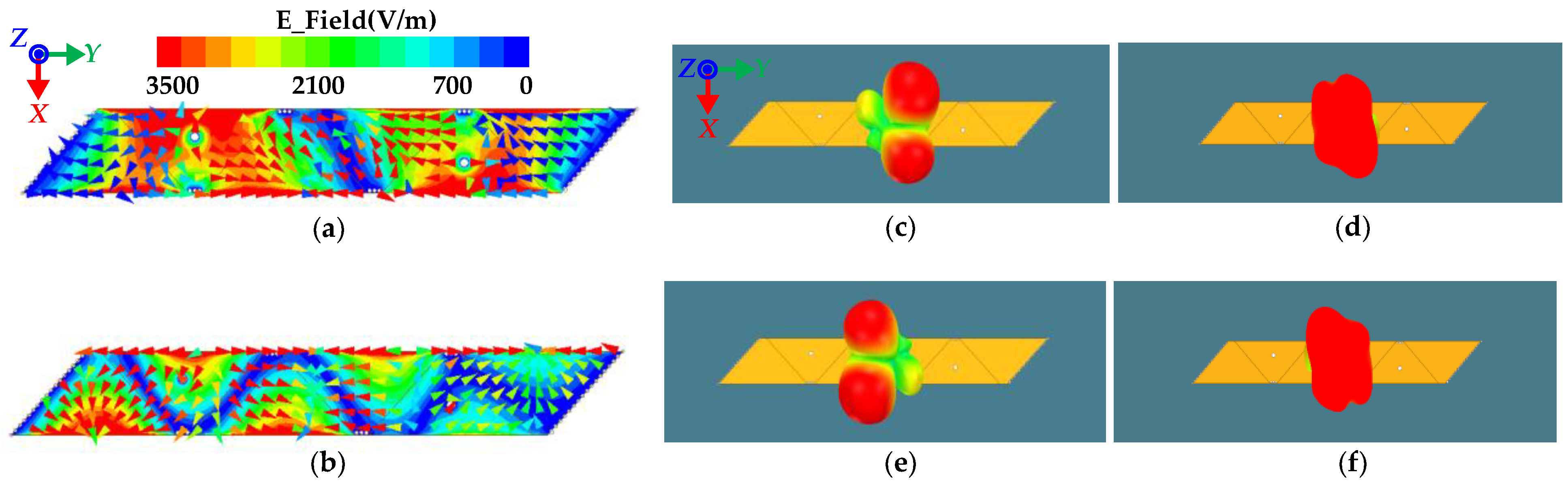
The antenna is excited through two 50 Ω coaxial ports (port 1 and port 2). In simulation and measurement, a standard 1 V Gaussian pulse source was used to excite one port at a time, while the other port was terminated with a 50 Ω matched load. The electric field distributions of the proposed antenna at 3 and 5 GHz are shown in Figure 4a,b when port 1 is excited. At 3 GHz, the electric field distribution of the antenna patch is approximately odd symmetrical, while the amplitude of the electric field at the center is quite low based on Figure 4a. The corresponding current distribution (focus on the current areas with high amplitude, i.e., red arrows) can be approximated to that of Mode 1. Hence, the 3D radiation pattern with two lobes is achieved, as can be seen in Figure 4c. The maximum radiation directions are theta1 = 48°, phi1 = 150° and theta2 = −48°, phi2 = −30°
Based on the electric field distribution at 5 GHz, from Figure 4b, it is found that two radiation edges of the proposed antenna are excited effectively. In addition, the current distribution is in good agreement with that of Mode 5. Figure 4d shows the corresponding 3D radiation pattern with a directional lobe. The maximum radiation direction is theta = 27°, phi = 36° in this case. In addition, when port 2 is excited, the 3D radiation patterns at 3 and 5 GHz are symmetrical with the above situation, as can be seen from Figure 4c–f. Namely, beam scanning can be achieved by exciting different feed ports of the proposed antenna.
Figure 4. The electric field and current distribution of the proposed antenna at (a) 3 GHz and (b) 5 GHz, and the 3-D radiation pattern at (c) 3 and (d) 5 GHz when port 1 is excited. (e,f) show the 3-D ra-diation patterns when port 2 is excited.
Electronics 14 04927 g004
To sum up, the simulated current distributions at 3 and 5 GHz are in good agreement with the current distributions based on CMA. Therefore, the pattern diversity of the proposed antenna can be realized. The simulated 3D radiation pattern has little deviation with the CMA due to the introduction of two feeding ports.

3. Fabrication and Measurement

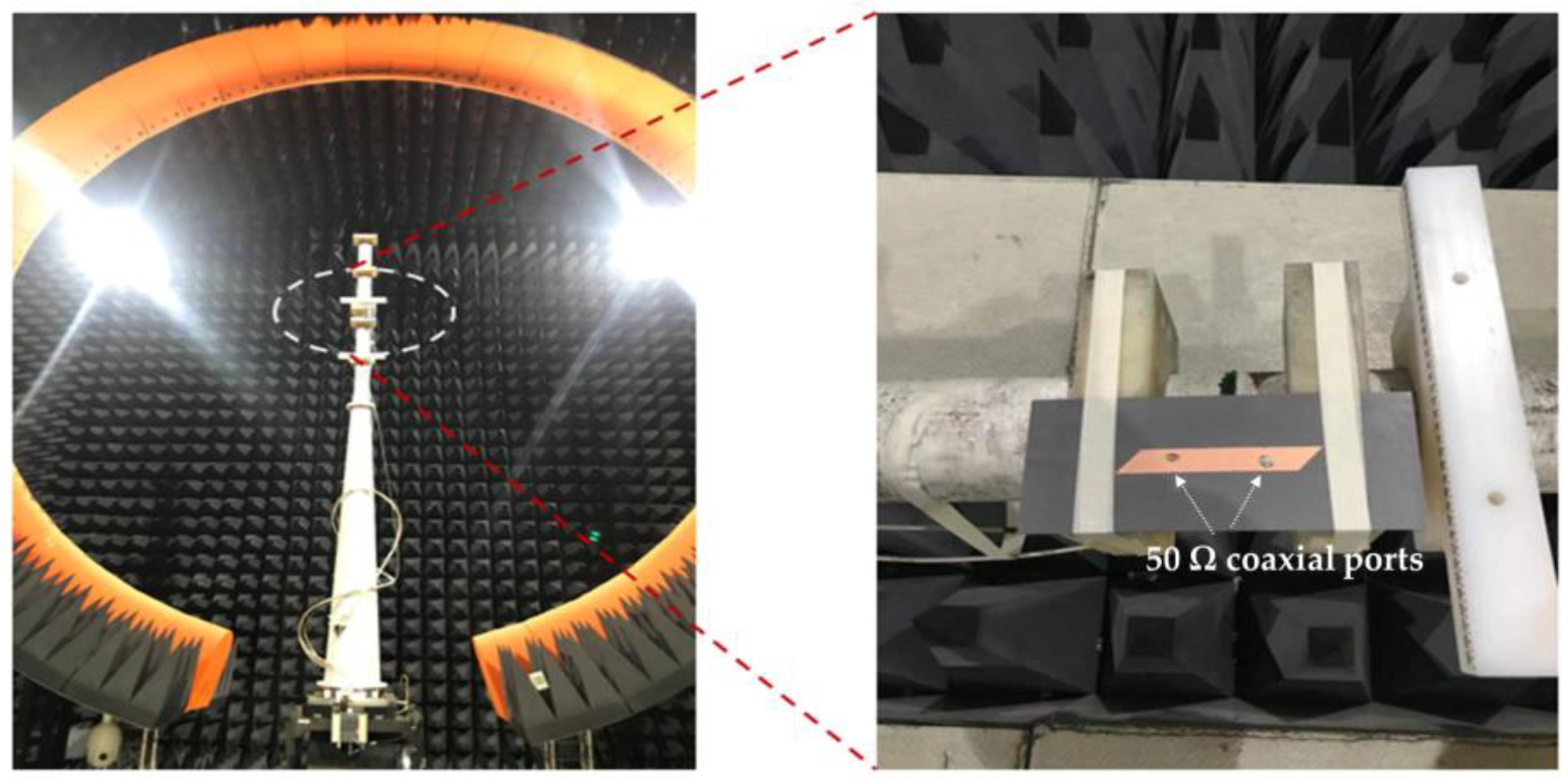
A dual-band antenna prototype is fabricated and measured for demonstration. A photograph of the proposed antenna is shown in Figure 5. The reflection coefficients and far-field radiation performances of this fabricated antenna are measured by Vector Network Analyzer (Agilent E5071C, Keysight Technologies Vietnam Company Limited, Hanoi City, Vietnam) and the SATIMO measurement system (MVG, Inc., Marietta, GA, USA) in a microwave anechoic chamber, respectively.
Figure 5. Test scenario diagram in microwave anechoic chamber.
Electronics 14 04927 g005
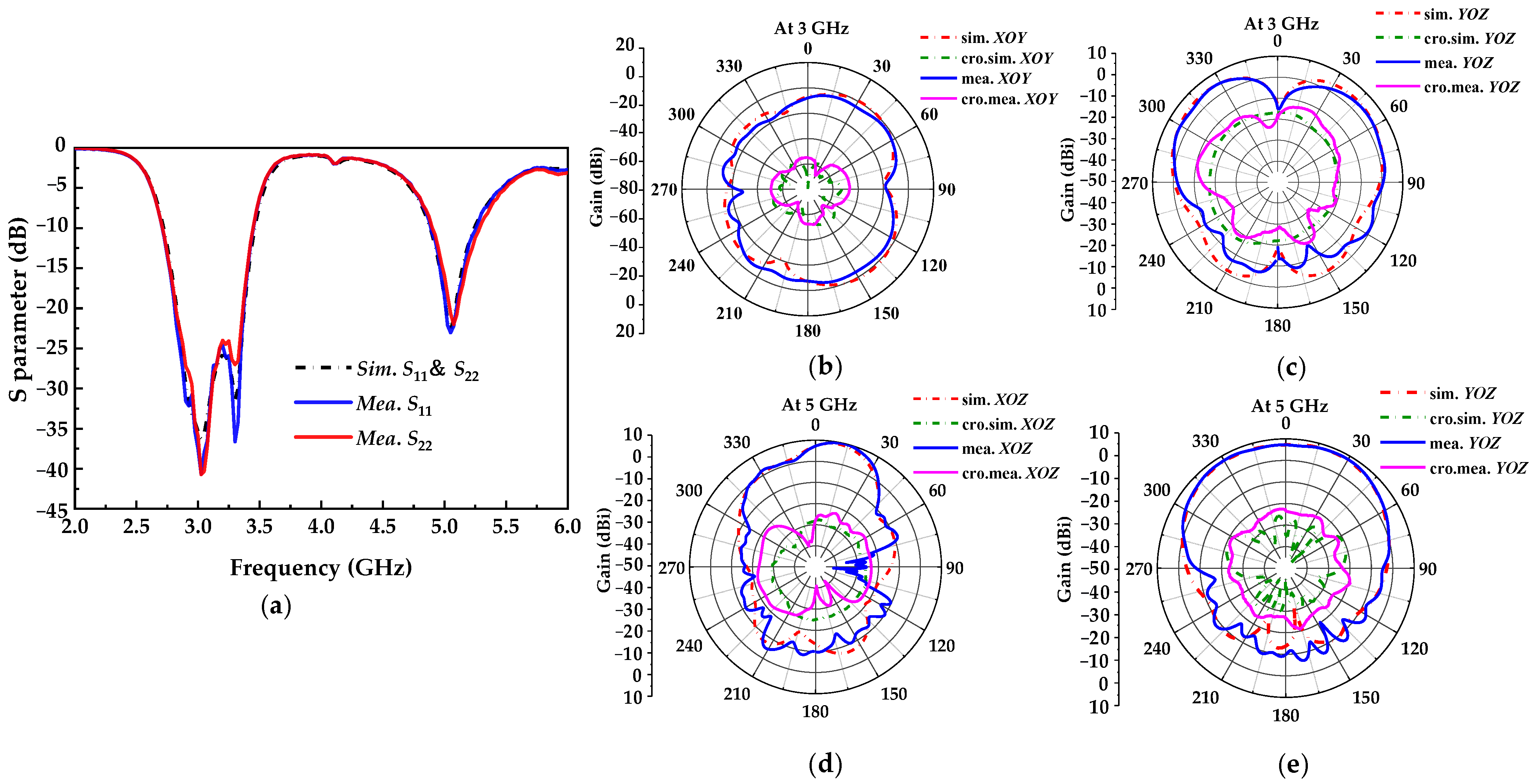
Figure 6a shows that the simulated and measured return losses are highly consistent. The measured (simulated) 10 dB impedance bandwidths are 2.73–3.42 GHz (2.73–3.45 GHz) and 4.91–5.28 GHz (4.9–5.23 GHz). Hence, the dual-band performance of the proposed antenna is attained. The simulated and measured 2-D radiation patterns at 3 GHz in the XOY and YOZ planes and 5 GHz in the XOZ and YOZ planes are presented in Figure 6b–e. Since the antenna is relatively symmetrical, we only show the radiation patterns when port 1 is excited and port 2 is connected to a 50 Ω matched load. At 3 GHz, the 2-D radiation pattern has two lobes. The measured and simulated peak gains are 4.92 and 5.18 dBi, respectively. The two measured lobes occur at theta = 53° and −36°, while the simulated ones occur at theta = 42° and −42°. At 5 GHz, the 2-D radiation pattern has one lobe. The measured and simulated peak gains are 8.83 and 9.10 dBi and occur at theta = 12° and 9°, respectively. Therefore, pattern diversity is obtained. Compared with the cascaded cavity antennas in [18,19], the proposed antenna has dual-band and pattern diversity functions.
Figure 6. (a) Measured and simulated reflection coefficients and measured and simulated 2-D radiation patterns in (b) XOY and (c) YOZ planes at 3 GHz and (d) XOZ and (e) YOZ planes at 5 GHz.
Electronics 14 04927 g006
To comprehensively evaluate the performance and practical feasibility of the proposed antenna, Table 1 compares it with several reported dual-band pattern diversity antennas. In addition to conventional metrics such as operating bands, fractional bandwidth, and peak gain, two aspects—structural complexity and fabrication cost—are introduced for a more holistic assessment. In [13], a single-layer circular patch with a shorting pin and arc-shaped slots is used, resulting in medium structural complexity, while its fabric and PDMS flexible substrate contribute to its low fabrication cost. The antenna in [15] employs a stacked-patch structure with air layers and 12 shorting vias, leading to high structural complexity, and its metal-based construction with mechanical assembly results in medium cost. The design in [16] utilizes a multi-layer microstrip array with four open-ended slots, exhibiting medium structural complexity, and its Rogers substrate with etching processes leads to medium fabrication cost. In contrast, the proposed CMA-based cascaded cavity antenna uses a parallelogram-shaped patch with multiple shorting pillars to form a cavity structure, which is categorized as medium in structural complexity. Its single-layer F4B substrate and standard PCB process contribute to its low fabrication cost. Moreover, the proposed antenna achieves a notably high fractional bandwidth of 23.0% at the lower band, with peak gains of 5.18 dBi and 9.10 dBi at 3 GHz and 5 GHz, respectively. In summary, while maintaining good electrical performance, the proposed antenna demonstrates clear advantages in structural implementation and cost-effectiveness, making it more suitable for space- and cost-constrained vehicular communication scenarios.

4. Conclusions

In this study, a dual-band dual-mode antenna is proposed by alternatively and periodically shorting the edges of a transmission line based on CMA. From the electric field and current distribution of the two operating frequency bands, it is observed that their working modes are different, which leads to pattern diversity. At the lower-frequency band, the radiation pattern has two beams since the electric field distribution at the center of the parallelogram-shaped patch is quite low. At the higher-frequency band, the radiation pattern is broadside because the two long radiation edges can be excited effectively. Additionally, beam scanning can be achieved by exciting different feeding ports of the proposed antenna without adding an extra complex feeding network. Therefore, the proposed antenna has the merits of fabrication convenience, low cost, light weight, dual band, pattern diversity, and beam scanning, which means that it has great application potential in modern wireless vehicular communication systems.

Author Contributions

Conceptualization, Q.D. and H.Z.; methodology, Q.D. and C.W.; software, Q.D.; validation, C.W.; formal analysis, J.S.; investigation, Q.D. and H.Z.; resources, Q.D. and C.W.; data curation, Q.D.; writing—original draft preparation, Q.D.; writing—review and editing, Q.D. and C.W.; visualization, Q.D.; supervision, J.S. and Z.Z.; project administration, Z.Z. All authors have read and agreed to the published version of the manuscript.

Funding

This research was supported by the Sustained Development Fund of Beijing City University, grant number KYXH202406.

Data Availability Statement

Data are contained within the article.

Conflicts of Interest

The authors declare no conflicts of interest.

Abbreviations

The following abbreviations are used in this manuscript:
CMAcharacteristic mode analysis
MSmodal significance
CSTComputer Simulation Technology

References

  1. Liu, J.; Weng, Z.; Zhang, Z.-Q.; Qiu, Y.; Zhang, Y.-X.; Jiao, Y.-C. A Wideband Pattern Diversity Antenna with a Low Profile Based on Metasurface. IEEE Antennas Wirel. Propag. Lett. 2021, 20, 303–307. [Google Scholar] [CrossRef]
  2. Alsath, M.G.N.; Lawrance, L.; Kanagasabai, M.; Rajendran, D.B.; Moorthy, B.; George, J.V. Quad-Band Diversity Antenna for Automotive Environment. IEEE Antennas Wirel. Propag. Lett. 2015, 14, 875–878. [Google Scholar] [CrossRef]
  3. Bhattacharya, R.; Garg, R.; Bhattacharyya, T.K. Design of a PIFA-Driven Compact Yagi-Type Pattern Diversity Antenna for Handheld Devices. IEEE Antennas Wirel. Propag. Lett. 2016, 15, 255–258. [Google Scholar] [CrossRef]
  4. Bhattacharya, R.; Garg, R.; Bhattacharyya, T.K. A Compact Yagi-Uda Type Pattern Diversity Antenna Driven by CPW-Fed Pseudomonopole. IEEE Trans. Antennas Propag. 2016, 64, 25–32. [Google Scholar] [CrossRef]
  5. Dong, Y.; Choi, J.; Itoh, T. Vivaldi Antenna with Pattern Diversity for 0.7 to 2.7 GHz Cellular Band Applications. IEEE Antennas Wirel. Propag. Lett. 2018, 17, 247–250. [Google Scholar] [CrossRef]
  6. Xu, Z.; Deng, C. High-Isolated MIMO Antenna Design Based on Pattern Diversity for 5G Mobile Terminals. IEEE Antennas Wirel. Propag. Lett. 2020, 19, 467–471. [Google Scholar] [CrossRef]
  7. Cui, L.; Wu, W.; Fang, D. Wideband Circular Patch Antenna for Pattern Diversity Application. IEEE Antennas Wirel. Propag. Lett. 2015, 14, 1298–1301. [Google Scholar] [CrossRef]
  8. Sun, L.; Zhang, G.; Sun, B.; Tang, W.; Yuan, J. A Single Patch Antenna with Broadside and Conical Radiation Patterns for 3G/4G Pattern Diversity. IEEE Antennas Wirel. Propag. Lett. 2016, 15, 433–436. [Google Scholar] [CrossRef]
  9. Yang, N.; Leung, K.W. Compact Cylindrical Pattern-Diversity Dielectric Resonator Antenna. IEEE Antennas Wirel. Propag. Lett. 2020, 19, 19–23. [Google Scholar] [CrossRef]
  10. Wang, Z.; Ning, Y.; Dong, Y. Compact Shared Aperture Quasi-Yagi Antenna with Pattern Diversity for 5G-NR Applications. IEEE Trans. Antennas Propag. 2020, 69, 4178–4183. [Google Scholar] [CrossRef]
  11. Lu, P.; Yang, X. Pattern Reconfigurable Rectenna with Omni-Directional/Directional Radiation Modes for MPT With Multiple Transmitting Antennas. IEEE Microw. Wirel. Compon. Lett. 2019, 29, 826–829. [Google Scholar] [CrossRef]
  12. Zheng, Y.; Yan, S. A Low-Profile Half-Mode Annular Microstrip Antenna with Pattern Diversity. IEEE Antennas Wirel. Propag. Lett. 2020, 19, 1739–1743. [Google Scholar] [CrossRef]
  13. Simorangkir, R.B.V.B.; Yang, Y.; Matekovits, L.; Esselle, K.P. Dual-Band Dual-Mode Textile Antenna on PDMS Substrate for Body-Centric Communications. IEEE Antennas Wirel. Propag. Lett. 2017, 16, 677–680. [Google Scholar] [CrossRef]
  14. Lin, S.; Huang, K. A compact microstrip antenna for GPS and DCS application. IEEE Trans. Antennas Propag. 2005, 53, 1227–1229. [Google Scholar] [CrossRef]
  15. Ge, L.; Gao, S.; Li, Y.; Qin, W.; Wang, J. A Low-Profile Dual-Band Antenna with Different Polarization and Radiation Properties Over Two Bands for Vehicular Communications. IEEE Trans. Veh. Technol. 2019, 68, 1004–1008. [Google Scholar] [CrossRef]
  16. Mao, C.; Werner, D.H.; Zhang, Y.; Zhang, X. Compact Dual-Band Dual-Mode Antenna with Omni-/Unidirectional Radiation Characteristics. IEEE Antennas Wirel. Propag. Lett. 2019, 18, 2657–2660. [Google Scholar] [CrossRef]
  17. Liu, Z.; Zhu, L.; Liu, N. Design Approach for Compact Dual-Band Dual-Mode Patch Antenna with Flexible Frequency Ratio. IEEE Trans. Antennas Propag. 2020, 68, 6401–6406. [Google Scholar] [CrossRef]
  18. Chang, L.; Li, Y.; Zhang, Z.; Feng, Z. Horizontally Polarized Omnidirectional Antenna Array Using Cascaded Cavities. IEEE Trans. Antennas Propag. 2016, 64, 5454–5459. [Google Scholar] [CrossRef]
  19. Chang, L.; Zhang, Z.; Li, Y.; Feng, Z. Wideband Triangular-Cavity-Cascaded Antennas. IEEE Trans. Antennas Propag. 2016, 64, 2840–2847. [Google Scholar] [CrossRef]
  20. Vogel, M.; Gampala, G.; Ludick, D.; Jakobus, U.; Reddy, C.J. Characteristic Mode Analysis: Putting Physics back into Simulation. IEEE Antennas Propag. Mag. 2015, 57, 307–317. [Google Scholar] [CrossRef]
  21. Wang, C.; Chen, Y.; Yang, S. Application of Characteristic Mode Theory in HF Band Aircraft- Integrated Multiantenna System Designs. IEEE Trans. Antennas Propag. 2019, 67, 513–521. [Google Scholar] [CrossRef]
  22. Harrington, R.; Mautz, J. Theory of characteristic modes for conducting bodies. IEEE Trans. Antennas Propag. 1971, 19, 622–628. [Google Scholar] [CrossRef]
  23. Naik, G.; Choudhury, B.; Park, J. IEEE 802.11bd 5G NR V2X: Evolution of radio access technologies for V2X communications. IEEE Access 2019, 7, 70169–70184. [Google Scholar] [CrossRef]

Table 1. Comparison with other dual-band pattern diversity antennas.
Ref.Band (GHz)FBW (%)
LF/HF
Peak Gain (dBi)
LF/HF
Structural ComplexityFabrication Cost
[13]2.45/5.83.43%/4.26%4.16/4.34MediumLow
[15]~2.5/~3.99.2%/22.1%9.8/~8.1HighMedium
[16]2.45/5.8~8.2%/~10.3%~2/~11MediumMedium
This Work3.0/5.023.0%/7.4%5.18/9.10MediumLow
LF: low-frequency; HF: high-frequency; FBW: fractional bandwidth; Detailed justifications for the structural complexity and fabrication cost ratings, including specific structural descriptions and cost-related factors, are provided in the accompanying text.
Disclaimer/Publisher’s Note: The statements, opinions and data contained in all publications are solely those of the individual author(s) and contributor(s) and not of MDPI and/or the editor(s). MDPI and/or the editor(s) disclaim responsibility for any injury to people or property resulting from any ideas, methods, instructions or products referred to in the content.