Performance Enhancement of Low-Altitude Intelligent Network Communications Using Spherical-Cap Reflective Intelligent Surfaces

 ,
, 
 and
and 
Abstract
1. Introduction
2. Method
2.1. ScRIS Design and Coding Patterns
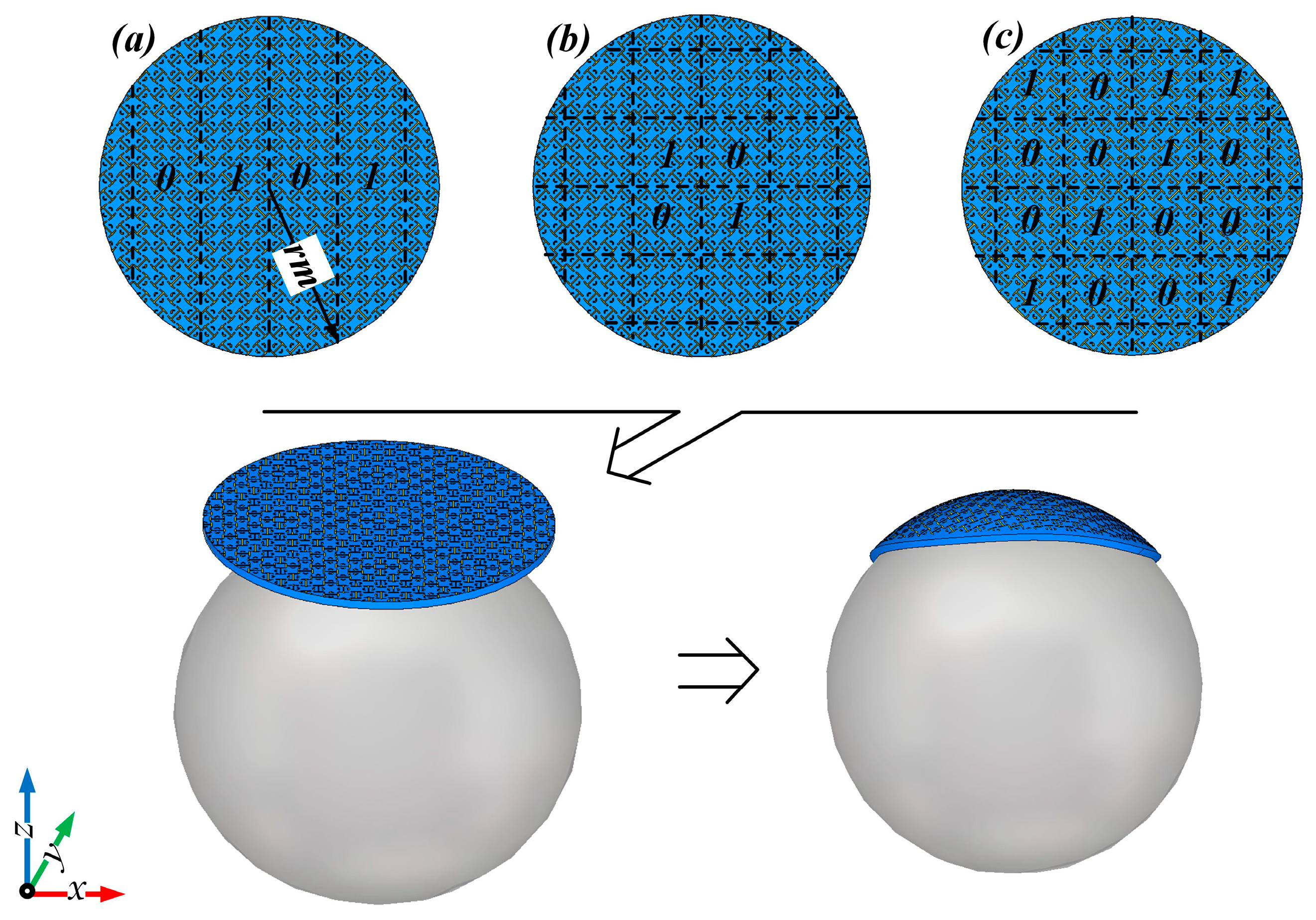
- ‘0’ Element (Phase 0 degree): Characterized by a gap width of h = 0.8 mm in the resonant patch.
- ‘1’ Element (Phase 180 degree): Characterized by a gapless structure (h = 0 mm), providing the required π phase shift relative to the ‘0’ element.
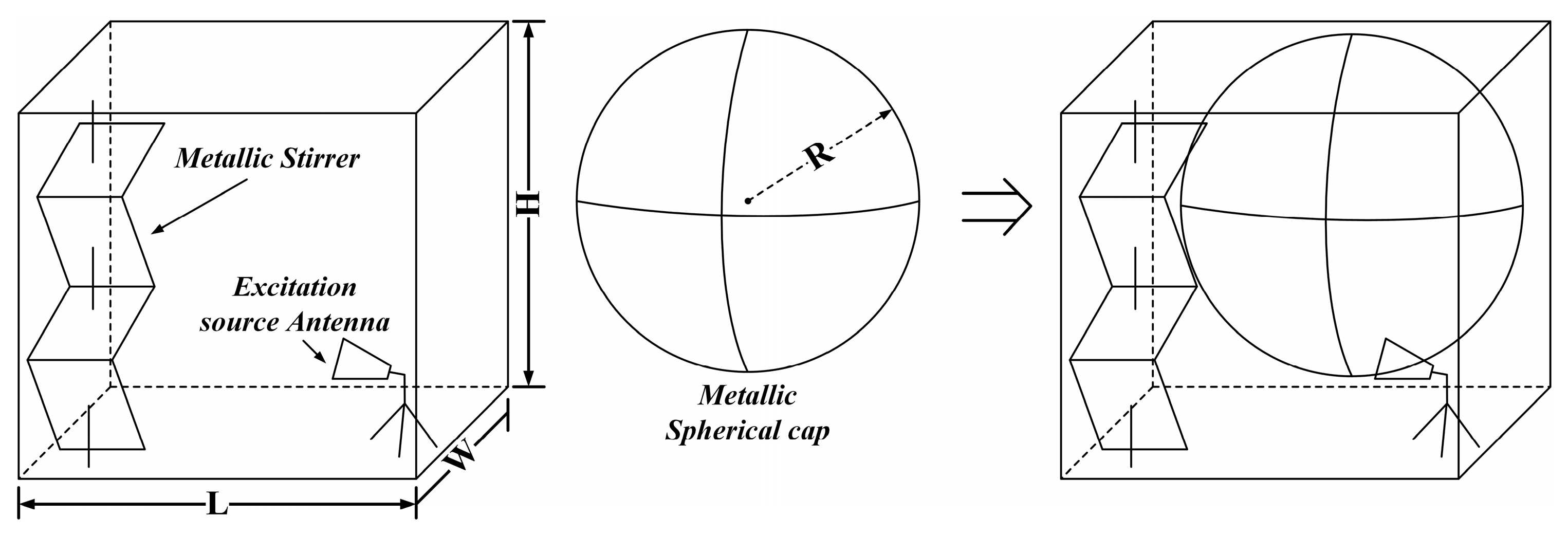
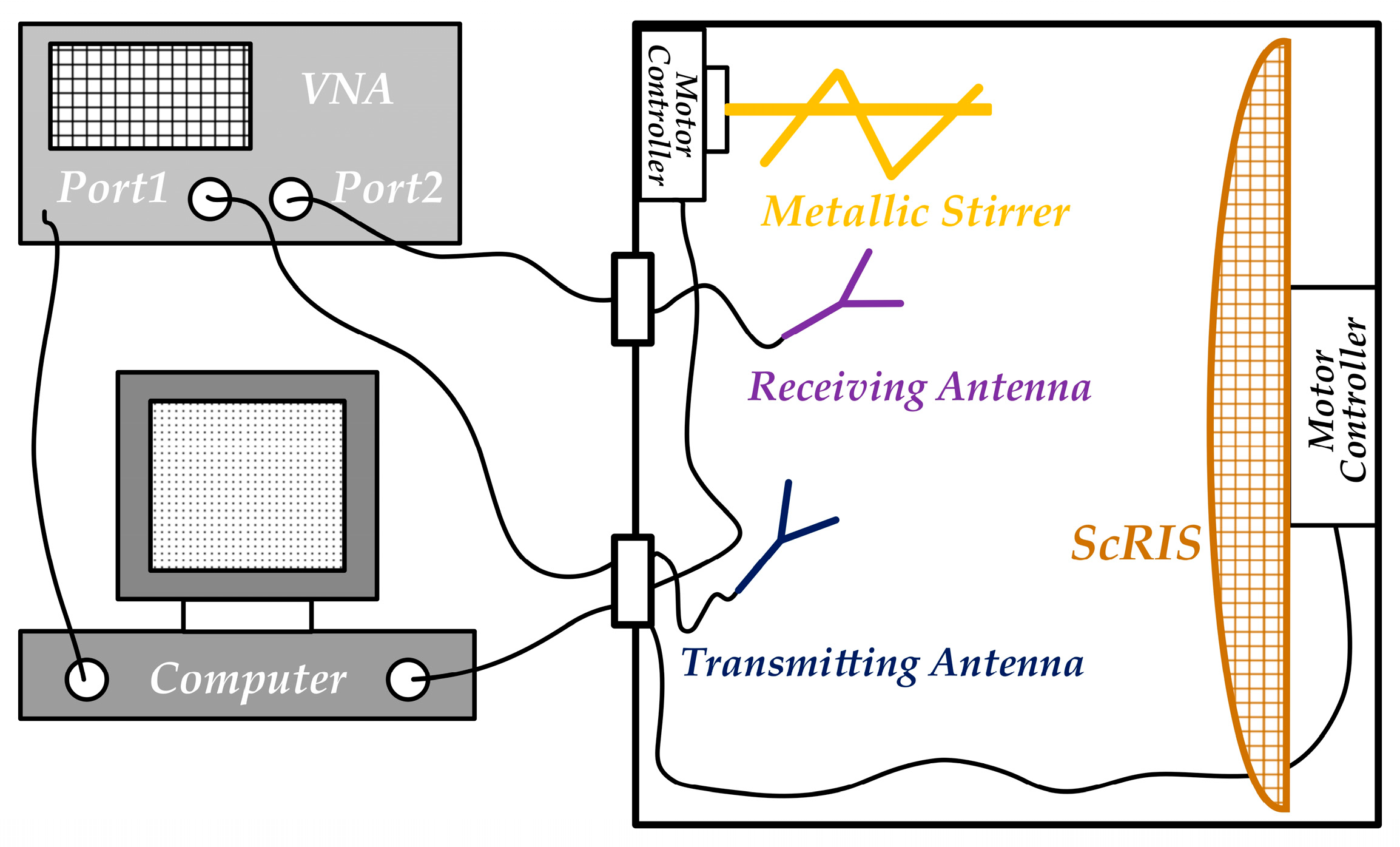
- Antennas: A broadband double-ridged horn antenna was employed simultaneously as both the transmitter (Tx) and the receiver (Rx). It was placed at the corners of the chamber and oriented towards the stirrers to prevent direct line of sight coupling.
- Stirring Sequence: A four-sheet metallic mechanical stirrer was rotated in discrete steps of 6°, resulting in 60 independent stirrer positions per frequency point.
- Field Sampling: The electric field magnitude (|E|) was sampled at a uniform grid of 8 points within the central “working volume” (0.5 × 0.5 × 0.5 m), defined according to IEC 61000-4-21 standards to be sufficiently distant (>λ/4) from the chamber walls and the ScRIS.
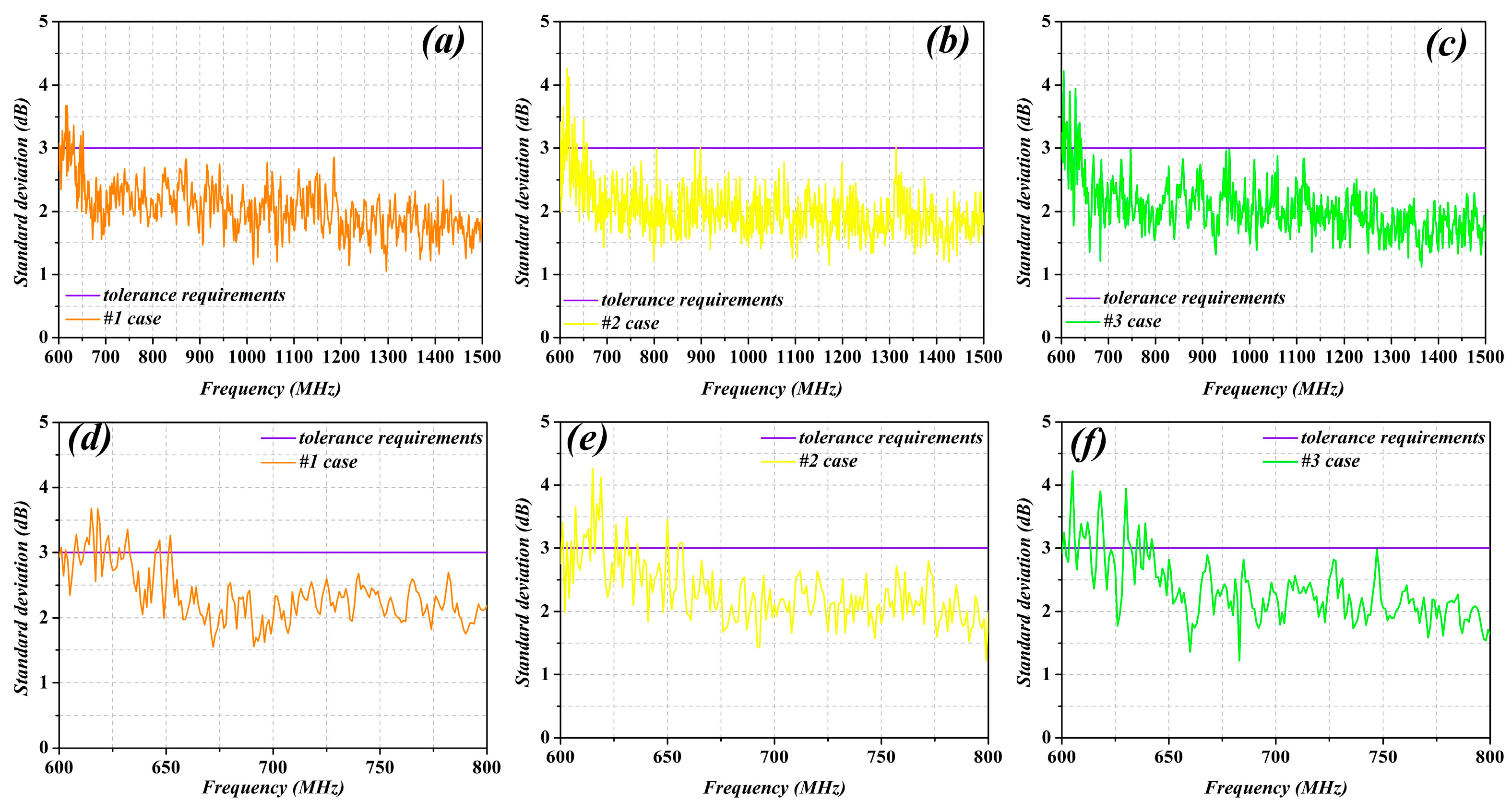
- Averaging: The S21 were averaged over the stirrer positions to compute the field uniformity standard deviation (STD).
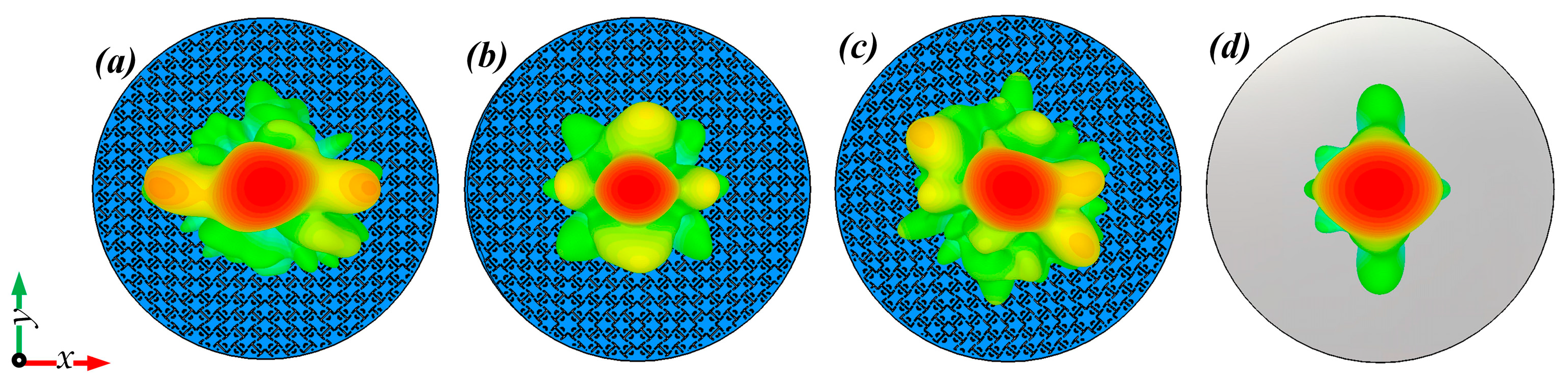
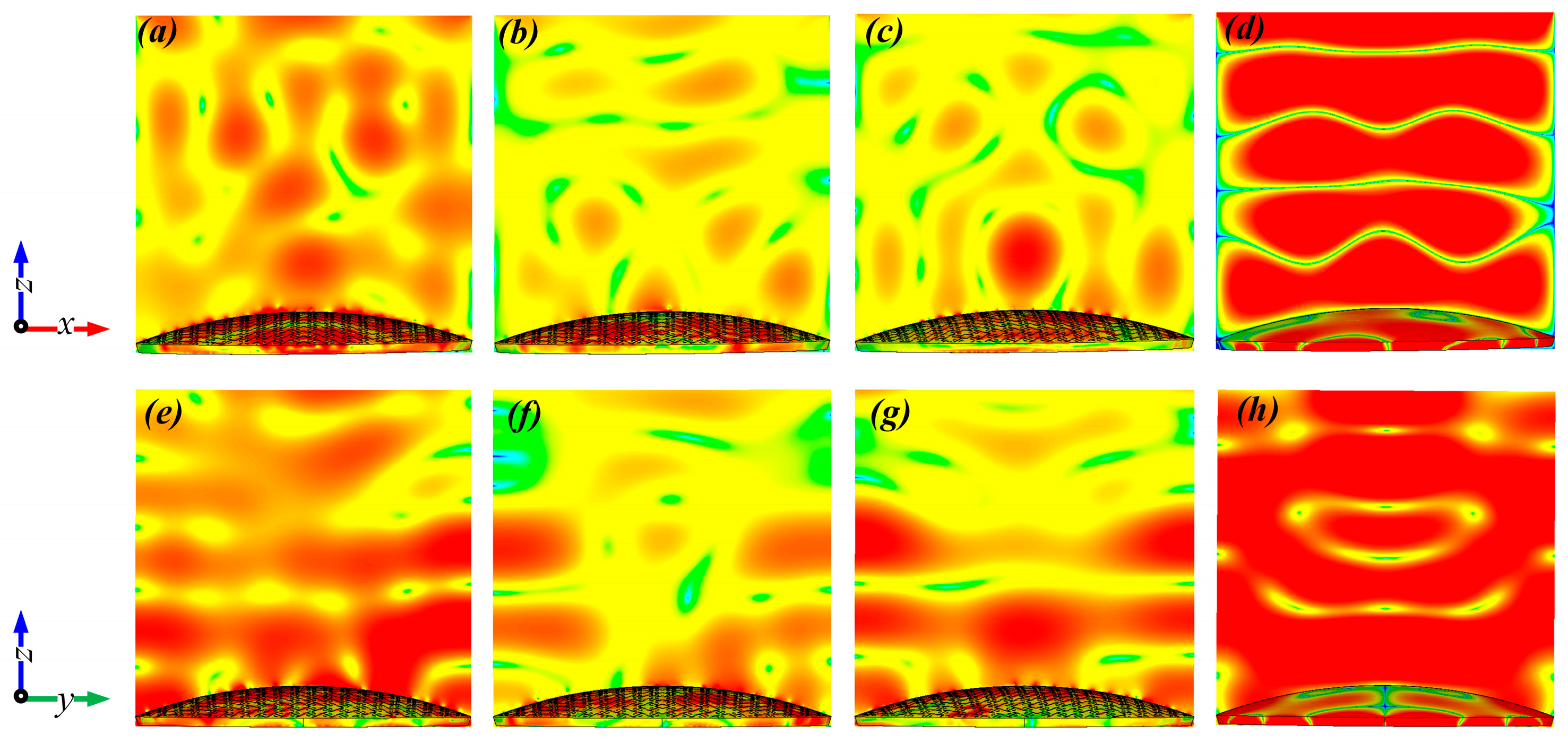
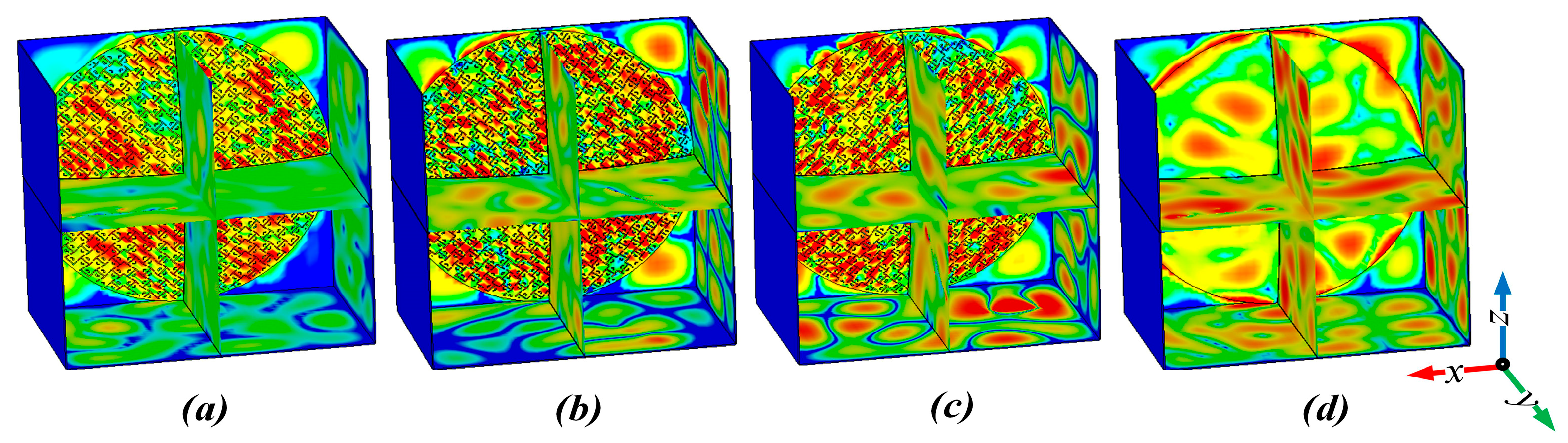
- Alternate Pattern (#1): Unit cells arranged in an alternating sequence (e.g., “…0101…”) in both horizontal and vertical directions, acts as a 1D diffraction grating, splitting the incident beam into two dominant specular lobes. Characterized by low entropy, this pattern optimizes directionality while minimizing diffusion.
- Chessboard Pattern (#2): Cells arranged in a checkerboard configuration (e.g., row 1: “…0101…”, row 2: “…1010…”.), resulting in a 2D lattice with π phase jumps in orthogonal directions, leading to symmetric scattering. Generates four symmetric scattering lobes due to the 2D lattice diffraction. Medium entropy presents superior angular coverage compared to that of #1 while maintaining high-level coherence.
- Random Pattern (#3): Cell phases (0 or π) distributed pseudo-randomly and independently across the cap, maximizing and resulting in a non-periodic, asymmetric metasurface. Produces diffuse, isotropic scattering, with maximum entropy (H ≈ 1 bit/cell). This configuration minimizes the spatial autocorrelation of the reflected field, theoretically providing the highest field uniformity and mode-stirring efficiency in the RC.
2.2. Modeling, Simulation, and Evaluation Metrics
3. Theoretical Analytical Modeling and RC Validation
3.1. Baseline Metallic Spherical-Cap Performance
3.2. ScRIS Scattering Characteristics
3.3. Field Uniformity and LUF Reduction in RC
4. Link-Level Performance Analysis for UAV Communications
4.1. System Model and Simulation Parameters
- (1)
- Direct Path (GBS-UAV): Modeled as a Rician fading channel with a K-factor of 6 dB, representing a partially obstructed Line-of-Sight link. The Rician distribution is chosen to capture the presence of a dominant path that is subject to scattering.
- (2)
- Reflected Path (GBS-RIS-UAV): The ScRIS is mounted on a building façade to provide an additional reflected path. The channel gain for this path is derived from the “radar equation” for RIS, which accounts for the path loss from GBS to RIS and RIS to UAV.
- (3)
- Diversity Induction: The coding patterns are modeled based on their scattering characteristics derived from the Far-Field analysis:
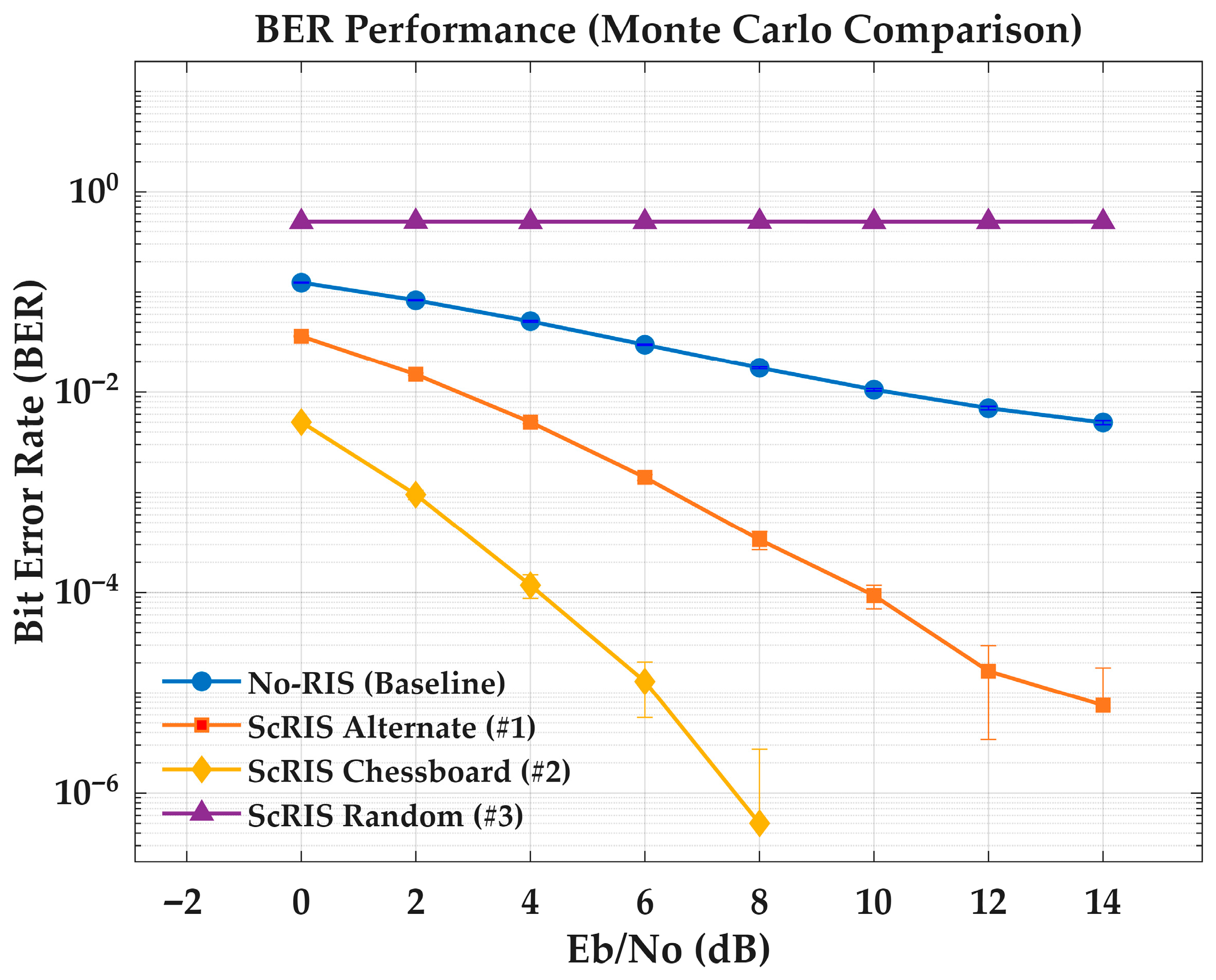
- Alternate Pattern: Modeled as providing 2 distinct specular paths (2-path diversity).
- Chessboard Pattern: Modeled as providing 4 distinct paths (4-path diversity).
- Random Pattern: Modeled as a diffuse scatterer, contributing to the diffuse component of the Rician channel, effectively raising the average received power without creating strong specular components.
4.2. Link Reliability and Throughput
4.3. Comparative Analysis: ScRIS vs. Planar RIS
5. Discussion
5.1. Implications for Low-Altitude Communications
5.2. Advanced Adaptive Phase Control: DRL-Based Approach
5.3. Practical Challenges and Future Work
- (1)
- Multi-Band Operation and Spectrum Integration: Real 6G networks are envisioned to operate across a heterogeneous spectrum, utilizing sub-6 GHz bands for ubiquitous coverage and mmWave or sub-THz bands for ultra-high capacity. Optimizing multi-band use is therefore a critical requirement for RIS deployment. While this study focused on discrete frequency bands (700 MHz and 3.5 GHz), future ScRIS architectures must address the scarcity of mounting space by supporting simultaneous multi-band operation. Recent advancements in shared-aperture metasurfaces suggest that sub-6 GHz and mmWave elements can be interleaved or stacked on the same physical surface without significant mutual coupling [64]. Developing such dual-band ScRIS designs would allow a single infrastructure node to simultaneously maintain robust control links (at lower frequencies) and high-throughput data beams (at mmWave) for passing UAVs, significantly enhancing network spectral efficiency [65,66,67].
- (2)
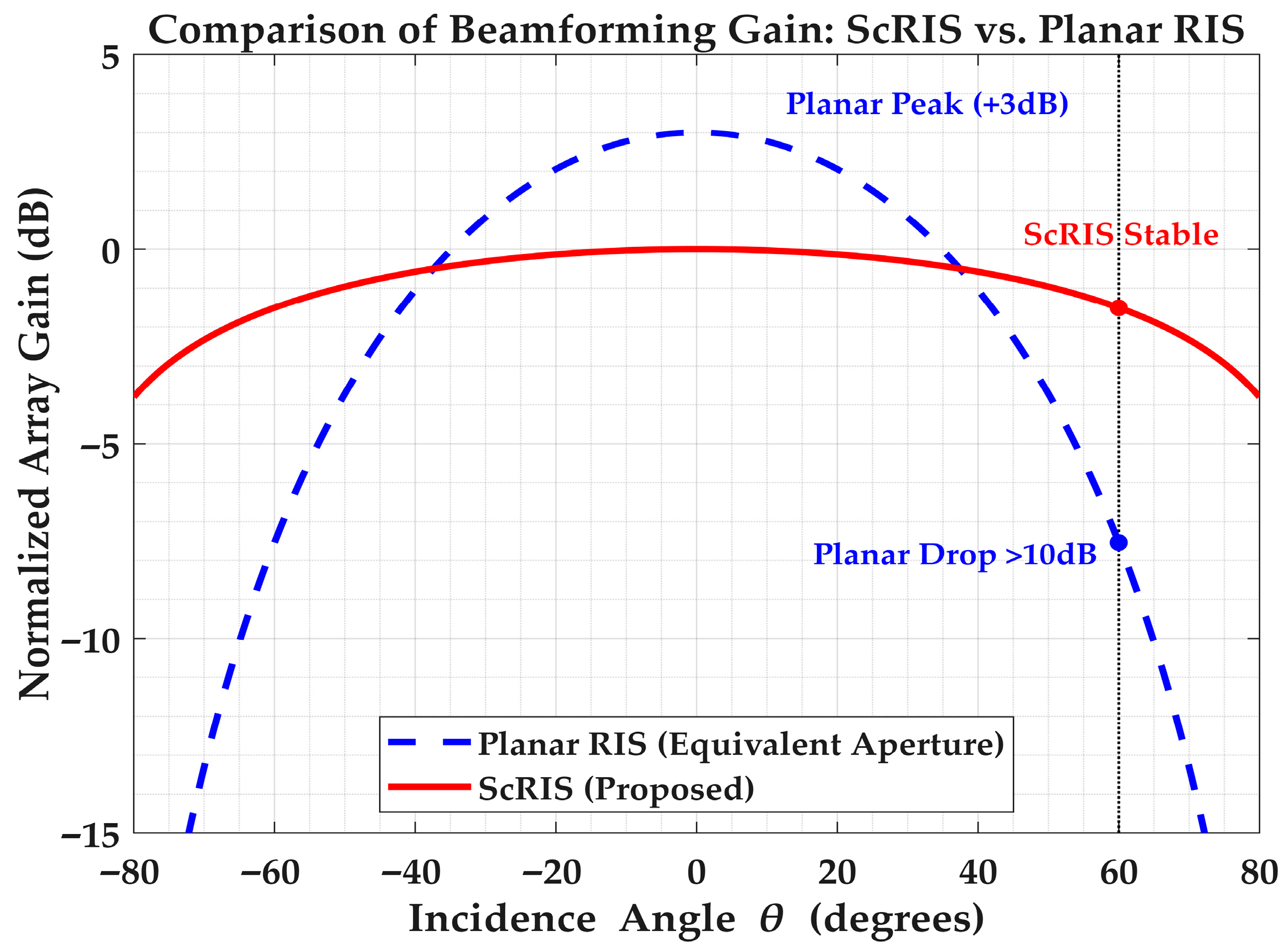
- Beam Squint in Wideband Systems: Our analysis assumed narrowband operation. In broadband systems (e.g., >100 MHz bandwidth), the phase shift imparted by passive RIS elements is frequency-dependent. A beam focused optimally at the center frequency will deviate or “squint” at the band edges. This effect can cause frequency-selective fading and significant unintended interference. However, the physical curvature of ScRIS naturally broadens the effective beamwidth, providing intrinsic resilience against squint-induced outages compared to high-gain planar arrays. Future designs could incorporate time-delay units (TDUs) to fully compensate for this effect in ultra-wideband scenarios.
- (3)
- Channel Estimation: Effective RIS operation, especially for adaptive control methods like DRL, relies on accurate CSI. However, estimating the cascaded GBS-RIS-UAV channel is notoriously difficult because the passive RIS cannot transmit pilot signals. This necessitates advanced techniques like compressive sensing or deep learning-based estimation.
- (4)
- Scalability and Control: Scaling to thousands of elements on a curved surface presents manufacturing and control challenges. Future work will explore lightweight, low-power control networks and the potential of “static” coded sectors that reduce the need for real-time element-wise tuning.
6. Conclusions
- (1)
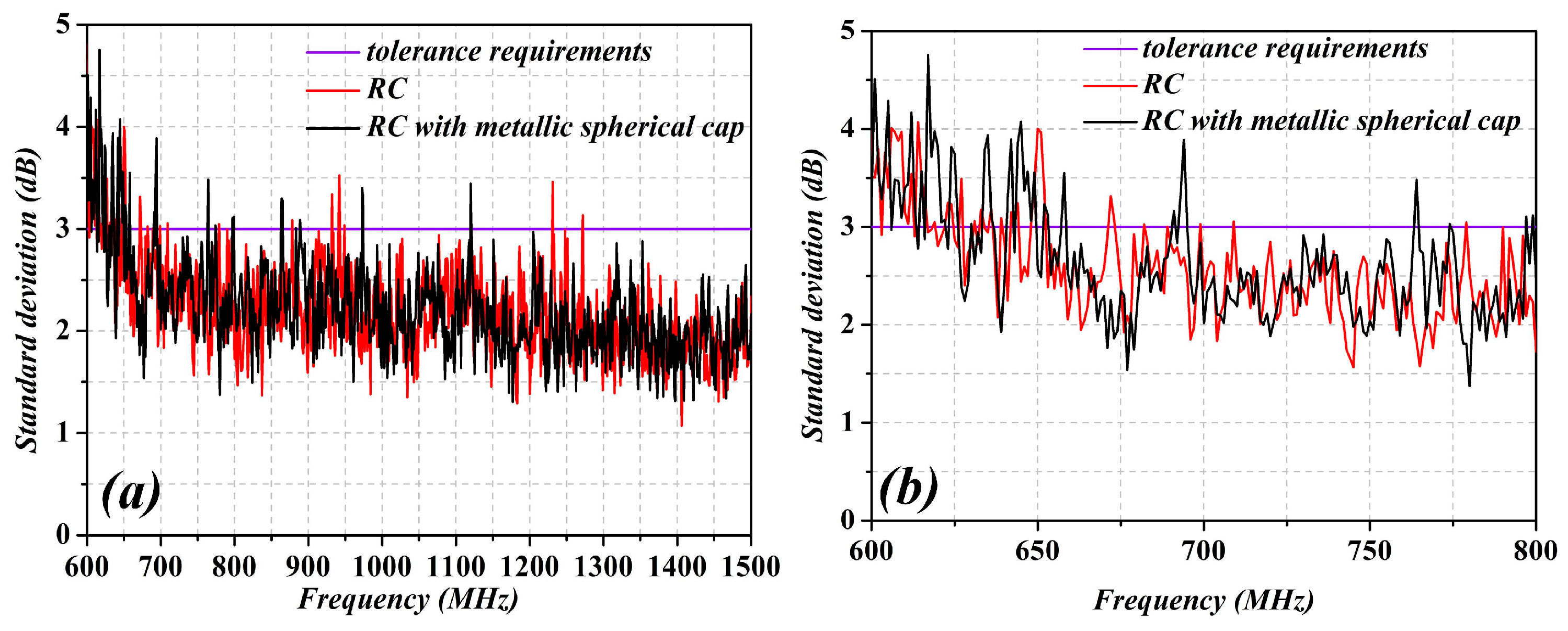
- Experimental and simulation results showing that integrating a coding ScRIS (with 0/π phase elements) reduces the Lowest Usable Frequency (LUF) of the RC by approximately 20% compared to a conventional setup, enabling the desired field uniformity at significantly lower frequencies.
- (2)
- Demonstration of markedly improved field uniformity (reduced STD) across a broad frequency range with the ScRIS, indicating a more homogeneous and isotropic field distribution beneficial for testing and coverage applications.
- (3)
- Comparative analysis of alternate, chessboard, and random coding patterns, showing all outperform a plain metallic cap, with the random pattern yielding the most pronounced improvement in uniformity, consistent with maximizing phase randomness for mode-stirring.
- (4)
- (5)
- In-depth analysis of a DRL-based adaptive control framework, confirming its theoretical basis and hardware implementation feasibility for dynamic channel adaptation.
- (6)
- Acknowledgement of practical challenges, including beam squint, channel estimation, scalability/cost, and interference management, outlining directions for future research.
Author Contributions
Funding
Data Availability Statement
Conflicts of Interest
Abbreviations
| 1-bit | 1-bit (Binary phase shift) |
| 3D | Three-Dimensional |
| 5G | 5th Generation |
| 6G | 6th Generation |
| BER | Bit Error Rate |
| CSI | Channel State Information |
| DRL | Deep Reinforcement Learning |
| DDPG | Deep Deterministic Policy Gradient |
| DQN | Deep Q-Networks |
| FPGA | Field-Programmable Gate Array |
| FR1 | Frequency Range 1 |
| GBS | Ground Base Station |
| LoS | Line-of-Sight |
| LUF | Lowest Usable Frequency |
| MDP | Markov Decision Process |
| MEC | Mobile Edge Computing |
| PEC | Perfect Electric Conductors |
| QPSK | Quadrature Phase-Shift Keying |
| RC | Reverberation Chamber |
| RIS | Reconfigurable Intelligent Surfaces |
| ScRIS | Spherical-cap Reflective Intelligent Surface |
| SINR | Signal-to-Interference-plus-Noise Ratio |
| SNR | Signal-to-Noise Ratio |
| STD | Standard Deviation |
| T-UAV | Tethered Unmanned Aerial Vehicle |
| TD3 | Twin Delayed Deep Deterministic Policy Gradient |
| UAV | Unmanned Aerial Vehicle |
References
- Li, C.; Qiang, X. Advancing reliability and efficiency of urban communication: Unmanned aerial vehicles, intelligent reflection surfaces, and deep learning techniques. Heliyon 2024, 10, e32472. [Google Scholar] [CrossRef]
- Banagar, M.; Dhillon, H.S.; Molisch, A.F. Impact of UAV wobbling on the air-to-ground wireless channel. IEEE Trans. Veh. Technol. 2020, 69, 14025–14030. [Google Scholar] [CrossRef]
- Salah, M. Floating meta-bubbles: Aerial gateway and routing on the sky. J. Wirel. Commun. Netw. 2024, 2024, 61. [Google Scholar] [CrossRef]
- Pan, G.; Miao, X.; Yang, X.; Yang, Z. Introduction to UAV communications. In UAV Communications: Modeling and Analyses; Springer Nature: Singapore, 2024; pp. 1–21. [Google Scholar]
- Basar, E. Reconfigurable intelligent surfaces for Doppler effect and multipath fading mitigation. Front. Commun. Netw. 2021, 2, 672857. [Google Scholar] [CrossRef]
- You, C.; Kang, Z.; Zeng, Y.; Zhang, R. Enabling smart reflection in integrated air-ground wireless network: IRS meets UAV. IEEE Wirel. Commun. 2022, 28, 138–144. [Google Scholar] [CrossRef]
- Ma, D.; Ding, M.; Hassan, M. Enhancing cellular communications for UAVs via intelligent reflective surface. In Proceedings of the 2020 IEEE Wireless Communications and Networking Conference (WCNC), Seoul, Republic of Korea, 25–28 May 2020; pp. 1–6. [Google Scholar]
- Singh, S.K.; Agrawal, K.; Singh, K.; Li, C.-P.; Ding, Z. NOMA enhanced hybrid RIS-UAV-assisted full-duplex communication system with imperfect SIC and CSI. IEEE Trans. Commun. 2022, 70, 7609–7627. [Google Scholar] [CrossRef]
- Wu, Q.; Zheng, B.; You, C.; Zhu, L.; Shen, K.; Shao, X.; Mei, W.; Di, B.; Zhang, H.; Basar, E.; et al. Intelligent surfaces empowered wireless network: Recent advances and the road to 6G. Proc. IEEE 2024, 112, 724–763. [Google Scholar] [CrossRef]
- Li, Z.; Lao, M.; Phang, S.K.; Hamid, M.R.A.; Tang, K.Z.; Lin, F. Development and design methodology of an anti-vibration system on micro-UAVs. In Proceedings of the International Micro Air Vehicle Conference and Flight Competition (IMAV), Toulouse, France, 18–21 September 2017. [Google Scholar]
- Zhu, Q.; Gao, Y.; Nie, J.; Xiao, Y.; Tang, W. Dynamic wireless networks assisted by RIS mounted on aerial platform: Joint active and passive beamforming design. IET Commun. 2022, 16, 1509–1522. [Google Scholar] [CrossRef]
- Hu, S.; Rusek, F. Spherical large intelligent surfaces. In Proceedings of the 2020 IEEE International Conference on Acoustics, Speech and Signal Processing (ICASSP), Barcelona, Spain, 4–8 May 2020; pp. 8673–8677. [Google Scholar]
- Rahmatov, N.; Baek, H. RIS-carried UAV communication: Current research, challenges, and future trends. ICT Express 2023, 9, 961–973. [Google Scholar] [CrossRef]
- Pavlov, V.A.; Belov, A.A.; Sayanskiy, A.D.; Vabishchevich, D.A. Reconfigurable intelligent surface assisted by computer vision for increasing coverage area in mobile communication systems. Photonics Nanostruct. Fundam. Appl. 2024, 62, 101318. [Google Scholar] [CrossRef]
- Aboagye, S.; Ndjiongue, A.R.; Ngatched, T.M.N.; Dobre, O.A.; Poor, H.V. RIS-assisted visible light communication systems: A tutorial. IEEE Commun. Surv. Tutor. 2022, 25, 251–288. [Google Scholar] [CrossRef]
- Wu, Z.Y.; Ismail, M.; Wang, J. Efficient exclusion strategy of shadowed RIS in dynamic indoor programmable wireless environments. IEEE Trans. Wirel. Commun. 2023, 23, 994–1007. [Google Scholar] [CrossRef]
- Kim, K.; Phon, R.; Park, E.; Lim, S. 4D-printed intelligent reflecting surface with improved beam resolution via both phase modulation and space modulation. Microsyst. Nanoeng. 2024, 10, 157. [Google Scholar] [CrossRef]
- Qiu, T.; An, Q.; Wang, J.; Wang, J.; Qiu, C.-W.; Li, S.; Lv, H.; Cai, M.; Wang, J.; Cong, L.; et al. Vision-driven metasurfaces for perception enhancement. Nat. Commun. 2024, 15, 1631. [Google Scholar] [CrossRef] [PubMed]
- Zhang, Q.; Zhao, J.; Zhang, R.; Yang, L. Downlink transmissions of UAV-RIS-assisted cell-free massive MIMO systems: Location and trajectory optimization. Sensors 2024, 24, 4064. [Google Scholar] [CrossRef]
- Zhang, S.; Zhang, S.; Yuan, W.; Quek, T.Q. Transformer-empowered predictive beamforming for rate-splitting multiple access in non-terrestrial networks. IEEE Trans. Wirel. Commun. 2024, 23, 1234–1245. [Google Scholar] [CrossRef]
- Sun, G.; Yan, W.; Hao, W.; Huang, C.; Yuen, C. Beamforming design for the distributed RISs-aided THz communications with double-layer true time delays. IEEE Trans. Veh. Technol. 2023, 73, 3886–3900. [Google Scholar] [CrossRef]
- Li, X.; Liu, F.; Zhou, Z.; Zhu, G.; Wang, S.; Huang, K.; Gong, Y. Integrated sensing, communication, and computation over-the-air: MIMO beamforming design. IEEE Trans. Wirel. Commun. 2023, 22, 5383–5398. [Google Scholar] [CrossRef]
- Zhao, L. A hybrid deep learning-based intelligent system for sports action recognition via visual knowledge discovery. IEEE Access 2023, 11, 46541–46549. [Google Scholar] [CrossRef]
- Zhao, Y.; Guan, Y.L.; Ismail, A.M.; Ju, G.; Lin, D.; Lu, Y.; Yuen, C. Holographic-inspired meta-surfaces exploiting vortex beams for low-interference multipair IoT communications: From theory to prototype. IEEE Internet Things J. 2023, 11, 12660–12675. [Google Scholar] [CrossRef]
- Liu, R.; Xie, M.; Liu, A.; Song, H. Joint optimization risk factor and energy consumption in IoT networks with TinyML-enabled internet of UAVs. IEEE Internet Things J. 2024, 11, 20983–20994. [Google Scholar] [CrossRef]
- Cui, Z.; Zhang, P.; Pollin, S. 6G Wireless Communications in 7–24 GHz Band: Opportunities, Techniques, and Challenges. In Proceedings of the 2025 IEEE International Symposium on Dynamic Spectrum Access Networks (DySPAN), Washington, DC, USA, 14–17 October 2025. [Google Scholar]
- Atoev, S.; Kwon, O.H.; Lee, S.H.; Kwon, K.R. An efficient SC-FDM modulation technique for a UAV communication link. Electronics 2018, 7, 352. [Google Scholar] [CrossRef]
- Nowakowski, M.; Idzkowski, A. Ultra-wideband signal transmission according to European regulations and typical pulses. In Proceedings of the 2020 International Conference Mechatronic Systems and Materials (MSM), Bialystok, Poland, 1–3 July 2020; pp. 1–4. [Google Scholar]
- Deshpande, A.A.; Vaca-Rubio, C.J.; Mohebi, S.; Salami, D.; De Carvalho, E.; Popovski, P.; Sigg, S.; Zorzi, M.; Zanella, A. Energy-Efficient Design for RIS-assisted UAV communications in beyond-5G Networks. In Proceedings of the 2021 IEEE 94th Vehicular Technology Conference (VTC2021-Fall), Norman, OK, USA, 27–30 September 2021. [Google Scholar]
- Tesfaw, B.A.; Juang, R.T.; Tai, L.C.; Lin, H.P.; Tarekegn, G.B.; Nathanael, K.W. Deep Learning-Based Link Quality Estimation for RIS-Assisted UAV-Enabled Wireless Communications System. Sensors 2023, 23, 8041. [Google Scholar] [CrossRef]
- Zhang, Q.; Zhao, Y.; Li, H.; Hou, S.; Song, Z. Joint optimization of STAR-RIS assisted UAV communication systems. IEEE Wirel. Commun. Lett. 2022, 11, 2390–2394. [Google Scholar] [CrossRef]
- Yao, Y.; Lv, K.; Huang, S.; Li, X.; Xiang, W. UAV trajectory and energy efficiency optimization in RIS-assisted multi-user air-to-ground communications networks. Drones 2023, 7, 272. [Google Scholar] [CrossRef]
- Wu, M.; Zhu, S.; Li, C.; Chen, Y.; Zhou, F. Joint beamforming design for RIS-assisted integrated satellite-HAP-terrestrial networks using deep reinforcement learning. Sensors 2023, 23, 3034. [Google Scholar] [CrossRef] [PubMed]
- Li, C.; Qiang, X. Enhancing reliable and energy-efficient UAV communications with RIS and deep reinforcement learning. Sci. Rep. 2024, 14, 11116. [Google Scholar]
- Laguerre, C.; Lee, H.I.; Cho, N.; Tsourdos, A. Coverage Path Planning for Structural Inspections with UAV. In Towards Autonomous Robotic Systems; Springer Nature: Cham, Switzerland, 2025; pp. 405–418. [Google Scholar]
- Monemi, M.; Rasti, M.; De Sena, A.S.; Fallah, M.A.; Latva-Aho, M.; Di Renzo, M. Practical Challenges for Reliable RIS Deployment in Heterogeneous Multi-Operator Multi-Band Networks. IEEE Commun. Mag. 2025, 63, 154–160. [Google Scholar] [CrossRef]
- Ghazikor, M.; Nguyen, V.L.; Hashemi, M. Performance Analysis of RIS-Assisted UAV Communication in NOMA Networks. In Proceedings of the 2026 IEEE Consumer Communications & Networking Conference (CCNC), Las Vegas, NV, USA, 9–12 January 2026. [Google Scholar]
- Senic, D.; Remley, K.A.; Becker, M.G.; Holloway, C.L. Spatial uniformity study in a loaded reverberation chamber at millimeter-wave frequencies. In Proceedings of the 2018 IEEE Symposium on Electromagnetic Compatibility, Signal Integrity and Power Integrity (EMC, SI & PI), Long Beach, CA, USA, 30 July–3 August 2018; pp. 467–472. [Google Scholar]
- Chen, J. Multi-user communications for line-of-sight large intelligent surface systems. EURASIP J. Adv. Signal Process. 2023, 2023, 129. [Google Scholar] [CrossRef]
- Cui, T.J.; Liu, S.; Li, L.L. Information entropy of coding metasurface. Light Sci. Appl. 2016, 5, e16172. [Google Scholar] [CrossRef]
- Moccia, M.; Liu, S.; Wu, R.Y.; Castaldi, G.; Andreone, A.; Cui, T.J.; Galdi, V. Coding metasurfaces for diffuse scattering: Scaling laws, bounds, and suboptimal design. Adv. Opt. Mater. 2017, 5, 1700455. [Google Scholar] [CrossRef]
- Rao, J.; Zhang, Y.; Tang, S.; Li, Z.; Shen, S.; Chiu, C.Y.; Murch, R. A novel reconfigurable intelligent surface for wide-angle passive beamforming. IEEE Trans. Microw. Theory Tech. 2022, 70, 5427–5439. [Google Scholar] [CrossRef]
- Li, W.; Yan, S.; Shi, L.; Yue, J.; Shi, M.; Lin, B.; Qin, K. Multiagent consensus tracking control over asynchronous cooperation–competition networks. IEEE Trans. Cyber. 2025, 55, 4347–4360. [Google Scholar] [CrossRef]
- Shi, L.; Yan, S.; Li, W. Consensus and Products of Substochastic Matrices: Convergence Rate with Communication Delays. IEEE Trans. Syst. Man Cybern. Syst. 2025, 55, 4752–4761. [Google Scholar] [CrossRef]
- Iqbal, A.; Bouali, F.; Al-Habashna, A.; Wali, K. Deep Reinforcement Learning-Based Resource Allocation for Secure RIS-aided UAV Communication. IEEE Commun. Lett. 2023, 27, 3369–3373. [Google Scholar]
- Sun, H.; Li, Z.; Gu, C.; Xu, Q.; Zhang, Y.; Xu, Z.; Luo, X.; Sun, C.; Chan, A. Experimental investigation of the metasurfaced reverberation chamber. Electronics 2023, 12, 4985. [Google Scholar] [CrossRef]
- IEC 61000-4-21:2011; Electromagnetic Compatibility (EMC)—Part 4-21: Testing and Measurement Techniques—Reverberation Chamber Test Methods. International Electrotechnical Commission (IEC): Geneva, Switzerland, 2011.
- Kang, M.; Liu, T.; Chan, C.T.; Xiao, M. Applications of bound states in the continuum in photonics. Nat. Rev. Phys. 2023, 5, 659–678. [Google Scholar] [CrossRef]
- Zhang, L.; Huang, Z.R.; Chen, X.Q.; Zheng, Y.N.; Liu, S.; Galdi, V.; Cui, T.J. Co-prime modulation for space-time-coding digital metasurfaces with ultralow-scattering characteristics. Adv. Funct. Mater. 2024, 34, 2314110. [Google Scholar] [CrossRef]
- Qian, C.; Kaminer, I.; Chen, H. A guidance to intelligent metamaterials and metamaterials intelligence. Nat. Commun. 2025, 16, 1154. [Google Scholar] [CrossRef]
- Beccaria, M.; Freni, A.; Mazzinghi, A.; Pirinoli, P. On the features of curved, passive reconfigurable smart electromagnetic skins. Sci. Rep. 2025, 15, 32277. [Google Scholar] [CrossRef] [PubMed]
- Freni, A.; Beccaria, M.; Mazzinghi, A.; Massaccesi, A.; Pirinoli, P. Low-profile and low-visual impact smart electromagnetic curved passive skins for enhancing connectivity in urban scenarios. Electronics 2023, 12, 4491. [Google Scholar] [CrossRef]
- Tagliaferri, D.; Mizmizi, M.; Ayoubi, R.A.; Gentili, G.G.; Spagnolini, U. Conformal intelligent reflecting surfaces for 6G V2V communications. In Proceedings of the 2022 1st International Conference on 6G Networking (6GNet), Paris, France, 6–8 July 2022; pp. 1–8. [Google Scholar]
- Tishchenko, A.; Khalily, M.; Shojaeifard, A.; Burton, F.; Björnson, E.; Di Renzo, M.; Tafazolli, R. The emergence of multi-functional and hybrid reconfigurable intelligent surfaces for integrated sensing and communications—A survey. IEEE Commun. Surv. Tutor. 2025, 27, 2895–2936. [Google Scholar] [CrossRef]
- Li, L. Designing RIS-Assisted UAV 3D Trajectory Using Deep Reinforcement Learning. Master’s Thesis, South Dakota State University, Brookings, SD, USA, 2024. [Google Scholar]
- You, Q.; Xu, Q.; Yang, X.; Zhang, T.; Chen, M. RIS-assisted UAV-D2D communications exploiting deep reinforcement learning. ZTE Commun. 2023, 21, 61. [Google Scholar]
- Nguyen, K.K.; Khosravirad, S.R.; da Costa, D.B.; Nguyen, L.D.; Duong, T.Q. Reconfigurable Intelligent Surface-Assisted Multi-UAV Networks: Efficient Resource Allocation with Deep Reinforcement Learning. IEEE J. Sel. Top. Signal Process. 2022, 16, 358–368. [Google Scholar] [CrossRef]
- Ssimbwa, J.; Lim, B.; Lee, J.H.; Ko, Y.C. A survey on robust modulation requirements for the next generation personal satellite communications. Front. Commun. Netw. 2022, 3, 850781. [Google Scholar] [CrossRef]
- Rivera, M.; Jaafar, W.; Yanikomeroglu, H. Optimization of RIS-Assisted RSMA-Enabled Tethered-UAV Communications. IEEE Trans. Wirel. Commun. 2024, 23, 8346–8361. [Google Scholar]
- Faisal, A.; Al-Nahhal, I.; Dobre, O.A.; Ngatched, T.M.N. Deep Reinforcement Learning for Optimizing RIS-Assisted HD-FD Wireless Systems. IEEE Wirel. Commun. Lett. 2021, 10, 2755–2759. [Google Scholar] [CrossRef]
- Alexandropoulos, G.C.; Stylianopoulos, K.; Huang, C.; Yuen, C.; Bennis, M.; Debbah, M. Pervasive Machine Learning for Smart Radio Environments Enabled by Reconfigurable Intelligent Surfaces. Proc. IEEE 2022, 110, 1494–1525. [Google Scholar] [CrossRef]
- Janji, S.; Sroka, P. RIS-aided multi-hop backhauling for 5G/6G UAV-assisted access points. J. Telecommun. Inf. Technol. 2023, 2, 63–69. [Google Scholar] [CrossRef]
- Liu, Q.; Zhu, Y.; Li, M.; Liu, R.; Liu, Y.; Lu, Z. DRL-based secrecy rate optimization for RIS-assisted secure ISAC systems. IEEE Trans. Veh. Technol. 2023, 72, 16871–16875. [Google Scholar] [CrossRef]
- Yuan, Y.; Zhao, Y.; Zong, B.; Parolari, S. Potential Key Technologies for 6G Mobile Communications. Sci. China Inf. Sci. 2020, 63, 183301. [Google Scholar] [CrossRef]
- Rao, J.; Zhang, Y.; Tang, S.; Li, Z.; Ming, Z.; Zhang, J.; Chiu, C.Y.; Murch, R. A Shared-Aperture Dual-Band Sub-6 GHz and mmWave Reconfigurable Intelligent Surface with Independent Operation. IEEE Trans. Microw. Theory Tech. 2025, 73, 4116–4132. [Google Scholar] [CrossRef]
- Umer, A.; Müürsepp, I.; Alam, M.M.; Wymeersch, H. Reconfigurable intelligent surfaces in 6g radio localization: A survey of recent developments, opportunities, and challenges. IEEE Commun. Surv. Tutor. 2025, in press. [Google Scholar] [CrossRef]
- de Sena, A.S.; Rasti, M.; Mahmood, N.H.; Latva-Aho, M. Beyond Diagonal RIS for Multi-Band Multi-Cell MIMO Networks: A Practical Frequency-Dependent Model and Performance Analysis. IEEE Trans. Wirel. Commun. 2025, 24, 749–766. [Google Scholar] [CrossRef]



| Parameter | Symbol | Value | Justification/Source |
|---|---|---|---|
| Substrate Material | - | F4B-2 | PTFE-glass composite |
| Dielectric Constant | εr | 2.65 | Stable permittivity |
| Loss Tangent | tan δ | 0.001 | Low dielectric loss |
| Substrate Thickness | d | 10 mm | Structural support & bandwidth |
| Unit Cell Periodicity | a | 30 mm | ≈λ/10 at 1 GHz |
| Coding State ‘0’ | h0 | 0.8 mm | Induces phase shift Φ0 |
| Coding State ‘1’ | h1 | 0.0 mm | Induces phase shift Φ0 + π |
| Parameter | Value | Justification/Source |
|---|---|---|
| System | ||
| Carrier Frequency | 3.5 GHz | 5G/6G Mid-band (FR1) |
| System Bandwidth | 20 MHz | 5G/6G standard channel |
| Modulation | QPSK | Common for robust links |
| Coding | 1/2-rate Convolutional | Standard for BER simulations |
| Geometry | ||
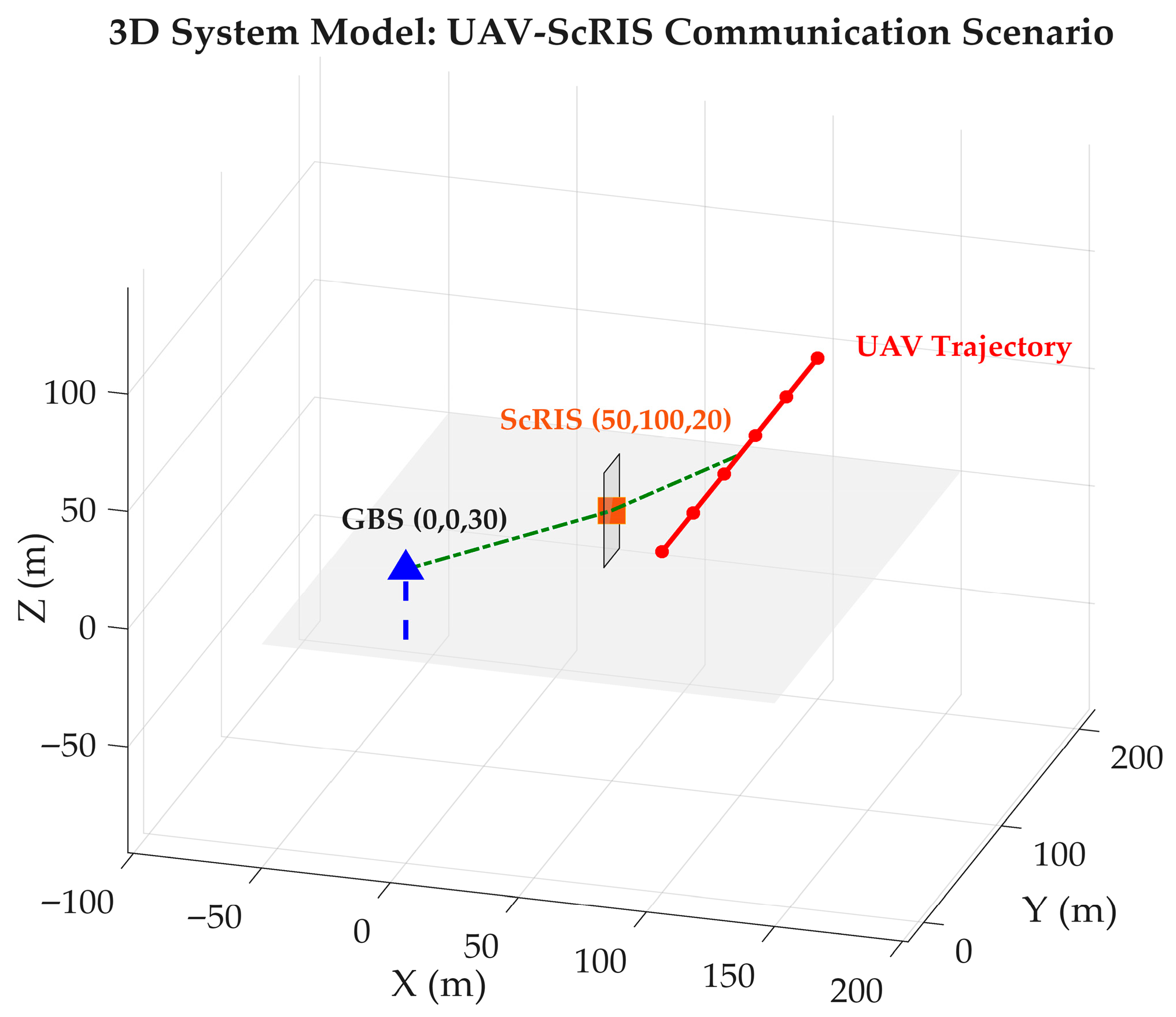
| GBS Position | (0, 0, 30 m) | Ground Base Station |
| ScRIS Position | (50 m, 100 m, 20 m) | Fixed on building façade |
| UAV Altitude | 50 m | Constant low altitude |
| UAV Trajectory | (100 m, y, 50 m) | Flying parallel to RIS, y = variable |
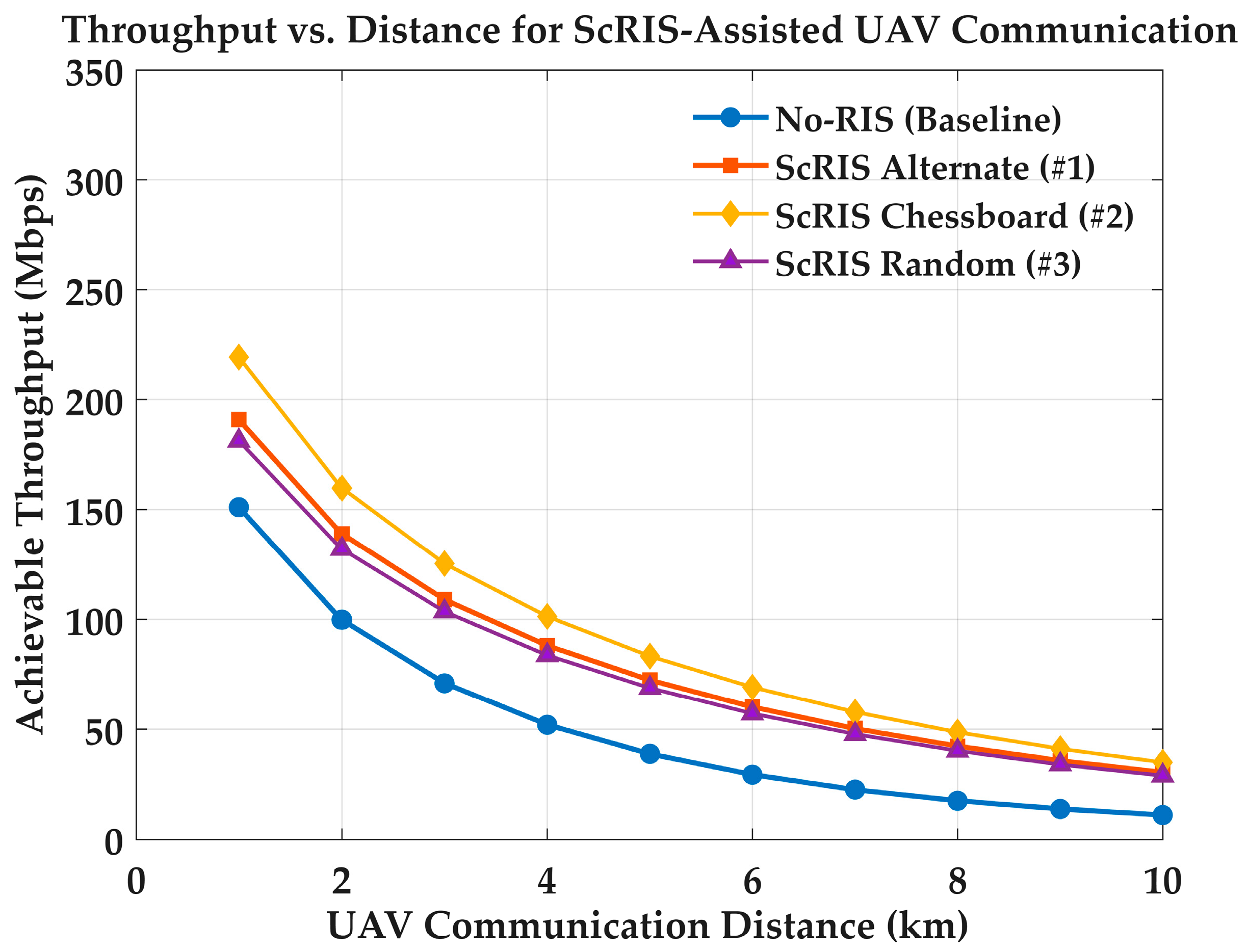
| Tx-Rx Distance | 1 km to 10 km | For throughput simulation |
| Link Budget | ||
| GBS Transmit Power (Ptx) | 40 dBm (10 W) | Typical Macro BS |
| GBS Antenna Gain (Gtx) | 8 dBi | Standard sector antenna |
| UAV Antenna Gain (Grx) | 3 dBi | Standard omni antenna |
| Noise Figure (UAV Rx) | 5 dB | Standard receiver value |
| Channel Model | ||
| GBS-UAV (Baseline) | Rician Fading | Obstructed LoS |
| K-Factor (Baseline) | 6 dB | Partially obstructed LoS |
| GBS-RIS-UAV | Rician + Path Loss | Additional diversity paths |
Disclaimer/Publisher’s Note: The statements, opinions and data contained in all publications are solely those of the individual author(s) and contributor(s) and not of MDPI and/or the editor(s). MDPI and/or the editor(s) disclaim responsibility for any injury to people or property resulting from any ideas, methods, instructions or products referred to in the content. |
© 2025 by the authors. Licensee MDPI, Basel, Switzerland. This article is an open access article distributed under the terms and conditions of the Creative Commons Attribution (CC BY) license (https://creativecommons.org/licenses/by/4.0/).
Share and Cite
Sun, H.; Feng, X.; Guo, W.; Zhang, X.; Zeng, Y.; Tan, G.; Tan, Y.; Sun, C.; Lu, X.; Yu, L. Performance Enhancement of Low-Altitude Intelligent Network Communications Using Spherical-Cap Reflective Intelligent Surfaces. Electronics 2025, 14, 4848. https://doi.org/10.3390/electronics14244848
Sun H, Feng X, Guo W, Zhang X, Zeng Y, Tan G, Tan Y, Sun C, Lu X, Yu L. Performance Enhancement of Low-Altitude Intelligent Network Communications Using Spherical-Cap Reflective Intelligent Surfaces. Electronics. 2025; 14(24):4848. https://doi.org/10.3390/electronics14244848
Chicago/Turabian StyleSun, Hengyi, Xingcan Feng, Weili Guo, Xiaochen Zhang, Yuze Zeng, Guoshen Tan, Yong Tan, Changjiang Sun, Xiaoping Lu, and Liang Yu. 2025. "Performance Enhancement of Low-Altitude Intelligent Network Communications Using Spherical-Cap Reflective Intelligent Surfaces" Electronics 14, no. 24: 4848. https://doi.org/10.3390/electronics14244848
APA StyleSun, H., Feng, X., Guo, W., Zhang, X., Zeng, Y., Tan, G., Tan, Y., Sun, C., Lu, X., & Yu, L. (2025). Performance Enhancement of Low-Altitude Intelligent Network Communications Using Spherical-Cap Reflective Intelligent Surfaces. Electronics, 14(24), 4848. https://doi.org/10.3390/electronics14244848