An Zero-Point Drift Suppression Method for eLoran Signal Based on a Segmented Inaction Algorithm


Abstract
1. Introduction
2. Adaptive Filtering Zero-Point Drift Suppression Algorithm
2.1. Mathematical Model of eLoran Signal
2.2. Research on Adaptive Filtering Algorithm for eLoran Signals
2.3. Zero-Point Drift Suppression Method for Signal Pre-Filtering of Traditional Filters
2.3.1. Zero-Point Drift Suppression Method for Signal Pre-Filtering Based on FIR/IIR Filters
2.3.2. Zero-Point Drift Suppression Method for Signal Pre-Filtering Based on Wavelet-Decomposition Algorithm
2.4. Zero-Point Drift Suppression Method for Signal Pre-Filtering Based on Inaction Method
- (1)
- , when ;
- (2)
- , when .
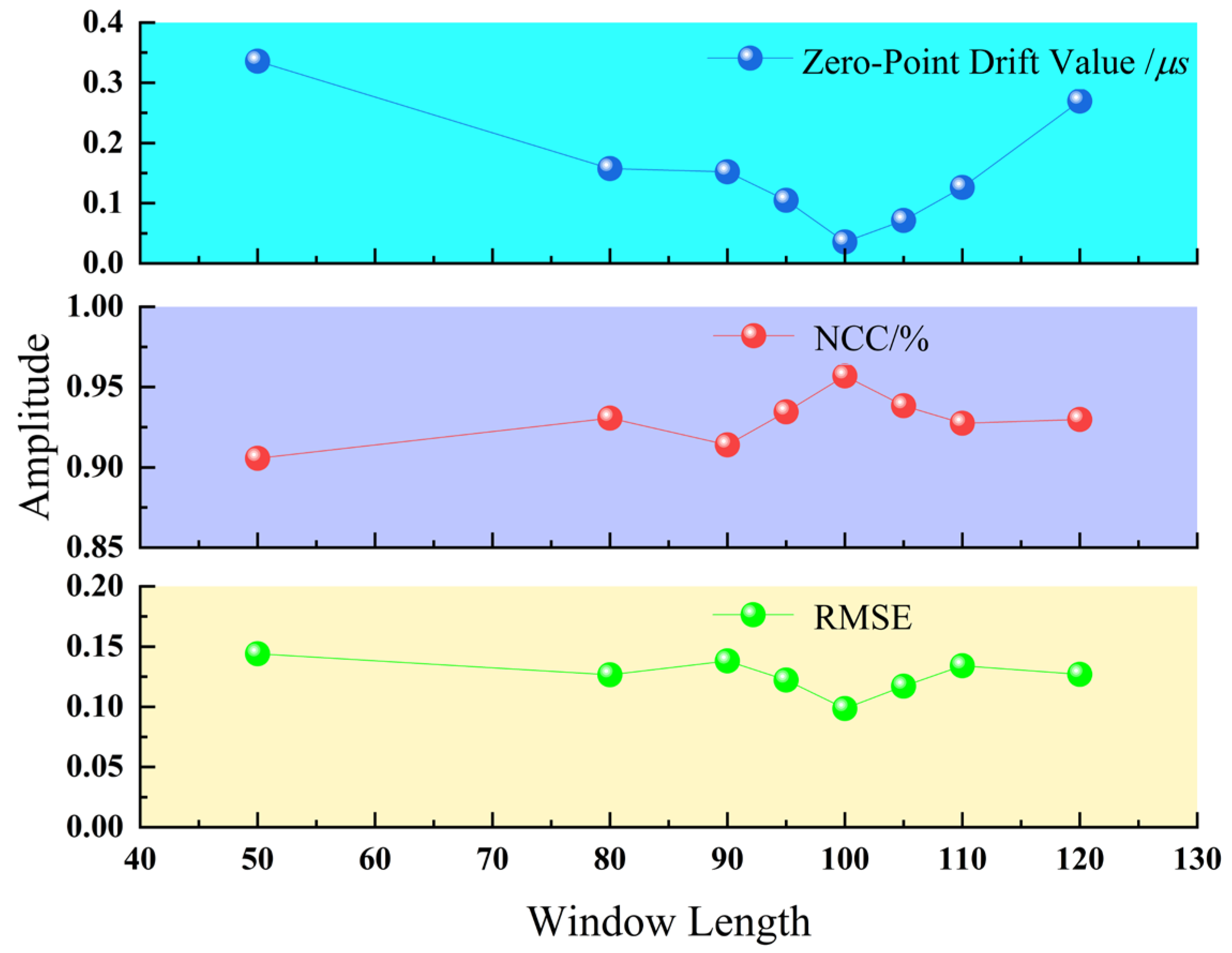
Selection of Window Function Length
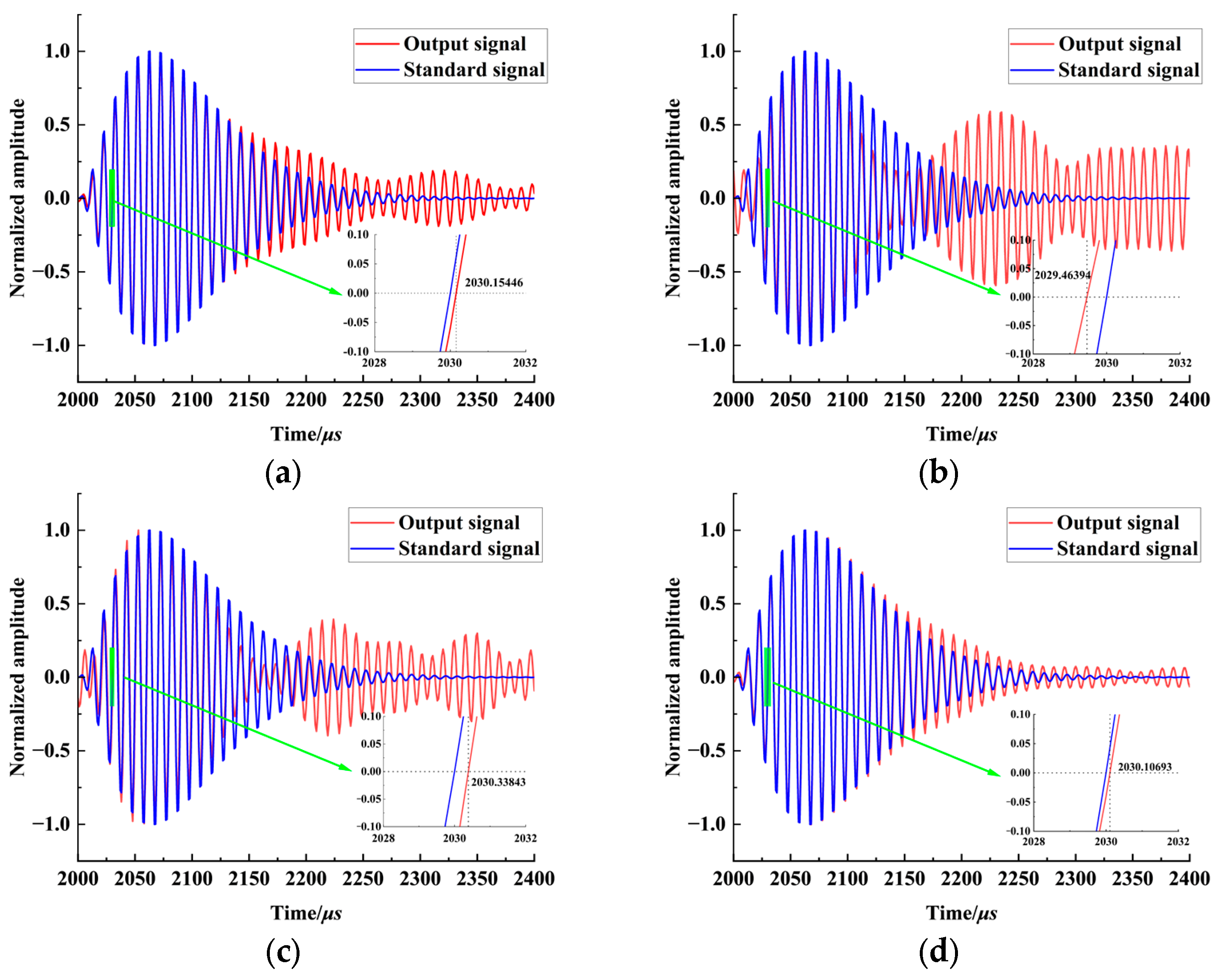
3. Simulation Analysis of Zero-Point Drift Suppression
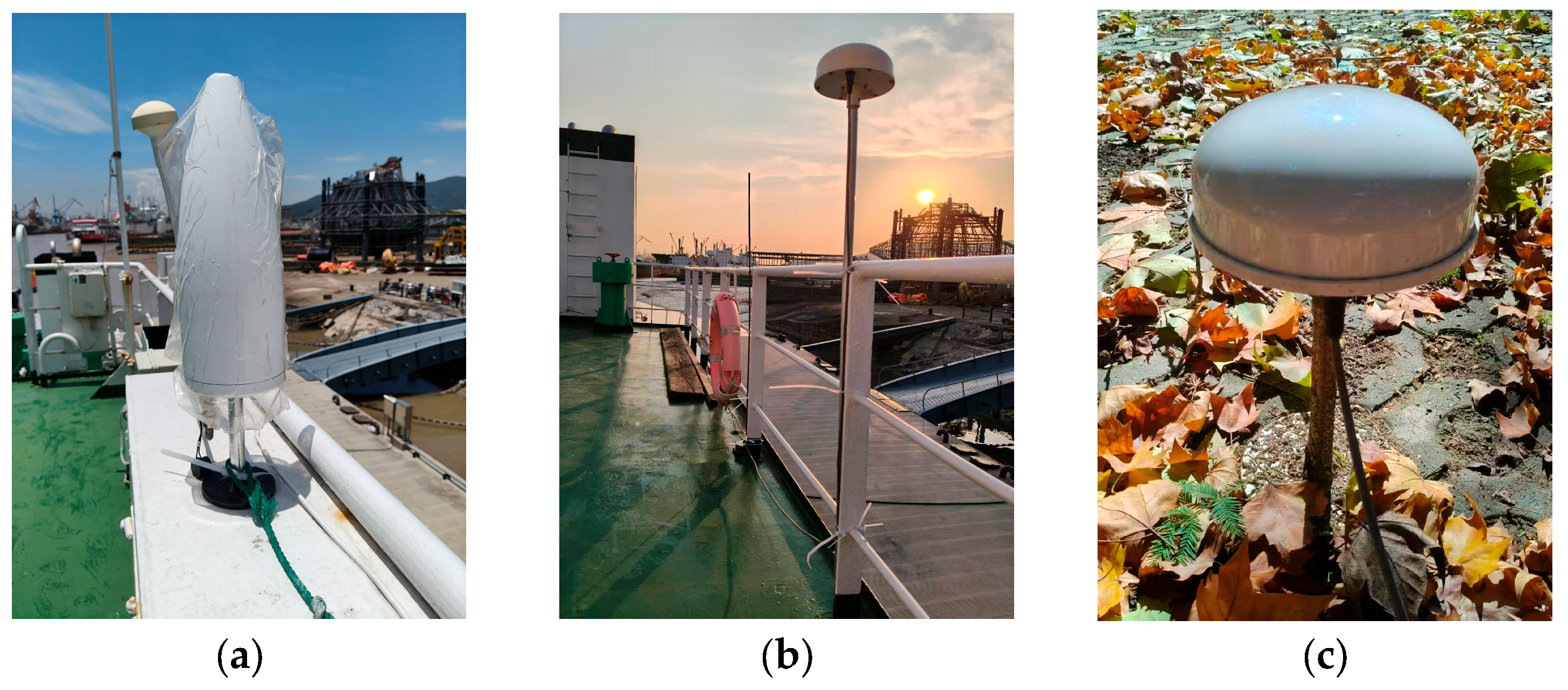
4. Experimental Verification
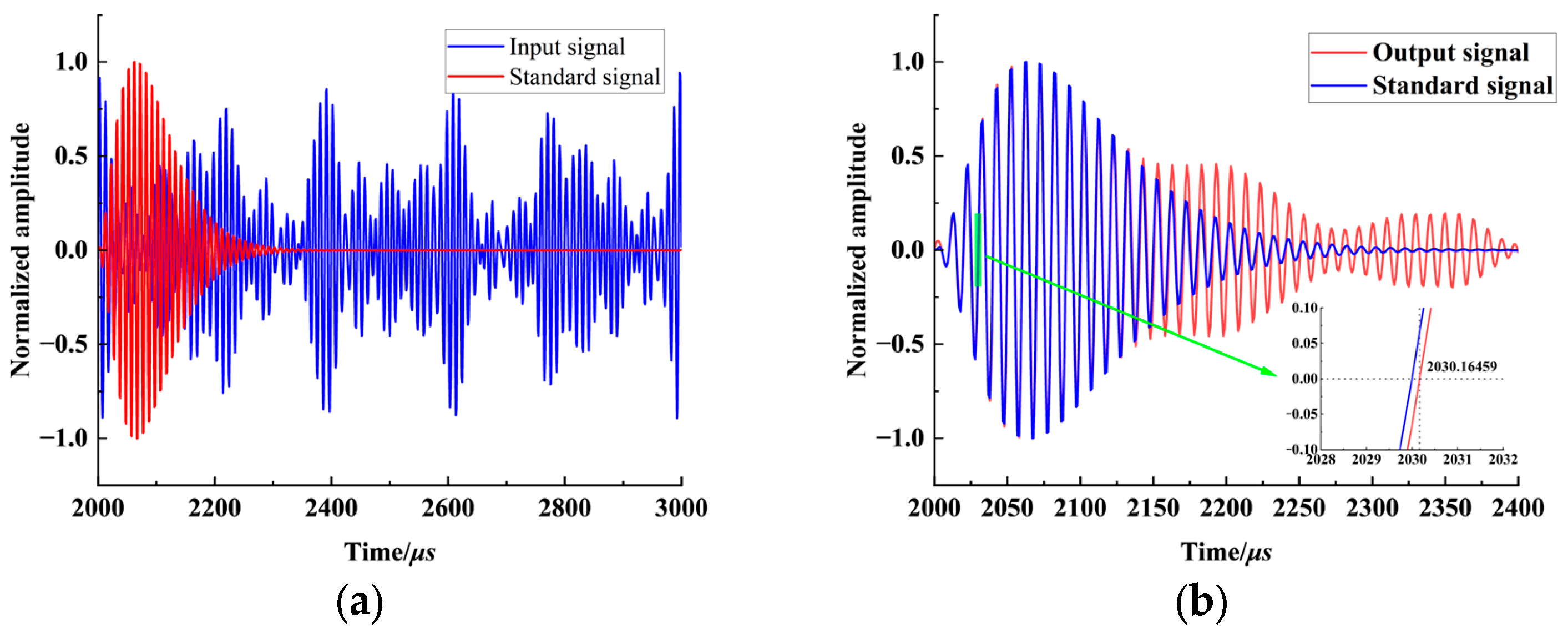
4.1. Experimental and Time–Frequency Domain Analysis of eLoran Signals
4.2. Reconstruction of Measured eLoran Signals
5. Conclusions
- (1)
- The FIR filter specifically targets the removal of out-of-band noise within the eLoran band while preserving in-band noise. This approach results in unstable signal filtering performance, which does not enhance the subsequent VSS-LMS processing. Consequently, the final signal reconstruction is inferior to that achieved by a standalone VSS-LMS algorithm, and it exacerbates the zero-point drift phenomenon of the eLoran signal.
- (2)
- The IIR filters exhibit an inherent nonlinear phase that causes time delays at specific frequencies within the signal, resulting in significant waveform distortions. The VSS-LMS algorithm cannot correct for this deterministic distortion introduced during preprocessing. Instead, it converges incorrectly on the distortion, leading to performance degradation, particularly in zero-point drift.
- (3)
- The wavelet decomposition combined algorithm is not well-suited for the VSS-LMS algorithm regarding primary filtering. This mismatch leads to considerable waveform distortion and increased error. Additionally, it filters out effective frequency band components in the signal, compromising the original structure of the eLoran signal. Consequently, a “negative synergy” effect arises, exacerbating the zero-point drift phenomenon.
- (4)
- The segmented inaction algorithm presented in this paper serves as an innovative primary filtering method. It effectively retains the useful frequency bands of eLoran signals while filtering out both in-band and out-of-band noise. Additionally, this algorithm demonstrates excellent compatibility and synergy with the VSS-LMS algorithm. The VSS-LMS algorithm minimizes zero-point drift caused by adaptive filtering to an extremely low level. This combination holds significant value and promising applications in engineering.
6. Discussion
Author Contributions
Funding
Data Availability Statement
Acknowledgments
Conflicts of Interest
Correction Statement
Abbreviations
| BDS | BeiDou navigation satellite |
| GPS | Global positioning system |
| GLONASS | Global navigation satellite system |
| GNSS | Global navigation satellite system |
| eLoran | Enhanced long-range navigation |
| PNT | Positioning, navigation, and timing |
| ECD | Envelope to cycle difference |
| IFFT | Inverse fast Fourier transform |
| APFFT | All-phase fast Fourier transform |
| MUSIC | Multiple signal classification |
| FIR | Finite impulse response |
| IIR | Infinite impulse response |
| WD | Wavelet decomposition |
| NTFT | Normal time–frequency transforms |
| VSS-LMS | Variable step size least mean square |
| LMS | Least mean square |
| SNR | Signal-to-noise ratio |
| RMS | Root mean square |
| RMSE | Root mean square error |
| R | Correlation coefficient |
| R-RMSE | Relative root mean square error |
| NCC | Normalized correlation coefficient |
| HFSWRs | High-frequency surface wave radars |
References
- Son, P.-W.; Park, S.G.; Han, Y.; Seo, K.; Fang, T.H. Demonstration of the Feasibility of the Korean eLoran System as a Resilient PNT in a Testbed. Remote Sens. 2023, 15, 3586. [Google Scholar] [CrossRef]
- Chang, S.; Ji, B.; Wu, M.; Bian, S.; Li, W.; Du, H. Evaluation of Height Correction on Loran Signal’s Groundwave Transmission Delay Model. IEEE Antennas Wirel. Propag. Lett. 2023, 22, 1005–1009. [Google Scholar] [CrossRef]
- Wu, M.; Di, J.; Xu, J.; Li, F. Application and development of eLoran. Hydrogr. Surv. Charting 2022, 42, 44–49. [Google Scholar]
- Wu, M.; Zhu, Y.; Li, F.; Xu, J. Radio Navigation Principle and Signal Receiving Technology; National Defense Industry Press: Beijing, China, 2015; ISBN 978-7-118-09795-5. [Google Scholar]
- Pelgrum, W. New Potential of Low-Frequency Radionavigation in the 21st Century. Ph.D. Thesis, TU Delft, Delft, The Netherlands, 2006. [Google Scholar]
- Yin, K.; Wu, J.; Ning, R.; Chen, Y.; Liu, Q.; Wang, K. Preliminary Evaluation and Analysis of Differential Technology Performance of eLoran Timing System. Electronics 2025, 14, 789. [Google Scholar] [CrossRef]
- Johnson, G.W.; Dykstra, K.; Oates, C.; Swaszek, P.F.; Hartnett, R. Navigating Harbors at High Accuracy Without GPS: eLoran Proof-of-Concept on the Thames River. In Proceedings of the 2007 National Technical Meeting of The Institute of Navigation, San Diego, CA, USA, 22–24 January 2007; pp. 1201–1211. Available online: http://www.ion.org/publications/abstract.cfm?jp=p&articleID=7215 (accessed on 26 October 2025).
- Zhu, Y.; Xu, J.; Wang, H.; Cao, K.; Hu, D. A New Sky-Groundwave Identification Algorithm for Loran-C Based on IFFT Spectral Division. Electron. Inf. Technol. 2009, 31, 1153–1156. [Google Scholar]
- Li, J.; Xu, J.; Li, B.; He, H. Design and Implementation of Loran-C front Digital Band Pass Filter. Appl. Electron. Tech. 2012, 38, 42–45+49. [Google Scholar]
- Lin, H.; Zhou, M.; Zhu, S.; Wang, K. A Frequency-Domain Suppression Method for Loran-C Narrowband Interference Based on apFFT. J. Nav. Aeron. Eng. 2012, 27, 613–617. [Google Scholar]
- Zeng, H.; Hua, Y.; Li, S. A Method Based on MUSIC Algorithm for Distinguishing between Sky-Wave and Ground-Wave. J. Time Freq. 2011, 34, 53–59. [Google Scholar]
- Chen, J. Cross-Rate Interference Suppression Technology in Loran-C Based on Comb Filter. Mod. Navig. 2022, 13, 41–45. [Google Scholar]
- Zhu, Y.; Cao, K.; Cui, G.; Hu, D. An Improved Joint Denoising Method for Loran-C Signal. Electron. Meas. Tech. 2008, 31, 21–23+43. [Google Scholar]
- Yi, Q.; Deng, Z.; Zhao, J. Digital filter design of eLoran receiver. J. Hebei Acad. Sci. 2019, 36, 17–25. [Google Scholar]
- Cheng, L.; Zhang, S.; Qi, Z.; Wang, X.; Chen, Y.; Feng, P. Research on eLoran Weak Signal Extraction Based on Wavelet Hard Thresholding Processing. Remote Sens. 2024, 16, 3012. [Google Scholar] [CrossRef]
- Liu, L.; Su, X.; Wang, G. Discussion on normal Time-Frequency Transform. J. Navig. Position 2016, 4, 1–4+23. [Google Scholar]
- Wang, C.; Xu, G.; Su, X.; Zhang, Y.; Zhao, Y.; Mu, J. FBPBPF and NTFT are Used to Extract the Weak Periodic Component of Polar Motion and Analyze Its Excitation Reasons. Prog. Geophys. 2025, 40, 905–912. Available online: https://d.wanfangdata.com.cn/Periodical/dqwlxjz202503003 (accessed on 22 November 2025).
- Liu, S.; Hua, Y.; Zhang, S. A Cycle Identification Algorithm for enhanced Long Range Navigation Signal Based on Skywave Reconstruction Technology. Electron. Inf. Technol. 2022, 44, 3592–3601. [Google Scholar]
- Ponikvar, D.; Zupanic, E.; Jeglic, P. Magnetic Interference Compensation Using the Adaptive LMS Algorithm. Electronics 2023, 12, 2360. [Google Scholar] [CrossRef]
- Wang, P.; Ma, K.; Wu, C. Segmented Variable-Step-Size LMS Algorithm Based on Normal Distribution Curve. J. Natl. Univ. Def. Technol. 2020, 42, 16–22. [Google Scholar]
- Wu, M.; Liu, L.; Li, F.; Zhu, B.; Li, W.; Jin, X. An Envelope-to-Cycle Difference Compensation Method for eLoran Signals in Seawater Based on a Variable Step Size Least Mean Square Algorithm. Electronics 2025, 14, 597. [Google Scholar] [CrossRef]
- Tong, W. Research on Front-End Signal Processing in Loran-C Receiver. Master’s Thesis, Xidian University, Xi’an, China, 2007. Available online: https://d.wanfangdata.com.cn/Thesis/Y1035851 (accessed on 14 November 2025).
- Gao, Y.; Xie, S. A Variable Step Size LMS Adaptive Filtering Algorithm and Its Analysis. Acta Electron. Sin. 2001, 29, 1094–1097. [Google Scholar]
- Golubović, D.; Marjanović, D. An Experimentally-Based Method for Detection Threshold Determination in HFSWR’s High-Resolution Range-Doppler Map Target Detection. In Proceedings of the 2025 24th International Symposium INFOTEH-JAHORINA (INFOTEH), Jahorina, Bosnia and Herzegovina, 19–21 March 2025; pp. 1–6. [Google Scholar] [CrossRef]
- Golubović, D. The Future of Maritime Target Detection Using HFSWRs: High-Resolution Approach. In Proceedings of the 2024 32nd Telecommunications Forum, Belgrade, Serbia, 26–27 November 2024; pp. 1–8. Available online: https://d.wanfangdata.com.cn/Conference/811a15500fcd8154d010b791bde18ef0 (accessed on 1 December 2025).
- Sun, W.; Wang, C. Power signal denoising based on improved soft threshold wavelet packet network. J. Nav. Univ. Eng. 2019, 31, 79–82. [Google Scholar]
- Liu, C.; Ma, L.; Pan, J.; Ma, Z. PD signal denoising based on VMD and improved wavelet threshold. Mod. Electron. Tech. 2021, 44, 45–50. [Google Scholar]
- Zhang, P.; Li, X.; Cui, S. An improved wavelet threshold-CEEMDAN algorithm for ECG signal denoising. Comput. Eng. Sci. 2020, 42, 2067–2072. [Google Scholar]
- Liu, F.; Lü, Z.; Zhang, C.; Ma, Z. Research on Speech Enhancement Algorithm Based on Modified Wavelet Threshold Function. Signal Process. 2016, 32, 203–213. [Google Scholar]
- Qiao, Y.; Li, Q.; Qian, H.; Song, X. Seismic signal denoising method based on VMD and improved wavelet threshold. Comput. Tech. Geophys. Geochem. Explor. 2021, 43, 690–696. [Google Scholar]
- GB/T 12752-1991; General Specification for Marine Loran-C Receiving Equipment. The State Bureau of Quality and Technical Spervision: Beijing, China, 1991. Available online: https://www.renrendoc.com/p-881056.html (accessed on 26 May 2025).
- Cai, S.; Ye, R.; Wang, Q.; Liu, L. Tide analysis and prediction based on inaction principle. Hydrogr. Surv. Charting 2021, 41, 47–51. [Google Scholar]
- Yao, Y.; Liu, L.; Sheng, M.; Xu, H. Unbiased picking onset time of P and S phases by Normal Time-Frequency Transform method under a strong noise environment. Chin. J. Geophys. 2022, 65, 227–243. [Google Scholar]



| Threshold Function | Mathematical Expressions for Each Threshold Function |
|---|---|
| hard threshold | , denotes the sign function |
| soft threshold | , denotes the indicator function |
| Reference [26] | |
| Reference [27] | |
| Reference [28] | |
| Reference [29] | , denotes the adjustment parameters |
| Reference [30] | , denotes the adjustment parameters |
| Threshold Function | RMSE | NCC/% | Zero-Point Drift Value/μs |
|---|---|---|---|
| hard threshold | 0.34879 | 0.56799 | 0.65574 |
| soft threshold | 0.31009 | 0.63553 | 0.47756 |
| Reference [26] | 0.22790 | 0.78673 | 0.87972 |
| Reference [27] | 0.21187 | 0.80981 | 0.46794 |
| Reference [28] | 0.20670 | 0.82391 | 0.40962 |
| Reference [29] | 0.24872 | 0.76990 | 0.49850 |
| Reference [30] | 0.12605 | 0.93093 | 0.34900 |
| Combined Method | Performance Indicators | |||
|---|---|---|---|---|
| RMSE | R | R-RMSE | Zero-Point Drift | |
| VSS-LMS | 0.12112 | 0.85612 | 0.62463 | 0.16459 |
| FIR + VSS-LMS | 0.09435 | 0.89364 | 0.48660 | 0.15446 |
| IIR + VSS-LMS | 0.24770 | 0.61694 | 1.27742 | 0.53606 |
| WD + VSS-LMS | 0.15426 | 0.74983 | 0.79555 | 0.38843 |
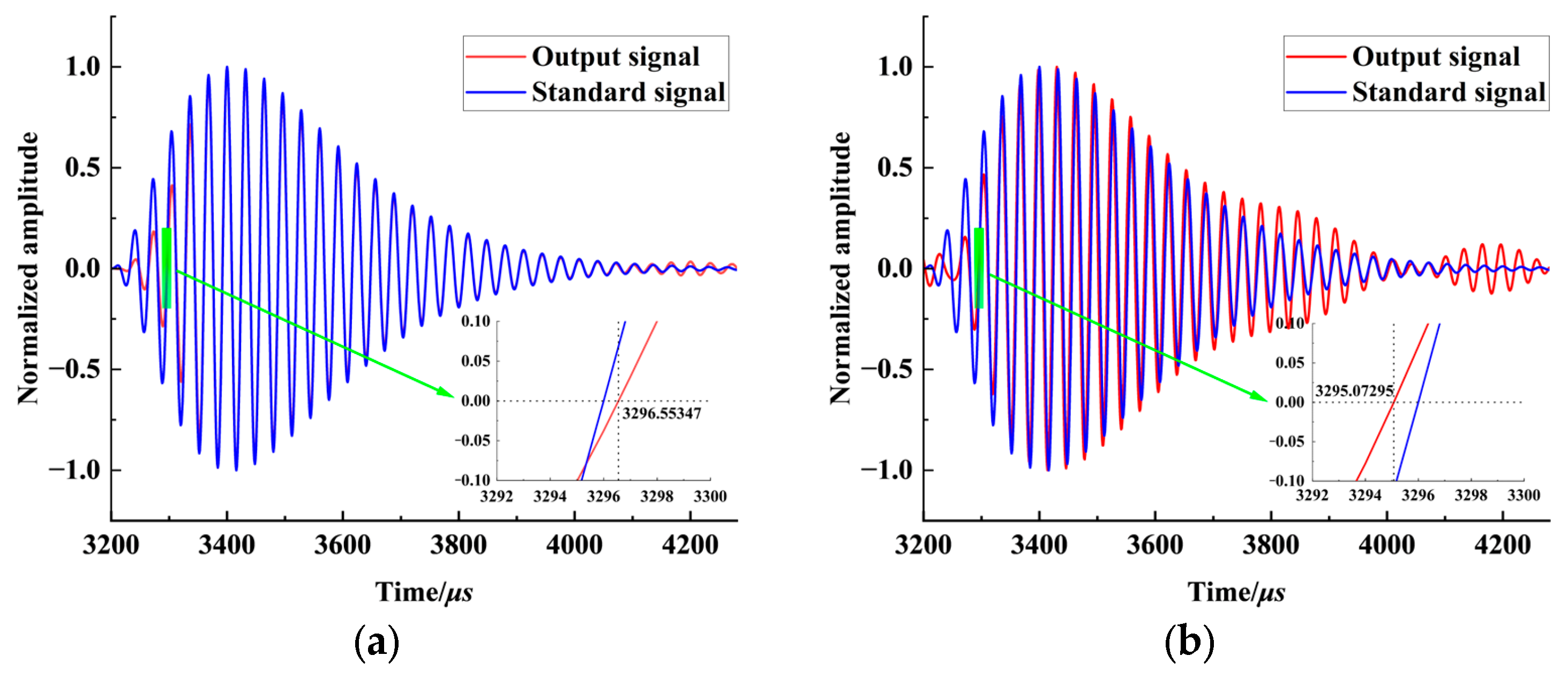
| Inaction + VSS-LMS | 0.05554 | 0.87371 | 0.28642 | 0.10693 |
| Experimental Site | Combined Method | Performance Indicators | |||
|---|---|---|---|---|---|
| RMSE | R/% | R-RMSE | Zero-Point Drift | ||
| coastland | VSS-LMS | 0.02529 | 0.94800 | 0.13273 | 0.26554 |
| FIR + VSS-LMS | 0.05058 | 0.94737 | 0.26542 | 0.55347 | |
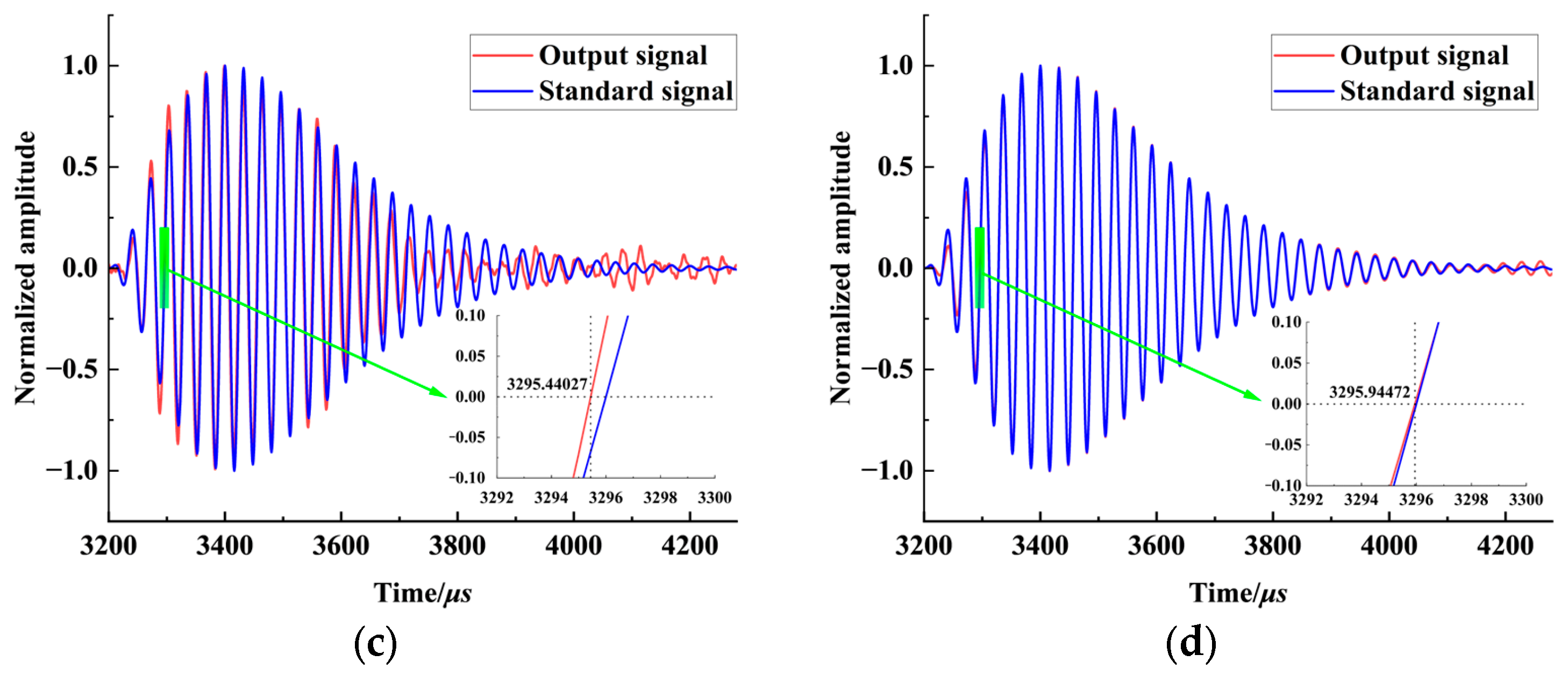
| IIR + VSS-LMS | 0.14773 | 0.77943 | 0.77529 | 0.92705 | |
| WD + VSS-LMS | 0.09776 | 0.72361 | 0.51306 | 0.55973 | |
| Inaction + VSS-LMS | 0.01540 | 0.97680 | 0.08083 | 0.05528 | |
| inland | VSS-LMS | 0.05028 | 0.92656 | 0.26665 | 0.11672 |
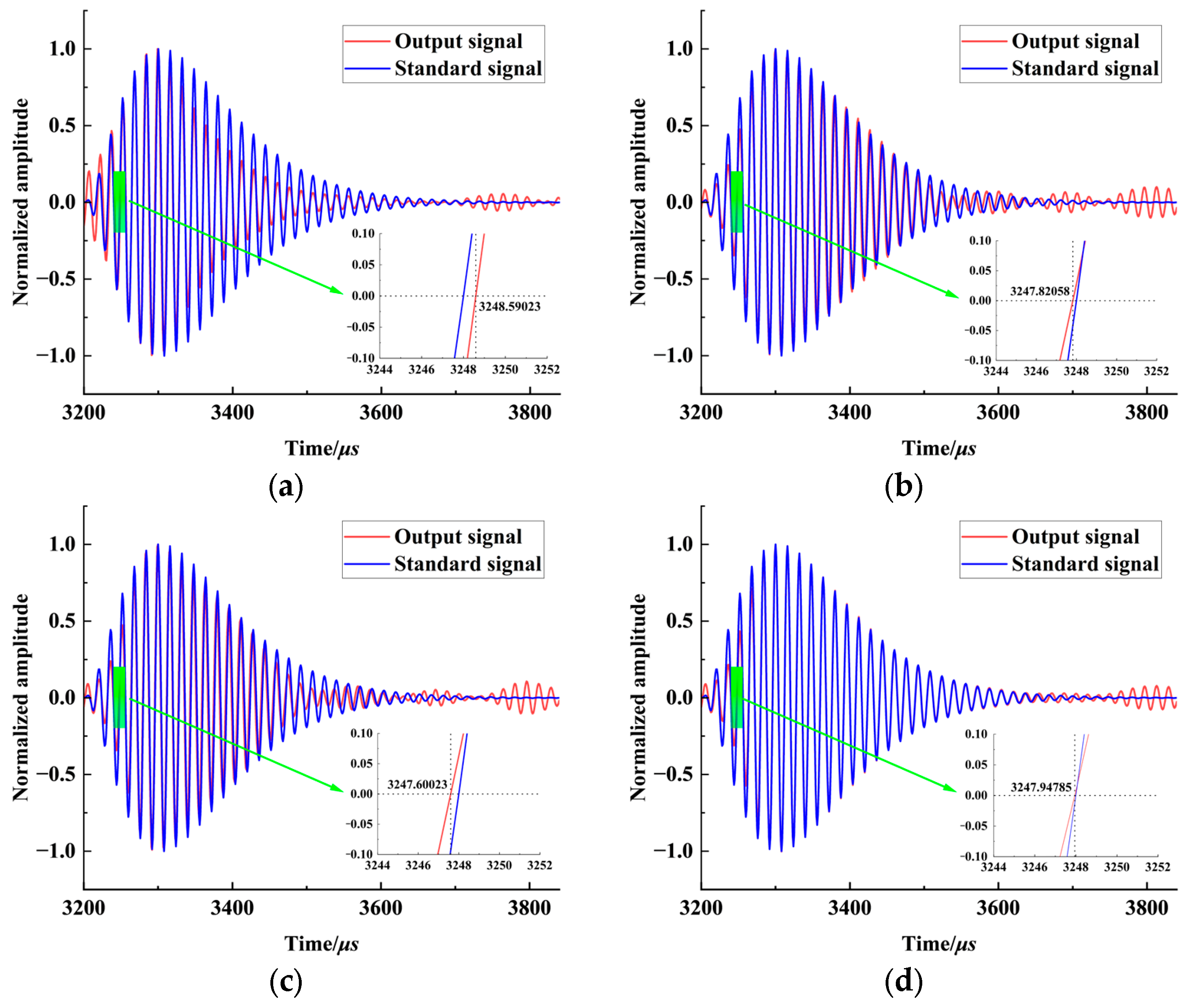
| FIR + VSS-LMS | 0.10470 | 0.90690 | 0.55525 | 0.59023 | |
| IIR + VSS-LMS | 0.09553 | 0.78617 | 0.50663 | 0.17942 | |
| WD + VSS-LMS | 0.10518 | 0.77726 | 0.55780 | 0.39977 | |
| Inaction + VSS-LMS | 0.04780 | 0.94201 | 0.25349 | 0.05215 | |
Disclaimer/Publisher’s Note: The statements, opinions and data contained in all publications are solely those of the individual author(s) and contributor(s) and not of MDPI and/or the editor(s). MDPI and/or the editor(s) disclaim responsibility for any injury to people or property resulting from any ideas, methods, instructions or products referred to in the content. |
© 2025 by the authors. Licensee MDPI, Basel, Switzerland. This article is an open access article distributed under the terms and conditions of the Creative Commons Attribution (CC BY) license (https://creativecommons.org/licenses/by/4.0/).
Share and Cite
Wu, M.; Jin, X.; Qi, X.; Di, J.; Yu, T.; Li, F. An Zero-Point Drift Suppression Method for eLoran Signal Based on a Segmented Inaction Algorithm. Electronics 2025, 14, 4838. https://doi.org/10.3390/electronics14244838
Wu M, Jin X, Qi X, Di J, Yu T, Li F. An Zero-Point Drift Suppression Method for eLoran Signal Based on a Segmented Inaction Algorithm. Electronics. 2025; 14(24):4838. https://doi.org/10.3390/electronics14244838
Chicago/Turabian StyleWu, Miao, Xianzhou Jin, Xin Qi, Jianchen Di, Tingyi Yu, and Fangneng Li. 2025. "An Zero-Point Drift Suppression Method for eLoran Signal Based on a Segmented Inaction Algorithm" Electronics 14, no. 24: 4838. https://doi.org/10.3390/electronics14244838
APA StyleWu, M., Jin, X., Qi, X., Di, J., Yu, T., & Li, F. (2025). An Zero-Point Drift Suppression Method for eLoran Signal Based on a Segmented Inaction Algorithm. Electronics, 14(24), 4838. https://doi.org/10.3390/electronics14244838