From Vulnerability to Robustness: A Survey of Patch Attacks and Defenses in Computer Vision


Abstract
1. Introduction
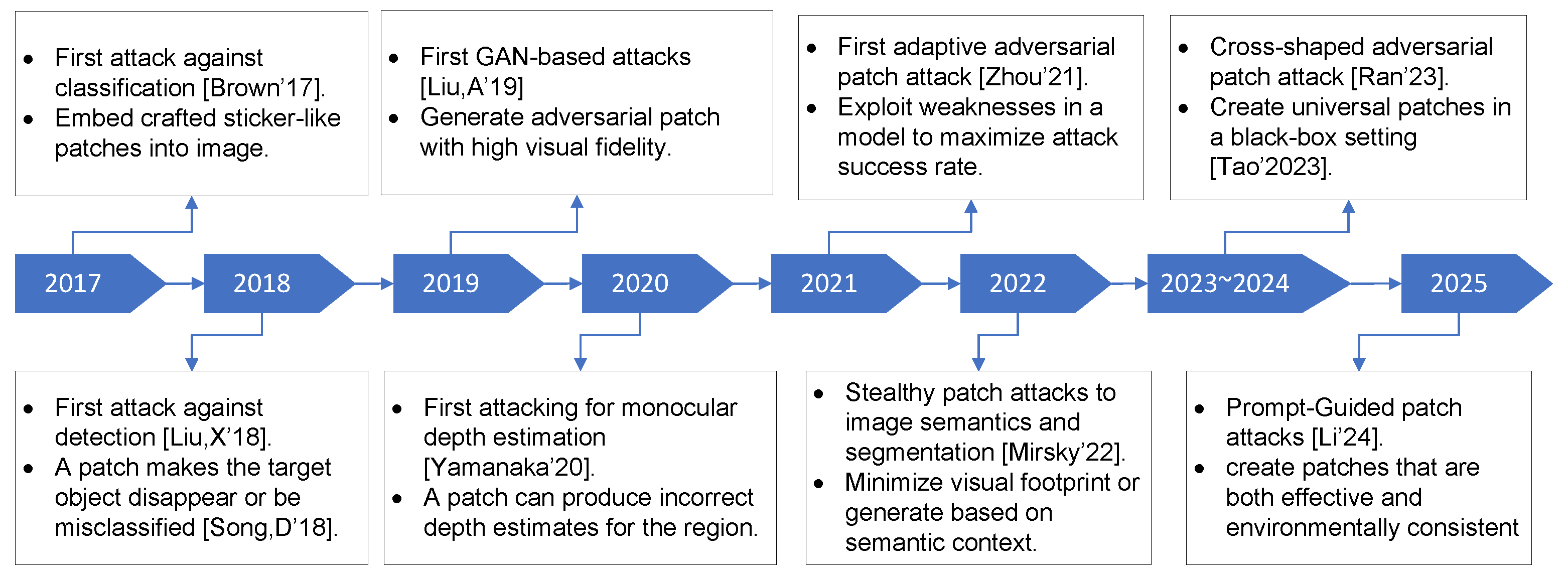
- We present an up-to-date and in-depth survey of adversarial patch attacks and defenses, especially covering works published in the past two years. Compared with existing surveys, our work emphasizes both digital and physical attack settings across a wide range of vision tasks, ensuring timeliness and broader applicability.
- We introduce a new, task-oriented taxonomy that systematically categorizes patch attack methods according to their downstream vision applications (e.g., classification, detection, segmentation) and defense mechanisms based on three major strategies. This unified framework provides an integrated perspective that bridges attack and defense research.
- We summarize open challenges in developing patch-resilient vision systems and discuss promising directions such as adaptive defense frameworks, benchmark standardization, cross-modal robustness, and realistic physical-world evaluations.
2. Background and Related Work
2.1. Deep Neural Networks in Computer Vision
2.2. Vision-Based Tasks in ML
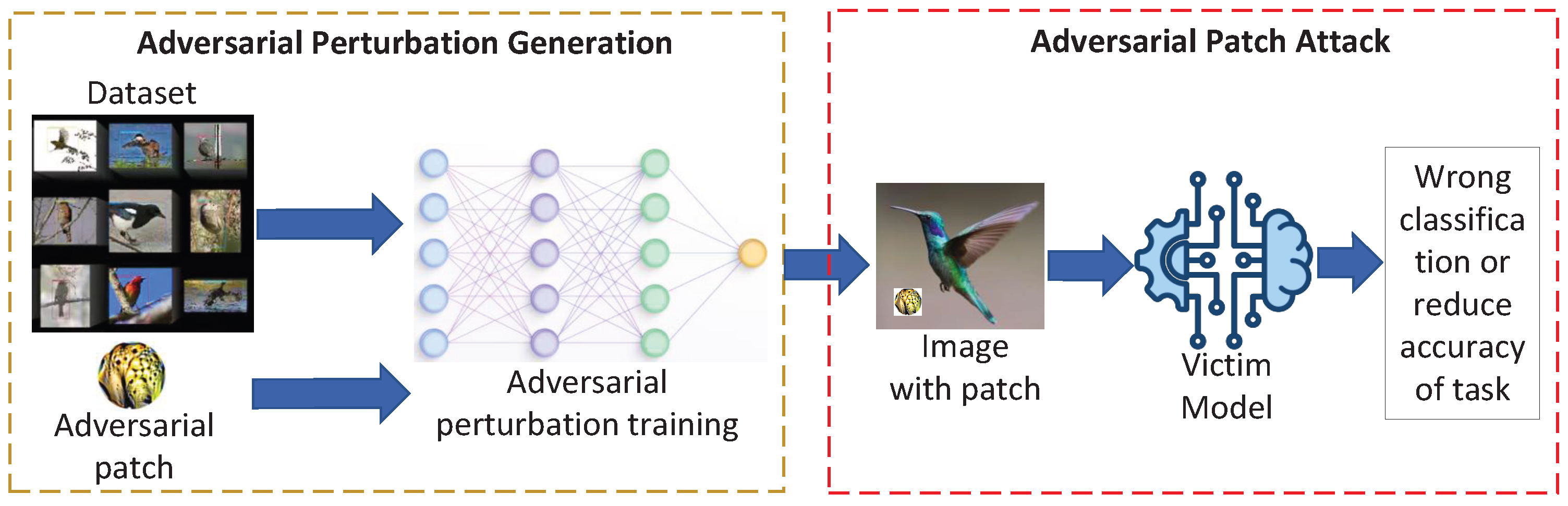
2.3. Adversarial Patch Attacks
- Locality: They affect only a specific region of the input rather than the entire image.
- Visibility: The modifications are usually perceptible to humans, yet remain effective against machine learning models.
- Transferability: A single patch can generalize across multiple inputs and sometimes across different models.
- Physical realizability: Adversarial patches can be printed and deployed in real-world settings, posing threats to autonomous driving, surveillance, and facial recognition.
- Reusability: Once generated, the same patch can be applied repeatedly to achieve consistent attack success.
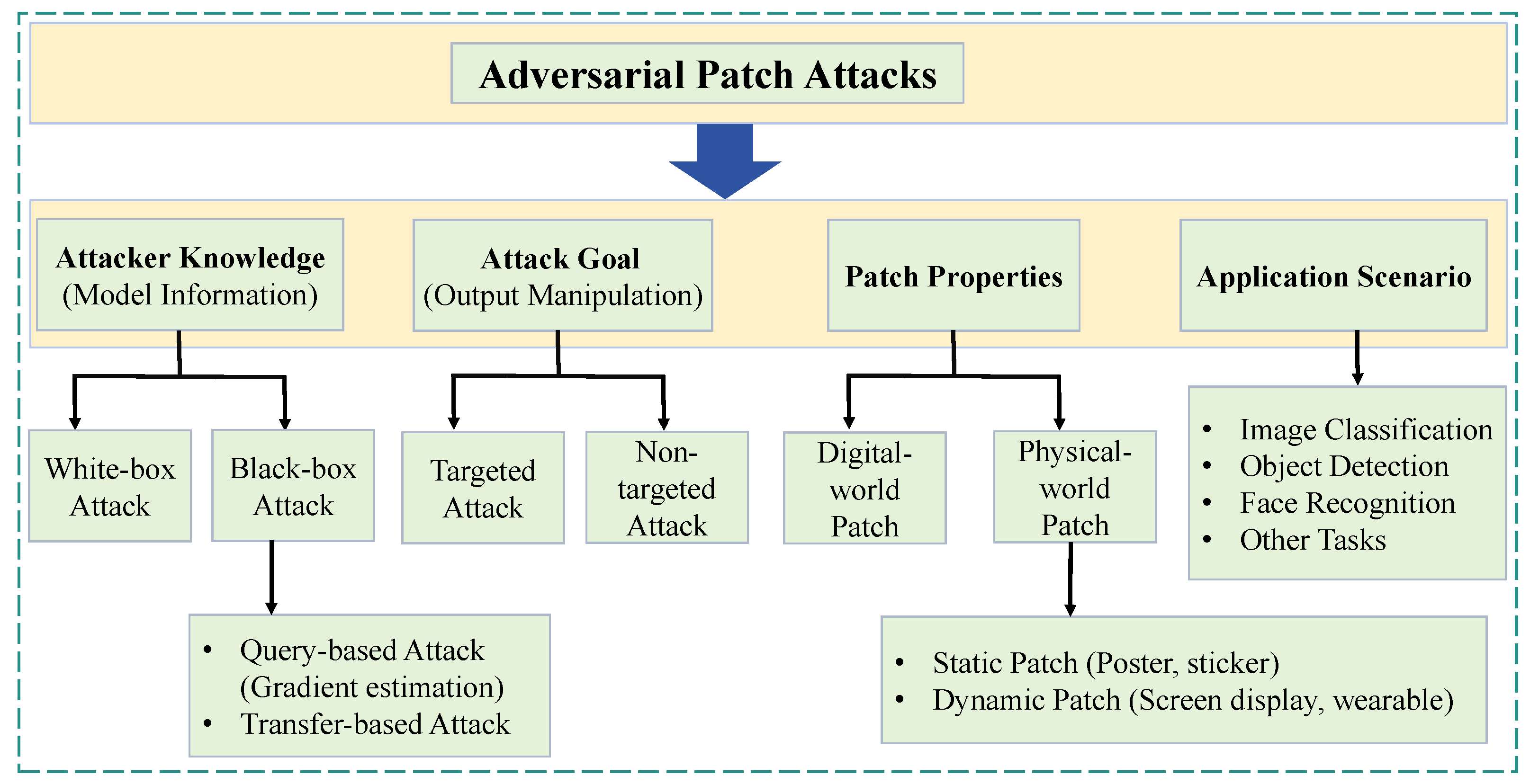
2.3.1. Attacker Knowledge
2.3.2. Attack Goal
2.3.3. Patch Properties
2.3.4. Application Scenario
2.4. Comparison with Other Attack Types
3. Patch Attack Methods
3.1. Patch Attacks in Image Classification
3.2. Patch Attacks in Object Detection
3.3. Patch Attacks on Other Vision Tasks
4. Defense Methods Against Patch Attacks
4.1. Patch Localization and Removal-Based Defenses

| Defense Category | Ref. & Year | Method & Approach | Key Characteristics |
|---|---|---|---|
| Certified Defenses | Ref. [98], 2023 | Divide the binary into byte chunks and make the final decision by majority voting over chunk predictions. | Chunk-Based Smoothing, Certifiable Robustness, Majority Voting |
| Detection-based | Ref. [93], 2024 | Remove adversarial patches by leveraging their semantic independence and spatial heterogeneity | Patch-agnostic, Training-free, Effective across modalities |
| Detection-based | Ref. [95], 2024 | Uses an ensemble of explainable detectors to spot inconsistencies from adversarial patches and raise alerts. | Real-time detection, Explainability, Generalization to new attacks |
| Detection-based | Ref. [96], 2024 | It improves robustness to naturalistic adversarial patches by leveraging their aggressiveness and naturalness. | Targets naturalistic adversarial patches, Feature-level modulation, Improves precision and generalization |
| Detection-based & Pre-processing | Ref. [99], 2024 | A text-guided diffusion model detects and localizes adversarial patches by identifying distributional differences, then restores the image to remove the perturbations. | Utilizes diffusion models, few-shot tuning |
| Detection-based & Pre-processing | Ref. [100], 2024 | Analyze the visual and feature-level inconsistencies introduced by adversarial patches to locate and filter out adversarial regions | Dual Attack Resistance, High Generalization |
| Detection-based | Ref. [97], 2025 | Detect adversarial patches using a binarized feature map ensemble generated with multiple saliency thresholds | Explicit patch detection, inpainting-based recovery, Low computational complexity |
| Detection-based | Ref. [101], 2025 | Apply randomized Fourier-space sampling masks to enhance robustness to occlusion and adversarial perturbations. SAF (Split-and-Fill) Strategy | Fourier-based augmentation, edge-aware segmentation, and adaptive reconstruction. |
4.2. Input Transformation and Reconstruction-Based Defenses
4.3. Model Modification and Training-Based Defenses
4.4. Task-Specific Defenses
4.5. Discussion and Insights
5. Future Challenges and Research Directions
6. Conclusions
Author Contributions
Funding
Data Availability Statement
Conflicts of Interest
Abbreviations
| AI | Artificial Intelligence |
| CNN | Convolutional Neural Networks |
| DL | Deep Learning |
| DNN | Deep neural networks |
| GANs | Generative Adversarial Networks |
| ML | Machine Learning |
| ViTs | Vision Transformers |
| ASR | Attack Success Rate |
| mAP | Mean Average Precision |
| mIoU | Mean Intersection over Union |
| RSI | Remote Sensing Image |
| MPAA | Multi-Patch Adversarial Attack |
| PG | Patch Generation |
| FEMG | Feasible and Effective Map Generation |
| CSPA | Cross-Shaped Patch Attack |
| PSO | Particle Swarm Optimization |
| YOLO | You Only Look Once |
| FOD | First-order Difference |
| BDL | Bounding-box Drifting Loss |
| CAP | Physical Adversarial Patch |
| ISP | Image Signal Processing |
| NAP | Naturalistic Adversarial Patche |
| AAP | Adversarial Anomaly Perception |
| FNS | Feature Norm Suppressing |
| EBCE | Edge-aware binary cross-entropy |
| POD | Patch-based Occlusion-aware Detection |
| AFDD | Automated Fault Detection and Diagnosis |
| Trans-CWGAN | Transfer Conditional Wasserstein GAN |
References
- Ota, K.; Dao, M.S.; Mezaris, V.; Natale, F.G.D. Deep learning for mobile multimedia: A survey. ACM Trans. Multimed. Comput. Commun. Appl. 2017, 13, 1–22. [Google Scholar] [CrossRef]
- Chen, C.; Seff, A.; Kornhauser, A.; Xiao, J. Deepdriving: Learning affordance for direct perception in autonomous driving. In Proceedings of the IEEE International Conference on Computer Vision, Santiago, Chile, 7–13 December 2015; pp. 2722–2730. [Google Scholar]
- Liu, X.; Xu, R.; Chen, Y. A decentralized digital watermarking framework for secure and auditable video data in smart vehicular networks. Future Internet 2024, 16, 390. [Google Scholar] [CrossRef]
- Liu, X.; Xiao, P.; Esposito, M.; Raavi, M.; Zhao, C. AGFA-Net: Attention-Guided Feature-Aggregated Network for Coronary Artery Segmentation Using Computed Tomography Angiography. In Proceedings of the 2024 IEEE 36th International Conference on Tools with Artificial Intelligence (ICTAI), Herndon, VA, USA, 28–30 October 2024; pp. 327–334. [Google Scholar]
- Khan, S.; Naseer, M.; Hayat, M.; Zamir, S.W.; Khan, F.S.; Shah, M. Transformers in vision: A survey. ACM Comput. Surv. 2022, 54, 1–41. [Google Scholar] [CrossRef]
- Liu, L.; Ouyang, W.; Wang, X.; Fieguth, P.; Chen, J.; Liu, X.; Pietikäinen, M. Deep learning for generic object detection: A survey. Int. J. Comput. Vis. 2020, 128, 261–318. [Google Scholar] [CrossRef]
- Chai, J.; Zeng, H.; Li, A.; Ngai, E.W. Deep learning in computer vision: A critical review of emerging techniques and application scenarios. Mach. Learn. Appl. 2021, 6, 100134. [Google Scholar] [CrossRef]
- Guo, Q.; Chen, S.; Xie, X.; Ma, L.; Hu, Q.; Liu, H.; Liu, Y.; Zhao, J.; Li, X. An empirical study towards characterizing deep learning development and deployment across different frameworks and platforms. In Proceedings of the 2019 34th IEEE/ACM International Conference on Automated Software Engineering (ASE), San Diego, CA, USA, 11–15 November 2019; pp. 810–822. [Google Scholar]
- He, Y.; Meng, G.; Chen, K.; Hu, X.; He, J. Towards security threats of deep learning systems: A survey. IEEE Trans. Softw. Eng. 2020, 48, 1743–1770. [Google Scholar] [CrossRef]
- Liu, X.; Xu, R.; Peng, X. BEWSAT: Blockchain-enabled watermarking for secure authentication and tamper localization in industrial visual inspection. In Proceedings of the Eighth International Conference on Machine Vision and Applications (ICMVA 2025), Melbourne, Australia, 12–14 June 2025; SPIE: Bellingham, WA, USA, 2025; Volume 13734, pp. 54–65. [Google Scholar]
- Xu, R.; Liu, X.; Nagothu, D.; Qu, Q.; Chen, Y. Detecting Manipulated Digital Entities Through Real-World Anchors. In International Conference on Advanced Information Networking and Applications; Springer: Berlin/Heidelberg, Germany, 2025; pp. 450–461. [Google Scholar]
- Lipton, Z.C. The mythos of model interpretability: In machine learning, the concept of interpretability is both important and slippery. Queue 2018, 16, 31–57. [Google Scholar] [CrossRef]
- Hendrycks, D.; Dietterich, T. Benchmarking neural network robustness to common corruptions and perturbations. arXiv 2019, arXiv:1903.12261. [Google Scholar] [CrossRef]
- Han, S.; Mao, H.; Dally, W.J. Deep compression: Compressing deep neural networks with pruning, trained quantization and huffman coding. arXiv 2015, arXiv:1510.00149. [Google Scholar]
- Li, Y.; Xie, B.; Guo, S.; Yang, Y.; Xiao, B. A survey of robustness and safety of 2d and 3d deep learning models against adversarial attacks. ACM Comput. Surv. 2024, 56, 1–37. [Google Scholar] [CrossRef]
- Yuan, X.; He, P.; Zhu, Q.; Li, X. Adversarial examples: Attacks and defenses for deep learning. IEEE Trans. Neural Netw. Learn. Syst. 2019, 30, 2805–2824. [Google Scholar] [CrossRef]
- Madry, A.; Makelov, A.; Schmidt, L.; Tsipras, D.; Vladu, A. Towards deep learning models resistant to adversarial attacks. arXiv 2017, arXiv:1706.06083. [Google Scholar]
- Chen, X.; Liu, C.; Li, B.; Lu, K.; Song, D. Targeted backdoor attacks on deep learning systems using data poisoning. arXiv 2017, arXiv:1712.05526. [Google Scholar] [CrossRef]
- Brown, T.B.; Mané, D.; Roy, A.; Abadi, M.; Gilmer, J. Adversarial patch. arXiv 2017, arXiv:1712.09665. [Google Scholar]
- Wei, H.; Tang, H.; Jia, X.; Wang, Z.; Yu, H.; Li, Z.; Satoh, S.; Van Gool, L.; Wang, Z. Physical adversarial attack meets computer vision: A decade survey. IEEE Trans. Pattern Anal. Mach. Intell. 2024, 46, 9797–9817. [Google Scholar] [CrossRef] [PubMed]
- Liu, X.; Shen, F.; Zhao, J.; Nie, C. EAP: An effective black-box impersonation adversarial patch attack method on face recognition in the physical world. Neurocomputing 2024, 580, 127517. [Google Scholar] [CrossRef]
- Liu, X.; Yang, H.; Liu, Z.; Song, L.; Li, H.; Chen, Y. Dpatch: An adversarial patch attack on object detectors. arXiv 2018, arXiv:1806.02299. [Google Scholar]
- Song, D.; Eykholt, K.; Evtimov, I.; Fernandes, E.; Li, B.; Rahmati, A.; Tramer, F.; Prakash, A.; Kohno, T. Physical adversarial examples for object detectors. In Proceedings of the 12th USENIX Workshop on Offensive Technologies (WOOT 18), Baltimore, MD, USA, 13–14 August 2018. [Google Scholar]
- Liu, A.; Liu, X.; Fan, J.; Ma, Y.; Zhang, A.; Xie, H.; Tao, D. Perceptual-sensitive gan for generating adversarial patches. In Proceedings of the AAAI Conference on Artificial Intelligence, Honolulu, HI, USA, 27 January–1 February 2019; Volume 33, pp. 1028–1035. [Google Scholar]
- Yamanaka, K.; Matsumoto, R.; Takahashi, K.; Fujii, T. Adversarial patch attacks on monocular depth estimation networks. IEEE Access 2020, 8, 179094–179104. [Google Scholar] [CrossRef]
- Zhou, X.; Pan, Z.; Duan, Y.; Zhang, J.; Wang, S. A data independent approach to generate adversarial patches. Mach. Vis. Appl. 2021, 32, 67. [Google Scholar] [CrossRef]
- Mirsky, Y. Ipatch: A remote adversarial patch. Cybersecurity 2023, 6, 18. [Google Scholar] [CrossRef]
- Ran, Y.; Wang, W.; Li, M.; Li, L.C.; Wang, Y.G.; Li, J. Cross-shaped adversarial patch attack. IEEE Trans. Circuits Syst. Video Technol. 2023, 34, 2289–2303. [Google Scholar] [CrossRef]
- Tao, G.; An, S.; Cheng, S.; Shen, G.; Zhang, X. Hard-label black-box universal adversarial patch attack. In Proceedings of the 32nd USENIX Security Symposium (USENIX Security 23), Anaheim, CA, USA, 9–11 August 2023; pp. 697–714. [Google Scholar]
- Li, C.; Yan, H.; Zhou, L.; Chen, T.; Liu, Z.; Su, H. Prompt-guided environmentally consistent adversarial patch. arXiv 2024, arXiv:2411.10498v1. [Google Scholar] [CrossRef]
- Chakraborty, A.; Alam, M.; Dey, V.; Chattopadhyay, A.; Mukhopadhyay, D. A survey on adversarial attacks and defences. CAAI Trans. Intell. Technol. 2021, 6, 25–45. [Google Scholar] [CrossRef]
- Sharma, A.; Bian, Y.; Munz, P.; Narayan, A. Adversarial patch attacks and defences in vision-based tasks: A survey. arXiv 2022, arXiv:2206.08304. [Google Scholar] [CrossRef]
- Wang, D.; Yao, W.; Jiang, T.; Tang, G.; Chen, X. A survey on physical adversarial attack in computer vision. arXiv 2022, arXiv:2209.14262. [Google Scholar]
- Liu, X.; Liu, Z.; Chatterjee, S.; Portfleet, M.; Sun, Y. Understanding human behaviors and injury factors in underground mines using data analytics. In Proceedings of the 2021 43rd Annual International Conference of the IEEE Engineering in Medicine & Biology Society (EMBC), Virtual, 1–5 November 2021; pp. 2459–2462. [Google Scholar]
- Kang, H.; Kim, H.; Le, T.T. Robust adversarial attack against explainable deep classification models based on adversarial images with different patch sizes and perturbation ratios. IEEE Access 2021, 9, 133049–133061. [Google Scholar] [CrossRef]
- Krizhevsky, A.; Sutskever, I.; Hinton, G.E. Imagenet classification with deep convolutional neural networks. Adv. Neural Inf. Process. Syst. 2012, 25, 84–90. [Google Scholar] [CrossRef]
- Rawat, W.; Wang, Z. Deep convolutional neural networks for image classification: A comprehensive review. Neural Comput. 2017, 29, 2352–2449. [Google Scholar] [CrossRef]
- Ren, S.; He, K.; Girshick, R.; Sun, J. Faster r-cnn: Towards real-time object detection with region proposal networks. Adv. Neural Inf. Process. Syst. 2015, 28, 1137–1149. [Google Scholar] [CrossRef]
- Redmon, J.; Divvala, S.; Girshick, R.; Farhadi, A. You only look once: Unified, real-time object detection. In Proceedings of the IEEE Conference on Computer Vision and Pattern Recognition, Las Vegas, NV, USA, 27–30 June 2016; pp. 779–788. [Google Scholar]
- Long, J.; Shelhamer, E.; Darrell, T. Fully convolutional networks for semantic segmentation. In Proceedings of the IEEE Conference on Computer Vision and Pattern Recognition, Boston, MA, USA, 7–12 June 2015; pp. 3431–3440. [Google Scholar]
- Taigman, Y.; Yang, M.; Ranzato, M.; Wolf, L. Deepface: Closing the gap to human-level performance in face verification. In Proceedings of the IEEE Conference on Computer Vision and Pattern Recognition, Columbus, OH, USA, 23–28 June 2014; pp. 1701–1708. [Google Scholar]
- Schroff, F.; Kalenichenko, D.; Philbin, J. Facenet: A unified embedding for face recognition and clustering. In Proceedings of the IEEE Conference on Computer Vision and Pattern Recognition, Boston, MA, USA, 7–12 June 2015; pp. 815–823. [Google Scholar]
- Goodfellow, I.J.; Shlens, J.; Szegedy, C. Explaining and harnessing adversarial examples. arXiv 2014, arXiv:1412.6572. [Google Scholar]
- Chen, P.Y.; Zhang, H.; Sharma, Y.; Yi, J.; Hsieh, C.J. ZOO: Zeroth Order Optimization based Black-box Attacks to Deep Neural Networks without Training Substitute Models. In Proceedings of the 10th ACM Workshop on Artificial Intelligence and Security (AISec), Dallas, TX, USA, 3 November 2017; pp. 15–26. [Google Scholar]
- Ilyas, A.; Engstrom, L.; Athalye, A.; Lin, J. Black-box adversarial attacks with limited queries and information. In Proceedings of the 35th International Conference on Machine Learning (ICML), Stockholm, Sweden, 10–15 July 2018; pp. 2137–2146. [Google Scholar]
- Bhagoji, A.N.; He, W.; Li, B.; Song, D. Practical black-box attacks on deep neural networks using efficient query mechanisms. In Proceedings of the European Conference on Computer Vision (ECCV), Munich, Germany, 8–14 September 2018; pp. 158–174. [Google Scholar]
- Szegedy, C.; Zaremba, W.; Sutskever, I.; Bruna, J.; Erhan, D.; Goodfellow, I.; Fergus, R. Intriguing properties of neural networks. arXiv 2013, arXiv:1312.6199. [Google Scholar]
- Papernot, N.; McDaniel, P.; Goodfellow, I.; Jha, S.; Celik, Z.B.; Swami, A. Practical black-box attacks against machine learning. In Proceedings of the 2017 ACM on Asia Conference on Computer and Communications Security, Abu Dhabi, United Arab Emirates, 2–6 April 2017; pp. 506–519. [Google Scholar]
- Sharif, M.; Bhagavatula, S.; Bauer, L.; Reiter, M.K. Accessorize to a crime: Real and stealthy attacks on state-of-the-art face recognition. In Proceedings of the 2016 ACM Sigsac Conference on Computer and Communications Security, Vienna, Austria, 24–28 October 2016; pp. 1528–1540. [Google Scholar]
- Eykholt, K.; Evtimov, I.; Fernandes, E.; Li, B.; Rahmati, A.; Xiao, C.; Prakash, A.; Kohno, T.; Song, D. Robust Physical-World Attacks on Deep Learning Visual Classification. In Proceedings of the IEEE Conference on Computer Vision and Pattern Recognition (CVPR), Salt Lake City, UT, USA, 18–23 June 2018; pp. 1625–1634. [Google Scholar]
- Karmon, D.; Zoran, D.; Goldberg, Y. Lavan: Localized and visible adversarial noise. In Proceedings of the International Conference on Machine Learning. PMLR, Stockholm, Sweden, 10–15 July 2018; pp. 2507–2515. [Google Scholar]
- Thys, S.; Van Ranst, W.; Goedemé, T. Fooling Automated Surveillance Cameras: Adversarial Patches to Attack Person Detectors. In Proceedings of the IEEE/CVF Conference on Computer Vision and Pattern Recognition (CVPR) Workshops, Long Beach, CA, USA, 15–20 July 2019. [Google Scholar]
- Hingun, N.; Sitawarin, C.; Li, J.; Wagner, D. REAP: A Large-Scale Realistic Adversarial Patch Benchmark. In Proceedings of the IEEE/CVF International Conference on Computer Vision (ICCV), Paris, France, 1–6 October 2023; pp. 12500–12509. [Google Scholar]
- Shrestha, S.; Pathak, S.; Viegas, E.K. Towards a robust adversarial patch attack against unmanned aerial vehicles object detection. In Proceedings of the 2023 IEEE/RSJ International Conference on Intelligent Robots and Systems (IROS), Detroit, MI, USA, 1–5 October 2023; pp. 3256–3263. [Google Scholar]
- Wang, X.; Li, W. Physical adversarial attacks for infrared object detection. In Proceedings of the 2024 4th International Conference on Consumer Electronics and Computer Engineering (ICCECE), Guangzhou, China, 12–14 January 2024; pp. 64–69. [Google Scholar]
- Li, Y.; Li, Y.; Wu, B.; Li, L.; He, R.; Lyu, S. Invisible backdoor attack with sample-specific triggers. In Proceedings of the IEEE/CVF International Conference on Computer Vision, Montreal, BC, Cananda, 11–17 October 2021; pp. 16463–16472. [Google Scholar]
- Wang, Z.; Huang, J.J.; Liu, T.; Chen, Z.; Zhao, W.; Liu, X.; Pan, Y.; Liu, L. Multi-patch adversarial attack for remote sensing image classification. In Proceedings of the Asia-Pacific Web (APWeb) and Web-Age Information Management (WAIM) Joint International Conference on Web and Big Data, Wuhan, China, 6–8 October 2023; Springer: Berlin/Heidelberg, Germany, 2023; pp. 377–391. [Google Scholar]
- Huang, J.J.; Wang, Z.; Liu, T.; Luo, W.; Chen, Z.; Zhao, W.; Wang, M. DeMPAA: Deployable multi-mini-patch adversarial attack for remote sensing image classification. IEEE Trans. Geosci. Remote Sens. 2024, 62, 15623613. [Google Scholar]
- Tiliwalidi, K.; Yan, K.; Shi, Y.; Hu, C.; Zhou, J. Cost-effective and robust adversarial patch attacks in real-world scenarios. J. Electron. Imaging 2025, 34, 033003. [Google Scholar]
- Lee, M.; Kolter, Z. On physical adversarial patches for object detection. arXiv 2019, arXiv:1906.11897. [Google Scholar] [CrossRef]
- Wu, S.; Dai, T.; Xia, S.T. Dpattack: Diffused patch attacks against universal object detection. arXiv 2020, arXiv:2010.11679. [Google Scholar] [CrossRef]
- Huang, H.; Wang, Y.; Chen, Z.; Tang, Z.; Zhang, W.; Ma, K.K. Rpattack: Refined patch attack on general object detectors. arXiv 2021, arXiv:2103.12469. [Google Scholar] [CrossRef]
- Hoory, S.; Shapira, T.; Shabtai, A.; Elovici, Y. Dynamic adversarial patch for evading object detection models. arXiv 2020, arXiv:2010.13070. [Google Scholar] [CrossRef]
- Wang, Y.; Lv, H.; Kuang, X.; Zhao, G.; Tan, Y.a.; Zhang, Q.; Hu, J. Towards a physical-world adversarial patch for blinding object detection models. Inf. Sci. 2021, 556, 459–471. [Google Scholar] [CrossRef]
- Lang, D.; Chen, D.; Shi, R.; He, Y. Attention-Guided Digital Adversarial Patches on Visual Detection. Secur. Commun. Netw. 2021, 2021, 6637936. [Google Scholar]
- Sun, X.; Cheng, G.; Pei, L.; Li, H.; Han, J. Threatening patch attacks on object detection in optical remote sensing images. IEEE Trans. Geosci. Remote Sens. 2023, 61, 5609210. [Google Scholar]
- Tang, G.; Jiang, T.; Zhou, W.; Li, C.; Yao, W.; Zhao, Y. Adversarial patch attacks against aerial imagery object detectors. Neurocomputing 2023, 537, 128–140. [Google Scholar] [CrossRef]
- Deng, B.; Zhang, D.; Dong, F.; Zhang, J.; Shafiq, M.; Gu, Z. Rust-style patch: A physical and naturalistic camouflage attacks on object detector for remote sensing images. Remote Sens. 2023, 15, 885. [Google Scholar]
- Wang, J.; Li, F.; He, L. A unified framework for adversarial patch attacks against visual 3D object detection in autonomous driving. IEEE Trans. Circuits Syst. Video Technol. 2025, 35, 4949–4962. [Google Scholar] [CrossRef]
- Zhu, W.; Ji, X.; Cheng, Y.; Zhang, S.; Xu, W. {TPatch}: A triggered physical adversarial patch. In Proceedings of the 32nd USENIX Security Symposium (USENIX Security 23), Anaheim, CA, USA, 9–11 August 2023; pp. 661–678. [Google Scholar]
- Wei, H.; Wang, Z.; Zhang, K.; Hou, J.; Liu, Y.; Tang, H.; Wang, Z. Revisiting adversarial patches for designing camera-agnostic attacks against person detection. Adv. Neural Inf. Process. Syst. 2024, 37, 8047–8064. [Google Scholar]
- Zhang, S.; Cheng, Y.; Zhu, W.; Ji, X.; Xu, W. {CAPatch}: Physical Adversarial Patch against Image Captioning Systems. In Proceedings of the 32nd USENIX Security Symposium (USENIX Security 23), Anaheim, CA, USA, 9–11 August 2023; pp. 679–696. [Google Scholar]
- Jiang, K.; Chen, Z.; Huang, H.; Wang, J.; Yang, D.; Li, B.; Wang, Y.; Zhang, W. Efficient decision-based black-box patch attacks on video recognition. In Proceedings of the IEEE/CVF International Conference on Computer Vision, Paris, France, 1–6 October 2023; pp. 4379–4389. [Google Scholar]
- Liu, A.; Guo, J.; Wang, J.; Liang, S.; Tao, R.; Zhou, W.; Liu, C.; Liu, X.; Tao, D. {X-Adv}: Physical adversarial object attacks against x-ray prohibited item detection. In Proceedings of the 32nd USENIX Security Symposium (USENIX Security 23), Anaheim, CA, USA, 9–11 August 2023; pp. 3781–3798. [Google Scholar]
- Agrawal, K.; Bhatnagar, C. A black-box based attack generation approach to create the transferable patch attack. In Proceedings of the 2023 7th International Conference on Intelligent Computing and Control Systems (ICICCS), Madurai, India, 17–19 May 2023; pp. 1376–1380. [Google Scholar]
- Wei, X.; Yu, J.; Huang, Y. Infrared adversarial patches with learnable shapes and locations in the physical world. Int. J. Comput. Vis. 2024, 132, 1928–1944. [Google Scholar] [CrossRef]
- Chen, X.; Liu, F.; Jiang, D.; Yan, K. Natural adversarial patch generation method based on latent diffusion model. arXiv 2023, arXiv:2312.16401. [Google Scholar] [CrossRef]
- Lin, C.Y.; Huang, T.Y.; Ng, H.F.; Lin, W.Y.; Farady, I. Entropy-Boosted Adversarial Patch for Concealing Pedestrians in YOLO Models. IEEE Access 2024, 12, 32772–32779. [Google Scholar] [CrossRef]
- Zhou, Z.; Zhao, H.; Liu, J.; Zhang, Q.; Geng, L.; Lyu, S.; Feng, W. Mvpatch: More vivid patch for adversarial camouflaged attacks on object detectors in the physical world. arXiv 2023, arXiv:2312.17431. [Google Scholar]
- Wang, S.; Li, W.; Xu, Z.; Yu, N. Learning from the Environment: A Novel Adversarial Patch Attack against Object Detectors Using a GAN Trained on Image Slices. In Proceedings of the 2025 2nd International Conference on Electronic Engineering and Information Systems (EEISS), Nanjing, China, 23–25 May 2025; pp. 1–6. [Google Scholar]
- Zhou, D.; Qu, H.; Wang, N.; Peng, C.; Ma, Z.; Yang, X.; Gao, X. Fooling human detectors via robust and visually natural adversarial patches. Neurocomputing 2025, 616, 128915. [Google Scholar] [CrossRef]
- Yuan, S.; Li, H.; Han, X.; Xu, G.; Jiang, W.; Ni, T.; Zhao, Q.; Fang, Y. Itpatch: An invisible and triggered physical adversarial patch against traffic sign recognition. arXiv 2024, arXiv:2409.12394. [Google Scholar]
- Hu, Z.; Yang, X.; Zhao, J.; Gao, H.; Xu, H.; Mu, H.; Wang, Y. Physically structured adversarial patch inspired by natural leaves multiply angles deceives infrared detectors. J. King Saud Univ.-Comput. Inf. Sci. 2024, 36, 102122. [Google Scholar] [CrossRef]
- Liu, T.; Yang, C.; Liu, X.; Han, R.; Ma, J. RPAU: Fooling the eyes of UAVs via physical adversarial patches. IEEE Trans. Intell. Transp. Syst. 2023, 25, 2586–2598. [Google Scholar] [CrossRef]
- Nesti, F.; Rossolini, G.; Nair, S.; Biondi, A.; Buttazzo, G. Evaluating the robustness of semantic segmentation for autonomous driving against real-world adversarial patch attacks. In Proceedings of the IEEE/CVF Winter Conference on Applications of Computer Vision, Waikoloa, HI, USA, 3–8 January 2022; pp. 2280–2289. [Google Scholar]
- Chen, J.; Zhang, Y.; Liu, C.; Chen, K.; Zou, Z.; Shi, Z. Digital-to-Physical visual consistency optimization for adversarial patch generation in remote sensing scenes. IEEE Trans. Geosci. Remote Sens. 2024, 62, 5623017. [Google Scholar] [CrossRef]
- Wiyatno, R.R.; Xu, A. Physical adversarial textures that fool visual object tracking. In Proceedings of the IEEE/CVF International Conference on Computer Vision, Seoul, Republic of Korea, 27 October–2 November 2019; pp. 4822–4831. [Google Scholar]
- Ranjan, A.; Janai, J.; Geiger, A.; Black, M.J. Attacking optical flow. In Proceedings of the IEEE/CVF International Conference on Computer Vision, Seoul, Republic of Korea, 27 October–2 November 2019; pp. 2404–2413. [Google Scholar]
- Liu, S.; Wang, J.; Liu, A.; Li, Y.; Gao, Y.; Liu, X.; Tao, D. Harnessing perceptual adversarial patches for crowd counting. In Proceedings of the 2022 ACM SIGSAC Conference on Computer and Communications Security, Los Angeles, CA, USA, 7–11 November 2022; pp. 2055–2069. [Google Scholar]
- Tarchoun, B.; Ben Khalifa, A.; Mahjoub, M.A.; Abu-Ghazaleh, N.; Alouani, I. Jedi: Entropy-based localization and removal of adversarial patches. In Proceedings of the IEEE/CVF Conference on Computer Vision and Pattern Recognition, Vancouver, BC, Canada, 17–24 June 2023; pp. 4087–4095. [Google Scholar]
- Xu, K.; Xiao, Y.; Zheng, Z.; Cai, K.; Nevatia, R. Patchzero: Defending against adversarial patch attacks by detecting and zeroing the patch. In Proceedings of the IEEE/CVF Winter Conference on Applications of Computer Vision, Waikoloa, HI, USA, 3–7 January 2023; pp. 4632–4641. [Google Scholar]
- Xiang, C.; Valtchanov, A.; Mahloujifar, S.; Mittal, P. Objectseeker: Certifiably robust object detection against patch hiding attacks via patch-agnostic masking. In Proceedings of the 2023 IEEE Symposium on Security and Privacy (SP), San Francisco, CA, USA, 21–25 May 2023; pp. 1329–1347. [Google Scholar]
- Jing, L.; Wang, R.; Ren, W.; Dong, X.; Zou, C. PAD: Patch-agnostic defense against adversarial patch attacks. In Proceedings of the IEEE/CVF Conference on Computer Vision and Pattern Recognition, Seattle, WA, USA, 16–22 June 2024; pp. 24472–24481. [Google Scholar]
- Bunzel, N.; Siwakoti, A.; Klause, G. Adversarial patch detection and mitigation by detecting high entropy regions. In Proceedings of the 2023 53rd Annual IEEE/IFIP International Conference on Dependable Systems and Networks Workshops (DSN-W), Porto, Portugal, 27–30 June 2023; pp. 124–128. [Google Scholar]
- Hofman, O.; Giloni, A.; Hayun, Y.; Morikawa, I.; Shimizu, T.; Elovici, Y.; Shabtai, A. X-detect: Explainable adversarial patch detection for object detectors in retail. Mach. Learn. 2024, 113, 6273–6292. [Google Scholar] [CrossRef]
- Wu, S.; Wang, J.; Zhao, J.; Wang, Y.; Liu, X. NAPGuard: Towards detecting naturalistic adversarial patches. In Proceedings of the IEEE/CVF Conference on Computer Vision and Pattern Recognition, Seattle, WA, USA, 16–22 June 2024; pp. 24367–24376. [Google Scholar]
- Victorica, M.B.; Dán, G.; Sandberg, H. Saliuitl: Ensemble Salience Guided Recovery of Adversarial Patches against CNNs. In Proceedings of the Computer Vision and Pattern Recognition Conference, Nashville, TN, USA, 23–26 September 2025; pp. 20360–20369. [Google Scholar]
- Gibert, D.; Zizzo, G.; Le, Q. Certified robustness of static deep learning-based malware detectors against patch and append attacks. In Proceedings of the 16th ACM Workshop on Artificial Intelligence and Security, Copenhagen, Denmark, 30 November 2023; pp. 173–184. [Google Scholar]
- Kang, C.; Dong, Y.; Wang, Z.; Ruan, S.; Chen, Y.; Su, H.; Wei, X. Diffender: Diffusion-based adversarial defense against patch attacks. In Proceedings of the European Conference on Computer Vision, Milan, Italy, 29 September– 4 October 2024; Springer: Berlin/Heidelberg, Germany, 2024; pp. 130–147. [Google Scholar]
- Lin, Z.; Zhao, Y.; Chen, K.; He, J. I don’t know you, but I can catch you: Real-time defense against diverse adversarial patches for object detectors. In Proceedings of the 2024 on ACM SIGSAC Conference on Computer and Communications Security, Salt Lake City, UT, USA, 14–18 October 2024; pp. 3823–3837. [Google Scholar]
- Liu, X.; Shen, F.; Zhao, J.; Nie, C. Radap: A robust and adaptive defense against diverse adversarial patches on face recognition. Pattern Recognit. 2025, 157, 110915. [Google Scholar]
- Wei, X.; Kang, C.; Dong, Y.; Wang, Z.; Ruan, S.; Chen, Y.; Su, H. Real-world adversarial defense against patch attacks based on diffusion model. IEEE Trans. Pattern Anal. Mach. Intell. 2025, 47, 11124–11140. [Google Scholar] [CrossRef]
- Cai, J.; Chen, S.; Li, H.; Xia, B.; Mao, Z.; Yuan, W. HARP: Let object detector undergo hyperplasia to counter adversarial patches. In Proceedings of the 31st ACM International Conference on Multimedia, Ottawa, ON, Canada, 29 October–3 November 2023; pp. 2673–2683. [Google Scholar]
- Chen, Z.; Dash, P.; Pattabiraman, K. Jujutsu: A two-stage defense against adversarial patch attacks on deep neural networks. In Proceedings of the 2023 ACM Asia Conference on Computer and Communications Security, Singapore, 1–5 July 2023; pp. 689–703. [Google Scholar]
- Yu, C.; Chen, J.; Wang, Y.; Xue, Y.; Ma, H. Improving adversarial robustness against universal patch attacks through feature norm suppressing. IEEE Trans. Neural Netw. Learn. Syst. 2023, 36, 1410–1424. [Google Scholar]
- Zheng, Y.; Demetrio, L.; Cinà, A.E.; Feng, X.; Xia, Z.; Jiang, X.; Demontis, A.; Biggio, B.; Roli, F. Hardening RGB-D object recognition systems against adversarial patch attacks. Inf. Sci. 2023, 651, 119701. [Google Scholar] [CrossRef]
- Chattopadhyay, N.; Guesmi, A.; Hanif, M.A.; Ouni, B.; Shafique, M. Oddr: Outlier detection & dimension reduction based defense against adversarial patches. arXiv 2023, arXiv:2311.12084. [Google Scholar] [CrossRef]
- Liang, J.; Yi, R.; Chen, J.; Nie, Y.; Zhang, H. Securing autonomous vehicles visual perception: Adversarial patch attack and defense schemes with experimental validations. IEEE Trans. Intell. Veh. 2024, 9, 7865–7875. [Google Scholar] [CrossRef]
- Chattopadhyay, N.; Guesmi, A.; Shafique, M. Anomaly unveiled: Securing image classification against adversarial patch attacks. In Proceedings of the 2024 IEEE International Conference on Image Processing (ICIP), Abu Dhabi, United Arab Emirates, 27–30 October 2024; pp. 929–935. [Google Scholar]
- Strack, L.; Waseda, F.; Nguyen, H.H.; Zheng, Y.; Echizen, I. Defending against physical adversarial patch attacks on infrared human detection. In Proceedings of the 2024 IEEE International Conference on Image Processing (ICIP), Abu Dhabi, United Arab Emirates, 27–30 October 2024; pp. 3896–3902. [Google Scholar]
- Wu, H.; Yunas, S.; Rowlands, S.; Ruan, W.; Wahlström, J. Adversarial detection: Attacking object detection in real time. In Proceedings of the 2023 IEEE Intelligent Vehicles Symposium (IV), Anchorage, AK, USA, 4–7 June 2023; pp. 1–7. [Google Scholar]
- Wang, S.; Park, S.; Kim, J.; Kim, J. Safety helmet monitoring on construction sites using YOLOv10 and advanced transformer architectures with surveillance and body-worn cameras. J. Constr. Eng. Manag. 2025, 151, 04025186. [Google Scholar] [CrossRef]
- Wang, S. A hybrid SMOTE and Trans-CWGAN for data imbalance in real operational AHU AFDD: A case study of an auditorium building. Energy Build. 2025, 348, 116447. [Google Scholar] [CrossRef]
- Liu, L.; Guo, Y.; Zhang, Y.; Yang, J. Understanding and defending patched-based adversarial attacks for vision transformer. In Proceedings of the 40th International Conference on Machine Learning, Honolulu, HI, USA, 23–29 July 2023. [Google Scholar]
- Chen, Z.; Li, B.; Xu, J.; Wu, S.; Ding, S.; Zhang, W. Towards practical certifiable patch defense with vision transformer. In Proceedings of the IEEE/CVF Conference on Computer Vision and Pattern Recognition, New Orleans, LA, USA, 18–24 June 2022; pp. 15148–15158. [Google Scholar]


| Refs. | Year. | Tasks Covered | Attack Scope | Patch-Specific Taxonomy | Certified Defenses | Evaluation |
|---|---|---|---|---|---|---|
| [31] | 2021 | Adversarial attacks against ML and countermeasures | Digital | ✗ | ✗ | ✗ |
| [32] | 2022 | Adversarial patches and corresponding detection/defense | Digital/Physical | Task oriented | ✓ | ✗ |
| [33] | 2022 | Physical adversarial attacks against DNN in computer vision | Physical | ✗ | ✗ | ✓ |
| [20] | 2024 | Physical adversarial attacks against computer vision | Physical | Adversarial medium | ✗ | ✓ |
| Our | 2025 | A comprehensive survey on adversarial patch attacks and their defense strategies | Digital/Physical | Application oriented | ✓ | ✓ |
| Task Category | Ref. & Year | Method & Approach | Key Characteristics | Performance Metrics |
|---|---|---|---|---|
| Image Segmentation | Ref. [85], 2022 | Extends the Expectation Over Transformation (EOT) paradigm to semantic segmentation. Adversarial patches are printed on billboards and deployed in outdoor driving experiments. | Semantic segmentation (SS), digital and physical attack. | mIoU (mean Intersection-over-Union), ASR (Attack Success Rate) |
| Facial recognition | Ref. [49], 2016 | White-box optimization of adversarial patterns. Differentiable end-to-end pipeline through the face-recognition model. | Physically realizable (printed, wearable eyeglass frames). Inconspicuous. | ASR, Dodging results, Impersonation results |
| Remote sensing | Ref. [86], 2024 | Self-supervised harmonization module integrated into patch generation. Aligns patch appearance with background imaging environment. | digital-to-physical visual inconsistency. Self-supervised. Harmonization-guided optimization | ASR, FLOPs |
| Object Tracking | Ref. [87], 2019 | Optimize visually inconspicuous poster textures. Apply Expectation Over Transformation (EOT) for physical robustness. | Inconspicuous & natural-looking textures. Works against regression-based trackers | Success rate of evasion, Visual imperceptibility |
| Optical Flow Estimation | Ref. [88], 2019 | Extend adversarial patch attacks to optical flow networks. Analyze encoder–decoder vs. spatial pyramid architectures. | Patch attacks propagate errors beyond attack region. Patches can distort object motion | End Point Error (EPE), relative degradation. |
| Crowd Counting | Ref. [89], 2022 | Perceptual Adversarial Patch (PAP) framework. Uses adaptive crowd density weighting to capture invariant scale features. | Model-shared perceptual features. Effective in both digital and physical world. | Mean Absolute Error (MAE). Mean Squared Error (MSE). |
| X-ray Detection | Ref. [74], 2023 | Shape-based (not texture) adversarial generation to handle X-ray color/texture fading. Policy-based reinforcement learning to find worst-case placements inside luggage under heavy occlusion. | Texture-free, geometry-driven adversarial agents (metal objects). Designed for physical realizability (3D-printable). | ASR, Detection accuracy/mAP drop |
| Defense Category | Robustness (Adaptive/Physical) | Retraining Required | Inference Cost | Scalability to Large Models | Representative Methods |
|---|---|---|---|---|---|
| Localization & Removal | Moderate (depends on detection accuracy) | ✗ | Low | ✓ | PatchZero [91], ObjectSeeker [92], PAD [93] |
| Transformation | Moderate–High (attack-agnostic) | ✗ | Medium | ✓ | DIFFender [102] |
| Model Modification/ Training | High (intrinsic robustness) | ✓ | High | ✗ | HARP [103], NutNet [100], Radap [101] |
Disclaimer/Publisher’s Note: The statements, opinions and data contained in all publications are solely those of the individual author(s) and contributor(s) and not of MDPI and/or the editor(s). MDPI and/or the editor(s) disclaim responsibility for any injury to people or property resulting from any ideas, methods, instructions or products referred to in the content. |
© 2025 by the authors. Licensee MDPI, Basel, Switzerland. This article is an open access article distributed under the terms and conditions of the Creative Commons Attribution (CC BY) license (https://creativecommons.org/licenses/by/4.0/).
Share and Cite
Liu, X.; Xu, R. From Vulnerability to Robustness: A Survey of Patch Attacks and Defenses in Computer Vision. Electronics 2025, 14, 4553. https://doi.org/10.3390/electronics14234553
Liu X, Xu R. From Vulnerability to Robustness: A Survey of Patch Attacks and Defenses in Computer Vision. Electronics. 2025; 14(23):4553. https://doi.org/10.3390/electronics14234553
Chicago/Turabian StyleLiu, Xinyun, and Ronghua Xu. 2025. "From Vulnerability to Robustness: A Survey of Patch Attacks and Defenses in Computer Vision" Electronics 14, no. 23: 4553. https://doi.org/10.3390/electronics14234553
APA StyleLiu, X., & Xu, R. (2025). From Vulnerability to Robustness: A Survey of Patch Attacks and Defenses in Computer Vision. Electronics, 14(23), 4553. https://doi.org/10.3390/electronics14234553