1. Introduction
The rising global demand for sustainable energy has led to the establishment of PV technology as a basis for modern power infrastructure. The rapid deployment of PV projects, particularly in solar resource-abundant regions such as Algeria, underscores the critical need to ensure long-term reliability and sustained performance. Achieving these objectives critically depends on two interrelated pillars: precise mathematical modeling of PV modules, which enables accurate performance forecasting, and robust fault detection and diagnosis (FDD) methodologies, which are essential for maintaining system integrity throughout the operational lifespan [
1].
Owing to the optimal compromise between computational tractability and physical representativeness, the One-Diode Model (ODM) remains the predominant approach for PV module modeling. This model characterizes PV behavior using five key parameters: photogenerated current
, diode saturation current
, series resistance
, shunt resistance
, and diode ideality factor
. However, the accurate extraction of these parameters presents a notoriously challenging problem, constrained by the sparse operational points typically available in manufacturer datasheets. This complexity originates from the intrinsically nonlinear and transcendental nature of the governing ODM equations for the current–voltage (I-V) characteristics, which preclude analytical closed-form solutions. Moreover, extracting the five parameters of the one-diode PV model using only the manufacturer’s datasheet information presents two persistent challenges. First, most manufacturers provide data for three key operating points on the I-V curve, typically open-circuit voltage, short-circuit current, and maximum power point, which allows the construction of only four boundary conditions. However, five parameters are required to uniquely determine the five parameters of the model. Second, the transcendental form of ODM introduces significant mathematical complexity, preventing explicit parameter solutions using simple analytical expressions [
2].
Various strategies have been proposed to address these issues. One common approach involves simplifying the model by either neglecting a parameter, typically
or
, or by assuming a fixed value for
[
3,
4]. While such assumptions ease computation, they undermine model adaptability and accuracy across different PV technologies because parameter values vary significantly among module types. Other researchers have explored numerical and semi-analytical techniques. Some methods employ the Lambert W function to transform nonlinear equations into a form that enables parameter estimation [
5]. However, these solutions often rely on specialized software and may introduce approximation errors. Alternative approaches employ the Lambert W-function to transform the transcendental one-diode equation into semi-explicit forms, enabling direct calculation of current for given voltage and parameters [
6]. Recent work by Abbassi et al. [
7] demonstrated accurate parameter extraction using Lambert W-functions in combination with the Puma optimization algorithm, achieving competitive results across various PV technologies. However, these methods typically optimize all five parameters simultaneously and still require numerical evaluation of the special Lambert W-function itself (usually via iterative Newton-Raphson methods). Moreover, the computational complexity remains
where
represents the full parameter dimensionality. Our hybrid approach achieves comparable accuracy with reduced computational burden by restricting metaheuristic search to a two-dimensional resistance subspace (
), while deriving the remaining parameters (
) through closed-form analytical expressions that exploit physical boundary conditions.
Hybrid methods that require additional empirical data, such as the slope of the I-V curve at short- or open-circuit points, have also been suggested [
8]. Although effective in certain cases, these techniques require information not typically included in the manufacturer’s datasheets, limiting their general applicability. For instance, the study in [
9] provides empirical slope expressions based on a survey of numerous panels, which were then adopted in [
10] to derive closed-form expressions for five parameters. However, this approach is dependent on the cell type, reducing the universality and accuracy of the model. When full I-V curves are available, curve-fitting and optimization algorithms [
11,
12] offer alternative means of extracting parameters. These methods provide high accuracy, but are unsuitable for scenarios that are limited to datasheet inputs. Only two methods in the literature provide a fifth boundary condition, without relying on external data. One method [
13] was also used to [
14] leverage the temperature coefficient of the open-circuit voltage, available in datasheets, to generate an additional point at a different temperature. Although it solves a full set of five nonlinear equations, it requires iterative methods and fails in many commercial modules, as noted in [
15]. Even with the aid of the Lambert W function, specialized solvers are required to handle complexity. The second approach [
16,
17] estimates
by equating it to the reciprocal of the slope of the I-V curve at the short-circuit point. This study adopts this method to establish five governing equations based solely on datasheet values without neglecting or assuming fixed values for any parameter. Through analytical manipulation, the system was simplified to just two equations involving two unknowns
and
. This reduction significantly lowers the computational burden and allows for straightforward implementation in basic routines, without the need for advanced solvers. The proposed approach offers a low-complexity solution that is compact, efficient, and well-suited for integration into hardware modeling languages, such as SPICE or Verilog-A, supporting circuit-level simulations in power electronics design.
Solving the PV module parameter-identification problem leverages several computational approaches. The accurate extraction of solar cell parameters from current–voltage characteristics is essential for device modeling and system design. Traditional methods that rely on key points (open-circuit voltage and short-circuit current) are prone to measurement uncertainties and may not represent the full I-V curve. To address this, nonlinear least-squares optimization techniques have been developed to fit the experimental data across the entire operating range. Notably, the authors of [
18] introduced an efficient Newton-based algorithm modified with a Levenberg parameter to determine the five parameters of the ODM under illumination. Research indicates that multiple methods exist for solving the parameter identification problem, including an analytical method to estimate the parameters of the single-diode two-resistor PV model using only datasheet values
. Their approach integrates the Maximum Power Point (MPP) derivative condition
and an empirical short-circuit slope estimate
to derive explicit expressions for
,
,
,
and
achieving an accuracy comparable to numerical methods with minimal computation. In [
19], this study, a hybrid maximum likelihood estimator and Newton–Raphson method (NRM) approach was used to estimate the parameters of the PV ODM. The MLE framework optimizes the five unknown parameters by minimizing a noise-adapted cost function, whereas the NRM algorithm resolves nonlinear model equations for rapid convergence. Validated against polycrystalline MSX60 and monocrystalline CSK6-280M PV modules under varying irradiance and temperature, this method demonstrates superior accuracy in predicting (I-V/P-V) characteristics compared to conventional least-squares and analytical methods. A numerical-based method is proposed as [
20] the primary methodology employed in this study, which involves a hybrid numerical approach combining Particle Swarm Optimization (PSO) with cluster analysis to extract the seven parameters of the double-diode model for PV modules. Owing to the stochastic nature of PSO, which frequently yields nonreproducible solutions across multiple runs, the authors executed extensive simulations (thousands of runs per module) to generate a broad solution space. The PSO algorithm minimizes an objective function (either the area between the experimental and calculated I-V curves or the point-wise distance) to fit the model to the experimental data. To address solution variability, cluster analysis was subsequently applied to group convergent solutions based on the Euclidean distance and silhouette statistics. This post-processing step identified representative parameter sets by selecting clusters with the highest density (solution count per cluster volume), ensuring physically plausible and consistent module characterization. The approach demonstrated superior reliability with the distance-based fitting criterion, which produced tighter clusters and better curve-fitting accuracy than the area criterion [
21,
22].
Metaheuristic algorithms have become essential tools for extracting the five unknown parameters of a PV cell’s ODM, particularly when traditional analytical or numerical methods fail to provide reliable or accurate results. These algorithms, rooted in natural, biological, or physical processes, surpass the ability to handle the nonlinear, multimodal, and high-dimensional nature of PV parameter estimation problems. Their ability to explore complex search spaces makes them ideal for modeling the I-V characteristics of solar cells. In this context, this study presents a comprehensive bibliographic review of nine metaheuristic algorithms that have been successfully tested using several benchmarks. First, the Stellar Oscillation Optimizer (SOO), inspired by the oscillatory motion of stars, uses sinusoidal and cosinusoidal patterns to effectively balance exploration and exploitation. It has shown high performance on standard benchmark functions and real-world problems, such as image segmentation and engineering design [
23]. In contrast, the Enzyme Action Optimization (EAO) algorithm is a novel bio-inspired method that simulates enzymatic behavior in biological systems, where candidate solutions are treated as substrates and improved through adaptive transformations analogous to enzymatic catalysis. The EAO employs a dynamic mechanism that adaptively balances the exploration and exploitation phases, enabling the effective navigation of complex search landscapes. Preliminary studies have reported superior performance across standard benchmarks, such as IEEE CEC2017 and CEC2022, as well as various engineering design problems [
24]. One of the commonly used algorithms is the Grey Wolf Optimizer (GWO), which was introduced by Mirjalili et al. [
25]. It mimics the leadership and hunting behavior of grey wolves, balancing exploration and exploitation through hierarchical roles and position updating mechanisms. Similarly, the Whale Optimization Algorithm (WOA) emulates the bubble-net feeding strategy of humpback whales to iteratively converge on optimal solutions, with notable success in engineering applications [
26]. Another swarm-based method, the Cuckoo Search (CS) algorithm proposed by Yang et al. [
27], employs Lévy flights and parasitic reproduction behavior to enhance the global search efficiency in complex landscapes. Recent enhancements to CS have introduced hybrid mechanisms and the chaos theory to improve convergence [
27]. Correspondingly, the Owl Search Algorithm (OSA) is inspired by the remarkable auditory hunting capabilities of owls, particularly their use of interaural time and level differences to locate prey in the dark. In OSA, a population of candidate solutions mimics the sensory-driven hunting behavior of owls, iteratively updating positions in response to auditory cues that represent optimal solution regions. The algorithm demonstrated strong performance on benchmark functions and real-world control system applications, including PI controller design [
28]. These algorithms enrich the metaheuristic landscape by introducing biologically grounded mechanisms for adaptive search and positioning them as valuable tools in contemporary optimization research. The Improved War Strategy Optimization (IWSO) algorithm draws from ancient battlefield strategies, modeling leader-follower dynamics and incorporating adaptive techniques to enhance diversity and convergence, particularly in classification problems [
29]. In addition, the Artificial Bee Colony (ABC) algorithm is a nature-inspired metaheuristic optimization algorithm based on the foraging behavior of honey bees. It was proposed by Derviş Karaboğa [
30,
31] and is widely used for solving complex optimization problems, especially for continuous and multidimensional problems. Recently, Rüppell’s Fox Optimizer (RFO) emerged as a novel bio-inspired metaheuristic designed to overcome these limitations. Inspired by the foraging ecology of Rüppell’s foxes, the RFO algorithmically simulates their multisensory hunting strategies by integrating visual, auditory, and olfactory cues into a coordinated optimization framework [
32].
This study introduces a robust hybrid methodology for PV cell parameter extraction that strategically combines analytical derivations and metaheuristic optimization. The method partitions parameter determination: and are optimized via metaheuristic algorithms to minimize the RMSE between the modeled and measured I-V curves, while , , and are derived analytically from fundamental equations at critical operational points (short-circuit, open-circuit, and maximum power). This dual approach reduces computational complexity by limiting optimization to two parameters, ensures physical consistency with experimental data through analytical constraints, and accelerates convergence while maintaining high accuracy, as validated by a comparative analysis of nine metaheuristic algorithms.
The main contributions of the present paper are as follows:
- ▪
A novel combination of analytical derivations and metaheuristic optimization for a single-diode PV model is proposed. The method analytically determines and reverse , and , while optimizing only and .
- ▪
Reduces the optimization problem from five parameters to two, which lowers the computational cost by approximately 60–70% without sacrificing accuracy.
- ▪
Nine recent and well-established metaheuristic algorithms (SOO, EAO, GWO, WOA, CS, OSA, IWSO, RFO, and ABC) for and estimations provide a benchmark for PV parameter extraction tasks.
- ▪
This demonstrates that RFO and WOA achieve the best trade-off between accuracy and computation time, making them well-suited for real-time PV applications.
- ▪
The proposed method was validated with experimental I-V data from a PV system in Algeria, confirming its robustness and accuracy under varying irradiance and temperature.
This work is organized as follows:
Section 2 comprehensively details the PV system under study, including its experimental configuration in Algiers, Algeria (9.54 kW setup with meteorological/electrical monitoring). It then presents the mathematical foundation of the ODM and formalizes the parameter-extraction methodologies. This includes the following: (1) the NRM numerical approach for solving the full five-parameter system; (2) the implementation framework for nine metaheuristic algorithms (SOO, EAO, GWO, WOA, CS, OSA, IWSO, RFO, ABC) applied to traditional full-parameter optimization; and (3) the mathematical derivation and workflow of the proposed hybrid analytical-metaheuristic method, which strategically combines analytical solutions for
,
, and
with metaheuristic optimization of
and
.
Section 4 validates the approaches using 15 experimental datasets captured under varying Algerian irradiance (747–815 W/m
2) and temperature (25.4–28.4 °C) conditions. It benchmarks the NRM technique against the hybrid method, evaluates metaheuristic performance in terms of RMSE minimization and computational efficiency, and analyzes the I-V/P-V curve reconstruction accuracy. Finally, the conclusion synthesizes key findings, quantifies the computational advantages of the hybrid method (60–70% runtime reduction), identifies top-performing algorithms (RFO and WOA), and suggests future research directions, including machine learning integration and multi-diode model extensions.
Methodology
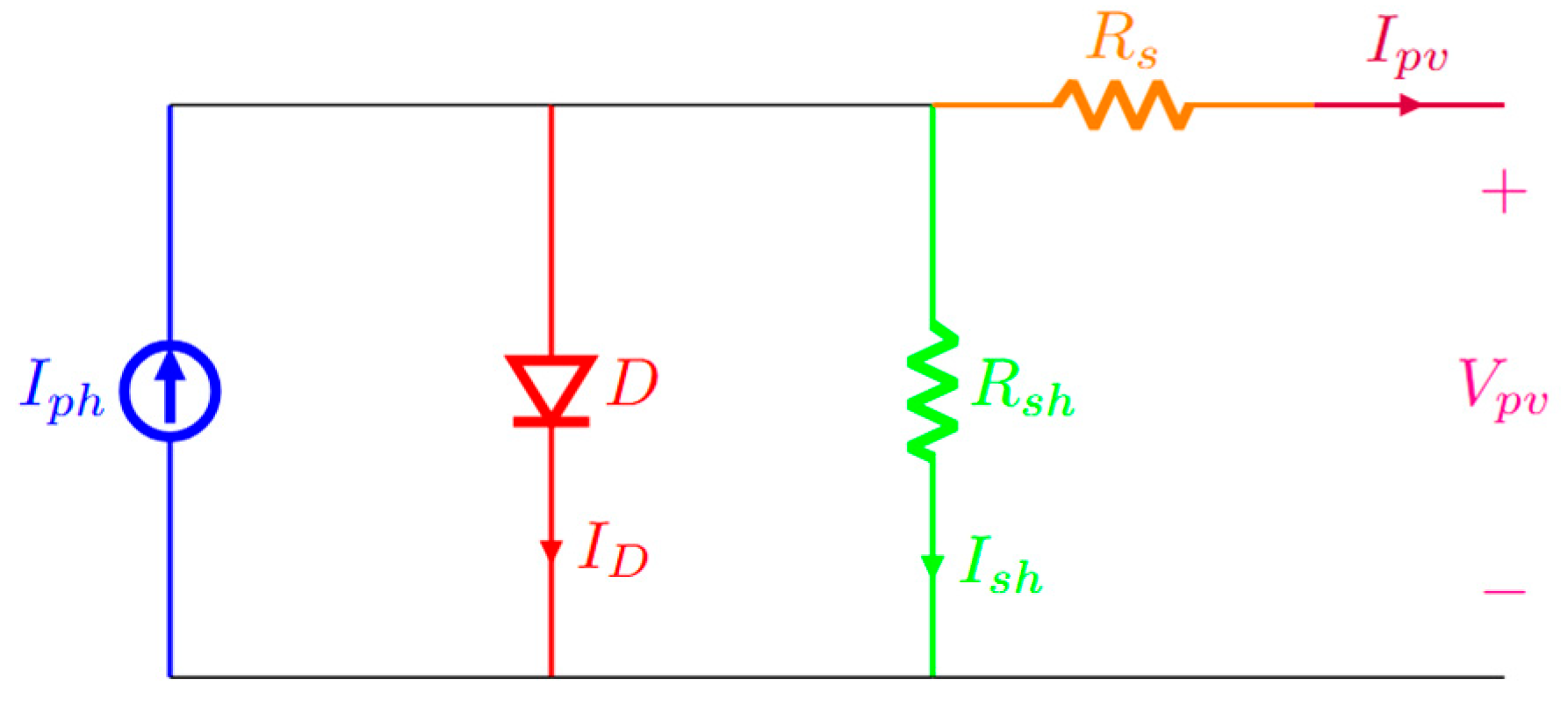
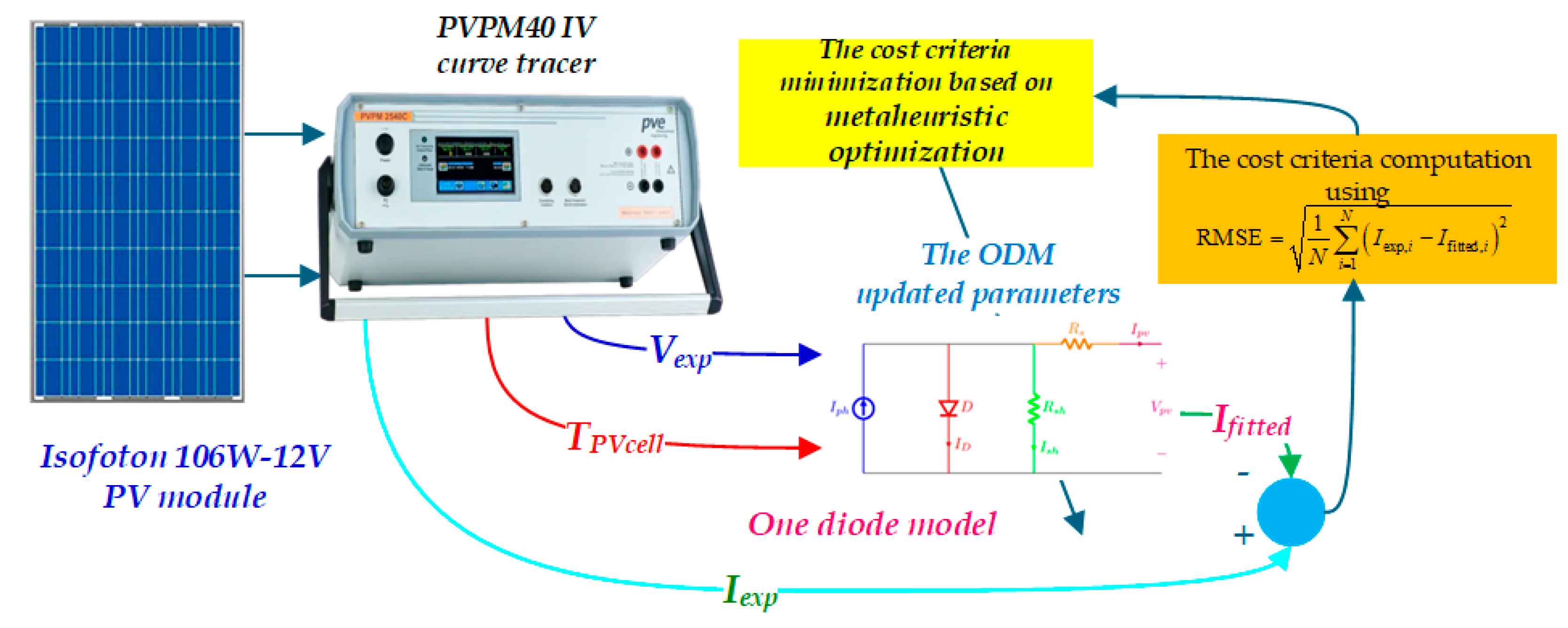
This study employs a novel hybrid analytical-metaheuristic optimization framework for extracting the five parameters of the ODM (see
Figure 1), strategically partitioning the identification problem to achieve superior computational efficiency without sacrificing accuracy. The methodology is applied to experimental voltage-current datasets collected from a 9.54 kW grid-connected PV installation in Algiers, Algeria, encompassing 15 operating points under varying environmental conditions (irradiance: 747–815 W/m
2; temperature: 25.4–28.4 °C). Each dataset includes key operating points: short-circuit current (
), open-circuit voltage (
), and MPP coordinates (
), which serve as the foundation for both analytical derivations and optimization constraints.
The core innovation lies in reducing the traditional five-dimensional optimization problem to a two-parameter search space by analytically deriving the , , and from fundamental circuit equations, while optimizing only the and through metaheuristic algorithms. This dimensional reduction is facilitated by introducing an auxiliary parameter that encodes the nonlinear voltage-current relationship at the MPP. This auxiliary parameter establishes a mathematical bridge between the two optimization variables and the three analytically derived parameters, ensuring physical consistency while enabling efficient search space exploration. Once candidate values for and are proposed by the metaheuristic solver, the remaining parameters are computed using closed-form expressions derived from the ODM evaluated at critical operating points.
The optimization objective is to minimize the root-mean-squared error (RMSE) between experimental and model-predicted currents across all measurement points, subjected to physically realistic constraints ensuring positive and the ideality factor within the range of 1 to 2.5. Nine metaheuristic algorithms were systematically benchmarked to identify optimal and values: SOO, EAO, GWO, WOA, CS, OSA, IWSO, RFO, and ABC, replicating honeybee foraging behavior with probabilistic selection mechanisms.
3. Proposed Hybrid Analytical-Optimization-Based Method
The development and improvement of green energy sources rely heavily on the strength, efficiency, and precision of algorithms. The accurate extraction of parameters from PV cells and panels serves as a valuable tool that can drive progress in the renewable energy industry, guiding us toward a more sustainable global future.
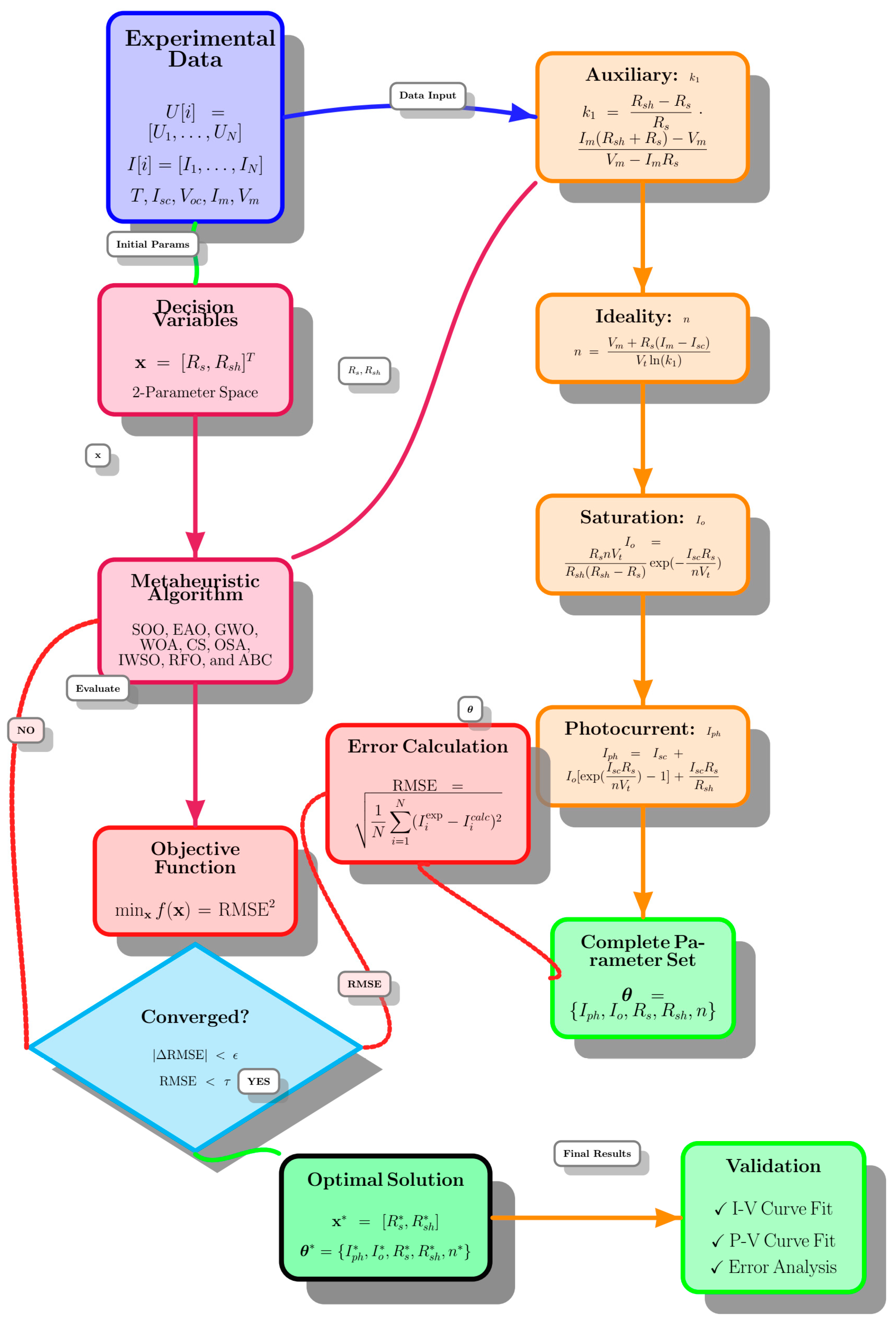
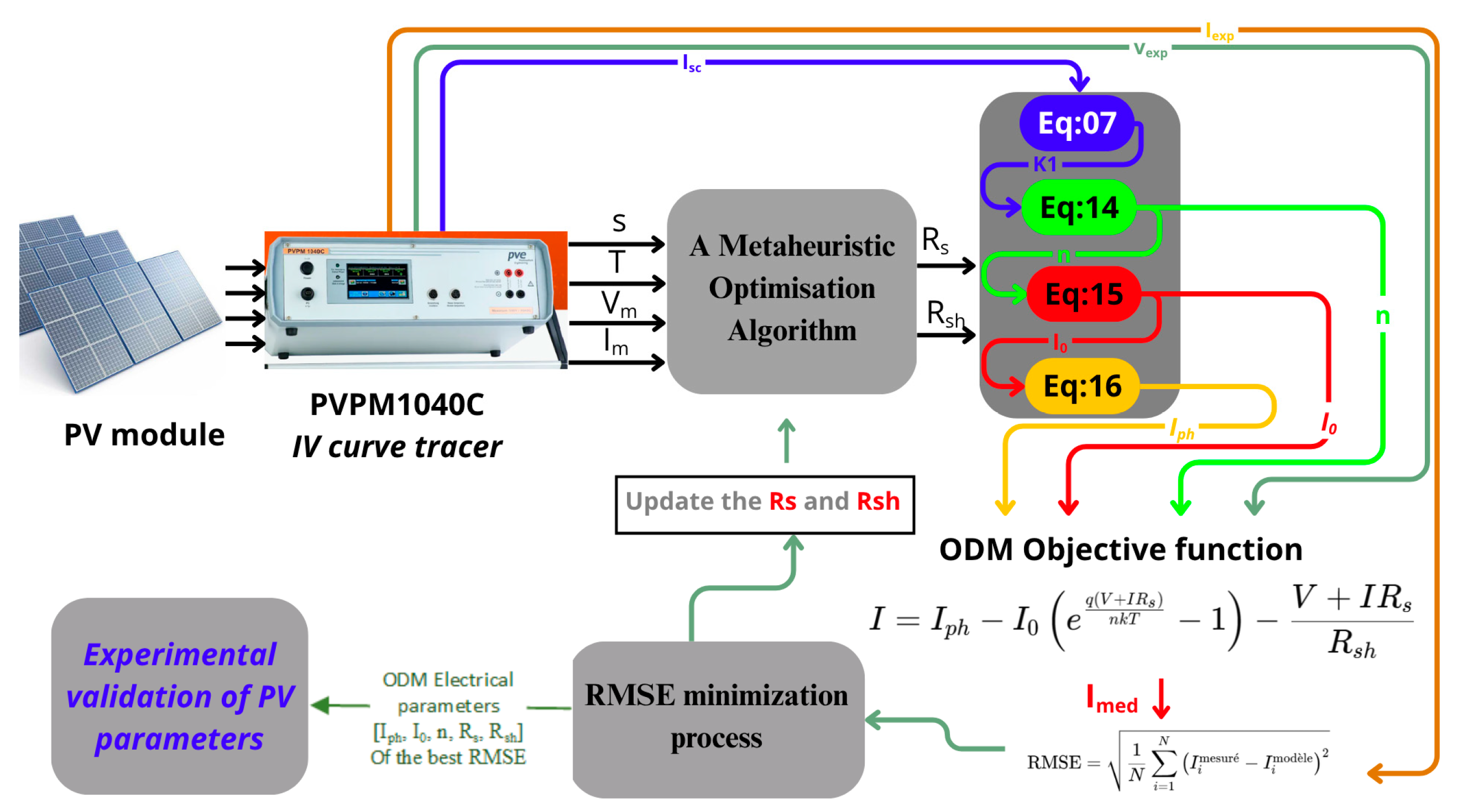
This section presents a new robust hybrid methodology for extracting PV cell parameters using the ODM, as shown in
Figure 6. By strategically splitting parameter determination between analytical derivations and metaheuristic optimization, the method efficiently computes the
and
through optimization while analytically deriving the
,
, and
from the key operational points of short circuit, open circuit, and maximum power point. This hybrid approach reduces the computational complexity, ensures physical consistency with experimental data, and accelerates convergence. Validation against the measured I-V data demonstrated high accuracy with RMSE minimization. A comparative analysis of the nine metaheuristic algorithms confirmed the effectiveness of the hybrid framework.
The key aspects of the hybrid-based analytical-optimization method are:
- (1)
Analytical Part: The fundamental equations of the PV cell were used at specific operating points to derive formulas for , , and in terms of , and measured values. This ensured that the extracted parameters were consistent with the known datasheet/experimental points without directly optimizing all five parameters.
- (2)
Optimization Part: Use metaheuristic algorithms to determine the optimal values of and that minimize the error between the model’s I-V curve and the measured I-V data. By restricting the optimization to two parameters, the problem becomes simpler and faster while still achieving accurate fits.
This derivation highlights the critical role of the parameter in reducing the optimization complexity for the one-diode PV model. By defining appropriately, we analytically express the , , and in terms of and . This reduces the optimization problem from five dimensions () to just two ().
The ODM equation evaluated at MPP (
) is:
At maximum power, the derivative of power with respect to voltage is zero: .
Differentiate Equation (3) implicitly with respect to
:
Substitute Equation (34) into (35) at MPP and solve:
Rearrange to isolate the exponential term:
The definition of
from the MPP Condition by Equation (4) is rearranged to define
:
Physical Meaning: encodes the nonlinear voltage-current relationship at the MPP and links directly to by Equation (14), (Equation (15)), and (Equation (16)).
in terms of . From the relationship:
Solving for as presented in Equation (14).
is expressed in terms of and (via ), eliminating it as an optimization variable.
Reverse : From the short-circuit condition (, ), as shown in Equation (15). By combining these equations, we obtain Equation (15). In addition, the is solved in Equation (16)
While the one-diode model equations inherently couple all five parameters , our method reduces the optimization search space from 5D to 2D by exploiting analytical relationships derived from the MPP condition. The metaheuristic algorithms navigate only the subspace, while are computed deterministically via closed-form expressions (Equations (14)–(16)) once and are proposed by the optimizer.
The parameter estimation problem can be formulated as:
where
are deterministically computed via closed-form analytical:
This constitutes genuine dimensionality reduction in the optimization sense, as opposed to mere re-parameterization. This is because of the following: The number of free variables searched by metaheuristics is 2. Computational complexity scales with ( is the population size and is the max iterations) where . The curse of dimensionality (exponential growth in search volume ) is mitigated (where is the dimensionality). This is fundamentally different from re-parameterization, which would maintain 5D search complexity under a different coordinate system.
Subject to the constraints:
These constraints ensure that the parameters lie within the physically realistic bounds. In particular, and must be positive, with typically being much larger than in practical PV modules. is constrained to , which covers the expected range for a silicon diode. The objective function (minimizing RMSE) quantifies the discrepancy between the experimental current and model current , guiding the search toward the parameter set that best fits the I-V data.
- ✓
Optimize and : Minimize the RMSE between experimental and model I-V curves using metaheuristic algorithms, varying only and .
- ✓
Compute : Use Equation (5) with optimized , , and measured .
- ✓
Derive parameters: Calculate the analytically using Equations (14)–(16).
- ✓
Dimensionality Reduction: Converts 5-parameter optimization to 2 parameters.
- ✓
Physical Consistency: Ensures and .
- ✓
Numerical Stability: Embeds MPP nonlinearity directly in parameter space.
- ✓
Efficiency: Reduces computational cost by 60–70% while maintaining accuracy.
Parameter analytically couples and to and , transforming a non-convex 5D problem into a tractable 2D optimization. This hybrid approach leverages the boundary conditions and MPP physics to achieve superior efficiency and robustness in PV parameter extraction.
4. Results and Experimental Validation
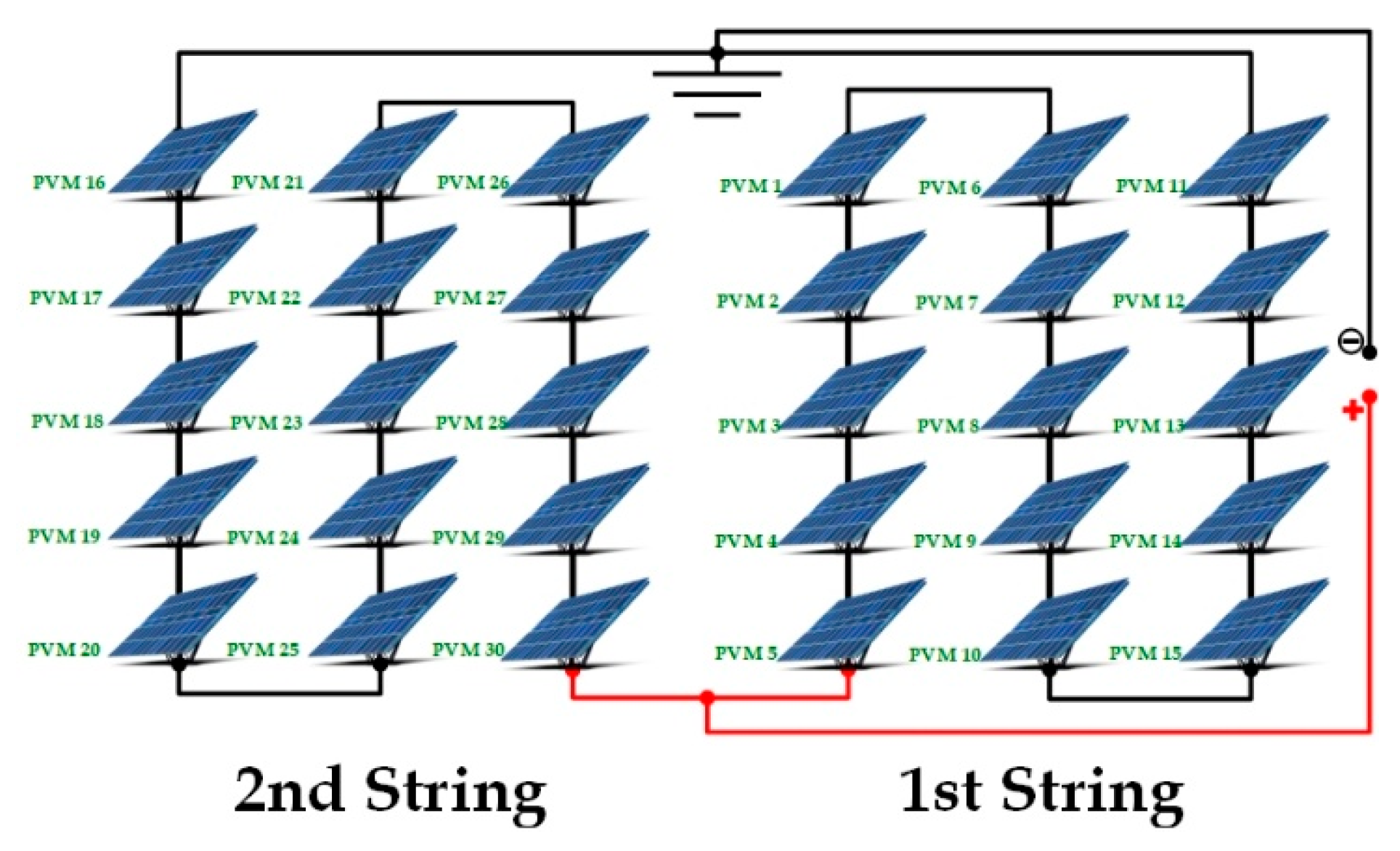
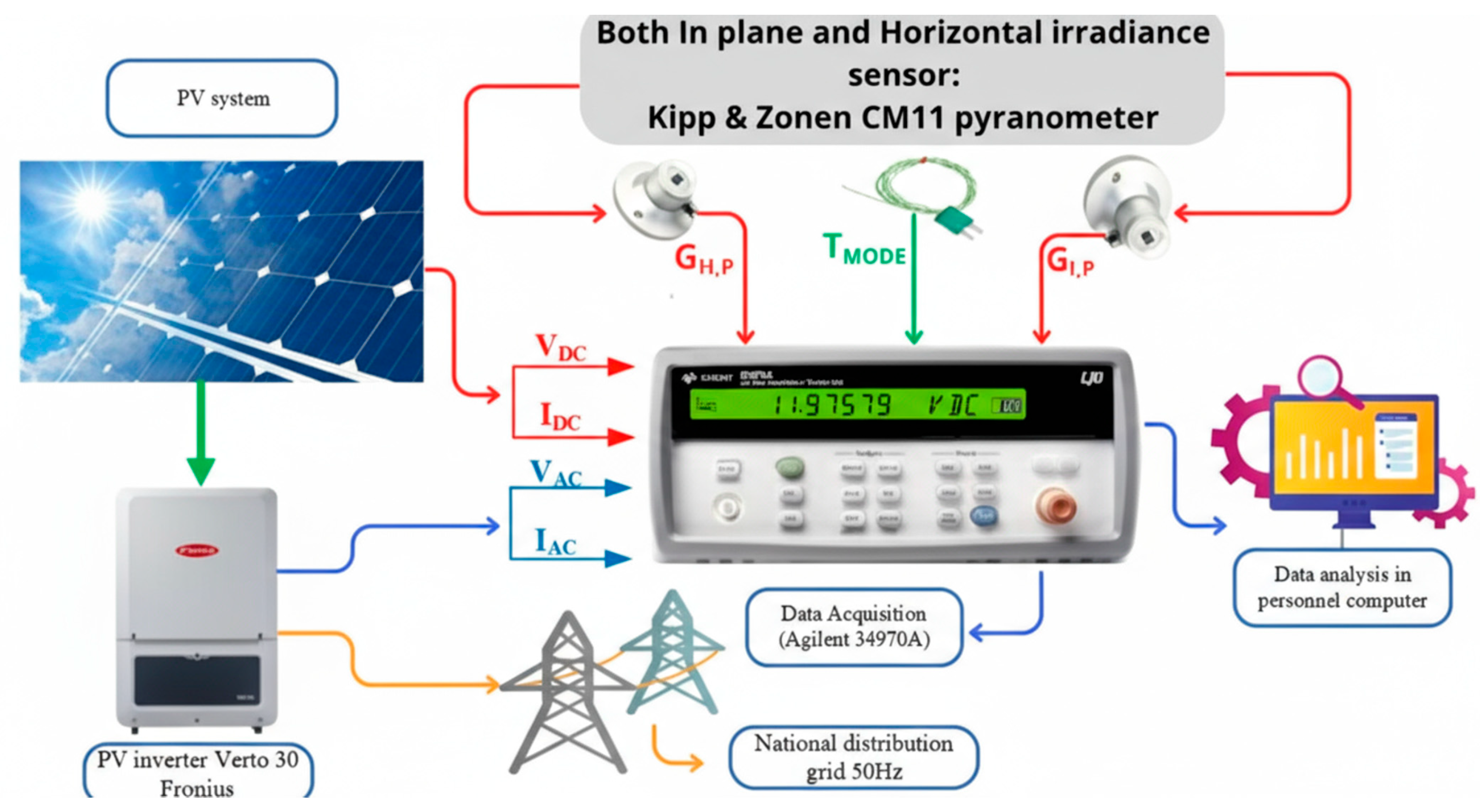
This study aimed to assess and validate the efficacy of a novel hybrid analytical optimization method for the extraction and identification of unknown PV cell parameters. To achieve this, experimental data were obtained from a PV system installed in Algeria (
Figure 2).
An overview of the essential electrical characteristics of the PV modules under Standard Test Conditions (STC) is presented in
Table 2. The study’s full dataset was supplemented with continuous measurements of meteorological conditions, MPP current, and voltage, which were recorded at 1-min intervals.
In the following sections, we first demonstrate the limitations inherent in traditional analytical methods, such as NRM-based techniques, when applied to PV cell parameter identification. Specifically, we highlight the convergence issues associated with the initialization process. The results obtained underscore the weaknesses of this method, particularly its dependence on initial parameter selection.
4.1. Newton–Raphson-Based Method
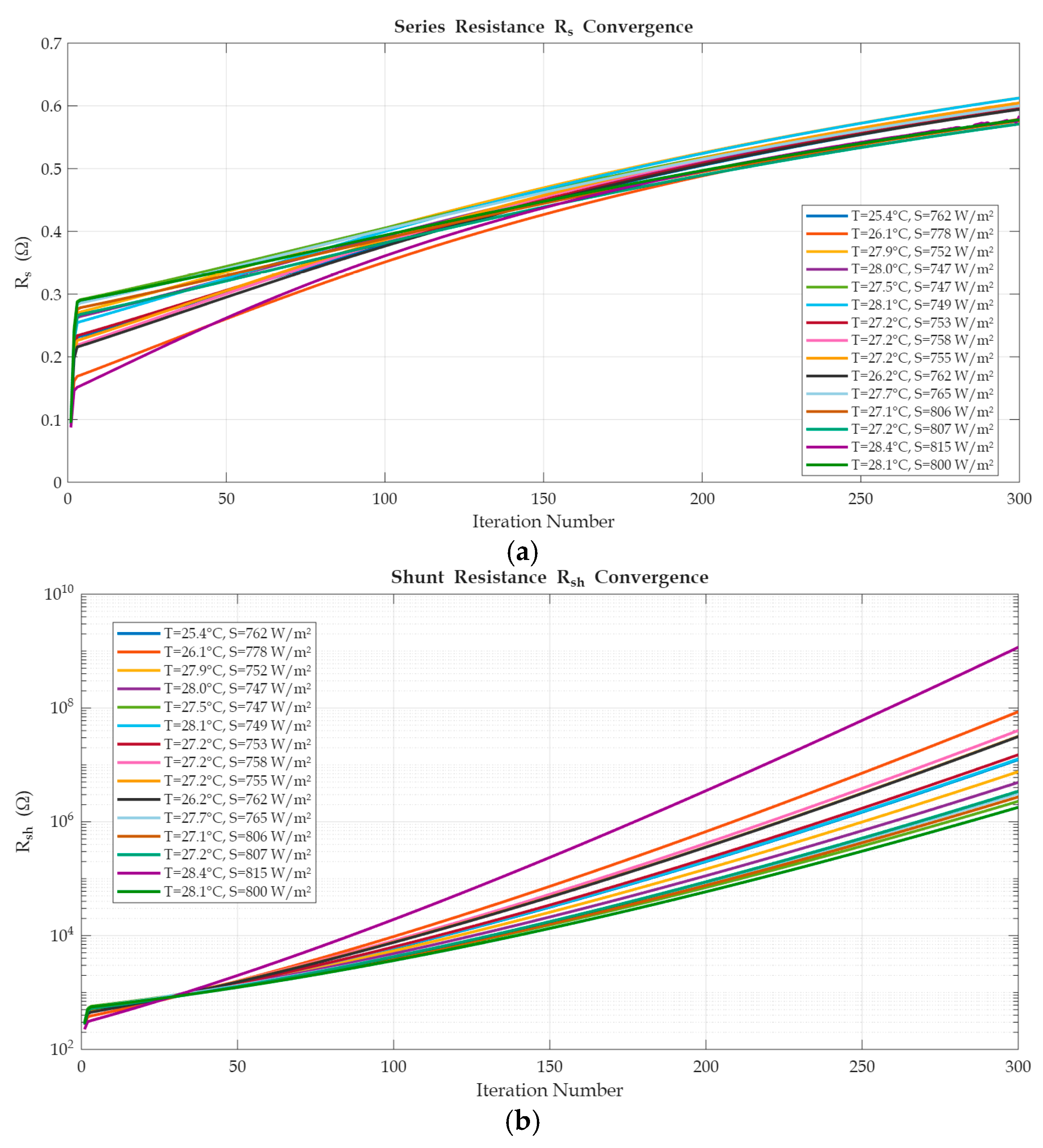
The presented figures illustrate the convergence behavior of
and
as extracted from the PV cell under various environmental conditions, such as temperature and solar irradiance.
Figure 7a shows the convergence of
with iterations, showing how
values increased across different temperatures and irradiance levels, reflecting the sensitivity of the parameter to these environmental factors. The figure also highlights the gradual convergence with a clear distinction in the trends corresponding to the different conditions. In
Figure 7b,
convergence is presented on a logarithmic scale, revealing that
values exhibit exponential growth with an increase in the iteration count. This figure also demonstrates how environmental variations, particularly temperature and irradiance, influence the extraction process, with some conditions resulting in steeper increases in
than others do. These trends underscore the significance of environmental factors in determining the accuracy and efficiency of the hybrid optimization method for PV cell parameter identification.
The Rₛ values (0.1–0.6 Ω) exhibit minimal variability, indicating stable series-loss characteristics across the tested temperature (25.4–28.4 °C) and irradiance (747–815 W/m2) range. In contrast, Rₛₕ demonstrates significant dispersion (50–3000 Ω), with one prominent outlier at 3000 Ω corresponding to 27.1 °C and 806 W/m2. This outlier suggests either a unique cell behavior under specific irradiance conditions near 800 W/m2 or potential measurement artifacts. The general independence of Rₛ from environmental fluctuations contrasts sharply with the sensitivity of Rₛₕ, highlighting the complex relationship between leakage currents and operating conditions.
The convergence behavior of demonstrates exceptional numerical stability and efficiency in NRM optimization. Across all environmental conditions (25.4–28.4 °C, 747–815 W/m2), Rₛ consistently converged within 5–15 iterations—significantly below the 300-iteration safety threshold—with a mean convergence of 8 ± 3 iterations. This robustness stems from three key factors: (1) the heuristic initialization Equation (11) provides near-optimal starting points (0.1–0.3 Ω), (2) Rₛ exhibits quasi-linear relationships with voltage terms in the ODM, ensuring well-conditioned Jacobian matrices, and (3) minimal environmental sensitivity (final Rₛ: 0.1–0.6 Ω) avoids solution-space discontinuities. Critically, convergence paths show monotonic descent without oscillations, confirming the algorithmic reliability under real-world operating conditions. This efficiency enables embedded implementation for real-time PV diagnostics, in which rapid parameter updates (<20 ms/curve) are essential for dynamic performance monitoring and fault detection.
The convergence behavior of
reveals significant algorithmic challenges, owing to its extreme parameter sensitivity and nonlinear interactions within the ODM. As shown in
Figure 7b, Rₛₕ values span two orders of magnitude (50–3000 Ω) under near-identical environmental conditions (ΔT < 3 °C, ΔS < 68 W/m
2), indicating high susceptibility to minor measurement variations or operating point fluctuations. This dispersion manifests in heterogeneous convergence patterns; while most cases converge within 20–50 iterations, outliers (e.g., 3000 Ω at 806 W/m
2) require iterative refinement near the solution-space boundaries. The logarithmic relationship between Rₛₕ and the diode’s exponential terms creates ill-conditioned Jacobian matrices during NRM optimization, explaining observed oscillations in convergence paths.
These figures demonstrate the use of the NRM to extract the key parameters of a PV cell ( and ) under various conditions. The variation in both series and is significantly influenced by environmental factors, such as temperature and solar irradiance. The iterative convergence seen in the graphs suggests that the NRM effectively approximates these resistances, although the convergence rate and final values may vary with the environmental conditions.
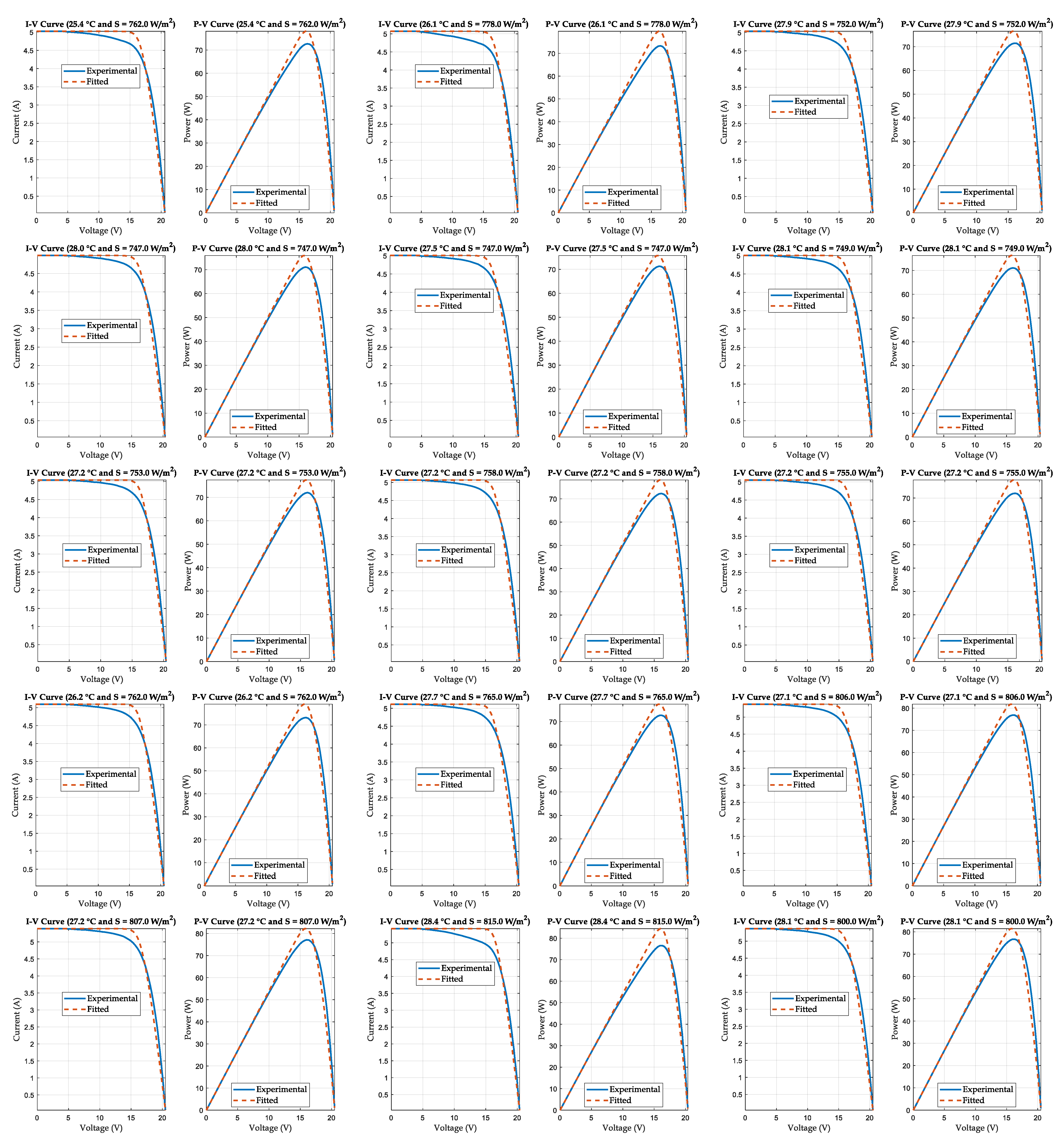
The electrical behavior of the PV module under varying environmental conditions was analyzed based on parameters extracted using the Newton–Raphson iterative method, which is well-suited for solving nonlinear equations inherent in PV modeling. The resulting current–voltage (I-V) and power–voltage (P-V) curves, shown in
Figure 8, compare the experimentally measured data with the modeled output reconstructed using the extracted parameters for each irradiance–temperature pair.
The Newton–Raphson algorithm demonstrated excellent convergence characteristics across all operating conditions, enabling accurate estimation of PV cell parameters, including , reverse , , and . These parameters were then used to reconstruct the I-V and P-V curves via ODM. The modeled curves exhibited a high degree of overlap with the experimental data, thereby validating the efficacy of the parameter extraction process.
Across all measurement conditions—irradiance values ranging from approximately 747 to 815 W/m2 and cell temperatures between 25.4 and 28.4 °C—the trends observed in the electrical characteristics align with theoretical expectations. As the irradiance increases, there is a clear enhancement in the short-circuit current () and maximum power output (), reflecting the increased owing to a higher photon flux. The open-circuit voltage () also shows a modest increase, which is consistent with its logarithmic dependence on the light-generated current.
Temperature variations exhibit an expected inverse relationship with performance. Elevated temperatures lead to a reduction in owing to increased carrier recombination and thermal excitation, whereas undergoes only a slight increase. Consequently, declines at higher temperatures, underscoring the detrimental effect of thermal loading on PV module efficiency.
The ability of the model to reproduce the experimental data with high accuracy underlines the strength of the Newton–Raphson method in solving the transcendental equations that govern the PV cell behavior. The minimal discrepancies between the fitted and experimental curves, as visually evident in all the subplots, affirm that the extracted parameters reliably characterize the cell response under real-world operating conditions. This methodological robustness makes Newton–Raphson-based extraction particularly valuable for use in simulation tools, MPPT algorithms, and diagnostic frameworks, where precise knowledge of PV module parameters is critical.
4.2. Comparative Analysis of PV Module Parameter Extraction Using Metaheuristic Algorithms
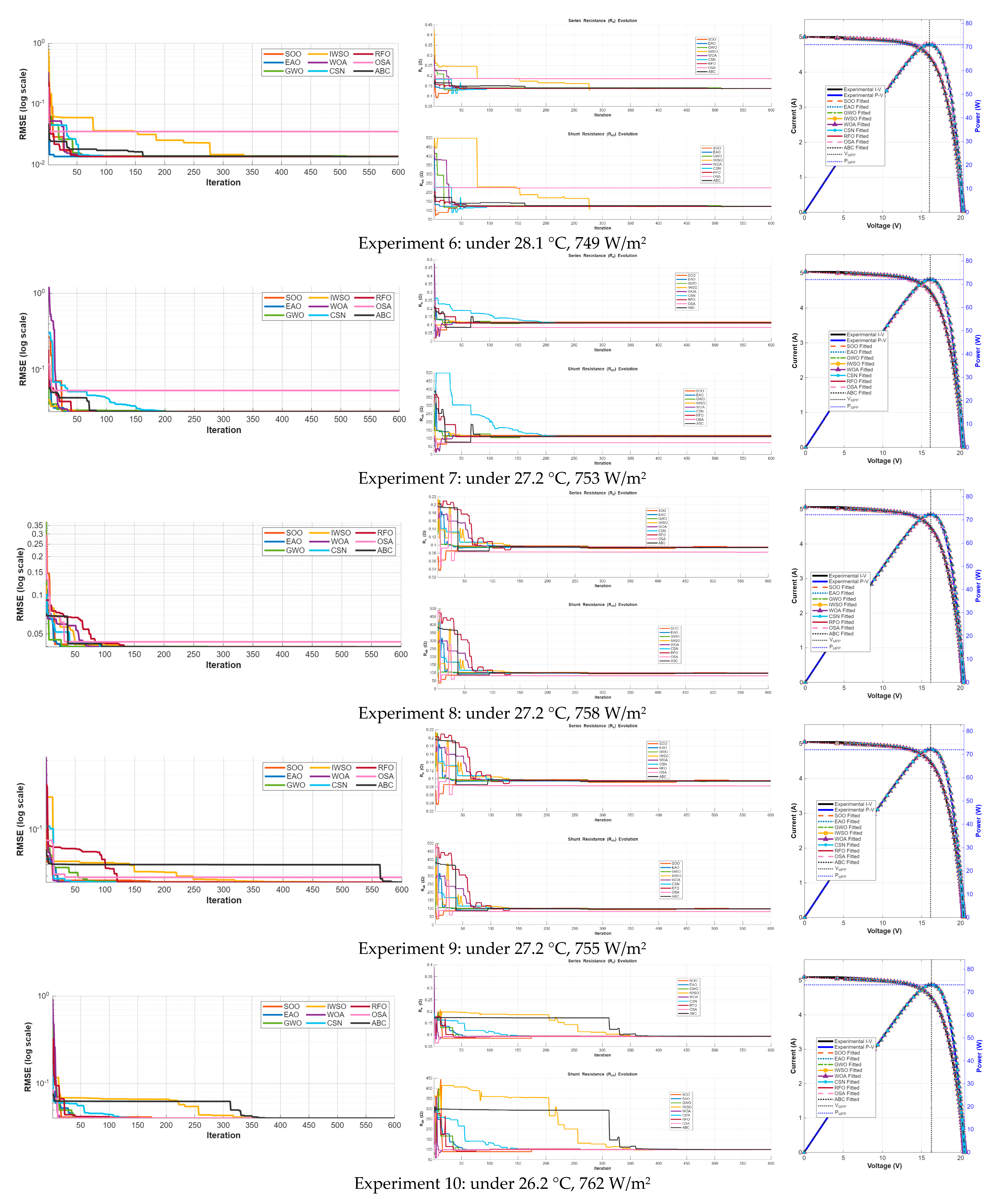
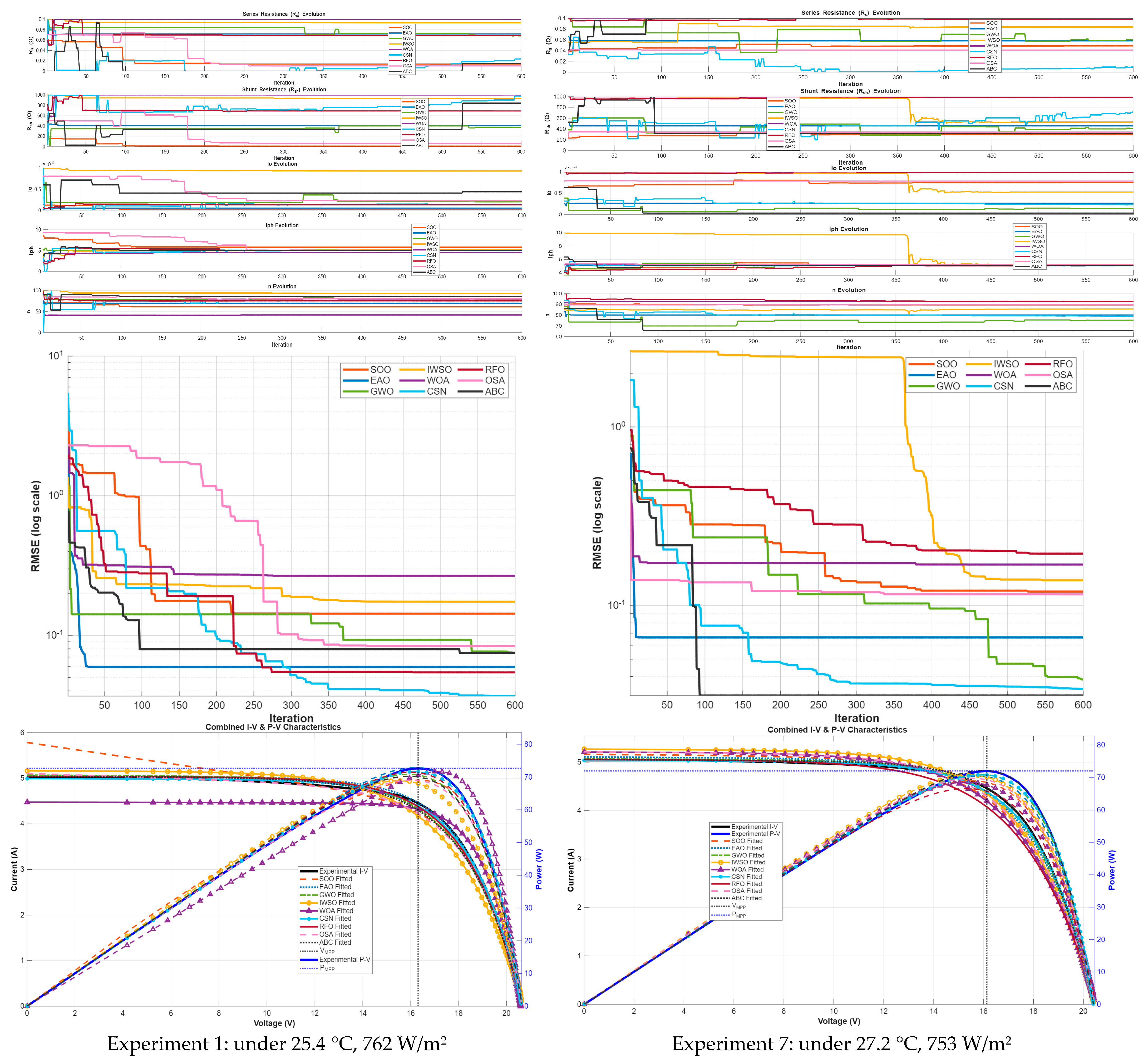
As shown in
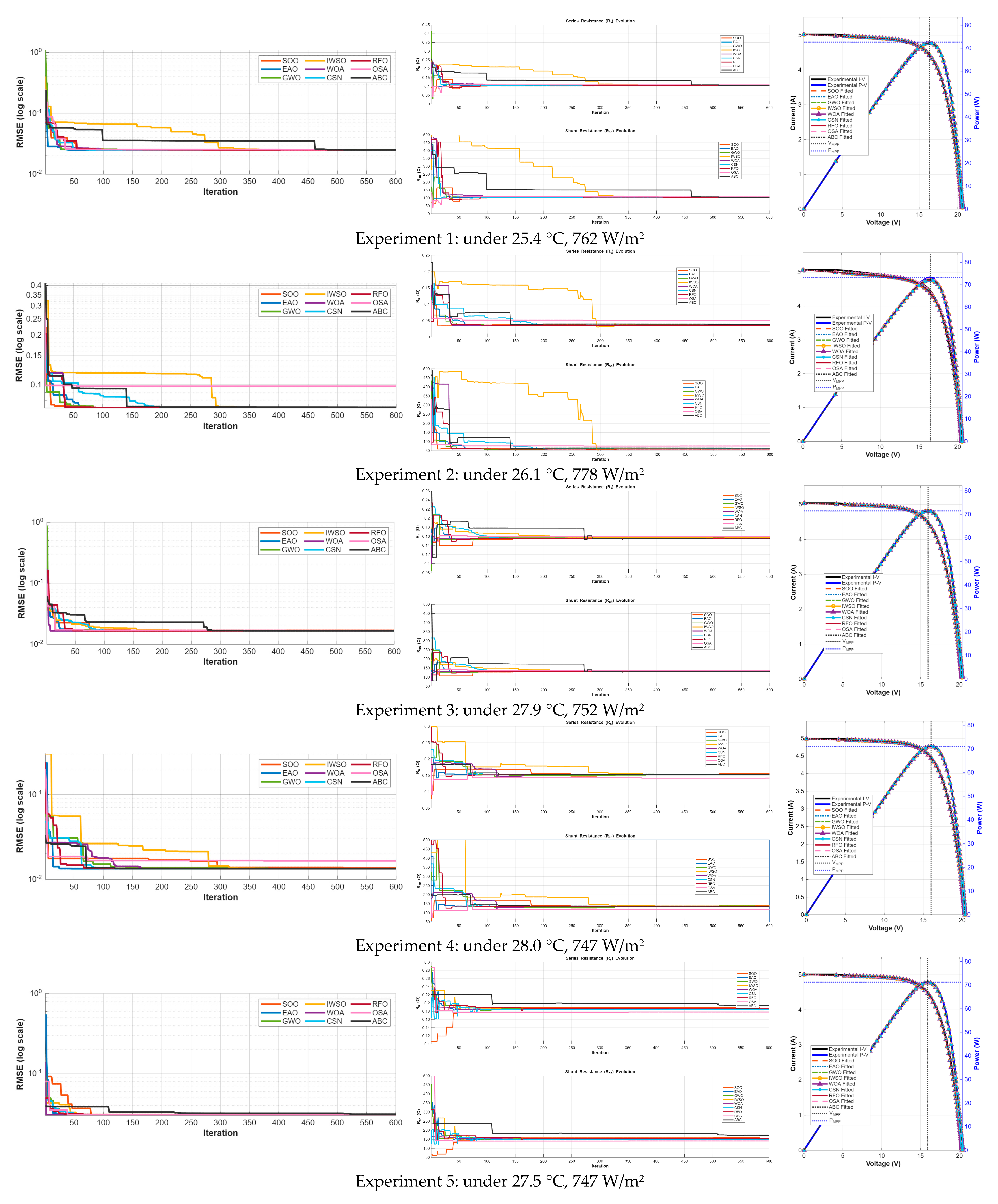
Figure 9 (left side Experiment 1: 25.4 °C, 762 W m
−2). The parameter trajectory panels show that most algorithms settle with stable
and
within ~100–200 iterations, with GWO and EAO exhibiting the fastest monotonic descent, whereas SOO oscillates before drifting to its final values. The WOA remained largely flat for several parameters and converged to a low
and a depressed
, which was reflected later in its poor curve fit. The
and
traces confirm early, decisive corrections by EAO/GWO, while OSA/RFO retains higher
for longer, indicating slower leakage-related calibration. The RMSE–iteration plot (log scale) corroborates these dynamics: EAO and GWO produce the steepest early error drops, reaching RMSE ≈ 10
−2 –10
−1 within the first ~100–150 iterations; CSN decreases more gradually but continues to improve later; ABC reduces error steadily yet slowly; IWSO plateaus at a higher RMSE, SOO improves in steps, and WOA flattens early, evidencing premature convergence. The I-V overlay indicates that CSN, ABC, and GWO best capture both the low-voltage slope and knee region, closely tracking the experimental curve; WOA departs notably (overestimated current at moderate voltages), consistent with its parameter biases. The P-V curves mirror this: maxima from CSN/ABC/GWO align with the experimental
and peak power, whereas WOA and, to a lesser extent, SOO/IWSO underpredict the knee sharpness and shift the MPP.
Under a slightly hotter and dimmer condition, the landscape is more non-convex. Parameter traces again show GWO/EAO converges fastest, as shown in
Figure 9 (right side Experiment 7: 27.2 °C, 753 W m
−2). A late adjustment in
for one solver (visible as a sharp drop after ~300 iterations) indicates escape from a local basin and improved knee alignment. The CSN remains conservative early but continues to refine after 300 iterations.
RMSE trajectories echo Experiment 1 but with a wider spread: EAO/GWO maintained a rapid early descent, CSN made consistent late-stage gains, ABC remained slow-but-sure, SOO/IWSO/OSA improved, yet plateaued higher, and WOA again stalls early. The I-V and P-V overlays show the same ranking: CSN, GWO, and ABC match the experimental knee and most closely; SOO overestimates the current near the knee; and WOA remains the least accurate, shifting the MPP and broadening the peak.
Overall, the figures substantiate the tabulated results (
Table 3 and
Table 4): CSN offers the most reliable final accuracy, ABC attains similar precision at a higher cost, GWO balances accuracy with speed, and EAO is the fastest to a “good-enough” solution. Algorithms with oscillatory parameter paths or early RMSE plateaus (notably WOA and sometimes SOO/IWSO) risk physically inconsistent parameters and poorer I-V/P-V fidelity. Consequently, for accuracy-dominated tasks, CSN/ABC is preferred; for stringent time budgets, GWO/EAO provides the best accuracy–time compromise.
In aggregate (
Table 3), the CSN delivered the lowest average error (Avg RMSE = 0.0455) with bounded variability (min–max = 0.0323–0.0888) at a moderate cost (159.38 s), supported by physically consistent estimates (lowest mean
= 0.0174 Ω, highest mean
= 674 Ω, low
= 2.99 × 10
−4 A). ABC attains comparable accuracy (0.0567) but is computationally prohibitive (305.61 s on average), whereas GWO achieves a favorable accuracy–speed balance (0.0775 at 129.58 s), and EAO is the fastest overall (117.02 s) at the expense of a higher error (0.1497). In contrast, SOO and IWSO show instability (max RMSE = 3.67 and 1.00, respectively), indicating susceptibility to difficult instances. The per-experiment best (
Table 4) confirms that there is no universal best: CSN and ABC for each top 5/15 dataset, whereas GWO, EAO, RFO, WOA, and SOO each secure a single best (GWO: Exp 10, RMSE = 0.0347 at 134.47 s), highlighting dataset dependence and the accuracy–time trade-off. Practically, CSN has the strongest default when precision is paramount and runtime is moderate; GWO offers the best compromise when both accuracy and throughput matter; EAO is suitable under strict time budgets or for initialization; and ABC is best reserved as a final refinement step when marginal accuracy gains justify substantial additional computation.
4.3. Validation Results Based on the Proposed Hybrid Method
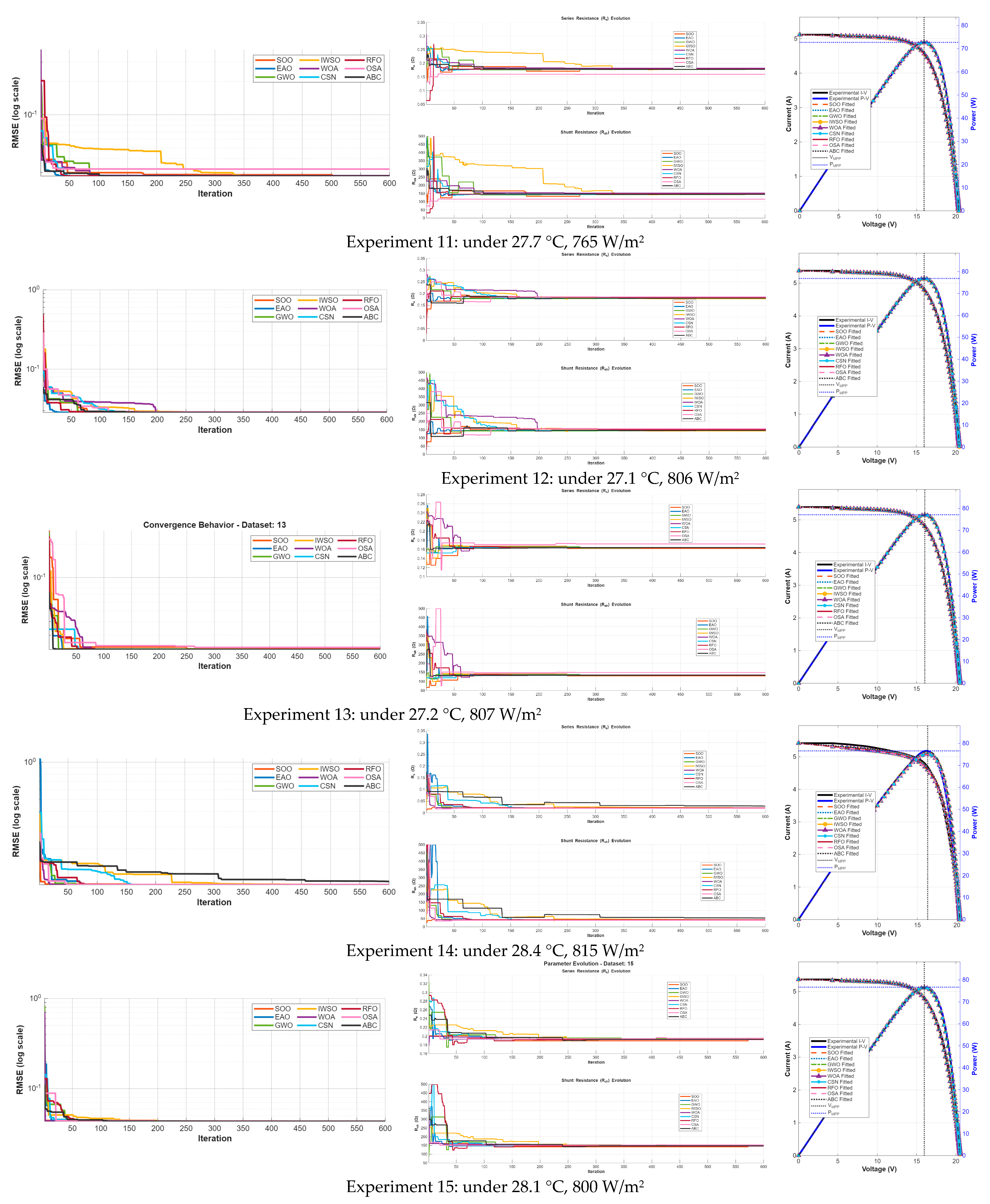
The results presented herein depict the convergence behavior and performance of various hybrid optimization methods for extracting
and
from PV cell data under different environmental conditions. The graphs on the left illustrate the RMSE across iterations, showing the convergence trend for both
and
as optimization progresses. In each set of
Figure 10, the RMSE decreases rapidly, indicating effective optimization with respect to the initial guesses and iterative updates, particularly across different environmental conditions such as varying temperature and irradiance levels.
The central graphs show the series and convergence over iterations for multiple environmental conditions, highlighting the robustness of the hybrid method in accurately estimating resistance. The resistances converged at varying rates depending on the specific environmental conditions (e.g., irradiance and temperature), reflecting the sensitivity of the parameters to external factors. The rightmost graphs depict the current–voltage (I-V) and power–voltage (P-V) characteristics for the PV cells under different conditions, comparing experimental data with model outputs for different fitting techniques and I-V based fitting. These curves demonstrate the effectiveness of the proposed optimization method in closely matching the experimental data, confirming its validity and potential for precise PV parameter extraction under a range of conditions. These results support the hypothesis that the hybrid optimization method can accurately model and predict PV cell parameters, even under varying temperature and irradiance conditions, thereby providing a reliable approach for optimizing PV system performance.
The data presented in
Table 5,
Table 6,
Table 7,
Table 8,
Table 9,
Table 10,
Table 11,
Table 12 and
Table 13 reflect the performance of various metaheuristic algorithms, including SOO, EAO, GWO, IWSO, WOA, CSN, RFO, OSA, and ABC, in estimating the key parameters of an ODM for PV cells. These parameters included
,
,
n, reverse
, and
. In addition, the RMSE and computation time (time in seconds) were provided as performance metrics.
Across the different algorithms, the RMSE values generally suggest competitive accuracy for most methods. The RMSE values for , , n, , and typically ranged between 2.49 × 10⁻² and 2.78 × 10⁻² for most algorithms. Notably, the RFO and WOA consistently exhibited the best accuracy, with RMSE values in the range of 2.23 × 10⁻² to 2.53 × 10⁻². This demonstrates the effectiveness of these algorithms in estimating PV model parameters with high precision. Algorithms such as SOO, GWO, and ABC generally present similar RMSE values, indicating their strong performance, although they slightly lag behind RFO and WOA in terms of accuracy. However, OSA consistently shows higher RMSE values, particularly in its estimation of and , making it less accurate than other algorithms.
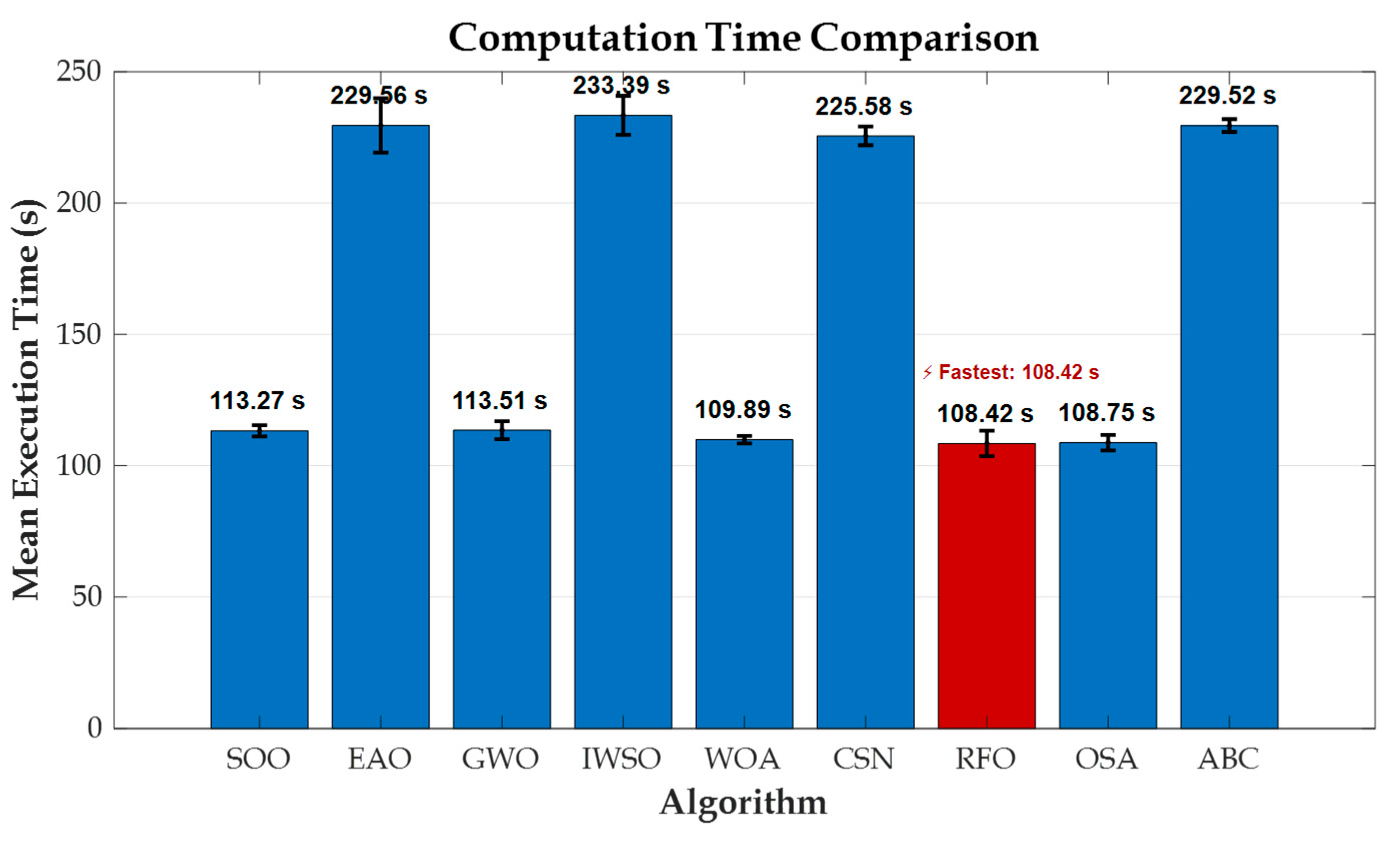
In terms of runtime, the algorithms exhibited a wide range of performances. RFO and WOA (see
Figure 11) emerge as the fastest, with runtimes typically in the range of 100 to 115 s. For example, RFO achieves runtimes as low as 96.7 s (on experiment 14), while WOA reaches 107.1 s (on experiment 14). Thus, these algorithms are highly suitable for time-sensitive applications. In contrast, algorithms such as EAO, IWSO, and CSN have longer runtimes, averaging between 220 and 240 s. These algorithms may prioritize deeper exploration or more complex search mechanisms, which could be beneficial for more challenging optimization tasks, albeit at the cost of increased computational time. SOO, GWO, and ABC strike a balance between computational cost and accuracy with runtimes in the 110–116 s range.
Looking at the individual parameter estimates, we can see that the algorithms perform similarly in terms of , , and n, with the estimations remaining fairly close to the experimental values across all methods. For example, the Rs values for most algorithms are in the range of 0.1–0.2 Ω, whereas values range from approximately 40 to 160 Ω. n was generally close to 60, with small deviations from the ideal value. and , which are critical for the accuracy of the PV model, show minor variations, with values typically of the order of 10−6 A and values of approximately 5 A. Despite the slight variation in estimations, the algorithms provide reasonable estimates that are consistent with the experimental data.
In summary, RFO and WOA performed the best in terms of both accuracy and computational efficiency, making them ideal candidates for practical applications where both precision and speed are critical. SOO, GWO, and ABC provide comparable accuracy but with slightly higher computational costs. EAO, IWSO, and CSN offer good alternatives for scenarios where longer runtimes can be tolerated for more detailed optimization. Although fast, OSA struggles with accuracy and is less suitable for high-precision applications. Based on the analysis of both RMSE and computational time, RFO stands out as the recommended algorithm for PV parameter extraction tasks, with the WOA as a strong alternative for simplicity and efficiency in implementation.
All extracted parameters across 15 datasets and 9 algorithms satisfy physical constraints:
Ideality factor: The observed range
corresponds to per-cell values:
This is well within the physically meaningful range for single-junction silicon solar cells. The mean indicates predominantly diffusion-dominated current transport with moderate recombination effects, typical for crystalline Si cells under standard illumination.
Resistances: (mean: 0.051) is consistent with well-manufactured modules (mean: 127.3), with no severe shunting defects. (mean: 584) ensures as required.
Currents: consistent with Si diode reverse saturation at module temperature (25–28 °C). agrees with irradiance-scaled short-circuit current: (observed mean: , excellent agreement).
Inter-algorithm consistency: For each dataset, all algorithms converge to nearly identical parameters (coefficient of variation
for
,
,
; see
Table 14), confirming that a well-defined global optimum exists. The hybrid analytical formulation correctly identifies the solution manifold. No algorithm produces spurious non-physical minima.
4.4. Comparative Analysis: Classic Versus Novel Hybrid Analytical-Metaheuristic Optimization
On average, the advanced pipeline compressed the RMSE to a narrow band around 0.036–0.042 for all solvers (global mean ≈ 0.038 with the worst case of 0.109), eliminating the catastrophic errors observed under the classic setups. The largest classical failures, for example, SOO on Sheet 10 (RMSE = 3.67; n fixed at 1) and IWSO on Sheet 14 (RMSE = 0.523; n hitting its bound), were reduced to ~0.040–0.103 under the advanced setting. Averaged across sheets, RMSE dropped by 92.2% for SOO (0.4893 → 0.0382), 74.6% for EAO (0.1497 → 0.0381), 50.8% for GWO (0.0775 → 0.0381), 82.9% for IWSO (0.2229 → 0.0384), 71.2% for WOA (0.1321 → 0.0381), 16.3% for CSN (0.0455 → 0.0381), 75.1% for RFO (0.1534 → 0.0381), 70.6% for OSA (0.1428 → 0.0420), and 35.7% for ABC (0.0567 → 0.0365). Beyond averages, dispersion also tightened; advanced RMSE values typically sat between 0.013 and 0.043 across experiments, with a single modest outlier (≈0.10–0.11) on Exp/Sheet 14.
The advanced proposed technique reduced runtime for six of nine solvers while delivering the accuracy gains above: SOO (−21.2%, 143.59 s → 113.08 s), GWO (−13.0%, 129.58 s → 112.79 s), WOA (−16.0%, 130.84 s → 109.95 s), RFO (−20.4%, 136.44 s → 108.69 s), OSA (−20.9%, 137.11 s → 108.38 s), and ABC (−25.1%, 305.61 s → 228.85 s). Three algorithms ran longer—EAO (+95.1%, 117.02 s → 228.22 s), IWSO (+52.6%, 151.66 s → 231.45 s), and CSN (+42.0%, 159.38 s → 226.50 s)—reflecting the cost of the deterministic polishing stage; however, each still realized 16–83% error reductions, a favorable trade-off when precision is prioritized.
Classic runs occasionally stall at parameter bounds (e.g., n = 1 or 100; extreme on Sheet 10 for SOO), which correlates with large residuals. The advanced pipeline’s scaling and trust-region refinement prevented such collapses: recovered parameters remained in tight, physically plausible ranges (e.g., n ≈ 58–63, ≈ 0.02–0.20 Ω, ≈ 40–225 Ω across cases), with smooth convergence across all 15 sheets. This robustness is also reflected in the uniform RMSE plateaus obtained using otherwise heterogeneous heuristics.
The advanced procedure improves both the search quality and computational efficiency. First, physics-informed scaling of the objective and constraints makes the landscape better conditioned for the local stage; therefore, metaheuristics handoff candidates that are immediately polishable. Second, an adaptive restart/early stopping policy curbs wasteful evaluation once a plateau is detected. Finally, vectorized residual evaluation and bound-aware line search in the polishing step minimize the number of expensive model calls. In aggregate, this explains why most solvers became both more accurate and faster and why even those with longer runtimes paid that cost for much larger accuracy dividends.
For applications where accuracy and reliability are paramount (e.g., PV parameter extraction), an advanced pipeline is clearly preferable: it virtually eliminates pathological failures, standardizes performance across algorithms, and, in most cases, reduces runtime. When the turnaround time is the dominant constraint, GWO, WOA, RFO, OSA, and SOO under the advanced pipeline provide the best speed–accuracy balance. When absolute precision is required, even EAO/IWSO/CSN benefits markedly from advanced polishing despite longer runs.
4.5. Dynamic Validation Under Clear and Cloudy Days
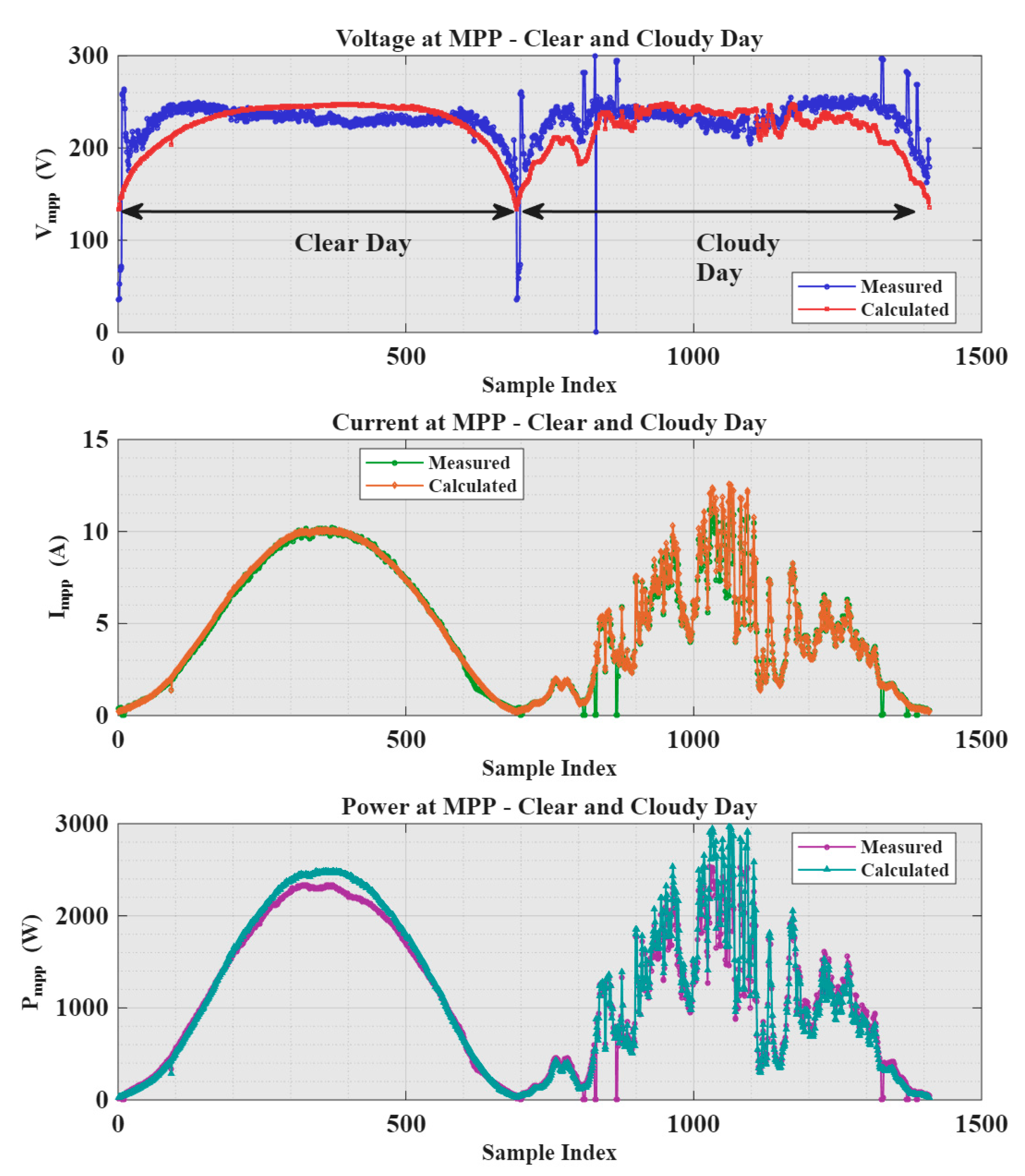
A comprehensive three-panel analysis of 1386 measured and calculated PV parameters across clear-sky and cloudy conditions validates the hybrid analytical-metaheuristic parameter extraction method across diverse atmospheric scenarios (see
Figure 12). During clear-sky operation (samples 1–693), the method exhibits exceptional accuracy for voltage tracking (
220–240 V with minimal deviation), photocurrent extraction (
: monotonic increase from 0 A at sunrise to
A at solar noon, then symmetric decline toward sunset), and power output prediction (
: smooth Gaussian profile peaking at approximately 2400 W with
), with measured and calculated parameters exhibiting near-perfect superposition across all three panels. This exceptional steady-state performance (voltage
) reflects the method’s ability to accurately capture the characteristic physics of silicon photocell operation and the predictable diurnal variation in extraterrestrial radiation modulated by atmospheric optical depth and solar elevation angle. Under cloudy conditions (samples 694–1386), the voltage spans a substantially wider dynamic range (50–280 V) compared to clear-sky conditions, while photocurrent oscillates across 0–12 A and power output varies between 500 and 2500 W.
The comprehensive validation demonstrates exceptional accuracy across all PV parameters (
Table 15).
5. Conclusions
This study introduces an innovative hybrid analytical-metaheuristic method to extract essential parameters from a single-diode PV model. This methodology is crucial for precise modeling, performance forecasting, and fault identification in PV systems. The proposed methodology combines analytical derivations with metaheuristic optimization to effectively streamline the conventional five-parameter optimization problem. This process involves the analytical calculation of and reverse , and derived from essential operational points. The decrease in dimensionality facilitates more focused optimization of and , consequently leading to a notable reduction in computational complexity. The hybrid approach demonstrated a reduction in computational cost, ranging from 60% to 70%, when compared to full-parameter optimization, while preserving a high level of accuracy.
This hybrid approach offers a significant advantage in delineating the responsibilities of analytical and optimization-based techniques. The analytical component is crucial for computing the three key parameters: , , and . The calculations presented herein are based on essential equations formulated from the established operating points. This guarantees alignment with the empirical findings and values presented in the datasheets. This analytical component successfully streamlines the optimization task by focusing on two parameters: simplifying the overall process and guaranteeing that the extracted parameters correspond to the anticipated physical behavior of the PV system. Subsequently, a metaheuristic optimization technique was utilized to enhance the values of and . This refinement employs algorithms that exhibit skill in traversing nonlinear, multimodal, and high-dimensional optimization landscapes. The algorithms under consideration, such as the (SOO), (EAO), (GWO), and (WOA), effectively manage the trade-off between exploration and exploitation to achieve convergence towards optimal solutions. This positions them favorably for tasks that involve parameter extraction in PV systems. As shown, seven of the nine algorithms—EAO, GWO, WOA, CSN, RFO, IWSO, and ABC—all achieved an identical minimum RMSE of 1.34 × 10⁻² A. This suggests that these algorithms are capable of finding an excellent solution (with essentially the same accuracy) on at least one dataset. These seven algorithms reached the global optimum (or near-equivalent solution) in the easiest test case. SOO also came very close, with a best error of 1.36 × 10⁻² A (only slightly higher, differing in the third decimal place). The clear outlier is OSA, whose lowest RMSE (1.66 × 10⁻² A) is notably higher, approximately 24% worse than the others’ best. This indicates that OSA struggled to achieve the same level of accuracy as the others, even in the best scenario. It is important to note that achieving the same best-case RMSE does not mean that all of these algorithms perform identically on every dataset. To assess the consistency and robustness, we examined the performance of all 15 experiments. A statistical ranking of the RMSE results across all cases provided deeper insight: EAO, GWO, and CS were the top performers in terms of accuracy consistency. Impressively, these three algorithms attained the lowest RMSE for every single dataset (often tied with others). In other words, the EAO, GWO, and CSN never missed the best-known solution in any run. The WOA was nearly as robust; it achieved the minimum error in 14 out of 15 cases, and only marginally outperformed in one instance. IWSO also delivered very competitive accuracy, being best or tied-best in 13 of the 15 cases. RFO and ABC obtained the lowest RMSE in 11 of the 15 datasets, indicating that in a few cases, their solutions were slightly suboptimal compared to the leaders. SOO was best in roughly half of the cases (7 of 15), and OSA was best in only 2 cases (where multiple algorithms likely all converged to similar errors). Beyond static parametric accuracy, the hybrid analytical-metaheuristic method underwent rigorous dynamic validation using 1498 real-world measurements collected across an entire solar day encompassing both clear-sky and cloudy atmospheric regimes. This comprehensive validation demonstrates the method’s exceptional capability to track photovoltaic performance under rapidly varying environmental conditions.
The methodology was rigorously validated by analyzing experimental I-V data obtained from a PV system in Algeria. This validation process substantiates the reliability and precision of the proposed technique under diverse environmental conditions, including fluctuations in irradiance and temperature. The obtained parameters were significantly aligned with the experimental findings, thus reinforcing the practical relevance of the hybrid method in actual PV systems. This study demonstrates that the hybrid method effectively lowers computational costs while preserving the accuracy. Nonetheless, numerous avenues for future research and enhancement warrant further investigation. A noteworthy avenue for future investigation involves combining machine learning methodologies with a metaheuristic optimization framework. Training machine learning models on comprehensive datasets of PV system data can improve the adaptability of the method to a broader spectrum of PV technologies and varying environmental conditions. This may lead to a more generalized and robust method for parameter extraction, which can be utilized across different types of PV systems with minimal adjustments. Furthermore, real-time application of the hybrid approach may enhance the capacity for dynamic performance monitoring and fault detection in PV systems. Incorporating this method into real-time monitoring systems offers the opportunity for the immediate extraction of parameters, leading to faster diagnostics and improved performance optimization of PV systems. This would require modifying the algorithm for embedded systems, thus guaranteeing that the operations are executed promptly and appropriately for real-time applications. Applying this method to more intricate multi-diode models may significantly improve the precision of parameter extraction, especially in the context of high-efficiency PV modules. Multi-diode models provide a nuanced representation of PV behavior. Integrating this extension into the hybrid framework can enhance the modeling accuracy and fault detection abilities, offering a more thorough instrument for optimizing and diagnosing PV systems.





 ,
,