A Framework for Joint Beam Scheduling and Resource Allocation in Beam-Hopping-Based Satellite Systems


Abstract
1. Introduction
1.1. Motivation
1.2. Related Work
1.3. Contribution
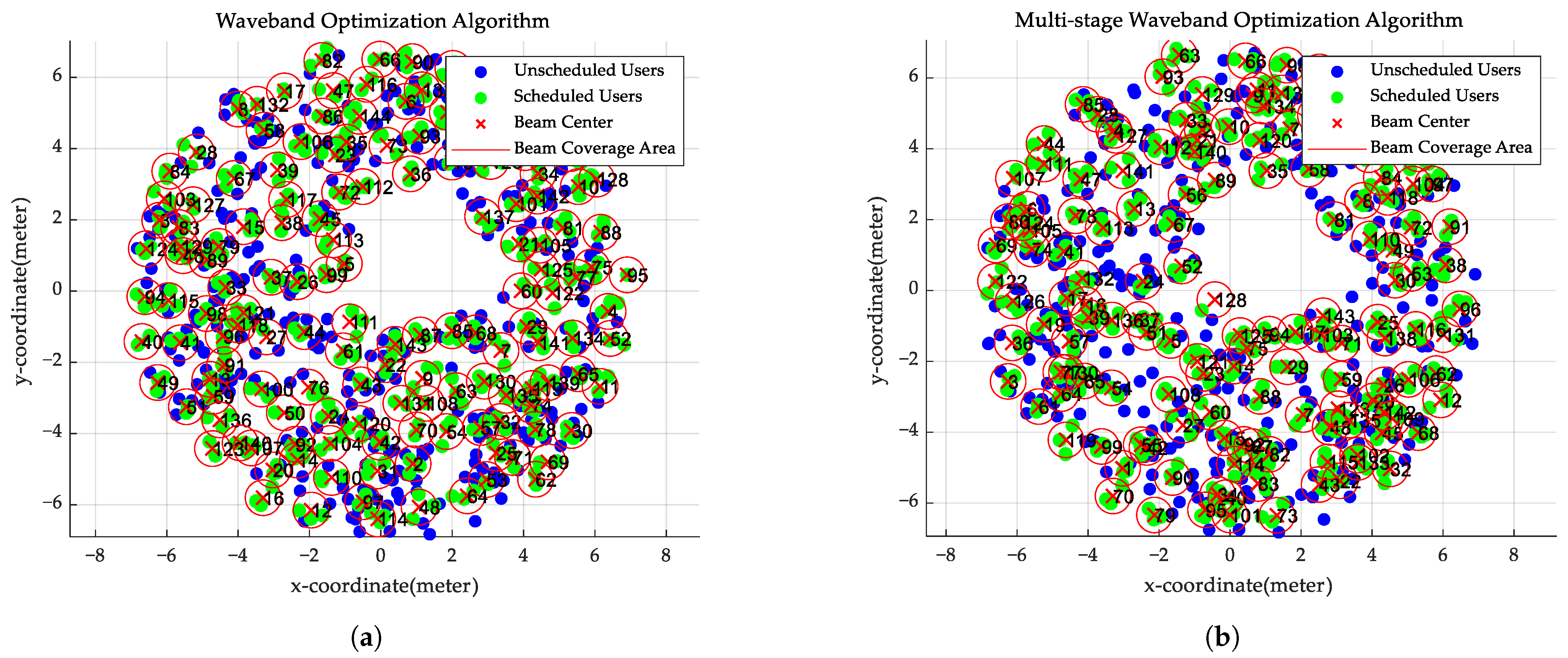
- Beam-Footprint Partitioning: to improve the coverage efficiency of multi-beam LEO satellite systems, we develop a multi-phase beam partitioning strategy that integrates density-aware clustering with ILP. The initial beam layout is guided by user distribution, where regions of high user density are prioritized during clustering. Subsequently, ILP is applied to optimize the association between users and beams, aiming to adjust beam center positions so that users are located as close as possible to beam centers for enhanced channel gain. An iterative adjustment step eliminates low-efficiency beams and reallocates their users, thereby increasing beam utilization efficiency and enabling better adaptation to spatially non-uniform traffic patterns.
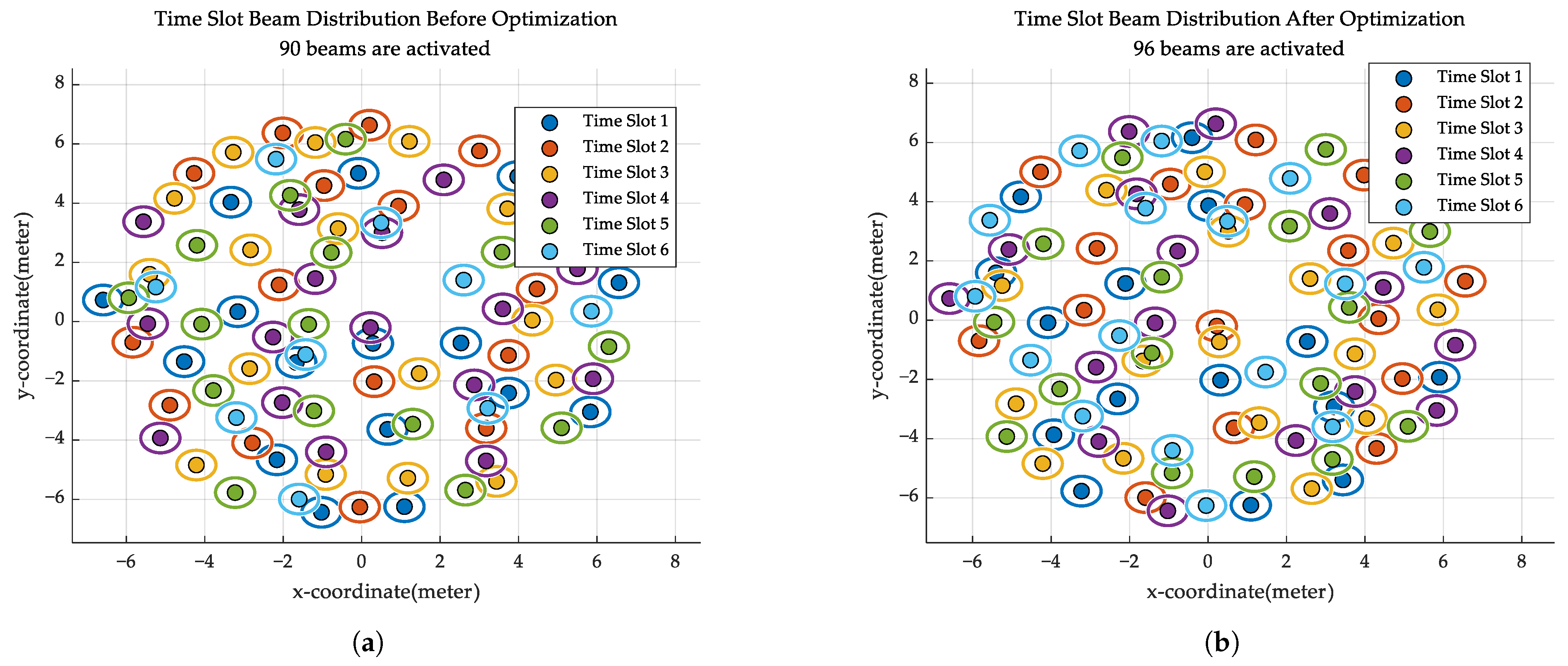
- Time-Slot Beam Scheduling: for scheduling beam positions across time slots within a BH cycle, we develop a hybrid approach, combining a greedy algorithm and simulated annealing. A feasible initial schedule is generated using a greedy filling strategy under constraints on minimum beam separation and per-slot beam limits. A simulated annealing algorithm is then applied to explore the solution space through probabilistic perturbations, enhancing the global optimality of beam allocation.
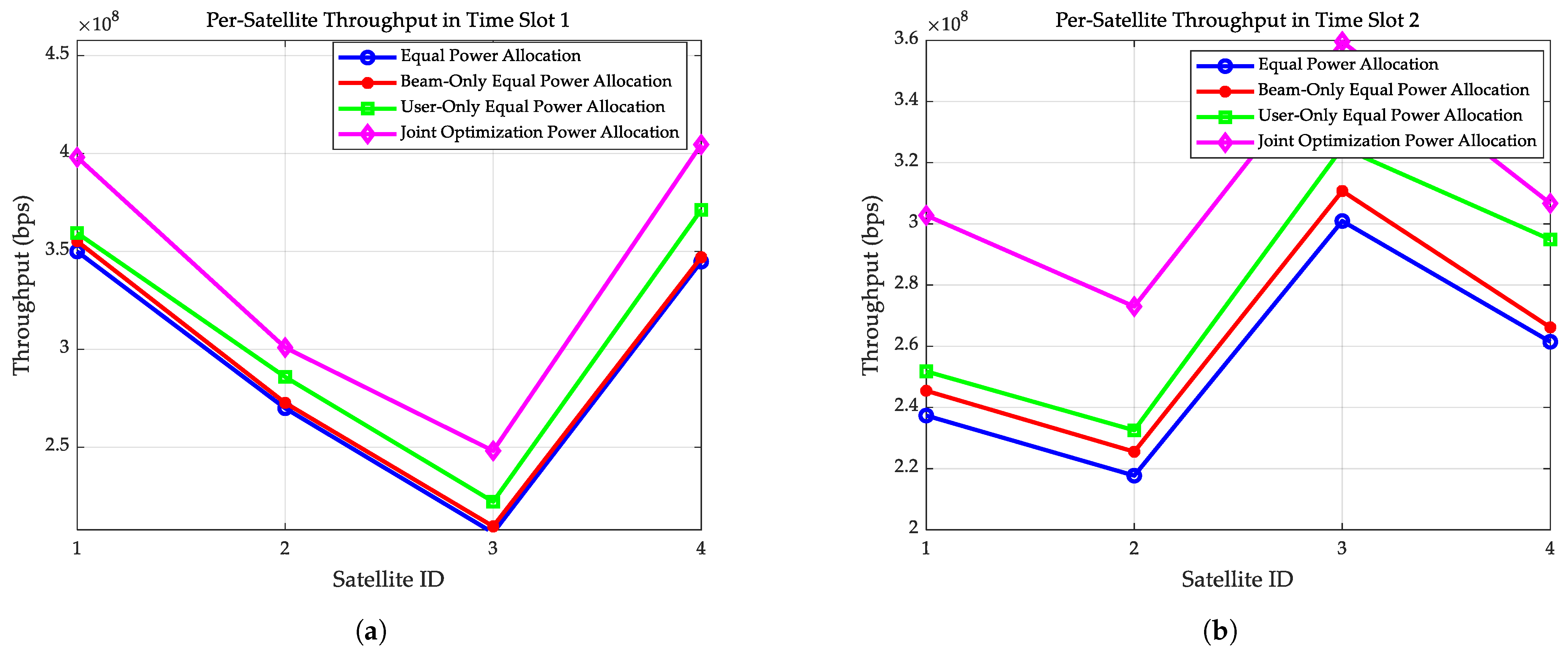
- Frequency–Power Joint Allocation: we propose a joint optimization method that integrates the Hungarian algorithm and water-filling theorem. The Hungarian algorithm is used to efficiently match users with sub-bands, while water-filling is applied to optimize intra-beam power distribution. Finally, we apply convex optimization to regulate inter-beam power allocation, leading to enhanced system throughput for the LEO network.
2. System Model
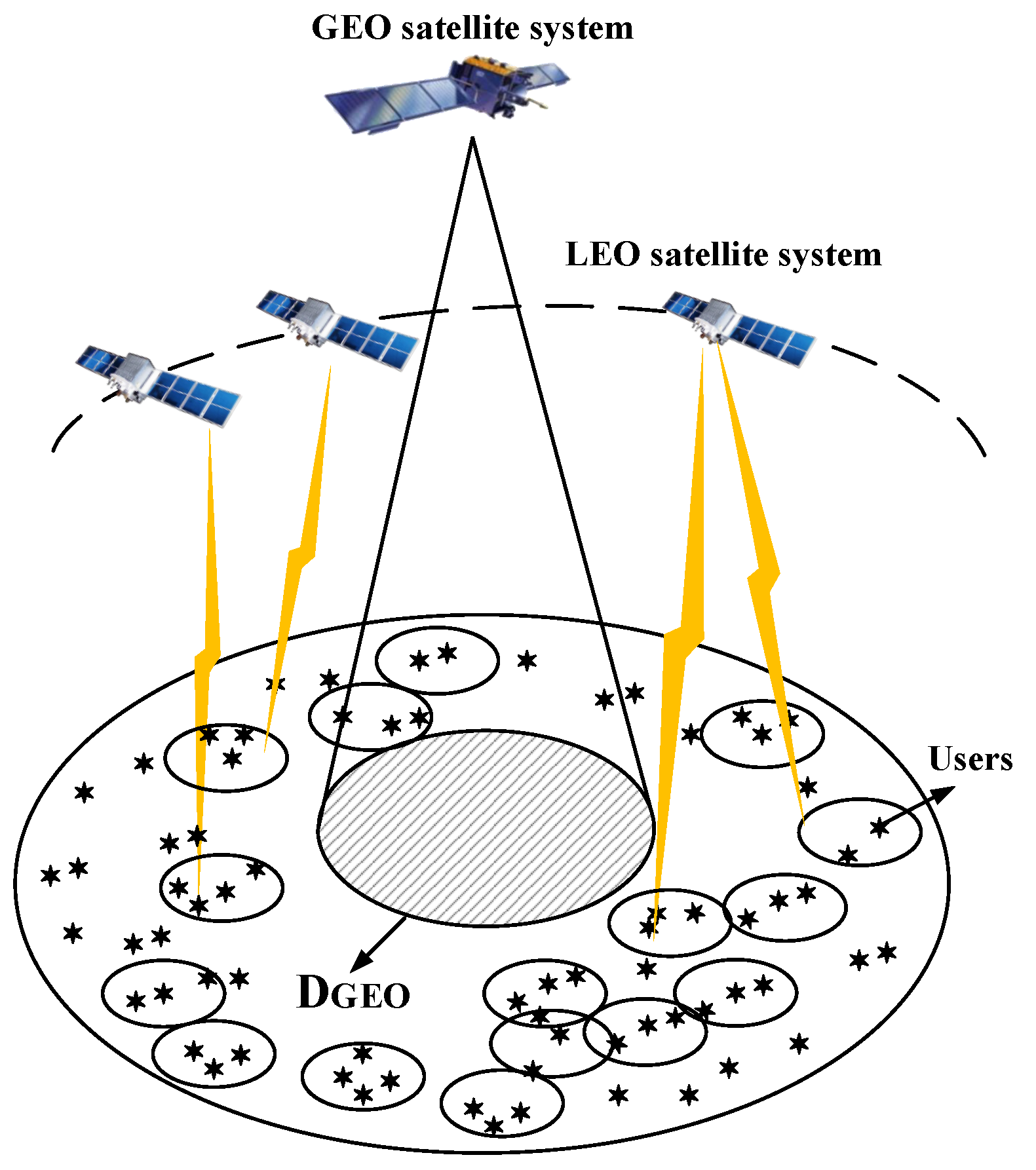
2.1. System Setup
2.2. Channel Model
2.3. Problem Formulation
- Constraint (7b) specifies that the total power allocated to users under each beam must not exceed the power assigned to that beam.
- Constraint (7c) specifies that the power allocated to each user must be non-negative.
- Constraint (7d) specifies that the power allocated to each beam must not exceed the predefined beam-level power limit.
- Constraint (7e) specifies that the total power allocated across all beams must not exceed the satellite’s onboard power budget.
- Constraint (7f) specifies that the total bandwidth allocated to users under each beam must equal the total bandwidth available to the satellite.
- Constraint (7g) specifies that the bandwidth allocated to each user must be non-negative.
- Constraint (7h) specifies that scheduled LEO users must be located outside the GEO protection zones in order to eliminate potential interference to GEO system operations.
3. A Beam-Hopping-Based Global Beam Scheduling and User Resource Allocation Algorithm
3.1. Algorithm A: Beam-Footprint Partitioning Algorithm
3.1.1. Initial Beam Candidate Generation
3.1.2. Beam–User Matching
3.1.3. Iterative Optimization
3.2. Algorithm B: Globally Optimized Beam–Slot Assignment Algorithm
| Algorithm 1: Global Optimization Beam-Time Slot Allocation Algorithm |
|
3.3. Algorithm C: Joint Frequency–Power Allocation Algorithm
4. Simulation Results and Analysis
4.1. Simulation Parameters
4.2. Performance of the Beam-Footprint Partitioning Algorithm
4.3. Performance of the Globally Optimized Beam–Slot Assignment Algorithm
4.4. Performance of the Joint Frequency–Power Allocation Algorithm
4.5. Computational Complexity and Runtime Evaluation
5. Conclusions
Author Contributions
Funding
Data Availability Statement
Acknowledgments
Conflicts of Interest
References
- Gu, P.; Li, R.; Hua, C.; Tafazolli, R. Dynamic cooperative spectrum sharing in a multi-beam LEO-GEO co-existing satellite system. IEEE Trans. Wire. Commun. 2022, 21, 1170–1182. [Google Scholar] [CrossRef]
- Ding, X.; Ren, Z.; Lu, H.; Zhang, G. Improving SINR via joint beam and power management for GEO and LEO spectrum-sharing satellite communication systems. China Commun. 2022, 19, 25–36. [Google Scholar] [CrossRef]
- Li, B.; Park, J.; Al-Hourani, A.; Pokhrel, S.R.; Choi, J. A novel frequency reuse model for co-existing LEO and GEO satellites. IEEE Wire. Commun. Lett. 2024, 13, 1024–1028. [Google Scholar] [CrossRef]
- Lin, Z.; Ni, Z.; Kuang, L.; Jiang, C.; Huang, Z. NGSO satellites beam hopping strategy based on load balancing and interference avoidance for coexistence with GSO systems. IEEE Commun. Lett. 2023, 27, 278–282. [Google Scholar] [CrossRef]
- Feng, W.; Lin, Y.; Wang, Y.; Wang, J.; Chen, Y.; Ge, N.; Zhu, H. Radio map-based cognitive satellite-UAV networks towards 6G on-demand coverage. IEEE Trans. Cognitive Commun. Netw. 2024, 10, 1075–1089. [Google Scholar] [CrossRef]
- He, M.; Cui, G.; Wu, M.; Wang, W. Collaborative interference avoidance technology in GEO-LEO co-existing satellite system. Int. J. Satellite Commun. Netw. 2024, 42, 257–272. [Google Scholar] [CrossRef]
- Chan, S.; Lee, H.; Kim, S.; Oh, D. Intelligent low complexity resource allocation method for integrated satellite-terrestrial systems. IEEE Wire. Commun. Lett. 2022, 11, 1087–1091. [Google Scholar] [CrossRef]
- Sun, H.; Jing, W.; Lu, Z.; Wen, X.; Li, W. An energy-efficient beam hoping strategy in interference coexistence satellite systems. In Proceedings of the 2024 IEEE/CIC International Conference on Communications in China (ICCC Workshops), Hangzhou, China, 7–9 August 2024; pp. 711–716. [Google Scholar] [CrossRef]
- Anzalchi, J.; Couchman, A.; Gabellini, P.; Gallinaro, G.; D’agristina, L.; Alagha, N.; Angeletti, P. Beam hoping in multi-beam broadband satellite systems: System simulation and performance comparison with non-hopped systems. In Proceedings of the 2010 5th Advanced Satellite Multimedia Systems Conference and the 11th Signal Processing for Space Communications Workshop (ASMS), Cagliari, Italy, 13–15 September 2010; pp. 248–255. [Google Scholar] [CrossRef]
- Wang, A.; Lei, L.; Lagunas, E.; Pérez-Neira, A.I.; Chatzinotas, S.; Ottersten, B. Joint optimization of beam-hopping design and NOMA-assisted transmission for flexible satellite systems. IEEE Wire. Commun. Lett. 2022, 21, 8846–8858. [Google Scholar] [CrossRef]
- Wang, L.; Zhang, C.; Qu, D.; Zhang, G. Resource allocation for beam-hoping user downlinks in multi-beam satellite system. In Proceedings of the 2019 15th International Wireless Communications Mobile Computing Conference (IWCMC), Tangier, Morocco, 24–28 June 2019; pp. 925–929. [Google Scholar] [CrossRef]
- Du, X.; Hu, X.; Wang, Y.; Wang, W. Dynamic resource allocation for beam hopping satellites communication system: An exploration. In Proceedings of the 2022 IEEE International Conference on Trust, Security and Privacy in Computing and Communications (TrustCom), Wuhan, China, 9–11 December 2022; pp. 1296–1301. [Google Scholar] [CrossRef]
- Han, Y.; Zhang, C.; Zhang, G. Dynamic beam hopping resource allocation algorithm based on deep reinforcement learning in multi-beam satellite systems. In Proceedings of the 2021 3rd International Academic Exchange Conference on Science and Technology Innovation (IAECST), Guangzhou, China, 10–12 December 2021; pp. 68–73. [Google Scholar] [CrossRef]
- Su, Y.; Liu, Y.; Zhou, Y.; Yuan, J.; Cao, H.; Shi, J. Broadband LEO satellite communications: Architectures and key technologies. IEEE Wire. Commun. 2019, 26, 55–61. [Google Scholar] [CrossRef]
- Xv, H.; Sun, Y.; Zhao, Y.; Peng, M.; Zhang, S. Joint beam scheduling and beamforming design for cooperative positioning in multi-beam LEO satellite networks. IEEE Trans. Veh. Technol. 2023, 73, 5276–5287. [Google Scholar] [CrossRef]
- Bui, V.P.; Van Chien, T.; Lagunas, E.; Grotz, J.; Chatzinotas, S.; Ottersten, B. Joint beam placement and load balancing optimization for non-geostationary satellite systems. In Proceedings of the 2022 IEEE International Mediterranean Conference on Communications and Networking (MeditCom), Athens, Greece, 5–8 September 2022; pp. 316–321. [Google Scholar] [CrossRef]
- Pachler, N.; Crawley, E.F.; Cameron, B.G. A genetic algorithm for beam placement in high-throughput satellite constellations. In Proceedings of the 2021 IEEE Cognitive Communications for Aerospace Applications Workshop (CCAAW), Cleveland, OH, USA, 21–23 June 2021; pp. 1–6. [Google Scholar] [CrossRef]
- Choi, H.H.; Park, G.; Heo, K.; Lee, K. Joint optimization of beam placement and transmit power for multibeam LEO satellite communication systems. IEEE Internet Things J. 2024, 11, 14804–14813. [Google Scholar] [CrossRef]
- Zhang, S.; Cui, G.; Long, Y.; Wang, W. Joint computing and communication resource allocation for satellite communication networks with edge computing. China Commun. 2021, 18, 236–252. [Google Scholar] [CrossRef]
- Tian, F.; Huang, L.; Liang, G.; Jiang, X.; Sun, S.; Ma, J. An efficient resource allocation mechanism for beam-hopping based LEO satellite communication system. In Proceedings of the 2019 IEEE International Symposium on Broadband Multimedia Systems and Broadcasting (BMSB), Jeju, Republic of Korea, 5–7 June 2019; pp. 1–5. [Google Scholar] [CrossRef]
- Sharma, S.K.; Chatzinotas, S.; Ottersten, B. In-line interference mitigation techniques for spectral coexistence of GEO and NGEO satellites. Int. J. Satellite Commun. Netw. 2014, 34, 11–39. [Google Scholar] [CrossRef]
- Choi, J.P.; Chan, V.W. Optimum power and beam allocation based on traffic demands and channel conditions over satellite downlinks. IEEE Trans. Wire. Commun. 2005, 4, 2983–2993. [Google Scholar] [CrossRef]
- Abdu, T.S.; Kisseleff, S.; Lagunas, E.; Chatzinotas, S. Flexible resource optimization for GEO multibeam satellite communication system. IEEE Trans. Wire. Commun. 2021, 20, 7888–7902. [Google Scholar] [CrossRef]
- Yuan, S.; Sun, Y.; Peng, M.; Yuan, R. Joint beam direction control and radio resource allocation in dynamic multi-beam LEO satellite networks. IEEE Trans. Veh. Technol. 2024, 73, 8222–8237. [Google Scholar] [CrossRef]
- Lin, Z.; Ni, Z.; Kuang, L.; Jiang, C.; Huang, Z. Multi-satellite beam hopping based on load balancing and interference avoidance for NGSO satellite communication systems. IEEE Trans. Commun. 2022, 71, 282–295. [Google Scholar] [CrossRef]
- Kibria, M.G.; Lagunas, E.; Maturo, N.; Spano, D.; Chatzinotas, S. Precoded cluster hopping in multi-beam high throughput satellite systems. In Proceedings of the 2019 IEEE Global Communications Conference (GLOBECOM), Waikoloa, HI, USA, 9–13 December 2019; pp. 1–6. [Google Scholar] [CrossRef]
- Yuan, Y.; Lei, L.; Vu, T.X.; Chang, Z.; Chatzinotas, S.; Sun, S. Adapting to dynamic LEO-B5G systems: Meta-critic learning based efficient resource scheduling. IEEE Trans. Wire. Commun. 2022, 21, 9582–9595. [Google Scholar] [CrossRef]
- Khan, W.U.; Ali, Z.; Lagunas, E.; Mahmood, A.; Asif, M.; Ihsan, A.; Dobre, O.A. Rate splitting multiple access for next generation cognitive radio enabled LEO satellite networks. IEEE Trans. Wire. Commun. 2023, 22, 8423–8435. [Google Scholar] [CrossRef]
- Huang, Q.; Lin, M.; Wang, J.B.; Tsiftsis, T.A.; Wang, J. Energy efficient beamforming schemes for satellite-aerial-terrestrial networks. IEEE Trans. Wire. Commun. 2020, 68, 3863–3875. [Google Scholar] [CrossRef]



| Parameter | Value |
|---|---|
| Initialize temperature T | 500 |
| Minimum temperature | |
| Cooling rate | 0.95 |
| Max iterations | 500 |
| Acceptance rule | Metropolis criterion |
| Parameter | Value |
|---|---|
| LEO Satellite Orbital Altitude | 500 km/600 km |
| Number of LEO Satellites | 4 |
| GEO Satellite Position | 40° E, 100° N |
| GEO Earth Station Location | 40° E, 100° N |
| Radius of Target Ground Area | 700 km |
| LEO Satellite Beam Radius | 50 km |
| Peak Antenna Gain of LEO Satellite | 35 dB |
| 3 dB Beamwidth | 1.65° |
| Number of Beams per LEO Satellite | 4 |
| Number of Users to Be Served | 750 |
| Number of Time Slots | 6 |
| System Bandwidth | 400 MHz |
| Carrier Frequency | 20 GHz |
| Noise Temperature | 150 K |
| Maximum LEO Satellite Transmit Power | 800 W |
| Rician Fading Factor | 0.95 |
| Cloud/Rain Attenuation Coefficient | 0.1/0.05 |
| Maximum Beam Power | 250 W |
Disclaimer/Publisher’s Note: The statements, opinions and data contained in all publications are solely those of the individual author(s) and contributor(s) and not of MDPI and/or the editor(s). MDPI and/or the editor(s) disclaim responsibility for any injury to people or property resulting from any ideas, methods, instructions or products referred to in the content. |
© 2025 by the authors. Licensee MDPI, Basel, Switzerland. This article is an open access article distributed under the terms and conditions of the Creative Commons Attribution (CC BY) license (https://creativecommons.org/licenses/by/4.0/).
Share and Cite
Zhang, J.; Li, W.; Li, Y.; Wang, H.; Li, S. A Framework for Joint Beam Scheduling and Resource Allocation in Beam-Hopping-Based Satellite Systems. Electronics 2025, 14, 2887. https://doi.org/10.3390/electronics14142887
Zhang J, Li W, Li Y, Wang H, Li S. A Framework for Joint Beam Scheduling and Resource Allocation in Beam-Hopping-Based Satellite Systems. Electronics. 2025; 14(14):2887. https://doi.org/10.3390/electronics14142887
Chicago/Turabian StyleZhang, Jinfeng, Wei Li, Yong Li, Haomin Wang, and Shilin Li. 2025. "A Framework for Joint Beam Scheduling and Resource Allocation in Beam-Hopping-Based Satellite Systems" Electronics 14, no. 14: 2887. https://doi.org/10.3390/electronics14142887
APA StyleZhang, J., Li, W., Li, Y., Wang, H., & Li, S. (2025). A Framework for Joint Beam Scheduling and Resource Allocation in Beam-Hopping-Based Satellite Systems. Electronics, 14(14), 2887. https://doi.org/10.3390/electronics14142887