Article

A Novel Fault Diagnosis Method for Rolling Bearings Based on Spectral Kurtosis and LS-SVM

School of Ocean Information Engineering, Jimei University, Xiamen 361000, China
*
Author to whom correspondence should be addressed.
Electronics 2025, 14(14), 2790; https://doi.org/10.3390/electronics14142790
Submission received: 19 June 2025 / Revised: 7 July 2025 / Accepted: 9 July 2025 / Published: 11 July 2025

Abstract

As a core component of machining tools and vehicles, the load-bearing and transmission performance of rolling bearings is directly related to product processing quality and driving safety, highlighting the critical importance of fault detection. To address the nonlinearity, non-stationary modulation, and low signal-to-noise ratio (SNR) observed in bearing vibration signals, we propose a fault feature extraction method based on spectral kurtosis and Hilbert envelope demodulation. First, spectral kurtosis is employed to determine the center frequency and bandwidth of the signal adaptively, and a bandpass filter is constructed to enhance the characteristic frequency components. Subsequently, the envelope spectrum is extracted through the Hilbert transform, allowing for the precise identification of fault characteristic frequencies. In the fault diagnosis stage, a multidimensional feature vector is formed by combining the kurtosis index with the amplitude ratios of inner/outer race characteristic frequencies, and fault pattern classification is accomplished using a Least-Squares Support Vector Machine (LS-SVM). To evaluate the effectiveness of the proposed method, experiments were conducted on the bearing datasets from Case Western Reserve University (CWRU) and the Machine Failure Prevention Technology (MFPT) Society. The experimental results demonstrate that the proposed method surpasses other comparative approaches, achieving identification accuracies of 95% and 100% for the CWRU and MFPT datasets, respectively.

1. Introduction

Bearings are critical components in various industrial applications, extensively utilized in transportation, medical equipment, aerospace, and other sectors, and play an indispensable role in ensuring the stable and efficient operation of manufacturing systems [1]. However, sudden rolling bearing failures often induce unplanned downtime in manufacturing systems, resulting in substantial production losses, increased maintenance expenditures, and potential safety risks [2,3]. Specifically, bearing failures account for 30% to 40% of industrial mechanical failures in modern industrial systems [4]. Therefore, monitoring the stator current, stray flux, thermal image, and vibration to assist in bearing fault diagnosis is an effective means to improve industrial production efficiency and ensure transportation safety [5]. The failure diagnosis methods for rolling bearings include mainly the temperature detection method, the acoustic emission technology analysis method, neural network-based methods, and the vibration detection method [6,7,8].
Due to the nonlinearity and non-stationarity of vibration signals, the vibration detection method demonstrates the advantages of convenient processing and accurate diagnosis in the fault diagnosis of bearings. Reference [5] proposed a fault diagnosis method for variable working conditions, which combines the normalized time–frequency entropy spectrum (NTFES) with the fault characteristic coefficient template (FCCT). The time–frequency distribution matrix is obtained through the short-time Fourier transform (STFT) of the vibration signal. Reference [9] utilized the bearing dataset of Mechanical Fault Prevention Technology (MFPT) and proposed a new custom Load Adaptive Framework (CLAF) for the fault classification of induction motors (IMs). The spectral entropy on each time window is calculated successively and normalized to obtain NTFES. Combining the two basic operators of median filtering and autocorrelation, Reference [10] proposed an enhanced spectral coherence. Meanwhile, the analog signals, the vibration datasets obtained from experiments of artificially faulty bearings, and accelerated bearing degradation tests were analyzed. However, its fixed window size inherently limits the time–frequency resolution, making it difficult to simultaneously achieve optimal temporal and frequency localization for rapidly varying vibration signals. Wavelet transform exhibits a superior capability in localized analysis of bearing impact-type faults due to its inherent multi-resolution characteristics. A wavelet-based method has been successfully applied to bearing fault diagnosis [11]. However, this algorithm cannot automatically select the best basis function to achieve the global optimal performance. Furthermore, the type of material and manufacturing technology are also important, mainly because they directly affect the microstructure and mechanical properties of the bearing [12]. To avoid the complexity of signal spectrum analysis, reference [13] proposes a diagnostic method called the impulse signal-to-noise ratio (PSNR) test. This method utilizes the time-domain sparsity of fault signals at a constant angular rate and models them as periodic pulses with consistent duty cycles and power.
With the development of artificial intelligence technology, the bearing fault diagnosis method based on neural networks is becoming increasingly popular [14,15,16,17]. Reference [15] proposes a new fault diagnosis method for rolling bearings, which combines convolutional neural networks (CNNs) and gated recurrent units (GRUs), and integrates envelope analysis and adaptive mean filtering techniques. Reference [16] presents a method based on HOG features extracted from the Q transform to identify bearing faults with a small sample. Reference [17] employed a novel hybrid signal processing method to strengthen feature extraction and reduce domain shifts. In addition, under the conditions of high noise and a complex working environment, reference [18] proposes a new weighted domain adaptation network based on residual denoising and attention (RMAD-WDAN) for the diagnosis of bearing failure. To address the issue of feature information loss, Zhang and Deng [19] propose an intelligent bearing fault diagnosis method that combines the Fourier transform in STFT time and a convolutional neural network (STFT-CNN). However, limited by the scarcity of bearing fault samples, neural networks and deep learning methods that require a large amount of sample data are difficult to make universally applicable. Several studies have employed statistical analysis approaches for bearing fault diagnosis, as presented in [10,20]. While these methods offer computational simplicity and straightforward implementation, their diagnostic robustness remains limited, particularly when handling complex vibration patterns under varying operational conditions.
A significant limitation of deep learning-based device fault diagnosis models is their inability to automatically identify new types of faults as new fault data becomes available. To address this issue, ref. [21] proposes an incremental single-class fault diagnosis method based on the online sequential Extreme Learning Machine (OS-ELM). To address this limitation, more advanced machine learning techniques such as Support Vector Machine (SVM) have been introduced for bearing fault detection [22,23]. To enhance detection accuracy, Nayana and Geethanjali [24] utilized particle swarm optimization (PSO) and wheel-based differential evolution (WBDE) feature selection algorithms to identify bearing faults. Safizadeh and Dardmand [25] extracted important features through the Principal Component Analysis (PCA) algorithm and used the K-Nearest Neighbor (KNN) classification algorithm to detect defects and make decisions, which has become an effective method for detecting bearing faults. Additionally, Zhang and Tong [26] utilized XGBoost for bearing fault detection as the source model and proposed a method that integrates Principal Component Analysis (PCA) with the extreme gradient boosting model, thereby achieving improved performance.
Building upon a comprehensive analysis of existing bearing fault diagnosis methodologies, this study proposes a novel nonlinear envelope demodulation approach based on spectral kurtosis. The developed vibration-based diagnostic framework comprises four key steps: (1) acquisition of vibration signals using high-sensitivity accelerometers, (2) signal preprocessing and feature extraction, (3) enhancement of fault features by spectral kurtosis analysis, and (4) precise identification of the fault type and severity evaluation through envelope demodulation techniques. The proposed method demonstrates superior capability in overcoming the limitations of conventional approaches, particularly in terms of accurate feature extraction under strong noise interference conditions. As such, we have made notable contributions to the methodology and assessment of bearing fault diagnosis. Specifically,
  • To address the challenges of strong noise and low signal-to-noise ratio (SNR) in bearing vibration signals, this paper proposes an integrated fault diagnosis method that combines spectral kurtosis-optimized adaptive bandpass filtering with Hilbert envelope demodulation. The proposed approach enables accurate extraction of bearing fault characteristic frequencies in noisy environments through optimal frequency band selection through spectral kurtosis analysis and subsequent envelope demodulation.
  • In terms of bearing fault diagnosis, this paper constructs an efficient bearing fault diagnosis method. It proposes taking the kurtosis value of the bearing vibration signal and the ratio of the amplitudes at the characteristic frequencies of the inner ring and the outer ring as the feature vectors, and the SVM is adopted as the classification identifier.
  • Taking 20 sets of data from the Mechanical Fault Prevention Technology (MFPT) challenge as the target dataset, a dataset of the quantities of fault identification features was established. A large number of experimental results show that the feature vector construction method proposed in this paper achieves better discrimination in different categories. Meanwhile, when the Least-Squares Support Vector Machine (LS-SVM) was tested with test sample data, and the recognition accuracy rate is 100%.
The remaining sections of this article are organized as follows: Section 2 presents a background of bearing faults. In Section 3, the paper proposes materials and methods for bearing failures. In Section 4, the experimental results are presented and analyzed. We summarize the article in Section 5.

2. Background

2.1. Characteristic Frequencies of Bearing Faults

Bearings, as rotating mechanical components, exhibit an inherent periodicity in their vibration signals. Rolling bearing faults exhibit distinct location-specific characteristics, occurring primarily in critical components, including the outer race, inner race, cage, or rolling elements. During operation, periodic impacts occur between defective rolling elements and fault locations on the tracks, or damaged rolling elements contact the tracks [27,28]. These mechanical impulses excite high-frequency resonance between the bearing system and response sensors.
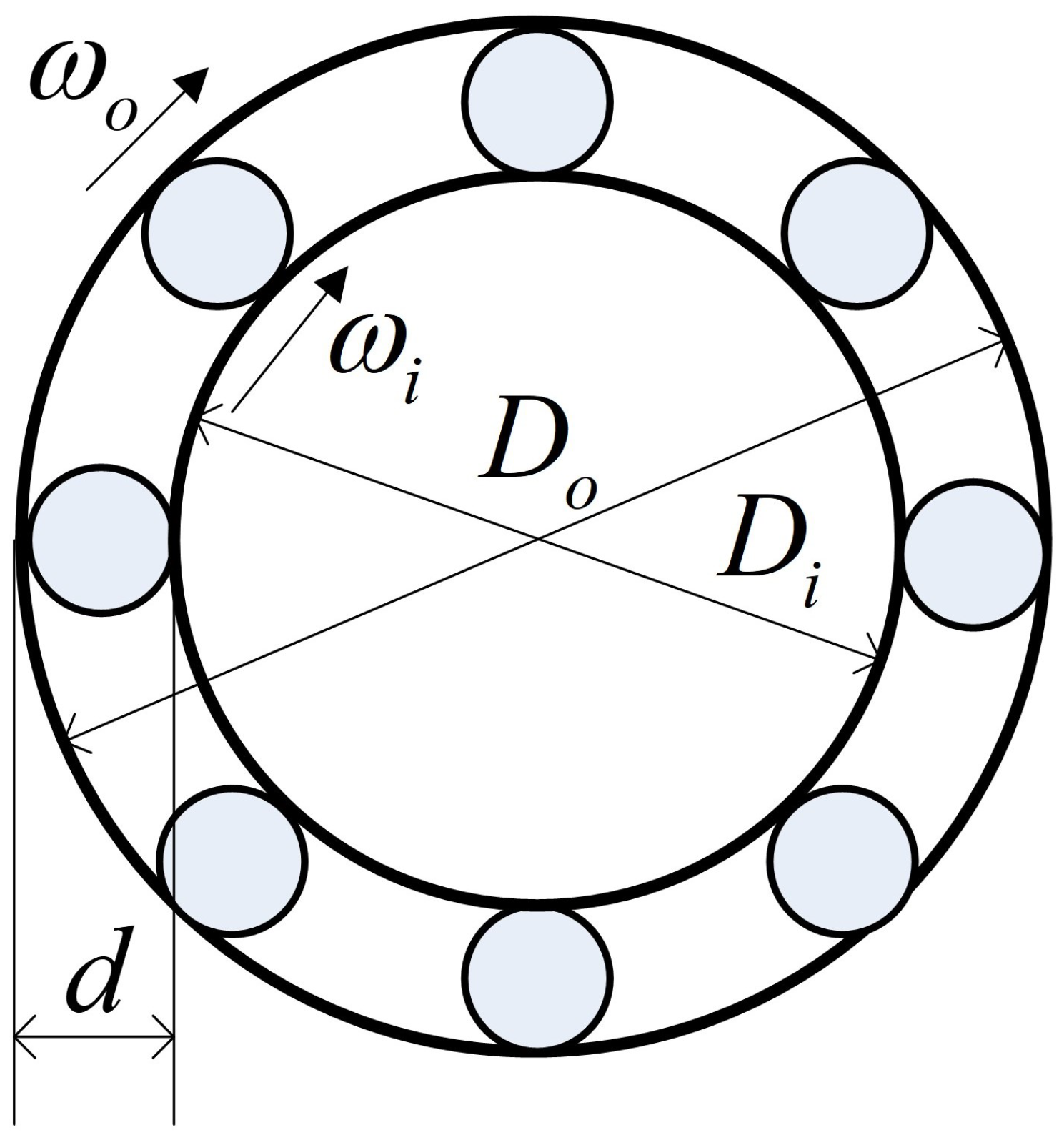
Figure 1 shows a schematic diagram and geometric parameters of a rolling bearing, where D o is the diameter of the raceway on the outer ring of the bearing, which can be expressed as
D o = D + d cos α
where d represents the diameter of the bearing rollers, α is the contact angle of the bearing, and D is the bearing diameter corresponding to the center of the rollers, which is simply referred to as the bearing mid diameter. D i is the diameter of the raceway of the inner ring of the bearing, which can be expressed as
D i = D d cos α .
The rotational linear velocity of the outer ring of the bearing can be expressed as
V o = 1 2 D o w o
where w o is the rotational angular velocity of the outer ring of the bearing. The rotational linear velocity of the inner ring of the bearing can be expressed as
V i = 1 2 D i w i
where w i is the rotational angular velocity of the inner ring of the bearing. The rotational linear velocity of the bearing cage is the average of the rotational linear velocities of the inner and outer rings, which can be expressed as
V c = 1 2 V o + V i = 1 4 ω o D + d cos α + 1 4 ω i D d cos α .
The rotation frequency of the bearing cage can be expressed as
f c = 1 2 f o 1 + d D cos α + 1 2 f i 1 d D cos α .
The rotation frequency of the cage relative to the outer ring can be expressed as
f r o = f o f c = 1 2 f o f i 1 d D cos α .
Then, the rotation frequency of the cage relative to the inner ring can be defined as
f r i = f c f i = 1 2 f i 1 d D cos α + 1 2 f o 1 + d D cos α f i = 1 2 f o f i 1 + d D cos α .
The spin frequency of the roller can be written as
f b p f = f r i D i d = f o f i 2 D d 1 d D cos α 2 .
Suppose the bearing has n rollers and the cage rotates one full circle relative to the outer and inner rings. Then, the rollers pass through the fixed points of the outer and inner rings n times. Therefore, the passing frequency of the roller through the fixed points on the outer ring can be expressed as
f b p f o = n f o f i 1 d D cos α 2 .
The passing frequency of the roller through the fixed points of the inner ring can be expressed as
f b p f i = n f o f i 1 + d D cos α 2 .
If the outer ring of the bearing is fixed and the inner ring rotates, then the rotational speed of the inner ring is f i , where f i = f r . At this point, the rotation frequency of the bearing cage can be expressed as
f c = f i 2 1 d D cos α .
The rotation frequency of the cage relative to the outer ring can be expressed as
f b p f = f i 2 D d 1 d D cos α 2 .
The rotation frequency of the cage relative to the inner ring can be defined as
f b p f o = n f i 2 1 d D cos α .
The spin frequency of the roller can be written as
f b p f i = n f i 2 1 + d D cos α .
Under the condition of a fixed outer ring, Equations (12)–(15) are derived based on the assumption of no relative sliding between the outer and inner raceways. Consequently, minor discrepancies may exist between the experimentally measured characteristic frequencies and the theoretically calculated values.
To calculate the characteristic frequency of the bearing, Table 1 shows the 4(15)2724-type two-row roller bearing commonly used in Chinese railway passenger cars, where α = 0 .
According to Equations (12)–(14), the characteristic frequency of the cage is computed as f c = 0.41 f i , the characteristic frequency of the roller is computed as f b p f = 2.66 f i , the characteristic frequency of the outer circle is computed as f b p f o = 5.73 f i , and the characteristic frequency of the inner circle is computed as f b p f i = 8.27 f i .

2.2. Kurtosis, Spectral Kurtosis

The kurtosis K, defined as the normalized fourth-order central moment, is a statistical measure that characterizes the distribution properties of random variables. Notably, K is independent of bearing rotational speed, dimensional parameters, and load conditions, yet exhibits high sensitivity to impulse signals. This characteristic makes it particularly suitable for bearing fault diagnosis. The calculation of kurtosis can be expressed as
K = 1 n i = 1 n x μ 4 1 n i = 1 n x μ 2 2 .
The magnitude of K shows a positive correlation with fault severity, where higher K values indicate more severe vibration and greater deviation from normal operating conditions. A kurtosis value of K = 3 indicates that the signal follows a mesokurtic distribution (i.e., Gaussian distribution). When K = 3, it represents a normal kurtosis distribution, that is, a zero kurtosis. When K > 3, it is a positive kurtosis distribution, and when K < 3, it is a negative kurtosis distribution. When the bearing operates normally, the amplitude of the bearing vibration follows a zero kurtosis distribution, namely, a normal distribution. When a fault occurs in the bearing, the amplitude of the bearing vibration increases, and the amplitude of the vibration signal follows a positive kurtosis distribution, with K > 3 at this moment. The larger the value of K, the greater the vibration of the bearing, and the more severe the deviation from the normal operating state.
In addition, the Fast Kurtogram algorithm is employed for spectral kurtogram calculation to achieve automatic optimization of frequency-band parameters. This method primarily consists of the following critical steps: (1) using a multi-resolution filter bank to conduct time–frequency decomposition of the signal; (2) computing the kurtosis values for each sub-frequency band; (3) identifying the frequency band with the maximum kurtosis value as the optimal filtering interval. The spectrum Kurtosis demonstrates remarkable sensitivity to transient components in signals, enabling simultaneous characterization of both transient impulse intensity and its frequency distribution. Owing to these distinctive properties, SK has been widely adopted in condition monitoring and fault diagnosis applications within both domestic and international research communities. The Wold–Cramer decomposition of non-stationary signal X t can be expressed as
Y t = + e j 2 π f t H t , f ; ω ¯ d X f
where H t , f ; b a r ω is a time-varying transfer function, which can be understood as the complex envelope of the signal Y t at frequency f. Then, the fourth-order spectral cumulant of Y t is defined as
C 4 Y f = S 4 Y f 2 S 2 Y 2 f , f 0
where S 2 n Y f represents the mathematical expectation of the 2n-th-order instantaneous moment S 2 n Y t , f , which can be expressed as
S 2 n Y f = Δ E S 2 n Y t , f
Furthermore, S 2 n Y t , f is the 2n-th-order instantaneous moment of Y t , representing the energy intensity of the complex envelope at time t and frequency f, can be expressed as
S 2 n Y t , f = Δ E H t , f d X f 2 n E H t , f d X f 2 n d f d f .
Therefore, the spectral kurtosis K Y f can be defined as
K Y f = Δ C 4 Y f S 2 Y 2 f = S 4 Y f S 2 Y 2 f 2 , f 0 .

3. Materials and Methods

3.1. Envelope Demodulation Based on Hilbert Transform

Since a bearing consists of multiple rotating parts, such as the inner race, outer race, rolling elements, and cage, its vibration signals typically represent a superposition of multiple periodic components. These periodic components interact with each other, resulting in modulation effects. When a localized defect occurs in one of the components, the resulting vibration signal is characterized by nonlinear amplitude modulation. Therefore, envelope demodulation must be performed to accurately extract the characteristic frequencies of the fault. In this study, the Hilbert transform-based envelope demodulation method is used to effectively demodulate the amplitude-modulated signal.
Similar to the Fourier transform and wavelet transform, the Hilbert transform also falls within the category of integral transforms. It is essentially a convolution operation of signals c t and 1 1 t t , which can be expressed as
d t = H c t = 1 π + c τ t τ d τ
Based on Equation (22), the complex function can be expressed as
z t = c t + i d t = A t e i θ t
where the instantaneous amplitude A t = c 2 t + d 2 t and instantaneous phase θ t = arctan d t c t . In addition, the instantaneous frequency can be obtained by differentiating the instantaneous phase, which can be expressed as
f t = 1 2 π d θ t d t

3.2. LS-SVM Classification

For bearing fault identification, this subsection employs the LS-SVM to construct a fault classifier. Rooted in statistical learning theory, the LS-SVM method operates on the principle of structural risk minimization. It selects a representative subset of features from the training samples and constructs an optimal hyperplane for classification. Unlike conventional SVM, LS-SVM achieves effective partitioning of the entire feature space through linear separation of support vectors, thereby effectively mitigating the “curse of dimensionality” problem. To enhance computational efficiency, Suykens and Vandewalle improved the traditional SVM by transforming inequality constraints into equality constraints. This modification reduces the quadratic programming problem to solving a system of linear equations, significantly decreasing computational complexity while maintaining classification performance. In this paper, we transform the feature vector x in the low-dimensional space into the high-dimensional feature space through the nonlinear transformation f x . Then, we classify f x in the high-dimensional feature space. The constrained optimization problem of the optimal separating hyperplane can be expressed as
min 1 2 V T V + C 2 i = 1 m ξ i 2 s . t . y i V T f x i + b = 1 ξ i , i = 1 , , m
where V is the weight vector, m is the sample size, i is the sample serial number, and y i is the classification output result. If x i belongs to category 1, then y i = 1 . If x belongs to category 2, then y i = 1 . Then, ξ i is the coefficient of relaxation, C is the penalty factor, and b is the bias term.
In the subsection, we introduce the Lagrange multiplier a. According to the Karush–Kuhn–Tucker (KKT) conditions, the original constrained optimization problem can be transformed into
y i V T f x i + b 1 + ξ i = 0 V = i = 1 m α i y i f x i i = 1 m α i y i = 0 α i = C ξ i , i = 1 , , m .
Based on Formula (26), the matrix form of the constrained optimization problem can be expressed as
Ω y y T 0 α b = R 0
where R = 1 1 T , y = y 1 y m T , α = α 1 α m T . The elements within a positive definite matrix can be defined as
Ω i j = y i y j f T x i f x j + δ i j C = y i y j K x i , x j + δ i j C
where δ i j = { 1 , i = j 0 , i j . According to Mercer’s condition, the kernel function can be defined as
K x i , x j = f T x i f x j .
In this paper, we select the radial basis function (RBF) as the kernel and solve for α and b using the least-squares method. Thus, the output of the LS-SVM classification can be expressed as
y x = sgn i = 1 m α i K x , x i + b
Compared with conventional SVMs, the LS-SVM transforms inequality constraints into equality constraints and reduces the quadratic programming problem in the training process to solving a system of linear equations, thereby significantly decreasing computational complexity.

3.3. Pseudo-Code of the Fault Detection Algorithm

The pseudo-code of the fault detection algorithm based on spectral kurtosis and SVM is shown in Algorithm 1. This paper proposes a novel fault detection method for rolling bearings based on spectral kurtosis (SK) and SVM. First, the center frequency and optimal bandwidth are determined via spectral kurtosis analysis, and a bandpass filter is designed accordingly to preprocess the raw vibration signal. Subsequently, the Hilbert transform (HT) is applied to demodulate the filtered signal, extracting its envelope spectrum to enhance the fault characteristic frequencies. Finally, the kurtosis of the vibration signal and the amplitude at the inner raceway fault frequency are selected as feature vectors and fed into an LS-SVM classifier for fault diagnosis.
Algorithm 1 Pseudo-Code of the Fault Detection Algorithm
1:
Initialization: Obtain the original vibration signal of the bearing failure;
2:
The center frequency f c and frequency band width B w are selected based on the spectral kurtosis K Y f of the bearing vibration signal based on Equation (21);
3:
The signal is bandpass filtered by using a bandpass filter;
4:
The envelope of the amplitude modulation signal is demodulated through the Hilbert variation based on Equations (22)–(24);
5:
Spectral analysis of the envelope signal is carried out to obtain the envelope spectrum;
6:
Extract the characteristic frequencies of bearing faults;
7:
The kurtosis of the bearing vibration signal and the amplitude at the characteristic frequency of the inner ring are selected as the feature vectors;
Output: 
The fault identifier of LS-SVM is inspected.

4. Results and Discussion

4.1. Verification and Simulation of Envelope Demodulation

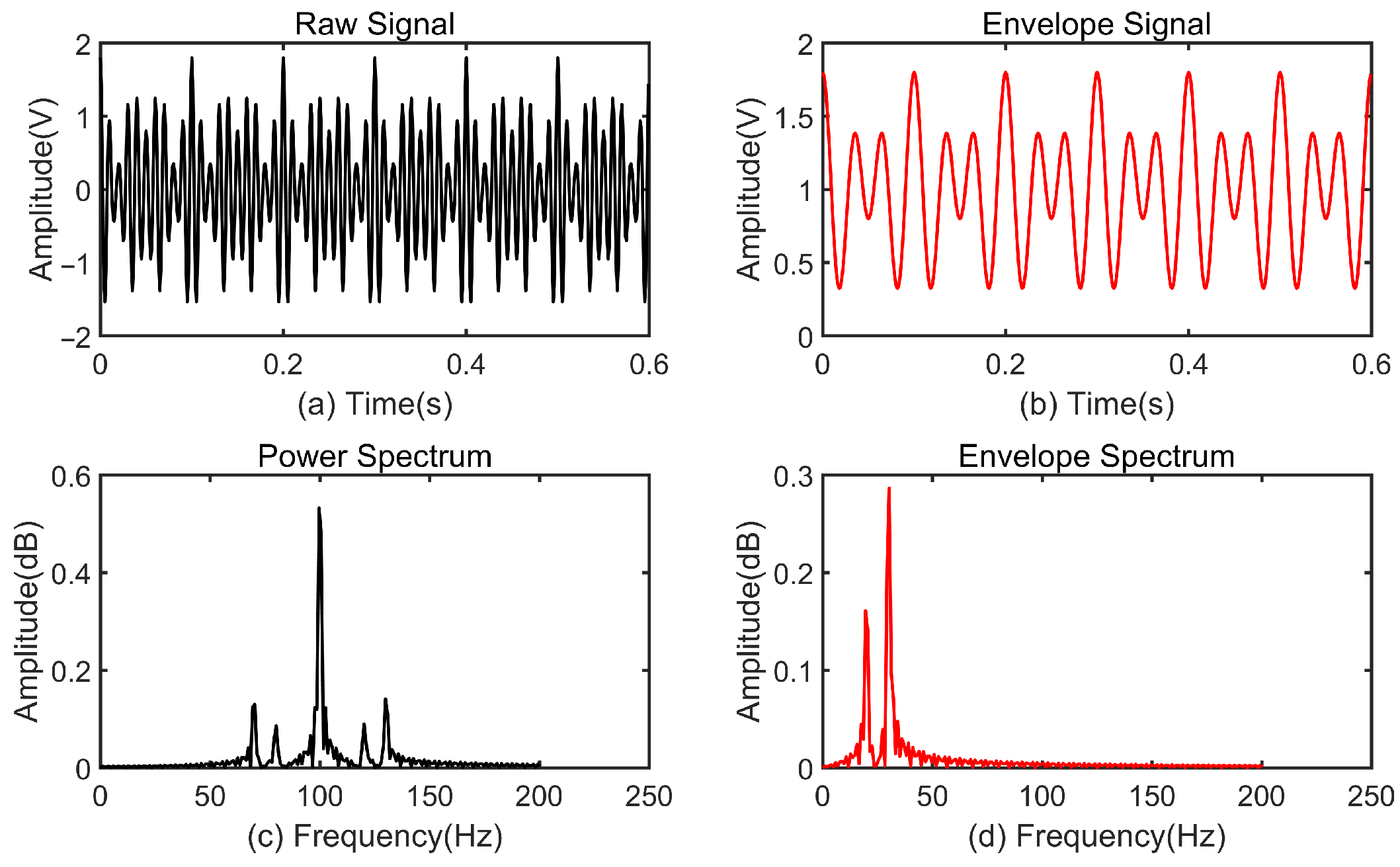
For a two-tone banner signal, it can be expressed as
y t = 1 + 0.3 cos 2 π · f 1 t + 0.5 cos 2 π · f 2 t cos 2 π · f c t
where the modulation frequencies are set as f 1 = 20 and f 2 = 30 , with a carrier frequency of f c = 100 .
Figure 2 demonstrates the validation results of the envelope demodulation algorithm, where subplots Figure 2a–d display the following, respectively: the original time-domain waveform, amplitude spectrum, demodulated envelope, and envelope spectrum. Specifically, the 100 Hz spectral component observed in Figure 2b corresponds to the carrier frequency of the modulated signal y t , while the distinct 20 Hz and 30 Hz spectral components in Figure 2d accurately reflect the characteristics of the original modulation frequencies. These results not only validate the effectiveness of the envelope demodulation algorithm but also demonstrate its capability to effectively separate bearing rotation signals from fault-induced vibration signals, thereby enabling accurate extraction of bearing fault features.
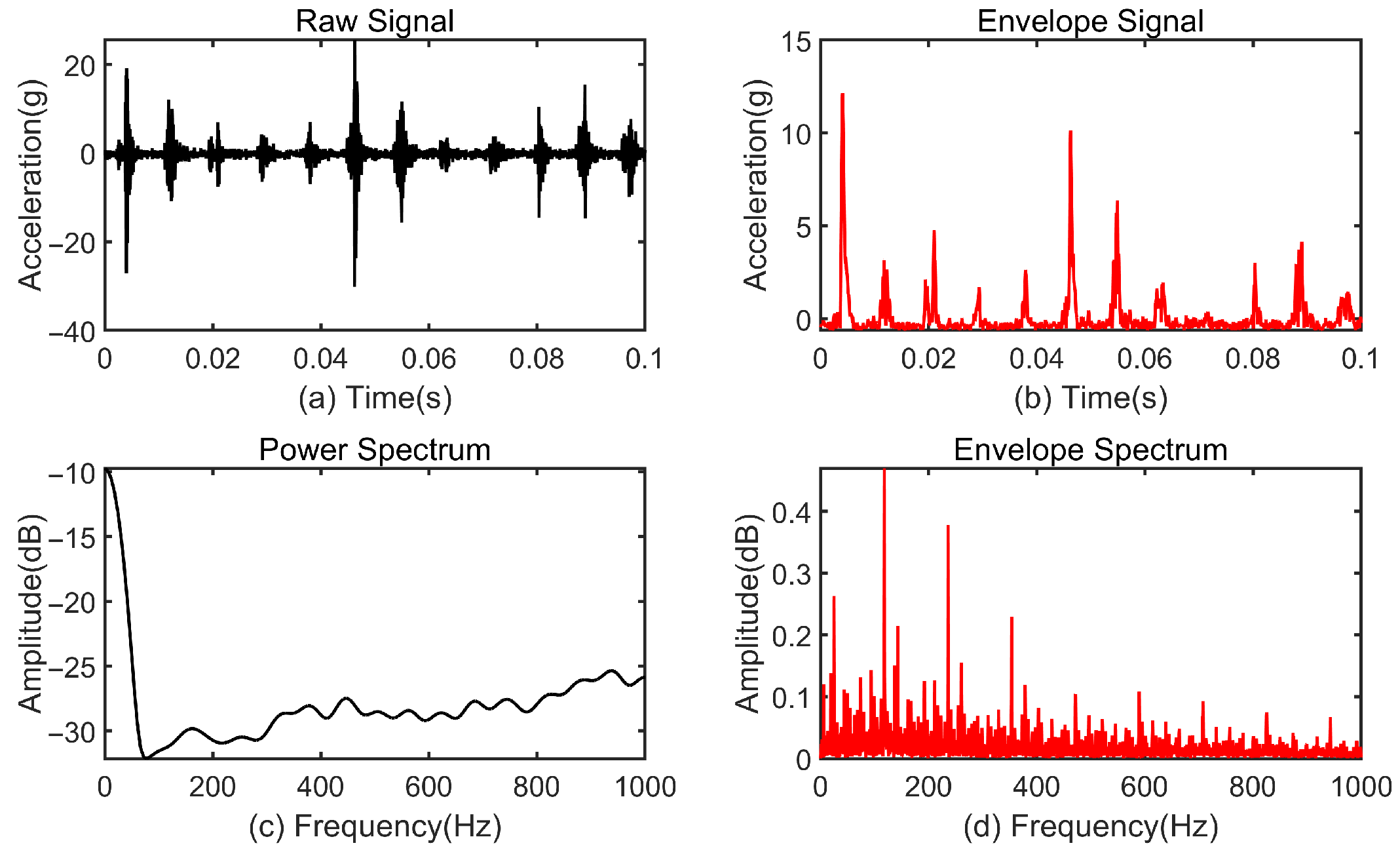
Then, we take the analysis of the Mechanical Fault Prevention Technology (MFPT) Challenge dataset as an example. The waveform, spectrum, envelope line, and envelope spectrum of the fault signal of the inner ring of the bearing are shown in Figure 3.
Figure 3 shows the analysis results of bearing inner race fault signals. The time-domain waveform of the original fault signal is shown in Figure 3a, with its corresponding frequency spectrum displayed in Figure 3c. As observed in Figure 3a,c, even with a relatively high SNR, the frequency spectrum fails to reveal the characteristic fault frequency, making feature identification challenging. Figure 3b shows the envelope waveform of the signal in Figure 3a, while Figure 3d presents the corresponding envelope spectrum. The results in Figure 3b–d demonstrate that after envelope demodulation processing, the signal’s envelope spectrum exhibits distinct pattern characteristics. Notably, Figure 3d clearly reveals the distribution pattern of the characteristic fault frequency, providing reliable evidence for bearing fault diagnosis. Therefore, the results show that the envelope demodulation can directly extract the characteristic frequency when the SNR is high.
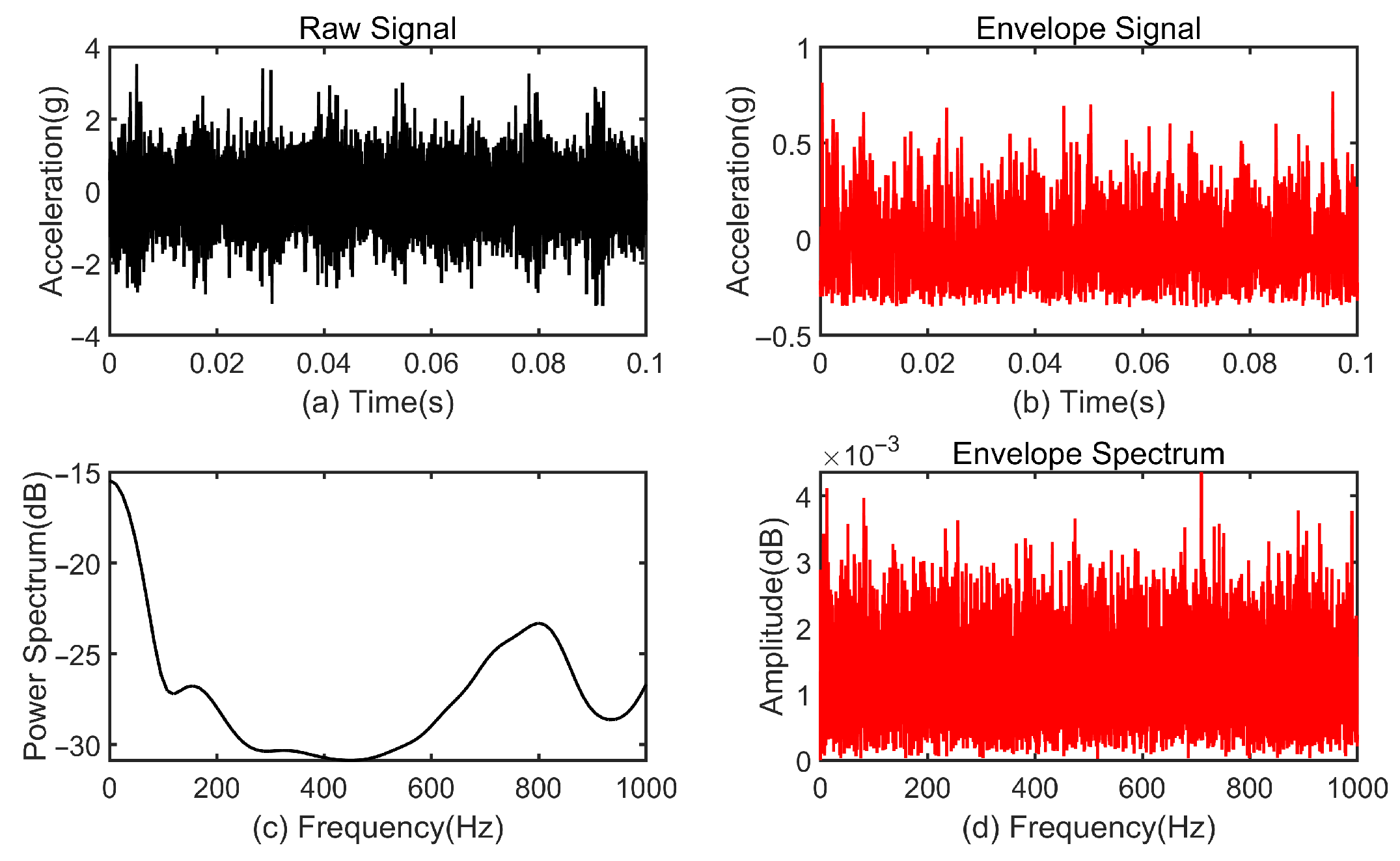
Next, the waveform, spectrum, envelope line, and envelope spectrum of the fault signal of the outer ring of the bearing are shown in Figure 4. Figure 4 presents the analytical results of bearing outer race fault signals. The time-domain waveform of the original fault signal is displayed in Figure 4a, with its corresponding frequency spectrum shown in Figure 4c. As evidenced by Figure 4a–c, under low-SNR conditions, the frequency spectrum fails to distinctly reveal the characteristic fault frequencies, resulting in unsuccessful feature identification. The envelope waveform of the signal in Figure 4a is presented in Figure 4b, while its corresponding envelope spectrum is illustrated in Figure 4d. Analysis of Figure 4b–d indicates that even after envelope demodulation processing, the envelope spectrum still cannot clearly exhibit the characteristic bearing fault frequencies, leaving the feature identification problem unresolved.
A comparative analysis of Figure 3 and Figure 4 leads to the following conclusions: (1) Conventional spectrum analysis fails to effectively identify characteristic fault frequencies, making envelope demodulation essential for successful extraction of fault-related frequency components. (2) Under high-noise conditions, envelope spectrum analysis also proves ineffective in revealing characteristic fault frequencies. Consequently, filtering pre-processing must be implemented before envelope demodulation to enhance the SNR.

4.2. Verification Based on Spectral Kurtosis

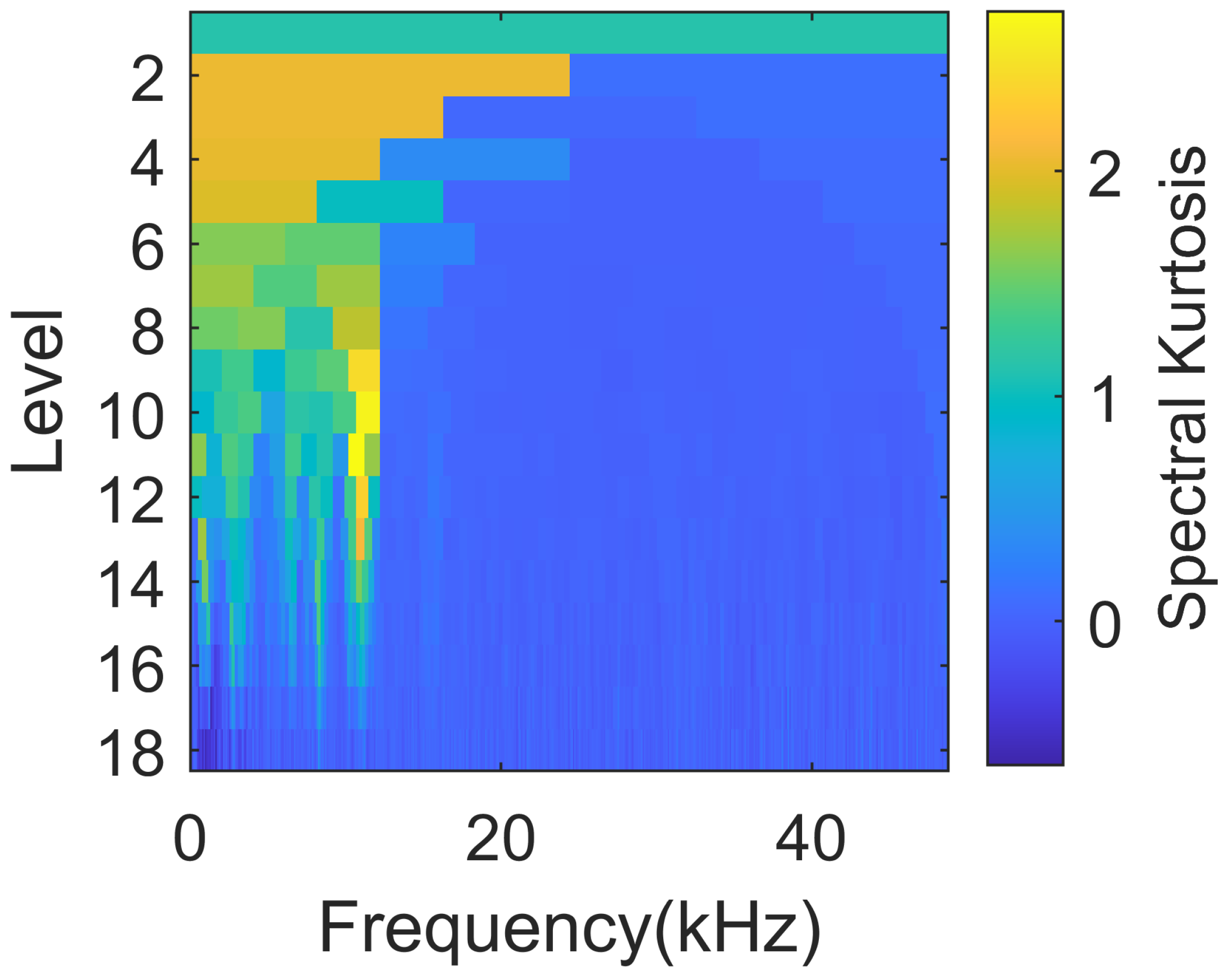
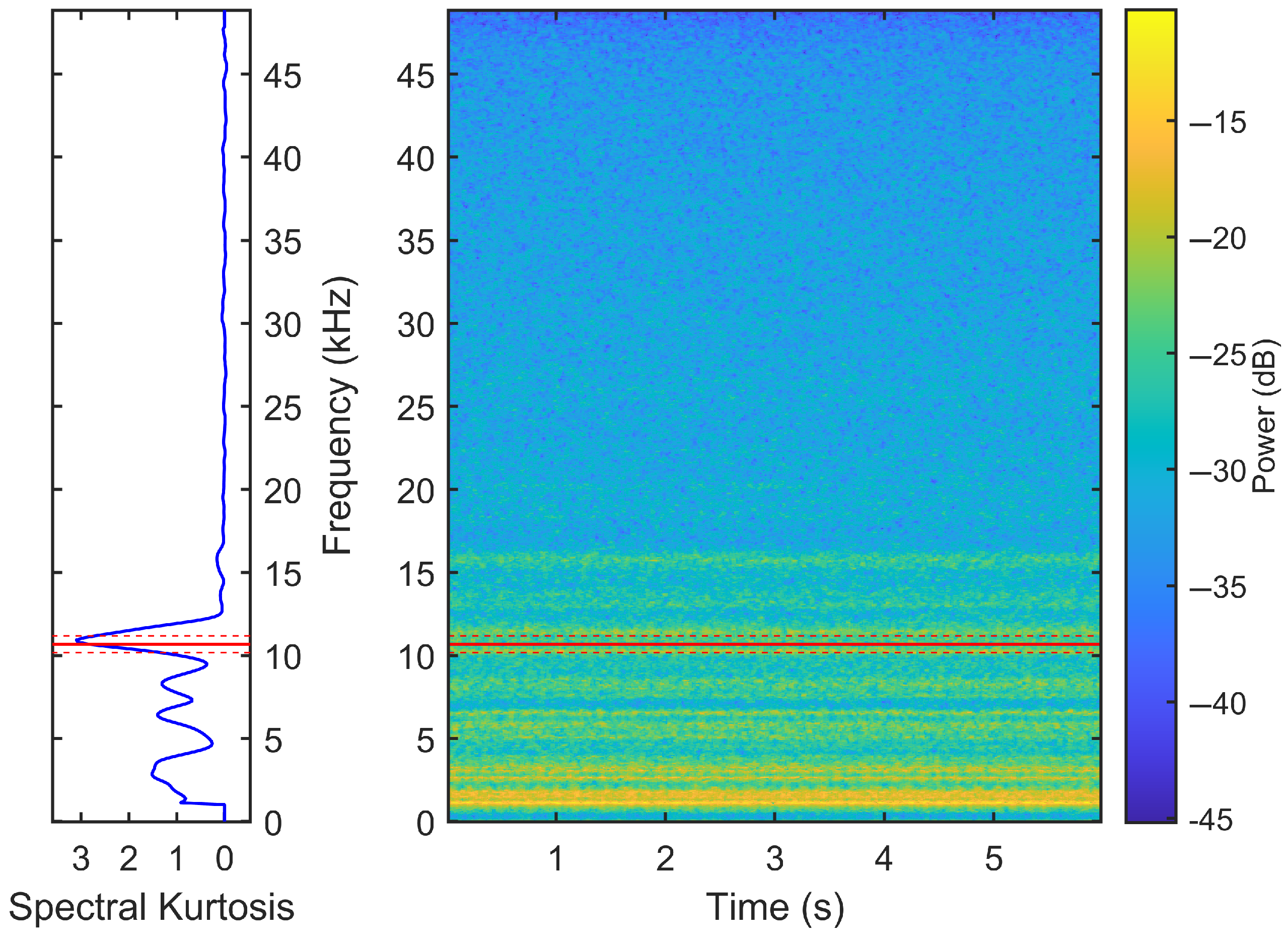
In this experiment, this paper takes the outer circle faults in the MFPT dataset as the research object. Figure 5 shows the spectral kurtosis of the outer circle fault vibration signal. Then, Figure 5 presents the frequency band visualization on the spectrogram. Based on Figure 5 and Figure 6, the center frequency and bandwidth of the bearing vibration can be determined, which are 10.681 kHz and 1.0173 kHz, respectively. In addition, the blue line indicates the trend of kurtosis changes as the frequency increases, and the red line represents the boundary of the central frequency in Figure 6.
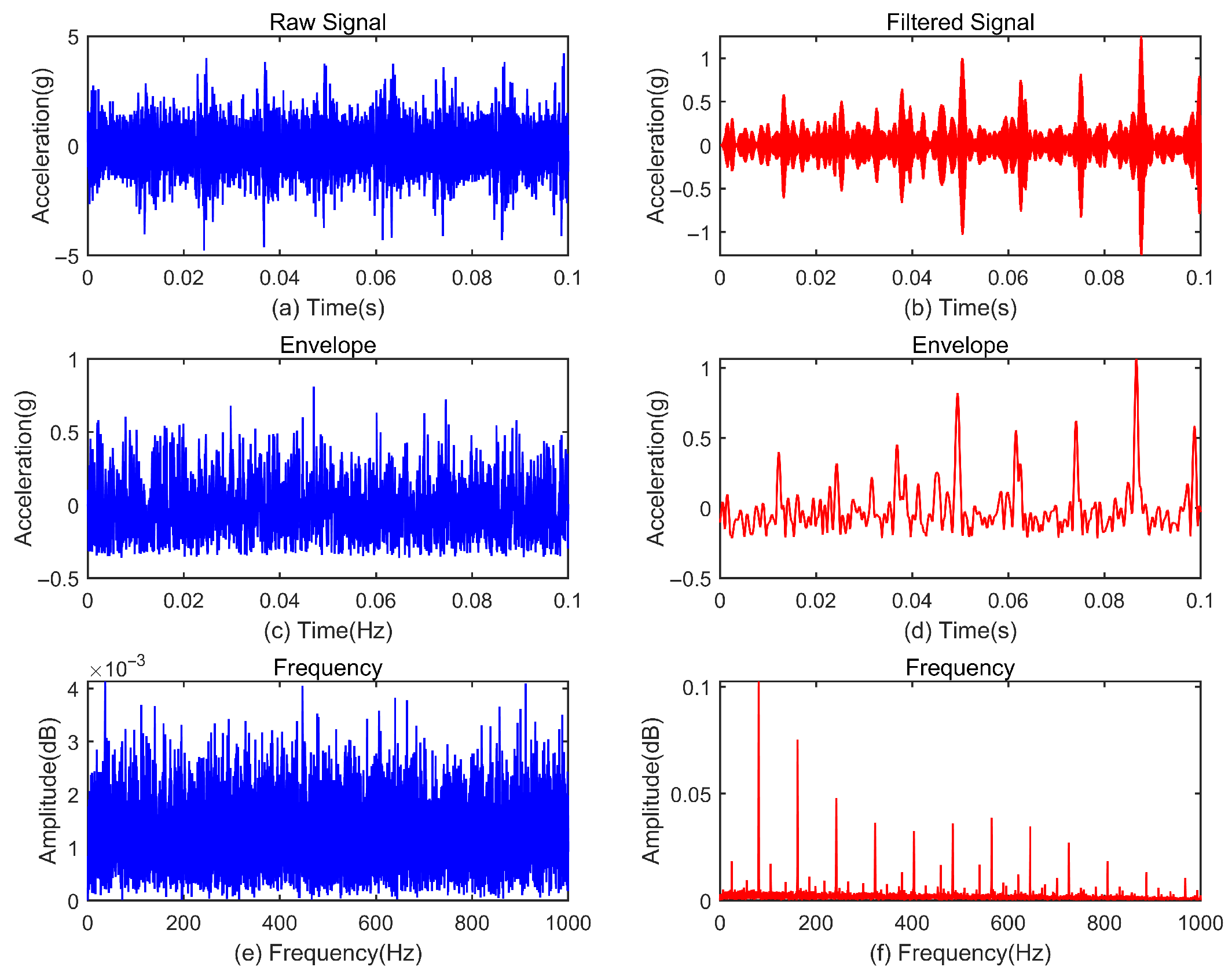
Furthermore, a bandpass filter was designed, and bandpass filtering was performed on the bearing vibration fault signal. Envelope demodulation was carried out through the Hilbert transform to obtain the envelope signal of the filtered signal. Spectral analysis was conducted on the envelope signal to obtain the envelope spectrum, as shown in Figure 7.
Figure 7 shows a comparative analysis of bearing fault signals before and after filtering. Specifically, Figure 7a displays the time-domain waveform of the original fault signal, with its envelope waveform and envelope spectrum shown in Figure 7c and Figure 7e, respectively. Figure 7b,d,f present the time-domain waveform, envelope waveform, and envelope spectrum of the filtered signal, respectively. The results demonstrate that the envelope spectrum of the filtered signal (Figure 7f) can effectively extract the characteristic fault frequencies of the bearing.

4.3. LS-SVM Fault Identification Results and Analysis

The selection of characteristic quantities is an important part of fault diagnosis, which directly affects the accuracy of fault diagnosis. In this paper, we propose selecting the kurtosis K of the bearing vibration signal and the ratio I O R a t i o of the amplitude A i n n e r at the characteristic frequency of the bearing inner ring to the amplitude A o u t e r at the characteristic frequency of the outer ring as the feature vector. Among them, I O R a t i o can be expressed as
I O R a t i o = ln A i n n e r A o u t e r .
To enhance the robustness of the algorithm, in this paper, narrow bands with a bandwidth of 10 Δ f are set centered around the characteristic frequencies of the inner ring of the bearing and the outer ring. The maximum values within these two narrow-band spectra are extracted to determine the amplitudes at the characteristic frequencies of the bearing inner ring and outer ring, where Δ f represents the frequency resolution of the spectrum. To test the generalization ability and stability of the model, this paper first conducts cross-validation on the bearing dataset of Case Western Reserve University, shown in Table 2. Specifically, we first apply the adaptive spectral kurtosis method to determine the center frequency and bandwidth of the signal. A corresponding bandpass filter is then constructed to enhance the characteristic frequency components, followed by the application of the Hilbert transform to extract the envelope spectrum.
In order to study the influence of data dimension and extraction of data feature information on bearing fault detection, this paper introduces normalization and principal component analysis (PCA) algorithms to preprocess the vibration signal data of rolling bearings, and then uses the LS-SVM algorithm to classify the processed data to detect bearing faults. In the experiment, we took N points per revolution as one term for the vibration data of the rolling bearing, selected several terms, processed them using the PCA algorithm, and used the principal components at η m 90 % as the input data of the LS-SVM proposed above. However, the simulation results show that although the reconstructed variables calculated by PCA eliminate the correlations between data samples, making the information contained in a single data sample more abundant, this scheme does not bring about performance improvement on the CWRU dataset. However, the LS-SVM algorithm proposed in this paper can bring about an improvement in detection performance compared with the normalization of combined data. This is mainly because the vibration signal of the bearing often accompanies the change of rotational speed, and traditional Fourier analysis has poor performance. The spectral kurtosis can dynamically track the frequency change and enhance the fault characteristics. It is worth noting that, compared with other benchmark algorithms, the algorithm proposed in this paper performs best in terms of accuracy. Furthermore, in multiple cross-validations, the accuracy of this model fluctuates the least, demonstrating higher stability.
In addition, this study selects 20 sets of data from the MFPT challenge as the target dataset and constructs a dataset of fault-identification characteristic quantities, as shown in Table 3. These 20 sets of data are all collected from a bearing test rig, including 3 sets of normal condition data, 3 sets of outer-ring fault data, 7 sets of inner-ring fault data, and 7 sets of inner-ring fault data. The set is available online at https://www.mfpt.org/fault-data-sets/(accessed on 13 July 2024).
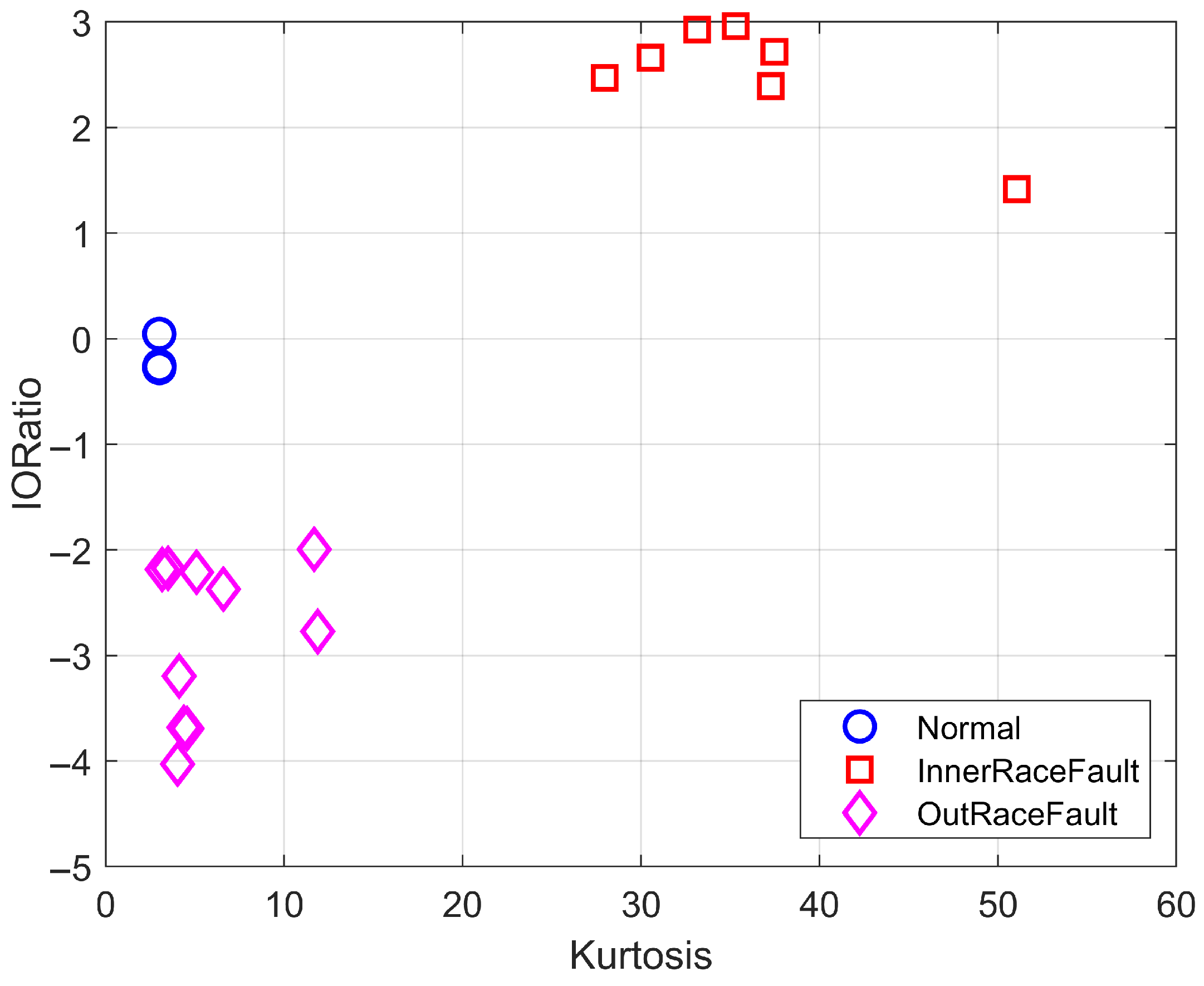
Based on extensive experimental investigations and repeated validations, a polynomial kernel function was ultimately selected for the LS-SVM fault identifier. The kernel parameter g = 0.01 , and the penalty factor C = 0.5 . The fault identification results based on the above-mentioned parameter settings are shown in Figure 8. To avoid overfitting caused by high-dimensional features, this paper selects the kurtosis and frequency–amplitude ratio with clear physical meanings as feature quantities. Among them, kurtosis reflects the impact characteristics of the vibration signal and is directly related to the physical damage of the bearing fault, while the frequency–amplitude ratio of the inner/outer ring features can extract the energy proportion of the fault feature frequency through the envelope spectrum. Thus, we eliminate the influence of individual differences in bearings and installation conditions.
The results are shown in Figure 8 and Table 4. They demonstrate that by applying the feature vector construction method proposed in this paper, the optimal performance in distinguishing among the three conditions of normal (fault-free), inner-ring fault, and outer-ring fault has been achieved. The Least-Squares Support Vector Machine (LS-SVM) was verified using the test sample data, and it achieved an identification accuracy rate of 100%, indicating excellent prediction performance.

5. Conclusions

Affected by the modulation effect, bearing vibration data must be subjected to envelope demodulation processing so that the characteristic frequencies of bearing faults can be effectively extracted. Due to the high signal noise and low SNR, the vibration signals need to be filtered. By using the spectral kurtosis analysis method, the center frequency and bandwidth of the vibration can be effectively extracted, and then a bandpass filter can be designed accordingly. Through the bandpass filter, noise can be filtered out, the SNR can be increased, and thus the characteristic frequencies can be effectively extracted. By using the kurtosis K of the bearing vibration signal and the ratio I O R a t i o of the amplitude A i n n e r at the characteristic frequency of the bearing inner ring to the amplitude A o u t e r at the characteristic frequency of the outer ring as the feature vector, the three conditions of normal bearings, inner-ring faults, and outer-ring faults can be effectively distinguished, achieving identification accuracies of 95% and 100% for the CWRU and MFPT datasets, respectively. Considering that verification based on a single dataset may indeed compromise the generalization ability of our conclusions, we plan to incorporate additional experimental datasets and introduce boundary conditions in future work to assess and further substantiate the robustness and generalization capability of the algorithm in the industrial domain.

Author Contributions

Conceptualization, L.L. and W.X.; methodology, L.L. and W.X.; software, Z.S.; validation, W.X.; formal analysis, Z.S. and W.X.; investigation, L.L. and W.X.; resources, L.L.; data curation, Z.S.; writing—original draft preparation, L.L.; writing—review and editing, Z.S.; visualization, L.L. All authors have read and agreed to the published version of the manuscript.

Funding

This work was supported by the Fujian Provincial Natural Science Foundation (Grant Number: 2023J01810) and the Xiamen Science and Technology Bureau under Projects 2024CXY0316 and 2024CXY0317.

Institutional Review Board Statement

Not applicable.

Informed Consent Statement

Not applicable.

Data Availability Statement

The data supporting the findings of this study are available from the corresponding authors upon reasonable request.

Conflicts of Interest

The authors declare no conflicts of interest.

References

  1. Wang, Z.; Han, G.; Liu, L.; Wang, F.; Zhu, Y. A Globally Interpretable Convolutional Neural Network Combining Bearing Semantics for Bearing Fault Diagnosis. IEEE Trans. Instrum. Meas. 2025, 74, 3507713. [Google Scholar] [CrossRef]
  2. Zhao, X.; Liu, X.; Li, H. Multi-Condition Rolling Bearing Fault Denoising Method and Application Based on RIME-VMD. Mathematics 2025, 13, 1348. [Google Scholar] [CrossRef]
  3. Wang, B.; Ding, C. An Adaptive Signal Denoising Method Based on Reweighted SVD for the Fault Diagnosis of Rolling Bearings. Sensors 2025, 25, 2470. [Google Scholar] [CrossRef] [PubMed]
  4. Zhang, C.; Wei, S.; Dong, G.; Zeng, Y.; Zhu, G.; Zhou, X.; Liu, F. Time-domain sparsity based bearing fault diagnosis methods using pulse signal-to-noise ratio. IEEE Trans. Instrum. Meas. 2024, 73, 3516804. [Google Scholar] [CrossRef]
  5. Wang, Z.; Liu, T.; Wu, X.; Wang, Y. A fault diagnosis method based on NTFES-FCCT for variable working condition bearing signals. IEEE Sens. J. 2024, 24, 20989–20998. [Google Scholar] [CrossRef]
  6. Seong, G.; Kim, D. An intelligent ball bearing fault diagnosis system using enhanced rotational characteristics on spectrogram. Sensors 2024, 24, 776. [Google Scholar] [CrossRef]
  7. Chen, S.; Fan, W.; Xiong, Y.; Peng, Z. Robust separation-enhanced NRC method for multiple periodicity detection: Applications in bearing compound fault diagnosis. IEEE Trans. Instrum. Meas. 2024, 73, 3517611. [Google Scholar] [CrossRef]
  8. Chalançon, B.; Roda-Buch, A.; Cornet, E.; Rapp, G.; Weisser, T.; Brambilla, L. Acoustic emission monitoring as a non-invasive tool to assist the conservator in the reactivation and maintenance of historical vehicle engines. Stud. Conserv. 2024, 69, 102–112. [Google Scholar] [CrossRef]
  9. Hejazi, S.Z.; Packianather, M.; Liu, Y. A novel customised load adaptive framework for induction motor fault classification utilising MFPT bearing dataset. Machines 2024, 12, 44. [Google Scholar] [CrossRef]
  10. Michalak, A.; Hebda-Sobkowicz, J.; Wodecki, J.; Szabat, K.; Wolkiewicz, M.; Weisse, S.; Valire, J.; Zimroz, R.; Wyłomańska, A. Enhancement of cyclic spectral coherence map by statistical testing approach—Application to bearing faults diagnosis in electric motors. Meas. Sci. Technol. 2024, 36, 016169. [Google Scholar] [CrossRef]
  11. Imane, M.; Rahmoune, C.; Zair, M.; Benazzouz, D. Multi-fault bearing diagnosis under time-varying conditions using Empirical Wavelet Transform, Gaussian mixture model, and Random Forest classifier. Adv. Mech. Eng. 2024, 16, 16878132241275787. [Google Scholar] [CrossRef]
  12. Park, S.J.; Heogh, W.; Yang, J.; Kang, S.; Jeong, W.; Lee, H.; Jang, T.S.; Jung, H.D.; Jahazi, M.; Han, S.C.; et al. Meta-structure of amorphous-inspired 65.1 Co28. 2Cr5. 3Mo lattices augmented by artificial intelligence. Adv. Compos. Hybrid Mater. 2024, 7, 224. [Google Scholar] [CrossRef]
  13. Li, R.; Pan, Y.; Fan, Q.; Wang, W.; Ren, R. A bearing fault diagnosis approach based on an improved neural network combined with transfer learning. Meas. Sci. Technol. 2024, 35, 096103. [Google Scholar] [CrossRef]
  14. Cui, Y.; Zhang, Z.; Zhong, Z.; Hou, J.; Chen, Z.; Cai, Z.; Kim, J.H. Bearing Fault Diagnosis Based on Multiscale Lightweight Convolutional Neural Network. Processes 2025, 13, 1239. [Google Scholar] [CrossRef]
  15. Zhu, H.; Sui, Z.; Xu, J.; Lan, Y. Fault Diagnosis of Mechanical Rolling Bearings Using a Convolutional Neural Network–Gated Recurrent Unit Method with Envelope Analysis and Adaptive Mean Filtering. Processes 2024, 12, 2845. [Google Scholar] [CrossRef]
  16. Dave, V.; Borade, H.; Agrawal, H.; Purohit, A.; Padia, N.; Vakharia, V. Deep learning-enhanced Small-sample bearing fault analysis using Q-Transform and HOG image features in a GRU-XAI framework. Machines 2024, 12, 373. [Google Scholar] [CrossRef]
  17. Kiakojouri, A.; Wang, L. A Generalized Convolutional Neural Network Model Trained on Simulated Data for Fault Diagnosis in a Wide Range of Bearing Designs. Sensors 2025, 25, 2378. [Google Scholar] [CrossRef]
  18. Zhong, T.; Qin, C.; Shi, G.; Zhang, Z.; Tao, J.; Liu, C. A residual denoising and multiscale attention-based weighted domain adaptation network for tunnel boring machine main bearing fault diagnosis. Sci. China Technol. Sci. 2024, 67, 2594–2618. [Google Scholar] [CrossRef]
  19. Zhang, Q.; Deng, L. An intelligent fault diagnosis method of rolling bearings based on short-time Fourier transform and convolutional neural network. J. Fail. Anal. Prev. 2023, 23, 795–811. [Google Scholar] [CrossRef]
  20. Ansari, A.K.; Kumar, P. Vibro-acoustic analysis of defective taper roller bearings. Tribol. Int. 2024, 199, 110044. [Google Scholar] [CrossRef]
  21. Hao, H.; Zhao, Y.; Chen, Y.; Zhang, Y.; Wang, D. Incremental single-class fault detection and diagnosis method for rolling bearings based on OS-ELM. Electronics 2023, 12, 4099. [Google Scholar] [CrossRef]
  22. Liu, Y.; Gu, H.; Qin, P. A verified training support vector machine in bearing fault diagnosis. Meas. Sci. Technol. 2024, 35, 116131. [Google Scholar] [CrossRef]
  23. Zhong, Y.; Zhang, B.; Ji, X.; Wu, J. Fault Diagnosis of PV Array Based on Time Series and Support Vector Machine. Int. J. Photoenergy 2024, 2024, 2885545. [Google Scholar] [CrossRef]
  24. Nayana, B.; Geethanjali, P. Improved identification of various conditions of induction motor bearing faults. IEEE Trans. Instrum. Meas. 2019, 69, 1908–1919. [Google Scholar] [CrossRef]
  25. Safizadeh, M.; Dardmand, R. Diagnosing simultaneous bearing and misalignment faults in an induction motor using sensor fusion. Insight-Non-Destr. Test. Cond. Monit. 2024, 66, 240–249. [Google Scholar] [CrossRef]
  26. Zhang, Q.; Tong, K. Vocal Cord Vibration Signal Recognition Model Based on Feature Engineering Preprocessing. IEEE Sens. J. 2023, 23, 31380–31388. [Google Scholar] [CrossRef]
  27. Bin, L.; Rongsheng, Z.; Qian, H.; Yongyong, Z.; Qiang, F.; Xiuli, W. Fault diagnosis of horizontal centrifugal pump orifice ring wear and blade fracture based on complete ensemble empirical mode decomposition with adaptive noise-singular value decomposition algorithm. J. Vib. Control 2024, 30, 5228–5236. [Google Scholar] [CrossRef]
  28. Aziz, S.; Khan, M.U.; Usman, A.; Faraz, M.; Ghadi, Y.Y.; Montes, G.A. Bearing faults classification using novel log energy-based empirical mode decomposition and machine Mel-frequency cepstral coefficients. Digit. Signal Process. 2025, 156, 104776. [Google Scholar] [CrossRef]
Figure 1. The structural configuration of a typical rolling bearing.
Electronics 14 02790 g001
Figure 2. Envelope demodulation of vibration fault signals.
Electronics 14 02790 g002
Figure 3. Bearing fault signals and envelope spectra with high SNR.
Electronics 14 02790 g003
Figure 4. Bearing fault signals and envelope spectra with high SNR.
Electronics 14 02790 g004
Figure 5. Spectral kurtosis of the vibration signal of the outer ring fault.
Electronics 14 02790 g005
Figure 6. Frequency band visualization.
Electronics 14 02790 g006
Figure 7. The waveforms, envelope lines, and envelope spectra of the signals before and after filtering.
Electronics 14 02790 g007
Figure 8. Fault identification result.
Electronics 14 02790 g008
Table 1. Selection of SR scale factor.
NumberItemParameter
1Outer diameter of the inner raceway150 mm
2The average diameter of the inner and outer raceways165 mm
3The number of rollers14
4The roller diameter30 mm
5The roller length48 mm
6The bearing width80 mm
7The bore diameter of outer ring240 mm
8The outside diameter of inner ring120 mm
Table 2. Comparison of fault diagnosis results of different algorithms on CWRU dataset.
MethodNormalizationNormalization + PCA
Accuracy Acc Std Accuracy Acc Std
LS-SVM0.950.010.870.05
WBDE [24]0.90-0.86-
XGDBoost [26]0.940.020.850.05
KNN [25]0.900.020.860.05
where the “-” Indicates an unknown result.
Table 3. Bearing fault characteristic dataset.
Sample Serial Number iCharacteristic Quantity x 1 i Characteristic Quantity x 2 i Output y i
13.01360.044867338Normal
23.0164−0.277040398Normal
33.0211−0.257597719Normal
451.05441.416208436InnerRaceFault
527.96532.471317993InnerRaceFault
630.5252.660357525InnerRaceFault
733.13042.925249621InnerRaceFault
830.5252.393782396InnerRaceFault
930.5252.717496294InnerRaceFault
1035.29982.960238531InnerRaceFault
113.1679−2.183994077OutRaceFault
123.5008−2.175196507OutRaceFault
134.1326−3.19529767OutRaceFault
144.5643−3.69449087OutRaceFault
155.089−2.2111322OutRaceFault
164.3986−3.68286532OutRaceFault
174.0432−4.03103051OutRaceFault
1811.8966−2.77173234OutRaceFault
196.593−2.37082209OutRaceFault
2011.6851−1.993281487OutRaceFault
Table 4. Comparison of fault diagnosis results of different algorithms on the MFPT dataset.
Author iMethodFault Diagnosis Rate (%)
Hejazi et al. [9]WSE-CWT96.3
Hao et al. [21]OS-ELM98.8
Zhang and Deng [19]STFT-CNN99.96
Nayana and Geethanjali [24]PSO-WBDE100
The propose methodLS-SVM100
Disclaimer/Publisher’s Note: The statements, opinions and data contained in all publications are solely those of the individual author(s) and contributor(s) and not of MDPI and/or the editor(s). MDPI and/or the editor(s) disclaim responsibility for any injury to people or property resulting from any ideas, methods, instructions or products referred to in the content.