You are currently viewing a new version of our website. To view the old version click .
Electronics
  • Feature Paper
  • Article
  • Open Access

12 February 2024

A Multi-View Temporal Knowledge Graph Reasoning Framework with Interpretable Logic Rules and Feature Fusion

,
,
,
and
1
School of Computer Science and Technology, Xi’an Jiaotong University, Xi’an 710049, China
2
School of Mathematics and Statistics, Chongqing Jiaotong University, Chongqing 400074, China
*
Author to whom correspondence should be addressed.
This article belongs to the Special Issue Applied Artificial Intelligence Approach: Intelligent Data Processing and Mining with Online Behaviors

Abstract

A temporal knowledge graph represents temporal information between entities in a multi-relational graph. Its reasoning aims to infer and predict potential links among entities. Predicting time-aware entities is a challenging task due to significant differences in entity appearances over time, such as different timestamps and frequencies. Current embedding-based similarity-matching methods have been introduced for predicting temporal facts. However, they lack deterministic logical explainability and cannot model the dynamic evolution of entities over time. To address these challenges, we propose a novel framework for temporal knowledge graph reasoning based on multi-view feature fusion (MVFF). First, MVFF extracts logical rules and uses the Gumbel-Softmax trick to sample high-quality rules. Second, it integrates logical rules, temporal quadruples, and factual triples to capture semantic features, temporal information, and structural information to solve link prediction tasks. Through experiments on four benchmark datasets, we show that MVFF outperforms state-of-the-art methods, providing not only better performance but also interpretable results.

1. Introduction

Knowledge graphs (KGs) contain facts/triples that indicate relationships between entities, such as (South Korea, Accuse, and North Korea). However, in the real world, many entities and relations are time-dependent. To capture the evolution of information over time, temporal knowledge graphs (TKGs) have been developed. In TKGs, triples (s, p, o) are expanded into quadruples (s, p, o, t), where the time t denotes the validity of the fact. For example, (South Korea, Accuse, North Korea, 17 October 2014) indicates that South Korea accused North Korea on 17 October 2014.
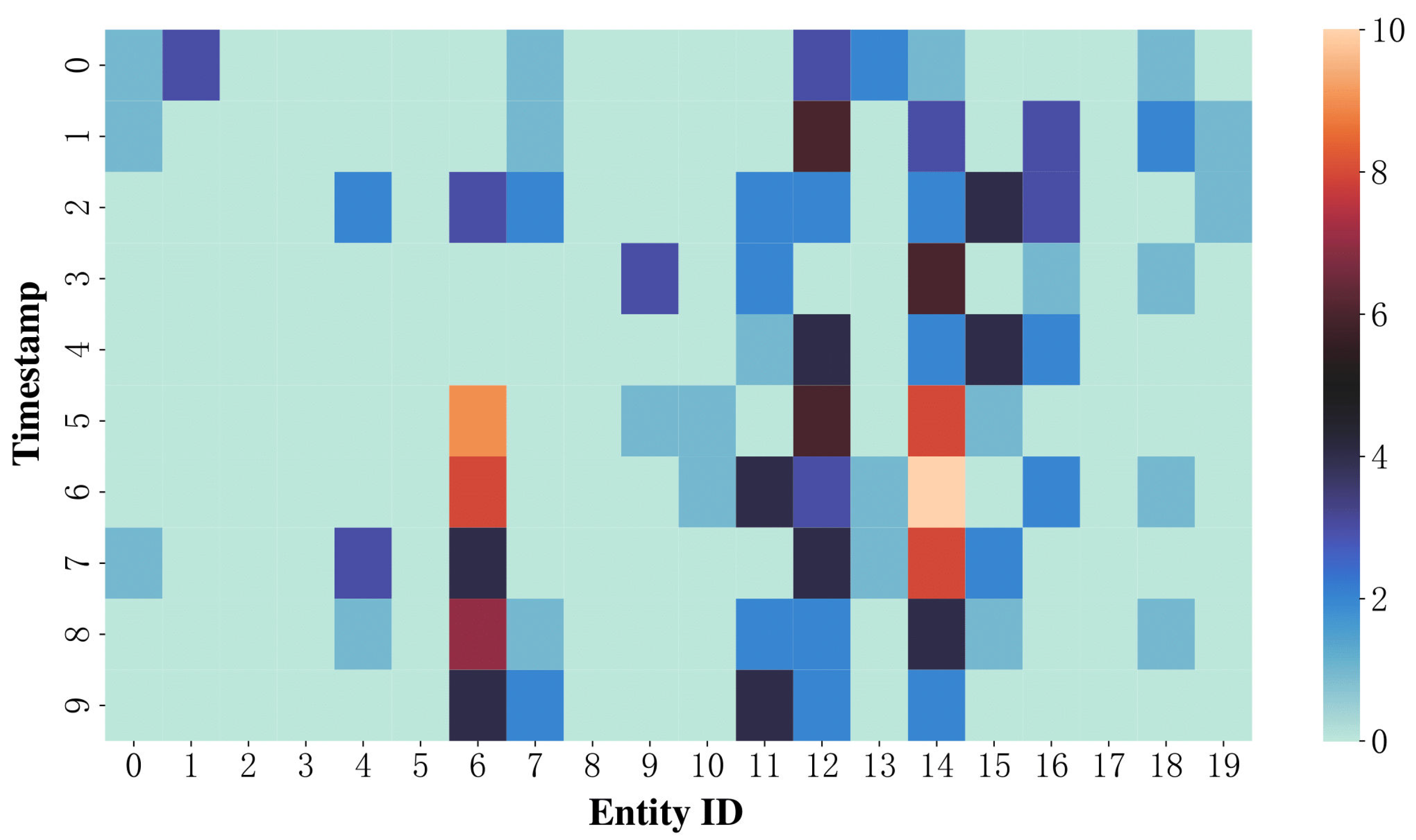
While the TKGs provide a comprehensive description of the dynamics of real-world relationships, specific complexities are introduced when dealing with such structures. Temporal knowledge graph reasoning is realized through a link prediction task that focuses on identifying candidates that are most likely to complete a timestamped query of the form (s, p, ?, t), where s represents the head entity, p represents the relationship, and t represents the timestamp. Traditional learning techniques for static KGs are unable to capture the dynamic interactions between entities. To address this issue, various temporal knowledge graph embedding (KGE) models are proposed to encode entities and relations in a low-dimensional space using translation-based functions [1,2], a deep neural network-based method [3,4], and a tensor decomposition method [5,6]. As these methodologies have progressed, numerous strategies for TKG completion have been proposed, including geometric methods (ChronoR [7], BoxTE [8], TLT-KGE [9], RotateQVS [10], HTTR [11], PTKE [12]); tensor decomposition methods (QDN [13], TBDRI [14]); deep learning and embedding-based methods (TASTER [15], TeAST [16], RoAN [17], BiQCap [18]); and graph neural network-based reasoning methods (TARGCN [19], T-GAP [20], TAL-TKGC [21]). Interpolation is a statistical method that utilizes the relevant known values to estimate an unknown value or set [19]. The goal of extrapolation is to infer “future” unknown values from the current information [22]. These models employ time-dependent embedding of entities and relations to enhance the KG reasoning process. While effective, these methods lack interpretability. As shown in Figure 1, the color shades in the heatmap indicate how often the entity appears at different timestamps. Temporal information can be regarded as perturbations to the representations of entities or relations. As a result, it can be challenging for current models to accurately represent their temporal dynamics over time.
Figure 1. Differences in periods and frequencies of entity appearances over time on ICEWS14.
To overcome this issue, logic rule-based symbolic techniques have been proposed as a substitute for embedding-based models. One advantage of these methods is that they produce transparent and comprehensible inference results. However, the subtleties of event complexities can make the manual rule formulation process challenging, which might impede the acquisition of knowledge. Recent works, such as TLogic [23] and LCGE [24], propose methods for temporal KG reasoning and automatically extract knowledge rules. However, there are still several challenges that need to be addressed. First, these techniques used to determine confidence in individual rules sometimes ignore the interaction between several rules, resulting in an oversight of certain rules. Second, temporal rule selection with high-confidence metrics may include inconsistencies and irrelevant facts.
To overcome the limitations of both embedding-based and rule-based methods, we propose the MVFF framework that integrates temporal logical rules, tensor decomposition, time-encoding module, and GNN-based method. MVFF employs closed-loop restrictions and the temporal random walk algorithm [25] to produce a set of candidate rules based on sample entity sequences. The rules obtained after Gumbel sampling are combined with tensor decomposition embedding, time-encoding, and relationship-aware graph neural networks [26] for both scalability and interpretability.
The main contributions of our work include:
  • The proposed rule sampling method is differentiable, which aids in network backpropagation and weight updates. Additionally, it allows for the exploration of rule diversity or the utilization of rules with high confidence through temperature parameters.
  • To capture semantic, structural, and temporal information about temporal knowledge graphs, MVFF combines temporal coding techniques, relation-aware graph neural networks, and tensor decomposition.
  • Experimental results on four benchmark temporal knowledge graph datasets show that our model significantly outperforms many state-of-the-art baseline methods. Our framework improves 2.98%/4.96%/23.97%/6.78% on the MRR evaluation metrics, and 5.03%/3.29%/26.0%/7.82% on the Hit@1 evaluation metrics for datasets ICEWS14/ICEWS05-15/Wikidata12k/GDELT, respectively.
The rest of this paper is organized as follows. Section 2 briefly reviews the related work of temporal knowledge graph reasoning. In Section 3, we introduce the proposed method (MVFF), including the temporal logical rule learning module, temporal logical rule learning module, and multi-view feature fusion module. Afterward, we discuss experiments of temporal knowledge graph reasoning in Section 4. Section 5 delineates the limitations of our method. Section 6 concludes this paper and discusses the future research directions.

3. Approach

3.1. Overview of MVFF

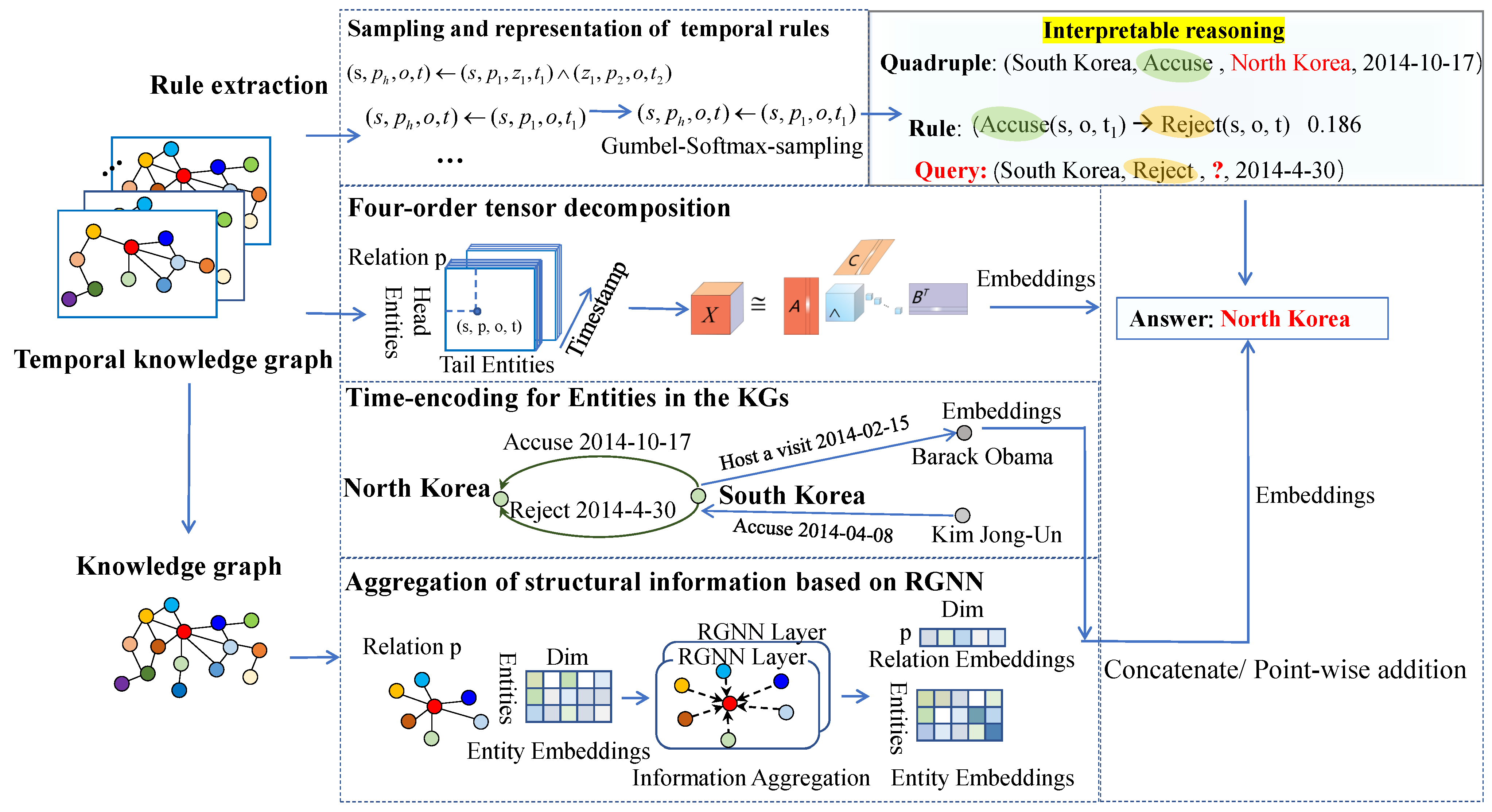
MVFF can be divided into four modules: (1) the temporal rule module, which conducts explainable reasoning; (2) the four-order tensor decomposition module, which captures both temporal evolution and semantic dependence simultaneously; (3) the RGNN module, which effectively captures structural information; and (4) the time-encoding module, which represents the temporarily valid entities. Figure 2 illustrates an example of interpretable reasoning for temporal rules at the top, and the multi-view feature encoding process is depicted in the subsequent three rectangles.
Figure 2. Framework of MVFF. Rule-based reasoning is illustrated by explainable reasoning.

3.2. Temporal Logical Rule Learning

3.2.1. Temporal Logical Rules

Given the symbolic nature of knowledge graphs (KGs), logic rules are ideally suited for tasks involving temporal knowledge graph link prediction. In rule-based TKG reasoning, temporal logic rules are generally expressed using Horn clauses. They consist of a head and a body, where the head is a single atomic proposition and the body is a conjunction of several atomic propositions. Horn clauses can be represented as Equation (1).
u p q v ,
where u denotes the head of the rule, and p q v refers to the body of the rule. The validity of facts is time-sensitive. Thus, Horn clauses can be used for temporal relationships between facts, as shown in Equation (2).
s , p h , o , t s , p 1 , z 1 , t 1 z n , r n , o , t n ,
where p i ( i = 1 , , h ) denotes the relationships between head and tail entities; s, o, and z j ( j = 1 , , n ) refer to different entities; and t k ( k = 1 , , m ) means timestamp. To enable horn clauses to represent temporal relationships between quadruple propositions, the temporal information needs to satisfy the constraint t 1 t 2 t n t . Based on the length of the temporal logic rule’s body and the temporal relationships, the rules can be divided into different forms. Table 1 shows all temporal logic rules with lengths of 1 and 2.
Table 1. Representation of different temporal rule patterns.
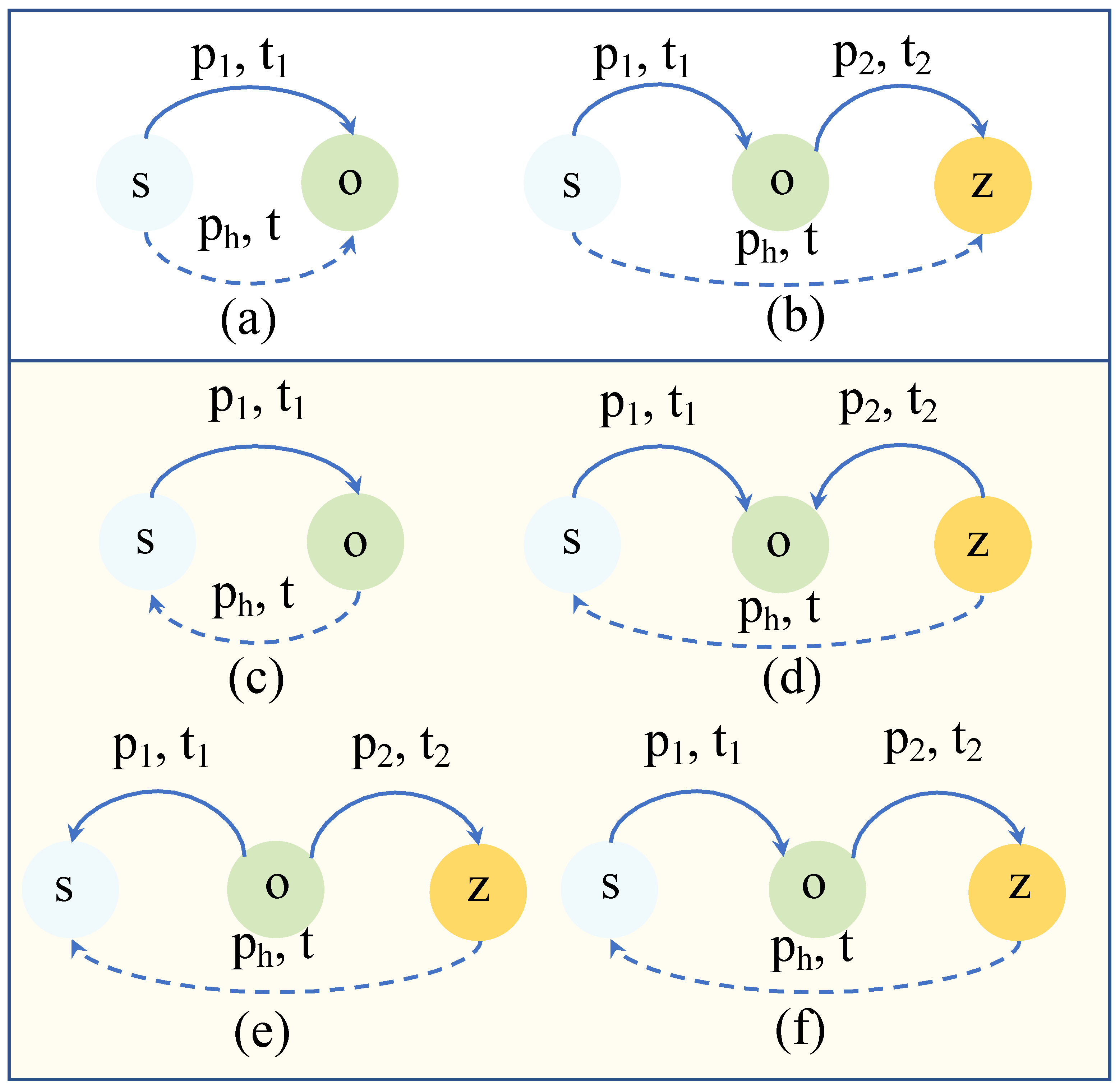
Figure 3a,b show the general pattern of rules with a length of 1 and 2, respectively, which can be inferred through chain propagation. Figure 3c–f show other patterns of links. To mine temporal logic rules using such links, we add inverse relations to mine potential temporal logic patterns.
Figure 3. Different patterns of linking between entities. (a,b) show the general pattern of rules with a length of 1 and 2. (cf) are four compositions of temporal logic rules.
We utilize the temporal random walk to extract temporal sequences from TKGs. By adding constraints from cycles during the random walk, circular sequences like those in Figure 3c,d can be obtained by the following Equations (3) and (4). In our environment conditions, the number of tuples impacted by the temporal order is typically rather significant. Stated differently, it is challenging for a single formulation of the temporal logical rule to address them to the greatest extent feasible. We define three compositions of different patterns of linking between entities. When o and s are linked by relation p 1 at timestamp t 1 , and o and z are linked by relation p 2 at t 2 , we can infer that z and s will be linked by relation p h at timestamp t 1 , as shown in Figure 3d. The differences between the three subgraphs, namely Figure 3d–f, lie in the orientation of the arrows. When ‘s’, ‘o’, and ‘z’ are in different directions, they serve as distinct starting and ending entities for the links, resulting in different temporal logical rules being generated.
s , p 1 , o , t 1 , o , p h , s , t t 1 t ,
s , p 1 , o , t 1 , o , p 2 , z , t 2 , z , p h , s , t t 1 t 2 t ,
To extract temporal logic rules from circular sequences of entities, we introduce inverse relationships between connected entities, which are expressed in Equations (5) and (6).
s , p h 1 , o , t s , p 1 , o , t 1 t 1 t ,
s , p h 1 , z , t s , p 1 , o , t 1 o , p 2 , z , t 2 t 1 t 2 t ,
For a rule head relationship, multiple rules may be generated during temporal random walks, which may overlap or conflict with each other. Therefore, it is necessary to determine the confidence of a rule to evaluate the likelihood of its correctness. Using Equation (6) as an example, s, o, and z in the equation represent entity variables, which are replaced with actual entities. The number of specific sequences that satisfy the rule body in the TKGs is referred to as body support, and the number of sequences that satisfy the rule grounding is referred to as rule support. Rule confidence is defined as the ratio of rule support to body support.

3.2.2. Representation of Temporal Logic Rules

To embed temporal logical rules, we represent the relationships as atomic propositions and adopt a linear layer as a time transition operator (W), which maps the relationships in the rule body to the same time as the rule head relationship for correlation calculation via the Hadamard product, as shown in Table 1. We obtain different patterns of rules by setting different time constraints of temporal random walks and then translate the relationships of different times involved in the rules into the same vector space for representation learning, using an approach similar to TransR [40].
By performing temporal random walks, a large number of temporal logical rules can be obtained. Existing methods for applying rules to specific queries directly select the rule with the maximum confidence [23] or use all the rules [24]. The method of selecting the rule with the maximum confidence does not take into account the diversity of the rules. Using all the rules may lead to conflicting rules and cause a significant increase in computational complexity. In this paper, we employ the Gumbel-softmax [41] to sample temporal rules, which address the issues of resource scarcity and slow reasoning that arise from using all rules, as well as the problem of always selecting the rule with the maximum confidence using Argmax. Furthermore, this method retains gradient information during the sampling process and can be optimized using backpropagation.
Suppose there are k rules under the relation p h in a certain pattern, we sample k random numbers ε 1 , , ε k from a uniform distribution and use the Gumbel distribution to transform these random numbers. The resulting values are added to the original probability of each rule. The Gumbel distribution is expressed as follows:
g i Gumbel ( 0 , 1 ) = log ( log u i ) , u i Uniform ( 0 , 1 ) ,
By using the Gumbel-Softmax method, we transfer the randomness of rule sampling to the sampling of the uniform distribution, which has no unknown parameters. This completes the reparameterization process of discrete rules. To maintain differentiability, we apply the softmax function to smooth the approximate result of Argmax. The final rule is obtained as follows:
r u l e = softmax g i + log a i τ i 1 k = exp g i + log a i τ j = 1 k exp g i + log a i τ i 1 k ,
where a i is the probability corresponding to the rule; g i is the Gumbel noise added to the rule; τ is the temperature coefficient, and the smaller its value, the closer the result is to Argmax; k represents the number of temporal logical rules under the patterns with the head relation p h .

3.3. Multi-View Feature Fusion

3.3.1. Tensor Decomposition

In this paper, we utilize a four-order tensor decomposition method (e.g., [6]) that incorporates temporal information to represent entities and relations. Specifically, some relations in the TKG are influenced by timestamps, while others are not. Therefore, we represent the relationship in the four-tuple as a time-constrained representation and a time-independent representation. The tensor decomposition is defined as follows:
X ^ = Re ( S , P t , O ¯ , T ) + ( S , P , O ¯ , 1 ) X ^ i , j , k , l = Re s i , p j t t l + p j , o k ¯ ,
where Re denotes the real part of the complex numbers; S denotes the tensor matrix of the head entity; P t denotes the time-dependent relational tensor matrix; O ¯ denotes the conjugate of the tensor matrix of the tail entity; T denotes the tensor matrix of time; P denotes the time-independent relational tensor matrix; and i , j , k , l denote the tensor indexes in the corresponding matrices, respectively. The time-independent relation p i is embedded using the embedding obtained by learning the temporal logic rules.
In TKGs, some facts will never occur because there is no possible connection between certain types of entities, as shown in Figure 1. At the same time, the method based on tensor decomposition can obtain representations of entities, relationships, and time but does not sufficiently model the structural information in TKGs. Based on these considerations, this paper converts TKG into a static graph by removing the time and then uses RGNN to encode the static knowledge graph.

3.3.2. RGNN Module and Time-Encoding Module

The RGNN model (e.g., [26]) is trained on a static knowledge graph to obtain the static constraints between entities and relations. In a relational multi-graph propagation model, the entity s embedding is updated as follows:
h s ( l + 1 ) = σ p P j N s p 1 c s , p W p ( l ) h j ( l ) + W 0 ( l ) h s ( l ) ,
where a set of neighbor entities with a p-relationship to entity s is represented by the symbol N s p . c s , p is a regularization constant, the value of c s , p is N i r , W p ( l ) is a linear transformation function.
To enable “knowledge” and entities to keep pace with time and update automatically, the time coding module (TE) encodes the temporal information through a neural network and concatenates it with the entity features encoded by the relation-aware graph neural network to complete the coding of the temporal information, as shown in Figure 2.

3.3.3. Learning

For a given quadruple, the rationality of the quadruple is evaluated using the scoring function in Equation (11). Similarly, the triple is scored using the function in Equation (12).
f 1 ( s , p , o , t ) = Re i = 1 d [ s ] i · p t + p r i · [ o ¯ ] i ,
where R e ( · ) represents the real part of a complex number; [ s ] i represents the ith dimension of the complex vector of the head entity; p t represents the relationship representation related to timestamp t; p r represents the relationship representation; o ¯ represents the conjugate of the vector of the tail entity.
f 2 ( s , p , o ) = i = 1 k [ s ] i · [ p ] i · [ o ] i ,
During model optimization, the cross-entropy function is used to calculate the loss of positive and negative samples of quadruples and triples. N3 regularization is used for the embedding representation of entities and relationships based on tensor decomposition. The following displays the objective functions.
L 1 = log exp f 1 ( s , p , o , t ) s ε exp f 1 s , p , o , t log exp f 1 ( s , p , o , t ) o ε exp f 1 s , p , o , t ,
L 2 = log exp f 2 ( s , p , o ) s ε exp f 2 s , p , o log exp f 2 ( s , p , o ) o ε exp f 2 s , p , o ,
L = ( s , p , o , t ) τ L 1 + α · s 3 3 + p t 3 3 + p r 3 3 + o 3 3 + λ · L 2 ,
where α represents the weight of the regularization term, and λ controls the proportion of static embeddings.

4. Experiments

4.1. Datasets

In this paper, we utilized four datasets to validate the effectiveness of the proposed model, including ICEWS14 [10], ICEWS0515 [10], Wikidata12k [2], and GDELT [10]. Dataset statistics are shown in Table 2. The following explains the selection of the above datasets in this paper: First, training distinct time sets can satisfy the variable time intervals in these datasets. Second, the temporal representation of Wikidata12k is similar to that of ICEWS. Third, to give a more precise comparison of the experimental results, we chose the same dataset as the benchmark model.
Table 2. The datasets used in experiments.

4.2. Experimental Setup

RGNN was first trained on static knowledge graphs without temporal information. The embedding dimensions of entities and relations ranged from 100, 150, 200, 250, and the learning rate was optimized within 0.01, 0.05, 0.1, 0.2. The batch size of each training data set was set to 30,000. The rule confidence threshold range used was 0.1, 0.2, 0.3, 0.4, 0.5. The range of embedding dimensions of entities and relations in the tensor decomposition is 500, 1000, 1500, 2000, 2500. The learning rate was set within 0.01, 0.05, 0.1, 0.5, and the weight range of N3 regularization was set to 0.01. The ratio of static knowledge features in the loss calculation was set to 2.5, and the batch size was set to 1000. The maximum number of iterations for the model was set to 500. During model training, early stopping was used.

4.3. Baseline Models

We compare MVFF with static knowledge graph methods and temporal knowledge graph methods. Static knowledge graph methods include TransE [27], DisMult [42], ComplEx [5], SimplE [43]. TKG methods are divided into geometric methods (TTransE [1], HyTE [2], TeRo [31], ChronoR [7], BoxTE [8], TLT-KGE [9], RotateQVS [10], HTTR [11], PTKE [12], TGeomE [44]); tensor decomposition methods (TNTComplEx [6], TuckERTNT [33], QDN [13], TBDRI [14]); deep learning and embedding-based methods (TeMP-SA [3], DE-Simple [4], TeLM [45], TASTER [15], TeAST [16], RoAN [17], BiQCap [18]); and graph neural network based-reasoning methods (TARGCN [19], T-GAP [20], TAL-TKGC [21]).

4.4. Measures

We evaluate MVFF using mean reciprocal rank (MRR) and Hits@{1, 3, 10}(H@1, 3, 10).
M R R = 1 N · i N 1 rank i ,
where N is the total amount of test data.
H i t s @ n = 1 N · i N f rank i n ,
If r a n k i < n is true, the value of function f is 1. Typically, n is usually set as 1, 3, or 10. Keep in mind that better performance is indicated by higher MRR and Hits@n.

4.5. Overall Results

In this section, we compare the MVFF model with other TKG reasoning models, including traditional static knowledge graph-based reasoning models, embedding-based TKG reasoning models, and GNN-based TKG reasoning models. The comparison results on the ICEWS2014 and ICEWS05-15 datasets are shown in Table 3, and the comparison results on the Wikidata12k and GDELT datasets are shown in Table 4.
Table 3. Temporal knowledge graph link prediction results on datasets ICEWS14 and ICEWS05-15. The highest score is in the bold, and the second highest score is underlined.
Table 4. Temporal knowledge graph link prediction results on datasets Wikidata12k and GDELT.
As shown in the tables, the MVFF model achieved the best experimental results in all evaluation metrics. We notice that, across all datasets, the MVFF model consistently and significantly outperforms all baselines. Our technique achieves significant performance increases, particularly when compared to the baselines that perform the best overall. Compared to the state-of-the-art approach, our framework improves 2.98%/4.96%/ 23.97%/6.78% on the MRR evaluation metrics and 5.03%/3.29%/26.0%/7.82% on the Hit@1 evaluation metrics for datasets ICEWS14/ICEWS05-15/Wikidata12k/GDELT, respectively.

4.6. The Impact of Different Hyperparameters

This section investigates the impact of different hyperparameters on model performance.

4.6.1. Comparison of Different Rule Confidence

Based on the knowledge graph reasoning algorithm that uses temporal logical rules, the quality of the rules plays a crucial role in the algorithm’s performance. The rule confidence threshold is a metric utilized to measure the minimum probability value at which a rule is considered to be correct. In this study, we conducted experiments to determine the optimal range of rule confidence thresholds, which include values of 0.1, 0.2, 0.3, 0.4, 0.5. We specified a minimum body support of 20 for the experiment to prevent small body support from leading to high overall rule confidence. Moreover, we held all other parameters constant to disentangle the influence of the rule confidence threshold from other factors. The results, which are displayed in Table 5, illustrate how various rule confidence criteria affect the algorithm’s performance for the ICEWS14 and ICEWS05-15 datasets.
Table 5. Results of link prediction on ICEWS14 and ICEWS05-15 with different levels of confidence.

4.6.2. Comparison of Embedding Dimensions

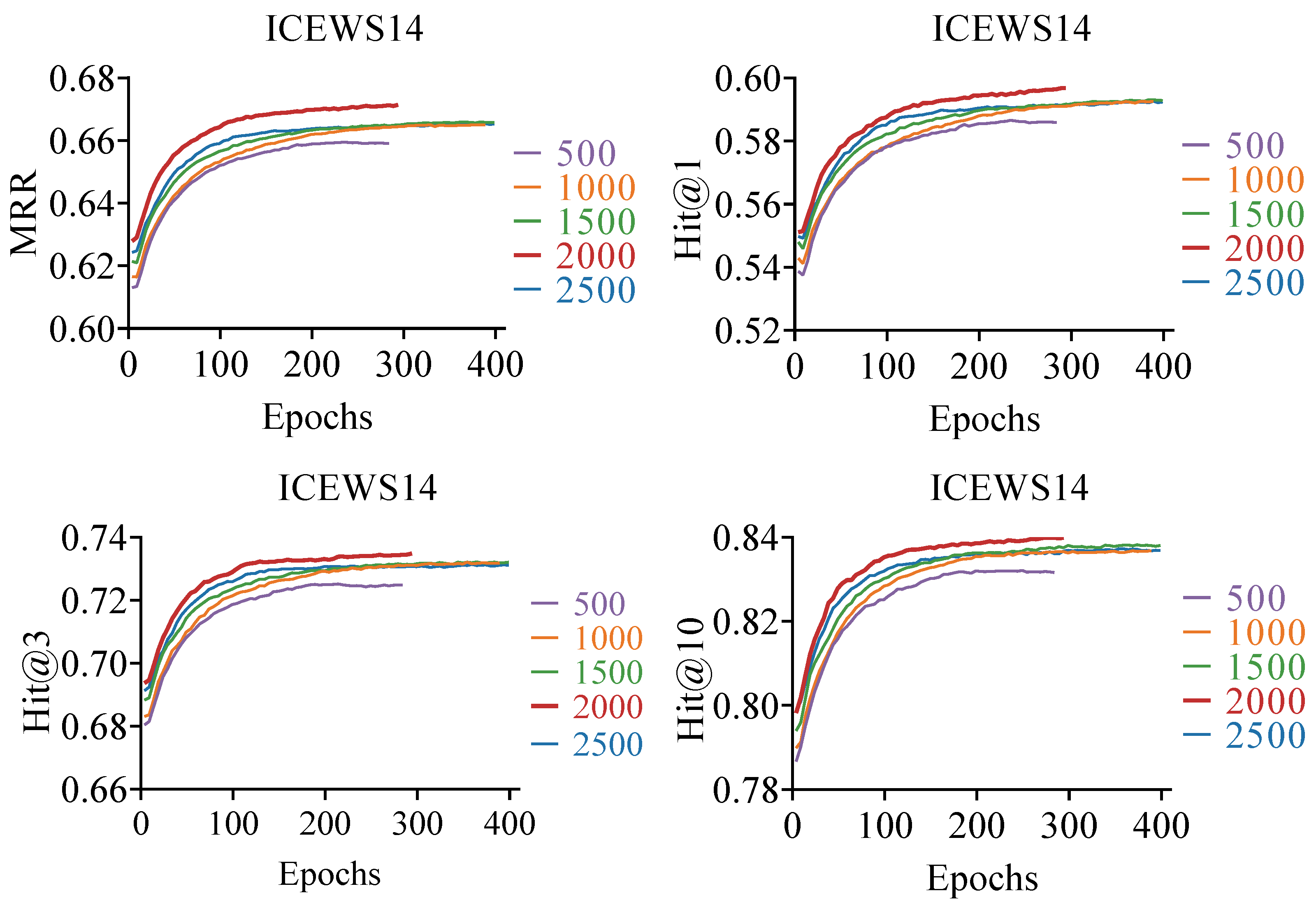
In this study, we investigated the impact of embedding dimensions on the TKG reasoning method based on embedding representation, where entities, relations, and timestamps are embedded into a low-dimensional vector space for link prediction tasks. While higher embedding dimensions can improve model performance, excessively high dimensions can also increase the computational cost. To examine the influence of embedding dimensions, with a batch size of 1000, an RGNN embedding dimension of 250, a learning rate of 0.1, and a rule confidence threshold of 0.2, we conducted comparison analyses on the ICEWS14 dataset. Except for the embedding dimension, all other parameters remained unchanged. According to the experimental results, as illustrated in Figure 4, the model’s performance increases with increasing embedding dimensions—that is, until a certain point, at which point it begins to decrease. As Figure 4 shows, the embedding dimension is fixed at 2000.
Figure 4. Training curves on ICEWS14 for various embedding dimensions.

4.6.3. The Impact of Rule Sampling Methods

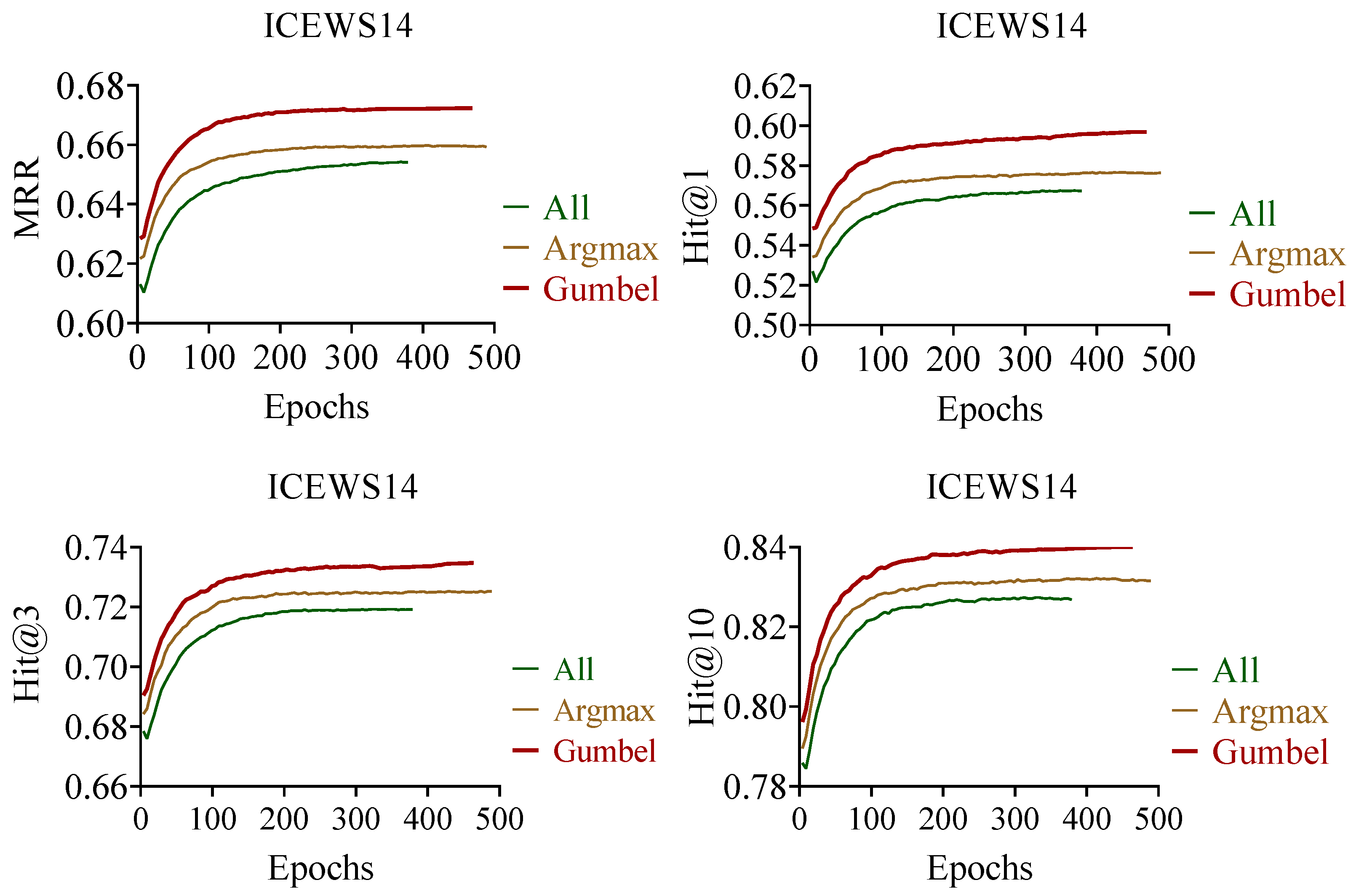
The experiment used a Gumbel-Softmax method to sample rules that meet the conditions for specific relationships. Other methods utilized Argmax to select the rule with the highest confidence score and used all the rules that meet the conditions without sampling. Comparative experiments were conducted on the ICEWS14 dataset while keeping other model parameters constant. The experimental results, as shown in Figure 5, demonstrated that the Gumbel-Softmax method yielded the best performance.
Figure 5. Training curves on ICEWS14 for different sample methods.
In the comparative analysis of temporal rule sampling methods, the Gumbel-softmax method can flexibly sample the appropriate rules, the Argmax method selects the rules with maximum confidence, and the third method uses all the rules; the experiment was performed on the ICEWS14 dataset. As can be seen in Figure 5, the training evaluation curve of the Gumbel-softmax method has been kept the highest, and as a result, it can be confirmed that this study utilizes differentiable sampling effectively.

4.6.4. Comparison of Different Temperature Coefficients

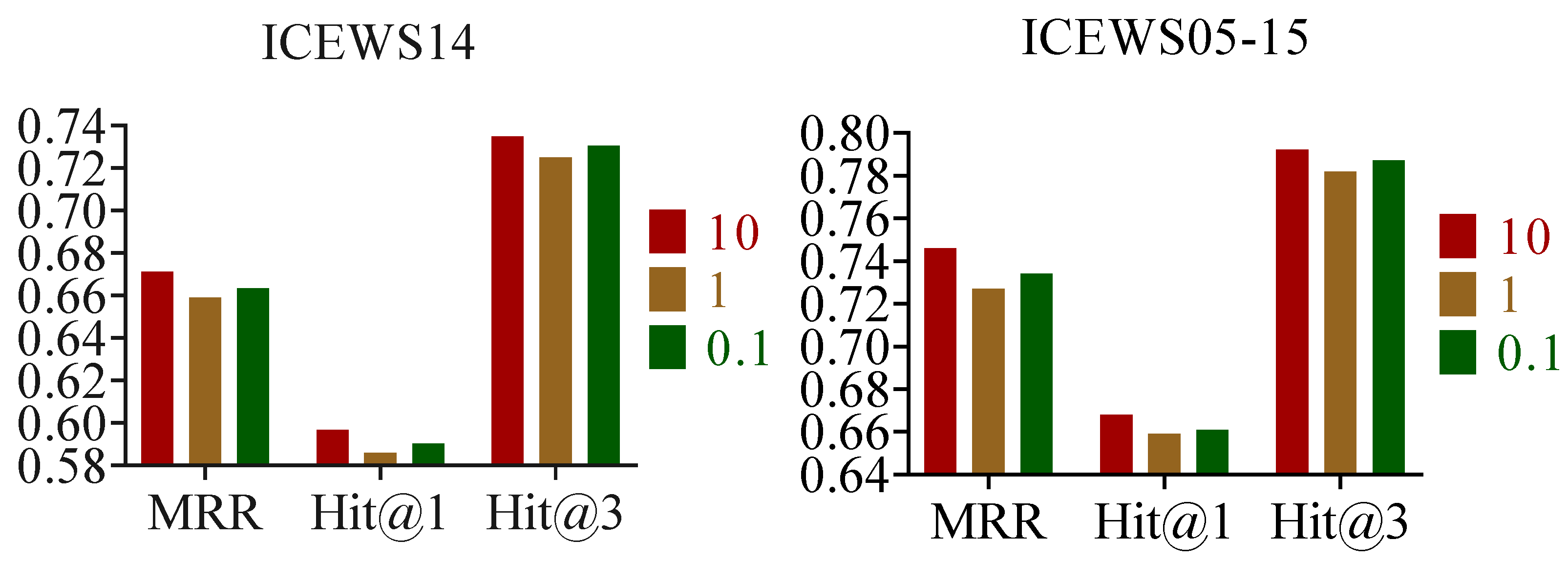
To explore the impact of the Gumbel-Softmax method on rule sampling, we conducted experiments using different temperature coefficients ( τ ). A higher τ value means more new rules are explored during the sampling process, while a lower τ value means more rules with higher probabilities are exploited. It can be seen from Figure 6 that τ is set to 10, and the result is the best. This implies that the model prefers to explore diverse temporal logic rules.
Figure 6. Results of link prediction using different τ (10, 1, 0.1) temperature coefficients.

4.7. Statistics of Extracted Temporal Logic Rules

Table 6 displays the statistics of the rules collected from the ICEWS14 dataset. The number of excursions across each relation was set to 200, and the sequence lengths of the excursions were 2 and 3, corresponding to rules of lengths 1 and 2. Table 7 includes the number of rule instances and the number of rules for various rule confidence levels. Our study presents six distinct temporal reasoning patterns, each with its own confidence level, reflecting the likelihood of one event leading to another within temporal knowledge graphs. These patterns range from direct actions such as accusations leading to rejections (Pattern 1, confidence 0.186) to more complex interactions involving multiple parties and actions, like the influence of making statements and hosting visits on subsequent consultations (Pattern 3, confidence 0.143). Notably, Pattern 2 (confidence 0.506) underscores a significant likelihood of property confiscation following investigations, highlighting a strong predictive relationship in legal or regulatory contexts. By synthesizing these examples, we gain insights into the reasoning power and practical implications of these patterns. This not only validates the effectiveness of our method in capturing complex temporal relationships but also opens avenues for further exploration into the impact of various rule extraction methods on reasoning accuracy.
Table 6. Statistical information on rules in the ICEWS14 dataset.
Table 7. Examples of rules in ICEWS14.

4.8. Ablation Study

To further analyze the contribution of model components (logic rules, RGNN, and TE), we perform a set of ablation studies. In the MVFF model, the temporal logic rule models the causal relationship using extracted rules, the RGNN encodes structural information for the static knowledge graph, and TE learns the temporal information. To ensure the comparability of the results, the same parameters were used in the experiments. The embedding dimension of RGNN was set to 250, the embedding dimension of tensor decomposition was set to 2000, and the rule confidence threshold was set to 0.2. The experimental results are shown in Table 8. As shown in the table, the performance of MVFF decreases no matter which module is removed, especially after the removal of the RGNN module, the performance of MVFF decreases the most, thus verifying the importance of a static knowledge graph in temporal knowledge graph reasoning.
Table 8. Ablation study of removing the rule module, RGNN, and TE from the whole model MVFF.

4.9. Case Study

Our framework provides interpretable reasoning processes, as can be seen in the explainable reasoning module in the top right corner of Figure 2; for the query (South Korea, Reject, ?, 30 April 2024), based on the temporal rules R e j e c t ( s , o , t ) A c c u s e ( s , o , t 1 ) and the existing quadruple (South Korea, Accuse, North Korea, 17 October 2024), we can interpretably answer the query as to where the answer (North Korea) is located.


5. Limitation

Our proposed method integrates logic rules and multi-view feature encoding modules for the task of temporal knowledge graph reasoning. However, the rules extracted under different settings may vary, potentially impacting the final reasoning outcomes. In subsequent research, we will further explore and study the effects of different rule extraction methods on temporal knowledge graph reasoning. Although our multi-view feature fusion approach has already achieved optimal results in reasoning tasks, it lacks mathematical theoretical proof. In future studies, we will continue to investigate how to theoretically explain the advanced nature of our proposed method.

6. Conclusions and Future Work

In this paper, we propose a novel framework that combines logic rule-based and embedding-based methods for temporal knowledge graphs (TKG). The proposed framework provides both the interpretability of logic rule-based methods and the scalability of embedding-based methods. We introduced the pattern of temporal logic rules and demonstrated how they can be automatically extracted in TKG. Additionally, we introduced the Gumbel-Softmax sampling method used in rule sampling and the multi-view representation of TKG, where entities and relations are embedded separately in the static knowledge graph and TKG. Our experimental results demonstrate that the MVFF performs well on the link prediction task. This provides strong evidence that the combination of rule-based and embedding-based methods improves the performance of TKG reasoning.
In the future, we will learn how entities and relations in quaternions evolve as time goes on, transitioning from interpolative to extrapolative reasoning. Additionally, we will theoretically investigate the contribution of static knowledge graph representations to temporal knowledge graph reasoning. Due to the powerful understanding capabilities of large models, we further explore the task of temporal knowledge graph reasoning by integrating it with symbolic reasoning in large models [46].

Author Contributions

Conceptualization, H.X. and J.B.; methodology, H.X. and H.L.; software, H.X., H.L. and J.B.; validation, H.X., J.B. and H.L.; formal analysis, H.X., J.B., C.H. and F.C.; resources, J.B.; writing—original draft preparation, H.X. and J.B.; writing—review and editing, H.X., J.B., C.H. and F.C.; project administration, J.B.; funding acquisition, J.B. All authors have read and agreed to the published version of the manuscript.

Funding

This research was funded by the CAAI-Huawei MindSpore Open Fund and the Science and Technology Research Program of Chongqing Municipal Education Commission (Grant No. KJQN202200718).

Institutional Review Board Statement

Not applicable.

Data Availability Statement

Data are contained within the article.

Conflicts of Interest

The authors declare no conflicts of interest.

References

  1. Leblay, J.; Chekol, M.W. Deriving validity time in knowledge graph. In Proceedings of the Companion Proceedings of the Web Conference 2018, Lyon, France, 23–27 April 2018; pp. 1771–1776. [Google Scholar]
  2. Dasgupta, S.S.; Ray, S.N.; Talukdar, P. Hyte: Hyperplane-based temporally aware knowledge graph embedding. In Proceedings of the 2018 Conference on Empirical Methods in Natural Language Processing, Brussels, Belgium, 31 October–4 November 2018; pp. 2001–2011. [Google Scholar]
  3. Wu, J.; Cao, M.; Cheung, J.C.K.; Hamilton, W.L. Temp: Temporal message passing for temporal knowledge graph completion. arXiv 2020, arXiv:2010.03526. [Google Scholar]
  4. Goel, R.; Kazemi, S.M.; Brubaker, M.; Poupart, P. Diachronic embedding for temporal knowledge graph completion. In Proceedings of the AAAI Conference on Artificial Intelligence, New York, NY, USA, 7–12 February 2020; Volume 34, pp. 3988–3995. [Google Scholar]
  5. Trouillon, T.; Welbl, J.; Riedel, S.; Gaussier, É.; Bouchard, G. Complex embeddings for simple link prediction. In Proceedings of the International Conference on Machine Learning, PMLR, New York, NY, USA, 20–22 June 2016; pp. 2071–2080. [Google Scholar]
  6. Lacroix, T.; Obozinski, G.; Usunier, N. Tensor Decompositions for Temporal Knowledge Base Completion. In Proceedings of the International Conference on Learning Representations, Addis Ababa, Ethiopia, 26–30 April 2020. [Google Scholar]
  7. Sadeghian, A.; Armandpour, M.; Colas, A.; Wang, D.Z. Chronor: Rotation based temporal knowledge graph embedding. In Proceedings of the AAAI Conference on Artificial Intelligence, Vancouver, BC, Canada, 2–9 February 2021; Volume 35, pp. 6471–6479. [Google Scholar]
  8. Messner, J.; Abboud, R.; Ceylan, I.I. Temporal knowledge graph completion using box embeddings. In Proceedings of the AAAI Conference on Artificial Intelligence, Virtual, 22 February–1 March 2022; Volume 36, pp. 7779–7787. [Google Scholar]
  9. Zhang, F.; Zhang, Z.; Ao, X.; Zhuang, F.; Xu, Y.; He, Q. Along the Time: Timeline-traced Embedding for Temporal Knowledge Graph Completion. In Proceedings of the 31st ACM International Conference on Information & Knowledge Management, Atlanta, GA, USA, 17–21 October 2022; pp. 2529–2538. [Google Scholar]
  10. Chen, K.; Wang, Y.; Li, Y.; Li, A. RotateQVS: Representing Temporal Information as Rotations in Quaternion Vector Space for Temporal Knowledge Graph Completion. In Proceedings of the 60th Annual Meeting of the Association for Computational Linguistics (Volume 1: Long Papers), Dublin, Ireland, 22–27 May 2022; pp. 5843–5857. [Google Scholar] [CrossRef]
  11. Zhao, X.; Li, A.; Jiang, R.; Chen, K.; Peng, Z. Householder Transformation-Based Temporal Knowledge Graph Reasoning. Electronics 2023, 12, 2001. [Google Scholar] [CrossRef]
  12. Liu, R.; Yin, G.; Liu, Z.; Zhang, L. PTKE: Translation-based temporal knowledge graph embedding in polar coordinate system. Neurocomputing 2023, 529, 80–91. [Google Scholar] [CrossRef]
  13. Wang, J.; Wang, B.; Gao, J.; Li, X.; Hu, Y.; Yin, B. QDN: A Quadruplet Distributor Network for Temporal Knowledge Graph Completion. IEEE Trans. Neural Netw. Learn. Syst. 2023, 1–13. [Google Scholar] [CrossRef] [PubMed]
  14. Yu, M.; Guo, J.; Yu, J.; Xu, T.; Zhao, M.; Liu, H.; Li, X.; Yu, R. TBDRI: Block decomposition based on relational interaction for temporal knowledge graph completion. Appl. Intell. 2023, 53, 5072–5084. [Google Scholar] [CrossRef]
  15. Wang, X.; Lyu, S.; Wang, X.; Wu, X.; Chen, H. Temporal knowledge graph embedding via sparse transfer matrix. Inf. Sci. 2023, 623, 56–69. [Google Scholar] [CrossRef]
  16. Li, J.; Su, X.; Gao, G. TeAST: Temporal Knowledge Graph Embedding via Archimedean Spiral Timeline. In Proceedings of the 61st Annual Meeting of the Association for Computational Linguistics (Volume 1: Long Papers), Toronto, ON, Canada, 9–14 July 2023; pp. 15460–15474. [Google Scholar] [CrossRef]
  17. Bai, L.; Ma, X.; Meng, X.; Ren, X.; Ke, Y. RoAN: A relation-oriented attention network for temporal knowledge graph completion. Eng. Appl. Artif. Intell. 2023, 123, 106308. [Google Scholar] [CrossRef]
  18. Zhang, S.; Liang, X.; Li, Z.; Feng, J.; Zheng, X.; Wu, B. BiQCap: A Biquaternion and Capsule Network-Based Embedding Model for Temporal Knowledge Graph Completion. In Proceedings of the International Conference on Database Systems for Advanced Applications, Tianjin, China, 17–20 April 2023; pp. 673–688. [Google Scholar]
  19. Ding, Z.; Ma, Y.; He, B.; Tresp, V. A simple but powerful graph encoder for temporal knowledge graph completion. arXiv 2021, arXiv:2112.07791. [Google Scholar]
  20. Jung, J.; Jung, J.; Kang, U. Learning to walk across time for interpretable temporal knowledge graph completion. In Proceedings of the 27th ACM SIGKDD Conference on Knowledge Discovery & Data Mining, Singapore, 14–18 August 2021; pp. 786–795. [Google Scholar]
  21. Nie, H.; Zhao, X.; Yao, X.; Jiang, Q.; Bi, X.; Ma, Y.; Sun, Y. Temporal-structural importance weighted graph convolutional network for temporal knowledge graph completion. Future Gener. Comput. Syst. 2023, 143, 30–39. [Google Scholar] [CrossRef]
  22. Zhang, M.; Xia, Y.; Liu, Q.; Wu, S.; Wang, L. Learning Latent Relations for Temporal Knowledge Graph Reasoning. In Proceedings of the 61st Annual Meeting of the Association for Computational Linguistics (Volume 1: Long Papers), Toronto, ON, Canada, 9–14 July 2023; pp. 12617–12631. [Google Scholar] [CrossRef]
  23. Liu, Y.; Ma, Y.; Hildebrandt, M.; Joblin, M.; Tresp, V. Tlogic: Temporal logical rules for explainable link forecasting on temporal knowledge graphs. In Proceedings of the AAAI Conference on Artificial Intelligence, Virtual, 22 February–1 March 2022; Volume 36, pp. 4120–4127. [Google Scholar]
  24. Niu, G.; Li, B. Logic and Commonsense-Guided Temporal Knowledge Graph Completion. In Proceedings of the AAAI, Washington, DC, USA, 7–14 February 2023. [Google Scholar]
  25. Nguyen, G.H.; Lee, J.B.; Rossi, R.A.; Ahmed, N.K.; Koh, E.; Kim, S. Dynamic network embeddings: From random walks to temporal random walks. In Proceedings of the 2018 IEEE International Conference on Big Data (Big Data), Seattle, WA, USA, 10–13 December 2018; pp. 1085–1092. [Google Scholar]
  26. Schlichtkrull, M.; Kipf, T.N.; Bloem, P.; Van Den Berg, R.; Titov, I.; Welling, M. Modeling relational data with graph convolutional networks. In Proceedings of the Semantic Web: 15th International Conference, ESWC 2018, Heraklion, Crete, Greece, 3–7 June 2018; pp. 593–607. [Google Scholar]
  27. Bordes, A.; Usunier, N.; Garcia-Duran, A.; Weston, J.; Yakhnenko, O. Translating embeddings for modeling multi-relational data. Adv. Neural Inf. Process. Syst. 2013, 26, 2787–2795. [Google Scholar]
  28. Jiang, T.; Liu, T.; Ge, T.; Sha, L.; Li, S.; Chang, B.; Sui, Z. Encoding temporal information for time-aware link prediction. In Proceedings of the 2016 Conference on Empirical Methods in Natural Language Processing, Austin, TX, USA, 1–5 November 2016; pp. 2350–2354. [Google Scholar]
  29. García-Durán, A.; Dumančić, S.; Niepert, M. Learning Sequence Encoders for Temporal Knowledge Graph Completion. In Proceedings of the 2018 Conference on Empirical Methods in Natural Language Processing, Brussels, Belgium, 31 October–4 November 2018; pp. 4816–4821. [Google Scholar]
  30. Wang, Z.; Zhang, J.; Feng, J.; Chen, Z. Knowledge graph embedding by translating on hyperplanes. In Proceedings of the AAAI Conference on Artificial Intelligence, Québec City, QC, Canada, 27–31 July 2014; Volume 28. [Google Scholar]
  31. Xu, C.; Nayyeri, M.; Alkhoury, F.; Yazdi, H.S.; Lehmann, J. TeRo: A time-aware knowledge graph embedding via temporal rotation. arXiv 2020, arXiv:2010.01029. [Google Scholar]
  32. Yuan, L.; Li, Z.; Qu, J.; Zhang, T.; Liu, A.; Zhao, L.; Chen, Z. TRHyTE: Temporal Knowledge Graph Embedding Based on Temporal-Relational Hyperplanes. In Proceedings of the Database Systems for Advanced Applications: 27th International Conference, DASFAA 2022, Virtual Event, 11–14 April 2022; pp. 137–152. [Google Scholar]
  33. Shao, P.; Zhang, D.; Yang, G.; Tao, J.; Che, F.; Liu, T. Tucker decomposition-based temporal knowledge graph completion. Knowl.-Based Syst. 2022, 238, 107841. [Google Scholar] [CrossRef]
  34. Jin, W.; Qu, M.; Jin, X.; Ren, X. Recurrent event network: Autoregressive structure inference over temporal knowledge graphs. arXiv 2019, arXiv:1904.05530. [Google Scholar]
  35. He, Y.; Zhang, P.; Liu, L.; Liang, Q.; Zhang, W.; Zhang, C. HIP Network: Historical Information Passing Network for Extrapolation Reasoning on Temporal Knowledge Graph. In Proceedings of the IJCAI, Virtual Event, 19–27 August 2021; pp. 1915–1921. [Google Scholar]
  36. Li, Y.; Sun, S.; Zhao, J. Tirgn: Time-guided recurrent graph network with local-global historical patterns for temporal knowledge graph reasoning. In Proceedings of the Thirty-First International Joint Conference on Artificial Intelligence, IJCAI 2022, Vienna, Austria, 23–29 July 2022; pp. 2152–2158. [Google Scholar]
  37. Zhu, Y.; Cong, F.; Zhang, D.; Gong, W.; Lin, Q.; Feng, W.; Dong, Y.; Tang, J. WinGNN: Dynamic Graph Neural Networks with Random Gradient Aggregation Window. In Proceedings of the 29th ACM SIGKDD Conference on Knowledge Discovery and Data Mining, Long Beach, CA, USA, 6–10 August 2023; pp. 3650–3662. [Google Scholar]
  38. Lin, Q.; Liu, J.; Mao, R.; Xu, F.; Cambria, E. TECHS: Temporal logical graph networks for explainable extrapolation reasoning. In Proceedings of the 61st Annual Meeting of the Association for Computational Linguistics (Volume 1: Long Papers), Toronto, ON, Canada, 9–14 July 2023; pp. 1281–1293. [Google Scholar]
  39. Bai, L.; Yu, W.; Chai, D.; Zhao, W.; Chen, M. Temporal knowledge graphs reasoning with iterative guidance by temporal logical rules. Inf. Sci. 2023, 621, 22–35. [Google Scholar] [CrossRef]
  40. Lin, Y.; Liu, Z.; Sun, M.; Liu, Y.; Zhu, X. Learning entity and relation embeddings for knowledge graph completion. In Proceedings of the AAAI Conference on Artificial Intelligence, Austin, TX, USA, 25–30 January 2015; Volume 29. [Google Scholar]
  41. Jang, E.; Gu, S.; Poole, B. Categorical Reparameterization with Gumbel-Softmax. In Proceedings of the International Conference on Learning Representations, Toulon, France, 24–26 April 2017. [Google Scholar]
  42. Yang, B.; Yih, W.t.; He, X.; Gao, J.; Deng, L. Embedding entities and relations for learning and inference in knowledge bases. arXiv 2014, arXiv:1412.6575. [Google Scholar]
  43. Kazemi, S.M.; Poole, D. Simple embedding for link prediction in knowledge graphs. Adv. Neural Inf. Process. Syst. 2018, 31, 4289–4300. [Google Scholar]
  44. Xu, C.; Nayyeri, M.; Chen, Y.Y.; Lehmann, J. Geometric Algebra Based Embeddings for Static and Temporal Knowledge Graph Completion. IEEE Trans. Knowl. Data Eng. 2022, 35, 4838–4851. [Google Scholar] [CrossRef]
  45. Xu, C.; Chen, Y.Y.; Nayyeri, M.; Lehmann, J. Temporal knowledge graph completion using a linear temporal regularizer and multivector embeddings. In Proceedings of the 2021 Conference of the North American Chapter of the Association for Computational Linguistics: Human Language Technologies, Online, 6–11 June 2021; pp. 2569–2578. [Google Scholar]
  46. Xu, F.; Wu, Z.; Sun, Q.; Ren, S.; Yuan, F.; Yuan, S.; Lin, Q.; Qiao, Y.; Liu, J. Symbol-llm: Towards foundational symbol-centric interface for large language models. arXiv 2023, arXiv:2311.09278. [Google Scholar]
Disclaimer/Publisher’s Note: The statements, opinions and data contained in all publications are solely those of the individual author(s) and contributor(s) and not of MDPI and/or the editor(s). MDPI and/or the editor(s) disclaim responsibility for any injury to people or property resulting from any ideas, methods, instructions or products referred to in the content.

Article Metrics

Citations

Article Access Statistics

Multiple requests from the same IP address are counted as one view.