Article

Dynamic Gust Detection and Conditional Sequence Modeling for Ultra-Short-Term Wind Speed Prediction

by
Liwan Zhou
,
Di Zhang
*,
Le Zhang
and
Jizhong Zhu
*
School of Electric Power Engineering, South China University of Technology, Guangzhou 510641, China
*
Authors to whom correspondence should be addressed.
Electronics 2024, 13(22), 4513; https://doi.org/10.3390/electronics13224513

Submission received: 8 October 2024 / Revised: 8 November 2024 / Accepted: 12 November 2024 / Published: 18 November 2024

Abstract

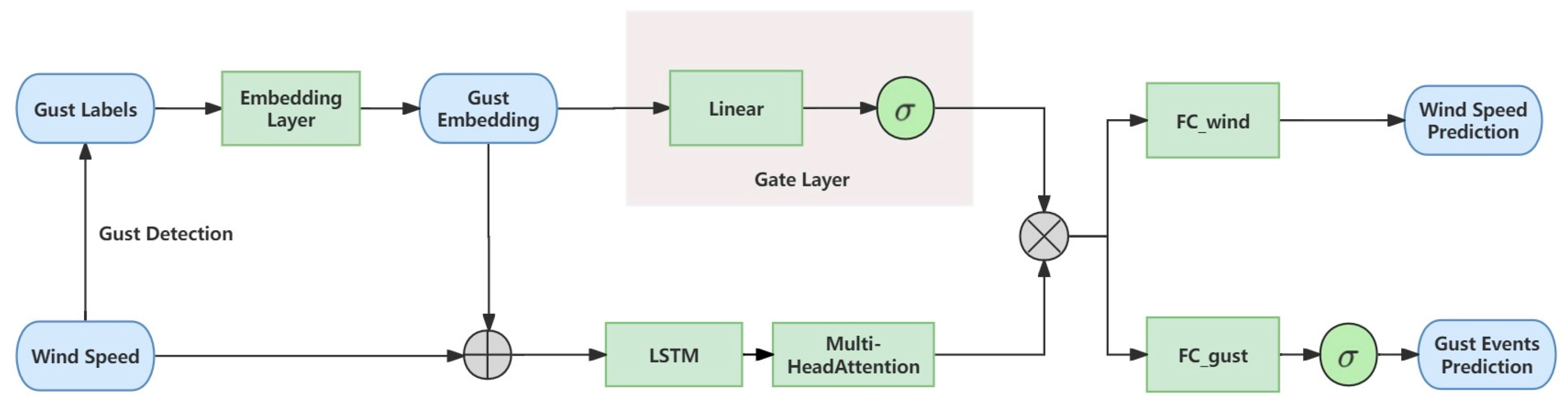
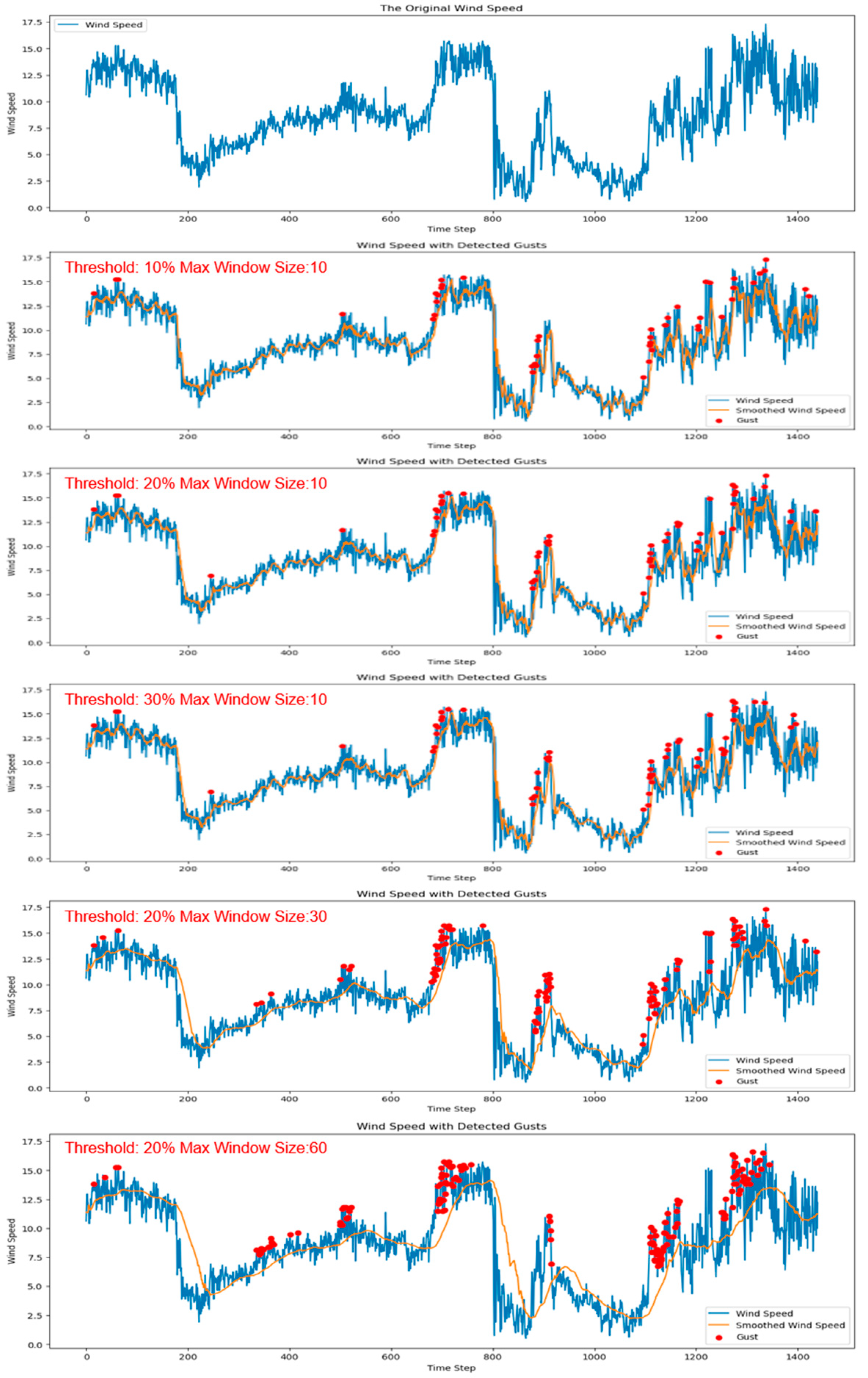
As the foundation for optimizing wind turbine operations and ensuring energy stability, wind speed forecasting directly impacts the safe operation of the power grid, the rationality of grid planning, and the balance of supply and demand. Furthermore, gust events, characterized by sudden and rapid wind speed fluctuations, pose significant challenges for ultra-short-term wind speed forecasting, making the data more complex and thus harder to predict accurately. To address this issue, this paper proposes a novel hybrid model that combines dynamic gust detection with Conditional Long Short-Term Memory (Conditional LSTM) and incorporates dynamic window adjustment and wind speed difference threshold screening methods. The model dynamically adjusts the window size to accurately detect gust events and uses a conditional LSTM model to adjust predictions based on gust and non-gust conditions. Experimental results show that the proposed model exhibits higher prediction accuracy across various wind speed scenarios, particularly during gust events. Through detailed experiments using data from a single actual wind farm, the effectiveness and practicality of the proposed hybrid model are demonstrated. The experimental results indicate that the proposed model outperforms contrast models, especially in handling gust events, significantly enhancing the robustness of ultra-short-term wind speed predictions.
Keywords: wind speed forecasting; gust detection; ultra-short-term prediction; conditional long short-term memory (Conditional LSTM); hybrid model wind speed forecasting; gust detection; ultra-short-term prediction; conditional long short-term memory (Conditional LSTM); hybrid model