Abstract
Emerging data processing techniques brought back into attention the HF range communication as an interesting alternative to third-party solutions for IoT applications, such as data transmission in distributed energy production facilities. The physical size of HF antennas, often comparable to the surrounding objects, require in situ radiation measurements resulting in site-customized antenna design and positioning, and consequently in a higher reliability of such HF grid communications. Drone-borne measuring systems are already known as a flexible solution, but are mostly restricted to higher frequency ranges where full-wave, wide-band probes are feasible. In this work, we propose to use an electrically small, folded dipole as a probe for drone-borne measurements on HF antennas. We also propose a calibration approach for the effects related to the near-field zone, and to the drone body proximity; corrections on these two effects are the key methodological steps. We show that despite a realized gain figure in the order of −20 dBi, such a probe can provide stable results for near-field measurements, even at input power levels as low as 1 mW. Compared to other similar approaches, our configuration provides a wider frequency band of operation, higher stability in terms of pattern diagram, and a lower cost.
1. Introduction
The concept of the Internet of Things (IoT) covers communications in distributed energy production facilities, known as smart grids [1,2]. Communications for transmitting command and control information in smart grid energy facilities should often cover long ranges. As an example, off-shore power plants are often outside of the service area of mobile networks [3], and satellite communications would be too expensive. Additionally, point-to-point communications are always preferred for transmitting controls and commands compared to any other third-party solutions. Point-to-point solutions in UHF such as LoRa might not be reliable enough, especially in the offshore environment.
Low-power and low-rate HF communication systems [4,5] can be easily implemented and made extremely reliable for transmitting information through appropriate signal processing [4,6] and appropriate frequency management [4,7,8]. Such communications are not only immune to noise, as they usually operate at a negative signal-to-noise ratio, but they also do not interfere with other communication services due to their extremely low power. Moreover, techniques mainly used for higher frequency ranges such as spread-spectrum [9] or ultra-wide band technologies [10] could be implemented on a fully software-defined radio platform [11,12,13], and can further reduce the risk of interference with other HF communication systems or between components of the same communication system.
Sensor networks in the HF band have successfully been implemented, e.g., for biological and geophysical monitoring in remote places [14], covering either short ranges of approximately 250 km, or transequatorial ranges of more than 10,000 km. In distributed energy production facilities, communication ranges are usually in the order of 100 km. Antennas transmitting controls and commands over HF should therefore provide communications at a high elevation angle, i.e., over a short skip. They also have to operate over a wide frequency range, so as to constantly adapt the frequency to the current propagation conditions. Antenna structures should also be low-cost and low-profile, e.g., traveling wave linear wire antennas.
The radiation pattern of an HF antenna is highly impacted by the environing objects. In order to provide reliable communications over the entire frequency range of interest between two sites of the grid, the HF antennas should be measured in situ [15,16,17], making therefore sure that the main lobe direction is pointing to the correspondent site.
Advancements in GPS accuracy, miniaturization of the data acquisition and processing systems, development of the real-time data communication systems, improvements in autonomous flight capabilities and battery life make drone-borne systems a viable solution for accurate HF antenna measurements. Recently, many drone-borne antenna-measuring systems have been developed as drones have become more and more affordable. However, most of those solutions were developed for frequencies above the HF band [17,18,19,20,21,22,23], and very few for HF antennas [24,25].
In this work, we propose a drone-borne data-acquisition system using a short, folded dipole as a probe antenna. The measurements are performed by flying the drone carrying the probe at a distance in the order of one meter along the HF antenna under test, so as to provide a safe flight and a low risk of interference between the transmitted signal and the drone control circuitry. It should be emphasized that near-field to far-field transforms must be performed when measuring an HF antenna with such a drone-borne system [26,27]. A calibration procedure to take into account the effect of the field zone, ground reflection, and drone chassis is also presented.
High-frequency communications in smart grid facilities should utilize most of the frequency range to keep a reliable link, regardless of the season or time. Thus, the antennas must be characterized over a wide frequency range (typically, between 7 and 30 MHz) using probes with stable electrical and mechanical characteristics, in order to accurately assess the skywave incidence angle in situ. Table 1 shows a comparison between our measuring configuration and two other measuring systems for HF antennas, one of them using a drone-borne receiver with an active antenna [24], and the other one using a drone-borne transmitter with a resonant antenna [25].
Table 1.
Comparison between drone-borne measuring configurations for HF antennas.
Compared to the drone-borne transmitter type configurations using full-wave antennas [25], our approach is based on an electrically short probe providing a wide frequency band of operation, and better mechanical stability, since the antenna is firmly attached to the drone.
The cost of our system is kept low since the measurements are performed in the near-field zone, and thus the receiver consists of a simple peak detector. As opposed to other measuring systems based on small-size transducers [24], the equipment to be carried by the drone is not only cheaper but also lighter and consequently a cheaper, low-payload drone is needed.
2. Platform Design
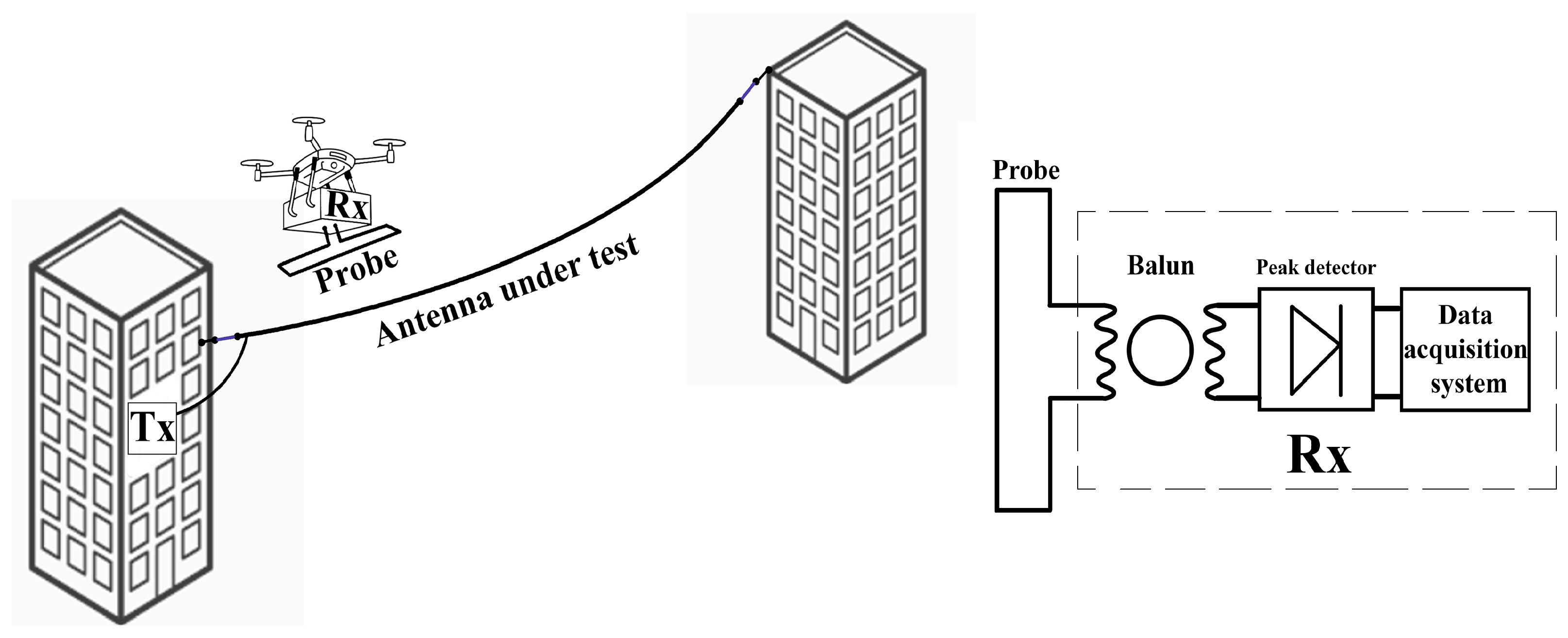
The configuration of the drone-borne antenna-measuring system is shown in Figure 1.
Figure 1.
Drone-borne antenna-measuring system.
When measuring HF antennas with a drone-borne acquisition system, weight and size constraints apply. Most of the commercial off-the-shelf drones can carry loads of up to 0.5 kg, and the load size should not affect the drone stability. As a result, only electrically small probes can be used, such as short straight or folded dipoles, or small loop antennas. Such antennas provide good pattern diagram stability over a wide frequency band; conversely, the radiation resistance is quite low, and the input reactance is high.
Table 2 shows a comparison between three types of electrically small probes, in terms of input impedance, radiation pattern and mechanical stability. All three probes have the same first resonant frequency, i.e., 150 MHz.
Table 2.
Comparison between different types of electrically small probes.
Although the short, straight dipole has a higher radiation resistance, the folded dipole and the loop input reactance is inductive and much lower, and therefore easier to mitigate over a wide frequency band by simply connecting in parallel the balun input inductance. The loop exhibits a stable pattern diagram over the entire frequency range; however, since the main lobe lies in the loop plane, the probe should be hanged vertically below the drone in a less stable mechanical position. Reinforcing a vertical loop in order to make it less deformable and more stable results in using additional dielectric supports and/or a thicker antenna conductor, thus impacting on the overall payload and flight stability.
These considerations lead to the conclusion that using an electrically short, folded dipole is a good tradeoff to achieve our goal. The dual-mode radiation of the folded dipole is analyzed in Section 3. More detailed, quantitative data on the probe used in our design including input impedance and gain are given in Section 4; we also show that the gain variation over the frequency range of interest does not impact the probe performance.
For HF band measurements, non-Foster impedance-matching networks can be easily implemented [28,29], to compensate for the antenna input reactance, and the peak detector can be designed so as to provide an appropriate input resistance.
Nevertheless, using a non-Foster impedance-matching network on a drone-borne system increases the power consumption and load mass; additionally, the exposure to HF radiation might impact the active circuit operation. The most critical challenges when using a non-Foster circuit would be first the payload, and second the power consumption. The non-Foster circuitry might be neither heavy nor with a high power consumption, but those figures add to the weight and consumption of the data acquisition and communication systems. The power consumption may indirectly result in a heavier load when the battery capabilities are exceeded, and a higher-capacity battery is needed. Moving to the next payload class of drones increases the overall cost of the system by more than 100%.
A simpler approach would be to terminate the probe on a constant, 50 ohm resistor without using any impedance-matching network. In that case, the impedance mismatch loss and the antenna conductor loss might be compensated for by reducing the distance to the antenna under test to approximately one meter.
3. Probe Design and Calibration
When using a probe antenna on an unmatched impedance termination, the antenna input impedance should also be known, typically by measuring its input reflection coefficient. Calibrating such an antenna also requires gain measurements. Since the antenna will be placed on a metallic drone body, the effect of the drone body should also be investigated. An electrically short antenna is expected to have a low realized gain, and the measurements are performed very close to the antenna under test; consequently, the effect of most of the environing objects on the accuracy would be negligible.
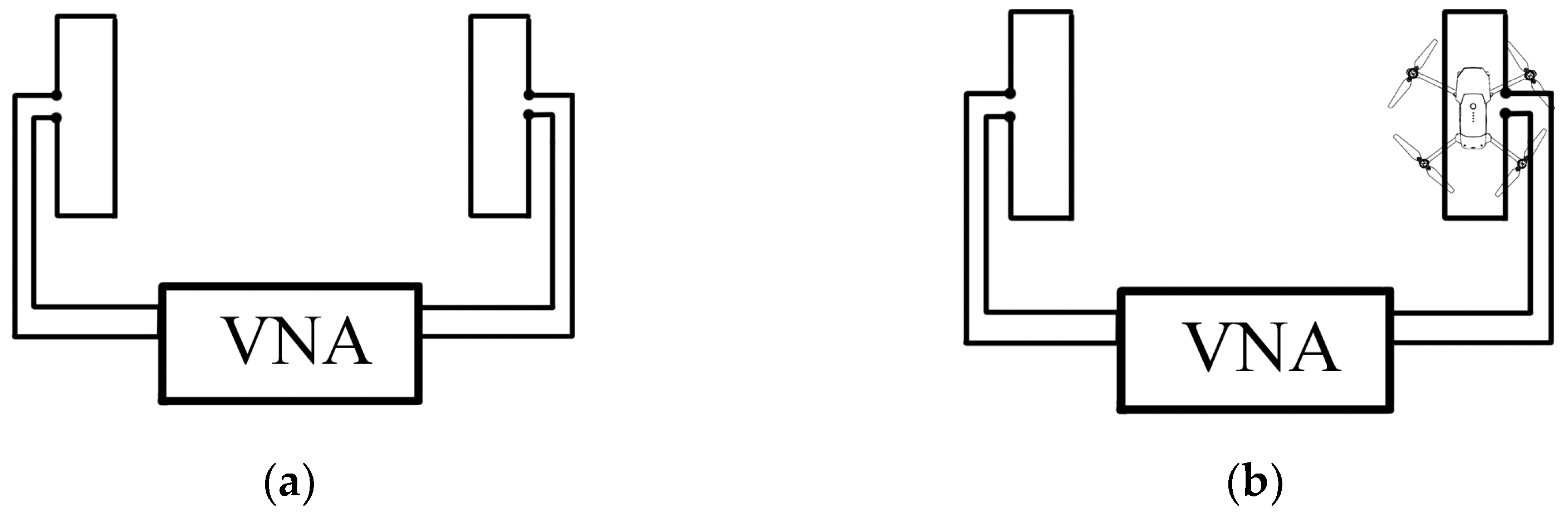
The two-antenna method [16,30] can be adapted to characterize such a probe by successively pairing two identical probes as follows: both on dielectric tripods, the first on a dielectric tripod and the second attached to the drone (Figure 2).
Figure 2.
Two-antenna method for drone-borne probe calibration: (a) off-drone; (b) on-drone measurements.
The gain can then be found by taking into consideration the input impedance variation [31] as follows
Since and are not essentially impacted by the drone body proximity, the following results:
As probes, we considered a pair of 1 m long dipoles (Figure 3); we chose a folded configuration, as explained in Section 2.
Figure 3.
Folded dipole as a probe.
Such a dipole is electrically short over the entire HF band; as a result, the impact of the common mode currents on gain measurements is quite high [32]. One-to-one baluns were used as part of the antenna in order to reduce the effect of the common mode currents, and thus the antennas will be characterized including the transformers. The same balun will be used with the probe on the drone as well. When used as a probe on a drone, the folded dipole has no feeder, and therefore the common mode current would not impact on the radiation pattern as it does when measuring the probe gain. Conversely, the current would close through the ground of the on-drone data-acquisition circuitry and may therefore induce erratic operation. In Section 4, we will thoroughly analyze the effect of the balun in terms of input impedance and losses.
Gain measurements need to be performed in a reflection-free environment; since anechoic chambers for HF antennas are quite rare, we opted for an open-area test site (OATS). Reflection and diffraction on massive objects can still occur in that frequency range. The distance-averaging method [33,34] may reduce the effect of the multipath propagation, even for narrow band antenna measurements. However, for HF antennas it might be unpractical, as the distance variation range between antennas should be in the order of the wavelength so as to provide sufficient variability to the contribution of the indirect wave. Time gating can be applied instead [35,36], by correlating the gate width with the distance to the nearest massive obstacle in the OATS.
Other sources of errors when using the two-antenna method for characterizing HF antennas in an OATS include discrepancies in the individual electric and radiation properties of the antennas, field-zone effect, and ground reflection. The reproducibility of different characteristics for our probe design is very high, as any possible dimensional discrepancy in manufacturing is much smaller than the wavelength. We therefore further investigated the two other sources of errors.
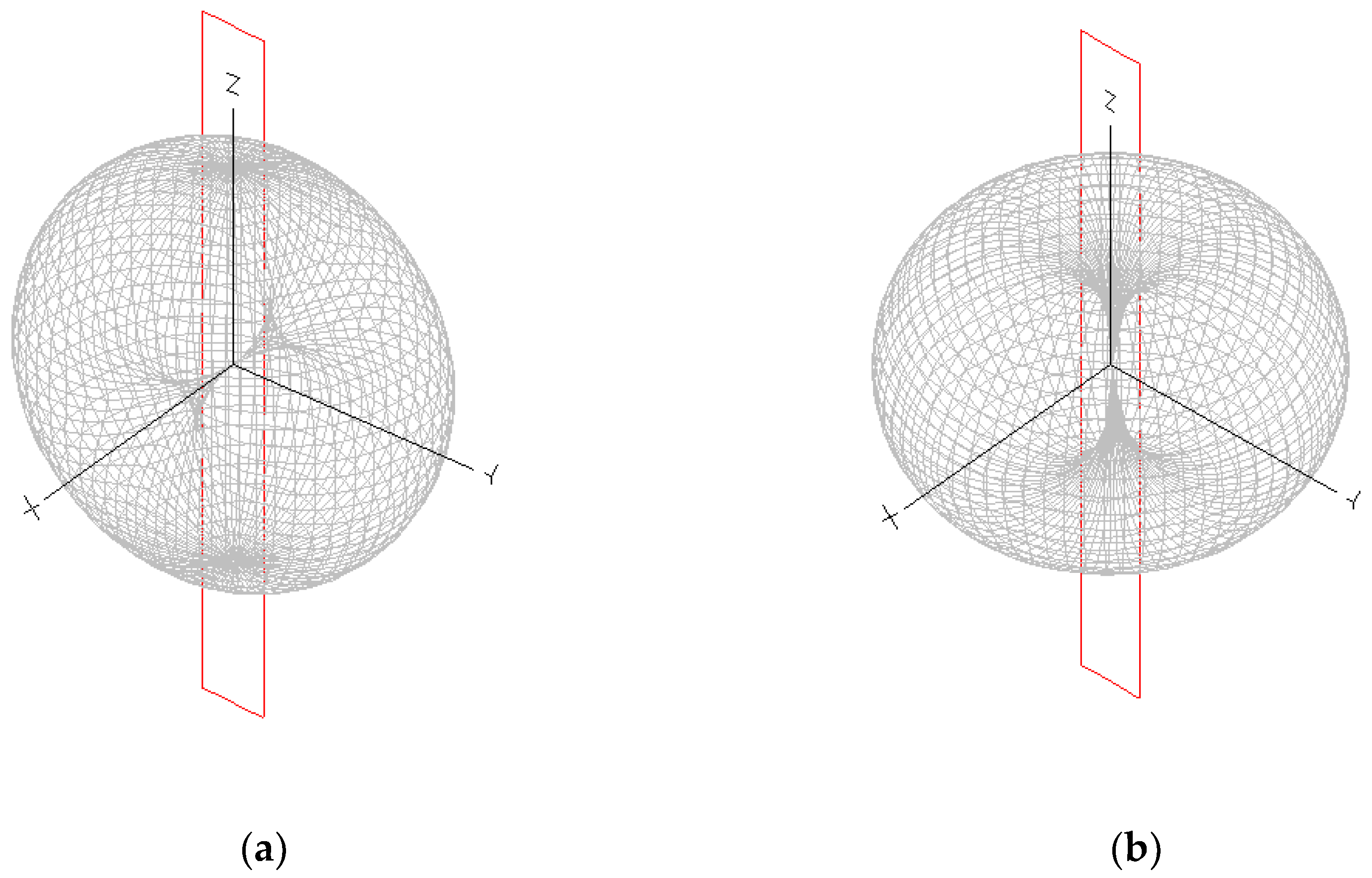
It should be emphasized that a one meter-long, folded dipole acts mostly like an electrically small loop near the lowest limit of the HF range, and as an electrically short dipole, near the highest limit. In between, both modes of radiation, i.e., the loop mode and the dipole mode, are present and comparable. The loop mode (Figure 4a) provides omnidirectional radiation in the antenna plane, i.e., YOZ, and a dual polarization, except for the XOY plane, where solely the OZ polarization is present. The dipole mode provides omnidirectional radiation in the XOY plane (Figure 4b), and a linear polarization along the OZ axis.
Figure 4.
Radiation from a short, folded dipole (in red): (a) loop mode; (b) dipole mode.
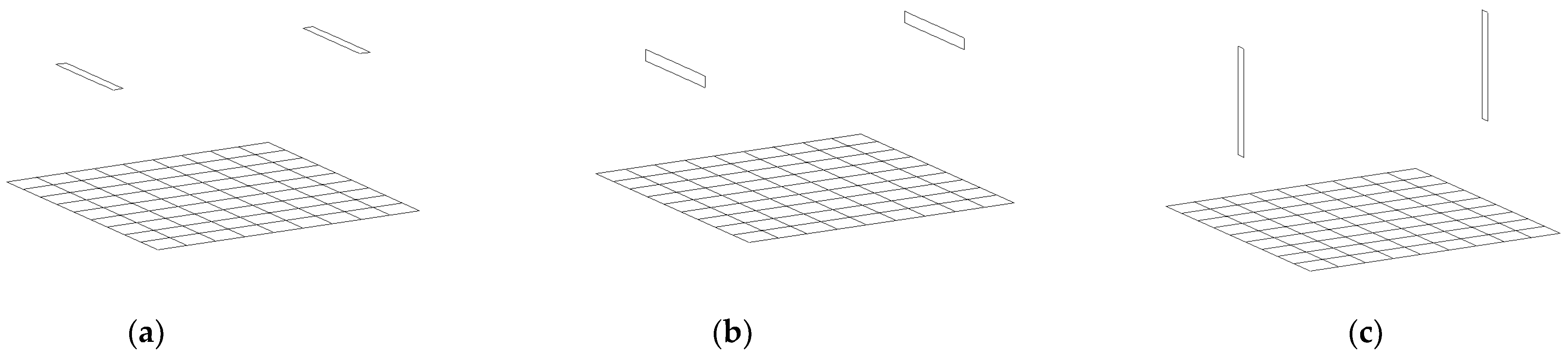
Probe gain was measured by placing the antennas on two 1.25 m high dielectric tripods. The ground-reflected wave magnitude depends on the ground characteristics, e.g., the humidity and soil type, and on the antenna position with respect to the ground. In order to discriminate the contribution of the direct wave regardless of the soil characteristics, the ground reflection effect should be assessed by successively placing the antennas in vertical and horizontal positions, in face-to-face and coplanar configurations (Figure 5). Pattern diagrams have 90 degree-wide radiation lobes (half-power beamwidth) for both the loop and dipole modes; it is therefore worth to place the antennas one away from the other at a distance twice the mast height, in order to have the same weight in the link budget for the loop mode, and a ground-reflected wave both for coplanar and face-to face configurations. Let R be the ground reflection coefficient; since the distance between the antennas and the mast height are comparable (i.e., in the order of one meter), and both are much shorter than the wavelengths in the HF range (i.e., tens to one hundred meters), direct and reflected waves are quasi in-phase.
Figure 5.
Evaluation of the ground reflection effect: (a) horizontal coplanar configuration; (b) horizontal face-to-face configuration; (c) vertical face-to-face configuration.
For the horizontal coplanar configuration, the electric field contributing to the current on the receiving antenna can be found as follows:
where and are the contributions of the dipole mode and loop mode, respectively.
Similarly, for the horizontal face-to-face configuration one can find the following:
and
for the vertical face-to-face configuration.
By subtracting (5) from (4) we obtain the following:
and by subtracting (5) from (6), we obtain the following:
Next, by adding (5) to (6):
and by substituting in (9) as given in (7), the following equation is found:
The reflection coefficient can then be computed by dividing (10) by (8) as follows:
We denote the following:
From (11) and (12),
and from (8),
with R calculated as in (13).
Three maximum-gain figures can then be defined: the dipole mode gain (corresponding to the ‘face-to-face’ orientation),
the loop mode gain,
and the total gain (corresponding to the ‘coplanar’ orientation),
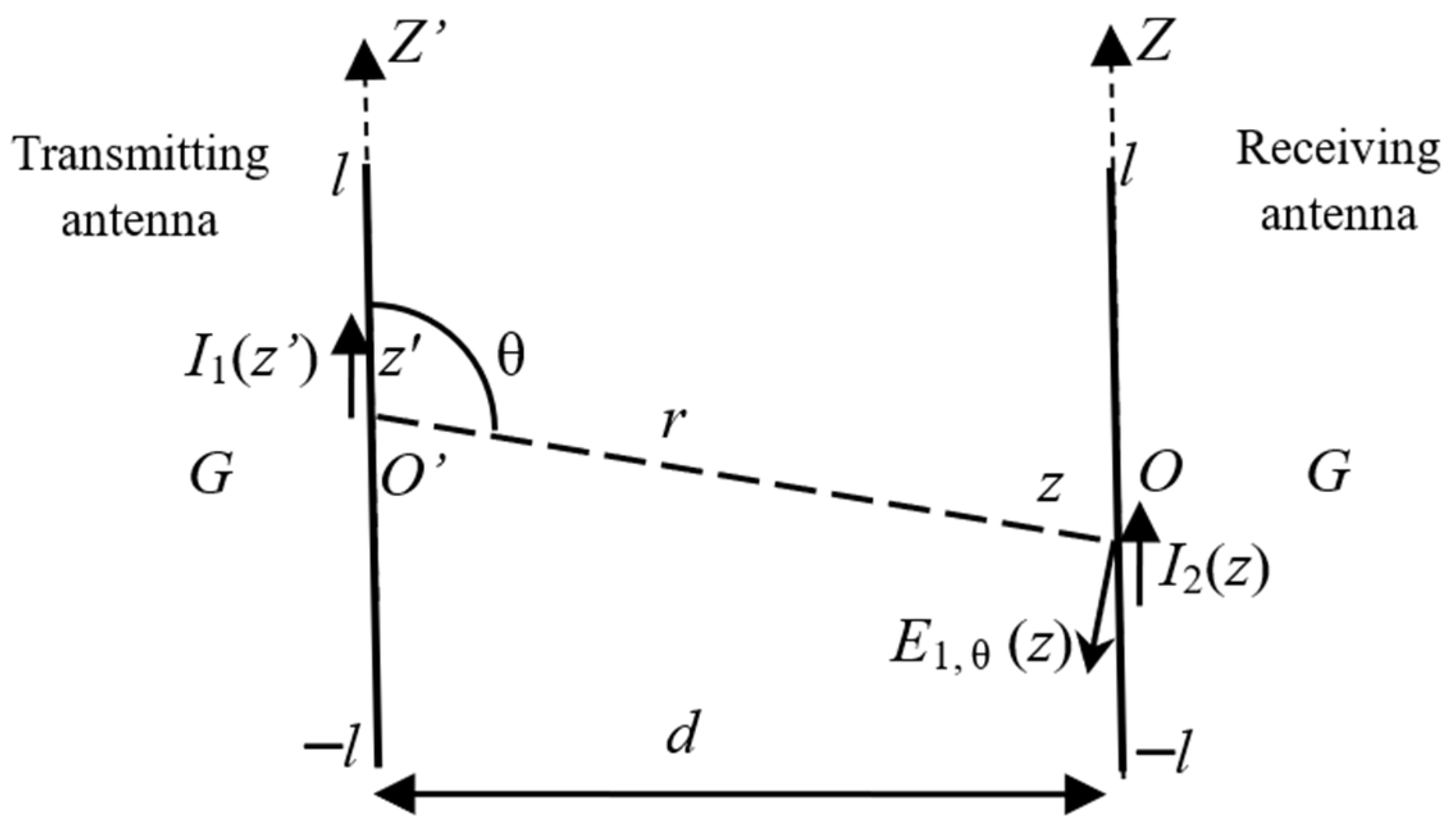
As the antenna length and the distance between antennas fall in the same order and both are much shorter than the wavelength, measurements are performed in the near-field zone. The most important effect compared to a far-field measurement setup comes from the variability of the longitudinal component of the electric field generated by the transmitting antenna along the receiving antenna (Figure 6).
Figure 6.
Near-field transmission between electrically short dipoles.
Let be the output voltage at the receiving antenna. One can define a normalized, received voltage by compensating for the effects of propagation in terms of magnitude and phase. By taking into consideration the radiation field in the expression of the mutual impedance for two straight dipoles [37], the normalized received voltage can be written as follows:
Current distributions are assumed to be quasi-constant. Moreover, since r and d are much smaller than the wavelength the phase of the integrand, they can be neglected. Given that ,
The far-field received voltage can be found by making d→∞,
A simple correction factor for close-distance transmission between two identical, electrically short dipoles can be found [38] as follows:
Gain measurements in the near-field zone would yield instead of G. The Friis formula for the probe gain should therefore be corrected as follows:
Since computed as before is already a far-field figure, the on-drone gain can be found from near-field measurements as follows:
Once calibrated as presented above, the probe can be mounted on the drone together with a peak detector and a data-acquisition system. Near-field data can then be acquired by flying the drone at a fixed distance away from the HF antenna under test, as shown in Figure 1. Based on the near-field samples, one can calculate the antenna gain in the far-field zone. In highly dynamic scenarios, such as offshore wind farms, blade turning might impact the measured results, as their length is usually comparable to the wavelength. In that case, a statistical approach similar to mobile channel sounding can be developed. For this purpose, near-field measurements must be performed under calm weather conditions when the turbines are turning slowly, during several flight trips covering multiple turbine turnings.
4. Results
4.1. Antenna Input Characteristics
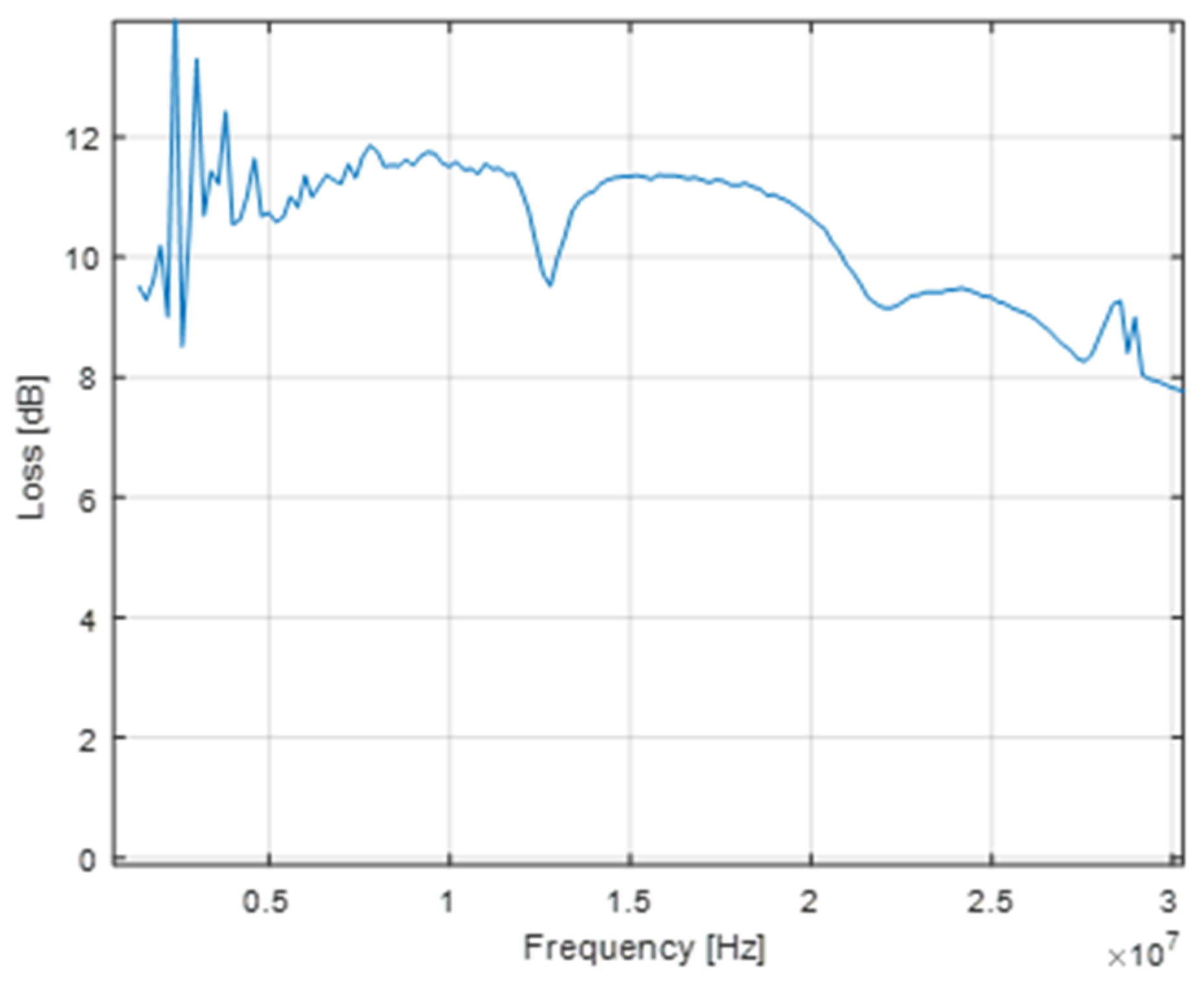
We first characterized the balun by measuring its scattering parameters on a standard, 50 ohm normalizing impedance. Based on that, we found the insertion loss of the balun terminated on the folded dipole (Figure 7), and the input impedance both at the antenna input and at the balun input.
Figure 7.
Insertion loss of the balun terminated on the folded dipole.
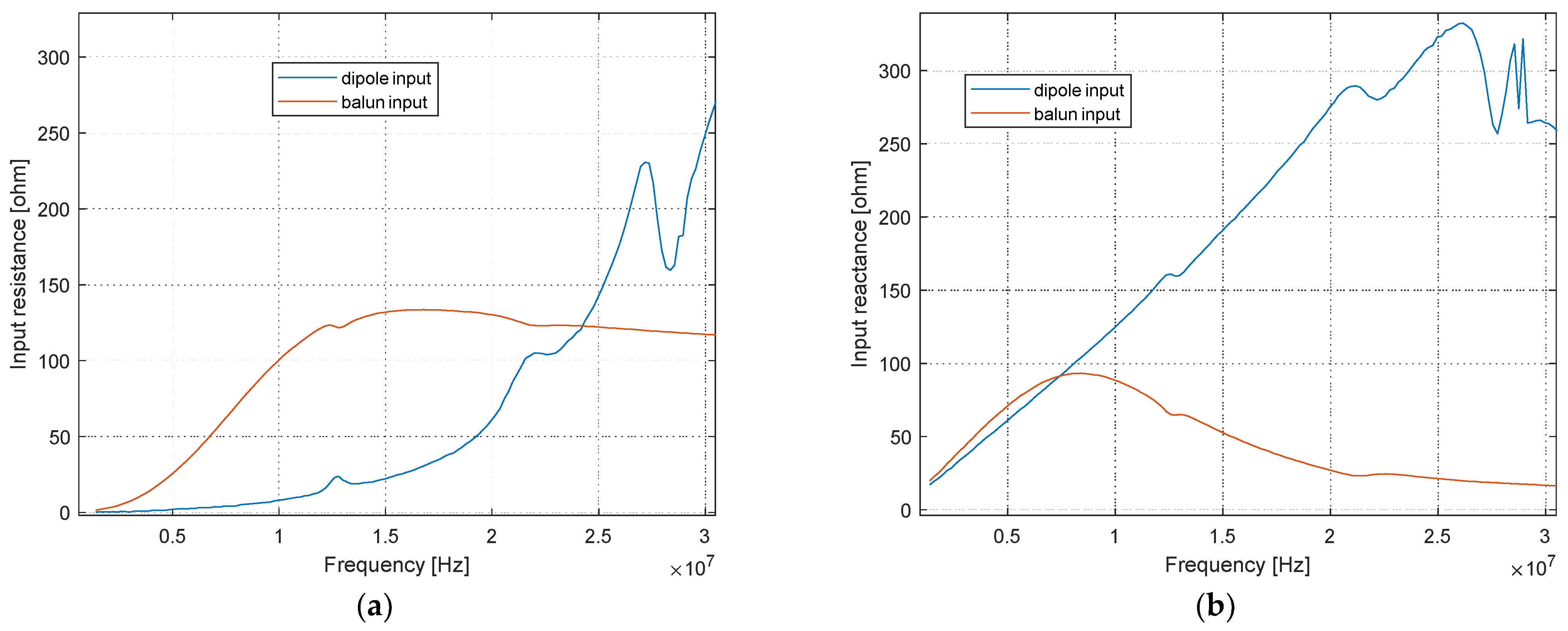
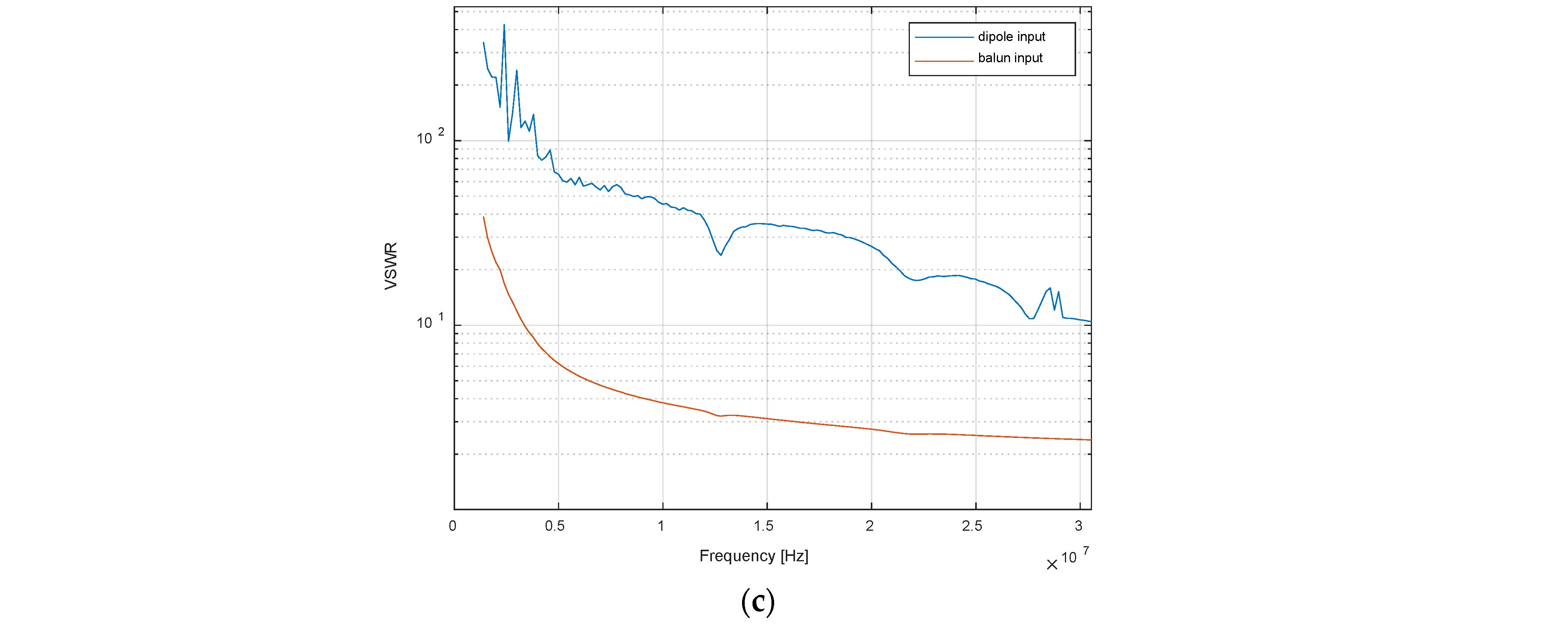
Figure 8 shows the variation as a function of frequency of the resistance, reactance, and VSWR at the antenna input. Losses in the antenna wire and balun make it possible to obtain a VSWR mostly below five over the frequency range of interest, i.e., between 7 and 30 MHz. The efficiency ranges between −36 and −7.8 dB; however, our gain measurements yield stable results for transmission between two such antennas placed at distances of up to 2.5 m one from the other, and for an input power of 0 dBm.

Figure 8.
Antenna input characteristics, with and without balun: (a) resistance; (b) reactance; (c) VSWR.
4.2. Ground Reflection
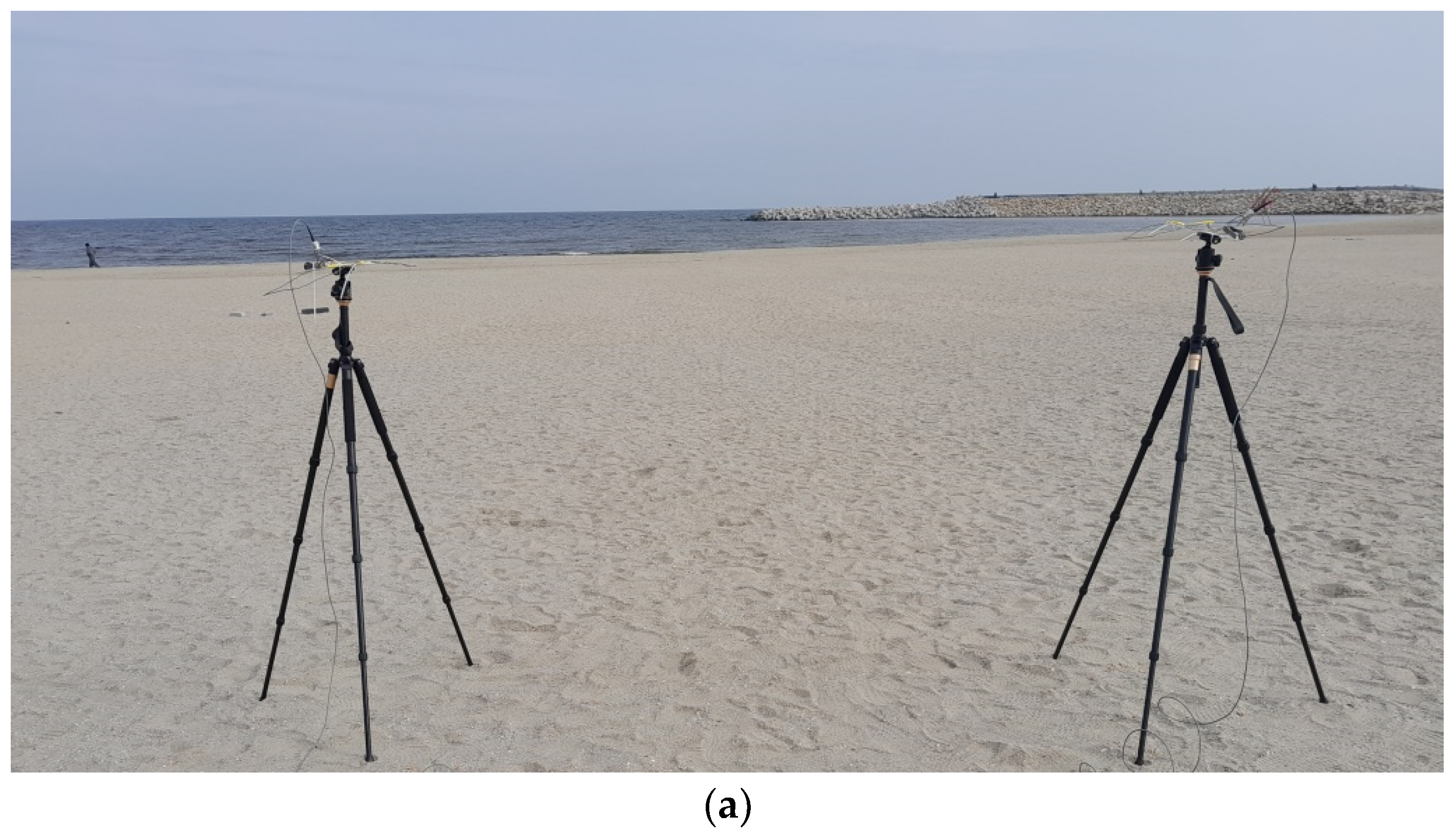
All antenna measurements were performed in an open-area test site (OATS), i.e., on a beach after more than 15 rainless days. The calibration of the electrically short dipole configuration to be installed on the drone was performed through S-parameter measurements between two identical antennas, including baluns.
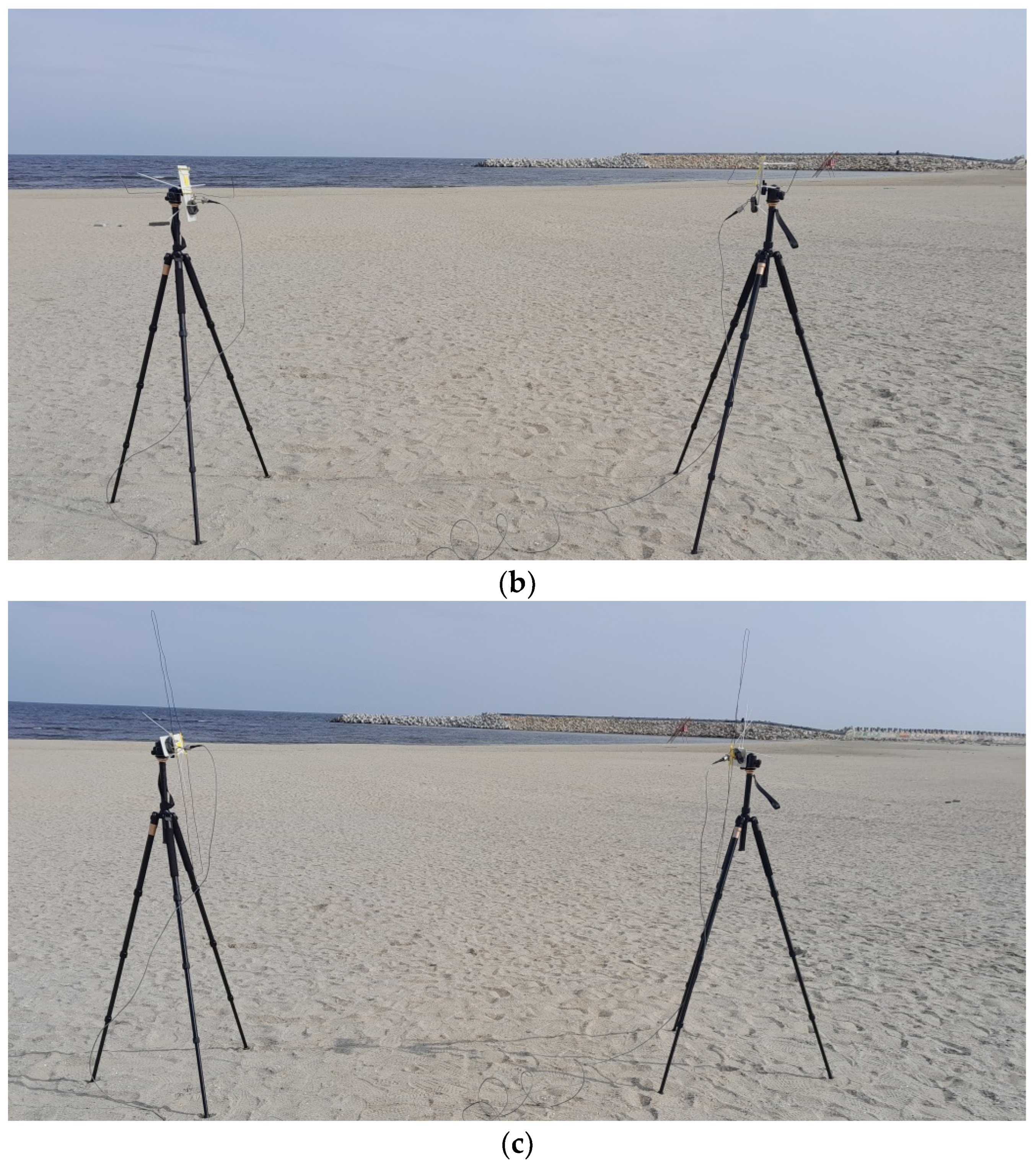
The antennas were placed at 2.5 m away one from the other, face-to-face, in horizontal and vertical positions (Figure 9). Both tripods were adjusted to a height of 1.25 m.

Figure 9.
Antenna setup for ground reflection measurements in an OATS: (a) horizontal coplanar orientation; (b) horizontal face-to-face; (c) vertical face-to-face.
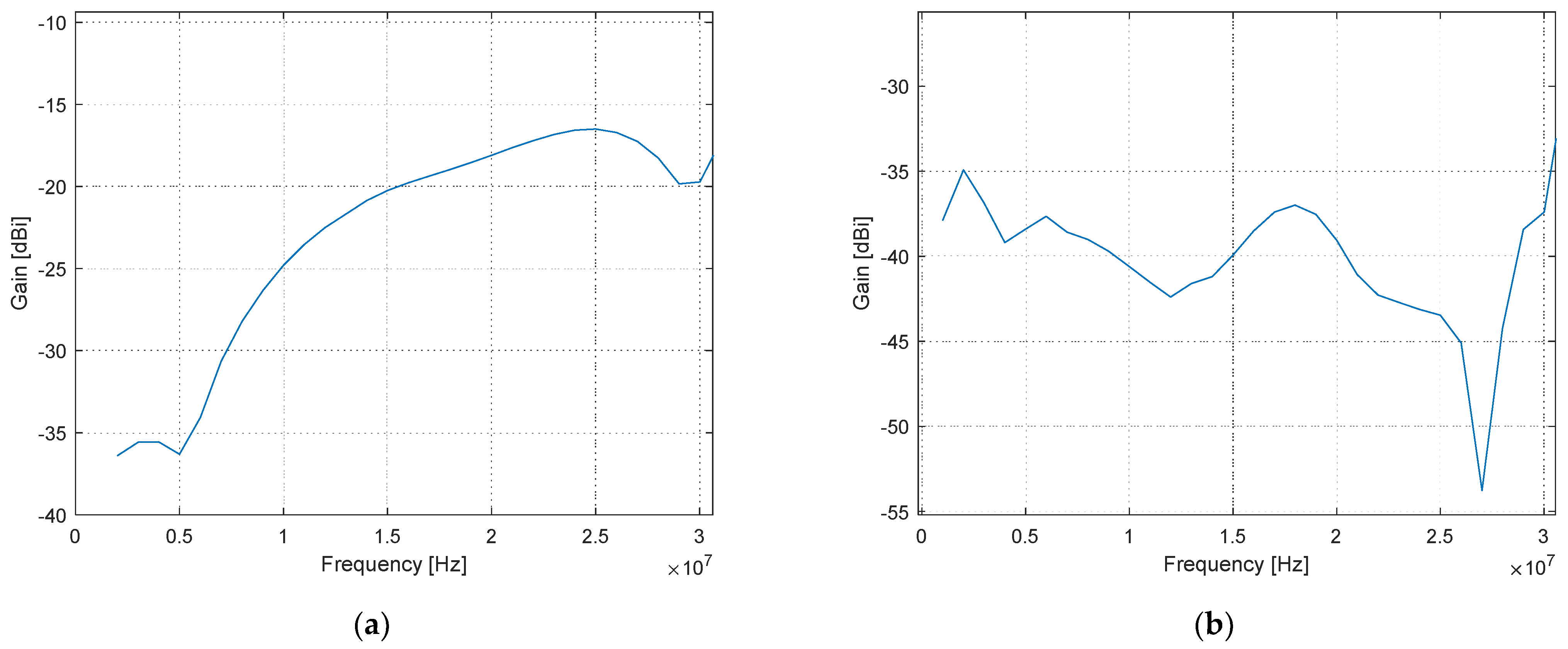
Dipole mode and loop mode gain figures were computed by using (15) and (16) and are shown in Figure 10.
Figure 10.
Gain: (a) dipole mode; (b) loop mode.
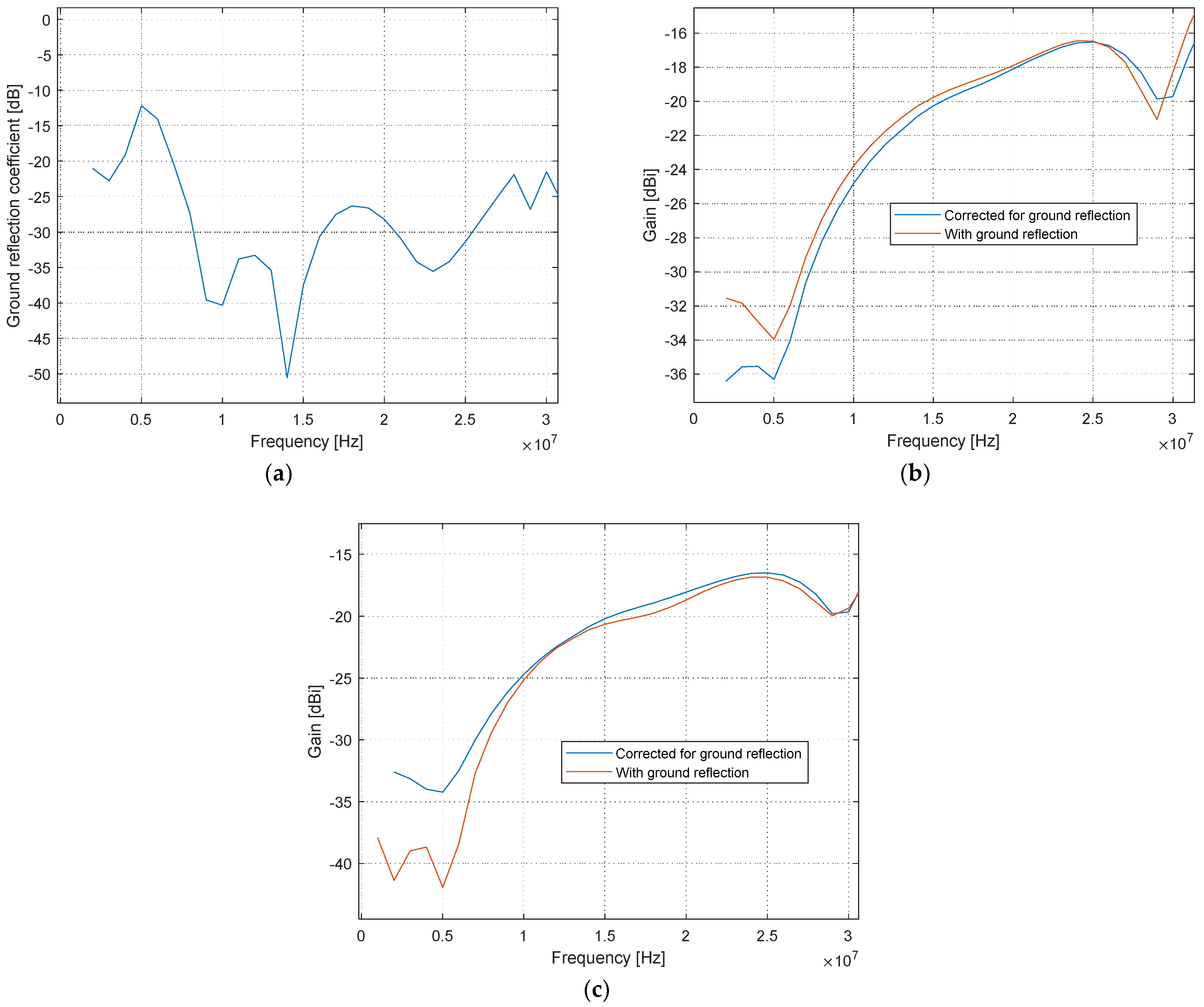
The ground reflection coefficient (Figure 11a) and the gain figures corrected for ground reflection (Figure 11b,c) were computed by using (13), (15), and (17).
Figure 11.
Ground effect: (a) ground reflection coefficient; (b) gain: horizontal ‘face-to-face’ orientation, with and without ground reflection correction; (c) gain: horizontal ‘coplanar’ orientation, with and without ground reflection correction.
We found that the ground reflection in the current measuring site did not critically impact the accuracy, which was slightly better for a ‘face-to-face’ orientation.
4.3. Probe Calibration with Field-Zone Correction and On-Drone Measurements
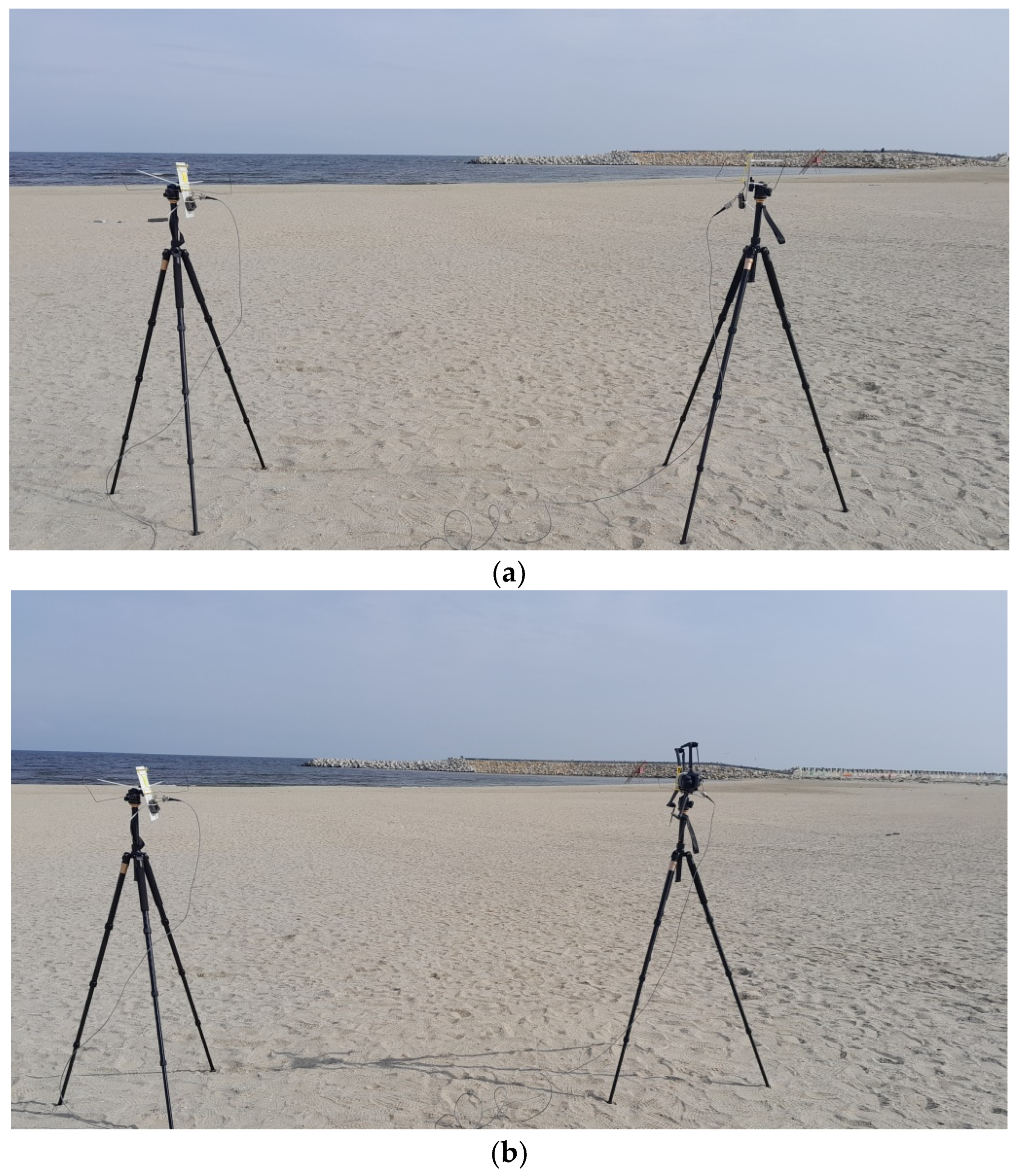
Two identical, electrically small dipoles were placed in a horizontal face-to-face position 0.5, 1, 1.5, 2, and 2.5 m away one from the other. One of the antennas was placed at first off-drone (Figure 12a) and then on-drone (Figure 12b).
Figure 12.
Antenna setup for on-drone gain measurements in an OATS: (a) horizontal, off-drone face-to-face antennas as a reference; (b) horizontal, on-drone face-to-face antennas.
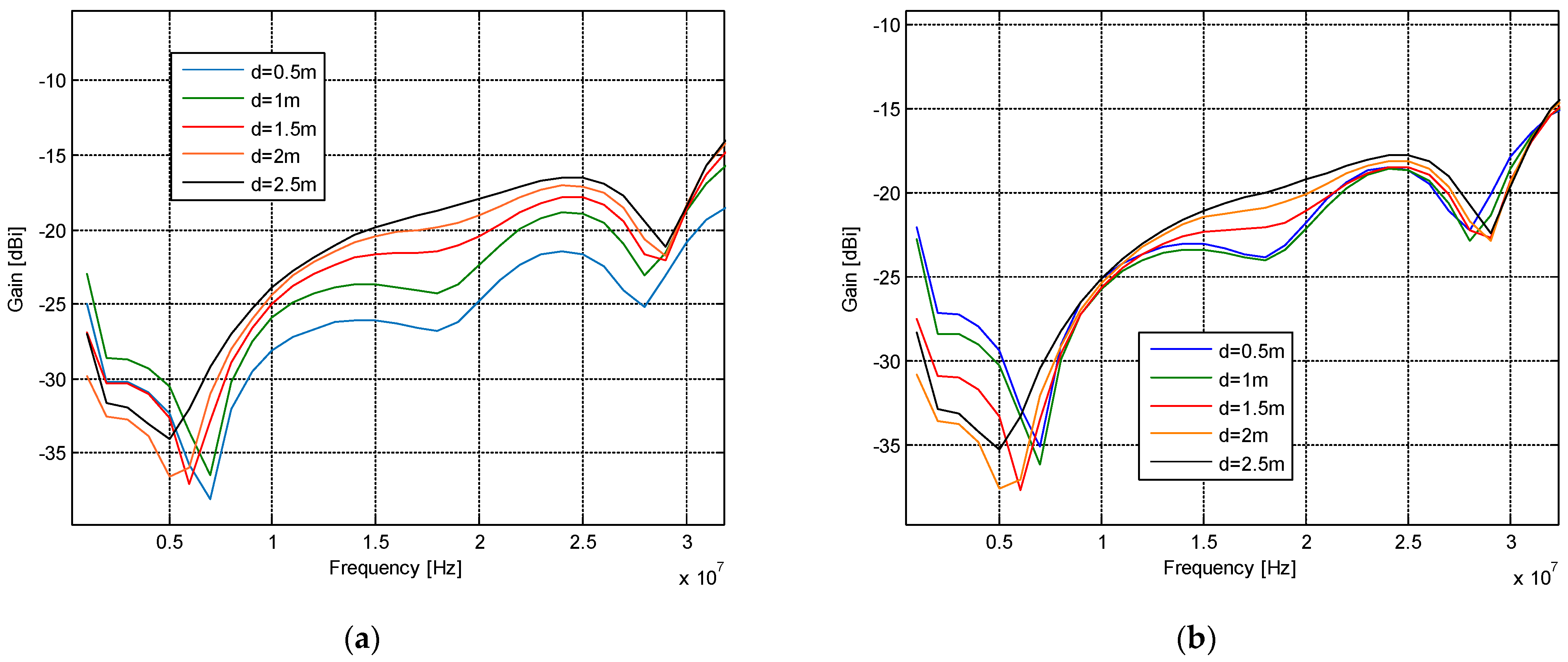
The gain variation over the HF range with and without field-zone correction by using (2) and (23) is given in Figure 13. An accuracy improvement in the probe gain assessment of up to 4 dB can be noted by correcting the results for the field-zone effect.
Figure 13.
Gain variation over the HF range: (a) without field-zone correction; (b) with field-zone correction.
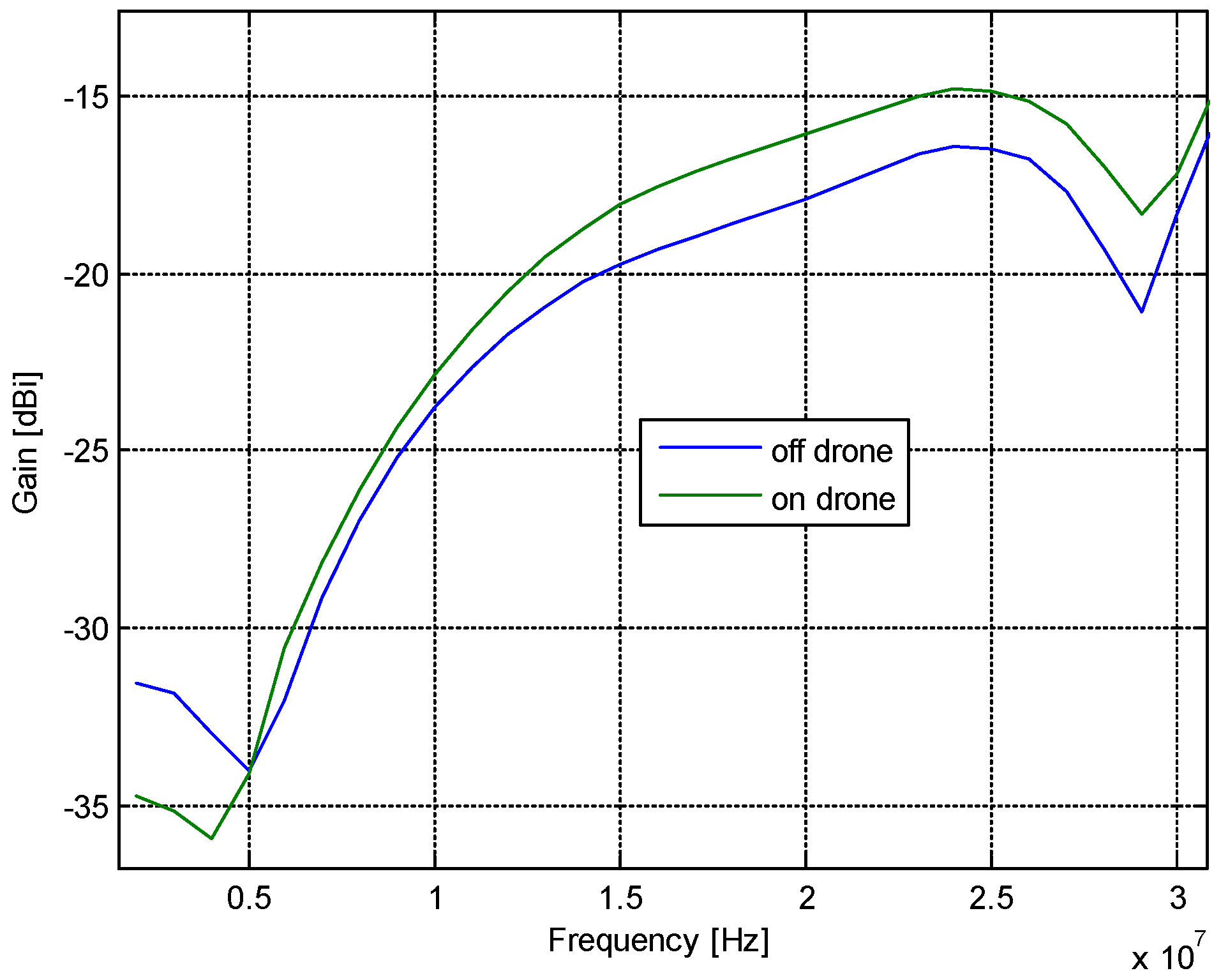
Figure 14 depicts a gain comparison for the on-drone and off-drone configurations. An accuracy improvement in the probe gain assessment of up to 2 dB can be noted by correcting the results for the drone-proximity effect.
Figure 14.
On-drone versus off-drone gain.
It is expected that gain measurements on an HF antenna under test will improve by up to 6 dB by using a probe going through all the calibration steps described above.
5. Conclusions
Improving the gain measurement accuracy on HF antennas is critical in over-the-horizon communication systems for smart grid energy facilities. A good control of the in situ radiation patterns is needed since transmitted powers are low, and most of the HF spectrum must be exploited to constantly provide reliable links.
In this work, we proposed to use an electrically small, folded dipole as a probe for in situ drone-borne gain measurements on HF antennas. We presented a calibration procedure taking into account the effect of the field zone, ground reflection, and drone body proximity. Compared to existing solutions based on a drone-borne transmitter driving a full-wave antenna, our approach provides a wider frequency band of operation (typically, five times wider), and better mechanical stability. Our system can also be a cheaper alternative to drone-borne, active antenna configurations, as the receiver consists of a simple peak detector and consequently a cheaper, low-payload drone is needed.
We compared the characteristics of our probe to those of other electrically small antennas utilized for a similar purpose. The magnitude of the input reactance for an electrically short, folded dipole is twenty times lower than for a straight dipole with the same length. The electrically small loop seemingly yields a less variable pattern diagram; in fact, the folded dipole provides a combination between loop-mode and dipole-mode radiation, which is stable enough over the frequency range of interest. Conversely, the loop must be hanged vertically below the drone for effective operation, i.e., in a less stable mechanical position.
Regarding the design, we found that losses in the antenna wire and balun rather have a positive impact, as the VSWR is smaller than five over the entire frequency band of interest, i.e., between, 7 and 30 MHz. The realized gain exhibits a smooth variation between −25 and −15 dBi; transmission measurements between two identical folded dipoles show that such low gain figures provide stable and noiseless results at distances of up to 2.5 m between antennas even at an input power in the order of 1 mW.
The dipole-type radiation mode dominates over the loop-type mode over the frequency range of interest, and the impact of the ground reflection is mostly less than 1 dB for a face-to-face orientation.
Our calibration procedure helps to improve the accuracy of gain measurements of up to 4 dB for field-zone related discrepancies, and by around 2 dB for the drone body impact.
Future work on improving the accuracy of our approach will focus on including in the calibration procedure the effect of the peak detector non-linearity and thermal drift, as well as on calibrating the probes in a more controlled environment, i.e., a low-frequency anechoic chamber.
Our calibration approach can be further adapted to highly dynamic smart grid scenarios such as offshore wind farms by acquiring near-field data during several flight trips, covering multiple turbine turnings, in order to develop a statistical link model.
Author Contributions
Conceptualization, M.P., A.C., A.H. and R.D.T.; methodology, M.P., A.C., A.H. and R.D.T.; software, M.P. and R.D.T.; validation, M.P., A.C., A.H. and R.D.T.; formal analysis, M.P., A.C., A.H. and R.D.T.; investigation, M.P., A.C., A.H. and R.D.T.; resources, R.D.T.; data curation, M.P., A.C., A.H. and R.D.T.; writing—original draft preparation, M.P., A.C., A.H. and R.D.T.; writing—review and editing, R.D.T.; visualization, M.P., A.C., A.H. and R.D.T.; supervision, R.D.T.; project administration, R.D.T.; funding acquisition, R.D.T. All authors have read and agreed to the published version of the manuscript.
Funding
This work was supported under the project MAREHC, a grant of the Romanian Ministry of Research, Innovation and Digitalization, project number PNRR-C9-I8-760111/23.05.2023, code CF 48/14.11.2022, within PNRR.
Data Availability Statement
Ongoing research project requiring confidential data status.
Conflicts of Interest
The authors declare no conflicts of interest.
References
- Ohanu, C.P.; Rufai, S.A.; Oluchi, U.C. A comprehensive review of recent developments in smart grid through renewable energy resources integration. Heliyon 2024, 10, e25705. [Google Scholar] [CrossRef] [PubMed]
- Kabeyi, M.J.B.; Olanrewaju, O.A. Smart grid technologies and application in the sustainable energy transition: A review. Int. J. Sustain. Energy 2023, 42, 685–758. [Google Scholar] [CrossRef]
- Zhang, Z.; Peng, T.; Yang, K.; Li, X. Trajectory Optimization and Retrieving Monitory System for UAV-assisted Offshore Maritime Communications. In Proceedings of the 2023 3rd International Conference on Electronic Information Engineering and Computer Science (EIECS), Changchun, China, 22–24 September 2023; pp. 1014–1019. [Google Scholar] [CrossRef]
- Koziniec, T.; Murray, D.; Dixon, M. Precomputed Ionospheric Propagation for HF Wireless Sensor Transmission Scheduling. In Proceedings of the 2021 29th International Symposium on Modeling, Analysis, and Simulation of Computer and Telecommunication Systems (MASCOTS), Virtual Conference, 3–5 November 2021; pp. 1–8. [Google Scholar] [CrossRef]
- Marti-Puig, P.; Serra-Serra, M.; Bolaño, R.R. Low Complex Wireless Sensor Network Uplink in the HF band. April 2008. [Online]. Available online: https://upcommons.upc.edu/handle/2099/4925 (accessed on 3 June 2024).
- WSJT-X User Guide. [Online]. Available online: https://wsjt.sourceforge.io/wsjtx-doc/wsjtx-main-2.6.1.html (accessed on 14 March 2024).
- Parkins, W.A. Propagation Management for No-Acknowledge HF Communications Links. 1986. Available online: https://ui.adsabs.harvard.edu/abs/1986MsT..........5P (accessed on 14 March 2024).
- HF_radio_GM _ISPACG_Ver1.pdf. [Online]. Available online: https://www.icao.int/APAC/documents/edocs/cns/HF_radio_GM%20_ISPACG_Ver1.pdf (accessed on 23 May 2024).
- Tan, X.; Su, S.; Sun, X. Research on Narrowband Interference Suppression Technology of UAV Network Based on Spread Spectrum Communication. In Proceedings of the 2020 IEEE International Conference on Artificial Intelligence and Information Systems (ICAIIS), Dalian, China, 20–22 March 2020; pp. 335–338. [Google Scholar] [CrossRef]
- Tamas, R.D.; Babour, L.; Fond, E.; Slamnoiu, G.; Chilo, J.; Saguet, P. Cylindrical dipoles as ultra-wide band antennas: An energy-based analysis. Microw. Opt. Technol. Lett. 2008, 50, 917–921. [Google Scholar] [CrossRef]
- Bostan, S.M.; Urbina, J.V.; Mathews, J.D.; Bilén, S.G.; Breakall, J.K. An HF Software-Defined Radar to Study the Iono-sphere. Radio Sci. 2019, 54, 839–849. [Google Scholar] [CrossRef]
- Wicaksono, A.; Mauludiyanto, A.; Hendrantoro, G. An HF Digital Communication System Based on Software-Defined Radio. In Proceedings of the 2020 International Conference on Smart Technology and Applications (ICoSTA), Surabaya, Indonesia, 20 February 2020; pp. 1–5. [Google Scholar] [CrossRef]
- Belgibaev, R.R.; Ivanov, V.A.; Ivanov, D.V.; Laschevsky, A.R. Software-Defined Radio Ionosonde for Diagnostics of Wideband HF Channels with the Use of USRP Platform. In Proceedings of the 2019 Wave Electronics and its Application in Information and Telecommunication Systems (WECONF), St. Petersburg, Russia, 3–7 June 2019; pp. 1–4. [Google Scholar] [CrossRef]
- Porté, J.; Pijoan, J.L.; Masó, J.; Badia, D.; Zaballos, A.; Alsina-Pagès, R.M. Advanced HF Communications for Remote Sensors in Antarctica. In Antarctica—A Key to Global Change; IntechOpen: London, UK, 2018. [Google Scholar] [CrossRef]
- IEEE Std 149-2021 (Revision of IEEE Std 149-1977); IEEE Recommended Practice for Antenna Measurements. IEEE: New York, NY, USA, 2022; pp. 1–207. [CrossRef]
- ANSI/IEEE Std 149-1979; IEEE Standard Test Procedures for Antennas. IEEE: New York, NY, USA, 1979; pp. 1–144. [CrossRef]
- Álvarez López, Y.; García Fernández, M.; Álvarez Narciandi, G.; Arboleya Arboleya, A.; Las-Heras Andrés, F.; García Cortés, S.; Fernández Cabanas, M. In situ antenna diagnostics and characterization system based on RFID and Remotely Piloted Aircrafts. Sens. Actuators A Phys. 2017, 269, 29–40. [Google Scholar] [CrossRef]
- Harmer, S.W.; De Novi, G. Distributed Antenna in Drone Swarms: A Feasibility Study. Drones 2023, 7, 126. [Google Scholar] [CrossRef]
- Bolli, P.; Paonessa, F.; Pupillo, G.; Virone, G.; Arts, M.; Lingua, A.; Monari, J.; Wijnholds, S.J. Antenna pattern characterization of the low-frequency receptor of LOFAR by means of an UAV-mounted artificial test source. In Proceedings of the SPIE Astronomical Telescopes + Instrumentation, Edinburgh, UK, 26 June–1 July 2016; Hall, H.J., Gilmozzi, R., Marshall, H.K., Eds.; SPIE: Bellingham, DC, USA; p. 99063V. [Google Scholar] [CrossRef]
- Paonessa, F.; Virone, G.; Addamo, G.; Peverini, O.A.; Tascone, R.; Acedo, E.d.L.; Colin-Beltran, E.; Razavi-Ghods, N.; Bolli, P.; Pupillo, G.; et al. UAV-based pattern measurement of the SKALA. In Proceedings of the 2015 IEEE International Symposium on Antennas and Propagation & USNC/URSI National Radio Science Meeting, Vancouver, BC, Canada, 19–24 July 2015; pp. 1372–1373. [Google Scholar] [CrossRef]
- De Acedo, E.D.; Bolli, P.; Paonessa, F.; Virone, G.; Colin-Beltran, E.; Razavi-Ghods, N.; Aicardi, I.; Lingua, A.; Maschio, P.; Monari, J.; et al. SKA aperture array verification system: Electromagnetic modeling and beam pattern measurements using a micro UAV. Exp. Astron. 2018, 45, 1–20. [Google Scholar] [CrossRef]
- Virone, G.; Lingua, A.M.; Piras, M.; Cina, A.; Perini, F.; Monari, J.; Paonessa, F.; Peverini, O.A.; Addamo, G.; Tascone, R. Antenna Pattern Verification System Based on a Micro Unmanned Aerial Vehicle (UAV). IEEE Antennas Wirel. Propag. Lett. 2014, 13, 169–172. [Google Scholar] [CrossRef]
- Bolli, P.; Wijnholds, S.J.; De Acedo, E.D.; Lingua, A.; Monari, J.; Paonessa, F.; Pupillo, G.; Virone, G. In-situ characterization of international low-frequency aperture arrays by means of an UAV-based system. In Proceedings of the 2017 XXXIInd General Assembly and Scientific Symposium of the International Union of Radio Science (URSI GASS), Montreal, QC, Canada, 19–26 August 2017; pp. 1–4. [Google Scholar] [CrossRef]
- Herbette, Q.; Saillant, S.; Menelle, M.; Urbani, B.; Bourey, N.; Darces, M.; Helier, M. HF Radar antenna near field assessment using a UAV. In Proceedings of the 2019 International Radar Conference (RADAR), Toulon, France, 23–27 September 2019; pp. 1–4. [Google Scholar] [CrossRef]
- Analysis and Validation of an Improved Method for Measuring HF Surface Wave Radar Antenna Pattern. [Online]. Available online: https://ieeexplore.ieee.org/document/8645675 (accessed on 22 July 2024).
- Apriono, C.; Nofrizal; Firmansyah, M.D.; Zulkifli, F.Y.; Rahardjo, E.T. Near-field to far-field transformation of cylindrical scanning antenna measurement using two dimension fast-fourier transform. In Proceedings of the 2017 15th International Conference on Quality in Research (QiR): International Symposium on Electrical and Computer Engineering, Bali, Indonesia, 24–27 July 2017; pp. 368–371. [Google Scholar] [CrossRef]
- Camilo, F.M.E.; Rego, C.G.D.; Ramos, G.L. Near-to-far-field transform sample reduction through statistical analysis. In Proceedings of the 12th European Conference on Antennas and Propagation (EuCAP 2018), London, UK, 9–13 April 2018; pp. 1–4. [Google Scholar] [CrossRef]
- Tang, M.-C.; Shi, T.; Ziolkowski, R.W. Electrically Small, Broadside Radiating Huygens Source Antenna Augmented with Internal Non-Foster Elements to Increase Its Bandwidth. IEEE Antennas Wirel. Propag. Lett. 2017, 16, 712–715. [Google Scholar] [CrossRef]
- Ziolkowski, R.W.; Zhu, N. Broad bandwidth, efficient, metamaterial-inspired, electrically small antennas augmented with internal non-Foster elements. In Proceedings of the 2012 6th European Conference on Antennas and Propagation (EUCAP), Prague, Czech Republic, 26–30 March 2012; pp. 123–125. [Google Scholar] [CrossRef]
- Mistry, K.K.; Lazaridis, P.I.; Zaharis, Z.D.; Akinsolu, M.; Liu, B.; Loh, T. Accurate antenna gain estimation using the two-antenna method. In Proceedings of the Antennas and Propagation Conference 2019 (APC-2019), Birmingham, UK, 11–12 November 2019; Institution of Engineering and Technology: Birmingham, UK, 2019; p. 4. [Google Scholar] [CrossRef]
- Bucuci, S.; Constantin, A.; Paun, M.; Pastorcici, M.N.; Tamas, R.D.; Danisor, A.; Constantinescu, R. A Compact Monopole Antenna for Underwater Acoustic Monitoring Beacons. Sensors 2022, 22, 8392. [Google Scholar] [CrossRef] [PubMed]
- Constantin, A.; Tamas, R.D. Evaluation and Impact Reduction of Common Mode Currents on Antenna Feeders in Radiation Measurements. Sensors 2020, 20, 3893. [Google Scholar] [CrossRef] [PubMed]
- Tamas, R.D.; Deacu, D.; Caruntu, G.; Petrescu, T. An indoor measuring technique for antenna gain. In Proceedings of the 2013 International Workshop on Antenna Technology (iWAT), Karlsruhe, Germany, 4–6 March 2013; pp. 219–222. [Google Scholar] [CrossRef]
- Tamas, R.D.; Babour, L.; Danisor, A.; Caruntu, G. An intermediate-field approach of the differential time-domain single-antenna method for electrically large ultra-wide band antennas. In Proceedings of the 2010 International Workshop on Antenna Technology (iWAT), Lisbon, Portugal, 1–3 March 2010; pp. 1–4. [Google Scholar] [CrossRef]
- Hsiao, Y.-T.; Lin, Y.-Y.; Lu, Y.-C.; Chou, H.-T. Applications of time-gating method to improve the measurement accuracy of antenna radiation inside an anechoic chamber. In Proceedings of the IEEE Antennas and Propagation Society International Symposium. Digest. Held in conjunction with: USNC/CNC/URSI North American Radio Sci. Meeting (Cat. No.03CH37450), Columbus, OH, USA, 22–27 June 2003; Volume 3, pp. 794–797. [Google Scholar] [CrossRef]
- Constantin, A.; Anchidin, L.; Tamas, R.D. A Distance Averaging Approach for Measuring the Radiation from Common Mode Currents on Antenna Feeders. In Proceedings of the 2020 International Workshop on Antenna Technology (iWAT), Bucharest, Romania, 25–28 February 2020; pp. 1–4. [Google Scholar] [CrossRef]
- Richmond, J.; Geary, N. Mutual impedance of nonplanar-skew sinusoidal dipoles. IEEE Trans. Antennas Propag. 1975, 23, 412–414. [Google Scholar] [CrossRef]
- Anchidin, L.; Bari, F.; Tamas, R.D.; Pometcu, L.; Sharaiha, A. Near-field gain measurements: Single-probe distance averaging in a multipath site versus multi-probe field scanning inside an anechoic chamber. In Proceedings of the 2017 XXXIInd General Assembly and Scientific Symposium of the International Union of Radio Science (URSI GASS), Montreal, BC, Canada, 19–26 August 2017; pp. 1–3. [Google Scholar] [CrossRef]
Disclaimer/Publisher’s Note: The statements, opinions and data contained in all publications are solely those of the individual author(s) and contributor(s) and not of MDPI and/or the editor(s). MDPI and/or the editor(s) disclaim responsibility for any injury to people or property resulting from any ideas, methods, instructions or products referred to in the content. |
© 2024 by the authors. Licensee MDPI, Basel, Switzerland. This article is an open access article distributed under the terms and conditions of the Creative Commons Attribution (CC BY) license (https://creativecommons.org/licenses/by/4.0/).