Combined Use of Python and DIgSILENT PowerFactory to Analyse Power Systems with Large Amounts of Variable Renewable Generation




Abstract
1. Introduction
2. Materials and Methods
2.1. Implementation of Networks in DIgSILENT PowerFactory
2.2. Wind Resource
2.3. Python Scripting and DIgSILENT PowerFactory
- Numpy: This module is specifically designed to perform numerical computations. It enables the user to create arrays and matrices and provides multiple mathematical functions to operate with them.
- Scipy: This package is a scientific computing library which implements a large set of commands intended for solving scientific tasks.
- Pandas: This module was created to make it easier for the user to create and manipulate large sets of data in Python.
- Matplotlib: This library is the most widely used module to visually represent data in Python. This module enables users to create complex and publication-quality visualisations in a straightforward procedure.
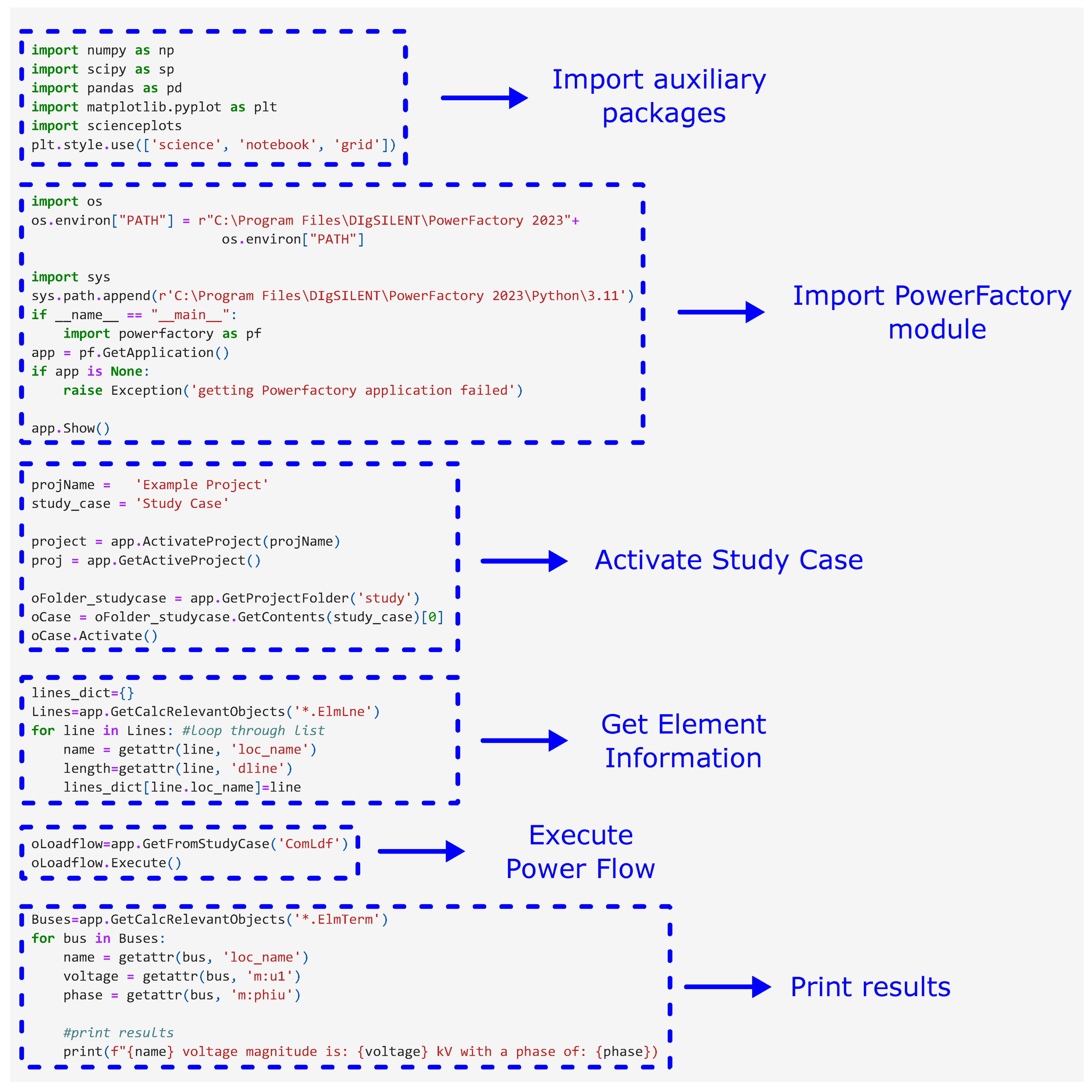
- Import PowerFactory module along with auxiliary packages in the Python environment;
- Activate project and study case;
- Define input and output variables;
- Perform calculation in engine mode (e.g., simple powerflow);
- Export output variables.
3. Case Studies
3.1. Stochastic Analysis
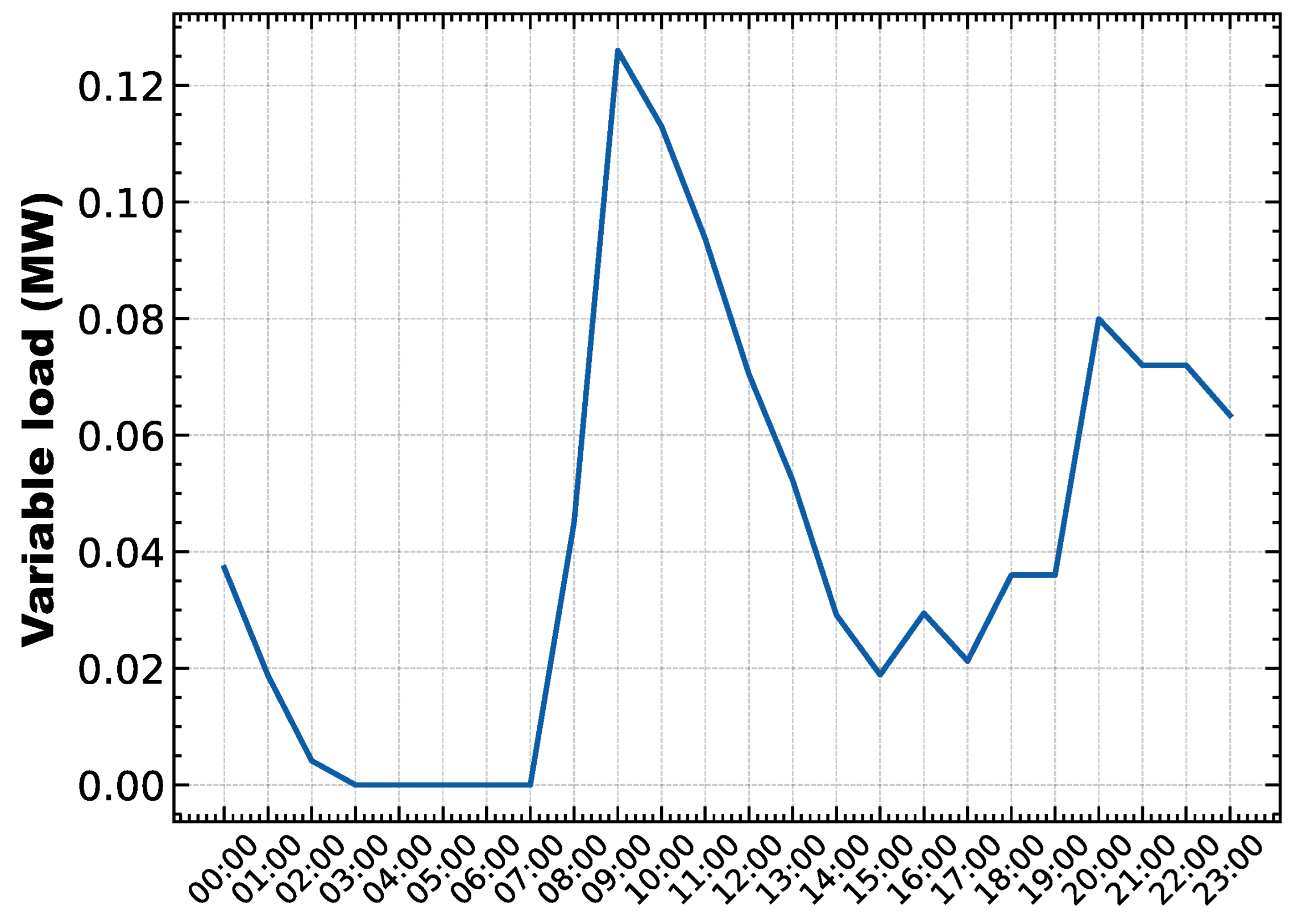
3.2. Quasi-Dynamic Analysis
- Time-dependent loads (be they daily variations, seasonal changes, etc.).
- Renewable energy sources dependent on environmental factors (such as wind or solar radiation).
- Regular variations in the topology or characteristics of the network (maintenance operations, faults, etc.).
4. Results and Analysis
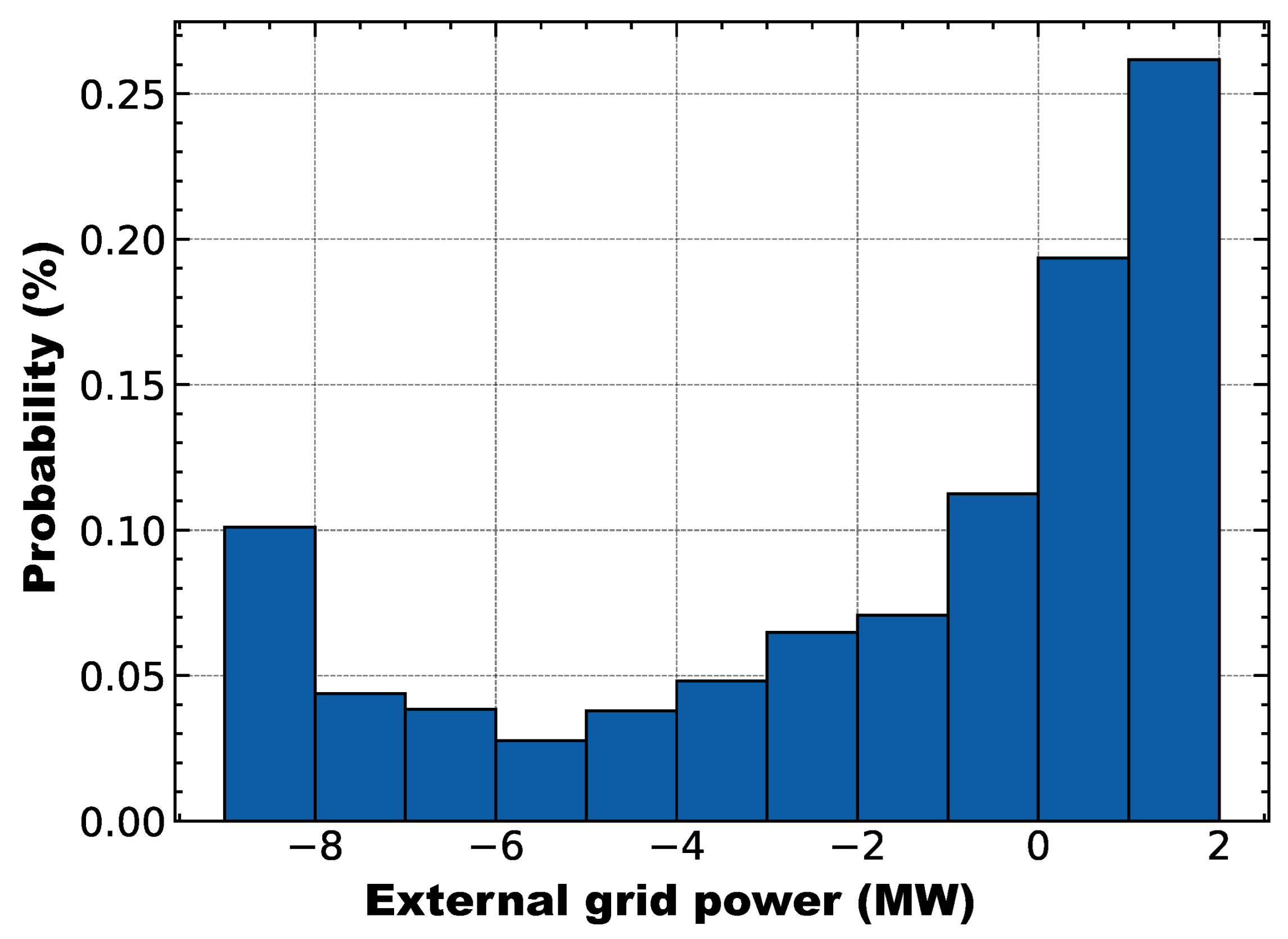
4.1. Generation Adequacy Analysis
4.2. Quasi-Dynamic Analysis
5. Discussion and Conclusions
Author Contributions
Funding
Institutional Review Board Statement
Informed Consent Statement
Data Availability Statement
Acknowledgments
Conflicts of Interest
Abbreviations
| EU | European Union |
| API | Application Programming Interface |
| TSO | Transmission System Operator |
| DSO | Distribution System Operator |
| LiDAR | Light Detection and Ranging |
| GAA | Generation Adequacy Analysis |
| LOLP | Loss of Load Probability |
| EDNS | Estimation of Demand not Supplied |
| EV | Electric Vehicle |
Appendix A
Appendix A.1
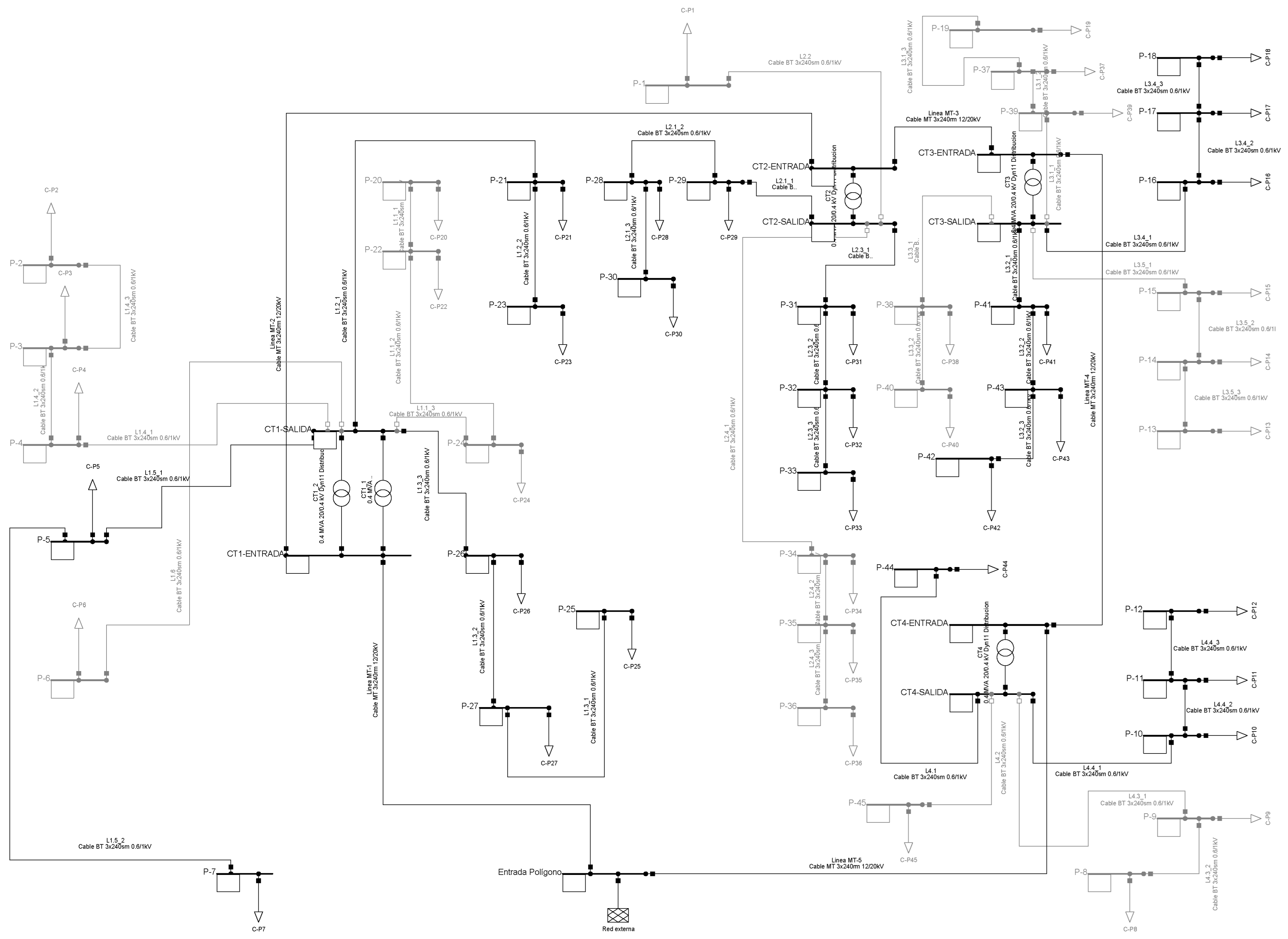

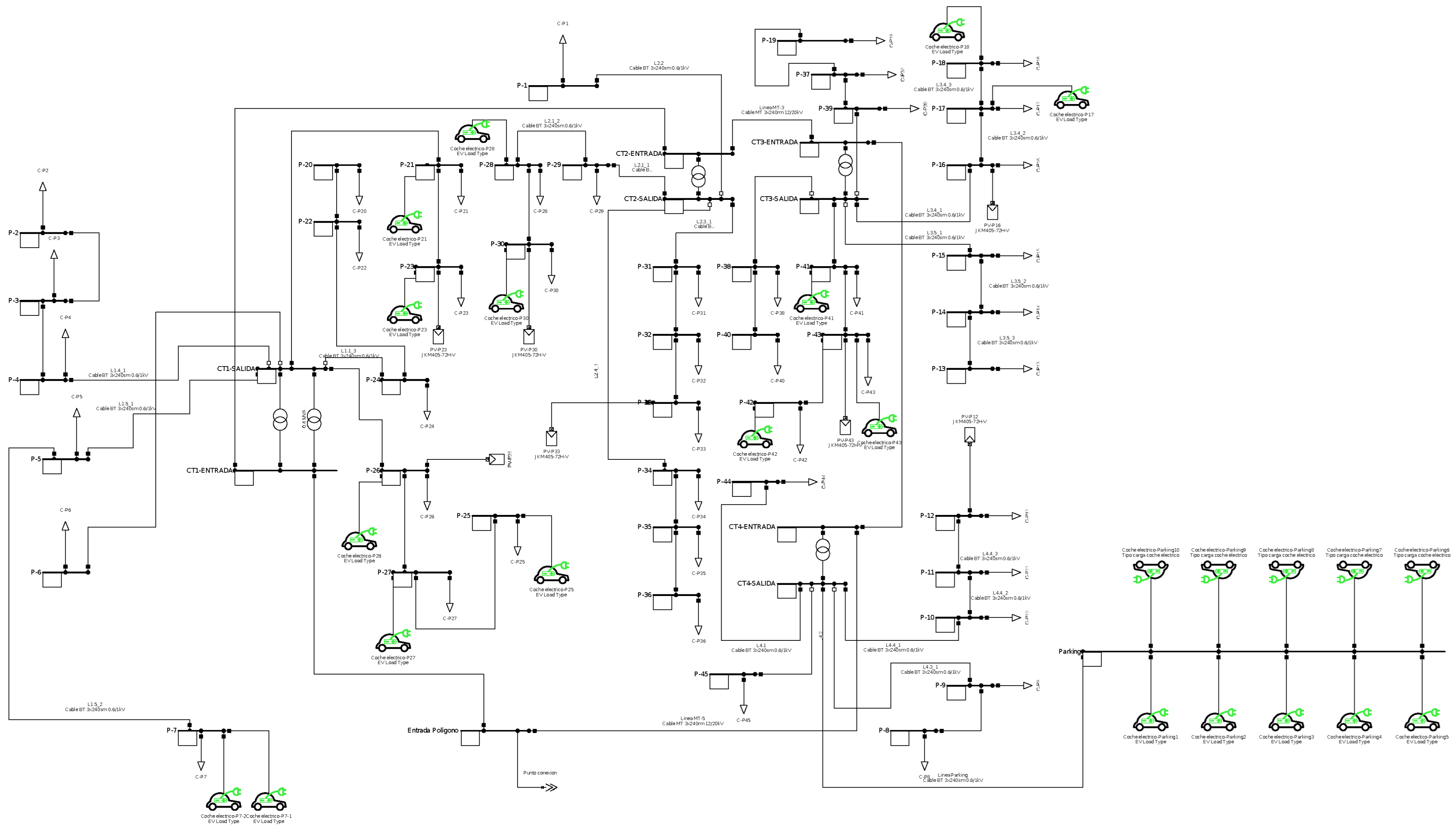
Appendix A.2
Appendix B

| Name | Rated Voltage (kV) | Rated Current (kA) | AC-Resistance () | AC-Reactance () | Nominal Frequency (Hz) |
|---|---|---|---|---|---|
| LV 3 × 240sm 0.6/1 kV | 1 | 0.305 | 0.1266 | 0.069115 | 50 |
| MV 3 × 240rm 12/20 kV | 20 | 0.345 | 0.1281 | 0.097389 | 50 |
| NA2XS(F)2Y 1 × 150RM 12/20 kV | 20 | 0.32 | 0.211 | 0.122208 | 50 |
| Name | Rated Power (MVA) | Nominal Frequency (Hz) | Rated Voltage—HV Side (kV) | Rated Voltage—LV Side (kV) | Configuration | Short-Circuit Voltage (%) | Copper Losses (kW) |
|---|---|---|---|---|---|---|---|
| 0.4 MVA 20/0.4 kV Dyn11 | 0.4 | 50 | 20 | 0.4 | Dyn11 | 6 | 4.8 |
| Transformer Type 2.5 MVA 50 Hz | 2.5 | 50 | 20 | 0.69 | Dyn5 | 6 | 22 |
| Name | Nominal Power (MW) | Hub Height (m) | Cut-In Speed (m/s) | Cut-Out Speed (m/s) | Rated Speed (m/s) | Generator Type |
|---|---|---|---|---|---|---|
| Gamesa G80 | 2 | 78 | 3.5 | 25 | 12 | Type III (DFIG) |
| Name | Material | Peak Power (W) | Rated Voltage (V) | Rated Current (A) | Open Circuit Voltage (V) | Short Circuit Current (A) |
|---|---|---|---|---|---|---|
| JKM405-72H-V | Single crystalline silicon | 405 | 40.42 | 10.02 | 49.4 | 10.69 |
References
- Raimi, D.; Campbell, E.; Newell, R.G.; Prest, B.; Villanueva, S.; Wingenroth, J. Global Energy Outlook 2022: Turning Points and Tension in the Energy Transition; Resources for the Future: Washington, DC, USA, 2022. [Google Scholar]
- Heuberger, C.F.; Bains, P.K.; Mac Dowell, N. The evolution of the power system: A spatio-temporal optimisation model to investigate the impact of electric vehicle deployment. Appl. Energy 2020, 257, 113715. [Google Scholar] [CrossRef] [Scilit]
- International Renewable Energy Agency (IRENA). Available online: https://www.irena.org/Energy-Transition/Technology/Wind-energy (accessed on 21 March 2024).
- Global Wind Energy Council Gobal Report. Available online: https://gwec.net/globalwindreport2023/ (accessed on 20 March 2024).
- Soares-Ramos, E.P.; de Oliveira-Assis, L.; Sarrias-Mena, R.; Fernández-Ramírez, L.M. Current status and future trends of offshore wind power in Europe. Energy 2020, 202, 117787. [Google Scholar] [CrossRef] [Scilit]
- Anuario Eólico (Asociación Empresarial Eólica). Available online: https://aeeolica.org/aee-anuario-2023/ (accessed on 20 March 2024).
- Gao, A.M.Z.; Huang, C.H.; Lin, J.C.; Su, W.N. Review of recent offshore wind power strategy in Taiwan: Onshore wind power comparison. Energy Strategy Rev. 2021, 38, 100747. [Google Scholar] [CrossRef] [Scilit]
- Gao, Y.; Ma, S.; Wang, T.; Gong, Y.; Peng, F.; Tsunekawa, A. Assessing the wind energy potential of China in considering its variability/intermittency. Energy Convers. Manag. 2020, 226, 113580. [Google Scholar] [CrossRef] [Scilit]
- Ren, B.; Jia, Y.; Li, Q.; Wang, D.; Tang, W.; Zhang, S. Robust Wind Power Ramp Control Strategy Considering Wind Power Uncertainty. Electronics 2024, 13, 211. [Google Scholar] [CrossRef] [Scilit]
- Garrido-Perez, J.M.; Ordóñez, C.; Barriopedro, D.; García-Herrera, R.; Paredes, D. Impact of weather regimes on wind power variability in western Europe. Appl. Energy 2020, 264, 114731. [Google Scholar] [CrossRef] [Scilit]
- Garip, S.; Özdemir, Ş.; Altın, N. Power System Reliability Assessment—A Review on Analysis and Evaluation Methods. J. Energy Syst. 2022, 6, 401–419. [Google Scholar] [CrossRef] [Scilit]
- Alimi, O.A.; Ouahada, K.; Abu-Mahfouz, A.M. A Review of Machine Learning Approaches to Power System Security and Stability. IEEE Access 2020, 8, 113512–113531. [Google Scholar] [CrossRef] [Scilit]
- Duchesne, L.; Karangelos, E.; Wehenkel, L. Recent Developments in Machine Learning for Energy Systems Reliability Management. Proc. IEEE 2020, 108, 1656–1676. [Google Scholar] [CrossRef] [Scilit]
- Pishgar-Komleh, S.H.; Keyhani, A.; Sefeedpari, P. Wind speed and power density analysis based on Weibull and Rayleigh distributions (a case study: Firouzkooh county of Iran). Renew. Sustain. Energy Rev. 2015, 42, 313–322. [Google Scholar] [CrossRef] [Scilit]
- Singh, V.; Moger, T.; Jena, D. Uncertainty handling techniques in power systems: A critical review. Electr. Power Syst. Res. 2022, 203, 107633. [Google Scholar] [CrossRef] [Scilit]
- Krupenev, D.; Boyarkin, D.; Iakubovskii, D. Improvement in the computational efficiency of a technique for assessing the reliability of electric power systems based on the Monte Carlo method. Reliab. Eng. Syst. Saf. 2020, 204, 107171. [Google Scholar] [CrossRef] [Scilit]
- Hasan, K.N.; Preece, R.; Milanović, J.V. Existing approaches and trends in uncertainty modelling and probabilistic stability analysis of power systems with renewable generation. Renew. Sustain. Energy Rev. 2019, 101, 168–180. [Google Scholar] [CrossRef] [Scilit]
- Barelli, L.; Ciupageanu, D.A.; Ottaviano, A.; Pelosi, D.; Lazaroiu, G. Stochastic power management strategy for hybrid energy storage systems to enhance large scale wind energy integration. J. Energy Storage 2020, 31, 101650. [Google Scholar] [CrossRef] [Scilit]
- Honrubia-Escribano, A.; Villena-Ruiz, R.; Artigao, E.; Gómez-Lázaro, E.; Morales, A. Advanced teaching method for learning power system operation based on load flow simulations. Comput. Appl. Eng. Educ. 2021, 29, 1743–1756. [Google Scholar] [CrossRef] [Scilit]
- Sun, L.; You, F. Machine learning and data-driven techniques for the control of smart power generation systems: An uncertainty handling perspective. Engineering 2021, 7, 1239–1247. [Google Scholar] [CrossRef] [Scilit]
- Habibi, M.R.; Golestan, S.; Guerrero, J.M.; Vasquez, J.C. Deep Learning for Forecasting-Based Applications in Cyber–Physical Microgrids: Recent Advances and Future Directions. Electronics 2023, 12, 1685. [Google Scholar] [CrossRef] [Scilit]
- Mossa, M.A.; El Ouanjli, N.; Gam, O.; Do, T.D. Enhancing the Performance of a Renewable Energy System Using a Novel Predictive Control Method. Electronics 2023, 12, 3408. [Google Scholar] [CrossRef] [Scilit]
- Lund, T.; Eek, J.; Uski, S.; Perdana, A. Dynamic fault simulation of wind turbines using commercial simulation tools. In Proceedings of the 5th International Workshop on Large-Scale Integration of Wind Power and Transmission Networks for Offshore Wind Farms, Glasgow, UK, 7–8 April 2005; pp. 238–246. [Google Scholar]
- López, C.D.; Rueda Torres, J.L. Python scripting for DIgSILENT PowerFactory: Leveraging the Python API for scenario manipulation and analysis of large datasets. In Advanced Smart Grid Functionalities Based on PowerFactory; Springer: Cham, Switzerland, 2018; pp. 19–48. [Google Scholar]
- Jimenez-Ruiz, J.; Honrubia-Escribano, A.; Gómez-Lázaro, E. Use of Python Programming Language for Solving Practical Problems Related to Electrical Engineering. In Proceedings of the 18th International Technology, Education and Development Conference, Valencia, Spain, 4–6 March 2024; pp. 562–569. [Google Scholar]
- Xie, Y.; Hou, Y.; Zhang, D.; Wen, T.; Jiang, X. Power System Frequency Dynamic Simulation Analysis and Tool Development of PSS/E. In Proceedings of the IEEE 2nd International Conference on Information Technology, Big Data and Artificial Intelligence (ICIBA), Chongqing, China, 17–19 December 2021; pp. 667–672. [Google Scholar]
- Cañas-Carretón, M.; Honrubia-Escribano, A. Coordinated teaching of power system simulation in a university multicampus structure. In Proceedings of the 17th International Technology, Education and Development Conference, Valencia, Spain, 6–8 March 2023; pp. 7389–7397. [Google Scholar]
- Mehendale, N.; Neoge, S. Review on Lidar Technology. SSRN 2020. [Google Scholar] [CrossRef] [Scilit]
- Albornoz, C.P.; Soberanis, M.E.; Rivera, V.R.; Rivero, M. Review of atmospheric stability estimations for wind power applications. Renew. Sustain. Energy Rev. 2022, 163, 112505. [Google Scholar] [CrossRef] [Scilit]
- Castro, P.F.; Rodriguez, Y.P.M.; Carvalho, F.B. Application of Generation Adequacy Analysis for Reliability Evaluation of a Floating Production Storage and Offloading Platform Power System. Energies 2022, 15, 5336. [Google Scholar] [CrossRef] [Scilit]




| Iteration | Load | |||||
|---|---|---|---|---|---|---|
| 1 | 100 | 100 | 200 | 175 | 0 | ✗ |
| 2 | 50 | 50 | 100 | 175 | 75 | ✓ |
| 3 | 75 | 50 | 125 | 150 | 25 | ✓ |
Disclaimer/Publisher’s Note: The statements, opinions and data contained in all publications are solely those of the individual author(s) and contributor(s) and not of MDPI and/or the editor(s). MDPI and/or the editor(s) disclaim responsibility for any injury to people or property resulting from any ideas, methods, instructions or products referred to in the content. |
© 2024 by the authors. Licensee MDPI, Basel, Switzerland. This article is an open access article distributed under the terms and conditions of the Creative Commons Attribution (CC BY) license (https://creativecommons.org/licenses/by/4.0/).
Share and Cite
Jiménez-Ruiz, J.; Honrubia-Escribano, A.; Gómez-Lázaro, E. Combined Use of Python and DIgSILENT PowerFactory to Analyse Power Systems with Large Amounts of Variable Renewable Generation. Electronics 2024, 13, 2134. https://doi.org/10.3390/electronics13112134
Jiménez-Ruiz J, Honrubia-Escribano A, Gómez-Lázaro E. Combined Use of Python and DIgSILENT PowerFactory to Analyse Power Systems with Large Amounts of Variable Renewable Generation. Electronics. 2024; 13(11):2134. https://doi.org/10.3390/electronics13112134
Chicago/Turabian StyleJiménez-Ruiz, Javier, Andrés Honrubia-Escribano, and Emilio Gómez-Lázaro. 2024. "Combined Use of Python and DIgSILENT PowerFactory to Analyse Power Systems with Large Amounts of Variable Renewable Generation" Electronics 13, no. 11: 2134. https://doi.org/10.3390/electronics13112134
APA StyleJiménez-Ruiz, J., Honrubia-Escribano, A., & Gómez-Lázaro, E. (2024). Combined Use of Python and DIgSILENT PowerFactory to Analyse Power Systems with Large Amounts of Variable Renewable Generation. Electronics, 13(11), 2134. https://doi.org/10.3390/electronics13112134