Abstract
Hemoglobin is an essential parameter in human blood. This paper proposes a non-invasive hemoglobin concentration measurement method based on the characteristic parameters of four-wavelength photoplethysmography (PPG) signals combined with machine learning. The DCM08 sensor and NRF52840 chip form a data acquisition system to collect 58 human fingertip photoelectric volumetric pulse wave signals. The 160 four-wavelength PPG signal feature parameters were constructed and extracted. The feature parameters were screened by combining three feature selection methods: reliefF, Chi-square score, and information gain. The top 10, 20, and 30 features screened were used as input to evaluate the prediction performance of different feature sets for hemoglobin. The prediction models used were XGBoost, support vector machines, and logistic regression. The results showed that the optimal performance of the 30 feature sets screened using the Chi-square test was achieved by the XGBoost model with a coefficient of determination () of 0.997, root mean square error (RMSE) of 0.762 g/L, and mean absolute error (MAE) of 0.325 g/L. The study showed that the four-wavelength-based PPG signal feature parameters with the XGBoost algorithm could effectively achieve non-invasive detection of hemoglobin, providing a new measurement method in clinical practice.
1. Introduction
Hemoglobin (Hb) is one of the important components of red blood cells. It consists of four protein molecules called globulin chains, each of which contains an important central structure called the hemoglobin molecule, embedded in iron [1]. Hb is a crucial indicator of anemia, blood loss, and other body symptoms. The primary function of hemoglobin is to deliver oxygen to the whole body [2]. According to the World Health Organization (WHO), an estimated 1.6 billion people, approximately 30% of the total population, are suffering from anaemia. This vulnerable group of anaemia includes pregnant women, preschool children, and teenagers [3]. The general symptoms of anemia are tiredness, lethargy, weakness, pale lips, shortness of breath, slippery tongue, increased heart rate, loss of appetite, dizziness, and lethargy [4]. Therefore, the detection of Hb is essential for preventing and diagnosing related diseases.
Current assays for hemoglobin concentration include mainly invasive and minimally invasive methods, both of which require collecting a blood sample from the subject, which can be painful for the issue. At the same time, there is a risk of cross-infection, the need for professionals to operate, and the inability to detect in real time. The emergence of noninvasive testing technology is a better solution to the above problems, and currently, noninvasive hemoglobin testing is mainly based on photoplethysmography (PPG). PPG is another signal that reflects the state of the cardiovascular system, and has received a great deal of attention in recent years due to its ease regarding collection, small sensor size, and non-invasiveness [5]. The pulse wave is highly critical in human life and health detection and contains rich physiological information. The human pulse wave signal is collected, and the PPG signal is processed in various ways to extract useful human physiological information. In addition, it is of great significance for detecting related diseases. PPG can be used not only to assess hemoglobin levels but also to evaluate several aspects, such as SPO2 [6], heart rate estimation [7], respiratory rate [8], continuous blood pressure measurement [9], sleep assessment [10], and arrhythmia detection [11]. Thus, clinical monitoring of PPG and hemoglobin parameters provides a timely diagnostic reference for the disease and can be used for subsequent studies on various disease and physiological state assessment methods. With the development of machine learning, scholars have conducted much research on non-invasive hemoglobin detection methods based on machine learning. Kavsaoglu et al. proposed a non-invasive method for predicting hemoglobin that utilizes features of the PPG signal using classification and regression trees (CART), least squares regression (LSR), support vector regression (SVR), and eight other machine learning regression methods. The results showed good results using RFS feature selection method combined with SVR (MSE = −0.0027) [12]. Acharya et al. used a Multi-Model Stacking Regressor such as Selection Operator (LASSO), Ridge, Elastic Net, and five other machine learning methods to achieve non-invasive hemoglobin prediction. They suggest that this approach could form the basis of a public health screening tool for the detection and treatment of maternal anaemia and could complement global health intervention strategies [13]. Lakshmi et al. used PPG signals and a generalized linear regression technique to monitor hemoglobin levels in pregnant women. They showed an absolute deviation of 0.73 g/dL between the predicted and actual hemoglobin concentration values [14]. Pinto et al. applied Multivariate Partial Least Square Regression (PLSR) to predict hemoglobin concentration and validated the designed system by Bland–Altman analysis, which showed good agreement between predicted hemoglobin and reference hemoglobin [15].
In this paper, the four-wavelength pulse wave signals of fingertips were collected by photoelectric sensors, 160 morphological feature parameters based on the four-wavelength pulse wave signals were constructed and extracted, and then the main feature parameters were screened using reliefF, Chi-square Score, and Information Gain. Next, the hemoglobin concentration was predicted using XGBoost, support vector machine regression (SVR), and logistic regression (LR) models with the screened feature set as input. Finally, the prediction performance was evaluated using RMSE, , and MAE.
2. Materials and Methods
2.1. Four-Wavelength Non-Invasive Hemoglobin Testing System Design
2.1.1. Hardware System
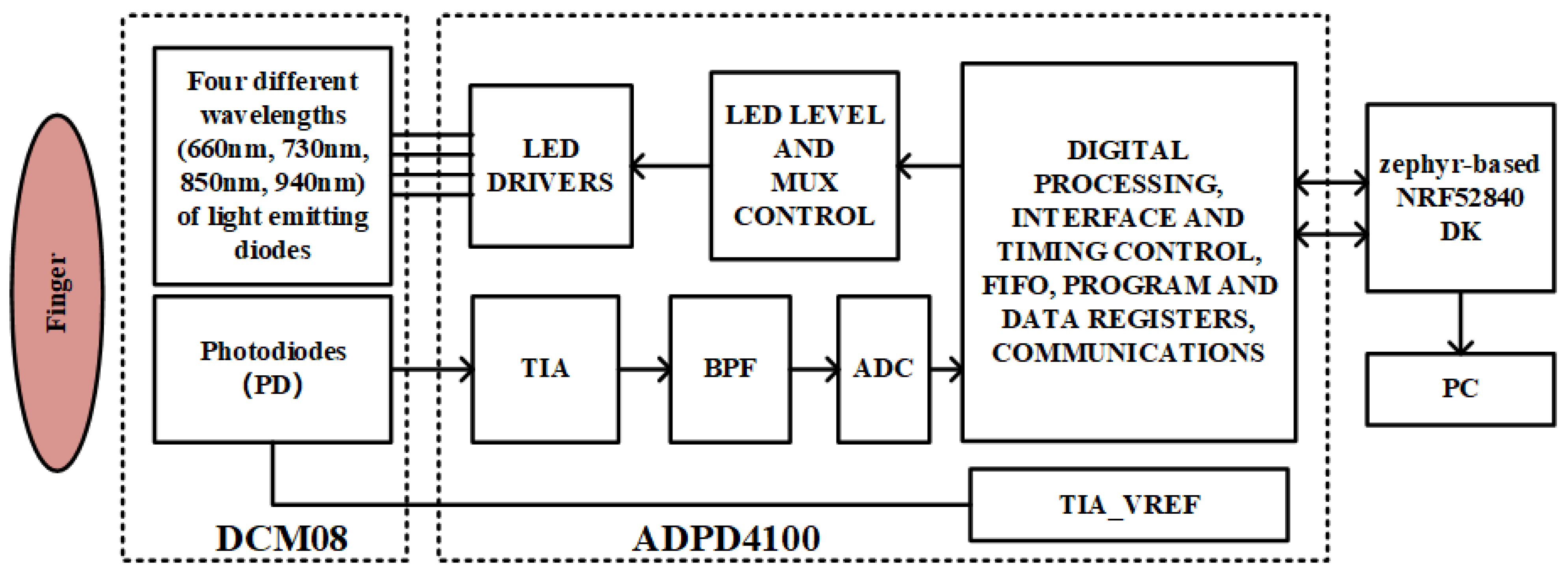
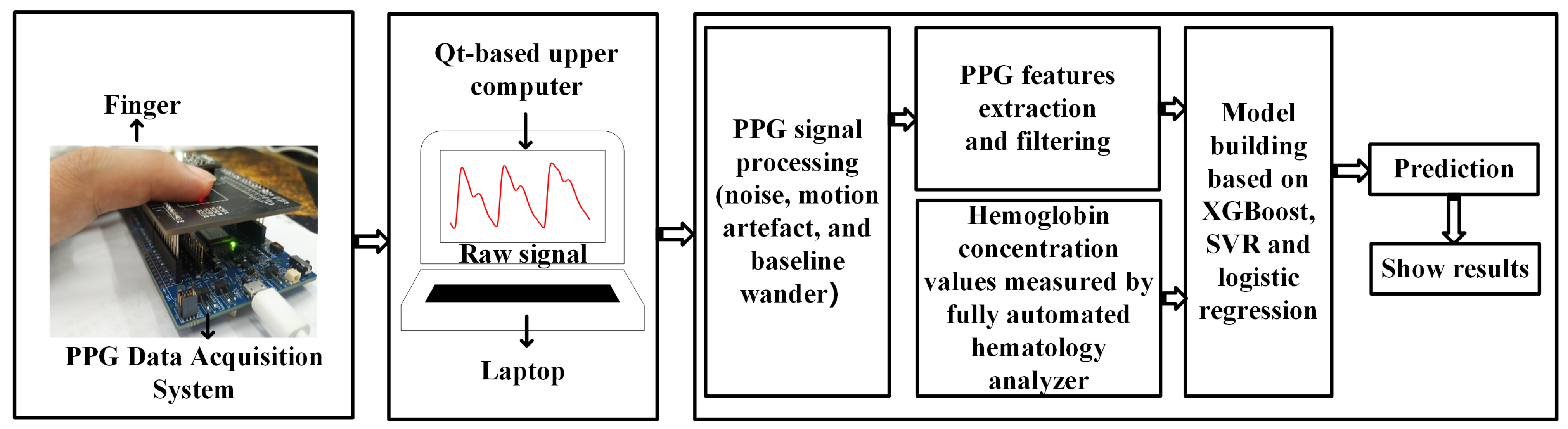
This paper uses a four-wavelength reflective oxygen sensor DCM08 for finger-end pulse wave signal detection at 660 nm, 730 nm, 850 nm, and 940 nm. The four-wavelength acquisition system combines ADPD4100, a multi-mode sensor analog front-end chip from ADI, and NRF52840, an ultra-low-power Bluetooth from Nordic. As a complete multi-mode sensor front-end chip, the ADPD4100 can excite up to eight light-emitting diodes and measure the return signals of up to eight independent current inputs while suppressing signal shifts and corruption from asynchronous modulated interference from ambient light, eliminating the need for filters or externally controlled DC offset circuits. In addition, the acquisition system is equipped with the zephyr real-time operating system. Zephyr is a lightweight open-source operating system for the Internet of Things, targeted at building a small, tailorable real-time operating system (RTOS) for resource-constrained devices, providing a low footprint, high-performance, multi-threaded execution environment. The block diagram of the described four-wavelength PPG signal acquisition system is shown in Figure 1. The ADPD4100 provides current excitation for the four LEDs of the DCM08 and starts four time slots to control the four wavelengths of the DCM08 in turn, which are then transmitted through the SPI interface. First, the raw pulse wave data are pre-processed, and then the four wavelengths are sent to the PC host computer by the serial port. The system framework of the specific design is shown in Figure 2.
Figure 1.
PPG signal acquisition experimental system.
Figure 2.
Block diagram of a four-wavelength PPG signal acquisition system.
2.1.2. Software Design for the Host Computer
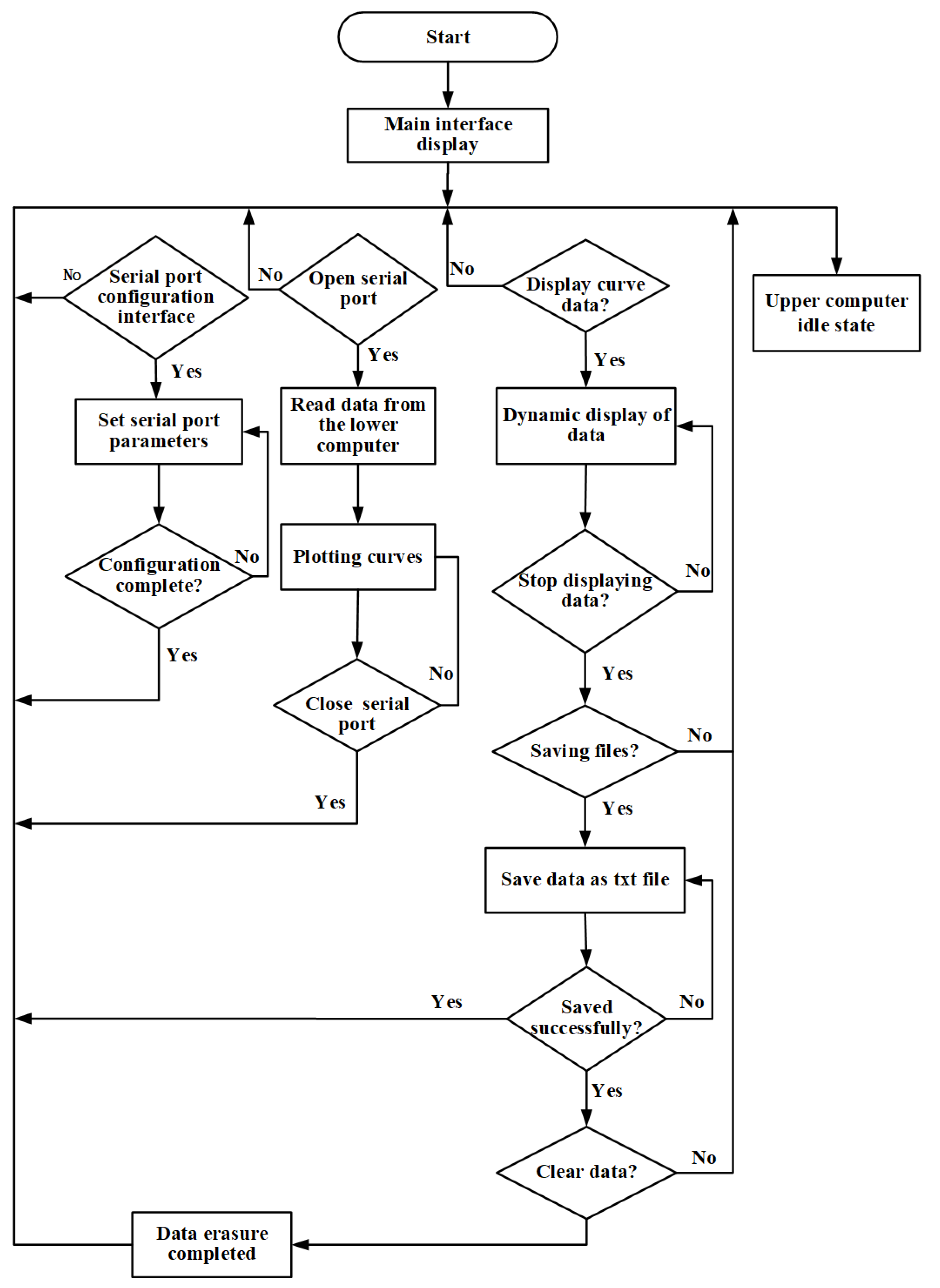
In this study, Qt Creator implements the upper computer software, which displays and stores the four pulse wave signals transmitted by the serial port for subsequent processing and calculation. Figure 3 shows the program workflow diagram.
Figure 3.
The program workflow diagram.
2.2. Data Collection and Preprocessing
2.2.1. Data Collection
The experimental measurement subjects were 58 volunteers recruited for this project to the University Hospital of the Guilin University Of Electronic Technology for routine physical examination, with an age range from 21 to 27 years old; the male-to-female ratio was about 1:1, and the volunteers signed an informed consent form and received approval from the University’s Medical Research Ethics Committee to participate in the test. A self-designed four-wavelength PPG detection device collected the volumetric pulse signal from each volunteer’s fingertip. Volunteers fasted from 9:00 p.m. the night before until the end of the experiment the following day. The pulse wave signal was collected at a sampling rate of 200 Hz for 1 min, and the data were through the host computer. Immediately after each subject’s measurement, a venous blood sample is drawn from the volunteer and analyzed by the hospital’s fully automated hematocrit analyzer to obtain the corresponding invasive hemoglobin assay value, which is used as a reference value for constructing the model.
2.2.2. Data Preprocessing
The PPG signal is low-frequency, generally between 0.2 and 10 Hz. In this paper, a second-order Butterworth bandpass filter from 0.25 Hz to 10 Hz is designed and implemented in the hardware system to filter the original pulse wave signal to remove high-frequency noise, motion artifacts, and baseline drift from the call, and the processed data are transmitted to the host computer by the serial port. Before feature extraction, the acquired data need to be screened for completeness and availability as well as signal quality assessment, and Mohamed et al. proposed signal quality indices skewness () as the best method to evaluate the quality of PPG signals, which can effectively distinguish between good, acceptable, and noisy signals [16,17]. Meanwhile, the method is very suitable for wearable health devices because of its real-time processing and low computing power. Therefore, this paper uses the bias method to analyze and judge the quality of the collected PPG signals.
2.3. PPG Signal Feature Extraction and Selection
2.3.1. Feature Extraction
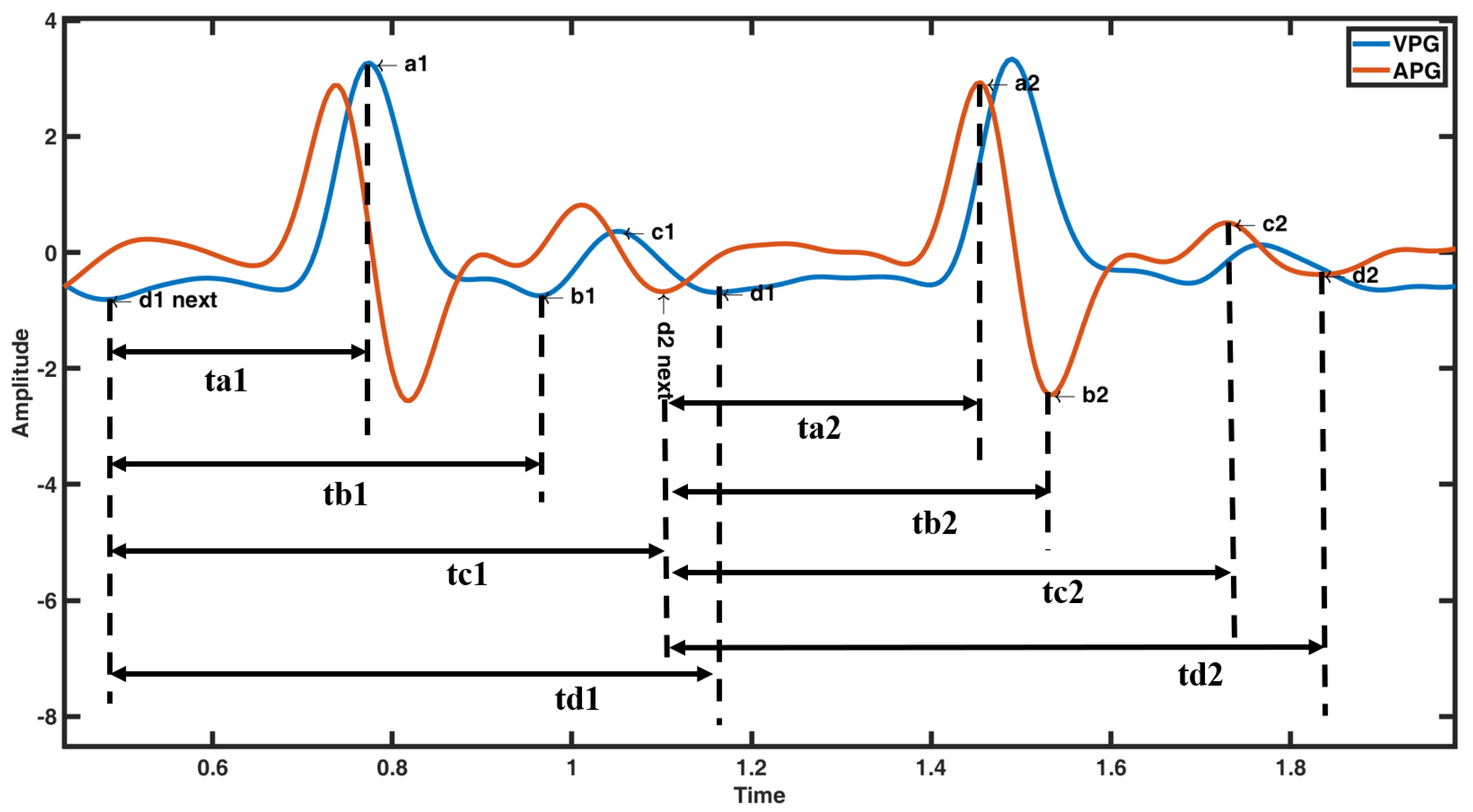
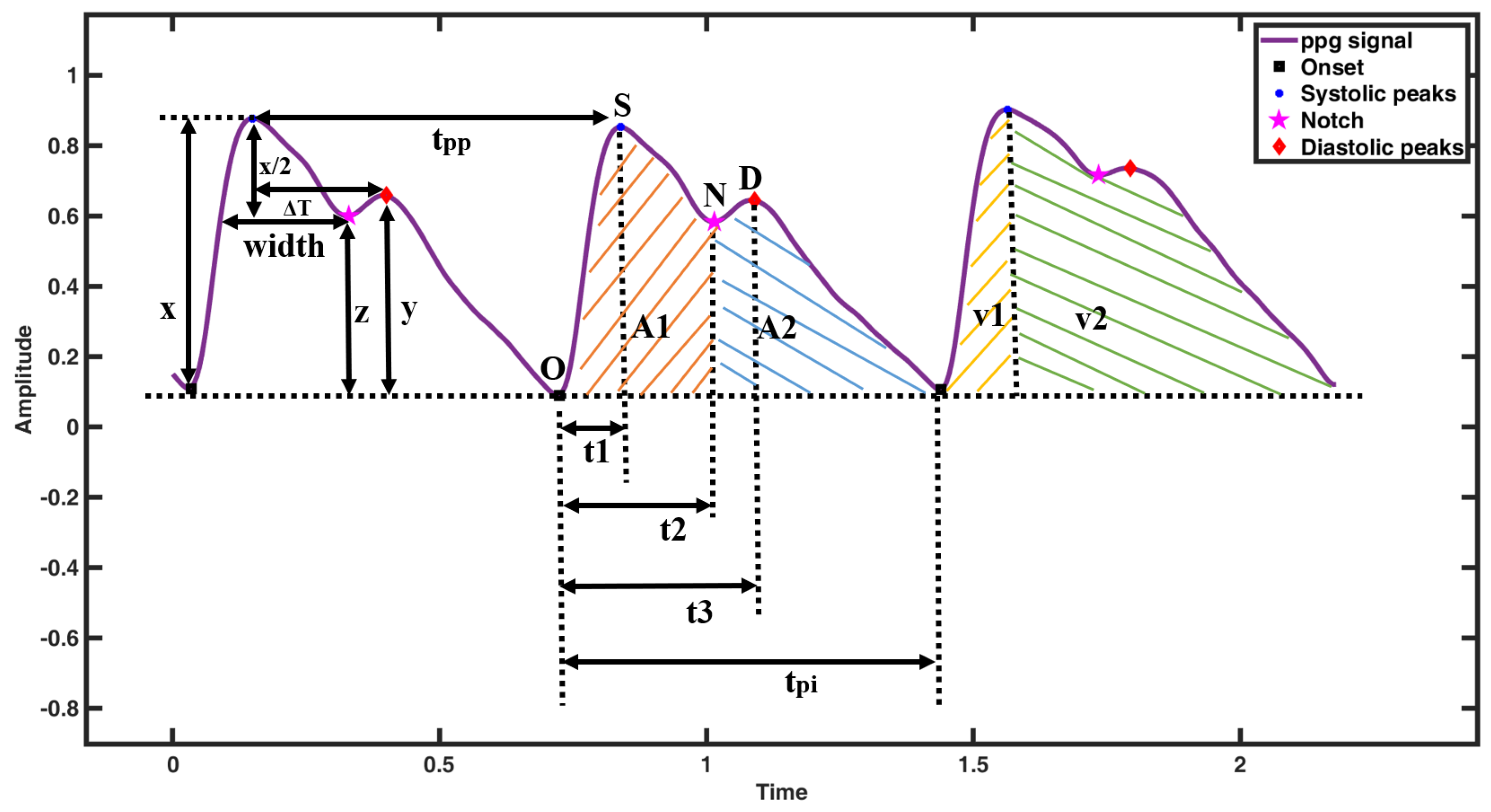
After the signal pre−processing is finished, the signal feature extraction can be carried out, mainly from the morphological and time−domain parts of the PPG signal. First, they analyzed the PPG waveforms corresponding to the long sequence in each of the four channels as the period splitting points, thus locating the feature points in different periods, as shown in Figure 4. In the PPG waveform of one cycle, ”O” is called Onset, ”S” is called Systolic Peak, “N” is called Notch, D is called Diastolic Peak, “a1 wave(a1)”, “b1 wave(b1)”, “c1 wave(c1)”, “d1 wave(d1)” in VPG waveform, “a2 wave(a2)”, “b2 wave(b2)”, “c2 wave(c2)”, and “d2 wave(d2)” in APG waveform. According to the literature [18], the definition of the waveform characteristic points. Then, the extraction of PPG waveforms and first–order derivative and second–order derivative feature information in one complete cycle is completed, as shown in Figure 5. Forty feature parameters are extracted for each channel, and the detailed feature information is shown in Table 1. In addition, 160 features are constructed and extracted in total for the four channels.
Figure 4.
The characteristic features obtained from the PPG signal.
Figure 5.
The characteristic features acquired from APG and VPG.
Table 1.
Features acquired in PPG signal.
2.3.2. Feature Selection
Feature selection is an essential step in model building. In machine learning, the greater the number of features, the more irrelevant features will exist, and the correlation between components and degree of importance to the detection target varies greatly. Through feature importance selection, we can eliminate irrelevant, redundant, and non-drawable features, thus reducing the number of features, training time, and model robustness. Therefore, in this study, three feature importance selection methods [20], namely reliefF, Chi-square Score, and Information Gain, were used, and the top 10, 20, and 30 features of the entire feature set were screened as inputs, respectively, and applied to the regression model for prediction, and analyze and discuss the differences in the performance of the different number of features in regression prediction.
2.4. Hemoglobin Regression Model Selection
In this study, three prediction models with different regression principles, logistic regression (LR), support vector regression (SVR), and eXtreme Gradient Boosting(XGBoost) were used. Determination coefficient (), root mean square error (RMSE), and mean absolute error (MAE) can be used to evaluate regression prediction performance.
2.4.1. LR
Logistic regression models are widely used and have powerful explanatory powers and have been used to describe phenomena in diverse medical and nonmedical research areas. Similar to other regression models, logistic regression models are often used to assess predictors and regulate confusion and interactions [21]. The feature-to-result mapping process adds a layer of function mapping. The sigmoid function uses the sigmoid function to constrain the linear sum to between (0,1), and the resultant values can be used for binary classification or regression prediction.
2.4.2. SVR
Smola [22] proposed Support Vector Regression (SVR) in 1998, a machine learning method based on statistical VC dimensionality theory and structural risk minimization criteria. It has a high degree of generalization and can solve practical problems such as small sample size, high dimensionality, strong nonlinearity, and local extrema [23]. Furthermore, unlike other regression methods, support-vector regression chooses the regression function by minimizing some observational errors [24].
2.4.3. XGBoost
The XGBoost algorithm [25] is an integrated learning algorithm based on boosting. It is developed based on the gradient-boosting decision tree (GBDT) algorithm [26]. As a result, its speed and precision have increased. In addition, the XGBoost algorithm expands the cost function by introducing regularization to avoid overfitting. In the field of machine learning, it is a good and widely used algorithm. Furthermore, developing specialized medical databases, such as the Medical Information Mart for Intensive Care III (MIMIC-III database), facilitates data extraction and analysis for ML models [27].
3. Results and Discussion
In this study, 58 samples were collected, with 60 to 90 PPG signal cycles in each piece of 1-minute data. In addition, a randomly selected 70% of the heartbeat cycles of each instance were for training and the remaining 30% were for testing, and each sample’s training and testing cycles were pooled together to form the training and testing sets, respectively. To better reflect the performance differences of different feature numbers, different feature importance selection methods, and different regression prediction models for noninvasive hemoglobin detection, the prediction performance results achieved by each heartbeat cycle are compiled in Table 2 for comparative analysis.
Table 2.
Prediction accuracy of three regression models under three feature selection methods under different numbers of features.
From the results, it can be seen that the prediction accuracy of the three models increases with the increase in the number of features, and the detection error gradually decreases. It indicates that the introduced feature parameters significantly improve the prediction accuracy of hemoglobin concentration, and the accuracy of all three feature selection methods is the highest, with some 30 features. The prediction accuracy of the XGBoost regression model is the highest for the other two models, and the prediction accuracy of all three regression models is better than the results of the other two feature selection methods under the Chi-square Score feature selection method. In addition, the XGBoost regression model achieved the most petite MAE of 0.325 g/L. Therefore, overall, higher hemoglobin prediction performance could be achieved using the Chi-square filtered 30 features combined with the XGBoost regression model.
The 30 key features screened based on the Chi-square feature selection method are specified in Table 3.
Table 3.
Characteristic results of Chi-square method selection.
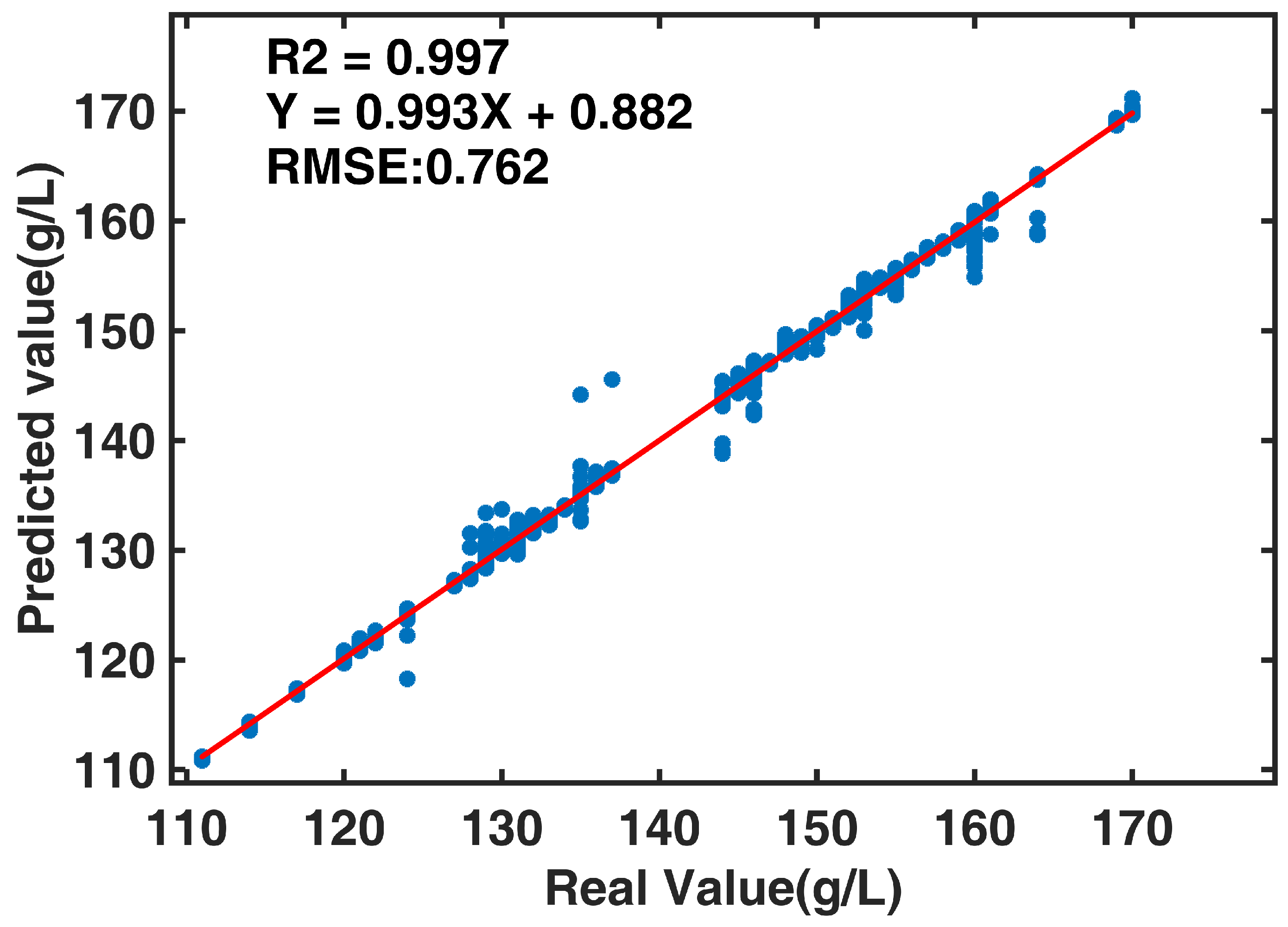
Figure 6 shows the scatter plot of hemoglobin reference values and the XGBoost regression model predicted values under 30 key characteristic parameters. The horizontal coordinate is the actual hemoglobin value of the fully automated hematology analyzer, and the vertical coordinate is the XGBoost regression model hemoglobin predicted value. The correlation analysis of the valid and predicted values showed that the slope is 0.993, is 0.997, and MAE is 0.762 g/L.
Figure 6.
Fitting chart of the real value of hemoglobin and predicted value of the XGBoost regression model.
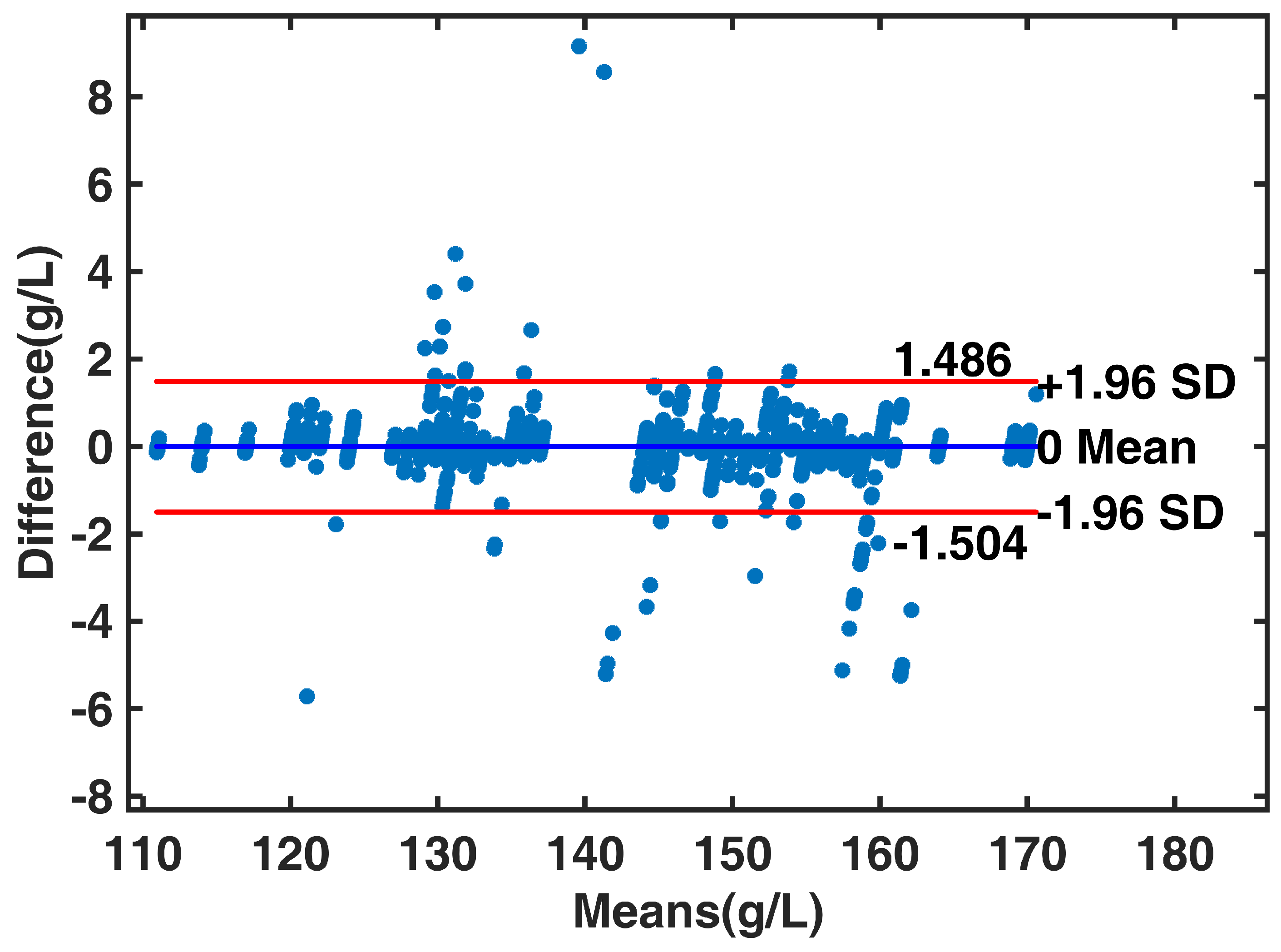
The Bland–Altman plot in biomedicine is a data plotting method used to assess the difference between a new and a standard procedure and to analyze the agreement between two different assays. This paper uses Bland–Altman plots to achieve consistent analysis of hemoglobin values. The horizontal axis of the field represents the mean value of the results of each sample measured by the two methods, and the vertical axis represents the difference between the results of the two methods. The upper and lower horizontal lines indicate the upper and lower limits of the 95% consistency limits, i.e., 1.96 times the standard deviation; the middle horizontal solid line indicates the position where the mean value of the difference is 0. The Bland–Altman plots of the XGBoost regression model with 30 key parameters are shown in Figure 7, and most of the sample data are within the consistency limits, with 95% consistency limits of (−1.504, 1.486) g/dL.
Figure 7.
Bland–Altman diagram of XGBoost regression model for predicting hemoglobin concentration.
This paper provides an idea for achieving noninvasive detection of hemoglobin, and Table 4 compares the proposed method with the existing literature. Ghosal et al. [28] proposed to collect conjunctival images of the right and left eyes of 65 subjects using a smartphone camera and proposed the FANIAD image processing algorithm model to assess hemoglobin levels. The model achieved an accuracy of ±0.32 g/dL, a sensitivity of 89%, and an of 0.8774 for the left eye and 0.8144 for the right eye. Saracoglu et al. [29] used a Radical-7 Pulse CO-Oximeter (Massimo Corporation, Irvine, CA, USA) to continuously monitor 42 patients The impact of hemoglobin measurement on patients during and after surgery was evaluated, concluding that monitoring hemoglobin levels intraoperatively allowed for less postoperative site bleeding and reduced patient length of stay in the ICU, with accuracy and coefficient of determination not mentioned. Fan et al. [30] proposed a smartphone-based acquisition of 24 fingertip images from normal and anemic populations at five wavelengths. First, the images were extracted for the PPG signal. Then, a multiple linear regression algorithm was used to achieve prediction with an of 0.880 and an RMSE of 9.04. Hardyanto et al. [31] used 660 nm and 940 nm LEDs to acquire PPG signals from nine subjects for analysis. The experimental results yielded an accuracy of 94.2% for this noninvasive hemoglobin measurement device, with a standard deviation being 4.7. Pinto et al. [32] developed a noninvasive hemoglobin measurement device using an Arduino Uno embedded development board to control five light-emitting diodes with wavelengths of 670 nm, 770 nm, 810 nm, 850 nm, and 950 nm, respectively. Data from 15 subjects were collected for analysis, and after LED power normalization, the accuracy reached 98.29%, RMSE was reduced to 0.36 gm/dL, and was 0.981. All of these methods achieved noninvasive detection of hemoglobin, and the predicted results were evaluated using different indicators. As can be seen from the table, more volunteers were recruited in this study than in the literature [29,30,31,32], indicating that the experimental data in this paper have some reliability. For the index, compared with the literature [28,30,32], the of this paper is closest to 1, indicating that the XGboost algorithm proposed in this paper improves the generalization ability of the model. For the RMSE index, the RMSE of this paper is the smallest compared with that of the literature [30]. The RMSE of this paper is 0.402 more than that of the literature [32], which indicates that the prediction error of hemoglobin by the system in this paper needs to be further reduced, which is also a shortcoming of the method in this paper. However, in general, this paper’s experimental results have improved performance.
Table 4.
Comparison of the proposed methodology with the existing literature.
4. Conclusions
The PPG acquisition system combining the four-wavelength DCM08 blood oxygen sensor and the analog front-end chip ADPD4100 was designed to perform the human fingertip hemoglobin detection study. First, the hemoglobin prediction model was established by extracting the feature parameters of the four channels’ high-quality PPG waveforms. Then, different feature parameters were filtered into other regression models using reliefF, Chi-square, and InfoGain feature selection methods to determine the optimal model and key feature parameters. Chi-square, a feature selection algorithm that screened 30 feature quantities, has the best prediction result, is 0.997, and RMSE is 0.762 g/L, which indicates that this model has good generalization ability and accuracy. The results of the experiments show that the XGBoost-based noninvasive hemoglobin prediction model established in this paper has certain reliability and research value, which is helpful for the improvement and broad application of continuous noninvasive hemoglobin measurement methods and can be expected to be used for the diagnosis of early anemia. Suppose the proposed XGBoost algorithm is put into the upper computer software. In that case, the prediction of hemoglobin will be more convenient and intelligent, or the collected data will be transferred to the cloud for processing, and the results will be returned to the upper computer software for display, which will make the system function more diversified. In addition, more than the sample size collected in this paper is needed. Therefore, we will expand the sample size and widen the range of sample data in future research work to further study the regression modeling algorithm, train the model continuously, improve the generalization ability of the model, make our detection system have more data support, and make the experimental results more reliable and based.
Author Contributions
Y.L. designed the study. Z.C., H.Q., W.G., S.L. and Y.L. conceived the study, provided directions, feedback, and/or revised the manuscript. Y.L. led the investigation and drafted the manuscript for submission with revisions and feedback from the contributing authors. All authors have read and agreed to the published version of the manuscript.
Funding
This research was supported by the Guangxi Innovation Driven Development Project (Guike AA19254003), the National Natural Science Foundation of China (62101148), the Natural Science Foundation of Guangxi (2020GXNSFBA297156), the National Major Research Instrument Development Project of the NSFC (Grant No. 61627807), and the Innovation Project of GUET Graduate Education (Grant No. 2022YCXS222 and Grant No. 2022YCXB08).
Institutional Review Board Statement
Not applicable.
Informed Consent Statement
Not applicable.
Data Availability Statement
The data used in this manuscript can be downloaded from this link https://figshare.com/articles/dataset/Hemoglobin_detection_based_on_four-wavelength_PPG_signal_zip/22256143 (accessed on 12 February 2023).
Conflicts of Interest
The authors declare no conflict of interest.
References
- Pintavirooj, C.; Ni, B.; Chatkobkool, C.; Pinijkij, K. Noninvasive portable hemoglobin concentration monitoring system using optical sensor for anemia disease. Healthcare 2021, 9, 647. [Google Scholar] [CrossRef]
- Jensen, F.B.; Fago, A.; Weber, R.E. Hemoglobin structure and function. Fish Physiol. 1998, 17, 1–40. [Google Scholar]
- Pinto, C.; Parab, J.; Naik, G. Non-invasive hemoglobin measurement using embedded platform. Sens. Bio-Sens. Res. 2020, 29, 100370. [Google Scholar] [CrossRef]
- Munira, L.; Viwattanakulvanid, P. Influencing Factors and Knowledge Gaps on Anemia Prevention among Female Students in Indonesia. Int. J. Eval. Res. Educ. 2021, 10, 215–221. [Google Scholar] [CrossRef]
- Tang, Q.; Chen, Z.; Ward, R.; Menon, C.; Elgendi, M. Subject-Based Model for Reconstructing Arterial Blood Pressure from Photoplethysmogram. Bioengineering 2022, 9, 402. [Google Scholar] [CrossRef] [PubMed]
- Tamura, T. Current progress of photoplethysmography and SPO2 for health monitoring. Biomed. Eng. Lett. 2019, 9, 21–36. [Google Scholar] [CrossRef]
- Kumar, A.; Komaragiri, R.; Kumar, M. A review on computation methods used in photoplethysmography signal analysis for heart rate estimation. Arch. Comput. Methods Eng. 2022, 29, 921–940. [Google Scholar]
- Touw, H.R.; Verheul, M.H.; Tuinman, P.R.; Smit, J.; Thone, D.; Schober, P.; Boer, C. Photoplethysmography respiratory rate monitoring in patients receiving procedural sedation and analgesia for upper gastrointestinal endoscopy. J. Clin. Monit. Comput. 2017, 31, 747–754. [Google Scholar] [CrossRef] [PubMed]
- El-Hajj, C.; Kyriacou, P.A. A review of machine learning techniques in photoplethysmography for the non-invasive cuff-less measurement of blood pressure. Biomed. Signal Process. Control 2020, 58, 101870. [Google Scholar] [CrossRef]
- Huttunen, R.; Leppanen, T.; Duce, B.; Oksenberg, A.; Myllymaa, S.; Toyras, J.; Korkalainen, H. Assessment of obstructive sleep apnea-related sleep fragmentation utilizing deep learning-based sleep staging from photoplethysmography. Sleep 2021, 44, zsab142. [Google Scholar] [CrossRef] [PubMed]
- Sardana, H.; Dogra, N.; Kanawade, R. Dynamic time warping based arrhythmia detection using photoplethysmography signals. Signal Image Video Process. 2022, 16, 1925–1933. [Google Scholar]
- Kavsaoğlu, A.R.; Polat, K.; Hariharan, M. Non-invasive prediction of hemoglobin level using machine learning techniques with the PPG signal’s characteristics features. Appl. Soft Comput. 2015, 37, 983–991. [Google Scholar] [CrossRef]
- Acharya, S.; Swaminathan, D.; Das, S.; Kansara, K.; Chakraborty, S.; Kumar, D.; Francis, T.; Aatre, K.R. Non-invasive estimation of hemoglobin using a multi-model stacking regressor. IEEE J. Biomed. Health Inform. 2019, 24, 1717–1726. [Google Scholar] [CrossRef]
- Lakshmi, M.; Manimegalai, P.; Bhavani, S. Non-invasive haemoglobin measurement among pregnant women using photoplethysmography and machine learning. J. Phys. Conf. Ser. 2020, 1432, 012089. [Google Scholar] [CrossRef]
- Pinto, C.; Parab, J.; Sequeira, M.; Naik, G. Development of Altera NIOS II Soft-core system to predict total Hemoglobin using Multivariate Analysis. J. Phys. Conf. Ser. 2021, 1921, 012039. [Google Scholar] [CrossRef]
- Liang, Y.; Chen, Z.; Liu, G.; Elgendi, M. A new, short-recorded photoplethysmogram dataset for blood pressure monitoring in China. Sci. Data 2018, 5, 1–7. [Google Scholar] [CrossRef] [PubMed]
- Orphanidou, C. Quality Assessment for the Photoplethysmogram (PPG). In Signal Quality Assessment in Physiological Monitoring; Springer: Berlin/Heidelberg, Germany, 2018; pp. 41–63. [Google Scholar]
- Liang, Y.; Abbott, D.; Howard, N.; Lim, K.; Ward, R.; Elgendi, M. How effective is pulse arrival time for evaluating blood pressure? Challenges and recommendations from a study using the MIMIC database. J. Clin. Med. 2019, 8, 337. [Google Scholar] [CrossRef]
- Golap, M.A.u.; Raju, S.T.U.; Haque, M.R.; Hashem, M. Hemoglobin and glucose level estimation from PPG characteristics features of fingertip video using MGGP-based model. Biomed. Signal Process. Control 2021, 67, 102478. [Google Scholar] [CrossRef]
- Zhao, Z.; Morstatter, F.; Sharma, S.; Alelyani, S.; Anand, A.; Liu, H. Advancing Feature Selection Research–ASU Feature Selection Repository. 2010, pp. 1–28. Available online: https://www.researchgate.net/publication/305083748 (accessed on 15 January 2023).
- Zabor, E.C.; Reddy, C.A.; Tendulkar, R.D.; Patil, S. Logistic regression in clinical studies. Int. J. Radiat. Oncol. Biol. Phys. 2021, 271–277. [Google Scholar] [CrossRef]
- Smola, A.; Scholkopf, B. A Tutorial on Support Vector Regression: NeuroCOLT; Technical Report NC-TR-98-030; Royal Holloway College: London, UK, 1998. [Google Scholar]
- Huang, H.; Wei, X.; Zhou, Y. An overview on twin support vector regression. Neurocomputing 2022, 490, 80–92. [Google Scholar] [CrossRef]
- Li, Q.; Qin, Z.; Liu, Z. Uncertain support vector regression with imprecise observations. J. Intell. Fuzzy Syst. 2022, 43, 3403–3409. [Google Scholar] [CrossRef]
- Chen, T.; Guestrin, C. Xgboost: A scalable tree boosting system. In Proceedings of the 22nd Acm Sigkdd International Conference on Knowledge Discovery and Data Mining, San Francisco, CA, USA, 13–17 August 2016; pp. 785–794. [Google Scholar] [CrossRef]
- Friedman, J.H. Greedy function approximation: A gradient boosting machine. Ann. Stat. 2001, 1189–1232. [Google Scholar] [CrossRef]
- Wang, X.; Zhu, T.; Xia, M.; Liu, Y.; Wang, Y.; Wang, X.; Zhuang, L.; Zhong, D.; Zhu, J.; He, H.; et al. Predicting the prognosis of patients in the coronary care unit: A novel multi-category machine learning model using XGBoost. Front. Cardiovasc. Med. 2022, 9, 764629. [Google Scholar] [CrossRef] [PubMed]
- Ghosal, S.; Das, D.; Udutalapally, V.; Talukder, A.K.; Misra, S. sHEMO: Smartphone spectroscopy for blood hemoglobin level monitoring in smart anemia-care. IEEE Sens. J. 2020, 21, 8520–8529. [Google Scholar] [CrossRef]
- Saracoglu, A.; Abdullayev, R.; Sakar, M.; Sacak, B.; Girgin Incekoy, F.; Aykac, Z. Continuous hemoglobin measurement during frontal advancement operations can improve patient outcomes. J. Clin. Monit. Comput. 2022, 36, 1689–1695. [Google Scholar] [CrossRef]
- Fan, Z.; Zhou, Y.; Zhai, H.; Wang, Q.; He, H. A Smartphone-Based Biosensor for Non-Invasive Monitoring of Total Hemoglobin Concentration in Humans with High Accuracy. Biosensors 2022, 12, 781. [Google Scholar] [CrossRef]
- Hardyanto, I.; Pambudi, S.; Suyarna, Y.; Ardidarma, A.; Kurniawan, A.; Iskandar, J.; Siskandar, R.; Jenie, R.P.; Alatas, H.; Irzaman. Non-invasive hemoglobin blood level measurement system. AIP Conf. Proc. 2021, 2320, 050005. [Google Scholar]
- Pinto, C.; Parab, J.; Parab, M.; Naik, G. Improving hemoglobin estimation accuracy through standardizing of light-emitting diode power. Int. J. Electr. Comput. Eng. 2022, 12, 219–228. [Google Scholar] [CrossRef]
Disclaimer/Publisher’s Note: The statements, opinions and data contained in all publications are solely those of the individual author(s) and contributor(s) and not of MDPI and/or the editor(s). MDPI and/or the editor(s) disclaim responsibility for any injury to people or property resulting from any ideas, methods, instructions or products referred to in the content. |
© 2023 by the authors. Licensee MDPI, Basel, Switzerland. This article is an open access article distributed under the terms and conditions of the Creative Commons Attribution (CC BY) license (https://creativecommons.org/licenses/by/4.0/).