Joint Sub-Band and Transmission Rate Selection for Anti-Jamming Non-Contiguous Orthogonal Frequency Division Multiplexing System: An Upper Confidence Bound Based Reinforcement Learning Approach


Abstract
:1. Introduction
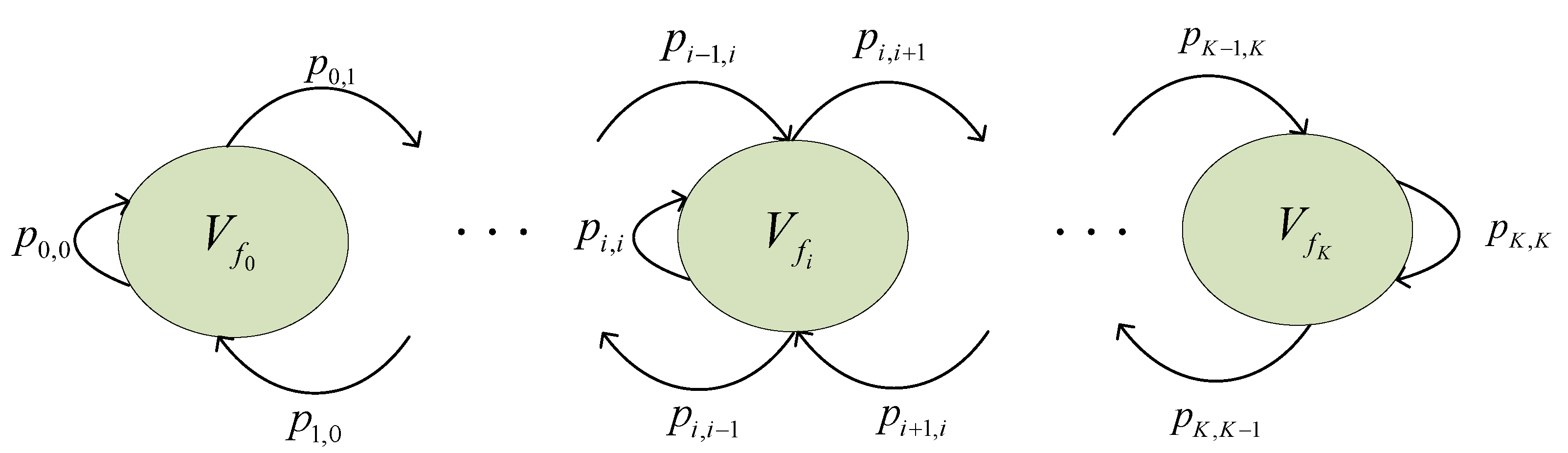
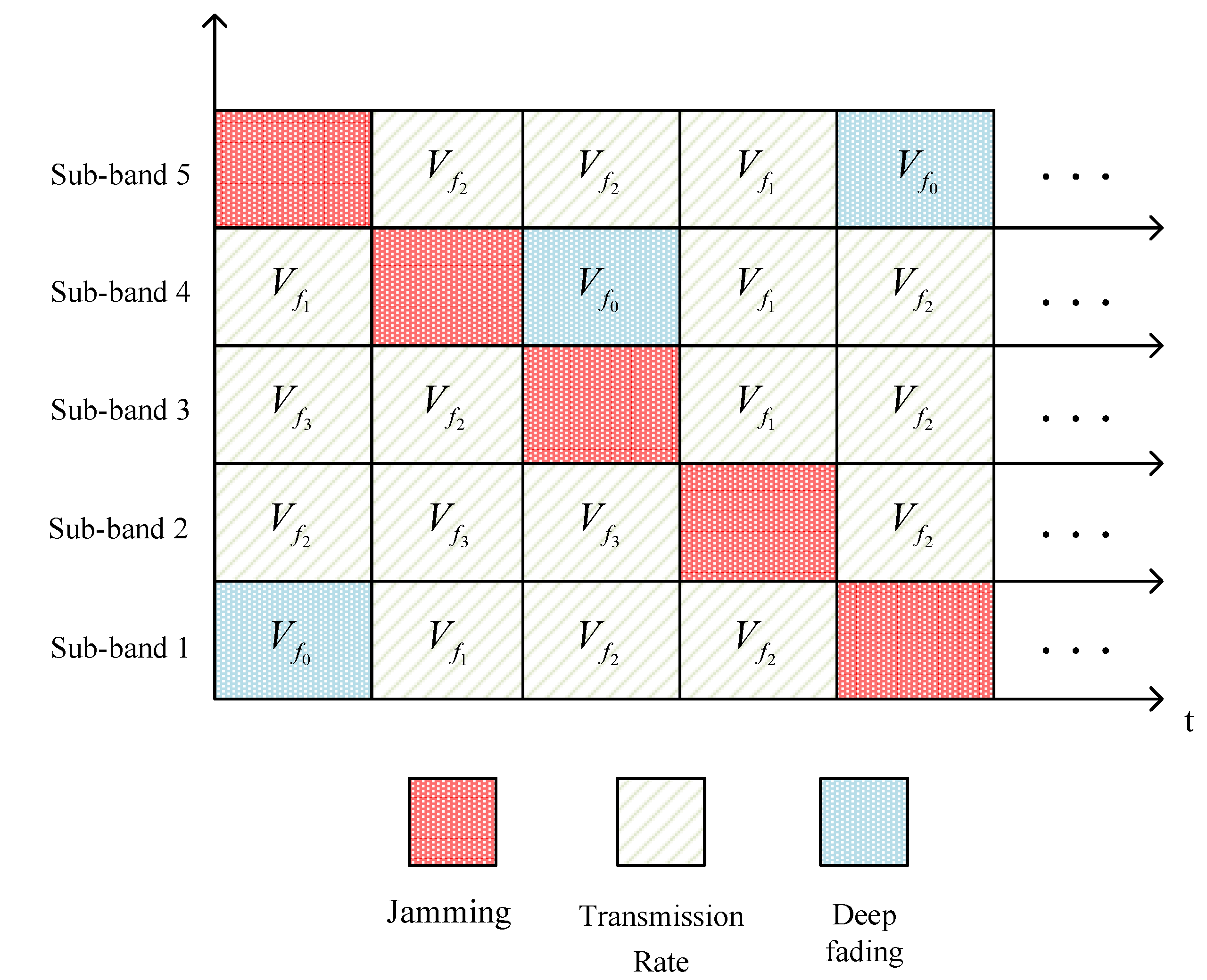
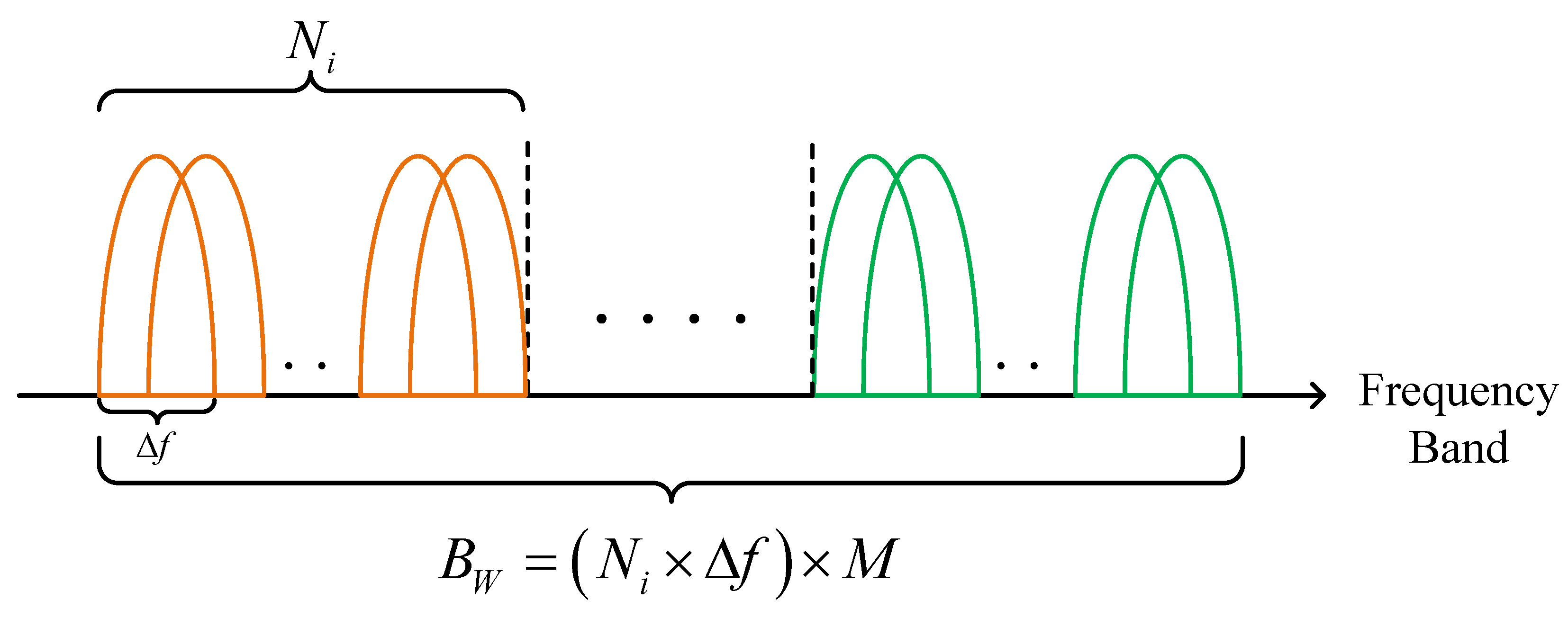
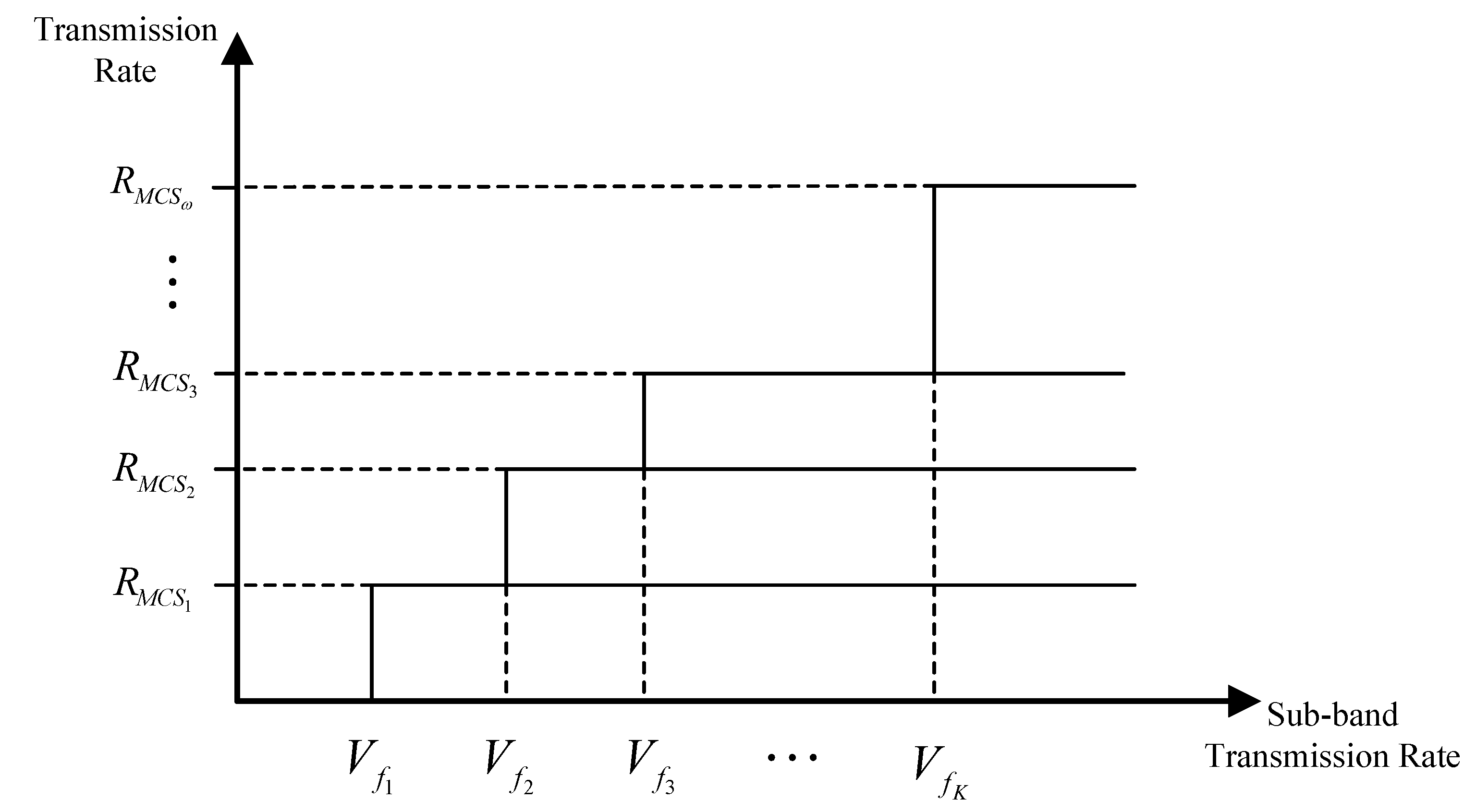
- Unlike prior research that employed sub-carriers as allocation units for OFDM systems, the sub-carriers are divided into sub-band units to decrease the decision space of the system. Meanwhile, the FSMS model is used to determine the time-varying properties of the transmission rates of these sub-bands under the fading environment.
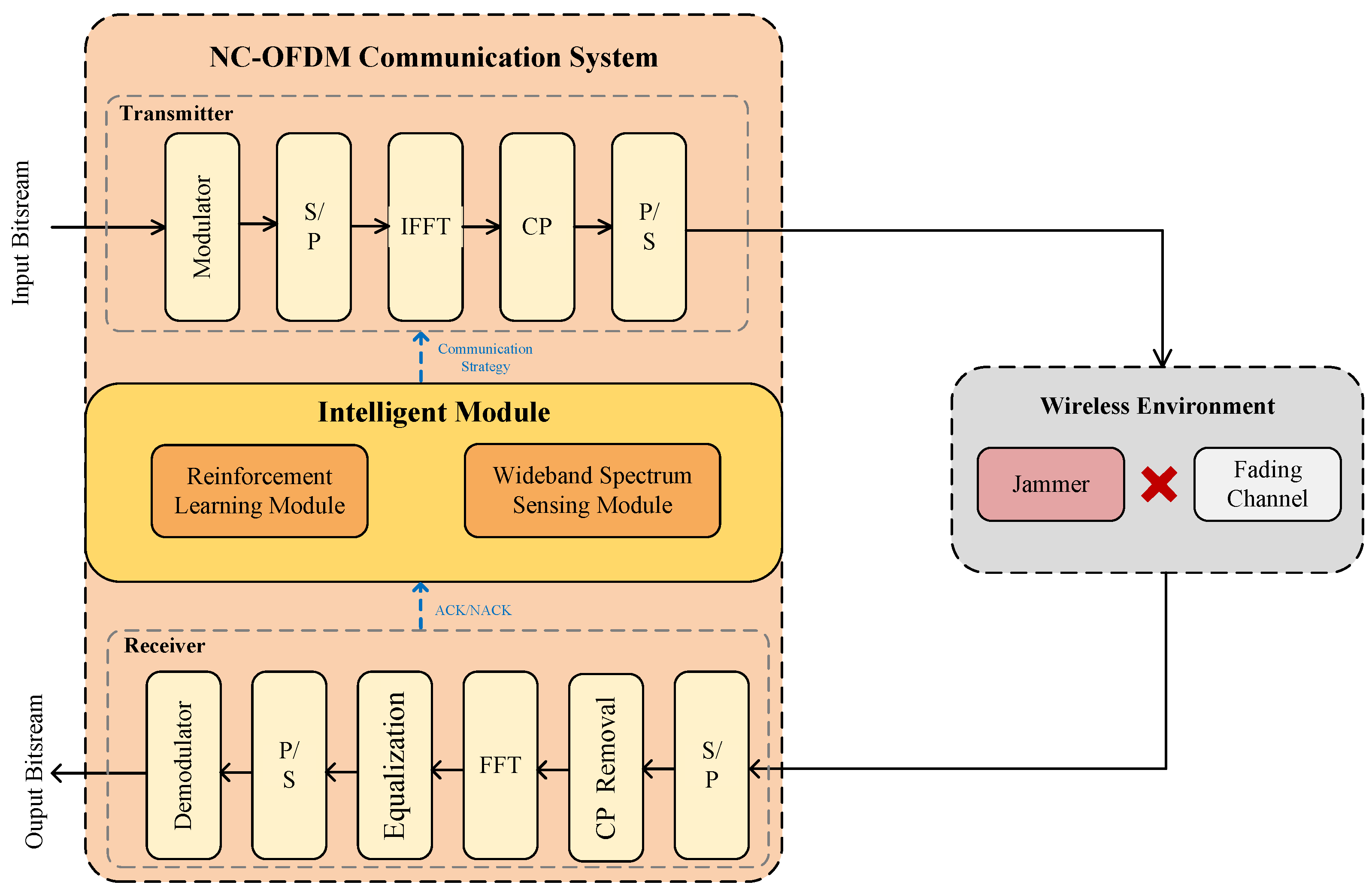
- A jamming-aware transmission parameter selection scheme is proposed to enhance transmission stability in fading and jamming environments. This scheme selects the transmission sub-band and rate by sensing the wireless environment, which transforms the selection challenge into an MDP problem.
- To address the challenges presented by a vast action and state spaces, a modified Q-learning algorithm based on confidence intervals is introduced. The algorithm combines Q-learning with confidence in the UCB algorithm to balance exploration and exploitation in action selection. Since it does not require prior knowledge of interference and quickens the convergence to the optimal value, the proposed algorithm can be widely applied.
2. System Model
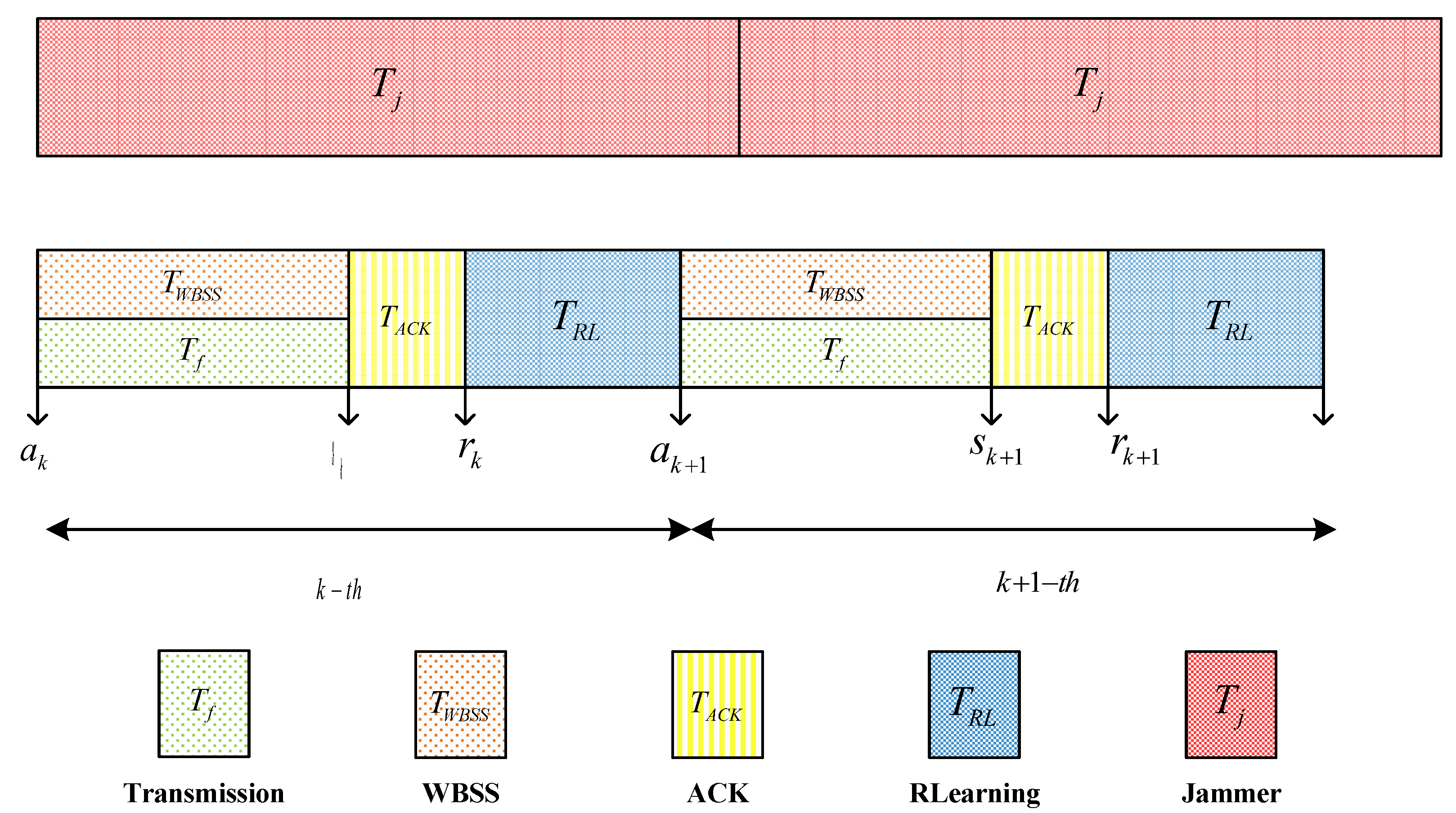
2.1. OFDM Transmission Frame Structure
2.2. FSMS Model
3. Problem Formulation
4. Reinforce Learning-Based Optimal Action Acquisition Scheme
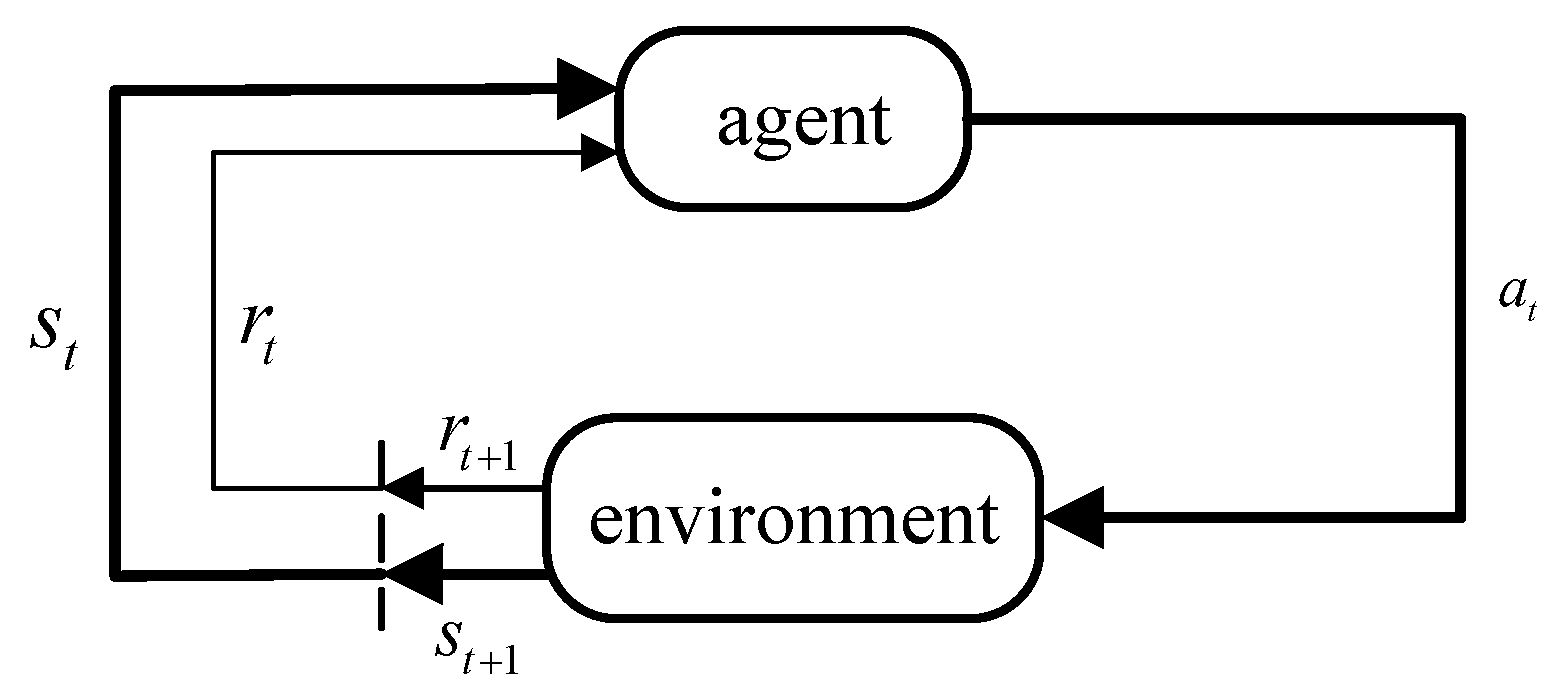
4.1. Q-Learning Algorithm
4.2. Modified Q-Learning Anti-Jamming Algorithm Based on Confidence Intervals
| Algorithm 1 The modified Q-learning anti-jamming algorithm based on confidence intervals |
|
5. Simulation Results and Discussion
5.1. Simulation Parameter
- 1.
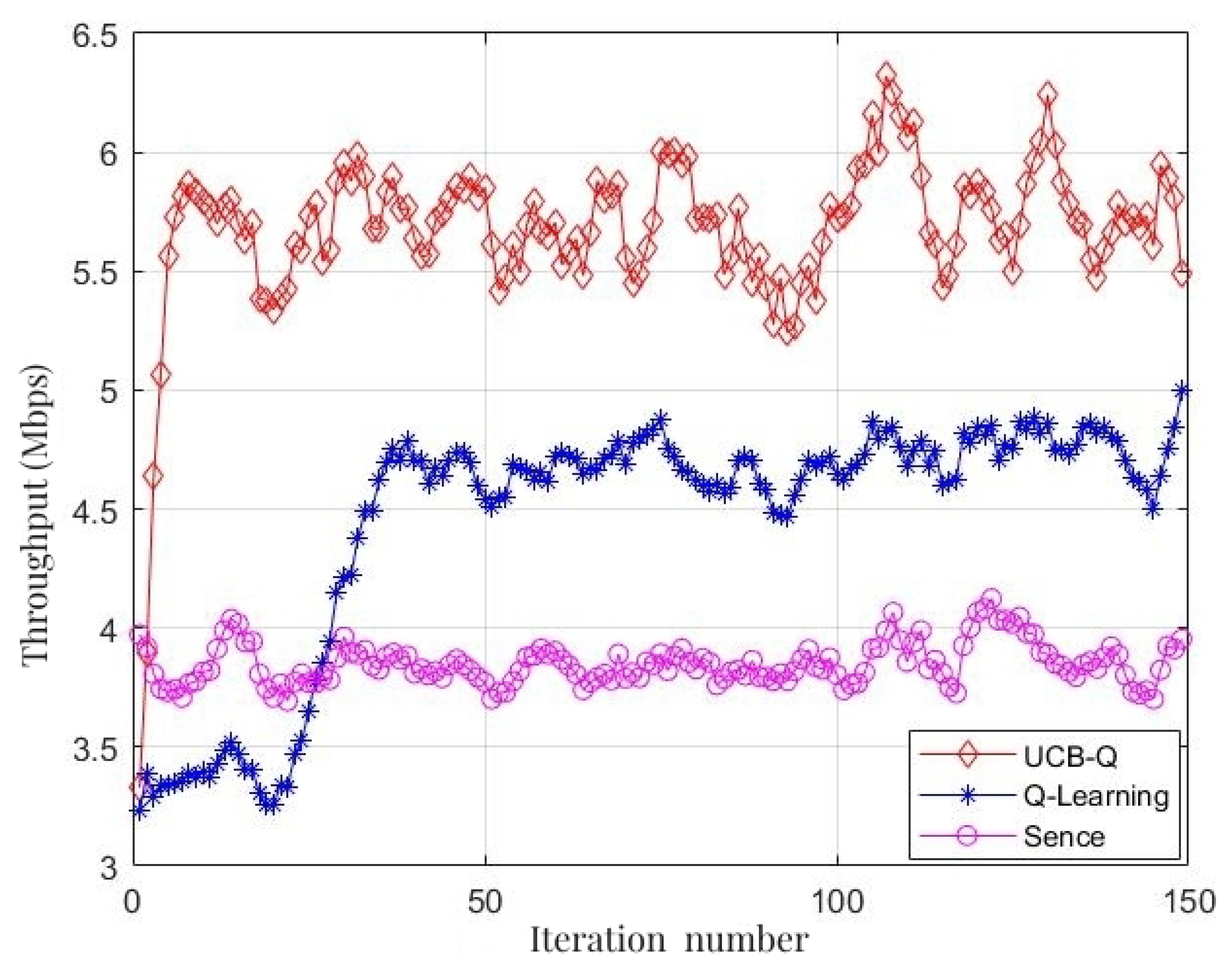
- Q-learning: The user adopts the standard Q-learning described in Section 4 as the execution algorithm and the Q-value is updated according to (16).
- 2.
- Perception-based random selection algorithm: Based on the WBSS results for the current time slot, the user randomly selects the non-interfered sub-band and transmission rate. This selection strategy is more intuitive.
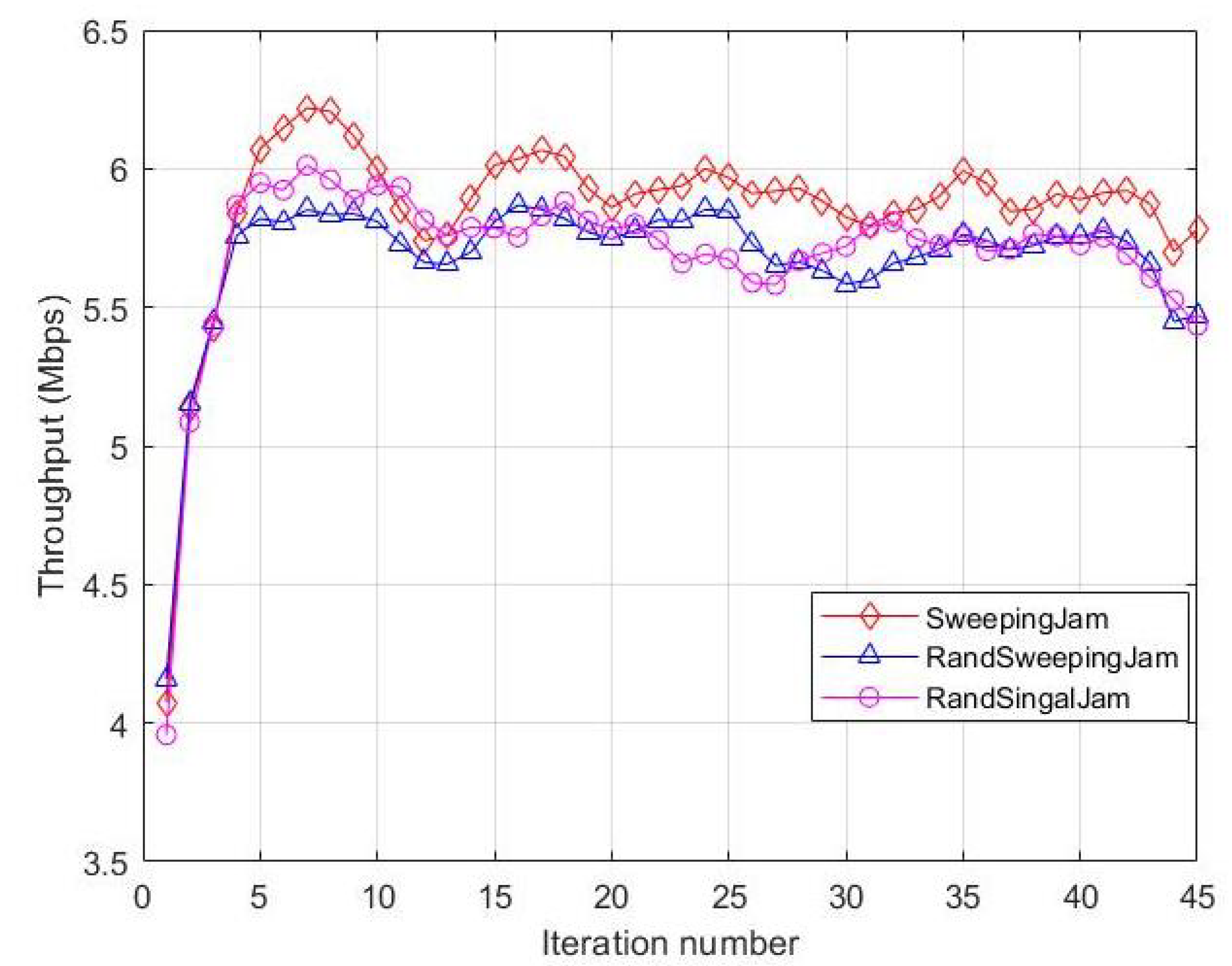
5.2. Simulation Result
6. Conclusions
Author Contributions
Funding
Data Availability Statement
Conflicts of Interest
References
- Yao, F.Q.; Zhang, Y.; Liu, Y.X. Security and control for electromagnetic spectrum. J. Command Control 2015, 1, 278–283. [Google Scholar]
- Pelechrinis, K.; Iliofotou, M.; Krishnamurthy, S.V. Denial of service attacks in wireless networks: The case of jammers. IEEE Commun. Surv. Tutor. 2010, 13, 245–257. [Google Scholar] [CrossRef]
- Rajbanshi, R.; Wyglinski, A.M.; Minden, G.J. An efficient implementation of NC-OFDM transceivers for cognitive radios. In Proceedings of the 2006 1st International Conference on Cognitive Radio Oriented Wireless Networks and Communications, Mykonos, Greece, 8–10 June 2006; pp. 1–5. [Google Scholar]
- Bahai, A.R.S.; Saltzberg, B.R.; Ergen, M. Multi-Carrier Digital Communications: Theory and Applications of OFDM; Springer: New York, NY, USA, 2004; ISBN 9780387225753. [Google Scholar]
- Xu, G.; Zhu, Y.; Han, M. Broadband cognitive radio transmission based on sub-channel sensing and NC-OFDM. Int. J. Commun. Netw. Inf. Secur. 2010, 2, 98. [Google Scholar]
- Grover, K.; Lim, A.; Yang, Q. Jamming and anti–jamming techniques in wireless networks: A survey. Int. J. Ad Hoc Ubiquitous Comput. 2014, 17, 197–215. [Google Scholar] [CrossRef]
- Sun, W.; Amin, M.G. A self-coherence anti-jamming GPS receiver. IEEE Trans. Signal Process. 2005, 53, 3910–3915. [Google Scholar] [CrossRef]
- Song, K.-B.; Ekbal, A.; Chung, S.T.; Cioffi, J.M. Adaptive modulation and coding (AMC) for bit-interleaved coded OFDM (BIC-OFDM). IEEE Trans. Wirel. Commun. 2006, 5, 1685–1694. [Google Scholar] [CrossRef]
- Choi, J.W.; Lee, Y.H. Improved AMC using adaptive SIR thresholds in OFDM based wireless systems. In Proceedings of the IEEE Wireless Communications and Networking Conference, 2006. WCNC 2006, Las Vegas, NV, USA, 3–6 April 2006; Volume 3, pp. 1289–1292. [Google Scholar]
- Bolcskei, H. MIMO-OFDM wireless systems: Basics, perspectives, and challenges. IEEE Wirel. Commun. 2006, 13, 31–37. [Google Scholar]
- Patil, P.; Patil, M.R.; Itraj, S.; Bomble, U.L. A review on MIMO OFDM technology basics and more. In Proceedings of the 2017 International Conference on Current Trends in Computer, Electrical, Electronics and Communication (CTCEEC), Mysore, India, 8–9 September 2017; pp. 119–124. [Google Scholar]
- Yang, Y.; Zhang, Q.; Wang, Y.; Emoto, T.; Akutagawa, M.; Konaka, S. Adaptive resources allocation algorithm based on modified PSO for cognitive radio system. China Commun. 2019, 16, 83–92. [Google Scholar] [CrossRef]
- Demirci, S.; Gözüpek, D. Switching cost-aware joint frequency assignment and scheduling for industrial cognitive radio networks. IEEE Trans. Ind. Inform. 2019, 16, 4365–4377. [Google Scholar] [CrossRef]
- Rang, Y.; Chen, D.; Cheng, Y.; Wang, X. Cognitive anti-jamming intelligent decision based on improved artificial bee colony algorithm. J. Signal Process. 2019, 35, 240–249. [Google Scholar]
- Liang, Y.; Tan, J.; Niyato, D. Overview on intelligent wireless communication technology. J. Commun. 2020, 41, 1–17. [Google Scholar]
- Machuzak, S.; Jayaweera, S.K. Reinforcement learning based anti-jamming with wideband autonomous cognitive radios. In Proceedings of the 2016 IEEE/CIC International Conference on Communications in China (ICCC), Chengdu, China, 27–29 July 2016; pp. 1–5. [Google Scholar]
- Bkassiny, M.; Li, Y.; Jayaweera, S.K. A survey on machine-learning techniques in cognitive radios. IEEE Commun. Surv. Tutor. 2012, 15, 1136–1159. [Google Scholar] [CrossRef]
- Moy, C. Reinforcement learning real experiments for opportunistic spectrum access. In Proceedings of the WSR’14, Karlsruhe, Germany, 14 March 2014; p. 10. [Google Scholar]
- Chung, S.T.; Goldsmith, A.J. Degrees of freedom in adaptive modulation: A unified view. IEEE Trans. Commun. 2001, 49, 1561–1571. [Google Scholar] [CrossRef]
- Physical Layer Aspects of UTRA High Speed Downlink Packet Access. Tech. Rep. 3GPP TR 25.848 v4. 0.0. 2005. Available online: https://portal.3gpp.org/desktopmodules/Specifications/SpecificationDetails.aspx?specificationId=1281(accessed on 3 September 2023).
- Doufexi, A.; Armour, S.; Butler, M.; Nix, A.; Bull, D.; McGeehan, J.; Karlsson, P. A comparison of the HIPERLAN/2 and IEEE 802.11 a wireless LAN standards. IEEE Commun. Mag. 2002, 40, 172–180. [Google Scholar] [CrossRef]
- Liu, Q.; Zhou, S.; Giannakis, G.B. Queuing with adaptive modulation and coding over wireless links: Cross-layer analysis and design. IEEE Trans. Wirel. Commun. 2005, 4, 1142–1153. [Google Scholar]
- Kong, L.; Xu, Y.; Zhang, Y.; Pei, X.; Ke, M.; Wang, X.; Bai, W.; Feng, Z. A reinforcement learning approach for dynamic spectrum anti-jamming in fading environment. In Proceedings of the 2018 IEEE 18th International Conference on Communication Technology (ICCT), Chongqing, China, 8–11 October 2018; pp. 51–58. [Google Scholar]
- Pimentel, C.; Falk, T.H.; Lisbôa, L. Finite-state Markov modeling of correlated Rician-fading channels. IEEE Trans. Veh. Technol. 2004, 53, 1491–1501. [Google Scholar] [CrossRef]
- Zhang, Q.; Kassam, S.A. Finite-state Markov model for Rayleigh fading channels. IEEE Trans. Commun. 1999, 47, 1688–1692. [Google Scholar] [CrossRef]
- Alouini, M.S.; Goldsmith, A.J. Adaptive modulation over Nakagami fading channels. Wirel. Pers. Commun. 2000, 13, 119–143. [Google Scholar] [CrossRef]
- Wang, H.S.; Moayeri, N. Modeling, capacity, and joint source/channel coding for Rayleigh fading channels. In Proceedings of the IEEE 43rd Vehicular Technology Conference, Secaucus, NJ, USA, 18–20 May 1993; pp. 473–479. [Google Scholar]
- Razavilar, J.; Liu, K.R.; Marcus, S.I. Jointly optimized bit-rate/delay control policy for wireless packet networks with fading channels. IEEE Trans. Commun. 2002, 50, 484–494. [Google Scholar] [CrossRef]
- Kong, H.; Shwedyk, E. Markov characterization of frequency selective Rayleigh fading channels. In Proceedings of the IEEE Pacific Rim Conference on Communications, Computers, and Signal Processing, Victoria, BC, Canada, 17–19 May 1995; pp. 359–362. [Google Scholar]
- Park, J.M.; Hwang, G.U. Mathematical modeling of Rayleigh fading channels based on finite state Markov chains. IEEE Commun. Lett. 2009, 13, 764–766. [Google Scholar] [CrossRef]
- Sutton, P.D.; Nolan, K.E.; Doyle, L.E. Cyclostationary signatures in practical cognitive radio applications. IEEE J. Sel. Areas Commun. 2008, 26, 13–24. [Google Scholar] [CrossRef]
- Jones, A.M.; Headley, W.C. Considerations of Reinforcement Learning within Real-Time Wireless Communication Systems. In Proceedings of the MILCOM 2022–2022 IEEE Military Communications Conference (MILCOM), Rockville, MD, USA, 28 November–2 December 2022; pp. 418–425. [Google Scholar]




| Model 1 | Model 2 | Model 3 | Model 4 | |
|---|---|---|---|---|
| Modulation | BPSK | QPSK | QPSK | 16-QAM |
| (bits/sym) | 0.5 | 1.00 | 1.50 | 3.00 |
| 274.7299 | 90.2514 | 67.6181 | 53.3987 | |
| 7.9932 | 3.4998 | 1.6883 | 0.3756 | |
| (dB) | −1.5331 | 1.0942 | 3.972 | 10.2488 |
| Modulation and Coding Scheme | ||||
|---|---|---|---|---|
| Modulation | BPSK | QPSK | QPSK | 16-QAM |
| Code rates | 1/2 | 1/2 | 3/4 | 3/4 |
| Parameter | Value |
|---|---|
| Number of total sub-bands | M = 5 |
| Frequency bandwidth | = 8 MHz |
| Number of subcarrier | N = 2560 |
| Sub-band transmitting rate set | (Mbps) |
| Transmitting rate set | (Mbps) |
| Data transmission time | = 3 ms |
| WBSS time | = 3 ms |
| ACK transmission time | = ms |
| RL learning time | = ms |
| Jamming time | = ms |
| Learning rate | = |
| Discount factor | = |
| Exploration weight | c = |
| Boltzmann coefficient | = 5~25 |
Disclaimer/Publisher’s Note: The statements, opinions and data contained in all publications are solely those of the individual author(s) and contributor(s) and not of MDPI and/or the editor(s). MDPI and/or the editor(s) disclaim responsibility for any injury to people or property resulting from any ideas, methods, instructions or products referred to in the content. |
© 2023 by the authors. Licensee MDPI, Basel, Switzerland. This article is an open access article distributed under the terms and conditions of the Creative Commons Attribution (CC BY) license (https://creativecommons.org/licenses/by/4.0/).
Share and Cite
Yuan, X.; Yu, L.; Li, Y.; Xu, Y.; Shi, Y. Joint Sub-Band and Transmission Rate Selection for Anti-Jamming Non-Contiguous Orthogonal Frequency Division Multiplexing System: An Upper Confidence Bound Based Reinforcement Learning Approach. Electronics 2023, 12, 4418. https://doi.org/10.3390/electronics12214418
Yuan X, Yu L, Li Y, Xu Y, Shi Y. Joint Sub-Band and Transmission Rate Selection for Anti-Jamming Non-Contiguous Orthogonal Frequency Division Multiplexing System: An Upper Confidence Bound Based Reinforcement Learning Approach. Electronics. 2023; 12(21):4418. https://doi.org/10.3390/electronics12214418
Chicago/Turabian StyleYuan, Xinyi, Long Yu, Yusheng Li, Yifan Xu, and Yuxin Shi. 2023. "Joint Sub-Band and Transmission Rate Selection for Anti-Jamming Non-Contiguous Orthogonal Frequency Division Multiplexing System: An Upper Confidence Bound Based Reinforcement Learning Approach" Electronics 12, no. 21: 4418. https://doi.org/10.3390/electronics12214418
APA StyleYuan, X., Yu, L., Li, Y., Xu, Y., & Shi, Y. (2023). Joint Sub-Band and Transmission Rate Selection for Anti-Jamming Non-Contiguous Orthogonal Frequency Division Multiplexing System: An Upper Confidence Bound Based Reinforcement Learning Approach. Electronics, 12(21), 4418. https://doi.org/10.3390/electronics12214418