Article

Detecting Breast Arterial Calcifications in Mammograms with Transfer Learning

School of Computing, University of Kent, Canterbury CT2 7NZ, UK
*
Author to whom correspondence should be addressed.
Electronics 2023, 12(1), 231; https://doi.org/10.3390/electronics12010231

Submission received: 30 November 2022 / Revised: 23 December 2022 / Accepted: 26 December 2022 / Published: 3 January 2023
(This article belongs to the Special Issue Machine Learning for Classification and Analysis of Biomedical Images)

Abstract

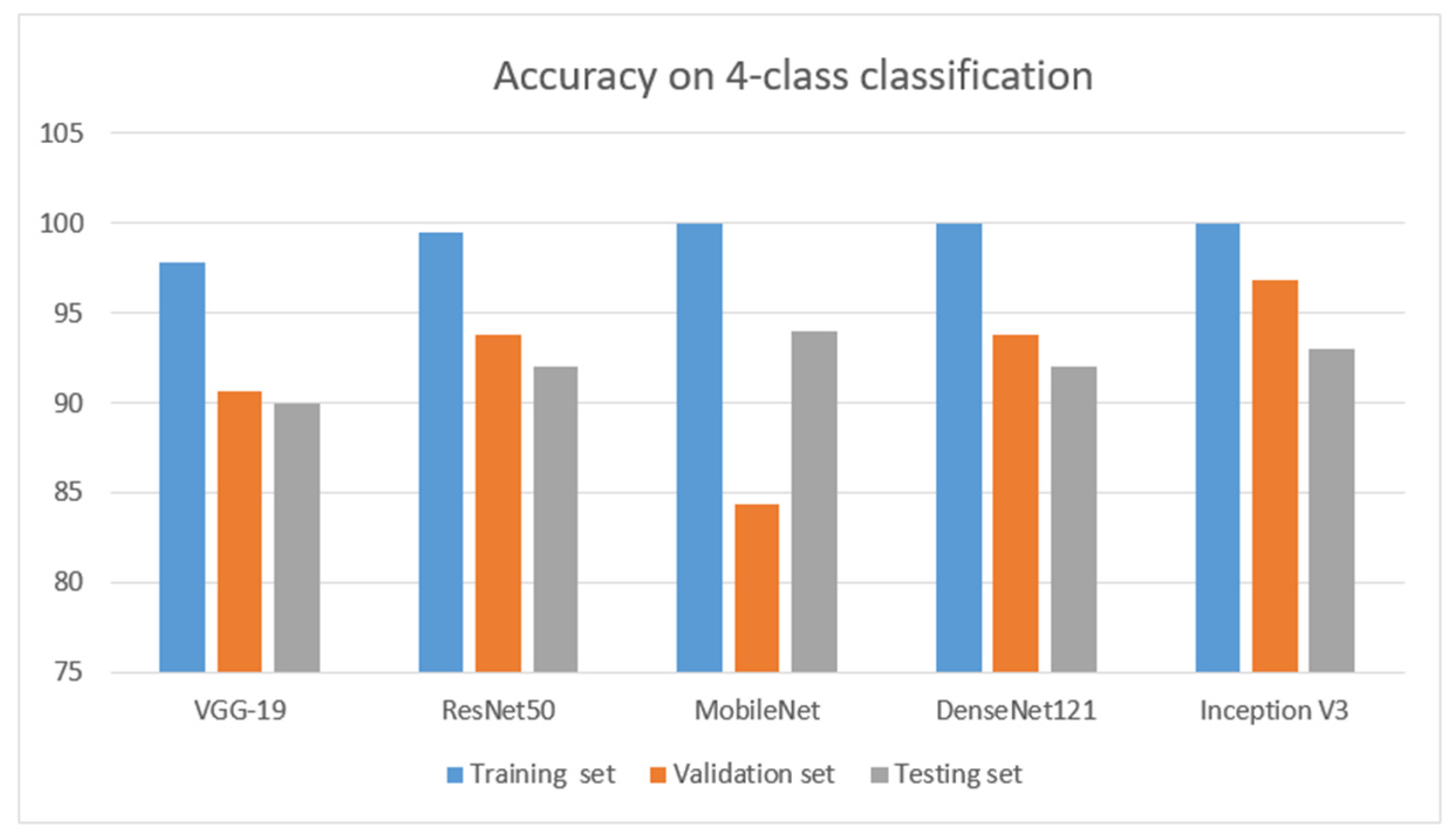
Cardiovascular diseases, which include all heart and circulatory diseases, are among the major death-causing diseases in women. Cardiovascular diseases are not subject to screening programs, and early detection can reduce their mortal effect. Recent studies have shown a strong association between severe Breast Arterial Calcifications and cardiovascular diseases. The aim of this study is to use the screening programs for breast cancer to detect the high severity of BACs and therefore to obtain indirect information about coronary diseases. Previous attempts in the literature on the detection of BACs from digital mammograms still need improvements to be used as a standalone technique. In this study, a dataset of mammograms with BACs is divided into 4 grades of severity, and this study aims to improve their classification through a transfer learning approach to overcome the need for a large dataset of training. The performances achieved in this study by using pre-trained models to detect four Breast Arterial Calcifications severity grades reached an accuracy of 94% during testing. Therefore, it is possible to benefit from the advantage of Deep Learning models to define a rapid marker of BACs along Brest Cancer screening programs.
Keywords: breast arterial calcifications; cardiovascular diseases; coronary artery disease; deep learning; transfer learning breast arterial calcifications; cardiovascular diseases; coronary artery disease; deep learning; transfer learning