Abstract
Highly dispersive solitons in fiber Bragg gratings with quadratic-cubic law of nonlinear refractive index are studied in this paper. The -expansion approach and the enhanced Kudryashov’s scheme have made this retrieval possible. A deluge of solitons, that emerge from the two integration schemes, are presented.
1. Introduction
One of the inherent drawbacks of soliton transmission is the compromise of the delicate balance between nonlinearity and chromatic dispersion (CD). There are several countermeasures that have been adopted to this extent. One such adopted modification is the introduction of dispersive optical solitons to compensate for the low count of CD. Some such well-known models that are studied in this context are Radhakrishnan–Kundu–Lakshmanan equation, Fokas–Lenells equation, Schrödinger–Hirota equation, and others. Later, additional dispersion terms were presented to address the model with surplus dispersive effects that led to the concept of highly dispersive (HD) optical solitons [1,2,3,4,5,6]. In this context, sixth-order dispersion (6OD), fifth-order dispersion (5OD), fourth-order dispersion (4OD), third-order dispersion (3OD), and intermodal dispersion (IMD) terms are considered, in addition to the pre-existing CD, which together makeup the HD solitons to provide the necessary delicate balance between self-phase modulation (SPM) and CD for the solitons to sustain the intercontinental distance propagation.
Another mechanism for the balance to sustain is the introduction of a grating structure along the internal walls of the fiber core. Such an engineering marvel was first introduced by the engineer Bragg; henceforth, this mechanism is referred to as fiber Bragg gratings [7,8,9,10]. The current paper is a combination of two such countermeasures to ensure a smooth transmission of solitons through the fibers for intercontinental distances. The SPM effect comes from the quadratic-cubic (QC) form of nonlinear refractive index structure. This leads to a model that is represented by the coupled nonlinear Schrödinger’s equation (NLSE), with dispersive reflectivity, which will be addressed using two integration schemes that will extract a phenomenal variety of solitons with the model. While there are several integration schemes to take care of the wide variety of optoelectronic phenomena [11,12,13,14,15,16], the current work implements two familiar integration technologies to handle the model. These schemes are the enhanced Kudryashov’s approach and -expansion. The findings are derived from the two integration approaches and are collectively indicated after the model is presented.
The current paper is organized as indicated. Section 2 starts off with the introduction to the governing model with a physical interpretation of the involved parameters including the perturbation terms that are incorporated. Subsequently, Section 3 displays the preliminary mathematical analysis that is recovered by first decomposing the governing complex-valued coupled nonlinear evolution equations into the phase-amplitude format. This would give the velocity of the solitons, which would indicate the slowdown of the solitons. The parameter constraints are also revealed with this decomposition. Next, Section 4 yields a family of soliton and other solutions that stem from the application of G’/G-expansion scheme. Additional parameter constraints naturally emerge from the solution structures that guarantee the existence of the solitons and other forms of waves. Section 5 also reveals a few forms of soliton solutions, including the so-called straddled solitons that sit in between bright and singular solitons, depending on the parameter variations. The surface plots of bright and dark soliton pairs are also exhibited at the end of this section. Finally, a few conclusive statements are made with potential future avenues to venture into.
2. Governing Model
Here, the coupled mode Equations (1) and (2) describe wave propagation through nonlinear grating structures, where and represent the forward and backward propagating waves, respectively. and give the nonlinear dispersions, while and yield the cross-phase modulation. come from the self-steepening, while the first terms stand for the linear temporal evolution, where . arise from the IMD, while and stem from the wave profiles. yield the detuning parameters, while emerge from the SPM. stem from the four-wave mixing. Finally, and , are called the coefficients of IMD, CD, 3OD, 4OD, 5OD, and 6OD in sequence.
and
The mathematical model for Bragg gratings in highly dispersive fibers having quadratic-cubic form of self-phase modulation is an extension/generalization of the model that was first introduced by Winful et al. [17]. Bragg gratings in optical fibers can be uniform or nonuniform. Lately, there has been great demand for nonuniform gratings, including chirped gratings, phase-shifted gratings, and apodized gratings, in tunable lasers and signal processing applications. Models that consider nonuniform gratings, often known as dispersive reflectivity models [10], have been extensively studied. Grating nonuniformities usually result from nonuniform variations in grating period or strength along the propagation direction. Thus, the amplitude modulation produces apodization of gratings, while a small variation in phase causes chirping of gratings. Both apodization and chirping of gratings cause variations in photonic bandgap. In addition, experimental and theoretical studies have demonstrated that the apodization of Bragg gratings induces reduction of soliton velocity. Additionally, variations in the intensity of ultraviolet laser beams employed to create grating cause random variations in the local refractive index of the medium. Standard coupled mode equations are unable to describe these effects accurately.
Atai and Malomed introduced a dispersive reflectivity model to explain the effects of nonuniformities in grating systems [10]. Other models describing the influence of nonstandard gratings have also been reported, and the bandgap spectrum of these models is typically wider and/or nonhomogeneous. For the practical application of nonuniform grating, the modified coupled model equations, including the dispersive reflectivity parameter, are displayed here. It is presumed that spatial variations in the amplitude of coupled modes assist in explaining the spatial alterations of the local refractive index.
3. Mathematical Analysis
The wave profiles are considered as
and
where v, , , , , and stand for the velocity, frequency, wave number, phase constant, phase component, and amplitude components of the soliton in sequence. Substituting (3) and (4) into (1) and (2) yields the real parts
and the imaginary parts
Set
Equations (5) and (6) are thus presented as below:
and
while Equations (7) and (8) become
and
From Equations (12) and (13), one obtains the frequency of the soliton as
the constraint conditions
and the velocity of the soliton as
From (18), we have the constraint condition
One of Equations (10) and (11) can be addressed by the aid of the restrictions
Thus, Equation (10) falls out as
where
4. ()-Expansion
Equation (21) admits the solution form
along with the ancillary equations
and
which satisfy the combo soliton
the singular periodic wave
and the rational wave
where N comes from the balancing method, while , , , , and are constants. Balancing with in (21) simplifies (23) to
Inserting (29) along with (25) into (21) leaves us with the results
and
Type-1: Placing (30) along with (26) into (29), the combo solitons come out as
and
In particular, if and , the dark solitons evolve as
and
while, if and , the singular solitons shape up as
and
Type-2: Inserting into (30) and (31) provides us the coefficients
and
Substituting (38) along with (28) into (29), the rational waves fall out as
and
5. Enhanced Kudryashov’s Procedure
Equation (21) holds the solution structure
along with the auxiliary equation
which satisfies the combo soliton
where p is a natural number, N comes from the balancing method, while , B, and A are constants. Balancing and in Equation (21) gives
Case-1: Setting simplifies (42) to
Inserting (46) along with (43) into (21) yields the coefficients
and
Plugging (47) along with (44) into (46), the combo solitons evolve as
and
When and , the bright solitons read as
and
Case-2: Setting transforms (42) to
Inserting (53) along with (43) into (21) gives the coefficients
and
Substituting (54) along with (44) into (53), the combo solitons stand as
and
If and , the bright solitons stick out as
and
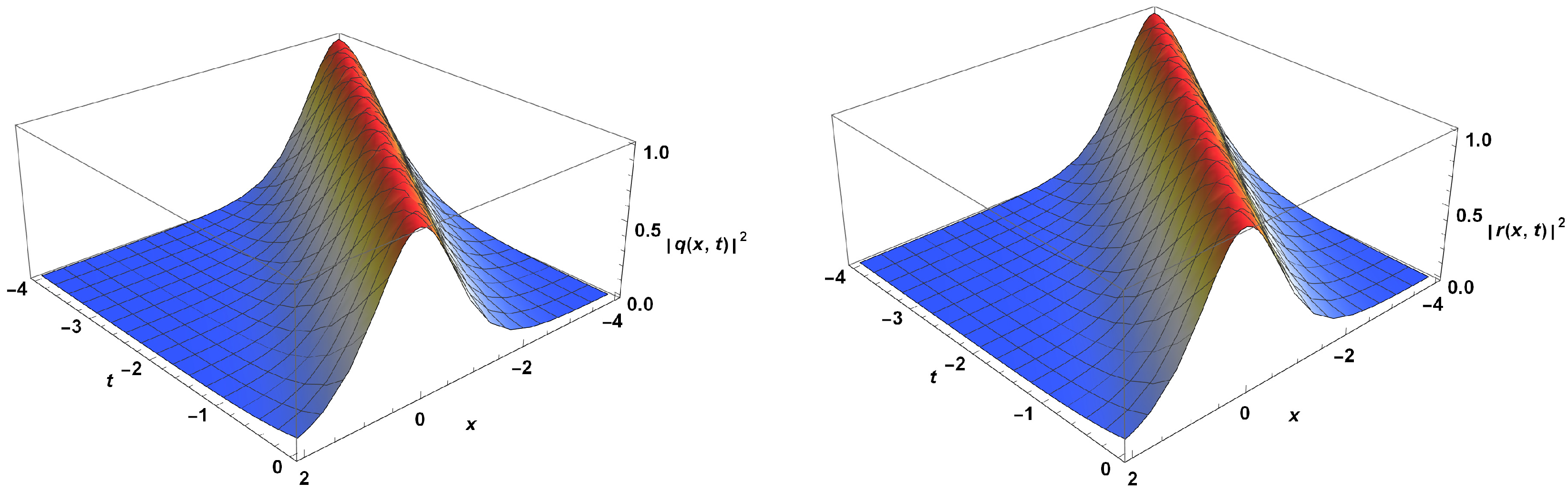
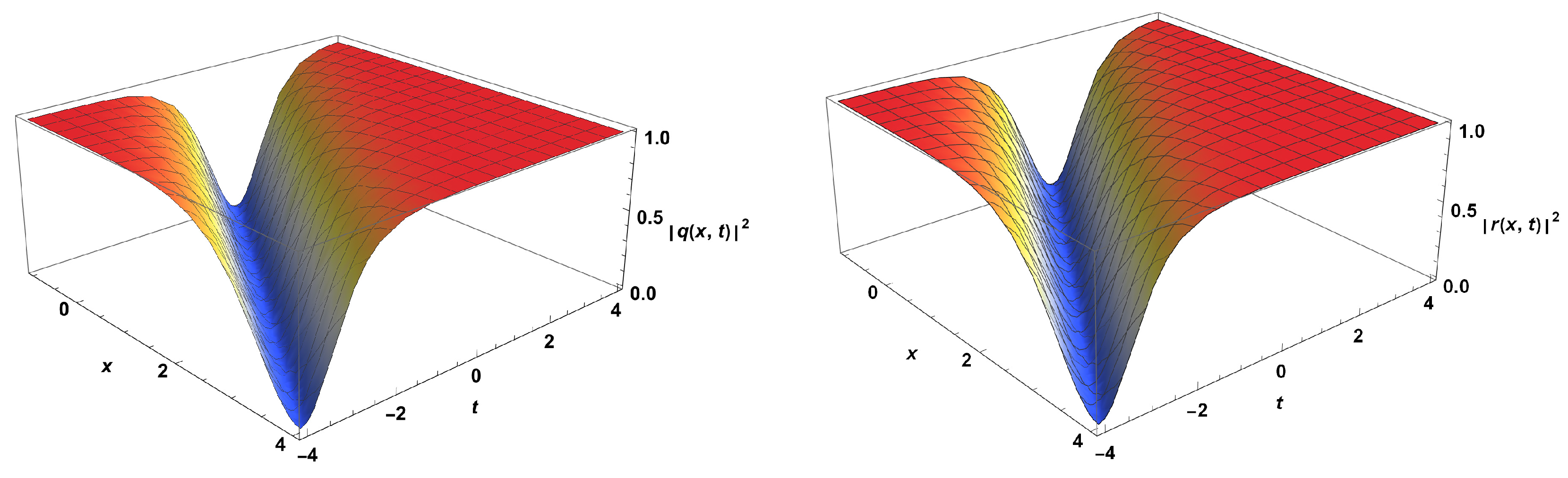
The Figure 1 and Figure 2 represent the surface plots of dark and bright solitons respectively. The selected parameter values are indicated in the captions.
Figure 1.
Surface plots of dark solitons (34) and (35) with , , , , , , , , , , , , and .
Figure 2.
Surface plots of bright solitons (51) and (52) with , , , , , , , , , , , , , and .
6. Conclusions
The current paper revealed HD solitons with the model that is studied in fiber Bragg gratings having QC form of nonlinear refractive index. Two integration algorithms were employed to extract such solitons. These solitons are now going to be of greater value to move forward. The results will be utilized to compute the conservation laws when the conserved densities would come from multiplier approach or using the Lagrangian or Lie symmetry. These results would be later displayed. Moreover, the variational principle would also give the soliton parameter variations that would further provide additional perspective to the model. Such results and other such findings would be reported in future along the lines of the pre-existing results [5,6,7,8,9].
Author Contributions
Conceptualization, E.M.E.Z. and M.E.M.A.; methodology, R.M.A.S.; software, Y.Y.; writing—original draft preparation, L.M.; writing—review and editing, S.M.; project administration, A.B. and C.I. All authors have read and agreed to the published version of the manuscript.
Funding
This research received no external funding.
Institutional Review Board Statement
Not applicable.
Informed Consent Statement
Not applicable.
Data Availability Statement
Not applicable.
Acknowledgments
The authors thank the anonymous referees whose comments helped to improve this paper.
Conflicts of Interest
The authors declare no conflict of interest.
References
- Biswas, A.; Vega-Guzman, J.; Mahmood, M.F.; Khan, S.; Ekici, M.; Zhou, Q.; Moshokoa, S.P.; Belic, M.R. Highly dispersive optical solitons with undetermined coefficients. Optik 2019, 182, 890–896. [Google Scholar] [CrossRef]
- Kudryashov, N.A. Method for finding highly dispersive optical solitons of nonlinear differential equations. Optik 2020, 206, 163550. [Google Scholar] [CrossRef]
- Kudryashov, N.A. Highly dispersive optical solitons of the generalized nonlinear eighth-order Schrödinger equation. Optik 2020, 206, 164335. [Google Scholar] [CrossRef]
- Wang, M.Y. Highly dispersive optical solitons of perturbed nonlinear Schrödinger equation with Kudryashov’s sextic-power law nonlinear. Optik 2022, 267, 169631. [Google Scholar] [CrossRef]
- Zayed, E.M.; Alngar, M.E.; El-Horbaty, M.M.; Biswas, A.; Ekici, M.; Zhou, Q.; Khan, S.; Mallawi, F.; Belic, M.R. Highly dispersive optical solitons in the nonlinear Schrödinger’s equation having polynomial law of the refractive index change. Indian J. Phys. 2021, 95, 109–119. [Google Scholar] [CrossRef]
- Zayed, E.M.; Al-Nowehy, A.G.; Alngar, M.E.; Biswas, A.; Asma, M.; Ekici, M.; Alzahrani, A.K.; Belic, M.R. Highly dispersive optical solitons in birefringent fibers with four nonlinear forms using Kudryashov’s approach. J. Opt. 2021, 50, 120–131. [Google Scholar] [CrossRef]
- Kan, K.V.; Kudryashov, N.A. Solitary waves described by a high-order system in optical fiber Bragg gratings with arbitrary refractive index. Math. Methods Appl. Sci. 2022, 45, 1072–1079. [Google Scholar] [CrossRef]
- Kudryashov, N.A. Periodic and solitary waves in optical fiber Bragg gratings with dispersive reflectivity. Chin. J. Phys. 2020, 66, 401–405. [Google Scholar] [CrossRef]
- Zayed, E.; Alngar, M.; Biswas, A.; Ekici, M.; Khan, S.; Alzahrani, A.; Belic, M. Optical solitons in fiber Bragg gratings with quadratic-cubic law of nonlinear refractive index and cubic-quartic dispersive reflectivity. Proc. Est. Acad. Sci. 2022, 71, 120–131. [Google Scholar] [CrossRef]
- Atai, J.; Malomed, B.A. Gap solitons in Bragg gratings with dispersive reflectivity. Phys. Lett. A 2005, 342, 404–412. [Google Scholar] [CrossRef]
- Dakova, A.; Kovachev, L.; Dakova, D.; Georgieva, D.; Slavchev, V. Degenerate four-photon parametric processes and vector solitons. Optik 2018, 168, 721–727. [Google Scholar] [CrossRef]
- Dakova, A.; Dakova, D.; Andreeva, Z.; Slavchev, V.; Kovachev, L. Mutual action of self-phase modulation and cross-phase modulation on the parametric four-photon mixing. Exact analytical solutions in the form of Jacobi functions. Optik 2019, 194, 163024. [Google Scholar] [CrossRef]
- Kudryashov, N.A. One method for finding exact solutions of nonlinear differential equations. Commun. Nonlinear Sci. Numer. Simul. 2012, 17, 2248–2253. [Google Scholar] [CrossRef]
- Kudryashov, N.A. A generalized model for description of propagation pulses in optical fiber. Optik 2019, 189, 42–52. [Google Scholar] [CrossRef]
- Kudryashov, N.A. Mathematical model of propagation pulse in optical fiber with power nonlinearities. Optik 2020, 212, 164750. [Google Scholar] [CrossRef]
- Kudryashov, N.A.; Antonova, E.V. Solitary waves of equation for propagation pulse with power nonlinearities. Optik 2020, 217, 164881. [Google Scholar] [CrossRef]
- Winful, H.G.; Marburger, J.; Garmire, E. Theory of bistability in nonlinear distributed feedback structures. Appl. Phys. Lett. 1979, 35, 379–381. [Google Scholar] [CrossRef]
Disclaimer/Publisher’s Note: The statements, opinions and data contained in all publications are solely those of the individual author(s) and contributor(s) and not of MDPI and/or the editor(s). MDPI and/or the editor(s) disclaim responsibility for any injury to people or property resulting from any ideas, methods, instructions or products referred to in the content. |
© 2022 by the authors. Licensee MDPI, Basel, Switzerland. This article is an open access article distributed under the terms and conditions of the Creative Commons Attribution (CC BY) license (https://creativecommons.org/licenses/by/4.0/).