


System for Automatic Assignment of Lexical Stress in Croatian


Abstract
1. Introduction
2. Background
2.1. Lexical Stress Features in the Croatian Language
2.2. Related Work
3. Method
3.1. Dataset
3.2. Linguistic Features
3.3. Model Training
4. Results
Hybrid Approach
5. Discussion and Conclusions
Author Contributions
Funding
Institutional Review Board Statement
Informed Consent Statement
Data Availability Statement
Conflicts of Interest
References
- Quesada, W.; Lautenbach, B. Programming Voice Interfaces; O’Reilly Media, Inc.: Sebastopol, CA, USA, 2017. [Google Scholar]
- Tadić, M. European Language Equality. In D1.7 Report on the Croatian Language; ELE: Karaez, France, 2022. [Google Scholar]
- Ljubešić, N.; Koržinek, D.; Rupnik, P.; Jazbec, I. ParlaSpeech-HR—A freely available ASR dataset for Croatian bootstrapped from the ParlaMint corpus. In Proceedings of the ParlaCLARIN III @ LREC2022, Marseille, France, 20 June 2022; pp. 111–116. [Google Scholar]
- Nikola, L.J.; Koržinke, D.; Rupnik, P.; Jazbec, I.; Batanović, V.; Bajčetić, L.; Evkoski, B. ASR training dataset for Croatian ParlaSpeech-HR v1.0. In Slovenian language resource repository CLARIN.SI; Jožef Stefan Institute: Ljubljana, Slovenia, 2022; ISSN 2820-4042. [Google Scholar]
- Načinović, L.; Pobar, M.; Ipšić, I.; Martinčić-Ipšić, S. Grapheme-to-Phoneme Conversion for Croatian Speech Synthesis. In Proceedings of the 32nd International Convention on Information and Communication Technology, Electronics and Microelectronics (MIPRO 2009), Opatija, Croatia, 25–29 May 2009; pp. 318–323. [Google Scholar]
- Vaissière, J. Cross-linguistic prosodic transcription: French vs. English. In Problems and Methods of Experimental Phonetics; Volskaya, N.B., Svetozarova, N.D., Skrelin, P.A., Eds.; St Petersburg State University Press: St Petersburg, Russia, 2002; pp. 147–164. [Google Scholar]
- Malisz, Z.; Zygis, M. Lexical stress in Polish: Evidence from focus and phrase-position differentiated production data. In Proceedings of the 9th International Conference on Speech Prosody, Poznan, Poland, 13–16 June 2018; pp. 1008–1012. [Google Scholar] [CrossRef] [Scilit]
- Skarnitzl, R.; Eriksson, A. The Acoustics of Word Stress in Czech as a Function of Speaking Style. In Proceedings of the 18th Annual Conference of the International Speech Communication Association, Stockholm, Sweden, 20–24 August 2017; pp. 3221–3225. [Google Scholar] [CrossRef] [Scilit]
- Babić, S.; Brozović, D.; Moguš, M.; Pavešić, S.; Škarić, I.; Težak, S. Povijesni Pregled, Glasovi i Oblici Hrvatskoga Književnog Jezika [Historic Review, Sounds and Forms of the Standard Croatian Language]; Globus, Nakladni zavod: Zagreb, Croatia, 1991. [Google Scholar]
- Anić, V. Veliki Rječnik Hrvatskoga Jezika [The Great Dictionary of Croatian Language]; Novi liber: Zagreb, Croatia, 2009. [Google Scholar]
- Mikelic Preradovic, N.; Nacinovic Prskalo, L. Development of the accent dictionary for the pitch-accent language: The case of Croatian. J. Slav. Linguist. submitted 2022.
- Pletikos Olof, E.; Bradfield, J. Standard Croatian pitch-accents: Fact and fiction. In Proceedings of the 19th International Congress of Phonetic Sciences ICPhS 2019, Melbourne, Australia,, 5–9 August 2019; Calhoun, S., Escudero, P., Tabain, M., Warren, P., Eds.; Australian Speech Science & Technology Association Inc: Canberra, Australia, 2019; pp. 855–858. [Google Scholar]
- Barić, E.; Lončarić, M.; Malić, D.; Pavešić, S.; Peti, M.; Zečević, V.; Znika, M. Hrvatska Gramatika [Croatian Grammary]; Školska knjiga: Zagreb, Croatia, 2003. [Google Scholar]
- McKechnie, J.; Shahin, M.; Ahmed, B.; McCabe, P.; Arciuli, J.; Ballard, K.J. An Automated Lexical Stress Classification Tool for Assessing Dysprosody in Childhood Apraxia of Speech. Brain Sci. 2021, 11, 1408. [Google Scholar] [CrossRef] [Scilit] [PubMed]
- Korzekwa, D.; Barra-Chicote, R.; Zaporowski, S.; Beringer, G.; Lorenzo-Trueba, J.; Serafinowicz, A.; Droppo, J.; Drugman, T.; Kostek, B. Detection of Lexical Stress Errors in Non-Native (L2) English with Data Augmentation and Attention. Proc. Interspeech 2021, 2021, 3915–3919. [Google Scholar] [CrossRef] [Scilit]
- Brown, G.; Franco-Pedroso, J.; González-Rodríguez, J. A segmentally informed solution to automatic accent classification and its advantages to forensic applications. Int. J. Speech Lang. Law 2022, 28, 201–232. [Google Scholar] [CrossRef] [Scilit]
- Woldemariam, Y.D. Transfer Learning for Less-Resourced Semitic Languages Speech Recognition: The Case of Amharic. In Proceedings of the 1st Joint SLTU and CCURL Workshop (SLTU-CCURL 2020), Marseille, France, 11–12 May 2020; pp. 61–69. [Google Scholar]
- Rosenberg, A.; Audhkhasi, K.; Sethy, A.; Ramabhadran, B.; Picheny, M. End-to-end speech recognition and keyword search on low-resource languages. In Proceedings of the 2017 IEEE International Conference on Acoustics, Speech and Signal Processing (ICASSP), New Orleans, LA, USA, 5–9 March 2017; pp. 5280–5284. [Google Scholar]
- Das, A.; Jyothi, P.; Hasegawa-Johnson, M. Automatic speech recognition using probabilistic transcriptions in Swahili, Amharic, and Dinka. In Proceedings of the 17th Annual Conference of the International Speech Communication Association, San Francisco, CA, USA, 8–12 September 2016; pp. 3524–3528. [Google Scholar]
- Ni, C.; Liu, W.; Xu, B. Mandarin stress detection using hierarchical model based boosting classification and regression tree. In Proceedings of the 2010 International Joint Conference on Neural Networks (IJCNN), Barcelona, Spain, 18–23 July 2010; pp. 1–5. [Google Scholar] [CrossRef] [Scilit]
- Gharavian, D.; Sheikhan, M.; Ghasemi, S.S. Combined classification method for prosodic stress recognition in Farsi language. Int. J. Speech Technol. 2018, 21, 333–341. [Google Scholar] [CrossRef] [Scilit]
- Bellur, A.; Narayan, K.B.; Raghava Krishnan, K.; Murthy, H.A. Prosody modeling for syllable-based concatenative speech synthesis of Hindi and Tamil. In Proceedings of the 2011 National Conference on Communications (NCC), Bangalore, India, 28–30 January 2011; pp. 1–5. [Google Scholar] [CrossRef] [Scilit]
- James, J.; Shields, I.; Berriman, R.; Keegan, P.J.; Watson, C.I. Developing Resources for Te Reo Māori Text To Speech Synthesis System. In Lecture Notes in Computer Science, Proceedings of the Text, Speech, and Dialogue (TSD), Brno, Czech, 8–11 September 2020; Sojka, P., Kopeček, I., Pala, K., Horák, A., Eds.; Springer: Berlin/Heidelberg, Germany, 2020; Volume 12284, pp. 294–302. [Google Scholar] [CrossRef] [Scilit]
- Ciobanu, A.M.; Dinu, A.; Dinu, P.L. Predicting Romanian Stress Assignment. In Proceedings of the 14th Conference of the European Chapter of the Association for Computational Linguistics, Gothenburg, Sweden, 26–30 April 2014; pp. 64–68. [Google Scholar]
- Marinčič, D.; Tušar, T.; Gams, M.; Šef, T. Analysis of Automatic Stress Assignment in Slovene. Informatica 2009, 20, 35–50. [Google Scholar] [CrossRef] [Scilit]
- Lorincz, B.; Irimia, E.; Stan, A.; Barbu Mititelu, V. RoLEX: The development of an extended Romanian lexical dataset and its evaluation at predicting concurrent lexical information. Nat. Lang. Eng. 2022, 1–26. [Google Scholar] [CrossRef] [Scilit]
- Martinčić–Ipšić, S.; Ribarić, S.; Ipšić, I. Acoustic Modelling for Croatian Speech Recognition and Synthesis. Informatica 2008, 19, 227–254. [Google Scholar] [CrossRef] [Scilit]
- Načinović, L.; Pobar, M.; Martinčić-Ipšić, S.; Ipšić, I. Automatic Intonation Event Detection Using Tilt Model for Croatian Speech Synthesis. In Proceedings of the INFuture2011, The Future of Information Sciences, Information Sciences and e-Society, Zagreb, Croatia, 9–11 November 2011; pp. 383–391. [Google Scholar]
- Martinčić-Ipšić, S.; Ipšić, I. Croatian HMM Based Speech Synthesis. J. Comput. Inf. Technol. CIT 2006, 14, 299–305. [Google Scholar] [CrossRef] [Scilit]
- Tadić, M. The Croatian Lemmatization Server. South. J. Linguist. 2005, 29, 206–217. [Google Scholar]
- Ljubešić, N.; Klubička, F.; Agić, Ž.; Jazbec, I.-P. New Inflectional Lexicons and Training Corpora for Improved Morphosyntactic Annotation of Croatian and Serbian. In Proceedings of the Tenth International Conference on Language Resources and Evaluation (LREC 2016), Portorož, Slovenia, 23–28 May 2016; Calzolari, N., Choukri, K., Declerck, T., Goggi, S., Grobelnik, M., Maegaard, B., Mariani, J., Mazo, H., Moreno, A., Odijk, J., et al., Eds.; pp. 4262–4270. [Google Scholar]
- Filko, M.; Šojat, K.; Štefanec, V. The Design of Croderiv 2.0. Prague Bull. Math. Linguist. 2020, 115, 83–104. [Google Scholar] [CrossRef] [Scilit]
- Šnajder, J. Derivbase.hr: A high-coverage derivational morphology resource for Croatian. In Proceedings of the Ninth International Conference on Language Resources and Evaluation (LREC’14), Reykjavik, Iceland, 26–31 May 2014; Calzolari, N., Choukri, K., Declerck, T., Loftsson, H., Maegaard, B., Mariani, J., Moreno, A., Odijk, J., Piperidis, S., Eds.; pp. 3371–3377. [Google Scholar]
- Salzberg, S.L. C4.5: Programs for Machine Learning. Mach. Learn. 1994, 16, 235–240. [Google Scholar] [CrossRef] [Scilit]
- Krzywinski, M.; Altman, N. Classification and regression trees. Nat. Methods 2017, 14, 757–758. [Google Scholar] [CrossRef] [Scilit]
- Witten, I.H.; Frank, E.; Hall, M.A. Data Mining, Practical Machine Learning Tools and Techniques, 3rd ed.; Elsevier: Amsterdam, The Netherlands, 2011. [Google Scholar]
- Ljubešić, N. MULTEXT-East Morphosyntactic Specifications, revised Version 4; Croatian Specifications. 2013. Available online: http://nlp.ffzg.hr/data/tagging/msd-hr.html (accessed on 15 May 2022).
- Mikelić Preradović, N. Pristupi Izradi Strojnog Tezaurusa za Hrvatski Jezik, Doktorska Disertacija [Approaches to the Development of the Machine Lexicon for Croatian Language]. Ph.D. Thesis, University of Zagreb, Zagreb, Croatia, 2008. [Google Scholar]
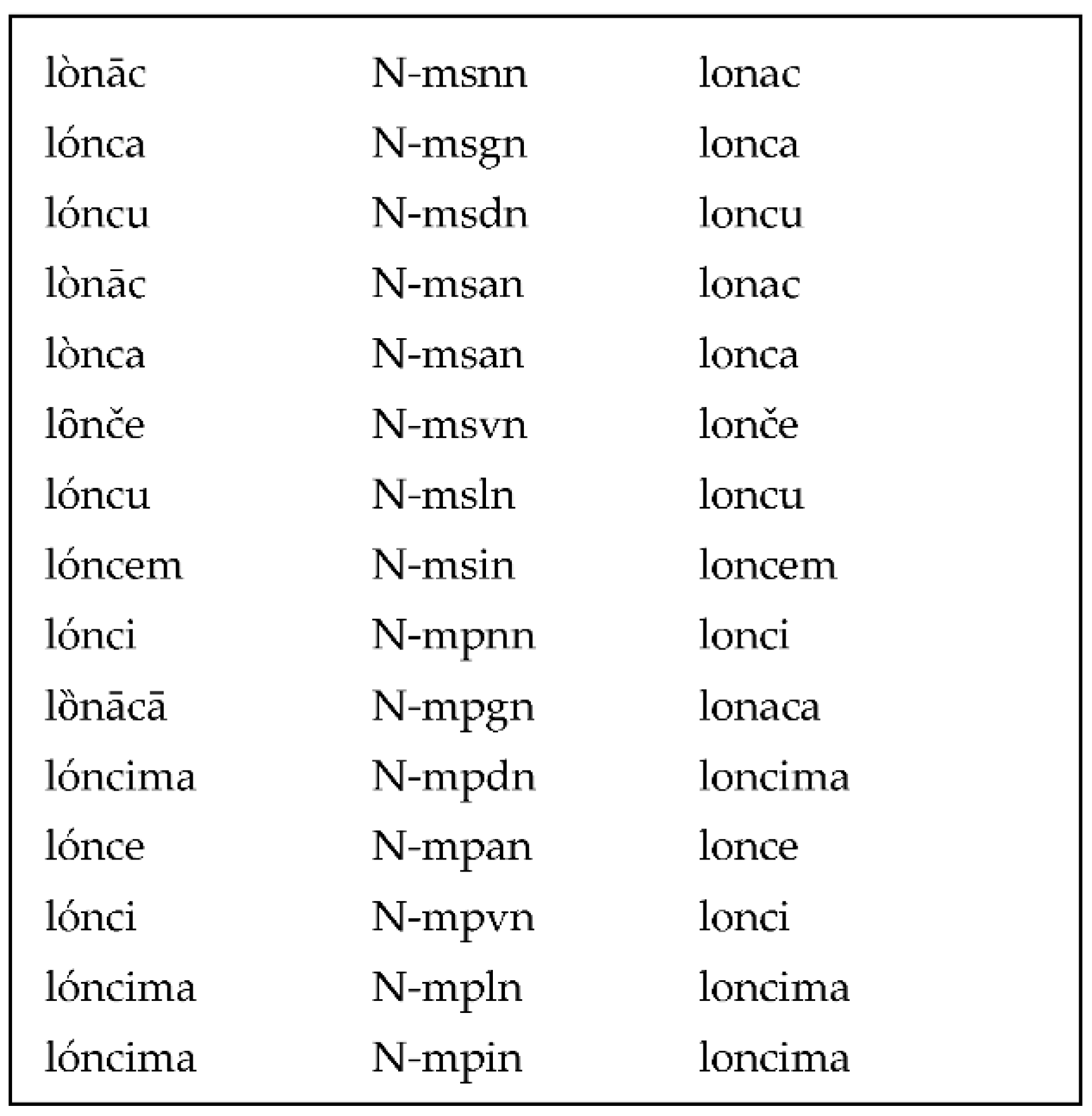
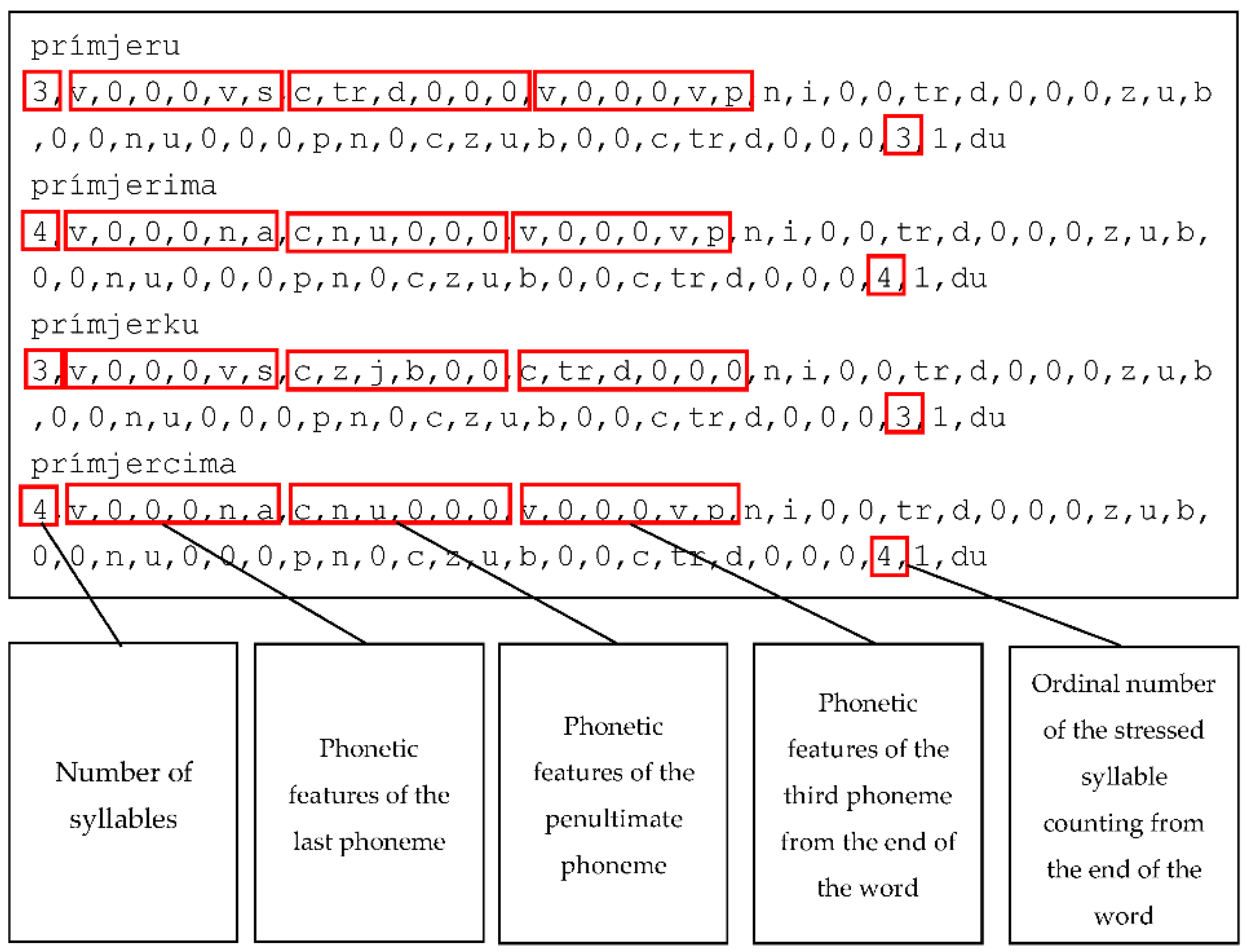
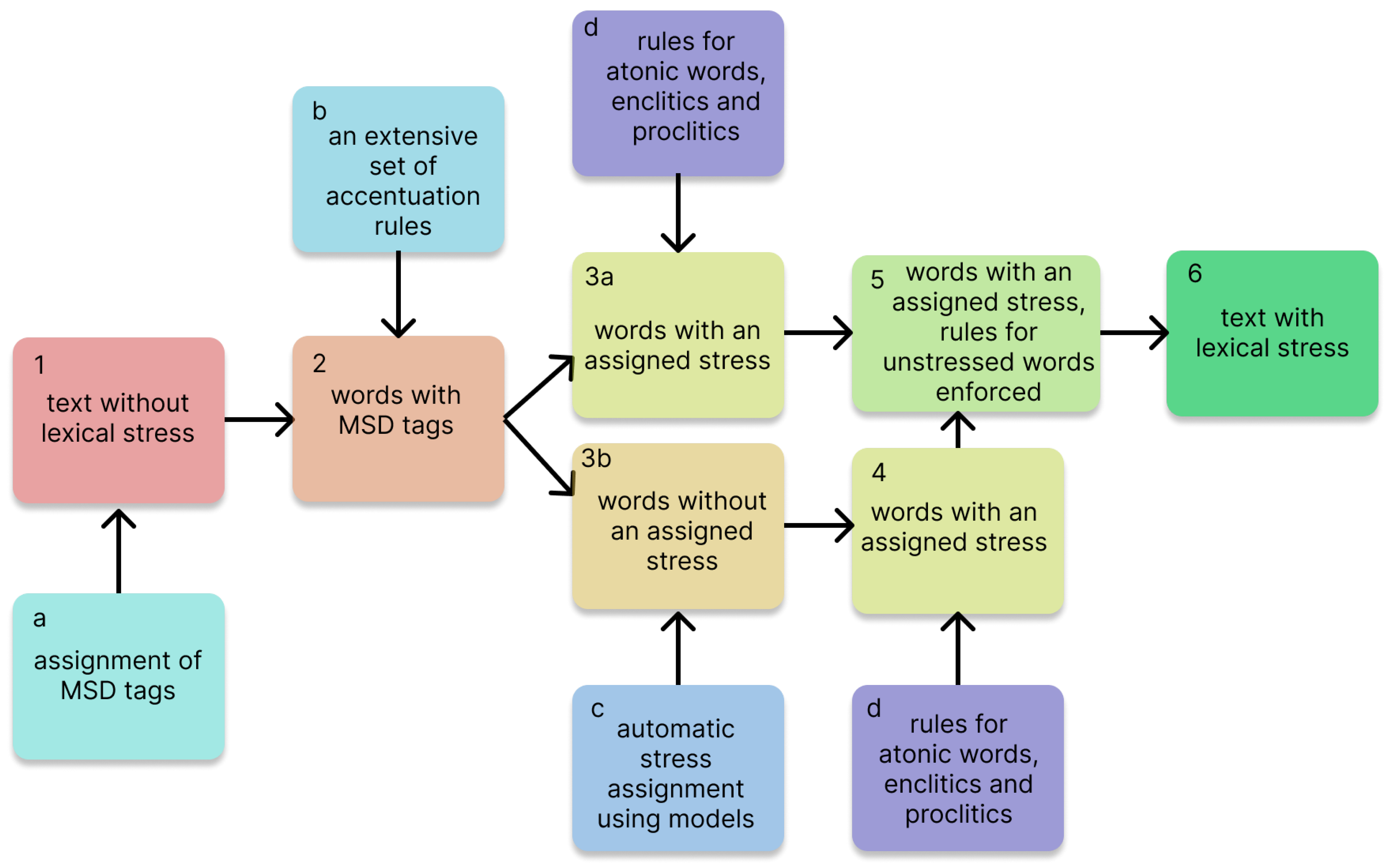

| Proclitics | |||
| Prepositions | monosyllabic | s, k, zbog, na, o, po, pri, u, etc. | |
| two-syllabic | među, mimo, nada, poda, pokraj, preko, prema, oko | ||
| three-syllabic | umjesto (Eng. instead), all compounds with the preposition “iz-”, e.g., između, iznad, ispod (Eng. between, above, below) | ||
| Conjunctions | a, i, ni, da, kad (when it is stressed) | ||
| Negative particle | ne | ||
| Enclitics | |||
| Pronoun proclitic | unstressed forms of personal pronouns | genitive | me, te, ga, je, nas, vas, ih |
| dative | mi, ti, mu, joj, nam, vam, im | ||
| accusative | me, te, ga (nj), ju (je), nju, nas, vas, ih | ||
| unstressed forms of the reflexive pronoun | genitive | se | |
| dative | si | ||
| accusative | se | ||
| Verb proclitic | unstressed present tense forms of the verb to be | sam, si, je, smo, ste, su | |
| unstressed present tense forms of the modal verb will | ću, ćeš, će, ćemo, ćete, će | ||
| unstressed aorist forms of the verb to be | bih, bi, bi, bismo, biste, bi | ||
| conjunctive—interrogative li | |||
| Linguistic Feature | Feature Description | Potential Values | Number of Attributes |
|---|---|---|---|
| number of syllables | number of syllables in a word | values from 1 to 12 | 1 |
| the last phoneme in a word | phonetic features of the last phoneme in a word | according to Table 3 | 6 |
| the penultimate phoneme in a word | phonetic features of the penultimate phoneme in a word | according to Table 3 | 6 |
| the third phoneme from the end of a word | phonetic features of the third phoneme from the end of a word | according to Table 3 | 6 |
| the fourth phoneme from the end of a word | phonetic features of the fourth phoneme from the end of a word | according to Table 3 | 6 |
| the first phoneme in a word | phonetic features of the first phoneme in a word | according to Table 3 | 6 |
| the second phoneme in a word | phonetic features of the second phoneme in a word | according to Table 3 | 6 |
| the third phoneme in a word | phonetic features of the third phoneme in a word | according to Table 3 | 6 |
| POS tag | POS tag of a word | N, V, A, P, R, S, C, M, Q, I | 1 |
| Phonetic Feature | Label | |
|---|---|---|
| Vowel or consonant | vowel | v |
| consonant | c | |
| Type of consonant according to place of articulation | approximant | p |
| vibrant | tr | |
| lateral | b | |
| nasal | n | |
| plosive | z | |
| fricative | tj | |
| affricate | s | |
| Type of consonant | labial | u |
| labiodental | z | |
| dental | d | |
| postalveolar | p | |
| palatal | n | |
| velar | j | |
| Type of consonant according to voicing | voiced | z |
| voiceless | b | |
| Height of vowels | high vowel | v |
| mid vowel | s | |
| low vowel | n | |
| Vowels according to place of articulation | i | p |
| e | ps | |
| a | a | |
| o or u | s |
| Linguistic Feature | Feature Description | Potential Values | Number of Attributes |
|---|---|---|---|
| number of syllables | number of syllables in a word | values from 1 to 12 | 1 |
| the last phoneme in a word | phonetic features of the last phoneme in a word | according to Table 3 | 6 |
| the penultimate phoneme in a word | phonetic features of the penultimate phoneme in a word | according to Table 3 | 6 |
| the third phoneme from the end of a word | phonetic features of the third phoneme from the end of a word | according to Table 3 | 6 |
| the first phoneme in a word | phonetic features of the first phoneme in a word | according to Table 3 | 6 |
| the second phoneme in a word | phonetic features of the second phoneme in a word | according to Table 3 | 6 |
| POS tag | POS tag of a word | N, V, A, P, R, S, C, M, Q, I | 1 |
| ordinal number of the stressed syllable | ordinal number of the stressed syllable as a result of the first model | values from 1 to 12 | 1 |
| ordinal number of the stressed syllable counting from the end of a word | ordinal number of the stressed syllable counting from the end of a word | values from 1 to 12 | 1 |
| the identity of the stressed phoneme | ordinal number of the stressed syllable counting from the end of a word | a, e, i, o, u, syllabic r | 1 |
| the phoneme in front of the stressed one | phonetic features of the phoneme in front of the stressed one | according to Table 3 | 5 (except for vowels/consonants) |
| the phoneme following the stressed one | phonetic features of the phoneme following the stressed one | according to Table 3 | 5 (except for vowels/consonants) |
| TP Rate | FP Rate | Precision | Recall | F-Measure | ROC Area | |
|---|---|---|---|---|---|---|
| Prediction of lexical stress position (weighted avg.) | 0.908 | 0.084 | 0.907 | 0.908 | 0.908 | 0.964 |
| Prediction of lexical stress type (weighted avg.) | 0.867 | 0.072 | 0.867 | 0.867 | 0.867 | 0.948 |
| Accuracy of Prediction of Lexical Stress Position | Accuracy of Prediction of Lexical Stress Type | Accuracy of Prediction of Both Stress Position and Type | |
|---|---|---|---|
| Before enforcing the rules for unstressed words | 95.99% | 74.26% | 72.15% |
| After enforcing the rules for unstressed words | 97.4% | 82.4% | 80.97% |
Publisher’s Note: MDPI stays neutral with regard to jurisdictional claims in published maps and institutional affiliations. |
© 2022 by the authors. Licensee MDPI, Basel, Switzerland. This article is an open access article distributed under the terms and conditions of the Creative Commons Attribution (CC BY) license (https://creativecommons.org/licenses/by/4.0/).
Share and Cite
Mikelić Preradović, N.; Nacinovic Prskalo, L. System for Automatic Assignment of Lexical Stress in Croatian. Electronics 2022, 11, 3687. https://doi.org/10.3390/electronics11223687
Mikelić Preradović N, Nacinovic Prskalo L. System for Automatic Assignment of Lexical Stress in Croatian. Electronics. 2022; 11(22):3687. https://doi.org/10.3390/electronics11223687
Chicago/Turabian StyleMikelić Preradović, Nives, and Lucia Nacinovic Prskalo. 2022. "System for Automatic Assignment of Lexical Stress in Croatian" Electronics 11, no. 22: 3687. https://doi.org/10.3390/electronics11223687
APA StyleMikelić Preradović, N., & Nacinovic Prskalo, L. (2022). System for Automatic Assignment of Lexical Stress in Croatian. Electronics, 11(22), 3687. https://doi.org/10.3390/electronics11223687


