You are currently viewing a new version of our website. To view the old version click .
Electronics
  • Article
  • Open Access

26 October 2022

Hiding and Extracting Important Information in Encrypted Images by Using the Transformation of All Possible Permutations and VQ Codebook


,
,
and
1
Department of Information Engineering and Computer Science, Feng Chia University, Taichung 40724, Taiwan
2
Department of Computer Science and Information Engineering, National of Chin-Yi University of Technology, Taichung 411030, Taiwan
*
Authors to whom correspondence should be addressed.
This article belongs to the Special Issue Multimedia Processing: Challenges and Prospects

Abstract

Due to its applications in cloud computing, research on reversible data hiding in encrypted images (RDHEI) is becoming more and more important. This paper proposes a reversible data hiding scheme for encrypted images that utilizes an all-permutation technique to embed data into encrypted images. The proposed scheme follows a block-wise data hiding process. Message extraction and image restoration are performed by the receiver using the trained vector quantization (VQ) codebook. This scheme can provide a high embedding rate and reduce the hardware burden on the receiver.

1. Introduction

1.1. Background Introduction

With the rapid development of cloud storage and cloud computing technologies, more and more users are processing their images through cloud-based social networking applications. However, some unauthorized attackers may intercept, leak, or even tamper with sensitive image data during transmission, resulting in compromised user security. The combination of image encryption and data hiding techniques is a potential solution to protect the privacy of information while enabling the transmission of messages.
Image encryption is a technique that usually uses an encryption key to encrypt a plaintext image into a ciphertext image, and only the recipient with the decryption key can decrypt the image [1]. Data hiding methods are mainly divided into two types: reversible and irreversible. Reversible Data Hiding (RDH) [2,3,4,5,6] can extract the secret data and restore the original image without distortion. Irreversible Data Hiding (IRDH) [7,8] can only extract the secret data and does not restore the original image losslessly.
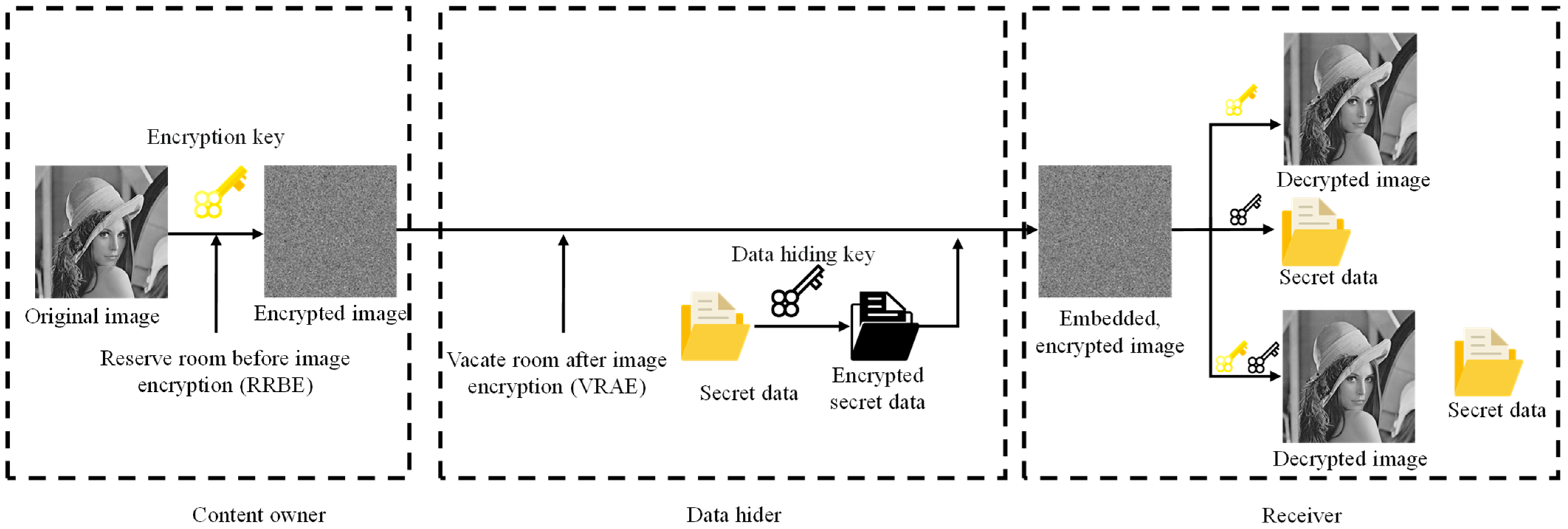
Reversible data hiding (RDHEI) in encrypted images has become increasingly important in recent years. There are three hypothetical users in the RDHEI scheme, including content owners, data hiders, and receivers. The whole process is that the content owner encrypts the original image with the image encryption key, and then the data hider embeds additional data such as timestamp, watermark, and copyright information into the encrypted image. The receiver with the data hiding key can extract the embedded data, and the decrypted image can be obtained with the image encryption key. Existing spatial RDHEI schemes can be mainly divided into two categories: (1) reserving the spare room before image encryption (RRBE) [9,10,11] and (2) vacating the spare room after image encryption (VRAE) [12,13,14,15,16,17,18,19,20,21,22,23,24,25]. Figure 1 shows the general process of RDHEI, and briefly shows the difference between RRBE and VRAE.
Figure 1. The overall process of RDHEI.
In the RRBE scheme, the spare space is reserved before the image is encrypted, that is, the spare space is reserved in the plaintext image. Because meaningful images have some correlation between their adjacent pixels, these redundant spaces can be reserved for data embedding. It is obvious that the RRBE scheme requires a significant amount of complex preprocessing to compress the original image before image encryption. However, it is difficult to require each content owner to perform specific preprocessing on the images before uploading them, and therefore the VRAE scheme is sometimes more appropriate than RRBE.
In VRAE schemes, the content owner simply encrypts the original image. The spare room used to embed the data is freed up in the process of encrypting the image. Because there is little correlation between the adjacent pixels of encrypted images, some early VRAE schemes cannot recover the original image and extract the embedded data losslessly. To improve the embedding rate and avoid errors, some block-based VRAE schemes have been proposed in recent years. In these schemes, the original image is first divided into non-overlapping blocks, and each block is encrypted with the same key. By doing this, the correlation between pixels in the block is preserved.
In this paper, we propose a permutation-based RDHEI scheme (P-RDHEI) that can be directly applied to encrypted images. In each encrypted image block of size p × q , the image block is divided into n sub-blocks for all permutations, and multi-bit secret data are embedded by replacing the permutation of the image blocks. The original arrangement can be predicted from the VQ codebook to restore the image and extract information. When restoring encrypted blocks, the original arrangement can be predicted from the VQ codebook to restore the image and extract information. Most encrypted blocks can be fully recovered because the codewords in the VQ codebook are inherently representative of the pixel distribution of natural image blocks. The main contributions of our scheme are summarized as follows:
(1) Compared with traditional VRAE schemes, the P-RDHEI scheme significantly improves the embedding rate using all permutations, which can embed 0.9562 bpp of secret data into encrypted images.
(2) The proposed P-RDHEI scheme can achieve lossless data extraction and image restoration when the VQ codebook is relatively large.
(3) Compared with the CNN network required for extraction in the scheme in [12], the P-RDHEI scheme only needs the VQ codebook to complete the function of extracting and restoring images, effectively reducing the hardware burden on the receiver.
(4) Encrypted images and embedded encrypted images are fully encrypted. Because our proposed scheme only changes the order of the pixels in each block, the statistical properties and textures of the original image are not exposed.
The rest of this paper is organized as follows. Section 2 introduces the VQ compression techniques used in this paper and the related work that this paper mainly refers to. Section 3 illustrates the proposed scheme P-RDHEI. In Section 4, experimental results, comparisons, and discussions are given. Conclusions are provided in Section 5.

1.2. Literature Review

In this section, related literature is reviewed. After many years of development, the traditional RDH method has achieved many effective results in many fields [2,3,4,5,6,7,8]. Chang [2] trained generative adversarial networks (GANs) to reinvigorate the regular-singular (RS) method. This network generates a synthetic image and uses it as a reference to provide guidance for data embedding and image recovery. Ref. [3] combines VQ compression [4] with multiple linear regression prediction to further compress the VQ index using multiple linear regression prediction, which improves the embedding capability of images. In Ref. [5], using the feature that 3D space points have more moveable directions, Chi et al. used the prediction error of PVO to locate 3D space coordinate points to obtain more embedding space and designed clever displacement rules to reduce image distortion. In [6], a new data encryption method is proposed to reduce the size of encrypted data and improve the spatial efficiency. In [7], a very classical data hiding method is proposed, where the mapping space corresponding to the pixel pair coordinates is divided into the shape of a turtle shell, and then the secret numbers are embedded into each pixel pair under the guidance of the turtle shell. In [8], the identity of the lip image is hidden in the image itself using modulation techniques without hindering the recognition rate of the biometric system, thus reducing the possibility of template misuse.
In the RRBE domain, in [9], a local difference predictor is used to calculate the prediction error of the central pixel of each block with the other pixels, and the blocks are classified into different types based on these prediction errors, freeing up room for high embedding capacity before the original image is encrypted. The method of [10] improves the embedding capability of reversible data hiding methods based on encrypted images using public key encryption by preprocessing the images using differential expansion (DE) before encryption. The method of [11] performs the preprocessing of histogram shrinkage before encryption and then embeds the data into the LSB plane of the ciphertext pixels.
In the VRAE domain, in [12], the Arnold transform was used in the data embedding of the encrypted block, and the number of Arnold transforms of the encrypted block was determined according to the decimal of the embedded data. A convolutional neural network (CNN) model was then used to restore the image and extract information. Ref. [13] also uses pixel rotation technology to embed data into encrypted images and embeds different secret data according to the position of the maximum value in different rotation states. The block complexity is used to recover the original state of the pixel block. A method for embedding watermarks in encrypted images using the mean property and using mean preservation to extract hidden messages is discussed in [14]. Ming et al. introduced a histogram shift-based RDH scheme for encrypted images in [15]. By using homomorphic addition, the shifted histogram for data hiding will be created for the purpose of data hiding. In [16,19], the secret data are embedded by flipping the least significant bits (LSBs) of the encrypted pixel blocks. Ref. [17] improved the algorithm for calculating the smoothness in [16] to reduce the error rate of image recovery. Huang et al. [20] applied the histogram shifting technique to the prediction error histogram derived from each encrypted block for data embedding using a two-layer strategy. An RDH method for encrypted domains using the Laplacian-like distribution high-frequency coefficients of integer wavelet transform and the independence of orthogonal coefficients is detailed in [21]. Ref. [23] uses a median edge detection (MED) predictor to predict the bit-plane and then recursively processes all the bit-planes of the image to improve the hiding ability. Ref. [24] used matrix coding to embed the data to the location of the highest significant bit (MSB). To recover the image, high accuracy MSB prediction based on the orthogonal projection technique is preprocessed on the original image, and the prediction is self-embedded to help recover the image. An RDHEI method using adaptive difference recovery (ADR) was proposed in [25]. The range of the original disparity between the overlay pixel and the reference pixel can be determined adaptively based on the marker disparity generated by the bit substitution technique. The pixels can be recovered by the range of the original disparity and the reference pixel.

3. Proposed Scheme

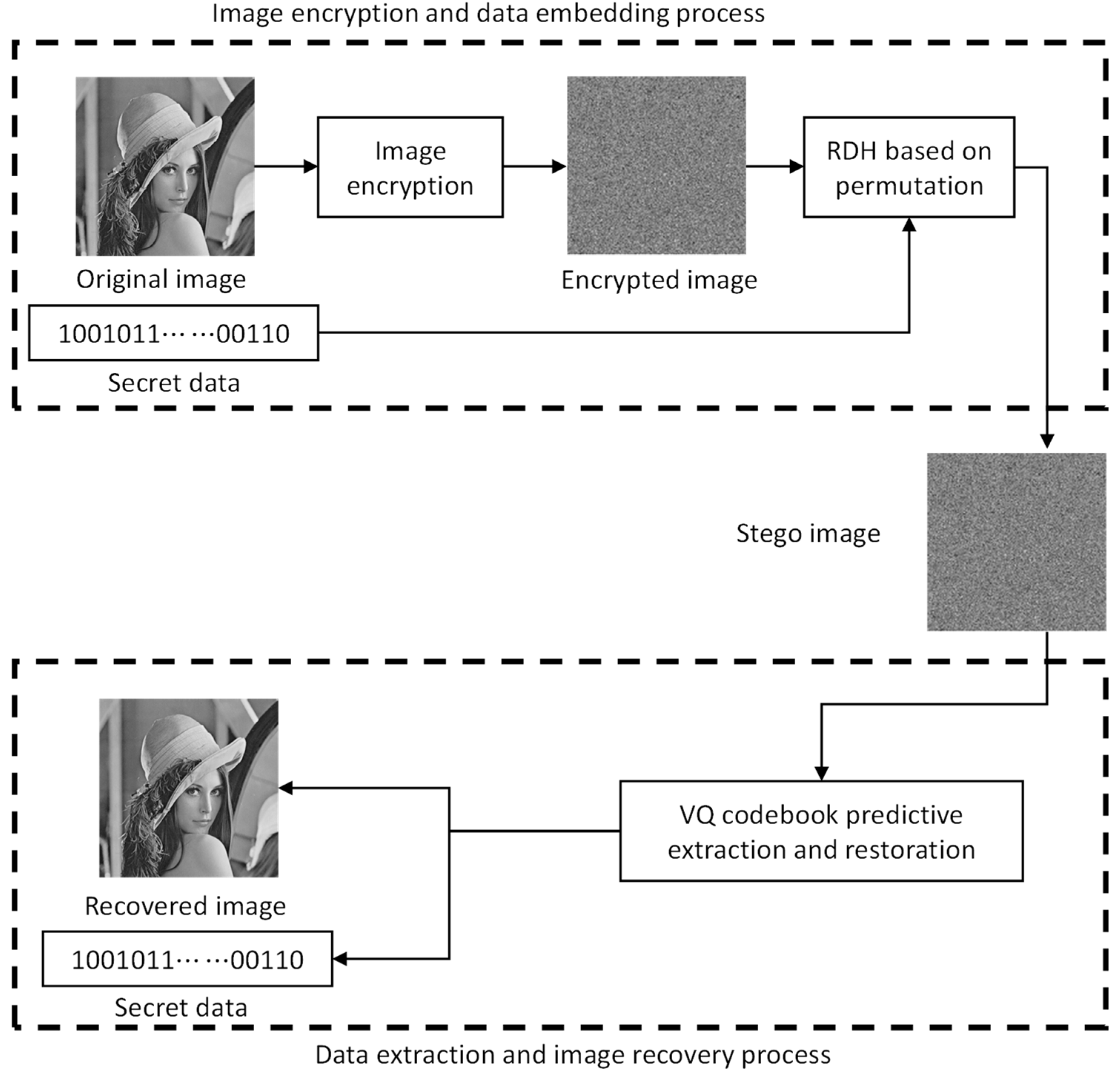
In this section, we propose an all permutation-based data hiding technique to embed data into encrypted images (P-RDHEI). The original image is encrypted by the content owner using stream cipher encryption technology. For the data hider, the encrypted image is divided into non-overlapping p × q sized blocks; all blocks are then divided into n sub-blocks. Next, the data hider performs an all permutation of the n sub-blocks to obtain a list with all permutations. The original permutations are then replaced with the corresponding permutations in the list based on the secret data as an index. In the data extraction and image restoration phases, we need to first train a p × q dimensional VQ codebook for image restoration. We also divide the received stego image into non-overlapping p × q blocks, divide all blocks into n sub-blocks, and then perform an all permutation of these n sub-blocks to obtain a list with all permutations. Next, we decrypt all the permutations in the list. Then, the original permutation is found from the list according to the VQ codebook, and then the index of the permutation of the stego pixel block is extracted. Figure 4 shows the framework of our proposed P-RDHEI. The detailed phase of image encryption, data embedding, data extraction, and image restoration will be described in the following subsections.
Figure 4. The overall flow of the proposed scheme P-RDHEI.

3.1. The Image Encryption

First, we encrypt the original image O of size M × N into encrypted image E of size M × N . This paper chooses the stream cipher encryption method to ensure the security of the encrypted image. To conduct the image encryption, a pseudo-random matrix sized M × N is used as the encryption key, K E , where each value of the random stream ranges from 0 to 255. The original image, O , is then encrypted according to the following steps.
Step 1: Each pixel of the original image, O , and the corresponding encryption key, K E , are converted into an 8-bit binary system according to Equation (2).
O ( i , j ) x = O ( i , j ) 2 x 1   m o d   2 K E ( i , j ) x = K E ( i , j ) 2 x 1   m o d   2
where ( i , j ) represents the coordinates, and the ranges of i and j are [ 1 ,   M ] and [ 1 ,   N ] , respectively. The order of bits from back to front is denoted as x ( x = 1 , 2 , , 8 ) .
Step 2: According to Equation (3), a bit-level XOR operation is performed on the original image, O, and the encryption key, K E .
Step 3: The final decimal encrypted image, E , can be obtained by converting the binary number to decimal by Equation (4).
E ( i , j ) x = O ( i , j ) x K E ( i , j ) x
E ( i , j ) = x = 1 8 E ( i , j ) x × 2 x 1

3.2. The Data Embedding Phase

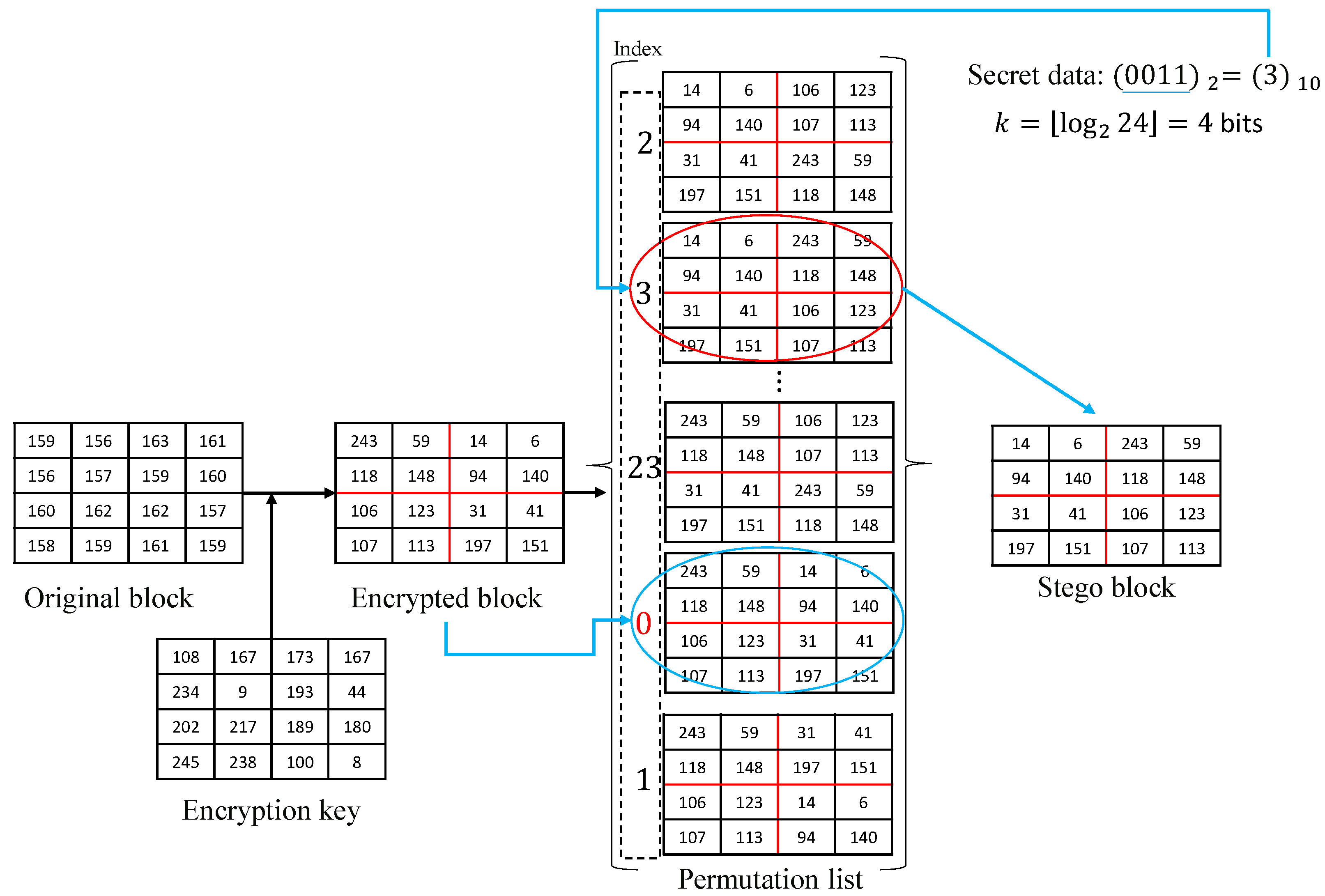
After receiving the encrypted image, E, it is first divided into ( M × N ) / ( p × q ) non-overlapping p × q sized blocks, where E B θ denotes the θ-th encrypted block. For each p × q sized encrypted block, E B θ , we divide it equally into n sub-blocks of the same size (the maximum value of n is p × q ), and then we perform a non-repeated all permutation operation on these n sub-blocks to generate a list sorted from small to large. That is to say, we list all the random permutations of n sub-blocks and delete duplicate permutations. According to the order from top to bottom and from left to right, the pixel value of each permutation is then extracted to form a p × q -dimensional array, and all permutations are then sorted according to these arrays. Next, we find the E B θ permutation from the list and set the index of the current permutation as 0. The other permutations are cyclically numbered along the current item. Assuming that there are W items in the list generated by the encrypted block, E B θ , we can then embed k = log 2 W bits of secret data into this block. The specific operation removes the k-bit secret data to be embedded in the block, converts it to decimal D , finds the permutation numbered D in the list, uses it to replace the current permutation, and the embedding operation is completed. As shown in the list in Figure 5, the 4 × 4 encrypted block is divided into 4 sub-blocks of the same size by the red line. All possible random permutations of these 4 sub-blocks are then listed, resulting in 24 different permutations. We then extract the pixel values from top to bottom and left to right for each permutation to form 24 16-dimensional arrays. Finally, according to the value of these arrays, 24 different permutations are sorted from small to large, and finally our permutation list is generated. We then find the original permutation of encrypted blocks in this list and number its index as 0. The index values of other permutations are numbered from 0 down in the order of the list. In Figure 5, we can see that when the index number is 1, we have numbered the last item of the list, but the permutations above index 0 in the list have not been numbered. Therefore, we loop to the first permutation in the list, and number down along the previous index until all permutations that do not have an index value are numbered. There are 24 items in the list, so we can embed k = log 2 24 = 4 bits of secret data in this encrypted block. Because the secret data are ( 0011 ) 2 = ( 3 ) 10 , we use the permutation where the index is 3 to replace the original permutation as the stego block.
Figure 5. An example of the embedding process in which the 4 × 4 pixel block is divided into 4 sub-blocks.
From the process of embedding data, as long as we can correctly find the permutation with the index value of 0, we can accurately extract the index value of the received stego block permutation and then use the permutation with the index value of 0 to restore the image.

3.3. The Data Extraction and Image Recovery Phase

After receiving the stego encrypted image, the receiver needs to use natural images to train a VQ codebook with L = 2 l codewords to assist the receiver in restoring the image and extracting the secret data. The training method of the VQ codebook is described in detail in Section 2.1. In general, the value of l is an integer greater than 3. The more codewords in the VQ codebook, the more accurate the prediction of the VQ codebook; however, the more codewords there are in the VQ codebook, the more storage space will be required. Therefore, after weighing the accuracy and storage space, the value of l is 6 and 7 in the subsequent experiments.
The stego encrypted image is then divided into non-overlapping p × q sized blocks, where E B θ denotes the θ-th stego encrypted block. Similar to the operation during embedding, we divide E B θ into n sub-blocks, and then perform a non-repeated all permutation operation on these n sub-blocks to generate a list sorted from small to large. Next, we perform a decryption operation for each item in this list using the encryption key, K E , as shown in Equations (5) and (6).
I T ( i , j ) v x = E ( i , j ) v x K E ( i , j ) x
I T ( i , j ) v = x = 1 8 I T ( i , j ) v x × 2 x 1
where ( i , j ) represents the coordinates, and the ranges of i and j are [ 1 ,   M ] and [ 1 ,   N ] , respectively. E ( i , j ) v represents the encrypted value at position ( i , j ) of the v-th item in the permutation list, I T ( i , j ) v represents the decrypted value at the position ( i , j ) of the v-th item in the permutation list, and the range of v is [ 1 ,   W ] .
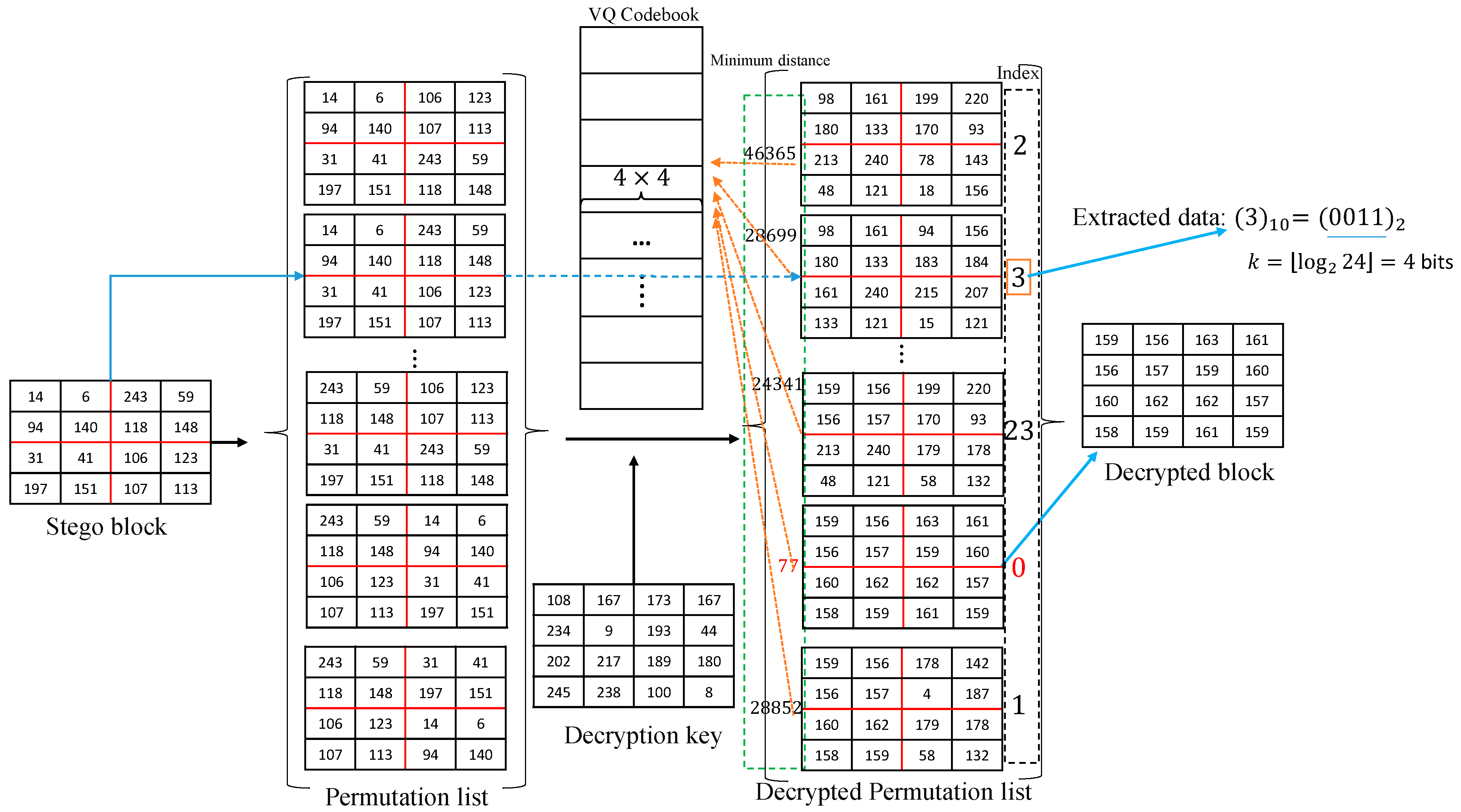
We then have a decrypted list with W items, of which only one is a permutation of the original image block. Due to the characteristics of stream encryption, only the correct arrangement can decrypt pixel blocks with normal pixel distribution, and other arrangements will decrypt some garbled characters. What the receiver must do is find the permutation of the natural image; we use the characteristics of the VQ codebook, which means the pixels in the natural image pixel block can be replaced by the best matching codeword in the VQ codebook to find the permutation that best matches the VQ codebook in the decryption list. Because the distribution of elements in the decrypted garbled blocks is irregular, their matching degree with the VQ codebook will be very low. That is to say, they are very different from the codewords of the VQ codebook. As such, we can use the shortest distance of the permutation to the VQ codebook to find the permutation of the original image block in the decryption list. We need to calculate the shortest distance between the W items in the decryption list and the VQ codebook, and then the permutation with the shortest distance is what we think is the natural permutation. After we have determined which item in the list is the original pixel permutation, we number the index of the current permutation as 0. The other items are cyclically numbered along the current item. This way, we can find the index of the received permutation in the list. By extracting this index and converting it into a k-bit binary number ( k = log 2 W ), the secret data embedded in the block by the data hider can be obtained. Figure 6 is an example of pixel block recovery and information extraction, where the pixel block size is 4 × 4 and is divided into 4 sub-blocks for permutation. As shown in the list in Figure 6, the 4 × 4 encrypted stego block is divided into 4 sub-blocks of the same size by the red line. We thanlist all possible random permutations of these 4 sub-blocks, resulting in 24 different permutations. We then extract the pixel values from top to bottom and left to right for each permutation to form 24 16-dimensional arrays. According to the value of these arrays, 24 permutations are sorted from small to large, and the permutation list is generated. We then decrypt all 24 permutations in the list in order to obtain the decrypted permutation list. Only one of the 24 decrypted permutations is the permutation of the original pixel block, and the others are irregular garbled codes; that is, only one permutation of the 24 decrypted permutations has the general characteristics of the image pixel block. The codeword of the VQ codebook may be a judgment criterion that can be used as a universal feature of an image pixel block. Therefore, we calculate the shortest distance between these 24 decrypted permutations and the VQ codebook, respectively. When the shortest distance of a permutation is the smallest among all permutations, we number its index value as 0, and we consider this permutation to be the permutation of our original pixel block. At this point, we can restore the pixel block. The next step is extracting our secret data. The index values of other permutations are numbered from 0 down in the order of the list. In Figure 6, we can see that when the index number is 1, we have numbered the last item of the list, but the permutations above index 0 in the list have not been numbered. We loop to the first permutation in the list and number down along the previous index until all permutations that do not have an index value are numbered. In the decrypted permutation list, we find the same permutation as the decrypted received stego block, extract its index value ( 3 ) 10 , and then convert the index value into a k -bit (   k = log 2 24 = 4 ) binary number. Therefore, our secret data are ( 0011 ) 2 .
Figure 6. An example of the extraction process in which the 4 × 4-pixel block is divided into 4 sub-blocks.

4. Experimental Results

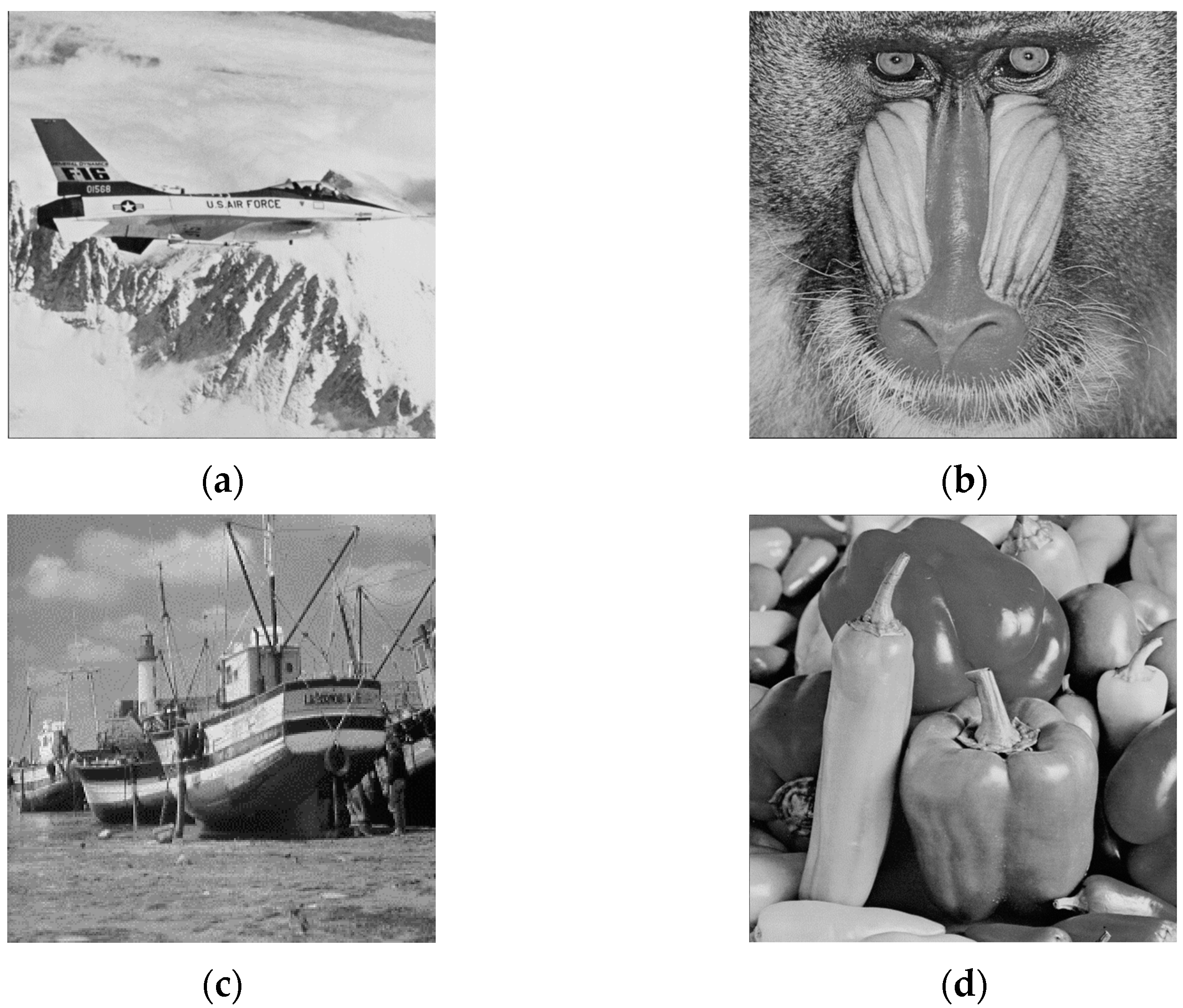
In this section, some experimental results were conducted in the R2017a version MATLAB environment on a Windows PC operating system to evaluate the performance of our proposed scheme and compare it with state-of-the-art schemes. We mainly tested different schemes on four commonly used grayscale images “Airplane”, “Baboon”, “Boat”, and “Peppers” with 512 × 512 pixels, as shown in Figure 7.
Figure 7. Test images. (a) Airplane; (b) Baboon; (c) Boat; (d) Peppers.
Two important metrics, PSNR (dB) and SSIM, are used to evaluate the image distortion between the original image and the recovered image and can be calculated by:
M S E = 1 M × N i = 1 M j = 1 N ( O i , j D i , j ) 2 ,
PSNR = 10 log 10 ( 255 ) 2 MSE ( dB ) ,
φ ( o α ,   d α ) = ( 2 μ o α μ d α + c 1 ) ( 2 σ o d α + c 2 ) [ ( μ o α ) 2 + ( μ d α ) 2 + c 1 ] [ ( σ o α ) 2 + ( σ d α ) 2 + c 2 ] ,
SSIM = 1 b α = 1 b φ ( o α ,   d α ) .
In Equation (9), μ and σ denote the mean value and standard deviation and set two constants, c 1 and c 2 , near to zero, respectively. In Equation (10), b and α represent the total block number and block index, respectively. The embedding rate reveals the average number of bits that can be embedded into one pixel, which is obtained by:
γ = | A d | M × N .
The error rate measures the data extraction and image recovery accuracies in this paper, which can be calculated by:
ε = E r r o r   b l o c k   n u m b e r T o t a l   b l o c k   n u m b e r .
Meanwhile, the information entropy is chosen to test the security of the encrypted image, i.e., calculate the randomness of the image histogram by:
H ( I ) = ı = 0 255 Θ ( ρ ı ) log 2 ( Θ ( ρ ı ) ) ,
where I is an input grayscale image with 256 gray-levels, ρ ı ( 0 ı 255), and Θ ( ρ ı ) denotes the probability of ρ ı . The information entropy value is closer to 8 if an encrypted image has a higher randomness. We first evaluate our proposed scheme in different scenarios in Section 4.1 and provide some execution results and a security analysis in Section 4.2. The comparisons with other state-of-the-art schemes are given in Section 4.3.

4.1. Performances of Our Proposed Schemes

Because the block size, number of sub-blocks, and codebook size will affect the embedding rate and the image block recovery accuracy, we first tested the performance of our proposed scheme in different block sizes, numbers of sub-blocks, and codebook sizes. For comparison purposes, we tested different block sizes of 4 × 4, 8 × 8, 16 × 16, and 32 × 32. For each block composed of different block sizes, we divided it into four or eight sub-blocks. This is because the size of the pixel blocks we divide determines that we cannot define the number of sub-blocks as multiples of 3. When the number of sub-blocks is 2, the amount of data that can be embedded in a pixel block will be small. When the number of sub-blocks is greater than 8, the time cost of calculating the full arrangement of sub-blocks will be large. To sum up, we chose to define the number of sub-blocks as 4 or 8 after weighing the embedding ability and the time cost. Therefore, each block can carry l o g 2 4 ! or l o g 2 8 ! secret bits, so that the embedding rates for these two scenarios are 0.2866 bpp and 0.9562 bpp, 0.0716 bpp and 0.2391 bpp, 0.0179 bpp and 0.0598 bpp, and 0.0045 bpp and 0.0149 bpp, with block sizes from 4 × 4 to 32 × 32. From Table 1, Table 2, Table 3 and Table 4, except for ‘Airplane’ and ‘Baboon’ in the case of block size 32 × 32, in most cases the error rates are growing while the block size decreases, so that the PSNRs and SSIMs are gradually decreasing. When the block size is larger, such as 16 × 16 or 32 × 32, most images can be totally recovered. While the images ‘Airplane’ and ‘Baboon’ have a block size of 16 × 16 or 32 × 32, due to some randomness of the stream cipher, the error rate suddenly increases occasionally in multiple experiments. Our table shows the average error rate of multiple experiments, so there will be an increase in the value. Generally, the error rates when choosing 4 sub-blocks are much lower than when the number of sub-blocks is 8, because there are more recovered block states compared to when the number of sub-blocks is 8, and they are more prone to be misjudged. The error rate decreases as the size of the VQ codebook increases, because the larger the size of the VQ codebook, the codewords in it can express more image features, and we can better judge the permutation of the original pixel blocks. From our experimental results, when the size of the VQ codebook is 128 and the number of sub-blocks is 4, the error rate is lower than other cases.
Table 1. Performances when number of sub-blocks = 4 and codebook size = 64.
Table 2. Performances when number of sub-blocks = 4 and codebook size = 128.
Table 3. Performances when number of sub-blocks = 8 and codebook size = 64.
Table 4. Performances when number of sub-blocks = 8 and codebook size = 128.

4.2. Execution Results and Security Analysis

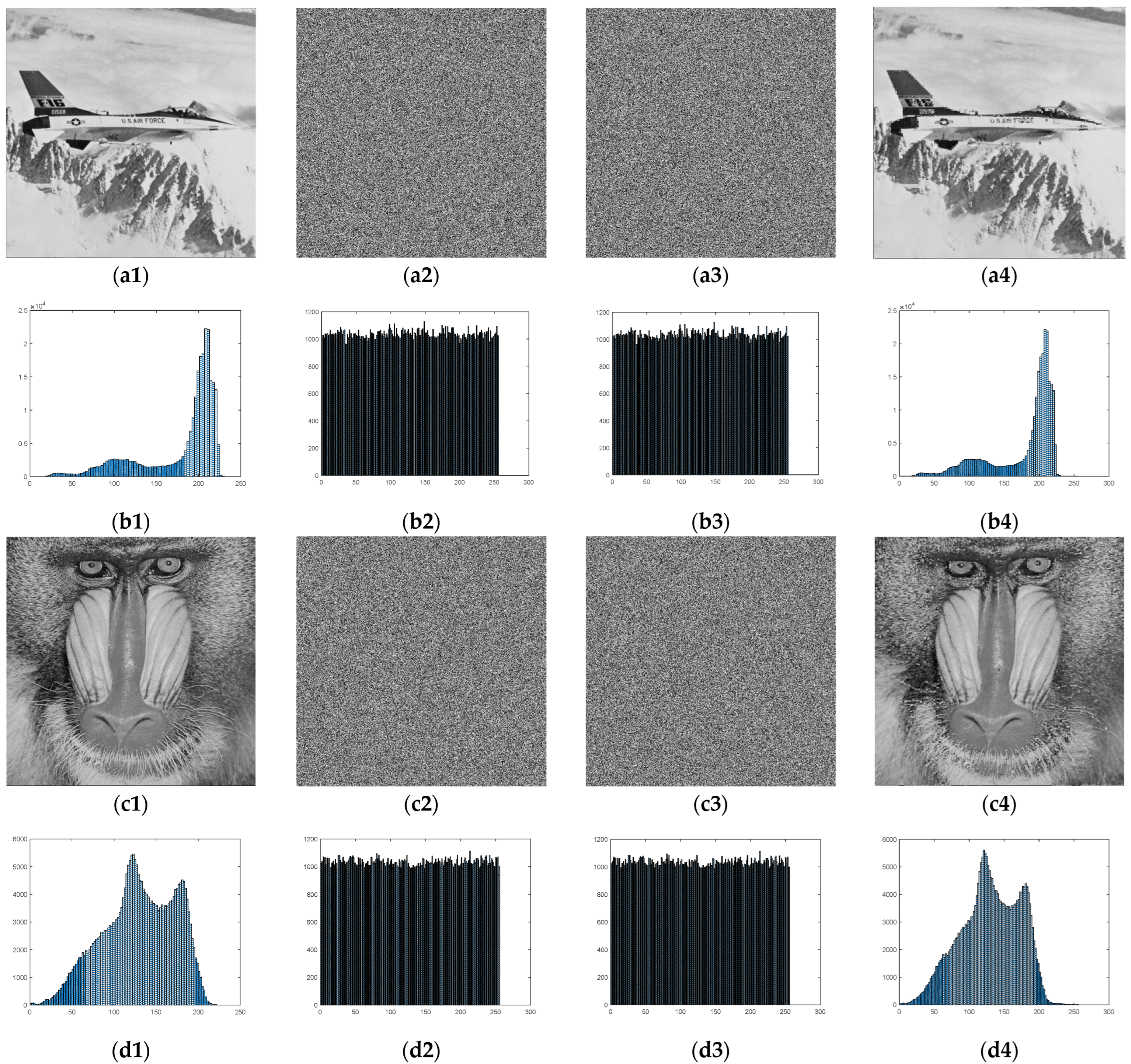
Some execution results, i.e., images in different phases, are given in Figure 8. After encrypting the image, the pixel values are disordered, and no meaningful information can be observed. Therefore, the pixel distributions of the encrypted images are even in a histogram. Because our proposed data embedding scheme only scrambles the encrypted pixel locations, the pixel distributions of the embedded encrypted images are not changed. When the number of sub-blocks is 8, codebook size is 64, and block size is 4 × 4, 0.9562 bpp can be embedded; however, the recovered image has some errors, as shown in Figure 8a4. When the number of sub-blocks is 4, codebook size is 128, and block size is 16 × 16, after extracting 0.0179 bpp of additional data, the original image can be totally recovered without any errors.
Figure 8. Execution results of our proposed scheme: (a1) The original “Airplane” image with 512 × 512 pixels. (a2,a3) are the encrypted image and embedded encrypted image (the number of sub-blocks = 8, codebook size = 64, block size = 4 × 4, and γ = bpp). (a4) is the decrypted image (PSNR = dB). (b1b4) are the corresponding histograms of (a1a4). In (c,d), the results of “Baboon” (the number of sub-blocks = 4, codebook size = 128, block size = 16 × 16, γ = 0.0179 bpp, and PSNR = Inf dB) are given.
Additionally, we also analyze the security of our proposed scheme based on information entropy. The original images, encrypted images, and embedded encrypted images of different block sizes are shown in Table 5. Obviously, the entropy values of the encrypted image and the embedded encrypted image for each image are all the same, because our proposed scheme only scrambles the encrypted pixel locations. On the other hand, the entropy values of different encrypted images are very close to 8 and are much higher than those of the original images. Therefore, the distribution of pixel values in the encrypted images have a higher randomness so that security can be better guaranteed.
Table 5. Information Entropy of Different Images in Two Scenarios.
Furthermore, the correlation between the adjacent pixels of an image is also an important part of image security analysis. Therefore, we further analyzed some statistical features and provided some results, including horizontal correlation and vertical correlation. Table 6, Table 7, Table 8 and Table 9 show the correlation distribution between the encrypted image and the original image in different directions when embedding using different pixel block sizes, respectively. As shown in Table 6, Table 7, Table 8 and Table 9, there is some similarity between adjacent pixels in the original image, i.e., both horizontal and vertical correlations are high. Because stream encryption is used, the correlation distribution of the encrypted image in different directions does not change with the pixel block size, as long as the stream cipher key remains unchanged. The correlations of both the encrypted image and the embedded encrypted image are close to 0, indicating a high difference in the values of adjacent pixels, because the stream cipher encryption fully encrypts the image and all of the permutation embedding retains the encrypted pixel values. After image encryption, most of the pixels are not equal to the original pixels, so no image content is exposed.
Table 6. Correlation distribution of images in different directions when the pixel block size is 4 × 4.
Table 7. Correlation distribution of images in different directions when the pixel block size is 8 × 8.
Table 8. Correlation distribution of images in different directions when the pixel block size is 16 × 16.
Table 9. Correlation distribution of images in different directions when the pixel block size is 32 × 32.

4.3. Comparison with State-of-the-Art Schemes

In this section, we mainly compare our proposed scheme with the scheme in [12], and we carry out an embedding rate comparison with some state-of-the-art schemes. In Table 10, the embedding rates of our proposed scheme are all higher than those in [12], except for when the number of sub-blocks is 4 and the block size is 32. Especially when dividing each block into 8 parts, the embedding rates have tremendous improvements. Because the image quality of the recovery image mainly depends on the error rate, we further compare our proposed scheme with [12] in terms of error rate. As shown in Table 11, [12] has lower errors in the most cases, because the CNN model was only trained on these four images. Our proposed scheme trained the VQ codebook on other images, so the error rates are relatively higher. Nevertheless, the error rates remain at a low level, so they are still acceptable, especially in the larger block sizes.
Table 10. Comparison of Embedding Rate γ (bpp).
Table 11. Comparison of Error Rate ε (%).
Because the spare room of our proposed scheme is vacated after image encryption, we make the embedding rate comparison with some VRAE schemes [10,11,12,14,15,16,17,18,21,22], as shown in Table 12. In [12], and in our proposed scheme, we set the block size to 8 × 8 and the number of sub-blocks to 8. It can be observed that our proposed scheme has outstanding embedding rates compared to other schemes. This is because we are using the all-permutation technique in mathematics, which generates more permutations than other permutation techniques, so our embedding rate is better.
Table 12. Maximum Embedding Rate Comparison in Different Schemes.

5. Conclusions

In this paper, we proposed a reversible data hiding scheme in encrypted images that directly embeds data into encrypted images using the all-permutation technique (P-RDHEI). In the process of extracting information and restoring images, the scheme combines the characteristics of the VQ codebook, which effectively reduces the burden on the receiver. The encrypted image of our scheme and the embedded encrypted image of our scheme are fully encrypted without exposing the statistical properties and texture of the original image. It has a high payload capacity of 0. 9562 bpp when dividing a 4 × 4 size image block into 8 sub-blocks, and our P-RDHEI scheme has a higher embedding efficiency and larger embedding capacity compared to many other existing similar RDHEI schemes. When a 32 × 32 size image block is divided into four sub-blocks for embedding, our scheme is able to achieve total image recovery, that is, full image recovery can be achieved using VQ codebook-assisted image restoration, which is also better than some existing replacement-based RDHEI schemes.
When the number of sub-blocks is greater than 8, the time cost of computing the full sub-block arrangement will be large. After weighing the embedding capability and time cost, we choose to define the number of sub-blocks as 4 or 8. In future research, we will try to design other methods to obtain more embeddable space without increasing the time cost. We can also introduce deep learning techniques to further optimize the algorithm to improve the decrypted image quality of our P-RDHEI scheme.

Author Contributions

Conceptualization and methodology, H.-X.C., C.-C.C. and C.-C.L.; software, H.-X.C. and X.W.; validation, H.-X.C., C.-C.C., X.W. and C.-C.L.; writing—original draft preparation, H.-X.C., X.W. and C.-C.L.; writing—review and editing, H.-X.C., C.-C.C., X.W. and C.-C.L. All authors have read and agreed to the published version of the manuscript.

Funding

This research received no external funding.

Data Availability Statement

Not applicable.

Conflicts of Interest

The authors declare no conflict of interest.

References

  1. Chen, G.; Mao, Y.; Chui, C.K. A symmetric image encryption scheme based on 3D chaotic cat maps. Chaos Solitons Fractals 2004, 21, 749–761. [Google Scholar] [CrossRef]
  2. Chang, C.-C. Adversarial Learning for Invertible Steganography. IEEE Access 2020, 8, 198425–198435. [Google Scholar] [CrossRef]
  3. Chi, H.; Chang, C.-C.; Liu, Y. An SMVQ compressed data hiding scheme based on multiple linear regression prediction. Connect. Sci. 2021, 33, 495–514. [Google Scholar] [CrossRef]
  4. Gray, R. Vector quantization. IEEE ASSP Mag. 1984, 1, 4–29. [Google Scholar] [CrossRef]
  5. Chi, H.-X.; Horng, J.-H.; Chang, C.-C. Reversible Data Hiding Based on Pixel-Value-Ordering and Prediction-Error Triplet Expansion. Mathematics 2021, 9, 1703. [Google Scholar] [CrossRef]
  6. Chang, C.-C.; Li, C.-T.; Shi, Y.-Q. Privacy-Aware Reversible Watermarking in Cloud Computing Environments. IEEE Access 2018, 6, 70720–70733. [Google Scholar] [CrossRef]
  7. Chang, C.C.; Liu, Y.; Nguyen, T.S. A Novel Turtle Shell Based Scheme for Data Hiding. In Proceedings of the 2014 Tenth International Conference on Intelligent Information Hiding and Multimedia Signal Processing, Kitakyushu, Japan, 27–29 August 2014; pp. 89–93. [Google Scholar] [CrossRef]
  8. Das, S.; Muhammad, K.; Bakshi, S.; Mukherjee, I.; Sa, P.K.; Sangaiah, A.K.; Bruno, A. Lip biometric template security framework using spatial steganography. Pattern Recognit. Lett. 2019, 126, 102–110. [Google Scholar] [CrossRef]
  9. Mohammadi, A.; Nakhkash, M.; Akhaee, M.A. A High-Capacity Reversible Data Hiding in Encrypted Images Employing Local Difference Predictor. IEEE Trans. Circuits Syst. Video Technol. 2020, 30, 2366–2376. [Google Scholar] [CrossRef]
  10. Shiu, C.-W.; Chen, Y.-C.; Hong, W. Encrypted image-based reversible data hiding with public key cryptography from difference expansion. Signal Process. Image Commun. 2015, 39, 226–233. [Google Scholar] [CrossRef]
  11. Zhang, X.; Long, J.; Wang, Z.; Cheng, H. Lossless and Reversible Data Hiding in Encrypted Images With Public-Key Cryptography. IEEE Trans. Circuits Syst. Video Technol. 2016, 26, 1622–1631. [Google Scholar] [CrossRef]
  12. Panchikkil, S.; Manikandan, V.M.; Zhang, Y.-D. A convolutional neural network model based reversible data hiding scheme in encrypted images with block-wise Arnold transform. Optik 2022, 250, 168137. [Google Scholar] [CrossRef]
  13. Wang, X.; Chang, C.-C.; Lin, C.-C.; Chang, C.-C. Reversal of pixel rotation: A reversible data hiding system towards cybersecurity in encrypted images. J. Vis. Commun. Image Represent. 2022, 82, 103421. [Google Scholar] [CrossRef]
  14. Agrawal, S.; Kumar, M. Mean value based reversible data hiding in encrypted images. Optik 2017, 130, 922–934. [Google Scholar] [CrossRef]
  15. Li, M.; Li, Y. Histogram shifting in encrypted images with public key cryptosystem for reversible data hiding. Signal Process. 2017, 130, 190–196. [Google Scholar] [CrossRef]
  16. Zhang, X. Reversible Data Hiding in Encrypted Image. IEEE Signal Process. Lett. 2011, 18, 255–258. [Google Scholar] [CrossRef]
  17. Hong, W.; Chen, T.-S.; Wu, H.-Y. An Improved Reversible Data Hiding in Encrypted Images Using Side Match. IEEE Signal Process. Lett. 2012, 19, 199–202. [Google Scholar] [CrossRef]
  18. Zhang, X. Separable Reversible Data Hiding in Encrypted Image. IEEE Trans. Inf. Forensics Secur. 2012, 7, 826–832. [Google Scholar] [CrossRef]
  19. Bhardwaj, R.; Aggarwal, A. An improved block based joint reversible data hiding in encrypted images by symmetric cryptosystem. Pattern Recognit. Lett. 2020, 139, 60–68. [Google Scholar] [CrossRef]
  20. Huang, F.; Huang, J.; Shi, Y.-Q. New Framework for Reversible Data Hiding in Encrypted Domain. IEEE Trans. Inf. Forensics Secur. 2016, 11, 2777–2789. [Google Scholar] [CrossRef]
  21. Xiong, L.; Xu, Z.; Shi, Y.-Q. An integer wavelet transform based scheme for reversible data hiding in encrypted images. Multidimens. Syst. Signal Process. 2018, 29, 1191–1202. [Google Scholar] [CrossRef]
  22. Chen, Y.-C.; Shiu, C.-W.; Horng, G. Encrypted signal-based reversible data hiding with public key cryptosystem. J. Vis. Commun. Image Represent. 2014, 25, 1164–1170. [Google Scholar] [CrossRef]
  23. Puteaux, P.; Puech, W. A Recursive Reversible Data Hiding in Encrypted Images Method With a Very High Payload. IEEE Trans. Multimed. 2021, 23, 636–650. [Google Scholar] [CrossRef]
  24. Xie, X.-Z.; Chang, C.-C.; Chen, K. A High-Embedding Efficiency RDH in Encrypted Image Combining MSB Prediction and Matrix Encoding for Non-Volatile Memory-Based Cloud Service. IEEE Access 2020, 8, 52028–52040. [Google Scholar] [CrossRef]
  25. Yu, C.; Zhang, X.; Li, G.; Zhan, S.; Tang, Z. Reversible data hiding with adaptive difference recovery for encrypted images. Inf. Sci. 2022, 584, 89–110. [Google Scholar] [CrossRef]
Publisher’s Note: MDPI stays neutral with regard to jurisdictional claims in published maps and institutional affiliations.

Article Metrics

Citations

Article Access Statistics

Multiple requests from the same IP address are counted as one view.