Article

A Circuit-Based Wave Port Boundary Condition for the Nodal Discontinuous Galerkin Time-Domain Method
School of Electronic Engineering, Xidian University, Xi’an 710071, China
*
Author to whom correspondence should be addressed.
Electronics 2022, 11(12), 1842; https://doi.org/10.3390/electronics11121842

Submission received: 17 May 2022 / Revised: 8 June 2022 / Accepted: 9 June 2022 / Published: 9 June 2022

Abstract

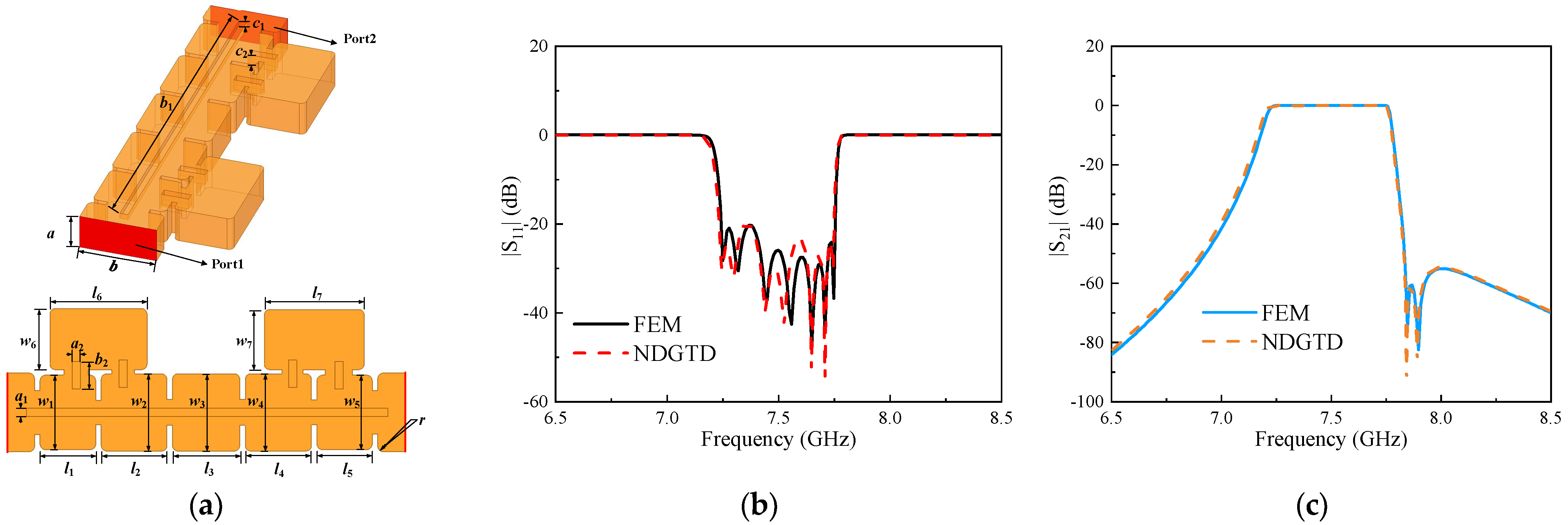
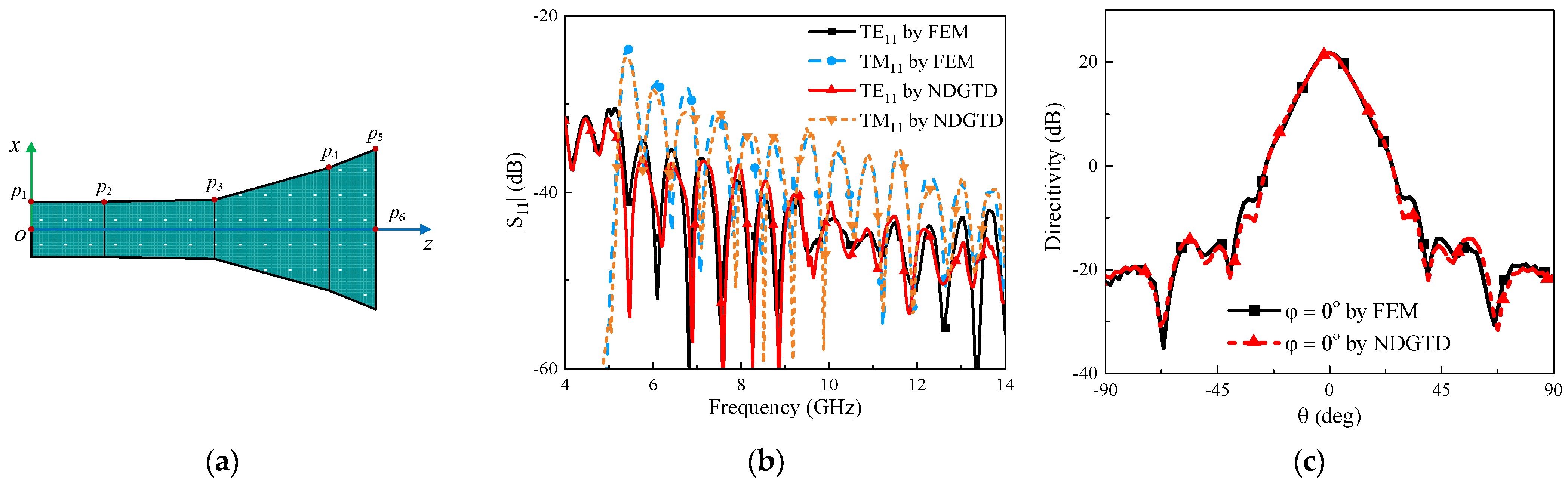
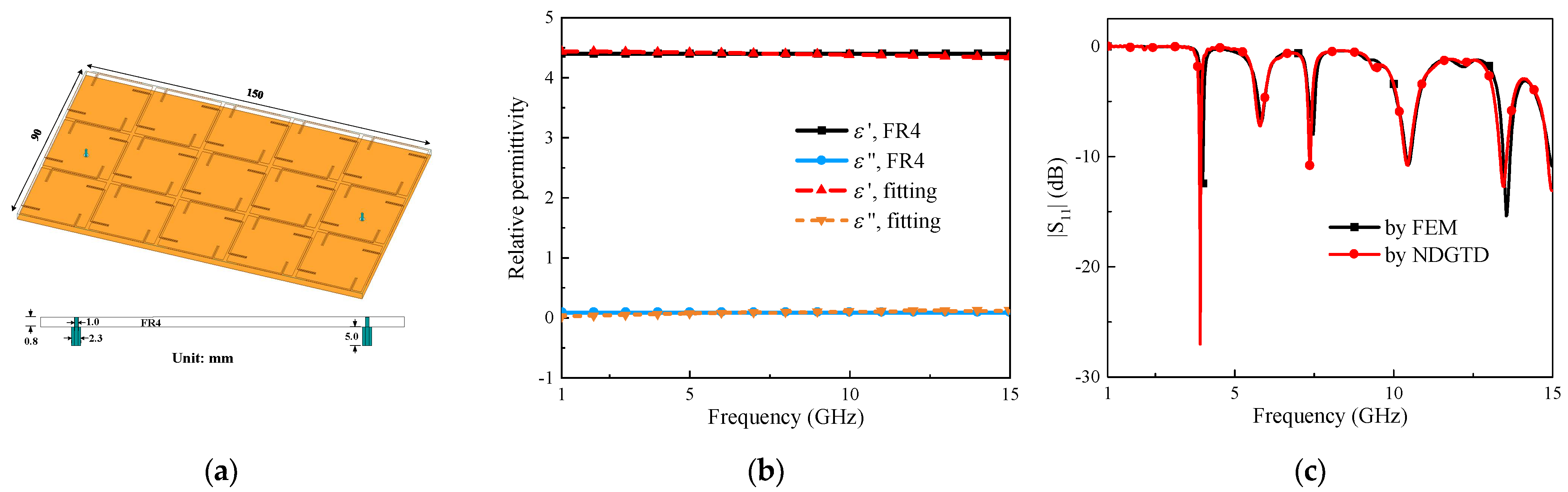
Waveguide-like transmission line (WLTL) structures, including rectangular waveguides, circular waveguides, and coaxial lines, have been widely used in microwave engineering. Determining how to efficiently model WLTLs has become vital for the design of various WLTL-based devices. In this paper, a circuit-based wave port boundary condition (CWPBC) is developed and applied in the discontinuous Galerkin time-domain (DGTD) method to accurately simulate these structures for the first time. In the CWPBC, modal voltages and currents of a WLTL are defined, and circuits based on modal voltages and currents are introduced. By co-simulating the modal circuit and the WLTL modeled using the DGTD method, various modal fields can be excited in the WLTL, and at the same time, the WLTL can be terminated without reflections. No extra costs or approximations are used in the proposed CWPBC, and there is no requirement of either the extension of the computational domains widely used in perfectly matched layer (PML) termination or the longitudinal field continuity used in the reported DGTD method. The proposed method can easily obtain the postprocessing parameters, including S-parameters and port power. Numerical results, including rectangular waveguide filters, circular waveguide horns, and coaxial-fed electromagnetic bandgaps (EBG), are given to validate the effectiveness of the proposed CWPBC.
Keywords: circuit-based wave port boundary condition (CWPBC); discontinuous Galerkin time domain (DGTD); modal circuit; co-simulation circuit-based wave port boundary condition (CWPBC); discontinuous Galerkin time domain (DGTD); modal circuit; co-simulation