Article

Efficient Depth Map Creation with a Lightweight Deep Neural Network
1
Department of Applied Artificial Intelligence, Kwangwoon University, Seoul 01897, Korea
2
School of Computer and Information Engineering, Kwangwoon University, Seoul 01897, Korea
*
Author to whom correspondence should be addressed.
Electronics 2021, 10(4), 479; https://doi.org/10.3390/electronics10040479

Submission received: 24 December 2020 / Revised: 5 February 2021 / Accepted: 11 February 2021 / Published: 18 February 2021
(This article belongs to the Special Issue Deep Learning for Computer Vision and Pattern Recognition)

Abstract

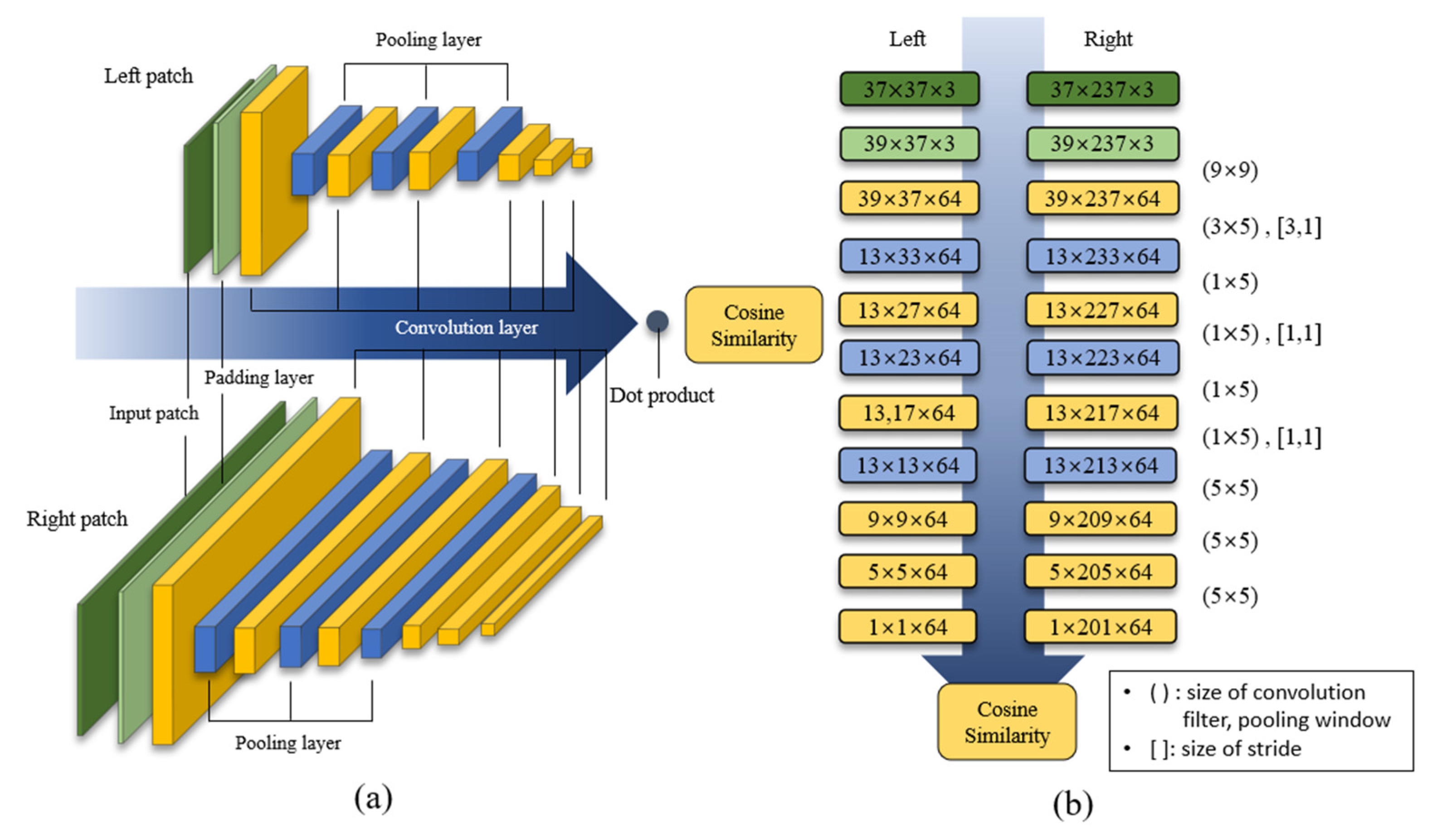
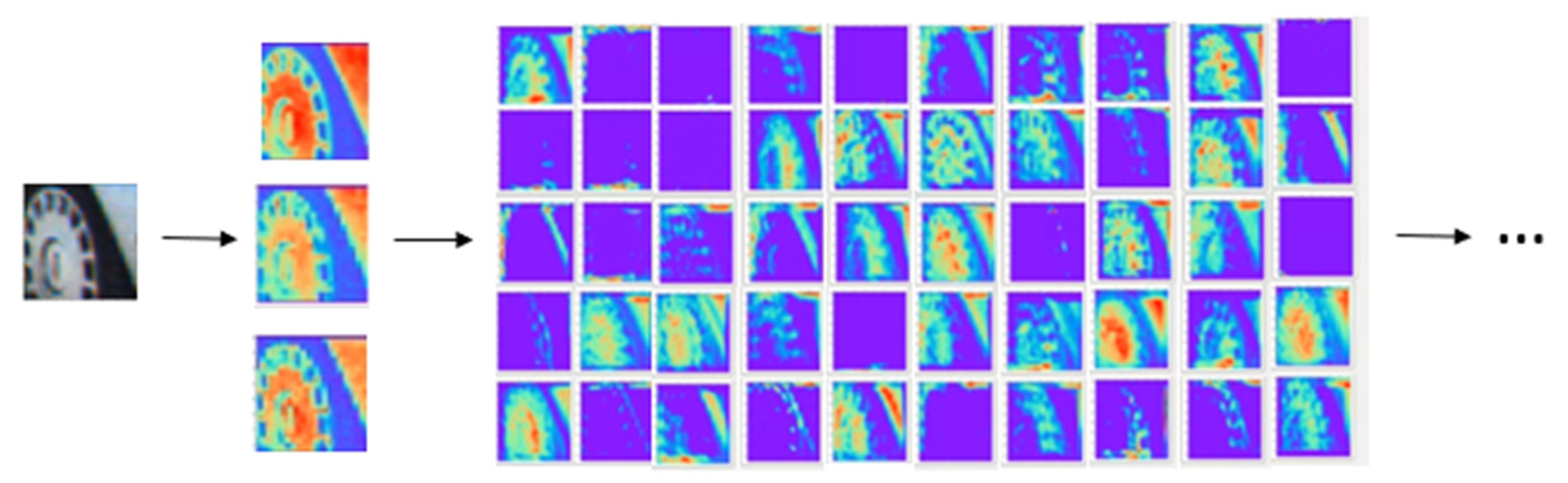
Finding depth information with stereo matching using a deep learning algorithm for embedded systems has recently gained significant attention owing to emerging high-performance mobile graphics processing units (GPUs). Several researchers have proposed feasible small-scale CNNs that can run on a local GPU, but they still suffer from low accuracy and/or high computational requirements. In the method proposed in this study, pooling layers with padding and an asymmetric convolution filter are used to reduce computational costs and simultaneously maintain the accuracy of disparity. The patch size and number of layers are adjusted by analyzing the feature and activation maps. The proposed method forms a small-scale network algorithm suitable for a vision system at the edge and still exhibits high-disparity accuracy and low computational loads as compared to existing stereo-matching networks.
Keywords: AI; embedded computer vision; neural networks; algorithm; stereo matching; feature visualization AI; embedded computer vision; neural networks; algorithm; stereo matching; feature visualization