Highly Stable Inverted CdSe/ZnS-Based Light-Emitting Diodes by Nonvacuum Technique ZTO as the Electron-Transport Layer
 ,
,  ,
,  , and
, and 
Abstract
1. Introduction
2. Materials and Methods
2.1. Synthesis
2.2. Device Fabrication
2.3. Device Characterization
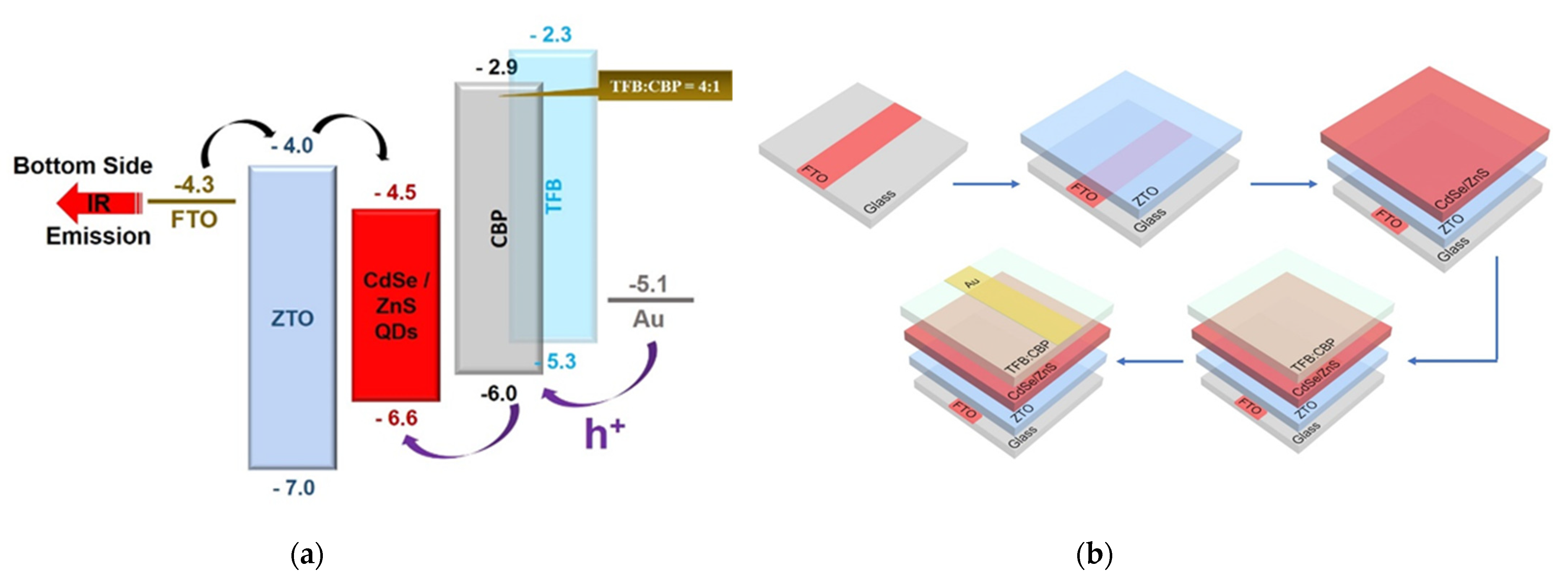
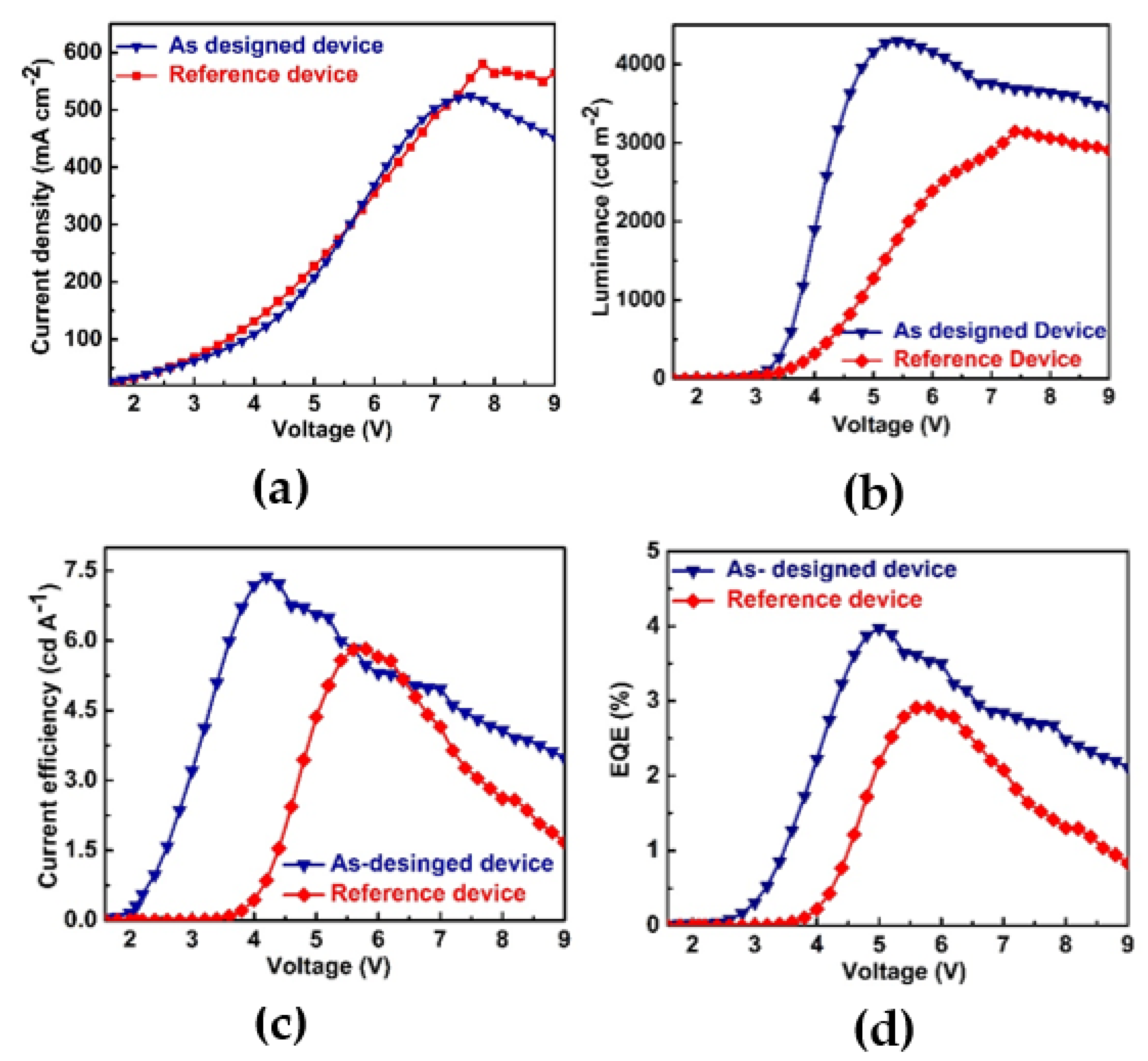
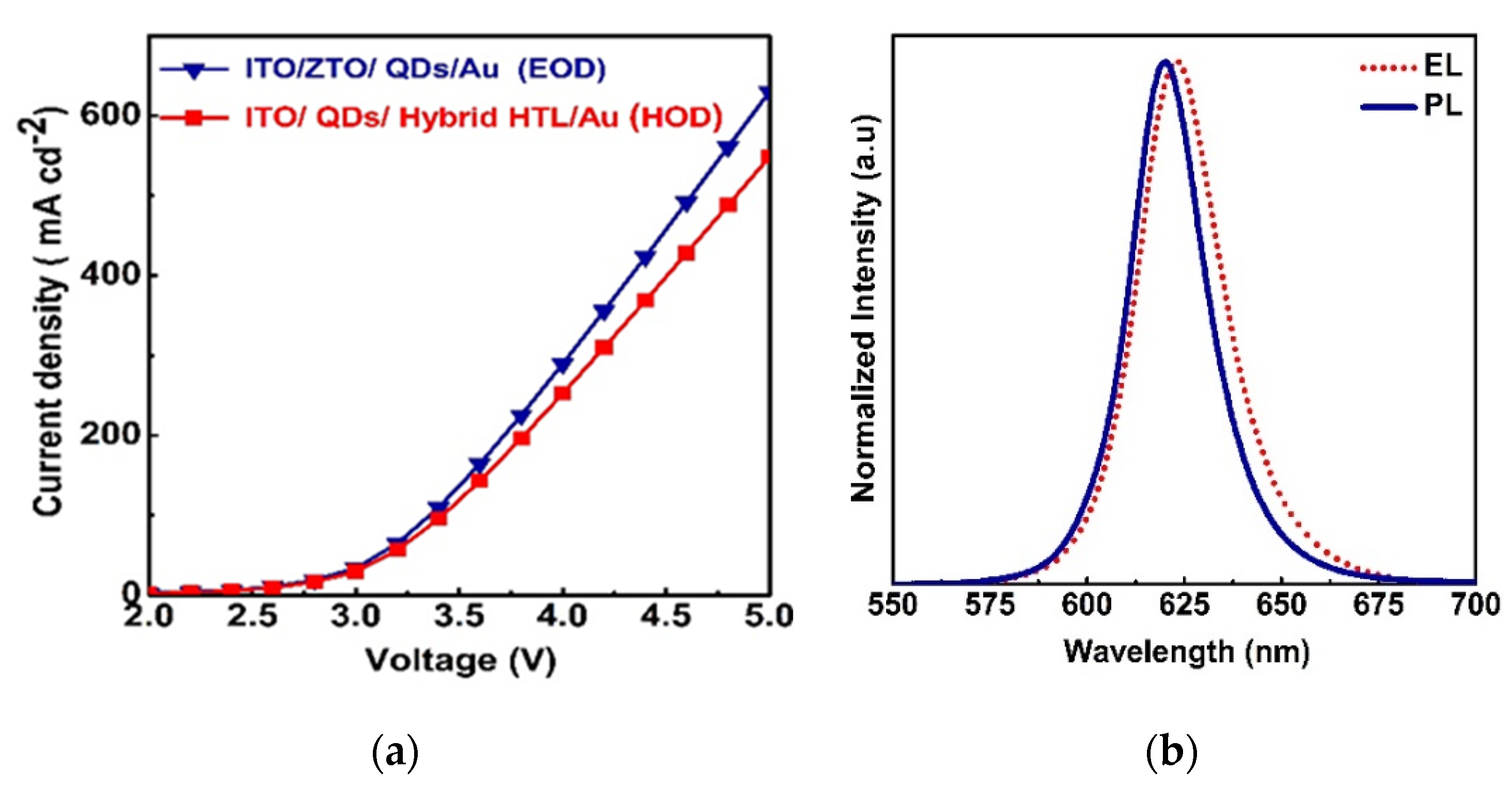
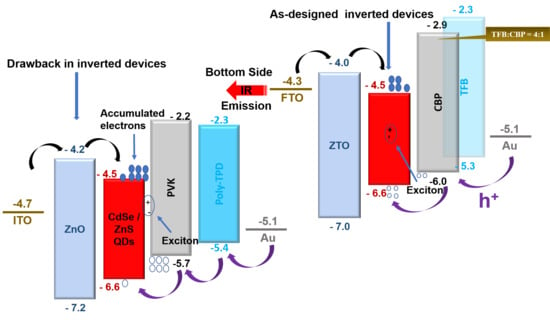
3. Results and Discussion
4. Conclusions
Author Contributions
Funding
Data Availability Statement
Acknowledgments
Conflicts of Interest
References
- Khan, Q.; Subramanian, A.; Yu, G.; Maaz, K.; Li, D.; Sagar, R.U.R.; Chen, K.; Lei, W.; Shabbir, B.; Zhang, Y. Structure optimization of perovskite quantum dot light-emitting diodes. Nanoscale 2019, 11, 5021–5029. [Google Scholar] [CrossRef] [Scilit]
- Zhang, H.; Chen, S. An ZnMgO:PVP inorganic-organic hybrid electron transport layer: Towards efficient bottom-emission and transparent quantum dot light-emitting diodes. J. Mater. Chem. C 2019, 7, 2291–2298. [Google Scholar] [CrossRef] [Scilit]
- Lee, M.H.; Chen, L.; Li, N.; Zhu, F. MoO3-induced oxidation doping of PEDOT:PSS for high performance full-solution-processed inverted quantum-dot light emitting diodes. J. Mater. Chem. C 2017, 5, 10555–10561. [Google Scholar] [CrossRef] [Scilit]
- Mashford, B.S.; Stevenson, M.; Popovic, Z.; Hamilton, C.; Zhou, Z.; Breen, C.; Steckel, J.; Bulovic, V.; Bawendi, M.; Coe-Sullivan, S.; et al. High-efficiency quantum-dot light-emitting devices with enhanced charge injection. Nat. Photonics 2013, 7, 407–412. [Google Scholar] [CrossRef] [Scilit]
- Coe, S.; Woo, W.K.; Bawendi, M.; Bulović, V. Electroluminescence from single monolayers of nanocrystals in molecular organic devices. Nature 2002, 420, 800–803. [Google Scholar] [CrossRef] [Scilit]
- Zhao, J.; Bardecker, J.A.; Munro, A.M.; Liu, M.S.; Niu, Y.; Ding, I.K.; Luo, J.; Chen, B.; Jen, A.K.Y.; Ginger, D.S. Efficient CdSe/CdS quantum dot light-emitting diodes using a thermally polymerized hole transport layer. Nano Lett. 2006, 6, 463–467. [Google Scholar] [CrossRef] [Scilit] [PubMed]
- Caruge, J.M.; Halpert, J.E.; Wood, V.; Buloví, V.; Bawendi, M.G. Colloidal quantum-dot light-emitting diodes with metal-oxide charge transport layers. Nat. Photonics 2008, 2, 247–250. [Google Scholar] [CrossRef] [Scilit]
- Cho, K.S.; Lee, E.K.; Joo, W.J.; Jang, E.; Kim, T.H.; Lee, S.J.; Kwon, S.J.; Han, J.Y.; Kim, B.K.; Choi, B.L.; et al. High-performance crosslinked colloidal quantum-dot light-emitting diodes. Nat. Photonics 2009, 3, 341–345. [Google Scholar] [CrossRef] [Scilit]
- Qian, L.; Zheng, Y.; Xue, J.; Holloway, P.H. Stable and efficient quantum-dot light-emitting diodes based on solution-processed multilayer structures. Nat. Photonics 2011, 5, 543–548. [Google Scholar] [CrossRef] [Scilit]
- Kwak, J.; Bae, W.K.; Lee, D.; Park, I.; Lim, J.; Park, M.; Cho, H.; Woo, H.; Yoon, D.Y.; Char, K.; et al. Bright and efficient full-color colloidal quantum dot light-emitting diodes using an inverted device structure. Nano Lett. 2012, 12, 2362–2366. [Google Scholar] [CrossRef] [Scilit]
- Bae, W.K.; Park, Y.S.; Lim, J.; Lee, D.; Padilha, L.A.; McDaniel, H.; Robel, I.; Lee, C.; Pietryga, J.M.; Klimov, V.I. Controlling the influence of Auger recombination on the performance of quantum-dot light-emitting diodes. Nat. Commun. 2013, 4, 3661. [Google Scholar] [CrossRef] [Scilit]
- Qasim, K.; Wang, B.; Zhang, Y.; Li, P.; Wang, Y.; Li, S.; Lee, S.T.; Liao, L.S.; Lei, W.; Bao, Q. Solution-Processed Extremely Efficient Multicolor Perovskite Light-Emitting Diodes Utilizing Doped Electron Transport Layer. Adv. Funct. Mater. 2017, 27, 1606874. [Google Scholar] [CrossRef] [Scilit]
- Subramanian, A.; Pan, Z.; Zhang, Z.; Ahmad, I.; Chen, J.; Liu, M.; Cheng, S.; Xu, Y.; Wu, J.; Lei, W.; et al. Interfacial Energy-Level Alignment for High-Performance All-Inorganic Perovskite CsPbBr3 Quantum Dot-Based Inverted Light-Emitting Diodes. ACS Appl. Mater. Interfaces 2018, 10, 13236–13243. [Google Scholar] [CrossRef] [Scilit] [PubMed]
- Dai, X.; Zhang, Z.; Jin, Y.; Niu, Y.; Cao, H.; Liang, X.; Chen, L.; Wang, J.; Peng, X. Solution-processed, high-performance light-emitting diodes based on quantum dots. Nature 2014, 515, 96–99. [Google Scholar] [CrossRef] [Scilit] [PubMed]
- Son, D.I.; Kim, H.H.; Cho, S.; Hwang, D.K.; Seo, J.W.; Choi, W.K. Carrier transport of inverted quantum dot LED with PEIE polymer. Org. Electron. 2014, 15, 886–892. [Google Scholar] [CrossRef] [Scilit]
- Liu, B.; Lan, L.; Liu, Y.; Tao, H.; Li, H.; Xu, H.; Zou, J.; Xu, M.; Wang, L.; Peng, J.; et al. Improved performance of quantum dot light-emitting diodes by hybrid electron transport layer comprised of ZnO nanoparticles doped organic small molecule. Org. Electron. Phys. Mater. Appl. 2019, 74, 144–151. [Google Scholar] [CrossRef] [Scilit]
- Subramanian, A.; Akram, J.; Hussain, S.; Chen, J.; Qasim, K.; Zhang, W.; Lei, W. High-Performance Photodetector Based on a Graphene Quantum Dot/CH 3 NH 3 PbI 3 Perovskite Hybrid. ACS Appl. Electron. Mater. 2020, 2, 230–237. [Google Scholar] [CrossRef] [Scilit]
- Hussain, S.; Raza, A.; Saeed, F.; Perveen, A.; Sikhai, Y.; Din, N.; Elemike, E.E. Stable and high performance all-inorganic perovskite light-emitting diodes with anti-solvent treatment. Chin. Opt. Lett. 2021, 19, 030005. [Google Scholar] [CrossRef] [Scilit]
- Kim, D.J.; Lee, H.N. Improving the charge balance and performance of CdSe/ZnS quantum-dot light-emitting diodes with a sputtered zinc-tin-oxide electron-transport layer and a thermally evaporated tungsten-oxide charge-restricting layer. Jpn. J. Appl. Phys. 2019, 58, 106502. [Google Scholar] [CrossRef] [Scilit]
- Kim, T.G.; Shin, D.S.; Jung, K.Y.; Kadam, A.N.; Park, J. Improving light extraction in light-emitting diodes using zinc-tin-oxide layers. J. Alloys Compd. 2017, 710, 399–402. [Google Scholar] [CrossRef] [Scilit]
- Park, M.; Roh, J.; Lim, J.; Lee, H.; Lee, D. Double metal oxide electron transport layers for colloidal quantum dot light-emitting diodes. Nanomaterials 2020, 10, 726. [Google Scholar] [CrossRef] [Scilit]
- Joo, Y.H.; Wi, J.H.; Lee, W.J.; Chung, Y.D.; Cho, D.H.; Kang, S.; Um, D.S.; Kim, C. Il Work function tuning of zinc–tin oxide thin films using high-density o2 plasma treatment. Coatings 2020, 10, 1026. [Google Scholar] [CrossRef] [Scilit]
- Ji, W.; Tian, Y.; Zeng, Q.; Qu, S.; Zhang, L.; Jing, P.; Wang, J.; Zhao, J. Efficient quantum dot light-emitting diodes by controlling the carrier accumulation and exciton formation. ACS Appl. Mater. Interfaces 2014, 6, 14001–14007. [Google Scholar] [CrossRef] [Scilit]
- Cho, Y.R.; Kang, P.; Shin, D.H.; Kim, J.; Maeng, M.; Sakong, J.; Hong, J.; Park, Y.; Suh, M.C. Effect of anode buffer layer on the efficiency of inverted quantum-dot light-emitting diodes. Appl. Phys. Express 2015, 9, 012103. [Google Scholar] [CrossRef] [Scilit]
- Lin, W.; Wu, J.L.; Zhang, Q.M.; Lei, Y.L.; Chen, L.X. High-performance full-solution-processed quantum dot lightemitting diodes with a doped hole injection layer. Sci. Sin. Phys. Mech. Astron. 2020, 50, 067301. [Google Scholar] [CrossRef] [Scilit]
- Choi, M.K.; Yang, J.; Kim, D.C.; Dai, Z.; Kim, J.; Seung, H.; Kale, V.S.; Sung, S.J.; Park, C.R.; Lu, N.; et al. Extremely Vivid, Highly Transparent, and Ultrathin Quantum Dot Light-Emitting Diodes. Adv. Mater. 2017, 30, 1703279. [Google Scholar] [CrossRef] [Scilit]
- Sun, Y.; Su, Q.; Zhang, H.; Wang, F.; Zhang, S.; Chen, S. Investigation on Thermally Induced Efficiency Roll-Off: Toward Efficient and Ultrabright Quantum-Dot Light-Emitting Diodes. ACS Nano 2019, 13, 11433–11442. [Google Scholar] [CrossRef] [Scilit] [PubMed]
- Ding, K.; Fang, Y.; Dong, S.; Chen, H.; Luo, B.; Jiang, K.; Gu, H.; Fan, L.; Liu, S.; Hu, B.; et al. 24.1% External Quantum Efficiency of Flexible Quantum Dot Light-Emitting Diodes by Light Extraction of Silver Nanowire Transparent Electrodes. Adv. Opt. Mater. 2018, 6, 1800347. [Google Scholar] [CrossRef] [Scilit]
- Fang, Y.; Ding, K.; Wu, Z.; Chen, H.; Li, W.; Zhao, S.; Zhang, Y.; Wang, L.; Zhou, J.; Hu, B. Architectural Engineering of Nanowire Network Fine Pattern for 30 μm Wide Flexible Quantum Dot Light-Emitting Diode Application. ACS Nano 2016, 10, 10023–10030. [Google Scholar] [CrossRef] [Scilit] [PubMed]
- Son, D.I.; Kim, H.H.; Hwang, D.K.; Kwon, S.; Choi, W.K. Inverted CdSe-ZnS quantum dots light-emitting diode using low-work function organic material polyethylenimine ethoxylated. J. Mater. Chem. C 2014, 2, 510–514. [Google Scholar] [CrossRef] [Scilit]
- Zhao, Y.; Chen, L.; Wu, J.; Tan, X.; Xiong, Z.; Lei, Y. Composite Hole Transport Layer Consisting of High-Mobility Polymer and Small Molecule with Deep-Lying HOMO Level for Efficient Quantum Dot Light-Emitting Diodes. IEEE Electron Device Lett. 2020, 41, 80–83. [Google Scholar] [CrossRef] [Scilit]
- Khan, Q.; Subramanian, A.; Ahmed, I.; Khan, M.; Nathan, A.; Wang, G.; Wei, L.; Chen, J.; Zhang, Y.; Bao, Q. Overcoming the Electroluminescence Efficiency Limitations in Quantum-Dot Light-Emitting Diodes. Adv. Opt. Mater. 2019, 7, 1900695. [Google Scholar] [CrossRef] [Scilit]
- Hussain, S.; Subramanian, A.; Yan, S.; Din, N.; Abbas, G.; Shuja, A.; Lei, W.; Khan, Q. Engineering Architecture of Quantum Dot-Based Light-Emitting Diode for High Device Performance with Double-Sided Emission Fabricated by Nonvacuum Technique. ACS Appl. Electron. Mater. 2020, 2, 2383–2389. [Google Scholar] [CrossRef] [Scilit]
- Li, Y.; He, P.; Chen, S.; Lan, L.; Dai, X.; Peng, J. Inkjet-Printed Oxide Thin-Film Transistors Based on Nanopore-Free Aqueous-Processed Dielectric for Active-Matrix Quantum-Dot Light-Emitting Diode Displays. ACS Appl. Mater. Interfaces 2019, 11, 28052–28059. [Google Scholar] [CrossRef] [Scilit]
- Zhang, X.; Li, Q.; Yan, S.; Lei, W.; Chen, J.; Khan, Q. A Novel Phototransistor Device with Dual Active layers composited of CsPbBr3 and ZnO Quantum Dots. Materials 2019, 12, 1215. [Google Scholar] [CrossRef] [Scilit] [PubMed]
- Beek, W.J.E.; Wienk, M.M.; Kemerink, M.; Yang, X.; Janssen, R.A.J. Hybrid zinc oxide conjugated polymer bulk heterojunction solar cells. J. Phys. Chem. B 2005, 109, 9505–9516. [Google Scholar] [CrossRef] [Scilit]
- Zhang, Q.; Xia, G.; Li, L.; Xia, W.; Gong, H.; Wang, S. High-performance Zinc-Tin-Oxide thin film transistors based on environment friendly solution process. Curr. Appl. Phys. 2019, 19, 174–181. [Google Scholar] [CrossRef] [Scilit]
- Mustafa, M.; Zubair, M.; Mustafa, M.; Lee, K.; Yoon, C.; Hoi, Y. Fabrication of CdSe/ZnS quantum dots thin film by electrohydrodynamics atomization technique for solution based flexible hybrid OLED application Fabrication of CdSe/ZnS quantum dots thin film by electrohydrodynamics atomization technique for solution. Chem. Eng. J. 2014, 253, 325–331. [Google Scholar] [CrossRef] [Scilit]
- Chang, Y.; Sun, D.; Zhang, Z.; Zhang, Y.; Yao, X.; Jiang, D.; Yu, Y.; Mi, L.; Chen, L.; Zhong, H.; et al. High color-rendering-index Hybrid white LEDs employing CdSe/ZnS core/shell quantum dots. J. Nanosci. Nanotechnol. 2016, 16, 670–676. [Google Scholar] [CrossRef] [Scilit]
- Zhao, Y.; Dong, G.; Duan, L.; Qiao, J.; Zhang, D.; Wang, L.; Qiu, Y. Impacts of Sn precursors on solution-processed amorphous zinc-tin oxide films and their transistors. RSC Adv. 2012, 2, 5307–5313. [Google Scholar] [CrossRef] [Scilit]



| Device No. | Structure | VT(V) Lmax (cd m−2) | EQE (%) | |
|---|---|---|---|---|
| Reference device | FTO/ZnO/CdSe-ZnS/PVK/Poly-TBD/Au | 2.4 | 3146 | 2.91 |
| As-designed device | FTO/ZTO/CdSe-ZnS/TFB:CBP/Au | 1.9 | 4296 | 3.97 |
Publisher’s Note: MDPI stays neutral with regard to jurisdictional claims in published maps and institutional affiliations. |
© 2021 by the authors. Licensee MDPI, Basel, Switzerland. This article is an open access article distributed under the terms and conditions of the Creative Commons Attribution (CC BY) license (https://creativecommons.org/licenses/by/4.0/).
Share and Cite
Hussain, S.; Saeed, F.; Raza, A.; Parveen, A.; Asghar, A.; Din, N.; Chao, Z.; Chen, J.; Khan, Q.; Lei, W. Highly Stable Inverted CdSe/ZnS-Based Light-Emitting Diodes by Nonvacuum Technique ZTO as the Electron-Transport Layer. Electronics 2021, 10, 2290. https://doi.org/10.3390/electronics10182290
Hussain S, Saeed F, Raza A, Parveen A, Asghar A, Din N, Chao Z, Chen J, Khan Q, Lei W. Highly Stable Inverted CdSe/ZnS-Based Light-Emitting Diodes by Nonvacuum Technique ZTO as the Electron-Transport Layer. Electronics. 2021; 10(18):2290. https://doi.org/10.3390/electronics10182290
Chicago/Turabian StyleHussain, Sajid, Fawad Saeed, Ahmad Raza, Abida Parveen, Ali Asghar, Nasrud Din, Zhang Chao, Jing Chen, Qasim Khan, and Wei Lei. 2021. "Highly Stable Inverted CdSe/ZnS-Based Light-Emitting Diodes by Nonvacuum Technique ZTO as the Electron-Transport Layer" Electronics 10, no. 18: 2290. https://doi.org/10.3390/electronics10182290
APA StyleHussain, S., Saeed, F., Raza, A., Parveen, A., Asghar, A., Din, N., Chao, Z., Chen, J., Khan, Q., & Lei, W. (2021). Highly Stable Inverted CdSe/ZnS-Based Light-Emitting Diodes by Nonvacuum Technique ZTO as the Electron-Transport Layer. Electronics, 10(18), 2290. https://doi.org/10.3390/electronics10182290