


Abstract
Achieving urban water security is a major challenge for many countries. While several studies have assessed water security at a regional level, many studies have also emphasized the lack of assessment of water security and application of measures to achieve it at the urban level. Recent studies that have focused on measuring urban water security are not holistic, and there is still no agreed-upon understanding of how to operationalize and identify an assessment framework to measure the current state and dynamics of water security. At present, there is also no clearly defined and widely endorsed definition of urban water security. To address this challenge, this study provides a systematic approach to better understand urban water security, with a working definition and an assessment framework to be applied in peri-urban and urban areas. The proposed working definition of urban water security is based on the United Nations (UN) sustainable development goal on water and sanitation and the human rights on water and sanitation. It captures issues of urban-level technical, environmental, and socio-economic indicators that emphasize credibility, legitimacy, and salience. The assessment framework depends on four main dimensions to achieve urban water security: Drinking water and human beings, ecosystem, climate change and water-related hazards, and socio-economic factors (DECS). The framework further enables the analysis of relationships and trade-off between urbanization and water security, as well as between DECS indicators. Applying this framework will help governments, policy-makers, and water stakeholders to target scant resources more effectively and sustainably. The study reveals that achieving urban water security requires a holistic and integrated approach with collaborative stakeholders to provide a meaningful way to improve understanding and managing urban water security.
1. Introduction
The world is becoming predominantly urban, dominated by human settlements and economic activities. According to the 2018 revision of World Urbanization Prospects [1], more than half of the global population—4.2 billion people—lives in urban areas, and this number is projected to grow by 68% to 2.5 billion people by 2050. Urbanization, urban water security, and economic growth move in tandem. However, for growth to be sustainable, the urban water security implications of rapid urbanization need to be at the center of the national and municipal development agenda [2,3,4].
The concept of urban water security is a multi-faceted one and is interrelated with the broader frameworks and concepts of urban metabolism, ecological security, integrated urban water management, the web of water–energy–food securities, risk management, resilient and adaptive water management, and water-sensitive cities [2,3,4,5,6]. A clear understanding of the synergies and trade-offs between these frameworks will also provide more clarity on what urban water security means and will help with systematically operationalizing the concept of water security, including at the urban level.
Urban areas have been experiencing major transitions and are facing the pressures of increasing demands due to population and economic growth, coupled with the climate change extremes of floods and droughts [7,8]. These conditions pose threats to socio-economic development and human and water security, such as inadequate water and sanitation services, failing storm water management, and water quality and ecosystem degradation [9,10,11]. Eighty percent of GDP is produced in cities—so there are major economic repercussions [10]. Thus, ensuring urban water security is an urgent challenge that may threaten humanity’s food, economic, ecological, and national security if not properly addressed [12,13,14,15,16,17]. Water security is one of the top priorities for policy-makers and governments.
Water security as a concept has received greater consideration over the past twenty years in a series of studies and debates, and has become a common currency among researchers, development partners, and policy-makers focused on adding value to urban water management [18,19]. Most water security assessments have been undertaken at a regional and national level, which may not always be applicable at the local level. Understanding water security is a complex undertaking, with different definitions, interpretations, and assessments used across disciplines; conceiving it variously as national, political, technical, or human security [20,21,22,23,24,25]. Water security is also typically a primary goal of water management, along with related concepts such as integration, sustainability, adaptability, resiliency, and the water, energy, and food nexus [26,27,28,29,30].
Recent studies have demonstrated the evolution of numerous definitions and assessment frameworks for water security over the past decade [31]. However, there is still no agreed-upon understanding of how to operationalize and identify an assessment framework to measure the current state and the dynamics of water security, including at the urban level. Moreover, there is no clear and widely endorsed definition of urban water security [30,31,32,33,34,35]. Water security is framed in different ways; some frameworks focus on risks, while others have adopted a broad understanding with a focus on the development of water resources to meet human needs [30,36,37]. There is a significant similarity and overlap between the three widely-used definitions of water security: Those of Global Water Partnership, World Bank (Grey and Sadoff), and UN-Water [38,39,40,41].
UN-Water has adopted a holistic and interdisciplinary definition, capturing all perspectives and dimensions, and thus it should be the basis of the national water security framework. Most national water strategies are built upon the principle of integrated water resources management (IWRM) as a process and as a good framework for achieving water security and linking water with society [42]. However, IWRM implementation has been criticized for failing to provide comprehensive solutions to the challenges, uncertainties, and complexity of water management [43].
Many studies have emphasized the lack of assessment of water security and application of water security measures at the local level [44,45,46]. These should reflect the considerable variation in dynamics of water security at the local level, in order to address urban water challenges effectively and provide decision-makers with robust policy instruments and measures to achieve urban water security [31,47]. Among the broad definitions and assessment frameworks for water security, many well-established arrays of indicators have been applied at the city level to provide different perspectives on water security [48]. The most widely used indicators include:
- Stand-alone indexes, such as the water stress index and the water poverty index [49,50,51]. These are conceived to be applied at all levels, including at the city level, but they are not salient and narrow enough to capture the dynamics and multiple aspects of urban water security [52,53,54]. In addition, the thresholds used are often arbitrary and not based on scientific principles.
- Composite indicators, such as Asian Development Bank’s urban water security index [55,56], which forms part of its national water security rankings, using averages of all urban areas, and is thus likely to be used by decision-makers at the urban level. A city-specific water index can be developed and applied [43,57,58,59,60] by including the city blueprint framework (CBF) to capture issues of urban water security, but it seeks specifically to measure the implementation of integrated water resources management (IWRM) in different cities, and also to benchmark cities on their resilience at the social, economic, and environmental dimensions [60,61,62,63].
We note that that there is significant overlap, and sometimes even confusion, between the utility benchmarks, which measure operating and financial performance as part of the management and regulatory system; and water security indicators, which are broader in scope and linked to decision-makers rather than managerial targets.
This paper aims to address the knowledge gap by providing a new working definition and assessment framework with different dimensions of urban water security.
2. Methodology to Develop the Assessment Framework for Urban Water Security
The proposed framework has been developed according to the needs and special characteristics of urban water security, so as to evaluate current and future state of water security in a scientifically sound way, using a standard methodology for constructing indicators based on the definition of urban water security.
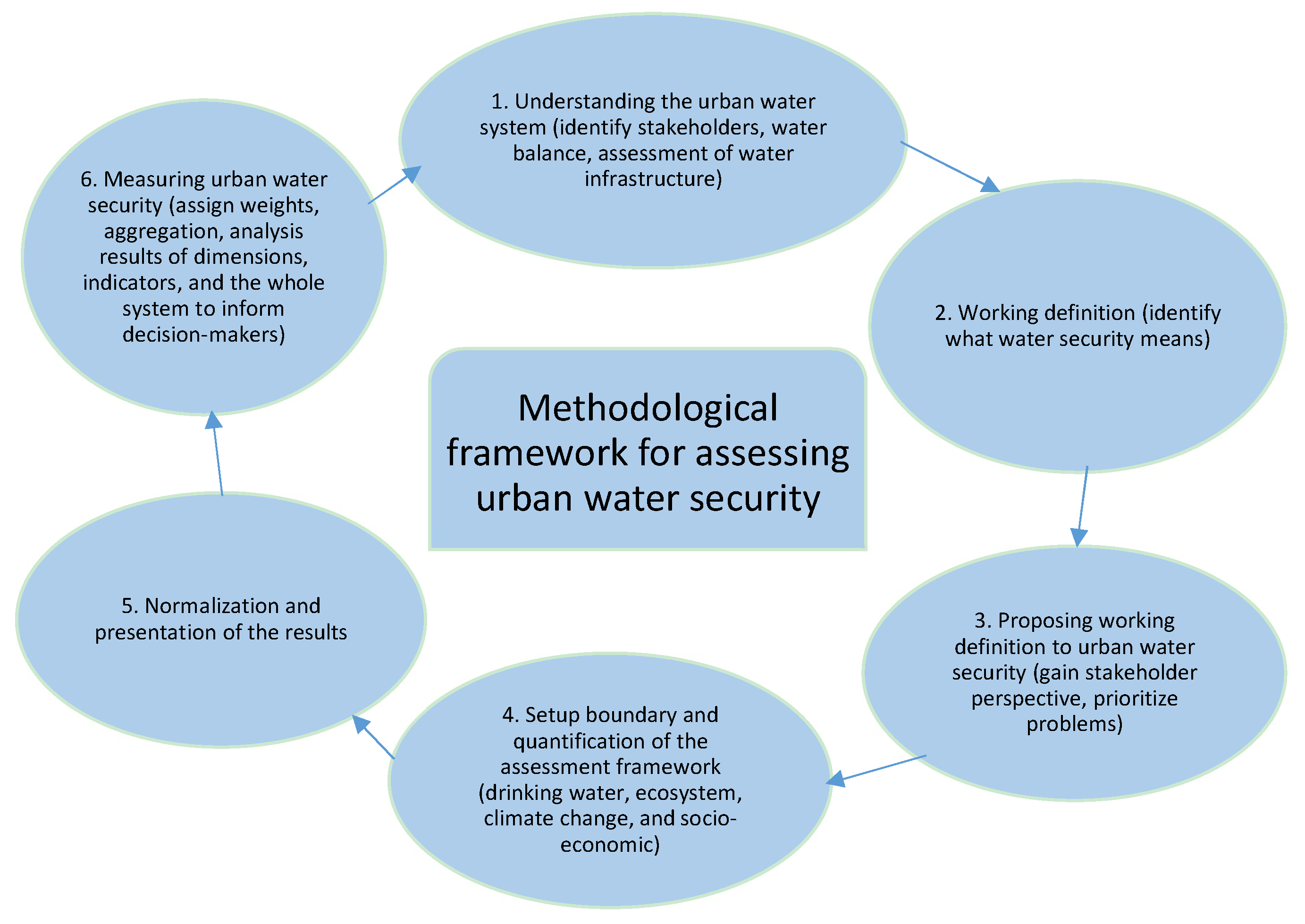
The methodology for operationalizing urban water security is based on six systematic steps, as shown in Figure 1, starting with (1) understanding how water is managed in a water-scarce city; (2) what we mean by urban water security; (3) then proposing a working definition; (4) putting in place an urban water security framework based on a working definition that includes sustainable development goal on water and sanitation SDG6 and the United Nations (UN) human rights to water and sanitation; (5) interpreting this framework for decision-makers; and (6) measuring the index.
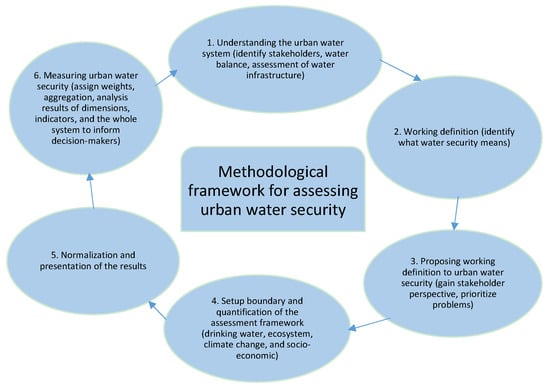
Figure 1.
The framework cycle to operationalize urban water security.
2.1. Understanding the Urban Water System
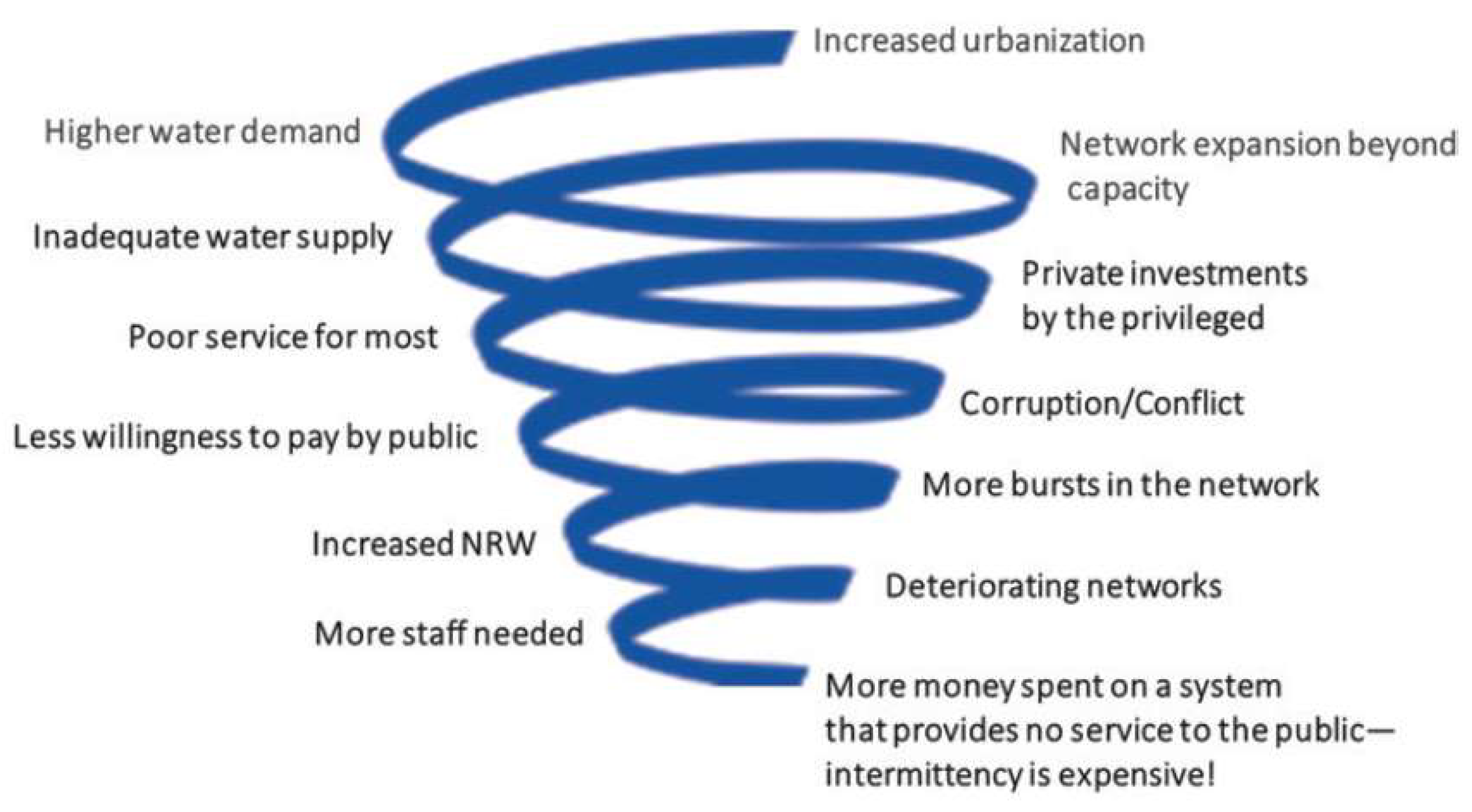
Many cities are at risk of running out of water, with water supply crises rated as one of the top global threats in terms of likelihood and impact, both on the quantity and quality of freshwater resources, as per the Global Risks report 2019 [64]. The typical mode of water supply in urban systems is designed to provide continuous safe, clean drinking water [65]. Today, increased urbanization and climate change are putting a great pressure on water supply, and as a result, 1.2 billion people are receiving water less than 24 h a day under intermittent water supply systems, which are running in downward spiral (simplified in Figure 2) [66,67,68].
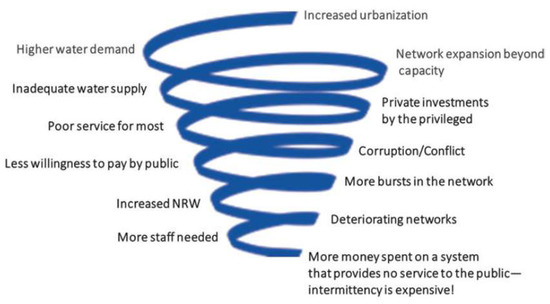
Figure 2.
The downward spiral of intermittent water supply IWS/Source [65]. NRW, non-revenue water.
Intermittent water supply can cause severe urban water insecurity, with water quality degradation and public health problems, increased leakage and accelerated wear and tear, illegal uses, lowered service quality, and ineffective demand management [69,70,71].
The key to developing an assessment framework for urban water security is gaining a better understanding of the urban water system and the factors that influence its insecurity. So, the first step is necessarily a diagnostic approach to answer the following questions: How is water managed and operated, what are the constraints acting upon the infrastructure, and what strategies can be introduced to the infrastructure to achieve urban water security?
This diagnostic has been elaborated in a recent papers [71,72], which outlined conducting a water balance in the case of a water-scarce city (Madaba, Jordan): Measuring inflow and outflow and examining the causes of the high level of water losses in the distribution network, the vulnerabilities of the water system that cause insecurity, water-related risks, and emerging water-related issues, such as intermittent water supply in the context of changing climate and increasing demand.
The study offered recommendations to reduce the physical losses as an important component of water losses that affect urban water security through an infrastructure, repair, economic, awareness, and pressure (IREAP) framework as a way of systematically engaging the non-revenue water (NRW) challenge in Jordan [71].
2.2. Working Definition of Urban Water Security
The second step involves defining the term “urban water security”. The working definition sets up the criteria and benchmarks by which the system will be evaluated. It is clear: There is no widely recognized definition of urban water security [31,32,37,39,44,73]. In terms of widely-referenced definitions (Table 1), a recent review has identified 25 definitions of water security, of which only three relate to the urban level [31].

Table 1.
Common global water security definitions.
2.3. The Proposed Working Definition of Urban Water Security
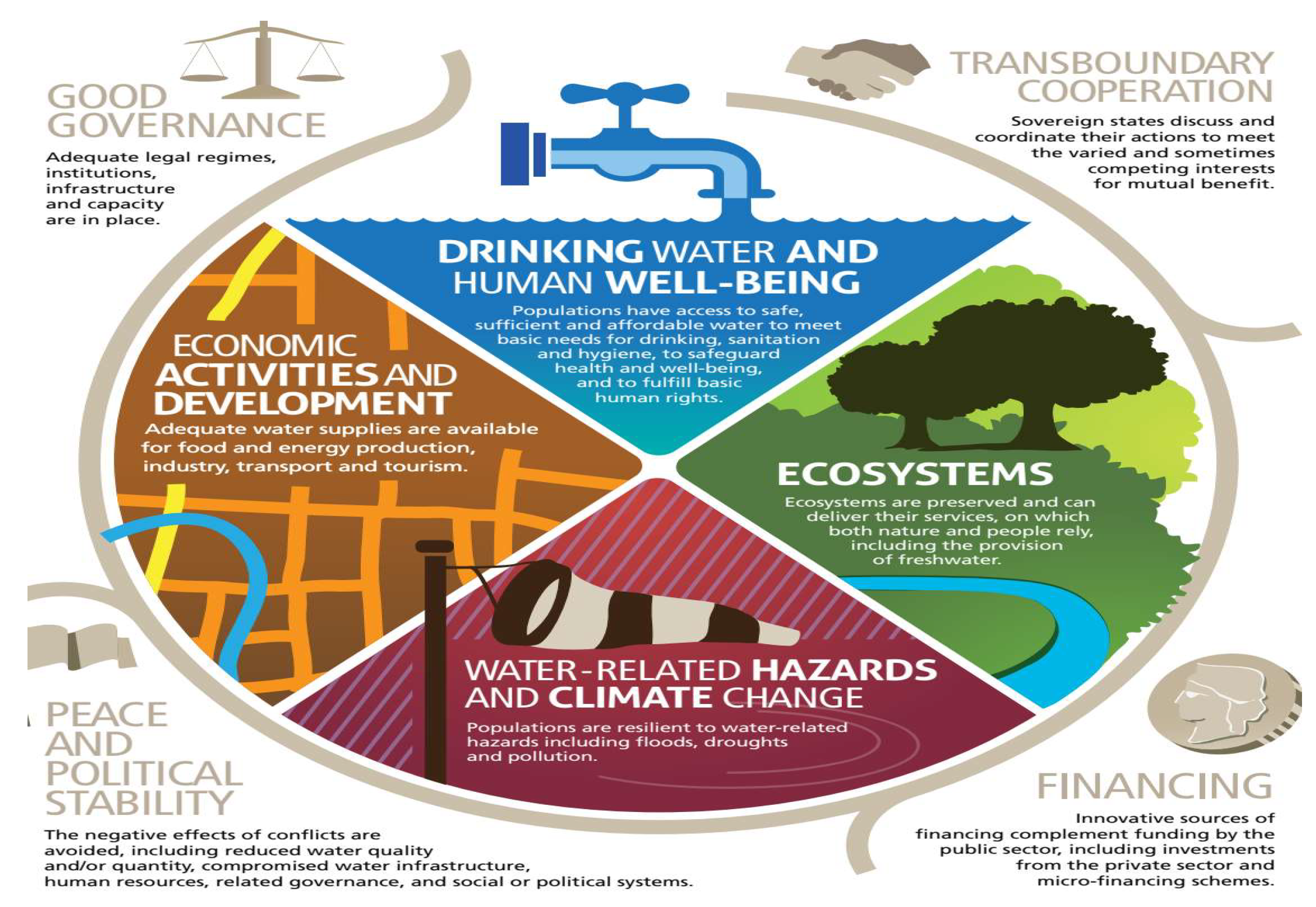
To build a definition for urban water security, we have examined the existing definitions and found that the UN-Water definition has the merits of being holistic yet general. In order to be more useful, further analysis and specification is required. As shown in Figure 3, the UN water security is based of broad framework of different dimensions and cross sectors to achieve sustainable water management.
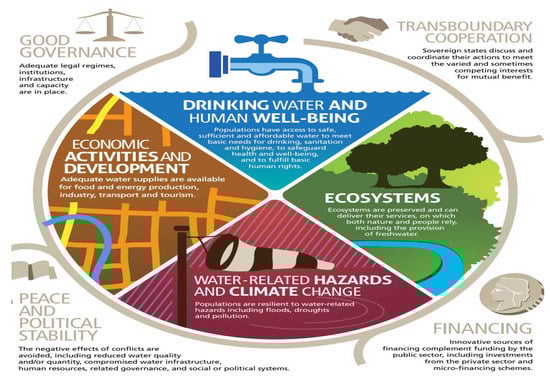
Figure 3.
United Nations framework of water security [74].
This study suggests changes in the UN-Water definition to derive perspectives from the sustainable development goal of clean water and sanitation “SDG6” and the UN human rights of water and sanitation in Resolution 64/292, which specifies different elements embedded in urban water security [74]. We propose an urban water security definition which emphasizes the role of water stakeholders to define the elusive terminologies embedded in the definition, such as adequate and acceptable, as it will not be a one-size-fits-all proposition.
Therefore, urban water security can be defined as the dynamic capacity of the water system and water stakeholders to safeguard sustainable and equitable access to adequate quantities and acceptable quality of water that is continuously, physically, and legally available at an affordable cost for sustaining livelihoods, human well-being, and socio-economic development, for ensuring protection against water-borne pollution and water-related disasters, and for preserving ecosystems in a climate of peace and political stability.
3. Urban Water Security Assessment Framework
3.1. Setup the System Boundary and the Assessment Framework
The study considers the entire urban water cycle in peri-urban and urban areas, including the social, economic, institutional, and environmental dimensions that affect the performance of urban water systems. The urban water system includes main processes in the water cycle: Drinking water production, water treatment plants, drinking water storage and distribution, and wastewater collection, treatment, and discharge.
The system boundary is determined by two factors: The spatial and temporal scales. The spatial scale refers to the physical size of the system. In the context of the present research, the urban area comprises the following features: The entire geographical area of a city, all its inhabitants, and all users of its water resources. The temporal scale is set enough to measure the dynamic status of urban water security.
Based on the working definition of urban water security and the definition of the system boundary, the next step is the core of the assessment: Selection and categorization of a tailored set of indicators at the urban level. The index is based on a weighted aggregate score to assess water security in urban areas. Design of the framework includes: Scoping to identify issues and problems and to set priorities; examining risks and development of criteria; and a review of data availability. At the end of the design stage, the goal is to have developed sets of indicators to measure urban water security.
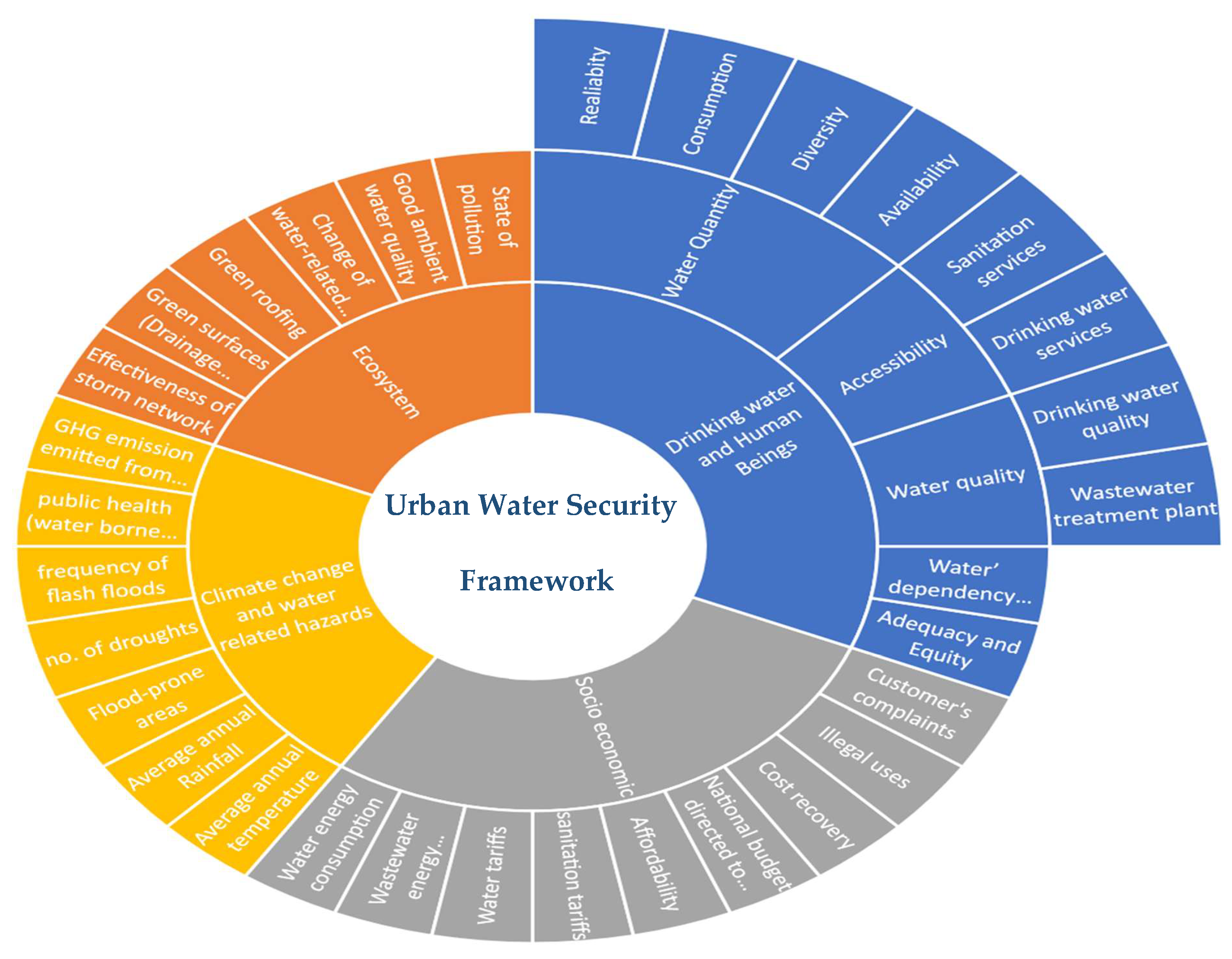
It is crucial to understand the dynamics of water security and their associated holistic perspectives, which can provide the foundation of the assessment with robust indicators and variables to divide the urban water security into four main dimensions, as shown in Figure 4.
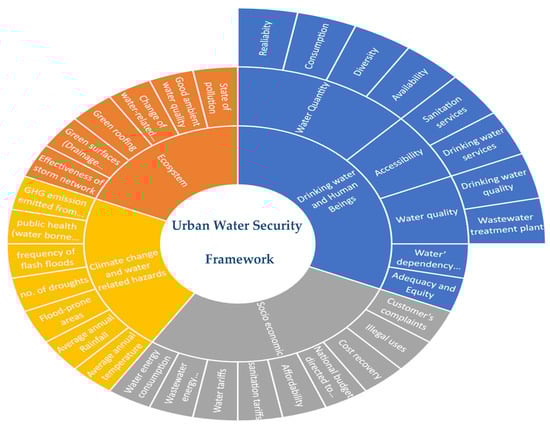
Figure 4.
Urban water security assessment framework.
3.1.1. Drinking Water and Human Well-being
Availability and diversity of domestic water resources (e.g., desalination, water reuse, rainwater harvesting) should be analyzed, considering accessibility, rationality, and efficiency of water and energy systems, as well as quality, adequacy and equity, and dependency on other sources (Table 2).
Table 2.
Dimensions, indicators, and variables of drinking water and human well-being.
Water availability is one of the common indicators for measuring water scarcity in terms of the water stress index [75,76]. Diversity of water resources is key to achieving urban water security, as it mitigates the risk of dependency on one water source by securing alternative sources and mitigations to meet the demand (e.g., desalination, wastewater reuse, water harvesting) [77].
It is of paramount importance to improve the capacity of the system to safeguard sustainable and integrated water supply from different sources [10]. In addition, energy plays a great role in securing and driving water to households and operating wastewater treatment plants [78]. Lack of energy supplies forces many cities with intermittent water supply to reduce energy supply time [64,65].
The UN human right to water specifies that the water supply must be sufficient and continuous [10]. According to the World Health Organization (WHO), between 50 and 100 L of water per person per day are required to ensure that most basic requirements are met and that few health concerns arise [79]. Water consumption is paramount to achieving water security when water is scarce, which requires consuming it in the most rational and sustainable way to reserve the water available [80].
The major objectives of the water system and infrastructure involve improving the capacity of water utilities to supply water to consumers [81]. Infrastructure reliability requires ensuring the right quantity at the required pressure and of adequate quality. In an unreliable system, shortages may result from failures of a system’s physical components [64,65]. We consider the indicators of non-revenue water and the energy efficiency of the network to measure the reliability of the system [62,81]. Non-revenue water (NRW) includes physical losses, commercial losses, and unbilled authorized consumption. Infrastructure leakage puts many cities in a vicious circle, and it can be measured using the infrastructure leakage index (ILI), which is the ratio between current annual real losses (CARL) and the unavoidable background leakage rate (UARL) [71,79,82].
Water quality is a major component of urban water security [83]. Issues of water quality are more acute in intermittent water systems, due principally to infiltration, regrowth within pipes, and the detachment of the bacterial biofilm following variations in pressure and velocity [68,69,83]. After water is supplied to the customers, when there is no flow in the network, people must store water in roof top tanks for several days to meet their demand, thereby providing more chances for microbial regrowth and degradation of the water quality [64,65]. This ultimately results in incidents of opportunistic pathogens and negative effects on public health. In addition, the physical accessibility of safely managed water and sanitation services is key to achieving the human right to water and sanitation [40,41].
Ensuring access to water and sanitation for all is a basic human right and is fundamental to achieve the sustainable development goal on safely managed water and sanitation services SDG6 [74]. For the purpose of this research, the indicator of average supply time is used to measure the adequacy and equity in water supply systems. Adequacy in this study means that the actual supply of water is sufficient to meet everybody’s needs, and this also includes the timing perspective. Equity implies that all people within a district metered area receive fair distribution of the limited amount of water available during the few hours of supply [64,65]. Adequacy and equity in water supply are one of the main challenges faced in water-scarce cities with intermittent water distribution systems, in which water wastage is at the highest pressure nodes and scarcity at the lowest pressure nodes [64,69,83]. Service intermittency poses a great threat to guaranteeing people’s access to limited water supply, and inabilities to meet the water demand equally negatively impact customers’ satisfaction, with high coping costs and inequitable water distribution. [65,68].
Dependency ratio—the risk of dependence on one source of water—can be measured by the percentage of the total renewable water resources originating outside the city [84]. It is a relevant indicator of the threats to urban water security—to measure the possibility of tensions, failures, and/or conflict over water use and sharing. Thus, a climate of peace and political stability is a mandatory factor for imported/transboundary water sources in order achieve urban water security [41]. Water dependency in cities can be created by insufficient water and risks to public health within the boundaries of city or by dependency on upstream flows outside the city or country [85].
3.1.2. Ecosystems
The key to achieving urban water security is to have a balance between the exploitation of water resources and sustaining and protecting urban ecosystem services as “natural infrastructure” that is critical to people’s well-being and livelihoods (e.g., pollution and contamination, level of water stress, good ambient water quality, exploiting green roofs and green areas, effectiveness of the infrastructure) (Table 3) [9,16,30].
Table 3.
Dimensions, indicators, and variables of ecosystem.
State of pollution in terms of untreated wastewater is one of the major risks to ambient water quality, public health, and urban water security if it is not treated and discharged properly [82]. Although wastewater presents a risk of pollution, it can also provide many opportunities if this untapped resource is treated as an additional source of water and is properly harnessed to mitigate water scarcity [76,77,86].
The indicator bodies of water with good ambient water SDG target 6.3.2 aims to improve water quality by reducing pollution, eliminating dumping, and minimizing the release of hazardous chemicals and materials [10,19]. Surface water and groundwater quality can be compared to ambient water quality standards, for both chemical and biological pollutants [31]. The change in extent of water-related ecosystem is also a relevant indicator to urban water security, which measures the quantity of water contained in various water-related ecosystems [87].
Green roofing is another often untapped resource for urban agriculture, which can boost water security by maximizing the benefits of water from rainwater harvesting [43,58]. Green surface is one of the crucial features of a productive green infrastructure for humans’ well-being, sustainability, and health ecosystem [88,89]. As a drainage factor, it can intercept water from the canopy and stem areas and enhance infiltration into the soil and root systems [56,57,58,59,90].
Green areas include all types of urban green spaces that can contribute to the livability, sustainability, and resilience of cities, thus achieving urban water security [56]. The storm water network and sewage system are critical to the resilience of the urban water system [43,90]. If they fail to accommodate the full load and to work properly, it can cause infrastructure failures and serious social and economic losses [43,61]. Sewer blockage can represent one of the main threats to the effectiveness of the sewage system, as the system should achieve the goal of discharging water efficiently [78].
3.1.3. Climate Change and Water-Related Hazards
Climate change, which may be exacerbated by water infrastructure, has an impact on water-related risks, including flood risk and health-related risks [8,57]. As shown in (Table 4), the dimension of climate change and water-related hazards can be measured by the following indicators; public health, frequency of floods, No. of droughts, flood prone areas, precipitation and temperature.
Table 4.
Dimensions, indicators, and variables of climate change and water related hazards.
The urban water system contributes to climate change in terms of greenhouse gas emissions from energy consumption, water and wastewater treatment, and discharge [78,91].
Public health is one of the core components of urban water security in shaping the city’s metabolism. Water-borne diseases represent a huge risk to public health. Many incidents of water-borne diseases is an indicator of urban water insecurity [92].
Urban flooding may be caused by heavy and/or prolonged rainfall which exceeds the capacity of the drainage system [92,93]. Flooding and droughts are natural hazards, with great economic and social impacts on cities [94]. The growing threat of urban flooding has been a critical test of cities’ resilience in the face of climate change [94]. Flood-prone areas need protection and proactive measures to mitigate the risks [89,91].
Climate change and water security challenges are primarily about adaptation and making development climate-resilient. This requires the improvement of our knowledge of climate impacts and effective technologies and their application and building local capacity for improved preparedness and adaptation.
3.1.4. Socio-Economic Development
Particular attention must be paid to the actual and potential role of social and economic factors and their impacts on water demand and supply, which may hamper the system’s ability to meet people’s basic needs and to achieve urban water security [12,13,14,15,16,17]. These factors include energy consumption in the water and wastewater system, water and sanitation tariffs, affordability, budget directed to water and wastewater services, cost recovery, illegal uses, and customers’ complaints (Table 5) [78,88].
Table 5.
Socio-economic dimensions, indicators, and variables.
Water supply systems are heavily dependent on energy to deliver water at an optimal pressure to reach households. Energy consumption is related to many factors, such as topography of the area; distance from source to tap; and type, capacity, and efficiency of pump stations [78].
Water tariff should be a good indicator by which to evaluate the economic value of scarce water; thus, targeted tariffs and smart subsidies would contribute to achieving urban water security. In many cities, water is highly subsidized by the government. Thus, the water tariff is too low to cover the operation and maintenance costs and it discourages efficient use of water [62].
Cost recovery is a robust performance indicator of a well-managed water utility. It is essential to ensure long-term sustainability of water services [62]. Sound water management also requires that users consider both the financial costs of supplying services and the costs that their use of water imposes on others (externalities, as well as “opportunity costs”—which represent the true costs) [62]. Water tariff and the high level of non-revenue water are key components of cost recovery in many water-scarce cities. Illegal uses represent one of the major socio-economic threats to urban water security, which can erode the equality of water distribution and cause huge human and economic losses [79,81,82].
Water service fees to cover financial costs and ensure minimum water security are essential for two reasons. First, they provide the user with information on the cost of providing the service, thereby inducing more considerate use than if the service were free and encouraging conservation. Second, revenues from tariffs provide financing for water resources protection, infrastructure maintenance, and ensuring equitable and reliable service delivery [56,57,58,59,90].
Affordability is a key factor especially for vulnerable people who cannot afford to pay for water [49,50,51]. This indicator can give an approximate measure of the affordability, but it does not include the high coping costs of intermittent water supply [69,70,71].
The national budget for water and sanitation is crucial to placing water security as a top priority [24,25]. Thus, maximizing public financing is essential, but it is not enough to bridge the financial gaps. Commercial financing from the private sector is also needed to achieve urban water security [13,14,15].
Customer satisfaction is a key indicator of urban water security, as it means that the utility is capable of operating and managing the water system in a manner that satisfies the water demand. In an intermittent water supply system, complaints about leakage and lack of water are among the main issues that put pressure on water utility governance [78].
In sum, these perspectives signal the direction of change required to improve water security. A more water-secure city can be achieved by improving the four dimensions and their indicators.
3.2. Normalization and Interpreretaion of the Results
Normalization is a key step of the decision-making process to covert the results of each component in different units into a common scale and comparable units. Normalization and presentation of the results of the indicators should be aggregated in order to reflect the status and aspirational values of each indicator, since they have different units, so that that indicators are dimensionless in a range from 1 to 5. This process will allow us to better understand the bottlenecks, identify future intervention strategies, and facilitate communication between different water stakeholders.
The establishment of ranges and scores for each indicator of achieving urban water security is aspirational and hangs on the dynamic capacity of the water system and stakeholders to achieve the ambitious UN sustainable development goals on water and sanitation (SDG6).
The below Table 6, Table 7, Table 8 and Table 9 present the urban water security index scores on a scale from 1 to 5 for each variable, where 1 represents poor water security and 5 represents excellent water security.
Table 6.
Thresholds of drinking water and human well-being.
Table 7.
Thresholds of ecosystem.
Table 8.
Thresholds of climate change and water-related hazards.
Table 9.
Thresholds of socio-economic.
The resulting scores on the urban water index can be interpreted and identified to measure the level of urban water security, as in the below Table 10 [92].
Table 10.
Grades of urban water security.
3.3. Measuring the Urban Water Index
For composite indices, weighting and aggregation are familiar challenges due to their sensitivity and subjectivity. It should be recognized that assigning explicit weightings, by definition, represents only one viewpoint. Thus, water stakeholders should define the weighting system to be appropriate in the local context.
The output of the urban water security index is calculated by aggregating the values of the variables. In the study, equal weights are assigned to all dimensions, indicators, and variables. This implies that all components are equally important. However, if there is a case where one of the indicators is more important than the other, weights in proportion to significance can be used.
The formulas are simplified when the weights are normalized such that they sum up to 1, i.e.,
For such normalized weights, the weighted mean is then:
Note that one can always normalize the weights by making the following transformation on the original weights:
Using the normalized weight yields the same results as when using the original weights:
4. Conclusions
Framing the challenge of urban water security goes beyond single-issue indicators such as water quantity, water quality, or access to water sanitation. Rather, we must think holistically about the four dimensions of DECS—drinking water and human beings, ecosystem, climate change and water-related hazards, and socio-economic—in order to arrive at concrete solutions that can shift the vicious cycle of water insecurity into a virtuous cycle of sustainable and secure cities.
The dominant threats to urban water security vary geographically and over time. Urban water security is not a stagnant goal; it is a dynamic process affected by changing climate, political structures, economic growth, and resource degradation. The proposed working definition of urban water security encompasses the challenges of urban and peri-urban areas in achieving the goal of secure water for all by underlining the principles of UN human rights and sustainable development goals of safely managed water and sanitation. Urban water security is defined as the dynamic capacity of the water system and water stakeholders to safeguard sustainable and equitable access to adequate quantities of an acceptable quality of water that is continuously physically and legally available to meet water demand at an affordable cost; in order to sustain livelihoods, human well-being, and socio-economic development, to ensure protection against water-borne pollution and water-related disasters, and to preserve ecosystems in a climate of peace and political stability.
This study develops a novel urban water security assessment framework The interconnections and implications of each indicator in the DECS framework prove that we cannot achieve urban water security via water quantity and quality alone, but must also change the way we look at the quantity of water—from relying on a sole source of fresh water, to a diversity of water resources—and preserving the urban water in climate of peace and political stability. Developing the urban water security indexes is a complex undertaking, given weighting and aggregation issues, but it is essential to be able to quantify the impacts. However, there is a need for indexes which define some components as more important, and therefore, more researches are required to define the relative weight of these indexes.
Despite clear evidence of dwindling water resources and increasing water demands in water-scarce cities, many cities continue to count on conventional solutions based on the assumption of plentiful water resources and on silo-oriented solutions to increase the quantity of water resources, neglecting other dimensions and indicators.
Effective management of drinking water in terms of availability, accessibility, water quality, and adequacy of urban water systems is critical in order to sustain inclusive and integrated urban water systems. Diversity of water resources is critical to achieving urban water security and hedging against the risks associated with water resource exhaustion or contamination, such as high-water turbidity in wells during flashfloods and reliance on imported water from outside the city. Reliance on external water supplies poses risks, including competition over water during times of drought and the threat of illegal water uses. Integrated urban water management is essential in order to increase the resilience of urban water systems to external climate extremes. This can be achieved by turning risks into opportunities and diversifying the water resources; for instance, through wastewater reuse, desalination, rainwater harvesting, and replenishing groundwater.
This study can help water stakeholders and policy-makers target scant resources more effectively and sustainably. The developed framework is also generally applicable and can be applied to urban and potentially peri-urban areas in any part of the world. It is suggested to carry out assessment and monitoring programs on a regular basis to measure progress, and also to benchmark urban water security in cities and to develop an environment of competition among cities and utilities to improve the DECS dimensions.
We emphasize that urban water security is a complex and cross-cutting challenge that needs to be addressed holistically in order to achieve SDG 6. It is not only rooted in a single indicator such as the availability of fresh water resources to meet the increasing demands, but also in the dynamics of the DECS framework, including poor water governance, institutional fragmentation, and ineffective water policies. Thus, we acknowledge the following limitations:
- Stakeholder engagement is key to designing and applying the DECS framework to achieve mutual understanding among water stakeholders of the terms, scores, and weights of each indicator to inform decision making about the state of urban water security and the actions needed for its improvement.
- In order to adequately incorporate the dynamics of urban water security, there is a need for water stakeholder participation, data considerations, trade-off analyses among the various components of DECS framework, governance tools, and incorporating climate risks and resilience.
- The assessment framework needs to go through sensitivity analysis and validation stages, applying it to real-life case studies representing different scales.
Author Contributions
H.T.A. and L.R. designed this research. H.T.A. carried out this research with L.R., F.-B.F. and J.S. L.R. and J.S. revised the analysis and the paper. F.-B.F. and L.R. supervised and took part in the design, implementation, and analysis.
Funding
This research received no external funding.
Acknowledgments
The authors are thankful to Richard Damania, the Global Lead Economist in the World Bank’s Water Practice, for his valuable comments and feedback on this paper.
Conflicts of Interest
The authors declare no conflict of interest.
References
- United Nations, Department of Economic and Social Affairs, Population Division. World Urbanization Prospects: The 2018 Revision; (ST/ESA/SER.A/420); United Nations Department of Economic and Social Affairs, Population Division: New York, NY, USA, 2019. [Google Scholar]
- Maheshwari, B.; Singh, V.; Thoradeniya, B. Balanced Urban Development: Options and Strategies for Liveable Cities; Springer: Berlin, Germany, 2016. [Google Scholar]
- Artioli, F.; Acuto, M.; McArthur, J. The water-energy-food nexus: An integration agenda and implications for urban governance. Polit. Geogr. 2017, 61, 215–223. [Google Scholar] [CrossRef]
- Scanlon, B.; Ruddell, B.; Reed, P.; Hook, R.; Zheng, C.; Tidwell, V.; Siebert, S. The food-energy-water nexus: Transforming science for society. Water Resour. Res. 2017, 53, 3550–3556. [Google Scholar] [CrossRef]
- Aboelnga, H.; Khalifa, M.; McNamara, I.; Ribbe, L.; Sycz, J. The Water-Energy-Food Security Nexus: A Review of Nexus Literature and Ongoing Nexus Initiative for Policymakers; Nexus Regional Dialogue Programme (NRD): Bonn, Germany, 2018; pp. 25–30. [Google Scholar]
- Brown, R.R.; Keath, N.; Wong, T.H.F. Urban water management in cities: Historical, current and future regimes. Water Sci. Technol. 2009, 59, 847–855. [Google Scholar] [CrossRef] [PubMed]
- Sadoff, C.W. Securing Water, Sustaining Growth: Report of the GWP/OECD Task Force on Water Security and Sustainable Growth; University of Oxford: Oxford, UK, 2015. [Google Scholar]
- Haddeland, I.; Heinke, J.; Biemans, H.; Eisner, S.; Flörke, M.; Hanasaki, N.; Stacke, T. Global water resources affected by human interventions and climate change. Proc. Natl. Acad. Sci. USA 2014, 111, 3251–3256. [Google Scholar] [CrossRef] [PubMed]
- Wheater, H.S.; Gober, P. Water security and the science agenda. Water Resour. Res. 2015, 51, 5406–5424. [Google Scholar] [CrossRef]
- UNESCO World Water Assessment Programme. The United Nations World Water Development Report 2019: Leaving No One Behind; UNESCO: Paris, France, 2019. [Google Scholar]
- Gheuens, J.; Nagabhatla, N.; Perera, E. Disaster-Risk, Water Security Challenges and Strategies in Small Island Developing States (SIDS). Water 2019, 11, 637. [Google Scholar] [CrossRef]
- Jimenez Cisneros, B.E.; Oki, T.; Arnell, N.W.; Benito, G.; Cogley, J.G.; Doll, P.; Jiang, T.; Mwakalila, S.S. Freshwater resources. In Climate Change 2014: Impacts, Adaptation and Vulnerability; Cambridge University Press: Cambridge, UK, 2014. [Google Scholar]
- World Economic Forum. Global Risks Report 2015; WEF: Davos, Switzerland, 2015. [Google Scholar]
- Steffen, W.; Richardson, K.; Rockström, J.; Cornell, S.E.; Fetzer, I.; Bennett, E.M.; Biggs, R.; Carpenter, S.R.; de Vries, W.; de Wit, C.A.; et al. Planetary boundaries: Guiding human development on a changing planet. Science 2015, 347, 6223. [Google Scholar] [CrossRef]
- Mekonnen, M.M.; Hoekstra, A.Y. Four billion people facing severe water scarcity. Sci. Adv. 2016, 2, e1500323. [Google Scholar] [CrossRef]
- Hartley, K.; Tortajada, C.; Biswas, A.K. Confronting global security in an era of water instabilities. Foreign Policy J. 2017. Available online: https://www.foreignpolicyjournal.com/2017/02/03/confronting-global-security-in-an-era-of-water-instabilities/ (accessed on 22 November 2019).
- Gerlak, A.K.; House-Peters, L.; Varady, R.; Albrecht, T.; Zuniga Teran, A.; de Grenade, R.; Scott, C.A. Water security: A review of place-based research. Environ. Sci. Policy 2018, 82, 79–89. [Google Scholar] [CrossRef]
- Chad, S.; Christopher, A.S. Putting water security to work: Addressing global challenges. Water Int. 2018, 43, 1017–1025. [Google Scholar] [CrossRef]
- Vorosmarty, C.J.; McIntyre, P.B.; Gessner, M.O.; Dudgeon, D.; Prusevich, A.; Green, P.; Glidden, S.; Bunn, S.E.; Sullivan, C.A.; Liermann, C.R.; et al. Global threats to human water security and river biodiversity. Nature 2010, 467, 555–561. [Google Scholar] [CrossRef] [PubMed]
- Pahl-Wostl, C. Transitions towards Adaptive Management of Water Facing Climate and Global Change. Water Resour. Manag. 2007, 21, 49–62. [Google Scholar] [CrossRef]
- Bakker, K. Water security: Research challenges and opportunities. Science 2012, 337, 914–915. [Google Scholar] [CrossRef]
- Garfin, G.M.; Scott, C.A.; Wilder, M.; Varady, R.G.; Merideth, R. Metrics for assessing adaptive capacity and water security: Common challenges, diverging contexts, emerging consensus. Curr. Opin. Environ. Sustain. 2016, 21, 86–89. [Google Scholar] [CrossRef]
- Halbe, J.; Pahl-Wostl, C.; Sendzimir, J.; Adamowski, J. Towards Adaptive and Integrated ManagementParadigms to Meet the Challenges of Water Governance. Water Sci. Technol. J. Int. Assoc. Water Pollut. Res. 2013, 67, 2651–2660. [Google Scholar] [CrossRef] [PubMed]
- Van Beek, E.; Arriens, V.L. Water Security: Putting the Concept into Practice; Global Water Partnership Stockholm: Stockholm, Sweeden, 2014; p. 52. [Google Scholar]
- Grey, D.; Sadoff, C.W. Sink or Swim? Water security for growth and development. Water Policy 2007, 9, 545–571. [Google Scholar] [CrossRef]
- Biswas, A.K. Integrated water resources management: A reassessment. Water Int. 2004, 29, 248–256. [Google Scholar] [CrossRef]
- Cairns, R.; Krzywoszynska, A. Anatomy of a buzzword: The emergence of ‘the water-energy-food nexus’ in UK natural resource debates. Environ. Sci. Policy 2016, 64, 164–170. [Google Scholar] [CrossRef]
- Al-Saidi, M.; Elagib, N.A. Towards understanding the integrative approach of the water, energy and food nexus. Sci. Total Environ. 2017, 574, 1131–1139. [Google Scholar] [CrossRef]
- Giordano, M.; Shah, T. From IWRM back to integrated water resources management. Int. J. Water Resour. Dev. 2014, 30, 364–376. [Google Scholar] [CrossRef]
- Clement, F. From water productivity to water security: A paradigm shift. In Water Security Principles, Perspectives and Practices; Lankford, B.A., Ed.; Routledge: Abingdon, UK, 2013; pp. 148–165. [Google Scholar]
- Allan, J.V.; Kenway, S.J.; Head, B.W. Urban water security-what does it mean? Urban Water J. 2018, 15, 899–910. [Google Scholar] [CrossRef]
- Cook, C.; Bakker, K. Debating the concept of water security. In Water Security: Principles, Perspectives and Practices; Lankford, B.A., Ed.; Routledge: Abingdon, UK, 2013; pp. 49–63. [Google Scholar]
- Nazif, S.; Karamouz, M.; Yousefi, M.; Zahmatkesh, Z. Increasing water security: An algorithm to improve water distribution performance. Water Resour. Manag. 2013, 27, 2903–2921. [Google Scholar] [CrossRef]
- Howlett, M.P.; Cuenca, J.S. The use of indicators in environmental policy appraisal: Lessons from the design and evolution of water security policy measures. J. Environ. Policy Plan 2017, 19, 229–243. [Google Scholar] [CrossRef]
- Damkjaer, S.; Taylor, R. The measurement of water scarcity: Defining a meaningful indicator. Ambio 2017, 46, 1–19. [Google Scholar] [CrossRef]
- Giordano, M. Water security. In The International Encyclopedia of Geography: People, the Earth, Environment, and Technology; Richardson, D., Ed.; John Wiley & Sons: Hoboken, NJ, USA, 2017. [Google Scholar] [CrossRef]
- Garrick, D.; Hall, W.J. Water security and society: Risks, metrics, and pathways. Annu. Rev. Environ. Resour. 2014, 39, 611–639. [Google Scholar] [CrossRef]
- Zeitoun, M.; Lankford, B.; Krueger, T.; Forsyth, T.; Carter, R.; Hoekstra, A.Y.; Taylor, R.; Varis, O.; Cleaver, F.; Boelens, R.; et al. Reductionist and integrative research approaches to complex water security policy challenges. Glob. Environ. Chang. 2016, 39, 143–154. [Google Scholar] [CrossRef]
- Hoekstra, A.Y.; Buurman, J.; van Ginkel, K.C.H. Urban water security: A review. Environ. Res. Lett. 2018, 13, 053002. [Google Scholar] [CrossRef]
- Global Water Partnership. Towards Water Security: A Framework for Action; GWP: Stockholm, Sweden, 2000. [Google Scholar]
- UN-Water, Water Security and Global Water Agenda: A UN-Water Analytical Brief; United Nations University, Institute for Water, Environment and Health: Hamilton, ON, Canada, 2013.
- Hussein, H. An analysis of the framings of water scarcity in the Jordanian national water strategy. Water Int. 2019, 44, 6–13. [Google Scholar] [CrossRef]
- Phillis, Y.A.; Kouikoglou, V.S.; Verdugo, C. Urban sustainability assessment and ranking of cities. Comput. Environ. Urban Syst. 2017, 64, 254–265. [Google Scholar] [CrossRef]
- Cook, C.; Bakker, K. Water security: Debating an emerging paradigm. Global Environ. Chang. 2012, 22, 94–102. [Google Scholar] [CrossRef]
- Grey, D.; Garrick, D.; Blackmore, D.; Kelman, J.; Muller, M.; Sadoff, C. Water security in one blue planet: Twenty-First century policy challenges for science. Phil. Trans. R. Soc. A 2013, 371, 20120406. [Google Scholar] [CrossRef] [PubMed]
- Srinivasan, V.; Konar, M.; Sivapalan, M. A dynamic framework for water security. Water Security 2017, 1, 12–20. [Google Scholar] [CrossRef]
- Rouse, M.J. Institutional Governance and Regulation of Water Services; IWA Publishing: London, UK, 2013. [Google Scholar]
- Falkenmark, M. The massive water scarcity now threatening Africa: Why isn’t it being addressed? Ambio 1989, 18, 112–118. [Google Scholar] [CrossRef]
- Sullivan, C. Calculating a water poverty index. World Dev. 2002, 30, 1195–1210. [Google Scholar] [CrossRef]
- Lawrence, P.R.; Meigh, J.; Sullivan, C. The Water Poverty Index: An International Comparison; Department of Economics, Keele University: Keele, UK, 2002. [Google Scholar]
- Jensen, O.; Wu, H. Urban water security indicators: Development and pilot. Environ. Sci. Policy 2018, 83, 33–45. [Google Scholar] [CrossRef]
- Gassert, F.; Luck, M.; Landis, M.; Reig, P.; Shiao, T. Aqueduct Global Maps 2.1: Constructing Decision-Relevant Global Water Risk Indicators; World Resources Institute: Washington, DC, USA, 2014. [Google Scholar]
- Komnenic, V.; Ahlers, R.; Van Der Zaag, P. Assessing the usefulness of the water poverty index by applying it to a special case: Can one be water poor with high levels of access? Phys. Chem. Earth Parts A B C 2009, 34, 219–224. [Google Scholar] [CrossRef]
- Asian Development Bank (ADB). Asia Water Development Outlook 2013; ADB: Manila, Philippines, 2013. [Google Scholar]
- Asian Development Bank (ADB). Asia Water Development Outlook 2016; ADB: Manila, Philippines, 2016. [Google Scholar]
- Van Leeuwen, C.J. City blueprints: Baseline assessments of sustainable water management in 11 cities of the future. Water Resour. Manag. 2013, 27, 5191–5206. [Google Scholar] [CrossRef]
- Van Leeuwen, C.J.; Koop, S.H.A.; Sjerps, R.M.A. City blueprints: Baseline assessments of water management and climate change in 45 cities. Environ. Dev. Sustain. 2016, 18, 1113–1128. [Google Scholar] [CrossRef]
- Siemens. The Green City Index, Economist Intelligence Unit; Siemena: Munich, Germany, 2012. [Google Scholar]
- Arcadis. Sustainable Cities Water Index: Which Cities Are the Best Placed to Harness Water for Future Success? Arcadis: Amsterdam, The Netherlands, 2015. [Google Scholar]
- Berg, S. Developments in best-practice regulation: Principles, processes, and performance. Electr. J. 2000, 13, 11–18. [Google Scholar] [CrossRef]
- Berg, S.; Marques, R.C. Quantitative studies of water and sanitation utilities: A benchmarking literature survey. Water Policy 2011, 13, 591–606. [Google Scholar] [CrossRef]
- Danilenko, A.; Van den Berg, C.; Macheve, B.; Moffitt, L.J. The IBNET Water Supply and Sanitation Blue Book 2014: The International Benchmarking Network for Water and Sanitation Utilities Databook; World Bank Publications: Washington, DC, USA, 2014. [Google Scholar]
- World Economic Forum (WEF). The Global Risks Report 2019. Geneva: World Economic Forum. Available online: http://www3.weforum.org/docs/WEF_Global_Risks_Report_2019.pdf (accessed on 16 October 2019).
- Kala, V.; Sunil, D.; Gorantiwar, S.M. Intermittent water supply under water scarcity situations. Water Int. 2007, 32, 121–132. [Google Scholar] [CrossRef]
- Charalambous, B.; Laspidou, C. Dealing with the Complex Interrelation of Intermittent Supply and Water Losses; IWA Publishing: London, UK, 2017; pp. 22–28. [Google Scholar]
- Sashikumar, N.; Mohankumar, M.S.; Sridharan, K. Modelling an Intermittent Water Supply. World Water Environ. Resour. Congr. 2003, 118, 261. [Google Scholar]
- Ingeduld, P.; Pradhan, A.; Svitak, Z.; Terrai, A. Modelling intermittent water supply systems with EPANET. In Proceedings of the Water Distribution Systems Analysis Symposium, Cincinati, OH, USA, 27–30 August 2006; pp. 1–8. [Google Scholar]
- LeChevallier, M.; Gullick, R.; Karim, M.; Friedman, M.; Funk, J. The potential for health risks from intrusion of contaminants into the distribution system from pressure transients. J. Water Health 2003, 1, 3–14. [Google Scholar] [CrossRef] [PubMed]
- Choe, K.; Varley, R.; Bilani, H. Coping with Intermittent Water Supply: Problems and Prospects, Environmental Health Project; Activity Report No. 26.; USAID: Washington, DC, USA, 1996.
- Coelho, S.T.; James, S.; Sunna, N.; Abu Jaish, A.; Chatila, J. Controlling water quality in intermittent supply systems. Water Sci. Technol. Water Supply 2003, 3, 119–125. [Google Scholar] [CrossRef]
- Aboelnga, H.; Saidan, M.; Al-Weshah, R.; Sturm, M.; Ribbe, L.; Frechen, F. Component analysis for optimal leakage management in Madaba, Jordan. J. Water Supply Res. Technol. Aqua. 2018, 67, 384–396. [Google Scholar] [CrossRef]
- Saidan, M.; Khasawneh, H.; Aboelnga, H.; Meric, S.; Kalavrouziotis, I.; Jasem, A.; Hayek, B.; Al-Momany, S.; Al Malla, M.; Porro, J. Baseline carbon emission assessment in water utilities in Jordan using ECAM tool. J. Water Supply Res. Technol. Aqua. 2019, 68, 460–473. [Google Scholar] [CrossRef]
- Falkenmark, M. Fresh water—Time for a modified approach. Ambio 1986, 15, 192–200. [Google Scholar]
- UNESCO and UNESCO i-WSSM. Water Security and the Sustainable Development Goals (Series l); Global Water Security Issues (GWSI) Series; UNESCO Publishing: Paris, France, 2019. [Google Scholar]
- Falkenmark, M.; Lundqvist, J.; Widstrand, C. Macro-Scale water scarcity requires micro-scale approaches. Nat. Resour. Forum 1989, 13, 258–267. [Google Scholar] [CrossRef]
- Jimenez, B.; Asano, T. Water Reclamation and Reuse around the World: An International Survey of Current Practice, Issues and Needs; IWA Publishing: London, UK, 2008; pp. 27–48. [Google Scholar]
- Howard, G.; Bartram, J.; World Health Organization. Water, Sanitation and Health Team. Domestic Water Quantity, Service Level and Health; World Health Organization: Geneva, Switzerland, 2003. [Google Scholar]
- Wakeel, M.; Chen, B.; Hayat, T.; Alsaedi, A.; Ahmad, B. Energy consumption for water use cycles in different countries: A review. Appl. Energy 2016, 178, 868–885. [Google Scholar] [CrossRef]
- Waldron, T. Managing and Reducing Losses from Water Distribution Systems. Manual 10, Executive Summary; Environmental Protection Agency: Brisbane, Australia, 2005; ISBN 0724294988. [Google Scholar]
- Arfanuzzaman, M.; Rahman, A.A. Sustainable water demand management in the face of rapid urbanization and ground water depletion for social–ecological resilience building. Glob. Ecol. Conserv. 2017, 10, 9–22. [Google Scholar] [CrossRef]
- World Health Organization. Guidelines for Drinking-Water Quality, 4th ed.; WHO: Geneva, Switzerland, 2017; ISBN 978-92-4-154995-0. [Google Scholar]
- Mara, D.; Kramer, A. The 2006 WHO Guidelines for Wastewater and Greywater Use in Agriculture: A Practical Interpretation; WHO: Geneva, Switzerland, 2006. [Google Scholar]
- Karpi, A. Letter to the Editor. Emerg. Infect. Dis. 1993, 3, 3. [Google Scholar] [CrossRef]
- Food and Agriculture Organization of the United Nations (FAO). Review of World Water Resources by Country; Water Report No. 23; FAO: Rome, Italy, 2003. [Google Scholar]
- Mancosu, N.; Snyder, R.; Kyriakakis, G.; Spano, D. Water Scarcity and Future Challenges for Food Production. Water 2015, 7, 975–992. [Google Scholar] [CrossRef]
- Rodríguez, M.; Cuevas, M.; Huertas, F.; Martínez, G.; Moreno, B. Indicators to evaluate water sensitive urban design in urban planning. WIT Trans. Built Environ. 2015, 371–382. [Google Scholar] [CrossRef]
- Dickens, C.; Rebelo, L.-M.; Nhamo, L. Guidelines and Indicators for Target 6.6 of the SDGs: Change in the Extent of Waterrelated Ecosystems over Time. In CGIAR Research Program on Water, Land and Ecosystems; International Water Management Institute: Colombo, Sri Lanka, 2017; 44p. [Google Scholar]
- Grafton, Q.A.; Daniell, K.; Nauges, C.; Rinaudo, J.; Wah Chan, N. Understanding and Managing Urban Water in Transition, 1st ed.; Springer: Berlin, Germany, 2015; 318p. [Google Scholar]
- Cornejo, P.; Santana, M.; Hokanson, D.; Mihelcic, R.J.; Zhang, Q. Carbon footprint of water reuse and desalination: A review of greenhouse gas emissions and estimation tools. J. Water Reuse Desalin. 2014, 4, 238. [Google Scholar] [CrossRef]
- Koop, S.H.; van Leeuwen, C.J. Application of the improved city blueprint framework in 45 municipalities and regions. Water Resour. Manag. 2015, 29, 4629–4647. [Google Scholar] [CrossRef]
- Smith, K.; Liu, S.; Chang, T. Contribution of urban water supply to greenhouse gas emissions in China. J. Ind. Ecol. 2015, 20, 792–802. [Google Scholar] [CrossRef]
- Assefa, Y.; Babel, M.; Sušnik, J.; Shinde, V. Development of a generic domestic water security index, and its application in Addis Ababa, Ethiopia. Water 2018, 11, 37. [Google Scholar] [CrossRef]
- Asian Development Bank. Asian Water Development Outlook 2016: Strengthening Water Security in Asia and the Pacific; Asian Development Bank: Mandaluyong City, Philippines, 2016. [Google Scholar]
- Damania, R.; Desbureaux, S.; Rodella, A.; Russ, J.; Zaveri, E. Quality Unknown: The Invisible Water Crisis; World Bank Publications: Washington, DC, USA, 2019. [Google Scholar]
© 2019 by the authors. Licensee MDPI, Basel, Switzerland. This article is an open access article distributed under the terms and conditions of the Creative Commons Attribution (CC BY) license (http://creativecommons.org/licenses/by/4.0/).