1. Introduction
The global transition toward low-carbon economic systems has accelerated significantly in recent years under the combined pressure of climate change mitigation objectives, carbon neutrality commitments, energy security concerns, and technological transformation. In this context, green finance has emerged as a central mechanism for mobilizing capital toward environmentally sustainable investments, including renewable energy infrastructure, clean technologies, electrification systems, and low-carbon industrial transformation. Simultaneously, the rapid expansion of renewable energy technologies and digitalized energy systems has intensified global dependence on critical raw materials (CRMs), particularly lithium, cobalt, nickel, copper, and rare earth elements, which constitute essential inputs for batteries, solar panels, wind turbines, smart grids, and energy storage systems.
Despite the increasing strategic importance of these dynamics, the existing literature remains conceptually fragmented and empirically incomplete. Previous studies on green finance have predominantly focused on emissions reduction, environmental performance, sustainable investment efficiency, and ESG-related financial outcomes. While this literature provides important insights into the role of financial systems in supporting environmental sustainability, it generally treats the energy transition as a purely technological or environmental process without adequately incorporating the material constraints associated with low-carbon transformation. In particular, limited attention has been devoted to the implications of increasing dependence on critical raw materials and the potential feedback effects of resource scarcity on financial systems and investment allocation mechanisms.
At the same time, the literature on critical raw materials has evolved largely within the fields of resource economics, industrial policy, and geopolitical risk analysis. Existing studies mainly emphasize supply concentration, import dependence, resource criticality, and geopolitical vulnerabilities in mineral supply chains. Although these contributions highlight the strategic importance of CRMs for renewable energy systems, they rarely integrate financial mechanisms into their analytical frameworks. As a result, the role of green financial flows, sustainable investment strategies, and capital market dynamics in shaping resource sustainability outcomes remains insufficiently explored.
Similarly, research on the energy transition primarily concentrates on technological deployment, renewable energy expansion, decarbonization pathways, and energy system restructuring. However, much of this literature implicitly assumes the unlimited availability of critical raw materials and often overlooks the financial and resource interdependencies underlying the transition process. Consequently, the sustainability transition is frequently analyzed through isolated perspectives that fail to capture the systemic interactions between financial capital allocation, technological transformation, and material dependency.
This fragmentation reveals an important theoretical and empirical gap in the literature. Although green finance, energy transition dynamics, and critical raw material sustainability are structurally interconnected, very few studies attempt to examine them simultaneously within a unified analytical framework. Existing approaches generally neglect the bidirectional and endogenous relationships between these dimensions. In reality, green finance accelerates investment in low-carbon technologies, which in turn increases demand pressure on critical raw materials; simultaneously, resource scarcity, supply-chain vulnerabilities, and geopolitical risks may feed back into financial systems by affecting investment risks, capital allocation, and sustainability pricing mechanisms. Ignoring these dynamic interdependencies may lead to incomplete policy recommendations and an oversimplified understanding of sustainability transitions.
This study addresses this gap by developing an integrated finance–energy–resource framework that conceptualizes green finance, energy transition systems, and critical raw material sustainability as a triangular dynamic system characterized by mutual interactions and feedback effects. Unlike previous studies that examine these dimensions separately, this research provides a unified empirical investigation of their interrelationships within a single dynamic modeling structure.
Methodologically, the study contributes to the literature by employing a dynamic panel estimation framework based on the System Generalized Method of Moments (System GMM) estimator. This approach allows the analysis to explicitly address endogeneity, persistence effects, reverse causality, and unobserved heterogeneity issues that are particularly relevant in the context of interconnected financial, technological, and resource systems. Empirically, the study relies on an unbalanced panel dataset covering multiple countries over the period 2010–2022 and combines indicators of green finance, energy transition dynamics, and CRM sustainability together with macroeconomic and environmental control variables.
The study makes three main contributions to the literature. First, it extends the green finance literature by integrating critical raw material sustainability into the analysis of low-carbon transitions. Second, it contributes to the resource sustainability literature by incorporating financial systems and investment allocation mechanisms into the study of resource criticality. Third, it advances the energy transition literature by demonstrating that decarbonization processes cannot be fully understood without considering the financial and material constraints associated with renewable energy expansion.
The findings of this study have important implications for policymakers, financial institutions, and sustainability governance frameworks. More specifically, the analysis highlights the necessity of moving beyond fragmented sustainability policies toward integrated approaches that simultaneously address financial development, technological transformation, resource governance, and supply-chain resilience.
The remainder of the paper is organized as follows.
Section 2 develops the conceptual framework linking green finance, energy transition systems, and critical raw materials.
Section 3 reviews the related literature and develops the research hypotheses.
Section 4 presents the data and methodology.
Section 5 discusses the empirical results, while
Section 6 presents the policy implications and limitations of the study.
Section 9 concludes.
2. Conceptual Framework: Green Finance, Critical Raw Materials, and the Energy Transition
2.1. Green Finance, Critical Raw Materials, and the Energy Transition
Green finance refers to the set of financial instruments, capital allocation mechanisms, and regulatory frameworks designed to direct financial resources toward environmentally sustainable activities, climate-change mitigation, and low-carbon technological development. It includes green bonds, sustainable investment funds, climate finance mechanisms, transition finance instruments, and ESG-aligned capital flows. Beyond its role as a financing channel, green finance increasingly functions as a structural mechanism that shapes investment priorities, technological adoption, and the allocation of capital across sectors.
Within the broader sustainability transition, green finance plays a central role in enabling the energy transition. The shift from fossil-fuel-based energy systems toward renewable, low-carbon, and resource-efficient energy structures requires substantial investment in renewable energy infrastructure, electrification systems, energy storage, smart grids, and clean technologies. By reducing financing constraints and improving access to capital, green finance can accelerate the deployment of low-carbon technologies and support the transformation of energy systems.
However, the energy transition is not only a financial and technological process; it is also a material-intensive transformation. Renewable energy technologies, batteries, electric vehicles, and digital energy infrastructure depend heavily on critical raw materials such as lithium, cobalt, nickel, copper, and rare earth elements. As green finance accelerates the deployment of these technologies, it may indirectly increase demand pressure on critical raw materials and expose energy transition pathways to supply-chain vulnerabilities, geopolitical concentration, and resource sustainability risks.
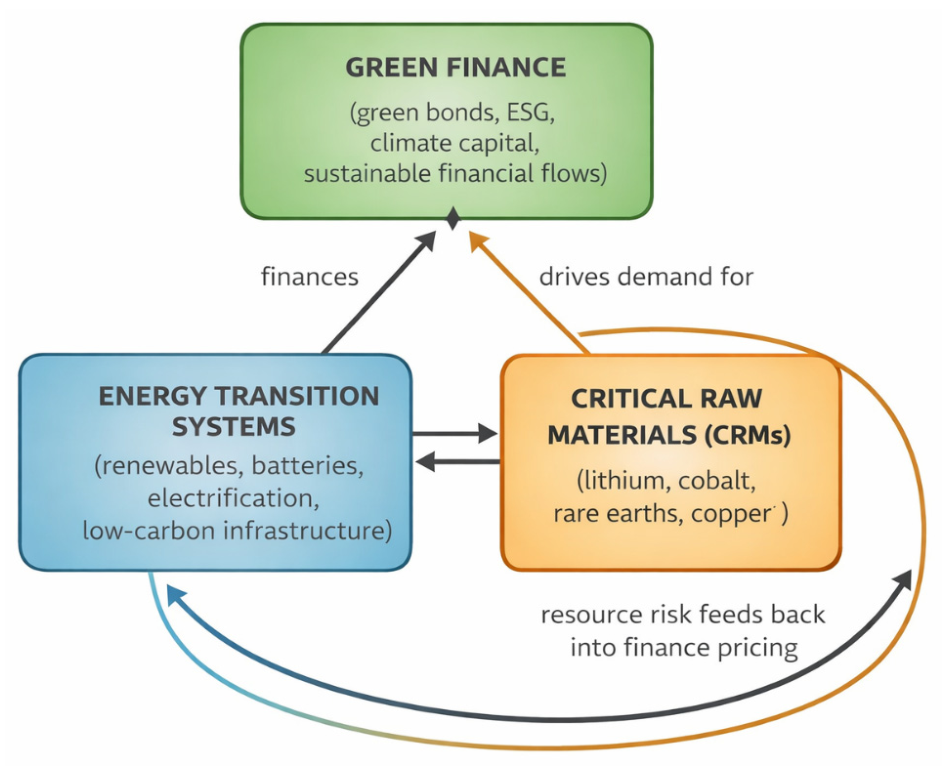
This creates a resource–finance feedback mechanism. On the one hand, green finance supports the expansion of clean energy technologies. On the other hand, the expansion of these technologies increases dependence on critical raw materials. Rising CRM demand, supply concentration, and geopolitical risk may then feed back into financial systems by increasing project costs, raising investment uncertainty, affecting risk pricing, and influencing capital allocation decisions. Therefore, financial systems, energy transition dynamics, and material resource constraints should not be analyzed as separate domains.
Existing research has often treated these dimensions independently. Green finance studies usually focus on emissions reduction, ESG performance, or green investment efficiency. Energy transition studies tend to emphasize renewable energy deployment and decarbonization pathways. Critical raw material research commonly focuses on supply risk, scarcity, import dependence, and geopolitical concentration. While each strand provides valuable insights, this fragmented approach does not fully capture the systemic interdependence between financial flows, technological transformation, and material sustainability.
Accordingly, this study conceptualizes green finance, the energy transition, and critical raw materials as a triangular dynamic system. In this framework, green finance influences the energy transition by mobilizing capital for low-carbon technologies; the energy transition increases demand pressure on critical raw materials; and critical raw material constraints feed back into financial systems through risk, pricing, and investment allocation channels. This integrated perspective provides the conceptual basis for examining the finance–energy–resource nexus within a dynamic empirical framework. The conceptual relationships among green finance, energy transition systems, and critical raw materials are summarized in
Figure 1.
2.2. Theoretical Mechanism and Dynamic Interaction Structure
The relationship between green finance, energy transition systems, and critical raw material sustainability can be conceptualized as an endogenous dynamic system characterized by bidirectional transmission mechanisms and feedback effects. Rather than operating independently, financial systems, technological transformation, and material-resource constraints co-evolve through interconnected causal channels. In this framework, green finance functions as a financial acceleration mechanism that stimulates low-carbon investment and renewable energy deployment. However, the expansion of renewable energy systems simultaneously intensifies structural demand for critical raw materials, thereby increasing supply-chain vulnerabilities and resource dependency. In turn, rising material scarcity and geopolitical concentration feed back into financial systems by influencing investment risk, capital allocation, and sustainability pricing dynamics.
The first mechanism underlying this framework is the financial acceleration mechanism. Green finance reduces financing constraints and lowers the cost of capital for environmentally sustainable investments, particularly in renewable energy infrastructure, battery storage technologies, electrification systems, and low-carbon industrial transformation. Through instruments such as green bonds, climate finance facilities, sustainability-linked loans, and ESG-oriented investment funds, financial systems facilitate the mobilization of capital toward clean technologies and energy transition projects. As a result, increased green financial development accelerates renewable energy deployment, technological diffusion, and low-carbon transition processes.
The second mechanism is the material dependency mechanism associated with the energy transition. Although renewable energy systems contribute to decarbonization objectives, they are inherently material-intensive. Technologies such as solar panels, wind turbines, electric vehicles, batteries, and smart-grid infrastructure require substantial quantities of critical raw materials, including lithium, cobalt, nickel, copper, graphite, and rare earth elements. Consequently, the expansion of renewable energy systems increases structural demand pressure on global critical raw material supply chains. This growing dependency generates sustainability challenges related to extraction intensity, recycling capacity, import dependence, and geopolitical concentration of mineral production.
The third mechanism corresponds to the resource constraint transmission mechanism. As demand for critical raw materials rises, supply-chain vulnerabilities and scarcity risks become increasingly important determinants of economic and financial stability. High geographic concentration of mineral production, geopolitical tensions, export restrictions, and production volatility may increase uncertainty regarding the long-term availability and affordability of strategic minerals. These constraints may increase production costs for renewable energy technologies and create additional investment risks for sustainability-oriented projects. Therefore, critical raw material scarcity is expected to influence technological deployment, industrial competitiveness, and energy transition dynamics.
The fourth mechanism involves financial feedback effects generated by resource scarcity and supply-chain risk. Financial markets progressively internalize critical raw material risks through adjustments in capital allocation, sustainability pricing, and investment risk assessment. Rising uncertainty regarding mineral supply security may increase risk premiums associated with clean energy projects and influence investor preferences toward less resource-intensive technologies or more diversified supply chains. Financial institutions may also integrate resource vulnerability indicators into ESG assessments, sustainability reporting frameworks, and green investment strategies. Accordingly, resource sustainability and financial system dynamics become mutually interdependent components of the broader sustainability transition.
Based on these mechanisms, the present study conceptualizes green finance, energy transition systems, and critical raw material sustainability as an integrated finance–energy–resource nexus characterized by endogenous interactions and circular causality. The empirical framework therefore assumes that green finance influences energy transition dynamics, energy transition processes affect critical raw material sustainability and supply risk, and resource constraints subsequently feed back into financial systems and investment allocation mechanisms.
The operational structure of the framework can be summarized as follows:
where
represents green finance development,
denotes energy transition dynamics,
refers to critical raw material sustainability,
captures critical raw material supply risk, and
X represents the set of macroeconomic and environmental control variables included in the empirical model.
This theoretical structure provides the conceptual foundation for the dynamic empirical analysis developed in the subsequent sections and clarifies the transmission channels linking financial systems, energy transition processes, and critical raw material sustainability within an integrated analytical framework.
3. Literature Review and Hypotheses Development
3.1. Green Finance, FinTech, and Sustainable Investment Dynamics
The growing literature on green finance emphasizes its increasingly strategic role in promoting environmental sustainability and accelerating the transition toward low-carbon economic systems. Existing studies generally agree that green financial instruments—including green bonds, sustainability-linked credit, climate finance mechanisms, and ESG-oriented investment frameworks—contribute significantly to improving environmental performance, stimulating sustainable investment, and supporting decarbonization pathways. Empirical evidence further suggests that green finance facilitates cleaner production systems, enhances energy efficiency, and promotes technological innovation, particularly when integrated with financial technology (FinTech) developments [
1].
In parallel, recent research highlights the broader macroeconomic and institutional dimensions of sustainable financial systems. Gafsi [
2] demonstrates that financial investment structures and resource-backed capital flows play an important role in shaping long-term economic growth trajectories and resource allocation efficiency. Furthermore, Gafsi [
3] shows that foreign financial flows can support renewable energy transition processes, particularly when supported by globalization mechanisms that facilitate technology transfer, capital mobility, and international cooperation. From the perspective of digital transformation, Gafsi et al. [
4] provide evidence that the adoption of FinTech, artificial intelligence (AI), and blockchain technologies contributes to sustainable development outcomes by improving financial inclusion, innovation capacity, and the efficiency of sustainable economic systems. Complementing these perspectives, Belgacem [
5] highlights the importance of low-carbon transition strategies in achieving climate-emissions reduction objectives, particularly within energy-intensive sectors. Collectively, these studies reinforce the argument that green finance should not be viewed solely as an environmental financing mechanism, but rather as a multidimensional structural driver linking financial systems, technological transformation, sustainable resource management, and low-carbon transition dynamics.
Recent studies further emphasize that green finance has evolved from a niche sustainability instrument into a strategic policy framework supporting decarbonization and climate-resilient investment systems. Ref. [
6] argues that the emergence of green finance policies is strongly associated with climate governance pressures, institutional quality, and sustainable financial regulation. Similarly, Ref. [
7] demonstrates that green finance plays a critical role in accelerating the net-zero energy transition by mobilizing capital toward renewable energy infrastructure and clean technological innovation. These findings reinforce the view that financial systems are increasingly integrated into long-term environmental transition strategies rather than functioning solely as passive funding mechanisms.
At the same time, the literature increasingly recognizes that green finance performs both environmental and financial functions. Ref. [
8] demonstrates that green investment funds can partially hedge climate-related financial risks, suggesting that green assets contribute not only to sustainability objectives but also to portfolio diversification and financial stability. Similarly, Refs. [
9,
10] show that digital financial systems and ESG-based frameworks improve the allocation efficiency of green investments and promote corporate green innovation.
Despite these important contributions, the existing literature remains characterized by several limitations and unresolved debates. First, most studies focus primarily on emissions reduction, environmental performance, and financial returns while paying limited attention to the material requirements underlying sustainability transitions. In particular, the increasing dependence of renewable energy systems on critical raw materials is rarely incorporated into green finance analyses. Second, the literature remains divided regarding the long-term effectiveness of green finance in achieving structural sustainability transformation. While some studies argue that sustainable financial flows accelerate decarbonization, others suggest that financial expansion alone may be insufficient in the absence of effective governance structures, institutional quality, and sustainable resource management mechanisms.
Moreover, existing empirical studies frequently rely on static analytical frameworks or sector-specific approaches that do not adequately capture the dynamic interactions between financial systems, technological transformation, and material-resource constraints. Consequently, feedback effects and endogenous relationships remain insufficiently explored in the green finance literature.
3.2. Natural Resources, Mining, and Green Productivity
A parallel strand of research examines the relationship between natural resources, mining activities, and sustainability outcomes. This literature highlights the importance of governance quality, fiscal decentralization, technological innovation, and environmental regulation in shaping green productivity and sustainability performance within resource-dependent economies.
Several studies suggest that green finance can positively influence sustainability outcomes in resource-intensive sectors. For instance, Ref. [
11] finds that green finance improves environmental and operational sustainability in the mineral sector, particularly in Asian economies. Similarly, Ref. [
12] demonstrates that fiscal decentralization, FinTech development, and mineral resource endowments jointly affect green productivity in G5 countries, emphasizing the importance of financial and institutional frameworks in promoting sustainable resource use.
At the macroeconomic level, the interaction between energy systems and natural resource sustainability has also attracted increasing attention. Ref. [
13] shows that green energy production and consumption significantly influence natural resource sustainability, while Ref. [
14] demonstrates that carbon neutrality policies reshape the emissions–growth relationship in mining industries. In addition, broader environmental frameworks such as the Environmental Kuznets Curve under carbon neutrality conditions [
15] further highlight the moderating role of governance structures and financial mechanisms in determining environmental outcomes.
The accelerating deployment of renewable energy systems has also intensified concerns regarding the availability and sustainability of critical minerals required for low-carbon technologies [
16] highlight that the clean energy transition substantially increases demand for strategic minerals such as lithium, cobalt, nickel, and rare earth elements, thereby raising new challenges related to supply security and resource governance. Likewise, Ref. [
17] emphasizes that recycling systems and circular resource strategies will become increasingly important for mitigating long-term supply constraints associated with emerging clean-energy technologies.
Nevertheless, the existing literature remains conceptually fragmented. Most studies analyze natural resource sustainability primarily from production, governance, or environmental perspectives without explicitly incorporating the role of financial capital allocation and investment dynamics. Furthermore, unresolved debates persist regarding whether the expansion of renewable energy systems and green technologies necessarily promotes sustainable resource management. While some studies emphasize the potential of technological innovation and recycling systems to mitigate resource pressure, others warn that the rapid expansion of low-carbon technologies may intensify extraction activities, increase environmental degradation, and generate new forms of resource dependency.
As a result, the relationship between sustainability transitions and critical raw material sustainability remains insufficiently integrated within existing empirical frameworks.
3.3. Green Finance and Natural Resource Management Mechanisms
More recent research has begun to explore the role of green finance as a mechanism for improving natural resource management and supporting sustainable development objectives. Reference [
18] shows that green financing instruments contribute to achieving Sustainable Development Goals by improving resource efficiency and strengthening sustainable management practices. Similarly, cross-regional evidence reported in Energy Policy (2025) [
19] indicates that green finance plays a significant role in supporting energy transition processes, although the effectiveness of these mechanisms varies substantially across institutional and regional contexts.
In addition, emerging literature highlights the importance of geopolitical, financial, and institutional factors in shaping resource sustainability and energy transition pathways. Studies published in Energy Economics (2025) [
19] demonstrate that governance quality, geopolitical risks, and financial distress significantly influence mineral trade networks and environmental product flows. These findings suggest that resource sustainability is increasingly linked to financial system conditions, global capital allocation, and supply-chain stability.
Recent policy-oriented research also highlights the growing strategic importance of critical raw material governance within sustainability transitions. Ref. [
20] underlines that the European Union’s external raw materials strategy increasingly focuses on securing resilient and diversified mineral supply chains to support industrial decarbonization objectives. Similarly, Ref. [
21] stresses that critical raw material supply chains have become central to global economic security, technological competitiveness, and energy-transition resilience.
In parallel, emerging research emphasizes the importance of circular economy financing mechanisms in reducing resource dependency and improving supply-chain sustainability. Ref. [
22] argues that financing circularity strategies, including recycling, reuse, and resource-efficiency investments, can significantly improve the sustainability and resilience of critical raw material supply chains.
However, despite acknowledging interactions between finance and resource management, the literature remains fragmented in several important respects. Existing studies typically examine bilateral relationships, such as green finance and environmental performance or energy transition and mineral demand, without integrating financial systems, technological transformation, and material-resource constraints within a unified analytical framework. In addition, most empirical studies do not adequately address the bidirectional relationships between these variables.
In reality, sustainability transitions involve dynamic feedback mechanisms. Green finance accelerates investment in renewable energy technologies, which subsequently increases demand pressure on critical raw materials. At the same time, rising resource scarcity, geopolitical concentration, and supply-chain vulnerabilities may feed back into financial systems by influencing investment risk, capital allocation, and sustainability pricing dynamics. Ignoring these systemic interdependencies may therefore lead to incomplete policy recommendations and an oversimplified understanding of sustainability transitions.
3.4. Research Gap
Despite significant advances in the literature, several important theoretical and empirical gaps remain unresolved.
First, studies on green finance mainly focus on emissions reduction, technological innovation, and sustainable investment performance while devoting limited attention to critical raw material dependency and supply-chain vulnerabilities associated with renewable energy expansion.
Second, the resource criticality literature concentrates primarily on supply risk, geopolitical concentration, and material scarcity but largely overlooks the role of financial systems, investment allocation mechanisms, and green capital flows in shaping resource sustainability outcomes.
Third, energy transition research emphasizes technological deployment and decarbonization pathways while rarely integrating financial mechanisms and material-resource constraints within a single empirical framework.
Moreover, although recent studies acknowledge the growing strategic importance of critical mineral governance and supply-chain resilience, limited empirical attention has been devoted to integrating green finance policies, circularity financing strategies, and critical raw material sustainability within a unified dynamic framework. Existing research generally analyzes these dimensions separately, thereby overlooking the endogenous interactions and feedback mechanisms linking financial systems, renewable energy expansion, and resource dependency.
Finally, important methodological limitations persist in the literature. Most existing studies rely on static models, sector-specific approaches, or isolated analytical perspectives that are unable to capture the dynamic, endogenous, and bidirectional relationships between green finance, energy transition systems, and critical raw material sustainability.
This study addresses these limitations by developing an integrated finance–energy–resource framework that conceptualizes green finance, energy transition systems, and critical raw material sustainability as an interconnected dynamic system characterized by mutual interactions and feedback effects. Unlike previous studies that examine these dimensions separately, this research provides a unified empirical investigation of their interrelationships within a dynamic panel framework estimated using the System Generalized Method of Moments (System GMM) approach. This methodology explicitly accounts for endogeneity, persistence effects, reverse causality, and unobserved heterogeneity, thereby contributing to a more comprehensive understanding of the financial and material dimensions of sustainability transitions.
Building on these limitations, recent contributions increasingly emphasize that sustainability transitions cannot be adequately understood through isolated analyses of finance, energy systems, or resource governance. Emerging evidence suggests that the effectiveness of green finance depends not only on the expansion of sustainable capital flows, but also on the capacity of economic systems to manage material dependency, supply-chain resilience, and critical mineral sufficiency. In this context, Ref. [
23] argues that the long-term feasibility of the green transition is closely linked to the sustainable availability, recycling potential, and strategic governance of critical raw materials. Similarly, recent findings published in Nature Communications (2025) [
24] demonstrate that critical mineral constraints are becoming structural determinants of energy-transition dynamics and international trade patterns, thereby reinforcing the strategic importance of resource security within decarbonization processes. At the same time, the green finance literature increasingly highlights the role of institutional quality, regulatory frameworks, and climate-governance structures in shaping sustainable financial development. Ref. [
25] identifies macroeconomic stability and institutional effectiveness as key determinants of green finance expansion, while Ref. [
6] shows that the emergence of green finance policies is fundamentally driven by broader transformations in climate governance and financial regulation. Complementing these perspectives, Ref. [
7] underlines that green finance constitutes a critical enabling mechanism for achieving net-zero energy-transition objectives through sustained investment in renewable energy systems and low-carbon technological innovation. Collectively, these studies reinforce the need for integrated analytical frameworks capable of capturing the endogenous interactions between financial systems, technological transformation, and material-resource constraints. In response, the present study advances the literature by proposing a unified finance–energy–resource framework estimated within a dynamic panel setting that explicitly incorporates bidirectional relationships, feedback mechanisms, and resource-related transition risks.
4. Hypotheses Development
The relationships between green finance, energy transition systems, and critical raw material sustainability remain theoretically complex and potentially nonlinear. Existing studies provide mixed evidence regarding the effectiveness of green financial mechanisms, the sustainability implications of renewable energy expansion, and the long-term effects of resource dependency on financial systems. Moreover, institutional quality, technological innovation, geopolitical conditions, and market maturity may moderate these relationships. Accordingly, the following hypotheses are formulated as dynamic and conditional relationships rather than purely deterministic associations.
H1. Green finance development is expected to positively influence energy transition system development.
Green finance is widely regarded as a key mechanism for accelerating low-carbon economic transformation by facilitating capital allocation toward renewable energy infrastructure, clean technologies, and environmentally sustainable investments. Financial instruments such as green bonds, climate finance facilities, sustainability-linked loans, and ESG-oriented investment funds may reduce financing constraints and improve investment incentives for renewable energy deployment and technological innovation.
Existing literature generally supports the argument that green financial development contributes positively to renewable energy expansion and sustainability transitions. The integration of FinTech systems and ESG-based investment frameworks may further enhance the efficiency and targeting of sustainable financial flows by improving information transparency and reducing investment risk.
However, the effectiveness of green finance remains subject to important limitations and conflicting evidence. Some studies argue that green financial expansion may not automatically translate into effective environmental transformation in the absence of strong institutional quality, governance mechanisms, and regulatory oversight. In addition, concerns regarding greenwashing, speculative financial behavior, and unequal access to sustainable capital markets may reduce the long-term effectiveness of green finance in supporting real technological transformation, particularly in emerging economies.
Despite these limitations, the dominant theoretical perspective suggests that green finance plays a positive role in facilitating energy transition processes by reducing capital costs and supporting investment in low-carbon technologies. Therefore, the following hypothesis is proposed:
H2. Energy transition expansion is expected to increase demand pressure on critical raw materials.
The transition toward low-carbon energy systems is inherently material-intensive. Renewable energy technologies, electric vehicles, battery storage systems, digital energy infrastructure, and smart-grid technologies require substantial quantities of critical raw materials such as lithium, cobalt, nickel, copper, graphite, and rare earth elements. Consequently, the expansion of renewable energy systems is expected to intensify structural demand pressure on global critical raw material supply chains.
From a resource economics perspective, increasing demand for strategic minerals may exacerbate supply constraints, increase extraction intensity, and elevate geopolitical and environmental risks associated with mineral production. Existing studies emphasize that the geographic concentration of mineral reserves and limited short-term substitutability of many critical materials may further increase supply-chain vulnerabilities during periods of rapid energy transition expansion.
Nevertheless, the long-term relationship between energy transition systems and critical raw material dependency may not be strictly linear. Technological innovation, recycling systems, circular economy strategies, and material substitution mechanisms may partially mitigate future resource pressure and reduce dependency on certain minerals over time. Furthermore, improvements in extraction efficiency and advances in alternative battery technologies may alter the intensity of material demand across different stages of the energy transition.
Despite these potential mitigating mechanisms, current renewable energy deployment remains strongly dependent on critical raw materials, particularly in the short and medium term. Therefore, the following hypothesis is proposed:
H3. Green finance mechanisms are expected to improve sustainability and risk management within critical raw material sectors.
Green finance may contribute to improving sustainability outcomes within resource-intensive sectors by directing capital toward environmentally responsible mining activities, cleaner extraction technologies, recycling systems, and circular economy initiatives. Sustainable financial instruments can incentivize firms to adopt improved environmental standards, resource-efficiency practices, and ESG-compliant governance structures within critical raw material supply chains.
In addition, green finance may strengthen transparency, environmental monitoring, and sustainability reporting practices, thereby reducing operational, environmental, and reputational risks associated with mineral extraction and processing activities. The availability of sustainable capital may also support investment in alternative technologies, recycling infrastructure, and resource diversification strategies capable of mitigating long-term supply vulnerabilities.
However, conflicting perspectives remain within the literature. Some scholars argue that increased green investment in mining and extraction sectors may unintentionally intensify resource exploitation and environmental degradation if sustainability regulations and governance mechanisms remain insufficient. In some contexts, the rapid expansion of green investment may generate additional ecological pressures through intensified extraction activities and increased land-use transformation.
Moreover, the sustainability impact of green finance may vary significantly across countries depending on institutional quality, environmental regulation, technological capacity, and governance effectiveness. Consequently, the relationship between green finance and resource sustainability may involve important conditional and context-specific effects.
Despite these limitations, the dominant literature suggests that green financial mechanisms generally contribute to improving sustainability performance and risk management within critical raw material sectors. Therefore, the following hypothesis is proposed:
H4. Critical raw material supply risk is expected to influence green finance allocation and pricing dynamics.
Although green finance supports renewable energy deployment and low-carbon technological transformation, increasing critical raw material supply risks may generate important feedback effects on financial systems and sustainable investment strategies. High geographic concentration of mineral production, geopolitical tensions, export restrictions, and production volatility may increase uncertainty surrounding the availability and affordability of strategic materials required for renewable energy technologies.
From a financial markets perspective, increasing resource scarcity and supply-chain vulnerabilities may affect investment behavior, capital allocation decisions, and sustainability pricing mechanisms. Rising uncertainty regarding critical material availability may increase risk premiums associated with renewable energy projects and encourage investors to diversify toward less resource-intensive technologies or alternative supply-chain structures.
At the same time, financial institutions may progressively incorporate resource dependency and supply-chain vulnerability indicators into ESG frameworks, sustainability assessments, and green investment strategies. As a result, critical raw material risks may become increasingly integrated into financial decision-making processes.
Nevertheless, the magnitude of these effects may vary depending on market maturity, technological substitution capacity, geopolitical conditions, and investor risk perception. Technological innovation and resource diversification strategies may partially reduce the long-term financial impact of material scarcity in some contexts.
Despite these moderating factors, the growing strategic importance of critical raw materials suggests that supply risks are likely to influence sustainable financial systems and green investment allocation.
5. Data and Methodology
5.1. Methodological Positioning
Several methodologies have been proposed to address the sustainability implications of raw materials. Ref. [
26] highlights the need for integrated sustainability assessment methodologies that encompass environmental, economic, and social sustainability dimensions in raw material supply chains. They distinguish between procedural tools that can be applied ex ante, like environmental impact assessments, and analytical tools that can be applied ex post and are more appropriate for sustainability evaluation. The analytical tools that can be applied for sustainability evaluation comprise material flow analysis, life cycle analysis, environmentally extended input–output analysis, and cost–benefit analysis, etc.
Similarly, Ref. [
27] proposed a SCARCE method that improves upon critical raw materials assessments by including societal acceptability, environmental limits, and geopolitical risks at the country level. Although these methodologies provide valuable insights into material criticality and sustainability issues through their structured approach, they are limited by their data and sectoral intensity.
Since the objective of this study is to empirically investigate the relationships between green finance, energy transition, and critical raw material sustainability at a macro level, a panel econometric model is employed.
5.2. Data and Variable Construction
The study employs an unbalanced panel dataset covering 32 advanced and emerging economies over the period 2010–2022, generating a total of 416 country-year observations. The sample was selected based on the availability and consistency of data related to green finance, energy transition indicators, and critical raw material sustainability measures. The period 2010–2022 was chosen because internationally comparable data on green finance and renewable energy indicators became more systematically available after 2010, particularly following the expansion of sustainable finance reporting frameworks and climate-related investment initiatives.
All variables were collected from publicly available international databases to ensure transparency, consistency, and replicability. Data sources include the World Bank’s World Development Indicators (WDI), the International Renewable Energy Agency (IRENA), the European Commission Critical Raw Materials Dashboard, the United States Geological Survey (USGS), and the Climate Bonds Initiative (CBI). Since the variables originate from multiple databases, the data were harmonized and standardized to improve comparability across countries and years.
The panel is unbalanced due to differences in data availability across countries and indicators, particularly for green finance and critical raw material sustainability measures. However, the use of an unbalanced panel structure allows for broader country coverage while preserving the maximum number of observations available for estimation.
To enhance transparency and reproducibility, detailed information on variable definitions, sample composition, composite index construction procedures, and econometric diagnostics is provided in
Appendix A,
Appendix B,
Appendix C and
Appendix D.
5.2.1. Sample Composition and Data Sources
The empirical analysis is based on an unbalanced panel dataset covering 32 advanced and emerging economies over the period 2010–2022. The sample includes countries for which consistent data on green finance, energy transition indicators, and critical raw material sustainability measures were available throughout the study period.
The final sample consists of the following countries:
Australia, Brazil, Canada, Chile, China, Denmark, Finland, France, Germany, India, Indonesia, Italy, Japan, Kazakhstan, Mexico, Morocco, Netherlands, Nigeria, Norway, Peru, Poland, Portugal, Russia, Saudi Arabia, South Africa, South Korea, Spain, Sweden, Türkiye, United Kingdom, United States, and Vietnam.
The sample was intentionally designed to include both advanced and emerging economies in order to capture cross-country heterogeneity in sustainable finance development, renewable energy transition dynamics, and critical raw material dependency and supply risk exposure.
Table 1 presents the definitions, measurements, and data sources of all variables included in the empirical analysis.
5.2.2. Variable Definitions and Measurement
The principal variables used in the empirical analysis are constructed as follows:
Green Finance (GF)
where
measures green finance intensity as the ratio of green bond issuance and climate finance flows to GDP for country i in year t.
Energy Transition (ET)
where
captures the share of renewable energy in total final energy consumption.
CRM Supply Risk (CRMSR)
where the CRM supply risk index reflects import dependence, geopolitical concentration, and production vulnerability associated with critical raw material supply chains.
CRM Sustainability Index (CRMSI)
where the index captures the sustainability performance of critical raw material systems through recycling intensity, diversification, and sustainable production indicators.
5.2.3. Construction of the CRM Sustainability Index (CRMSI)
The CRM Sustainability Index (CRMSI) was constructed as a composite indicator designed to capture the sustainability performance of critical raw material systems across countries and over time. Following the resource sustainability and criticality literature, the index combines three principal dimensions:
The construction procedure involved three stages: normalization, weighting, and aggregation.
First, all component indicators were normalized using min–max normalization to ensure comparability across variables measured in different units.
where
represents the normalized value of indicator X for country i in year t.
Second, equal weighting was applied across the three dimensions due to the absence of a universally accepted weighting structure in the critical raw materials sustainability literature. Equal weighting is commonly employed in composite sustainability indicators to avoid subjective weighting bias and maintain methodological transparency.
Finally, the normalized indicators were aggregated to construct the composite CRM Sustainability Index.
where:
RR denotes recycling rates;
SD represents supply diversification;
PS captures production sustainability indicators.
Higher values of the CRMSI indicate stronger sustainability performance in critical raw material systems, reflecting greater recycling capacity, lower supply concentration, and more sustainable production structures.
5.2.4. Descriptive Statistics and Correlation Analysis
Table 2 reports the descriptive statistics of the variables used in the empirical analysis. The results reveal substantial cross-country heterogeneity across both explanatory and dependent variables. Green finance indicators display considerable dispersion, reflecting differences in sustainable financial market development between advanced and emerging economies. Similarly, CRM sustainability and supply risk indicators exhibit significant variability, indicating heterogeneous exposure to resource dependency and supply-chain vulnerabilities.
Table 3 presents the correlation matrix among the main variables. The correlation coefficients remain below commonly accepted multicollinearity thresholds, suggesting the absence of severe multicollinearity problems within the empirical model.
The correlation coefficients remain below commonly accepted multicollinearity thresholds, suggesting the absence of severe multicollinearity problems among the explanatory variables. The observed correlations are generally consistent with theoretical expectations regarding the relationships between green finance, energy transition dynamics, and critical raw material sustainability.
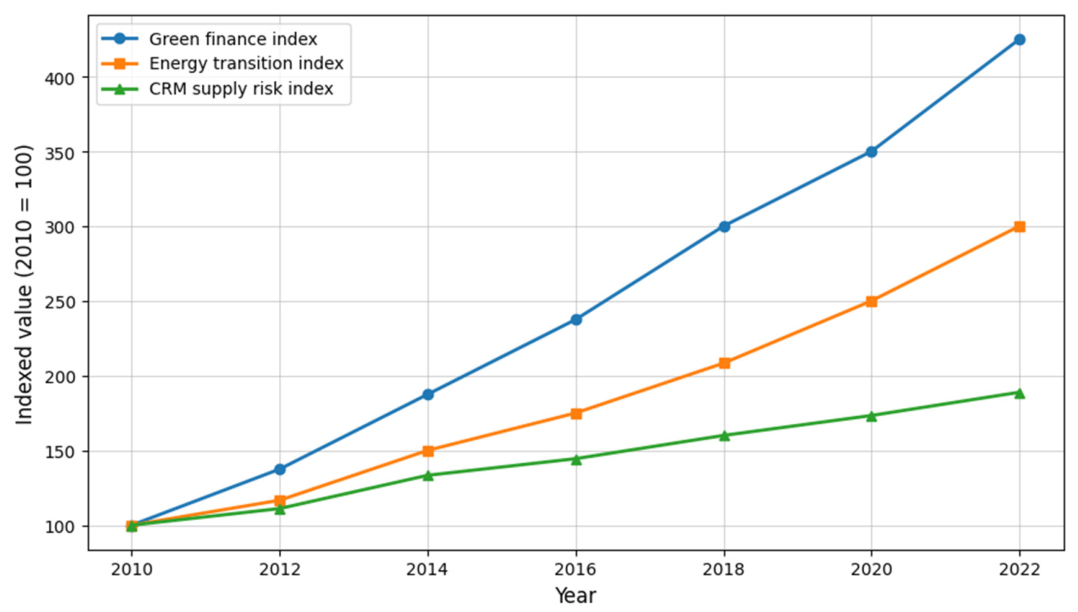
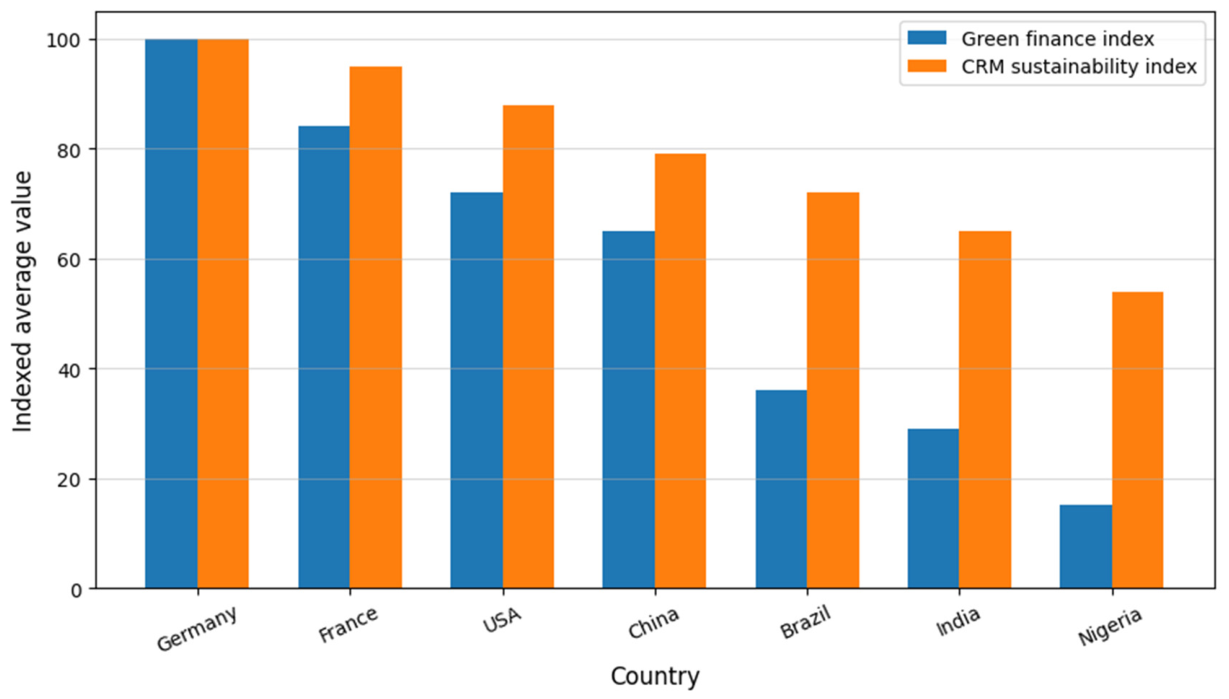
Figure 2 and
Figure 3 provide descriptive empirical evidence regarding the temporal evolution and cross-country heterogeneity of the main variables included in the panel analysis.
Figure 2 reports the annual evolution of the main variables using sample-average values from the empirical panel dataset. To improve comparability across indicators measured in different units, all series are indexed to 2010 = 100. The figure shows a clear increase in green finance and energy transition indicators over the study period, while CRM supply risk also rises, suggesting that the acceleration of low-carbon investment and renewable energy deployment is accompanied by growing pressure on critical raw material supply chains. This descriptive pattern supports the need for an empirical model that jointly examines financial, energy, and material-resource dynamics.
Figure 3 presents cross-country heterogeneity in average green finance development and CRM sustainability indicators across selected economies included in the panel dataset. The results reveal substantial differences between advanced and emerging economies in terms of sustainable financial development and resource sustainability performance. Countries with more developed financial systems and stronger renewable energy investment capacity generally exhibit higher levels of green finance and relatively stronger CRM sustainability indicators. In contrast, several emerging economies display lower green finance penetration and higher exposure to resource-related vulnerabilities. These differences support the relevance of a panel-data framework and justify the inclusion of macroeconomic and structural control variables in the empirical analysis.
5.3. Model Specification
To examine the dynamic relationship between green finance, energy transition, and critical raw material sustainability, the study specifies a dynamic panel model in which CRM outcomes depend on their past values, green finance, energy transition indicators, and a set of macroeconomic and structural control variables.
where
denotes either the CRM Sustainability Index or the CRM Supply Risk indicator for country iii in year t.
represents green finance intensity, while
captures energy transition progress.
is a vector of control variables including GDP per capita, industrial value added, trade openness, R&D expenditure, and CO
2 emissions. The term
captures persistence in CRM sustainability and supply risk. Country-specific effects are represented by μi, year effects by λt, and εit is the idiosyncratic error term.
The inclusion of the lagged dependent variable is theoretically justified by the persistent nature of critical raw material systems. Recycling capacity, supply-chain diversification, production structures, and resource dependency do not adjust immediately, but evolve gradually over time due to technological, institutional, and investment constraints.
The baseline specification is estimated using two alternative dependent variables. The first model uses the CRM Sustainability Index to assess whether green finance and energy transition dynamics improve the sustainability performance of critical raw material systems. The second model uses the CRM Supply Risk indicator to examine whether the expansion of green finance and energy transition processes is associated with changes in supply-chain vulnerability.
Accordingly, the empirical analysis estimates the following two equations:
This specification allows the study to distinguish between the sustainability-enhancing effects of green finance and the potential supply-risk pressures associated with the energy transition. The detailed estimation strategy, including the treatment of endogeneity and the choice of instruments, is presented in
Section 5.4.
5.4. System GMM Estimation Strategy and Diagnostic Tests
To estimate the dynamic panel model, this study employs the two-step System Generalized Method of Moments (System GMM) estimator developed by Refs. [
28,
29]. The System GMM estimator is appropriate for panel settings characterized by:
- (i)
A relatively small time dimension and larger cross-sectional dimension;
- (ii)
Dynamic persistence;
- (iii)
Potential endogeneity of explanatory variables;
- (iv)
Unobserved country-specific heterogeneity.
The baseline empirical specification is expressed as follows:
where
represents the critical raw material sustainability index for country i at time t,
denotes green finance development,
captures energy transition dynamics,
refers to critical raw material supply risk, and
represents the vector of macroeconomic and environmental control variables including GDP per capita, industrial value added, trade openness, R&D expenditure, and CO
2 emissions. The terms
capture country-specific and time-specific effects, respectively, while
denotes the idiosyncratic error term.
Following the System GMM framework, the estimation combines equations in first differences and levels in order to improve estimator efficiency and reduce finite-sample bias. Lagged levels of endogenous variables are used as instruments for differenced equations, while lagged differences are employed as instruments for level equations.
In the empirical estimation, green finance, energy transition indicators, and CRM supply risk are treated as endogenous variables due to potential simultaneity and reverse causality effects. The lagged dependent variable is treated as predetermined, while the control variables are considered weakly exogenous. Internal instruments are generated using lagged observations dated t–2 and earlier, consistent with standard dynamic panel estimation procedures.
To improve the reliability of the two-step estimator, Ref. [
30] finite-sample correction was applied to the standard errors. In addition, the instrument matrix was collapsed and lag depth restrictions were imposed in order to avoid instrument proliferation and overfitting problems commonly associated with System GMM estimations.
Several post-estimation diagnostic tests were conducted to evaluate the validity and robustness of the empirical specification.
First, the Arellano–Bond serial correlation tests for first-order [AR(1)] and second-order [AR(2)] autocorrelation were employed. While first-order serial correlation is expected in differenced residuals, the absence of statistically significant second-order serial correlation is required for instrument validity.
Second, the Hansen J-test of over-identifying restrictions was used to assess the overall validity of the instrument set. A non-significant Hansen statistic indicates that the instruments are jointly exogenous and uncorrelated with the error term. The Difference-in-Hansen test was additionally employed to evaluate the validity of the supplementary level instruments introduced under the System GMM framework.
Finally, the number of instruments was carefully monitored to ensure that it remained below the number of cross-sectional groups, thereby reducing the risk of instrument proliferation and weak instrument bias. The combination of these estimation procedures and diagnostic tests strengthens the consistency and robustness of the empirical results.
The diagnostic tests support the validity and robustness of the empirical specification. The AR(2) results indicate the absence of second-order serial correlation, while the Hansen and Difference-in-Hansen tests confirm the validity of the instrument set. In addition, the number of instruments remains below the number of cross-sectional groups, reducing concerns related to instrument proliferation.
5.5. Robustness Checks
To ensure the reliability and stability of the empirical findings, a series of robustness checks are performed.
First, alternative measures of green finance are employed, distinguishing between bond-based indicators (e.g., green bonds) and broader investment-based proxies. Second, different indicators of critical raw material sustainability are considered to account for measurement sensitivity. Third, subsample analyses are conducted to examine potential heterogeneity across country groups or time periods. Finally, alternative lag structures are tested to verify that the results are not driven by specific dynamic assumptions.
Together, these robustness checks strengthen the credibility of the results by demonstrating that the main findings are not sensitive to variable definitions or model specification choices.
6. Empirical Results
6.1. Descriptive Statistics
The descriptive statistics reported in
Table 2 provide preliminary evidence on the distribution and variability of the variables included in the empirical analysis. The dataset is constructed from publicly available international databases, including the World Bank (WDI), IRENA, the EU Critical Raw Materials Dashboard, the United States Geological Survey (USGS), and the Climate Bonds Initiative. The panel covers 32 advanced and emerging economies over the period 2010–2022, generating 416 country-year observations. Due to differences in data availability across countries and indicators, the panel is unbalanced.
Overall, the descriptive statistics reveal substantial cross-country heterogeneity in green finance development, energy transition dynamics, and critical raw material sustainability. The average value of the CRM sustainability index indicates moderate levels of resource sustainability across the sample, while the relatively large standard deviation suggests important differences in countries’ exposure to supply-chain vulnerabilities, import dependence, and resource-related risks.
Green finance indicators exhibit considerable variation across economies, reflecting differences in financial market development, institutional quality, and the maturity of sustainable finance frameworks. Similarly, energy transition indicators display significant dispersion, highlighting unequal progress in renewable energy deployment and low-carbon technological adoption across countries. These preliminary patterns provide initial empirical support for the relevance of a dynamic panel-data framework capable of capturing heterogeneity, persistence effects, and interdependencies between financial systems, energy transition processes, and resource sustainability.
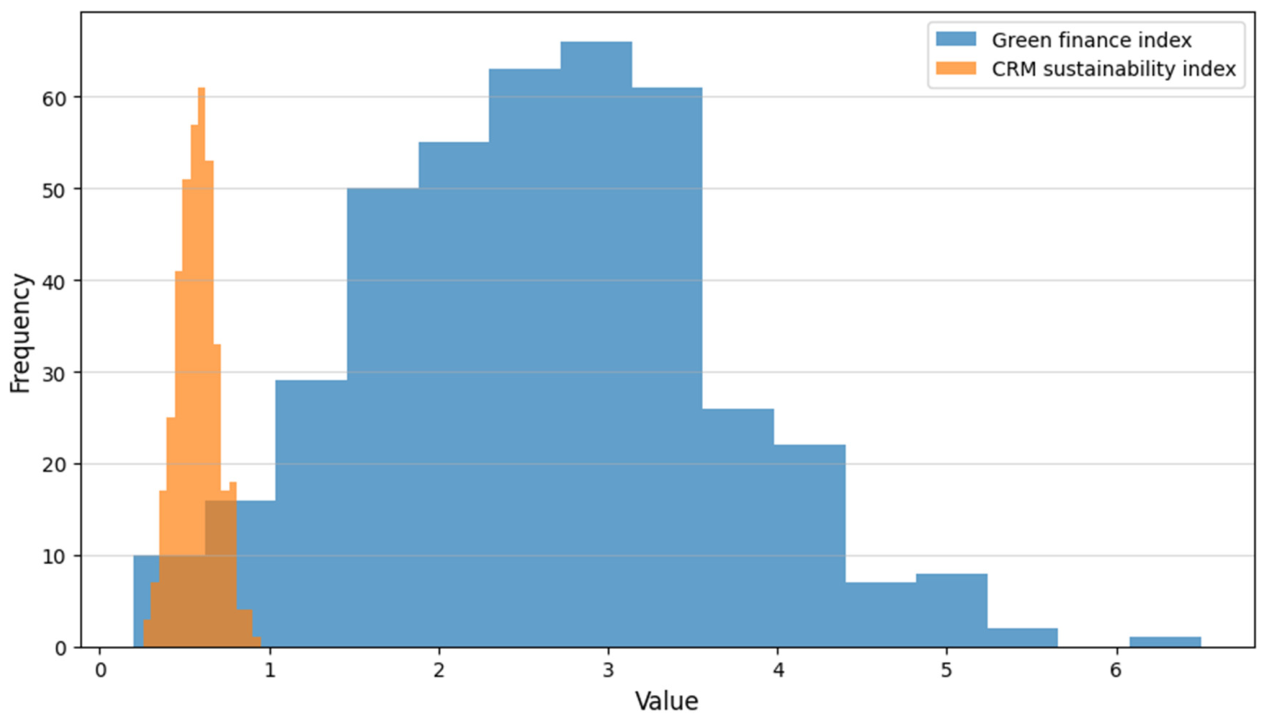
To complement the descriptive statistics reported in
Table 2,
Figure 4 illustrates the distributional characteristics and cross-country heterogeneity of the principal variables used in the empirical analysis.
Figure 4 illustrates the distributional characteristics of the principal variables included in the empirical analysis. The figure highlights the presence of substantial heterogeneity across country-year observations, particularly in green finance development and CRM sustainability indicators. The distributions suggest varying levels of financial development, renewable energy transition progress, and exposure to resource sustainability constraints across the sampled economies. The observed dispersion further supports the appropriateness of a panel-data framework capable of capturing cross-country heterogeneity and dynamic relationships among the variables.
6.2. Baseline Results
Table 4 presents the baseline two-step System Generalized Method of Moments (System GMM) estimation results examining the relationship between green finance, energy transition dynamics, and critical raw material (CRM) sustainability. The dynamic panel specification accounts for persistence effects, potential endogeneity, and unobserved heterogeneity across countries.
The coefficient of the lagged dependent variable is positive and statistically significant across the estimated models, confirming the presence of persistence in CRM sustainability dynamics over time. This result indicates that current levels of resource sustainability are partially influenced by previous-period conditions, reflecting the structural and long-term nature of critical raw material supply chains and resource governance systems.
The estimated coefficient associated with green finance is negative and statistically significant with respect to CRM supply risk, suggesting that higher levels of sustainable financial development contribute to improving resource sustainability and reducing supply-chain vulnerabilities. This finding indicates that green financial flows facilitate investment in cleaner technologies, recycling systems, resource efficiency, and environmentally responsible production practices.
By contrast, the energy transition variable exhibits a positive and statistically significant association with CRM supply pressure, indicating that the expansion of renewable energy systems and low-carbon technologies increases demand for critical raw materials. This result is consistent with the material-intensive nature of decarbonization processes, particularly the growing dependence on lithium, cobalt, nickel, copper, and rare earth elements required for renewable energy infrastructure, battery storage, and electrification technologies.
The estimated coefficients of the control variables are generally consistent with theoretical expectations. Higher levels of industrial activity and CO2 emissions are associated with greater pressure on CRM systems, while higher R&D expenditure contributes to improved sustainability performance through technological innovation and resource efficiency improvements.
Overall, the baseline results provide empirical evidence supporting the existence of strong interdependencies between financial systems, energy transition processes, and critical raw material sustainability. The findings further support the relevance of an integrated finance–energy–resource framework for analyzing sustainability transitions and resource-related vulnerabilities.
The post-estimation diagnostic tests support the validity and robustness of the System GMM specification. The non-significant AR(2) statistic confirms the absence of second-order serial correlation, while the Hansen and Difference-in-Hansen tests indicate that the selected instruments are valid and uncorrelated with the error term. Furthermore, the number of instruments remains below the number of cross-sectional groups, reducing concerns related to instrument proliferation and overfitting.
Table 5 summarizes the diagnostic tests, including the AR(1), AR(2), Hansen, and Difference-in-Hansen tests, used to evaluate the validity of the empirical specification.
The post-estimation diagnostic tests support the validity and consistency of the System GMM specification. The AR(1) test indicates the expected presence of first-order serial correlation in differenced residuals, while the non-significant AR(2) statistics confirm the absence of second-order serial correlation. In addition, the Hansen J-test and Difference-in-Hansen test fail to reject the null hypothesis of instrument validity, suggesting that the selected instruments are appropriate and not correlated with the error term. Furthermore, the number of instruments remains lower than the number of cross-sectional groups, reducing concerns related to instrument proliferation.
6.3. Interpretation of Results
The empirical results provide several important quantitative insights regarding the interactions between green finance, energy transition dynamics, and critical raw material sustainability.
First, the estimated coefficient associated with green finance is negative and statistically significant across all specifications. Quantitatively, the coefficient estimate (−0.145) indicates that a one-unit increase in green finance intensity is associated with an approximately 0.145-point reduction in CRM supply risk, ceteris paribus. This result suggests that sustainable financial development contributes to improving resource sustainability through increased investment in recycling systems, cleaner technologies, and environmentally efficient production structures.
Second, the estimated coefficient of the energy transition variable is positive and statistically significant. The magnitude of the coefficient (0.231) implies that the expansion of renewable energy systems and low-carbon technologies is associated with a measurable increase in pressure on critical raw material supply chains. This finding empirically confirms the material-intensive nature of decarbonization processes, particularly the growing dependence on lithium, cobalt, nickel, copper, and rare earth elements required for renewable energy infrastructure and battery storage technologies.
Third, the lagged dependent variable exhibits a relatively large and statistically significant coefficient (0.620), indicating strong persistence in CRM sustainability dynamics over time. This result suggests that resource sustainability conditions evolve gradually and remain strongly influenced by historical investment structures, institutional capacity, and long-term industrial dynamics.
Among the control variables, industrial activity and CO2 emissions are positively associated with CRM supply pressure, while R&D expenditure contributes negatively to supply risk, suggesting that technological innovation and research investment play an important role in improving resource efficiency and sustainability performance.
Overall, the empirical findings provide robust quantitative evidence supporting the existence of strong interdependencies between financial systems, energy transition processes, and critical raw material sustainability. The consistency of the estimated coefficients across baseline and robustness specifications further strengthens the empirical validity of the proposed finance–energy–resource framework.
6.4. Robustness Checks
To evaluate the stability and reliability of the baseline findings, several robustness checks were conducted using alternative model specifications, variable definitions, and subsample estimations. These robustness analyses aim to verify whether the estimated relationships between green finance, energy transition dynamics, and critical raw material sustainability remain consistent under different empirical conditions.
First, the baseline green finance indicator was replaced with an alternative measure based exclusively on green bond issuance in order to assess whether the results are sensitive to the construction of the financial variable. Second, the CRM Sustainability Index was replaced with an alternative composite specification using modified weighting and normalization procedures. Third, a subsample analysis was conducted by separating advanced and emerging economies to examine whether the estimated relationships differ across country groups characterized by different levels of financial development and industrial structure.
The robustness estimation results are presented in
Table 6.
The robustness results confirm the stability of the baseline findings across alternative empirical specifications. In particular, the coefficients associated with green finance remain negative and statistically significant, indicating that sustainable financial development consistently contributes to reducing critical raw material supply risk and improving sustainability performance.
Similarly, the energy transition variable maintains a positive and statistically significant relationship with CRM supply pressure across all alternative specifications, confirming the material-intensive nature of low-carbon transition processes.
The diagnostic tests further support the validity of the robustness estimations. The Hansen tests confirm instrument validity, while the AR(2) statistics indicate the absence of second-order serial correlation. In addition, the number of instruments remains below the number of cross-sectional groups in all specifications, reducing concerns related to instrument proliferation.
Overall, the robustness analyses confirm that the main empirical findings are not driven by a specific model specification, variable construction method, or sample composition, thereby strengthening the reliability and consistency of the proposed finance–energy–resource framework.
7. Discussion and Policy Implications
7.1. Discussion of Findings
The empirical findings of this study provide robust evidence supporting the existence of strong interdependencies between green finance, energy transition dynamics, and critical raw material (CRM) sustainability. More importantly, the results demonstrate that financial systems, technological transformation, and resource sustainability should not be analyzed as isolated dimensions, but rather as components of an interconnected and dynamic sustainability transition framework.
First, the estimated coefficient associated with green finance is negative and statistically significant across both the baseline and robustness specifications. Quantitatively, the baseline estimations indicate that an increase in green finance intensity contributes to a measurable reduction in CRM supply risk and improvement in sustainability performance. This result suggests that sustainable financial development facilitates investment in environmentally responsible extraction practices, recycling infrastructure, resource-efficient technologies, and circular economy initiatives. The consistency of this relationship across alternative specifications further reinforces the empirical validity of the finance–resource sustainability nexus.
Second, the positive and statistically significant coefficient associated with the energy transition variable confirms the material-intensive nature of low-carbon transformation processes. The results indicate that the expansion of renewable energy systems, electrification technologies, and battery storage infrastructure generates increasing pressure on critical raw material supply chains. This finding quantitatively supports growing concerns regarding the structural dependence of decarbonization pathways on lithium, cobalt, nickel, copper, and rare earth elements. Consequently, while the energy transition contributes to emissions reduction objectives, it may simultaneously intensify resource dependency, supply-chain vulnerability, and geopolitical concentration risks.
Third, the relatively large and statistically significant coefficient associated with the lagged dependent variable confirms the presence of strong persistence effects in CRM sustainability dynamics. This result indicates that resource sustainability outcomes evolve gradually over time and remain strongly influenced by historical investment structures, industrial specialization, institutional quality, and long-term policy conditions. The persistence identified in the System GMM estimations suggests that short-term policy interventions alone are unlikely to generate substantial improvements in resource sustainability unless accompanied by broader structural transformation strategies.
The estimated coefficients of the control variables also provide relevant empirical insights. Industrial activity and CO2 emissions are positively associated with CRM supply pressure, suggesting that higher industrial intensity and carbon-intensive production systems increase resource-related vulnerabilities. By contrast, R&D expenditure contributes negatively to CRM supply risk, highlighting the importance of technological innovation and research investment in improving resource efficiency, recycling capacity, and sustainable production systems.
The robustness analyses further strengthen the reliability and consistency of the empirical findings. The estimated relationships remain stable across alternative green finance indicators, modified CRM sustainability indices, and subsample estimations. In addition, the Hansen and Difference-in-Hansen tests confirm the validity of the instrument set, while the non-significant AR(2) statistics indicate the absence of second-order serial correlation. These diagnostic results support the econometric consistency of the System GMM estimations and reinforce the empirical credibility of the proposed finance–energy–resource framework.
Overall, the findings demonstrate that sustainability transitions generate complex feedback mechanisms between financial systems, technological transformation, and material resource constraints. Green finance contributes to supporting sustainability objectives, yet the acceleration of low-carbon technologies simultaneously increases dependence on strategically important raw materials. This dual dynamic reveals that the transition toward a low-carbon economy is not solely an environmental challenge, but also a financial, industrial, and geopolitical resource challenge requiring integrated policy and governance approaches.
Furthermore, the empirical findings contribute to broader debates surrounding the sustainability of green industrial transformation and the potential contradictions embedded within low-carbon transition strategies. While green finance and renewable energy expansion are generally associated with environmental improvement, the results demonstrate that decarbonization processes may simultaneously intensify dependence on strategically concentrated critical raw materials. This finding reflects an important sustainability trade-off frequently highlighted in recent debates on green industrial policy and resource governance. In particular, the transition toward renewable energy systems may reduce fossil-fuel dependency while generating new forms of geopolitical dependency associated with lithium, cobalt, nickel, and rare earth supply chains. Consequently, the findings support emerging arguments that sustainability transitions should not be evaluated exclusively through carbon reduction metrics, but also through material intensity, supply-chain resilience, and long-term resource governance considerations.
7.2. Policy Implications
Based on the empirical findings, several important policy implications emerge for governments, financial institutions, industrial actors, and international organizations.
First, policymakers should move beyond fragmented sustainability strategies and adopt integrated policy frameworks capable of simultaneously addressing financial development, energy transition objectives, and critical raw material sustainability. Green finance policies should explicitly incorporate resource-efficiency criteria, recycling objectives, and supply-chain resilience considerations within sustainable investment frameworks.
Second, the increasing material intensity of the energy transition highlights the urgent need to strengthen sustainability standards in mining, extraction, and raw material processing sectors. Governments should encourage the use of green financial instruments to support environmentally responsible extraction practices, recycling infrastructure, and circular economy systems capable of reducing dependence on primary resource extraction.
Third, the concentration of critical raw material production in a limited number of countries exposes global supply chains to geopolitical and strategic vulnerabilities. Policymakers should therefore promote diversification strategies, international cooperation mechanisms, strategic stockpiling policies, and supply-chain resilience initiatives in order to reduce exposure to external disruptions.
Fourth, financial systems and ESG frameworks should better integrate material dependency risks into sustainability assessments and investment decision-making processes. Improving transparency standards, resource-related disclosure mechanisms, and sustainability reporting requirements would allow financial markets to more accurately price resource-related risks and allocate capital toward sustainable and resource-efficient investments.
Fifth, innovation and technological development remain essential for reducing the long-term material intensity of low-carbon transitions. Public and private investment should therefore support research and development in alternative materials, advanced recycling technologies, energy storage innovation, and resource-efficient industrial processes. Green finance can play a critical role in facilitating these investments by reducing financing constraints and improving access to sustainable capital.
7.3. Broader Implications
Beyond the specific empirical findings and policy implications, this study highlights a broader transformation in the conceptualization of sustainability transitions. The transition toward low-carbon economic systems should not be viewed exclusively through the lens of emissions reduction and renewable energy deployment. Rather, sustainability transitions involve deeply interconnected financial, technological, industrial, and material-resource dimensions.
Ignoring the interdependencies between financial systems, energy transition processes, and critical raw material sustainability may generate unintended consequences, including increased resource scarcity, supply-chain instability, geopolitical concentration risks, and financial vulnerability. Consequently, achieving long-term sustainable development requires systemic governance approaches capable of integrating financial regulation, technological transformation, industrial policy, and resource sustainability within a unified analytical and policy framework.
Overall, the findings of this study contribute to a more comprehensive understanding of the finance–energy–resource nexus and provide empirical evidence supporting the need for integrated sustainability governance strategies in the context of accelerating global decarbonization.
More broadly, the findings contribute to ongoing debates concerning green growth, degrowth, and the material limits of sustainability transitions. While green technological transformation is often presented as a pathway toward environmentally sustainable economic growth, the results suggest that large-scale decarbonization strategies remain strongly dependent on resource-intensive industrial systems. This raises important questions regarding the long-term compatibility between continuous economic expansion, accelerating material demand, and global sustainability objectives. Accordingly, future sustainability frameworks may require greater emphasis on circular economy strategies, resource efficiency, consumption restructuring, and sustainable industrial policy coordination at the international level.
8. Limitations
While this study provides important insights into the relationship between green finance, energy transition, and critical raw material (CRM) sustainability, several limitations should be acknowledged.
First, the empirical analysis is based on estimations using harmonized indicators from publicly available data sources. Although these data provide useful approximations of global trends, they may not fully capture country-specific dynamics, sectoral heterogeneity, or measurement nuances associated with CRM sustainability and green finance indicators.
Second, the construction of the CRM sustainability index relies on composite measures that aggregate multiple dimensions of resource risk, including supply concentration, import dependence, and recycling capacity. While this approach allows for a comprehensive assessment, it may mask important variations across individual materials and supply chains.
Third, the analysis is conducted at a macroeconomic level, which limits the ability to capture firm-level behavior, micro-level investment decisions, and supply chain interactions. Future research could extend the framework by incorporating disaggregated data at the sectoral or firm level.
Fourth, the dynamic relationships explored in this study do not explicitly account for short-term shocks, geopolitical disruptions, or sudden technological breakthroughs, which may significantly affect both financial markets and resource systems.
Finally, while the study identifies key linkages between financial systems, energy transition processes, and resource sustainability, the analysis remains of general patterns rather than precise causal estimates. This limitation is partly due to data constraints and highlights the need for future empirical work using more granular and high-frequency data.
9. Conclusions
This study examined the dynamic relationship between green finance, energy transition processes, and critical raw material (CRM) sustainability using an unbalanced panel dataset covering 32 advanced and emerging economies over the period 2010–2022. Employing a two-step System Generalized Method of Moments (System GMM) estimation framework, the analysis accounted for dynamic persistence, endogeneity, and unobserved country-specific heterogeneity in order to provide a more robust empirical assessment of the finance–energy–resource nexus.
The empirical findings reveal several important quantitative insights. First, green finance exhibits a statistically significant negative relationship with CRM supply risk, suggesting that sustainable financial development contributes to improving resource sustainability and reducing supply-chain vulnerabilities. The results indicate that green financial flows support investment in recycling infrastructure, cleaner technologies, resource efficiency improvements, and environmentally sustainable production systems.
Second, the energy transition variable displays a positive and statistically significant association with CRM supply pressure, confirming the material-intensive nature of decarbonization processes. The expansion of renewable energy systems, electrification technologies, and battery storage infrastructure increases demand for strategic minerals such as lithium, cobalt, nickel, copper, and rare earth elements. This finding demonstrates that the transition toward low-carbon economic systems may simultaneously generate new forms of resource dependency and geopolitical vulnerability.
Third, the relatively large and statistically significant coefficient associated with the lagged dependent variable confirms the presence of strong persistence effects in CRM sustainability dynamics. Resource sustainability outcomes evolve gradually over time and remain strongly influenced by historical investment structures, industrial specialization, institutional quality, and long-term policy conditions. This result highlights the structural nature of resource sustainability challenges and the limitations of short-term policy interventions.
The robustness analyses further reinforce the consistency and reliability of the empirical findings. The estimated relationships remain stable across alternative model specifications, alternative CRM index constructions, and subsample estimations. In addition, the Hansen and Difference-in-Hansen tests confirm the validity of the instrument set, while the AR(2) statistics indicate the absence of second-order serial correlation. These diagnostic results strengthen the econometric credibility and methodological robustness of the empirical framework adopted in this study.
Beyond its empirical findings, the study provides several broader scientific and methodological contributions. Conceptually, the analysis advances the literature by integrating green finance, energy transition dynamics, and critical raw material sustainability within a unified analytical framework rather than treating them as isolated dimensions of sustainability transitions. Methodologically, the study contributes by constructing a composite CRM sustainability index and applying a dynamic panel-data framework capable of capturing persistence effects, endogenous relationships, and cross-country heterogeneity. Empirically, the findings contribute to ongoing debates regarding green industrial policy, sustainability trade-offs, strategic resource dependency, and the material limits of low-carbon transitions.
The results also highlight an important policy paradox. While green finance and renewable energy deployment are essential for achieving climate objectives, large-scale decarbonization strategies remain heavily dependent on finite and geographically concentrated critical raw materials. Consequently, sustainability transitions should not be evaluated solely through emissions reduction targets, but also through resource efficiency, circular economy capacity, supply-chain resilience, and long-term material sustainability considerations.
Despite these contributions, the study remains subject to several limitations. The availability and comparability of cross-country data on green finance and critical raw material sustainability remain constrained, particularly for emerging economies. In addition, the composite CRM sustainability index may not fully capture all dimensions of geopolitical risk, technological substitution, or informal resource markets. Future research could extend the analysis by incorporating disaggregated mineral-level data, regional supply-chain networks, firm-level sustainability indicators, and alternative econometric approaches capable of capturing nonlinearities and structural breaks in sustainability transitions.
Overall, the findings demonstrate that the transition toward a low-carbon economy constitutes not only an environmental challenge, but also a financial, industrial, geopolitical, and material-resource challenge. Achieving long-term sustainability therefore requires integrated governance approaches capable of simultaneously addressing financial systems, technological transformation, and critical raw material sustainability within a coherent global policy framework.