


Abstract
The variability of solar energy limits its reliability as a thermal resource, motivating the use of thermal energy storage (TES) to extend heat availability beyond periods of direct irradiance. This study numerically compares latent and sensible TES integrated into a solar dish system from a resource-oriented perspective across representative Mexican climates. Rather than focusing only on stored energy, the analysis evaluates how each storage strategy affects the temporal availability and post-irradiation persistence of usable thermal energy over 24 h charge–discharge cycles. A salt-based PCM (58.1LiNO3–41.9KCl) was assessed against steel-based sensible storage under identical operating conditions. Under average-day forcing, the minimum PCM mass required to effectively utilize latent heat while sustaining a 320 W test load was found to be 13 kg. Under these conditions, the PCM case showed smoother thermal transients and longer post-irradiation energy availability, enabling nocturnal operation. In contrast, a mass-matched 13 kg steel store showed negligible post-irradiation availability, while a volume-matched 55 kg steel configuration achieved similar nocturnal operation only by substantially increasing mass, with limited improvement in accumulated energy. Hot-day forcing extended the operating window, whereas cold-day forcing yielded negligible charging so that operation could not be sustained within a single daily cycle.
1. Introduction
The transition toward low-carbon energy systems has increased interest in technologies that can enhance the reliability of renewable resources. Solar thermal energy is broadly available, yet its diurnal and weather-driven variability limits its direct use in applications that require continuous heat supply. Thermal energy storage mitigates this constraint by decoupling energy collection from delivery, thereby extending the usability of solar heat beyond periods of peak irradiance and reducing reliance on auxiliary heating systems [1].
TES can be implemented through sensible, latent, or thermochemical storage, each with distinct operating ranges and design trade-offs [2]. Heat-accumulating materials are commonly classified by their temperature range (low, medium, and high), which conditions candidate materials and containment strategies [3]. For solar thermal systems, sensible storage (e.g., metals or molten salts) and latent storage using phase change materials (PCMs) are particularly relevant. PCMs store and release latent heat during phase transitions, enabling higher energy density and a quasi-isothermal discharge around the melting temperature, which is advantageous for targeted thermal delivery [2,4]. Material selection is primarily governed by melting temperature and latent heat, but high-temperature operation further requires long-term thermal stability and chemical compatibility with structural materials [4,5,6]. In addition, heat-transfer limitations in many PCMs have motivated enhancement strategies such as nano-additives aimed at increasing effective thermal conductivity while preserving practical storage performance [7].
Encapsulation has emerged as a practical route to improve PCM handling, reduce leakage risks, and increase heat-transfer area, with growing evidence of its relevance for concentrated solar power (CSP) and related high-temperature applications [8,9,10,11,12]. At the system level, integrating TES into solar collectors can alter the temporal distribution of deliverable energy, and reported performance gains depend on the PCM type and operating conditions [13].
Recent perspectives on TES also emphasize its role in increasing energy-system flexibility, including within emerging energy communities [14], reinforcing the importance of evaluating storage options from a resource-oriented viewpoint. Beyond solar–thermal applications, recent techno-economic studies on hybrid renewable systems highlight that integrating energy storage (and resource management strategies such as tracking) is essential to improve supply reliability and system feasibility under variable renewable inputs [15].
In the Mexican context, prior research has explored thermal energy storage mainly in low- and medium-temperature solar applications, including PCM-enhanced building envelopes for warm climates and solar-assisted storage for cooling-oriented systems. For example, García-Pérez et al. [16] evaluated PCM integration in wall assemblies under Mérida, Yucatán conditions, while Ríos-Arriola et al. [17] analyzed underground thermal energy storage supplied by solar collectors for an absorption-cooling application in northwest Mexico. These studies confirm the relevance of thermal storage under Mexican climatic conditions, but they focus on building-envelope moderation or solar-assisted cooling rather than on collector-integrated high-temperature TES.
While most PCM-based TES studies emphasize storage capacity and conventional thermal-performance indicators, fewer studies examine how storage strategies influence the temporal availability of usable solar thermal energy under realistic climatic conditions. In particular, the implications of different TES configurations for the continuity of solar-derived heat across diurnal cycles remain comparatively underexplored.
This study adopts a resource-oriented perspective to evaluate thermal energy storage performance under realistic solar forcing. In this context, a resource-oriented perspective refers to evaluating the performance of a system under the constraints imposed by natural resource availability—particularly climatic variability—while focusing on how storage strategies influence the temporal availability, persistence, and usability of the solar thermal resource rather than peak efficiency metrics.
The present work addresses this gap by providing a systematic comparison of the resource continuity performance of PCM-based and steel-based thermal energy storage under identical Mexican climatic conditions. The analysis examines how latent (PCM-based) and sensible (steel-based) storage, together with storage mass and day-type variability, influence the persistence and availability of usable solar thermal energy across daily charge–discharge cycles.
The PCM selection and preliminary thermal evaluation under representative operating conditions were addressed in the authors’ previous work [18]. Accordingly, the present study focuses on the resource-availability implications of a previously selected PCM relative to a sensible-storage reference, rather than on establishing general conclusions for all PCM classes. Broader material-qualification aspects, including degradation under repeated cycling, corrosion effects, and compatibility with containment materials, are outside the scope of the present numerical comparison.
2. Materials and Methods
2.1. Study Framework and System Description
The objective of this study is to quantify how TES reshapes the temporal availability of solar thermal energy as a usable resource under representative Mexican climatic conditions. Because solar irradiation is inherently variable, TES enables a fraction of the collected heat to be shifted to post-irradiation periods, extending the duration of recoverable thermal supply. In this work, the influence of storage strategy is examined by comparing a conventional sensible-heat storage medium (steel) with a latent-heat strategy based on a phase change material (PCM).
Following the authors’ previous screening study reported in [18], the present simulations adopt 58.1LiNO3–41.9KCl as the latent-storage material and steel as the sensible-storage benchmark. Thus, this section focuses on the comparative system-level framework used to assess how these two storage strategies influence the temporal availability of usable thermal energy.
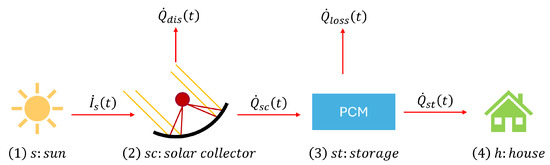
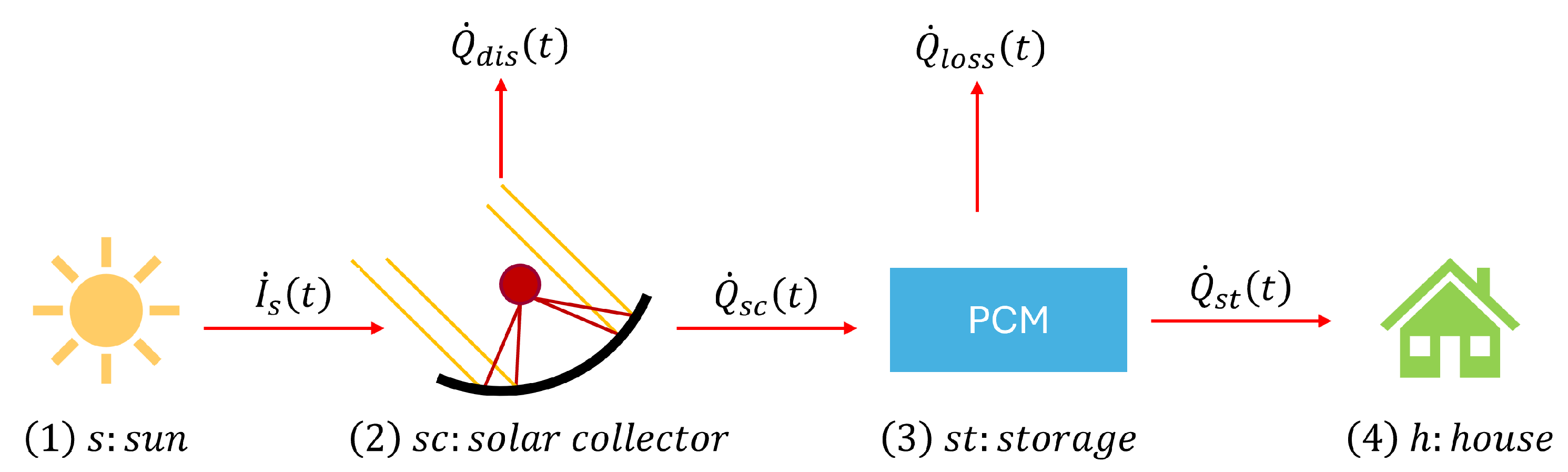
The analyzed configuration is designed to evaluate the temporal continuity of thermal energy delivery rather than to maximize instantaneous conversion efficiency. It consists of a solar thermal collector coupled to a cylindrical TES unit that stores part of the collected energy and releases it during periods of reduced or null solar input. Figure 1 presents a conceptual representation of the system and the associated time-dependent energy flows. Solar irradiance is represented by . The collector delivers a useful heat rate to the storage unit, while heat dissipated to the environment from the collector is grouped in . The storage unit exchanges heat with the surroundings through and provides a useful thermal output to the end-use (house). In addition, a downstream utilization device is represented through a prescribed thermal extraction from the TES, used here as a test load to assess whether the stored thermal resource can sustain useful delivery beyond irradiation hours. The device is characterized by a minimum required thermal input and an activation condition based on the available temperature driving force, °C. In the present framework, this condition is used as a practical indicator of thermally usable output rather than as the exact operating requirement of a specific end-use device; its representativeness is discussed in Section 2.6.
Figure 1.
Conceptual diagram of the solar thermal system showing the main components (sun, solar collector, thermal energy storage, and end-use/test load) and the associated time-dependent energy flows: solar irradiance input , useful heat delivered by the collector to the storage unit , collector heat dissipation to the environment , storage heat losses , and useful thermal delivery to the end-use/test load .
To address the stated objective, the methodology begins by establishing representative climatic boundary conditions for Mexico, which define the solar irradiation input and the time window over which resource continuity is evaluated. The coupled collector–TES response is then analyzed using finite-element simulations in COMSOL Multiphysics®, accounting for transient irradiation forcing and environmental heat losses. The analysis is structured to connect directly to the results presented in this work. First, the PCM storage mass is defined through a sizing step based on phase-change utilization (via the indicator ) to promote effective exploitation of latent heat and avoid oversizing. After fixing the PCM mass, two complementary comparisons are performed to isolate the influence of storage strategy: (i) a constant-mass comparison (PCM versus steel at equal mass) to assess material effects on temporal energy retention, and (ii) a constant-volume comparison (PCM versus steel at equal storage volume) to evaluate trade-offs between thermal continuity and storage mass.
Performance is assessed over repeating 24-h cycles using resource-oriented indicators. The central output is the time-resolved amount of usable thermal energy (“available energy”) delivered as and its persistence beyond the end of direct irradiation. In addition, total and nocturnal efficiencies and operating hours are reported to quantify how storage strategy affects the continuity of supply. Finally, storage capacity and mean deliverable power are computed to contextualize the availability results and support comparisons across storage configurations.
Storage capacity is varied by changing the stored mass while keeping the TES cross-sectional area fixed. Mass is increased by extending the cylinder length L. Assuming uniform density and constant cross-sectional area , the mass scales with length as
so that increasing L increases mass proportionally without altering the layer structure.
A thermal energy extraction boundary condition is imposed at the disk face opposite to the receiving surface to represent coupling between the TES and the downstream utilization/conversion unit. A heat extraction rate is applied when the temperature difference between the mean extraction-surface temperature and the ambient temperature exceeds a prescribed threshold . When this condition is met, is ramped from 0 to its nominal value over one hour to improve numerical stability. The resulting extracted heat defines the useful thermal delivery .
2.2. Resource-Representative Climate Inputs
To evaluate TES from a resource-oriented perspective, the system is analyzed under time-dependent climatic boundary conditions representative of Mexico, with emphasis on the diurnal variability that governs the temporal availability of solar thermal energy. The environmental drivers that affect both solar capture and heat losses—solar irradiance, ambient temperature, wind speed, and atmospheric pressure—are incorporated as transient inputs to quantify resource continuity during peak and off-peak solar periods, including low- or zero-irradiance hours.
Mexico’s climatic diversity is represented using the Köppen–Geiger climate classification [19]. Although the classification is global, the selected locations span the main Mexican regimes (humid tropical, arid/semi-arid, and temperate highland/coastal conditions). The selected locations are: Villahermosa, Ciudad del Carmen, Cancún, Chihuahua, Hermosillo, Mexico City, Guadalajara, and Tijuana.
For each location, diurnal profiles were obtained from NASA’s POWER database using the Data Access Viewer, which provides solar and meteorological parameters for renewable-energy and agroclimatology applications [20]. In this study, the year 2021 was used to construct representative 24-h profiles. A national representative day was then formed by averaging the city-level diurnal profiles.
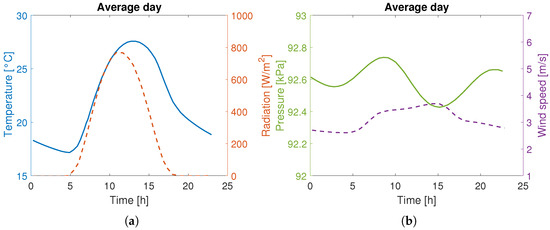
Figure 2 shows the resulting national-average boundary conditions used in the baseline simulations. For the processed 2021 dataset and selected locations, the integrated daily irradiation is approximately , distributed between approximately 06:00 and 18:00 h, with a peak irradiance of about near solar noon. Ambient temperature varies from roughly 17 °C during nighttime to 27 °C during daytime. Wind speed remains in the range of about –, while atmospheric pressure stays near . These time-dependent profiles are imposed as boundary-condition inputs in the transient TES simulations.
Figure 2.
Representative average-day boundary conditions used as transient simulation inputs: (a) ambient temperature and solar irradiance; (b) atmospheric pressure and wind speed.
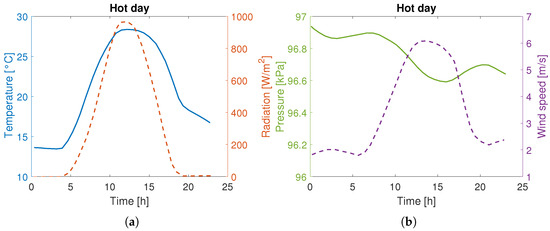
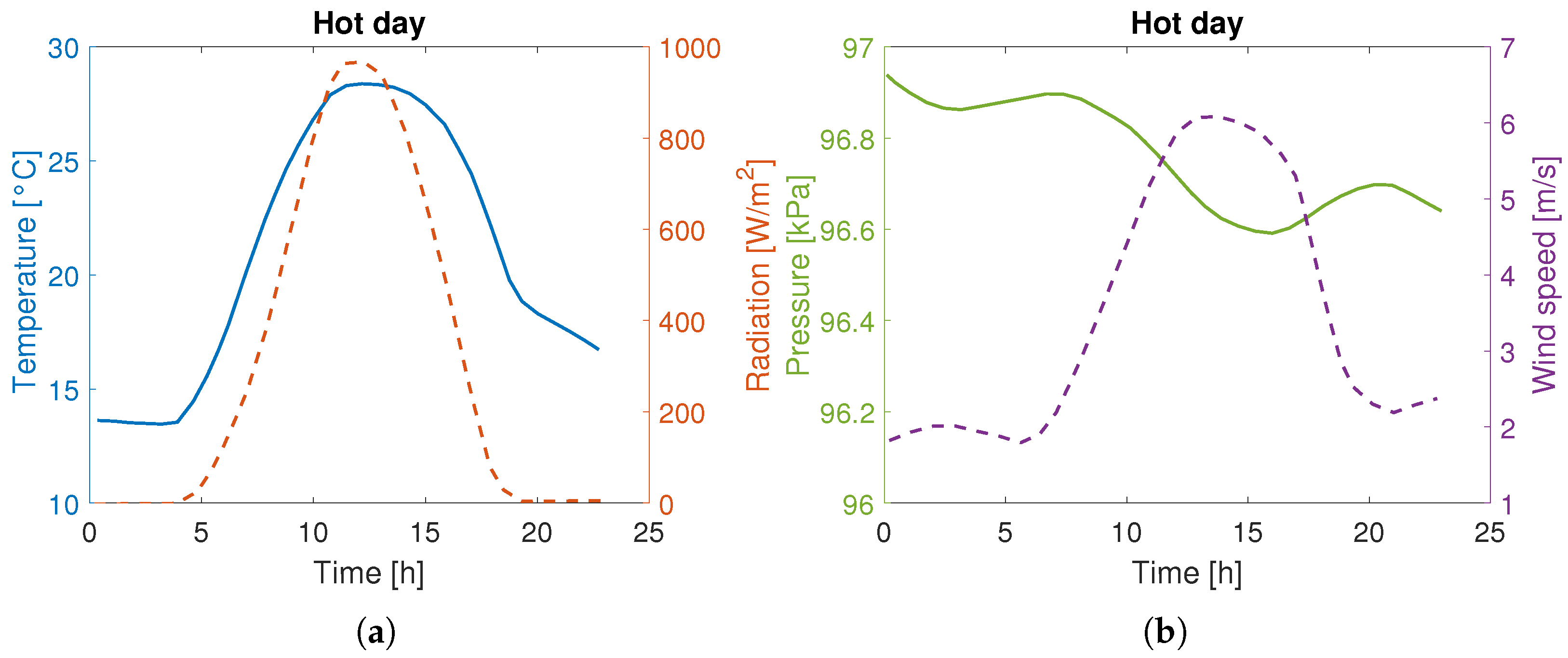
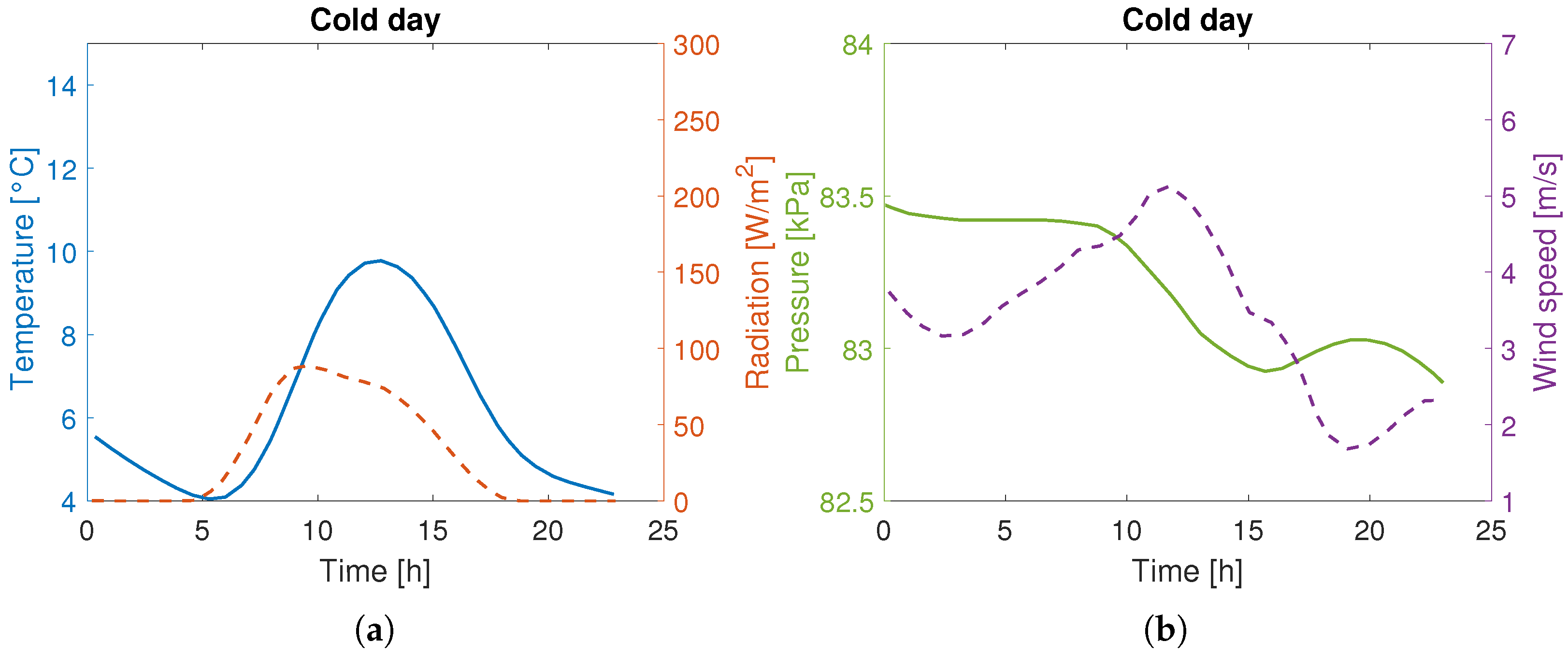
To probe storage performance under climatic conditions that differ from the annual representative day, two additional representative days were defined using the same data source and processing approach: (i) a hot representative day derived from the period exhibiting the highest average irradiation levels, and (ii) a cold representative day derived from the period exhibiting the lowest average irradiation levels. The hot-day profiles (Figure 3) exhibit peak irradiance close to around solar noon, with ambient temperature varying approximately between 15 °C and 30 °C; atmospheric pressure remains near with small variations, and wind speed spans roughly 2–. The cold-day profiles (Figure 4) show markedly reduced irradiance (peak on the order of ), with ambient temperature varying approximately between 5 °C and 10 °C; atmospheric pressure remains around 82–, and wind speed ranges roughly from 2 to . These profiles are used as transient boundary-condition inputs for the TES simulations.
Figure 3.
Representative hot-day boundary conditions used as transient simulation inputs: (a) ambient temperature and solar irradiance; (b) atmospheric pressure and wind speed.
Figure 4.
Representative cold-day boundary conditions used as transient simulation inputs: (a) ambient temperature and solar irradiance; (b) atmospheric pressure and wind speed.
The averaging across multiple cities was intended to build a normalized national-level representative boundary condition spanning major Mexican climate regimes, rather than to reproduce a single local climate. The use of 2021 provides a consistent reference dataset for comparative transient simulations; it is not intended to represent long-term climatology.
2.3. Composition of the Collector–Storage System
This section describes the physical configuration of the parabolic-dish collector coupled to the TES unit, with emphasis on the geometric arrangement and material composition that determine how the local solar resource is converted into a distributed thermal input and stored over time. The description provides the context required for the thermal modeling assumptions and for the resource-oriented performance metrics presented later.
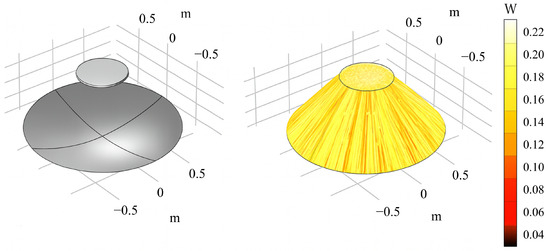
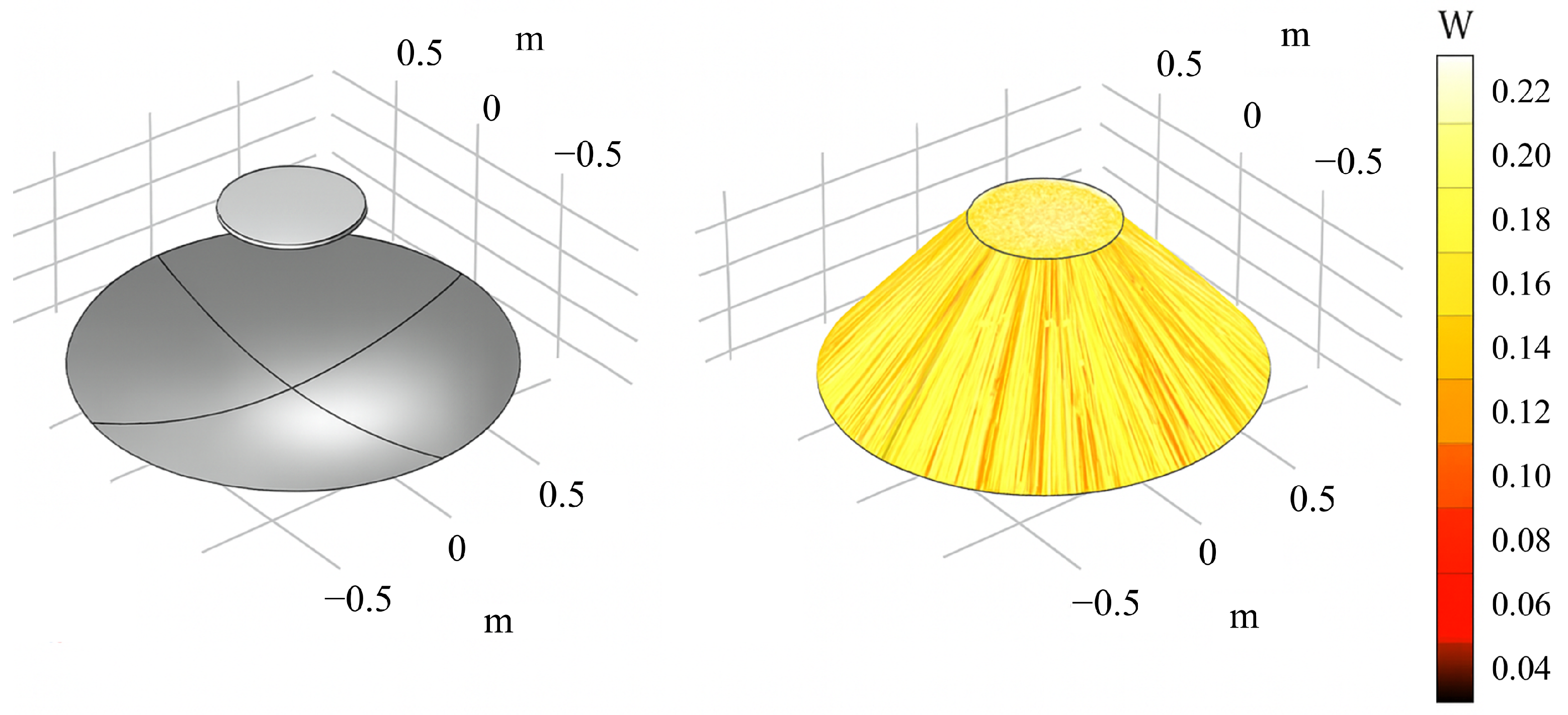
The collector–storage system consists of a parabolic dish that concentrates incoming solar irradiation onto a disk-shaped receiving surface integrated with the TES unit. The TES is positioned in the focal region of the dish, such that the captured solar input is represented at the receiver surface as a spatially distributed boundary condition. Figure 5 illustrates the adopted distribution in terms of integrated power across the receiving surface, characterized by a maximum near the disk center and a gradual decrease toward the edge, consistent with typical focal-region concentration patterns in dish collector–receiver systems [21]. This defines the energy pathway analyzed in this study: solar irradiation is concentrated by the dish, delivered as a non-uniform thermal input to the TES receiving surface, and subsequently redistributed within the storage while external heat losses occur through heat exchange with the environment.
Figure 5.
Schematic representation of the disk-shaped TES receiving concentrated solar radiation from the parabolic dish collector. The concentrated input is represented as a spatial distribution of integrated power across the receiving surface and is imposed as the thermal boundary condition in the simulations.
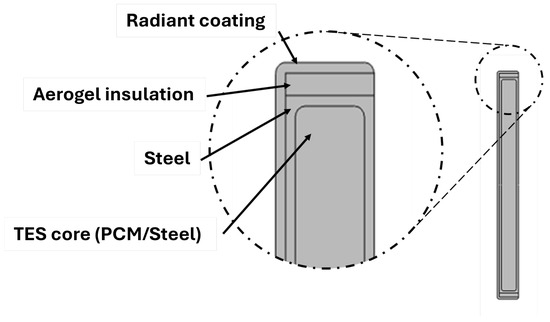
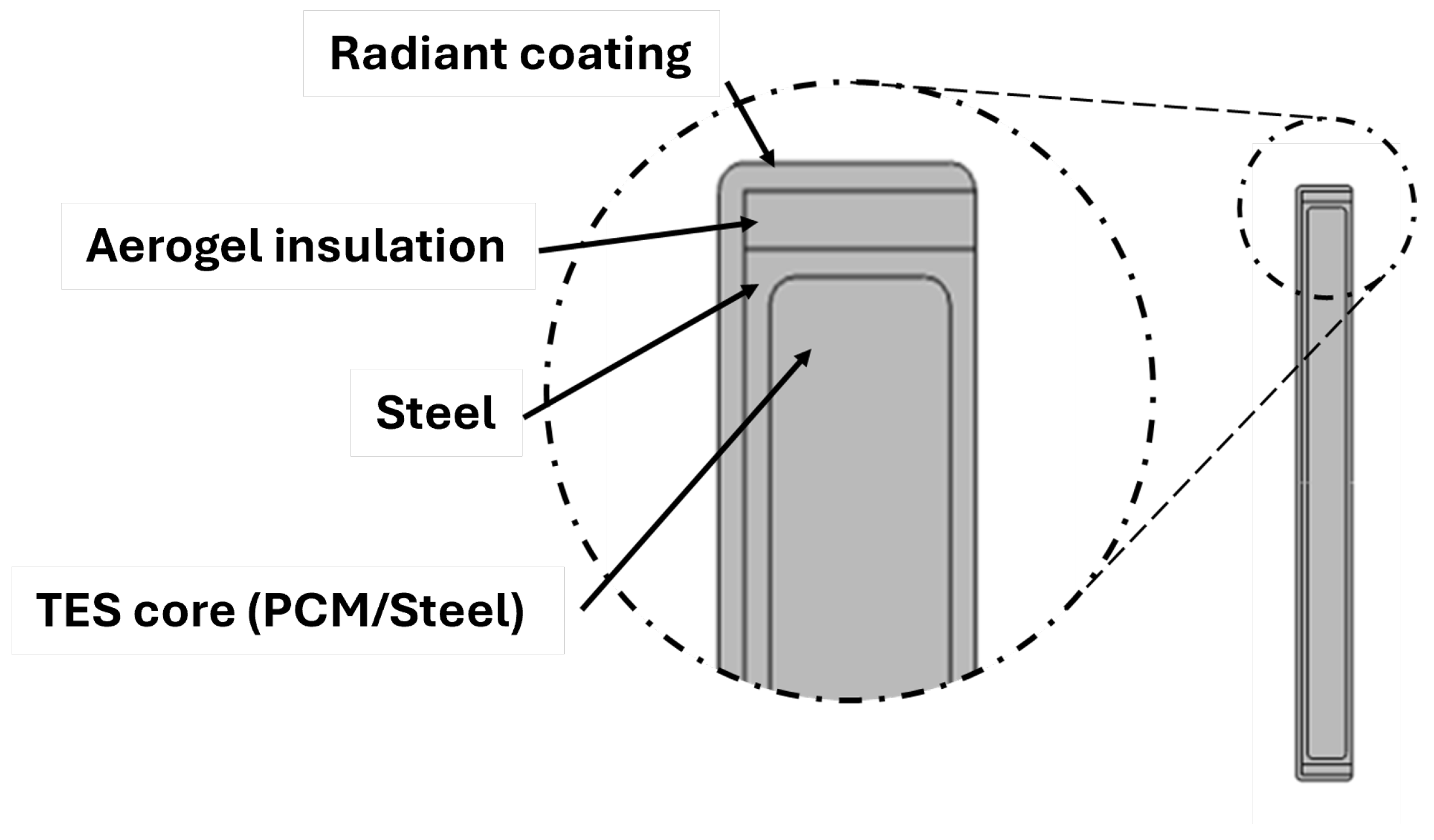
The TES unit is represented as a cylindrical, layered assembly in which each material layer plays a distinct thermal function to preserve the available thermal resource during post-irradiation periods. As shown in the cross-sectional schematic (Figure 6), the TES comprises: (i) a selective/radiative coating layer, (ii) an aerogel insulation layer to reduce heat losses to the surroundings, (iii) a steel capsule that provides containment and structural integrity, and (iv) the TES core (PCM or steel), which acts as the active storage medium. The TES core material constitutes the primary design variable in this study and enables a direct comparison between latent (PCM) and sensible (steel) storage concepts under identical external forcing and geometric constraints.
Figure 6.
Cross-sectional schematic of the cylindrical TES unit showing the layered structure: selective (radiative) coating, aerogel insulation, steel capsule, and the TES core (PCM or steel). Concentrated radiation from the parabolic dish enters the TES at the receiving surface.
The selective (radiative) coating is applied on the receiving/front face and on the cylindrical surface of the TES. In contrast, the rear face (opposite to the receiver) is intentionally left uncoated to promote heat transfer toward the test-load coupling interface. In the model, the coating radiative properties are prescribed using the parameter set reported in Appendix A, with the intent to increase absorption of incoming concentrated radiation on the receiving face while limiting radiative emission losses from the exposed external surface during post-irradiation periods.
In the thermal model, heat exchange with the ambient temperature is considered only at the front (receiver) surface and the cylindrical surface, with areas and , respectively. The rear face is assumed to be in direct contact with the test load (no exposed area to the environment) and therefore no convective or radiative losses are applied on that boundary.
The parabolic dish geometry and optical assumptions define the magnitude and distribution of the thermal resource captured at the receiver/TES surface and thus determine the heat input available for storage. The collector geometry is characterized using standard parabolic-dish parameters (e.g., aperture diameter, focal length, and rim angle), together with receiver placement relative to the focal region; the adopted parameters are reported in Appendix A.2 for completeness. A mirror reflectivity of 0.90 is assumed to represent a high-quality reflective surface; values in this range are commonly reported for well-maintained solar concentrator mirrors, depending on coating and soiling conditions [21,22].
In the thermal simulations, the concentrated input distribution provided by the collector–receiver model (Figure 5) is imposed at the TES receiving surface and drives the charging process under the prescribed climatic conditions. This coupling enables the subsequent storage analysis to quantify how different TES concepts redistribute and preserve the captured solar thermal resource over time, and how such behavior translates into resource-availability metrics in the Section 3.
2.4. Modeling Framework for Solar Resource Capture and Thermal Storage
The collector–receiver model is evaluated using Monte Carlo ray tracing to estimate the spatial distribution of the concentrated thermal input at the TES receiving surface. This distribution is subsequently imposed as a boundary condition that drives the charging process of the storage unit. Monte Carlo ray tracing is widely used to compute flux maps in parabolic-dish concentrator–receiver systems and has been validated against experiments in dish/Stirling facilities [23].
A convergence study was performed to ensure that the predicted receiver input map is insensitive to the stochastic sampling and the receiver discretization. The receiver surface was discretized using a structured rectangular mesh with more than 1000 surface elements. The number of traced rays was increased until changes in key optical outputs became marginal. In the final configuration, the relative change in (i) peak receiver input and (ii) total integrated receiver power, with respect to a further refinement in ray count, remained below 5%. These settings were adopted to generate the spatially distributed integrated-power boundary condition applied at the TES receiving surface (Figure 5).
Thermal transport in the TES is modeled as transient heat conduction in a cylindrical multilayer domain comprising the selective coating/insulation layers, steel capsule, and storage core (PCM or steel). This approximation is intended for storage configurations in which internal natural convection effects remain limited relative to conductive transport, such as compact geometries or effectively encapsulated PCM domains with small characteristic lengths. Under these conditions, heat redistribution occurs predominantly through conduction, so the model provides a practical first-order representation of the transient charging and discharging behavior examined here. The adopted formulation is also consistent with a PCM-based thermal-storage modeling approach previously applied and experimentally validated by the authors in a related study [12].
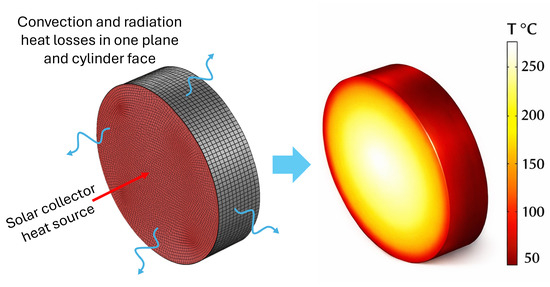
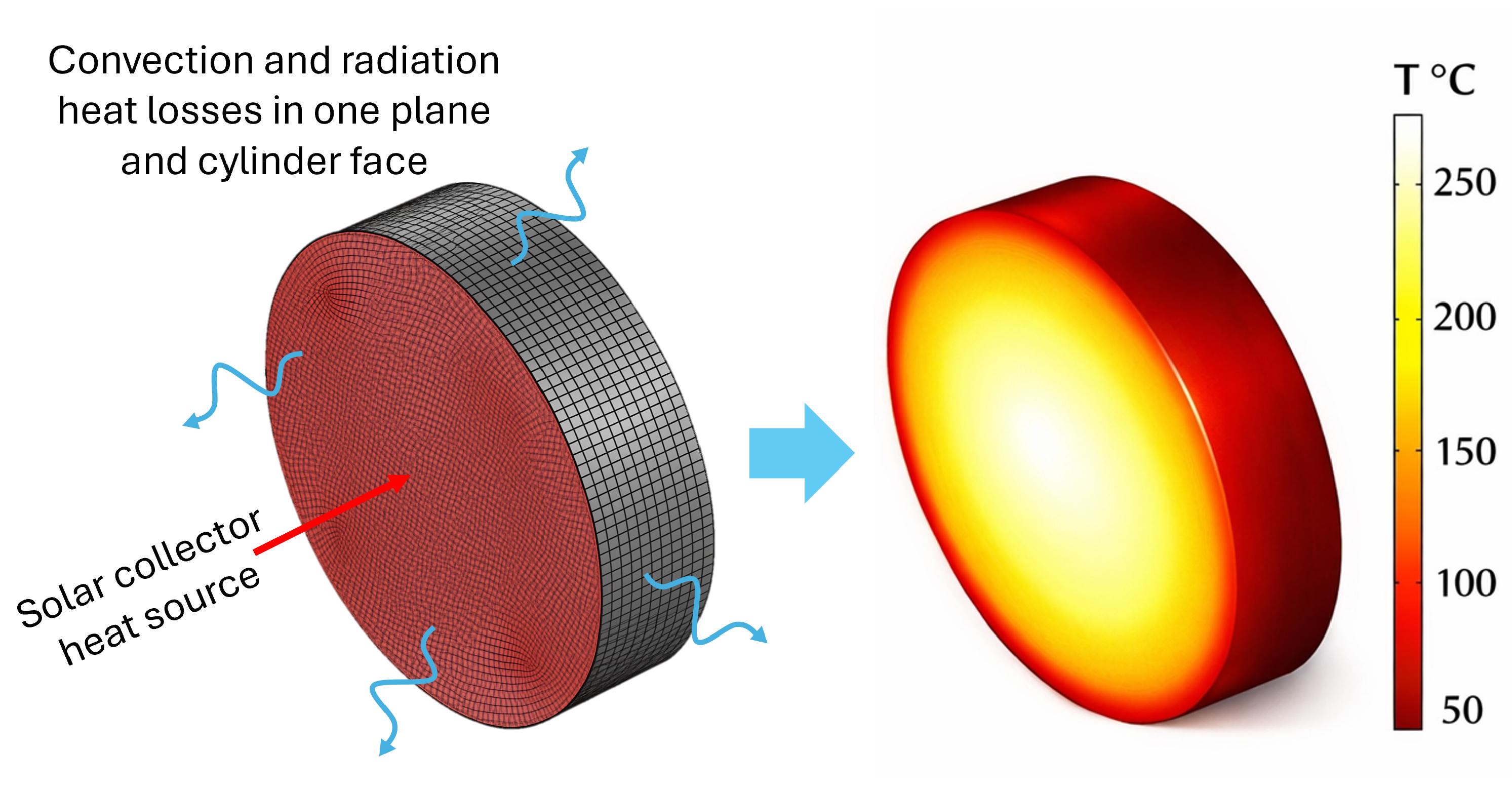
The TES receives a time-dependent thermal input from the concentrator and simultaneously exchanges heat with the environment through convection and radiation at the exposed external surfaces (Figure 7). Convective heat losses were modeled as forced convection driven by wind, using time-dependent ambient temperature, wind speed, and pressure from the climatic inputs (Section 2.2). The convective heat-transfer coefficients were computed from external-flow correlations for the front surface and the cylindrical surface (Appendix B), based on the local film temperature and air properties evaluated at the transient ambient pressure. Radiative exchange is modeled using the surface radiative properties specified for the coated surfaces (Appendix B). Thermophysical properties of the structural layers are treated as constant (Appendix A), while the storage-core properties depend on the selected storage strategy.
Figure 7.
Simulated TES geometry and applied boundary conditions, including the mesh configuration. Concentrated solar input is applied at the front (receiver) surface, while convection and radiation losses (small blue arrows) are imposed only on the front surface and the cylindrical surface.
For the sensible storage strategy (steel core), the transient response is governed by heat conduction with constant thermophysical properties. For the latent-storage strategy (PCM core), melting/solidification is represented using an apparent heat-capacity formulation, in which the latent heat is incorporated into an effective temperature-dependent heat capacity over a finite phase-change interval , avoiding explicit tracking of the moving solid–liquid interface [24]. The governing equation solved in the PCM domain is
where T is temperature, is density (assumed constant), and is the effective thermal conductivity. In the present implementation, is treated as phase-dependent but otherwise constant, switching between prescribed values representative of solid and liquid phases across the melting interval. The model assumes no internal volumetric heat generation and conduction-dominated transport within the storage core; natural convection in the molten PCM is neglected to isolate the effect of material latent storage on resource continuity.
The coupled transient model is solved using finite-element simulations in COMSOL Multiphysics® (v. 5.2). Primary outputs include volume-averaged TES temperature and time-resolved energy indicators used in the Section 3, including available energy, delivered thermal power relative to the minimum operating requirement, and derived performance metrics such as operating hours, efficiencies, storage capacity, and mean deliverable power.
Mesh and time-step convergence analyses were performed to ensure numerical accuracy and stability of the transient TES simulations. A structured prismatic mesh was adopted and refined until changes in key thermal outputs (e.g., delivered thermal energy over 24 h and peak temperature) became marginal. The final resolution was set to 17,806 elements, for which the relative change in the selected outputs was within approximately 2%, indicating that further refinement produced only minor differences. A temporal refinement study similarly confirmed that using more than approximately 300 time steps per simulated day reduces the relative change in these outputs to below about 0.4%, supporting the adopted time resolution for intermittent solar input and transient boundary conditions.
The instantaneous solar power incident on the collector aperture is expressed as
where is the time-dependent solar irradiance (Section 2.2) and is the effective collector aperture area. The usable thermal power transferred to the TES is then represented as
where is the shading fraction and is the mirror reflectivity. In the present work, the concentrator input applied at the receiver surface is obtained from the ray-tracing model and therefore inherently reflects the adopted optical assumptions; Equations (3) and (4) are provided to document the irradiance-to-input bookkeeping and parameter definitions.
2.5. Evaluation Metrics
To connect storage behavior with resource availability and continuity across diurnal cycles, TES performance is quantified using temperature- and energy-based indicators derived from the transient simulations. These metrics characterize (i) the temporal stability of the stored thermal resource and (ii) its capability to sustain useful operation under varying climatic conditions.
The analysis considers: the mean volume-averaged TES temperature ; the time-resolved useful thermal delivery ; operating hours relative to a minimum operating level; storage efficiencies; total energy capacity; and mean deliverable power. In addition, the reference PCM configuration is evaluated under hot-day, average-day, and cold-day boundary conditions by analyzing and the corresponding delivered power.
To quantify how the thermal resource is distributed between daytime and nighttime operation, two periods are defined: a diurnal period from 05:00 to 18:00 h and a nocturnal period from 18:00 to 05:00 h. The metrics are computed over a full 24 h cycle.
The overall TES efficiency over a 24 h cycle is defined as
where is the useful heat rate delivered from the storage to the end-use and is the heat rate entering the storage from the solar collector (Section 2.1). The numerator is evaluated over the reported 24 h cycle . Analogous diurnal and nocturnal efficiencies, and , are computed by restricting the numerator integral to the corresponding time windows, while retaining the same daily input denominator to preserve a resource-oriented interpretation.
In the simulations, the useful delivery is defined by the thermal extraction boundary condition applied at the rear face of the TES (Section 2.1). To support interpretation and post-processing, the transient energy balance of the storage unit can be written as
where the index i refers to the TES layers (e.g., coating/insulation, steel capsule, and core), and are their masses and specific heats, and denotes the corresponding volume-averaged temperatures. For latent storage, is the PCM mass, is the specific latent heat, and is the liquid-phase fraction (melt fraction), with fully solid and fully liquid. The term accounts for forced-convection (wind-driven) and radiative heat losses evaluated only on the exposed front surface and cylindrical surface of the TES. The rear face is excluded from ambient losses because the test load is assumed to be in direct contact with that surface. A detailed formulation of , including the transient evaluation of air properties and the corresponding correlations, is provided in Appendix B. Here Equation (6) is used as a consistency check and to interpret the temporal allocation of the captured solar input among useful delivery, losses, and internal energy storage.
Operating hours quantify the duration over which the TES can sustain useful delivery above a minimum operating level. In this study, the minimum useful-delivery threshold is set to the test-load requirement, . Operating hours are computed as
where is the indicator function. The mean deliverable thermal power over the reported cycle is defined as
All storage evaluations are performed after start-up transients have decayed. Each case is simulated for two consecutive days, and only the second 24 h cycle is reported, ensuring that the presented results represent quasi-periodic operation under the imposed diurnal boundary conditions.
2.6. Test-Load Definition and Thermal Extraction Rule
To evaluate TES performance in terms of usable resource availability, a downstream utilization device is represented as a simplified test load. The goal is not to model a specific conversion technology, but to impose an operationally meaningful thermal demand that enables consistent comparisons of storage strategies under identical boundary conditions.
The test load is assumed to require a minimum thermal input of to be considered “operational”. In addition, operation is allowed only when the thermal driving force relative to ambient conditions is sufficient, expressed as
where is the area-averaged temperature of the TES extraction interface (rear face) and is the ambient temperature (Section 2.2). All temperatures are evaluated consistently with the transient simulation outputs.
The extraction criterion of °C was adopted as a practical threshold representing the minimum thermal driving force required for the delivery of usable heat. This choice is consistent with the operating logic of thermally driven devices, such as Stirling engines, whose performance depends strongly on the temperature difference between the hot and cold sides [25]. Although low-temperature-differential Stirling engines can operate under specialized configurations with relatively small temperature gradients, larger temperature differences are generally required to obtain thermally useful output. In this context, the selected threshold is not intended to reproduce the exact operating condition of a specific end-use device, but rather to provide a representative activation criterion indicating when the stored thermal energy reaches sufficient thermal quality for effective extraction.
When the activation condition in Equation (9) is satisfied, a constant heat rate is extracted from the rear face of the TES. To avoid numerical stiffness, the extraction is ramped linearly from 0 to over one hour at the onset of operation. If the activation condition is not met, no extraction is applied:
This test-load abstraction provides a conservative and transparent criterion to quantify the duration over which the TES can sustain useful delivery (operating hours) and to assess the persistence of available thermal energy beyond irradiation periods, without introducing additional assumptions associated with detailed prime-mover modeling.
3. Results
3.1. Determination of the Reference PCM Mass
The temporal availability of solar thermal energy is first evaluated under the representative average-day boundary conditions defined in Section 2.2. This initial step aims to determine a reference PCM mass that ensures effective latent-heat utilization under the same external forcing adopted throughout the study, including convective and radiative losses and the uniform selective coating.
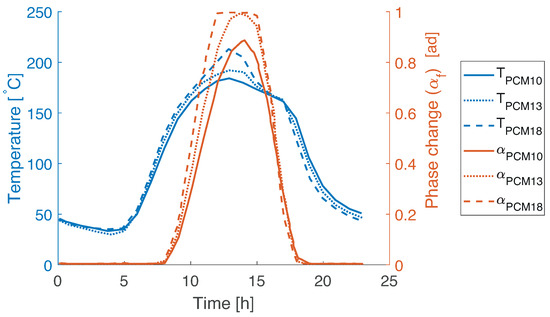
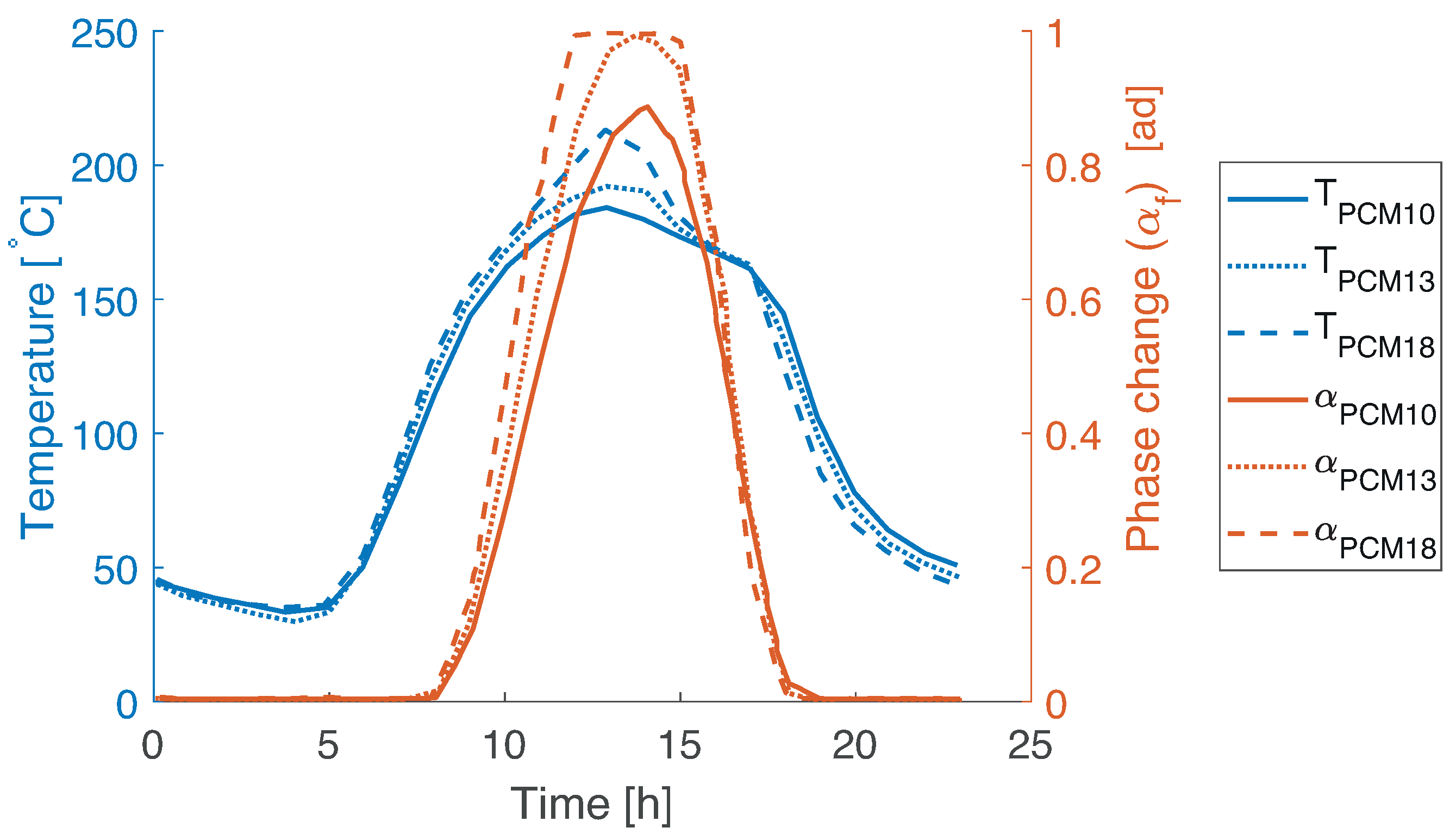
Figure 8 reports the mean PCM temperature (solid lines) together with the phase-change index (dashed lines) for three candidate PCM masses (10, 13, and 18 kg). Here, is defined as the volume-averaged liquid-phase fraction (melt fraction) of the PCM, bounded between 0 (fully solid) and 1 (fully liquid). The sizing criterion requires that reaches 0.99 for at least one hour during the day, ensuring near-complete exploitation of latent heat while avoiding unnecessary oversizing.
Figure 8.
Average PCM temperature and phase-change index for candidate PCM masses (10, 13, and 18 kg) under average-day boundary conditions, including convective and radiative losses and a uniform selective coating. Here, denotes the volume-averaged liquid-phase fraction (melt fraction), with fully solid and fully liquid.
Among the evaluated candidates, the 13 kg configuration satisfies the criterion, whereas the 10 kg case remains below the threshold, indicating insufficient phase-change utilization within the daily cycle. Increasing the PCM mass to 18 kg does not improve compliance with the utilization criterion under the same boundary conditions, implying that additional PCM would be underutilized. On this basis, the PCM storage mass is fixed at 13 kg for the subsequent comparisons against sensible-heat storage alternatives under identical boundary conditions.
3.2. Performance Assessment of the Reference PCM Compared with Steel
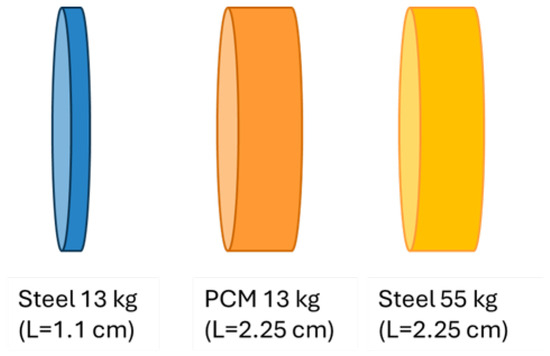
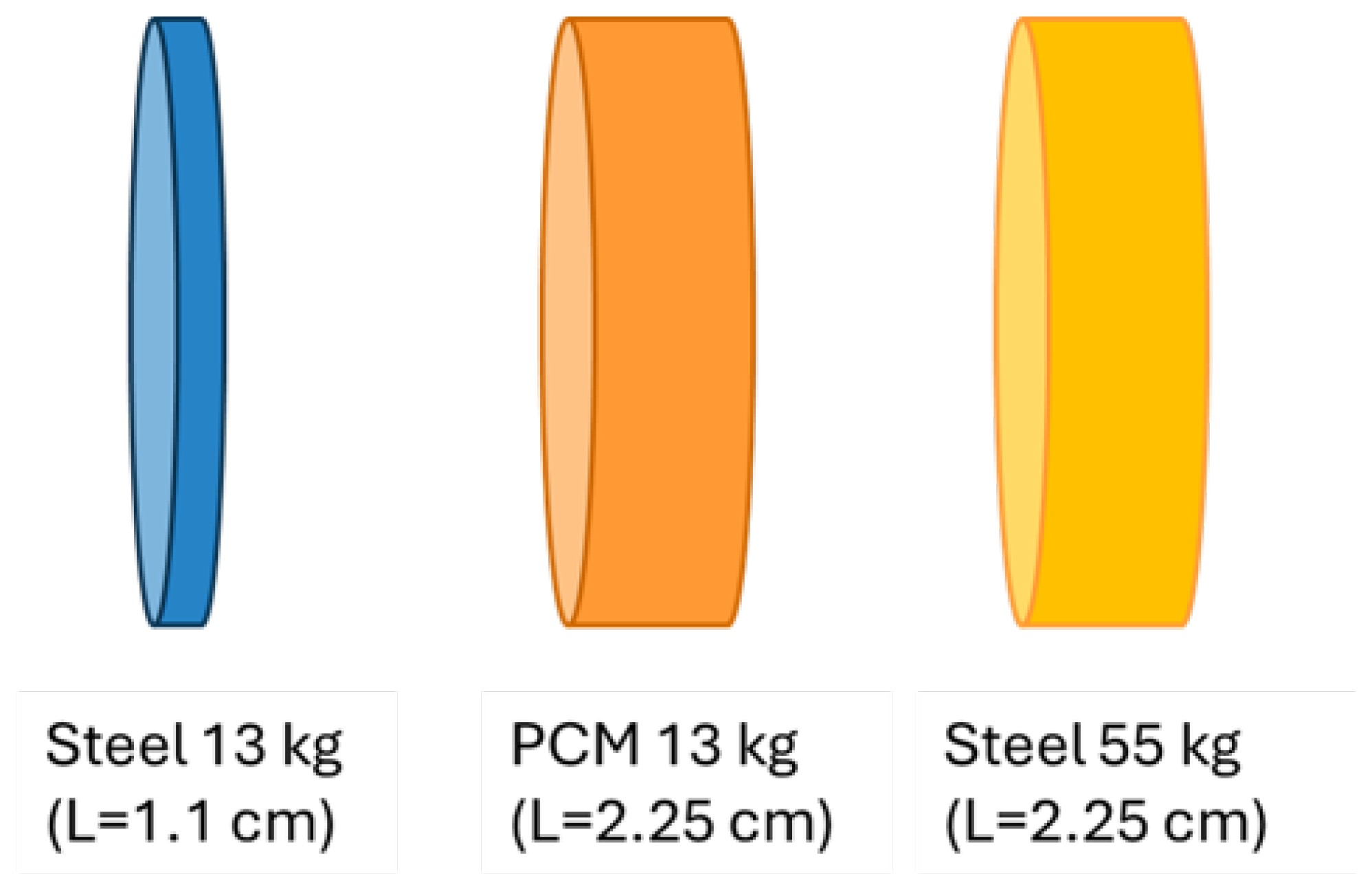
With the reference PCM mass defined, three storage concepts are evaluated under identical boundary conditions (including convective and radiative losses) and identical coating assumptions, in order to quantify how storage mechanism and storage mass affect heat availability beyond irradiation hours. The cases comprise: (i) 13 kg PCM (latent storage), (ii) 13 kg AISI 304B steel (sensible storage, mass-matched), and (iii) 55 kg AISI 304B steel (sensible storage, volume-matched to the PCM case). Figure 9 illustrates the corresponding geometric sizing, showing the relative cylinder lengths required for each configuration under the adopted design constraints.
Figure 9.
Geometric sizing of the cylindrical TES units for the three storage concepts: 13 kg PCM (latent storage), 13 kg AISI 304B steel (sensible storage, mass-matched), and 55 kg AISI 304B steel (sensible storage, volume-matched to the PCM case).
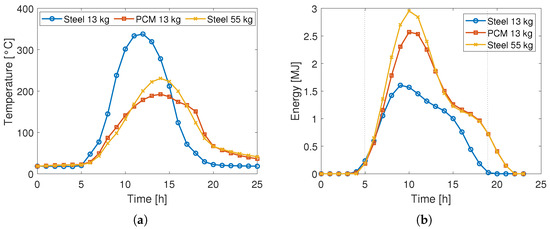
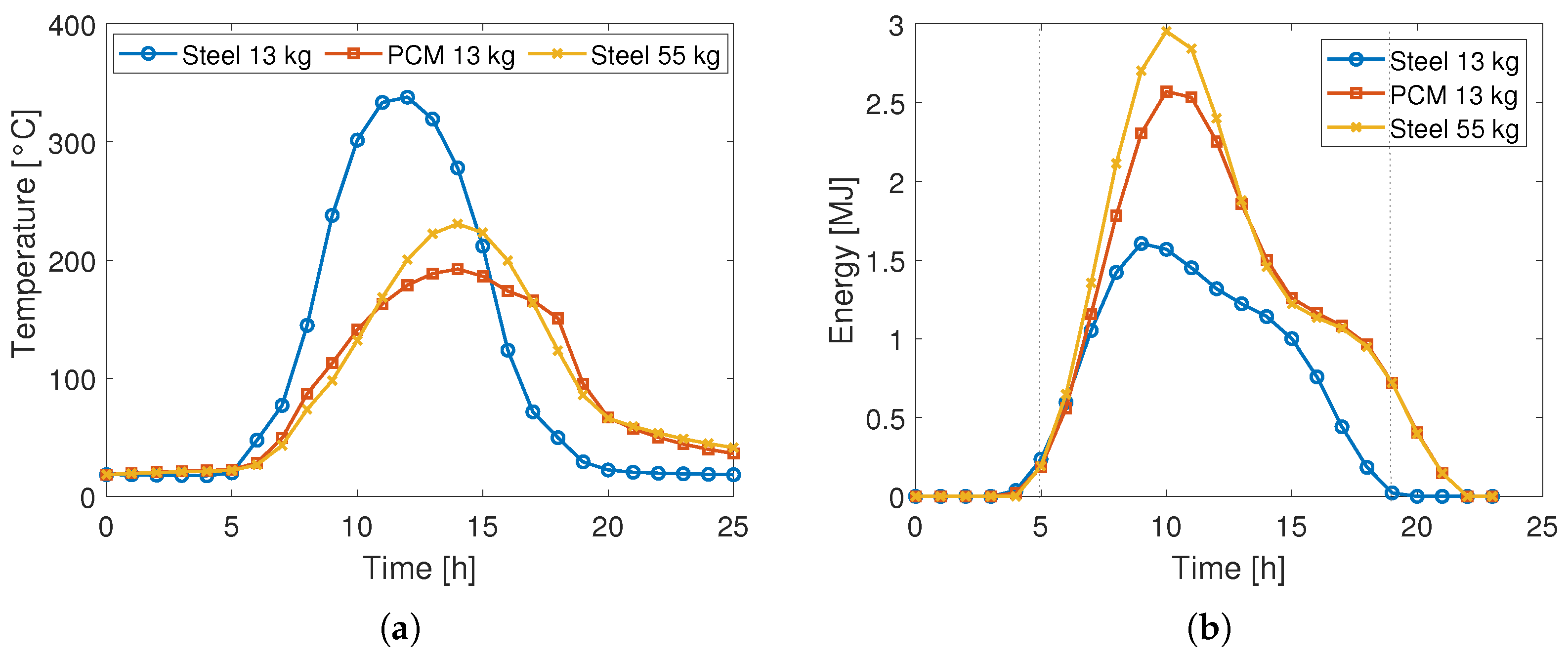
Figure 10a,b compare the thermal response of the three storage configurations over a representative 24 h cycle. Figure 10a shows the evolution of the mean TES temperature. The 13 kg steel case reaches the highest peak temperature during the irradiation period, but cools most rapidly after sunset, indicating limited retention of the captured thermal resource. In contrast, the 13 kg PCM case exhibits a smoother temperature trajectory and delayed cooling, consistent with the thermal buffering associated with latent-heat release during discharge. The 55 kg steel configuration shows a lower peak temperature than the 13 kg steel case but cools more slowly after irradiation due to its substantially larger sensible-heat mass.
Figure 10.
Comparison of the three storage configurations over a representative 24 h cycle under identical boundary conditions: (a) mean TES temperature and (b) time-resolved available energy for 13 kg PCM (latent storage), 13 kg AISI 304B steel (sensible storage, mass-matched), and 55 kg AISI 304B steel (sensible storage, volume-matched). Vertical grey dashed lines indicate the start and end of the solar-irradiation period.
Figure 10b presents the corresponding available energy (Section 2.5) vs. time. For the 13 kg PCM configuration, available energy remains nonzero for approximately three hours after the end of irradiation, demonstrating an extension of usable thermal availability into evening operation. The 13 kg steel case shows that useful availability is largely confined to the irradiation window, with negligible persistence into post-irradiation hours under the same conditions. The 55 kg steel storage exhibits a clearer storage effect than the 13 kg steel case: available energy persists beyond sunset and enables additional post-irradiation operation, approaching the qualitative behavior of the PCM configuration but requiring a substantially larger sensible-heat mass.
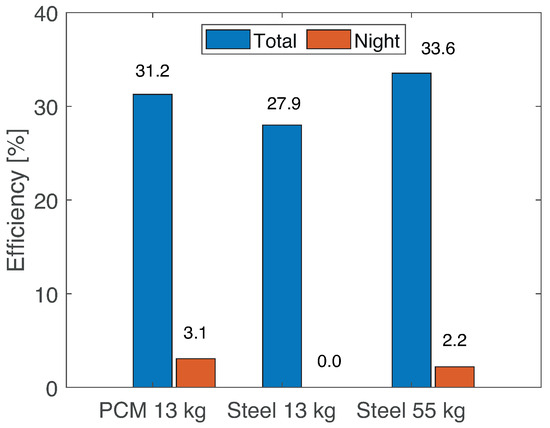
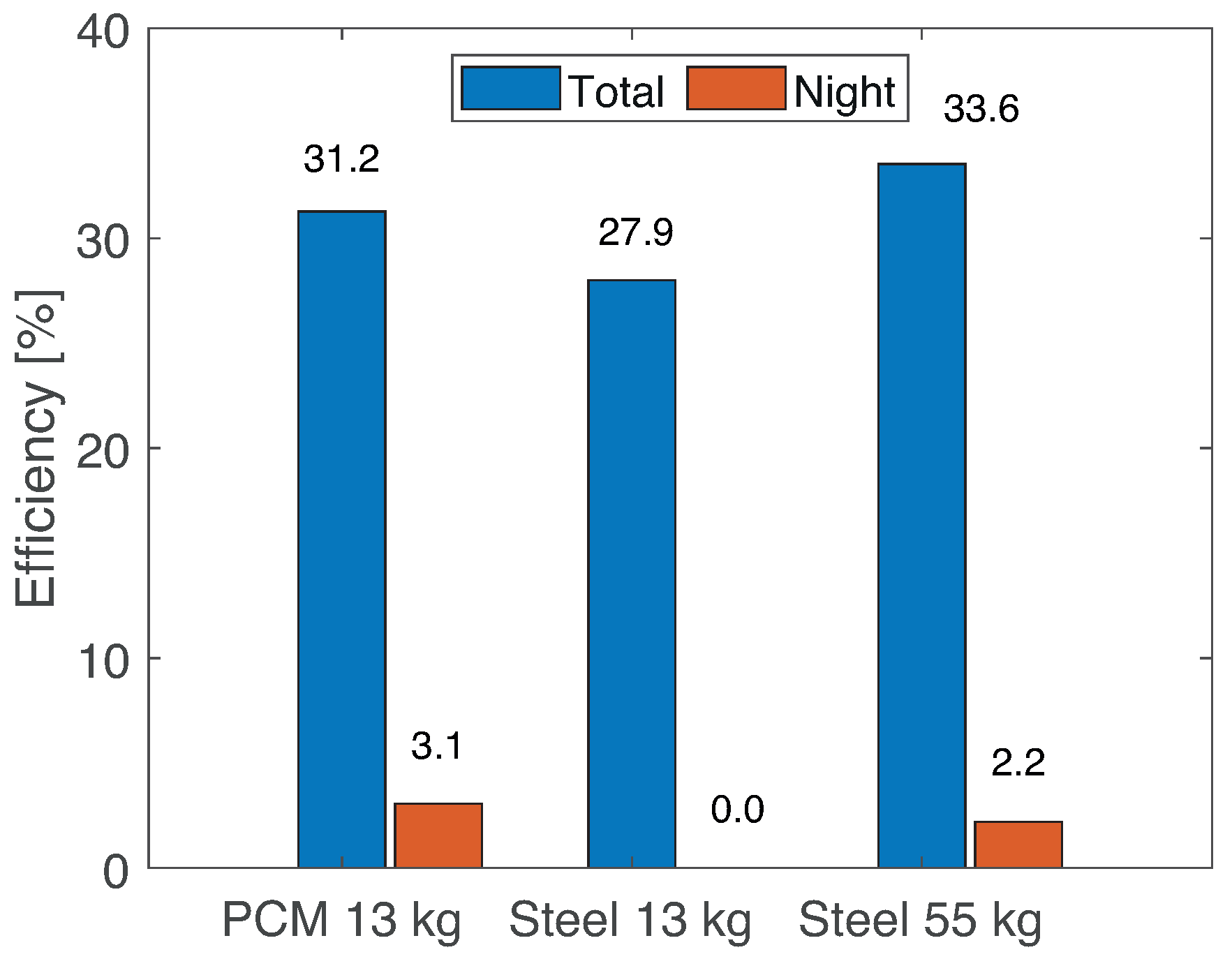
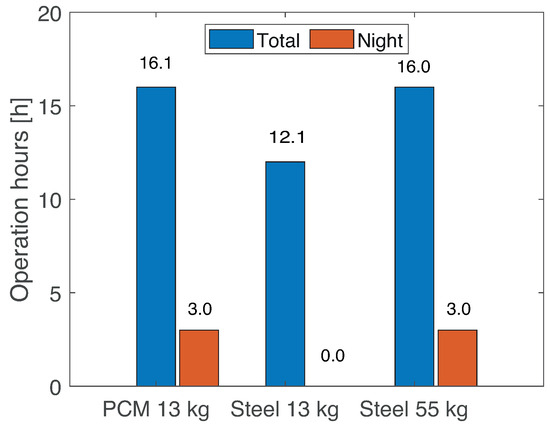
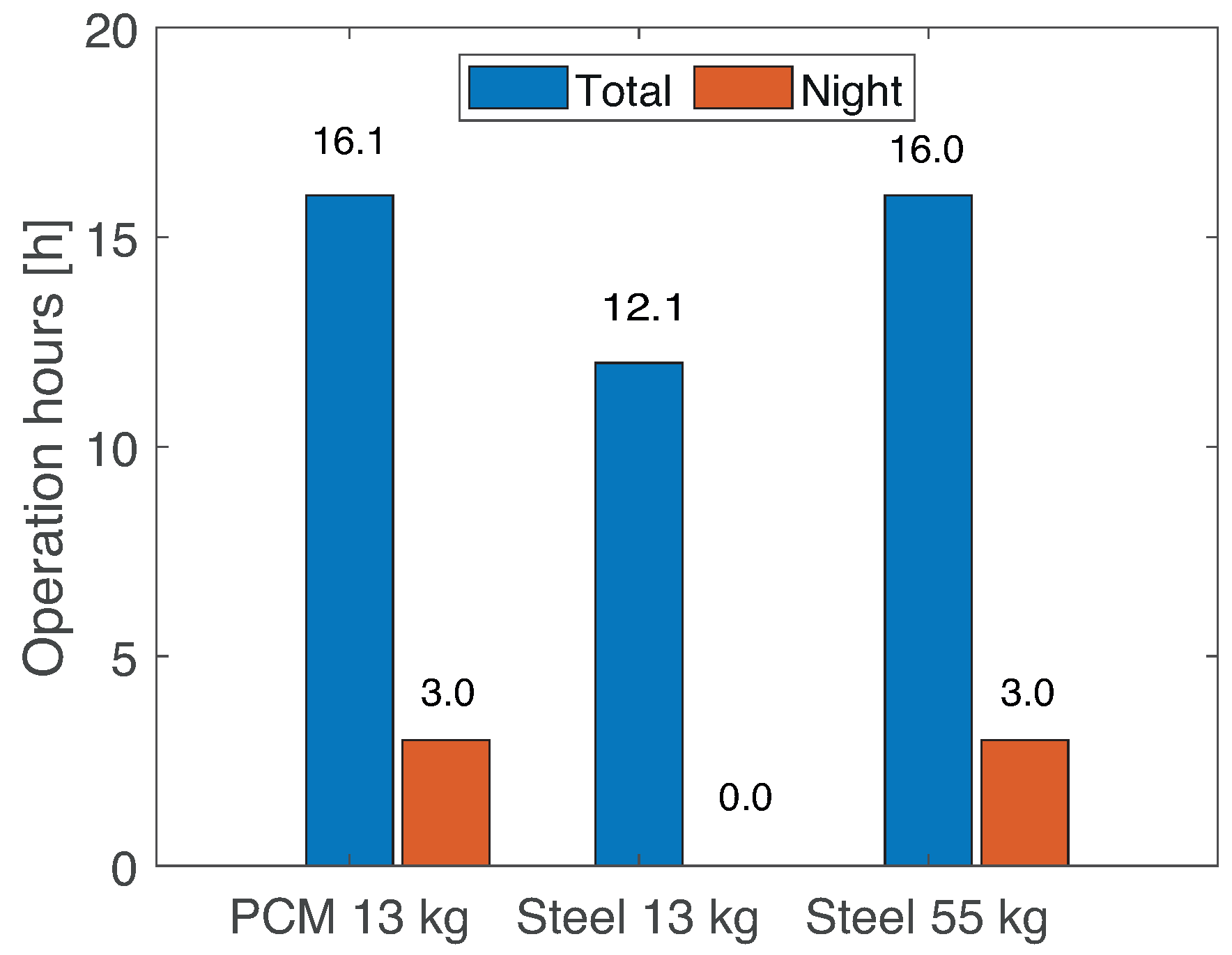
Building on this time-resolved behavior, Figure 11 and Figure 12 summarize efficiency and operating-hour metrics (defined in Section 2.5). The 13 kg PCM configuration achieves a total efficiency of 31.26% and a nocturnal efficiency of 3.04%, yielding 17 total operating hours including 3 nocturnal hours. The 13 kg steel case attains 28.10% total efficiency but 0% nocturnal efficiency, with 14 total operating hours and no night operation. The 55 kg steel case provides 33.57% total efficiency and 2.80% nocturnal efficiency, also reaching 17 total hours with 3 nocturnal hours. These results indicate that comparable nocturnal operability can be achieved via sensible storage only by substantially increasing storage mass (volume-matched configuration).
Figure 11.
Comparison of total and nocturnal efficiencies for the PCM (13 kg) and steel (13 kg and 55 kg) configurations.
Figure 12.
Comparison of operating hours for the PCM (13 kg) and steel (13 kg and 55 kg) configurations using the minimum operating threshold .
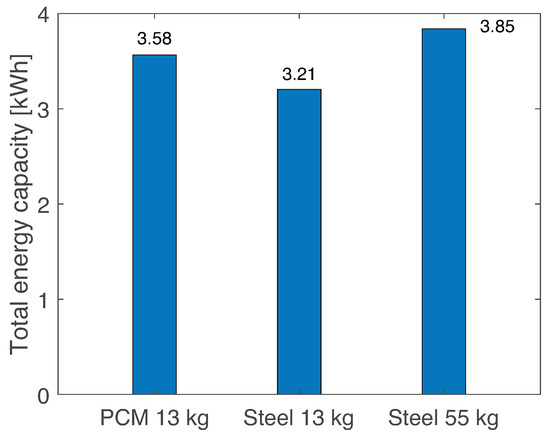
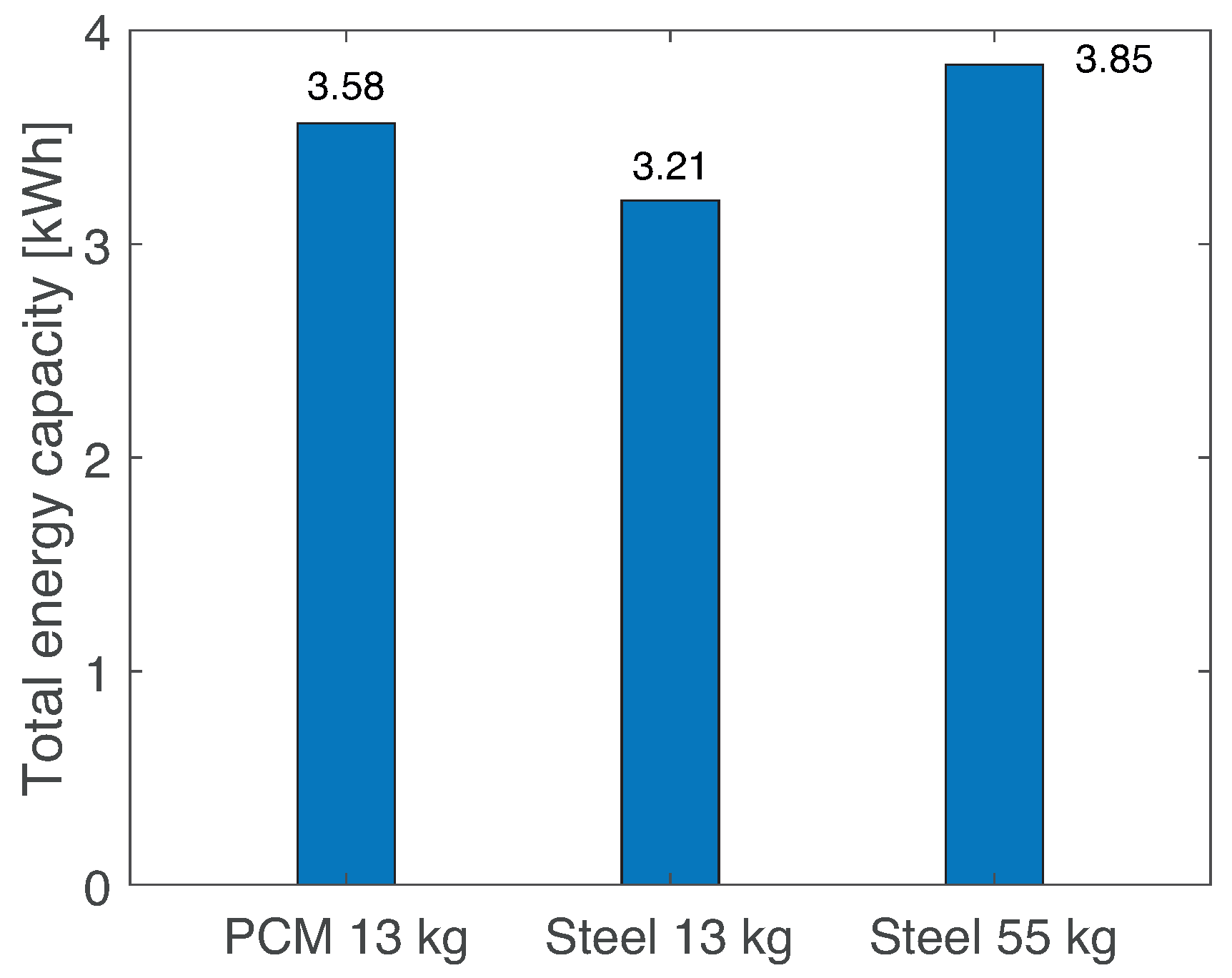
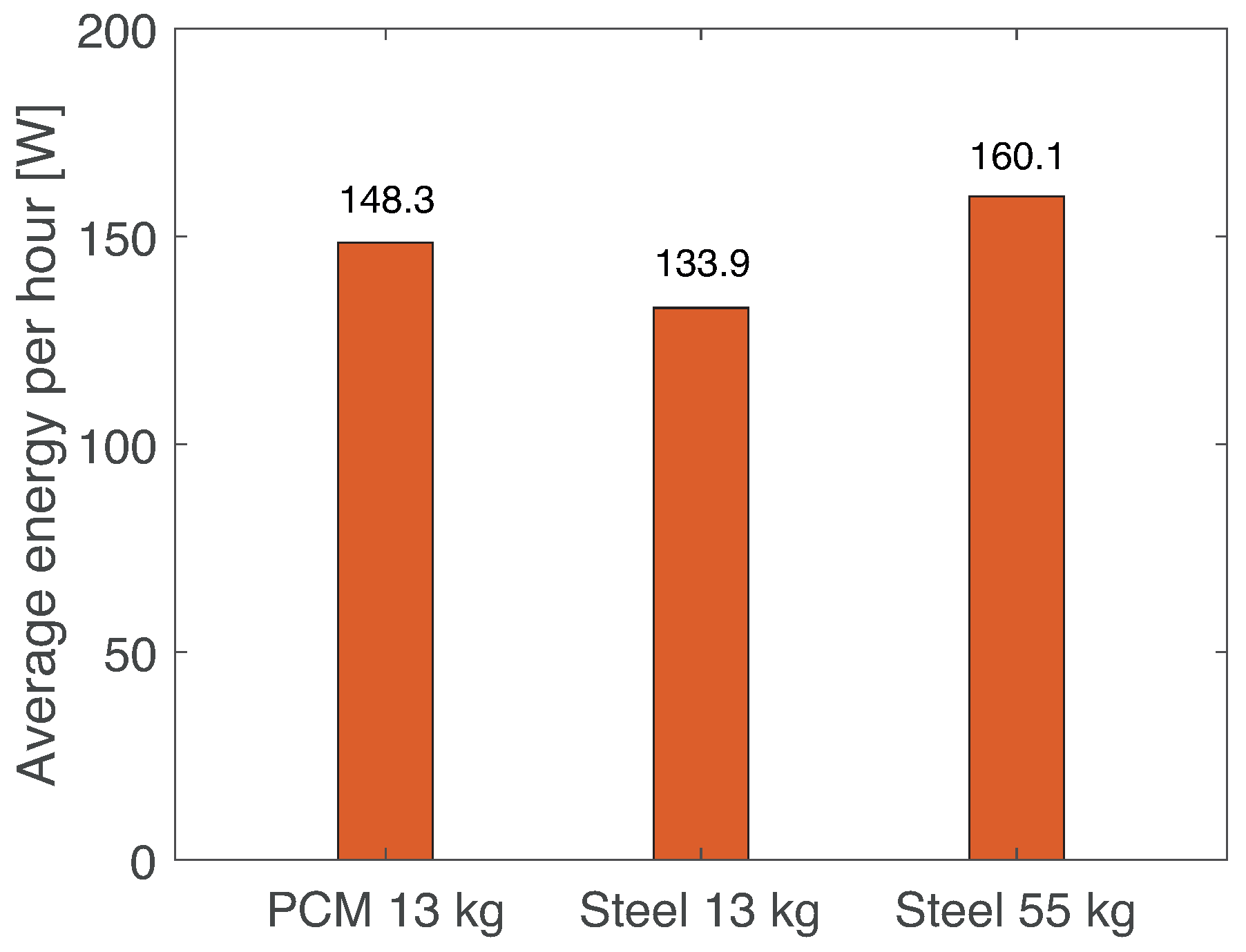
Finally, Figure 13 and Figure 14 report total energy capacity and mean deliverable power over the 24 h cycle. The total energy capacities are 3.57 kWh (12.87 MJ) for 13 kg PCM, 3.84 kWh (13.82 MJ) for 55 kg steel, and 3.21 kWh (11.57 MJ) for 13 kg steel, confirming that the mass-matched steel store is energetically disadvantaged while the PCM store approaches the larger steel storage in total capacity. Consistently, in Figure 14, the mean deliverable powers are 148 W (13 kg PCM), 160 W (55 kg steel), and 133 W (13 kg steel), reinforcing that latent storage improves usable heat supply relative to a same-mass sensible store and approaches the performance achieved with a substantially larger sensible-heat mass.
Figure 13.
Comparison of total energy capacity for the PCM (13 kg) and steel (13 kg and 55 kg) configurations.
Figure 14.
Comparison of mean deliverable power (average energy delivery per hour) for the PCM (13 kg) and steel (13 kg and 55 kg) configurations.
3.3. Performance of the Reference PCM TES Under Hot- and Cold-Day Boundary Conditions
The reference PCM-based TES (13 kg) is next evaluated under the hot-day and cold-day boundary conditions defined in Section 2.2 and compared against the average-day case. The objective is to quantify how deviations from average climatic forcing translate into differences in TES thermal response, available energy, and the resulting ability to sustain useful delivery beyond the main irradiation period.
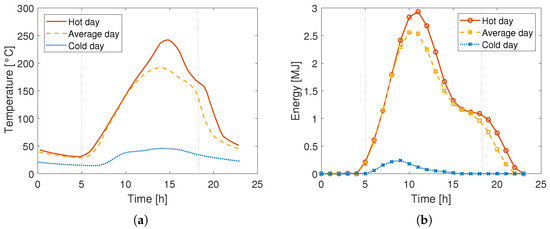
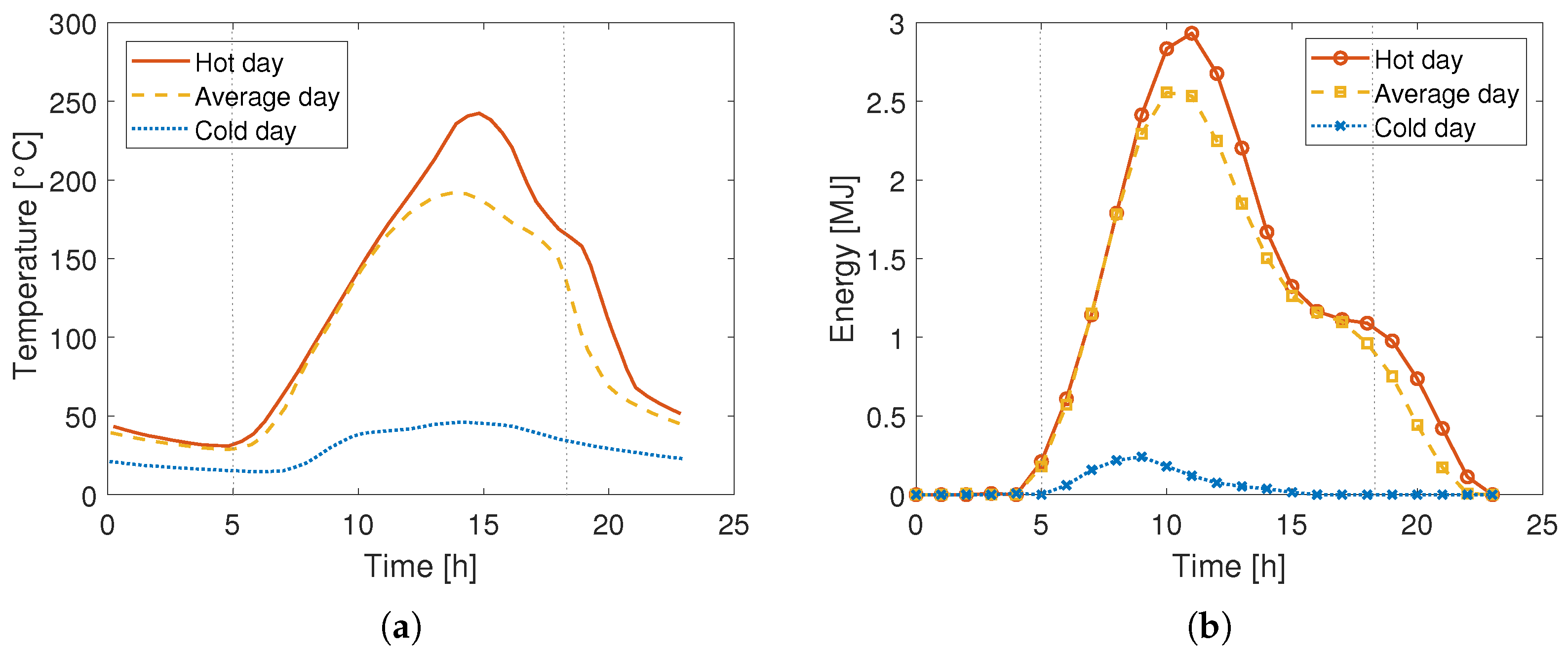
Figure 15a shows the time evolution of the volume-averaged TES temperature for the three climatic cases. The hot-day and average-day trajectories remain similar during the early heating phase, while the hot-day case reaches a higher peak after solar noon. In contrast, cold-day forcing yields substantially lower TES temperatures throughout the cycle, indicating limited charging and a markedly reduced thermal resource available for downstream use.
Figure 15.
Reference PCM configuration under representative climatic conditions: (a) volume-averaged TES temperature and (b) available thermal energy as functions of time for hot-day, average-day, and cold-day boundary conditions.
The corresponding available energy in the TES along time is shown in Figure 15b. The hot-day case accumulates more energy over the day (25.32 MJ) than the average-day case (22.21 MJ), consistent with higher irradiation input and yielding a wider availability window. Conversely, the cold-day case exhibits negligible energy accumulation (1.19 MJ), indicating that under low-irradiance forcing the TES cannot be effectively charged within a single daily cycle under the same operating and loss assumptions.
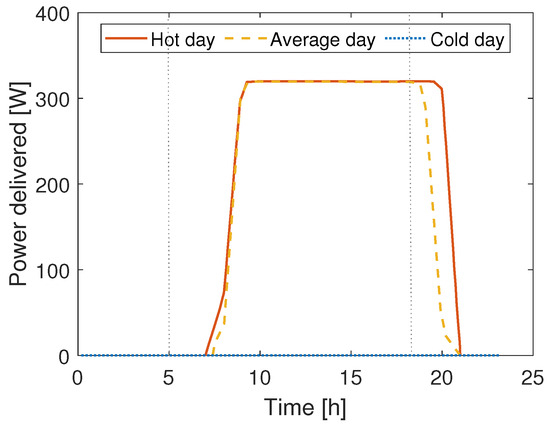
Figure 16 reports the delivered thermal power relative to the test-load requirement . Under hot-day conditions, the system sustains the required 320 W for approximately one additional hour compared with the average-day case. Under cold-day conditions, the TES does not satisfy the activation requirement of the test load ( °C), and therefore no useful delivery is obtained during that day. These results show that the reference PCM TES can extend post-irradiation operation under high-irradiance conditions, whereas under low-irradiance conditions operation becomes strongly dependent on charging history (i.e., consecutive days with higher solar input).
Figure 16.
Delivered thermal power for the reference PCM configuration under hot-day, average-day, and cold-day boundary conditions. Note that no output is shown for the cold-day condition because the storage system did not reach the minimum temperature difference required to activate heat extraction during the evaluated daily cycle.
Overall, the results demonstrate that latent storage with the reference PCM mass (13 kg) provides a clear advantage over a mass-matched sensible store by extending post-irradiation thermal availability and enabling nocturnal operability under the same boundary conditions and loss mechanisms. Achieving comparable nocturnal operating hours with sensible storage requires a substantial increase in storage mass (volume-matched steel configuration), highlighting the mass–volume trade-off between sensible and latent TES concepts. The climate sensitivity analysis further shows that the persistence of useful delivery is strongly driven by daily irradiance levels: hot-day conditions widen the availability window, whereas under cold-day forcing the system may not meet the activation requirements within a single cycle, emphasizing the importance of representative climatic inputs when interpreting resource continuity metrics.
Accordingly, these results demonstrate the enhanced operational flexibility of the storage system, reflected in the persistence of available energy after the end of irradiation. This extended availability supports nocturnal operation and facilitates improved matching between thermal supply and demand profiles. From a resource management perspective, enhancing the temporal persistence of solar thermal energy also improves effective accessibility to the solar resource during periods when direct irradiation is unavailable. Latent heat storage may reduce the need for system oversizing or auxiliary backup solutions, potentially influencing material requirements and associated costs. Furthermore, improved temporal energy retention increases the fraction of captured energy that remains usable, thereby contributing to a more efficient functional utilization of the solar resource compared with purely sensible storage approaches.
4. Conclusions
This work presented a resource-oriented assessment of thermal energy storage coupled to a solar concentrator, focusing on how storage strategy reshapes the temporal availability and continuity of usable solar thermal energy under representative Mexican boundary conditions. Based on transient finite-element simulations with convective and radiative losses and a consistent coating assumption, the following conclusions are drawn:
- A reference PCM mass of 13 kg was selected using a phase-change utilization criterion based on the melt-fraction index , requiring for at least one hour under average-day forcing. This criterion ensured near-complete latent-heat exploitation without oversizing the storage core.
- Compared with a mass-matched sensible store (13 kg AISI 304B steel), the 13 kg PCM configuration produced smoother thermal transients and a longer persistence of available energy after the end of irradiation, enabling nocturnal operability under identical boundary conditions. The mass-matched steel configuration exhibited negligible post-irradiation availability and no nocturnal operation.
- A volume-matched sensible configuration (55 kg AISI 304B steel) achieved nocturnal operability comparable to the 13 kg PCM case, but only by substantially increasing the sensible-storage mass. This highlights a key design trade-off: latent storage can approach the temporal continuity benefits of a larger sensible store at significantly lower mass.
- Climatic variability strongly controls the usable-energy window of the reference PCM TES: hot-day forcing increases stored energy (25.32 vs. 22.21 MJ) and extends the 320 W delivery period by about one hour relative to the average day, whereas cold-day forcing yields negligible charging, does not meet the °C activation threshold, and delivers no useful power—indicating the need for multi-day carryover under low-irradiance conditions.
The proposed framework and metrics provide a consistent basis for comparing TES strategies in terms of usable-energy persistence and operating windows, complementing conventional performance indicators focused on instantaneous efficiency. Future work should extend the present day-type analysis beyond stabilized representative cycles (average, hot, and cold days) by driving the model with continuous, high-resolution climate time series (e.g., a full month or year of measured meteorological data) to quantify seasonal variability and multi-day sequences of low-irradiance conditions. Additional research could also evaluate the sensitivity of the conclusions to coating selectivity, insulation thickness, and operational thresholds linked to specific end-use technologies. Since the present conclusions are restricted to the specific PCM considered and are based on a transient numerical assessment rather than durability testing, future studies should examine long-term material stability, degradation under repeated thermal cycling, corrosion effects, and compatibility with containment materials before practical implementation can be fully supported. Broader material generalization would also require extending the analysis to additional PCM classes with different transition temperatures and thermophysical properties. In addition, emphasis should be placed on practical end-use integration by quantifying how the stored thermal energy can be utilized within a household context, including estimating the overall conversion efficiencies and delivery performance of candidate combined heat-and-power configurations.
Author Contributions
Conceptualization, C.M.J., J.R.R., R.J. and G.G.-U.; methodology, C.M.J., R.J. and G.G.-U.; software, C.M.J., J.R.R. and R.J.; validation, J.R.R., R.J., J.A.A.R. and G.G.-U.; formal analysis, C.M.J., R.J., J.A.A.R., G.B. and G.G.-U.; investigation, C.M.J., J.R.R. and R.J.; resources, C.M.J., R.J. and G.G.-U.; data curation, C.M.J., J.R.R. and R.J.; writing—original draft preparation, C.M.J., R.J., G.B. and G.G.-U.; writing—review and editing, C.M.J., J.R.R., R.J., J.A.A.R., G.B., A.R.B. and G.G.-U.; visualization, C.M.J., J.R.R. and R.J.; supervision, C.M.J., R.J. and G.G.-U.; project administration, A.R.B. and G.G.-U.; funding acquisition, C.M.J., J.R.R., R.J., J.A.A.R., G.B., A.R.B. and G.G.-U. All authors have read and agreed to the published version of the manuscript.
Funding
This research received no external funding.
Data Availability Statement
The data that support the findings of this study are available from the corresponding author upon reasonable request.
Acknowledgments
The authors acknowledge the support provided by SECIHTI through the graduate scholarship awarded to Jonathan Rojas. R.J. and would like to acknowledge the support from the Coordenação de Aperfeiçoamento de Pessoal de Nível Superior–Brasil (CAPES).
Conflicts of Interest
The authors declare no conflicts of interest.
Abbreviations
The following abbreviations are used in this manuscript:
| PCM | Phase Change Materials |
| TES | Thermal Energy Storage |
| CSP | Concentrated Solar Power |
Appendix A. Thermophysical Properties of the TES Materials
This appendix reports the thermophysical properties adopted for the multilayer thermal energy storage unit depicted in Figure 6. The TES domain comprises (i) a steel capsule (AISI 304B), (ii) an aerogel insulation layer in the side face, and (iii) the TES core material, which is either a PCM for latent storage or AISI 304B steel for sensible storage. Unless otherwise stated, properties are treated as constant in the transient conduction model.
The selective (radiant) coating shown in Figure 6 is implemented through surface radiative properties (absorptivity/emissivity) prescribed at the receiving face and cylindrical surface. Since the coating is modeled as a surface condition (i.e., without a resolved volumetric thickness), its bulk thermophysical properties are not required in the solid energy equation. The adopted radiative parameters are documented separately in Appendix B (optical/radiative properties).
Table A1 summarizes the properties used for the TES core (PCM or steel), the steel capsule, and the aerogel insulation. For the PCM, phase change is represented via an apparent heat-capacity formulation (Section 2.4), using solid- and liquid-phase conductivities and heat capacities, a melting temperature , and latent heat L. For the steel domains, constant properties are used. The values for the PCM are taken from the high-temperature PCM literature [4]. Steel properties correspond to AISI 304B as implemented in the simulation database. Aerogel insulation properties are based on reported values for silica-aerogel blanket insulation; thermal conductivity is taken from a Pyrogel® XT-E datasheet at near-relevant temperatures, while the specific heat capacity is taken from published measurements of aerogel blankets [26,27].
Table A1.
Thermophysical properties adopted for the TES layers and core materials (Figure 6).
The PCM properties in Table A1 correspond to the solid and liquid phases required by the apparent heat-capacity method, while the latent heat is introduced over a finite melting interval (see Section 2.4). For aerogel insulation, thermal conductivity exhibits a temperature dependence; the value reported here corresponds to a representative level near the operating temperature range of interest and is used as a constant approximation in the conduction model [26].
The general operating conditions used in the TES simulations are summarized in Table A2. These values correspond to representative conditions for an average day and define the external forcing applied to the receiver, including wind-driven convective effects and the range of incident solar irradiance obtained from the optical model.
Table A2.
General conditions used in the TES simulations and receiver input definition.
Appendix A.1. Properties of the Parabolic Dish Arrangement
This annex summarizes the geometric and optical parameters used to model the parabolic-dish concentrator and its coupling to the TES receiver surface. The objective is to document the assumptions required to compute the concentrated solar input imposed at the TES receiving face (Figure 5) via Monte Carlo ray tracing.
Appendix A.2. Geometric Definition
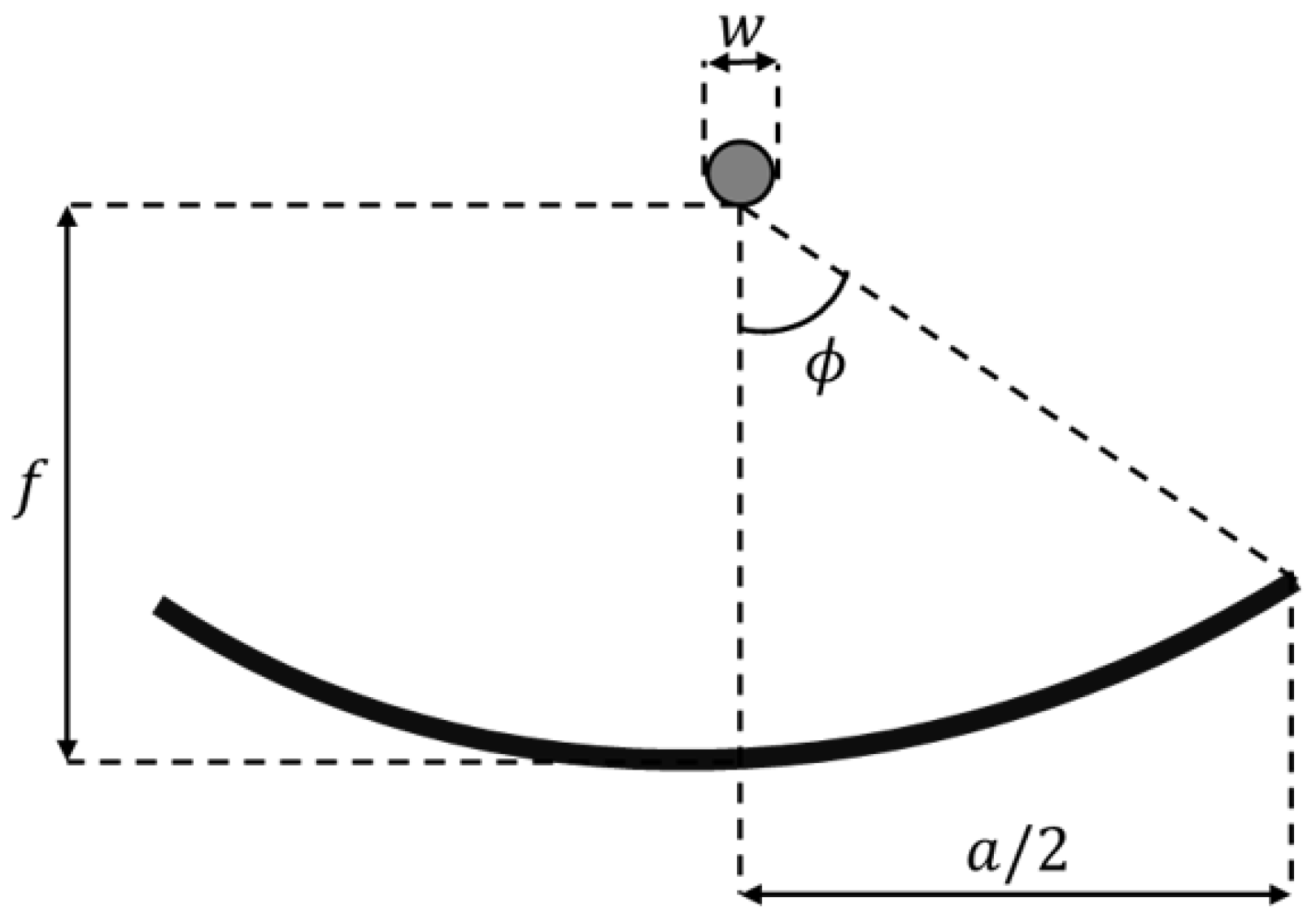
The parabolic dish is characterized by its focal length f, aperture diameter a, and rim angle , while the receiver is modeled as a circular disk of diameter w placed in the focal region. The geometric relationship between these parameters is illustrated in Figure A1. Table A3 summarizes the values adopted in the optical model.
Table A3.
Parabolic-dish and receiver parameters used in the optical model.
The receiver diameter w is related to the apparent angular size of the sun (modeled through ) and to the geometry of the concentrator. In this work, w is selected consistently with the geometric relations used to define dish–receiver interception (see Figure A1 and the corresponding expressions in the source document).
Appendix A.3. Optical Assumptions and Concentration Bookkeeping
A mirror reflectivity of is assumed, representing a high-quality reflective surface under ideal conditions. Reflectance values in this range have been reported for solar concentrator mirrors depending on coating type, aging, and soiling conditions [21,22]. A shading fraction is included to account for partial aperture blockage by the receiver (Figure A1). Using the projected areas of the receiver and the dish aperture, the shading fraction is written as
where is the receiver area and is the dish aperture area. A geometric concentration ratio is defined as
For the parameters in Table A3, and , yielding and .
Figure A1.
Geometric relationship between the parabolic dish and the receiver used to define the concentrator arrangement. The dish is characterized by the focal length f, aperture diameter a, and rim angle , while the receiver diameter is w.
Appendix A.4. Intensity at the Receiver and Coupling to the TES Model
Appendix B. Calculation of Convective and Radiative Heat Losses from the TES
Appendix B.1. Nomenclature
| Exposed front (receiver) surface area of the TES | |
| Exposed cylindrical surface area of the TES | |
| r | TES radius () |
| L | TES length (varies by configuration; fixed) |
| Ambient air temperature | |
| Wind speed | |
| Ambient pressure | |
| Front surface temperature | |
| Cylindrical surface temperature | |
| Surroundings temperature (here ) | |
| Stefan–Boltzmann constant | |
| Convective coefficients | |
| Reynolds, Prandtl, Nusselt numbers | |
| Local irradiance at the TES front surface after concentration | |
| Transmittance, absorptance, reflectance, emissivity | |
| Subscript (1) | Solar band (incoming irradiation) |
| Subscript (2) | Thermal IR band (re-emission from hot TES) |
Appendix B.2. Energy Balance and Loss Surfaces
The TES is modeled as a closed system under transient conditions with negligible kinetic and potential energy variations. The transient balance is
and the delivered heat rate is written as
Convective and radiative losses are applied only on the front surface and cylindrical surface:
No ambient losses are imposed on the rear face because the test load is assumed to be in direct contact with that surface (no exposed rear area).
Appendix B.3. Convective Heat Losses (Forced Convection Driven by Wind)
Convective losses are computed as forced convection driven by wind:
Air properties are evaluated at the film temperature of each surface,
The Reynolds and Prandtl numbers are
Appendix B.3.1. Front Surface (Flat-Plate Correlation)
The Nusselt number for the front surface is evaluated as
and
Appendix B.3.2. Cylindrical Surface (Crossflow Correlation)
For the cylindrical surface, the Churchill–Bernstein form is used:
The corresponding coefficient is
Appendix B.4. Radiative Heat Losses (Front and Cylindrical Surfaces)
Radiative losses are evaluated only on the exposed front and cylindrical surfaces:
with in the present study. Surface emissivities are prescribed according to the selective-coating parameter set described in the next subsection. In this study, the surroundings temperature is approximated as , which represents a conservative simplification for longwave exchange with the environment.
Selective Coating Model and Non-Selective Reference
This subsection documents the selective-coating representation used to (i) enhance the absorption of concentrated solar radiation at the TES surface and (ii) reduce longwave radiative losses from the exposed external surfaces during post-irradiation periods. The coating is applied to the front surface and the cylindrical surface (same parameter set in both areas).
Subscript (1) denotes optical properties associated with incoming solar radiation (shortwave), while subscript (2) denotes properties associated with thermal emission from the hot TES (longwave IR). Material (A) represents the coating system and Material (B) represents the TES structure behind it.
Figure A2.
Selective-coating optical interaction model at the receiver/front surface: Material (A) is the coating with two-band properties (solar band 1 and thermal band 2), and Material (B) is the TES structure.
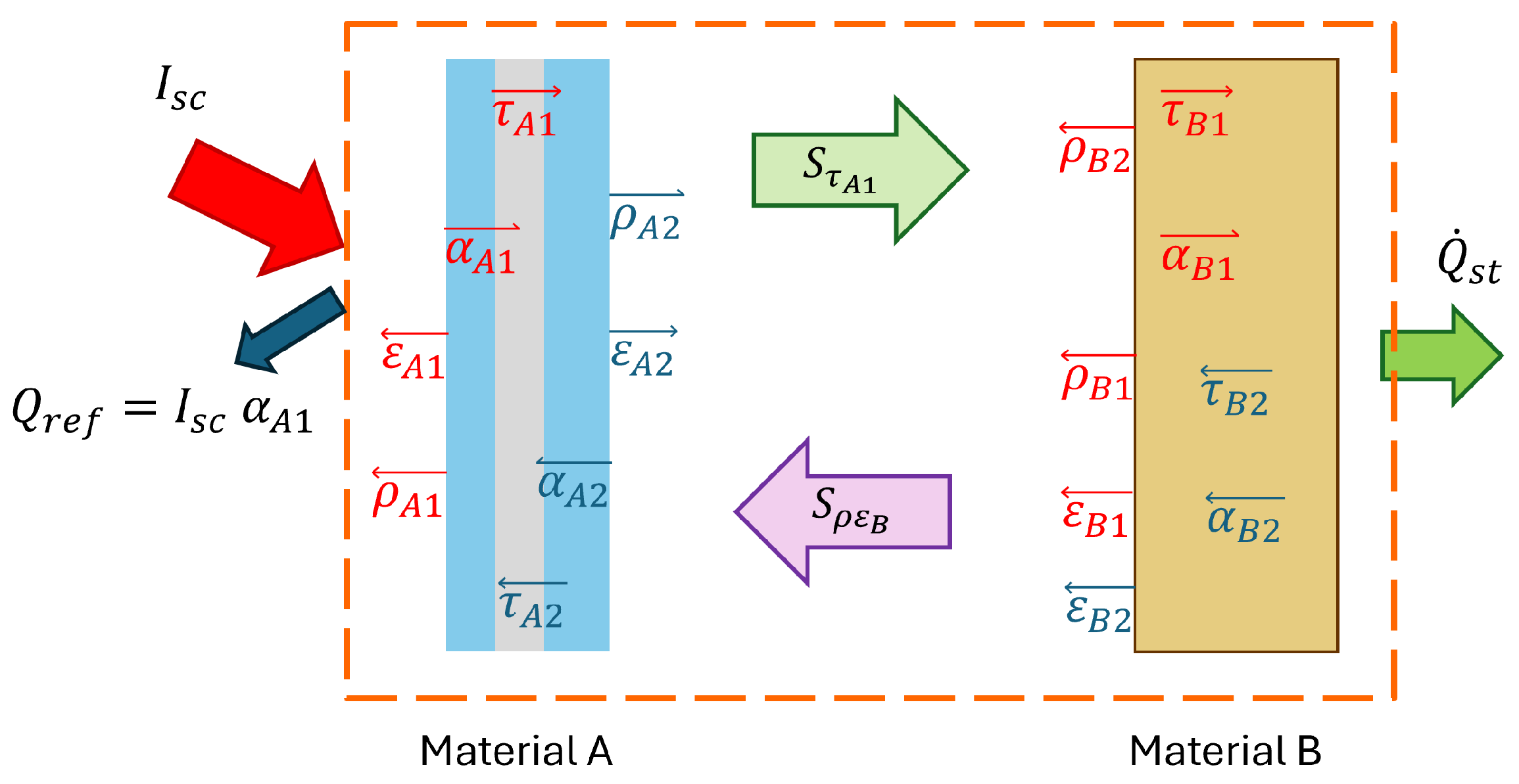
All coating parameters and the corresponding emissive parameters used for radiative exchange (Equation (A13)) are taken from Table A4. This selective set is used for both the front and cylindrical coated surfaces.
Table A4.
Optical properties of the selective coating.
For the non-selective case, wavelength-independence is enforced by setting
This implies that the material exhibits identical optical behavior for incoming and outgoing radiation.
Appendix B.5. Collector-to-Receiver Irradiance and Concentration Bookkeeping
The local irradiance imposed on the TES front surface is denoted as and represents the local irradiance at the receiver face after concentration. In the manuscript, is obtained from Monte Carlo ray tracing and imposed directly as a boundary condition.
For completeness, a bookkeeping form may be written as
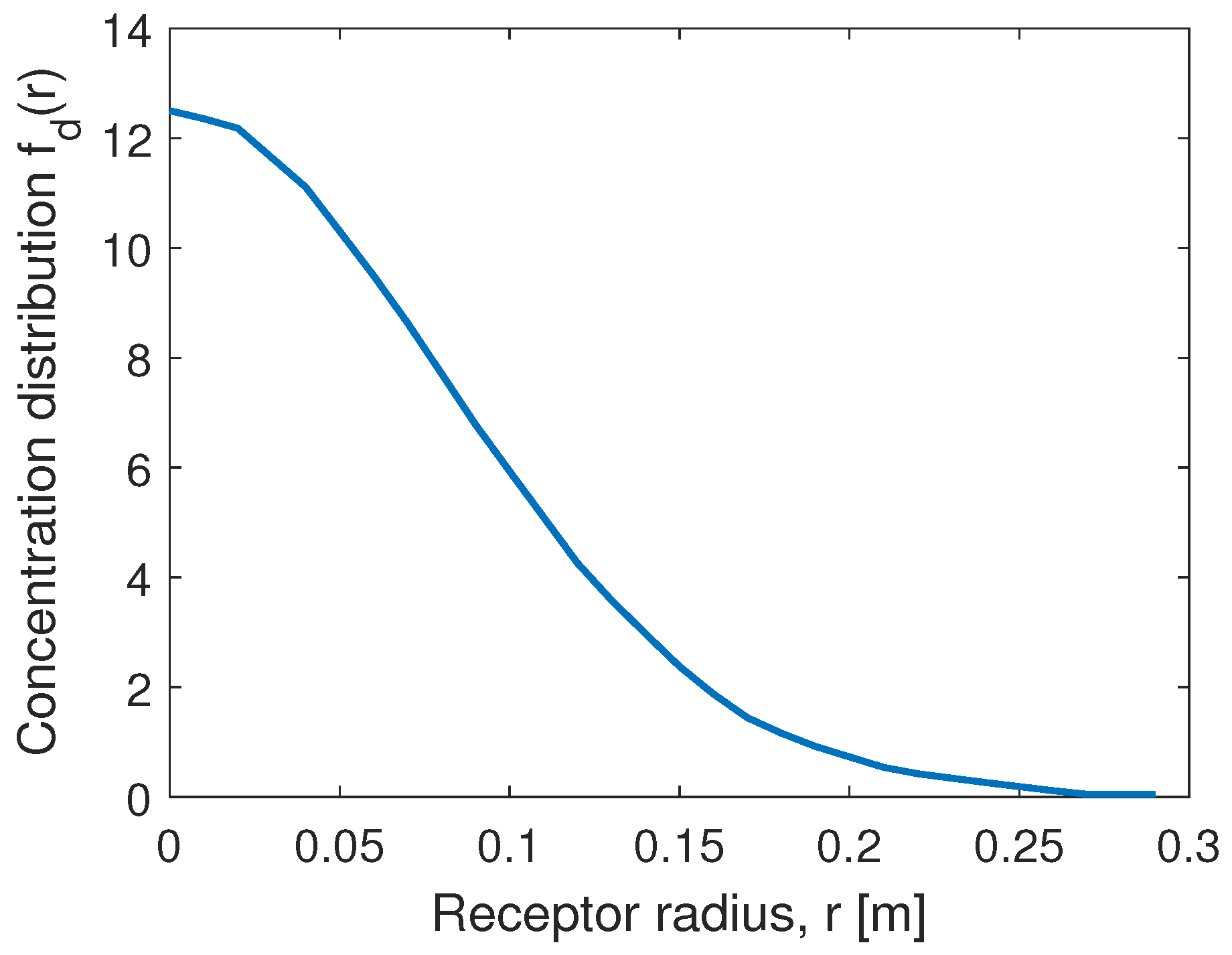
where is the ambient solar irradiance, is the shading factor, is mirror reflectivity, is an average concentration factor, and is the normalized radial concentration distribution (surface-average equal to 1).
Figure A3.
Normalized radial concentration distribution at the receiver/front surface obtained from Monte Carlo ray tracing.
Appendix B.6. Areas Used for Losses
The TES length L is computed for each configuration by keeping fixed and enforcing either (i) mass-matched conditions (equal mass of PCM and steel) or (ii) volume-matched conditions (equal storage volume of PCM and steel), using the corresponding material densities.
References
- International Renewable Energy Agency (IRENA). Innovation Outlook: Thermal Energy Storage. 2020. Available online: https://www.irena.org/publications/2020/Nov/Innovation-outlook-Thermal-energy-storage (accessed on 28 October 2025).
- Sarbu, I.; Sebarchievici, C. A Comprehensive Review of Thermal Energy Storage. Sustainability 2018, 10, 191. [Google Scholar] [CrossRef] [Scilit]
- Gasanaliev, A.M.; Gamataeva, B.Y. Heat-Accumulating Properties of Melts. Russ. Chem. Rev. 2000, 69, 179–186. [Google Scholar] [CrossRef] [Scilit]
- Kenisarin, M.M. High-Temperature Phase Change Materials for Thermal Energy Storage. Renew. Sustain. Energy Rev. 2010, 14, 955–970. [Google Scholar] [CrossRef] [Scilit]
- Bonk, A.; Braun, M.; Sötz, V.A.; Bauer, T. Solar Salt: Pushing an Old Material for Energy Storage to a New Limit. Appl. Energy 2020, 262, 114535. [Google Scholar] [CrossRef] [Scilit]
- El Karim, Y.; Faik, A.; Grosu, Y.; Lbibb, R. Assessing Mg84Cu16 as a Novel PCM for High-Temperature Energy Storage: Focus on Thermal Stability and Material Compatibility. E3S Web Conf. 2025, 649, 01004. [Google Scholar] [CrossRef] [Scilit]
- Tofani, K.; Tiari, S. Nano-Enhanced Phase Change Materials in Latent Heat Thermal Energy Storage Systems: A Review. Energies 2021, 14, 3821. [Google Scholar] [CrossRef] [Scilit]
- Zhao, W.; Elmozughi, A.F.; Oztekin, A.; Neti, S. Heat Transfer Analysis of Encapsulated Phase Change Material for Thermal Energy Storage. Int. J. Heat Mass Transf. 2013, 63, 323–335. [Google Scholar] [CrossRef] [Scilit]
- Zheng, Y.; Zhao, W.; Sabol, J.C.; Tuzla, K.; Neti, S.; Oztekin, A.; Chen, J.C. Encapsulated Phase Change Materials for Energy Storage: Characterization by Calorimetry. Sol. Energy 2013, 87, 117–126. [Google Scholar] [CrossRef] [Scilit]
- Zhou, X.; Yamashita, S.; Kubota, M.; Zhang, C.; Hong, F.; Kita, H. Macro-Encapsulated Cu-Based Phase Change Material for High-Temperature Heat Storage with Self-Sealing and High Durability. Appl. Therm. Eng. 2023, 229, 120491. [Google Scholar] [CrossRef] [Scilit]
- Issa, O.O.; Thirunavukkarasu, V. Storage Performance of Immersed Phase Change Material Shell-and-Tube Encapsulation for a Concentrated Solar Power System: An Experimental Study. Appl. Therm. Eng. 2025, 277, 126971. [Google Scholar] [CrossRef] [Scilit]
- Ayala-Zambrano, S.; Jäckel, R.; Gutiérrez-Urueta, G.L.; Ramos Blanco, A.; Monreal Jiménez, C. Parametric optimization of cylindrical vaccine transport containers with dual phase change materials to prevent vaccine freezing and heat damage using artificial neural networks. J. Energy Storage 2025, 109, 115239. [Google Scholar] [CrossRef] [Scilit]
- Babu, D.; Shukla, A.K.; Gaba, V.K.; Dewan, A. Thermal Performance of Solar Flat Plate Collector Using Energy Storage Phase Change Materials. Energy Storage 2024, 6, e577. [Google Scholar] [CrossRef] [Scilit]
- Brunelli, L.; Borri, E.; Pisello, A.L.; Nicolini, A.; Mateu, C.; Cabeza, L.F. Thermal Energy Storage in Energy Communities: A Perspective Overview through a Bibliometric Analysis. Sustainability 2024, 16, 5895. [Google Scholar] [CrossRef] [Scilit]
- Babatunde, O.; Adedoja, O.; Oyebode, O.; Kareem, U.A.; Babatunde, D.; Adedoja, T.; Akintayo, B.; Emezirinwune, M.; Ighravwe, D.E.; Ogunniran, O.; et al. Techno-Economic Optimization and Assessment of Solar Photovoltaic–Battery–Hydrogen Energy Systems with Solar Tracking for Powering ICT Facility. Resources 2025, 14, 74. [Google Scholar] [CrossRef] [Scilit]
- García-Pérez, E.; Álvarez, G.; Xamán, J. Thermal performance of building walls containing phase change materials under Mexican warm climate conditions. Appl. Therm. Eng. 2016, 103, 1227–1235. [Google Scholar] [CrossRef] [Scilit]
- Ríos-Arriola, J.G.; Rivera, W.; Best, R.; Romero, R.J. Study of a solar-assisted underground thermal energy storage system for an absorption cooling system. Energy Build. 2014, 68, 458–465. [Google Scholar] [CrossRef] [Scilit]
- Rojas Ricca, J.E.; Jäckel, R.; Monreal, C.; Gutierrez Urueta, G. Comparative Assessment of Thermal Storage Technologies in Solar Disk Collectors: Conventional versus Phase Change Materials. In Proceedings of the 20th Brazilian Congress of Thermal Sciences and Engineering (COBEM), Foz do Iguaçu, Brazil, 10–14 November 2024. [Google Scholar]
- Peel, M.C.; Finlayson, B.L.; McMahon, T.A. Updated World Map of the Köppen–Geiger Climate Classification. Hydrol. Earth Syst. Sci. 2007, 11, 1633–1644. [Google Scholar] [CrossRef] [Scilit]
- NASA POWER. NASA POWER Data Access Viewer. Available online: https://power.larc.nasa.gov/data-access-viewer/ (accessed on 12 May 2024).
- Shuai, Y.; Xia, X.L.; Tan, H.P. Radiation Performance of Dish Solar Concentrator/Cavity Receiver Systems. Sol. Energy 2008, 82, 13–21. [Google Scholar] [CrossRef] [Scilit]
- Hongn, M.; Flores Larsen, S.; Altamirano, M.; Gea, M.; Saravia, L. Estudio de reflectancia de espejos para un concentrador solar Fresnel lineal. Av. En Energías Renov. Y Medio Ambiente 2011, 15, 08.191–08.197. [Google Scholar]
- Li, Z.; Tang, D.; Du, J.; Li, T. Study on the radiation flux and temperature distributions of the concentrator–receiver system in a solar dish/Stirling power facility. Appl. Therm. Eng. 2011, 31, 1780–1789. [Google Scholar] [CrossRef] [Scilit]
- COMSOL. Apparent Heat Capacity Method (Heat Transfer with Phase Change Theory Documentation). Available online: https://doc.comsol.com/6.3/doc/com.comsol.help.heat/heat_ug_theory.07.024.html (accessed on 27 June 2025).
- Kongtragool, B.; Wongwises, S. A review of solar-powered Stirling engines and low temperature differential Stirling engines. Renew. Sustain. Energy Rev. 2003, 7, 131–154. [Google Scholar] [CrossRef] [Scilit]
- Aspen Aerogels. Pyrogel® XT-E: High-Temperature Aerogel Insulation Blanket (Datasheet). Available online: https://www.aerogel.com/es/product/pyrogel-xte/?utm_source=chatgpt.com (accessed on 19 February 2025).
- Pérez, O.C. The Behavior of Aerogel Blankets as Insulation Material in External Walls at High Temperatures. Master’s Thesis, Chalmers University of Technology, Göteborg, Sweden, 2012. [Google Scholar]
Disclaimer/Publisher’s Note: The statements, opinions and data contained in all publications are solely those of the individual author(s) and contributor(s) and not of MDPI and/or the editor(s). MDPI and/or the editor(s) disclaim responsibility for any injury to people or property resulting from any ideas, methods, instructions or products referred to in the content. |
© 2026 by the authors. Licensee MDPI, Basel, Switzerland. This article is an open access article distributed under the terms and conditions of the Creative Commons Attribution (CC BY) license.