Article

Used Cork Stoppers: A New Recycled Raw Material for the Growing Media Industry


1
Linking Landscape, Environment, Agriculture and Food (LEAF), Associate Laboratory TERRA, School of Agriculture, University of Lisbon, Tapada da Ajuda, 1349-017 Lisbon, Portugal
2
Forest Research Centre (CEF), Associate Laboratory TERRA, School of Agriculture, University of Lisbon, Tapada da Ajuda, 1349-017 Lisbon, Portugal
3
Amorin Cork, S.A., R dos Corticeiros, 850, 4535-387 Santa Maria de Lamas, Portugal
*
Author to whom correspondence should be addressed.
Resources 2026, 15(4), 49; https://doi.org/10.3390/resources15040049
Submission received: 30 December 2025 / Revised: 21 March 2026 / Accepted: 23 March 2026 / Published: 25 March 2026

Abstract

A characterization study of two by-products from the cork stopper industry was conducted to assess their suitability as components of growing media (substrate). Granulate of natural cork stopper (GNCS) and granulate of technical cork stopper (GTCS) were studied, evaluating their chemical composition, fractionation, effects on physical and chemical properties, mineral elements, and phytotoxicity. The two by-products were granulometrically classified into four categories: very fine fractions (≤1 mm), fine fractions (>1 and ≤2 mm), intermediate fractions (>2 and ≤5 mm), and coarse fractions (>5 and ≤10 mm). The highest proportion of granulates was observed within the intermediate fraction (>2 and ≤5 mm). GTCS presented significant limitations regarding the assessed properties, while the very fine fractions (≤1 mm) were the most attractive in both granulates. Therefore, selecting raw materials and their fractionation are vital for predicting the performance of growing media and establishing their suitability for promoting plant growth and productivity. Thus, these two by-products of the cork stopper industry have desirable characteristics as components of growing media.

1. Introduction

Sustainable resource management is a central pillar of current environmental policy and industrial innovation, aiming to balance resource efficiency, environmental protection, and socio-economic development. This approach promotes the responsible use of natural resources throughout their life cycle, prioritizing renewable materials, minimizing waste generation, and extending material lifespans through reuse and recycling. By reducing dependence on finite resources and lowering greenhouse gas emissions, sustainable resource management contributes to climate change mitigation while supporting resilient and competitive value chains. In this context, the integration of bio-based materials and industrial by-products into circular production systems plays a key role in enhancing resource efficiency and delivering measurable environmental and societal benefits [1,2]. Within this framework of sustainable resource management, the cork industry in Portugal represents a particularly illustrative case. Cork extraction is based on a renewable forest resource managed under long rotation cycles, in which cork oak (Quercus suber) forests provide environmental services such as carbon sequestration, biodiversity conservation, and landscape stability, while simultaneously supporting rural economies. The periodic harvesting of cork does not require tree felling, allowing continuous material production over decades and aligning naturally with principles of resource efficiency and long-term stewardship. Moreover, the Portuguese cork sector has progressively integrated circular economy practices by valorizing industrial by-products and post-consumer cork materials, thereby extending material life cycles and reinforcing the role of cork as a sustainable bio-based material within European sustainability and policy frameworks [3,4,5,6].
Within the Portuguese cork industry, cork stoppers constitute the most emblematic and economically significant application of cork. Globally, approximately 12 billion bottles are sealed with cork stoppers each year, corresponding to an estimated 54,000 tons of post-consumer cork stopper waste annually. Although this volume is modest when compared with other waste streams, post-consumer cork represents an environmentally significant material flow. Recycling used cork stoppers enables the recovery of cork biomass for technical and industrial applications, reducing reliance on non-renewable materials and contributing to long-term carbon retention. Currently, there are campaigns both in Portugal (e.g., “GreenCORK”) and abroad (e.g., “ReCORK North America” in the USA and Canada, EcoBouchon in France, Etico in Italy, and “ReCORK Australia” in Australia) for the collection and recycling of used cork stoppers. The collection is distributed through local networks with strong voluntary and institutional participation, thereby reducing costs. At the end of life, cork stoppers offer clear opportunities for material recovery and circular valorization within evolving European environmental and regulatory frameworks. In this context, the valorization of post-consumer cork stoppers as granulated materials represents a promising pathway for their integration into growing media. Once collected and processed, cork stoppers can be transformed into cork granulates with physical and chemical characteristics that are potentially suitable for use as growing-media components [7,8,9,10]. The incorporation of cork granulates into growing media offers an opportunity to extend the material life cycle of cork stoppers while contributing to the partial replacement of peat, a non-renewable resource associated with significant environmental impacts. By linking residue valorization with sustainable practices, the use of recycled cork granulates in growing media aligns with circular economy principles and supports the development of locally sourced, bio-based alternatives for nursery and plant production systems.
On the European continent, peat is the primary component of growing media due to its unique qualities, including a uniform texture, light weight, excellent air and water retention, low pH, and manageable nutrient levels, as well as a biologically stable structure [11,12]. However, peat extraction harms habitats and accelerates climate change, as it is estimated to release 15 million tons of carbon annually [13,14,15]. Additionally, peat is a non-renewable resource on a human timescale [16]. Consequently, reliance on peat-based growing media leads to ongoing resource depletion, environmental harm, and high costs, especially for transportation, since this raw material is sourced from northern and central European countries [17]. In response, sustainable, local alternatives are increasingly popular as substitutes for peat in growing media [18]. One such alternative is the use of forestry-sector by-products [19,20]. Besides their use in growing media, these by-products support circularity within industries and add value [21].
The limited information on the use of cork as part of growing media, especially regarding the potential reuse of used cork stoppers, makes this study highly relevant. Since research on this topic is scarce, a detailed characterization of these materials’ properties is crucial to ensure the success and effectiveness of the growing media being developed. Studies show that factors like particle size distribution [22], air and water availability [23], salinity [24], pH, and electrical conductivity, which affect nutrient availability [25], and the presence of substances with phytotoxic effects [26] can limit the use of some materials as growing media.
The objective of this study is to characterize (i) granulates from used natural cork stoppers and granulates from used technical cork stoppers and (ii) assess the impact of fractionation of these materials on properties relevant to the growing media industry.

2. Materials and Methods

2.1. Raw Material

Granulate of natural cork stopper (GNCS) and granulate of technical cork stoppers (GTCS) were supplied by Amorim Cork, S.A. (Santa Maria de Lamas, Portugal). The GNCS are obtained by grinding natural cork stoppers extracted directly from high-quality cork boards, yielding a single-cork body. In turn, the GTCS are obtained by grinding from technical stoppers, consisting of a dense body of agglomerated cork, with 1 natural cork disk glued to both ends or with 2 disks, only on one end.
The particle size distribution was evaluated for different particle size fractions using the vibrational sieving method with screens (Retsch GmbH, Retsch-Allee 1-5, 42781 Haan, Germany) of sizes 10, 5, 2, 1, 0.5, and 0.25 mm [27]. All experiments were conducted in triplicate.

2.2. Chemical Analysis

The dry mass was measured by drying samples at 105 °C for 24 h in a oven Binder ED 23 (BINDER GmbH & Co. KG, Eike-Kerstein-Straße 4, 31789 Hameln, Germany), and the ash content was determined by combusting the oven-dried sample at 500 °C for eight hours in a muffle furnace Heraeus MR170E (Heraeus Group, Heraeusstraße 12-14, 63450 Hanau, Germany), following Technical Association of the Pulp and Paper Industry (TAPPI) Standard Method T 15 os-58 [28], which specifies the procedure for determining ash content in lignocellulosic materials. Samples (approximately 2.2 g dry mass) were fully extracted using solvents of increasing polarity—dichloromethane, ethanol, and water (ultra-purified)—in a Soxhlet apparatus according to TAPPI T 204 cm-07 [29], the standard method for determining total extractives.
To analyze suberin, extractive-free samples were depolymerized through methanolysis with sodium methoxide in methanol and quantified gravimetrically. Total lignin was calculated as the sum of Klason lignin and acid-soluble lignin, following TAPPI T 13 m-54 (Klason lignin) [30] and TAPPI UM 205 om-83 (acid-soluble lignin) [31], respectively.
Neutral monosaccharides were quantified in the hydrolysate obtained from lignin determination using high-performance liquid chromatography (HPLC). Analyses were performed on a Thermo/Dionex 031824 system (ThermoFisher Scientific, 2 Radcliff Road Tewksbury, MA 01876, USA) equipped with a pulse–amperometric detector and an Aminotrap plus Carbopac PA10 analytical column system (ThermoFisher Scientific, 2 Radcliff Road Tewksbury, MA 01876, USA) (4 × 250 mm) [32]. The mobile phase consisted of 18 mM NaOH for elution, followed by 100 mM NaOH for column cleaning, operating at a flow rate of 1.0 mL min−1 at 25 °C. The monosaccharides determined were glucose, xylose, arabinose, galactose, and rhamnose, and the results are expressed as percentages of their total content.

2.3. Physical and Chemical Properties

The physical properties described by [33] were assessed following the procedures established in the European Standard [34]. These included bulk density (BD), total porosity (TP), available water (AW), calculated as the difference in water content at 1 and 10 kPa, and air-filled porosity (AFP), defined as the volume of air at a suction of 1 kPa.
pH and electrical conductivity (EC) were measured in the water extract (1:5 v/v) [35,36].
The dry mass (DM) content was determined by oven drying the samples at 105 °C for 24 h, while ash content was obtained by combusting the dried material at 550 °C for 5 h in a muffle furnace. The organic matter (OM) content was subsequently calculated as the difference between DM and ash.

2.4. Mineral Elements

Mineral nitrogen (NH4+-N and NO3-N), phosphorus (P), sodium (Na), potassium (K), calcium (Ca), magnesium (Mg), sulfur (S), silicon (Si), iron (Fe), copper (Cu), zinc (Zn), manganese (Mn), and boron (B) were quantified in water extract (1:5 v/v), following European Standards [37].

2.5. Phytotoxicity Test

Phytotoxicity was assessed in Petri dishes containing 100 cm3 of perlite soaked with 50 mL of extract prepared from GNCS and GTCS. In each dish, 10 cress seeds (Lepidium sativum) were sown. The dish was covered, wrapped in aluminum foil, and incubated for 3 days in the dark at 25 °C, following the EN 16086-2 [38]. The assay was performed in triplicate, with a nutrient solution as the control treatment.
The extracts were prepared using a nutrient-based solution composed of the following: 1 mmol NH4-N L−1, 16 mmol NO3-N L−1, 8 mmol K L−1, 4 mmol Ca L−1, 1.5 mmol Mg L−1, 1.25 mmol sulfate (SO42−) L−1, 1.5 mmol dihydrogen phosphate (H2PO4) L−1, 15 μmol Fe L−1, 8 μmol Mn L−1, 4 μmol Zn L−1, 25 μmol B L−1, 0.75 μmol Cu L−1, and 0.5 μmol Mo L−1 [38].
Phytotoxicity was quantified using the Munoo–Lisa Vitality Index (MLV) (Equation (1)), which integrates both the germination rate (GR), where GR1–3 correspond to the triplicates and GRC to the control, and the root length (RL), where RL1–3 represent the triplicates and RLC the control [38].
M L V   % = G R 1 × R L 1 + G R 2 × R L 2 + G R 3 × R L 3 3 × G R C × R L C × 100

2.6. Statistics

All data were analyzed using Statistic 9 software (Analytical Software, Tallahassee, FL, USA). Data were subjected to a normality test, a homogeneity of variance test, and an analysis of variance, followed by the LSD test at p ≤ 0.05.

3. Results and Discussion

3.1. Chemical Analysis

Table 1 shows the chemical analysis of granulated natural cork stopper (GNCS) and granulated technical cork stopper (GTCS). The GNCS has a higher ash content compared to the GTCS. The presence of mineral impurities (dust, dirt) in the cork bark and during the natural cork stopper manufacturing process leads to a higher ash content in GNCS than in technical stoppers, which go through a more controlled manufacturing process and stricter purification [39,40].
In the granulate samples, the total extractive content was similar, with GTCS (14.72%) and GNCS (14.35%). The total extractive content in GTCS is typically attributed to adhesives, resins, and other materials used in the manufacturing process [39]. Dichloromethane extracts yielded larger amounts for both granulates, followed by water, with ethanol extracts yielding the lowest amounts.
GNCS exhibited a higher total suberin content (52.1%) and a lower total lignin content (17.11%) compared to GTCS. Natural cork primarily consists of suberin [41,42]; therefore, granulates derived from natural cork stoppers are likely to contain a higher overall level of suberin. Conversely, granulates from technical cork stoppers may have a greater proportion of total lignin due to the use of cork coast, which is rich in lignin [43,44].
In both granulates, glucose made up the largest percentage of total monosaccharides, followed by xylose, arabinose, galactose, and rhamnose. This sequence of total monosaccharide content in cork stopper granulates reflects the chemical makeup of the cork. It is important to note that these percentages may change depending on factors such as the cork’s origin, extraction method, and processing conditions [45,46].
Therefore, the chemical characterization of cork stopper granulates is essential for understanding how these materials can influence the properties of growing media and, consequently, the growth and development of plants cultivated in them. The composition of monosaccharides (glucose, xylose, arabinose, galactose, and rhamnose) can affect the availability of nutrients for plants. Some monosaccharides may serve as energy sources for soil microorganisms, thereby aiding nutrient cycling and the health of growing media. However, the presence of readily available carbon sources may also affect substrate stability. High concentrations of monosaccharides can accelerate microbial growth and respiration, increasing biological oxygen demand and potentially causing transient hypoxia around plant roots. The rapid degradation of these carbon fractions may also contribute to the shrinkage of the substrate matrix, leading to reduced pore volume, air changes, water balance, and overall instability of the growing media [47,48,49]. The extractives present in cork granulates can impact the phytotoxic properties of growing media.

3.2. Analysis of Particle Size Fractions

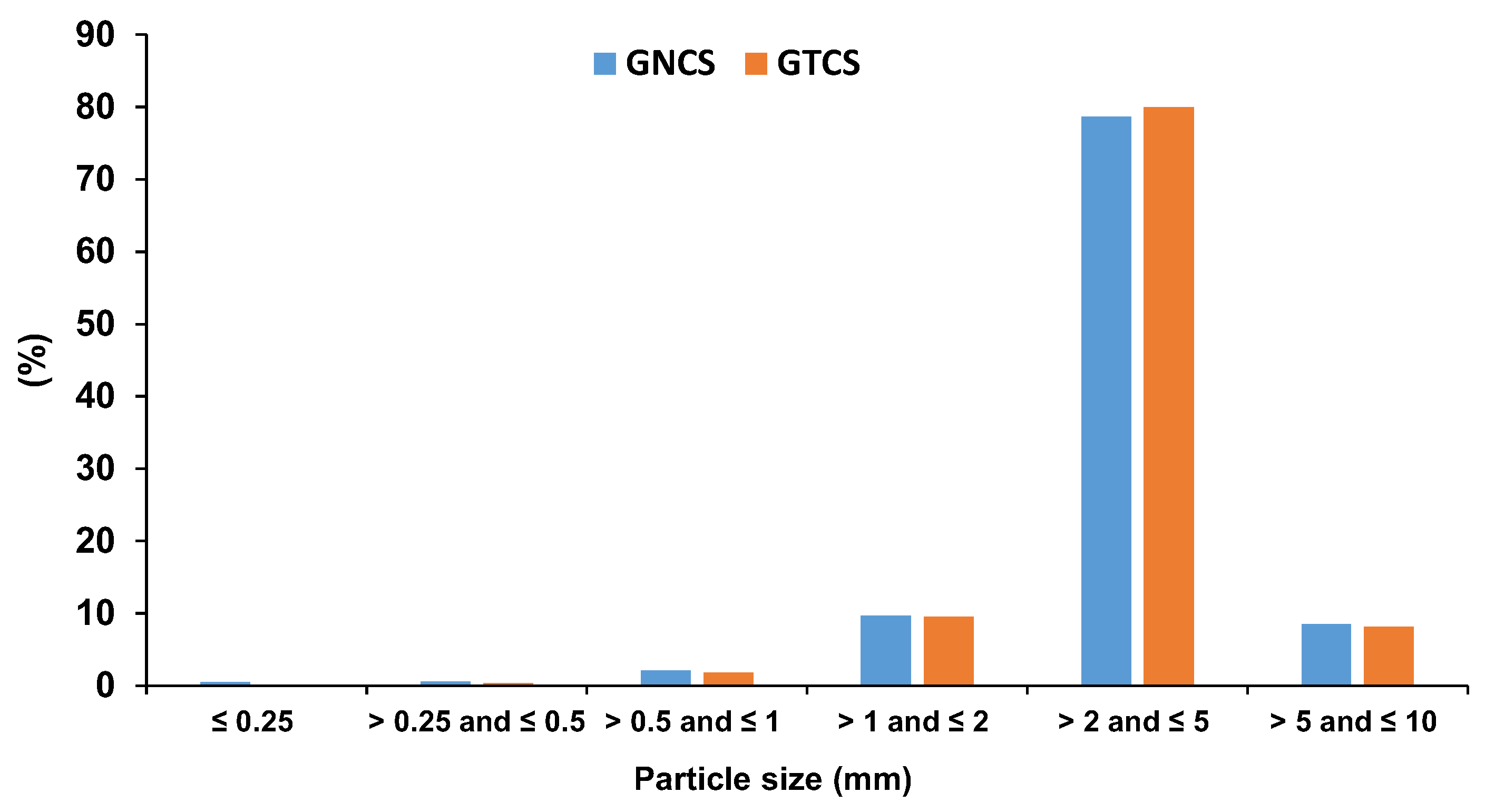
Granulates of natural cork stoppers (GNCS) and granulates of technical cork stoppers (GTCS) exhibit similar patterns in particle size classes or granulometric fractions (Figure 1). A classification system for their granulometric distribution has been proposed as follows: very fine fractions (≤1 mm); fine fractions (>1 and ≤2 mm); intermediate fractions (>2 and ≤5 mm); and coarse fractions (>5 and ≤10 mm). The highest proportion of granulates is observed within the intermediate fractions (>2 and ≤5 mm).
Understanding the particle size classes of a material is fundamental to the formulation of growing media. Particle size distribution directly influences the physical structure of the growing media, including its porosity, aeration, drainage, and water retention. Furthermore, selecting the appropriate particle size provides insights into nutrient availability and root nutrient uptake. Consequently, knowledge of particle size classes is crucial for predicting and optimizing plant growth conditions, promoting favorable root development, ensuring adequate nutrition, and maximizing productivity [50,51].

3.3. Physical and Chemical Properties

The physical and chemical properties of the granulate of natural cork stopper (GNCS) and the granulate of technical cork stopper (GTCS) are significantly affected by particle size class (fractionation). As particle size class increases, the bulk density (BD) decreases, and the total porosity (TP) increases in GNCS; however, this trend is not observed in GTCS (Table 2). It is assumed that this behavior may be related to the material characteristics (Table 1). Consistent with [51], the variation in particle size of organic materials used in growing media is influenced by factors including origin and nature, decomposition state, collection or extraction process, and crushing and screening conditions. In both types of granulates and across different classes, the obtained values support the findings of [50], who emphasized that bulk density and total porosity are inversely proportional properties. Additionally, the values obtained are within the recommended range for organic substrates [51]; therefore, no limitations are expected for these parameters in the formulation of growing media.
In all fractions of GNCS compared to GTCS (Table 2), pH values were slightly lower and below the recommended range. While electrical conductivity (EC) values were higher and also below the reference values, except in the very fine fraction (≤1 mm). In this fraction, the EC was higher for both granulates.
As noted by [53], the ideal pH for different plant types can vary considerably. Similarly to pH, the optimal EC level—which reflects salt solubility—can vary among plants. Maintaining an adequate balance of these factors through management practices such as pH correction and salinity control is essential [54]. These parameters are adjustable and therefore do not seem to be limiting factors for using cork stopper granulates as a component of growing media.

3.4. Mineral Elements

Granulate of natural cork stoppers (GNCS) showed significantly higher nutrient levels compared to granulate of technical cork stoppers (GTCS) (Table 3). As noted by [55], nutrient availability correlates with pH and EC. When pH is acidic (high H+ concentration), EC increases, as seen with GNCS (Table 2).
The very fine fraction (≤1 mm) shows higher nutrient availability in both granulates than the other fractions (Table 3). A very fine fraction can increase nutrient availability due to the larger surface contact area of the particles [56].
Overall, the nutrient values are low (Table 3), indicating low soluble salt content in these materials, as shown by the decreasing EC values as the size of the fractionated particles increased (Table 2). However, the granulates were found to be a source of sodium (Na) and potassium (K). GNCS (≤1 mm) significantly increased the availability of mineral nitrogen (Nmin), phosphorus (P), and magnesium (Mg). Proper fertilization planning can address the low nutrient content in growing media [49]. Therefore, the nutritional composition of cork stopper granulates (Table 3) shows that growing media formulated with these materials require fertilization to meet nutrient requirements. It is advisable to begin with a low nutrient level and progressively increase the fertilization rate as required [57].

3.5. Phytotoxicity

Table 4 shows the results for root length (RL) and the Munoo–Lisa vitality index (MLV) of cress seeds (Lepidium sativum). Granulate of natural cork stoppers (GNCS ≤ 1 mm) showed higher phytotoxicity (RL = 0.65 cm and MLV = 13.80%) compared to the control (RL = 4.63 cm and MLV = 100%). The germination rate of the seeds was not affected across different fractions, as the values were not significantly different from the control (100%).
It is common to encounter phytotoxicity in materials of forest origin [47], but studies suggest methods to reduce this issue and enhance the performance of these materials as growing media. Among these methods, leaching [58], aging [48], and hydrothermal treatment [59] are notable. Therefore, the presence of phytotoxicity in forest materials is not necessarily a limiting factor for their use as components of growing media, as previous studies have shown that certain organic residues can be rendered suitable after appropriate pretreatment. However, in the specific case of cork stopper granulates, the effectiveness, feasibility, and economic implications of potential pretreatment strategies remain uncertain and require further investigation. Thus, any mitigation approach should be evaluated experimentally before being recommended for practical application.

4. Conclusions

This study provides a detailed characterization of cork stopper granulates, allowing a clearer understanding of how these materials behave as potential components of growing media. The results show that fine and very fine particles exhibited higher total porosity and water-holding porosity, whereas coarse particles presented greater aeration porosity. These effects are inherent to the particle-size distribution of the materials analyzed, and any influence on the final growing media would depend on the proportions in which these fractions are incorporated.
The chemical composition revealed moderate amounts of extractives and lignin-derived compounds, as well as monosaccharides that may influence microbial activity; however, no plant cultivation test was conducted. Therefore, no conclusions can be drawn regarding nutrient delivery, plant performance, or mitigation strategies for potential phytotoxicity. Similarly, although pretreatment methods may reduce phytotoxicity in some organic residues, their effectiveness or applicability to cork stopper granulates remains unknown and requires further investigation.
Overall, the characterization presented here establishes a foundational understanding of the physical and chemical properties of cork-based materials and highlights the need for future studies that incorporate plant growth trials and growing media formulation experiments to assess their practical suitability.

Supplementary Materials

The following supporting information can be downloaded at: https://www.mdpi.com/article/10.3390/resources15040049/s1, Table S1: Standard deviation (SD) of physical and chemical properties of the raw material: bulk density (BD), total porosity (TP), available water (AW), air-filled porosity (AFP), pH, and electrical conductivity (EC). Table S2: Standard deviation (SD) of mineral elements present in raw material: mineral nitrogen (Nmin), phosphorous (P), sodium (Na), potassium (K), calcium (Ca), magnesium (Mg), sulfur (S), silicon (Si), iron (Fe), copper (Cu), zinc (Zn), manganese (Mn), and boron (B). Table S3: Standard deviation (SD) of phytotoxicity of cress seeds: root length (RL) and Munoo–Lisa vitality index (MLV).

Author Contributions

Conceptualization: D.F. and H.R.; validation: H.R., M.C., and J.G.; formal analysis: D.F., H.R., M.C., and J.G.; writing—original draft preparation: D.F.; writing—review and editing: H.R., J.G., and M.C.; visualization: H.R., J.G., and M.C.; supervision: H.R. and J.G. All authors have read and agreed to the published version of the manuscript.

Funding

This research was funded by Fundação para a Ciência e Tecnologia, I.P. (FCT), grant number 2021.08843.BD (DOI 10.54499/2021.08843.BD), doctoral fellowship awarded to Daniela Freitas.

Data Availability Statement

The original contributions presented in this study are included in the article. Further inquiries can be directed to the corresponding author.

Acknowledgments

The authors express their gratitude to Instituto Superior de Agronomia (ISA) for institutional support, to Amorim Cork S.A. for providing the by-products, and to Fundação para a Ciência e Tecnologia, I.P. (FCT) for financial support: (i) the support to the LEAF Research Center through project UID/04129/2025 (DOI 10.54499/UID/04129/2025); and (ii) the support to the Forest Research Center (CEF) through project UID/00239/2025 (DOI 10.54499/UID/00239/2025); and (iii) the funding of the Associate Laboratory TERRA under project LA/P/0092/2020 (DOI 10.54499/LA/P/0092/2020).

Conflicts of Interest

Author Miguel Cabral was employed by the company Amorim Cork S.A. The remaining authors declare that the research was conducted in the absence of any commercial or financial relationships that could be construed as a potential conflict of interest.

Abbreviations

The following abbreviations are used in this manuscript:
GNCSGranulate of natural cork stopper
GTCSGranulate of technical cork stopper GTCS
BDBulk density
TPTotal porosity
AWAvailable water
AFPAir-filled porosity
ECElectrical conductivity
DMDry mass
OMOrganic matter
NminNmineral
PPhosphorous
NaSodium
KPotassium
CaCalcium
MgMagnesium
SSulfur
SiSilicon
FeIron
CuCopper
ZnZinc
MnManganese
BBoron
SO42−Sulfate
H2PO4Dihydrogen phosphate
MoMolybdenum
MLVMunoo–Lisa Vitality Index
GRGermination rate

References

  1. Geetha, R. Circular economy through integrated industrial ecology: Innovations in resource recovery and process redesign. Biotech. Notes 2025, 6, 245–259. [Google Scholar] [CrossRef]
  2. Ferraz, D.; Pyka, A. Circular economy, bioeconomy, and sustainable development goals: A systematic literature review. Environ. Sci. Pollut. Res. 2023, 1–22. [Google Scholar] [CrossRef]
  3. Rego, L.; Mota, S.; Torres, A.; Pinto, C.; Cravo, S.; Silva, J.R.; Páscoa, R.N.M.J.; Almeida, A.; Amaro, F.; Pinho, P.G.; et al. Quercus suber bark as a sustainable source of value-added compounds: Experimental Studies with cork by-products. Forests 2023, 14, 543. [Google Scholar] [CrossRef]
  4. Silva, J.; Araújo, S.S.; Sales, H.; Pontes, R.; Nunes, J. Quercus suber L. Genetic resources: Variability and strategies for its conservation. Forests 2023, 14, 1925. [Google Scholar] [CrossRef]
  5. Lopes-Fernandes, M.; Martínez-Fernández, E.; Alves, R. Cork oak woodlands and decline: A social-ecological review and future transdisciplinary approaches. Agrofor. Syst. 2024, 98, 1927–1944. [Google Scholar] [CrossRef]
  6. Sustainability Report. Available online: https://www.amorimcork.com/xms/files/Relatorios_Sustentabilidade/Sustainability_Report_2023.pdf?utm_source=chatgpt.com (accessed on 15 January 2026).
  7. Silva, N.M.; Maurício, A.C.; Fernandes, R.; Barros, A.N. Cork by-products as bioactive ingredients: From waste valorization to pharmaceutical prototypes. Molecules 2026, 31, 95. [Google Scholar] [CrossRef]
  8. Bambagioni, E.; Anzilotti, S.; Borghi, C.; Chirici, G.; Salbitano, F.; Marchetti, M.; Francini, S. Satellite remote sensing for monitoring cork oak woodlands-A comprehensive literature review. Diversity 2025, 17, 420. [Google Scholar] [CrossRef]
  9. Freitas, D.; Gominho, J.; Ribeiro, H. Valorisation of product residues from the cork stoppers industry: Potential use as growing-media component for potted plants. Clean. Circ. Bioecon. 2025, 11, 100148. [Google Scholar] [CrossRef]
  10. Catalão, J.; Navarro, A.; Calvão, J. Mapping cork oak mortality using multitemporal high-resolution satellite imagery. Remote Sens. 2022, 14, 2750. [Google Scholar] [CrossRef]
  11. Sradnick, A.; Korner, O. Efficiently evaluating peat-free growing media for press pots: Effects of mixture combinations. Front. Hortic. 2025, 4, 1620375. [Google Scholar] [CrossRef]
  12. Manjari, R.; Malathi, G.; Balasubramaniam, P.; Irene, V.P.; Sara, P.B.K.; Vanitha, K. Exploring ideal growing media for the mass multiplication of plantation and spice crops. J. Plant Nutr. 2025, 48, 1214–1227. [Google Scholar] [CrossRef]
  13. Koseoglu, M.N.; Roberts, M. Supply chain dynamics of moving from peat-based to peat-free horticulture. Sustainability 2025, 17, 6159. [Google Scholar] [CrossRef]
  14. Sharma, B.; He, H.; Roulet, N.T. CO2 emitted from peat use in horticulture supports a lower emission factor. Carbon Manag. 2025, 16, 2468476. [Google Scholar] [CrossRef]
  15. Sharma, B.; Moore, T.R.; Roulet, N.T. Carbon balance and greenhouse gas emissions from horticultural plants grown in peat-based growing media. Front. Hortic. 2025, 4, 1655432. [Google Scholar] [CrossRef]
  16. Tanneberger, F.; Appulo, L.; Ewert, S.; Lakner, S.; Brolchain, N.O.; Peters, J.; Wichtmann, W. The power of nature-based solutions: How peatlands can help us to achieve key EU sustainability objectives. Adv. Sustain. Syst. 2021, 5, 2000146. [Google Scholar] [CrossRef]
  17. Hirschler, O.; Thran, D. Peat substitution in horticulture: Interviews with German growing media producers on the transformation of the resource base. Horticulturae 2023, 9, 919. [Google Scholar] [CrossRef]
  18. Campos, P.; Martin, A.M.S.; Lucas, M.; Ollala, A.S.; Rosales, M.A.; Rosa, J.M.L. Biochar and compost as sustainable alternatives to peat. Agronomy 2025, 15, 2455. [Google Scholar] [CrossRef]
  19. Sdão, A.E.; Gruda, N.S.; Lucia, B. Beyond peat: Wood fiber and two novel organic by products as growing media—A systematic review. Plants 2025, 14, 1945. [Google Scholar] [CrossRef] [PubMed]
  20. Hirschler, O.; Osterburg, B. Achieving peat-free hobby gardening for climate mitigation in Germany: Insights into prices of growing media constituents, potting soils and policy. Resour. Conserv. Recycl. 2025, 220, 108330. [Google Scholar] [CrossRef]
  21. Samanez, C.A.L.; Carrión, M.L.H.; Ponce, W.C.C.; Cruz, G. Technological innovations and circular economy in the valorization of agri-food by products: Advances, challenges and perspectives. Foods 2025, 14, 1950. [Google Scholar] [CrossRef]
  22. Dede, O.H.; Ozer, H. Investigating the impact of various growing media on the expansion of green wall plant coverage with image analysis. Horticulturae 2023, 10, 654. [Google Scholar] [CrossRef]
  23. Sdão, A.E.; Cacini, S.; Laconsole, D.; Conversa, G.; Cristiano, G.; Antonio, E.; Lúcia, B. Partial replacement of peat: Effects on substrate physico-hydrological properties and sage grown. Plants 2025, 14, 2801. [Google Scholar] [CrossRef] [PubMed]
  24. Machado, R.; Serralheiro, R.P. Soil salinity: Effect on vegetable crop growth. Management practices to prevent and mitigate soil salinization. Horticulturae 2017, 3, 30. [Google Scholar] [CrossRef]
  25. Gonzalez, R.S.V.; Garcia, A.L.G.; Zapata, E.V. A review on hydroponics and the techonologies associated for medium and small sacale operations. Agriculture 2022, 12, 646. [Google Scholar] [CrossRef]
  26. Liu, J.; Cui, W.; Qi, Z.; Wu, L.; Zhou, W. Plant-derived waste as a component of growing media: Manifestation, assessments, and sources of their phytotoxicity. Plants 2024, 13, 2000. [Google Scholar] [CrossRef]
  27. DIN 66165-1; Particle Size Analysis—Sieving Analysis—Part 1: Fundamentals. German National Standard. DIN: Berlin, Germany, 2016.
  28. TAPPI T 15 os-58; Ash in Wood, Pulp, Paper and Paperboard. Technical Association of the Pulp and Paper Industry: Atlanta, GA, USA, 1958.
  29. TAPPI T 204 cm-07; Solvent Extractives of Wood and Pulp. Technical Association of the Pulp and Paper Industry: Atlanta, GA, USA, 2007.
  30. TAPPI T 13 m-54; Lignin in Wood. Technical Association of the Pulp and Paper Industry: Atlanta, GA, USA, 1954.
  31. UM 205 om-83; Acid-Soluble Lignin in Wood and Pulp. Technical Association of the Pulp and Paper Industry: Atlanta, GA, USA, 1983.
  32. Dionex Corporation. CarboPac PA10 Column Product Manual; Thermo Scientific/Dionex: Sunnyvale, CA, USA, 2010. [Google Scholar]
  33. Wallach, R. Physical characteristics of soilless media. In Soilless Culture, 2nd ed.; Elsevier: Amsterdam, The Netherlands, 2019; pp. 33–112. [Google Scholar] [CrossRef]
  34. EN13041; Soil Improvers and Growing Media—Determination of physical properties—Dry Bulk Density, Air Volume, Water Volume, Shrinkage Value and Total Pore Space. European Committee for Standardization: Brussels, Belgium, 2011.
  35. EN 13037; Soil Improvers and Growing Media—Determination of pH. European Committee for Standardization: Brussels, Belgium, 1999.
  36. EN 13038; Soil Improvers and Growing Media, Determination of Electrical Conductivity. European Committee for Standardization: Brussels, Belgium, 1999.
  37. EN 13652; Soil Improvers and Growing Media, Extraction of Water-Soluble Nutrients and Elements. European Committee for Standardization: Brussels, Belgium, 2001.
  38. EN 16086-2; Soil Improvers and Growing Media, Determination of Plant Response—Part 2: Petri Dish Test Using Cress. European Committee for Standardization: Brussels, Belgium, 2011.
  39. Engel, J.B.; Luchese, C.L.; Tessaro, I.C. Characterization techniques comparison towards a better understanding of different cork-based stoppers types. J. Food Eng. 2022, 328, 111063. [Google Scholar] [CrossRef]
  40. Suffo, M.; Sales, D.L.; Triviño, E.C.; Mata, M.; Jiménez, E. Characterization and production of agglomerated cork stoppers for spirits based on a factor analysis method. Food Packag. Shelf Life 2022, 31, 100815. [Google Scholar] [CrossRef]
  41. Yoon, H.; Yoon, B.; Cho, S.H.; Oh, T.; Suhr, J. Plasticizing effect of depolymerized suberin derivatives from natural cork and potato periderm in poly (lactic acid) (PLA) for improved toughness and processability. Indu. Crops Prod. 2024, 209, 117990. [Google Scholar] [CrossRef]
  42. Elmaci, S.B.; Schultz, J.; Isci, A.; Scherzinger, M.; Aslanhan, D.D.; Cam, M.D.; Sakiyan, O.; Kaltschmitt, M. Deep eutectic solvent pretreatment of cork dust—Effects on biomass composition, phenolic extraction and anaerobic degradability. Waste Manag. 2024, 181, 114–127. [Google Scholar] [CrossRef] [PubMed]
  43. Gendron, J.; Stambouli, I.; Bruel, C.; Boumghar, Y.; Montplaisir, D. Characterization of different types of lignin and their potential use in green adhesives. Indus. Crops Prod. 2022, 182, 114893. [Google Scholar] [CrossRef]
  44. Gendron, J.; Bruel, C.; Boumghar, Y.; Montplaisir, D. Preparation and optimization of a lignin-based pressure-sensitive adhesive. MethodsX 2023, 10, 102144. [Google Scholar] [CrossRef] [PubMed]
  45. Carriço, C.M.; Tiritan, M.E.; Cidade, H.; Afonso, C.; Silva, J.R.; Almeida, I.F. Added-value compounds in cork by-products: Methods for extraction, identification, and quantification of compounds with pharmaceutical and cosmetic interest. Molecules 2023, 28, 3465. [Google Scholar] [CrossRef]
  46. Azevedo, J.; Lopes, P.; Mateus, N.; Freitas, V. Cork, a natural choice to wine? Foods 2022, 11, 2638. [Google Scholar] [CrossRef]
  47. Gruda, N.S. Increasing sustainability of growing media constituents and standalone substrates in soilless culture systems. Agronomy 2019, 9, 298. [Google Scholar] [CrossRef]
  48. Barrett, G.E.; Alexander, P.D.; Robinson, J.S.; Bragg, N.C. Achieving environmentally sustainable growing media for soilless plant cultivation systems—A review. Sci. Hortic. 2016, 212, 220–234. [Google Scholar] [CrossRef]
  49. Cannavo, P.; Recous, S.; Valé, M.; Bresch, S.; Paillat, L.; Benbrahim, M.; Guénon, R. Organic Fertilization of Growing Media: Response of N Mineralization to Temperature and Moisture. Horticulturae 2022, 8, 152. [Google Scholar] [CrossRef]
  50. Molari, M.; Dominici, L.; Comino, E. Experimenting growing media through local bio-resources valorisation: A design-oriented approach for living walls. J. Clean. Prod. 2024, 436, 140446. [Google Scholar] [CrossRef]
  51. Durand, S.; Jackson, B.E.; Fonteno, W.C.; Michel, J.C. Quantitative description and classification of growing media particle morphology through dynamic image analysis. Agriculture 2023, 13, 396. [Google Scholar] [CrossRef]
  52. Chemetova, C.; Mota, D.; Fabião, A.; Gominho, J.; Ribeiro, H. Low-temperature hydrothermally treated Eucalyptus globulus bark: From by product to horticultural fiber-based growing media viability. J. Clean. Prod. 2021, 319, 128805. [Google Scholar] [CrossRef]
  53. Hosseini, H.; Mozafari, V.; Roosta, H.R.; Shirani, H. Nutrient use in vertical farming: Optimal electrical conductivity of nutrient solution for growth of Lettuce and basil in hydroponic cultivation. Horticulturae 2021, 7, 283. [Google Scholar] [CrossRef]
  54. Yang, T.; Samarakoom, U.; Altland, J.; Ling, P. Influence of electrical conductivity on plant growth, nutritional quality, and phytochemical properties of kale (Brassica nupus) and collard (Brassica oleracea) Grown using hydroponics. Agronomy 2024, 14, 2704. [Google Scholar] [CrossRef]
  55. Ferrarezi, R.S.; Lin, X.; Neira, A.C.G.; Zambon, F.T.; Hu, H.; Wang, X.; Huang, J.-H.; Fan, G. Substrate pH Influences the nutrient absorption and rhizosphere microbiome of huanglonbing-affected grapefruit plants. Front. Plant Sci. 2022, 13, 856937. [Google Scholar] [CrossRef] [PubMed]
  56. Tang, Y.; Shen, Y.; Feng, H.; Wu, H. Study on primary Physicochemical characteristics and nutrient adsorption ou four plant cultivation substrate. Life Sci. Space Res. 2023, 36, 78–85. [Google Scholar] [CrossRef]
  57. Lee, D.H.; Park, M.S.; Lee, C.W.; Choi, J.M. Determination of the optimal nitrogen concentration in pre-planting fertilizers for the cultivation of tomato. Korean J. Hortic. Sci. Technol. 2017, 35, 431–438. [Google Scholar] [CrossRef]
  58. Gruda, N.; Rau, B.J.; Wright, R.D. Laboratory bioassay and greenhouse evaluation of a pine tree substrate used as a container substrate. Eur. J. Horti. Sci. 2009, 74, 73–78. [Google Scholar] [CrossRef]
  59. Chemetova, C.; Fabião, A.; Gominho, J.; Ribeiro, H. Range analysis of Eucalyptus globulus bark low-temperature hydrothermal treatment to produce a new component for growing media industry. Waste Manag. 2018, 79, 1–7. [Google Scholar] [CrossRef] [PubMed]
Figure 1. Distributions of the particle size in different fractions: GNCS and GTCS.
Resources 15 00049 g001
Table 1. Chemical composition of the granulate natural cork stopper (GNCS) and the granulate of the technical cork stopper (GTCS). Values are expressed as a percentage of dry weight (% DW).
CompoundsGNCSGTCS
(% DW)
Ash0.950.69
Total extractives14.3514.72
  Dichloromethane6.699.65
  Ethanol2.742.01
  Water5.113.06
Total suberin52.1041.80
Total lignin17.1119.42
  Klason lignin16.2818.45
  Soluble lignin0.820.97
Total monosaccharides4.3517.29
  Glucose2.327.83
  Rhamnose0.060.21
  Arabinose0.341.85
  Galactose0.271.06
  Xylose1.376.34
No statistical analysis was performed because the chemical characterization was based on composite samples.
Table 2. Physical and chemical properties of the raw material: bulk density (BD), total porosity (TP), available water (AW), air-filled porosity (AFP), pH, and electrical conductivity (EC). Values are means (n = 4). Means followed by the same letter within a column do not differ at p ≤ 0.05 according to the LSD test. Standard deviations are provided in Table S1 (Supplementary Material). The acceptable range was taken from [52].
Raw-MaterialParticle SizeBDTPAWAFPpHEC
(mm)(g dm−3) (%v/v) (µS/cm)
1NF70.36 f95.48 a0.27 d78.94 b5.40 bc99.26 d
≤1147.33 a90.69 f28.85 a26.51 f4.84 d634.78 a
GNCS>1 and ≤272.36 f95.36 a1.53 c71.69 c5.17 cd131.40 b
>2 and ≤571.46 f95.41 a0.54 cd78.93 b5.32 c75.96 e
>5 and ≤1070.66 f95.46 a0.75 cd82.44 a5.44 bc55.09 fg
1NF105.90 d93.18 c0.27 d71.56 cd6.15 a58.91 f
≤1124.93 b91.98 e9.48 b51.65 e6.08 a114.95 c
GTCS>1 and ≤2102.17 e93.43 b0.30 d69.98 d5.84 a60.30 f
>2 and ≤5112.17 c92.78 d0.27 d71.88 c5.76 ab49.63 g
>5 and ≤10124.63 b91.98 e0.44 cd72.91 c5.90 a36.72 h
Acceptable range <400>8524–4020–305.5–6.5350–650
1NF = Not fractionated (material).
Table 3. Mineral elements present in raw material: mineral nitrogen (Nmin), phosphorous (P), sodium (Na), potassium (K), calcium (Ca), magnesium (Mg), sulfur (S), silicon (Si), iron (Fe), copper (Cu), zinc (Zn), manganese (Mn), and boron (B). Values are means (n = 4). Means sharing the same letter within a column are not significantly different at p ≤ 0.05 according to the LSD test. Standard deviations are provided in Table S2 (Supplementary Material). The acceptable range was taken from [52].
Raw MaterialParticle SizeNminPNaKCaMgSSiFeCuZnMnB
(mm) (mg L−1)
1NF15.65 c8.16 d23.99 c76.33 d11.82 c2.15 cd30.04 c5.27 de0.48 bc0.07 d0.11 bc0.05 cd0.33 c
≤197.33 a46.13 a155.30 a413.61 a123.99 a16.02 a269.48 a12.92 a1.31 a0.28 a1.24 a1.53 a1.80 a
GNCS>1 and ≤220.75 b12.21 c35.48 b106.07 c15.41 b2.73 b44.81 b5.34 de0.39 bc0.09 b0.14 b0.08 bc0.47 b
>2 and ≤512.16 d7.65 de19.65 d64.35 e10.05 c1.88 de23.01 d3.99 g0.34 c0.06 de0.06 cde0.03 de0.29 d
>5 and ≤109.55 e4.68 g12.73 e47.40 f6.10 d1.40 ef15.03 e2.96 h0.96 ab0.06 def0.10 bcd0.01 e0.20 e
1NF6.03 f6.93 e12.66 e77.03 d6.54 d1.48 ef5.55 fg5.88 cd0.27 c0.05 fgh0.06 cde0.03 de0.25 d
≤16.43 f15.17 b26.05 c140.26 b12.67 bc2.67 bc7.98 f9.63 b0.33 c0.08 c0.10 bcd0.11 b0.48 b
GTCS>1 and ≤25.61 fg7.93 d12.27 e83.06 d6.26 d1.47 ef3.98 g6.42 c0.28 c0.06 efg0.05 de0.02 de0.26 d
>2 and ≤55.45 fg6.00 f10.75 e66.28 e4.53 d1.28 f3.48 g4.75 ef0.18 c0.05 gh0.04 e0.01 e0.20 e
>5 and ≤104.57 g4.36 g9.98 e43.64 f4.30 d1.06 f3.14 g4.27 fg0.09 c0.05 h0.03 e0.01 e0.15 f
Acceptable range 50–25019–75<10051–40016–8016–80 0.3–3.00.001–0.50.3–3.00.02–3.00.05–0.5
1NF = Not fractionated (material).
Table 4. Phytotoxicity of cress seeds: root length (RL) and Munoo–Lisa vitality index (MLV). Values are means (n = 3). Means sharing the same letter within the column are not significantly different at p ≤ 0.05 according to the LSD test. Standard deviations are provided in Table S3 (Supplementary Material).
Raw MaterialParticle SizeRLMLV
(mm)(cm)(%)
1NF4.28 ab92.51 ab
≤10.65 c13.80 c
GNCS>1 and ≤23.56 b76.89 b
>2 and ≤53.83 ab82.86 ab
>5 and ≤103.85 ab83.15 ab
1NF4.26 ab92.01 ab
≤13.95 ab85.38 ab
GTCS>1 and ≤23.52 b76.17 b
>2 and ≤53.99 ab83.22 ab
>5 and ≤104.21 ab91.00 ab
Nutrient solution 4.63 a100.00 a
1NF = Not fractionated (material).
Disclaimer/Publisher’s Note: The statements, opinions and data contained in all publications are solely those of the individual author(s) and contributor(s) and not of MDPI and/or the editor(s). MDPI and/or the editor(s) disclaim responsibility for any injury to people or property resulting from any ideas, methods, instructions or products referred to in the content.