Article

Assessment of Community Dependence and Perceptions of Wetlands in the Upper Chindwin Basin, Myanmar


1
Stockholm Environment Institute, Asia Centre, Chulalongkorn University, Bangkok 10330, Thailand
2
Environmental Research Institute, Chulalongkorn University, Bangkok 10330, Thailand
*
Author to whom correspondence should be addressed.
Resources 2023, 12(10), 112; https://doi.org/10.3390/resources12100112

Submission received: 10 September 2023 / Accepted: 18 September 2023 / Published: 22 September 2023

Abstract

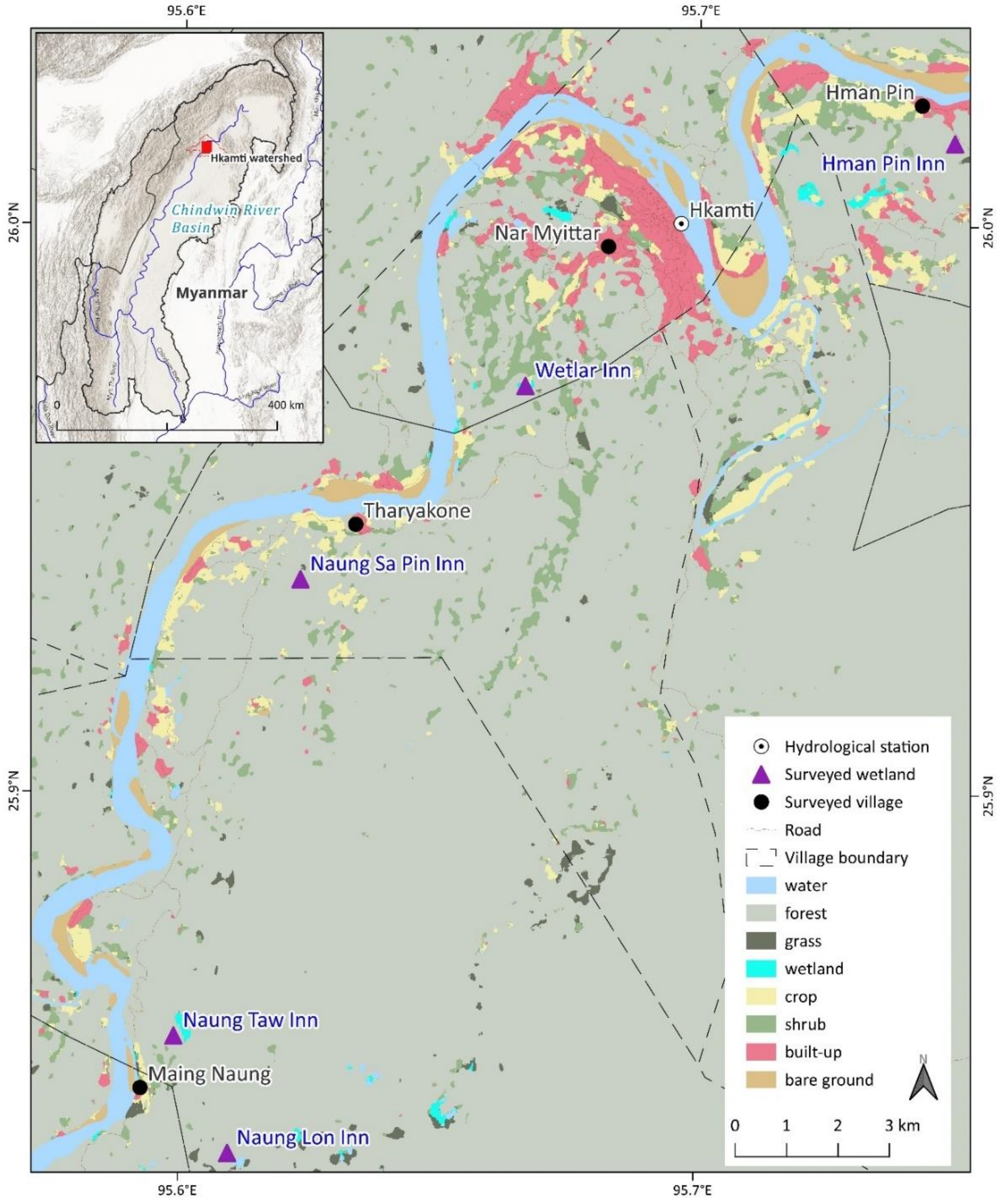
Understanding the relationship between communities and wetland ecosystems is imperative to facilitate the development of wetland management and conservation strategies that can effectively safeguard wetland health and sustain the flow of ecosystem services. To understand the knowledge, attitude, and perception of communities on wetland ecosystem services, a survey was conducted involving 133 households from 4 villages dependent on 5 wetlands within the Upper Chindwin Basin (UCB), northwestern Myanmar. Most of the respondents extracted wetland resources for subsistence and income. A total of 84% of the households depended on wetland fish for their primary protein consumption, while 70% (n = 94) collected fuelwood from wetlands for subsistence. The survey participants unanimously recognized the benefits of wetland ecosystem services (i.e., provisioning benefits), particularly for fish, food, fiber, fuel, natural medicines, ornamental resources, and minerals. A total of 97% of the participants lacked knowledge of any existing law or regulation that ensures wetland protection in Myanmar. Furthermore, 87% of the respondents concurred that the government has not adequately endeavored to promote awareness of wetland conservation in this remote area due to lack of capacity and resources. This study establishes a baseline for the region and recommends designing and implementing a community-centric wetland action plan. This action plan provides a self-sustaining and cost-effective approach to conserve wetlands and is crucial in enhancing the capacity of dependent communities to participate and eventually lead wetland management of UCB.
Keywords: community dependence; perception; wetlands ecosystem services; Upper Chindwin Basin; Myanmar community dependence; perception; wetlands ecosystem services; Upper Chindwin Basin; Myanmar