Review

Wearable, Self-Powered Electronic Devices: Logical Framework for Transforming the Future of Digital Health


by
Jegan Rajendran
1,*,
Nimi Wilson Sukumari
2 and
Manikandan Rajendran
3
1
Department of Electrical and Computer Engineering, Lawrence Technological University, Southfield, MI 48075, USA
2
School of Engineering and Technology, Karunya University, Coimbatore 641114, India
3
Department of Electronics and Communication Engineering, Annai Vailankanni College of Engineering, Kanyakumari 629401, India
*
Author to whom correspondence should be addressed.
J. Low Power Electron. Appl. 2026, 16(2), 20; https://doi.org/10.3390/jlpea16020020
Submission received: 4 May 2026 / Revised: 3 June 2026 / Accepted: 11 June 2026 / Published: 16 June 2026

Abstract

The increasing demand of digital technologies and their integration with wearable health devices provides an efficient trigger for next-generation wearable healthcare devices for long-term physiological monitoring. The advancement of energy harvesting mechanism, nanomaterial-based sensor fabrication and their integration with digital technologies have emerged as a promising solution for transforming future of digital health. This study provides a comprehensive summary and framework for wearable self-powered electronic devices, enabling continuous, battery-free health monitoring and advancing the development of sustainable, next-generation digital healthcare systems. This review paper presents a broad and detailed overview of current technologies and sensors advancement in developing low-power wearable, self-powered electronic devices suitable for healthcare applications. The importance and reliable use of key energy harvesting approaches including triboelectric, piezoelectric, thermoelectric, and photovoltaic approaches are systematically presented which focused on development of energy efficient wearable devices. This review further examines the low-power circuit design strategies for flexible electronics focusing personalized healthcare monitoring. Current challenges and limitations related to advanced manufacturing of wearable health devices focusing on large-scale deployment are also analyzed. Finally, the key future research directions are outlined for advancing a next-generation intelligent digital health system.

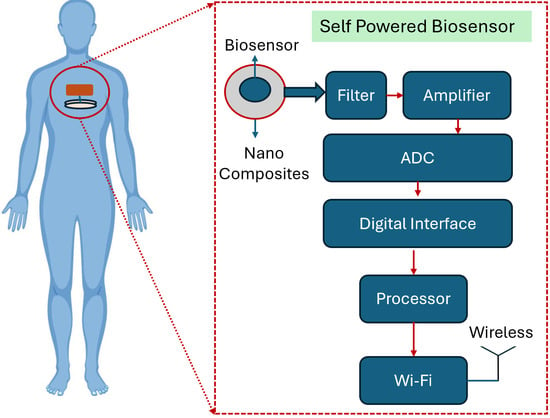
Graphical Abstract

1. Introduction

The applicable use of digital electronic healthcare devices provides a transformation from clinical assessment evaluation into personalized long-term monitoring of physiological signal. The rapid use of digital health wearables enables monitoring of various health vital parameters which are designed specific to applications such as cardiovascular and neurological health monitoring [1,2]. The advancement of wearable devices by integrating low-power circuits extends the operational time by reducing power consumption and makes them suitable for large-scale medical devices for disease detection and real-time monitoring. The role of biosensing technologies and their integration with conductive nanomaterials with digital readout circuitry develops sophisticated devices for non-invasive measurement and evaluation of disease specific vital parameters which includes systolic and diastolic blood pressure levels [3], blood sugar levels [4], oxygen saturation [5], and heart rate variability [6]. This transition from small-scale to large-scale detection has been driven through low-power miniaturized electronics [7], novel conductive materials [8], and various adaptive data processing techniques [9] focusing on transforming prototype design to their usage in clinical decision [10]. The current advancement of wearable devices supports preventive healthcare [11], managing chronic diseases [12], IoT monitoring [13], and personalized data recording [14]. These features facilitate earlier assessment and detection of diseases and enable timely clinical decisions. The healthcare system has drastically evolved in all aspects such as patient-centric, data analytics, fast detection through machine learning algorithms and integration of Internet of Medical Things, mobile health platforms further extend the applicable development of future digital healthcare devices for continuous health monitoring [15,16]. The existing reviews primarily focused on and examined various wearable applications including sensor integration, sensor networks deployment, and communication networks [17,18].
The field of low-power wearable sensors has seen a notable shift, with a growing focus on self-sustaining power, seamless integration into IoT, textiles and a move beyond general wellness tracking to sophisticated medical grade monitoring and long-term physiological tracking [19]. Along with rapid progress, there are several challenges such as low-power circuit design, low battery life, data security and privacy, maintaining electronic health records, and clinical validation continue to degrade the adoption in the field of healthcare [20,21,22,23,24,25,26,27,28]. Focusing on this evolution, broader trends in healthcare digital devices toward preventive, predictive, and personalized healthcare monitoring have transformed the future of digital health [21].
The evolution of self-sustaining systems has become increasingly important to overcome these limitations. The advantages and applicable use of energy harvesting provide a solution to utilize them into digital healthcare devices for self-powered continuous operation by extracting the required energy automatically by body and environmental sources [29,30]. Self-powered wearable digital devices (SPWDs) enable autonomous operation and deliver wide range of benefits such as enhancing portability, energy efficiency, and improving user comfort [31]. Unlike traditional battery-operated wearable digital devices, self-powered devices can harvest energy from various sources and enable low-power sensing applications with prolonged time. The implementation and design of low-power circuits for sensing and energy harvesting act as a fundamental principle behind the development of next-generation smart digital devices. The incorporation of these techniques is not only required for powering the devices but used to deliver uninterrupted services for signal processing and data management. Furthermore, the integration of soft, flexible, biocompatible materials with advanced integration of conductive polymers provides self-adhesiveness with the human surface for ensuring user comfort and wearability in real-world healthcare applications [32]. The fundamental mechanisms for experimental procedure and material selection and properties characterization are essential for the design and integration of autonomous wearable digital devices and low-power energy-efficient sensing systems.
This study presents a detailed overview of recent developments in self-powered wearable sensor technologies aimed at next-generation future wearable electronic device development. Unlike existing reviews that primarily focus on individual aspects such as sensor integration, energy harvesting technologies, and communication networks, this study presents a comprehensive system-level logical framework for wearable self-powered electronic devices. Specifically, it integrates energy harvesting, power management, sensing modules, low-power system design, and digital health applications into a unified perspective. Furthermore, we identify key challenges and future development pathways toward sustainable, autonomous, and clinically deployable wearable healthcare systems. Key energy harvesting approaches, design methodologies, material choices, and system integration strategies are systematically compiled and presented with the support of existing published articles in the same field. The review further examines applications in physiological monitoring, disease diagnosis, and signal analysis, while addressing critical technical challenges such as limited energy conversion efficiency, biocompatibility, material flexibility, and signal stability. The organization of this study is outlined as follows. Section 2 outlines the fundamental principles of wearable digital health systems; Section 3 presents energy harvesting techniques for low-power wearable devices. Section 4 reviews design strategies for wearable flexible electronics. Section 5 highlights major challenges and emerging research opportunities, and Section 6 concludes the paper with future perspectives on sustainable and autonomous wearable healthcare technologies.

2. Overview of Wearable Digital Health Monitoring Systems

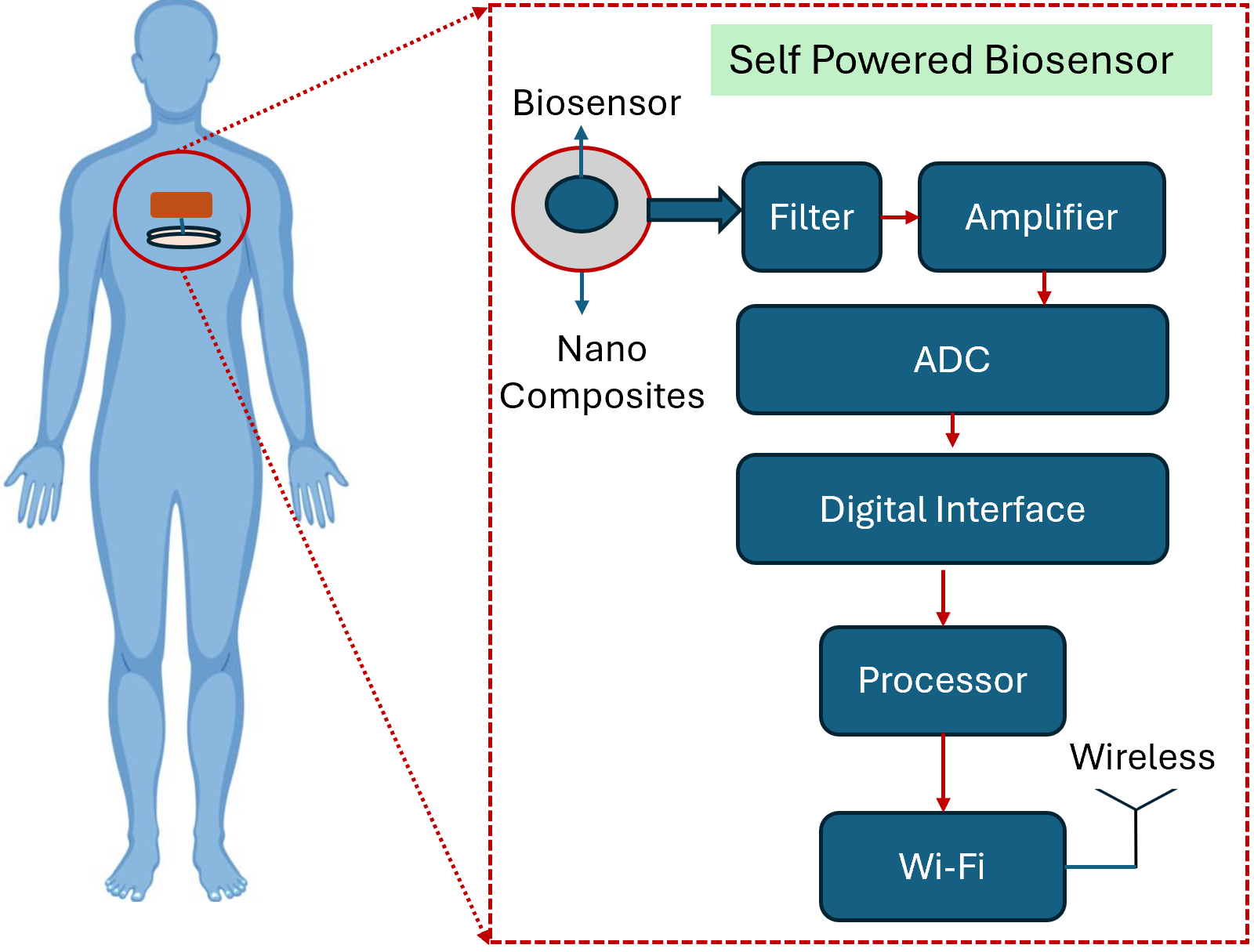
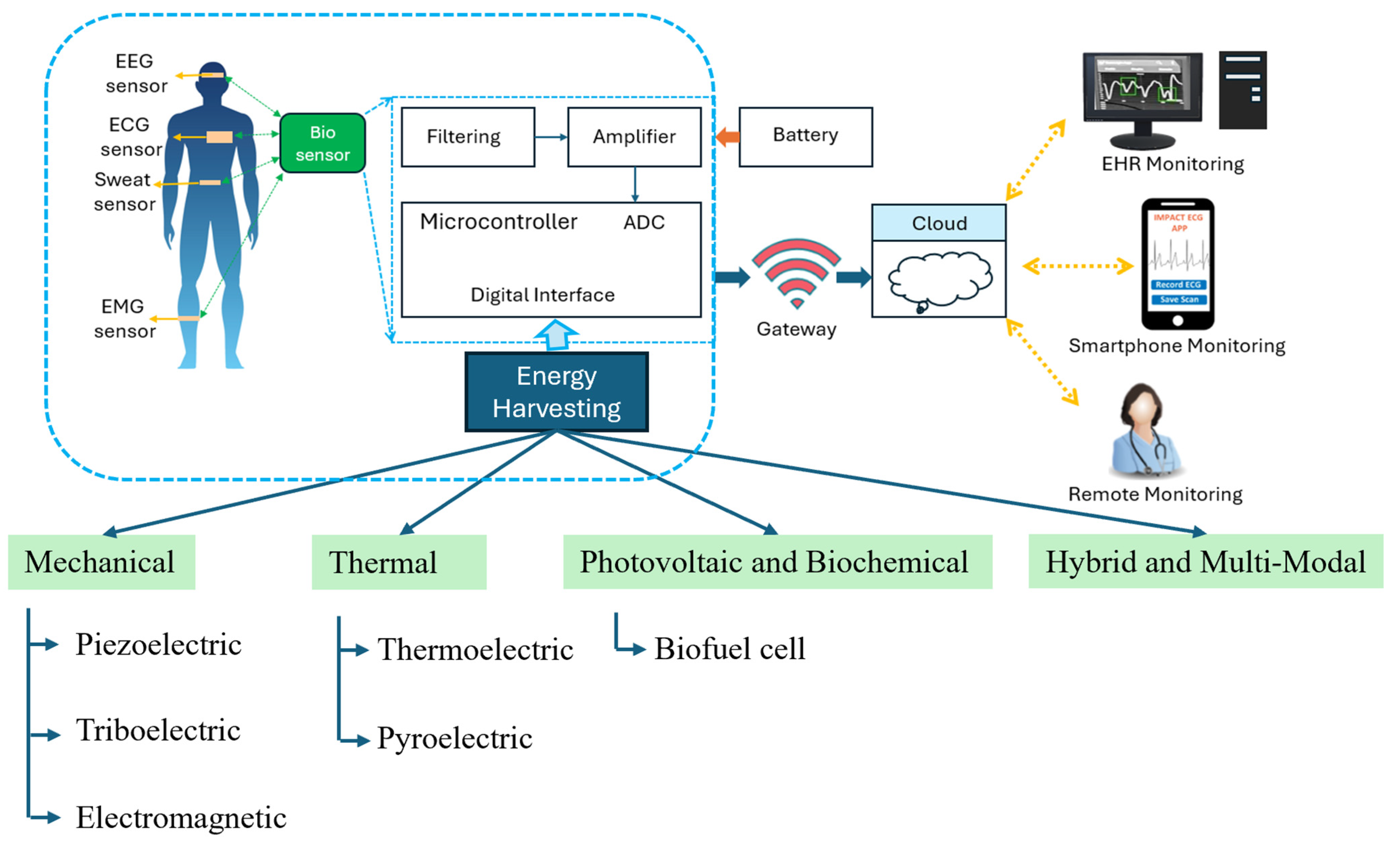
Wearable digital health systems are compact and easy body-worn electronic platforms designed to monitor physiological signals that translate into clinically meaningful information. Arrhythmia in heart activities is commonly identified using bedside monitoring ECG systems, wearable halter monitors and implantable loop recorders, but each device operation has drawbacks. Bedside monitoring limits patient movement and often fails to acquire intermittent events, resulting in low detection rates. Halter devices enable longer recording periods with improved mobility [33], yet they still provide limited diagnostic yield and delayed clinical feedback. Implantable devices and their operating procedure involve complexity, increased cost, and invasive device placement. Therefore, a continuous, real-time, and energy-efficient wearable solution is essential to improve diagnostic accuracy and patient convenience [34]. Figure 1 presents the functional architecture of fully integrated wearable digital health monitoring systems.
These systems integrate sensors, signal conditioning circuits, processing units, communication modules, and power sources into lightweight miniaturized user-friendly devices such as wristbands, patches, textiles, and smart garments. The architecture of these wearable digital health systems typically consists of five main building blocks: sensing unit, analog front-end (AFE), processing unit, communication interface, and power management subsystem for signal acquisition, processing, and monitoring. These wearable digital devices with sensor capabilities reshape the requirement of personalized healthcare and disease management. Their design and reliability, however, depend mostly on sensing precision, system flexibility, and energy extracting efficiency which determine the long-term usability of these devices.

2.1. Significance of Low-Power Circuit Design

The low-power circuit design for healthcare devices becomes essential for reducing power consumption which has emerged as a significant challenge with higher computational complexities. The scaling of nanometer dimensions and its device characterization allows more components required for specific operation can be integrated into a single chip for higher processing and miniaturization. However, these approaches trigger many reliability issues such as short-channel effects (SCEs), and variations in the process and current density which further increases higher power dissipation and generates more heat to reduce the lifespan for device operation. The wide use of the Internet of Things (IoT) and the advancement of the Internet of Bio-Nano Things (IoBNT) have emphasized the importance of low-power circuits for self-powered operation on wearable devices to execute the task independently without power sources. Table 1 summarizes the related work carried out in the field of low-power device fabrication suitable for wearable applications. The low-power circuit design with biosensors requirement is especially important for wearable and implantable miniaturized biomedical devices, in which the size limitations and biocompatibility constraints restrict the reliance on large batteries, which promotes energy harvesting from surrounding sources a promising alternative. These technologies offer wide range of benefits to healthcare networks in vital signs monitoring systems and sports performance tracking systems. These challenges require further research across multiple levels such as device fabrication, flexible circuit design, system integration, and application development.
Table 1. Summary of recently reported literature for low-power circuit design in wearables.
Ref.Sensors UsedPower/EnergyPower Management UnitSelf-Powered
[36]ECG, SCG, PPG, body temperature, pulse vibration Not specifiedIntegrated battery management systemNo (battery-powered wearable patch).
[37]Chest PPG sensorDynamic range (DR) IC optimized for wearable chest PPG No battery management systemConventional IC electronics integrated on a 20 cm2 PCB and does not incorporate any energy harvesting
[38]ECG dry textile electrodes, motion/activity sensor683 μWMulti-source energy-combining power management systemYes (indoor solar + thermoelectric energy harvesting)
[39]Wearable motion sensorsUp to 95% energy reductionLightweight trigger-based energy-aware control algorithmNo
[40]Activity monitoring sensors<0.005% energy-management overheadAdaEM ML-based adaptive energy management with DyRO optimizationYes (energy harvesting assisted/self-sustainable)
[41]Sweat biochemical sensorsNot specifiedTriboelectric nanogenerators (TENGs), biofuel cells (BFCs), and solar cells (SCs)Yes (fully self-powered)
[42]Sweat biosensorsLow-voltage operationNoNo
[43]Active human motion sensorsSystem powered by triboelectric nanogeneratorIntegrated energy harvesting and power management circuitYes (battery-free triboelectric nanogenerator based on kinesio tapes)
[44]Flexible pressure sensorSolid–liquid triboelectric chargingNot specifiedYes (hydrophobic triboelectric layet)
[45]Gait sensorHigh output: 156.6 V, 46.9 μA and 13.5 mW PowerSodium alginate/gelatin-based triboelectric nanogeneratorYes (triboelectric nanogenerator)
[46]Gait recognition sensorPeak output power of 5.82 mWTilted magnetic microneedle surface (TMMS-TENG)Yes (triboelectric self-powered wearable sensor)

2.2. Physiological Monitoring Parameters

Wearable digital health devices are widely suitable for online tracking of vital signs through physiological signals that indicate the health condition of the patient. The most common parameters used to analyze the status of health conditions include heart rate, RR interval, blood oxygen saturation (SpO2), blood pressure, respiratory rate, skin temperature, glucose level ranges, and time-dependent physical activity. Advanced sophisticated systems can be used to acquire and record electroencephalograms (EEG), electromyography (EMG), sweat biomarkers, and hydration levels. The advantage of developing these devices is to record these signals and enable early detection of abnormalities which could be used for real-time clinical decision-making. There are many portable devices available, and the required sensing is determined by the specific application. Hayirlioglu, Y.Z et al. developed a wearable patch for concurrent signal monitoring to derive hemodynamic parameters which includes heart rate, heart rate variability, respiration rate, and oxygen saturation levels. The experiments have been conducted with 20 participants and results demonstrated high-quality signal acquisition and accurate estimation of various vital signs. This indicates and supports wearable device potential for long-term remote monitoring [36]. Another study presents a high dynamic range integrated system for wearable chest-based PPG monitoring, capable of accurately capturing weak cardiac signals and respiratory artifacts. Validation with six adults showed over 99.53% heart rate accuracy (0.41 bpm deviation) compared to ECG, more than 98.6% agreement with finger and wrist PPG devices, HRV deviation below 12.8 ms, and reliable estimation of respiration rate and SpO2 [37]. The application of low-power circuit design for wearable electronics is able to monitor these physiological vital parameters and is essential for predicting early-stage diseases. Similarly, a flexible sleep monitoring belt was developed by integrating electrocardiogram (ECG) sensing, and a lightweight convolutional neural network (CNN) model for simultaneous heart rate variability (HRV) and sleep posture detection. Experimental results show 91.1% HRV detection accuracy using ballistocardiography (BCG) and 96.44% accuracy in sleep posture recognition [47].

2.3. Energy Consumption in Wearable Electronics

Wearable devices can be developed and functioned by integrating sensors, low-power electronic devices, wireless modules, and graphical user interfaces into portable body-worn forms to collect and estimate physiological parameters. Energy autonomy is one of the important factors to be considered in wearable devices which refers to the capability of devices to generate power and operate continuously without battery and external power sources. In conventional wearables, energy usage greatly demands from sensing signal, processing, and transmission of data which often exceed the limited capacity of batteries, resulting in reduced lifetimes [48]. Most of the existing modules used in wearable devices operated with 1.2–5 V provided by lithium-ion batteries. Due to the continuous operation of wearable devices, energy consumption becomes very high. Energy efficient self-powered wearable devices address this limitation by utilizing energy harvesting techniques to translate ambient energy, including body motion, heat, and light signals, into electrical power which improves sustainability and minimizes electronic waste [49,50]. Energy consumption is one of the notable parameters and remains a challenge in wearable digital health devices due to miniaturized packages and overall size. Among the various layers of wearable devices, wireless communication accounts for the greatest energy expenditure. Therefore, a strong optimization strategy can be integrated in the field of wearable devices to mitigate power demand which includes software design for duty cycling for data processing, ultra-low-power circuit design, sleep mode, data compression algorithms, and adaptive sampling methodologies. Lattanzi et al. presented a human-induced activity recognition study for wearable devices with a lightweight triggering approach for activating classification only when necessary. Experimental performance results on a developed device showed the greatest reduction in energy consumption of up to 95%, with only a 1–2% decrease in recognition accuracy compared to existing conventional methods [39]. The integration of efficient power management and harvesting technologies further improve operational lifetime, reduce charging frequency, and improve user convenience. The ultra-low-power operation is needed for enabling reliable, long-term, and battery-free operation in wearable digital healthcare devices. Table 2 presents the summary of recent development on energy autonomous and harvesting modality used in wearable devices for continuous operation.
Table 2. Summary of recently reported energy autonomy in wearables.
Ref.Focus/Harvesting Modality and Wearable ContextKey ContributionsLimitations/Gaps
[51]Wearable energy harvesting (solar, mechanical, RF)Different harvesting modalities and interface circuitsLess detailed on energy budgeting, system-level integration
[52]Contact-lens wearable sensor with energy harvestingDemonstrates miniaturized wearable form-factor with harvestingSpecific niche (contact lens) so methods might not apply broadly
[53]Field for wearable and implantable harvesting devicesFraming of challenges, and directions for wearable/implantable devicesNot an empirical full study; more of a roadmap
[54]Adaptive energy management algorithms for wearablesNovel approach that leverages deep reinforcement learning (DRL) to optimize power management in wearable devicesReal-World Deployment, Computational Overhead
[55]Portable and wearable self-powered devicesHighlights sensing to actuation and intelligent functionsReal-world autonomous wearables commercially remain rare
[56]Ambient energy harvesters in wearablesProvides survey of harvesting types and hybrid power systems for wearablesLong-term durability/commercial viability still limited
[57]Advances in harvesting technologies for wearable devicesAddresses need for power management and energy storage couplingFull autonomous wearable device remains challenging
[58]Wearable and implantable devices with energy harvesting Harvesting applied to implants/wearables for precision healthcareLarge-scale wearables yet fully autonomous
[59]Energy storage and harvesting synergy for wearablesIntegration with harvesting for self-sustaining systemsCommercialization remains uncertain
[60]E-textile wearable microgrid: biochemical (sweat biofuel), biomechanical (triboelectric) harvesting, supercapacitor storageDemonstrates a real prototype of multi-module wearable microgrid concept; shows synergy of modules and form-factor on textileHarvested power may still be very low; may not yet match robust commercial usage
[61]Focus on prediction and modelling of harvestable energy for wearablesAddresses how much energy can be harvested under given conditions to support autonomyFocus on prediction rather than full system implementation; real-world variabilities remain a challenge
[62]Concept of a microgrid on miniaturized self-powered systems for wearablesDevelopment of reliable, self-sustainable on-body systems and their extension to autonomous implantable, ingestible, or small mobile devicesFocusing on high-power applications
[63]Stretchable lithium-air batteries for wearable devicesFlexible and stretchable lithium-air battery has been developed by designing a rippled air electrode made of aligned carbon nanotube sheets, a lithium array electrode and a polymer gel electrolyte. Size and real-time usage
[64]Textile structure as flexible energy storage deviceGraphene oxide/manganese dioxide (G-MnO2)/carbon black composite with textile to produce flexible supercapacitorsLimited material comparison, electrochemical characterization
The increasing demand of smart healthcare devices provides utilization of energy management and storage circuits to buffer energy, regulate voltage, and balance supply within the devices [62]. Energy storage requirements for wearables include micro-batteries, thin-film batteries, and supercapacitors. Recent studies in the literature have demonstrated more flexible micro-batteries and flexible, stretchable, lithium-based batteries to maintain electrochemical operation under mechanical deformation, further suitable for wearables integration [63,64]. Supercapacitors have many advantages and complement batteries by providing high power density and charge–discharge capability, indicating promising mechanical durability and cycling stability for e-textile applications [65]. Additionally, hybrid approaches have been developed to combine batteries with supercapacitors for improving device lifetime [66,67,68]. Power management circuits (PMCs) play an important role in wearables by ensuring regulated power delivery, enabling cold-start operation, implementing maximum power point tracking (MPPT), and dynamically allocating energy based on load conditions [69]. Many studies have been developed on energy management circuits and show significant progress on wearable devices. Along with the progress improvement, energy management systems still face critical challenges including low harvested energy, regulated energy mismatch, durability, and real-world variability [70]. Consequently, multi-modal energy harvesting and intelligent energy management techniques are increasingly being explored in the field of wearable device energy consumption to enhance practical robustness and enable long-term energy-autonomous wearable systems [71,72].

3. Energy Harvesting Techniques for Low-Power Wearable Devices

The ultimate need for energy harvesting techniques is increasingly seen as an effective way to overcome the power delivery restrictions which further enable them to operate independently without external power sources. Body-centric energy sources include biomechanical motion, body heat, and physiological processes, which provide continuous and predictable energy during daily activities. Ambient energy sources such as solar radiation, radio-frequency signals, and airflow offer additional opportunities for energy harvesting depending on the surrounding light distribution. Understanding the important aspects of these energy sources is essential for selecting and designing efficient energy harvesting systems for wearable devices. Self-powered systems for low-power wearable electronics operate by utilizing available energy sources, thereby minimizing reliance on external power supplies. The integration of energy systems with wearable devices can be categorized into energy harvesting-based systems [73], hybrid energy systems [74], and self-sustaining energy storage systems [75]. Energy harvesting systems directly translate ambient energy sources such as light, heat, and body-centric motion into electrical energy to operate wearable devices. Hybrid configurations of systems integrate multiple harvesting schemes with primary and secondary batteries and supercapacitors to enhance the continuity of power delivery. Additionally, a self-sustaining storage mechanism provides autonomous energy management for ultra-low-power operation. From the wide range of literature, a distributed energy harvesting network combining solar, thermal, and mechanical energy sources has demonstrated a stable power stability and extended operational duration compared to single-source approaches, thereby reducing dependence on conventional methods [76].

3.1. Mechanical Energy Harvesting (MEH)

MEH exploits motion and vibrations which are generated by human-induced activities including walking, running, and movement to produce electrical energy.
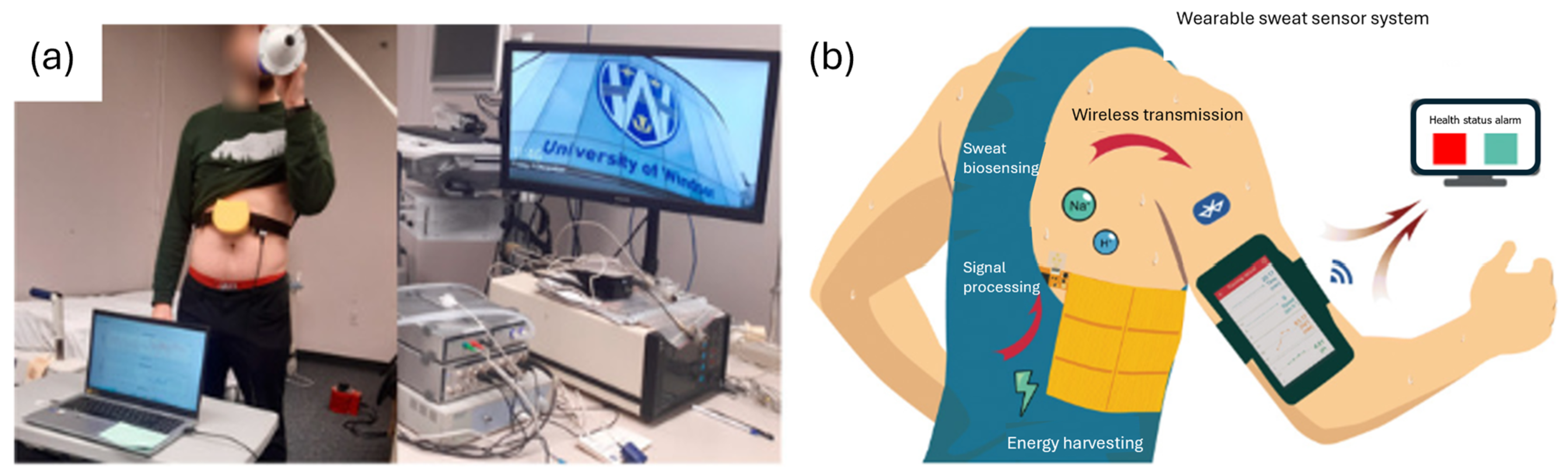
There are several common approaches that can be integrated such as piezoelectric, electromagnetic, and triboelectric generators in the system and the circuit can be designed for converting strain and motion into required power. Recent research utilized mechanical energy as an energy source by translating motion into electrical energy for wearable applications. Figure 2a presents a multi-sensor wearable patch that incorporates both an accelerometer and pressure sensor with data fusion technique to monitor the pattern of breathing. Experimental results validation showed rapid detection of breathing rates and patterns during body movements [77]. Z. Zhou et al. presented a 3D meshed textile pressure sensor combining Ti3C2Tx MXene nanolayers with woven fibers, fabricated using a simple dip-coating method. The sensor shows sensitivity (up to 81.9 kPa−1), fast response (30 ms), and durability over 5000 cycles, enabling real-time monitoring of physiological signals [78]. Similarly, Y. Song et al. developed the battery-free wearable devices shown in Figure 2b using a flexible PCB-based freestanding triboelectric nanogenerator (FTENG). The developed system delivers output power (~416 mW/m2) and successfully powers sweat biosensors, demonstrating continuous, noninvasive health monitoring [79]. Another study shows wrist-based wearable devices with modular sensors for mental wellbeing assessment. This study explores the use of wearable multi-sensor devices to enable continuous and privacy-preserving monitoring of individual wellbeing. Long-term data collected from behavioral, physiological, environmental, and speech-derived features were used to examine the relationship between physical and mental health [80]. These studies are seen as more attractive in the field of self-powered wearable devices, and strongly depends on mechanical energy during daily activities. However, challenges such as low-power output at irregular motion frequencies and user comfort must be carefully addressed in system design.

3.1.1. Piezoelectric Energy Harvesting (PEH)

PEH is increasingly used as an effective method for delivering power to low-energy wearable devices by transforming mechanical movements of the human body into electrical energy. When piezoelectric materials experience deformation, these materials generate an electric charge. These properties can be further utilized and make them suitable for extracting energy from walking, joint motion, breathing, and even minor body vibrations. This PEH-enabled self-powered mechanism greatly reduces battery dependence and able to provide continuous operation of sensors, microcontrollers, and communication modules in wearable systems. However, their performance can be limited by material properties and reduced performance under low-frequency and irregular human motion.
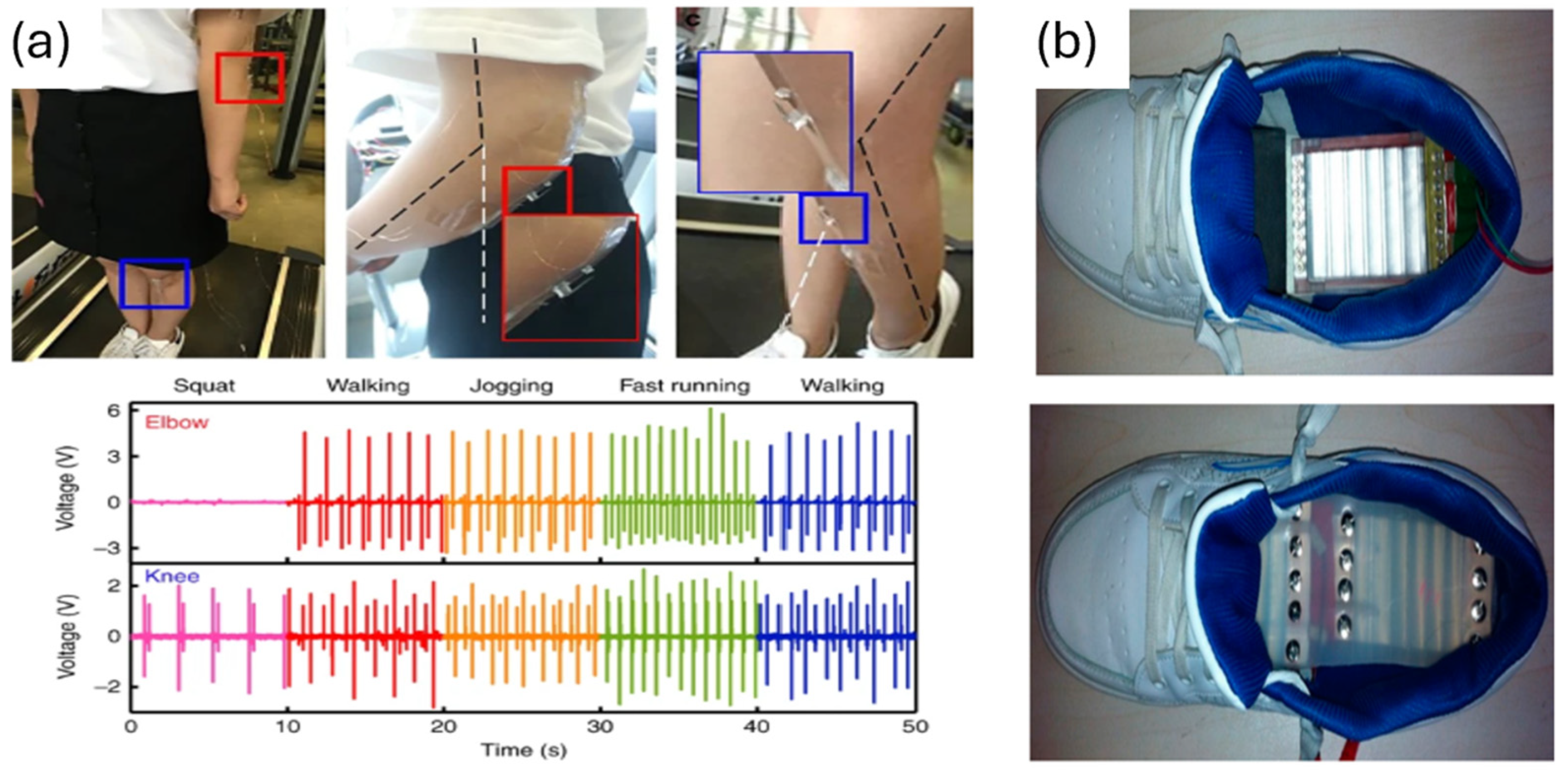
Studies have reported on a piezoelectric energy harvesting device that converts knee joint motion during human gait into electrical power using two piezoelectric patch transducers integrated into a knee brace [81]. Similarly, a wearable energy harvester is proposed that translates human joint motion into electricity using a piezoelectric cantilever integrated with a micro-electroplated ferromagnetic nickel cantilever on a flexible substrate. Based on their experiment through a vertical-vibration frequency-up-conversion mechanism, horizontal low-frequency joint movements (0.5–5 Hz) excite the cantilever into high-frequency resonance and generate stable energy (~0.56–0.69 μJ per cycle) with peak-to-peak voltages around 4.0 V, as indicated in Figure 3a during activities such as walking, jogging, and squatting, demonstrating its potential for self-powered wearable applications [82]. Zhao J et al. investigated a shoe-integrated piezoelectric energy harvester shown in Figure 3b to convert mechanical energy from human motion into electricity for wearable sensors. The harvester unit of the developed system featuring a thin sandwich structure which produces an average output of 1 mW during walking (~1 Hz) and when combined with a power management circuit, can drive a simulated wireless transmitter with 50 mW mean power, demonstrating its feasibility for self-powered wearable applications [83]. Shilpa D.R et al. demonstrated a piezoelectric energy harvesting system that converts vibrational energy into DC power, stored and regulated to supply wearable devices [84]. Simulations and a hardware prototype validate their efficiency, highlighting their potential for wearable applications. These approaches highlight the effectiveness of piezoelectric energy harvesting for next-generation energy efficient and self-sustaining wearable digital devices.

3.1.2. Triboelectric Nanogenerators (TENGs)
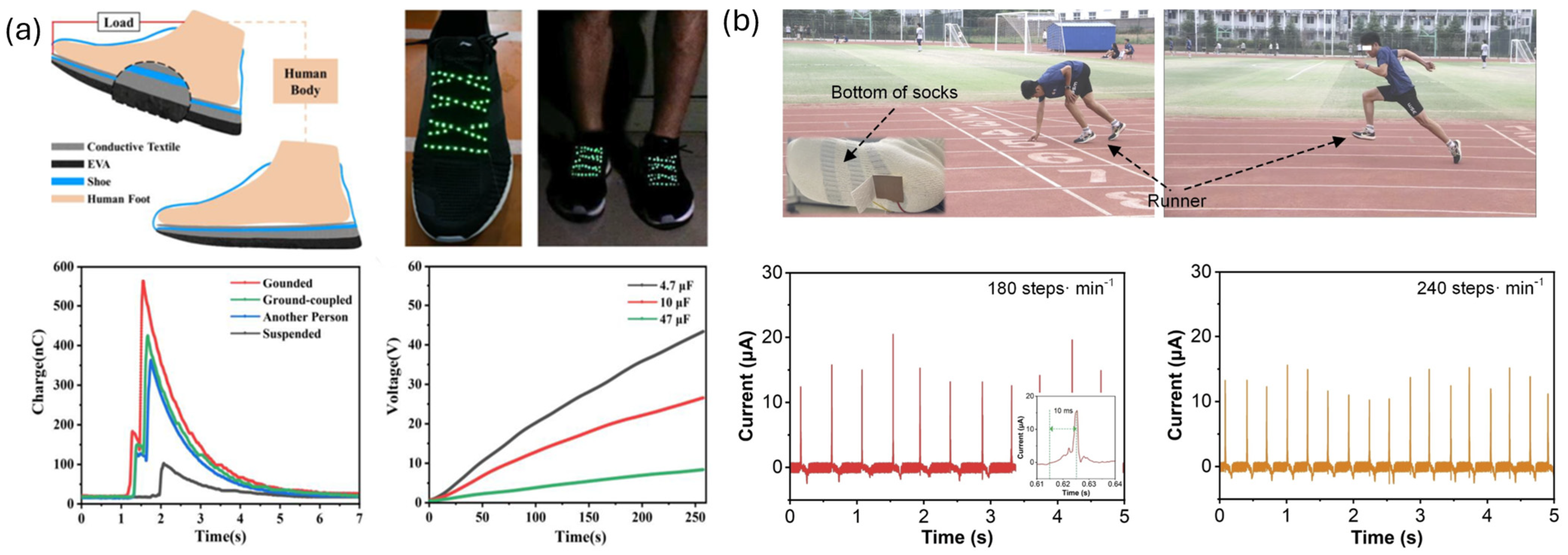
TENGs have emerged as an adaptable technology for transforming mechanical energy from human activity into electrical power. They function based on the coupling of triboelectric charging and electrostatic induction which produce electricity when two materials with different tendencies to gain or lose electrons repeatedly come into contact and then separate. Based on various studies focused on self-powered operation, TENGs are well-suited and considered for portable wearable applications because they are lightweight, flexible, and capable of translating energy from low-frequency and irregular movements. A non-woven fabric triboelectric nanogenerator (NW-TENG) was developed, utilizing the fluffy fiber structure for high pressure sensitivity, achieving 1.22 V N−1 for 0–7 N and 0.18 V N−1 for 8–55 N. The NW-TENG can be mounted on badminton players’ joints to monitor movements, enabling data-driven training and performance evaluation for sports monitoring applications [85]. Additionally, a wearable TENG with a ground-coupled electrode was designed as shown in Figure 4a for efficient biomechanical energy harvesting and motion sensing. By coupling the reference electrode with the ground, the developed device enhances the performance and reaches a maximum voltage of 946 V, a short-circuit current of 36.3 μA, and a transferred charge of 419.6 nC per walking step. TENG also enables LED driving, gait recognition, step counting, and movement speed monitoring and make them well-suited for wearable electronic applications [86].
A conductive sponge-based TENG was developed using a simple one-step fabrication method which integrates a porous conductive sponge electrode with textured Ecoflex. The developed structure enables highly sensitive pressure detection, including the ability to sense extremely small forces. The device demonstrates excellent flexibility, durability over 25,000 cycles, and liquid resistance, while functioning both as a biomechanical energy harvester to power small electronics and as a self-powered sensor for posture monitoring, motion tracking, and real-time gait analysis, highlighting its potential for scalable wearable health applications [87]. Figure 4b presents the performance of TENG based on polyester–paper cloth (PP-TENG) for harvesting mechanical energy and tracking running movements offering superior durability and tear resistance. The PP-TENG exhibits high pressure sensitivity and delivers maximum output power of 930.26 μW when connected to a 40 MΩ load. The experimental procedure involves integration into athletic sock soles for real-time gait and step-count monitoring [88].
Energy harvesting for wearable devices has advanced through the features of thermoelectric (TEG), triboelectric (TENG), piezoelectric (PENG), and hybrid approaches, each converting environment and body-generated energy into usable electricity. Table 3 summarizes the recent development of energy harvesting approaches in wearables. TEGs utilize body heat and thermal gradients to deliver power to low-power IoT and biomedical devices, while TENGs observe a mechanical energy from movements and supporting motion tracking and wearable sensors. PENGs transform physiological strains, vibrations, micro-motions into electrical energy using materials such as PVDF, ZnO, BaTiO3, and PZT, suitable for low-power electronics.
Figure 4. TENGs-based energy harvesting approaches. (a) Capacitor charging for motion sensing and biomechanical energy harvesting of a ground-coupled wearable TENG [86]. (b) Experimental setup of a CS-SE TENG embedded in a shoe insole for motion detection [88].
Jlpea 16 00020 g004
Table 3. Summary of recently reported energy harvesting approaches in wearables.
Ref.CategoryWorking PrincipleEnergy Source/StimulusMaterials UsedTypical
Uses
[89]TEGSeebeck effectThermal gradient/waste heatTE materials, PCMWireless IoT nodes
[90]TENGTriboelectric effectHuman motion, mechanical inputPolymer dielectrics, electrodesIoT sensors, wearables
[91]TENG,
PENG
Mixed (tribo, piezo, Seebeck)Mechanical, thermalPolymer, ceramic, semiconductorIoT, energy-autonomy
[92]Hybrid Triboelectric, piezoMechanical, thermal, solar, electromagneticsPolymers, electrodes, semiconductorsSelf-powered sensors
[93]PENGPiezoelectric effectMechanical tapping/bendingGraphene, ZnO, PVDFWearable low-power electronics
[94]PENGPiezoelectric effectMechanical vibrationPZT ceramicStructural health monitoring
[95]TENGTriboelectric effectHuman gait/walking (mechanical motion)PTFE film, thin copper layer, copper foilHealth monitoring
[96]TENGTriboelectric effect Human motion Aluminum (patterned via CO2 laser), PDMS Wearable devices
[97]PENGPiezoelectric effectPhysiological mechanical strain (~1% micromotion)ZnO, PVDFOrthopedic implants
[98]PENGPiezoelectric effectMechanical loading from daily movement.BaTiO3Bone tissue scaffolds; implants
[99]PENGPiezoelectric effectPhysiological micro-strainPVDF, BaTiO3Regenerative implants
[100]PENGPiezoelectric effectPhysiological bone loading Barium titanate/Polylactic acidBiodegradable implants
[101]TEGSeebeck effectInternal body temperature gradient Chalcogenide thermos electricsFuture regenerative medicine

3.1.3. Electromagnetic Energy Harvesting (EEH) Approaches

Electromagnetic generators produce electrical power from mechanical movement related with Faraday’s law of electromagnetic induction. In wearable devices, they typically generate electricity by the relative movement of a magnet and coil which further captures energy from activities such as walking and arm motion. Based on various studies, these generators offer advantages including durability, long operational life, and stable low-frequency power output. The major challenges remain in minimizing size, weight, and integration flexibility to ensure user comfort and practicality. Sharghi, H et al. presented a study on a pendulum-based wearable energy harvester using an electromagnetic generator which generates electricity from the kinetic energy produced from walking. The developed system demonstrates oscillatory behavior synchronized with walking motion, showing that output power increases with walking speed and can be maximized by optimizing load conditions [102]. Similarly, an AI-enabled wearable hip joint energy harvester (HJEH) was developed to generate power from hip motions with the added capability of tracking body motion. The HJEH combines an EMG and a freestanding (FS)-TENG, where the EMG recovers negative energy from hip motion, and the FS-TENG generates triboelectric signals processed by deep learning algorithms for precise motion detection. Performance evaluation tests show the EMG achieving a peak power of 357 mW and a maximum gravitational power density of 1.67 W·kg−1 at 8 km·h−1, while the FS-TENG attains 99.95% accuracy in classifying 12 motion types [103].
Another study presented a piezoelectric–electromagnetic wearable harvester (PEWH) capable of capturing energy from upper-limb swinging motions. The developed device integrates a piezoelectric power generation module consisting of a piezoelectric sheet which deforms to produce electricity, and an electromagnetic sensing module consists of a magnetic ball that generates induced electromotive force that can be used for both sensing and power supply. Measurements obtained from experiments show that the PEWH produces a peak-to-peak voltage of 57.84 V and a maximum power of 115.52 mW at 2 Hz vibration, capable of powering 82 LEDs and a temperature and humidity sensor, demonstrating its potential for self-powered wearable motion detection [104]. Similarly, wearable electromagnetic vibration energy harvesters (EMVEHs) are a vital component of body sensor networks (BSNs), offering a promising solution to overcoming sustainability challenges and enable self-powered operation with diverse functionalities [105].

3.2. Thermal Energy Harvesting

3.2.1. Thermoelectric Generators (TEGs)

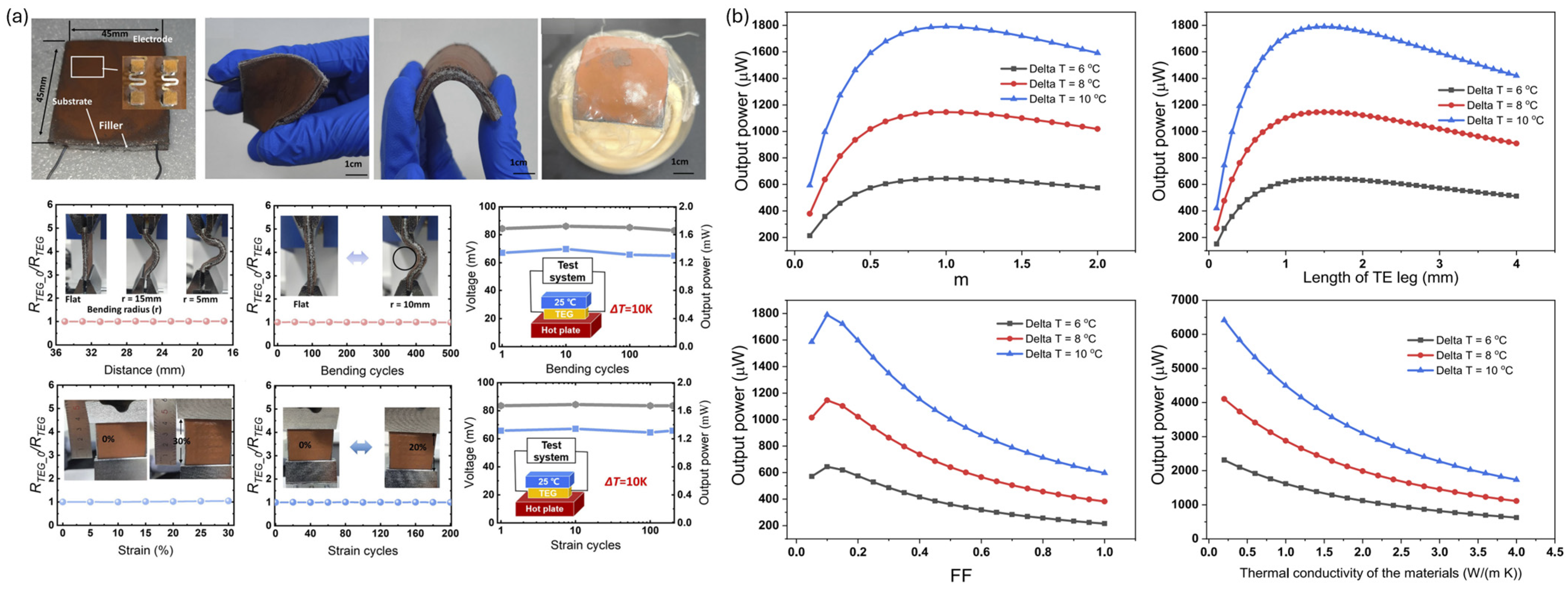
The operation of thermoelectric devices depends on a constant temperature differential (ΔT) between materials. Thermal energy harvesting for wearable devices converts temperature differences into electrical energy using pyroelectric materials. Research reported that Mg-based thermoelectric materials in device fabrication, as depicted in Figure 5a, achieves a power density of 18.4 μW cm−2 at a comfortable wearing pressure of 0.8 kPa and skin temperature of 33 °C, demonstrating strong potential to replace conventional Bi2Te3-based systems [106].
Similarly, a bendable, wearable prototype was designed based on miniature thermoelectric generators encapsulated in a polydimethylsiloxane matrix to power a temperature sensor [107]. Highly stretchable thermoelectric generators (STEGs) were developed using polyaniline-based nanocomposites with p-type tellurium and n-type silver selenide, liquid metal interconnects, and elastomer encapsulation to maintain excellent thermoelectric performance under strain. The developed STEG produced 2.4 µW at an 80 K temperature difference which maintains stable output under 80% stretch and successfully demonstrates body-heat harvesting by powering a fan during running [108]. Figure 5b, presents an experimental study of wearable thermoelectric generators, highlighting the impact of electrical impedance matching, thermocouple design, and leg length optimization on improving output power and energy conversion efficiency under varying thermal conditions [109]. Recent studies highlight impedance matching, optimized geometries, and integrated energy management as key factors enabling efficient, battery-free operation of wearable sensors, and wireless communication [109,110].
Figure 5. Wearable thermoelectric generator. (a) Fabricated w-TEG and its bending performance [106] (b) Wearable thermoelectric generators showing variation of output power [109].
Jlpea 16 00020 g005

3.2.2. Pyroelectric Materials

Temporal temperature changes (dT/dt) are the main cause of the electrical response that pyroelectric devices produce. Pyroelectric materials such as polyvinylidene fluoride (PVDF), triglycine sulfate (TGS), and bulk perovskite ceramics are often incorporated into lightweight, flexible wearable devices. Based on the literature, carbon-assisted pyroelectric composites have increasingly attracted attention due to high thermal stability, electrical conductivity, and structural versatility of carbon-based materials. These composites provide a promising solution for converting temperature differences into an electrical energy. Strong and efficient strategies for understanding the fabrication process with pyroelectric and pyro-phototronic effects become essential in advancing their practical implementation [111]. Recent progress in flexible nanogenerators plays a vital role for integrating pyroelectric functionality with electromechanical mechanisms. The hybrid piezoelectric–pyroelectric nanogenerators developed from electrospun poly(vinylidene fluoride) (PVDF), which was further integrated with graphene oxide nanofibers, enhanced sensitivity and mechanical flexibility. It is concluded that the role of graphene oxide not only improves thermal-to-electrical energy conversion efficiency but also enhances temperature-sensing capability [112].
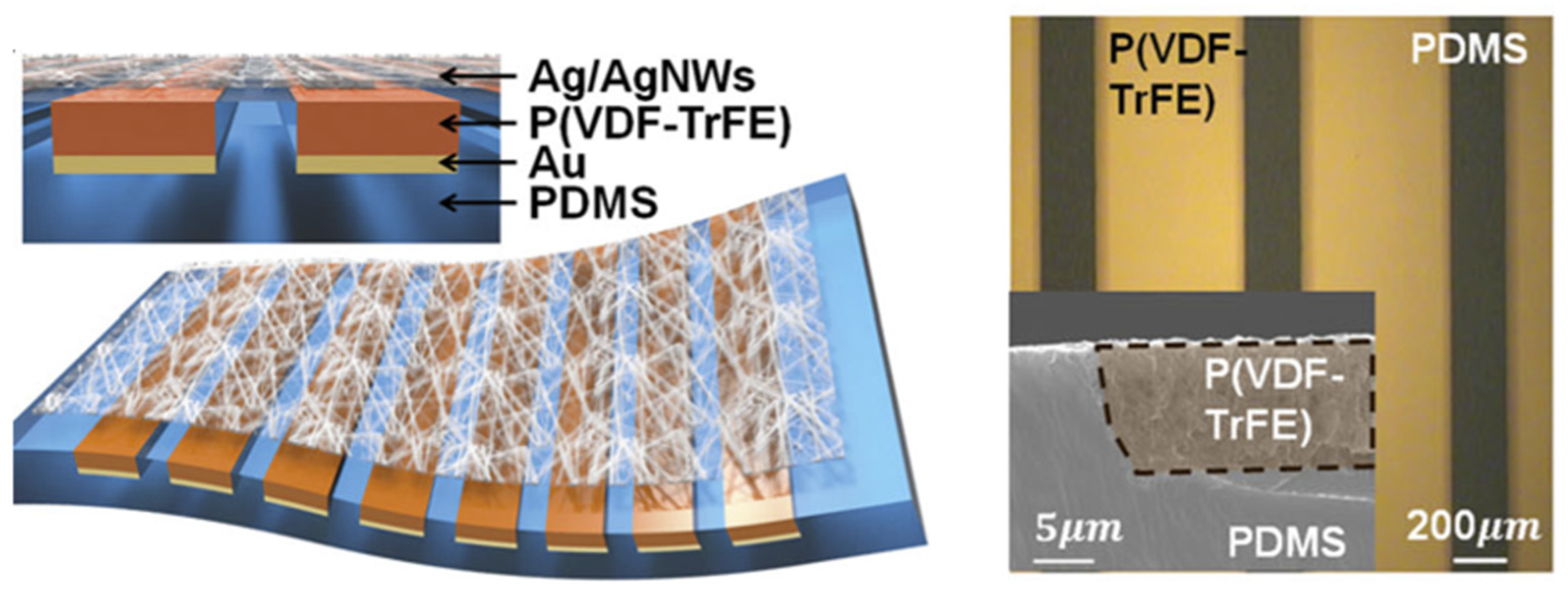
Wearable pyroelectric nanogenerators are incorporated into the supports of personal protection equipment to supply additional energy for continuous functioning in emergency scenarios. Research reported that PVDF-based wearable technology incorporated into respiratory masks may extract energy from sporadic temperature changes brought on by breathing [113]. Additionally, structural design techniques that take advantage of mismatched thermal expansion coefficients between polymeric components have been used to create stretchable pyroelectric nanogenerators which are displayed in Figure 6 [114]. Hybrid setups allow for continuous monitoring of physiological and motion-related signals without the need for external power supplies, improve sensitivity and expand detection capabilities. Thermal energy harvesting has clear benefits of passive operation, environmental independence, and compatibility with wearable and low-grade heat sources, although often producing lower power densities than photovoltaic systems [115].

3.3. Photovoltaic and Biochemical Based Energy Harvesting

By directly converting ambient light into electrical energy, solar energy harvesting provides a viable method for providing wearable low-power medical devices with sustainable power. Recent advancements show that solar-powered wearable sensing devices that can function during regular everyday activities are feasible. Low-power optical sensing modules are used in the wrist-mounted systems’ design to monitor physiological and environmental information. Through the integration of Bluetooth Low Energy (BLE) connectivity, rechargeable lithium-polymer batteries, and small monocrystalline solar cells, these platforms are able to collect sunlight to provide wireless data transfer and sensing. The findings showed that while additional energy storage components, including supercapacitors, enhance charge buffering and operational reliability, sophisticated power management techniques enable stable operation under varied light levels [116]. Optimizing solar performance in wearable environments still requires effective power conditioning. Simplified analog maximum power point tracking (MPPT) techniques preserve efficient tracking capabilities while lowering circuit complexity. According to experimental assessments, these systems are capable of achieving high overall energy conversion efficiencies, which are adequate to power wireless communication modules and biosensors continuously [117]. The viability of this strategy is further confirmed by proof-of-concept wearable energy harvesting systems that combine flexible batteries, low-power microprocessors, and semi-flexible solar modules. These devices can produce tens to hundreds of milliwatts under normal outdoor exposure, greatly recharging batteries with regular use. Such performance shows that wearable electronics have the potential to have smaller batteries and longer operating times [118].
Energy yield is mostly determined by system design factors, such as the orientation and placement of solar panels with respect to the light source. Research on wearable forearm designs shows that surface curvature has less impact on output performance than panel alignment. In order to ensure sufficient energy supply while maintaining wearer comfort and safety, optimized multi-panel layouts can significantly increase post-conversion power delivery [119]. Flexible photovoltaic cells have also been directly integrated into clothing to create sophisticated self-sustaining wearable sensor devices. These platforms use event-driven MPPT algorithms and staged startup tactics to maintain stable voltage control and great tracking precision under varying lighting conditions. For thorough physiological monitoring, this enables the consistent operation of several dispersed sensor nodes [120]. Even though the availability of solar energy is dependent on ambient lighting, wearable healthcare equipment benefits greatly from its relatively high-power density among ambient sources. The development of autonomous, low-power medical monitoring technologies is anticipated to be supported by ongoing advancements in flexible photovoltaic materials, circuit efficiency, and system integration, which will further increase performance, dependability, and scalability.
There has been a lot of interest in biofuel and biological energy harvesting techniques as sustainable energy sources for implanted and wearable electronics. These systems use biofluids such as lactate, glucose, and other metabolites found in sweat and interstitial fluid to produce energy through electrochemical and enzymatic processes. Biochemical harvesters, in contrast to traditional batteries, produce continuous, low-level energy directly from physiological processes which make devices especially well-suited for long-term, low-power, self-sustaining wearable applications.
Hybrid energy systems that combine both biochemical and biomechanical harvesting mechanisms have demonstrated enhanced performance and operational flexibility. A hybrid platform combining a triboelectric nanogenerator with a glucose-based fuel cell has been designed for simulated in vivo environments. In this configuration, mechanical motion and glucose oxidation contribute simultaneously to electrical generation. The two subsystems can function independently, resulting in increased current output and faster energy storage charging compared to single-source devices. Such systems have demonstrated the capability to power small electronic components, underscoring their potential for autonomous healthcare monitoring where both motion and biochemical fuels are readily available [121]. Textile-integrated bioenergy systems further illustrate the feasibility of wearable biochemical harvesting. Stretchable hybrid configurations that couple enzymatic biofuel cells with supercapacitors enable simultaneous energy conversion and storage. In these devices, lactate present in sweat is oxidized to produce electrical energy, which is rapidly stored in nanostructured supercapacitor electrodes. The use of elastomeric conductive inks and serpentine interconnected designs ensures mechanical resilience under bending and stretching. Scalability and user comfort are highlighted by on-body assessments that verify consistent output voltage, dependable cycle behavior, and compatibility with smart textile production techniques [122]. Despite these developments, the practicality of many motion-dependent bioenergy harvesters is limited since they only capture a tiny portion of the mechanical energy that is accessible. Biofuel cells that can extract energy from passive sweat secretion without requiring physical exertion have been developed in order to overcome this constraint. These systems have the capacity to store a substantial amount of energy over long periods of time, which is enough to operate low-energy sensors for physiological and environmental monitoring. This approach demonstrates a notable improvement in energy return compared to traditional biomechanical harvesters [123].
One of the key technologies in biochemical energy harvesting is enzymatic biofuel cells (EBFCs), which rely on redox interactions between metabolites and oxygen. However, ineffective electron transport between the biocatalyst and electrode surface, low operational stability, and enzyme degradation limit their practical application. Advanced functional nanomaterials have been the subject of recent studies to improve catalytic activity, promote direct electron transfer, and improve enzyme immobilization. The viability of wearable and implantable bioelectronics has been improved by extensive research into nanostructured carbon materials, conductive polymers, and hybrid composites to boost power density and prolong device lifetime [124]. Innovations in textile-based biofuel cells have also leveraged moisture management fabrics to facilitate efficient transport of glucose or other metabolites to enzymatically modified electrodes within single-compartment architectures. Multi-cell stacking strategies enable higher output voltage and power, sufficient to directly operate low-power consumer electronics. These designs emphasize low-cost and scalable manufacturing processes, enabling seamless integration into garments for continuous energy harvesting from bodily fluids [125]. Fiber-shaped biofuel cells represent another promising direction, particularly for implantable applications. Their thread-like geometry provides high flexibility and mechanical compliance with biological tissues. Structural strategies such as enzyme entrapment between conductive carbon nanotube layers enhance catalytic stability and maintain performance under repeated mechanical deformation. These fibers can be incorporated into fabrics and connected in series and parallel arrangements to tailor voltage and current output according to application requirements [126].
Recent developments in perspiration-powered electronic skins further demonstrate the multifunctional capabilities of biochemical energy systems. Flexible platforms integrating lactate biofuel cells with multimodal sensors have achieved milliwatt-level power densities while maintaining stable operation over prolonged durations. These devices can serve as human–machine interfaces for prosthesis control, transfer data wirelessly using low-power communication protocols, and simultaneously monitor skin temperature and metabolic biomarkers [127]. Furthermore, integrated energy harvesting and storage in small forms are offered by bio supercapacitor architectures that combine biofuel cells with electrochemical capacitors. By combining materials like MXene and carbon nanotubes with immobilized enzymes, hierarchical nanostructured bioanodes produce three-dimensional catalytic environments that improve charge storage and power generation [128]. These wearables provide a feasible route toward small, self-powered platforms for wearable electronics of the future by maintaining conformal skin contact and steady performance under mechanical pressure. Overall, biochemical energy harvesting technologies provide wearable systems a strong substitute for traditional batteries. Transforming these laboratory-scale demonstrations into workable, long-term solutions for autonomous healthcare monitoring and implantable bioelectronics will require ongoing advancements in enzyme stabilization, nanomaterial engineering, device architecture, and scalable production.

3.4. Hybrid and Multi-Modal Harvesting Systems

Hybrid and multi-modal energy harvesting systems integrate more transduction mechanisms such as photovoltaic, mechanical, thermal, radiofrequency, and biochemical conversion to improve energy availability and operational reliability in wearable and portable electronics. These systems reduce the intermittent nature and low output of single-mode harvesters by concurrently utilizing various ambient and physiological energy sources. Compact, flexible, and mechanically compliant hybrid architectures designed for self-powered biomedical and wearable applications have been made possible by developments in nanomaterials, device downsizing, and system-level integration. The working principles, performance traits, and real-world applications of batteries, supercapacitors, solar cells, biofuel cells, thermoelectric generators, RF harvesters, and kinetic energy devices have all been thoroughly studied recently [56]. These studies have highlighted the significance of multifunctional integration and nanostructured materials in achieving stable and sustainable power supplies for next-generation wearable electronics. Among emerging approaches, the combination of triboelectric nanogenerators (TENGs) and biofuel cells (BFCs) has received significant attention because they can harness complementary energy sources, including biomechanical motion, for energy generation and biochemical fuels. However, disparities in output characteristics and limitations in device breathability and conformability have restricted practical implementation. To address these challenges, a breathable woven hybrid energy harvester integrating a textile-based TENG with fiber-shaped BFCs has been developed. A customized power management circuit harmonizes the electrical outputs of the two subsystems, substantially increasing the effective direct-current power and lowering internal impedance. This configuration enables sustainable powering of wearable electronics while maintaining air permeability and adaptability to non-planar body surfaces, providing valuable design strategies for high-performance TENG–BFC hybrid systems [129].
By combining solar cells, thermoelectric generators, and piezoelectric components on a single platform, multi-source collaborative energy harvesters further improve stability. One such design integrates a macro-fiber composite (MFC) piezoelectric structure, a thermoelectric generator, and a ring-shaped solar module to capture vibrational energy, heat gradients, and light, respectively. An interface circuit facilitates efficient extraction of low-voltage thermal energy during simultaneous vibration harvesting. The resulting system achieves milliwatt-level power output with stable performance under diverse environmental and motion conditions, demonstrating its versatility as a compact energy solution for wearable devices [130].
Self-sustaining medical sensor nodes have also been realized through hybrid energy integration. These systems integrate hybrid harvesters made up of solar panels, thermoelectric generators, DC–DC converters, and supercapacitors with microcontrollers, photoplethysmography (PPG) sensors, inertial measurement units, and Bluetooth Low Energy (BLE) communication modules. Remote monitoring of mobile patients is made possible by such arrangements, which allow continuous recording and wireless transmission of physiological data without the need for constant external charging [131]. Hybrid systems that use ultra-low-power DC–DC boost converters in conjunction with tiny solar panels and thermoelectric generators have been introduced to further increase operating lifetime. For every energy source, independent maximum power point tracking guarantees optimal energy extraction in a variety of environmental circumstances. High energy conversion efficiency and significant battery life extension are demonstrated by experimental assessments, and under adequate illumination, fully self-powered operation is possible. These systems are especially well-suited for outdoor and high-demand applications since they demonstrate mechanical compatibility with wearables installed on the head, face, and wrist [132]. Table 4 summarizes the existing framework used in wearable devices to generate maximum power for monitoring applications.
Table 4. Summary of recently reported literature with maximum power generation in wearables.
Ref.Energy HarvestingMaximum PowerApplications
[79]Freestanding triboelectric nanogenerator416 mW Sweat biosensors
[83]Piezoelectric energy harvester50 mWWearable sensors
[88]Paper-based triboelectric nanogenerators930.26 μWWearable electronics
[89]Thermoelectric generator30 µW Portable devices
[104]Piezoelectric–electromagnetic wearable harvester115.52 mWPowering electronic devices
[108]Stretchable thermoelectric generator2.4 μWWearable electronics
[112]Piezo- and pyro-electric hybrid nanogenerator6.2 mWBreathing sensors
[113]Pyroelectric nanogenerator8.31 μWWearable sensors
[118]Solar energy harvesting159.1 mWSmart Wearables
Depending on the energy harvesting technique employed in wearables, self-powered sensors have a number of limitations. Based on the literature, it shows that mechanical energy harvesting techniques face a challenge by delivering an inconsistent power during low human activity, whereas the thermal energy harvesting technique delivers wide low output and operation requires a significant temperature difference between the skin and sensor surface. Solar and photovoltaic harvesting basically rely heavily on light availability and are not practically suitable for personalized health monitoring without ambient lights. Biofuel cells and biochemical energy harvesting rely on the availability of biofluids like sweat or glucose, but they frequently have low power density and poor long-term stability due to enzyme breakdown. Hybrid and multi-modal harvesting systems can improve energy availability, but their design, circuit complexity, and size become important challenges by incorporating with wearables. Hybrid and multi-modal energy harvesting strategies in wearable healthcare systems are promising solutions for long-term power delivery operations that make the systems more autonomous. Further developments in power management circuits, nanomaterial engineering, structural design, and scalable production are critical for improving efficiency, reducing system complexity, and enabling the widespread deployment of fully self-sustaining wearable electronics.

4. Design Strategies for Wearable Flexible Electronics

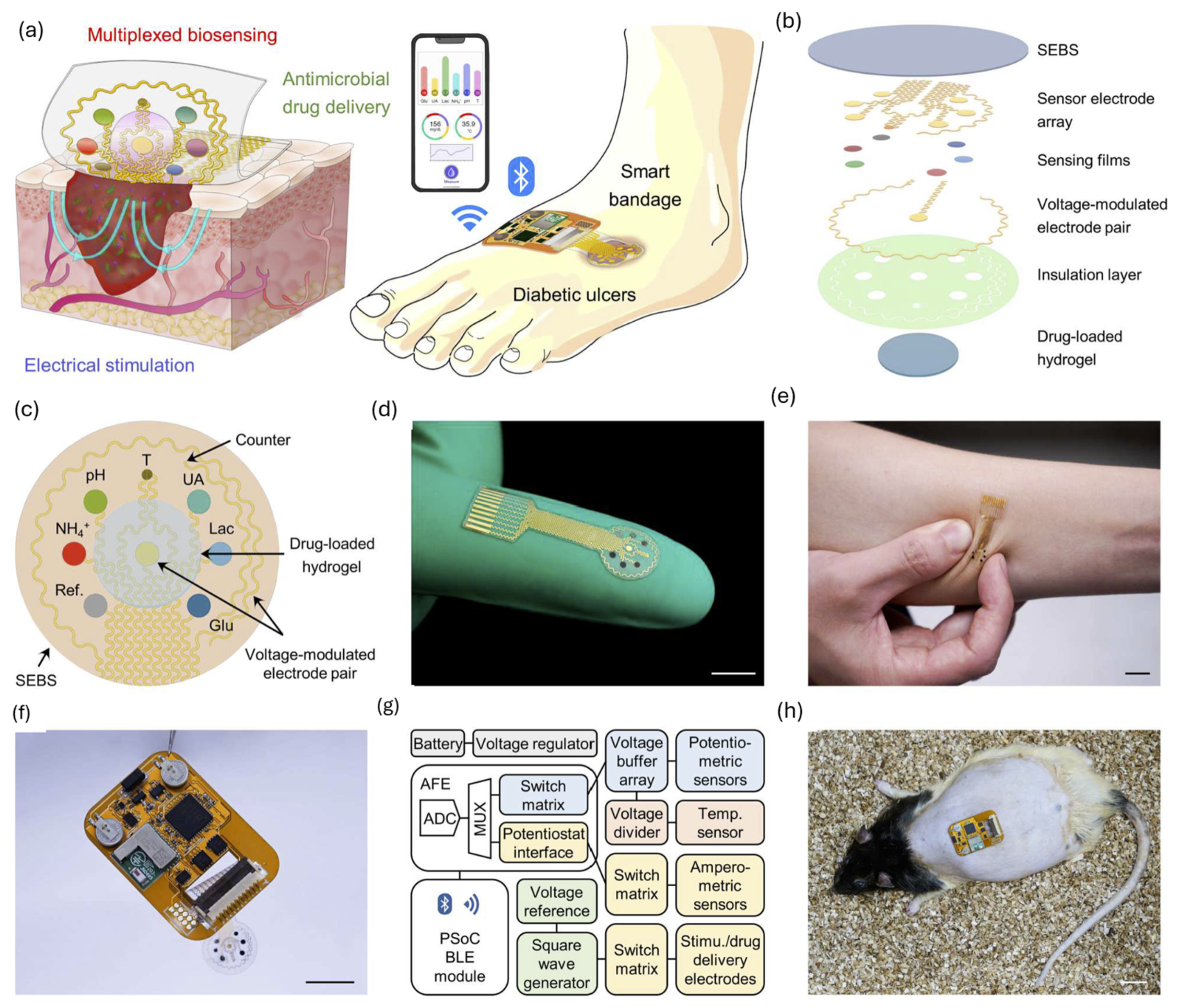
The demand for creative design approaches that can preserve high performance while allowing for mechanical deformability has increased due to the quick development of flexible electrical technology. Flexible electronic systems must function dependably during repeated bending, stretching, and twisting, in contrast to traditional rigid electronics. The selection of materials, device architecture, and system integration are all made more difficult by these mechanical requirements. A research report that chronic nonhealing wounds pose significant clinical challenges, often requiring invasive treatments and prolonged drug therapies. In preclinical models, a wearable bioelectronic patch with multiplexed electrochemical biosensors greatly sped up wound healing by enabling noninvasive combination therapy and real-time wound monitoring [133].
Consequently, the development of robust design strategies has become a critical aspect in enabling flexible electronics to achieve both mechanical resilience and functional stability. One of the primary considerations in designing flexible electronic systems is the mechanical compatibility between different components. Flexible substrates, conductive interconnects, and active devices all require carefully chosen materials to guarantee longevity and preserve electrical performance under deformation. To lessen the pressure on electronic components while maintaining flexibility, techniques including the use of elastomeric substrates, thin-film materials, and serpentine or wavy connection topologies have been widely used. These approaches allow rigid or brittle electronic materials to function reliably when integrated into deformable platforms. Figure 7 presents a wireless stretchable wearable bioelectronic system for wound healing applications. In order to promote anti-inflammatory, antimicrobial activity, and tissue regeneration, Figure 7a shows a schematic illustration of the fully integrated wireless wearable bioelectronic patch designed for chronic wound management. Figure 7b shows a conceptual overview of the system operation showing multiplexed biomarker sensing combined with electro-responsive drug delivery and electrical stimulation. The multiplexed multimodal electrochemical biosensor array employed for in situ monitoring of wound biomarkers, including temperature, pH, ammonium, glucose, lactate, and uric acid in the wound exudate, is depicted in Figure 7c. The multiplexed sensor array patch was made using traditional microfabrication techniques on a sacrificial copper layer before transfer printing onto a poly(styrene-b-(ethylene-co-butylene)-b-styrene) (SEBS) thermoplastic elastomer substrate, as shown in Figure 7d. The serpentine-shaped electronic interconnects shown in Figure 7e, combined with the high elasticity of the SEBS substrate, provide excellent stretchability and mechanical durability, allowing the sensor patch to withstand various physical deformations. The flexible bandage presented in Figure 7f–h is integrated with a flexible printed circuit board (FPCB) that enables electrochemical signal acquisition, wireless data transmission, and supports regulated voltage control for applications such as drug delivery and electrical stimulation.
Another key design aspect involves the structural layout and system architecture of flexible electronics. Effective mechanical design can significantly reduce stress concentration and enhance device longevity. Such architecture enables the integration of conventional high-performance electronic components while maintaining the overall flexibility of the system. Integration strategies also are essential in defining the scalability and functionality of flexible electronic systems. System complexity, manufacturability, and reliability must all be balanced by designers. Methods including flexible packaging, heterogeneous component assembly, and modular integration have become viable approaches for building multifunctional flexible systems. These methods enable the integration of sensors, communication modules, power units, and signal processing circuits into small, mechanically compliant platforms.
Additionally, the design strategy is greatly influenced by the production and assembly methods selected. Electronic components may be precisely placed onto flexible surfaces while retaining structural integrity thanks to techniques like transfer printing, flexible printed circuit technology, and additive manufacturing. These fabrication methods enable the creation of high-density electrical layouts while preserving the mechanical flexibility required for flexible systems. Overall, effective flexible electronics design strategies require a multidisciplinary approach that integrates circuit design, mechanical engineering, material science, and contemporary production techniques. By optimizing both structural and functional aspects, these approaches enable flexible electronic systems to achieve high performance, durability, and scalability, enabling their ongoing development in emerging applications.

5. Challenges and Limitations

Energy harvesting technologies and flexible electronics for wearable and biomedical devices have made great strides, but their practical application is still limited by a number of challenges due to energy harvesting approaches, low-power circuit design strategies, and deployment in flexible electronic structures. These design challenges could be considered and used for designing an innovative self-powered wearable device for healthcare applications.

5.1. Energy Harvesting Approaches for Wearable Devices

The very low and erratic power output produced by physiological and environmental energy sources is a significant drawback. Variations in the energy collected from body movements, temperature gradients, sunlight, or biological activities are often caused by environmental conditions and user activity. As a result, maintaining a consistent and reliable power supply for sensors, signal processing units, and wireless communication modules remains difficult, especially for low-power applications that must function independently for long periods of time. Another major challenge is integrating energy collecting devices with wearable and implantable electronics. These devices must maintain mechanical flexibility, lightweight design, and user comfort in addition to improving electrical performance. It is difficult to design systems that satisfy all these objectives at once, especially when a compact structure needs to integrate several components including sensors, power management circuits, energy storage elements, and wireless communication. Furthermore, wearable technology is frequently bent, stretched, and subjected to various mechanical stresses during daily use, which can progressively deteriorate the functionality of flexible materials and electronic connections. There are certain restrictions on biochemical energy harvesting systems. Enzymatic biofuel cells are essentially dependent on biological catalysts, whose activity may decline over time, reducing the device’s efficiency and operating lifetime. Changes in the body’s supply of metabolic substrates, such as glucose and lactate, can also affect energy generation. Ensuring biocompatibility and preventing harmful interactions with biological tissues are crucial aspects of implantable technology. Another technical challenge is effective power management, particularly in systems that integrate various energy collecting technologies. Each harvesting mechanism often generates different voltage and current levels, making it necessary to create advanced power conditioning circuits capable of efficiently regulating and combining their outputs. Research into developing ultra-low-power power management circuits that function well at extremely low energy input levels are still ongoing challenges. Additionally, in order to stabilize power delivery at times when harvested energy is insufficient, appropriate energy storage devices, such as micro-batteries and supercapacitors, must be integrated.
The commercialization of many advanced energy collecting systems is also constrained by manufacturing and scaling concerns. Although numerous prototypes have demonstrated promising performance in lab settings, large-scale production with consistent quality and inexpensive prices remains challenging. For reliable long-term functioning in real-world applications, more developments in material stability, device durability, and environmental resistance are required. To solve these challenges, more research in advanced materials, device engineering, power management strategies, and system-level integration is typically required. Addressing these limitations will be crucial to enabling trustworthy, fully autonomous wearable and implantable electronic systems for Smart ECG patches, skin conformal neuro-systems development in the future.

5.2. Structural Designs and Circuit Flexibility in Self-Powered Wearable Devices

Self-powered systems are expected to play a significant role in the growing Internet of Things ecosystem and show great promise for applications related to energy harvesting, detecting, actuation, and human–machine interaction. In order to accomplish autonomous physiological signal monitoring, enable actuation operations, and facilitate interactive human–machine interfaces, recent research has focused on the integration of wearable, small technologies for harvesting energy with functional devices. These systems are becoming more intelligent because of the rising application of machine learning, which offers higher-level functionality and adaptable reactions in real-world situations. Despite these developments, a number of significant constraints still need to be overcome before these technologies are widely used in real-world applications. First, there are long-term stability concerns due to the use of flexible materials, which are necessary for wearability. Over time, environmental exposure, mechanical fatigue, and frequent bending can deteriorate device performance. Future studies should concentrate on creating sturdy material formulations and structural plans that preserve convenience, adaptability, and maintain excellent performance.
Second, the majority of wearable self-powered electronic devices available today are still in the testing prototype stage and frequently show only conceptual viability. It is challenging to guarantee consistent performance across several devices due to the absence of defined production procedures. Achieving dependable, repeatable outcomes in cost-effective systems will need the development of scalable production techniques and the establishment of calibration standards. Third, the most promising methods for future self-powered devices are hybrid energy harvesting techniques, which include many transduction processes (such as piezoelectric, triboelectric, thermoelectric, solar, or biochemical). Power management is made more difficult by variations in frequency range, magnitude, and waveform across different energy sources. It is still very difficult to design effective circuits that can control, keep, and transfer energy among various functional modules. In addition to increasing energy conversion efficiency, optimized low-power management techniques are crucial for allowing numerous system components to operate simultaneously. Furthermore, real-time data transfer in wearables and handheld devices requires the incorporation of wireless connectivity elements. Another level of design complexity arises when low-power, reliable wireless operation is achieved while keeping compact design parameters and adequate energy availability.

5.3. Practical Deployment of Flexible Electronic Systems

The broad acceptance and useful implementation of flexible electronics continue to be limited by a number of constraints and restrictions, despite tremendous advancements. Maintaining excellent electrical performance while ensuring dependable mechanical durability is one of the fundamental problems. Flexible devices are often bent, stretched, and twisted, which over time may cause material fatigue, delamination of conducting pathways. One of the most important design considerations is ensuring stability over an extended period under repetitive mechanical deformation. System-level interaction and minimization provide yet another significant constraint. The integration of several functional components, including detectors, energy sources, connectivity modules, and data computing units, is frequently necessary for flexible computing platforms. It is a major problem to integrate these heterogeneous components seamlessly with flexible and soft substrates without compromising efficiency or adding complexity to the device. Furthermore, it becomes difficult to integrate many efficient electrical components into flexible systems due to their inherent rigidity.
The supply of energy and management of power also provide significant issues. Compact, thin, and flexible power sources are necessary for the majority of flexible electronic devices, but the creation of reliable, long-lasting flexible battery and energy extraction systems is still a developing topic. Flexible electronic devices may not be able to operate continuously because of limitations in storage of energy and power stability, especially for long-term tracking applications. Other concerns include biological compatibility and environmental durability, especially for worn and implanted applications. Flexible electronics must be able to safely engage with biological tissues while resisting deterioration from exposure to chemicals, humidity, and temperature fluctuations. In such complex environments, advanced enclosing and protecting components are required to preserve device efficacy. Lastly, cost-effective and sustainable production continues to be a major constraint. Although many laboratory-scale manufacturing techniques have been established, it is still difficult to translate these procedures into large-scale production with reliable and consistent quality. In order to move electronic flexibility from laboratory prototypes to widely used commercial technological advances, these challenges need to be addressed in the field of wearable healthcare device development.
A SWOT analysis sheds light on the existing state and future prospects of wearable, self-powered electronic systems for digital health applications.
Strengths: The primary benefit of wearable self-powered devices is the ability to reduce the requirement for frequent battery charging and replacement. These devices can enable long-term and continuous monitoring by utilizing energy from the surrounding environment as well as the human body. Their compatibility with flexible nanomaterials and digital circuits, wearable form factors further improve user comfort and allows for seamless integration into everyday life for physiological monitoring. Furthermore, the integration of on-body sensing, energy harvesting, saving, and wireless transmission has significant implications for real-time health monitoring and personalized care.
Weaknesses: Despite significant development, the energy produced by most harvesting systems is still rather modest and frequently changes with environmental conditions or user actions. This can reduce the reliability of continuous uninterrupted operation, especially for systems that require extensive data processing and wireless transmission. Furthermore, integrating several functional components such as sensors, energy harvesters, energy storage units, and power management circuits add to system complexity and may have an impact on device size, flexibility, power consumption, and manufacturing cost.
Opportunities: Recent advances in flexible electronics, nanomaterials, smart textiles, low-power integrated circuits, and artificial intelligence create new opportunities for the development of highly efficient and autonomous wearable systems. Growing demand for remote healthcare, preventive medicine, elderly care, and personalized health management further expands the potential application space. Future developments in hybrid energy harvesting and intelligent energy management strategies may also improve system reliability and practical usability.
Threats: Several barriers may impede the widespread adoption of wearable self-powered technology. These include difficulties like long-term durability, device reliability in real-world settings, user acceptance, manufacturing scalability, and regulatory compliance for healthcare applications. In addition, concerns regarding data privacy and cybersecurity in connected health systems remain important considerations. Rapid improvements in battery technologies and ultra-low-power electronics may also present competitive alternatives for certain wearable applications.

6. Conclusions

This study describes a thorough overview of current developments in wearable electronics for autonomous operation, with a focus on self-powered systems and energy harvesting technologies for healthcare applications. The materials, device strategies, and integration techniques that allow for flexible and skin-conformable platforms for continuous physiological monitoring over long periods of time are highlighted in the study. These systems can lessen reliance on traditional batteries and increase long-term usability by capturing energy from sources such as human motion, temperature gradients, and ambient light. The importance of biocompatibility, system-level optimization, and low-power circuit design in wearable healthcare applications are further discussed in the study. Even though there has been a lot of development, there are still a number of obstacles to overcome, such as increasing energy conversion efficiency, mechanical dependability, signal stability, and scalable production. In order to achieve fully autonomous and dependable multimodal healthcare systems, future research should concentrate on innovative materials, hybrid energy harvesting techniques, intelligent power management strategies, and optimal system designs. Low-power sensing offered by ECG and EEG patches associated with flexible energy harvesting and wireless communication can provide long-term personalized health monitoring, while integrated microfluidic sensing and self-powered electrochemical detection techniques may be advantageous for sweat biosensors. Implantable bioelectronics require strong wireless power transfer, biocompatible materials, and incredibly low power consumption for long-term operation. Priorities for near-term research should also include developing scalable manufacturing methods for next-generation wearable healthcare systems, improving flexible and biocompatible materials, incorporating edge AI for low-power data processing, and increasing device durability under extended use. The insights gathered in this review can help researchers and designers create cutting-edge wearable healthcare solutions for digital health applications and continuous multimodal physiological monitoring.

Author Contributions

Conceptualization, J.R., N.W.S. and M.R.; methodology, J.R.; formal analysis, J.R.; investigation, J.R. and N.W.S.; resources, N.W.S.; data curation, J.R.; writing—original draft preparation, J.R. and N.W.S.; writing—review and editing, J.R., N.W.S. and M.R. All authors have read and agreed to the published version of the manuscript.

Funding

This research received no external funding.

Data Availability Statement

No new data were created or analyzed in this study.

Conflicts of Interest

The authors declare no conflicts of interest.

References

  1. Manjarres, J.; Narvaez, P.; Gasser, K.; Percybrooks, W.; Pardo, M. Physical Workload Tracking Using Human Activity Recognition with Wearable Devices. Sensors 2020, 20, 39. [Google Scholar] [CrossRef] [Scilit]
  2. Shajari, S.; Kuruvinashetti, K.; Komeili, A.; Sundararaj, U. The Emergence of AI-Based Wearable Sensors for Digital Health Technology: A Review. Sensors 2023, 23, 9498. [Google Scholar] [CrossRef] [Scilit]
  3. Wu, D.; Zhang, C.; Peng, G.; Zhang, Y.; Shao, W.; Zhang, J.; Peng, Y.; Zeng, C.; Mo, L.; Liu, Z. Wearable Device for Blood Pressure Monitoring Based on a Novel Algorithm with a Few Morphological Feature Parameters of Pulse Waves. IEEE Sens. J. 2025, 25, 13490–13501. [Google Scholar] [CrossRef] [Scilit]
  4. Mansour, M.; Tawakey, S.H.; Salim, A.I.; Muhammad, S.T.; Soltan, A. Toward Precision Health: A Bluetooth-Enabled, Miniaturized Glucose Monitoring Wearable. IEEE Sens. J. 2025, 25, 11971–11981. [Google Scholar] [CrossRef] [Scilit]
  5. Golemi, K.; Apinis, E.; Isiksalan, I.; Vakhter, V.; Guler, U. A Wearable Prototype Measuring PtcCO2 and SpO2. In Proceedings of the 2024 IEEE Biomedical Circuits and Systems Conference (BioCAS), Xi’an, China, 24–26 October 2024; IEEE: New York, NY, USA, 2024; pp. 1–5. [Google Scholar] [CrossRef] [Scilit]
  6. Neri, L.; Oberdier, M.T.; van Abeelen, K.C.J.; Menghini, L.; Tumarkin, E.; Tripathi, H.; Jaipalli, S.; Orro, A.; Paolocci, N.; Gallelli, I.; et al. Electrocardiogram Monitoring Wearable Devices and Artificial-Intelligence-Enabled Diagnostic Capabilities: A Review. Sensors 2023, 23, 4805. [Google Scholar] [CrossRef] [Scilit]
  7. Rajendran, J.; Shinde, M.; Slaughter, G. Design and Development of a Miniaturized Electrochemical Platform for Sensitive Detection of Dopamine. IEEE Sens. J. 2025, 25, 31931–31939. [Google Scholar] [CrossRef] [Scilit]
  8. Babu, M.M.; Lautman, Z.; Lin, X.; Sobota, M.H.B.; Snyder, M. Wearable Devices: Implications for Precision Medicine and the Future of Health Care. Annu. Rev. Med. 2023, 75, 401–415. [Google Scholar] [CrossRef] [Scilit]
  9. Mishra, A.; Singh, P.K.; Chauhan, N.; Roy, S.; Tiwari, A.; Gupta, S.; Tiwari, A.; Patra, S.; Das, T.R.; Mishra, P.; et al. Emergence of Integrated Biosensing-Enabled Digital Healthcare Devices. Sens. Diagn. 2024, 3, 718–744. [Google Scholar] [CrossRef] [Scilit]
  10. Petek, B.J.; Al-Alusi, M.A.; Moulson, N.; Grant, A.J.; Besson, C.; Guseh, J.S.; Wasfy, M.M.; Gremeaux, V.; Churchill, T.W.; Baggish, A.L. Consumer Wearable Health and Fitness Technology in Cardiovascular Medicine. J. Am. Coll. Cardiol. 2023, 82, 245–264. [Google Scholar] [CrossRef] [Scilit] [PubMed]
  11. Garg, M.; Parihar, A.; Rahman, M.S. Advanced and Personalized Healthcare Through Integrated Wearable Sensors (Versatile). Mater. Adv. 2024, 5, 432–452. [Google Scholar] [CrossRef] [Scilit]
  12. Jafleh, E.A.; Alnaqbi, F.A.; Almaeeni, H.A.; Faqeeh, S.; Alzaabi, M.A.; Al Zaman, K. The Role of Wearable Devices in Chronic Disease Monitoring and Patient Care: A Comprehensive Review. Cureus 2024, 16, e68921. [Google Scholar] [CrossRef] [Scilit] [PubMed]
  13. Gagnon, M.-P.; Ouellet, S.; Attisso, E.; Supper, W.; Amil, S.; Rhéaume, C.; Paquette, J.-S.; Chabot, C.; Laferrière, M.-C.; Sasseville, M. Wearable Devices for Supporting Chronic Disease Self-Management: A Scoping Review (Preprint). Interact. J. Med. Res. 2024, 13, e55925. [Google Scholar] [CrossRef] [Scilit]
  14. Liu, Y.; Li, J.; Xiao, S.; Liu, Y.; Bai, M.; Gong, L.; Zhao, J.; Chen, D. Revolutionizing Precision Medicine: Exploring Wearable Sensors for Therapeutic Drug Monitoring and Personalized Therapy. Biosensors 2023, 13, 726. [Google Scholar] [CrossRef] [Scilit]
  15. Wang, W.-H.; Hsu, W.-S. Integrating Artificial Intelligence and Wearable IoT System in Long-Term Care Environments. Sensors 2023, 23, 5913. [Google Scholar] [CrossRef] [Scilit]
  16. Ghadi, Y.Y.; Shah, S.F.A.; Waheed, W.; Mazhar, T.; Ahmad, W.; Saeed, M.M.; Hamam, H. Integration of Wearable Technology and Artificial Intelligence in Digital Health for Remote Patient Care. J. Cloud Comput. Adv. Syst. Appl. 2025, 14, 39. [Google Scholar] [CrossRef] [Scilit]
  17. Rajendran, J.; Slaughter, G. Transforming Cardiovascular Care–Biosensors and Their Potential: A Review. IEEE Sens. J. 2025, 25, 16593–16613. [Google Scholar] [CrossRef] [Scilit]
  18. Rajendran, J.; Slaughter, G. MXene-Enabled Wearable Biosensors: A Design Framework for Autonomous Biosensing. ChemElectroChem 2026, 13, e70217. [Google Scholar] [CrossRef] [Scilit]
  19. Jegan, R.; Nimi, W.S. On the development of low power wearable devices for assessment of physiological vital parameters: A systematic review. J. Public Health 2024, 32, 1093–1108. [Google Scholar] [CrossRef] [Scilit]
  20. Alzghaibi, H. Adoption Barriers and Facilitators of Wearable Health Devices with AI Integration: A Patient-Centred Perspective. Front. Med. 2025, 12, 1557054. [Google Scholar] [CrossRef] [Scilit]
  21. Elgendi, M.; Fletcher, R.R.; Abbott, D.; Zheng, D.; Kyriacou, P.; Menon, C. Editorial: Mobile and wearable systems for health monitoring. Front. Digit. Health 2023, 5, 1196103. [Google Scholar] [CrossRef] [Scilit]
  22. Kuaban, G.S.; Gelenbe, E.; Czachorski, T.; Czekalski, P.; Tangka, J.K. Modelling of the Energy Depletion Process and Battery Depletion Attacks for Battery-Powered Internet of Things (IoT) Devices. Sensors 2023, 23, 6183. [Google Scholar] [CrossRef] [Scilit]
  23. Che, Y.; Deng, Z.; Tang, X.; Lin, X.; Nie, X.; Hu, X. Lifetime and Aging Degradation Prognostics for Lithium-ion Battery Packs Based on a Cell to Pack Method. Chin. J. Mech. Eng. 2022, 35, 4. [Google Scholar] [CrossRef] [Scilit]
  24. Kurul, F.; Aydogan, D.; Janat, S.; Kırlangıc, I.A.; Kaya, H.O.; Topkaya, S.N. Wearable sensors for health monitoring: Current applications, trends, and future directions. Biosens. Bioelectron. X 2025, 28, 100727. [Google Scholar] [CrossRef] [Scilit]
  25. Sarode, A.; Rajendran, J.; Slaughter, G. Recent Advances in Triboelectric Nanogenerators for Biomedical and Cardiovascular Monitoring. Materials 2026, 19, 1647. [Google Scholar] [CrossRef] [Scilit]
  26. Routray, S.K. Electronic Waste, Power Electronics, and Environmental Sustainability. IEEE Power Electron. Mag. 2025, 12, 41–47. [Google Scholar] [CrossRef] [Scilit]
  27. Kulkarni, M.B.; Rajagopal, S.; Prieto-Simón, B.; Pogue, B.W. Recent advances in smart wearable sensors for continuous human health monitoring. Talanta 2024, 272, 125817. [Google Scholar] [CrossRef] [Scilit]
  28. Izadgoshasb, I. Piezoelectric Energy Harvesting towards Self-Powered Internet of Things (IoT) Sensors in Smart Cities. Sensors 2021, 21, 8332. [Google Scholar] [CrossRef] [Scilit] [PubMed]
  29. Shi, S.; Jiang, Y.; Xu, Q.; Zhang, J.; Zhang, Y.; Li, J.; Xie, Y.; Cao, Z.-P. A self-powered triboelectric multi-information motion monitoring sensor and its application in wireless real-time control. Nano Energy 2022, 97, 107150. [Google Scholar] [CrossRef] [Scilit]
  30. Jiang, Q.; Antwi-Afari, M.F.; Fadaie, S.; Mi, H.-Y.; Anwer, S.; Liu, J. Self-powered wearable Internet of Things sensors for human-machine interfaces: A systematic literature review and science mapping analysis. Nano Energy 2024, 131, 110252. [Google Scholar] [CrossRef] [Scilit]
  31. Aaryashree; Sahoo, S.; Walke, P.; Nayak, S.K.; Rout, C.S.; Late, D.J. Recent developments in self-powered smart chemical sensors for wearable electronics. Nano Res. 2021, 14, 3669–3689. [Google Scholar] [CrossRef] [Scilit]
  32. Hari, M.A.; Rajan, L. Self-Powered, Flexible, and Wearable Piezoelectric Nanocomposite Tactile Sensors with IoT for Physical Activity Monitoring. In Internet of Things in Bioelectronics: Emerging Technologies and Applications; Wiley: Hoboken, NJ, USA, 2024; pp. 69–87. [Google Scholar] [CrossRef] [Scilit]
  33. Liu, C.-M.; Chang, S.-L.; Yeh, Y.-H.; Chung, F.-P.; Hu, Y.-F.; Chou, C.-C.; Hung, K.-C.; Chang, P.-C.; Liao, J.-N.; Chan, Y.-H.; et al. Enhanced detection of cardiac arrhythmias utilizing 14-day continuous ECG patch monitoring. Int. J. Cardiol. 2021, 332, 78–84. [Google Scholar] [CrossRef] [Scilit]
  34. Olgin, J.E. Approach to the Patient with Suspected Arrhythmia. In Goldman’s Cecil Medicine, 24th ed.; Elsevier: Philadelphia, PA, USA, 2012; pp. 337–344. [Google Scholar]
  35. Lahcen, A.A.; Rajendran, J.; Slaughter, G. Advances and challenges in digitally connected point-of-care biosensing. Biosens. Bioelectron. X 2025, 28, 100728. [Google Scholar] [CrossRef] [Scilit]
  36. Hayirlioglu, Y.Z.; Semiz, B. PhysioPatch: A Multimodal and Adaptable Wearable Patch for Cardiovascular and Cardiopulmonary Assessment. IEEE Sens. J. 2024, 24, 21347–21357. [Google Scholar] [CrossRef] [Scilit]
  37. Lin, Q.; Wang, H.; Biswas, D.; Li, Z.; Lutin, E.; van Hoof, C.; Chen, M.; van Helleputte, N. A Novel Chest-Based PPG Measurement System. IEEE J. Transl. Eng. Health Med. 2024, 12, 675–683. [Google Scholar] [CrossRef] [Scilit]
  38. Ruiz, L.J.L.; Ridder, M.; Fan, D.; Gong, J.; Li, B.M.; Mills, A.C.; Cobarrubias, E.; Strohmaier, J.; Jur, J.S.; Lach, J. Self-Powered Cardiac Monitoring: Maintaining Vigilance with Multi-Modal Harvesting and E-Textiles. IEEE Sens. J. 2021, 21, 2263–2276. [Google Scholar] [CrossRef] [Scilit]
  39. Lattanzi, E.; Calisti, L.; Capellacci, P. Lightweight Accurate Trigger to Reduce Power Consumption In Sensor-Based Continuous Human Activity Recognition. Pervasive Mob. Comput. 2023, 96, 101848. [Google Scholar] [CrossRef] [Scilit]
  40. Hussein, D.; Bhat, G.; Doppa, J.R. Adaptive Energy Management for Self-Sustainable Wearables in Mobile Health. Proc. AAAI Conf. Artif. Intell. 2022, 36, 11935–11944. [Google Scholar] [CrossRef] [Scilit]
  41. Min, J.; Gao, W. Battery-Free Wearable Electrochemical Sweat Sensors. In Proceedings of the IEEE International Flexible Electronics Technology Conference (IFETC), San Jose, CA, USA, 13–16 August 2023; pp. 1–5. [Google Scholar] [CrossRef] [Scilit]
  42. Naik, A.R.; Zhou, Y.; Dey, A.A.; Arellano, D.L.G.; Okoroanyanwu, U.; Secor, E.B.; Hersam, M.C.; Morse, J.; Rothstein, J.P.; Carter, K.R.; et al. Printed Microfluidic Sweat Sensing Platform for Cortisol and Glucose Detection. Lab A Chip 2022, 22, 156–169. [Google Scholar] [CrossRef] [Scilit]
  43. Wang, S.; He, M.; Weng, B.; Gan, L.; Zhao, Y.; Li, N.; Xie, Y. Stretchable and Wearable Triboelectric Nanogenerator Based on Kinesio Tape for Self-Powered Human Motion Sensing. Nanomaterials 2018, 8, 657. [Google Scholar] [CrossRef] [Scilit] [PubMed]
  44. Wu, Y.; Lei, R.; Cao, J.; Chen, S.; Zhong, Y.; Jin, Z.; Cheng, G.; Ding, J. High-Sensitivity Flexible Self-Powered Pressure Sensor Based on Solid–Liquid Triboelectrification. ACS Sens. 2025, 10, 2347–2357. [Google Scholar] [CrossRef] [Scilit] [PubMed]
  45. Liang, T.; Wei, D.; Zhang, Q. Self-powered triboelectric sensing system for gait-based physiological and psychological assessment in track and field. AIP Adv. 2025, 15, 085114. [Google Scholar] [CrossRef] [Scilit]
  46. Sun, R.; Wu, P.; Li, P.; Jiang, J.; Shou, M.; Chen, Q.; Yang, P.; Wang, F.; Liao, C. Bio-inspired triboelectric nanogenerator as a self-powered gait recognition sensor for legged robots. Sci. China Mater. 2025, 68, 1542–1551. [Google Scholar] [CrossRef] [Scilit]
  47. He, C.; Liu, S.; Fang, Z.; Wu, H.; Liang, M.; Deng, S.; Lin, J. A Novel Detection Method for Heart Rate Variability and Sleep Posture Based on a Flexible Sleep Monitoring Belt. IEEE Sens. J. 2025, 25, 5178–5191. [Google Scholar] [CrossRef] [Scilit]
  48. Kazanskiy, N.L.; Butt, M.A.; Khonina, S.N. Recent Advances in Wearable Optical Sensor Automation Powered by Battery versus Skin-like Battery-Free Devices for Personal Healthcare-A Review. Nanomaterials 2022, 12, 334. [Google Scholar] [CrossRef] [Scilit]
  49. Wu, K.-K.; Wang, H.-Y.; Chen, C.; Tao, T. An ultra-low-power highly integrated novel one-cell battery management chip for wearables. Microelectron. J. 2022, 130, 105640. [Google Scholar] [CrossRef] [Scilit]
  50. Wu, S.; Han, Y.; Kang, M.; Zhou, Y.; Zhang, Y. Self-powered heart real-time monitoring system based on triboelectric and piezoelectric hybrid nanogenerator and artificial intelligence technology. Nano Energy 2025, 147, 111615. [Google Scholar] [CrossRef] [Scilit]
  51. Chong, Y.; Ismail, W.; Ko, K.; Lee, C. Energy Harvesting for Wearable Devices: A Review. IEEE Sens. J. 2019, 19, 9047–9062. [Google Scholar] [CrossRef] [Scilit]
  52. Yuan, M.; Yoo, H.; McGlynn, E.; Ghannam, R.; Imran, M.; Heidari, H. Wireless Communication and Power Harvesting in Wearable Contact Lens Sensors. IEEE Sens. J. 2021, 21, 12484–12497. [Google Scholar] [CrossRef] [Scilit]
  53. Heidari, H.; Ozturk, M.; Ghannam, R.; Law, M.-K.; Khanbareh, H.; Miah, A.H. IEEE Access Special Section Editorial: Energy Harvesting Technologies for Wearable and Implantable Devices. IEEE Access 2021, 9, 91324–91327. [Google Scholar] [CrossRef] [Scilit]
  54. Sunder, R.; Lilhore, U.K.; Rai, A.K.; Ghith, E.; Tilija, M.; Simaiya, S.; Majeed, A.K. SmartAPM framework for adaptive power management in wearable devices using deep reinforcement learning. Sci. Rep. 2025, 15, 6911. [Google Scholar] [CrossRef] [Scilit]
  55. Xu, C.; Song, Y.; Han, M.; Zhang, H. Portable and Wearable Self-Powered Systems Based on Emerging Energy Harvesting Technology. Microsyst. Nanoeng. 2021, 7, 25. [Google Scholar] [CrossRef] [Scilit]
  56. Yu, R.; Feng, S.; Sun, Q.; Xu, H.; Jiang, Q.; Guo, J.; Dai, B.; Cui, D.; Wang, K. Ambient Energy Harvesters in Wearable Electronics: Fundamentals, Methodologies, and Applications. J. Nanobiotechnol. 2024, 22, 497. [Google Scholar] [CrossRef] [Scilit]
  57. Kang, M.; Yeo, W.-H. Advances in Energy Harvesting Technologies for Wearable Devices. Micromachines 2024, 15, 884. [Google Scholar] [CrossRef] [Scilit]
  58. Shuvo, M.M.H.; Titirsha, T.; Amin, N.; Islam, S.K. Energy Harvesting in Implantable and Wearable Medical Devices for Enduring Precision Healthcare. Energies 2022, 15, 7495. [Google Scholar] [CrossRef] [Scilit]
  59. Zhang, Q.; Soham, D.; Liang, Z.; Wan, J. Advances in Wearable Energy Storage and Harvesting Systems. Med-X 2025, 3, 3. [Google Scholar] [CrossRef] [Scilit]
  60. Yin, L.; Kim, K.N.; Lv, J.; Tehrani, F.; Lin, M.; Lin, Z.; Moon, J.-M.; Ma, J.; Yu, J.; Xu, S.; et al. A Self-Sustainable Wearable Multi-Modular E-Textile Bioenergy Microgrid System. Nat. Commun. 2021, 12, 1542. [Google Scholar] [CrossRef] [Scilit] [PubMed]
  61. Wahba, M.A.; Ashour, A.S.; Ghannam, R. Prediction of Harvestable Energy for Self-Powered Wearable Healthcare Devices: Filling a Gap. IEEE Access 2020, 8, 170336–170354. [Google Scholar] [CrossRef] [Scilit]
  62. Yin, L.; Kim, K.N.; Trifonov, A.; Podhajny, T.; Wang, J. Designing Wearable Microgrids: Towards Autonomous Sustainable On-Body Energy Management. Energy Environ. Sci. 2022, 15, 82–101. [Google Scholar] [CrossRef] [Scilit]
  63. He, B.; Zhang, Q.; Li, L.; Sun, J.; Man, P.; Zhou, Z.; Li, Q.; Guo, J.; Xie, L.; Li, C.; et al. High-performance Flexible All-Solid-State Aqueous Rechargeable Zn–Mno2 Microbatteries Integrated with Wearable Pressure Sensors. J. Mater. Chem. A 2018, 6, 14594–14601. [Google Scholar] [CrossRef] [Scilit]
  64. Wang, L.; Zhang, Y.; Pan, J.; Peng, H. Stretchable Lithium-Air Batteries for Wearable Electronics. J. Mater. Chem. A 2016, 4, 13419–13424. [Google Scholar] [CrossRef] [Scilit]
  65. Khan, A.; Grabher, G.; Hossain, G. Smart-Textile Supercapacitor for Wearable Energy Storage System. J. Energy Storage 2023, 73, 108963. [Google Scholar] [CrossRef] [Scilit]
  66. Anjana, P.M.; Aminabhavi, T.M. Supercapattery: Energy storage devices combining functionalities of battery electrodes and supercapacitor electrodes. J. Energy Storage 2025, 134, 118265. [Google Scholar] [CrossRef] [Scilit]
  67. Rabbani, M.A. Supercapacitor and battery energy storage systems integrated renewable energy sources—A minireview. J. Energy Storage 2026, 146, 120012. [Google Scholar] [CrossRef] [Scilit]
  68. Dong, Z.; Zhang, Z.; Li, Z.; Li, X.; Qin, J.; Liang, C.; Han, M.; Yin, Y.; Bai, J.; Wang, C.; et al. A Survey of Battery–Supercapacitor Hybrid Energy Storage Systems: Concept, Topology, Control and Application. Symmetry 2022, 14, 1085. [Google Scholar] [CrossRef] [Scilit]
  69. Monagle, D.; Ponce, E.A.; Leeb, S.B. Rule the Joule: An Energy Management Design Guide for Self-Powered Sensors. IEEE Sens. J. 2024, 24, 6–15. [Google Scholar] [CrossRef] [Scilit]
  70. Yin, L.; Wang, J. Wearable Energy Systems: What are the Limits and Limitations? Natl. Sci. Rev. 2022, 10, nwac060. [Google Scholar] [CrossRef] [Scilit]
  71. Sinha, K.P.; Riyadh, H.A.; Roopa, Y.; Waris, S.F.; Hamatta, H.S.; Bhagyalakshmi, L.; Alam, S.; Algahtani, A. Real-time energy-efficient framework for multi-source harvesting and adaptive communication IIoT networks. Sustain. Comput. Inform. Syst. 2025, 47, 101150. [Google Scholar] [CrossRef] [Scilit]
  72. Rajendran, J.; Wilson Sukumari, N.; Jose, P.S.H.; Rajendran, M.; Saikia, M.J. Development of Self-Powered Energy-Harvesting Electronic Module and Signal-Processing Framework for Wearable Healthcare Applications. Bioengineering 2024, 11, 1252. [Google Scholar] [CrossRef] [Scilit] [PubMed]
  73. Zawawi, E.H.; Drieberg, M.; Aziz, A.A.; Sebastian, P.; Hiung, L.H. Development of Light Energy Harvesting for Wearable IoT. In Proceedings of the 2023 IEEE 8th International Conference on Software Engineering and Computer Systems (ICSECS), Penang, Malaysia, 25–27 August 2023; IEEE: New York, NY, USA, 2023; pp. 402–407. [Google Scholar] [CrossRef] [Scilit]
  74. Haritha, M.; Manojkumar, K.; Muthuramalingam, M.; Umapathi, R.; Hajra, S.; Khanbareh, H.; Bowen, C.; Sundaramoorthy, A.; Vivekananthan, V. Synergistic triboelectric-electromagnetic hybrid nanogenerator for broadband energy harvesting towards next-generation internet of things. Chem. Eng. J. 2026, 535, 175144. [Google Scholar] [CrossRef] [Scilit]
  75. Xin, W.; Cai, H.; Cui, X.; Han, L.; Zhang, K.; Xue, X.; Song, Y.; Liu, J.; Li, Z. Empowering Flexible Electronics with Piezoelectric Nanogenerators: Breakthroughs from Energy Harvesting to Intelligent Sensing. Adv. Sci. 2026, 13, e19604. [Google Scholar] [CrossRef] [Scilit]
  76. Zou, Y.; Bo, L.; Li, Z. Recent progress in human body energy harvesting for smart bioelectronic system. Fundam. Res. 2021, 1, 364–382. [Google Scholar] [CrossRef] [Scilit]
  77. Zabihi, M.; Bhawya; Pandya, P.; Shepley, B.R.; Lester, N.J.; Anees, S.; Bain, A.R.; Rondeau-Gagné, S.; Ahamed, M.J. Inertial and Flexible Resistive Sensor Data Fusion for Wearable Breath Recognition. Appl. Sci. 2024, 14, 2842. [Google Scholar] [CrossRef] [Scilit]
  78. Zhou, Z.; Tan, W.; Cai, J.; Wu, Y.; Yang, P.-A.; Huang, X.; Fan, W.; Bai, L.; Li, R. Wearable 3-D Meshed Textile Pressure Sensor for Physiological Signal Monitoring. IEEE Sens. J. 2024, 24, 7530–7536. [Google Scholar] [CrossRef] [Scilit]
  79. Song, Y.; Min, J.; Yu, Y.; Wang, H.; Yang, Y.; Zhang, H.; Gao, W. Wireless Battery-Free Wearable Sweat Sensor Powered by Human Motion. Sci. Adv. 2020, 6, eaay9842. [Google Scholar] [CrossRef] [Scilit] [PubMed]
  80. Jiang, L.; Gao, B.; Gu, J.; Chen, Y.; Gao, Z.; Ma, X.; Kendrick, K.M.; Woo, W.L. Wearable Long-Term Social Sensing for mental wellbeing. IEEE Sens. J. 2019, 19, 8532–8542. [Google Scholar] [CrossRef] [Scilit]
  81. Li, H.; Tian, C.; Deng, Z.D. Energy Harvesting from Low Frequency Applications Using Piezoelectric Materials. Appl. Phys. Rev. 2014, 1, 041301. [Google Scholar] [CrossRef] [Scilit]
  82. Li, K.; He, Q.; Wang, J.; Zhou, Z.; Li, X. Wearable Energy Harvesters Generating Electricity from Low-Frequency Human Limb Movement. Microsyst. Nanoeng. 2018, 4, 24. [Google Scholar] [CrossRef] [Scilit]
  83. Zhao, J.; You, Z. A Shoe-Embedded Piezoelectric Energy Harvester for Wearable Sensors. Sensors 2014, 14, 12497–12510. [Google Scholar] [CrossRef] [Scilit]
  84. Shilpa, D.R.; Rajith, K.B.K.; Raghunandan, A. Piezoelectric Energy Harvesting for Wearables. In Proceedings of the 2nd International Conference on Communication, Computing and Industry 4.0 (C2I4), Bangalore, India, 16–17 December 2021; IEEE: New York, NY, USA, 2022; pp. 1–6. [Google Scholar] [CrossRef] [Scilit]
  85. Wu, M.; Li, Z. A wearable Flexible Triboelectric Nanogenerator for Bio-Mechanical Energy Harvesting and Badminton Monitoring. Heliyon 2024, 10, e30845. [Google Scholar] [CrossRef] [Scilit]
  86. Su, K.; Lin, X.; Liu, Z.; Tian, Y.; Peng, Z.; Meng, B. Wearable Triboelectric Nanogenerator with Ground-Coupled Electrode for Biomechanical Energy Harvesting and Sensing. Biosensors 2023, 13, 548. [Google Scholar] [CrossRef] [Scilit] [PubMed]
  87. Liu, S.; Yu, W.; Sui, Y.; Zhang, C.; Shi, L.; Dong, S.; Peng, L. Simply Structured Wearable Triboelectric Nanogenerator with Milligram-Level Sensitivity for Biomechanical Energy Harvesting and Motion Detection. J. Sci. Adv. Mater. Devices 2025, 10, 100956. [Google Scholar] [CrossRef] [Scilit]
  88. Deng, X. A wearable Triboelectric Nanogenerator Based on Polyester-Paper Cloth for Mechanical Energy Harvesting and Running Motion Sensing. ChemistryOpen 2024, 14, e202400373. [Google Scholar] [CrossRef] [Scilit]
  89. Tuoi, T.T.K.; NToan, V.; Ono, T. Heat Storage Thermoelectric Generator for Wireless IoT Sensing Systems. In Proceedings of the 2021 21st International Conference on Solid-State Sensors, Actuators and Microsystems (Transducers), Orlando, FL, USA, 20–24 June 2021; IEEE: New York, NY, USA, 2021; pp. 924–927. [Google Scholar] [CrossRef] [Scilit]
  90. Cao, X.; Xiong, Y.; Sun, J.; Xie, X.; Sun, Q.; Wang, Z.L. Multidiscipline Applications of Triboelectric Nanogenerators for the Intelligent Era of Internet of Things. Nano-Micro Lett. 2022, 15, 14. [Google Scholar] [CrossRef] [Scilit]
  91. Delgado-Alvarado, E.; Elvira-Hernández, E.A.; Hernández-Hernández, J.; Huerta-Chua, J.; Vázquez-Leal, H.; Martínez-Castillo, J.; García-Ramírez, P.J.; Herrera-May, A.L. Recent Progress of Nanogenerators for Green Energy Harvesting: Performance, Applications, and Challenges. Nanomaterials 2022, 12, 2549. [Google Scholar] [CrossRef] [Scilit]
  92. Wang, Y.; Wang, N.; Cao, X. From Triboelectric Nanogenerator to Hybrid Energy Harvesters: A Review on the Integration Strategy toward High Efficiency and Multifunctionality. Materials 2023, 16, 6405. [Google Scholar] [CrossRef] [Scilit]
  93. Sengupta, J.; Hussain, C.M. Graphene-Enhanced Piezoelectric Nanogenerators for Efficient Energy Harvesting. C 2025, 11, 3. [Google Scholar] [CrossRef] [Scilit]
  94. Peng, X.; Tang, H.; Li, Z.; Liang, J.; Yu, L.; Hu, G. A Frequency Up-Conversion Piezoelectric Energy Harvester Shunted to a Synchronous Electric Charge Extraction Circuit. Micromachines 2024, 15, 842. [Google Scholar] [CrossRef] [Scilit]
  95. Li, J.; Xie, Z.; Wang, Z.; Lin, Z.; Lu, C.; Zhao, Z.; Jin, Y.; Yin, J.; Mu, S.; Zhang, C.; et al. A Triboelectric Gait Sensor System for Human Activity Recognition and User Identification. Nano Energy 2023, 112, 108473. [Google Scholar] [CrossRef] [Scilit]
  96. Lin, D.-Y.; Chung, C.-K. High-Performance Triboelectric Nanogenerator with Double-Side Patterned Surfaces Prepared by CO2 Laser for Human Motion Energy Harvesting. Micromachines 2024, 15, 1299. [Google Scholar] [CrossRef] [Scilit] [PubMed]
  97. Vaidya, S.; Joshi, M.; Ghosh, S.; More, N.; Velyutham, R.; Babu, S.S.; Kapusetti, G. Bioactive ZnO Decorated PVDF-Based Piezoelectric, Osteoconductive Nanofibrous Coatings for Orthopedic Implants. J. Biomed. Mater. Res. Part A 2025, 113, e37971. [Google Scholar] [CrossRef] [Scilit] [PubMed]
  98. Shuai, C.; Liu, G.; Yang, Y.; Yang, W.; He, C.; Wang, G.; Liu, Z.; Qi, F.; Peng, S. Functionalized BaTiO3 Enhances Piezoelectric Effect Towards Cell Response of Bone Scaffold. Colloids Surf. B Biointerfaces 2020, 185, 110587. [Google Scholar] [CrossRef] [Scilit]
  99. Fathollahzadeh, V.; Khodaei, M.; Emadi, S.; Hajisharifi, K. Plasma activated PVDF-BaTiO3 Composite Nanofiber Scaffolds Loaded with Vancomycin for Enhancing Biocompatibility and Piezoelectric Response. Sci. Rep. 2025, 15, 28515. [Google Scholar] [CrossRef] [Scilit]
  100. Dai, X.; Yao, X.; Zhang, W.; Cui, H.; Ren, Y.; Deng, J.; Zhang, X. The Osteogenic Role of Barium Titanate/Polylactic Acid Piezoelectric Composite Membranes as Guiding Membranes for Bone Tissue Regeneration. Int. J. Nanomed. 2022, 17, 4339–4353. [Google Scholar] [CrossRef] [Scilit]
  101. Gao, M.; Luo, Y.; Li, W.; Zheng, L.; Pei, Y. In Vitro and In Vivo Biocompatibility Assessment of Chalcogenide Thermoelectrics as Implants. J. Mater. Chem. B 2024, 12, 6847–6855. [Google Scholar] [CrossRef] [Scilit] [PubMed]
  102. Sharghi, H.; Bilgen, O. Energy Harvesting from Human Walking Motion using Pendulum-based Electromagnetic Generators. J. Sound Vib. 2022, 534, 117036. [Google Scholar] [CrossRef] [Scilit]
  103. Hao, D.; Fan, C.; Xia, X.; Zhang, Z.; Yang, Y. Hybrid Electromagnetic-Triboelectric HIP Energy Harvester for Wearables and AI-Assisted Motion Monitoring. Small 2025, 21, e2500643. [Google Scholar] [CrossRef] [Scilit] [PubMed]
  104. Han, L.; He, L.; Lv, X.; Sun, L.; Zhang, L.; Fan, W. Piezoelectric-Electromagnetic Wearable Harvester for Energy Harvesting and Motion Monitoring. Sustain. Energy Technol. Assess. 2024, 71, 104030. [Google Scholar] [CrossRef] [Scilit]
  105. Cao, Y.; Fan, S.; Tang, Y.; Shan, Q.; Gao, C.; Sepúlveda, N.; Hou, D.; Zhang, G. Human-Motion Adaptability Enhancement of Wearable Electromagnetic Vibration Energy Harvesters toward Self-Sustained Body Sensor Networks. Cell Rep. Phys. Sci. 2024, 5, 102117. [Google Scholar] [CrossRef] [Scilit]
  106. Miao, L.; Zhu, S.; Liu, C.; Gao, J.; Zhang, Z.; Peng, Y.; Chen, J.; Gao, Y.; Liang, J.; Mori, T. Comfortable Wearable Thermoelectric Generator with High Output Power. Nat. Commun. 2024, 15, 8516. [Google Scholar] [CrossRef] [Scilit]
  107. Proto, A.; Schmidt, M.; Vondrak, J.; Kubicek, J.; Paternò, G.; Jargus, J.; Penhaker, M. Wearable Device for Body Heat Energy Harvesting in Real-Life Scenarios. Sens. Actuators A Phys. 2024, 379, 115999. [Google Scholar] [CrossRef] [Scilit]
  108. Li, G.; Zhou, J.; Yang, L.; Deng, Y.; Wang, Y. A Highly Stretchable Thermoelectric Generator Developed from Polyaniline-Based Nanocomposites for Body Heat Harvesting. J. Mater. Chem. C 2024, 13, 2295–2302. [Google Scholar] [CrossRef] [Scilit]
  109. Kim, J.H.; Yusuf, A.; Moon, S.E.; Im, J.P.; Ballikaya, S. Experimental and Theoretical Optimization of Wearable Thermoelectric Generators Based on Fill Factor and Leg Geometry. ACS Appl. Energy Mater. 2024, 7, 9315–9326. [Google Scholar] [CrossRef] [Scilit]
  110. Yang, S.; Li, Y.; Deng, L.; Tian, S.; Yao, Y.; Yang, F.; Feng, C.; Dai, J.; Wang, P.; Gao, M. Flexible Thermoelectric Generator and Energy Management Electronics Powered by Body Heat. Microsyst. Nanoeng. 2023, 9, 106. [Google Scholar] [CrossRef] [Scilit]
  111. Waterhouse, G.I.N.; Liu, F.; Cheng, M.; Xu, J. Recent Advances in Carbon Assisted Pyroelectric Composites for Energy Conversion. J. Mater. Chem. C 2025, 13, 22899–22920. [Google Scholar] [CrossRef] [Scilit]
  112. Roy, K.; Ghosh, S.K.; Sultana, A.; Garain, S.; Xie, M.; Bowen, C.R.; Henkel, K.; Schmeißer, D.; Mandal, D. A Self-Powered Wearable Pressure Sensor and Pyroelectric Breathing Sensor Based on GO Interfaced PVDF Nanofibers. ACS Appl. Nano Mater. 2019, 2, 2013–2025. [Google Scholar] [CrossRef] [Scilit]
  113. Xue, H.; Yang, Q.; Wang, D.; Luo, W.; Wang, W.; Lin, M.; Liang, D.; Luo, Q. A Wearable Pyroelectric Nanogenerator and Self-Powered Breathing Sensor. Nano Energy 2017, 38, 147–154. [Google Scholar] [CrossRef] [Scilit]
  114. Lee, J.; Ryu, H.; Kim, T.; Kwak, S.; Yoon, H.; Kim, T.; Seung, W.; Kim, S. Thermally Induced Strain-Coupled Highly Stretchable and Sensitive Pyroelectric Nanogenerators. Adv. Energy Mater. 2015, 5, 1500704. [Google Scholar] [CrossRef] [Scilit]
  115. Zeng, X.; Deng, H.T.; Wen, D.L.; Li, Y.Y.; Xu, L.; Zhang, X.S. Wearable Multi-Functional Sensing Technology for Healthcare Smart Detection. Micromachines 2022, 13, 254. [Google Scholar] [CrossRef] [Scilit] [PubMed]
  116. Dieffenderfer, J.P.; Beppler, E.; Novak, T.; Whitmire, E.; Jayakumar, R.; Randall, C.; Qu, N.W.; Rajagopalan, R.; Bozkurt, A. Solar Powered Wrist-Worn Acquisition System for Continuous Photoplethysmogram Monitoring. In Proceedings of the Annual International Conference of the IEEE Engineering in Medicine and Biology Society, Chicago, IL, USA, 26–30 August 2014; IEEE: New York, NY, USA, 2014; pp. 3142–3145. [Google Scholar] [CrossRef] [Scilit]
  117. Wu, T.; Arefin, M.S.; Redoute, J.; Yuce, M. A Solar Energy Harvester with an Improved MPPT Circuit for Wearable IoT Applications. In Proceedings of the 11th International Conference on Body Area Networks, Turin, Italy, 15–16 December 2016. [Google Scholar] [CrossRef] [Scilit]
  118. Paez-Montoro, A.; García-Valderas, M.; Olías-Ruíz, E.; López-Ongil, C. Solar Energy Harvesting to Improve Capabilities of Wearable Devices. Sensors 2022, 22, 3950. [Google Scholar] [CrossRef] [Scilit]
  119. Kim, K.A.; Bagci, F.S.; Dorsey, K.L. Design Considerations for Photovoltaic Energy Harvesting in Wearable Devices. Sci. Rep. 2022, 12, 18143. [Google Scholar] [CrossRef] [Scilit]
  120. Ding, N.; Wang, X.; Jin, P.; Liu, D.; Cai, Y.; Fu, H.; Deng, F. A Solar-Powered Wearable Physiological Sensing System with Self-Sustained Energy Management: Design and Implementation. Sustain. Energy Technol. Assess. 2025, 82, 104548. [Google Scholar] [CrossRef] [Scilit]
  121. Li, H.; Zhang, X.; Zhao, L.; Jiang, D.; Xu, L.; Liu, Z.; Wu, Y.; Hu, K.; Zhang, M.; Wang, J.; et al. A Hybrid Biofuel and Triboelectric Nanogenerator for Bioenergy Harvesting. Nano-Micro Lett. 2020, 12, 50. [Google Scholar] [CrossRef] [Scilit]
  122. Lv, J.; Jeerapan, I.; Tehrani, F.; Yin, L.; Silva-Lopez, C.A.; Jang, J.; Joshuia, D.; Shah, R.; Liang, Y.; Xie, L.; et al. Sweat-Based Wearable Energy Harvesting-Storage Hybrid Textile Devices. Energy Environ. Sci. 2018, 11, 3431–3442. [Google Scholar] [CrossRef] [Scilit]
  123. Yin, L.; Moon, J.; Sempionatto, J.R.; Lin, M.; Cao, M.; Trifonov, A.; Zhang, F.; Lou, Z.; Jeong, J.; Lee, S.; et al. A Passive Perspiration Biofuel Cell: High Energy Return on Investment. Joule 2021, 5, 1888–1904. [Google Scholar] [CrossRef] [Scilit]
  124. Wang, J.; Ma, J.; Cheng, H. Nanomaterials-Based Enzymatic Biofuel Cells for Wearable and Implantable Bioelectronics. Front. Energy 2025, 19, 283–299. [Google Scholar] [CrossRef] [Scilit]
  125. Wang, C.; Shim, E.; Chang, H.; Lee, N.; Kim, H.R.; Park, J. Sustainable and High-Power Wearable Glucose Biofuel Cell Using Long-Term and High-Speed Flow in Sportswear Fabrics. Biosens. Bioelectron. 2020, 169, 112652. [Google Scholar] [CrossRef] [Scilit]
  126. Sim, H.J.; Lee, D.Y.; Kim, H.; Choi, Y.; Kim, H.; Baughman, R.H.; Kim, S.J. Stretchable Fiber Biofuel Cell by Rewrapping Multiwalled Carbon Nanotube Sheets. Nano Lett. 2018, 18, 5272–5278. [Google Scholar] [CrossRef] [Scilit]
  127. Yu, Y.; Nassar, J.; Xu, C.; Min, J.; Yang, Y.; Dai, A.; Doshi, R.; Huang, A.; Song, Y.; Gehlhar, R.; et al. Biofuel-Powered Soft Electronic Skin with Multiplexed and Wireless Sensing for Human-Machine Interfaces. Sci. Robot. 2020, 5, eaaz7946. [Google Scholar] [CrossRef] [Scilit]
  128. Guan, S.; Yang, Y.; Wang, Y.; Zhu, X.; Ye, D.; Chen, R.; Liao, Q. A Dual-Functional MXENE-Based Bioanode for Wearable Self-Charging Biosupercapacitors. Adv. Mater. 2023, 36, e2305854. [Google Scholar] [CrossRef] [Scilit]
  129. Zhuo, J.; Zheng, Z.; Ma, R.; Zhang, X.; Wang, Y.; Yang, P.; Cao, L.; Chen, J.; Lu, J.; Chen, G.; et al. A Breathable and Woven Hybrid Energy Harvester with Optimized Power Management for Sustainably Powering Electronics. Nano Energy 2023, 112, 108436. [Google Scholar] [CrossRef] [Scilit]
  130. Shi, G.; Chang, J.; Xia, Y.; Tong, D.; Jia, S.; Li, Q.; Wang, X.; Xia, H.; Ye, Y. A Wearable Collaborative Energy Harvester Combination of Frequency-Up Conversion Vibration, Ambient Light and Thermal Energy. Renew. Energy 2022, 202, 513–524. [Google Scholar] [CrossRef] [Scilit]
  131. Mohsen, S. Hybrid Energy Harvester for Medical Sensor Node toward Real-Time Healthcare Monitoring. Proc. Eng. Technol. Innov. 2021, 18, 43. [Google Scholar] [CrossRef] [Scilit]
  132. Tohidinejad, Z.; Danyali, S.; Valizadeh, M.; Seepold, R.; TaheriNejad, N.; Haghi, M. Designing a Hybrid Energy-Efficient Harvesting System for Head- or Wrist-Worn Healthcare Wearable Devices. Sensors 2024, 24, 5219. [Google Scholar] [CrossRef] [Scilit]
  133. Sani, E.S.; Xu, C.; Wang, C.; Song, Y.; Min, J.; Tu, J.; Solomon, S.A.; Li, J.; Banks, J.L.; Armstrong, D.G.; et al. A stretchable wireless wearable bioelectronic system for multiplexed monitoring and combination treatment of infected chronic wounds. Sci. Adv. 2023, 9, eadf7388. [Google Scholar] [CrossRef] [Scilit]
Figure 1. Architecture of a wearable digital health system with energy harvesting [35].
Jlpea 16 00020 g001
Figure 2. Mechanical energy harvesting approaches. (a) Wearable sensor for tracking breath activity [77]. (b) FTENG-powered wearable sweat sensor system for continuous real time monitoring of health conditions [79].
Jlpea 16 00020 g002
Figure 3. Piezoelectric energy harvesting approaches. (a) Wearable piezoelectric harvesting system demonstrating energy generation from joint movement at knee and elbow [82]. (b) Integration of a PVDF-based piezoelectric film within a shoe insole for harvesting energy from heel pressure during foot contact [83].
Jlpea 16 00020 g003
Figure 6. Pyroelectric nanogenerator (PyNG)—thermally induced strain-coupled pyroelectric nanogenerators [114].
Jlpea 16 00020 g006
Figure 7. Wireless stretchable bioelectronic patch for chronic wound management [133]. (a) Schematic of a soft wearable patch on an infected chronic nonhealing wound on a diabetic foot. (b) Schematic of layer assembly of the wearable patch, (c) Schematic layout of the smart patch con-sisting of a temperature (T) sensor, pH, ammonium (NH4+), glucose (Glu), lactate (Lac), and UA sensing electrodes, reference (Ref) and counter electrodes, and a pair of voltage-modulated electrodes for controlled drug release and electrical stimulation. (d,e) Photographs of the fingertip-sized stretchable and flexible wearable patch. Scale bars, 1 cm. (f,g) Schematic diagram and photograph of the fully integrated miniaturized wireless wearable patch. (h) Photograph of a fully integrated wearable patch on a diabetic rat with an open wound.
Jlpea 16 00020 g007
Disclaimer/Publisher’s Note: The statements, opinions and data contained in all publications are solely those of the individual author(s) and contributor(s) and not of MDPI and/or the editor(s). MDPI and/or the editor(s) disclaim responsibility for any injury to people or property resulting from any ideas, methods, instructions or products referred to in the content.