

An Ultra-Low-Quiescent-Current On-Chip Energy Management Circuit in 65 nm CMOS for Energy Harvesting Applications


Abstract
1. Introduction
2. EM Fundumentals
- The first structure relies on voltage comparators, which compare the voltage level to predefined thresholds.
- The second structure employs a comparator in the form of current comparison, evaluating the flow of current within the circuit.
- The last structure is based on a latch circuit, toggling between the supply voltage and ground to control energy flow.
Latch-Based EM
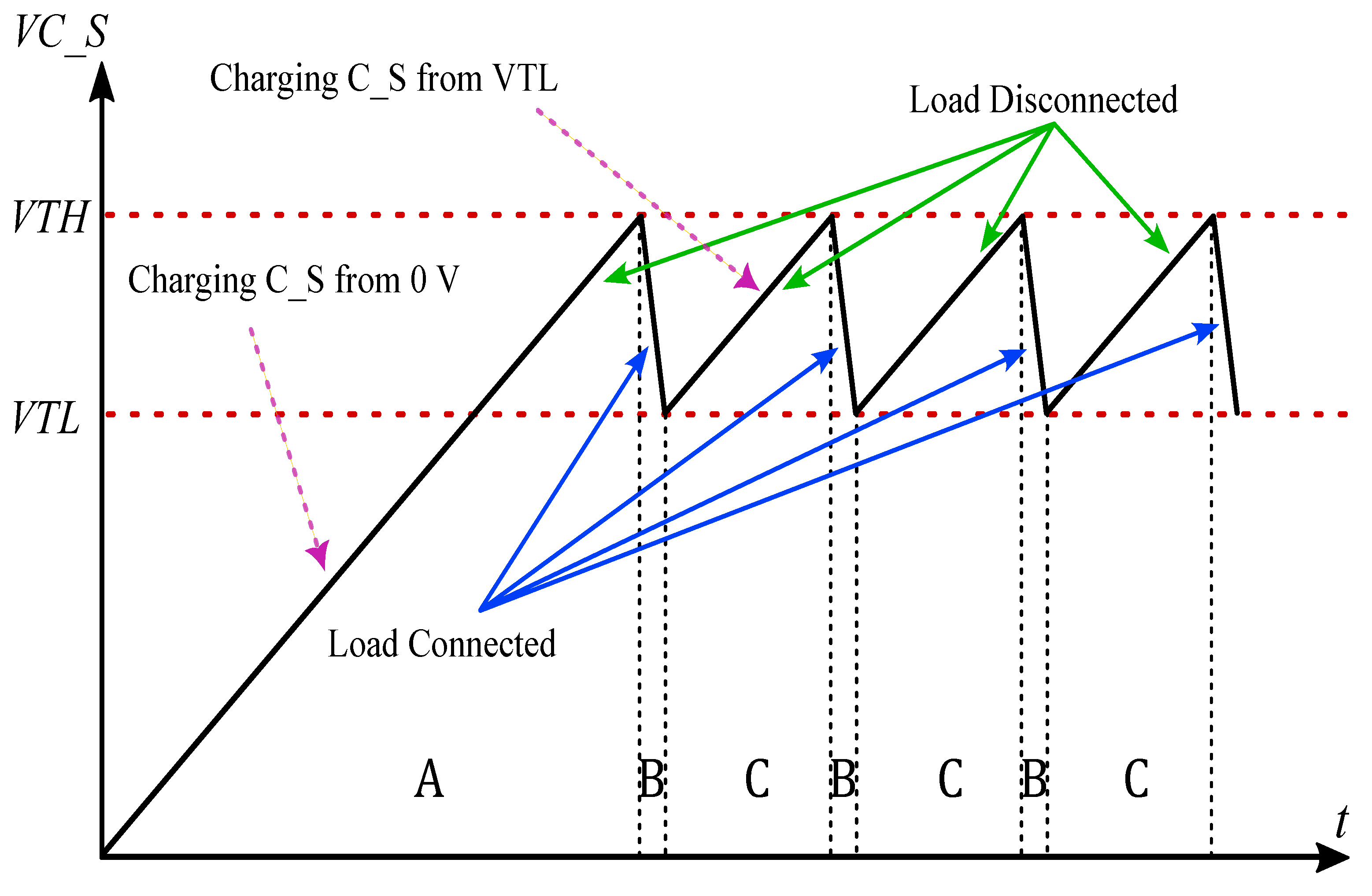
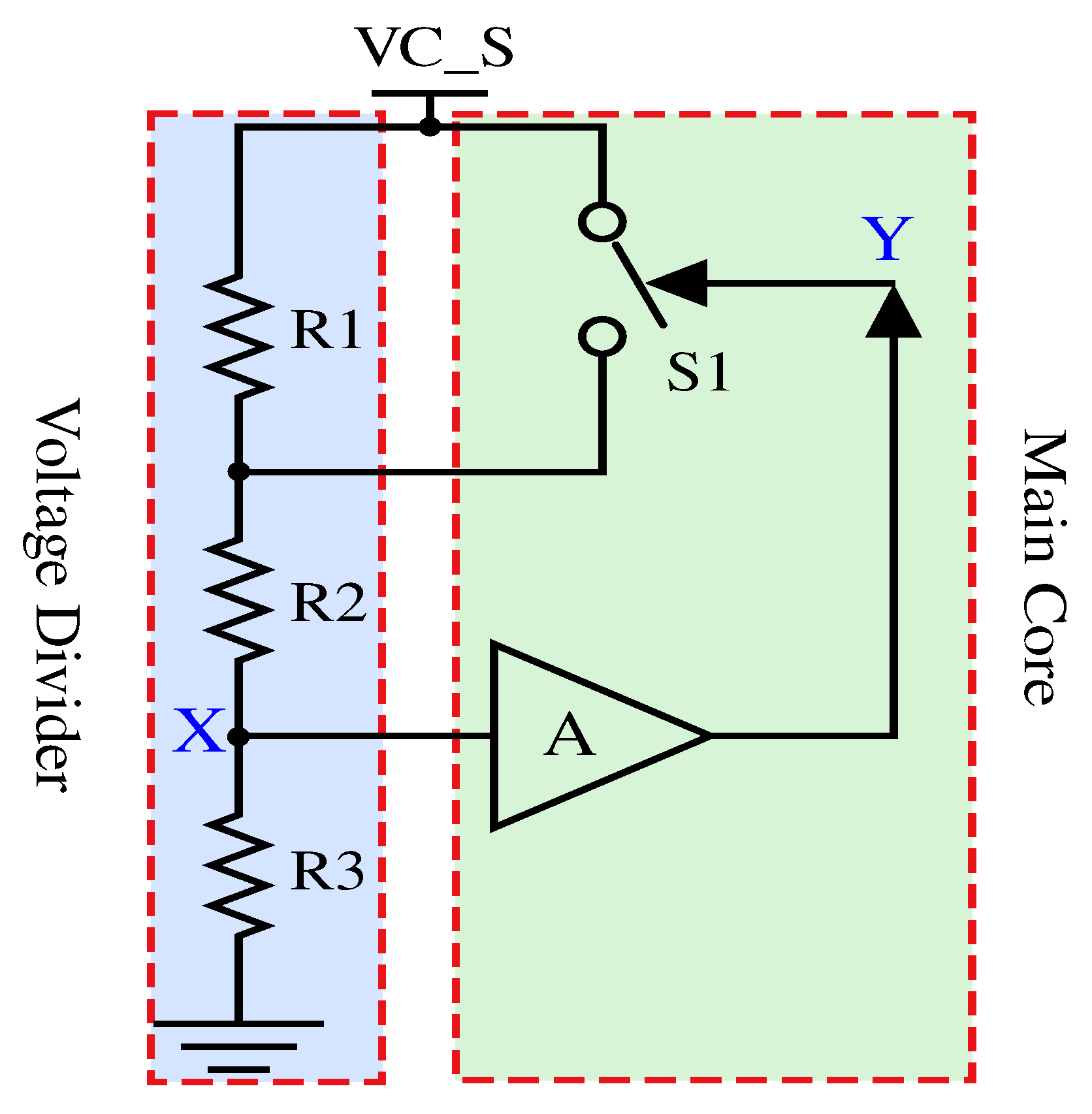
- Enabling: When VC_S becomes sufficiently high, the voltage at node X (VX) activates block A, and node Y is enabled. This action closes switch S1, causing resistor R1 to be shorted, which generates hysteresis. After connecting the load, this increase at VX preserves the existing state (region B). The value of VC_S just before the transition to the on state, while switch S1 is still open (region A), is defined as VTH. We have:
- Disabling: When falls below the level required by block A, block A turns off, node Y is disabled, and switch S1 opens (Region C). Similarly, the value of just before the transition to the off state, while switch S1 is still closed (region B), is defined as . We have:
3. Proposed Circuit
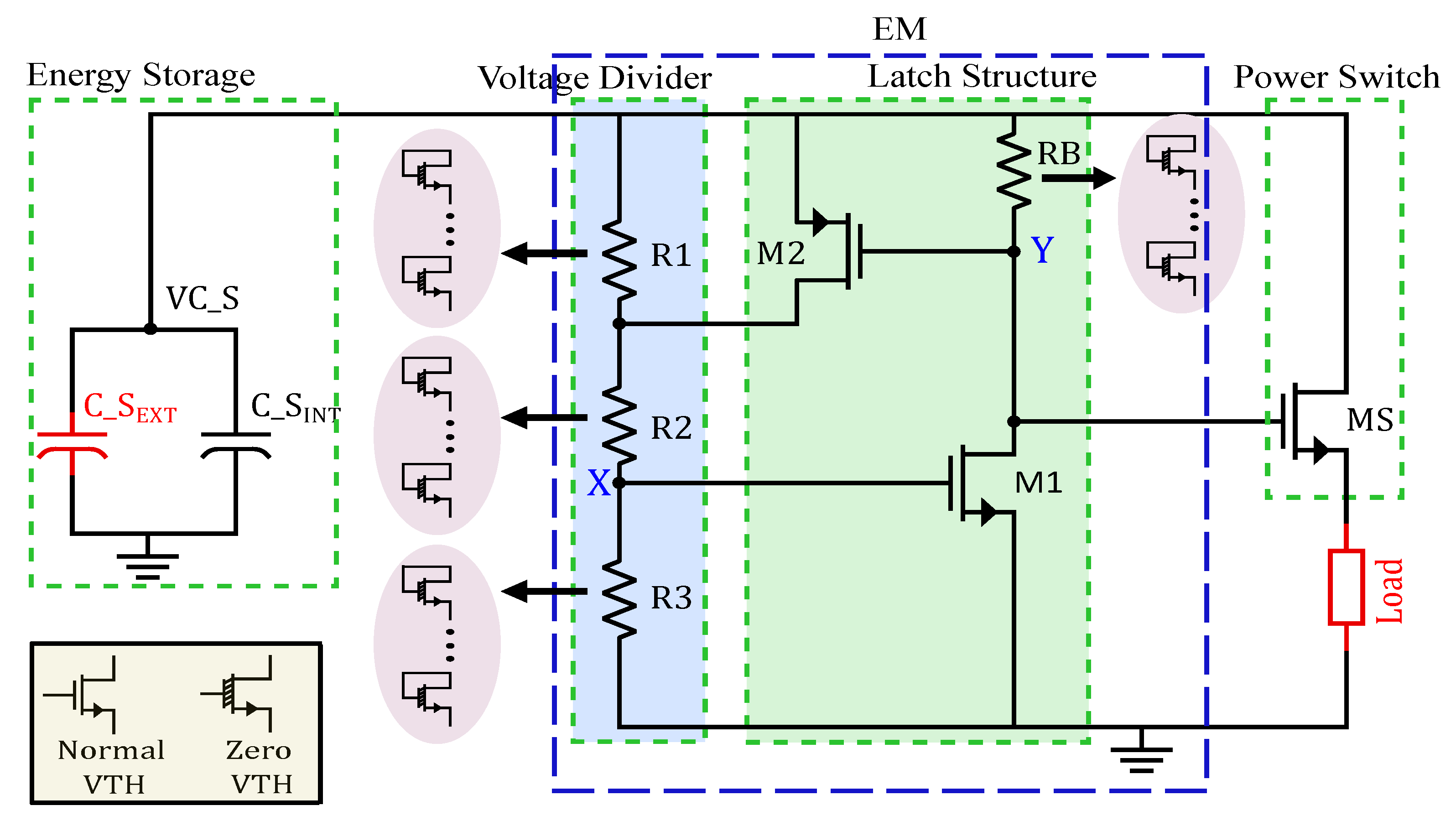
- Region A: Initially, when is at 0 V, both transistors M1 and M2 are fully off. The output node of EM circuit, labeled as Y, is connected to the supply rail through resistor RB. The PMOS power switch MS, remains off in this region because the voltage at node Y is sufficiently close to . As increases, the voltage at the gate of M1, denoted as , can be expressed as:is the gate-source voltage of M1. When is above 0 V but below the threshold voltage of M1, transistor M1 operates in the sub-threshold region. In this state, M1 is not fully on and conducts only a very low sub-threshold current. The current through M1 can be calculated as:represents the threshold voltage of M1. is a process-dependent current constant, n is the ideality factor, k is the Boltzmann constant, T is the absolute temperature of the transistor, and q is the electron charge. Equation (5) is valid only at low values, where the current through the voltage divider is low, leading to a low . As a result, M1 conducts only a minimal current, which is insufficient to activate the circuit for normal operation. For M2, we have:At the transition from Region A to Region B, M1 enters a transient state, shifting from nearly off to fully on. Assuming that both M1 and M2 are still off during this transition, we have:Once reaches , transistor M2 turns on, acting as a switch that shorts and causes hysteresis.
- Region B: In this region, all transistors M1, M2 and MS are on. This state continues, and node Y remains nearly tied to ground as long as stays above Vth1 to keep M1 fully on. During this period, M2 shorts , increasing despite the drop in . This keeps M1 on and introduces hysteresis. At the end of region B and the beginning of region C, M2 begins a transition from on to off. By assuming M2 is still on and continues to short , we have:
- Region C: Clearly, M1 stays off, and the voltage at node Y, which controls M2 and MS, is shorted to until reaches again.
3.1. Power Consumption Analysis
- Region A: During the charging phase of from 0 V to , both M1 and M2 remain completely or nearly off, consuming negligible current compared to the voltage divider. The maximum current in this state is given by:
- Region B: During the discharging phase of from to , the EM output is active. Most of the current is consumed by the load through MS, while a smaller portion is consumed by the EM. Since M1 and M2 are on in this region, the quiescent current is higher than in Region A. For M1, the current can be calculated by:where is the process transconductance parameter of the NMOS, W and L are transistor width and length, respectively, , and are the gate-to-source voltage, threshold voltage, and drain-to-source voltage of M1, respectively. where is the process transconductance parameter of the NMOS, W and L are transistor width and length, respectively, , and are the gate-to-source voltage, threshold voltage, and drain-to-source voltage of M1, respectively. To reduce the current through M1, should be minimized. This can be achieved by increasing the value of RB. For example, when is 3 V and the desired current for M1 is 50 nA, RB should be around 60 MΩ. In this design, to properly bias M2 and maintain ultra-low current in M1, even higher values, such as 100 MΩ, are required. The current through M2 is mainly set by and , since the drain–source resistance of M2 (Rds) is much smaller than , effectively shorting . Therefore, the current can be approximated as:Note that this value represents the maximum current for M2 assuming is fully shorted by M2. When is not completely shorted, the third term in the denominator of the first term in Equation (12) is higher, leading to a lower current. The total current consumption in this state can be estimated by:
- Region C: During the charging phase of from to , the EM output is disabled, and the maximum current consumption in this state is similar to that in Region A.
3.2. High Resistance Implementation
3.3. Load Connection
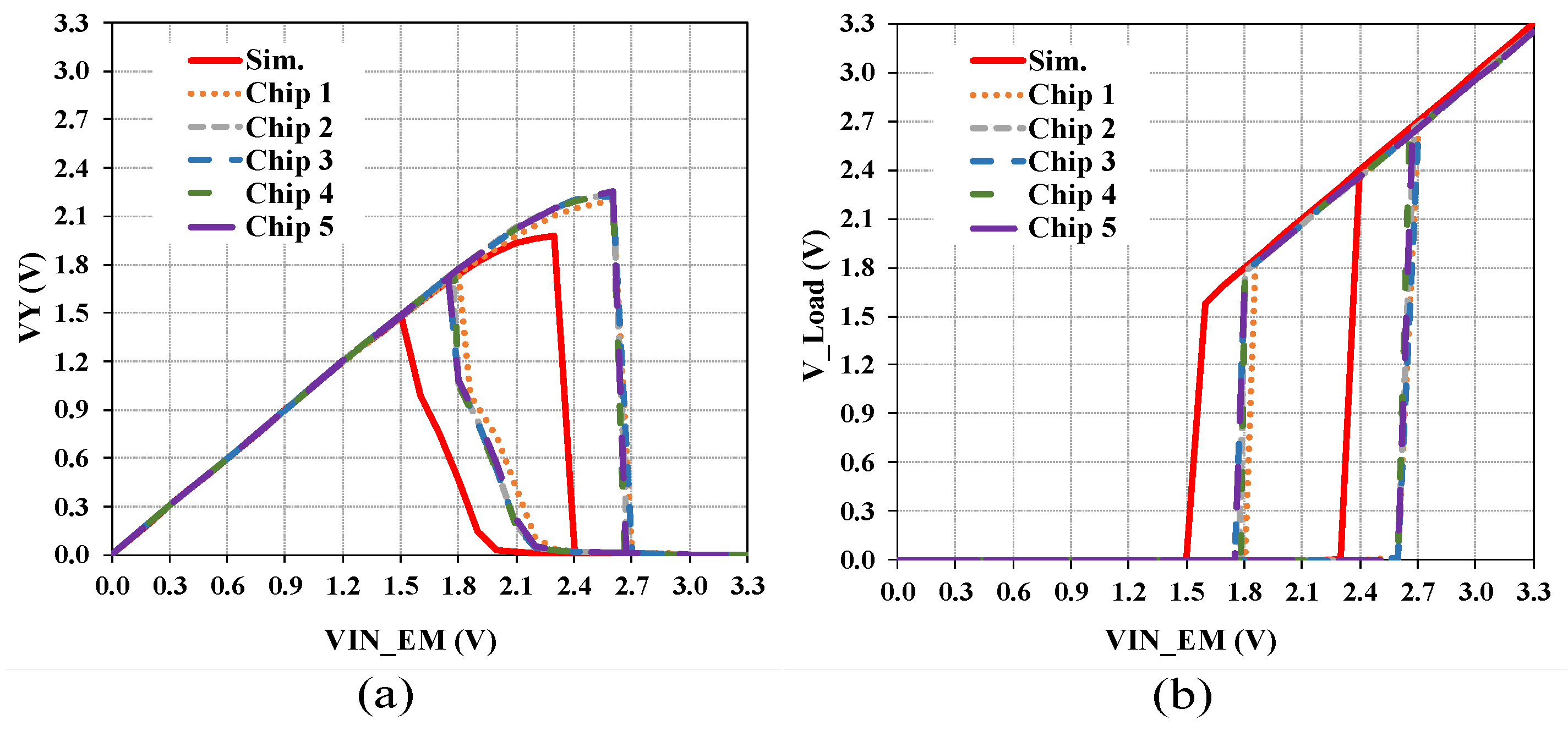
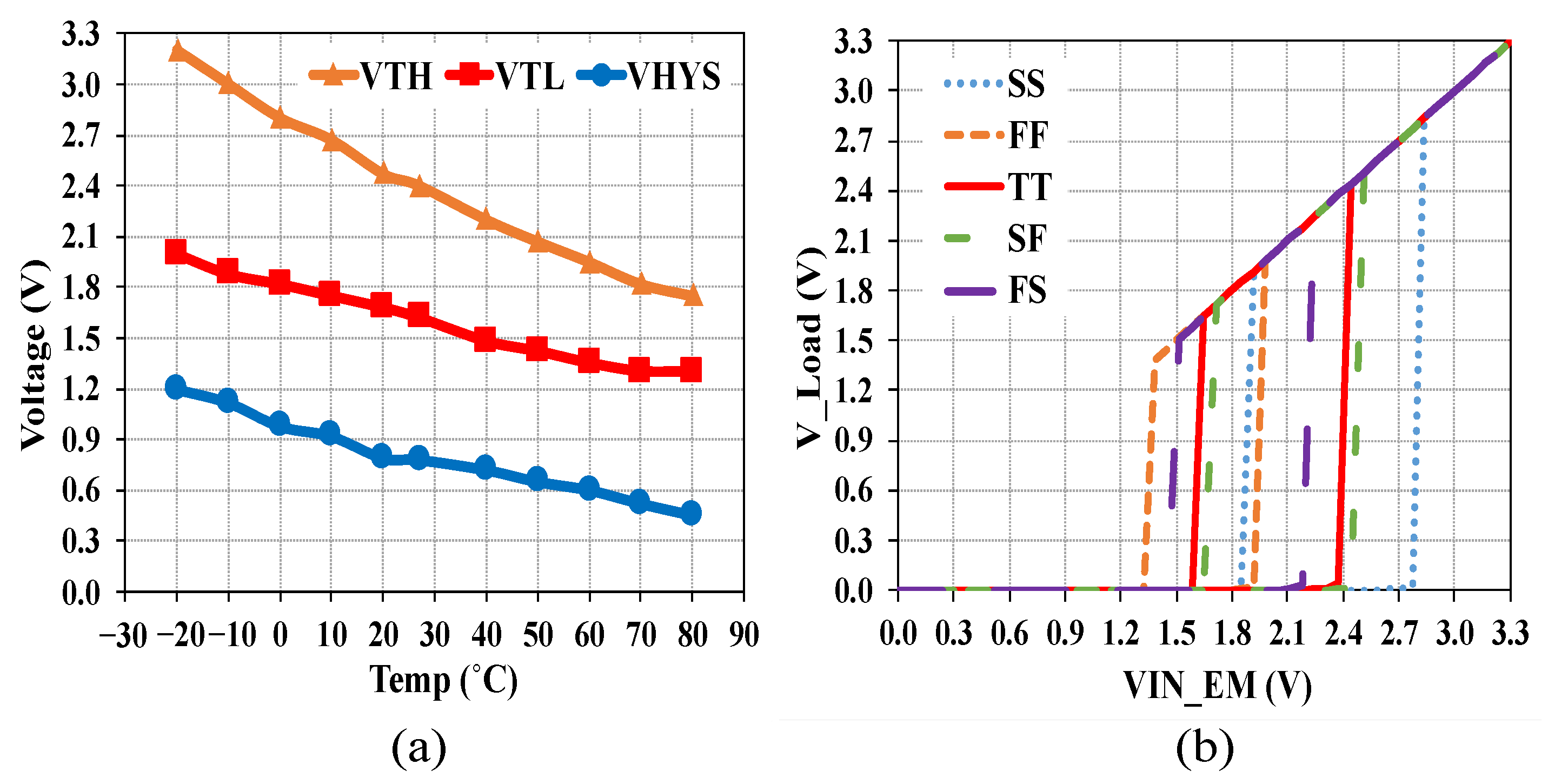
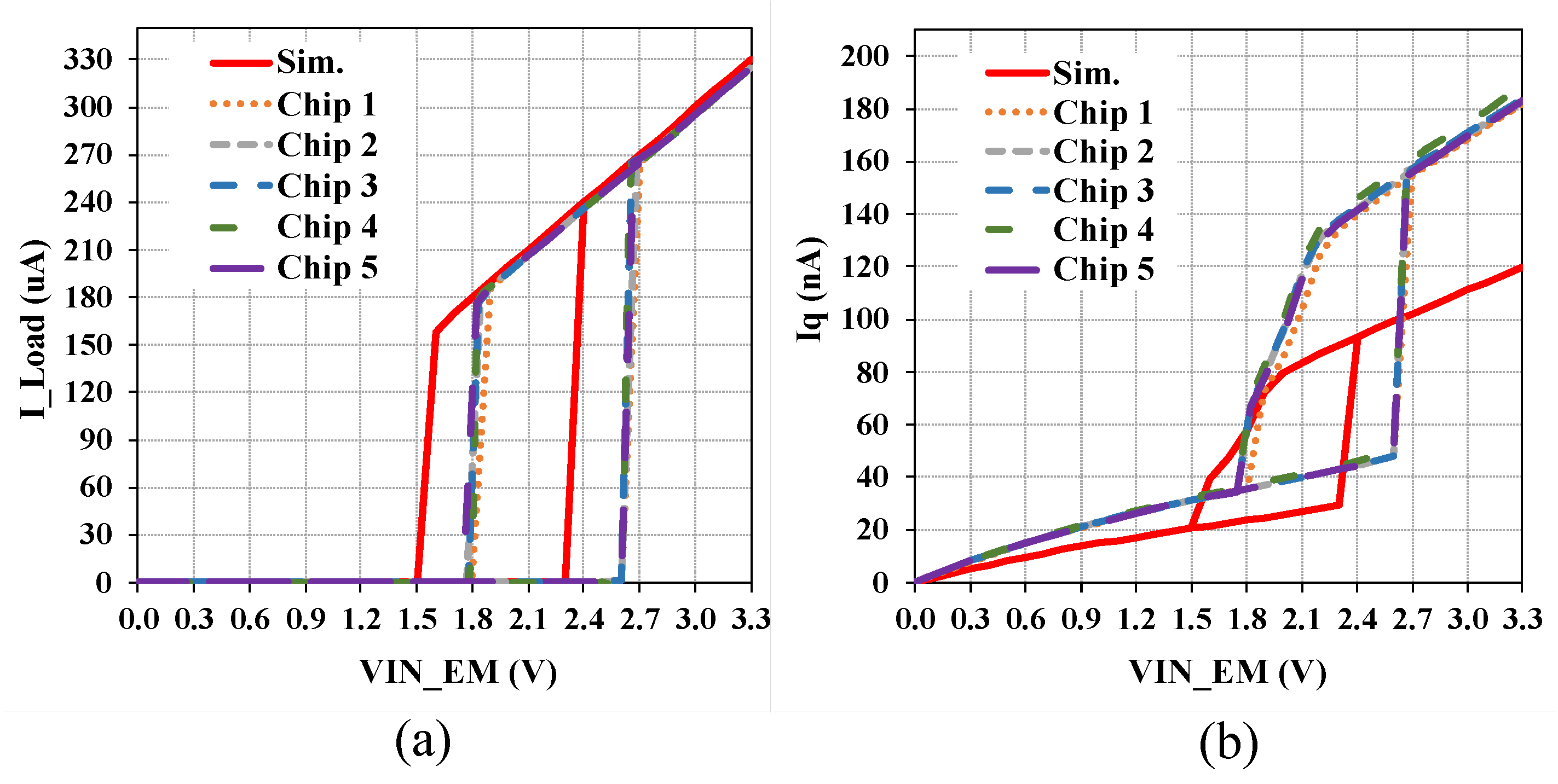
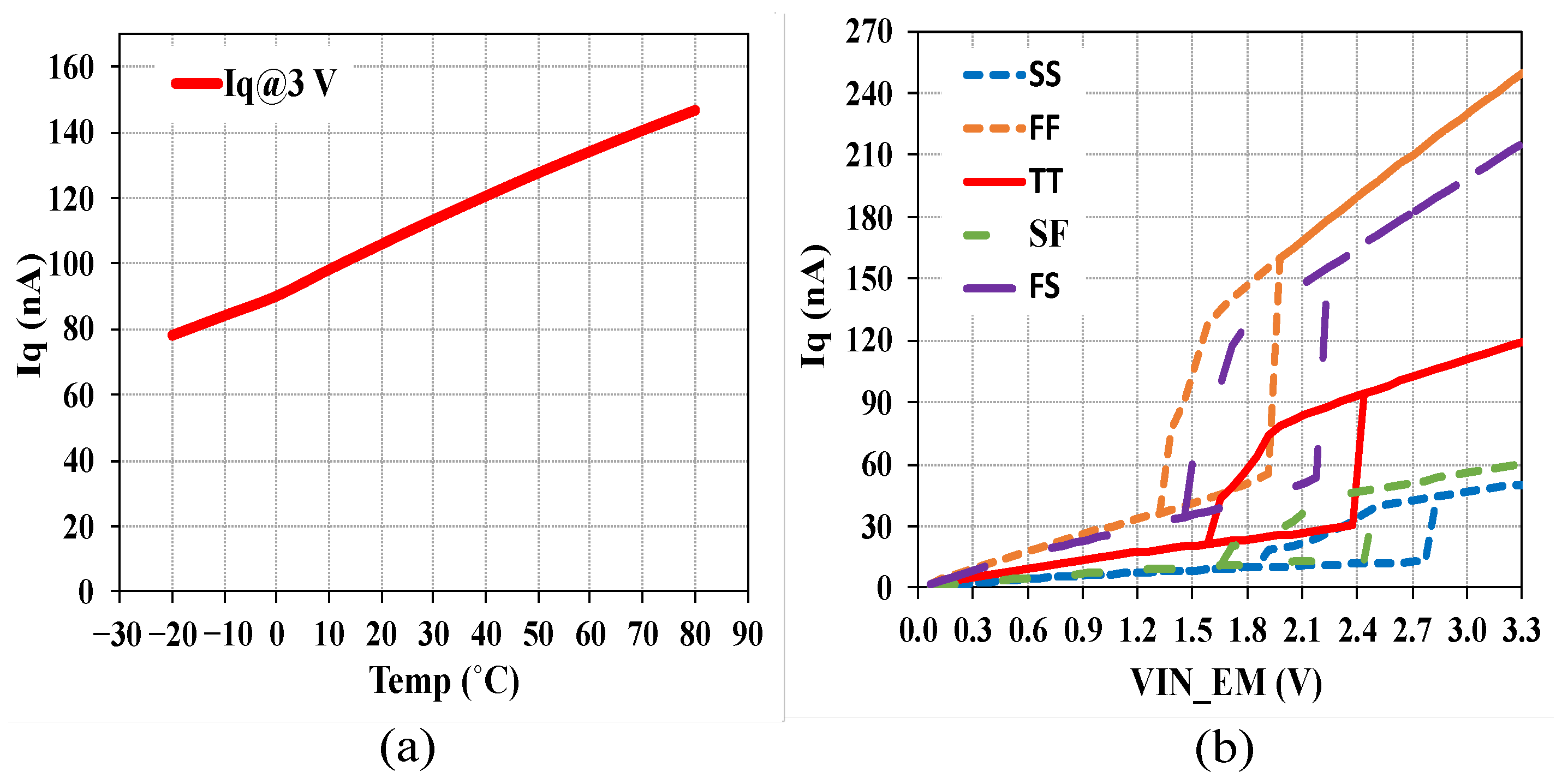
4. Results
5. Conclusions
Author Contributions
Funding
Institutional Review Board Statement
Informed Consent Statement
Data Availability Statement
Conflicts of Interest
Abbreviations
| EM | Energy Management |
| PMIC | Power Management Integrated Circuit |
| EH | Energy Harvesting |
| IoT | Internet of Things |
| WSN | Wireless Sensor Network |
| LDO | Low-Dropout Regulator |
| PDN | Power Delivery Network |
| PCB | Printed Circuit Board |
References
- Peng, W.; Du, S. The advances in conversion techniques in triboelectric energy harvesting: A review. IEEE Trans. Circuits Syst. I Regul. Pap. 2023, 70, 3049–3062. [Google Scholar] [CrossRef]
- Teng, L.; Wang, H.; Liu, Y.; Fu, M.; Liang, J. A three-transistor energy management circuit for energy-harvesting-powered iot devices. IEEE Internet Things J. 2023, 11, 1301–1310. [Google Scholar] [CrossRef]
- Liu, S.; Chen, S.; Gao, W.; Zhang, J.; Xu, D.; Chen, F.; Lu, Z.; Yu, X. A High-Efficiency Piezoelectric Energy Harvesting and Management Circuit Based on Full-Bridge Rectification. J. Low Power Electron. Appl. 2024, 14, 49. [Google Scholar] [CrossRef]
- Cheng, X.; Miao, L.; Song, Y.; Su, Z.; Chen, H.; Chen, X.; Zhang, J.; Zhang, H. High efficiency power management and charge boosting strategy for a triboelectric nanogenerator. Nano Energy 2017, 38, 438–446. [Google Scholar] [CrossRef]
- Solar, H.; Beriain, A.; Berenguer, R.; Sosa, J.; Montiel-Nelson, J.A. Semi-passive UHF RFID sensor tags: A comprehensive review. IEEE Access 2023, 11, 135583–135599. [Google Scholar] [CrossRef]
- Lopez-Gasso, A.; Beriain, A.; Solar, H.; Berenguer, R. Power Management Unit for Solar Energy Harvester Assisted Batteryless Wireless Sensor Node. Sensors 2022, 22, 7908. [Google Scholar] [CrossRef] [PubMed]
- Yu, J.; Ma, T. Passive power management for triboelectric nanogenerators in sub-microwatt applications. Nano Energy 2024, 119, 109079. [Google Scholar] [CrossRef]
- Teng, L.; Liang, J.; Du, S. A nano-power wake-up circuit for energy-driven IoT applications. In Proceedings of the 2022 IEEE International Symposium on Circuits and Systems (ISCAS), Austin, TX, USA, 27 May–1 June 2022; IEEE: Piscataway, NJ, USA, 2022; pp. 2383–2387. [Google Scholar] [CrossRef]
- Alghisi, D.; Ferrari, V.; Ferrari, M.; Touati, F.; Crescini, D.; Mnaouer, A.B. A new nano-power trigger circuit for battery-less power management electronics in energy harvesting systems. Sens. Actuators A Phys. 2017, 263, 305–316. [Google Scholar] [CrossRef]
- Fan, S.; Wei, R.; Zhao, L.; Yang, X.; Geng, L.; Feng, P.X.L. An ultralow quiescent current power management system with maximum power point tracking (MPPT) for batteryless wireless sensor applications. IEEE Trans. Power Electron. 2017, 33, 7326–7337. [Google Scholar] [CrossRef]
- Analog Devices Inc. LTC3588-1 Datasheet: Nanopower Energy Harvesting Power Supply. Analog Devices Inc., Document No. LTC3588-1, Rev. E. 2020. Available online: https://www.analog.com/media/en/technical-documentation/data-sheets/35881fc.pdf (accessed on 21 July 2025).
- Torex Semiconductor Ltd. XC6140 Series Datasheet: Voltage Monitoring IC for Energy Harvesting Applications. Torex Semiconductor Ltd., Document No. XC6140, Rev. 1.0. 2022. Available online: https://product.torexsemi.com/system/files/series/xc6140.pdf (accessed on 21 July 2025).
- Chew, Z.J.; Ruan, T.; Zhu, M. Power management circuit for wireless sensor nodes powered by energy harvesting On the synergy of harvester and load. IEEE Trans. Power Electron. 2018, 34, 8671–8681. [Google Scholar] [CrossRef]
- Chandrarathna, S.C.; Graham, S.A.; Ali, M.; Ranaweera, A.L.A.K.; Karunarathne, M.L.; Yu, J.S.; Lee, J.W. Analysis and Experiment of Self-Powered, Pulse-Based Energy Harvester Using 400 V FEP-Based Segmented Triboelectric Nanogenerators and 98.2% Tracking Efficient Power Management IC for Multi-Functional IoT Applications. Adv. Funct. Mater. 2023, 33, 2213900. [Google Scholar] [CrossRef]
- Ng, W.K.; Tam, W.S.; Kok, C.W. A Current Comparison Based Voltage Supervisory Circuit with On-Chip Detection Voltage Trimming. Solid State Electron. Lett. 2021, 3, 5–10. [Google Scholar] [CrossRef]
- Kim, J.; Chekuri, V.C.K.; Rahman, N.M.; Dolatsara, M.A.; Torun, H.M.; Swaminathan, M.; Mukhopadhyay, S.; Lim, S.K. Chiplet/interposer co-design for power delivery network optimization in heterogeneous 2.5-D ICs. IEEE Trans. Compon. Packag. Manuf. Technol. 2021, 11, 2148–2157. [Google Scholar] [CrossRef]
- Texas Instruments. CC1310 SimpleLink Ultra-Low-Power Sub-1 GHz Wireless Microcontroller; Texas Instruments Inc., 2018. Available online: https://www.ti.com/lit/ds/symlink/cc1310.pdf (accessed on 21 July 2025).
- Texas Instruments. MSP430x2xx Family Datasheet; Texas Instruments Inc. Available online: https://www.ti.com/product-category/microcontrollers-processors/msp430-mcus/products.html (accessed on 21 July 2025).
- Ishibashi, K.; Takahashi, S. A 375 nA Input Off Current Schmitt Triger LDO for Energy Harvesting IoT Sensors. In Proceedings of the 2018 IEEE Computer Society Annual Symposium on VLSI (ISVLSI), Hong Kong, China, 8–11 July 2018; IEEE: Piscataway, NJ, USA, 2018; pp. 187–190. [Google Scholar] [CrossRef]



| Parameter | SS @ 27 °C | FF @ 27 °C | TT @ −20 °C | TT @ 20 °C | TT @ 60 °C |
|---|---|---|---|---|---|
| VTH (V) | 2.85 | 1.95 | 3.2 | 2.47 | 1.97 |
| VTL (V) | 1.85 | 1.35 | 2 | 1.63 | 1.37 |
| Iq @ 3 V (nA) | 47 | 225 | 77 | 105.7 | 134 |
| Parameter | Min | Max | Mean | Std. Dev |
|---|---|---|---|---|
| (V) | 2.09 | 2.79 | 2.45 | 0.153 |
| (V) | 1.45 | 1.9 | 1.65 | 0.086 |
| Iq @ 3 V (nA) | 27.91 | 226.4 | 112.8 | 33.7 |
| Parameter | Min | Max | Mean | Std. Dev |
|---|---|---|---|---|
| (V) @ 1 Hz | 2.06 | 2.77 | 2.42 | 0.161 |
| (V) @ 1 Hz | 1.39 | 1.8 | 1.58 | 0.082 |
| (V) @ 100 Hz | 1.34 | 2.49 | 2.23 | 0.174 |
| (V) @ 100 Hz | 0.98 | 1.35 | 1.23 | 0.053 |
| (V) @ 500 Hz | 1.01 | 1.52 | 1.18 | 0.103 |
| (V) @ 500 Hz | 0.7 | 0.85 | 0.73 | 0.035 |
| Parameter | [2] | [9] | [12] | [19] | This Work |
|---|---|---|---|---|---|
| Off/On-Chip | Off | Off | On | On | On |
| Process | - | - | Not Mentioned 1 | 180 nm CMOS | 65 nm CMOS |
| Structure | Latch | Latch | Comparator | Comparator | Latch |
| Power Switch | Yes | Yes | No | No | Yes |
| Current Cons. | 300 nA @ 4 V | 150 nA @ 5 V | 139 nA @ 2.7 V | 3.9 µA @ 1.8 V 2 | 170 nA @ 3 V |
| Output Voltage (V) | 1.7–3.6 | 1.15–2.15 | 1.6–2.7 | 3.48–2.98 | 1.75–2.75 |
Disclaimer/Publisher’s Note: The statements, opinions and data contained in all publications are solely those of the individual author(s) and contributor(s) and not of MDPI and/or the editor(s). MDPI and/or the editor(s) disclaim responsibility for any injury to people or property resulting from any ideas, methods, instructions or products referred to in the content. |
© 2025 by the authors. Licensee MDPI, Basel, Switzerland. This article is an open access article distributed under the terms and conditions of the Creative Commons Attribution (CC BY) license (https://creativecommons.org/licenses/by/4.0/).
Share and Cite
Shahabi, M.; Perez, N.; Solar, H.; Beriain, A. An Ultra-Low-Quiescent-Current On-Chip Energy Management Circuit in 65 nm CMOS for Energy Harvesting Applications. J. Low Power Electron. Appl. 2025, 15, 65. https://doi.org/10.3390/jlpea15040065
Shahabi M, Perez N, Solar H, Beriain A. An Ultra-Low-Quiescent-Current On-Chip Energy Management Circuit in 65 nm CMOS for Energy Harvesting Applications. Journal of Low Power Electronics and Applications. 2025; 15(4):65. https://doi.org/10.3390/jlpea15040065
Chicago/Turabian StyleShahabi, Mehdi, Noemi Perez, Hector Solar, and Andoni Beriain. 2025. "An Ultra-Low-Quiescent-Current On-Chip Energy Management Circuit in 65 nm CMOS for Energy Harvesting Applications" Journal of Low Power Electronics and Applications 15, no. 4: 65. https://doi.org/10.3390/jlpea15040065
APA StyleShahabi, M., Perez, N., Solar, H., & Beriain, A. (2025). An Ultra-Low-Quiescent-Current On-Chip Energy Management Circuit in 65 nm CMOS for Energy Harvesting Applications. Journal of Low Power Electronics and Applications, 15(4), 65. https://doi.org/10.3390/jlpea15040065