
Business Ecosystem Embeddedness and SRDI SME Growth: The Roles of Organizational Resilience and Digital Leadership

Highlights
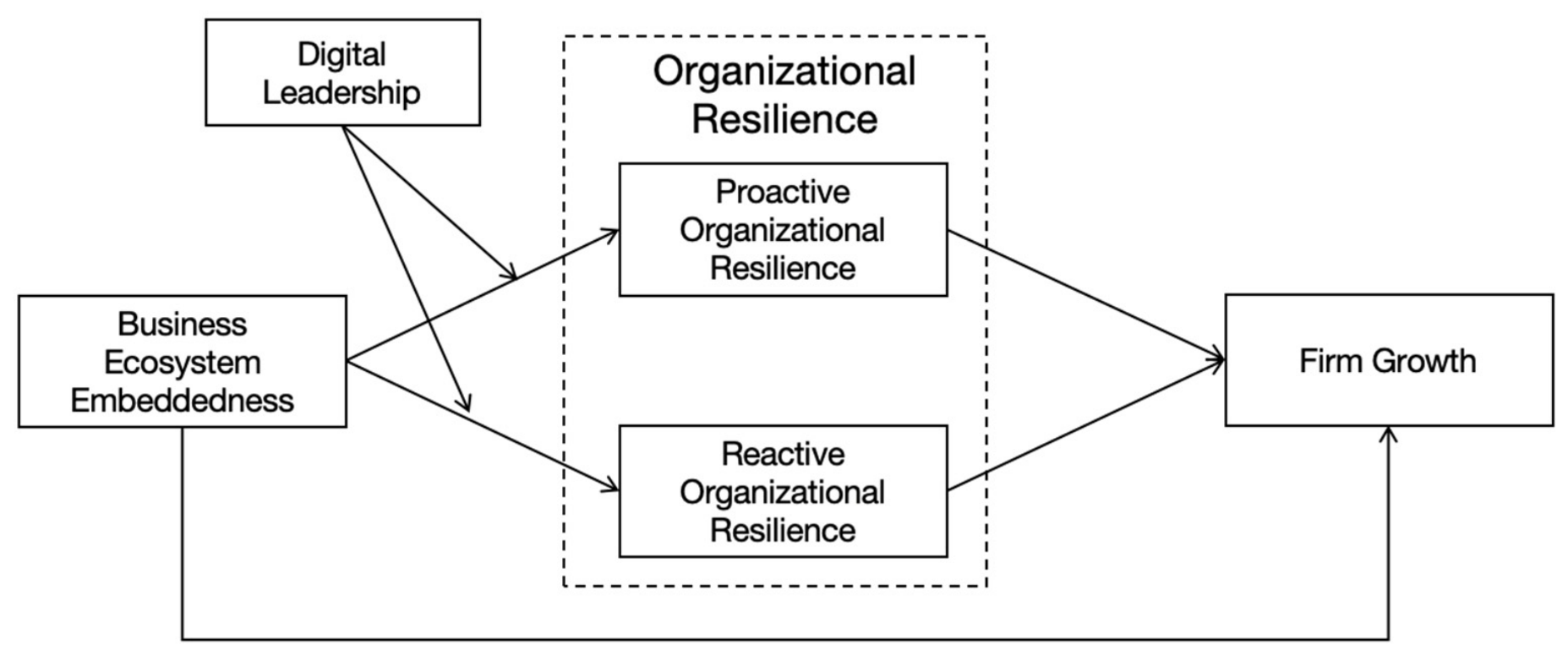
- This study adopts a systems perspective by viewing SRDI SME growth as an outcome of interactions within a business ecosystem characterized by interdependence, complementarity, and coordinated value creation among multiple actors.
- It contributes to systems theory by explaining the cross-level process through which business ecosystem embeddedness develops firm-level proactive and reactive organizational resilience, and how digital leadership shapes this process under environmental turbulence.
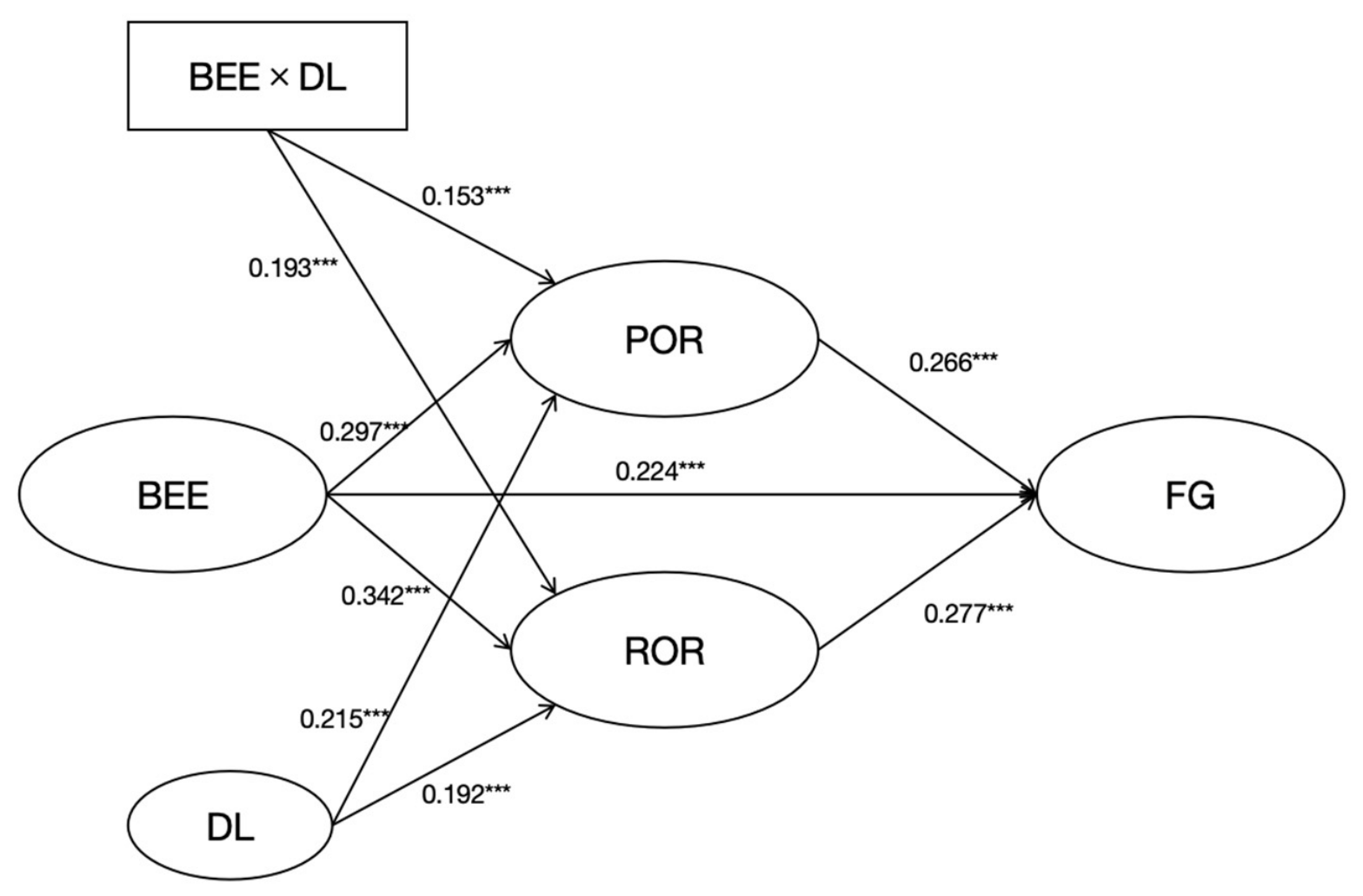
- Business ecosystem embeddedness is positively associated with SRDI SME growth, while proactive and reactive organizational resilience partially mediate this relationship at different stages of environmental disruption.
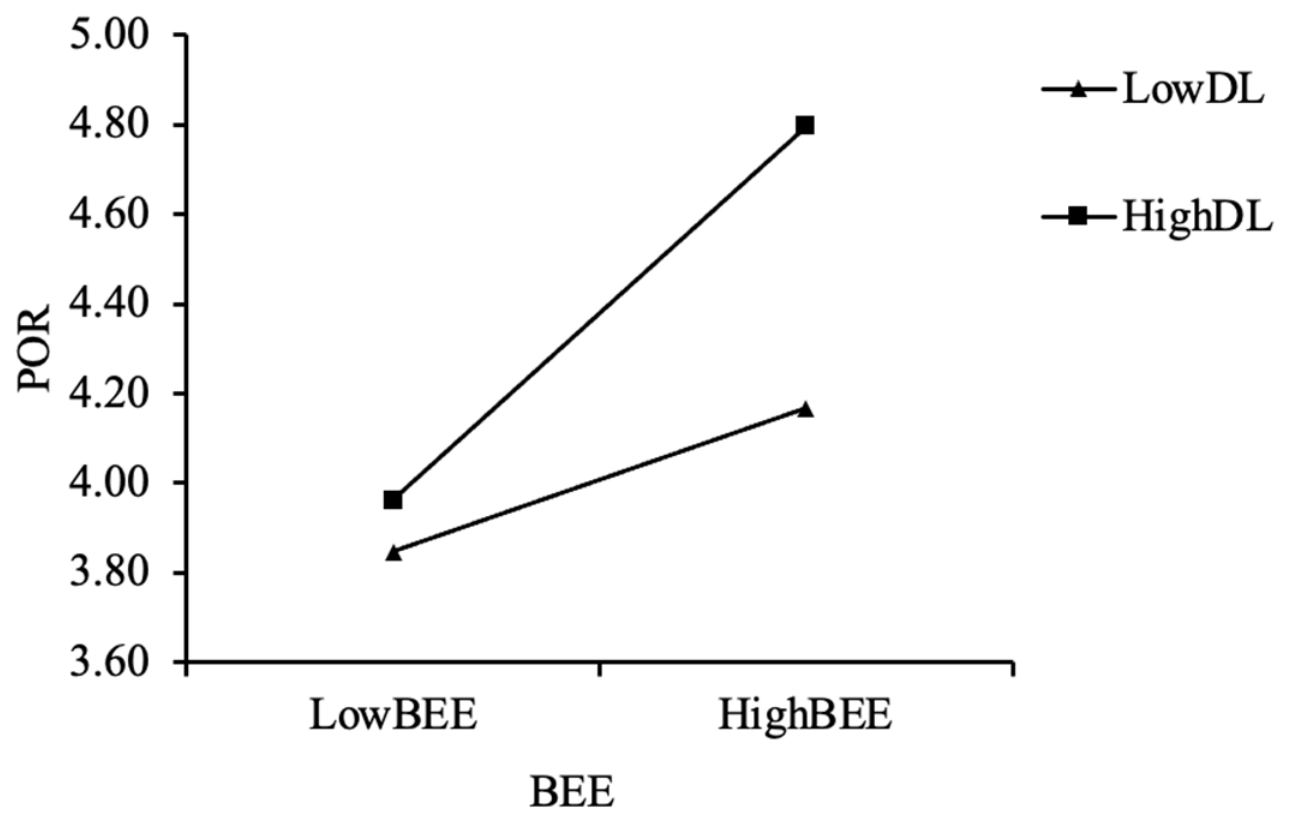
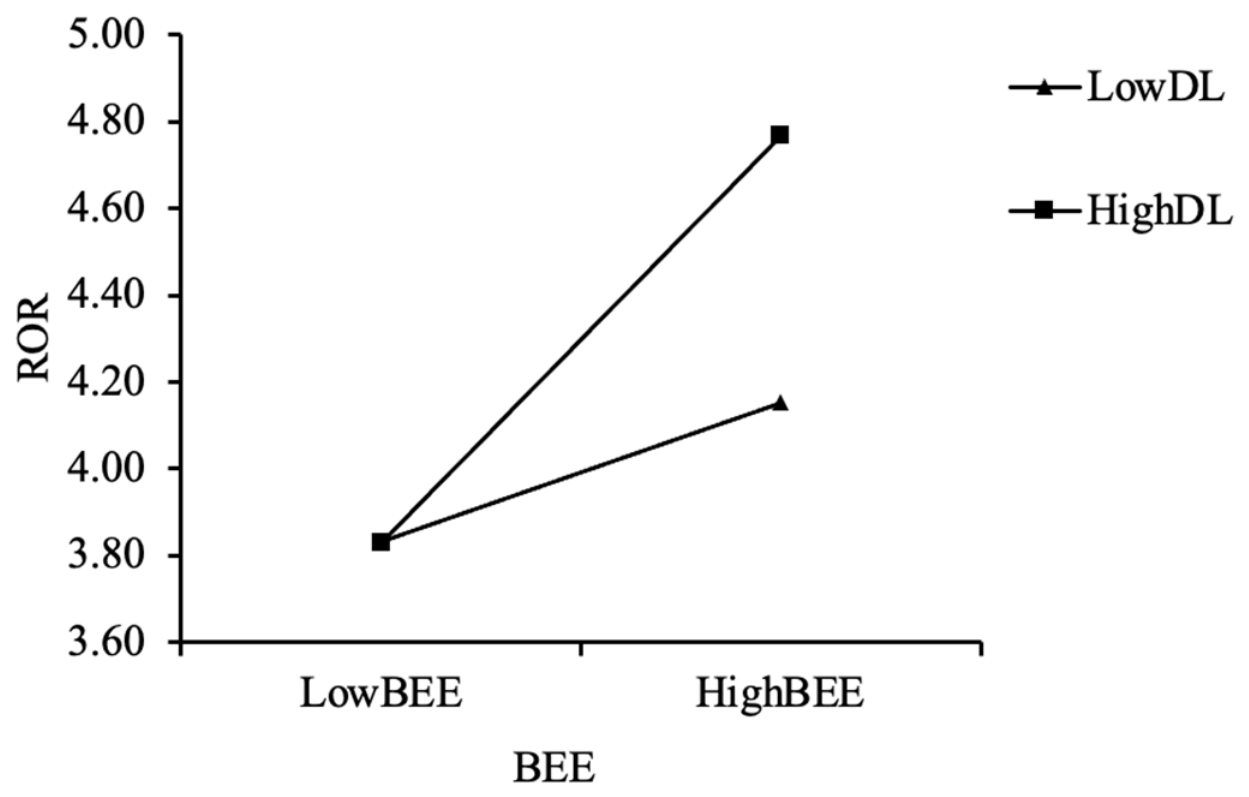
- Higher digital leadership strengthens the positive effects of business ecosystem embeddedness on both proactive and reactive organizational resilience, thereby increasing its indirect effects on SRDI SME growth through both resilience pathways.
Abstract
1. Introduction
2. Theoretical Background and Hypothesis Development
2.1. Resource Orchestration Theory
2.2. Business Ecosystem Embeddedness
2.3. Business Ecosystem Embeddedness and Firm Growth
2.4. The Mediating Effect of Organizational Resilience
2.5. The Moderating Effect of Digital Leadership
2.6. The Moderated Mediation Effect of Digital Leadership
3. Method
3.1. Sample
3.2. Measurement of Variables
3.3. Common Method Bias
4. Data Analysis and Results
4.1. Reliability and Validity
4.2. Descriptive Statistics and Correlation Analysis
4.3. Hypothesis Testing
4.3.1. The Main Effect

| Variables | 1 | 2 | 3 | 4 | 5 | 6 | 7 | 8 | 9 | 10 | 11 | 12 |
|---|---|---|---|---|---|---|---|---|---|---|---|---|
| 1 BEE | (0.755) | |||||||||||
| 2 POR | 0.384 *** | (0.731) | ||||||||||
| 3 ROR | 0.385 *** | 0.491 *** | (0.731) | |||||||||
| 4 DL | 0.256 *** | 0.304 *** | 0.286 *** | (0.801) | ||||||||
| 5 FG | 0.481 *** | 0.469 *** | 0.500 *** | 0.328 *** | (0.697) | |||||||
| 6 Lgen | 0.109 ** | 0.104 ** | 0.052 | 0.067 | 0.152 *** | - | ||||||
| 7 Lage | −0.009 | 0.020 | 0.008 | −0.018 | −0.051 | 0.177 *** | - | |||||
| 8 Ledu | 0.060 | 0.006 | −0.076 | −0.046 | 0.010 | 0.106 | 0.133 *** | - | ||||
| 9 F-size | −0.020 | −0.053 | −0.055 | −0.151 *** | −0.088 | 0.072 | −0.010 | 0.078 | - | |||
| 10 F-age | −0.164 *** | −0.096 | −0.039 | −0.079 | −0.099 | 0.034 | 0.089 * | 0.085 | 0.230 *** | - | ||
| 11 Ind | 0.002 | 0.034 | −0.006 | −0.029 | −0.003 | −0.056 | −0.114 ** | −0.115 ** | 0.013 | −0.012 | - | |
| 12 Own | 0.051 | 0.033 | −0.045 | 0.006 | −0.070 | 0.081 | 0.021 | 0.049 | −0.055 | −0.060 | −0.061 | - |
| Mean | 4.142 | 4.226 | 4.254 | 4.143 | 4.184 | 0.62 | 3.54 | 3.38 | 2.96 | 2.59 | 5.49 | 2.26 |
| SD | 1.193 | 1.205 | 1.138 | 1.315 | 1.133 | 0.487 | 0.880 | 0.593 | 1.073 | 1.233 | 2.669 | 0.836 |
4.3.2. The Mediation Effect
4.3.3. The Moderating Effect
| Variables | Firm Growth | Proactive Organizational Resilience | Reactive Organizational Resilience | Firm Growth | ||||||
|---|---|---|---|---|---|---|---|---|---|---|
| M1 | M2 | M3 | M4 | M5 | M6 | M7 | M8 | M9 | M10 | |
| Lgen | 0.181 *** | 0.129 *** | 0.108 ** | 0.067 | 0.066 | 0.023 | 0.132 *** | 0.107 ** | 0.148 *** | 0.121 *** |
| Lage | −0.078 | −0.068 | 0.012 | 0.019 | 0.008 | 0.016 | −0.083 * | −0.074 * | −0.081 * | −0.074 * |
| Ledu | 0.019 | −0.011 | 0.007 | −0.017 | −0.076 | −0.102 | 0.016 | −0.006 | 0.056 | 0.026 |
| Size | −0.089 * | −0.093 ** | −0.040 | −0.043 | −0.050 | −0.053 | −0.071 | −0.079 * | −0.065 | −0.073 * |
| Age | −0.085 | −0.004 | −0.090 * | −0.027 | −0.028 | 0.041 | −0.044 | 0.004 | −0.071 | −0.019 |
| Ind | −0.005 | −0.011 | 0.043 | 0.038 | −0.013 | −0.018 | −0.024 | −0.023 | 0.001 | −0.004 |
| Own | −0.094 * | −0.108 ** | 0.018 | 0.007 | −0.052 | −0.064 | −0.103 ** | −0.111 ** | −0.069 | −0.085 ** |
| BEE | 0.470 *** | 0.372 *** | 0.398 *** | 0.349 *** | 0.326 *** | |||||
| POR | 0.453 *** | 0.326 *** | ||||||||
| ROR | 0.488 *** | 0.362 *** | ||||||||
| R2 | 0.055 | 0.265 | 0.024 | 0.157 | 0.016 | 0.167 | 0.255 | 0.355 | 0.289 | 0.375 |
| Adj-R2 | 0.036 | 0.249 | 0.005 | 0.138 | −0.004 | 0.148 | 0.238 | 0.339 | 0.273 | 0.359 |
| F | 2.961 *** | 16.173 *** | 1.278 | 8.312 *** | 0.809 | 8.939 *** | 15.322 *** | 21.859 *** | 18.156 *** | 23.757 *** |
| VIF | <1.3 | <1.3 | <1.3 | <1.3 | <1.3 | <1.3 | <1.3 | <1.3 | <1.3 | <1.3 |
4.3.4. The Moderated Mediation Effect
| Variables | Proactive Organizational Resilience | Reactive Organizational Resilience | ||
|---|---|---|---|---|
| M11 | M12 | M13 | M14 | |
| Lgen | 0.054 | 0.041 | 0.012 | −0.004 |
| Lage | 0.024 | 0.023 | 0.020 | 0.019 |
| Ledu | −0.005 | −0.009 | −0.091 * | −0.097 * |
| Size | −0.011 | −0.007 | −0.025 | −0.019 |
| Age | −0.026 | −0.032 | 0.041 | 0.034 |
| Ind | 0.045 | 0.050 | −0.011 | −0.006 |
| Own | 0.011 | 0.014 | −0.060 | −0.058 |
| BEE | 0.318 *** | 0.289 *** | 0.350 *** | 0.315 *** |
| DL | 0.217 *** | 0.186 *** | 0.191 *** | 0.154 *** |
| BEE×DL | 0.140 *** | 0.168 *** | ||
| R2 | 0.199 | 0.216 | 0.199 | 0.224 |
| Adj-R2 | 0.179 | 0.194 | 0.179 | 0.202 |
| F | 9.872 *** | 9.815 *** | 9.880 *** | 10.263 *** |
| VIF | <1.3 | <1.3 | <1.3 | <1.3 |
| Conditional Indirect Effect(s) of X on Y at Values of the Moderator(s) | ||||
| Moderator | Effect | Boot SE | Boot LLCI | Boot ULCI |
| DL (−1 SD) | 0.0525 | 0.0263 | 0.0020 | 0.1063 |
| DL (Mean) | 0.0943 | 0.0204 | 0.0582 | 0.1368 |
| DL (+1 SD) | 0.1362 | 0.0269 | 0.0879 | 0.1928 |
| Index of Moderated Mediation | ||||
| Moderator | Index | Boot SE | Boot LLCI | Boot ULCI |
| DL | 0.0419 | 0.0171 | 0.0108 | 0.0781 |
| Conditional Indirect Effect(s) of X on Y at Values of the Moderator(s) | ||||
| Moderator | Effect | Boot SE | Boot LLCI | Boot ULCI |
| DL (−1 SD) | 0.0582 | 0.0274 | 0.0052 | 0.1152 |
| DL (Mean) | 0.1140 | 0.0220 | 0.0731 | 0.1606 |
| DL (+1 SD) | 0.1699 | 0.0298 | 0.1140 | 0.2299 |
| Index of Moderated Mediation | ||||
| Moderator | Index | Boot SE | Boot LLCI | Boot ULCI |
| DL | 0.0558 | 0.0183 | 0.0221 | 0.0942 |
4.3.5. Robustness Test
5. Conclusions and Discussion
5.1. Conclusions
5.2. Theoretical Contributions
5.3. Practical Implications
5.4. Limitations and Future Research
Author Contributions
Funding
Institutional Review Board Statement
Informed Consent Statement
Data Availability Statement
Conflicts of Interest
Abbreviations
| SRDI | Specialized, Refined, Differentiated, and Innovative |
| SME | Small and Medium-sized Enterprises |
| BEE | Business Ecosystem Embeddedness |
| POR | Proactive Organizational Resilience |
| ROR | Reactive Organizational Resilience |
| DL | Digital Leadership |
| FG | Firm Growth |
References
- Yucesan, E. Does Deglobalization Imply the End of Global Supply Chains? Int. Bus. Rev. 2025, 34, 102398. [Google Scholar] [CrossRef] [Scilit]
- Simon, H. Hidden Champions of the Twenty-First Century: Success Strategies of Unknown World Market Leaders; Springer: New York, NY, USA, 2009. [Google Scholar]
- Audretsch, D.B.; Lehmann, E.E.; Schenkenhofer, J. Internationalization Strategies of Hidden Champions: Lessons from Germany. Multinatl. Bus. Rev. 2018, 26, 2–24. [Google Scholar] [CrossRef] [Scilit]
- Feng, Y.; Cao, X.; Wu, A.; Wang, L.; Zhou, X. How Can “SRDI” Enterprises Break the Growth Lock? A Case Study Based on Mingfei Technology. J. Manag. World 2025, 41, 190–210. (In Chinese) [Google Scholar] [CrossRef]
- Eggers, F. Masters of Disasters? Challenges and Opportunities for SMEs in Times of Crisis. J. Bus. Res. 2020, 116, 199–208. [Google Scholar] [CrossRef] [Scilit] [PubMed]
- Schenkenhofer, J. Hidden Champions: A Review of the Literature & Future Research Avenues. Manag. Rev. Q. 2022, 72, 417–482. [Google Scholar] [CrossRef] [Scilit]
- Penrose, E.T. The Theory of the Growth of the Firm; Blackwell: Oxford, UK, 1959. [Google Scholar]
- Lefebvre, V. Does a Long-Term Orientation Lead to Faster Growth? Firms’ Temporal Orientation and the Growth Process. Entrep. Theory Pract. 2026, 50, 1088–1117. [Google Scholar] [CrossRef] [Scilit]
- Laidoja, L.; Li, X.; Liu, W.; Ren, T. Female Corporate Leadership and Firm Growth Strategy: A Global Perspective. Sustainability 2022, 14, 5578. [Google Scholar] [CrossRef] [Scilit]
- Shen, S.; Lei, L. Beyond the Surface: Exploring Configurations for Digital Innovation Based on Digital Technology Affordance Theory. Technovation 2026, 156, 103628. [Google Scholar] [CrossRef] [Scilit]
- Moore, J.F. Predators and Prey—A New Ecology of Competition. Harv. Bus. Rev. 1993, 71, 75–86. [Google Scholar] [PubMed]
- Adner, R. Ecosystem as Structure: An Actionable Construct for Strategy. J. Manag. 2017, 43, 39–58. [Google Scholar] [CrossRef] [Scilit]
- Granstrand, O.; Holgersson, M. Innovation Ecosystems: A Conceptual Review and a New Definition. Technovation 2020, 90–91, 102098. [Google Scholar] [CrossRef] [Scilit]
- Riquelme-Medina, M.; Stevenson, M.; Barrales-Molina, V.; Llorens-Montes, F.J. Coopetition in Business Ecosystems: The Key Role of Absorptive Capacity and Supply Chain Agility. J. Bus. Res. 2022, 146, 464–476. [Google Scholar] [CrossRef] [Scilit]
- Zhang, Y.; Hao, S. Impel or Impede? Revealing the Effect of Innovation Eco-Embeddedness on the Digital Capabilities of Manufacturing Firms. Eur. J. Innov. Manag. 2025, 28, 4781–4805. [Google Scholar] [CrossRef] [Scilit]
- Sirmon, D.G.; Hitt, M.A.; Ireland, R.D. Managing Firm Resources in Dynamic Environments to Create Value: Looking inside the Black Box. Acad. Manag. Rev. 2007, 32, 273–292. [Google Scholar] [CrossRef] [Scilit]
- Sirmon, D.G.; Hitt, M.A.; Ireland, R.D.; Gilbert, B.A. Resource Orchestration to Create Competitive Advantage: Breadth, Depth, and Life Cycle Effects. J. Manag. 2011, 37, 1390–1412. [Google Scholar] [CrossRef] [Scilit]
- Ozanne, L.K.; Chowdhury, M.; Prayag, G.; Mollenkopf, D.A. SMEs Navigating COVID-19: The Influence of Social Capital and Dynamic Capabilities on Organizational Resilience. Ind. Mark. Manag. 2022, 104, 116–135. [Google Scholar] [CrossRef] [Scilit]
- Kantur, D.; Iseri-Say, A. Measuring Organizational Resilience: A Scale Development. J. Bus. Econ. Financ. 2015, 4, 456. [Google Scholar] [CrossRef] [Scilit]
- Williams, T.A.; Gruber, D.A.; Sutcliffe, K.M.; Shepherd, D.A.; Zhao, E.Y. Organizational Response to Adversity: Fusing Crisis Management and Resilience Research Streams. Acad. Manag. Ann. 2017, 11, 733–769. [Google Scholar] [CrossRef] [Scilit]
- Iftikhar, A.; Purvis, L.; Giannoccaro, I. A Meta-Analytical Review of Antecedents and Outcomes of Firm Resilience. J. Bus. Res. 2021, 135, 408–425. [Google Scholar] [CrossRef] [Scilit]
- Chadwick, C.; Super, J.F.; Kwon, K. Resource Orchestration in Practice: CEO Emphasis on SHRM, Commitment-Based HR Systems, and Firm Performance. Strateg. Manag. J. 2015, 36, 360–376. [Google Scholar] [CrossRef] [Scilit]
- Benitez, J.; Arenas, A.; Castillo, A.; Esteves, J. Impact of Digital Leadership Capability on Innovation Performance: The Role of Platform Digitization Capability. Inf. Manag. 2022, 59, 103590. [Google Scholar] [CrossRef] [Scilit]
- Zeike, S.; Bradbury, K.; Lindert, L.; Pfaff, H. Digital Leadership Skills and Associations with Psychological Well-Being. Int. J. Environ. Res. Public Health 2019, 16, 2628. [Google Scholar] [CrossRef] [Scilit] [PubMed]
- Aftab, J.; Stan, M.R.; Srivastava, M.; Wei, F.; Abid, N. The Impact of Digital Leadership on Performance: Examining the Roles of Big Data Analytical Capabilities, Green Innovation, and AI Change Readiness in Italian SMEs. Bus. Strategy Environ. 2025, 34, 6864–6884. [Google Scholar] [CrossRef] [Scilit]
- Barney, J. Firm Resources and Sustained Competitive Advantage. J. Manag. 1991, 17, 99–120. [Google Scholar] [CrossRef] [Scilit]
- Bals, L.; Huang, F.; Tate, W.L.; Rosca, E. Creating Social Value at the Bottom of the Pyramid: Elaborating Resource Orchestration via Social Intermediaries. J. Bus. Res. 2023, 168, 114209. [Google Scholar] [CrossRef] [Scilit]
- Iansiti, M.; Levien, R. The Keystone Advantage: What the New Dynamics of Business Ecosystems Mean for Strategy, Innovation, and Sustainability; Harvard Business School Press: Boston, MA, USA, 2004. [Google Scholar]
- Jacobides, M.G.; Cennamo, C.; Gawer, A. Towards a Theory of Ecosystems. Strateg. Manag. J. 2018, 39, 2255–2276. [Google Scholar] [CrossRef] [Scilit]
- Uzzi, B. Social Structure and Competition in Interfirm Networks: The Paradox of Embeddedness. Adm. Sci. Q. 1997, 42, 35–67. [Google Scholar] [CrossRef] [Scilit]
- Gulati, R.; Lavie, D.; Madhavan, R. How Do Networks Matter? The Performance Effects of Interorganiztional Networks. Res. Organ. Behav. 2011, 31, 207–224. [Google Scholar] [CrossRef] [Scilit]
- Riquelme-Medina, M.; Stevenson, M.; Barrales-Molina, V.; Llorens-Montes, F.J. Business Ecosystem Embeddedness to Enhance Supply Chain Competence: The Key Role of External Knowledge Capacities. Prod. Plan. Control 2023, 34, 658–675. [Google Scholar] [CrossRef] [Scilit]
- Wulf, A.; Butel, L. Knowledge Sharing and Collaborative Relationships in Business Ecosystems and Networks A Definition and a Demarcation. Ind. Manag. Data Syst. 2017, 117, 1407–1425. [Google Scholar] [CrossRef] [Scilit]
- Ferreira, J.J.M.; Fernandes, C.I.; Veiga, P.M. The Role of Entrepreneurial Ecosystems in the SME Internationalization. J. Bus. Res. 2023, 157, 113603. [Google Scholar] [CrossRef] [Scilit]
- Wei, Z.; Li, M. Platform Strategy, Niche Strategy, and Firm Growth: A Business Ecosystem Positioning Perspective. IEEE Trans. Eng. Manag. 2024, 71, 8870–8885. [Google Scholar] [CrossRef] [Scilit]
- Chen, J.; Mai, S.; Liu, Y. Industrial Internet Platform Ecosystem Embeddedness and Enterprise Business Model Innovation. Financ. Res. Lett. 2025, 80, 107359. [Google Scholar] [CrossRef] [Scilit]
- Wang, Q.; Liu, T.; Wang, H.; Huang, T. The Persistent Innovation Effect of Platform Ecosystem Embeddedness. Sustainability 2025, 17, 5507. [Google Scholar] [CrossRef] [Scilit]
- Forliano, C.; Orlandi, L.B.; Zardini, A.; Rossignoli, C. Technological Orientation and Organizational Resilience to COVID-19: The Mediating Role of Strategy’s Digital Maturity. Technol. Forecast. Soc. Change 2023, 188, 122288. [Google Scholar] [CrossRef] [Scilit] [PubMed]
- Bartuseviciene, I.; Butkus, M.; Schiuma, G. Modelling Organizational Resilience Structure: Insights to Assess Resilience Integrating Bounce-Back and Bounce-Forward. Eur. J. Innov. Manag. 2024, 27, 153–169. [Google Scholar] [CrossRef] [Scilit]
- Conz, E.; Magnani, G. A Dynamic Perspective on the Resilience of Firms: A Systematic Literature Review and a Framework for Future Research. Eur. Manag. J. 2020, 38, 400–412. [Google Scholar] [CrossRef] [Scilit]
- Lin, J.; Fan, Y. Seeking Sustainable Performance through Organizational Resilience: Examining the Role of Supply Chain Integration and Digital Technology Usage. Technol. Forecast. Soc. Change 2024, 198, 123026. [Google Scholar] [CrossRef] [Scilit]
- Jia, X.; Chowdhury, M.; Prayag, G.; Chowdhury, M.M.H. The Role of Social Capital on Proactive and Reactive Resilience of Organizations Post-Disaster. Int. J. Disaster Risk Reduct. 2020, 48, 101614. [Google Scholar] [CrossRef] [Scilit]
- Beninger, S.; Francis, J.N.P. Resources for Business Resilience in a COVID-19 World: A Community-Centric Approach. Bus. Horiz. 2022, 65, 227–238. [Google Scholar] [CrossRef] [Scilit]
- Xie, X.; Wu, Y.; Palacios-Marques, D.; Ribeiro-Navarrete, S. Business Networks and Organizational Resilience Capacity in the Digital Age during COVID-19: A Perspective Utilizing Organizational Information Processing Theory. Technol. Forecast. Soc. Change 2022, 177, 121548. [Google Scholar] [CrossRef] [Scilit]
- Brandon-Jones, E.; Squire, B.; Autry, C.W.; Petersen, K.J. A Contingent Resource-Based Perspective of Supply Chain Resilience and Robustness. J. Supply Chain Manag. 2014, 50, 55–73. [Google Scholar] [CrossRef] [Scilit]
- Teixeira, E.d.O.; Werther, W.B., Jr. Resilience: Continuous Renewal of Competitive Advantages. Bus. Horiz. 2013, 56, 333–342. [Google Scholar] [CrossRef] [Scilit]
- Liang, L.; Li, Y. How Does Organizational Resilience Promote Firm Growth? The Mediating Role of Strategic Change and Managerial Myopia. J. Bus. Res. 2024, 177, 114636. [Google Scholar] [CrossRef] [Scilit]
- Yang, J.P.; Zhao, C.H. Research on the Impact of Organizational Resilience on the Growth of New Ventures Based on the Chain Mediation Model. Sci. Technol. Manag. Res. 2022, 42, 192–200. (In Chinese) [Google Scholar]
- Chen, H.-C.; Wei, L.-L.; Li, Y.-J.; Wei, L.-Q. How Does Management Innovation Affect Enterprise Competitive Advantage? The Role of Organizational Resilience and Government Support under the Impact of the COVID-19 Pandemic. J. Guangdong Univ. Financ. Econ. 2021, 36, 90–102. [Google Scholar] [CrossRef]
- Fuentelsaz, L.; Garrido, E.; Maicas, J.P. Incumbents, Technological Change and Institutions: How the Value of Complementary Resources Varies across Markets. Strateg. Manag. J. 2015, 36, 1778–1801. [Google Scholar] [CrossRef] [Scilit]
- Zang, S.; Wang, H.; Zhou, J. Impact of Eco-Embeddedness and Strategic Flexibility on Innovation Performance of Non-Core Firms: The Perspective of Ecological Legitimacy. J. Innov. Knowl. 2022, 7, 100266. [Google Scholar] [CrossRef] [Scilit]
- Li, P.; Zhu, J.A. A Literature Review of Organizational Resilience. Foreign Econ. Manag. 2021, 43, 25–41. [Google Scholar] [CrossRef]
- Memon, K.R.; Ooi, S.K. Identifying Digital Leadership’s Role in Fostering Competitive Advantage through Responsible Innovation: A SEM-Neural Network Approach. Technol. Soc. 2023, 75, 102399. [Google Scholar] [CrossRef] [Scilit]
- Mikalef, P.; Islam, N.; Parida, V.; Singh, H.; Altwaijry, N. Artificial Intelligence (AI) Competencies for Organizational Performance: A B2B Marketing Capabilities Perspective. J. Bus. Res. 2023, 164, 113998. [Google Scholar] [CrossRef] [Scilit]
- Fatima, T.; Masood, A. Impact of Digital Leadership on Open Innovation: A Moderating Serial Mediation Model. J. Knowl. Manag. 2024, 28, 161–180. [Google Scholar] [CrossRef] [Scilit]
- Yao, Q.; Tang, H.; Liu, Y.; Boadu, F. The Penetration Effect of Digital Leadership on Digital Transformation: The Role of Digital Strategy Consensus and Diversity Types. J. Enterp. Inf. Manag. 2024, 37, 903–927. [Google Scholar] [CrossRef] [Scilit]
- AlNuaimi, B.K.; Kumar Singh, S.; Ren, S.; Budhwar, P.; Vorobyev, D. Mastering Digital Transformation: The Nexus between Leadership, Agility, and Digital Strategy. J. Bus. Res. 2022, 145, 636–648. [Google Scholar] [CrossRef] [Scilit]
- Cai, Q.; Wu, J.; Wu, T.; Chang, P.-C.; Mardani, A. The Impact of Digital Leadership on Hidden Champions’ Competitive Advantage: A Moderated Mediation Model of Ambidextrous Innovation and Value Co-Creation. J. Bus. Res. 2024, 182, 114819. [Google Scholar] [CrossRef] [Scilit]
- Altinay, L.; Madanoglu, M.; De Vita, G.; Arasli, H.; Ekinci, Y. The Interface between Organizational Learning Capability, Entrepreneurial Orientation, and SME Growth. J. Small Bus. Manag. 2016, 54, 871–891. [Google Scholar] [CrossRef] [Scilit]
- Du, Y.; Ren, B.; Chen, Z.; Zhang, Y. Proactiveness, Legitimation, and the Growth of SMEs: A Mediation Model and Its Implications. J. Manag. World 2008, 24, 126–138+148. (In Chinese) [Google Scholar] [CrossRef]
- Gilbert, B.A.; McDougall, P.P.; Audretsch, D.B. New Venture Growth: A Review and Extension. J. Manag. 2006, 32, 926–950. [Google Scholar] [CrossRef] [Scilit]
- Ma, X.; Chen, L.; Yu, X. Failure Analysis and SME Growth: The Role of Dynamic Capabilities and Environmental Dynamism. Systems 2025, 13, 690. [Google Scholar] [CrossRef] [Scilit]
- Hair, J.F.; Anderson, R.E.; Tatham, R.L.; Black, W.C. Multivariate Data Analysis, 5th ed.; Prentice Hall: Upper Saddle River, NJ, USA, 1998. [Google Scholar]
- Fornell, C.; Larcker, D.F. Evaluating Structural Equation Models with Unobservable Variables and Measurement Error. J. Mark. Res. 1981, 18, 39–50. [Google Scholar] [CrossRef] [Scilit]
- Aiken, L.S.; West, S.G. Multiple Regression: Testing and Interpreting Interactions; Sage Publications: Newbury Park, CA, USA, 1991. [Google Scholar]
- Hayes, A.F. Introduction to Mediation, Moderation, and Conditional Process Analysis: A Regression-Based Approach; The Guilford Press: New York, NY, USA, 2013. [Google Scholar]
- Mbanefo, C.C.; Grobbelaar, S.S. Unveiling the Core Elements of Platform Ecosystem Development: A Systemic Lens for Value Co-Creation in Small and Medium Enterprises and Orchestrators. Manag. Rev. Q. 2025, 75, 1575–1618. [Google Scholar] [CrossRef] [Scilit]
- Duchek, S. Organizational Resilience: A Capability-Based Conceptualization. Bus. Res. 2020, 13, 215–246. [Google Scholar] [CrossRef] [Scilit]
- Conz, E.; Levanti, G.; Magnani, G.; Ferraris, A. Navigating Organizational Resilience in SMEs: Integrating Cognitive, Technological, and Value Chain Perspectives. Rev. Manag. Sci. 2026. [Google Scholar] [CrossRef] [Scilit]
- Martín-Rojas, R.; Garrido-Moreno, A.; García-Morales, V.J. Building Organizational Resilience in SMEs: The Key Role of Digital Technologies, Transformational Leadership, and Innovation. Rev. Manag. Sci. 2026. [Google Scholar] [CrossRef] [Scilit]
- Borah, P.S.; Iqbal, S.; Akhtar, S. Linking Social Media Usage and SME’s Sustainable Performance: The Role of Digital Leadership and Innovation Capabilities. Technol. Soc. 2022, 68, 101900. [Google Scholar] [CrossRef] [Scilit]
- Chatterjee, S.; Chaudhuri, R.; Vrontis, D.; Giovando, G. Digital Workplace and Organization Performance: Moderating Role of Digital Leadership Capability. J. Innov. Knowl. 2023, 8, 100334. [Google Scholar] [CrossRef] [Scilit]
- Ge, B.S.; Zhao, L.Y.; Ye, D. Research on the Impact of Niche Entrepreneurial Leadership on Hidden Champion Enterprise Performance: A Regulated Intermediary Model. Sci. Res. Manag. 2023, 44, 141–152. (In Chinese) [Google Scholar] [CrossRef]
- Yoon, B. How Do Hidden Champions Differ from Normal Small and Medium Enterprises (SMEs) in Innovation Activities? J. Appl. Sci. Res. 2013, 9, 6257–6263. [Google Scholar]
- Zeng, J.; Yang, Y.; Lee, S.H. Resource Orchestration and Scaling-up of Platform-Based Entrepreneurial Firms: The Logic of Dialectic Tuning. J. Manag. Stud. 2023, 60, 605–638. [Google Scholar] [CrossRef] [Scilit]
- Tu, J.; Lu, M.; Liu, Y. Can AI Capability Boost Firm Competitiveness? A Serial Mediation Analysis Based on Organizational Learning and Organizational Resilience. Systems 2026, 14, 667. [Google Scholar] [CrossRef] [Scilit]
- Garrido-Moreno, A.; Martin-Rojas, R.; Garcia-Morales, V.J. The Key Role of Innovation and Organizational Resilience in Improving Business Performance: A Mixed-Methods Approach. Int. J. Inf. Manag. 2024, 77, 102777. [Google Scholar] [CrossRef] [Scilit]
- Malik, F.S.; Terzidis, O. The Metamorphosis of Organizational Resilience: A Strategic Roadmap for SMEs in the Digital Age. Rev. Manag. Sci. 2026. [Google Scholar] [CrossRef] [Scilit]


| Characteristic | Category | Frequency | Percentage | Characteristic | Category | Frequency | Percentage |
|---|---|---|---|---|---|---|---|
| CEO Gender | Male | 226 | 61.6% | Industry | Non-metallic mineral products | 36 | 9.8% |
| Female | 141 | 38.4% | Metal products | 28 | 7.6% | ||
| CEO Age | 20 years old or younger | 0 | 0.0% | Automobile manufacturing | 41 | 11.2% | |
| 21–30 years old | 30 | 8.2% | General and special-purpose equipment manufacturing | 41 | 11.2% | ||
| 31–40 years old | 176 | 47.9% | Biotechnology, chemicals, and pharmaceuticals | 30 | 8.2% | ||
| 41–50 years old | 95 | 25.9% | Instrumentation manufacturing | 26 | 7.1% | ||
| Over 50 years old | 66 | 18.0% | Electrical machinery and equipment manufacturing | 47 | 12.8% | ||
| CEO Education | Junior high school or below | 0 | 0.0% | Software and information technology services | 63 | 17.2% | |
| High school or technical secondary school | 21 | 5.7% | Other | 55 | 15.0% | ||
| Junior college or bachelor’s degree | 184 | 50.2% | Firm Age | ≤5 years | 76 | 20.7% | |
| Master’s degree or above | 162 | 44.1% | 6–10 years | 122 | 33.2% | ||
| Firm Size (Number of Employees) | 1–100 | 22 | 6.0% | 11–20 years | 79 | 21.5% | |
| 101–300 | 119 | 32.4% | 21–30 years | 56 | 15.3% | ||
| 301–500 | 113 | 30.8% | >30 years | 34 | 9.3% | ||
| 501–1000 | 79 | 21.5% | Ownership | Private | 192 | 52.3% | |
| >1000 | 34 | 9.3% | Joint | 82 | 22.3% | ||
| Ownership | State-owned | 58 | 15.8% | Foreign-invested | 35 | 9.5% |
| Variables | Items | Loading | Cronbach’s α |
|---|---|---|---|
| Business Ecosystem Embeddedness CR = 0.9136 AVE = 0.5695 | BEE1. Our firm and many members of the business ecosystem are interdependent and jointly support one another’s operational effectiveness and long-term development. | 0.716 | 0.916 |
| BEE2. Our firm has interdependent relationships with some ecosystem members even when no direct transactions take place between us. | 0.755 | ||
| BEE3. Our firm actively participates in broader business communities composed of multiple networks, such as partner networks and lead-firm networks, and functions as an integral part of these communities. | 0.751 | ||
| BEE4. Our firm is deeply involved in several different business networks, each of which provides important value for specific purposes, such as acquiring technological knowledge or exchanging resources. | 0.758 | ||
| BEE5. Our firm identifies potential partners that are critical to business success, such as suppliers, distributors, outsourcing firms, competitors, and research institutions. | 0.754 | ||
| BEE6. Through its ecosystem networks, our firm actively explores potential opportunities in emerging markets, technologies, and products or services that do not yet exist. | 0.745 | ||
| BEE7. Our firm and other ecosystem members conduct business using shared industrial infrastructure or platforms, such as industrial clusters, public services, tools, and core technologies. | 0.800 | ||
| BEE8. Our firm and many of its ecosystem partners share a similar vision of the future business environment. | 0.756 | ||
| Proactive Organizational Resilience CR = 0.8212 AVE = 0.5347 | POR1. Our firm has established internal mechanisms for recognizing potential disruptions and actively communicates such awareness to employees. | 0.732 | 0.808 |
| POR2. Our firm systematically analyzes and assesses the likelihood of potential disruptions and their impact on core business operations. | 0.710 | ||
| POR3. Through continuous investment, our firm strengthens its ability to prevent internal and external disruptions and adverse shocks. | 0.760 | ||
| POR4. Our firm develops contingency plans for potential crises that may affect its business operations. | 0.722 | ||
| Reactive Organizational Resilience CR = 0.8514 AVE = 0.5343 | ROR1. Our firm can quickly recognize crisis situations that pose a threat to its business operations. | 0.748 | 0.844 |
| ROR2. Our firm can promptly collect and interpret relevant information to assess the scale, location, and causes of a disruption. | 0.713 | ||
| ROR3. Our firm can quickly identify, develop, and evaluate multiple feasible responses to business disruptions. | 0.721 | ||
| ROR4. When a crisis occurs, our firm can quickly form a response team composed of key personnel and coordinate actions across organizational levels. | 0.693 | ||
| ROR5. Our firm responds effectively to crises and can maintain stable business operations during a crisis. | 0.777 | ||
| Digital Leadership CR = 0.8777 AVE = 0.6420 | DL1. Our firm’s leaders are capable of exploring and leveraging emerging trends in information technology. | 0.800 | 0.845 |
| DL2. Our firm’s leaders can effectively identify and successfully deploy information technology applications and services to enhance competitiveness. | 0.808 | ||
| DL3. Our firm’s leaders are capable of developing innovative strategic business and operating models and of anticipating and driving changes that improve business performance. | 0.804 | ||
| DL4. Our firm’s leaders can lead interdisciplinary teams and influence stakeholders across functional and geographical boundaries. | 0.793 | ||
| Firm Growth CR = 0.8250 AVE = 0.4864 | FG1. Compared with our competitors, our firm has achieved faster growth in sales revenue. | 0.634 | 0.826 |
| FG2. Compared with our competitors, our firm has achieved faster growth in market share. | 0.694 | ||
| FG3. Compared with our competitors, our firm has achieved faster growth in net profit. | 0.745 | ||
| FG4. Compared with our competitors, our firm has experienced faster growth in the number of employees. | 0.745 | ||
| FG5. Compared with our competitors, our firm develops and iterates new products or technologies more rapidly. | 0.662 |
| Model | Factors Included | χ2/df | GFI | CFI | TLI | RMSEA |
|---|---|---|---|---|---|---|
| Five factors | BEE, POR, ROR, DL, FG | 1.659 | 0.911 | 0.958 | 0.952 | 0.042 |
| Four factors | BEE, POR + ROR, DL, FG | 2.430 | 0.855 | 0.907 | 0.897 | 0.063 |
| Three factors | BEE + POR + ROR, DL, FG | 4.752 | 0.686 | 0.753 | 0.729 | 0.101 |
| Two factors | BEE + POR + ROR + DL, FG | 6.402 | 0.615 | 0.642 | 0.609 | 0.121 |
| One factor | BEE + POR + ROR + DL + FG | 7.240 | 0.577 | 0.585 | 0.549 | 0.131 |
| Variables | 1 | 2 | 3 | 4 | 5 |
|---|---|---|---|---|---|
| 1 BEE | - | ||||
| 2 POR | 0.446 | - | |||
| 3 ROR | 0.438 | 0.595 | - | ||
| 4 DL | 0.292 | 0.370 | 0.339 | - | |
| 5 FG | 0.553 | 0.574 | 0.598 | 0.392 | - |
Disclaimer/Publisher’s Note: The statements, opinions and data contained in all publications are solely those of the individual author(s) and contributor(s) and not of MDPI and/or the editor(s). MDPI and/or the editor(s) disclaim responsibility for any injury to people or property resulting from any ideas, methods, instructions or products referred to in the content. |
© 2026 by the authors. Licensee MDPI, Basel, Switzerland. This article is an open access article distributed under the terms and conditions of the Creative Commons Attribution (CC BY) license.
Share and Cite
Ge, B.; Li, J. Business Ecosystem Embeddedness and SRDI SME Growth: The Roles of Organizational Resilience and Digital Leadership. Systems 2026, 14, 1110. https://doi.org/10.3390/systems14091110
Ge B, Li J. Business Ecosystem Embeddedness and SRDI SME Growth: The Roles of Organizational Resilience and Digital Leadership. Systems. 2026; 14(9):1110. https://doi.org/10.3390/systems14091110
Chicago/Turabian StyleGe, Baoshan, and Jiatong Li. 2026. "Business Ecosystem Embeddedness and SRDI SME Growth: The Roles of Organizational Resilience and Digital Leadership" Systems 14, no. 9: 1110. https://doi.org/10.3390/systems14091110
APA StyleGe, B., & Li, J. (2026). Business Ecosystem Embeddedness and SRDI SME Growth: The Roles of Organizational Resilience and Digital Leadership. Systems, 14(9), 1110. https://doi.org/10.3390/systems14091110