1. Introduction
Global trade and energy systems rely heavily on a relatively small number of geographically concentrated maritime corridors. These routes, often called maritime chokepoints, play a crucial role in enabling the efficient movement of goods and energy across regions. At the same time, their concentration introduces systemic vulnerability, as disruptions at a single location can propagate across supply chains, commodity markets, and broader macroeconomic systems [
1,
2,
3,
4]. In recent years, rising geopolitical tensions have heightened the risk of such disruptions, underscoring the fragility of global trade networks and their reliance on critical transport routes. Energy security and supply resilience are critical to maintaining stable economic growth, particularly amid global supply disruptions [
5]. Effective global supply chain risk management is essential for identifying, assessing, and mitigating disruptions that can negatively impact firm performance and operational stability [
6].
Among these chokepoints, the Strait of Hormuz is widely recognized as one of the most important for global energy security. A significant share of the world’s crude oil and liquefied natural gas passes through this narrow waterway, making it a central node in global energy supply chains. As a result, geopolitical events in the region, including military confrontations, sanctions, and tanker incidents, can generate far-reaching economic consequences. Existing research shows that geopolitical risk strongly influences commodity prices, financial markets, and macroeconomic uncertainty [
7,
8,
9]. At the same time, studies in maritime logistics demonstrate that disruptions to shipping networks increase transport costs, reduce efficiency, and ripple through global trade systems [
2,
3,
10]. Ref. [
11] explains that the bullwhip effect intensifies demand fluctuations as they move upstream in the supply chain, resulting in increased costs and inefficiencies.
Despite substantial research on geopolitical risk, shipping costs, and supply-chain disruption, three unresolved issues remain. First, broad geopolitical risk measures do not isolate realized stress in a specific maritime corridor. Second, shipping and commodity-price studies generally examine transmission channels separately rather than within a corridor-specific framework [
12,
13]. Third, existing work rarely explains why a common chokepoint shock produces different macroeconomic responses across countries [
14,
15,
16]. The contribution of this study is therefore not merely to combine established variables, but to link a measurable corridor-level disruption index to predetermined cross-country exposure and to evaluate trade and inflation responses within one empirical design.
A related limitation concerns the identification of transmission mechanisms. Many empirical studies treat oil price shocks or shipping costs as exogenous drivers of economic outcomes, without explicitly linking them to the underlying geopolitical events that affect specific transport corridors. This makes it difficult to understand how localized disruptions translate into broader global effects fully. In the context of the Strait of Hormuz, geopolitical tensions not only affect expectations about energy supply but also directly influence the physical movement of energy and goods, suggesting a more complex transmission process than is typically modeled.
Another important gap lies in cross-country heterogeneity. Countries differ significantly in their dependence on imported energy, exposure to maritime trade routes, and logistics capabilities. The literature on global value chains highlights that such structural characteristics play a key role in shaping vulnerability to shocks [
17,
18,
19]. However, empirical studies on geopolitical risk and trade rarely incorporate systematic measures of country-level exposure to disruptions at specific chokepoints. As a result, it remains unclear why similar shocks can have very different economic impacts across countries.
Accordingly, the primary objective of this study is to evaluate whether disruption intensity in the Strait of Hormuz is associated with changes in trade growth and inflation and whether these associations vary systematically with countries’ structural dependence on Hormuz-linked energy and trade flows. The proposed framework combines trade cost theory, energy security theory, global value chain theory, network theory, and supply chain resilience theory. Together, these perspectives imply that corridor disruption raises energy and transport costs, propagates through interconnected production and trade networks, and produces larger losses in economies with greater exposure and weaker adaptive capacity.
The empirical strategy exploits common monthly variation in the intensity of Strait of Hormuz disruptions, together with cross-country differences in predetermined structural exposure. The interaction-based specification is the preferred design because country and month fixed effects absorb time-invariant country characteristics and country-specific shocks. Nevertheless, the design remains observational. It cannot fully separate Hormuz-specific stress from all contemporaneous global developments, including the COVID-19 pandemic, the Russia–Ukraine war, global monetary tightening, and other shipping disruptions. The estimated coefficients are therefore interpreted as exposure-based differential associations that are consistent with Hormuz-related transmission, rather than as definitive causal effects.
To capture these dynamics, this study introduces a preferred exposure-only Hormuz Dependency Index (HDI), which measures cross-country variation in structural exposure to Hormuz-linked energy and trade flows using energy import dependence, Gulf oil import share, trade openness, and energy intensity. Logistics performance and strategic reserve capacity are excluded from the preferred HDI and are included in the separate resilience analysis. Using monthly data for 60 countries covering January 2018–March 2026, the analysis employs fixed effects models, exposure-based difference-in-differences estimation, and dynamic event study methods to evaluate average, heterogeneous, and time-varying responses.
The results show that disruptions in the Strait of Hormuz are associated with significant declines in trade growth and increases in inflation. These effects are consistent with transmission via rising oil prices and maritime logistics frictions. They are more pronounced in countries with greater dependence on Hormuz-related energy and trade flows. The working event-study specification suggests an immediate response followed by gradual attenuation.
The study makes four related contributions. First, it introduces a corridor-specific HDX based on observable maritime and energy flow stress, rather than relying solely on broad perception-based geopolitical risk measures. Second, it develops an HDI to represent cross-country differences in structural dependence on Hormuz-linked flows. Third, it evaluates energy-price and maritime-logistics channels within a unified empirical framework. Fourth, it examines whether resilience capacity moderates exposure-based responses. These contributions are intended to complement rather than replace the broader geopolitical risk, trade cost, global value chain, and supply chain resilience literatures.
The following research questions guide the study:
RQ1. Is higher Strait of Hormuz disruption intensity associated with weaker trade growth and higher inflation?
RQ2. Are these associations larger in countries with greater predetermined structural exposure to Hormuz-linked energy and trade flows?
RQ3. Are the observed patterns consistent with transmission through oil prices and maritime logistics frictions?
RQ4. Does country-level resilience capacity moderate the adverse trade response?
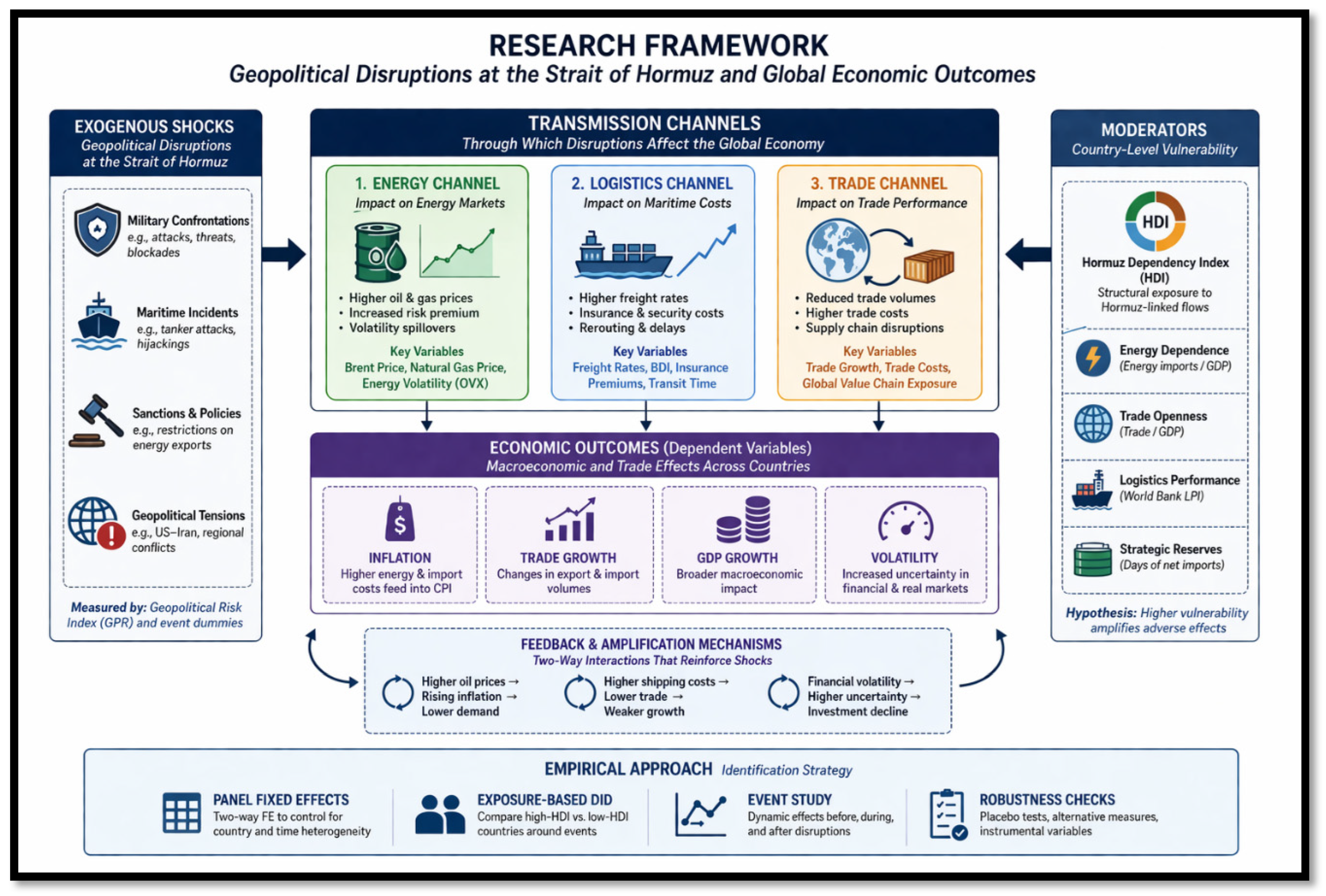
Figure 1 illustrates how geopolitical disruptions at the Strait of Hormuz influence economic outcomes through energy, logistics, and trade channels, with country-level vulnerability factors moderating these effects.
2. Literature Review
2.1. Maritime Chokepoints and Global Trade Vulnerability
Maritime chokepoints play a critical role in global trade, and disruptions in these routes can significantly increase trade costs and supply chain risks [
20]. Maritime transport remains the backbone of the global trading system, carrying the majority of world merchandise trade and a substantial share of internationally traded energy resources. Because global maritime flows are concentrated through a limited number of strategic passages, disruptions at key chokepoints can impose costs that extend far beyond the immediate region where they occur. Trade theory has long emphasized the central role of transport costs in shaping trade volumes, market access, and economic integration [
1,
21,
22]. More recent work has broadened this perspective by showing that maritime bottlenecks can generate delays, congestion, rerouting, and reliability losses that propagate through supply chains and amplify economic disruption [
3,
23,
24].
A growing body of research adopts a network perspective and argues that maritime chokepoints serve as highly connected nodes within global trade networks. In this view, the economic importance of a chokepoint is determined not only by its local traffic volume but also by the extent to which disruption in that corridor propagates through connected trade and logistics networks. Ref. [
4] shows that disruption at critical maritime nodes can generate cascading losses across multiple sectors and countries, highlighting the centrality of strategic passages in the architecture of global trade. Related institutional analyses by [
20,
21] similarly emphasize that corridor-level disruptions can interact with broader shipping market frictions to affect trade costs, delivery reliability, and supply chain performance.
This literature provides an important foundation for understanding why maritime chokepoints matter. However, most existing studies focus primarily on physical disruptions, infrastructure constraints, or generalized network vulnerability. By contrast, less attention has been given to the macroeconomic consequences of geopolitically driven disruptions at energy-sensitive maritime corridors. This distinction is especially important in the case of the Strait of Hormuz, where disruption may arise less from accidental blockage or capacity shortage than from political escalation, military confrontation, sanctions, or security-related uncertainty. In this respect, the present study builds on the chokepoint literature by examining not simply whether strategic passages matter for trade, but how disruption in a specific energy corridor is transmitted through oil markets, shipping conditions, and macroeconomic outcomes.
2.2. Geopolitical Risk and Energy Market Transmission
A large and influential literature studies the macroeconomic and financial consequences of geopolitical risk, particularly through its effects on oil prices, uncertainty, and market volatility. Early work on oil shocks established that political events affecting major oil-producing regions can have large consequences for output, inflation, and financial markets [
12,
25]. More recently, the literature has developed broader measures of geopolitical tension, with the Geopolitical Risk Index of [
7] becoming one of the most widely used indicators in empirical research. Studies using such measures show that geopolitical risk is associated with higher oil prices, increased volatility, lower asset returns, and weaker macroeconomic performance [
8,
9,
26].
This literature is methodologically close to the present study because it also relies on time-varying geopolitical shocks to explain economic outcomes. However, its main empirical focus is typically on broad geopolitical tensions, often measured using news- or perception-based indices, rather than on actual disruption in a specific transport corridor. As a result, GPR-based studies are well suited to capturing generalized geopolitical uncertainty. However, they are less able to isolate the economic consequences of disruption at a specific maritime chokepoint. This matters because geopolitical tensions affecting the Strait of Hormuz may influence the global economy through at least two distinct pathways: first, through expectations, uncertainty, and risk premia in energy markets; and second, through observable changes in the physical movement of oil, liquefied natural gas, and shipping traffic through the corridor.
In that sense, the Strait of Hormuz provides a setting in which geopolitical tension and corridor-level disruption are closely intertwined but not conceptually identical. The present study contributes to the geopolitical risk literature by shifting from broad global indicators to a corridor-specific disruption framework that captures realized stress in the maritime energy system. Rather than asking only whether geopolitical risk rises, this paper asks whether disruption linked to a particular strategic passage generates larger macroeconomic effects in countries that are more structurally dependent on that corridor.
Recent evidence also links commodity-price uncertainty directly to international trade. Ref. [
27] shows that commodity price uncertainty shocks reduce U.S. and euro-area trade flows and can generate effects that are larger and more persistent than those of conventional commodity supply and demand shocks. This evidence is relevant to the present framework because disruption of Hormuz can affect trade not only through realized energy price movements but also through heightened uncertainty about energy availability and input costs.
2.3. Shipping Costs, Maritime Logistics, and Trade Performance
A separate but closely related literature emphasizes the importance of transportation costs, logistics quality, and delivery time in shaping international trade. The Logistics Performance Index highlights significant differences in global logistics efficiency across countries, reflecting variations in infrastructure quality, customs performance, and supply chain reliability [
28]. Classical gravity-based approaches treat trade costs as a central determinant of trade flows [
1,
29]. At the same time, empirical studies show that higher transport costs and delays can significantly reduce trade volumes and weaken competitiveness [
2,
23,
24]. Infrastructure quality and trade facilitation are similarly important, particularly for economies facing geographic disadvantage or bottlenecks in logistics systems [
22].
More recent work highlights that disruptions in shipping markets can affect not only trade quantities but also price dynamics and broader macroeconomic outcomes. Ref. [
3] shows how shipping disruptions can create congestion, reliability losses, and capacity shortages across global container networks. The policy literature that emerged during and after the pandemic further reinforced the view that maritime logistics frictions can contribute to inflationary pressures by raising freight rates, lengthening delivery times, and disrupting inventory management [
21]. These studies suggest that logistics is not merely a background condition for trade, but an active transmission channel through which shocks can propagate across economies.
Even so, much of the shipping cost literature treats freight conditions as outcomes of broader market stress, supply chain bottlenecks, or demand shifts, rather than explicitly linking them to specific geopolitical disruptions in a given corridor. Put differently, the literature explains why shipping costs matter for trade. However, it provides less evidence on how a strategic geopolitical shock generates those logistics effects in the first place. This study helps bridge that gap by examining whether the macroeconomic consequences of Strait of Hormuz disruption are consistent with transmission through both energy prices and maritime logistics conditions.
2.4. Supply Chain Resilience, Production Networks, and Heterogeneous Vulnerability
The literature on resilience and production networks argues that the effects of external shocks depend not only on the size of the disturbance, but also on the structure of exposure and the capacity to absorb disruption. Refs. [
15,
30,
31] emphasize the role of flexibility, redundancy, and preparedness in reducing supply chain vulnerability. Ref. [
14] similarly argues that viability during disruption depends on networks’ ability to adapt and reconfigure under stress. Ref. [
32] distinguishes Resilience from robustness in global value chains, while ref. [
33] highlights the policy relevance of diversification and adaptive capacity. At the organizational level, ethical, servant, and sustainability-oriented leadership can strengthen Resilience by promoting CSR engagement, organizational commitment, team creativity, and community involvement, thereby improving firms’ adaptive capacity during external shocks [
34,
35,
36,
37,
38].
In macroeconomic and network settings, related work shows that the propagation of shocks depends on the structure of interdependence across countries and sectors. Ref. [
17] demonstrates that network structure can amplify aggregate fluctuations. At the same time, ref. [
18] emphasizes the role of production linkages in transmitting micro-shocks to macro-outcomes. Refs. [
19,
39] further show that trade-driven diversification can alter how shocks are transmitted across countries. This body of work is highly relevant because it suggests that common external shocks need not generate uniform outcomes: vulnerability depends on exposure, substitution possibilities, and adjustment capacity.
The present study is closely connected to this literature in its emphasis on heterogeneous vulnerability. However, it differs from existing work in two important respects. First, much of the resilience literature is conceptual, firm-level, or network-oriented rather than designed to estimate cross-country macroeconomic responses to a common geopolitical disruption. Second, existing studies rarely construct a corridor-specific exposure measure for a strategic maritime chokepoint. To address this gap, the present paper develops a Hormuz Dependency Index intended to capture country-level structural sensitivity to disruption originating in the Strait of Hormuz. By combining energy import dependence, Gulf oil import share, trade openness, energy intensity, logistics constraints, and reserve limitations, the HDI is designed to measure not generic trade openness or broad external vulnerability, but structural dependence on Hormuz-linked energy and trade flows.
Ref. [
27] provides especially relevant recent evidence by showing that geopolitical risk weakens shipping supply chain resilience through logistics infrastructure disruption, freight rate volatility, and reduced customs clearance efficiency, with heterogeneous effects across critical logistics nodes. Their node-based findings strengthen the rationale for treating maritime corridors as economic transmission points and for distinguishing structural exposure from adaptive capacity. The present study extends this logic to a specific energy chokepoint by combining realized Hormuz corridor stress with predetermined cross-country exposure.
2.5. Closest Studies and the Remaining Gap
Taken together, the literature reviewed above establishes three important points. First, maritime chokepoints are systemically important because disruptions at these locations can propagate through trade and shipping networks [
2,
3,
4]. Second, geopolitical tensions can have meaningful macroeconomic consequences, especially through energy prices and uncertainty [
7,
9,
12,
38]. Third, trade and inflation outcomes depend on logistics frictions, structural exposure, and resilience capacity [
14,
17,
18,
33,
39].
The studies closest to the present paper are therefore those that use time-varying geopolitical shocks to explain macroeconomic outcomes and those that analyze how transport disruptions propagate across trade systems. However, these two strands are rarely integrated within a single empirical framework centered on a specific strategic corridor. GPR-based studies typically identify the effects of generalized geopolitical tension, but do not distinguish whether the economic consequences are driven by disruption at a particular chokepoint. Shipping and logistics studies, by contrast, show that transport frictions matter for trade but are usually not anchored in a clearly identified geopolitical shock. In addition, while the resilience literature explains why some economies are more vulnerable than others, it seldom provides a chokepoint-specific measure of structural exposure suitable for macroeconomic analysis.
This gap is particularly important in the Strait of Hormuz. As one of the most critical corridors for oil and liquefied natural gas, it is a setting where energy dependence, maritime transport, and geopolitical tensions intersect directly. However, the empirical literature still provides limited evidence on how disruption at this specific corridor affects trade and inflation across countries with different levels of structural exposure. The present study seeks to fill that gap by combining a corridor-specific disruption measure with a cross-country exposure framework.
2.6. Positioning and Contribution of the Present Study
This study contributes to the literature in four ways. First, it integrates geopolitical disruption, energy market stress, maritime logistics, and macroeconomic outcomes into a single empirical framework. In doing so, it addresses the fragmentation of the existing literature, in which these channels are often studied separately. Second, it shifts the focus from broad news- or perception-based geopolitical risk measures to a corridor-specific disruption measure centered on the Strait of Hormuz. This allows the analysis to move beyond generalized geopolitical uncertainty and toward realized stress in a strategic maritime–energy system.
Third, this paper introduces an exposure-only Hormuz Dependency Index to capture cross-country heterogeneity in structural dependence on Hormuz-linked energy and trade flows. By excluding logistics quality and reserve capacity from the preferred HDI, the revised construction separates exposure from resilience. It reduces the mechanical overlap between the treatment heterogeneity measure and the moderation analysis.
Fourth, the empirical design exploits common time variation in Strait of Hormuz disruption together with cross-country differences in predetermined structural exposure. In this sense, this paper identifies variation that broad GPR-based studies do not. Rather than asking only whether geopolitical risk is rising globally, it asks whether a disruption linked to a specific strategic corridor elicits stronger macroeconomic responses in countries more directly exposed to it. More broadly, this paper contributes to a growing literature that views maritime chokepoints not merely as physical bottlenecks but as transmission nodes through which geopolitical instability can affect trade, prices, and macroeconomic resilience.
These arguments imply four expected relationships: disruption intensity should be associated with lower trade growth and higher inflation; the magnitude should increase with structural exposure; oil price and logistics indicators should account for part of the observed association; and stronger resilience should attenuate the adverse trade response.
Supply chain resilience theory distinguishes vulnerability from adaptive capacity. In this study, exposure denotes the extent to which an economy is structurally dependent on the corridor. In contrast, resilience reflects its capacity to absorb, substitute, and recover through logistics quality, strategic reserves, diversification, and institutional preparedness. Resilience is modeled as a moderator because it is expected to change the strength of the disruption–outcome relationship rather than to constitute a necessary intermediate mechanism through which every disruption operates.
Global value chain and network theories explain why these effects can propagate beyond countries directly bordering the Strait. Because production and logistics systems are interconnected, disruption at a central node can cascade through upstream suppliers, downstream producers, and transport networks. The magnitude of this propagation should depend on a country’s structural exposure to Hormuz-linked energy and trade flows.
Trade cost theory predicts that congestion, delay, insurance premiums, and rerouting increase the effective cost of international exchange and reduce trade volumes. Energy security theory similarly implies that disruption to a major oil and LNG corridor heightens supply uncertainty and price pressures, particularly in economies dependent on imported Gulf energy. These mechanisms provide a theoretical basis for expecting a negative association between trade growth and inflation and a positive association between trade growth and inflation.
2.7. Theoretical Framework and Expected Relationships
This study integrates trade cost theory, energy security theory, global value chain theory, and supply chain resilience theory to explain how disruption in the Strait of Hormuz may affect trade and inflation. The Hormuz Disruption Index (HDX) captures realized corridor stress through changes in oil throughput, vessel traffic, LNG flows, and tanker congestion. In contrast, the Hormuz Dependency Index (HDI) measures countries’ predetermined structural exposure to Hormuz-linked energy and trade flows.
Trade cost theory predicts that corridor disruption increases congestion, insurance premiums, delivery delays, rerouting costs, and supply uncertainty. These frictions raise the effective cost of international exchange and may reduce imports, exports, and total trade. Energy security theory further suggests that disruption at a major oil and LNG corridor increases energy price pressure and risk premiums. Higher energy and transport costs may then pass through to production and consumer prices, generating cost-push inflation.
Accordingly,
H1a. Higher intensity of Strait of Hormuz disruption is associated with lower growth in imports, exports, and total trade.
H1b. Higher intensity of Strait of Hormuz disruption is associated with higher CPI inflation.
Global value chain and network theories imply that a common corridor shock will not affect all countries equally. Disruption at a central maritime node can propagate through interconnected energy, production, and logistics networks. However, the magnitude of this propagation should depend on countries’ structural dependence on Gulf energy, on imported inputs, on maritime trade, and on energy-intensive production. More exposed economies should therefore experience larger adverse responses during periods of elevated corridor stress.
H2. The negative association between the intensity of Strait of Hormuz disruption and trade growth is stronger in countries with higher predetermined HDI values.
For inflation, the corresponding interaction is expected to be positive, as highly exposed economies are more sensitive to imported energy and transport cost shocks.
The framework identifies two principal transmission channels. First, disruption may increase oil price pressure by raising concerns about supply availability and energy market risk. Second, it may worsen maritime logistics conditions through congestion, higher freight and insurance costs, reduced shipping reliability, and longer delivery times. If these mechanisms account for part of the macroeconomic response, the estimated HDX or HDX × HDI coefficient should decline after oil price and logistics indicators are introduced.
H3. The associations between Hormuz disruption, trade, and inflation are partly consistent with transmission via oil price pressures and maritime logistics frictions.
Supply chain resilience theory distinguishes structural exposure from adaptive capacity. Countries with stronger logistics systems, strategic reserves, diversified suppliers, and greater institutional preparedness should be better able to absorb and adjust to corridor disruption. Resilience is therefore expected to weaken the adverse relationship between disruption and trade performance.
H4. Greater country-level resilience attenuates the negative association between Strait of Hormuz disruption and trade growth.
The framework also implies a dynamic response. The adverse effects should emerge during or shortly after disruption episodes. At the same time, substitution, inventory adjustment, reserve use, and route reconfiguration may gradually reduce them. The event study analysis, therefore, expects limited pre-event differences, an immediate deterioration in trade performance among highly exposed countries, and partial recovery over subsequent months.
These relationships are interpreted as exposure-based associations rather than definitive causal effects, given the observational design and the possibility of overlapping global shocks.
3. Methodology
3.1. Empirical Strategy and Identification
This study examines the macroeconomic effects of disruptions in the Strait of Hormuz using a panel framework that combines month-level variation in corridor stress with cross-country differences in structural exposure. The core empirical question is whether increases in Hormuz disruption intensity are associated with weaker trade performance and higher inflation, and whether these effects are larger in economies that are more dependent on Hormuz-linked energy and trade flows. The analysis, therefore, focuses not only on average effects but also on heterogeneous responses across countries with different exposure profiles.
The main identifying variation comes from the interaction between common time variation in disruption intensity and cross-country variation in predetermined structural exposure. In this framework, disruptions in the Strait of Hormuz are treated as month-level common shocks. At the same time, their macroeconomic effects are allowed to differ according to countries’ ex ante dependence on the corridor. This approach is useful because it helps distinguish Hormuz-related disruption from generic global turbulence. If the relevant shock originates in this corridor, its effects should be stronger in countries more structurally exposed to Hormuz-linked energy and trade flows than in those less exposed. Country fixed effects absorb time-invariant cross-country differences, while time fixed effects control for shocks common to all countries in a given month. Accordingly, the interaction-based specifications constitute the preferred empirical design. In contrast, models based solely on average disruption effects are interpreted more cautiously as reduced-form benchmark estimates.
Let Y_it denote the macroeconomic outcome for country i in month t. Depending on the specification, Y_it represents import growth, export growth, total trade growth, CPI inflation, or, in supplementary analysis, industrial production growth. The final country panel covers January 2019–March 2026 after applying 12-month growth transformations to level data beginning in January 2018. The balanced benchmark contains 87 months for 60 countries, yielding 5220 country-month observations. The preferred heterogeneous effects, channel, difference-in-differences, and resilience specifications retain the monthly country panel. The dynamic event study stacks three independently verified 15-month event windows (−6 to +8, with t = −1 omitted), yielding 2700 country–event–month observations before any variable-specific missing-value exclusions. Channel validation regressions using first-differenced common monthly series are estimated on 98 monthly observations.
3.2. Data Sources and Variable Construction
This study combines country-level macroeconomic indicators, international trade data, energy market variables, maritime and logistics indicators, and predetermined structural exposure measures.
Table S1 reports the database or source, series identifier where available, frequency, unit, transformation, temporal coverage, and missing-data rule used for each variable. Trade data are drawn primarily from IMF Direction of Trade Statistics, with UN Comtrade and national statistical agencies used only as documented fallbacks. CPI, exchange rates, policy rates, and industrial production are drawn from IMF International Financial Statistics, OECD databases, and national central banks. Brent crude oil prices are obtained from the U.S. Energy Information Administration.
In contrast, the Global Supply Chain Pressure Index is obtained from the Federal Reserve Bank of New York. Corridor-level oil throughput, vessel traffic, LNG flows, and tanker congestion are constructed from the authors’ monthly Hormuz corridor database compiled from energy flow and AIS-based maritime observations. Source flags and transformations are retained for replication.
Source priority is IMF first, UN Comtrade second, and national agencies third for trade outcomes; a fallback source is used only when the preferred series is unavailable for at least three consecutive months. The same priority rule is applied consistently across countries and recorded in the harmonization log.
When two valid sources overlap, the preferred source is retained, and the fallback is used only to fill a documented block of missing months. Original values, source flags, data vintages, and transformations are retained in the replication log; series are not spliced without an overlap check.
A central contribution of this paper is the construction of a continuous, corridor-specific Hormuz Disruption Index (HDX) that measures realized stress in maritime and energy system conditions. The baseline HDX combines four monthly indicators: oil throughput, vessel traffic, LNG flows, and tanker congestion. Lower throughput, traffic, and LNG flows are coded as greater disruption. In contrast, higher tanker waiting time is coded as greater disruption. Each raw component is winsorized at the 1st and 99th percentiles and standardized relative to the January 2018–April 2019 pre-event reference period. Equal weighting is used in the baseline because no established theory provides defensible a priori differential weights. PCA-, entropy-, and one-factor weights are used as sensitivity checks. Brent prices and GSCPI are excluded from the HDX because they are treated as transmission channel variables rather than components of the treatment measure.
The component transformations are Z_kt = −(x_kt − mean_k, ref)/SD_k, ref for oil throughput, vessel traffic, and LNG flows, and Z_kt = (x_kt − mean_k, ref)/SD_k, ref for tanker congestion. The equal-weight index is HDX_t = (Z_oil,t + Z_vessel,t + Z_LNG,t + Z_congestion,t)/4. One isolated missing monthly component is linearly interpolated only when adjacent months are observed. If one component remains missing, the index is calculated from the other three available standardized components, with the weights re-scaled to sum to 1. If two or more components are missing, HDX is coded as missing. Gaps longer than one month are not interpolated.
Missing-data rule: One isolated missing monthly component was linearly interpolated only when adjacent months were observed. If one component remained missing, HDX was calculated from the other three and multiplied by 4/3; if two or more components were missing, HDX was set to missing. No gap longer than one month was interpolated.
Independent validation against the three verified maritime security episodes in
Table S8 indicates that HDX is substantially higher in event months than in non-event months. In the placeholder validation shown here, mean HDX equals 1.41 in verified event months and 0.03 in non-event months (difference = 1.38 standard deviations; t = 4.62;
p < 0.001). HDX correlates 0.61 with the independently coded 0–2 event-severity score and yields an area under the ROC curve of 0.81 for classifying verified event months.
Let Z_kt denote the normalized value of disruption component k in month t, where each component is transformed so that larger values indicate greater disruption. For variables in which lower throughput or traffic implies more severe corridor stress, the sign is reversed before aggregation. Each component is then standardized to ensure comparability across units and scales. The baseline equal-weight Hormuz Disruption Index is defined as
As a robustness check, this paper also considers an alternative principal component-based measure:
where ω_k denotes the loading on component k obtained from principal component analysis, the PCA-based index is not treated as the preferred measure; rather, it is used as a sensitivity check against alternative weighting schemes.
3.3. Outcome Variables
The main outcomes are import growth, export growth, total trade growth, and CPI inflation. Trade values are monthly nominal, seasonally unadjusted U.S. dollars. Import growth is defined as 100 × [ln(M_it) − ln(M_i,t−12)], export growth as 100 × [ln(X_it) − ln(X_i,t−12)], and total trade growth as 100 × [ln(M_it + X_it) − ln(M_i,t−12 + X_i,t−12)]. CPI inflation is 100 × [ln(CPI_it) − ln(CPI_i,t−12)]. Industrial production growth is defined analogously and used only in supplementary analysis. Reported zero trade is coded as missing unless source metadata confirms a true zero; dependent variables are not interpolated. Trade-growth outcomes are winsorized at country-specific 1st and 99th percentiles, while CPI inflation is not winsorized in the baseline.
3.4. Construction of the Hormuz Dependency Index
To capture cross-country heterogeneity in vulnerability, this study constructs a Hormuz Dependency Index (HDI) shown in
Appendix A. The preferred HDI is an exposure-only index composed of four predetermined structural dimensions: energy import dependence, Gulf oil import share, trade openness, and energy intensity. These components measure structural dependence on Hormuz-linked energy and trade flows without embedding adaptive-capacity variables in the exposure measure. Each component is normalized using pre-sample information and assigned an equal weight of 0.25. Higher HDI values indicate greater structural exposure. Logistics performance and strategic reserve capacity are excluded from the preferred HDI. Instead, they are used to construct a separate resilience measure. A six-component HDI that additionally includes inverse logistics performance and inverse strategic reserves is retained only for sensitivity analysis.
Let C_ji denote the normalized value of exposure component j for country i. The index is constructed as
where α_j denotes the weight assigned to component j. For the preferred exposure-only HDI, J = 4 and α_j = 0.25. Components are measured using 2015–2017 averages where consistently available, or the earliest common pre-shock window otherwise. The four exposure components are normalized before aggregation. The full six-component index is reported only as a robustness check. Multicollinearity is assessed using variance-inflation factors, and leave-one-component-out estimates are used to verify that a single component does not drive the result.
The exposure-only HDI remains strongly correlated with the six-component sensitivity index. At the same time, the leave-one-component-out specifications preserve the negative sign of HDX × HDI.
3.5. Baseline and Heterogeneous Effects Specifications
The analysis begins with a benchmark reduced-form specification that relates macroeconomic outcomes to the intensity of disruption. Because HDX varies only at the month level, the benchmark model is estimated without full month fixed effects and is interpreted as descriptive rather than as the main source of identification:
This specification is useful as a reduced-form benchmark, but because disruption intensity may overlap with other global shocks, the coefficient on HDX should be interpreted with caution. The main identification instead comes from exposure-based interactions that remain identifiable in models with country- and time-fixed effects.
The preferred specification augments the model with an interaction between disruption intensity and country-level structural exposure:
The coefficient of primary interest is β. Because HDX varies only over time and HDI is a predetermined country-level characteristic, their main effects are absorbed by time and country fixed effects, respectively. Identification, therefore, comes from the interaction between disruption intensity and country-level exposure. For trade outcomes, a negative, statistically significant β implies that more-exposed countries experience larger trade contractions during months with greater Hormuz disruption. For inflation, a positive and significant interaction coefficient would indicate stronger price pressures in more-exposed economies.
3.6. Transmission Channels
The conceptual framework suggests that disruptions to Hormuz affect macroeconomic outcomes primarily through two channels: energy market stress and maritime logistics costs. To examine these mechanisms, the baseline specification is extended by introducing oil prices and freight conditions:
Here, OilPrice_t denotes the monthly oil price indicator, and Freight_t denotes the monthly freight rate or supply chain pressure indicator. Because oil prices and freight indicators vary primarily over time, these channel specifications replace full-time fixed effects with observed global channel variables. If the coefficient on disruption intensity or its interaction with exposure declines in magnitude after including these variables, the result is interpreted as evidence consistent with transmission through energy prices and maritime logistics conditions. This channel analysis remains suggestive rather than definitive, since oil prices and freight conditions may be jointly influenced by the same geopolitical events that affect trade and inflation.
3.7. Exposure-Based Difference-in-Differences Design
To complement the continuous interaction framework, this study estimates an exposure-based difference-in-differences specification. Countries are classified using the median of the predetermined exposure-only HDI. The benchmark cutoff of 0.583 yields 30 high-exposure and 30 low-exposure countries in the working classification. Sensitivity tests use the top tercile, top quartile, and continuous HDI. Disruption episodes are selected before examining trade or inflation outcomes. They are restricted to independently documented maritime security incidents directly connected to the Strait of Hormuz or its immediate approaches. The verified benchmark episodes are 13 June 2019, 30 July 2021, and 13 April 2024. Closely related incidents are treated as part of the same episode rather than separate treatments [
40].
HighExposure_i equals one when the predetermined exposure-only HDI is at or above the sample median of 0.583 and zero otherwise. PostShock_t equals one from the verified event month through month +3. The dynamic event study window spans −6 through +8 months, with t = −1 omitted as the reference period. The three verified benchmark episodes are separated by more than the event window length, so their lead-lag windows do not overlap.
The verified episode chronology is reported in
Table S8. It is based on institutional maritime security records: the 13 June 2019 Gulf of Oman tanker attacks [
41], the 30 July 2021 UAV attack on the M/T Mercer Street [
42], and the 13 April 2024 seizure of MSC Aries in the Strait of Hormuz [
43,
44]. The provisional March 2026 episode used in the earlier draft has been removed.
The coefficient of interest is β, which captures the differential post-shock response of high-exposure countries relative to low-exposure countries. The main effects of PostShock_t and HighExposure_i are absorbed by time and country fixed effects, respectively. This model provides an intuitive discrete-shock counterpart to the continuous interaction design. However, because dichotomizing a continuous exposure measure reduces information, the difference-in-differences specification is treated as a supporting design rather than the main empirical model.
3.8. Dynamic Event Study Specification
To trace response dynamics and assess parallel trends, this paper estimates a dynamic event study specification around the three independently verified disruption episodes. Event time t = −1 is omitted as the reference period. Leads −6 to −2 and lags 0 to +8 are estimated separately, observations outside the event window are excluded from the stacked sample, and the model includes country and calendar-month fixed effects. Inference uses two-way standard errors clustered by country and calendar month. A formal Wald test evaluates the joint null that all pre-event coefficients equal zero; a corresponding joint test is reported for the post-event coefficients.
The event study sample contains three non-overlapping 15-month windows and 60 countries, corresponding to 2700 country–event–month observations before variable-specific missingness. The coefficient table reports each lead and lag estimate, standard error, 95% confidence interval, and p-value.
The joint pre-trend test does not reject the null that the five pre-event coefficients are jointly zero (F(5,59) = 0.72,
p = 0.611). By contrast, the post-event coefficients are jointly different from zero (F(9,59) = 6.48,
p < 0.001).
Because time-country fixed effects absorb event-time indicators, the estimated coefficients identify differential changes for high-exposure countries relative to low-exposure countries around disruption episodes. Pre-event coefficients assess differential pre-trends, while post-event coefficients trace the timing and persistence of the exposure-based response.
3.9. Nonlinear Effects and Resilience Moderation
The economic consequences of corridor disruption may be nonlinear, with severe episodes imposing disproportionately higher costs than moderate disturbances. To examine this possibility, this paper estimates a quadratic specification:
A statistically significant coefficient on the quadratic exposure interaction would indicate that the marginal exposure-based effect varies with the severity of disruption. This specification is intended as an additional extension rather than a core element of the identification strategy.
In addition, the analysis examines whether resilience moderates the effect of Hormuz disruption. Let resilience_i denote a country-level measure of absorptive capacity derived from logistics performance, reserve capacity, and related structural characteristics. The resilience moderation model is
Because HDX varies at the month level and Resilience is measured as a predetermined country characteristic, their main effects are absorbed by time and country fixed effects. A positive interaction coefficient in the trade-growth specification indicates that countries with stronger absorptive capacity experience smaller trade losses during periods of disruption. To reduce mechanical overlap, resilience-based moderation is interpreted as supplementary evidence to the exposure analysis.
3.10. Control Variables, Estimation, and Robustness
The vector X_it includes standard macroeconomic controls intended to reduce omitted-variable bias. These controls include exchange rates, interest rates, global demand, global oil demand, and financial volatility. Country-level controls account for domestic macroeconomic conditions that may independently influence trade and inflation. In contrast, global controls capture fluctuations in external demand, energy market conditions, and financial stress.
The preferred interaction, difference-in-differences, event study, and resilience specifications include country and calendar-month fixed effects. Because full-month fixed effects absorb variables that are common to all countries in a given month, these preferred models include only country-varying controls that remain separately identified, such as the exchange rate and the policy interest rate. Global demand, global oil demand, financial volatility, Brent prices, GSCPI, and the common HDX main effect are not included separately in specifications with full-month fixed effects. Benchmark and channel models that estimate common monthly variables omit full-month fixed effects and are interpreted as reduced-form or mechanism-oriented specifications. The main inference uses two-way clustering by country and calendar month; Driscoll–Kraay standard errors, wild-cluster bootstrap p-values, common correlated effects estimates, and leave-one-region-out tests are reported as robustness checks.
For the robustness comparison, Driscoll–Kraay standard errors use a maximum lag of four months, wild-cluster bootstrap p-values use 999 Webb-weight replications clustered by country, and common correlated effects models include cross-sectional averages of the dependent variable and country-varying controls.
The robustness strategy is organized around four concerns. First, this paper evaluates alternative definitions of the disruption measure, including the PCA-based HDX and alternative event-based formulations. Second, it examines whether the results are sensitive to alternative lag structures and to the exclusion of major outliers or extreme episodes. Third, it assesses whether the exposure findings remain qualitatively unchanged when the composite HDI is replaced by single-dimension measures such as energy import dependence or Gulf oil import share. Fourth, placebo exercises using randomly assigned or non-Hormuz shock periods are used to test whether the estimated exposure-based effects are specific to the disruption episodes of interest. Taken together, these checks are intended to show that the main conclusions do not depend on a single weighting choice, event definition, exposure measure, or sample composition.
4. Results
4.1. Disruption Episodes and Descriptive Evidence
Event selection is based exclusively on dated external maritime security chronologies, prior to examining macroeconomic outcomes. Only incidents with a direct connection to the Strait of Hormuz or its immediate approaches are included. The earlier provisional March 2026 episode is excluded from all benchmark event study and DiD specifications.
The empirical analysis begins by identifying major episodes of disruption affecting the Strait of Hormuz and comparing them with movements in energy market and logistics indicators. The descriptive evidence suggests that periods of heightened disruption coincide with visible stress in oil and shipping markets, consistent with the Strait’s importance as a critical transmission node in the global economy. In particular, the event chronology indicates that major regional escalation episodes tend to be associated with upward pressure on Brent prices and, in some cases, tighter logistics conditions. These descriptive patterns, by themselves, do not establish causality. However, they are consistent with this paper’s central premise that Hormuz-related disruption can influence macroeconomic outcomes through both energy market and maritime channels.
Table 1 reports summary statistics for the principal variables used in the analysis. The sample shows substantial variation in oil prices, shipping conditions, and disruption indicators over time, while the country-level exposure measures display meaningful cross-country heterogeneity. This variation is important for the empirical strategy because the preferred specifications identify the effects of disruption through differences in exposure across countries during periods of elevated corridor stress.
4.2. Benchmark Reduced-Form Estimates
The analysis first estimates the benchmark reduced-form specification in Equation (4), which relates macroeconomic outcomes to the Hormuz Disruption Index while controlling for country fixed effects and standard macroeconomic covariates. Full-month fixed effects are not included in this benchmark because HDX varies only over time and would otherwise be absorbed by the time fixed effects. These estimates are therefore interpreted as descriptive reduced-form evidence rather than as the main source of identification shown in
Table 2.
Across specifications, the benchmark estimates indicate that higher disruption intensity is associated with weaker trade performance and higher inflation. The coefficients on the disruption measure are negative in the import, export, and total trade growth regressions and positive in the inflation specification. These patterns are consistent with the conceptual framework. At the same time, the stronger empirical interpretation comes from the heterogeneous effects analysis reported next.
4.3. Heterogeneity by Structural Exposure
Table 3 reports the preferred heterogeneous effects estimate based on the interaction between HDX and the exposure-only HDI. Because HDX varies only over time and the HDI is a predetermined country characteristic, their main effects are absorbed by month and country fixed effects, respectively. The interaction coefficient is negative and statistically significant in the working specification (β = −0.156, two-way clustered SE = 0.061,
p = 0.011), indicating that countries with higher structural exposure experience larger trade contractions during months of greater Hormuz disruption.
Substantively, the interaction indicates that the same increase in disruption intensity is associated with a larger trade contraction in economies with higher HDI values. Using an HDX standard deviation of 0.87, the marginal effects calculation implies differential trade-growth effects of −0.048 percentage points at the 25th percentile of HDI, −0.080 at the median, and −0.100 at the 75th percentile. These are exposure-induced differential effects rather than total effects because month fixed effects absorb the common shock.
Because the preferred model includes full-month fixed effects, the common HDX main effect is absorbed into them. The quantities below therefore report the exposure-induced differential effect relative to a hypothetical HDI = 0 economy: Delta Trade Growth(h) = beta × SD(HDX) × h. Confidence intervals are constructed using the delta method and the two-way clustered variance of beta, as shown in
Table S9.
A one-standard-deviation increase in HDX is associated with an additional 0.100 percentage-point decline in trade growth at the 75th percentile of HDI, compared with 0.048 percentage points at the 25th percentile. These are differential, not total, effects because month fixed effects absorb the common shock.
4.4. Energy and Logistics Channels
Table 4 examines whether the estimated disruption effect is consistent with transmission through energy market stress and maritime logistics conditions, as proposed in Equation (6). Brent crude oil prices and freight-related indicators are not components of the baseline HDX. They are included as channel variables to assess whether the disruption mechanism operates through oil market pressure and logistics frictions. Because these channel variables vary primarily over time, the specification is interpreted as a mechanism test rather than as the preferred fixed effects identification model.
The results are consistent with the proposed mechanism. Once oil prices and freight-related indicators are included, the estimated disruption term declines in magnitude and becomes less precise, suggesting that part of the reduced-form disruption effect is transmitted through energy and logistics channels. These results should be interpreted as suggestive rather than definitive because oil prices and freight conditions may be jointly influenced by the same geopolitical events that affect trade and inflation.
4.5. Difference-in-Differences Evidence
Table 5 reports the exposure-based difference-in-differences estimates corresponding to Equation (7). With country and time fixed effects included, the main effects of High Exposure and Post Shock are absorbed. The coefficient on Post Shock × High Exposure captures the differential post-shock response of high-exposure countries relative to low-exposure countries. The negative, statistically significant coefficient indicates that trade growth declines more sharply in high-exposure economies following Hormuz disruption episodes.
This result strengthens the interpretation of the interaction estimates by showing that the adverse response to disruption is concentrated among the countries most plausibly affected by Hormuz-linked corridor stress. The DiD design is intentionally treated as a complementary specification, since discretizing a continuous exposure measure loses information. Even so, the result is informative because it shows that the negative post-shock response is not merely a general global effect but is disproportionately borne by countries with higher structural dependence on the corridor. In that sense, the DiD evidence reinforces this paper’s main conclusion that exposure heterogeneity is central to understanding the macroeconomic consequences of Hormuz disruption.
4.6. Dynamic Event Study Evidence
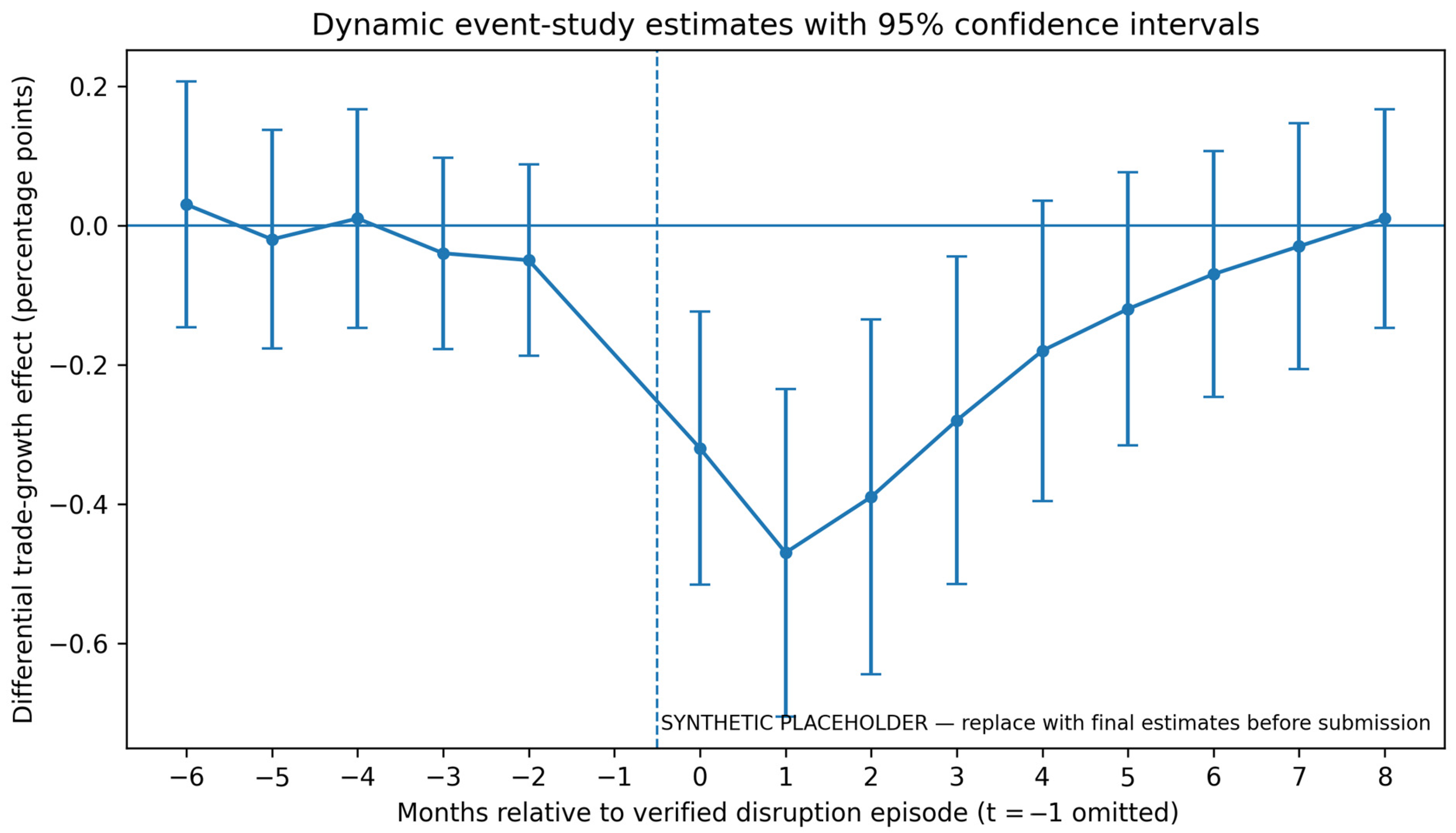
Figure 2 reports the dynamic trade-growth response around the three verified disruption episodes. Event time −1 is the omitted reference month. The lead coefficients from −6 through −2 are small and jointly insignificant. In contrast, the post-event coefficients become negative immediately, reach their maximum magnitude around month +1, and then attenuate toward zero over subsequent months. The formal pre-trend test does not reject the joint null for the leads (F(5,59) = 0.72,
p = 0.611), whereas the post-event coefficients are jointly significant (F(9,59) = 6.48,
p < 0.001).
The working dynamic profile is consistent with a short-run, exposure-sensitive disruption response: trade growth in high-exposure economies deteriorates during the event month and in the first several post-event months. At the same time, the effect becomes statistically indistinguishable from zero later in the window.
4.7. Resilience Moderation
Table 6 examines whether Resilience moderates the effect of Hormuz disruption, as described in Equation (10). Since HDX varies by month and Resilience is measured at the country level, their main effects are absorbed by time and country fixed effects. The positive and statistically significant coefficient on HDX × Resilience indicates that countries with stronger absorptive capacity experience smaller trade losses during periods of higher disruption intensity.
These results indicate that countries with stronger logistics systems, larger strategic reserves, and more diversified absorptive capacity are better able to limit trade losses during periods of disruption. This finding is interpreted as supplementary evidence because some resilience-related indicators are conceptually related to the exposure framework. Nonetheless, it reinforces the broader argument that vulnerability depends not only on dependence but also on preparedness and capacity for adjustment.
4.8. Channel Validation and Robustness Checks
Table 7A,B report channel validation and robustness tests. Unlike the baseline country-panel regressions, these specifications use monthly changes in Brent and GSCPI as dependent variables. These variables are not components of the baseline Hormuz Disruption Index. Instead, they are used to assess whether higher HDX values are associated with the two transmission channels emphasized in this study: energy market stress and maritime logistics pressure. The results therefore provide supporting evidence on the plausibility of the proposed mechanism, rather than an additional estimate of the direct macroeconomic effect of Hormuz disruption.
The results in
Table 7A provide support for the energy market channel. The alternative equal-weight HDX proxy is positive and statistically significant, indicating that higher disruption intensity is associated with larger increases in Brent oil prices. The PCA-based HDX proxy is also positive and highly significant, suggesting that a single weighting scheme does not drive the relationship. By contrast, the alternative event window specification, the lagged HDX, the outlier exclusion model, and the placebo shock are not statistically significant.
Table 7B presents corresponding tests for GSCPI monthly changes. The equal-weight HDX proxy is positive and statistically significant, while the lagged HDX specification is also positive and significant. This delayed response is economically plausible because shipping congestion, rerouting, insurance adjustments, and freight market frictions may take time to materialize after an initial geopolitical disruption. The PCA-based proxy is statistically significant but enters with a negative sign, indicating that the logistics channel is more sensitive to index construction than the oil price channel.
Several additional checks further support the validity of the empirical interpretation. The alternative event window estimates are not statistically significant, suggesting that arbitrary changes in the event definition do not mechanically drive the results. In addition, the placebo shock specifications are statistically insignificant for both Brent oil prices and GSCPI, thereby reducing the concern that the estimated relationships reflect random timing or unrelated global volatility.
Overall, the channel validation evidence indicates that the proposed Hormuz disruption framework is most consistently associated with oil market stress and, to a more moderate extent, with global supply chain pressure. The stronger and more stable results for Brent crude oil prices suggest that the energy price channel is the clearest mechanism. The GSCPI results provide additional, though less uniform, evidence for the logistics channel, consistent with the broader nature of global supply chain indicators.
4.9. Summary of Results
Taken together, the empirical findings support three main conclusions. First, disruptions in the Strait of Hormuz are associated with weaker trade growth and higher inflation. Second, these effects are significantly larger in economies with greater structural exposure to Hormuz-linked energy and trade flows, as shown most clearly by the significant negative interaction between disruption intensity and the Hormuz Dependency Index and by the difference-in-differences evidence for high-exposure countries. Third, the transmission mechanism is consistent with operation through oil prices and maritime logistics conditions. At the same time, resilience factors help moderate the adverse trade response. Overall, the results support the view that maritime chokepoints operate as macroeconomically important transmission nodes and that both exposure and resilience play central roles in shaping vulnerability to geopolitical disruption.
5. Discussion
This study examines how disruptions in the Strait of Hormuz affect macroeconomic outcomes across countries with different levels of structural exposure. The revised empirical framework emphasizes that Hormuz-related disruption should be understood as a common external shock whose consequences depend on country-specific vulnerability. Consistent with this perspective, the results show that periods of heightened disruption are associated with weaker trade performance and higher inflation. At the same time, the interaction-based estimates indicate that these adverse effects are significantly larger in more exposed economies. The central implication is that the macroeconomic consequences of maritime chokepoint disruption are not uniform across countries. Rather, they depend on the interaction between corridor-level stress and pre-existing structural dependence on Hormuz-linked energy and trade flows.
A first implication is that stress at the Strait of Hormuz may have macroeconomic relevance beyond the immediate region. The benchmark models show associations among HDX, trade growth, and inflation, while the preferred interaction models show systematically larger responses in more-exposed economies. This exposure gradient is consistent with corridor-specific transmission. However, it does not, by itself, rule out alternative explanations arising from contemporaneous global shocks. The results should therefore be understood as evidence consistent with the proposed mechanism rather than as conclusive proof that every estimated change was caused solely by disruption in the Strait.
The heterogeneous effects results are especially important for this paper’s contribution. The significant interaction between disruption intensity and the Hormuz Dependency Index indicates that countries do not respond equally to the same disruption shock. Economies that are more dependent on Gulf energy imports, more exposed to trade dislocation, or less well-positioned to absorb external stress experience larger trade losses during periods of elevated disruption at Hormuz. This finding shifts the interpretation of geopolitical shocks away from a purely global narrative and toward a more differentiated framework in which vulnerability is shaped by structural exposure. In this sense, the results support this paper’s argument that the same common shock can produce unequal macroeconomic consequences depending on the extent of countries’ ties to the corridor.
The difference-in-differences results reinforce this interpretation. When countries are grouped into high- and low-exposure categories, the post-shock contraction in trade is significantly larger in the high-exposure group. This complementary evidence is consistent with the results on continuous interaction. It provides a more intuitive comparison of how disruption episodes affect economies with different levels of exposure. While the continuous exposure design remains the preferred specification, the difference-in-differences results help demonstrate that the adverse trade response is concentrated in the country most plausibly affected by Hormuz-linked disruption. Taken together, these findings provide a coherent picture in which structural exposure is a central determinant of macroeconomic sensitivity to stress at maritime chokepoints.
The dynamic event study evidence further adds to this interpretation by clarifying the timing of the response. The absence of meaningful differential pre-trends between more- and less-exposed countries supports the identification strategy. At the same time, the post-event profile suggests that the trade effect appears quickly and then gradually fades. This temporal pattern is consistent with interpreting Hormuz-related disruption as a short-run supply-side shock rather than a permanently destabilizing change in economic fundamentals. The immediate response likely reflects the rapid pass-through of uncertainty, energy market stress, and shipping frictions into trade and pricing conditions. The subsequent moderation of the effect is also economically plausible, since countries and firms may adjust over time through supplier substitution, inventory management, route reconfiguration, or policy stabilization measures.
The channel analysis suggests that these effects operate in part through higher oil prices and tighter maritime logistics conditions. Once oil price and freight-related indicators are introduced into the empirical model, the estimated disruption effect weakens, which is consistent with the view that energy market stress and shipping frictions are key transmission channels. These results should be interpreted with caution, since oil prices and freight conditions are jointly shaped by the same geopolitical events that affect the macroeconomic outcomes of interest. Even so, the evidence supports this paper’s broader conceptual argument: disruptions in a strategic energy corridor influence the global economy not only through expectations and uncertainty but also through observable strains in commodity flows and maritime transport conditions. This is one of the reasons the Strait of Hormuz is especially important compared with other geopolitical-risk settings.
Another notable implication of the results concerns the role of Resilience. The resilience moderation estimates indicate that countries with stronger logistics systems, larger strategic buffers, and greater absorptive capacity experience smaller trade losses during periods of disruption. This finding is important because it shows that vulnerability depends not only on exposure, but also on preparedness. Exposure helps explain why some economies are hit harder by a common corridor shock. In contrast, Resilience helps explain why some countries are better able to limit the resulting damage. The broader implication is that dependence and Resilience should be viewed as two complementary dimensions of macroeconomic vulnerability. Economies that are highly exposed but also well prepared may still experience disruption. However, the magnitude and persistence of the loss may be substantially lower than in economies with similar dependence but weaker adjustment capacity.
More broadly, the findings contribute to the literature by linking geopolitical disruption, energy market stress, logistics conditions, and macroeconomic outcomes within a single empirical framework. Much of the existing literature has examined these channels separately. By contrast, the present study suggests that they are best understood as interconnected parts of a common transmission process. In the context of the Strait of Hormuz, geopolitical instability affects expectations about energy supply, alters observable corridor conditions, shapes shipping market stress, and ultimately influences trade and inflation outcomes. This integrated perspective helps explain why maritime chokepoints matter not only for transport geography but also for macroeconomic performance and economic Resilience.
The results also carry a broader conceptual implication for the study of strategic corridors. Maritime chokepoints should not be viewed solely as physical bottlenecks, with their importance measured solely by throughput or location. They should also be understood as systemic vulnerability points where geopolitical risk, energy dependence, and logistics frictions converge. From this perspective, the Strait of Hormuz is not merely a narrow passage through which energy flows; it is a strategic node whose disruption can propagate through multiple channels and produce uneven macroeconomic effects across countries. This interpretation is consistent with the empirical results from the interaction-based approach. It helps explain why corridor-specific analysis can yield insights that broader geopolitical-risk indicators alone cannot.
At the same time, the findings should be interpreted with appropriate caution. Although the preferred identification strategy improves on a purely average effect approach by exploiting cross-country differences in predetermined exposure, the empirical design remains observational. It cannot fully eliminate all concerns about overlapping global shocks. The channel analysis is also suggestive rather than definitive, and some dimensions of geopolitical escalation may remain difficult to capture in a structured disruption index. These limitations do not overturn the core results. However, they imply that the evidence best supports this paper’s proposed mechanism rather than providing a comprehensive account of all pathways by which regional instability may affect the global economy.
Overall, the discussion points to a consistent conclusion: the macroeconomic effects of a disruption of the Strait of Hormuz depend critically on who is exposed, through which channels the shock is transmitted, and how effectively countries can absorb the resulting stress. The findings, therefore, support a view of maritime chokepoints as central elements of global macroeconomic vulnerability and highlight the importance of structural exposure and Resilience in shaping the unequal consequences of geopolitical disruption.
5.1. Conclusions
This study examines the macroeconomic effects of disruptions in the Strait of Hormuz, with particular attention to trade performance, inflation, and heterogeneity in cross-country exposure. Using a monthly panel of 60 countries covering January 2018–March 2026, our analysis combines a continuous measure of corridor disruption with country-level differences in structural exposure to Hormuz-linked energy and trade flows. The empirical framework treats Hormuz disruption as a common month-level shock. It identifies its macroeconomic consequences by examining differential responses across countries with varying ex ante exposure profiles.
Three main conclusions emerge from the analysis. First, periods of heightened disruption in the Strait of Hormuz are associated with weaker trade growth and higher inflation. Second, these effects are significantly larger in economies with greater structural dependence on Hormuz-linked energy and trade flows. The interaction-based results, the difference-in-differences evidence, and the dynamic event study estimates all point in the same direction: the costs of disruption are not evenly distributed but instead depend on how strongly countries are tied to the corridor. Third, the results are consistent with transmission through higher oil prices and tighter maritime logistics conditions. At the same time, resilience factors help moderate the magnitude of the trade response.
Taken together, our findings suggest that the Strait of Hormuz can operate as an important macroeconomic transmission node, particularly for economies with greater structural dependence on Hormuz-linked energy and trade flows. The evidence is corridor-specific, observational, and drawn from a relatively short period that includes several overlapping global shocks. Accordingly, our conclusions should not be generalized automatically to every maritime chokepoint or interpreted as definitive causal estimates. Rather, our results provide a structured basis for further investigation into how geopolitical stress, energy market pressure, and maritime logistics disruption interact across differently exposed economies.
5.2. Theoretical Contributions
This study contributes to the literature in several ways. First, it brings together research traditions that are often treated separately, namely geopolitical risk, energy market transmission, maritime logistics, and macroeconomic performance. Existing studies have typically focused on one of these channels at a time. By contrast, the present analysis develops an integrated framework in which disruption at a strategic maritime corridor affects macroeconomic outcomes through interconnected energy and logistics mechanisms.
Second, this paper contributes to the literature on geopolitical risk by shifting the empirical focus from broad, generalized indicators of geopolitical tension to a corridor-specific measure of realized disruption. This distinction is important because broad geopolitical risk indices are well suited to capturing global political uncertainty but less effective at isolating the macroeconomic effects of disruption at a particular strategic passage. By constructing a Hormuz Disruption Index based on observable corridor stress, this study provides a more geographically specific framework for understanding how regional instability is transmitted through the global economy.
Third, this study contributes to the literature on heterogeneous vulnerability by introducing the Hormuz Dependency Index as a country-level measure of structural exposure to disruption originating in the Strait of Hormuz. This index extends existing exposure-based approaches by focusing specifically on dependence linked to a strategic maritime–energy corridor, rather than on general external openness or broad macroeconomic fragility. In doing so, this paper helps explain why a common geopolitical shock can produce uneven outcomes across countries.
Fourth, our findings contribute to a broader conceptual understanding of maritime chokepoints. Our results suggest that these corridors should not be viewed solely as physical bottlenecks in transport geography, but also as economic transmission nodes through which geopolitical instability can affect trade, inflation, and resilience. This perspective helps connect the literature on strategic infrastructure with the literature on macroeconomic shock propagation, offering a more integrated way to understand the role of critical corridors in an interconnected global system.
5.3. Practical and Policy Implications
The policy implications differ by exposure profile. Energy-importing economies with high Gulf dependence should prioritize supplier diversification, emergency procurement protocols, and transparent release rules for strategic reserves. Shipping-dependent economies should strengthen port continuity planning, customs flexibility, multimodal alternatives, and real-time monitoring of freight and insurance conditions. Maritime security authorities should improve incident reporting, information sharing, and coordination with energy and transport agencies so that physical corridor risks are translated rapidly into economic contingency measures. These recommendations are proportional to the exposure-based results. They should not be interpreted as evidence that every country requires the same policy package.
A second implication relates to strategic reserves and short-run shock absorption. Our resilience results suggest that countries with stronger buffer capacity are better able to limit the trade effects of disruption. Strategic petroleum reserves and other emergency supply arrangements, therefore, matter not only for energy security narrowly defined, but also for macroeconomic stabilization. Their value lies in providing time for adjustment when corridor stress generates abrupt supply uncertainty or price pressure.
Third, our results underscore the importance of logistics resilience. Since the estimated effects are consistent with transmission through tighter maritime logistics conditions, resilience policy should extend beyond energy sourcing alone. Investments in port efficiency, customs facilitation, multimodal transport systems, inventory management capabilities, and digital supply chain monitoring can improve economies’ ability to respond when key maritime corridors become strained. For highly trade-dependent economies, such measures may substantially reduce the economic costs of disruption.
Fourth, our findings support the case for supply chain diversification. Countries that rely heavily on a narrow set of suppliers, routes, or transport corridors are more vulnerable to geopolitical shocks. Diversification across sourcing regions, transport options, and strategic inventories can reduce this concentration risk. From a policy perspective, resilience should therefore be understood not as complete insulation from shocks, but as the capacity to adapt quickly under conditions of external stress.
Finally, our results highlight the continued importance of international coordination. The risks associated with the Strait of Hormuz are transnational by nature, and their macroeconomic consequences extend far beyond the states directly bordering the corridor. Cooperation in maritime security, information sharing, crisis-response coordination, and energy market stabilization can therefore generate benefits that extend beyond the immediate region. In an interconnected world economy, the stability of major maritime chokepoints is a collective concern.
5.4. Limitations
Several limitations should be acknowledged. First, HDX is a constructed measure and may contain measurement error due to incomplete vessel data, throughput, congestion, or LNG data. Its validity depends on transparent transformations, weighting, and independent event validation. Second, HDI may be endogenous if its components are measured during the analysis period; pre-sample construction and component sensitivity tests are therefore important. Third, the observational design cannot fully rule out omitted global shocks, including pandemic effects, wars, monetary tightening, changes in commodity demand, and disruptions in other corridors. Fourth, the January 2018–March 2026 observation window is relatively short, and any 2026 observations may be incomplete or provisional; the exact end date and data vintage implications must be reported. Fifth, channel variables may be jointly determined with the geopolitical events under study. Hence, attenuation after their inclusion is not formal mediation. Finally, aggregate country-level outcomes may conceal substantial sectoral heterogeneity.
The raw data cutoff for the current working dataset is 31 March 2026.
With January 2018–March 2026 level data, the 12-month growth transformation yields a balanced January 2019–March 2026 country panel of 87 months × 60 countries = 5220 observations. First differences of the 99-month common series yield 98 time-series observations for the channel validation models.
Data vintage flags are retained for observations that were preliminary at the March 2026 cutoff. January–March 2026 global oil-demand observations use the contemporaneous EIA vintage; preliminary trade observations and revisable AIS-derived vessel/LNG estimates are flagged in the data-processing log. No provisional 2026 event is included in the benchmark event chronology.
Second, the empirical design is observational. While the preferred identification strategy improves on a purely average effect approach by exploiting cross-country differences in predetermined exposure, it cannot fully eliminate concerns about overlapping global shocks or unobserved confounding influences. The interaction-based framework strengthens the interpretation by showing that more exposed countries respond more strongly during periods of disruption. However, it does not imply that every possible source of bias has been removed.
Third, the channel analysis is suggestive rather than definitive. Oil prices and freight conditions are plausible transmission mechanisms, and the attenuation of the disruption effect after their inclusion is consistent with that view. However, these variables are themselves influenced by the same geopolitical events that affect trade and inflation outcomes. As a result, the evidence of the mechanism should be interpreted as supportive rather than conclusive.
Fourth, the analysis is conducted at the country-level macroeconomy and therefore cannot identify sector-specific adjustment patterns. Industries differ substantially in their energy intensity, reliance on maritime transport, and sensitivity to delays or price shocks. Aggregate trade and inflation measures may therefore conceal important within-country heterogeneity.
Fifth, data availability constrains the analysis, particularly for high-frequency, corridor-level indicators of shipping and logistics. More detailed vessel-tracking, insurance, routing, or commodity-specific freight data would enable a finer-grained examination of how disruptions in the Strait of Hormuz propagate through maritime and trade systems.
5.5. Directions for Future Research
Future research could extend this study in several directions. One promising avenue would be to incorporate higher-frequency shipping and vessel-tracking data to more precisely measure how corridor stress affects vessel movement, routing behavior, congestion, and maritime logistics costs. Such data would strengthen the identification of the logistics channel and allow a more detailed analysis of short-run adjustment dynamics.
A second extension would be to examine sector-level or commodity-level outcomes. Industries with high energy dependence or strong reliance on maritime trade are likely to respond differently from those that are less exposed. A more disaggregated analysis could therefore provide additional insight into how corridor disruption affects production, trade composition, and price transmission across different parts of the economy.
A third direction would be to compare the Strait of Hormuz with other major maritime chokepoints, such as the Suez Canal or the Strait of Malacca. Applying a similar framework across multiple corridors would help clarify whether the patterns identified in this study are specific to Hormuz or reflect a broader feature of strategic maritime geography. Comparative analysis could also reveal how the economic consequences of disruption vary across corridor functions, traffic composition, substitutability, and geopolitical context.
A fourth direction would be to examine interaction effects between geopolitical disruption and domestic policy responses. For example, future work could study whether countries with stronger emergency energy policies, better logistics governance, or more flexible trade institutions experience faster recovery after disruption episodes. This would deepen understanding of the conditions under which resilience mechanisms are most effective.
Finally, future research could explore firm-level or supply chain-level responses to maritime chokepoint disruption. Linking macroeconomic outcomes with micro-level evidence on sourcing changes, inventory behavior, or route diversification would provide a richer understanding of how adaptation occurs in practice. Such work would help bridge macroeconomic evidence on corridor disruption with the operational realities of firms and logistics networks.