1. Introduction
Revenue recognition from contracts with customers is an area of financial reporting in which the normative framework provides a clear sequence but does not eliminate the need for professional accounting judgment. Revenue is not determined solely by an invoice, a payment, or a formally stated contract price. It is based on the contract’s economic substance, the transfer of control over promised goods or services, and the consideration the entity expects to receive. Revenue recognition therefore requires relevant contractual terms and circumstances to be assessed against specific IFRS 15 criteria. This creates a need for an analytical framework that organizes professional judgment without replacing it [
1].
International Financial Reporting Standard 15, “Revenue from Contracts with Customers,” introduces a principles-based model for revenue recognition. Its logic derives from the objective and core principle of the standard, under which revenue depicts the transfer of promised goods or services to a customer in an amount that reflects the consideration to which the entity expects to be entitled (IFRS 15 [
2], paragraphs 1–2). Accounting analysis therefore begins with the contract but does not end with its legal form. The rights and obligations arising from the contract, the promised goods or services, the transaction price, and the transfer of control must all be established. The analysis is normative, but it also requires professional judgment.
The five-step model of IFRS 15 is important because it organizes professional accounting judgment around distinct decision areas. A contract with a customer is assessed against the criteria for inclusion in the model, and performance obligations are identified by analyzing the promised goods or services. The transaction price is then determined and allocated to the performance obligations on the basis of their relative stand-alone selling prices. Revenue is subsequently recognized as the performance obligations are satisfied (IFRS 15 [
2], paragraphs 9–86). The sequence provides structure but is not mechanical. Each step may raise an issue requiring professional accounting judgment, and a formally correct procedure may still produce inappropriate accounting treatment if that judgment is not exercised properly.
The research problem concerns the link between the normative logic of IFRS 15 and digitally assisted analysis. Existing studies generally address IFRS 15 application, professional accounting judgment, and technological support as separate streams. However, the link among specific judgment areas under the standard, system-generated signals, professional approval, and control traceability remains underdeveloped. Accordingly, the study asks how professional accounting judgment under IFRS 15 can be structured in a digitally assisted environment while preserving normative justification, professional accountability, and audit traceability. The objective is to develop an analytical framework that organizes this relationship without replacing the five-step model of IFRS 15.
In this context, IFRS 15 does not eliminate professional accounting judgment but structures it. The standard establishes the analytical sequence and requires disclosure of significant judgments that affect the amount and timing of revenue from contracts with customers. This is particularly important in the post-implementation phase. The issue is no longer merely whether the five-step model is understood, but whether it is applied consistently and whether significant judgments are supportable and, where required, disclosed. The post-implementation review completed in 2024 concluded that IFRS 15 is working as intended. However, continuing practical issues were identified, including consideration payable to a customer, the principal-agent distinction, and interactions with other standards [
3,
4].
Against this background, digitalization is changing the environment in which professional accounting judgment is exercised. It improves access to contractual information and strengthens audit traceability [
5].
Artificial intelligence systems can extend these capabilities, particularly where entities process large volumes of customer contracts. Prior research documents the use of AI for extracting information from documents in auditing [
6]. They can identify clauses relating to discounts, bonuses, penalties, rights of return, warranties, advance payments, or third-party involvement; compare contracts; detect anomalies; and suggest issues for follow-up review. They can also support estimates of variable consideration. A system-generated proposal, however, is not professional accounting judgment. It is an input that must be evaluated against the contract, the standard, and the available evidence.
From a systems perspective, revenue recognition under IFRS 15 is not limited to interpreting contractual clauses. It also concerns how contractual data, accounting criteria, digital signals, professional approval, and audit evidence are connected within a structured information environment. Digital transformation therefore does more than accelerate contract processing; it requires a controlled architecture in which system-generated outputs remain subordinate to professional accounting judgment. The proposed framework is positioned as a systems-based decision-support structure linking contract analysis, IFRS 15 criteria, AI-assisted data processing, internal control, and audit traceability [
7].
The existing literature addresses separate dimensions of this issue [
8,
9]. Revenue-recognition research examines the effects of IFRS 15 and the application of the five-step model. The professional-judgment literature emphasizes the accountant’s role in applying principles-based standards. Research on digitalization, data analytics, and artificial intelligence in accounting and auditing examines large-scale information processing, anomaly detection, and control support [
10]. Although the digital-accounting literature has developed these capabilities extensively [
11], the link between specific IFRS 15 criteria and structured digital support for professional accounting judgment remains underdeveloped. This relationship is the subject of the present study.
The research proposition is that professional accounting judgment in revenue recognition under IFRS 15 can be supported by digital tools and artificial intelligence only when the decision process is structured in advance. The structure must remain compatible with the normative logic of the standard and preserve the traceability of the evidence. It is not sufficient for a system to extract a clause, calculate an amount, or propose a classification. The accounting relevance of the contractual term or circumstance, the criterion applied, and the basis for the resulting accounting treatment must be transparent. Only under these conditions can digital technologies facilitate the process without displacing professional responsibility.
Methodologically, the study combines normative analysis, structured illustrative scenario analysis, and a single-round exploratory expert-panel assessment. The normative analysis derives the IFRS 15 criteria and connects them to key points of professional judgment. The scenario analysis illustrates how the framework organizes professional judgment and the resulting accounting treatment. The analysis covers recurring judgment areas, including collectability, distinct promised goods or services, variable consideration, significant financing components, contract modifications, warranties, and the principal-agent distinction. The exploratory expert-panel assessment complements the analysis by examining how professionals in financial reporting, auditing, and accounting information systems perceive the framework. The framework is therefore examined as both a normative construct and as a potentially useful procedure for documenting professional judgment.
The study contributes in four interrelated ways. Theoretically, it develops an analytical framework linking specific areas of professional judgment under IFRS 15 to digitally assisted analysis. At the methodological level, activities are distinguished as system-executable, system-assisted, or dependent on professional judgment. Practically, it proposes a sequence for analyzing and documenting decisions relating to contracts with customers. From a control and auditing perspective, it establishes a traceable link among relevant contractual terms and circumstances, the applicable IFRS 15 criterion, professional approval, and the resulting accounting treatment.
The article is organized around the research problem.
Section 2 presents the theoretical framework and literature review, while
Section 3 describes the materials and methods.
Section 4 identifies the critical judgment points and presents the analytical framework, illustrative scenarios, and expert assessment.
Section 5 discusses implications for financial-reporting quality, internal control, auditability, and AI-related risk management.
Section 6 summarizes the findings, limitations, and directions for future research.
2. Theoretical Framework and Literature Review
The theoretical framework of the study is built on the relationship among IFRS 15, professional accounting judgment, and digital support for analyzing contracts with customers. This relationship is not merely methodological; it reflects the nature of revenue recognition, under which relevant contractual terms and circumstances must be assessed against an applicable IFRS 15 criterion rather than only by reference to their legal form. Revenue under IFRS 15 is not derived directly from an invoice, payment, or contract price. It is recognized when promised goods or services are transferred to the customer in an amount that reflects the consideration to which the entity expects to be entitled (IFRS 15 [
2], paragraphs 1–2). Professional accounting judgment therefore arises through a consistent comparison of the contract, its economic substance, and the applicable criterion of the standard. For purposes of the framework, the term “relevant contractual terms and circumstances” encompasses the terms of the contract and all other relevant facts and circumstances considered when applying IFRS 15.
IFRS 15 establishes a unified logic for recognizing revenue from contracts with customers. Although this logic is organized through a five-step model, the model should not be understood as a mechanical sequence. It structures professional accounting judgment and identifies the issues that must be resolved before revenue is recognized. Each step requires an assessment of both the contractual wording and the economic substance of the relationship between the entity and the customer. This is particularly important in complex contracts in which promised goods or services, the transaction price, and the timing of the transfer of control cannot be determined from a single contractual feature [
12].
2.1. The Normative Logic of IFRS 15 as a Basis for Analysis
The core principle of IFRS 15 requires an entity to recognize revenue in a manner that depicts the transfer of promised goods or services to the customer in an amount reflecting the consideration to which the entity expects to be entitled in exchange for those goods or services (IFRS 15 [
2], paragraphs 1–2). This principle guides the entire study. The focus is not on the receipt of cash but on the transfer of control. Measurement is based not just on the agreed amount but on the consideration the entity expects to receive. The required assessment therefore combines contractual rights, economic substance, and evidence of performance.
The first step assesses whether the parties have approved the contract, whether the rights and payment terms can be identified, whether the contract has commercial substance, and whether collection of the consideration to which the entity expects to be entitled is probable (IFRS 15 [
2], paragraphs 9–16). The contractual form guides the analysis but does not exhaust it.
The second step identifies the performance obligations by assessing what the entity has promised to transfer and whether the promised goods or services are distinct. The assessment considers both whether the customer can benefit from the good or service and whether the promise is separately identifiable in the context of the contract (IFRS 15 [
2], paragraphs 22–30, particularly paragraph 27).
The third step determines the transaction price. The contract price is only a starting point when consideration includes discounts, bonuses, penalties, rights of return, price protections, consideration payable to a customer, non-cash consideration, or a significant financing component (IFRS 15 [
2], paragraphs 47–72). Professional accounting judgment is required to determine the amount that may be included in the transaction price under the standard.
Variable consideration illustrates the relationship between calculation and professional judgment. An appropriate estimation method must be combined with the constraint on variable consideration so that only the amount permitted by IFRS 15 is included in the transaction price (IFRS 15 [
2], paragraphs 50–59).
The fourth step allocates the transaction price to the performance obligations, generally on the basis of relative stand-alone selling prices. Professional judgment remains necessary when those prices are not directly observable or when a discount or variable consideration relates only to specific performance obligations (IFRS 15 [
2], paragraphs 73–86).
The fifth step recognizes revenue when or as a performance obligation is satisfied through the transfer of control. The assessment distinguishes performance obligations satisfied over time from those satisfied at a point and considers the relevant indicators collectively rather than in isolation (IFRS 15 [
2], paragraphs 31–46).
The five-step model is therefore used as a normative decision sequence that identifies the areas in which contractual terms and circumstances must be evaluated through professional accounting judgment rather than as a mechanical procedure for revenue recognition.
The post-implementation review of IFRS 15 is important because it shows how attention has shifted from initial implementation to the quality of ongoing application. The review of academic literature supports the findings of studies examining financial-statement effects, implementation costs, changes to information systems, and disclosure quality [
13,
14]. The International Accounting Standards Board concluded that the standard is generally working as intended while identifying continuing practical issues, including consideration payable to a customer, the principal-agent distinction, and interactions with other standards [
3,
4]. These areas are directly relevant to this study because their accounting treatment depends substantially on professional judgment and the quality of its supporting documentation.
Initial European assessments show that IFRS 15 affects more than the timing of revenue recognition; it also affects information comparability, contractual processes, data-collection systems, and implementation costs [
15]. Subsequent empirical evidence also shows effects on financial-statement comparability [
16]. More recent institutional and professional literature similarly links IFRS 15 implementation to changes in management and information systems, the need for detailed documentation, and continuing practical issues in complex customer contracts [
12,
17].
2.2. Professional Accounting Judgment as a Reasoned Application of the Standard
Professional accounting judgment under IFRS 15 is not a discretionary choice among convenient accounting treatments. It is constrained by the standard, the contract, and the supporting evidence. Judgment is professional precisely because it is exercised within this framework. It does not permit arbitrariness; rather, it requires an assessment of relevant terms, conditions, and economic substance. In a principles-based standard, the appropriate accounting conclusion does not always follow from a single clause [
18].
The application of IFRS 15 often requires an assessment of a set of contractual elements. A penalty clause may raise the issue of variable consideration under par. 50–55 and 59 but does not in itself determine the transaction price. An advance payment may point to a significant financing component under par. 60–65, but the reason for the timing difference between payment and transfer of control must be assessed, including through the logic of par. 62. The involvement of a third party may require a principal-agent analysis under Appendix B to IFRS 15 [
2], paragraphs B34–B38, including B34A, B35A, B35B, and B37A. The decisive factor is whether the entity controls the specified good or service before it is transferred to the customer. Therefore, contractual terms and circumstances become accounting-relevant only when they are related to the applicable criterion in the Standard.
This logic provides professional accounting judgment evidentiary value. It is not sufficient to record that a good or service is distinct, that consideration is variable, or that the entity acts as an agent. The basis for the conclusion must also be demonstrated. Relevant contractual terms and circumstances, the applicable criteria, and the reasoning underlying the professional accounting judgment should therefore be documented so that the judgment can be reconstructed and verified.
Financial-reporting quality depends not only on the final accounting outcome but also on how that outcome is justified. Revenue may be recognized in the correct amount, yet verifiability remains limited if the underlying judgment is not clearly documented. This has implications for internal control, audit, and the risk of material misstatement. The need for justification is particularly pronounced in contracts involving multiple performance obligations, variable consideration, rights of return, warranties, modifications, or third-party involvement [
19].
Professional judgment must also be applied consistently. Similar contracts with customers should be analyzed using comparable logic unless differences in the relevant facts justify a different conclusion. Consistency does not mean mechanical uniformity; it means that the reasoning process should be comparable and traceable. If some contracts are subjected to detailed control analysis while others are assessed on the basis of a single formal feature, such as the existence of a commission or platform involvement, inconsistent revenue recognition may result. The analytical framework is intended to structure judgment without replacing it.
Contemporary research on professional judgment indicates that technologies can support higher-level analysis while simultaneously creating new areas of uncertainty and altering how practical professional knowledge is developed and applied. Attention should therefore be directed not only to the accuracy of system output but also to the way in which that output is incorporated into the professional judgment process [
20].
2.3. Digitalization as an Environment for More Structured Accounting Judgment
Digitalization is changing the environment in which professional accounting judgment is exercised. Contracts, invoices, payment schedules, amendments, discounts, warranties, rights of return, and performance data are increasingly stored and processed in accounting information systems. These technologies enable faster data retrieval, clearer organization of contractual terms, comparison of similar contracts, and improved documentation of professional judgments [
21].
However, these opportunities do not change the criteria in IFRS 15. An accounting information system can retrieve a right of return clause, but it cannot itself determine the accounting treatment of the refund liability and the associated asset, which are discussed in paragraph 55 and Appendix B to IFRS 15 [
2], paragraphs B20–B27. The system may indicate that a contract contains an advance payment, but such a finding does not demonstrate the presence of a significant financing component in accordance with paragraphs 60–65. A third-party participation clause may be found, but the principal-agent analysis in Appendix B to IFRS 15 [
2], paragraphs B34–B38, including B34A, B35A, B35B, and B37A, requires an assessment of control. Therefore, digitalization is relevant primarily to better prepare, organize, and document the analysis.
The literature on digitalization and data analytics in accounting shows that new technologies expand access to information and change how accountants, auditors, and management accountants work with data [
11]. This is particularly relevant to revenue recognition because customer contracts often combine structured and unstructured information. The accounting system holds some data, while contracts, applications, addenda, general terms and conditions, or commercial correspondence contain other information. Data volume alone cannot improve financial-reporting quality unless the information is linked appropriately to the criteria of the standard.
Digitalization can increase consistency when the process is organized around the appropriate accounting questions. For example, a system may require each contract to be assessed for variable consideration, rights of return, a significant financing component, consideration payable to a customer, or third-party involvement. This reduces the risk that relevant contractual elements will be overlooked. The highest value is achieved when each field is supported by evidence, linked to an applicable criterion, and subject to professional approval. In this way, the system supports rather than replaces the accounting judgment process [
20].
From the perspective of the decision-support systems literature, technological value is created by organizing information and supporting decisions that cannot be fully structured in advance. Accordingly, the proposed framework is not viewed as a system that replaces the accounting decision but as a structure that organizes contractual information, normative criteria, and control activities around professional accounting judgment [
22,
23].
There is also a reverse risk. When the system is built on the wrong rule, the error can be reproduced across a large number of contracts. If all advance payments are automatically treated as a significant financing component, the cause of the timing difference will be ignored. If all platform contracts are automatically treated as contracts in which the entity acts as an agent, the issue of control over the specified goods or services will be ignored. Thus, digitalization can improve the process, but it can also amplify the consequences of incorrect judgment. This makes control logic a necessary part of any digitally assisted revenue recognition procedure [
24].
This risk is consistent with the logic of technology dominance theory, according to which intelligent decision aids can influence how professional knowledge is applied, maintained, and developed. The effect of digital support therefore depends not only on technical accuracy but also on how responsibilities are allocated among the system, the professional, and the control function [
24].
2.4. Artificial Intelligence and the Boundary Between System Signals and Professional Accounting Judgment
Artificial intelligence systems can play a significant role in analyzing customer contracts, particularly where an entity processes large volumes of contracts with varied terms, modifications, and forms of consideration. Such systems can extract contractual terms, identify similar clauses, flag anomalies, and direct attention to higher-risk areas, including discounts, bonuses, penalties, rights of return, warranties, advance payments, and third-party involvement. These capabilities have practical value, but the system remains supportive rather than decisive [
25].
Technologically, this support may be provided through predefined extraction rules, natural language processing methods, classification models, or large language models. Regardless of the technology used, the system output may take the form of an extracted clause, a preliminary classification, an anomaly flag, or a scenario calculation. Its analytical value depends on whether the output can be traced to its source, verified against the contract, and corrected during professional review [
25,
26].
The principal boundary is between a system signal and professional accounting judgment. A system signal identifies an issue requiring professional review, whereas professional accounting judgment determines how that issue is treated under IFRS 15. Human professional assessment connects these two levels by comparing relevant contractual terms and circumstances with the applicable IFRS 15 criterion. Without that assessment, a technologically consistent output may remain insufficiently justified from an accounting perspective [
27].
An AI system may derive a warranty clause. However, the distinction between an assurance-type warranty and a service-type warranty requires an analysis of the nature of the promise to the customer under Appendix B to IFRS 15 [
2], paragraphs B28–B33. The system may identify the possibility of returning goods, but the accounting treatment requires an assessment of the expected recovery, the associated return asset, and the risk of subsequent adjustment to the recognized revenue under paragraph 55 and Appendix B to IFRS 15 [
2], paragraphs B20–B27. Similarly, a bonus or penalty clause may be detected, but professional judgment must determine whether variable consideration is present under paragraphs 50–55 and 59. The appropriate estimation method must then be selected under paragraphs 53–54. The constraint on variable consideration must also be applied in accordance with paragraphs 56–58. In these cases, the system prepares the analysis, but professional accounting judgment remains decisive in applying IFRS 15.
The European regulatory framework for artificial intelligence emphasizes a risk-based approach, transparency, accountability, and human oversight. These principles are relevant to accounting applications even where a particular system is not automatically classified as high-risk under Regulation (EU) 2024/1689 [
28]. AI-assisted contract analysis for financial reporting does not, solely by virtue of that use, fall within the high-risk categories listed in Annex III; however, its intended purpose and deployment context must still be assessed. Irrespective of formal classification, accounting treatment must remain traceable, justified, and verifiable, and governance should address risk management, transparency, accountability, and human oversight [
28,
29].
From the perspective of IFRS 15, any proposal for an AI system should be linked to relevant contractual terms and circumstances and to an applicable criterion of the standard. It is not enough for the system to propose a classification as “principal”, “agent”, “variable consideration” or “significant financing component”. It is necessary to be clear on what basis the relevant issue is marked, which contractual data has been used, and how the professional accounting judgment has led to the determined accounting treatment. Otherwise, there is a risk that the technological proposal will acquire an appearance of objectivity without providing the necessary regulatory and evidentiary basis [
30].
Explainability is directly relevant to the accounting application of artificial intelligence. A system-generated proposal should be linked to the source of the contractual information, the version of the model or rule used, the assumptions underlying the analysis, and any professional adjustment made. When probabilistic or generative models are used, additional control attention should be given to unsupported explanations, non-reproducible outputs, and model drift [
26,
31].
2.5. Quality of Financial Reporting and Verifiability of Judgment
Financial-reporting quality depends on whether revenue is recognized in the appropriate amount and period and on whether the underlying professional judgments are traceable. These dimensions are closely connected under IFRS 15. Incorrect identification of performance obligations may alter the timing of revenue recognition. Inclusion of variable consideration without adequate application of the constraint may result in premature recognition. An incorrect principal-agent conclusion may materially affect the amount of revenue presented (IFRS 15 [
2], paragraphs 22–30 and 56–58; Appendix B to IFRS 15, paragraphs B34–B38).
Verifiability requires more than a final accounting entry. The path from the contractual term to the professional accounting judgment must be traceable. This path comprises the relevant contractual terms and circumstances, the applicable criterion, the professional judgment, and the basis for the selected treatment. In a digitally assisted process, the system signal should also be visible but not determinative. Together, these elements create a traceable record for internal control and audit review [
32].
Internal control has a specific role when revenue recognition is supported by information systems. Control should extend beyond confirming that a field has been completed. It should identify who reviewed the contract, which IFRS 15 issue arose, what evidence was used, and who approved the professional accounting judgment. This approach links the accounting treatment to identifiable professional responsibility [
33].
In this context, the control level extends beyond the existence of a system record. It also encompasses the source of the information used, identification of the system output, its professional acceptance, modification, or rejection, and the basis for the final accounting treatment. The audit trail is therefore constructed around the judgment process itself rather than solely around the final accounting entry [
31].
Digitalization and artificial intelligence may therefore support the quality of revenue recognition when embedded in a clear professional framework. Without such a framework, technological output may create a false sense of certainty around an insufficiently supported accounting judgment. Within an appropriate framework, the same technology may support data extraction, analytical consistency, and clear documentation of professional judgment [
27].
2.6. Research Gap and Conceptual Position
The literature addresses revenue recognition, professional accounting judgment, financial-reporting quality, and digital transformation in accounting. IFRS 15 research examines the effects of the revenue-recognition model and the challenges of implementation [
34,
35]. Research on data analytics and accounting information systems emphasizes new capabilities for information processing, anomaly detection, and control enhancement [
10]. Research on AI in accounting and auditing extends this discussion to automation, task support, and emerging risks associated with intelligent systems [
36,
37,
38].
More recent IFRS 15 research indicates that the effects of the standard are not uniform and depend on the institutional environment, industry, and quality of the judgments exercised. Kabir and Su [
39] analyze changes in revenue-recognition practices and financial statements in Australia and New Zealand, while Onie, Ma, Spiropoulos, and Wells [
40] examine the materiality implications of adopting the standard. Chen [
41] provides evidence on IFRS 15, earnings quality, and earnings-management behavior in China. The EFRAG-supported study by García Osma, Gomez-Conde, and Mora [
17] is especially relevant because it links the application of IFRS 15 not only to financial statements but also to management control and information systems. Collectively, these studies indicate that the principles-based model can improve comparability and information usefulness while continuing to require substantial professional judgment.
The AI literature in accounting has likewise evolved from general descriptions of automation toward accountability, transparency, and human involvement. Lehner, Ittonen, Silvola, Ström, and Wührleitner [
42] examine ethical challenges associated with AI-based decision-making in accounting and auditing, including objectivity, privacy, transparency, accountability, and trustworthiness. Complementary peer-reviewed evidence indicates that AI-assisted outputs should remain subject to professional review and accountability [
25,
27]. Recent literature therefore supports the central position of this study: technological tools create value only when embedded in a controlled professional and normative environment.
The development of the literature reveals a shift from an initial emphasis on automation and efficiency toward technological dependence, explainability, professional accountability, and new forms of uncertainty. These streams converge on the need to establish a verifiable link between system output, the information used, and the professional decision, but they are rarely examined at the level of specific IFRS 15 criteria [
20,
24,
27].
Nevertheless, the relationship between specific IFRS 15 criteria and the controlled use of digital support in professional accounting judgment remains underdeveloped. Technology is commonly treated as a general data-processing capability, while professional judgment is examined as a separate accounting issue. The present study connects these streams on the premise that a digital tool has accounting value only when it is linked to the normative logic of the standard. This position avoids both excessive reliance on system-generated proposals and underuse of the opportunities for stronger documentation and traceability.
The article’s conceptual position is as follows. Relevant contractual terms and circumstances provide the input, while IFRS 15 establishes the criteria. Digital tools support the extraction and organization of information, and AI systems flag risk areas. Professional accounting judgment determines the accounting treatment, while control ensures verifiability. This sequence does not eliminate the complexity of individual contracts but makes that complexity more visible and structured.
The proposed analytical framework is developed on this basis. It does not seek to automate revenue recognition; rather, it provides a structured basis for professional accounting judgment, documentation, and subsequent verification. This framework is becoming increasingly important due to the growth in contract volumes and the increasing involvement of technological tools in preliminary processes.
3. Materials and Methods
The study adopts a normative-analytical design with an applied conceptual examination of the proposed framework. This approach reflects the nature of the research problem. Revenue recognition under IFRS 15 cannot be examined solely as a computational issue because professional accounting judgment arises from comparing relevant contractual terms and circumstances with normative criteria and supporting evidence. The methodology therefore combines three components: normative analysis, structured illustrative scenario analysis, and expert assessment. Each component performs a distinct function within the overall research design.
Normative analysis is the principal methodological component. It derives the criteria relating to contracts with customers, performance obligations, the transaction price, the allocation of the transaction price, and revenue recognition upon satisfaction of performance obligations (IFRS 15 [
2], paragraphs 9–16, 22–30, 31–46, 47–72, and 73–86). The analysis does not merely reproduce the five-step model; it identifies the points within that model at which critical professional judgments arise. Those points form the basis of the proposed analytical framework.
The second component is the structured illustrative scenario analysis. Its purpose is to examine whether the framework directs attention to the appropriate professional judgment and accounting treatment under IFRS 15. The scenarios do not constitute a statistical sample and are not used to measure the frequency of accounting issues. Rather, they illustrate how the framework consistently organizes different professional judgments in situations where relevant contractual terms and circumstances are insufficient without assessment against an applicable criterion of the standard.
The third component is the expert assessment, which examines how the framework is perceived by professionals in financial reporting, auditing, and accounting information systems. The objective is not to produce a statistical generalization for all entities applying IFRS 15 but to examine whether the framework is perceived as terminologically accurate, methodologically clear, and professionally useful. The expert assessment therefore complements the normative and scenario analyses by adding a professional perspective on the framework’s perceived usefulness.
3.1. Research Design
The research design is sequential and distinguishes among the normative criterion, relevant contractual terms and circumstances, and technological support. First, the key IFRS 15 requirements are derived and translated into professional questions. The actions that may be supported by digital tools are then separated from those requiring professional accounting judgment. On this basis, a framework comprising normative, contractual-analytical, technological, and control components is developed [
2].
Methodologically, the study is oriented toward the conceptual development of a framework in which the normative requirements of IFRS 15 are translated into a sequence of analytical, technological, and control functions.
The methodological design also includes a framework-based systems analysis. This analysis examines how the normative requirements of IFRS 15 can be translated into a structured decision-support process within a digital accounting environment. It distinguishes among system-executable actions, system-assisted actions, and actions requiring professional accounting judgment. This distinction allows the framework to be examined both as a normative decision-support structure and as an information and control architecture for digitally assisted revenue recognition.
This design reflects the link between the accounting standard and its practical application. Normative analysis alone would not show how the framework organizes complex contractual issues, while expert assessment alone would weaken the link to specific IFRS 15 criteria. The illustrative scenario analysis therefore shows the analytical sequence, and the expert assessment examines professional perceptions of that sequence.
The study does not develop a software model for automatic revenue recognition. Its purpose is not to propose an algorithm that independently determines the accounting treatment of a contract with a customer. Instead, the study develops a framework through which professional accounting judgment can be structured, documented, and made verifiable when digital tools and artificial intelligence are used. The technological component is therefore supportive rather than determinative.
3.2. Normative and Theoretical Basis
The normative basis of the study is IFRS 15, “Revenue from Contracts with Customers.” The standard provides the terminology and criteria used to analyze customer contracts. Particular attention is given to contract identification in paragraphs 9–16, performance obligations in paragraphs 22–30, the transaction price in paragraphs 47–72, variable consideration in paragraphs 50–59, significant financing components in paragraphs 60–65, allocation of the transaction price in paragraphs 73–86, and revenue recognition upon transfer of control in paragraphs 31–46. These requirements are treated as interrelated components of professional accounting judgment rather than as isolated topics.
The European Union framework for adopted international accounting standards is also considered [
43], because the article is directed toward entities applying IFRS in a European context. Terminological accuracy directly affects recognition, measurement, presentation, and disclosure. Accordingly, contract assets, contract liabilities, receivables, refund liabilities, and the principal-agent distinction are used in their specific IFRS 15 meanings (paragraphs 55 and 105–109; Appendix B to IFRS 15 [
2], paragraphs B20–B27 and B34–B38).
The theoretical basis incorporates research on professional accounting judgment, financial-reporting quality, data analytics, accounting information systems, and artificial intelligence in accounting and auditing. This literature explains why principles-based standards require documented professional judgment and why digital support can improve a process only when linked to a clear control logic. Normative and technological analysis are therefore brought together within a common research framework.
The AI analysis draws on institutional frameworks for transparency, accountability, human oversight, and risk management. These principles are applied to accounting issues without assuming that AI systems can replace professional accounting judgment. AI is treated as a means of extracting, organizing, and preliminarily tagging information, not as an independent source of accounting treatment.
3.3. Building the Analytical Framework
The analytical framework is developed by sequentially translating IFRS 15 criteria into professional questions. The standard is not applied through isolated rules but through an integrated analysis of the contract with the customer. Each step raises questions that must be resolved before revenue is recognized. For contract identification, the issue is whether the criteria in paragraph 9 are satisfied. For performance obligations, the issue is whether the promised goods or services are distinct under paragraphs 22–30, particularly paragraph 27. For the transaction price, the issue is how the amount of consideration is determined under paragraphs 47–72, including how the constraint in paragraphs 56–58 should be applied.
The framework comprises four components. The normative component links each judgment to the applicable IFRS 15 criterion. The contractual-analytical component translates relevant contractual terms and circumstances into accounting-relevant issues. The technological component identifies activities that may be supported by information systems or artificial intelligence. The control component provides documentation, professional approval, and subsequent verifiability. Although analytically distinct, the components operate as an integrated sequence.
A central feature of the framework is the distinction among system-executable actions, system-assisted actions, and actions requiring professional accounting judgment. Extraction of a date, amount, or contractual clause may be system-executable; classification of a contract as potentially containing variable consideration may be system-assisted. The decision whether variable consideration may be included in the transaction price after application of the constraint in IFRS 15 [
2], paragraphs 56–58, remains the responsibility of the professional.
The framework is designed so that each professional accounting judgment can be traced back to the relevant contractual terms and circumstances and the applicable criterion. This consistency is important for the quality of financial reporting, for internal control, and for audit review. If a judgment is made that the entity is acting as an agent, it should be traceable how control over the specified good or service was assessed under Appendix B to IFRS 15 [
2], paragraphs B34–B38, including B34A, B35A, B35B, and B37A. If a judgment is made that there is a significant financing component, it should be evident how the reason for the timing difference between payment and transfer of control was assessed under paragraphs 60–65. The framework thus links the professional accounting judgment to its evidentiary basis.
3.4. Structured Illustrative Scenario Analysis
The structured illustrative scenario analysis was used to examine how the framework operates in various professional judgments under IFRS 15. Illustrative situations were selected that cover key areas of risk in revenue recognition. These include collectability of consideration, implicit price concession, contract modification, and separateness of promised goods or services. They also include variable consideration, significant financing components, consideration payable to a customer, transaction price allocation, and revenue recognition over time. Additional areas include the presentation of contract assets, contract liabilities, receivables, warranties, and the principal-agent distinction. These situations were selected because the accounting treatment depends on professional assessment, not just on direct calculation.
The situations were selected using predetermined criteria. An area was included only if it could be linked to a specific IFRS 15 criterion or group of criteria and required professional judgment rather than only arithmetic calculation. It also had to be relevant to recognition, measurement, presentation, or disclosure and suitable for digital support through contract-data extraction, risk flagging, or scenario calculation. The selection therefore follows the logic of the standard rather than an arbitrary set of examples.
The illustrative situations and analytical matrix were developed jointly by both authors. The situations were formulated by generalizing recurring contractual terms and accounting issues characteristic of Bulgarian accounting practice, without linking them to a specific entity or individual contract. No formal independent coding was performed. Where interpretive differences arose, the relevant contractual terms and circumstances in the situation were reassessed against the applicable IFRS 15 criteria and terminology until agreement was reached between the authors.
Each situation is analyzed through a four-element matrix comprising relevant contractual terms and circumstances, the applicable IFRS 15 criterion, the required professional judgment, and the resulting accounting treatment. The matrix examines whether the framework directs the analysis to the appropriate IFRS 15 question. For example, collectability relates to contract identification, whereas distinct promised goods or services relate to performance obligations. Variable consideration requires estimation and application of the constraint. Significant financing components require analysis of the reason for the timing difference. Presentation requires distinction among contract assets, contract liabilities, receivables, and refund liabilities (IFRS 15 [
2], paragraphs 9–16, 22–30, 50–65, and 105–109; paragraph 55; Appendix B to IFRS 15, paragraphs B20–B27).
Each situation follows the same analytical sequence. First, the relevant contractual terms and circumstances giving rise to an accounting issue are identified. The applicable IFRS 15 criterion and the required professional judgment are then stated, after which the resulting accounting treatment is derived. The scenarios thereby illustrate how the framework organizes analysis consistently with IFRS 15.
The illustrative scenario analysis is not presented as an empirical study of a representative sample of entities. Its purpose is to examine the internal coherence of the framework across different contractual conditions. Where the analytical sequence links identified conditions to a professional judgment and accounting treatment consistent with IFRS 15, it is considered normatively coherent for the relevant area. Where additional evidence is required, the analysis remains dependent on the evidentiary context of the specific contract.
A key distinction is maintained between relevant contractual terms and circumstances and professional accounting judgment. A penalty clause may indicate possible variable consideration but does not determine the transaction price. An advance payment may indicate a possible significant financing component, but the reason for the advance must be assessed. Third-party involvement may trigger a principal-agent assessment, but the conclusion depends on whether the entity controls the specified good or service before transfer to the customer. The scenario analysis thus follows the structure of IFRS 15.
3.5. Expert Assessment
The expert assessment examines how the proposed framework is perceived by professionals in financial reporting, auditing, and accounting information systems. The participants were selected to provide complementary perspectives and included auditors, chief accountants, financial directors, financial controllers, accounting and auditing experts, and accounting information systems specialists. The framework is therefore assessed both as a normative construct and as a potentially useful procedure for documenting and reviewing professional judgment.
The expert survey was conducted in July 2026 among professionals practicing in Bulgaria. Purposive professional sampling was used to recruit participants with experience in financial reporting, auditing, financial control, and accounting information systems. Invitations were distributed through professional contacts and electronic communication. Of the 32 professionals invited, 26 submitted complete questionnaires, yielding a response rate of 81.25%. The questionnaire was administered in Bulgarian and distributed and completed electronically using Google Forms (Google LLC, Mountain View, CA, USA). The responses were anonymized and processed in aggregate form.
The questionnaire collected only non-identifying professional background variables—professional role, years of professional experience, and level of experience with IFRS 15. No names, email addresses, employer names, telephone numbers, or other direct identifiers were collected in the questionnaire. Contact details used solely to distribute invitations were not linked to submitted responses. Only aggregated professional characteristics are reported, and the information does not permit identification of individual participants.
The questionnaire contains 20 items addressing the principal elements of the framework. The items cover terminological consistency with IFRS 15, the five-step model, contract identification, performance obligations, the transaction price, variable consideration, significant financing components, presentation of contract assets, contract liabilities and receivables, the principal-agent distinction, documentation, internal control, auditability, and digitally assisted analysis. The instrument therefore addresses both normative accuracy and perceived professional usefulness.
The questionnaire items were developed deductively from the identified areas of professional accounting judgment under IFRS 15 and the four components of the proposed analytical framework. Items 1–14 address terminological compatibility, the five-step model, and the principal areas of professional judgment under IFRS 15. Items 15–17 address documentation, internal control, and auditability. Item 18 addresses the distinction between actions that can be automated and actions requiring professional accounting judgment. Item 19 addresses the applicability of the framework to digitally assisted analysis of customer contracts, whereas item 20 evaluates the perceived practical value of the framework.
The full list of statements included in the expert assessment questionnaire is presented in
Appendix A Table A1.
A five-point Likert scale was used to provide sufficient differentiation among professional evaluations. The analysis includes the mean, standard deviation, median, interquartile range, and proportion of ratings of 4 or 5. Cronbach’s alpha and Kendall’s W are used as complementary indicators of internal consistency and ranking concordance. They are not treated as stand-alone evidence of universal applicability but as supporting elements of the broader interpretation.
The framework is assessed as a proposed analytical structure rather than as an implemented practice. The results are therefore not generalized beyond the panel; instead, they are used to examine whether the framework is understandable, terminologically compatible with IFRS 15, and perceived as useful for documenting professional accounting judgment. The quantitative results are embedded in the research argument rather than treated as an independent statistical objective.
3.6. Processing and Interpretation of Results
The results are analyzed to examine the framework’s normative coherence and perceived professional usefulness, not to establish causality. The illustrative scenario analysis examines whether the framework directs attention to the appropriate professional judgment and accounting treatment under IFRS 15. The expert assessment examines how specialists evaluate the framework’s accuracy, clarity, perceived applicability, and usefulness for subsequent review. The two components complement each other by addressing normative coherence and professional perceptions, respectively.
Descriptive statistics are used to summarize and compare the expert evaluations. The mean indicates the overall direction of the ratings, the standard deviation their dispersion, and the median and interquartile range their central tendency and concentration. The proportion of ratings of 4 or 5 provides additional information on the items evaluated most favorably. Numerical results support the interpretation rather than replace it.
Cronbach’s alpha is used to evaluate the internal consistency of related questionnaire items. Kendall’s W indicates the extent to which experts rank the individual items similarly. Both indicators are interpreted in relation to the substantive content of the evaluated domains rather than as mechanical thresholds for accepting or rejecting the framework. More moderate evaluations are treated as signals that clearer methodological explanation is required, particularly for variable consideration and digitally assisted analysis.
The interpretation of Kendall’s W considers both statistical significance and effect magnitude; its low value is not treated as evidence of strong overall consensus.
The interpretation follows the logic of the study. It first considers compatibility with IFRS 15 terminology and the five-step model, then examines the framework’s perceived usefulness across specific judgment areas, and finally considers documentation, internal control, and auditability. The results are therefore treated as an analytical basis for interpreting the framework rather than as isolated numerical outcomes.
The results are interpreted within the methodological limits set out in
Section 5.5. They provide evidence of analytical coherence and reflect panel-based professional perceptions. They should not be interpreted as measures of issue frequency, population-level estimates, or software effectiveness.
Despite these limitations, the approach connects the normative standard, analysis of relevant contractual terms and circumstances, and digital support. It shows how IFRS 15 criteria can be translated into professional questions, how those questions can be supported by digital tools, and how professional accounting judgment can remain traceable. This connection is central to examining revenue recognition in the context of digitalization and artificial intelligence.
4. Results
The results are presented as a sequential derivation of the analytical framework and an illustration of its application. First, the critical points of professional accounting judgment within the five-step model are identified. The framework then connects those points to relevant contractual terms and circumstances, normative criteria, digital support, and control verifiability. The illustrative scenario analysis and expert assessment place the framework in a more specific professional context. The results therefore show how a structured process for professional accounting judgment can be derived from the normative logic of IFRS 15.
4.1. Critical Points of Professional Accounting Judgment in the Five-Step Model
The five-step model of IFRS 15 provides the basic sequence for recognizing revenue from contracts with customers. However, it does not eliminate professional accounting judgment. Each step poses a specific question: whether a contract with a customer exists; what the performance obligations are; what the transaction price is; how that price should be allocated; and when revenue should be recognized. The answers do not arise solely from the formal text of the contract. They are formed by comparing the contractual terms with the criteria of the standard.
The first two critical areas arise in identifying the contract with the customer and the performance obligations. For the contract, the criteria in IFRS 15 [
2], paragraphs 9–16, are assessed, including the probability of collecting the consideration. For the promised goods or services, the assessment determines whether they are distinct under paragraphs 22–30, particularly paragraph 27. In both cases, the formal existence of a contract or a separate contractual line item is insufficient without an evaluation of the relevant terms and circumstances.
The next group of critical judgments concerns determining and allocating the transaction price. Variable consideration requires an appropriate estimation method and the application of the constraint on variable consideration. Accordingly, only an amount for which it is highly probable that a significant reversal in the amount of cumulative revenue recognized will not occur when the associated uncertainty is subsequently resolved is included. For a significant financing component, the reason for the timing difference is assessed, including whether it arises for reasons other than the provision of finance. Allocation requires an assessment of stand-alone selling prices and of cases in which a discount or variable consideration relates to specific performance obligations (IFRS 15 [
2], paragraphs 47–86).
Critical judgments also arise in determining whether a performance obligation is satisfied over time or at a point and in presenting contract assets, contract liabilities, receivables, and refund liabilities. Professional judgment is also required in applying the principal-agent distinction (IFRS 15 [
2], paragraphs 31–46 and 105–109; paragraph 55; Appendix B to IFRS 15, paragraphs B20–B27 and B34–B38). In the principal-agent assessment, the controlling consideration remains whether the entity controls the specified good or service before transfer to the customer; the individual indicators support, but do not replace, the overall assessment.
The mapping demonstrates that professional accounting judgment under IFRS 15 is structured but not mechanical. Each area begins with relevant contractual terms and circumstances, proceeds through an applicable normative criterion, and culminates in professional accounting judgment. This distinction is particularly important in a digitally assisted environment because an information system can extract information or flag a risk, but it cannot independently reach an IFRS 15 accounting conclusion. Professional judgment therefore remains at the center of the framework. The critical judgment areas and related digital risks are summarized in
Table 1.
Table 1 presents the first result of the study: the critical points under IFRS 15 can be arranged as a sequence of professional judgments, rather than as isolated technical actions. The next section develops this logic into a four-component analytical framework that connects the applicable normative criteria, the relevant contractual terms and circumstances, the technological support, and the control’s verifiability.
4.2. A Four-Component Analytical Framework for Professional Accounting Judgment
The identified critical points show that professional accounting judgment under IFRS 15 should be structured from the initial analysis of the contract rather than treated as an informal conclusion at the end of the accounting process. Each significant judgment passes through several levels: relevant contractual terms and circumstances, an applicable criterion, professional assessment, and the accounting consequence. Where information systems or AI are involved, clear separation of these levels becomes even more important because technology can accelerate analysis but cannot independently determine the accounting significance of a contract.
On this basis, a four-component analytical framework is developed, comprising normative, contractual-analytical, technological, and control levels. These are not independent stages applied in isolation; they form an integrated sequence through which relevant contractual information is translated into an accounting treatment based on professional accounting judgment. The framework therefore complements rather than replaces the five-step model of IFRS 15 and provides a structured basis for applying it in a digitally assisted environment.
The normative level is primary because it identifies the IFRS 15 criterion applicable to the contractual issue. Contract identification, performance obligations, variable consideration, significant financing components, non-cash consideration, and consideration payable to a customer are all assessed against the relevant requirements of the standard (IFRS 15 [
2], paragraphs 9–16, 22–30, 50–72). Without this normative mapping, digital extraction remains a technical activity rather than a basis for professional accounting judgment.
The contractual-analytical level links the contract text to the applicable criterion. Promised goods or services, payment terms, rights of return, warranties, discounts, bonuses, penalties, modification clauses, and third-party involvement are identified as indicators of issues requiring professional judgment rather than as accounting conclusions in themselves. A discount clause, for example, may raise issues of variable consideration, consideration payable to a customer, or allocation of a discount to particular performance obligations (IFRS 15 [
2], paragraphs 50–59, 70–72, and 81–83).
The technological level performs a supporting function through extraction of contractual terms, contract grouping, comparison with similar contracts, scenario calculation, and risk flagging. These activities can reduce omissions and improve the consistency of preliminary analysis, but they create accounting value only when linked to the normative and contractual-analytical levels. Detection of a penalty clause, for example, does not determine whether the amount may be included in the transaction price under the constraint on variable consideration (IFRS 15 [
2], paragraphs 56–58).
The control level provides verifiability. It identifies the relevant contractual terms that were considered, the IFRS 15 criterion that was applied, the judgment that was exercised, any system-generated proposals, and the final professional approval. This aspect is especially important in digitally assisted analysis because a system-generated output may appear persuasive even when its accounting basis is insufficient. The framework therefore requires substantive professional approval rather than formal confirmation.
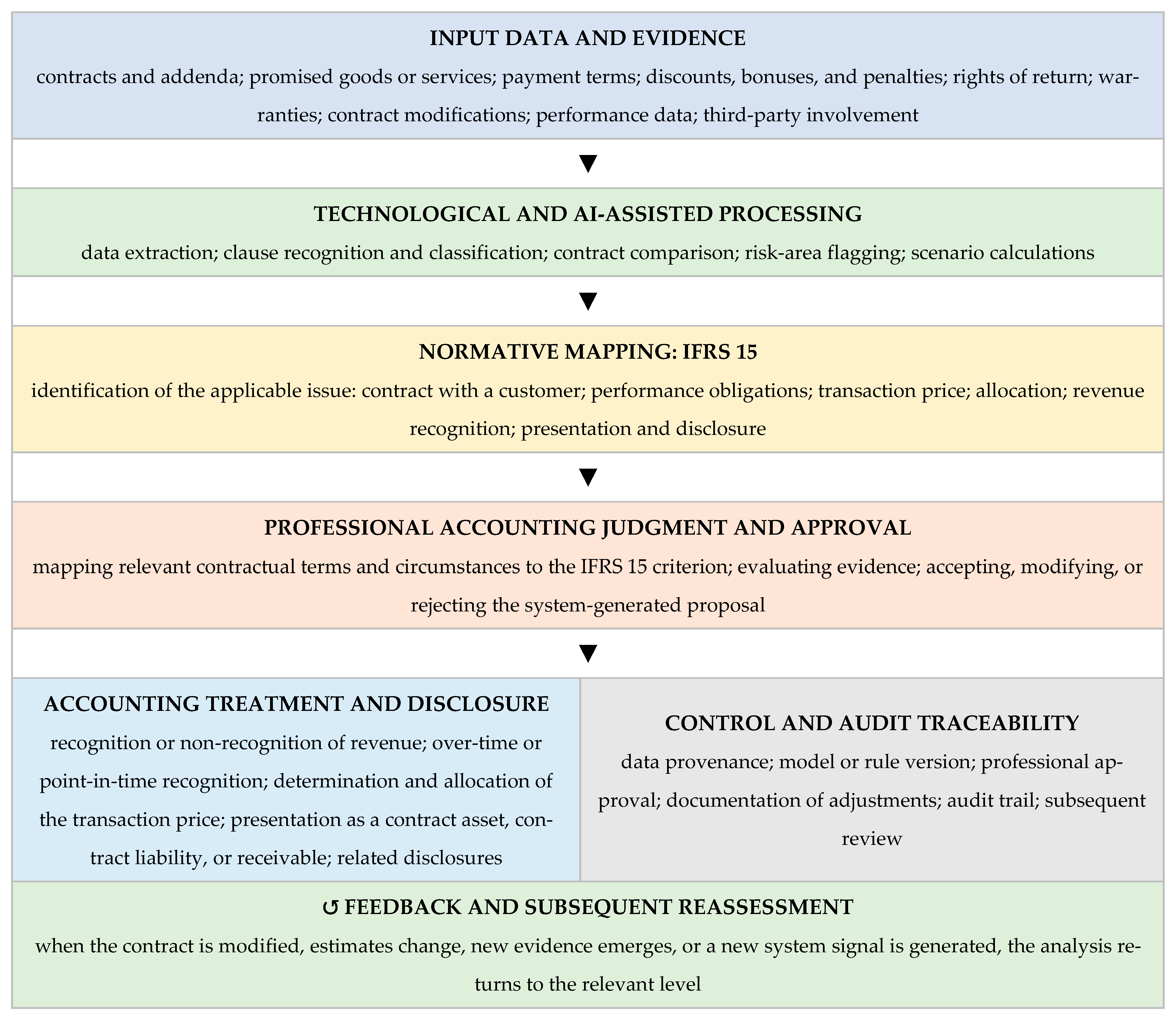
The framework is represented through a conceptual architecture connecting the contract with the customer, IFRS 15 criteria, professional accounting judgment, digital support, and control verifiability. The contract provides the relevant terms and circumstances, including promised goods or services, payment terms, discounts, bonuses, penalties, rights of return, warranties, modifications, and third-party involvement. These elements acquire accounting significance only when mapped to the applicable IFRS 15 criteria. These criteria relate to contract identification, performance obligations, the transaction price, allocation, revenue recognition, presentation, and disclosure (IFRS 15 [
2], paragraphs 1–2, 9, 18–21, 22–30, 31–86, and 105–129).
Professional accounting judgment occupies the center of the architecture because it maps relevant contractual terms and circumstances to the applicable IFRS 15 criterion and determines the accounting treatment. Digital tools and AI systems form a supporting layer that extracts data, recognizes clauses, flags risk areas, and performs scenario calculations. The control layer provides documentation, professional approval, internal control, an audit trail, and support for significant-judgment disclosures. The architecture thus combines normative accuracy, technological support, and evidentiary traceability.
The diagram emphasizes that IFRS 15 accounting treatment does not arise directly from a contractual clause or a system-generated proposal. It results from professional accounting judgment applied to a normative criterion and supported by contractual evidence and control traceability. Technology creates value by extracting and organizing information without displacing professional judgment, while the control level makes the process demonstrable and open to internal and audit review.
Figure 1 therefore illustrates the central proposition that digitalization and artificial intelligence may support the quality and traceability of revenue recognition when their use is aligned with IFRS 15 and remains subject to professional accounting judgment.
From a systems perspective, the framework can be traced as a sequence comprising contractual input information, normative mapping, technological support, professional accounting judgment, control approval, and accounting output. Documentation and subsequent review provide feedback to the analysis when contractual terms, estimates, or system-generated signals change.
Table 2 details the questions, functions, and IFRS 15 applications associated with each level.
The framework is applied to the five steps of IFRS 15 through a consistent logic: the normative level identifies the applicable criterion; the contractual-analytical level derives the relevant terms and circumstances; the technological level supports extraction, comparison, and calculation; and the control level provides professional approval and traceability. This sequence covers contract and performance-obligation identification, determination and allocation of the transaction price, and revenue recognition, while the specific criteria of IFRS 15 remain decisive in each case. The same logic applies to principal-agent assessment, in which a technological signal indicating third-party involvement does not replace the assessment of control over the specified good or service.
Within the analytical framework, actions are distinguished according to the degree of permissible system support. The lowest level includes the extraction of amounts, dates, contractual clauses, and payment terms, where the main risk is related to the completeness and accuracy of the data. The next level involves the preliminary flagging of risky contracts, comparison with similar contract models, and grouping of clauses using an artificial intelligence system. The system output acts as a signal for professional review. The most essential level remains professional accounting judgement. It determines the separateness of the promised goods or services, applies the constraint on variable consideration, and assesses control in a principal-agent analysis (IFRS 15 [
2], paragraph 27; paragraphs 56–58; Appendix B to IFRS 15, paragraphs B34–B38). Professional judgement also determines whether revenue is recognized at a point or over time (IFRS 15 [
2], paragraphs 35–38).
Table 3 clarifies the respective roles of system support and professional accounting judgment across these action types.
The distinction among execution, support, and professional judgment is essential in a digital environment. For simple information retrieval, the main risk concerns data completeness and accuracy. In system-assisted classification, the risk is greater because a technical output may be mistakenly viewed as a valid accounting basis. When the system contributes to variable-consideration calculations or transaction-price allocation, the assumptions used and the verification performed should be documented. The professional responsible for approving the accounting relevance of the system output should also be identified. The framework therefore places technology within an accounting-defensible sequence.
At the technological level, different forms of digital and AI-assisted processing entail different control requirements. Incomplete extraction or incorrect classification of a contractual clause requires verification against the primary contract text. A non-reproducible system output requires traceability of the version and input data used. A system proposal with direct accounting implications requires explicit professional acceptance, modification, or rejection. The technological and control components therefore operate jointly without altering the normative IFRS 15 criterion.
The result is a structured process in which professional accounting judgment remains central. The contract provides the relevant terms and circumstances, IFRS 15 provides the criteria, digital tools support information retrieval and organization, and the control level provides an evidentiary trail and professional approval. Technology can therefore support revenue recognition without becoming an autonomous accounting decision maker.
4.3. A Professionally Applicable Procedure for Evaluating a Contract with a Customer in a Digital Environment
The four-component framework can be applied as a practical procedure for evaluating a contract with a customer. It is not a model separate from IFRS 15 but a means of applying the standard’s criteria more consistently. The analysis extends beyond the formal contract text to identify accounting-relevant terms and circumstances, compare them with the applicable requirements, and document the professional judgment. Digital support is thereby used without transferring responsibility for the accounting treatment.
The practical sequence comprises five interrelated operations: extracting contractual data; identifying the accounting-relevant issue; applying the corresponding IFRS 15 criterion; assessing the role of system support; and professionally approving the accounting treatment. Within this sequence, the system output remains an input to professional judgment, while its acceptance, modification, or rejection is documented together with the evidence used and the applicable criterion.
Table 4 systematizes these operations and distinguishes the role of digital support from professional accounting judgment.
The procedure is also relevant to subsequent changes. Professional judgment under IFRS 15 is not confined to initial revenue recognition. Estimates may change over reporting periods for contracts involving variable consideration, modifications, rights of return, or long-term performance. Digital systems may signal such changes, but their accounting significance must be assessed professionally. The framework therefore covers both initial analysis and subsequent monitoring of judgments (IFRS 15 [
2], paragraph 59; paragraphs 18–21 and 39–43; Appendix B to IFRS 15, paragraphs B20–B27).
4.4. Illustrative Scenario Analysis of the Analytical Framework
The structured illustrative situations show how the proposed analytical framework organizes different areas of professional accounting judgment under IFRS 15. The analysis traces the relationship among relevant contractual terms and circumstances, the applicable criterion of the standard, the required professional judgment, and the resulting accounting treatment. The situations thus illustrate the framework’s analytical sequence in the context of recurring issues in accounting practice.
Each illustrative situation is examined through the same sequence: identifying relevant contractual terms and circumstances, defining the accounting-relevant issue, mapping it to the applicable IFRS 15 criterion, and formulating the professional accounting judgment on which the accounting treatment is based. This consistent analytical sequence enables a comparison of the areas without treating the technological output as an independent accounting basis.
The analytical interpretation focuses on areas in which professional judgment is particularly sensitive to uncertainty in consideration, timing differences, and the assessment of control. These areas include collectability and implicit price concessions, variable consideration, significant financing components, the timing of revenue recognition, and the principal-agent distinction. The remaining situations are systematized in
Table 5 using the same analytical sequence.
The synthesis of the illustrative situations yields three results. First, different areas of professional judgment can be organized through a common analytical sequence: relevant contractual terms and circumstances, an applicable IFRS 15 criterion, professional accounting judgment, and accounting treatment. Second, digital support performs different functions at different stages and remains subordinate to professional evaluation. Third, the greatest sensitivity to mechanical treatment arises in variable consideration, significant financing components, discount allocation, and the distinction between principal and agent.
4.5. Expert Assessment of the Analytical Framework
The expert assessment complements the structured illustrative scenario analysis by examining professional perceptions of the proposed framework. The scenario analysis applies the framework to recurring IFRS 15 judgment areas, while the expert assessment considers evaluations by specialists in financial reporting, auditing, internal control, and accounting information systems. The results therefore indicate whether the framework is perceived as understandable and useful for documenting judgments relating to contracts with customers.
The expert panel comprised 26 participants with different professional profiles, including auditors, chief accountants, financial directors, financial controllers, accounting and auditing experts, and accounting information systems specialists. These groups provide complementary perspectives because the framework addresses both IFRS 15 accounting treatment and the processing, documentation, and subsequent verification of contractual information.
Table 6 reports the distribution of participants by professional role, professional experience, and experience with IFRS 15.
The panel was composed primarily of professionals with direct experience in financial reporting and auditing. Auditors and chief accountants represented the largest groups, while financial directors and controllers added management and control perspectives. The two accounting information systems specialists contributed a complementary technological perspective, although their limited number constrains the extent to which the assessment can be interpreted as a technical evaluation of specific AI architectures.
The participants’ experience provides a relevant professional context for interpreting the assessment. A substantial proportion of the panel had more than ten years of professional experience, and more than half reported significant or very significant experience with IFRS 15. The assessment should therefore be understood as an exploratory professional evaluation of normative accuracy and perceived practical usability within the panel, rather than as a representative population estimate.
The expert assessment follows the 20-item structure described in
Section 3.5.
The item-level descriptive results are reported in
Table 7.
The aggregated results indicate generally favorable professional evaluations of the framework. All item means exceed 4.00, suggesting that participants perceive the framework as compatible with IFRS 15 and useful for analyzing contracts with customers. Documentation of professional accounting judgment received the highest mean score. This is noteworthy because documentation converts an internal professional opinion into a verifiable accounting argument, which is particularly important for contracts involving variable consideration, modifications, rights of return, or third-party involvement.
The more moderate evaluations of the constraint on variable consideration and digitally assisted analysis identify the areas requiring the greatest methodological clarity. The constraint requires not only calculation of an expected value or most likely amount but also assessment of the risk of a significant reversal in the amount of cumulative revenue recognized. Similarly, in a technological context, a system may generate a signal, classification, or scenario, but the resulting professional judgment must remain justified by the standard and contractual evidence.
When structured around IFRS 15, digital tools can enhance professional accounting judgment in revenue recognition, provided the resulting accounting treatment is demonstrable. The strongest evaluations relate to documentation and verifiability, whereas more complex judgments and technological proposals require clearer control questions and professional approval.
4.6. Analytical Interpretation of Expert Assessment
The expert assessment is interpreted not merely as a set of numerical values but as a professional response to the proposed analytical framework. The framework does not measure attitudes toward digitalization in general. Instead, it examines how professionals evaluate the normative accuracy, demonstrability, and perceived applicability of structured professional accounting judgment under IFRS 15 in a digitally assisted environment.
Table 8 reports the average scores and corresponding research interpretation across the analytical directions.
The indicators of internal consistency and ranking concordance are used as complementary analytical evidence rather than as independent proof of the framework’s applicability. Cronbach’s alpha is interpreted as an indicator of the internal consistency of the evaluation items and is not used as evidence of construct validity or operational effectiveness. For the item group relating to the five-step model and specific areas of professional judgment, the coefficient is interpreted in light of the substantively distinct areas covered by IFRS 15.
Table 9 presents the reliability and concordance statistics used to support the expert-assessment interpretation.
Kendall’s W = 0.092 indicates weak concordance in the relative ranking of the individual items. The statistical significance of the coefficient indicates that the observed concordance differs from zero within the panel. However, its small magnitude is not interpreted as evidence of substantively strong overall consensus. The primary interpretation therefore relies on the descriptive statistics and the relative differences among the evaluated areas.
The principal analytical value lies not in the absolute numerical levels alone, but in their relative pattern. Evaluations are strongest where the framework is most directly connected to IFRS 15 terminology and documentation and more moderate where future uncertainty or technological mediation is involved. The framework should therefore be applied with particular care in areas most susceptible to inappropriate automation, including variable consideration, system-assisted analysis, and professional approval of system-generated proposals.
The expert assessment provides an exploratory view of the framework’s perceived applicability and identifies conditions relevant to its use. The framework should remain linked to IFRS 15 terminology and criteria, require clear documentation of significant judgments, and treat digital support as a means of extracting, organizing, and verifying data rather than as an independent source of accounting treatment. Areas of greater uncertainty require more detailed justification and a clearer audit trail.
The expert-assessment results are consistent with the research proposition. Professional accounting judgment in revenue recognition can be supported by digital tools and artificial intelligence when structured around the normative logic of IFRS 15. The strongest evaluations concern the framework’s role in making judgment visible, documented, and verifiable.
4.7. Documentation Card for Professional Accounting Judgment in Revenue Recognition
The normative analysis, illustrative scenario analysis, and expert assessment collectively demonstrate the central role of documentation in the framework. Within the proposed structure, stating the selected accounting treatment is insufficient for subsequent review. The link between the contract with the customer, the applicable IFRS 15 criterion, the judgment exercised, and the reporting consequence must remain visible so that professional judgment can be reconstructed and verified.
The documentation card serves a practical function. It neither replaces IFRS 15 nor introduces an additional accounting model. Instead, it organizes the evidence supporting professional judgment by identifying the issue, the required evidence, and the expected output for each material area of analysis. This is particularly important for contracts involving variable consideration, significant financing components, multiple performance obligations, modifications, or third-party involvement.
In a digitally assisted process, the documentation card also performs a control function. An information system may store a contract, extract a clause, or flag a risk, but professional accounting judgment must be derived separately. Each system proposal should therefore be linked to the relevant contractual term or circumstance and the applicable IFRS 15 criterion. Without this link, system output may create a false sense of certainty without sufficient accounting justification.
Table 10 specifies the evidence base and expected outputs for the principal areas of professional accounting judgment.
The documentation card provides a structured basis for applying the analytical framework by linking the issue to be decided, the supporting evidence, the applicable IFRS 15 criteria, and professional approval. It preserves the central role of professional accounting judgment while supporting a clearer audit trail for digitally assisted revenue recognition.
5. Discussion
The results show that professional accounting judgment in revenue recognition under IFRS 15 is not an additional stage after contract processing but an integral part of each main step of the model. It determines whether the contract falls within the scope of the standard, how performance obligations are identified, how the transaction price is determined and allocated, and when revenue is recognized. For this reason, the framework should not be viewed as a technical procedure. It organizes the professional reasoning through which relevant contractual terms and circumstances acquire accounting significance.
The discussion proceeds along two interrelated dimensions. The first is normative and considers whether the framework remains faithful to IFRS 15. The second is organizational and technological and considers how that logic can be preserved when contractual data are processed by information systems and artificial intelligence. The framework’s principal strength lies in combining these dimensions: normative analysis alone does not address the management of large volumes of contractual data, while technological analysis alone does not establish the accounting basis of the decision.
The illustrative scenario analysis and expert assessment complement each other. The scenarios show how the framework organizes judgment where a formal contractual clause is insufficient to determine accounting treatment. The expert assessment identifies the components receiving the most favorable professional evaluations, particularly terminological compatibility, alignment with the five-step model, and documentation of professional judgment. The framework’s value, therefore, lies not in promising automation but in making professional accounting reasoning more visible and verifiable.
On this basis, the results identify four interrelated dimensions of the scientific contribution. At the theoretical level, professional accounting judgment is treated as the connecting mechanism between relevant contractual terms and circumstances and the applicable IFRS 15 criteria. At the methodological level, this relationship is organized through the four-component framework and the distinction among system-executable, system-assisted, and professional-judgment-dependent activities. At the systems level, contractual data, the system signal, professional approval, and the control trail are integrated into a unified decision-support sequence. At the control and auditing level, the framework requires a traceable link among the information used, the applicable criteria, the judgment exercised, and the final accounting treatment.
5.1. Normative Robustness of the Framework
The framework is normatively robust because it does not add criteria to IFRS 15. Each professional judgment is linked to the applicable requirement concerning contract identification, performance obligations, the transaction price, allocation, revenue recognition, presentation, or disclosure. The framework is not an external checklist and does not replace the standard; it structures how IFRS 15 is applied to relevant contractual terms and circumstances (IFRS 15 [
2], paragraphs 1–2, 9, 22–30, 31–86, and 105–129).
Practical vulnerability in applying IFRS 15 often begins not with the absence of a rule, but with an incorrectly framed accounting question. For an advance payment, the first issue is not the discount rate but why payment precedes the transfer of the promised goods or services. For a multi-element contract, the first issue is whether the promised goods or services are distinct, not how the price should be allocated. Where a third party is involved, the first issue is whether the entity controls the specified good or service before transfer, not whether a commission is charged. The framework places these questions before calculation [
44].
This sequencing addresses a common limitation of digitally assisted procedures. A system may detect a clause, but the accounting issue remains undefined unless the output is embedded in an appropriate process. Technological support acquires accounting value only when relevant contractual terms and circumstances are linked to a specific IFRS 15 criterion. Without that link, the output remains technical processing of text and numerical data rather than an accounting conclusion.
This positioning extends research on IFRS 15 that has established the importance of professional judgment, information systems, and variation in the standard’s practical application [
17,
39]. The proposed framework differs by connecting these elements at the level of the specific IFRS 15 issue: relevant contractual terms and circumstances are mapped to the applicable criterion, after which system support and professional approval are incorporated into a traceable sequence. The framework therefore complements the five-step model without altering its normative logic.
5.2. Digital Support as Evidence Infrastructure
Digital support is most useful when it helps build the evidence base for professional accounting judgment. Information systems can extract contractual terms, organize payment schedules, compare similar contracts, flag unusual clauses, and maintain an audit trail. AI systems can identify contractual patterns and direct attention to higher-risk areas. These functions create value only when the final accounting treatment results from professional judgment rather than a system-generated suggestion [
25].
A clear boundary should be maintained among extracted contractual information, a system signal, and professional accounting judgment. Extracted information identifies a term or circumstance in the contract; the system signal indicates a potential accounting issue; and professional judgment determines whether that issue leads to a particular accounting treatment under IFRS 15. The framework separates these levels so that technical output is not treated as an accounting conclusion.
The system’s contribution to the framework lies in separating extracted contractual information, system-generated signals, and professionally approved accounting treatment. Each system signal must be linked to an IFRS 15 criterion, supporting evidence, and documented professional approval. This separation strengthens the audit trail and provides a structured basis for internal control over revenue recognition.
From a decision-support systems perspective, this result extends the general concept of supporting semi-structured professional decisions by placing it in a normatively constrained accounting environment [
22]. At the same time, the distinction between a system signal and a professional decision mitigates the risk that technological output will acquire disproportionate influence over judgment, as discussed in the literature on technology dominance and professional judgment [
24]. The systems function of the framework therefore extends beyond data extraction to encompass decision organization, control, and subsequent verifiability.
This distinction is particularly important for variable consideration. A scenario calculation may indicate a probable amount but cannot determine whether that amount is included in the transaction price. The constraint on variable consideration requires assessment of both the likelihood and magnitude of a possible significant reversal in cumulative revenue recognized (IFRS 15 [
2], paragraphs 50–59). Technological output should therefore serve as an input to professional review rather than as a stand-alone accounting basis.
5.3. Control Logic and Auditability
The control logic of the framework is essential because IFRS 15 judgments depend on normative requirements, evidence, and management assumptions. Control should extend beyond checking whether a field is complete or a warning has been generated. It should assess whether relevant contractual terms and circumstances were understood correctly, whether the appropriate normative criterion was selected, and whether the professional judgment is supported by evidence. Control therefore addresses not only procedural completion but also the quality of the accounting reasoning.
Audit verifiability follows the same logic. The auditor requires not only the final accounting treatment but also the path by which it was reached. A principal-agent analysis should show how control over the specified good or service was assessed. A warranty analysis should show whether the promise merely provides assurance that the product complies with agreed specifications or provides an additional service. For contract assets, contract liabilities, and receivables, the conditional or unconditional nature of the right to consideration should be evident. The working paper therefore becomes part of the evidentiary quality of financial reporting (IFRS 15 [
2], paragraphs 105–109; Appendix B to IFRS 15, paragraphs B28–B38).
The framework also supports disclosure. A clear record of significant judgments provides a stronger basis for explaining contract balances, revenue, performance obligations, and the judgments applied under the standard. This is especially relevant where the timing of satisfaction of performance obligations or the methods used to determine the transaction price require significant judgment (IFRS 15 [
2], paragraphs 110–129, particularly paragraphs 123–126).
In a digitally assisted environment, the control trail should encompass not only the accounting document but also the provenance of the information used, identification of the system output, and its professional acceptance, modification, or rejection. When probabilistic or generative models are used, the traceability of the model or rule version and the ability to verify the system explanation against the primary contractual source are also required. In this way, principles of explainability and AI control are incorporated into the framework’s existing control logic without becoming an independent basis for accounting treatment [
26,
31].
5.4. Interpretation of Expert Assessment
The expert assessment indicates that the strongest evaluations concern elements closest to the normative logic of IFRS 15: terminology, the five-step model, and documentation. This pattern suggests that participants particularly value the framework where it converts complex judgment into a traceable and verifiable process. Documentation is especially important because the audit trail distinguishes a professional judgment from an unsupported accounting opinion.
The more moderate evaluations of digitally assisted analysis and the constraint on variable consideration are equally informative. They point out the limits of automation. Future uncertainty, rights of return, discounts, and bonuses cannot be reduced to a statistical output, and an AI system cannot assume professional accountability for applying the standard. These evaluations are consistent with the proposition that the framework should support rather than replace professional judgment.
The indicators of internal consistency and expert concordance should be interpreted within this scope. Cronbach’s alpha is a supplementary indicator of item consistency and is not evidence of construct validity or operational effectiveness. Kendall’s W = 0.092 indicates weak ranking concordance. Although statistically different from zero, its small magnitude does not support a conclusion of strong overall consensus in practical terms. Descriptive item-level results therefore remain the primary basis for interpreting the expert assessment.
5.5. Limitations and Future Research Directions
The study is limited to normative analysis, structured illustrative scenario analysis, and an exploratory expert assessment. The framework was not implemented in a live accounting information system; therefore, the results do not measure software effectiveness, processing accuracy, or operational outcomes. The illustrative scenarios were developed to examine the analytical coherence of the framework and do not measure the frequency of contract issues in practice.
The expert assessment reflects the views of a purposively selected panel of 26 professionals practicing in Bulgaria and is not statistically representative of the wider professional community. The study did not include a separate pilot group, open-ended questions, negatively worded items, an alternative framework, or a control condition. Because only two participants were accounting information systems specialists, the results provide a stronger basis for interpreting the accounting, control, and audit dimensions of the framework than for evaluating specific AI architectures. The findings are therefore interpreted as panel-based perceptions of normative compatibility, clarity, and potential usefulness, not as evidence of comparative superiority or operational effectiveness.
Participant-level Q1-Q20 responses are not publicly released because the consent process specified that responses would be used and reported only in aggregated form. This restriction remains applicable after removal of professional-background variables and limits independent recalculation of Cronbach’s alpha and Kendall’s W. To support transparency within this constraint, item-level descriptive statistics are reported in
Table 7, and the aggregate reliability and concordance indicators are reported in
Table 9.
Future research can develop the framework in three directions. The first is implementation in a real accounting information environment, where the impact on work files, control procedures, and consistency across similar contracts can be monitored. The second is sectoral adaptation, because critical judgments in software contracts, construction, platforms, retail, and long-term services do not arise in the same manner. The third is the development of rules for managing artificial intelligence systems in the accounting process, including traceability of system proposals, control of input data, professional approval, and documentation of deviations from the proposed system treatment [
31,
45]. In addition, professional judgments formed with and without structured system support could be compared, and specific technologies for contract processing could be examined. Such research would permit evaluation not only of perceived usefulness but also of extraction accuracy, judgment consistency, processing time, the frequency of professional adjustments, and the quality of the control trail.
The discussion indicates that the framework is strongest when normative precision, professional reasoning, and a verifiable evidence trail are combined. Digitalization and artificial intelligence may support this process when their roles are clearly defined and subject to professional and control procedures. They can prepare the analysis, focus attention, and improve documentation, while professional accounting judgment remains decisive.
6. Conclusions
Revenue recognition under IFRS 15 is an area in which the normative framework and professional accounting judgment are inseparable. The five-step model provides consistency but does not eliminate the need to evaluate relevant contractual terms and circumstances, economic substance, and uncertainty in consideration. This complexity is particularly evident for variable consideration, contract modifications, multiple promised goods or services, significant financing components, warranties, rights of return, and third-party involvement. In these cases, accounting treatment results from professional application of the standard rather than from a single formal indicator.
The study develops an analytical framework that structures professional judgment in the context of digitalization and artificial intelligence. The framework comprises normative, contractual-analytical, technological, and control levels. The normative level links judgment to IFRS 15 criteria; the contractual-analytical level provides relevant contractual information and evidence; the technological level supports the extraction, organization, and preliminary flagging of information; and the control level provides documentation, professional approval, and subsequent verification.
Digital assistance creates value only when subordinated to the normative logic of IFRS 15. Information systems may extract clauses, calculate amounts, or flag higher-risk contracts, and AI may support preliminary analysis. However, neither can independently determine whether promised goods or services are distinct, whether consideration is variable, whether a significant financing component exists, or whether the entity acts as principal or agent. These matters remain subject to professional accounting judgment.
The illustrative scenario analysis shows how the framework organizes different judgments through a common logic: relevant contractual terms and circumstances, the applicable criterion, professional judgment, and accounting treatment. The exploratory expert assessment complements this illustration. The most favorable evaluations concern terminological compatibility, alignment with the five-step model, and documentation; more moderate evaluations of digitally assisted analysis and the constraint on variable consideration indicate areas requiring stronger control questions and clearer professional justification.
The scientific contribution lies in presenting professional accounting judgment under IFRS 15 as essential to revenue recognition and capable of being systematically structured. The framework neither changes the standard nor introduces a new accounting model. Instead, it organizes the application of IFRS 15 in a digital environment while preserving the link among relevant contractual terms and circumstances, the applicable criterion, and accounting treatment. Its practical value lies in supporting structured documentation, a clearer audit trail, and stronger audit traceability.
Theoretically, the framework structures professional accounting judgment as the link among relevant contractual terms and circumstances, the applicable IFRS 15 criterion, and the accounting treatment. Methodologically, it distinguishes among system-executable actions, system-assisted actions, and actions requiring professional judgment. From a systems perspective, technological support is incorporated into a sequential information and control architecture. From a control and auditing perspective, emphasis is placed on documentation, professional approval, and the traceability of significant judgments.
The limitations of the study also define its next steps. The framework has not been implemented in a live accounting information system, and the study does not measure operational effectiveness or the frequency of contractual issues. The expert assessment is based on the opinions of a certain group of professionals in Bulgaria and is not statistically representative of any other group. Future research should evaluate the framework in real organizational environments, adapt it to specific sectors, and develop more detailed governance rules for AI-assisted contract analysis.
In summary, the future of revenue recognition in a digital environment lies not in replacing professional accounting judgment but in structuring, documenting, and verifying it more effectively. Digitalization and artificial intelligence can support process quality and traceability by extracting, organizing, and documenting relevant information and evidence. The decisive role, however, remains the professional application of IFRS 15 to the specific contract with the customer.