Article

Systemically Mediated Leadership in AI-Enabled Organizations: A Socio-Technical Systems Theory of Distributed Judgment, Feedback, and Accountability


Department of Business Administration, Lewis Bear Jr. College of Business, University of West Florida, Pensacola, FL 32514, USA
Systems 2026, 14(8), 984; https://doi.org/10.3390/systems14080984
Submission received: 13 July 2026 / Revised: 8 August 2026 / Accepted: 11 August 2026 / Published: 13 August 2026

Highlights

How does this work link to systems science?
  • The article defines AI-enabled leadership as a nested socio-technical system whose behavior emerges from four coupled subsystems, five component classes, eight decision–feedback stages, and institutionally weighted feedback loops.
  • It replaces a linear flow model with a causal-loop model that specifies three reinforcing loops, one balancing loop, material delays, accumulated system states, transition conditions, and recovery capacity.
  • What are the main findings and implications?
  • Systemically mediated leadership is present when AI mediation, leadership relevance, distributed judgment, and recurrent institutional embedding jointly hold; its intensity varies with authority, opacity, adaptivity, scale, autonomy, and power asymmetry.
  • Five mechanism families alter responsibility, legitimacy, control, attention, and feedback timing; accountable adaptation depends on epistemic capacity, authoritative contestability, inclusive feedback, independent accountability, and temporal monitoring and exit capacity.

Abstract

Artificial intelligence (AI) increasingly mediates leadership-relevant judgment through models, dashboards, metrics, decision-support systems, and autonomous agents. This conceptual article develops a socio-technical systems theory of systemically mediated leadership, defined as a nested system-level condition and recurrent process configuration through which human actors, AI systems, organizational routines, governance institutions, and affected stakeholders jointly produce and revise direction, meaning, consequential judgment, legitimacy, and accountability through recursive feedback. A problem-driven conceptual synthesis was updated through 3 August 2026. A structured discovery pass yielded 97 candidate records; 85 sources were retained after relevance screening, citation chaining, concept mapping, and comparison of eight candidate mechanism families. Four proposed qualification conditions jointly define the construct within the present framework: AI mediation, leadership relevance, distributed judgment, and recurrent institutional embedding. Five mechanism families explain transformations in responsibility, legitimacy, control, attention, and feedback timing: moral delegation, interpretive laundering, ceremonial oversight, metric-driven sensemaking, and ethical latency. A causal-loop model specifies justificatory reinforcement, capability atrophy, power insulation, and accountable correction. Their relative dominance produces three ideal-type dynamic regimes: accountable adaptation, stabilized trade-offs, and destructive drift. The theory predicts that organizations using equally accurate models may produce divergent leadership and accountability outcomes because their feedback, power, and oversight architectures differ. Responsible AI leadership thus depends on system architecture and contestable institutional practice, not leader intention, formal human approval, or model accuracy alone.

1. Introduction

Artificial intelligence (AI) is entering organizational leadership through models, dashboards, workforce analytics, automated screening, generative systems, risk scores, and agents. These systems do more than add information to a decision already framed by a leader. They select categories, rank alternatives, shape attention, define evidentiary thresholds, and sometimes execute action. Leadership influence therefore begins upstream of the visible decision, in data definitions, model objectives, interface defaults, workflow rules, and the institutional distribution of authority [1,2,3,4,5,6,7,8,9,10,11,12,13,14].
This upstream influence differs from ordinary data-informed management in several respects. Contemporary AI systems may infer unobserved states, generate novel content, update through new data, operate at scale, obscure their internal basis, and coordinate action across organizational and vendor boundaries [2,3,8,15,16,17,18]. A descriptive report may inform one manager without redistributing judgment. An adaptive risk model embedded in recurrent promotion, staffing, or service decisions may alter what counts as evidence, whose explanation is credible, and how responsibility is assigned. Model accuracy alone does not capture these leadership effects.
Systems theory provides the appropriate explanatory level because it emphasizes boundary selection, interdependence, feedback, delay, emergence, and control rather than isolated attributes [19,20,21,22,23,24]. Socio-technical scholarship adds the principle that technical and social performance depend on their joint organization [25,26,27,28,29,30,31]. Distributed leadership, leadership-as-practice, and relational leadership similarly shift attention from heroic individuals toward the practices and relations through which direction, alignment, and commitment are accomplished [32,33,34,35,36,37]. Yet these traditions do not by themselves specify when AI mediation constitutes a leadership system, how accountability changes across human and computational loci, or why apparently responsible arrangements diverge over time.
Algorithmic management explains important forms of digital allocation, monitoring, evaluation, and control [4,10]. Hybrid intelligence examines combinations of human and machine capability [1,2,3,9]. Responsible AI and human-accountable governance supply norms and institutional safeguards [5,6,7,13,14,38,39,40,41]. The unresolved theoretical object lies at their intersection: a recurrent configuration in which AI-mediated classification and action shape leadership-relevant direction, meaning, legitimacy, responsibility, and feedback. Neither a leader–tool dyad nor a control-system label captures the full process.
The article asks three questions: (1) Under what proposed constitutive conditions does AI-enabled organizational work qualify as systemically mediated leadership rather than routine management or decision support? (2) Through which discriminable mechanisms does AI mediation transform responsibility, legitimacy, control, attention, and feedback timing? (3) How do feedback structure, accumulated system states, governance capacity, and power produce movement among accountable adaptation, stabilized trade-offs, and destructive drift?
The resulting construct, systemically mediated leadership (SML), is defined as a nested system-level condition and recurrent process configuration through which human actors, AI systems, organizational routines, governance institutions, and affected stakeholders jointly produce and revise direction, meaning, consequential judgment, legitimacy, and accountability through recursive feedback. The construct is not an algorithmic leader, a new leadership style, or a synonym for technology use. Within the present framework, it is classified as present when four proposed qualification conditions hold: AI mediation, leadership relevance, distributed judgment, and recurrent institutional embedding. Its intensity then varies with authority, opacity, adaptivity, scale, autonomy, and power asymmetry.
The theory offers explanatory claims not available from model-centered or leader-centered accounts alone. It predicts that equally accurate models will yield different leadership outcomes when embedded in different feedback and power architectures; that formal human decision authority may coexist with declining effective judgment capacity; that consequential leadership influence moves upstream into data, interface, procurement, and threshold design; and that reported performance may improve while latent harm grows when metric reactivity and ethical latency suppress corrective feedback. These claims are configurational and temporal rather than claims that every use of AI creates a new form of leadership.
The article makes four contributions. First, it establishes explicit construct boundaries and a leadership–management threshold. Second, it integrates system structure, the decision–feedback process, and nested analytical scales within one architecture. Third, it develops five mechanism families through a common causal template and locates power within the core model. Fourth, it replaces the prior linear representation with a causal-loop model of reinforcing and balancing feedback, accumulated states, dynamic regimes, transition conditions, and recovery. Recent AI-leadership studies [38,42,43,44,45,46,47,48] inform contemporary application, while the theory is grounded primarily in established systems, leadership, organization, governance, human factors, and institutional studies.
The remainder of the article presents the conceptual method, system architecture, construct definition, mechanisms, dynamic model, empirical agenda, contributions, limitations, and conclusions. Appendix A provides literature-domain-to-construct mapping and the candidate-mechanism disposition for scholarly audit.

2. Materials and Methods

2.1. Research Design and Questions

The study uses problem-driven conceptual systems analysis. Conceptual theory building is appropriate when a phenomenon spans established studies, the focal construct requires boundary clarification, and the contribution depends on integrating mechanisms and producing testable relations rather than estimating a population parameter [49,50,51,52]. The unit of explanation is a nested AI-enabled leadership system, not an individual leader, one decision, or a technical artifact in isolation.
The synthesis followed an abductive sequence. Initial observations about AI-mediated judgment were compared with systems, leadership, organization, human factors, and governance concepts. Provisional relations were challenged against adjacent constructs, counterexamples, and rival explanations. The model was then revised until its components, mechanisms, signed feedback relations, dynamic regimes, and operational implications were internally consistent. Table 1 records the principal procedures and decision rules.

2.2. Source Discovery, Corpus, and Search Boundaries

A targeted, iterative revision search was updated through 3 August 2026 using publisher-hosted search and article pages, DOI-indexed bibliographic metadata, and reference lists of anchor publications. No bibliographic database served as a bounded sampling frame, and no single Boolean string was applied uniformly across platforms because the search was problem-driven rather than systematic review sampling. Four query families guided discovery at the level actually used: (1) (AI OR algorithm*) AND (leadership OR accountability OR oversight OR power OR responsibility); (2) (socio-technical OR systems) AND (leadership OR organizing OR feedback OR governance); (3) (algorithmic management OR hybrid intelligence OR human-in-the-loop) AND (judgment OR control OR work OR contestability); and (4) (automation bias OR moral crumple zone OR metric reactivity OR commensuration OR normalization OR drift OR ethical delay) AND (organization OR leadership). No lower date boundary was imposed because foundational systems, automation, institutional, and leadership work were theoretically necessary.
The structured pass yielded 97 candidate records. Eighty-five sources were retained after title, abstract, chapter, or full-text relevance review. A source was retained when it contributed at least one of seven functions: system architecture; human–AI decision behavior; leadership definition or practice; responsibility and governance; institutional power and legitimacy; quantification and attention; or dynamic failure and recovery. Purely technical performance studies without organizational implications, broad digital-leadership discussions without judgment or accountability content, and redundant sources that supplied no new construct relation were excluded. Backward and forward citation chaining began with foundational and review sources and continued until two consecutive passes generated no new component class, causal dimension, or trajectory-relevant loop.
The corpus is intentionally integrative rather than bibliometrically exhaustive. Established works ground systems, leadership, institutions, power, sensemaking, distributed cognition, automation, and drift [1,2,3,4,5,6,7,8,9,10,11,12,13,14,15,16,17,18,19,20,21,22,23,24,25,26,27,28,29,30,31,32,33,34,35,36,37,39,40,41,52,53,54,55,56,57,58,59,60,61,62,63,64,65,66,67,68,69,70,71,72,73,74,75,76,77,78,79,80,81,82,83,84,85]. The 2025–2026 studies [38,42,43,44,45,46,47,48] detail recent application and boundary refinement but do not constitute the theoretical foundation. Appendix A, Table A1 maps each literature domain to the revised architecture, mechanisms, loops, or propositions.

2.3. Concept Mapping and Mechanism Selection

Each retained source was examined by literature domain, focal unit, causal concept, system interface, temporal role, power implication, and proposed function in the framework; Table A1 reports the resulting judgments in aggregate by literature domain rather than as an 85-row source-level coding sheet. Concepts were then compared across eight candidate mechanism families: responsibility transfer; technical neutralization and legitimation; nominal oversight and decoupling; quantification and metric reactivity; delayed consequence recognition; automation bias and trust miscalibration; capability atrophy; and power concentration and boundary control.
A candidate was only retained as a mechanism family if it met the requirements of four tests. First, it described a transformation in the leadership system rather than a generic risk, antecedent, or outcome. Second, it occupied a distinct causal dimension. Third, an observable counterfactual permitted the process to be absent while another mechanism remained present. Fourth, it played a recursive role in system dynamics. Five families met all four tests. Automation bias and trust miscalibration were treated as micro-level antecedents to moral delegation and ceremonial oversight [12,53,54,77]. Capability atrophy was modeled as an accumulated state and reinforcing loop. Power concentration was elevated to a cross-cutting antecedent and moderator because it changes every mechanism and the weight of feedback. Appendix A, Table A2 records the disposition.
The five retained labels do not claim that the underlying phenomena lack intellectual antecedents. Moral delegation is compared with responsibility gaps and moral crumple zones [11,82]; ceremonial oversight draws on automation irony and institutional decoupling [12,65,66]; metric-driven sensemaking draws on attention, commensuration, audit, target effects, and reactivity [67,68,78,79,80,84]; and ethical latency develops systems work on delay, normalization, and practical drift [23,24,72,73,74]. The contribution lies in their discriminating definitions, shared causal template, location within a leadership system, and interaction in explicit feedback loops.

2.4. Dynamic Modeling, Epistemic Status, and Scope

The dynamic model was constructed by identifying variables that change in the same or opposite direction, material delays, stocks that accumulate across decision cycles, and institutional conditions that alter loop strength. A reinforcing loop amplifies an initial change; a balancing loop counteracts discrepancy. Trajectories are treated as ideal-type regimes defined by relative loop dominance rather than mutually exclusive permanent stages. Nested units within one organization may occupy different regimes at the same time.
This is a conceptual article, not a systematic review, meta-analysis, or empirical validation. A single-author synthesis does not supply inter-coder reliability, and purposive theoretical sampling remains judgment-dependent. Transparency is addressed through an explicit corpus count, search boundaries, query families, retention rules, a common mechanism template, counterexamples, a literature-domain-to-construct mapping, and candidate dispositions. The propositions state relationships for later examination rather than confirmed effects.

3. System Boundary, Architecture, and Power

3.1. Four Subsystems and Five Component Classes

Four subsystems describe analytic domains. The technical subsystem includes data pipelines, models, dashboards, interfaces, prompts, thresholds, agents, and automated actions. The social subsystem includes leaders, employees, technical staff, boards, affected stakeholders, professional norms, culture, and informal relations. The organizational subsystem includes workflows, incentives, procurement, performance systems, documentation, escalation, and appeals. The governance subsystem includes authority, accountability forums, audit, rights of contestation, labor and professional institutions, regulation, and independent review. The four subsystems are analytically distinct but operationally coupled [25,26,27,28,29,30,31].
Five component classes identify the entities or organized collectives that occupy those domains: human actors; computational artifacts; organizational routines; governance institutions; and affected stakeholders. This distinction resolves an apparent inconsistency between subsystem language and component language. Stakeholders are inside the focal explanatory boundary whenever they experience effects, supply corrective knowledge, bear costs, or possess standing to challenge. They may remain outside the organization’s formal boundary while remaining inside the leadership system’s causal boundary.
A performance-review system illustrates this coupling. A manager signs the final evaluation, while productivity metrics determine visibility; a model assigns risk; an interface anchors interpretation; incentives reward consistency; a vendor controls documentation; and an employee lacks access to correct the underlying record. The formal decision is human, but the judgment and accountability process spans all five component classes. Excluding the employee, vendor, or appeal forum would truncate the explanation.

3.2. Eight Decision–Feedback Stages and Nested Scales

The process architecture contains eight stages: sensing, framing, recommending, deciding, executing, experiencing, contesting, and correcting. Sensing selects and records data. Framing converts observations into categories, objectives, and comparators. Recommending ranks or generates options. Deciding allocates formal authority. Executing translates judgment into action. Experiencing locates effects among stakeholders. Contesting converts experience into a challenge, appeal, or alternative interpretation. Correcting changes data, models, rules, decisions, remedies, or institutional authority. The principal explanatory relations occur at interfaces among these stages.
The architecture is nested across four scales: the decision episode; the recurrent workflow, team, or unit; the organization; and the interorganizational ecosystem. The appropriate analytical boundary is the smallest nested system that contains AI output generation, organizational uptake and action, stakeholder effect, and an authoritative feedback or correction route. Vendors, data providers, consultants, labor organizations, professional bodies, and regulators enter the boundary when they materially control any stage or the capacity to revise it. The boundary may expand when a lower-level account leaves a consequential causal relation unexplained [13,21,22,23,24].
Scale matters because the same episode may be accountable while the organizational trajectory remains harmful, or one department may adapt while another drifts. Episode-level reason-giving does not establish organization-level correction. Conversely, an organizational audit policy does not establish that a particular workflow has usable evidence, time, or authority. The theory therefore requires explicit aggregation rules and permits simultaneous regimes in nested units.

3.3. Requisite Variety, Feedback Quality, and Accumulation

Ashby’s law of requisite variety implies that effective regulation requires enough informational, cognitive, procedural, and political variety to respond to the complexity of the regulated system [20]. A reviewer who receives only a score, lacks data provenance, has seconds to approve, and faces sanctions for deviation possesses less variety than the AI-mediated workflow. Human presence under those conditions does not supply substantive control [12,53,54].
Feedback quality depends on diversity, timeliness, disaggregation, credibility, and decision force. Stakeholder experience often supplies information absent from training data, dashboards, or aggregate performance measures. Feedback becomes regulatory only when it reaches actors with authority and prompts correction. A complaint channel whose validated challenges do not alter decisions is communication without control. Requisite variety and feedback quality therefore describe overarching properties of the governance portfolio rather than additional checklist items.
Repeated use creates stocks that are not visible in a one-period flow model. Organizational dependency, technical legitimacy, latent harm, stakeholder trust, internal expertise, contestability, and exit capacity accumulate or erode across deployment cycles. Delayed feedback permits favorable short-term indicators to rise while adverse stocks remain hidden. Path dependence follows when workflows, budgets, data pipelines, and professional routines make reversal progressively more costly [17,23,24,72,73,74].

3.4. Power and Institutional Boundary Control

Power is constitutive of the system rather than a contextual afterthought. Design power determines which problem is modeled, which data count, which proxy represents success, and which consequences remain outside the boundary. Operational power determines who interprets, overrides, allocates, disciplines, or withholds resources. Contestational power determines who has standing, access to evidence, protection, remedy, and authority to pause or exit. Institutional power stabilizes these arrangements by making selected categories appear legitimate or inevitable [17,65,66,69,70,71,83,85].
Power weights feedback. A worker’s direct experience may be informationally rich yet institutionally weak, while a vendor’s aggregate dashboard may be epistemically thin yet authoritative. Voice and contestability are therefore not merely communication channels. They are distributions of standing, evidence, and decision force. Formal consent to surveillance or automated control may reflect constrained compliance when exit options, professional autonomy, or labor power are unequal [4,10,69,70,83,85].
The framework models power through a reinforcing insulation loop. Increased reliance may concentrate knowledge and boundary control in executives, technical specialists, or vendors; concentrated control supports ceremonial review and suppresses inconvenient feedback; weakened correction permits greater reliance. Independent accountability, protected worker and professional voice, public scrutiny, and credible exit options weaken this loop. Power therefore shapes which mechanism is activated, which evidence is heard, who bears error costs, and which recovery pathways remain available.

4. Defining Systemically Mediated Leadership

4.1. Construct Status and Qualification Conditions

SML is a nested system-level condition and recurrent process configuration. It is not a leadership style, an autonomous machine leader, or a property of one individual. Within the present theory, the construct is classified as present when four proposed qualification conditions jointly hold. After qualification, intensity is continuous because the strength of mediation differs across systems.
  • AI mediation: An AI system classifies, predicts, generates, recommends, prioritizes, or acts; simple storage, transmission, or descriptive reporting is insufficient.
  • Leadership relevance: The mediated output materially shapes direction, alignment, commitment, organizational meaning, normative priorities, identity, or legitimate conduct [34]. A consequential allocation of opportunity, burden, voice, or risk qualifies only when it also implicates one or more of these leadership dimensions; consequence alone is insufficient.
  • Distributed judgment: Substantive framing, recommendation, approval, execution, or explanation spans multiple socio-technical loci, and no single human independently produces and accounts for the full judgment.
  • Recurrent institutional embedding: The arrangement is incorporated into routines, authority, incentives, governance, and repeated feedback or reuse rather than an isolated experimental interaction.
These four proposed conditions jointly constitute SML as defined in the present framework. Their satisfaction supports classification within this theory at the level selected by the boundary rule; it does not establish an empirically validated universal ontology or imply any beneficial or harmful outcome. Within the class, mediation intensity increases with the AI system’s authority, opacity, adaptivity, action autonomy, scale, and reach, and with asymmetry in access, voice, and exit. This two-stage formulation avoids both concept stretching and a false binary about the magnitude of mediation.

4.2. When AI-Mediated Work Becomes Leadership

The leadership threshold follows the direction–alignment–commitment ontology and relational practice scholarship [32,33,34,35,36,37]. Management coordinates work within substantially settled ends, standards, and role expectations. Leadership constructs or revises ends, meaning, legitimacy, commitment, identity, or contested priorities. The same workflow may contain both. AI-mediated scheduling is predominantly management-related when it applies settled availability rules to routine coverage under independent human deliberation. It becomes leadership-relevant when it encodes whose needs receive priority, redistributes burdens or voice, changes the meaning of fairness, or normalizes a contested employment relationship across repeated cycles.
A qualifying example is an adaptive workforce system that predicts retention risk and influences development, promotion, and restructuring. Data definitions frame potential, rankings direct managerial attention, workflows reward default acceptance, affected employees experience opportunity effects, and appeals feed—or fail to feed—back into the system. A counterexample is a descriptive inventory report used by one manager to reorder routine supplies under settled objectives while the manager independently evaluates context and explains the choice. The first meets all four conditions; the second lacks distributed judgment and leadership relevance.
A boundary case is a one-time generative summary prepared for a strategic retreat. AI mediation and leadership relevance may hold, but recurrent institutional embedding does not. The episode should be studied as AI-assisted leadership and not classified as an SML system. If the generated categories become a standing strategy dashboard linked to resource allocation, evaluation, and recurring review, the fourth condition emerges and the classification changes.

4.3. Adjacent Constructs and Unique Explanatory Scope

Table 2 compares SML with the closest alternatives. The boundaries are not claims that adjacent constructs are deficient. Each answers a different question. SML is warranted when the research question requires an integrated explanation of leadership relevance, upstream AI influence, distributed judgment, formal–effective authority gaps, stakeholder feedback, power, and dynamic trajectory.
The distinction from algorithmic management is consequential. Algorithmic management predicts changes in the control, monitoring, and labor process. SML predicts when those same infrastructures alter organizational direction, legitimacy, commitment, and moral justification, including outside direct labor control. The distinction from hybrid intelligence is equally specific. Hybrid intelligence asks how capabilities combine; SML asks who frames the goal, how the combination becomes legitimate, who remains answerable, which feedback has force, and how the arrangement evolves when reliance changes capacity.
Four discriminant predictions follow. First, with model accuracy held constant, outcome divergence should track differences in authoritative feedback and power concentration. Second, formal human authority may remain unchanged while independent judgment capacity declines across repeated use. Third, actors controlling data, interfaces, and thresholds should exercise measurable leadership influence before the interpersonal decision. Fourth, strong short-term performance may coexist with rising latent harm and dependency when ethical latency and metric reactivity are high. A theory limited to leader intention, model properties, or formal governance does not jointly derive these cross-level temporal predictions.

5. Five Mechanism Families

5.1. A Common Causal Template

A mechanism is a recurrent process through which specified antecedents transform a relation in the leadership system and generate an observable outcome. The five families occupy distinct analytic dimensions: responsibility, legitimacy, control, attention, and feedback timing. They are analytically discriminable but neither statistically independent nor temporally isolated. Each may be absent while another is present, and several may combine sequentially or recursively.
Table 3 applies the same template to every family: antecedent conditions; causal processes; immediate system transformation; longer consequence; and a discriminating observation or non-example. This structure guards against circular explanation. Naming an AI-supported decision moral delegation, for example, does not explain it. Evidence requires a shift in justificatory ownership under challenge that would not follow from ordinary use of relevant evidence.

5.2. Moral Delegation: Transformation of Responsibility

Moral delegation occurs when a formally accountable decision-owner substitutes AI output for independent normative judgment and shifts the justificatory burden toward the system. Delegation of computation or prediction is not moral delegation. The mechanism concerns what happens when the decision is contested: the actor cites the system as the reason, does not articulate an independent judgment, and treats technical provenance as a defense against responsibility. Time pressure, opacity, automation bias, reputational risk, and incentives for consistency increase this substitution [53,54,77].
The mechanism is related to but distinct from Elish’s moral crumple zone and Matthias’s responsibility gap [11,82]. A moral crumple zone places blame on a human operator who lacks sufficient control after system failure. Moral delegation moves in the opposite justificatory direction: an actor with formal authority pushes ownership toward the system during or after the decision. Both reveal responsibility–control misalignment, but they identify different locations and directions of displacement. The framework does not present these antecedent ideas as newly discovered.
Observable evidence includes decision records that repeat the recommendation without independent reasons, interview accounts that locate moral authority in the system, or challenge episodes in which the owner is unable or unwilling to defend the choice apart from the output. Override frequency alone is inadequate because low override may reflect accurate recommendations or routine cases. The relevant evidence is whether the owner retains informed, reasoned, and answerable judgment across contested episodes.
Proposition 1.
In recurrent consequential workflows, greater time pressure and output opacity will increase default acceptance through moral delegation and reduce traceable human ownership across successive decision episodes; mandatory independent reason-giving and authoritative appeal will weaken this indirect relationship.

5.3. Interpretive Laundering: Transformation of Legitimacy

Interpretive laundering occurs when contestable proxies, objectives, thresholds, categories, or uncertainties are recoded as apparently neutral technical facts. The output gains legitimacy because the design choices that produced it disappear from view [13,15,16,18,67,80]. A score labeled ‘flight risk’ may compress assumptions about loyalty, mobility, attendance, compensation, and opportunity into one number. The mechanism lies not in quantification itself but in the removal of interpretive alternatives and value judgments from deliberation.
The process joins three relations. Designers and sponsors select an objective and proxy; an interface presents the result with cues of precision or objectivity; organizational actors use the technical representation to close a debate or legitimate action. Institutional legitimacy reinforces the output when adoption signals modernity, consistency, or compliance [65,66,71,78]. Laundering is absent when assumptions, uncertainty, alternatives, and distributional effects remain visible and materially influence deliberation.
A discriminating test asks whether disclosure changes interpretation. If revealing the proxy, threshold, excluded variables, or plausible alternative models alters acceptance, the prior presentation converted contestable choices into technical authority. If the output was already presented as one uncertain input among several and actors deliberated over its assumptions, the case reflects technical evidence without interpretive laundering.
Proposition 2.
When AI interfaces suppress the provenance, uncertainty, and plausible alternatives of value-laden proxies, objectivity cues will increase technical legitimacy and reduce consideration of competing interpretations; visible model choices and stakeholder-authored alternatives will attenuate this effect.

5.4. Ceremonial Oversight: Transformation of Control

Ceremonial oversight occurs when a formally required human review step lacks effective authority, or the evidence, competence, time, or protection needed to regulate the AI-mediated workflow. The mechanism draws on the ironies of automation and institutional decoupling: formal structures satisfy expectations while operating practice remains substantially unchanged [12,65,66]. The reviewer certifies an outcome without possessing requisite variety to test, revise, or halt it.
Ceremonial oversight differs from a moral crumple zone [11]. The former describes ex-ante or recurrent control incapacity masked by a review ritual; the latter describes ex-post blame directed toward a low-control human after failure. Ceremonial oversight also differs from automation bias, which is an individual tendency [53,54]. It persists even with a skeptical reviewer when workload, access, authority, or retaliation risk makes substantive intervention impracticable.
Evidence requires more than a low override rate. Researchers should examine access to data and model logic, time per review, quality of counterevidence, authority to choose alternatives, consequences of dissent, escalation use, and responsiveness to adjudicated error. A low rate paired with accurate routine cases and documented independent reasons does not establish ceremony. A low rate paired with ignored valid challenges, unavailable evidence, or career penalties supports the mechanism.
Proposition 3.
As AI authority and case complexity exceed a review function’s informational, cognitive, procedural, and political capacity, formal human review will become more ceremonial and valid counterevidence will produce fewer corrections; resources, override authority, and protected dissent will moderate the degree of decoupling.

5.5. Metric-Driven Sensemaking: Transformation of Attention

Metric-driven sensemaking occurs when recurrent AI-generated measures reorganize what leaders notice, value, compare, and act upon. Organizational attention is scarce and institutionally structured [55,68,79]. Commensuration converts qualitative differences into common scales, while rankings and audits prompt actors to change their behavior in response to what is measured [67,78,80,84]. AI extends this process through granularity, prediction, continuous monitoring, and rapid linkage to rewards or opportunities.
The mechanism requires attention displacement or behavioral reactivity rather than the presence of metrics alone. Mentoring, care, conflict resolution, moral courage, local knowledge, and community maintenance may disappear from view when their proxies are weak. Employees then adapt to measured targets, and leaders interpret the resulting data as validation of the metric. A low-potential classification may reduce developmental assignments, depress later performance, and appear to confirm the initial category. This recursive performativity links metric-driven sensemaking to the justificatory loop.
Discriminating evidence includes changes in meeting agendas, resource allocation, communication, or worker behavior after the measure becomes salient; differences between measured and unmeasured but consequential work; and self-fulfilling classification effects. Measurement that remains subordinate to diverse qualitative evidence and does not redirect attention or incentives does not meet the mechanism definition.
Proposition 4.
When recurrent AI-generated metrics are linked to rewards or consequential allocation, measured dimensions will capture a growing share of leadership attention and induce target-oriented behavior, producing more self-confirming classifications over time; authoritative qualitative feedback and periodic construct revalidation will weaken the relationship.

5.6. Ethical Latency: Transformation of Feedback Timing

Ethical latency is the material delay between AI-mediated action and authoritative recognition of normatively relevant consequences. Harm may be cumulative, diffuse, displaced across stakeholders, or concealed by aggregation. Early efficiency gains occur quickly, while adverse effects involving exclusion, dependency, surveillance burdens, reduced trust, or capacity loss become visible later [23,24,72,73,74]. The mechanism is not any operational lag. It exists when timing attenuates the negative feedback needed to revise the leadership system.
During the delay, organizational dependency and technical legitimacy may accumulate. Workflows are redesigned, alternative skills decline, vendors update systems, and original decision-owners change roles. When consequences finally become visible, causal attribution is harder and exit costs are higher. Temporal separation therefore transforms a corrigible decision into an institutionalized routine [17,72,73,74]. Power magnifies latency when aggregate indicators suppress the experiences of groups with weak standing.
Evidence includes a gap between stakeholder experience and official detection, delayed disaggregated outcome data, gradual growth in complaints or disparities, and increased switching costs before correction. Temporal monitoring, leading indicators, repeated impact review, and sunset or renewal decisions shorten the effective delay even when consequences require time to mature.
Proposition 5.
Longer delays between AI-mediated action and disaggregated, authoritative recognition of its consequences will permit latent harm, normalization, and organizational dependency to accumulate before correction, increasing the likelihood of destructive drift; as a result, leading indicators, scheduled renewal, and credible exit alternatives will reduce this effect.

5.7. Distinctness, Sequence, and Interaction

Mechanism families need not be independent. A common sequence begins when metric-driven sensemaking narrows attention; interpretive laundering converts the selected proxy into neutral-seeming evidence; moral delegation shifts justificatory ownership toward the output; ceremonial oversight fails to reopen judgment; and ethical latency delays the consequences that would challenge the arrangement. The sequence then becomes recursive as accepted outputs generate new data, routines, and legitimacy.
The mechanisms remain discriminable because each sequence link may be interrupted. A transparent model may drive attention without laundering its assumptions. A leader may accept a technically legitimate recommendation while retaining independent moral ownership. A well-resourced review body may correct a laundered interpretation. Harm may be detected rapidly despite ceremonial approval. Empirical work should therefore test the discriminating evidence for each family and model interactions rather than collapse them into a single risk scale.

6. Dynamic Systems Model and Trajectories

6.1. Causal Loops, Delays, and Accumulated States

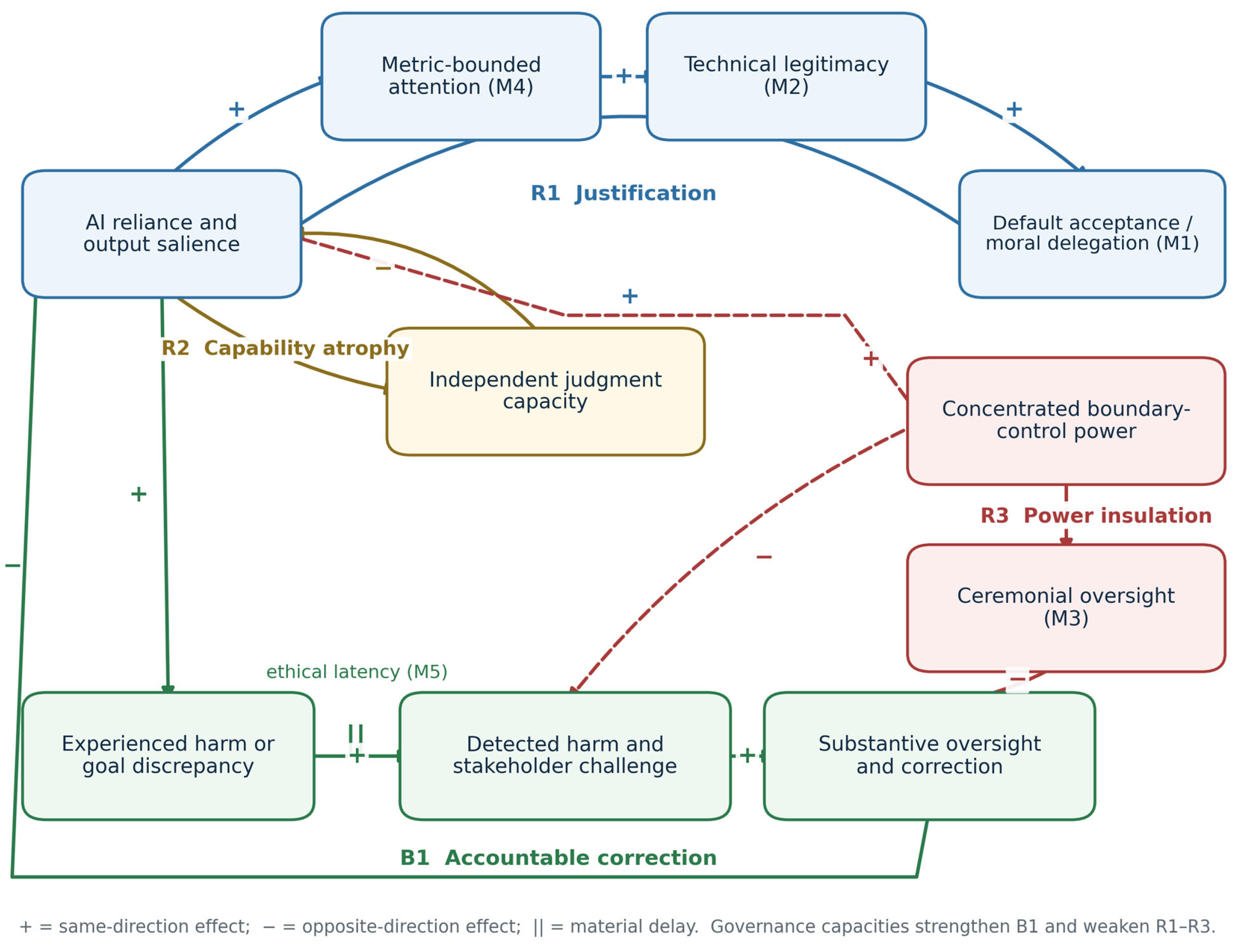
Figure 1 presents a qualitative causal-loop model rather than a linear flow or a formal stock–flow model. A positive sign means that a change in one variable moves the connected variable in the same direction, all else being equal; a negative sign means movement in the opposite direction. R denotes a reinforcing loop, B a balancing loop, and || a material delay. For visual economy, two nodes combine closely coupled operational dimensions—AI reliance with output salience, and substantive oversight with correction; empirical studies should measure their subdimensions separately. Accumulated states are identified in the text rather than displayed with stock notation. The loops represent tendencies whose realized strength depends on governance capacity, institutional context, technology, and power.
R1, justificatory reinforcement, begins when AI reliance increases metric-bounded attention. Bounded attention raises technical legitimacy, which increases default acceptance and further reliance. R2, capability atrophy, operates through two negative relations: greater reliance reduces opportunities to exercise independent judgment, and stronger independent capacity reduces uncritical reliance. The two negative links form a reinforcing loop in which early capacity loss encourages later dependence. R3, power insulation, links reliance to concentrated control over data, objectives, procurement, or interfaces; control supports ceremonial oversight and suppresses detection; weak correction then permits further reliance.
B1, accountable correction, begins when action creates a discrepancy between intended and experienced outcomes. Stakeholder experience must be detected, interpreted as credible, and connected to substantive oversight. Correction then changes reliance, data, model design, workflow, remedy, or authority. Ethical latency delays movement from experience to detection. The balancing loop may therefore exist formally yet remain too slow or weak to counter the reinforcing loops.
The principal accumulated states—and candidate stocks for subsequent formal stock–flow modeling—are organizational dependency, internal expertise, contestability, stakeholder trust, latent harm, technical legitimacy, and exit capacity. Flows into and out of these stocks determine regime. For example, training may add expertise while outsourcing and default acceptance deplete it. Resolved appeals may build trust while repeated unremedied challenges deplete it. Aggregated performance may conceal a rising stock of latent harm until a delayed audit or external event reveals it.

6.2. Accountable Adaptation

Accountable adaptation is an ideal-type regime in which B1 operates faster and with more authority than R1–R3. AI expands inquiry without displacing moral ownership. Outputs remain prompts for deliberation; uncertainty and assumptions remain visible; affected stakeholders possess standing; validated challenges alter decisions, data, rules, or remedies; and internal expertise remains active. Error is expected, detected, and used for learning rather than hidden by formal compliance.
Participatory AI-mediated scheduling illustrates the principle when transparency, professional knowledge, and worker voice revise constraints and criteria rather than merely legitimate an allocation [47]. The theory predicts not perfection but recovery: shorter detection delays, more documented correction, retained ability to decide without the system, and restored stakeholder trust after failure. Accountable adaptation may exist in one unit while another remains stabilized or drifting.
Proposition 6.
Across repeated deployment cycles, systems with authoritative stakeholder feedback and review capacity matched to task variety will exhibit more documented revisions, faster recovery from validated error, and less erosion of independent expertise than otherwise similar systems; concentrated boundary-control power will weaken these relationships.

6.3. Stabilized Trade-Offs

Stabilized trade-offs form a metastable regime rather than a neutral midpoint. B1 is strong enough to contain visible breakdown but too weak to revise underlying objectives, metrics, or power arrangements. Organizations accept recurring burdens in exchange for speed, predictability, consistency, or cost. Performance variance narrows and overt conflict remains manageable, while complaints, disparities, surveillance, or dependency persist within an institutional tolerance band.
Stability may reflect a genuine, negotiated compromise or constrained settlement. The distinction depends on contestational power, reversibility, and distribution of costs and benefits. Periodic renewal is necessary because a once-accepted compromise may drift as data, model behavior, workforce composition, law, vendor strategy, or professional norms change. Shocks, leadership turnover, labor mobilization, regulatory action, or sunset review may move the regime toward adaptation or destructive drift.
Proposition 7.
When corrective capacity limits visible failure but lacks authority to revise objectives, metrics, or power arrangements, AI-mediated leadership systems will enter a stabilized trade-off regime marked by predictable performance alongside persistent complaints or distributional burdens; exogenous shocks and scheduled renewal points will increase the likelihood of transition in either direction.

6.4. Destructive Drift

Destructive drift occurs when reinforcing loops dominate delayed correction. Reliance increases technical legitimacy and default acceptance; independent judgment capacity erodes; concentrated power narrows the boundary and weakens challenge; and ethical latency hides accumulating costs. Local actions remain individually defensible while the system moves away from its stated normative purpose [72,73,74]. Malicious intent is unnecessary.
The regime becomes visible through paired trends: reliance, dependency, legitimacy, and concentrated control rise while expertise, correction rates, stakeholder trust, disaggregated visibility, and exit options decline. Aggregate efficiency may improve in the early phase. The systems explanation identifies why that improvement does not falsify drift: positive performance signals are fast and institutionally privileged, while adverse feedback is delayed, diffuse, or politically weak.
Proposition 8.
When concentrated boundary-control power strengthens justificatory reinforcement and ceremonial oversight and ethical latency weakens accountable correction, organizational reliance, technical legitimacy, dependency, and latent harm will rise across deployment cycles as independent expertise and correction rates fall; independent accountability and credible exit capacity will attenuate this trajectory.

6.5. Governance Capacities and Regime Transitions

Five higher-order governance capacities alter loop strength. Epistemic capacity combines literacy, access to data and model evidence, uncertainty interpretation, and auditability. Authoritative contestability combines reason-giving, override, appeal, pause, halt, and remedy. Inclusive feedback combines stakeholder standing, disaggregated outcomes, protected voice, and evidence that challenges lead to changes in the system. Independent accountability separates scrutiny from adoption incentives and includes boards, professional institutions, labor organizations, regulators, and public oversight. Temporal monitoring and exit capacity combine lag and cumulative indicators, periodic renewal or sunset, alternatives, switching capability, and recovery planning.
These capacities are moderators and balancing control mechanisms, not conventional external boundary conditions. Their portfolio supplies requisite variety and feedback quality. Contextual scope conditions remain analytically separate: decision consequentiality, technology autonomy and adaptivity, scale, sector regulation, professional authority, labor power, and market or vendor concentration. Table 4 summarizes regime signatures and movement.

7. Operationalization and Empirical Tests

7.1. Distinguishing Roles and Levels of Measurement

Empirical work should separate five analytic roles: construct qualification indicators; antecedent organizational conditions; the mechanism process; governance moderators; and short- or long-term outcomes. It should also distinguish episode, workflow or unit, organization, and ecosystem levels. An individual perception of pressure may be an antecedent; a recurrent pattern of inaccessible evidence and ignored valid challenges supports ceremonial oversight at workflow level; an organization-level drift claim requires aggregated temporal evidence across workflows.
Measurement should begin with the four qualification conditions. Researchers should identify what the AI infers or does, which leadership outcome it materially shapes, where substantive judgment is distributed, and how the arrangement is recurrently embedded. Only after classification should mechanism strength and regime be assessed. This sequence prevents ordinary management analytics from being absorbed into the construct.
Table 5 identifies observables, evidence, and safeguards. The design emphasizes triangulation because self-report does not reconstruct system relations on its own. Logs, interfaces, decision documentation, procurement and governance records, adjudicated appeals, audit materials, interviews, observations, longitudinal outcomes, and comparative institutional evidence should be combined according to level.

7.2. Research Designs and Rival Explanations

Longitudinal process studies are central because the theory concerns accumulation and regime change. Event histories may code deployment, scaling, challenge, correction, model update, leadership turnover, and governance intervention. System-dynamics studies may estimate loop dominance and sensitivity to detection delays, loss of expertise, or exit costs. Comparative cases may hold technology class or model performance approximately constant while varying contestability, professional autonomy, labor power, or independent accountability.
Field and vignette experiments may isolate mechanism relations. Interface treatments may vary uncertainty, proxy disclosure, alternative explanations, and objectivity cues to test interpretive laundering. Time pressure, mandatory reason statements, and appeal visibility may test moral delegation. Review resources and dissent protection may test ceremonial oversight. Metric salience and reward linkage may test attention displacement and reactivity. Delayed versus immediate disaggregated outcomes may test ethical latency.
Rival explanations should be modeled rather than dismissed. Low correction may reflect high accuracy, homogeneous routine cases, or capture by power. High stakeholder acceptance may reflect substantive legitimacy or constrained compliance. Reduced independent judgment may reflect task specialization rather than atrophy. Performance divergence may reflect sector regulation, professional norms, or data quality. The propositions specify moderators and observable sequences so these alternatives may be adjudicated.

8. Discussion

8.1. Contribution to Systems Science

The first contribution is a systems account of leadership accountability. The theory links boundary selection, requisite variety, feedback quality, accumulation, delay, path dependence, and loop dominance to a focal leadership process. The multilevel architecture and nested boundary rule prevent the system from collapsing into a leader–algorithm dyad. The causal-loop model makes explicit which processes reinforce reliance and which permit recovery.
The distinction between formal human authority and effective control develops the cybernetic argument. A person may remain legally or organizationally responsible while lacking the informational, cognitive, procedural, or political variety needed to regulate the workflow. The theory therefore explains why a nominal human-in-the-loop arrangement may fail despite accurate technology, ethical intentions, and a documented policy. System performance depends on relations and feedback architecture, not the presence of preferred components in isolation.
The regime model also advances beyond a list of risks. Accountable adaptation, stabilized trade-offs, and destructive drift are not labels attached after an outcome. They are ideal-type patterns generated by relative loop strength, delays, stocks, and institutional control. The model predicts transition and recovery conditions, permits nested units to diverge, and identifies metastability rather than assuming a simple desirable–undesirable continuum.

8.2. Contribution to Leadership Theory

The leadership contribution is not the claim that algorithms are persons or leaders. Relational, distributed, and practice perspectives already establish that leadership is accomplished among multiple actors [32,33,34,35,36,37]. SML extends this insight by identifying when computational classifications, interfaces, workflow rules, and external providers become constitutive loci of direction, meaning, legitimacy, and accountability. It supplies a threshold separating leadership-relevant mediation from routine coordination.
The four qualification conditions and the direction–alignment–commitment criterion answer when management becomes leadership [34]. The same scheduling, evaluation, or forecasting process may remain managerial under settled ends and become leadership-relevant when it revises priorities, establishes legitimate conduct, or distributes voice and burden in ways that implicate direction, alignment, commitment, meaning, legitimacy, identity, or contested normative priorities. This formulation preserves the leadership constructs while recognizing that the practice begins before and continues after the interpersonal encounter.
The theory also adds unique predictions: upstream technical actors may exercise leadership influence without formal leadership roles; effective judgment may migrate while formal authority remains stable; and leadership outcomes may diverge under identical models because accountability and power architectures differ. These are relational and temporal predictions, not semantic differences in emphasis.

8.3. Contribution to AI Governance and Organization Studies

For algorithmic management, the framework connects digital control to leadership meaning, justification, and trajectory. For hybrid intelligence, this study explains why complementarity is an achieved and reversible system condition rather than an automatic property of combining a person with a model [1,2,3,4,9,10]. For responsible AI, it connects principles to organizational enactment and identifies how audit, oversight, or transparency become ceremonial [13,14,41,65,66]. For human-accountable governance, it specifies the mechanisms and dynamic pathways through which traceability is maintained or eroded [14,38,39,40].
Power is integral to these connections. Data access without standing does not make feedback authoritative. Explainability without override does not restore control. Voice without protection may expose challengers without changing outcomes. Exit rights without organizational alternatives may be nominal. Governance therefore concerns the institutional distribution of design, operational, and contestational power, not only the information supplied to a formally accountable individual.
The five mechanism labels should be evaluated by explanatory utility, not novelty of wording. Each family has established lineages. The revision’s contribution is to state discriminating conditions, show non-examples, locate each family at a distinct system dimension, connect them through signed loops, and derive propositions that separate antecedent, process, outcome, time, and moderation. Future evidence may support refinement, merger, or rejection of particular families without invalidating the need for a system-level research question.

8.4. Practical Design Implications

Organizations should begin with a boundary and power audit. The audit should trace who defines the objective and proxy, who controls data and documentation, where defaults enter the interface, who bears error costs, which stakeholders possess standing, and who has authority to change or halt the system. This exercise often reveals leadership influence in procurement, data governance, and interface design before a named leader receives an output.
Oversight should be scaled to system variety and consequences. Reviewers need evidence, competence, time, alternatives, reason-giving requirements, authority, and protection. Audit trails should reconstruct the chain from sensing and framing through recommendation, decision, action, experience, challenge, and correction. Recording the final approval click does not document judgment.
Organizations should monitor accumulated states as well as immediate performance. Measures of dependency, internal expertise, appeal effectiveness, stakeholder trust, latent disparity, and exit readiness reveal whether favorable flow indicators mask a worsening stock. Periodic renewal, simulation of model unavailability, protected challenge exercises, and independent review test recovery capacity before a crisis.

9. Limitations and Future Research

The theory remains conceptual and requires discriminant and predictive validation. The five mechanisms may correlate strongly in some settings, and the common template does not establish empirical independence. Research should first test each mechanism against its non-example and closest rival, and then examine sequence and interaction. The propositions should be evaluated using longitudinal and multilevel designs before a comprehensive structural model is attempted.
The source synthesis is transparent but not systematic in the bibliometric sense. A single author made relevance and mapping judgments; the 85-source corpus does not exhaust relevant studies. Future systematic reviews, citation-network studies, Delphi panels, and multi-coder concept analyses should test omitted clusters and the stability of the mechanism taxonomy. The audit trail in Appendix A provides a starting point for replication and challenge.
Technology and institutional context limit portability. Deterministic scheduling, machine-learning classification, generative assistance, and agentic action differ in opacity, adaptivity, speed, and authority. Public agencies, hospitals, universities, firms, and platforms differ in law, professional duty, labor power, transparency, and market concentration. Future studies should estimate how these scope conditions change qualification intensity, loop strength, and governance thresholds.
The causal-loop diagram is qualitative. It clarifies direction, delay, and feedback but does not estimate magnitude, nonlinear thresholds, or equilibrium. Empirical system-dynamics work should specify stock–flow equations, calibrate delays, test sensitivity, and identify tipping or recovery thresholds. Agentic systems may add loops involving delegation chains, inter-agent coordination, and action before human review.
Normative disagreement also remains. Stakeholders may contest not only errors but legitimate ends, acceptable trade-offs, and the distribution of costs. Accountable adaptation does not promise consensus. Future work should integrate procedural justice, democratic governance, professional ethics, and labor relations to examine when a stabilized settlement reflects legitimate compromise or constrained compliance.

10. Conclusions

AI-enabled leadership is not defined by the presence of a dashboard, an algorithm, or a human approver. It becomes systemically mediated within the proposed framework when AI shapes leadership-relevant direction, meaning, legitimacy, or a consequential allocation that also implicates those leadership dimensions; substantive judgment is distributed; and the arrangement is recurrently embedded in organizational and governance feedback. This definition establishes a testable boundary between SML, routine data-informed management, and adjacent constructs.
Five mechanism families describe distinct transformations in responsibility, legitimacy, control, attention, and feedback timing. Three reinforcing loops and one balancing loop explain why equally accurate models may support accountable adaptation in one architecture, stabilized trade-offs in another, and destructive drift in a third. Power determines whose categories, evidence, experience, and challenge shape those loops.
Responsible AI leadership depends on an architecture with epistemic capacity, authoritative contestability, inclusive feedback, independent accountability, and temporal monitoring and exit capacity. Leader characteristics, model accuracy, formal oversight, and compliance language remain relevant but insufficient alone. Accountability persists when the system retains enough variety, voice, traceability, independent judgment, and recovery capacity to challenge and revise its own outputs as it learns, scales, and adapts.

Funding

This research received no external funding.

Institutional Review Board Statement

Not applicable.

Informed Consent Statement

Not applicable.

Data Availability Statement

The original contributions presented in this study are included in the article. Further inquiries may be directed to the corresponding author.

Acknowledgments

The author independently selected, consulted, and verified every cited source, reviewed and revised the full manuscript, and takes full responsibility for its content and publication. ChatGPT (GPT-5.5; OpenAI, San Francisco, CA, USA; accessed on 13 July 2026) was initially used only to generate a preliminary list of potential sources. The author independently checked all suggested sources against Google search and excluded those that were unsuitable or irrelevant.

Conflicts of Interest

The author declares no conflicts of interest.

Appendix A. Conceptual Synthesis Audit Trail

The appendix records how the retained literature informs the framework and how the eight candidate mechanism families were retained, absorbed, or relocated.
Table A1. Literature-domain-to-construct mapping.
Literature DomainAnchor ConceptsRepresentative SourcesUse in the Revised Theory
Systems and cyberneticsBoundary, feedback, requisite variety, accumulation, delay, path dependence[19,20,21,22,23,24]Nested boundary rule; signed loops; accumulated states; correction and drift.
Socio-technical and sociomaterial systemsJoint optimization, reciprocal structuring, material–social inseparability[25,26,27,28,29,30,31]Four subsystems, five component classes, and interface-level relations.
Organizational AI and hybrid intelligenceHuman–AI complementarity, decision structures, automation–augmentation, learning algorithms[1,2,3,8,9]AI-specific mediation properties and the distinction between nominal and substantive complementarity.
Algorithmic management and worker contestationAllocation, surveillance, evaluation, control, contested terrain[4,10,83,85]Control infrastructure, power asymmetry, behavioral adaptation, and worker voice.
AI ethics, governance, and accountabilityOpacity, fairness, due process, auditing, accountable governance, social feedback[5,6,7,13,14,15,16,18,38,39,40,41,76,82]Accountability relations, governance capacities, contestability, and discriminant tests.
Human factors and automationAutomation bias, complacency, trust calibration, ironies of automation[11,12,53,54,77]Micro-level antecedents to moral delegation and ceremonial oversight; responsibility–control misalignment.
Leadership theory and practiceDirection–alignment–commitment, relational practice, distributed leadership, ethical and destructive leadership[32,33,34,35,36,37,42,43,44,45,55,56,57,58,59,60,61,62,63,64,75]Leadership–management threshold, construct boundary, leadership outcomes, and normative stakes.
Sensemaking, attention, quantification, and reactivityAttention selection, commensuration, rankings, audit ritual, target effects[55,67,68,78,79,79,80,84]Metric-driven sensemaking, interpretive laundering, and observable attention displacement.
Institutions, power, and legitimacyDecoupling, authority, agenda control, legitimacy, institutionalization[17,65,66,69,70,71]Power-weighted feedback, ceremonial oversight, technical legitimacy, and stabilized settlements.
Drift and practical failureNormalization, practical drift, delayed recognition, recovery[23,24,72,73,74]Ethical latency, reinforcing loops, accumulated harm, regime transitions, and recovery pathways.
Distributed cognition and agencyCognition across people and artifacts; responsibility gaps[81,82]Distributed judgment condition and the distinction between distributed production and traceable accountability.
Conceptual theory buildingProblem-driven synthesis, construct clarity, contribution, conceptual framework analysis[49,50,51,52]Search, mapping, retention tests, counterexamples, propositions, and audit trail.
Recent AI-leadership and Systems studiesAlgorithmic delegation, agentic AI, symbolic leadership, participatory scheduling[38,42,43,44,45,46,47,48]Contemporary application and boundary refinement; not the foundational basis of the theory.
Table A2. Candidate mechanism families and disposition.
Candidate FamilyDispositionReasonLocation in Revised Model
Responsibility transferRetained as moral delegationDistinct transformation in ownership and justificatory burden with an observable counterfactual.M1 and R1.
Technical neutralization and legitimationRetained as interpretive launderingDistinct transformation of value-laden choices into apparently neutral technical facts.M2 and R1.
Nominal oversight and organizational decouplingRetained as ceremonial oversightDistinct transformation of review into certification when formal authority exceeds effective control.M3 and R3.
Quantification and metric reactivityRetained as metric-driven sensemakingDistinct attentional transformation with behavioral feedback and self-confirming categories.M4 and R1.
Delayed consequence recognitionRetained as ethical latencyDistinct temporal attenuation of corrective feedback while harm and dependency accumulate.M5 and B1.
Automation bias and trust miscalibrationAbsorbed as antecedentsPrimarily individual-level tendencies; they strengthen M1 and M3 but do not supply a separate system transformation.Antecedents to M1/M3; R1/R2.
Capability atrophyRelocated as an accumulated state and loopRepresents a stock and reinforcing consequence rather than a parallel mechanism family.Independent judgment capacity in R2.
Power concentration and boundary controlRelocated as a cross-cutting antecedent and moderatorShapes every mechanism, feedback weight, and recovery route rather than one parallel process.Section 3.4 and R3.

References

  1. Jarrahi, M.H. Artificial intelligence and the future of work: Human–AI symbiosis in organizational decision making. Bus. Horiz. 2018, 61, 577–586. [Google Scholar] [CrossRef] [Scilit]
  2. Shrestha, Y.R.; Ben-Menahem, S.M.; von Krogh, G. Organizational decision-making structures in the age of artificial intelligence. Calif. Manag. Rev. 2019, 61, 66–83. [Google Scholar] [CrossRef] [Scilit]
  3. Raisch, S.; Krakowski, S. Artificial intelligence and management: The automation–augmentation paradox. Acad. Manag. Rev. 2021, 46, 192–210. [Google Scholar] [CrossRef] [Scilit]
  4. Kellogg, K.C.; Valentine, M.A.; Christin, A. Algorithms at work: The new contested terrain of control. Acad. Manag. Ann. 2020, 14, 366–410. [Google Scholar] [CrossRef] [Scilit]
  5. Martin, K. Ethical implications and accountability of algorithms. J. Bus. Ethics 2019, 160, 835–850. [Google Scholar] [CrossRef] [Scilit]
  6. Mittelstadt, B.D.; Allo, P.; Taddeo, M.; Wachter, S.; Floridi, L. The ethics of algorithms: Mapping the debate. Big Data Soc. 2016, 3, 2053951716679679. [Google Scholar] [CrossRef] [Scilit]
  7. Citron, D.K.; Pasquale, F. The scored society: Due process for automated predictions. Wash. Law Rev. 2014, 89, 1–33. [Google Scholar]
  8. Faraj, S.; Pachidi, S.; Sayegh, K. Working and organizing in the age of the learning algorithm. Inf. Organ. 2018, 28, 62–70. [Google Scholar] [CrossRef] [Scilit]
  9. Dellermann, D.; Ebel, P.; Söllner, M.; Leimeister, J.M. Hybrid Intelligence. Bus. Inf. Syst. Eng. 2019, 61, 637–643. [Google Scholar] [CrossRef] [Scilit]
  10. Lee, M.K.; Kusbit, D.; Metsky, E.; Dabbish, L. Working with machines: The impact of algorithmic and data-driven management on human workers. In Proceedings of CHI 2015; ACM: New York, NY, USA, 2015; pp. 1603–1612. [Google Scholar] [CrossRef] [Scilit]
  11. Elish, M.C. Moral crumple zones: Cautionary tales in human–robot interaction. Engag. Sci. Technol. Soc. 2019, 5, 40–60. [Google Scholar] [CrossRef] [Scilit]
  12. Bainbridge, L. Ironies of automation. Automatica 1983, 19, 775–779. [Google Scholar] [CrossRef] [Scilit]
  13. Selbst, A.D.; Boyd, D.; Friedler, S.A.; Venkatasubramanian, S.; Vertesi, J. Fairness and abstraction in sociotechnical systems. In Proceedings of FAT* ’19; ACM: New York, NY, USA, 2019; pp. 59–68. [Google Scholar] [CrossRef] [Scilit]
  14. Raji, I.D.; Smart, A.; White, R.N.; Mitchell, M.; Gebru, T.; Hutchinson, B.; Smith-Loud, J.; Theron, D.; Barnes, P. Closing the AI accountability gap: Defining an end-to-end framework for internal algorithmic auditing. In Proceedings of FAT* ’20; ACM: New York, NY, USA, 2020; pp. 33–44. [Google Scholar] [CrossRef] [Scilit]
  15. Burrell, J. How the machine ‘thinks’: Understanding opacity in machine learning algorithms. Big Data Soc. 2016, 3, 2053951715622512. [Google Scholar] [CrossRef] [Scilit]
  16. Kitchin, R. Thinking critically about and researching algorithms. Inf. Commun. Soc. 2017, 20, 14–29. [Google Scholar] [CrossRef] [Scilit]
  17. Lawrence, T.B.; Winn, M.I.; Jennings, P.D. The temporal dynamics of institutionalization. Acad. Manag. Rev. 2001, 26, 624–644. [Google Scholar] [CrossRef] [Scilit][Green Version]
  18. Pasquale, F. The Black Box Society: The Secret Algorithms That Control Money and Information; Harvard University Press: Cambridge, MA, USA, 2015. [Google Scholar]
  19. von Bertalanffy, L. General System Theory: Foundations, Development, Applications; George Braziller: New York, NY, USA, 1968. [Google Scholar]
  20. Ashby, W.R. An Introduction to Cybernetics; Chapman & Hall: London, UK, 1956. [Google Scholar]
  21. Churchman, C.W. The Systems Approach; Delacorte Press: New York, NY, USA, 1968. [Google Scholar]
  22. Checkland, P. Systems Thinking, Systems Practice; John Wiley & Sons: Chichester, UK, 1981. [Google Scholar]
  23. Meadows, D.H. Thinking in Systems: A Primer; Chelsea Green Publishing: White River Junction, VT, USA, 2008. [Google Scholar]
  24. Sterman, J.D. Business Dynamics: Systems Thinking and Modeling for a Complex World; Irwin/McGraw-Hill: Boston, MA, USA, 2000. [Google Scholar]
  25. Trist, E.L.; Bamforth, K.W. Some social and psychological consequences of the Longwall method of coal-getting. Hum. Relat. 1951, 4, 3–38. [Google Scholar]
  26. Emery, F.E.; Trist, E.L. Socio-technical systems. In Management Sciences, Models and Techniques; Churchman, C.W., Verhulst, M., Eds.; Pergamon Press: Oxford, UK, 1960; Volume 2, pp. 83–97. [Google Scholar]
  27. Orlikowski, W.J. Sociomaterial practices: Exploring technology at work. Organ. Stud. 2007, 28, 1435–1448. [Google Scholar] [CrossRef] [Scilit]
  28. Di Maio, P. Towards a metamodel to support the joint optimization of socio technical systems. Systems 2014, 2, 273–296. [Google Scholar] [CrossRef] [Scilit]
  29. Barley, S.R. Technology as an occasion for structuring: Evidence from observations of CT scanners and the social order of radiology departments. Adm. Sci. Q. 1986, 31, 78–108. [Google Scholar] [CrossRef] [Scilit]
  30. Orlikowski, W.J. The duality of technology: Rethinking the concept of technology in organizations. Organ. Sci. 1992, 3, 398–427. [Google Scholar] [CrossRef] [Scilit]
  31. Orlikowski, W.J.; Scott, S.V. Sociomateriality: Challenging the separation of technology, work and organization. Acad. Manag. Ann. 2008, 2, 433–474. [Google Scholar] [CrossRef]
  32. Uhl-Bien, M. Relational leadership theory: Exploring the social processes of leadership and organizing. Leadersh. Q. 2006, 17, 654–676. [Google Scholar] [CrossRef] [Scilit]
  33. Uhl-Bien, M.; Marion, R.; McKelvey, B. Complexity Leadership Theory: Shifting leadership from the industrial age to the knowledge era. Leadersh. Q. 2007, 18, 298–318. [Google Scholar] [CrossRef] [Scilit]
  34. Drath, W.H.; McCauley, C.D.; Palus, C.J.; Van Velsor, E.; O’Connor, P.M.G.; McGuire, J.B. Direction, alignment, commitment: Toward a more integrative ontology of leadership. Leadersh. Q. 2008, 19, 635–653. [Google Scholar] [CrossRef] [Scilit]
  35. Crevani, L.; Lindgren, M.; Packendorff, J. Leadership, not leaders: On the study of leadership as practices and interactions. Scand. J. Manag. 2010, 26, 77–86. [Google Scholar] [CrossRef] [Scilit]
  36. Gronn, P. Distributed leadership as a unit of analysis. Leadersh. Q. 2002, 13, 423–451. [Google Scholar] [CrossRef] [Scilit]
  37. Bolden, R. Distributed leadership in organizations: A review of theory and research. Int. J. Manag. Rev. 2011, 13, 251–269. [Google Scholar] [CrossRef] [Scilit]
  38. Enang, I.; Mukala, P.; Nkereuwem, U. Authentic intelligence in digital strategy systems: A socio-technical analysis of human-accountable decision governance. Systems 2026, 14, 259. [Google Scholar] [CrossRef] [Scilit]
  39. Bovens, M. Analysing and assessing accountability: A conceptual framework. Eur. Law J. 2007, 13, 447–468. [Google Scholar] [CrossRef] [Scilit]
  40. Rahwan, I. Society-in-the-loop: Programming the algorithmic social contract. Ethics Inf. Technol. 2018, 20, 5–14. [Google Scholar] [CrossRef] [Scilit]
  41. Floridi, L.; Cowls, J. A unified framework of five principles for AI in society. Harv. Data Sci. Rev. 2019, 1(1), 1–14. [Google Scholar] [CrossRef] [Scilit]
  42. Khassawneh, O.; Mohammad, T.; Tabche, I. Delegating to the algorithm: How AI-driven leadership shapes bias perceptions, trust and emotional disengagement in the workplace. Leadersh. Organ. Dev. J. 2026, 47, 243–260. [Google Scholar] [CrossRef] [Scilit]
  43. Al Harrasi, N.; Al Mujaini, A. Leadership governance under algorithmic mediation: Reconceptualizing transformative leadership through an integrative review. Leadersh. Organ. Dev. J. 2026, 47, 261–281. [Google Scholar] [CrossRef] [Scilit]
  44. Henderson, M.D. Agentic AI and the ethics of leadership maintenance: Rethinking responsibility in algorithmic organizations. Leadersh. Organ. Dev. J. 2026, 47, 294–308. [Google Scholar] [CrossRef] [Scilit]
  45. Skeja, A.; Sadiku-Dushi, N. Toward sustainable AI leadership: Ethical blind spots, accountability gaps and the CARE governance framework. Leadersh. Organ. Dev. J. 2026, 47, 336–354. [Google Scholar] [CrossRef] [Scilit]
  46. Hu, C.; Mohi Ud Din, Q.; Tahir, A. Artificial intelligence symbolic leadership in small and medium-sized enterprises: Enhancing employee flexibility and technology adoption. Systems 2025, 13, 216. [Google Scholar] [CrossRef] [Scilit]
  47. Virgillito, D.; Ledda, C. AI-mediated participation and people sustainability: A socio-technical case study in healthcare shift scheduling. Systems 2026, 14, 168. [Google Scholar] [CrossRef] [Scilit]
  48. Alibašić, H. Hybrid Intelligence for Effective Digital Governance: AI in Administration. In Public Administration and Information Technology; Springer: Cham, Switzerland, 2026; Volume 42. [Google Scholar]
  49. Jaakkola, E. Designing conceptual articles: Four approaches. AMS Rev. 2020, 10, 18–26. [Google Scholar] [CrossRef] [Scilit]
  50. Torraco, R.J. Writing integrative literature reviews: Guidelines and examples. Hum. Resour. Dev. Rev. 2005, 4, 356–367. [Google Scholar] [CrossRef] [Scilit]
  51. Whetten, D.A. What constitutes a theoretical contribution? Acad. Manag. Rev. 1989, 14, 490–495. [Google Scholar] [CrossRef] [Scilit]
  52. Jabareen, Y. Building a conceptual framework: Philosophy, definitions, and procedure. Int. J. Qual. Methods 2009, 8, 49–62. [Google Scholar] [CrossRef] [Scilit]
  53. Parasuraman, R.; Manzey, D.H. Complacency and bias in human use of automation: An attentional integration. Hum. Factors 2010, 52, 381–410. [Google Scholar] [CrossRef] [Scilit]
  54. Mosier, K.L.; Skitka, L.J.; Heers, S.; Burdick, M. Automation bias: Decision making and performance in high-tech cockpits. Int. J. Aviat. Psychol. 1998, 8, 47–63. [Google Scholar] [CrossRef] [Scilit]
  55. Weick, K.E. Sensemaking in Organizations; Sage: Thousand Oaks, CA, USA, 1995. [Google Scholar]
  56. Bazerman, M.H.; Tenbrunsel, A.E. Blind Spots: Why We Fail to Do What’s Right and What to Do about It; Princeton University Press: Princeton, NJ, USA, 2011. [Google Scholar]
  57. Simons, T. Behavioral integrity: The perceived alignment between managers’ words and deeds as a research focus. Organ. Sci. 2002, 13, 18–35. [Google Scholar] [CrossRef] [Scilit]
  58. Treviño, L.K.; Brown, M.; Hartman, L.P. A qualitative investigation of perceived executive ethical leadership: Perceptions from inside and outside the executive suite. Hum. Relat. 2003, 56, 5–37. [Google Scholar] [CrossRef] [Scilit]
  59. Einarsen, S.; Aasland, M.S.; Skogstad, A. Destructive leadership behaviour: A definition and conceptual model. Leadersh. Q. 2007, 18, 207–216. [Google Scholar] [CrossRef] [Scilit]
  60. Tepper, B.J. Consequences of abusive supervision. Acad. Manag. J. 2000, 43, 178–190. [Google Scholar] [CrossRef] [Scilit]
  61. Krasikova, D.V.; Green, S.G.; LeBreton, J.M. Destructive leadership: A theoretical review, integration, and future research agenda. J. Manag. 2013, 39, 1308–1338. [Google Scholar] [CrossRef] [Scilit]
  62. Van Quaquebeke, N.; Gerpott, F.H. The now, new, and next of digital leadership: How artificial intelligence (AI) will take over and change leadership as we know it. J. Leadersh. Organ. Stud. 2023, 30, 265–275. [Google Scholar] [CrossRef] [Scilit]
  63. McGuire, J.; De Cremer, D. Algorithms, leadership, and morality: Why a mere human effect drives the preference for human over algorithmic leadership. AI Ethics 2023, 3, 601–618. [Google Scholar] [CrossRef] [Scilit]
  64. Philip, J. Identifying key leadership competencies for digital transformation: Evidence from a cross-sectoral Delphi study of global managers. Leadersh. Organ. Dev. J. 2023, 44, 392–406. [Google Scholar] [CrossRef] [Scilit]
  65. Meyer, J.W.; Rowan, B. Institutionalized organizations: Formal structure as myth and ceremony. Am. J. Sociol. 1977, 83, 340–363. [Google Scholar] [CrossRef] [Scilit]
  66. Bromley, P.; Powell, W.W. From smoke and mirrors to walking the talk: Decoupling in the contemporary world. Acad. Manag. Ann. 2012, 6, 483–530. [Google Scholar] [CrossRef] [Scilit]
  67. Espeland, W.N.; Sauder, M. Rankings and reactivity: How public measures recreate social worlds. Am. J. Sociol. 2007, 113, 1–40. [Google Scholar] [CrossRef] [Scilit]
  68. Weick, K.E.; Sutcliffe, K.M.; Obstfeld, D. Organizing and the process of sensemaking. Organ. Sci. 2005, 16, 409–421. [Google Scholar] [CrossRef] [Scilit]
  69. Lukes, S. Power: A Radical View, 2nd ed.; Palgrave Macmillan: Basingstoke, UK, 2005. [Google Scholar]
  70. Pfeffer, J. Power in Organizations; Pitman: Marshfield, MA, USA, 1981. [Google Scholar]
  71. Suchman, M.C. Managing legitimacy: Strategic and institutional approaches. Acad. Manag. Rev. 1995, 20, 571–610. [Google Scholar] [CrossRef] [Scilit]
  72. Snook, S.A. Friendly Fire: The Accidental Shootdown of U.S. Black Hawks over Northern Iraq; Princeton University Press: Princeton, NJ, USA, 2000. [Google Scholar]
  73. Vaughan, D. The Challenger Launch Decision: Risky Technology, Culture, and Deviance at NASA; University of Chicago Press: Chicago, IL, USA, 1996. [Google Scholar]
  74. Dekker, S. Drift into Failure: From Hunting Broken Components to Understanding Complex Systems; Ashgate: Farnham, UK, 2011. [Google Scholar]
  75. Brown, M.E.; Treviño, L.K.; Harrison, D.A. Ethical leadership: A social learning perspective for construct development and testing. Organ. Behav. Hum. Decis. Process. 2005, 97, 117–134. [Google Scholar] [CrossRef] [Scilit]
  76. Green, B.; Chen, Y. Disparate interactions: An algorithm-in-the-loop analysis of fairness in risk assessments. In Proceedings of FAT* ’19; ACM: New York, NY, USA, 2019; pp. 90–99. [Google Scholar] [CrossRef] [Scilit]
  77. Dzindolet, M.T.; Peterson, S.A.; Pomranky, R.A.; Pierce, L.G.; Beck, H.P. The role of trust in automation reliance. Int. J. Hum.-Comput. Stud. 2003, 58, 697–718. [Google Scholar] [CrossRef] [Scilit]
  78. Power, M. The Audit Society: Rituals of Verification; Oxford University Press: Oxford, UK, 1997. [Google Scholar]
  79. Ocasio, W. Towards an attention-based view of the firm. Strateg. Manag. J. 1997, 18, 187–206. [Google Scholar] [CrossRef] [Scilit]
  80. Espeland, W.N.; Stevens, M.L. Commensuration as a social process. Annu. Rev. Sociol. 1998, 24, 313–343. [Google Scholar] [CrossRef] [Scilit]
  81. Hutchins, E. Cognition in the Wild; MIT Press: Cambridge, MA, USA, 1995. [Google Scholar]
  82. Matthias, A. The responsibility gap: Ascribing responsibility for the actions of learning automata. Ethics Inf. Technol. 2004, 6, 175–183. [Google Scholar] [CrossRef] [Scilit]
  83. Beer, D. The social power of algorithms. Inf. Commun. Soc. 2017, 20, 1–13. [Google Scholar] [CrossRef] [Scilit]
  84. Campbell, D.T. Assessing the impact of planned social change. Eval. Program Plan. 1979, 2, 67–90. [Google Scholar] [CrossRef] [Scilit]
  85. Bernstein, E.S. The transparency paradox: A role for privacy in organizational learning and operational control. Adm. Sci. Q. 2012, 57, 181–216. [Google Scholar] [CrossRef] [Scilit]
Figure 1. Causal-loop model of systemically mediated leadership. R1 links AI reliance, metric-bounded attention (M4), technical legitimacy (M2), and default acceptance or moral delegation (M1). R2 captures the reciprocal erosion of independent judgment capacity. R3 links reliance, concentrated boundary-control power, ceremonial oversight (M3), and weakened correction. B1 converts discrepancies experienced by stakeholders into challenges and substantive corrections, subject to ethical latency (M5). Governance capacities strengthen B1 and weaken R1–R3.
Systems 14 00984 g001
Table 1. Conceptual synthesis protocol and audit trail.
StageProcedureDecision RuleAudit Output
Problem framingSpecified the unexplained phenomenon as recurrent AI mediation of leadership judgment, meaning, legitimacy, and accountability.Retain questions requiring relations, feedback, boundaries, or emergence rather than individual attributes alone.Three research questions and a nested system-level unit of analysis.
Source discoverySearched publisher platforms and DOI-indexed metadata with four query clusters; used backward and forward citation chaining from anchor works.Include sources that specify architecture, human–AI behavior, causal mechanisms, leadership relevance, governance, power, or dynamic failure.97 candidate records; 85 retained; no lower date bound; updated through 3 August 2026.
Concept mappingRecorded source domain, focal unit, causal concept, system interface, temporal role, power implication, and proposed model function.Keep a concept when it adds a distinct relation, competing explanation, boundary, or observable implication.Literature-domain-to-construct mapping in Appendix A, Table A1.
Mechanism comparisonCompared eight candidate families against four retention tests and adjacent concepts.Require a system transformation, distinct causal dimension, observable counterfactual, and recursive role in feedback dynamics.Five retained mechanism families; three absorbed or relocated; Appendix A, Table A2.
Dynamic modelingMapped signed causal relations, delays, accumulated states, loop dominance, transition conditions, and recovery capacity.Treat trajectories as ideal-type regimes; avoid a linear input–outcome sequence.Three reinforcing loops, one balancing loop, three regimes, and eight propositions.
Saturation and challengeContinued chaining until two successive passes supplied no new component class, causal dimension, or trajectory-relevant loop; retained later sources only for boundary refinement or competing explanations.Do not treat citation volume as evidence of construct validity; preserve explicit scope and empirical tests.Limitations statement, counterexamples, discriminant evidence, and an empirical test agenda.
Table 2. Construct boundaries and unique explanatory scope.
Adjacent ConstructPrimary Unit and QuestionBoundary and Added Visibility from SML
Data-informed managementA manager uses information to coordinate work within substantially settled ends.Does not qualify when AI merely reports facts and one actor independently frames and justifies a routine choice. SML begins when all four qualification conditions hold.
Algorithmic managementDigital allocation, monitoring, evaluation, and control of work [4,10].Explains control infrastructures. SML additionally explains how AI-mediated control constructs direction, meaning, legitimacy, moral justification, stakeholder standing, and recursive accountability across organizational domains.
Distributed leadership and leadership-as-practiceLeadership emerges through relations, practices, and plural human influence [32,35,36,37].SML specifies how computational classifications, interfaces, vendors, and feedback architecture become constitutive loci of leadership influence while preserving human and institutional accountability.
Sociomaterial organizing and distributed cognitionAgency and cognition are accomplished through relations among people, artifacts, and practice [27,29,30,31,81].SML narrows the explanatory object to leadership-relevant direction, commitment, legitimacy, and accountability and adds qualification tests, mechanisms, loop dynamics, and trajectory predictions.
Hybrid intelligenceHuman and machine capabilities are combined to improve task performance [1,2,3,9].Describes a collaborative architecture. SML explains when nominal complementarity becomes accountable, ceremonial, politically insulated, or path dependent.
Responsible AINormative and technical properties such as fairness, transparency, safety, and accountability [5,6,7,13,14,41].Supplies evaluative criteria. SML explains how organizational routines and power either enact, neutralize, or symbolically satisfy those criteria over time.
Human-accountable decision governanceTraceable human authority and governance across digital decisions [38,39,40].Closely aligned governance objective. SML isolates leadership processes and predicts how responsibility, legitimacy, attention, control, and feedback timing interact before and after a formal decision.
Systemically mediated leadership (SML)A nested system-level condition and recurrent process configuration meeting four jointly necessary conditions.Makes upstream model and interface influence, formal–effective authority gaps, delayed harm, loop dominance, and power-weighted correction visible in one testable leadership framework.
Table 3. Common causal template and discriminating evidence for the five mechanism families.
Mechanism and DimensionAntecedent → Causal ProcessSystem Transformation and Longer OutcomeDiscriminating Observation or Non-Example
Moral delegation—responsibilityTime pressure, opacity, output authority, and weak reason-giving → a decision-owner substitutes the output for independent normative judgment.Justificatory burden shifts toward the system while formal accountability remains human → responsibility–control misalignment and habitual default acceptance.Present when the owner does not defend the decision independently under challenge. Ordinary use of evidence with documented independent reasons is not moral delegation.
Interpretive laundering—legitimacyHidden proxies, thresholds, objectives, or uncertainty plus an objectivity cue → contestable choices are recoded as technical facts.Alternatives and value judgments disappear from view → technical legitimacy narrows deliberation and weakens contestation.Present when disclosure of design choices changes acceptance or interpretation. A transparent estimate openly treated as contestable is not laundering.
Ceremonial oversight—controlReview obligations exceed authority, evidence, competence, time, or protection → the human step certifies rather than regulates.Formal authority separates from effective control → low correction, ritual compliance, and accountability theater.Low override rates alone are ambiguous. Evidence requires review-capacity deficits plus non-responsiveness to valid counterevidence.
Metric-driven sensemaking—attentionQuantified indicators are recurrent, comparable, and tied to rewards or allocation → measured proxies crowd out relevant unmeasured knowledge.Organizational attention and behavior reorganize around the metric → reactivity and self-confirming classifications.Measurement alone is insufficient. Evidence requires attention displacement or behavioral adaptation around the metric.
Ethical latency—feedback timingConsequences are delayed, diffuse, cumulative, or aggregated → negative signals arrive after dependency and normalization grow.Corrective feedback loses force → latent harm, lock-in, and difficult causal attribution.A short operational delay is not ethical latency. Evidence requires normatively relevant consequences whose timing attenuates authoritative correction.
Table 4. Dynamic regimes, accumulated states, transitions, and counterforces.
Ideal-Type RegimeDominant Feedback SignatureAccumulated States and Observable PatternTransition or Recovery Conditions
Accountable adaptationB1 accountable correction dominates R1–R3; challenge reaches actors with authority and produces revision.Independent expertise and contestability are maintained; detected errors, documented revisions, and stakeholder trust recover across cycles.Weakening voice, rapid scaling, or loss of independent expertise may shift the system toward stabilization or drift. Recurrent review sustains the regime.
Stabilized trade-offsB1 contains visible failure but does not revise objectives or power arrangements; reinforcing and balancing loops remain in metastable tension.Performance becomes predictable while recurring complaints, disparities, or burdens persist within an accepted tolerance band.A shock, metric change, leadership turnover, regulatory intervention, worker mobilization, or sunset review may reopen the settlement in either direction.
Destructive driftR1 (justificatory reinforcement), R2 (capability atrophy), and R3 (power insulation) dominate delayed B1 correction.Dependency, technical legitimacy, concentrated control, and latent harm rise while internal expertise, correction rates, and exit options fall.Recovery requires authoritative external or independent review, restored alternatives, disaggregated harm data, protected contestation, and power to pause or withdraw the system.
Table 5. Multilevel operationalization and empirical tests.
Analytic Role and LevelIllustrative ObservablesRecommended Evidence and DesignInterpretive Safeguard
Construct qualification—episode/workflowAI inference or action; leadership relevance; distributed judgment loci; recurrent embedding in routine and feedback.Process maps, model/interface records, decision documents, observations, and repeated workflow traces.Do not classify routine reporting or one-off tool use as SML when any qualification condition is absent.
Mechanisms—episode/workflow/unitIndependent reasons, interface framing, review resources, attention allocation, target adaptation, and consequence delay.Decision logs, screen recordings, reason statements, interviews, meeting records, experiments, and temporal event coding.Do not infer mechanisms from self-report alone; test the discriminating observation and plausible rival explanations.
Antecedents—workflow/organization/ecosystemOutput opacity, time pressure, scale, autonomy, reward linkage, vendor dependence, and control concentration.Procurement and governance records, workload data, technical documentation, contracts, and comparative cases.Separate pre-existing conditions from the mechanism and from later outcomes.
Governance moderators—unit/organization/ecosystemEpistemic resources, authority to override or halt, stakeholder standing, independent review, lag monitoring, and exit alternatives.Access audits, appeal outcomes, correction rates, audit reports, board or regulator records, and protection-for-dissent evidence.Formal policy is not evidence of effective capacity unless it changes decisions or system behavior.
Short-term outcomes—episode/workflowAcceptance, explanation quality, correction, allocation, error recovery, and stakeholder response.Matched decisions, field experiments, adjudicated appeals, and disaggregated outcome analysis.Low override frequency is uninterpretable without model accuracy, case mix, decision routineness, and reviewer authority.
Dynamic regime—organization/ecosystem over timeReliance, dependency, expertise, trust, harm stocks, complaint persistence, revision events, and exit capacity.Longitudinal case studies, interrupted time series, archival process tracing, comparative institutional analysis, and calibrated system-dynamics models.Avoid cross-level inference: aggregate episode evidence before assigning an organizational regime; permit simultaneous regimes in nested units.
Disclaimer/Publisher’s Note: The statements, opinions and data contained in all publications are solely those of the individual author(s) and contributor(s) and not of MDPI and/or the editor(s). MDPI and/or the editor(s) disclaim responsibility for any injury to people or property resulting from any ideas, methods, instructions or products referred to in the content.