Systemically Mediated Leadership in AI-Enabled Organizations: A Socio-Technical Systems Theory of Distributed Judgment, Feedback, and Accountability


Highlights
- The article defines AI-enabled leadership as a nested socio-technical system whose behavior emerges from four coupled subsystems, five component classes, eight decision–feedback stages, and institutionally weighted feedback loops.
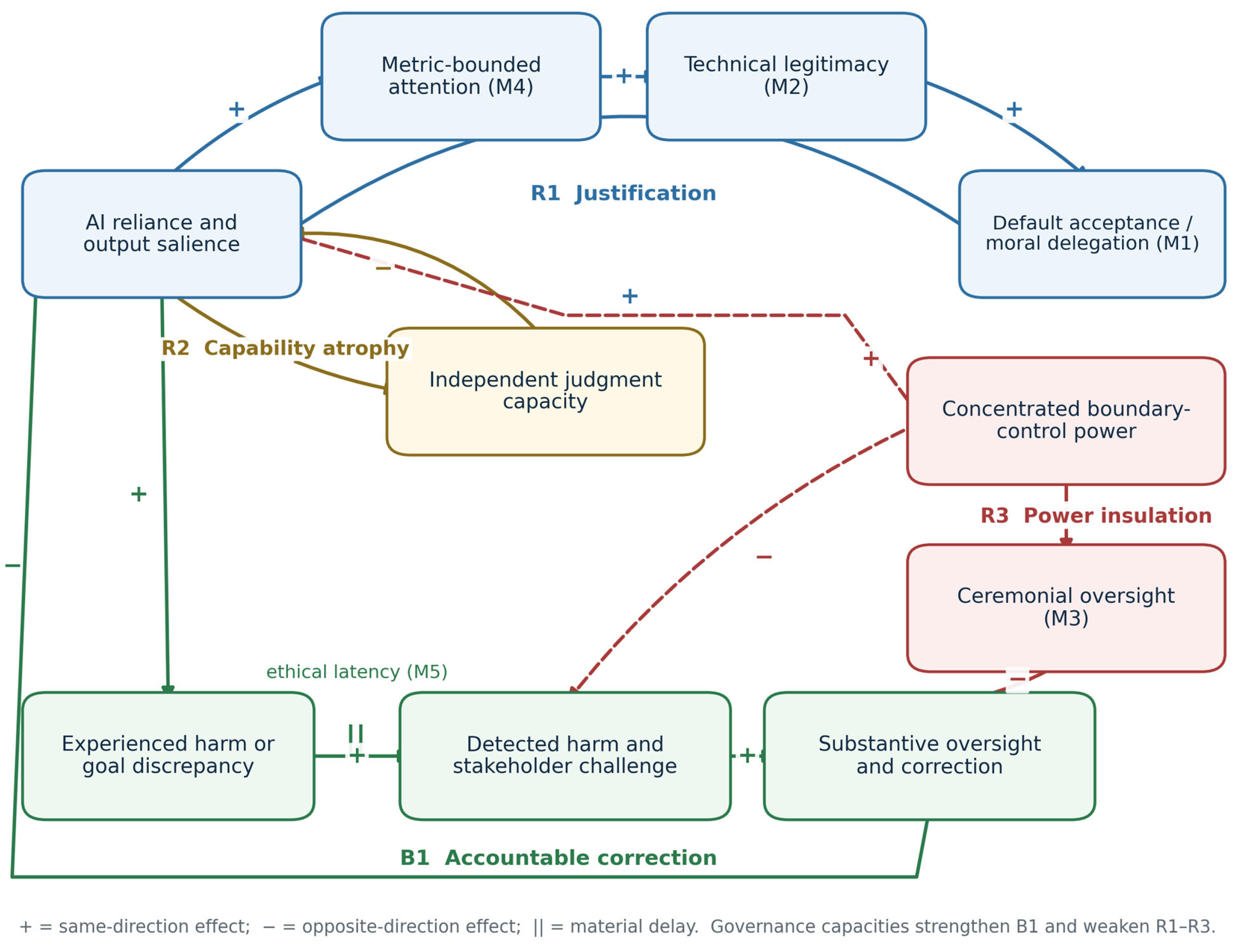
- It replaces a linear flow model with a causal-loop model that specifies three reinforcing loops, one balancing loop, material delays, accumulated system states, transition conditions, and recovery capacity.
- What are the main findings and implications?
- Systemically mediated leadership is present when AI mediation, leadership relevance, distributed judgment, and recurrent institutional embedding jointly hold; its intensity varies with authority, opacity, adaptivity, scale, autonomy, and power asymmetry.
- Five mechanism families alter responsibility, legitimacy, control, attention, and feedback timing; accountable adaptation depends on epistemic capacity, authoritative contestability, inclusive feedback, independent accountability, and temporal monitoring and exit capacity.
Abstract
1. Introduction
2. Materials and Methods
2.1. Research Design and Questions
2.2. Source Discovery, Corpus, and Search Boundaries
2.3. Concept Mapping and Mechanism Selection
2.4. Dynamic Modeling, Epistemic Status, and Scope
3. System Boundary, Architecture, and Power
3.1. Four Subsystems and Five Component Classes
3.2. Eight Decision–Feedback Stages and Nested Scales
3.3. Requisite Variety, Feedback Quality, and Accumulation
3.4. Power and Institutional Boundary Control
4. Defining Systemically Mediated Leadership
4.1. Construct Status and Qualification Conditions
- AI mediation: An AI system classifies, predicts, generates, recommends, prioritizes, or acts; simple storage, transmission, or descriptive reporting is insufficient.
- Leadership relevance: The mediated output materially shapes direction, alignment, commitment, organizational meaning, normative priorities, identity, or legitimate conduct [34]. A consequential allocation of opportunity, burden, voice, or risk qualifies only when it also implicates one or more of these leadership dimensions; consequence alone is insufficient.
- Distributed judgment: Substantive framing, recommendation, approval, execution, or explanation spans multiple socio-technical loci, and no single human independently produces and accounts for the full judgment.
- Recurrent institutional embedding: The arrangement is incorporated into routines, authority, incentives, governance, and repeated feedback or reuse rather than an isolated experimental interaction.
4.2. When AI-Mediated Work Becomes Leadership
4.3. Adjacent Constructs and Unique Explanatory Scope
5. Five Mechanism Families
5.1. A Common Causal Template
5.2. Moral Delegation: Transformation of Responsibility
5.3. Interpretive Laundering: Transformation of Legitimacy
5.4. Ceremonial Oversight: Transformation of Control
5.5. Metric-Driven Sensemaking: Transformation of Attention
5.6. Ethical Latency: Transformation of Feedback Timing
5.7. Distinctness, Sequence, and Interaction
6. Dynamic Systems Model and Trajectories
6.1. Causal Loops, Delays, and Accumulated States
6.2. Accountable Adaptation
6.3. Stabilized Trade-Offs
6.4. Destructive Drift
6.5. Governance Capacities and Regime Transitions
7. Operationalization and Empirical Tests
7.1. Distinguishing Roles and Levels of Measurement
7.2. Research Designs and Rival Explanations
8. Discussion
8.1. Contribution to Systems Science
8.2. Contribution to Leadership Theory
8.3. Contribution to AI Governance and Organization Studies
8.4. Practical Design Implications
9. Limitations and Future Research
10. Conclusions
Funding
Institutional Review Board Statement
Informed Consent Statement
Data Availability Statement
Acknowledgments
Conflicts of Interest
Appendix A. Conceptual Synthesis Audit Trail

| Literature Domain | Anchor Concepts | Representative Sources | Use in the Revised Theory |
|---|---|---|---|
| Systems and cybernetics | Boundary, feedback, requisite variety, accumulation, delay, path dependence | [19,20,21,22,23,24] | Nested boundary rule; signed loops; accumulated states; correction and drift. |
| Socio-technical and sociomaterial systems | Joint optimization, reciprocal structuring, material–social inseparability | [25,26,27,28,29,30,31] | Four subsystems, five component classes, and interface-level relations. |
| Organizational AI and hybrid intelligence | Human–AI complementarity, decision structures, automation–augmentation, learning algorithms | [1,2,3,8,9] | AI-specific mediation properties and the distinction between nominal and substantive complementarity. |
| Algorithmic management and worker contestation | Allocation, surveillance, evaluation, control, contested terrain | [4,10,83,85] | Control infrastructure, power asymmetry, behavioral adaptation, and worker voice. |
| AI ethics, governance, and accountability | Opacity, fairness, due process, auditing, accountable governance, social feedback | [5,6,7,13,14,15,16,18,38,39,40,41,76,82] | Accountability relations, governance capacities, contestability, and discriminant tests. |
| Human factors and automation | Automation bias, complacency, trust calibration, ironies of automation | [11,12,53,54,77] | Micro-level antecedents to moral delegation and ceremonial oversight; responsibility–control misalignment. |
| Leadership theory and practice | Direction–alignment–commitment, relational practice, distributed leadership, ethical and destructive leadership | [32,33,34,35,36,37,42,43,44,45,55,56,57,58,59,60,61,62,63,64,75] | Leadership–management threshold, construct boundary, leadership outcomes, and normative stakes. |
| Sensemaking, attention, quantification, and reactivity | Attention selection, commensuration, rankings, audit ritual, target effects | [55,67,68,78,79,79,80,84] | Metric-driven sensemaking, interpretive laundering, and observable attention displacement. |
| Institutions, power, and legitimacy | Decoupling, authority, agenda control, legitimacy, institutionalization | [17,65,66,69,70,71] | Power-weighted feedback, ceremonial oversight, technical legitimacy, and stabilized settlements. |
| Drift and practical failure | Normalization, practical drift, delayed recognition, recovery | [23,24,72,73,74] | Ethical latency, reinforcing loops, accumulated harm, regime transitions, and recovery pathways. |
| Distributed cognition and agency | Cognition across people and artifacts; responsibility gaps | [81,82] | Distributed judgment condition and the distinction between distributed production and traceable accountability. |
| Conceptual theory building | Problem-driven synthesis, construct clarity, contribution, conceptual framework analysis | [49,50,51,52] | Search, mapping, retention tests, counterexamples, propositions, and audit trail. |
| Recent AI-leadership and Systems studies | Algorithmic delegation, agentic AI, symbolic leadership, participatory scheduling | [38,42,43,44,45,46,47,48] | Contemporary application and boundary refinement; not the foundational basis of the theory. |
| Candidate Family | Disposition | Reason | Location in Revised Model |
|---|---|---|---|
| Responsibility transfer | Retained as moral delegation | Distinct transformation in ownership and justificatory burden with an observable counterfactual. | M1 and R1. |
| Technical neutralization and legitimation | Retained as interpretive laundering | Distinct transformation of value-laden choices into apparently neutral technical facts. | M2 and R1. |
| Nominal oversight and organizational decoupling | Retained as ceremonial oversight | Distinct transformation of review into certification when formal authority exceeds effective control. | M3 and R3. |
| Quantification and metric reactivity | Retained as metric-driven sensemaking | Distinct attentional transformation with behavioral feedback and self-confirming categories. | M4 and R1. |
| Delayed consequence recognition | Retained as ethical latency | Distinct temporal attenuation of corrective feedback while harm and dependency accumulate. | M5 and B1. |
| Automation bias and trust miscalibration | Absorbed as antecedents | Primarily individual-level tendencies; they strengthen M1 and M3 but do not supply a separate system transformation. | Antecedents to M1/M3; R1/R2. |
| Capability atrophy | Relocated as an accumulated state and loop | Represents a stock and reinforcing consequence rather than a parallel mechanism family. | Independent judgment capacity in R2. |
| Power concentration and boundary control | Relocated as a cross-cutting antecedent and moderator | Shapes every mechanism, feedback weight, and recovery route rather than one parallel process. | Section 3.4 and R3. |
References
- Jarrahi, M.H. Artificial intelligence and the future of work: Human–AI symbiosis in organizational decision making. Bus. Horiz. 2018, 61, 577–586. [Google Scholar] [CrossRef] [Scilit]
- Shrestha, Y.R.; Ben-Menahem, S.M.; von Krogh, G. Organizational decision-making structures in the age of artificial intelligence. Calif. Manag. Rev. 2019, 61, 66–83. [Google Scholar] [CrossRef] [Scilit]
- Raisch, S.; Krakowski, S. Artificial intelligence and management: The automation–augmentation paradox. Acad. Manag. Rev. 2021, 46, 192–210. [Google Scholar] [CrossRef] [Scilit]
- Kellogg, K.C.; Valentine, M.A.; Christin, A. Algorithms at work: The new contested terrain of control. Acad. Manag. Ann. 2020, 14, 366–410. [Google Scholar] [CrossRef] [Scilit]
- Martin, K. Ethical implications and accountability of algorithms. J. Bus. Ethics 2019, 160, 835–850. [Google Scholar] [CrossRef] [Scilit]
- Mittelstadt, B.D.; Allo, P.; Taddeo, M.; Wachter, S.; Floridi, L. The ethics of algorithms: Mapping the debate. Big Data Soc. 2016, 3, 2053951716679679. [Google Scholar] [CrossRef] [Scilit]
- Citron, D.K.; Pasquale, F. The scored society: Due process for automated predictions. Wash. Law Rev. 2014, 89, 1–33. [Google Scholar]
- Faraj, S.; Pachidi, S.; Sayegh, K. Working and organizing in the age of the learning algorithm. Inf. Organ. 2018, 28, 62–70. [Google Scholar] [CrossRef] [Scilit]
- Dellermann, D.; Ebel, P.; Söllner, M.; Leimeister, J.M. Hybrid Intelligence. Bus. Inf. Syst. Eng. 2019, 61, 637–643. [Google Scholar] [CrossRef] [Scilit]
- Lee, M.K.; Kusbit, D.; Metsky, E.; Dabbish, L. Working with machines: The impact of algorithmic and data-driven management on human workers. In Proceedings of CHI 2015; ACM: New York, NY, USA, 2015; pp. 1603–1612. [Google Scholar] [CrossRef] [Scilit]
- Elish, M.C. Moral crumple zones: Cautionary tales in human–robot interaction. Engag. Sci. Technol. Soc. 2019, 5, 40–60. [Google Scholar] [CrossRef] [Scilit]
- Bainbridge, L. Ironies of automation. Automatica 1983, 19, 775–779. [Google Scholar] [CrossRef] [Scilit]
- Selbst, A.D.; Boyd, D.; Friedler, S.A.; Venkatasubramanian, S.; Vertesi, J. Fairness and abstraction in sociotechnical systems. In Proceedings of FAT* ’19; ACM: New York, NY, USA, 2019; pp. 59–68. [Google Scholar] [CrossRef] [Scilit]
- Raji, I.D.; Smart, A.; White, R.N.; Mitchell, M.; Gebru, T.; Hutchinson, B.; Smith-Loud, J.; Theron, D.; Barnes, P. Closing the AI accountability gap: Defining an end-to-end framework for internal algorithmic auditing. In Proceedings of FAT* ’20; ACM: New York, NY, USA, 2020; pp. 33–44. [Google Scholar] [CrossRef] [Scilit]
- Burrell, J. How the machine ‘thinks’: Understanding opacity in machine learning algorithms. Big Data Soc. 2016, 3, 2053951715622512. [Google Scholar] [CrossRef] [Scilit]
- Kitchin, R. Thinking critically about and researching algorithms. Inf. Commun. Soc. 2017, 20, 14–29. [Google Scholar] [CrossRef] [Scilit]
- Lawrence, T.B.; Winn, M.I.; Jennings, P.D. The temporal dynamics of institutionalization. Acad. Manag. Rev. 2001, 26, 624–644. [Google Scholar] [CrossRef] [Scilit][Green Version]
- Pasquale, F. The Black Box Society: The Secret Algorithms That Control Money and Information; Harvard University Press: Cambridge, MA, USA, 2015. [Google Scholar]
- von Bertalanffy, L. General System Theory: Foundations, Development, Applications; George Braziller: New York, NY, USA, 1968. [Google Scholar]
- Ashby, W.R. An Introduction to Cybernetics; Chapman & Hall: London, UK, 1956. [Google Scholar]
- Churchman, C.W. The Systems Approach; Delacorte Press: New York, NY, USA, 1968. [Google Scholar]
- Checkland, P. Systems Thinking, Systems Practice; John Wiley & Sons: Chichester, UK, 1981. [Google Scholar]
- Meadows, D.H. Thinking in Systems: A Primer; Chelsea Green Publishing: White River Junction, VT, USA, 2008. [Google Scholar]
- Sterman, J.D. Business Dynamics: Systems Thinking and Modeling for a Complex World; Irwin/McGraw-Hill: Boston, MA, USA, 2000. [Google Scholar]
- Trist, E.L.; Bamforth, K.W. Some social and psychological consequences of the Longwall method of coal-getting. Hum. Relat. 1951, 4, 3–38. [Google Scholar]
- Emery, F.E.; Trist, E.L. Socio-technical systems. In Management Sciences, Models and Techniques; Churchman, C.W., Verhulst, M., Eds.; Pergamon Press: Oxford, UK, 1960; Volume 2, pp. 83–97. [Google Scholar]
- Orlikowski, W.J. Sociomaterial practices: Exploring technology at work. Organ. Stud. 2007, 28, 1435–1448. [Google Scholar] [CrossRef] [Scilit]
- Di Maio, P. Towards a metamodel to support the joint optimization of socio technical systems. Systems 2014, 2, 273–296. [Google Scholar] [CrossRef] [Scilit]
- Barley, S.R. Technology as an occasion for structuring: Evidence from observations of CT scanners and the social order of radiology departments. Adm. Sci. Q. 1986, 31, 78–108. [Google Scholar] [CrossRef] [Scilit]
- Orlikowski, W.J. The duality of technology: Rethinking the concept of technology in organizations. Organ. Sci. 1992, 3, 398–427. [Google Scholar] [CrossRef] [Scilit]
- Orlikowski, W.J.; Scott, S.V. Sociomateriality: Challenging the separation of technology, work and organization. Acad. Manag. Ann. 2008, 2, 433–474. [Google Scholar] [CrossRef]
- Uhl-Bien, M. Relational leadership theory: Exploring the social processes of leadership and organizing. Leadersh. Q. 2006, 17, 654–676. [Google Scholar] [CrossRef] [Scilit]
- Uhl-Bien, M.; Marion, R.; McKelvey, B. Complexity Leadership Theory: Shifting leadership from the industrial age to the knowledge era. Leadersh. Q. 2007, 18, 298–318. [Google Scholar] [CrossRef] [Scilit]
- Drath, W.H.; McCauley, C.D.; Palus, C.J.; Van Velsor, E.; O’Connor, P.M.G.; McGuire, J.B. Direction, alignment, commitment: Toward a more integrative ontology of leadership. Leadersh. Q. 2008, 19, 635–653. [Google Scholar] [CrossRef] [Scilit]
- Crevani, L.; Lindgren, M.; Packendorff, J. Leadership, not leaders: On the study of leadership as practices and interactions. Scand. J. Manag. 2010, 26, 77–86. [Google Scholar] [CrossRef] [Scilit]
- Gronn, P. Distributed leadership as a unit of analysis. Leadersh. Q. 2002, 13, 423–451. [Google Scholar] [CrossRef] [Scilit]
- Bolden, R. Distributed leadership in organizations: A review of theory and research. Int. J. Manag. Rev. 2011, 13, 251–269. [Google Scholar] [CrossRef] [Scilit]
- Enang, I.; Mukala, P.; Nkereuwem, U. Authentic intelligence in digital strategy systems: A socio-technical analysis of human-accountable decision governance. Systems 2026, 14, 259. [Google Scholar] [CrossRef] [Scilit]
- Bovens, M. Analysing and assessing accountability: A conceptual framework. Eur. Law J. 2007, 13, 447–468. [Google Scholar] [CrossRef] [Scilit]
- Rahwan, I. Society-in-the-loop: Programming the algorithmic social contract. Ethics Inf. Technol. 2018, 20, 5–14. [Google Scholar] [CrossRef] [Scilit]
- Floridi, L.; Cowls, J. A unified framework of five principles for AI in society. Harv. Data Sci. Rev. 2019, 1(1), 1–14. [Google Scholar] [CrossRef] [Scilit]
- Khassawneh, O.; Mohammad, T.; Tabche, I. Delegating to the algorithm: How AI-driven leadership shapes bias perceptions, trust and emotional disengagement in the workplace. Leadersh. Organ. Dev. J. 2026, 47, 243–260. [Google Scholar] [CrossRef] [Scilit]
- Al Harrasi, N.; Al Mujaini, A. Leadership governance under algorithmic mediation: Reconceptualizing transformative leadership through an integrative review. Leadersh. Organ. Dev. J. 2026, 47, 261–281. [Google Scholar] [CrossRef] [Scilit]
- Henderson, M.D. Agentic AI and the ethics of leadership maintenance: Rethinking responsibility in algorithmic organizations. Leadersh. Organ. Dev. J. 2026, 47, 294–308. [Google Scholar] [CrossRef] [Scilit]
- Skeja, A.; Sadiku-Dushi, N. Toward sustainable AI leadership: Ethical blind spots, accountability gaps and the CARE governance framework. Leadersh. Organ. Dev. J. 2026, 47, 336–354. [Google Scholar] [CrossRef] [Scilit]
- Hu, C.; Mohi Ud Din, Q.; Tahir, A. Artificial intelligence symbolic leadership in small and medium-sized enterprises: Enhancing employee flexibility and technology adoption. Systems 2025, 13, 216. [Google Scholar] [CrossRef] [Scilit]
- Virgillito, D.; Ledda, C. AI-mediated participation and people sustainability: A socio-technical case study in healthcare shift scheduling. Systems 2026, 14, 168. [Google Scholar] [CrossRef] [Scilit]
- Alibašić, H. Hybrid Intelligence for Effective Digital Governance: AI in Administration. In Public Administration and Information Technology; Springer: Cham, Switzerland, 2026; Volume 42. [Google Scholar]
- Jaakkola, E. Designing conceptual articles: Four approaches. AMS Rev. 2020, 10, 18–26. [Google Scholar] [CrossRef] [Scilit]
- Torraco, R.J. Writing integrative literature reviews: Guidelines and examples. Hum. Resour. Dev. Rev. 2005, 4, 356–367. [Google Scholar] [CrossRef] [Scilit]
- Whetten, D.A. What constitutes a theoretical contribution? Acad. Manag. Rev. 1989, 14, 490–495. [Google Scholar] [CrossRef] [Scilit]
- Jabareen, Y. Building a conceptual framework: Philosophy, definitions, and procedure. Int. J. Qual. Methods 2009, 8, 49–62. [Google Scholar] [CrossRef] [Scilit]
- Parasuraman, R.; Manzey, D.H. Complacency and bias in human use of automation: An attentional integration. Hum. Factors 2010, 52, 381–410. [Google Scholar] [CrossRef] [Scilit]
- Mosier, K.L.; Skitka, L.J.; Heers, S.; Burdick, M. Automation bias: Decision making and performance in high-tech cockpits. Int. J. Aviat. Psychol. 1998, 8, 47–63. [Google Scholar] [CrossRef] [Scilit]
- Weick, K.E. Sensemaking in Organizations; Sage: Thousand Oaks, CA, USA, 1995. [Google Scholar]
- Bazerman, M.H.; Tenbrunsel, A.E. Blind Spots: Why We Fail to Do What’s Right and What to Do about It; Princeton University Press: Princeton, NJ, USA, 2011. [Google Scholar]
- Simons, T. Behavioral integrity: The perceived alignment between managers’ words and deeds as a research focus. Organ. Sci. 2002, 13, 18–35. [Google Scholar] [CrossRef] [Scilit]
- Treviño, L.K.; Brown, M.; Hartman, L.P. A qualitative investigation of perceived executive ethical leadership: Perceptions from inside and outside the executive suite. Hum. Relat. 2003, 56, 5–37. [Google Scholar] [CrossRef] [Scilit]
- Einarsen, S.; Aasland, M.S.; Skogstad, A. Destructive leadership behaviour: A definition and conceptual model. Leadersh. Q. 2007, 18, 207–216. [Google Scholar] [CrossRef] [Scilit]
- Tepper, B.J. Consequences of abusive supervision. Acad. Manag. J. 2000, 43, 178–190. [Google Scholar] [CrossRef] [Scilit]
- Krasikova, D.V.; Green, S.G.; LeBreton, J.M. Destructive leadership: A theoretical review, integration, and future research agenda. J. Manag. 2013, 39, 1308–1338. [Google Scholar] [CrossRef] [Scilit]
- Van Quaquebeke, N.; Gerpott, F.H. The now, new, and next of digital leadership: How artificial intelligence (AI) will take over and change leadership as we know it. J. Leadersh. Organ. Stud. 2023, 30, 265–275. [Google Scholar] [CrossRef] [Scilit]
- McGuire, J.; De Cremer, D. Algorithms, leadership, and morality: Why a mere human effect drives the preference for human over algorithmic leadership. AI Ethics 2023, 3, 601–618. [Google Scholar] [CrossRef] [Scilit]
- Philip, J. Identifying key leadership competencies for digital transformation: Evidence from a cross-sectoral Delphi study of global managers. Leadersh. Organ. Dev. J. 2023, 44, 392–406. [Google Scholar] [CrossRef] [Scilit]
- Meyer, J.W.; Rowan, B. Institutionalized organizations: Formal structure as myth and ceremony. Am. J. Sociol. 1977, 83, 340–363. [Google Scholar] [CrossRef] [Scilit]
- Bromley, P.; Powell, W.W. From smoke and mirrors to walking the talk: Decoupling in the contemporary world. Acad. Manag. Ann. 2012, 6, 483–530. [Google Scholar] [CrossRef] [Scilit]
- Espeland, W.N.; Sauder, M. Rankings and reactivity: How public measures recreate social worlds. Am. J. Sociol. 2007, 113, 1–40. [Google Scholar] [CrossRef] [Scilit]
- Weick, K.E.; Sutcliffe, K.M.; Obstfeld, D. Organizing and the process of sensemaking. Organ. Sci. 2005, 16, 409–421. [Google Scholar] [CrossRef] [Scilit]
- Lukes, S. Power: A Radical View, 2nd ed.; Palgrave Macmillan: Basingstoke, UK, 2005. [Google Scholar]
- Pfeffer, J. Power in Organizations; Pitman: Marshfield, MA, USA, 1981. [Google Scholar]
- Suchman, M.C. Managing legitimacy: Strategic and institutional approaches. Acad. Manag. Rev. 1995, 20, 571–610. [Google Scholar] [CrossRef] [Scilit]
- Snook, S.A. Friendly Fire: The Accidental Shootdown of U.S. Black Hawks over Northern Iraq; Princeton University Press: Princeton, NJ, USA, 2000. [Google Scholar]
- Vaughan, D. The Challenger Launch Decision: Risky Technology, Culture, and Deviance at NASA; University of Chicago Press: Chicago, IL, USA, 1996. [Google Scholar]
- Dekker, S. Drift into Failure: From Hunting Broken Components to Understanding Complex Systems; Ashgate: Farnham, UK, 2011. [Google Scholar]
- Brown, M.E.; Treviño, L.K.; Harrison, D.A. Ethical leadership: A social learning perspective for construct development and testing. Organ. Behav. Hum. Decis. Process. 2005, 97, 117–134. [Google Scholar] [CrossRef] [Scilit]
- Green, B.; Chen, Y. Disparate interactions: An algorithm-in-the-loop analysis of fairness in risk assessments. In Proceedings of FAT* ’19; ACM: New York, NY, USA, 2019; pp. 90–99. [Google Scholar] [CrossRef] [Scilit]
- Dzindolet, M.T.; Peterson, S.A.; Pomranky, R.A.; Pierce, L.G.; Beck, H.P. The role of trust in automation reliance. Int. J. Hum.-Comput. Stud. 2003, 58, 697–718. [Google Scholar] [CrossRef] [Scilit]
- Power, M. The Audit Society: Rituals of Verification; Oxford University Press: Oxford, UK, 1997. [Google Scholar]
- Ocasio, W. Towards an attention-based view of the firm. Strateg. Manag. J. 1997, 18, 187–206. [Google Scholar] [CrossRef] [Scilit]
- Espeland, W.N.; Stevens, M.L. Commensuration as a social process. Annu. Rev. Sociol. 1998, 24, 313–343. [Google Scholar] [CrossRef] [Scilit]
- Hutchins, E. Cognition in the Wild; MIT Press: Cambridge, MA, USA, 1995. [Google Scholar]
- Matthias, A. The responsibility gap: Ascribing responsibility for the actions of learning automata. Ethics Inf. Technol. 2004, 6, 175–183. [Google Scholar] [CrossRef] [Scilit]
- Beer, D. The social power of algorithms. Inf. Commun. Soc. 2017, 20, 1–13. [Google Scholar] [CrossRef] [Scilit]
- Campbell, D.T. Assessing the impact of planned social change. Eval. Program Plan. 1979, 2, 67–90. [Google Scholar] [CrossRef] [Scilit]
- Bernstein, E.S. The transparency paradox: A role for privacy in organizational learning and operational control. Adm. Sci. Q. 2012, 57, 181–216. [Google Scholar] [CrossRef] [Scilit]

| Stage | Procedure | Decision Rule | Audit Output |
|---|---|---|---|
| Problem framing | Specified the unexplained phenomenon as recurrent AI mediation of leadership judgment, meaning, legitimacy, and accountability. | Retain questions requiring relations, feedback, boundaries, or emergence rather than individual attributes alone. | Three research questions and a nested system-level unit of analysis. |
| Source discovery | Searched publisher platforms and DOI-indexed metadata with four query clusters; used backward and forward citation chaining from anchor works. | Include sources that specify architecture, human–AI behavior, causal mechanisms, leadership relevance, governance, power, or dynamic failure. | 97 candidate records; 85 retained; no lower date bound; updated through 3 August 2026. |
| Concept mapping | Recorded source domain, focal unit, causal concept, system interface, temporal role, power implication, and proposed model function. | Keep a concept when it adds a distinct relation, competing explanation, boundary, or observable implication. | Literature-domain-to-construct mapping in Appendix A, Table A1. |
| Mechanism comparison | Compared eight candidate families against four retention tests and adjacent concepts. | Require a system transformation, distinct causal dimension, observable counterfactual, and recursive role in feedback dynamics. | Five retained mechanism families; three absorbed or relocated; Appendix A, Table A2. |
| Dynamic modeling | Mapped signed causal relations, delays, accumulated states, loop dominance, transition conditions, and recovery capacity. | Treat trajectories as ideal-type regimes; avoid a linear input–outcome sequence. | Three reinforcing loops, one balancing loop, three regimes, and eight propositions. |
| Saturation and challenge | Continued chaining until two successive passes supplied no new component class, causal dimension, or trajectory-relevant loop; retained later sources only for boundary refinement or competing explanations. | Do not treat citation volume as evidence of construct validity; preserve explicit scope and empirical tests. | Limitations statement, counterexamples, discriminant evidence, and an empirical test agenda. |
| Adjacent Construct | Primary Unit and Question | Boundary and Added Visibility from SML |
|---|---|---|
| Data-informed management | A manager uses information to coordinate work within substantially settled ends. | Does not qualify when AI merely reports facts and one actor independently frames and justifies a routine choice. SML begins when all four qualification conditions hold. |
| Algorithmic management | Digital allocation, monitoring, evaluation, and control of work [4,10]. | Explains control infrastructures. SML additionally explains how AI-mediated control constructs direction, meaning, legitimacy, moral justification, stakeholder standing, and recursive accountability across organizational domains. |
| Distributed leadership and leadership-as-practice | Leadership emerges through relations, practices, and plural human influence [32,35,36,37]. | SML specifies how computational classifications, interfaces, vendors, and feedback architecture become constitutive loci of leadership influence while preserving human and institutional accountability. |
| Sociomaterial organizing and distributed cognition | Agency and cognition are accomplished through relations among people, artifacts, and practice [27,29,30,31,81]. | SML narrows the explanatory object to leadership-relevant direction, commitment, legitimacy, and accountability and adds qualification tests, mechanisms, loop dynamics, and trajectory predictions. |
| Hybrid intelligence | Human and machine capabilities are combined to improve task performance [1,2,3,9]. | Describes a collaborative architecture. SML explains when nominal complementarity becomes accountable, ceremonial, politically insulated, or path dependent. |
| Responsible AI | Normative and technical properties such as fairness, transparency, safety, and accountability [5,6,7,13,14,41]. | Supplies evaluative criteria. SML explains how organizational routines and power either enact, neutralize, or symbolically satisfy those criteria over time. |
| Human-accountable decision governance | Traceable human authority and governance across digital decisions [38,39,40]. | Closely aligned governance objective. SML isolates leadership processes and predicts how responsibility, legitimacy, attention, control, and feedback timing interact before and after a formal decision. |
| Systemically mediated leadership (SML) | A nested system-level condition and recurrent process configuration meeting four jointly necessary conditions. | Makes upstream model and interface influence, formal–effective authority gaps, delayed harm, loop dominance, and power-weighted correction visible in one testable leadership framework. |
| Mechanism and Dimension | Antecedent → Causal Process | System Transformation and Longer Outcome | Discriminating Observation or Non-Example |
|---|---|---|---|
| Moral delegation—responsibility | Time pressure, opacity, output authority, and weak reason-giving → a decision-owner substitutes the output for independent normative judgment. | Justificatory burden shifts toward the system while formal accountability remains human → responsibility–control misalignment and habitual default acceptance. | Present when the owner does not defend the decision independently under challenge. Ordinary use of evidence with documented independent reasons is not moral delegation. |
| Interpretive laundering—legitimacy | Hidden proxies, thresholds, objectives, or uncertainty plus an objectivity cue → contestable choices are recoded as technical facts. | Alternatives and value judgments disappear from view → technical legitimacy narrows deliberation and weakens contestation. | Present when disclosure of design choices changes acceptance or interpretation. A transparent estimate openly treated as contestable is not laundering. |
| Ceremonial oversight—control | Review obligations exceed authority, evidence, competence, time, or protection → the human step certifies rather than regulates. | Formal authority separates from effective control → low correction, ritual compliance, and accountability theater. | Low override rates alone are ambiguous. Evidence requires review-capacity deficits plus non-responsiveness to valid counterevidence. |
| Metric-driven sensemaking—attention | Quantified indicators are recurrent, comparable, and tied to rewards or allocation → measured proxies crowd out relevant unmeasured knowledge. | Organizational attention and behavior reorganize around the metric → reactivity and self-confirming classifications. | Measurement alone is insufficient. Evidence requires attention displacement or behavioral adaptation around the metric. |
| Ethical latency—feedback timing | Consequences are delayed, diffuse, cumulative, or aggregated → negative signals arrive after dependency and normalization grow. | Corrective feedback loses force → latent harm, lock-in, and difficult causal attribution. | A short operational delay is not ethical latency. Evidence requires normatively relevant consequences whose timing attenuates authoritative correction. |
| Ideal-Type Regime | Dominant Feedback Signature | Accumulated States and Observable Pattern | Transition or Recovery Conditions |
|---|---|---|---|
| Accountable adaptation | B1 accountable correction dominates R1–R3; challenge reaches actors with authority and produces revision. | Independent expertise and contestability are maintained; detected errors, documented revisions, and stakeholder trust recover across cycles. | Weakening voice, rapid scaling, or loss of independent expertise may shift the system toward stabilization or drift. Recurrent review sustains the regime. |
| Stabilized trade-offs | B1 contains visible failure but does not revise objectives or power arrangements; reinforcing and balancing loops remain in metastable tension. | Performance becomes predictable while recurring complaints, disparities, or burdens persist within an accepted tolerance band. | A shock, metric change, leadership turnover, regulatory intervention, worker mobilization, or sunset review may reopen the settlement in either direction. |
| Destructive drift | R1 (justificatory reinforcement), R2 (capability atrophy), and R3 (power insulation) dominate delayed B1 correction. | Dependency, technical legitimacy, concentrated control, and latent harm rise while internal expertise, correction rates, and exit options fall. | Recovery requires authoritative external or independent review, restored alternatives, disaggregated harm data, protected contestation, and power to pause or withdraw the system. |
| Analytic Role and Level | Illustrative Observables | Recommended Evidence and Design | Interpretive Safeguard |
|---|---|---|---|
| Construct qualification—episode/workflow | AI inference or action; leadership relevance; distributed judgment loci; recurrent embedding in routine and feedback. | Process maps, model/interface records, decision documents, observations, and repeated workflow traces. | Do not classify routine reporting or one-off tool use as SML when any qualification condition is absent. |
| Mechanisms—episode/workflow/unit | Independent reasons, interface framing, review resources, attention allocation, target adaptation, and consequence delay. | Decision logs, screen recordings, reason statements, interviews, meeting records, experiments, and temporal event coding. | Do not infer mechanisms from self-report alone; test the discriminating observation and plausible rival explanations. |
| Antecedents—workflow/organization/ecosystem | Output opacity, time pressure, scale, autonomy, reward linkage, vendor dependence, and control concentration. | Procurement and governance records, workload data, technical documentation, contracts, and comparative cases. | Separate pre-existing conditions from the mechanism and from later outcomes. |
| Governance moderators—unit/organization/ecosystem | Epistemic resources, authority to override or halt, stakeholder standing, independent review, lag monitoring, and exit alternatives. | Access audits, appeal outcomes, correction rates, audit reports, board or regulator records, and protection-for-dissent evidence. | Formal policy is not evidence of effective capacity unless it changes decisions or system behavior. |
| Short-term outcomes—episode/workflow | Acceptance, explanation quality, correction, allocation, error recovery, and stakeholder response. | Matched decisions, field experiments, adjudicated appeals, and disaggregated outcome analysis. | Low override frequency is uninterpretable without model accuracy, case mix, decision routineness, and reviewer authority. |
| Dynamic regime—organization/ecosystem over time | Reliance, dependency, expertise, trust, harm stocks, complaint persistence, revision events, and exit capacity. | Longitudinal case studies, interrupted time series, archival process tracing, comparative institutional analysis, and calibrated system-dynamics models. | Avoid cross-level inference: aggregate episode evidence before assigning an organizational regime; permit simultaneous regimes in nested units. |
Disclaimer/Publisher’s Note: The statements, opinions and data contained in all publications are solely those of the individual author(s) and contributor(s) and not of MDPI and/or the editor(s). MDPI and/or the editor(s) disclaim responsibility for any injury to people or property resulting from any ideas, methods, instructions or products referred to in the content. |
© 2026 by the author. Licensee MDPI, Basel, Switzerland. This article is an open access article distributed under the terms and conditions of the Creative Commons Attribution (CC BY) license.
Share and Cite
Alibašić, H. Systemically Mediated Leadership in AI-Enabled Organizations: A Socio-Technical Systems Theory of Distributed Judgment, Feedback, and Accountability. Systems 2026, 14, 984. https://doi.org/10.3390/systems14080984
Alibašić H. Systemically Mediated Leadership in AI-Enabled Organizations: A Socio-Technical Systems Theory of Distributed Judgment, Feedback, and Accountability. Systems. 2026; 14(8):984. https://doi.org/10.3390/systems14080984
Chicago/Turabian StyleAlibašić, Haris. 2026. "Systemically Mediated Leadership in AI-Enabled Organizations: A Socio-Technical Systems Theory of Distributed Judgment, Feedback, and Accountability" Systems 14, no. 8: 984. https://doi.org/10.3390/systems14080984
APA StyleAlibašić, H. (2026). Systemically Mediated Leadership in AI-Enabled Organizations: A Socio-Technical Systems Theory of Distributed Judgment, Feedback, and Accountability. Systems, 14(8), 984. https://doi.org/10.3390/systems14080984