1. Introduction
The rapid advancement of artificial intelligence (AI) has significantly impacted various domains, introducing new ways to generate, process, and interact with information. Among the most transformative AI innovations is generative artificial intelligence (GenAI), which leverages sophisticated machine learning algorithms to create new content, including text, images, and problem-solving strategies [
1,
2]. Its ability to generate human-like responses, synthesize vast amounts of data, and adapt to user needs makes it an essential tool across multiple sectors, including business, research, healthcare, and industries.
As GenAI-driven technologies continue to shape professional and personal decision-making, self-regulated learning (SRL) and information processing abilities become increasingly important. SRL refers to individuals’ capacity to manage their own learning processes through cognitive, metacognitive, and motivational strategies [
3]. This concept extends beyond traditional educational settings and is critical for individuals in rapidly evolving work environments, where autonomous learning and continuous skill development are required. Research suggests that individuals who effectively engage in SRL exhibit higher adaptability, better problem-solving skills, and increased motivation to acquire new knowledge [
4,
5].
In an era where digital technologies facilitate lifelong learning, GenAI plays a growing role in potentially enhancing self-regulated knowledge acquisition. This technology’s unique characteristics, particularly its adaptive and interactive capabilities, open unprecedented opportunities for users to manage and optimize their perceived learning and decision-making processes. By providing instant access to information, generating insights, and offering personalized recommendations, GenAI can support individuals in setting goals, monitoring progress, and refining strategies based on real-time feedback [
1].
While the potential of GenAI to support self-regulated learning has gained increasing attention [
6,
7], there remain significant gaps in understanding learners’ perceptions of its contributions to self-regulated cognitive and behavioral processes. Furthermore, existing research has primarily focused on the applications of GenAI in structured learning environments, e.g., [
2,
7,
8], leaving a gap in exploring learners’ perspectives on how it facilitates independent learning and decision-making in non-educational contexts.
This study addresses these gaps by examining the relationships between self-reported SRL tendencies and attitudes toward GenAI. Specifically, it explores how self-reported SRL behaviors relate to perceived usefulness and concerns about GenAI, while also investigating mediating and moderating factors that shape these relationships. Through a comprehensive analysis of these dynamics, this research provides novel insights into learners’ perceptions of how they integrate GenAI into their self-regulated cognitive strategies, the extent to which its perceived usefulness predicts motivation and adoption, and the role of concerns in shaping reported AI-assisted learning behaviors. Understanding these mechanisms is essential for optimizing the design and implementation of GenAI-based tools, ensuring they effectively support perceived self-regulated decision-making and knowledge acquisition across diverse domains.
1.1. Literature Review
Generative artificial intelligence (GenAI) is a specialized branch of artificial intelligence (AI) designed to generate new content in various forms, such as text, images, video, and music. By identifying patterns in vast datasets using machine learning algorithms, GenAI can produce original outputs that resemble human-created content [
1,
2,
9]. Its ability to process large volumes of data and extract meaningful insights positions it as a transformative tool across multiple sectors, including business, healthcare, industries, and scientific research [
9].
A key strength of GenAI lies in its advanced linguistic and analytical capabilities, enabling seamless interaction between humans and machines [
8]. Its proficiency in understanding and generating human-like text, analyzing large-scale datasets, and adapting responses based on user input is perceived to enhance its applicability in fields requiring automated decision-making, content generation, and personalized assistance [
2,
9].
While GenAI offers significant benefits, concerns remain regarding ethical implications, reliability, and over-reliance on GenAI-generated content. Issues such as bias in training data, misinformation, and intellectual property challenges require careful oversight and responsible deployment of AI technologies [
10,
11]. As GenAI continues to evolve, striking a balance between automation and human oversight is essential to maximize its benefits while mitigating potential risks.
1.2. Self-Regulated Learning (SRL)
While traditionally viewed as a proactive approach, it is important to note that SRL processes can be counterproductive, for instance in cases of procrastination, which is often viewed as a failure of self-regulation [
12], or the application of misconceptions regarding effective learning practices, such as a preference for massed practice over spaced repetition [
13].
At the core of SRL lie three main strategies. Cognitive strategies facilitate the effective processing of learning materials and include techniques such as repetition, meaningful organization of information, and expansion through connections to prior knowledge. Metacognitive strategies enable learners to regulate the learning process through planning, continuous progress monitoring, and appropriate behavioral adjustments. These strategies also involve self-assessment of learning methods and attributing causes to outcomes. Finally, resource management strategies focus on controlling external learning conditions and optimizing available resources, including adapting the physical and social environment to learning goals, managing time effectively, and seeking assistance when necessary [
3,
14].
The increasing shift toward digital and GenAI-based learning environments further accentuates the need for SRL, as digital tools demand a high level of autonomy and self-discipline [
4,
5]. Studies have shown that students who employ self-regulation strategies achieve better outcomes compared to their peers, with metacognitive strategies, such as planning, self-monitoring, and reflective thinking, having the most significant impact on performance [
5].
1.3. SRL in the Age of GenAI
GenAI creates an immediate and personalized learning environment with the potential to foster SRL and enhance students’ motivation [
15,
16,
17,
18]. Beyond providing access to information, these tools support SRL through continuous monitoring and guidance, adapting tasks, feedback, and resources to meet learners’ evolving needs. Moreover, learners perceived that the use of AI applications supports their self-regulated learning, particularly in cognitive and metacognitive aspects [
7].
For example, GenAI-based chatbots can function as personalized virtual tutors, engaging in interactive conversations with learners and providing an adaptive learning environment by answering questions, offering explanations, and delivering immediate support [
17]. Due to these capabilities, chatbots have the potential to support SRL across different learning stages [
6,
7]. During the Forethought phase, chatbots provide examples, clarify objectives, and suggest diverse learning approaches. In the Performance phase, they offer practical support—suggesting solutions to complex problems, assisting in academic writing, improving writing skills through immediate feedback, and generating challenges to reinforce knowledge [
6]. Additionally, GenAI tools such as learning analytics dashboards are perceived by learners as helpful for monitoring progress and enhancing their understanding of content [
7]. Finally, in the Self-Reflection phase, GenAI facilitates personalized feedback, strengthens self-reflection skills, and offers tailored strategies for personal development based on prior learning experiences [
6].
Recent studies have reinforced the potential of GenAI to support SRL. Wu et al. [
18] and Xia et al. [
19] highlight a strong correlation between GenAI-driven digital support and students’ reported engagement in SRL activities. For example, Wu et al. [
18] demonstrated that in hybrid learning environments, GenAI significantly enhanced students’ reported behavioral, cognitive, and emotional engagement compared to traditional search engines.
Despite these promising findings, research on the role of GenAI in supporting SRL remains limited. The relationship between the use of GenAI and self-reported SRL processes is not yet fully understood, despite recent studies highlighting its potential in this domain [
7,
15]. Additionally, research has yet to explore the pedagogical and psychological considerations relevant to the integration of GenAI in SRL. Moreover, it is essential to understand learners’ perceptions of the role of GenAI in supporting SRL.
In light of the above, this study aims to address the following research questions:
RQ1: What are the associations between self-reported SRL and attitudes toward GenAI?
RQ2: What are the cognitive and personal factors predicting reported SRL and the perceived metacognitive use of GenAI?
3. Results
RQ1: What are the associations between self-reported SRL and attitudes toward GenAI?
Correlation coefficients were calculated to examine the associations between self-reported SRL using GenAI and attitudes toward GenAI. Each included two key dimensions: metacognitive strategies using GenAI and personal skills, and perceived usefulness and concerns and anxieties, respectively.
Table 3 presents the correlation coefficients for these variables, providing an initial understanding of how attitudes toward GenAI are associated with self-regulated learning processes.
Table 3 presents the correlation coefficients between self-reported SRL variables and attitudes toward GenAI. Perceived usefulness showed a significant positive correlation with both reported metacognitive use of GenAI (
r = 0.585,
p < 0.01) and perceived personal skills (
r = 0.519,
p < 0.01). In contrast, concerns and anxieties were not significantly correlated with reported metacognitive use of GenAI (
r = 0.048,
p > 0.05) or perceived personal skills (
r = −0.035,
p > 0.05).
RQ2: What are the cognitive and personal factors predicting reported SRL and the perceived metacognitive use of GenAI?
A multiple regression analysis was conducted to identify the cognitive and personal factors predicting self-reported metacognitive use of GenAI. This analysis assessed the predictive power of four key factors: learning motivation, perceived usefulness, self-reported metacognitive learning strategies, and perceived personal skills.
Table 4 presents the regression model, providing insights into how these factors are associated with the extent to which individuals report engaging in metacognitive strategies when using GenAI.
Table 4 presents the multiple regression model predicting the reported metacognitive use of GenAI. The model was significant (
F(4,1254) = 376.93,
p < 0.001), explaining 54.6% of the variance (
R2 = 0.546). These results indicate that Learning Motivation, Perceived Usefulness, reported Metacognitive Learning Strategies, and perceived Personal Skills are significantly associated with the extent to which individuals reported engaging in metacognitive strategies when using GenAI.
Among the predictors, perceived Personal Skills was the strongest positive predictor (B = 0.524, p < 0.001), followed by Perceived Usefulness (B = 0.367, p < 0.001) and reported Metacognitive Learning Strategies (B = 0.291, p < 0.001). All predictors were statistically significant (p < 0.001), indicating a strong association between these factors and the reported Metacognitive Use of GenAI. In contrast, Learning Motivation showed a significant negative association with the reported Metacognitive Use of GenAI (B = −0.268, p < 0.001). This negative association emerged within the multivariate model when controlling for perceived usefulness, personal skills, and metacognitive learning strategies.
3.1. Moderation Analyses
To further explore the complexity of these relationships, a series of moderation analyses were conducted to examine the moderating role of learning motivation, perceived personal skills, and reported metacognitive learning strategies in the relationship between perceived usefulness and reported metacognitive use of GenAI. The selection of these moderators is grounded in the theoretical assumption (e.g., [
3]) that the translation of perceived usefulness into active engagement is not automatic but depends on learners’ internal resources. Specifically, these factors were posited to act as catalysts or prerequisites that enable learners to effectively regulate their interactions with GenAI tools once their utility is recognized.
3.2. Learning Motivation as a Moderator
The first moderation model tested whether learning motivation moderates the relationship between perceived usefulness and reported metacognitive use of GenAI (
Table 5).
As shown in
Table 5, the overall model was significant,
F(5,1253) = 305.711,
p < 0.001, explaining 55.0% of the variance (
R2 = 0.550). The interaction effect was significant (
B = 0.089,
p = 0.002), indicating that learning motivation moderates the association between perceived usefulness and reported metacognitive use of GenAI.
A simple slope analysis was conducted to probe the significant interaction. The association between perceived usefulness and reported metacognitive use of GenAI was positive and significant at low levels of learning motivation (M − 1 SD), B = 0.306, SE = 0.032, t = 9.589, p < 0.001, 95% CI [0.244, 0.369]. This association was stronger at high levels of learning motivation (M + 1 SD), B = 0.428, SE = 0.032, t = 13.403, p < 0.001, 95% CI [0.366, 0.491]. Together, these results show that the positive association between perceived usefulness and reported metacognitive use of GenAI was stronger at higher levels of learning motivation.
A moderation analysis was conducted to examine whether perceived personal skills moderate the relationship between concerns about GenAI and reported metacognitive use of GenAI. This analysis tested whether individuals with higher perceived personal skills experience a different relationship between concerns about GenAI and their reported metacognitive engagement with GenAI-based tools (
Table 6).
As shown in
Table 6, the overall model was significant,
F(6,1247) = 254.02,
p < 0.001, explaining 55.0% of the variance (
R2 = 0.550). The main effect of concerns and anxieties was significant (
B = 0.058,
p = 0.005), indicating a small positive association with reported metacognitive use of GenAI after controlling for the other predictors. However, the interaction term was not significant (
B = 0.025,
p = 0.173), suggesting that perceived personal skills do not significantly moderate the association between reported Concerns about GenAI and reported metacognitive use of GenAI.
3.3. Metacognitive Learning Strategies as a Moderator
As metacognitive learning strategies represent a key component of the SRL cycle, enabling learners to adapt their approach based on ongoing monitoring and evaluation a moderation analysis was conducted. This analysis tested whether individuals with stronger metacognitive regulation skills experience a different relationship between concerns about GenAI and their metacognitive engagement with GenAI-based tools, as presented in
Table 7.
As shown in
Table 7, the overall model was significant,
F(6,1247) = 253.53,
p < 0.001, explaining 55.0% of the variance (
R2 = 0.550). Reported metacognitive learning strategies were a significant predictor of reported metacognitive use of GenAI (
B = 0.288,
p <
0.001). The main effect of concerns and anxieties was also significant (
B = 0.061,
p = 0.004), indicating a small positive association with reported metacognitive use of GenAI after controlling for the other predictors. However, the interaction term between reported concerns about GenAI and reported metacognitive learning strategies was not significant (
B = −0.014,
p = 0.465), indicating that reported metacognitive learning strategies do not significantly moderate the association between reported concerns about GenAI and reported metacognitive use of GenAI.
3.4. Perceived Usefulness and Reported Metacognitive Learning Strategies
A moderation analysis was conducted to examine whether reported metacognitive learning strategies moderate the relationship between perceived usefulness and reported metacognitive use of GenAI. This analysis tested whether individuals who report higher levels of self-regulation in their learning processes are more likely to translate their perception of GenAI’s usefulness into reported metacognitive engagement with GenAI-based learning tools (
Table 8).
As shown in
Table 8, the overall model was significant,
F(5,1253) = 312.45,
p < 0.001, explaining 55.5% of the variance (
R2 = 0.555). A significant interaction effect was found between Perceived usefulness and reported metacognitive learning strategies (
B = 0.108,
SE = 0.031,
p < 0.001). A simple slope analysis was conducted to probe this interaction. The association between perceived usefulness and reported metacognitive use of GenAI was positive and significant at low levels of reported metacognitive learning strategies (
M − 1
SD),
B = 0.295,
SE = 0.033,
t = 9.042,
p < 0.001, 95% CI [0.231, 0.359]. This association was stronger at high levels of reported metacognitive learning strategies (
M + 1
SD),
B = 0.433,
SE = 0.031,
t = 13.755,
p < 0.001, 95% CI [0.371, 0.495]. Together, these findings indicate that the positive association between perceived usefulness and reported metacognitive use of GenAI was stronger among participants who reported higher levels of metacognitive learning strategies.
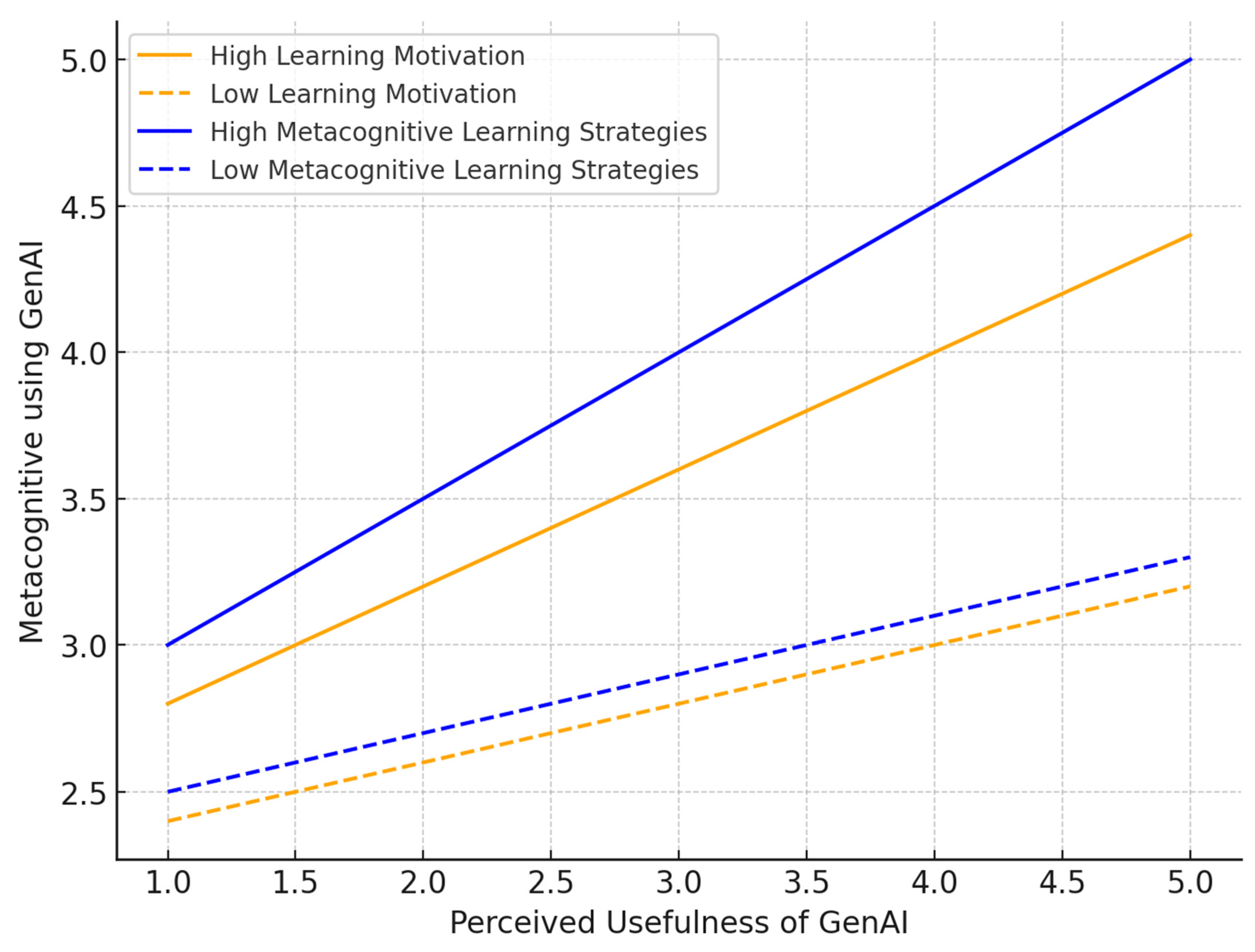
A single interaction plot is presented below to better illustrate how learning motivation and reported metacognitive learning strategies moderate the interaction effect between perceived usefulness of GenAI and reported metacognitive use of GenAI.
Figure 1 demonstrates that both learning motivation and reported metacognitive learning strategies moderate the relationship between perceived usefulness and reported metacognitive use of GenAI. Specifically, individuals with high learning motivation or high reported metacognitive learning strategies exhibited a sharper gradient, indicating that as their perception of GenAI’s usefulness increased, their reported metacognitive engagement with GenAI grew more significantly. Conversely, for individuals with low levels of these moderators, the relationship was weaker. These findings highlight the importance of motivation and reported metacognitive regulation in fostering effective engagement with GenAI-based learning tools.
3.5. Mediation Analysis: The Role of Perceived Usefulness
Building on previous findings, we examined whether perceived usefulness mediated the relationship between learning motivation and reported metacognitive use of GenAI. Given the significant association between learning motivation and reported metacognitive use of GenAI, this analysis was conducted to determine whether this association operated partly through perceived usefulness. Specifically, we tested whether the association between learning motivation and reported metacognitive use of GenAI was partially explained by perceived usefulness, such that higher learning motivation was associated with greater perceived usefulness, which, in turn, was associated with greater reported engagement in GenAI-based metacognitive strategies (
Table 9).
As shown in
Table 9, the mediation analysis indicated that perceived usefulness partially mediated the association between learning motivation and reported metacognitive use of GenAI. The total effect of learning motivation on reported metacognitive use of GenAI was significant, and the direct effect remained significant after perceived usefulness was included in the model, although it was substantially reduced. The indirect effect through perceived usefulness was also significant, indicating partial mediation. The final outcome model explained a substantial proportion of the variance in reported metacognitive use of GenAI, while learning motivation explained a smaller proportion of the variance in perceived usefulness.
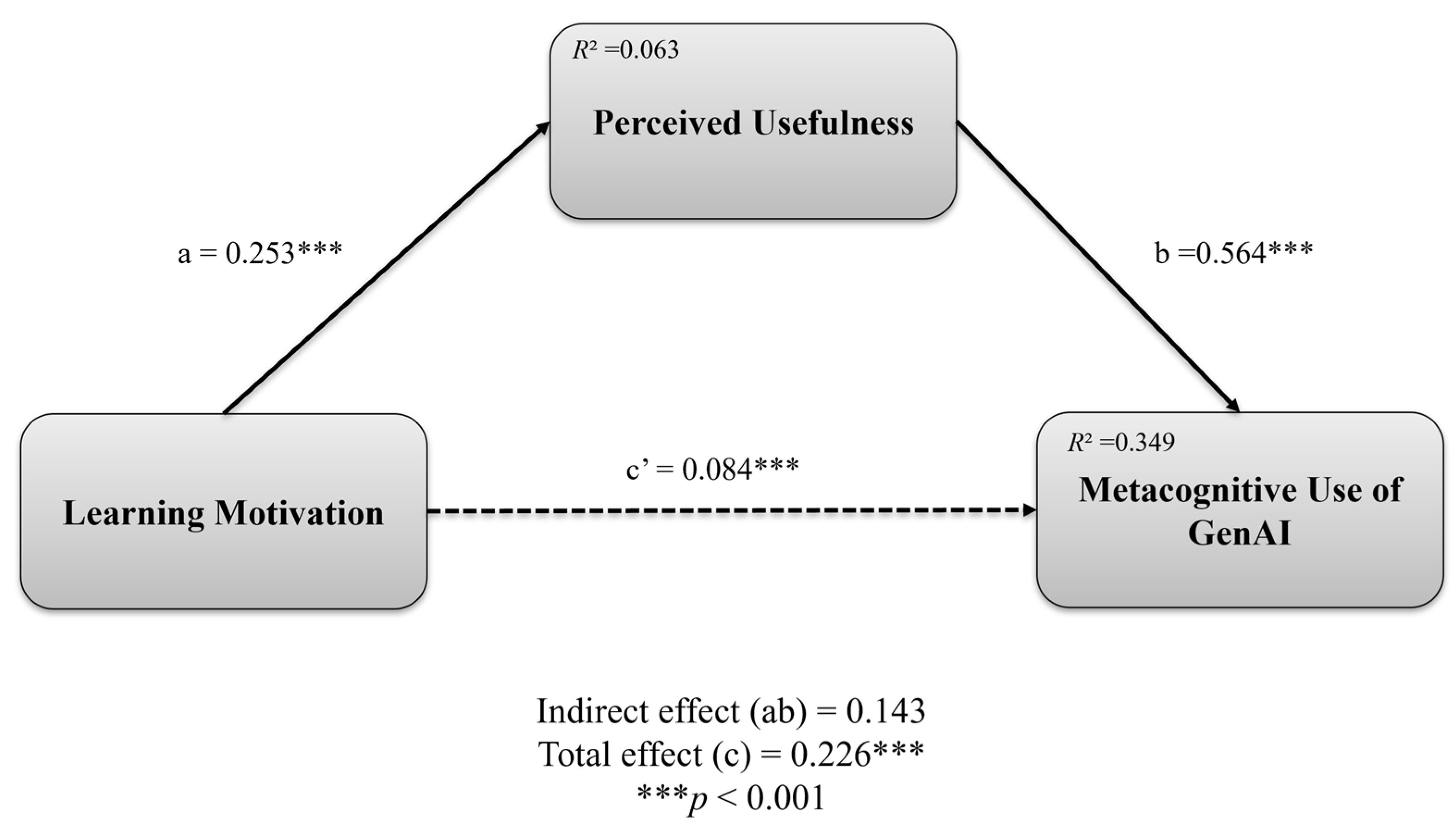
Figure 2 presents a graphical representation of the mediation model, illustrating the role of perceived usefulness in the relationship between learning motivation and reported metacognitive use of GenAI. The figure depicts the relationships tested in the regression analysis.
As shown in
Figure 2, learning motivation significantly predicted perceived usefulness, which in turn was associated with reported metacognitive use of GenAI. The direct effect of learning motivation on reported metacognitive use of GenAI (c′ = 0.084) was smaller than the total effect (c = 0.226), indicating partial mediation. The
R2 values indicate that learning motivation explained 6.3% of the variance in perceived usefulness, while the final outcome model, including both learning motivation and perceived usefulness, explained 34.9% of the variance in reported metacognitive use of GenAI. This figure visually represents the mediation model reported in
Table 9.
4. Discussion
This study examined the cognitive and personal factors associated with the self-reported metacognitive use of GenAI for learning purposes through the lens of SRL. As these tools become increasingly integrated into learning and professional contexts, understanding the internal mechanisms that drive effective engagement is of great importance. By exploring the interplay between perceived personal skills, learning motivation, and perceived usefulness, this study offers a comprehensive view of how learners navigate and regulate their learning in the age of AI. Overall, the findings suggest that effective engagement with GenAI is not merely a matter of technological access or general motivation but is deeply rooted in the learner’s existing self-regulation framework. The results indicate that while perceived personal skills and perceived usefulness are the most consistent predictors of metacognitive engagement, the role of learning motivation is more complex, acting as both a selective filter and a significant moderator when utility is recognized by learners.
A prominent finding is the central role of perceived personal skills and existing metacognitive learning strategies in predicting the reported use of GenAI. In the regression model, perceived personal skills emerged as the strongest positive predictor, followed closely by general metacognitive strategies. This aligns with classic self-regulated learning theories [
3], which suggest that learners with high self-regulatory capabilities are better equipped to adapt to new learning tools. In the context of GenAI, participants with strong internal regulation mechanisms tend to “export” their existing metacognitive habits into their interactions with AI. These learners likely use GenAI as a “cognitive partner” for brainstorming, self-testing, and critical evaluation rather than as a passive information source. This trend underscores the idea that AI does not replace the need for self-regulation; rather, it demands high levels of regulation for its informed and effective use.
Learning motivation is recognized in the research literature as an integral core component of the SRL process, serving as a central driver that guides the selection and implementation of learning strategies. According to this approach, high levels of motivation rooted in self-efficacy beliefs and task-value perceptions enable learners to employ complex metacognitive strategies such as planning, monitoring, and reflection, which contribute to significant improvements in academic achievement [
5]. However, the findings of the present study reveal a complex picture that contrasts with this established positive trend, indicating that learning motivation is a negative predictor of metacognitive GenAI use. Specifically, participants with high learning motivation reported less frequent use of Generative AI tools, whereas those with lower motivation reported higher levels of engagement with these tools.
A possible interpretation of this finding is that the negative coefficient of learning motivation in the multivariate model should not be understood as indicating that motivation is detrimental to the use of GenAI for metacognition. Rather, the mediation results suggest that motivation is positively associated with metacognitive GenAI use, partly through perceived usefulness. Once perceived usefulness was included in the model; part of the positive variance shared by motivation and metacognitive GenAI use appeared to be accounted for by perceived usefulness. The remaining unique component of learning motivation may reflect a more cautious or selective orientation toward GenAI, whereby highly motivated participants are less inclined to rely on the tool unless they perceive it as genuinely useful for supporting their learning process. Thus, motivation may operate indirectly through perceived usefulness while also functioning directly as a regulatory filter that shapes the quality and nature of engagement with GenAI. In this sense, motivation does not automatically lead to increased use but may support participants’ use of SRL skills to critically monitor and evaluate the tool’s outputs rather than passively accepting them.
A theoretical explanation for these findings can be found in recent research highlighting the concern regarding “metacognitive laziness”, a phenomenon in which cognitive effort is offloaded to the machine in a way that may undermine meaningful learning [
23]. Learners driven by a desire for deep understanding and high achievement [
24,
25] may perceive GenAI as a potential threat to their cognitive autonomy, explaining their initial tendency to limit its use. However, when functional usefulness is identified, motivation becomes a catalyst that supports the active monitoring and critical control of machine outputs [
26]. This trend aligns with studies showing that students who exhibit high engagement in learning monitoring successfully transform AI into a cognitive scaffold that enhances knowledge rather than merely utilizing it for task completion [
27].
The pedagogical value of GenAI tools is further validated by the mediation findings of this study. This implies that even when high motivation is present, it does not translate into active engagement with GenAI unless individuals perceive the tool as having functional value in advancing their goals. In other words, learners act rationally and strategically; they choose to invest metacognitive effort in monitoring and control only when they are convinced that the tool genuinely contributes to the quality of their learning or output. This insight aligns with the Technology Acceptance Model (TAM) [
28], which emphasizes the centrality of perceived usefulness in technology adoption, and with recent studies showing that in the context of GenAI, students tend to prioritize system efficiency and derived utility over the enjoyment of the process itself [
29].
The findings also provide insight into potential barriers to use. Concerns and anxieties were not significantly correlated with reported metacognitive GenAI use and did not significantly moderate the tested relationships. However, when examined within the controlled models, concerns showed a weak positive association with reported metacognitive GenAI use. This suggests that concerns do not necessarily prevent metacognitive engagement with GenAI but may coexist with more careful and reflective use of these tools. This finding aligns with research indicating that internal self-regulatory processes provide learners with academic resilience, enabling them to shift their focus from concerns associated with technology toward leveraging it to achieve their learning objectives [
24]. Essentially, metacognitive proficiency may function as a protective factor that allows participants to evaluate the tool’s efficiency and contribution to learning while also remaining aware of technological and ethical concerns [
29].
4.1. Theoretical Implications
The findings of this study offer several significant theoretical implications for the study of learning in the digital age. First, this study expands the SRL model by demonstrating that interaction with GenAI tools is not equivalent to working with traditional learning tools. Engagement with these tools requires a complex metacognitive interaction in which the learner is required not only to plan, monitor, and evaluate their learning process, but also to regulate the extent to which they rely on outputs generated by an intelligent and generative system. In this sense, SRL in GenAI environments involves an additional layer of regulation: deciding when to use the tool’s outputs, when to evaluate them critically, and when to exercise independent judgment in relation to these outputs.
Second, this extension helps to explain the motivation paradox observed in the present study. While high motivation is generally associated with greater engagement in learning in classical SRL models, in GenAI environments it may instead be expressed through greater caution, selectivity, and control over the use of the tool. Thus, highly motivated participants do not necessarily use GenAI more frequently; rather, they may regulate their use more cautiously to preserve cognitive autonomy and depth of learning.
Third, the findings also make a theoretical contribution to the Technology Acceptance Model (TAM), as they demonstrate that perceived usefulness functions not only as a direct predictor of engagement with GenAI but also as a partial mediating mechanism in the relationship between learning motivation and reported metacognitive use. In this way, the findings extend TAM by positioning perceived usefulness as a mechanism linking learning motivation with the regulated and metacognitive use of GenAI. However, because the mediation was partial, the findings suggest that technology acceptance in GenAI environments is not explained by perceived usefulness alone but also depends on motivational resources and self-regulatory capabilities.
4.2. Practical Implications
On a practical level, these findings offer several important recommendations. Learning programs should be designed to help learners recognize the pedagogical value of Generative AI in their learning processes rather than merely familiarizing them with its technological features. The implementation of these tools should emphasize their added value for learners across varying motivation levels, acknowledging that highly motivated participants may hesitate to adopt technology to preserve learning depth. Furthermore, developers should integrate self-regulated learning mechanisms within Generative AI platforms, such as prompts for reflection or monitoring, to assist learners in understanding how their interaction with the tool fosters personal skill development. Finally, efforts to integrate GenAI into learning contexts must address adoption concerns by providing participants with strategies to critically assess the generated content and understand its limitations, ensuring that the technology serves as a complementary resource that supports independent thinking rather than replacing it.
4.3. Research Limitations
Despite its significant contributions, this study has several limitations. A primary limitation is the reliance on self-reported data regarding participants’ use of GenAI, which may introduce response bias. Such data may also be affected by social desirability, recall inaccuracies, or participants’ limited awareness of their actual metacognitive behaviors while using GenAI. Participants’ perceptions of their self-regulated learning behaviors and engagement with the tool may not fully align with their actual usage patterns. Furthermore, as the study captured participants’ experiences at a single point in time, it provided limited insight into how GenAI adoption and metacognitive strategies evolve. Future longitudinal research could provide a deeper understanding of how learners’ engagement with GenAI changes as they become familiar with the technology and whether its perceived usefulness shifts over extended learning periods.
4.4. Future Research
The findings of this study provide a foundation for several promising avenues for future research. Longitudinal research could examine the evolution of GenAI usage patterns and the long-term development of self-regulation strategies as learners achieve greater technological fluency. Additionally, qualitative studies could offer deeper insights into the specific decision-making processes of highly motivated learners, exploring whether their measured approach to GenAI stems from concerns regarding authenticity, fear of cognitive overreliance, or other underlying academic values. Experimental designs could further evaluate the effectiveness of targeted educational interventions aimed at fostering metacognitive skills within AI-integrated environments and identify which instructional frameworks best facilitate critical and strategic use. Furthermore, comparative analyses across diverse academic disciplines would clarify how domain-specific demands shape metacognitive engagement and technology adoption patterns in these disciplines. Finally, incorporating cross-cultural and socioeconomic perspectives would provide a more comprehensive understanding of how social norms and systemic factors influence the global landscape of AI-assisted learning.