
Article

The Social Software of Corporate Governance: A Systems Analysis of Generalized Trust and Cultural Ecosystems

by
Vincent O’Connell
1,* and
Fabian Jintae Froese
2
1
Department of Accounting, College of Business Administration, Kuwait University, Safat, P.O. Box 5486, Kuwait City 13055, Kuwait
2
Faculty of Business and Economics, University of Göttingen, Platz der Göttinger Sieben 5, 37073 Göttingen, Germany
*
Author to whom correspondence should be addressed.
Systems 2026, 14(7), 876; https://doi.org/10.3390/systems14070876

Submission received: 4 June 2026 / Revised: 14 July 2026 / Accepted: 14 July 2026 / Published: 22 July 2026
(This article belongs to the Section Systems Practice in Social Science)

Abstract

Corporate governance is a complex, adaptive open system; yet it is usually modeled, in the classical agency tradition, as a closed matrix of legal and financial contracts. Adopting an open systems perspective, we decode the “social software”—the informal institutions—behind the wide variation in corporate governance across countries. At the heart of this system lies an element that comparative corporate governance research has largely overlooked: generalized trust. To our knowledge, ours is the first framework to unite open systems theory and generalized trust in explaining cross-country corporate governance. Drawing on the classic systems theory works of Ashby and Luhmann, we theorize trust as a systemic connector that absorbs complexity that formal rules would otherwise have to carry. Where trust carries that load, firms can govern through relationship-based collaboration rather than rule-based control. Using 4837 firm-year observations from 1293 firms in 23 countries (2003–2008)—a pre-crisis structural baseline—we document a robust negative association between trust and shareholder-oriented corporate governance: where trust is high, informal social regulation substitutes for formal control. The two cultural moderators—individualism and uncertainty avoidance—act on this connector in opposing directions. Individualism amplifies the substitution because monitoring conflicts with the desire for autonomy; uncertainty avoidance attenuates it because trust cannot supply the structural predictability that these cultures demand. Where individualism is high and uncertainty avoidance is low, formal control falls away steeply as trust rises; where that configuration is reversed, formal structures persist even when trust is abundant. Corporate governance architecture, these results suggest, is regulated by its surrounding cultural ecosystem—with trust as its central, and long-neglected, connector.

1. Introduction

Corporate governance is often treated as a game of formal rules: a predictable matrix of legal codes, financial frameworks, and compliance mandates. Yet, this surface-level view ignores a critical reality: formal institutions capture only a fraction of why governance practices vary so widely across the globe [1,2,3,4,5,6]. Scholars like Doidge et al. [7] have shown that country-level characteristics—specifically formal institutions like legal and financial systems—are more predictive of variations in governance practices than firm characteristics alone [7,8,9,10]. However, as Griffin et al. [5] demonstrate, these formal variables leave much of the cross-country variance in corporate governance unexplained. Griffin et al. [3,5] proceed to highlight the core importance of two key components of national culture—individualism and uncertainty avoidance—in explaining observed global differences in corporate governance across countries. Their findings dovetail with prior research demonstrating that national culture, as an informal institution, is a critical dimension of a country’s institutional environment [11,12]. They also validate research in finance, accounting, strategic management, and international business documenting the important role that national culture plays in organizations [13,14,15].
The objective of this study is to extend prior work on the role of national culture in corporate governance by investigating the role of a largely overlooked but potentially key driver of differences in corporate governance practices across countries: generalized trust. While Uttenthal [16] highlights the multifarious definitions of ‘trust’ in the extant literature, in this study, we rely on Robinson’s definition of trust as a person’s “expectations, assumptions, or beliefs about the likelihood that another’s future actions will be beneficial, favorable, or at least not detrimental to one’s interests” [17] (p. 576). According to dispositional theories of trust [18,19], the degree of an individual’s trust reflects a stable set of personal beliefs established early in life. Meanwhile, Inglehart [20] demonstrates that generalized trust varies widely across countries.
In this study, we investigate how generalized trust (hereafter ‘trust’) is associated with the behavioral assumptions underlying a firm’s corporate governance architecture, inclining it toward either strict, shareholder-oriented ‘control’ or relational ‘collaboration’. Specifically, we explore the baseline relationship between generalized trust and formal corporate governance while examining how the core cultural dimensions of individualism and uncertainty avoidance moderate this governance–trust dynamic. Consequently, through our focus on trust, we extend work conceptualizing governance as a multi-layered system shaped by both formal [7] and informal institutions [21,22,23]. From a systems standpoint, trust, a core dimension of national culture and norms, is not merely a background variable; it acts as a critical dimension of a country’s institutional environment that can substitute for or complement formal governance attributes [24,25,26].
Crucially, decoding this ‘social software’ requires a theoretical shift. By social software, we mean the informal, culturally transmitted rules of conduct—generalized trust together with the value orientations that govern its exercise—that program the behavioral expectations on which contracting rests, in deliberate contrast to the codified ‘hardware’ of formal legal and financial institutions; we use the term in this bounded, technical sense throughout, rather than as a loose metaphor. Traditional corporate governance research relies heavily on classical agency theory, which tends to characterize firms as a closed system of bilateral contracts managed through strict, formal monitoring, sealed off from its wider environment. However, agency models tend to diminish the potentially crucial role of environmental context. To bridge this gap, our study integrates classical agency models with an open systems perspective. In our model, we treat corporate governance as an evolving system within a larger cultural context, where trust acts as the critical link. To our knowledge, ours is the first framework to unite open systems theory and generalized trust in explaining cross-country corporate governance. This framework lets us examine how a society’s unwritten cultural rules alter internal company behavior, shifting the organization’s structure toward either strict control or flexible collaboration.
Building on this framework, our article has four primary objectives. First, we extend knowledge on the role of informal institutions by examining the direct relationship between trust and adherence to formal governance rules. In doing so, we isolate how a nation’s underlying ‘social software’ regulates firm-level compliance with shareholder-oriented practices [27]. Second, we explore how individualism—another key informal cultural characteristic—moderates the relationship between governance and trust. Third, extending our focus on national culture, we investigate the influence of uncertainty avoidance on the governance–trust nexus. Fourth, we investigate how a company’s corporate governance modus operandi—whether focused on strict oversight or collaborative teamwork—is shaped by the interplay of generalized trust, individualism, and uncertainty avoidance [2,28,29,30].
By cultural ecosystem we mean the interacting set of country-level informal institutions—here, generalized trust together with the cultural dimensions of individualism and uncertainty avoidance—that are mutually interdependent and jointly condition the behavioral assumptions on which a nation’s corporate governance rests. We use the term in a precise, bounded sense: not as a loose synonym for “national context” but to denote a small, tightly coupled system of cultural parameters whose elements cannot be varied independently of one another. To observe this cultural ecosystem in a relatively undisturbed state, we analyze a longitudinal panel of 1293 firms across 23 countries over the 2003–2008 period. This timeframe offers an analytically clean window. By halting the sample just before the 2008 Global Financial Crisis and the subsequent wave of reactive environmental, social, and governance (ESG) and digital-compliance mandates, we filter out a regime shift that would otherwise confound the relationship of interest. The justification is itself systemic: an open system has fast-moving and slow-moving components, and while formal institutions and legal codes can be reformed rapidly, the informal institutions that concern us—the deep parameters of national culture—change only over generational horizons. Beugelsdijk and Welzel [31] show that such deep-seated cultural values remain consistent over 30-year horizons, functioning as the slow-moving deep structure that constrains organizational design. Estimating the trust–governance relationship within a single pre-crisis regime therefore isolates the organic coupling between these slow cultural parameters and formal governance, uncontaminated by the post-crisis compliance shock, while still yielding inferences of contemporary relevance to, inter alia, investors, financiers, and regulators. Our contribution is accordingly positioned as a structural baseline of pre-crisis governance: an estimate of the culture–governance coupling in its undisturbed state, against which post-crisis and contemporary configurations can be assessed.
The remainder of our paper is organized as follows. In Section 2, we present the systems framework at the core of our study and outline the hypotheses. In Section 3, we elaborate upon our methodology and discuss our data selection processes. In Section 4, we present our core findings. In Section 5, we discuss the primary implications of our work for both practitioners and academicians. Section 6 concludes.

2. Prior Literature and Hypothesis Development

2.1. Agency Theory, Systems Theory and Trust

The core principle of the classical agency model is that in any relationship where a principal delegates work to an agent, there will inevitably be goal conflict and information asymmetry [32]. Because agents are assumed to be rational, risk-averse, and self-interested, classical agency theory suggests that they will engage in shirking or opportunistic behavior unless the principal implements strict monitoring systems and performance-based incentives [32,33]. However, as organizational psychology and behavioral economics advanced, scholars recognized a flaw in this baseline model: complete contracts are a practical and economic impossibility. Constant surveillance is not only prohibitively expensive but also socially destructive. This realization led to the integration of interpersonal trust into agency models—framing trust not as a naive sentiment but as a critical economic heuristic and a structural mechanism for reducing transaction and agency costs.
The shift from strictly control-based agency models to trust-integrated models was pioneered in the 1990s and early 2000s by scholars reimagining the psychological contract between principals and agents. A critical behavioral adjustment was introduced by Frey [34], who theoretically demonstrated that heavy monitoring can actively destroy organizational value. Frey [34] argued that while surveillance has a disciplining function, it simultaneously signals a profound lack of interpersonal trust. This perceived distrust can crowd out an agent’s intrinsic motivation, reducing their effort to the bare minimum required by the formal contract.
Building on the limitations of strict control, Davis et al. [35] formalized stewardship theory, the most prominent counter-model to traditional agency theory. Stewardship theory assumes that under the right conditions, an agent’s goals naturally align with the principal’s. In this paradigm, agents are motivated by intrinsic rewards, collective success, and interpersonal trust; consequently, applying intrusive agency controls to a “steward” is counterproductive and damages performance. Furthermore, scholars began to bridge agency theory with social exchange theory. Whitener et al. [36] shifted the burden of trust-building onto the principal (or the manager acting on their behalf). Their framework posits that principals must proactively take the first step in making themselves vulnerable—such as delegating authority without micromanaging—to initiate a reciprocal cycle of interpersonal trust that ultimately mitigates agency risks. Becerra and Gupta [37] argue that trust-embedded economic theories are superior to trust-absent theories. Later, Casadesus-Masanell [38] showed that extrinsic, performance-based incentives are not universally mandatory by demonstrating mathematically how fixed-payment contracts can outperform variable contracts if the principal trusts the agent to be guided by intrinsic motivation, social norms, and ethical standards. Relatedly, John et al. [39] demonstrate that sustainable research collaborations require both control and trust to ensure that performance and participant satisfaction are maximized.
While classical agency theory relies on a closed-system approach, organizational sociology and legal scholarship have increasingly advocated for an open systems perspective [40]. In this paradigm, the corporation is not merely a nexus of contracts to be monitored but a complex, interacting entity deeply embedded within diverse institutional and environmental contexts [40]. This conceptual shift reshapes the role of corporate governance and the utility of trust.
The application of systems theory to corporate law was notably advanced by scholars seeking alternatives to the prevailing shareholder primacy narrative. Belinfanti and Stout [41] argue that strict adherence to shareholder value as a primary governance metric fails to provide genuine managerial accountability and frequently encourages destructive regulatory and policy interventions. Instead, systems theory offers a robust methodology for structuring and measuring corporate performance in a manner that accounts for multiple overlapping goals while recognizing the critical importance of long-term sustainability [41]. Within this framework, the corporation is viewed as a bounded group of elements operating purposively to coordinate complex activities and manage interdependent operations [42].
In a systems-based governance model, interpersonal and institutional trust is elevated from a simple heuristic for reducing transaction costs to a vital systemic connector, the mechanism that couples the firm’s internal governance to its wider cultural environment. Because corporate systems are characterized by complex interdependencies, the effort to solve one localized governance issue through strict control can inadvertently trigger failures elsewhere if the system lacks a resilient culture [43]. Trust operates as the stabilizing force within such environments. Making trust a central pillar of corporate sustainability enables leadership to build stronger, mutually beneficial partnerships with all stakeholders [43]. Consequently, from a systems theory perspective, effective governance relies on adaptable management rather than universal surveillance. By aligning practices with specific contexts, organizations can cultivate mutual trust across all organizational levels [40].
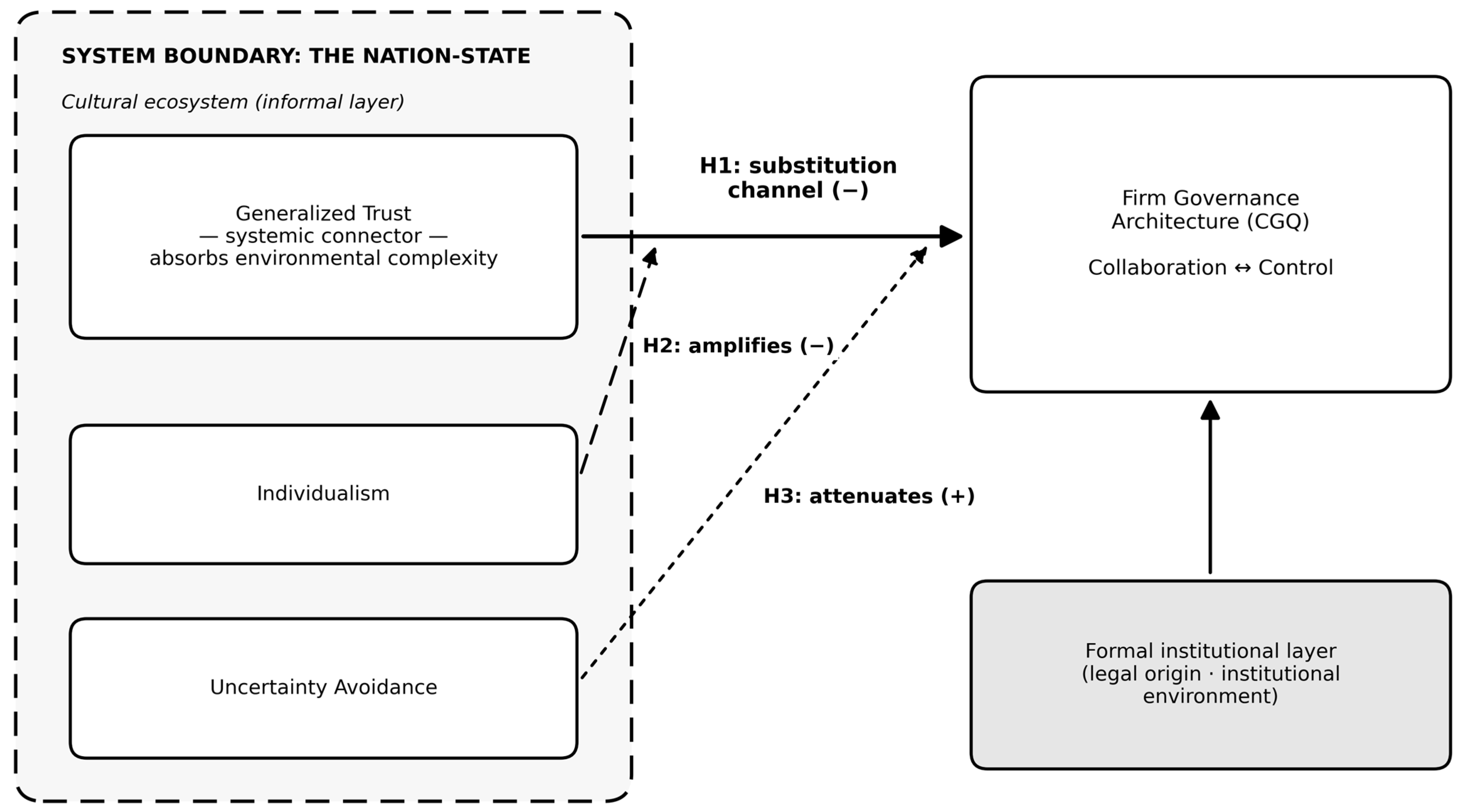
Positioning the systems-theoretic contribution. The systems contribution of this study is theoretical and interpretive rather than formal: we do not estimate a dynamic systems model but use open-systems constructs to organize the comparative-governance evidence, and the empirical analysis then tests the framework’s central prediction. Open systems theory accordingly provides the primary theoretical lens of the study; classical agency theory enters in a supporting role, as the baseline contracting model whose monitoring prescriptions the systems framework shows to be regulated by the surrounding cultural environment. The system’s components are the firm-level governance architecture (observed through the firm’s corporate governance rating score), the formal institutional layer (legal origin and the institutional environment), and the informal layer: the cultural ecosystem of generalized trust, individualism, and uncertainty avoidance defined in Section 1. The system boundary is the nation-state, which delimits the cultural environment within which firms are embedded. Trust operates as the systemic connector in a precise sense: following [44], it absorbs environmental complexity that the governance architecture would otherwise need to internalize as formal variety [45], and it is in this variety-absorbing capacity—not as a metaphor—that we use the term. The feedback operates through two channels of adaptation: a substitution channel, through which high generalized trust permits the relaxation of formal monitoring, and a restoration channel, through which uncertainty avoidance re-imposes structural predictability; firms adapt along the control–collaboration continuum [30]. Figure 1 summarizes these components, boundaries, and channels.

2.2. The Influence of Trust on Adherence to Shareholder-Oriented Corporate Governance

Modern corporate governance frameworks are typically classified into two fundamental models: the shareholder-centric approach and the stakeholder-centric approach [46]. The shareholder model (common in the U.S. and U.K.) prioritizes short-term equity, dispersed ownership, and strong formal rights designed to maximize investor wealth. Conversely, the stakeholder model (common in Continental Europe and Asia) relies on long-term debt, concentrated ownership, and a focus on satisfying a broader range of organizational participants.
These systems are built on opposing behavioral assumptions. Control-based (shareholder) systems assume that actors are individualistic and self-interested, requiring external monitoring to ensure alignment. Collaboration-based (stakeholder) systems assume that managers and shareholders share common interests, fostering a cycle of trust and identification with the firm. Because these cultural values vary globally, a governance system’s effectiveness is inherently tied to the informal institutions—the ‘social software’—of the nation in which it is embedded.
While formal corporate rules are rooted in the classical agency control-based perspective, relying solely on this view ignores the systemic friction created by rigid compliance. In this context, formal rules and monitoring systems impose substantial transaction costs and generate operational friction. From a systems standpoint, Ashby’s law of requisite variety states that a system’s internal control mechanisms must possess at least as much variety (flexibility) as the environment they govern [45]. Because formal corporate governance rules are static, codified, and binary, they inherently violate this law and act as a heavy systemic drag, forcing organizations to seek more efficient substitutes. Such formal reporting is neither costless nor without strategic value—financial disclosure also conveys information of competitive relevance to firms and their stakeholders [47]—yet in high-trust environments, much of its monitoring function can instead be met through informal social regulation.
Building on prior work, we posit that trust functions as a potentially key substitute, serving as an informal institution that manages complex forms of governance. Bradach and Eccles [48] identify authority (formal rules) and trust as distinct, yet highly substitutable, mechanisms for organizing economic activity and managing complex plural forms of governance. Parsons [49] conceptualized trust as a highly elastic, fluid control mechanism that allows a system to process unpredictable interactions rapidly. The recent empirical literature robustly validates this classical substitution effect. Guiso, Sapienza, and Zingales [50] demonstrate that high-trust corporate environments significantly lower monitoring costs and increase firm value. Pevzner, Xie, and Xin [51] confirm that trust acts as a direct substitute for formal institutional monitoring in mitigating agency problems, noting that firms in high-trust nations require vastly fewer explicit reporting rules. Hasan et al. [52] further validate this, showing that social capital actively replaces formal governance quality in reducing agency costs, specifically regarding executive monitoring and opportunistic tax avoidance. Chown [53] illustrates how organizational units adapt mandated formal controls in practice, at times replacing them with locally developed alternative mechanisms.
When a firm operates in a macro-environment characterized by high generalized trust, the baseline expectation shifts from opportunism to mutual stewardship. Fukuyama [54] operationalizes this by describing formal compliance mechanisms as a ‘tax’ on economic activity; in high-trust environments, ‘spontaneous sociability’ naturally replaces the need for codified governance, allowing firms to bypass this tax entirely. As Puranam and Vanneste argue [55], once a strong baseline of trust exists, the marginal utility of formal contractual governance drastically diminishes, making rigid rules economically redundant.
The mechanical efficiency of this substitution is further explained by Luhmann’s autopoietic (self-producing) systems theory [44], which frames both trust and rules as functional mechanisms for reducing social complexity. While rules reduce complexity by rigidly forcing behavior, trust reduces complexity by absorbing it. This creates an environment where trust facilitates adaptive forms of deference to organizational authorities. Conversely, in low-trust countries, the expectation of exploitation forces shareholders to install more formalized and rigid mechanisms to control managers. As generalized trust increases, the systemic necessity for formal agency controls—specifically shareholder-oriented practices—tends to diminish. This discussion leads to our first hypothesis.
Hypothesis 1 (H1). 
Trust is negatively associated with reliance on the formal corporate governance rules manifest in shareholder-oriented corporate governance.

2.3. The Moderating Influence of Individualism

After establishing our primary hypothesis, we turn our attention to two factors that we predict moderate the relationship between governance and trust. First, we investigate how the cultural values of those within the system shape their behavior. We begin by applying Hofstede’s [56,57] dimension of individualism to our analysis, followed by an examination of uncertainty avoidance in the next section.
Hofstede defines individualism as describing the “relationship between the individual and the collectivity that prevails in a given society” [57] (p. 209). In countries characterized by high individualism, people are likely to focus on themselves and personal gain [57]. Cable and Judge [58] showed that individualistic employees prefer promotion and pay based on individual performance. Accordingly, firms in individualistic countries typically employ promotion and pay systems based on individual performance to align their goals with those of their employees [59], and equity-based incentives are likewise used to align senior executives’ strategic decisions with shareholder interests [60].
In highly individualistic cultures, people possess a profound psychological aversion to micromanagement and rigid systemic constraints. However, in low-trust environments, individualists are forced to tolerate heavy formal rules (like dense legal contracts) to protect their individual property and rights from opportunistic peers [61]. When we introduce high generalized trust into a highly individualistic system, trust removes the threat of opportunism, thereby removing the need for protective formal rules.
Because people in highly individualistic cultures resent the systemic friction of rules and actively crave autonomy, they tend to relax those rules once trust provides a safe environment to do so. Recent macro-organizational research supports this accelerating effect. Crossland and Hambrick [12] demonstrate that highly individualistic cultures grant significantly higher managerial discretion to executives, an effect that is magnified when institutional constraints are relaxed. This discretion extends to consequential financial reporting choices, such as whether the success of a research and development (R&D) program leads firms to capitalize rather than expense development expenditures, a pattern documented among European firms [60]. Pitlik and Rode [62] find that individualistic values inherently resist interventionist regulation, and this resistance is heavily activated by the presence of systemic trust. Relatedly, Bloom et al. [63] show that firms in high-trust environments delegate substantially more decision-making authority from headquarters to managers, substituting managerial autonomy for centralized procedural control.
Consequently, when generalized trust is high within an individualistic culture, firms face intense pressure to protect the autonomy and intrinsic motivation of their managers by dismantling intrusive governance mechanisms. Rather than necessitating formal controls, high individualism makes the workforce acutely sensitive to, and resentful of, strict shareholder-oriented practices. Therefore, the drive for individual autonomy amplifies the negative relationship between formalized governance control structures and trust. This rationale leads to our second hypothesis.
Hypothesis 2 (H2). 
Individualism amplifies (strengthens) the negative relationship between generalized trust and shareholder-oriented corporate governance.

2.4. The Moderating Influence of Uncertainty Avoidance

While we predict that individualism amplifies the negative association between trust and shareholder-oriented corporate governance, we posit that a separate cultural dimension, uncertainty avoidance, acts as a powerful countervailing force.
Hofstede defines uncertainty avoidance as the degree to which a society feels threatened by ambiguous, unstructured situations [56,57,64]. Countries characterized by high uncertainty avoidance tend to have stable labor relationships and clear promotion systems based on seniority [59]. These long-term socialization processes naturally integrate the system, facilitating collaboration and company loyalty [31,57,65]. For example, Jang et al. [66] report that uncertainty avoidance shapes the relationship between job satisfaction and job strain. Because the primary purpose of managers in these stable, uncertainty-avoidant settings is to satisfy internal stakeholders [67], relationships often develop into a reciprocal sense of personal obligation, concern, and even friendship [68]. Relatedly, Han et al. [13] demonstrated that managers in countries characterized by low uncertainty avoidance tend to be less likely to manipulate accounting earnings for personal gain.
Integrating Hofstede’s concept of uncertainty avoidance with the environmental threat perception central to the open systems perspective of Katz and Kahn [69], we posit that rules serve a dual function. They act as economic safeguards against the agent and as boundaries that shield the organization from the ambiguity of the environment. In a high-trust society with low uncertainty avoidance, the system fears neither the agent nor environmental ambiguity. Luhmann’s complexity reduction operates without restriction: trust replaces monitoring, and formal rules are less important [44,70]. Conversely, in a high-trust society with high uncertainty avoidance, a specific type of paradox emerges. Because generalized trust is high, classic agency monitoring is less important. Yet, because the culture is highly intolerant of ambiguity, the system retains reliance on formal rules to ensure procedural predictability.
Recent empirical evidence strongly supports this dampening effect. Chen et al. [71] found that organizations in high uncertainty avoidance cultures inherently build defensive corporate buffers (like rigid corporate governance) to hedge against ambiguity, independent of trust levels. Furthermore, Astvansh et al. [72] highlight that compliance with rules designed explicitly to prevent negative outcomes is compatible with the psychological mindset associated with uncertainty avoidance. Tran [73] confirms that in high uncertainty avoidance countries, organizations retain formal, prescriptive rules because the psychological cost of operating without a structure outweighs the economic benefit of removing it. Relatedly, meta-analytic evidence suggests that in high uncertainty-avoidance cultures, firms rely less on trust-based relational governance and more on formal mechanisms [74].
Therefore, even in high-trust environments, a highly uncertainty-avoidant culture will struggle to reduce reliance on formal governance mechanisms. In these environments, we expect that shareholder-oriented corporate governance practices are adhered to as a means of meeting the systemic need for clear reporting lines, formalized rules, and environmental stability. Consequently, we predict that uncertainty avoidance overrides the self-regulating, structurally efficient benefits associated with trust, forcing firms to maintain formal oversight. This discussion leads to our third hypothesis.
Hypothesis 3 (H3). 
Uncertainty avoidance attenuates (weakens) the negative relationship between generalized trust and shareholder-oriented corporate governance.

3. Research Design

3.1. Estimation Models and Identification Strategy

To test the systemic influence of trust on firm-level governance (Hypotheses 1–3), we estimate a sequence of panel models. Equation (1) establishes the baseline association between generalized trust and shareholder-oriented corporate governance practices (SHO_CGP):
SHO_CGPit = α + β1 Trust + Controls + εit
Here, SHO_CGPit is the shareholder-oriented corporate governance practice score for firm i in year t, α and εit are the intercept and error term, and the control vector comprises individualism and uncertainty avoidance together with a set of country- and firm-level covariates (Table 1). Hypothesis 1 predicts a negative and significant β1. To test the moderating role of individualism (Hypothesis 2), we extend Equation (1) with an interaction term:
SHO_CGPit = α + β1 Trust + β2 Individualism + β3 (Trust × Individualism) + Controls + εit
Hypothesis 2, which holds that individualism amplifies the negative trust–governance relationship, implies a negative and significant β3. To test Hypothesis 3, we replace individualism with uncertainty avoidance:
SHO_CGPit = α + β1 Trust + β2 Uncertainty Avoidance + β3 (Trust × Uncertainty Avoidance) + Controls + εit
Hypothesis 3, which holds that uncertainty avoidance attenuates the negative relationship, implies a positive and significant β3. A fourth specification includes both interaction terms simultaneously, allowing the two countervailing cultural forces to be observed within a single system. In every specification the control vector includes a full set of industry and year indicator variables, and all standard errors are clustered at the country level; these are suppressed from the notation in Equations (1)–(3) for readability.
The structure of the data determines both the estimator and the construction of standard errors, and it is worth making this explicit because the cultural ‘social software’ we seek to isolate resides entirely in cross-country variation. Generalized trust, individualism, and uncertainty avoidance are each measured at the country level and are time-invariant within country; their interactions inherit this property. We therefore estimate all models using firm-level panel random effects, with full sets of industry and year indicators. Random effects is the appropriate estimator for the variables of theoretical interest in this setting: a firm or country fixed-effects estimator would absorb all time-invariant country-level variation and thereby eliminate trust, the cultural dimensions, and their interactions from the model altogether. Random effects do, however, rest on the assumption that the unobserved country- and firm-level heterogeneity is uncorrelated with the regressors. Because a within (fixed-effects) transformation would remove the between-country variation that is the sole source of identification for the country-level cultural variables, we retain random effects and probe this orthogonality assumption directly in Section 4.3 through a correlated-random-effects (Mundlak) specification and a between-country estimation. Year indicators absorb common macroeconomic shocks across the 2003–2008 window, and industry indicators absorb sectoral heterogeneity; neither competes with the between-country cultural variation that identifies the hypotheses.
A second feature of the data governs statistical inference. Because the regressor of interest varies only across the 23 countries in the sample, while the unit of observation is the firm-year, treating firm-years as independent would understate the true sampling variability and overstate significance, the consequence, well known since Moulton [75], of combining an aggregate-level regressor with disaggregated data. We therefore cluster all standard errors at the country level, permitting arbitrary correlation among firms embedded in the same national environment. The z-statistics reported throughout are robust to this clustering and are consequently far more conservative than conventional panel standard errors would imply. We note that with 23 clusters, the analysis sits in the small-cluster region, in which cluster-robust inference, while appropriate, is best corroborated by small-sample-robust methods; we return to this in Section 4.3.
Finally, to keep the lower-order coefficients interpretable in the presence of the interaction terms, we mean-center generalized trust, individualism, and uncertainty avoidance before forming their products. After centering, the coefficient on trust in Equations (2) and (3) is the marginal effect of trust evaluated at the sample-average level of the relevant moderator. The summary statistics in Table 2 are reported for the original, uncentered variables.

3.2. Measures

Dependent variable. Following prior research, we measure shareholder-oriented corporate governance practices using the Corporate Governance Quotient (CGQ) from RiskMetrics/MSCI. The CGQ evaluates each firm against 55 individual criteria (65 for U.S. firms) grouped into eight dimensions—boards, audits, charter/bylaws, anti-takeover provisions, executive and director compensation, progressive practices, ownership, and director education—and expresses the result as a percentile ranking (0–100) relative to a peer group of similarly sized firms. A higher CGQ score reflects stronger adherence to formal, shareholder-oriented governance practices. We use each firm’s year-end score for 2003 through 2008, with 2003 being the first year of comprehensive worldwide coverage. The 2008 endpoint reflects measurement continuity as well as research design: the CGQ was subsequently discontinued and replaced by differently constructed successor instruments, so the sampled years constitute the complete panel available on a single, consistent measurement basis, and a post-crisis extension would necessarily change the measure along with the period.
Independent and moderating variables. We measure generalized trust (Trust) using the fourth wave of the World Values Survey, taking the percentage of respondents in each country who affirm that ‘most people can be trusted’. Individualism and Uncertainty Avoidance are measured using Hofstede’s national culture scores, each ranging from 0 to slightly above 100, with higher values denoting greater individualism or uncertainty avoidance, respectively.
Construct validity of the cultural measures. Because generalized trust is a latent construct, its quantification warrants explicit justification rather than presumption. Our operationalization follows the definition adopted in Section 1 [17]: the World Values Survey item asks whether, in general, most people can be trusted, directly eliciting the generalized expectation about others’ conduct that this definition describes. The item has served as the standard measure of generalized trust in cross-country research since Knack and Keefer [76], and country-level aggregation is central to its validity: idiosyncratic response error averages out across respondents within a country, and the between-country component that remains—the only variation our design exploits (Section 3.1)—is highly stable across survey waves [31]. The Hofstede dimensions rest on a comparably extensive validation record [14], and their country rankings have been formally replicated in later respondent cohorts [77]. Alternative cultural frameworks yield convergent conclusions about the culture–governance nexus [78], whereas the Global Leadership and Organizational Behavior Effectiveness (GLOBE) project’s uncertainty-avoidance practices scores are known to correlate negatively with Hofstede’s index [79]; retaining the World Values Survey and Hofstede instruments therefore preserves construct continuity and comparability with the literature we extend [5]. Section 5.3 discusses the residual measurement limitations.
Control variables. The remaining controls follow the comparative governance literature. We include a Law Dummy coded 1 for common-law countries and 0 otherwise; an Institutional Environment index aggregating Kaufmann’s six worldwide governance dimensions [80] (voice and accountability, political stability, government effectiveness, regulatory quality, rule of law, and control of corruption) into a single score; Relative Stock Market Size, measured as stock-market capitalization divided by gross domestic product (GDP), to hold constant the scope for market-based monitoring, the extent to which security prices impound value-relevant information varies with the depth of the national market, including in the smaller exchanges represented in our sample [81]; and GDP Per Capita to capture economic development. At the firm level we control for Firm Size (the natural log of total assets, adjusted for exchange-rate differentials), Firm Performance (return on assets), Firm Leverage (total liabilities divided by total assets), and Firm Growth (the percent change in sales between t − 1 and t). To limit the influence of outliers, the four firm-level variables are winsorized at the 1st and 99th percentiles. We have also verified robustness to alternative outlier treatments of the firm-level controls. Re-estimating all four specifications with no winsorization, winsorization at the 2.5th/97.5th and 5th/95th percentiles, and trimming (rather than capping) at the 1st/99th percentiles leaves the results reported later essentially unchanged. Full definitions and sources are provided in Table 1.
Table 1. Variable definitions.
VariableOperational DefinitionData Source
Shareholder-Oriented CGThe Corporate Governance Quotient (CGQ) score, reflecting a firm’s percentile ranking relative to its peer group based on an evaluation of 55 individual criteria.RiskMetrics/MSCI
Generalized TrustThe percentage of affirmative answers to the survey question regarding whether most people can be trusted.World Values Survey (Fourth Wave)
Uncertainty AvoidanceA cultural dimension score (0 to 100+) measuring the degree to which a society feels threatened by ambiguity.Hofstede [56,57]
IndividualismA cultural dimension score (0 to 100+) measuring the relationship between the individual and the collectivity.Hofstede [56,57]
Law DummyAn indicator variable coded 1 for common-law countries and 0 otherwise.La Porta et al. [8,9]
Institutional EnvironmentA single aggregated score combining six dimensions: voice and accountability, political stability, government effectiveness, regulatory quality, the rule of law, and control of corruption.Kaufmann’s institutional environment index (World Bank) [80]
Relative Stock Market SizeStock-market capitalization divided by gross domestic product (stock market/GDP).Financial Structure and Economic Development database (World Bank)
GDP Per CapitaThe natural log of GDP per capita of the country.World Development Indicators (World Bank)
Firm SizeThe natural log of total assets after adjusting for exchange-rate differentials.COMPUSTAT
Firm PerformanceAnnual return on assets (ROA), defined as net income divided by total assets.COMPUSTAT
Firm LeverageTotal liabilities divided by total assets.COMPUSTAT
Firm GrowthThe percent change in sales between fiscal year t − 1 and year t.COMPUSTAT

3.3. Sample

Sample construction proceeds through several filters. Firms are excluded where the requisite financial data are unavailable from COMPUSTAT; countries with fewer than ten observations are dropped to maintain a robust estimation base; and firms incorporated in tax-haven jurisdictions or in countries lacking Hofstede cultural metrics are removed. We additionally exclude firms domiciled in the United States, for which the CGQ is constructed from a distinct and larger criterion set (65 items versus the 55 applied to non-U.S. firms) and benchmarked against a separate U.S. peer universe, leaving its scores not directly comparable in level to the international index that anchors our cross-country design. Retaining U.S. firms would moreover let a single, differently measured market dominate the analysis: U.S. observations (17,343 firm-years) outnumber the combined remainder by more than three to one and would constitute roughly 78% of a pooled sample, so that estimates of culturally driven variation would be governed largely by one country whose dependent variable is measured on a different basis. In estimates that retain the United States, the substitution effect and both cultural moderators nonetheless preserve their predicted signs, so the exclusion does not mask a reversal of the documented relationships; those pooled estimates are, however, governed by the differently measured U.S. observations and are not comparable in level to the international specification adopted here, and we accordingly do not report them alongside it. We therefore restrict the estimation sample to the non-U.S. countries, on which the CGQ rests on a common footing. The initial panel comprises 1341 distinct firms operating across 23 countries from 2003–2008. After imposing the complete-data requirements of the estimating equations, the final estimation sample consists of 4837 firm-year observations drawn from 1293 firms across the same 23 countries. The panel spans a deliberately ‘clean’ institutional era, concluding immediately before the 2008 global financial crisis and the subsequent proliferation of reactive regulatory and ESG mandates, allowing the organic interaction between informal norms and formal governance to be observed without that confounding overlay.

4. Results

4.1. Descriptive Statistics and Correlations

Table 2 reports summary statistics for the estimation sample. Shareholder-oriented corporate governance (SHO_CGP) has a mean of 42.52 and a standard deviation of 25.11 and spans the full 0–100 range, indicating substantial cross-firm variation in adherence to formal shareholder-oriented practices. Generalized trust averages 0.384 and ranges from roughly 0.10 to 0.68 across countries, while individualism and uncertainty avoidance average 57.7 and 70.6, respectively. The firm-level controls are unremarkable, with mean firm size of 7.74 (log assets), mean return on assets of 0.078, mean leverage of 0.54, and mean sales growth of 0.10.
Table 2. Summary statistics.
VariableNMeanSDMinp25p50p75Max
Shareholder-Oriented CG483742.5225.110.0022.1040.6061.60100.00
Generalized Trust48370.3840.1110.1000.3680.3910.4280.680
Uncertainty Avoidance483770.5725.678.0051.0086.0092.00112.00
Individualism483757.7119.0518.0046.0046.0074.0090.00
Law Dummy48370.2630.4410.0000.0000.0001.0001.000
Institutional Environment483715.408.613.289.0212.9519.1447.94
Relative Stock Market Size48371.1440.8830.1700.7381.0221.0965.279
GDP Per Capita483710.3800.2858.45510.33010.42010.47010.920
Firm Size48377.7431.5042.6816.7947.6408.68512.860
Firm Performance48370.0780.085−1.1950.0400.0690.1061.271
Firm Leverage48370.5390.2190.0000.4050.5480.6745.865
Firm Growth48370.1050.446−1.0000.0080.0630.14423.000
N = 4837 firm-year observations. Statistics are reported for the original, uncentered variables.
A country-level view reinforces the systemic logic of the study (Appendix A, Table A1). The strongly shareholder-oriented systems—the United Kingdom (mean CGQ ≈ 86), Switzerland (≈69), Australia (≈66), and New Zealand (≈61)—combine high individualism with comparatively low uncertainty avoidance. Conversely, the high-trust Nordic economies, such as Sweden, Denmark, and Norway, where generalized trust is highest in the sample, exhibit notably low scores on formal shareholder-oriented governance, while Greece and Portugal combine the lowest governance scores with the highest uncertainty avoidance. This descriptive pattern—high informal trust coinciding with low reliance on formal shareholder mechanisms—foreshadows the substitution effect formalized below, consistent with the open-systems premise that an organization’s internal structure comes to mirror the variety of the environment in which it is embedded [82].
Table 3 presents the Pearson correlations among the core variables. Shareholder-oriented governance correlates positively with individualism (0.47) and the law dummy (0.33) and negatively with uncertainty avoidance (−0.37), consistent with the bivariate intuitions of the systems framework. Notably, the simple correlation between generalized trust and shareholder-oriented governance is close to zero (0.02). This is itself instructive: trust is positively correlated with individualism (0.30), which is, in turn, strongly and positively associated with formal governance, so the substitution effect of trust is suppressed at the bivariate level and emerges only once the surrounding cultural ecosystem is modeled jointly. The cultural variables are themselves moderately intercorrelated (trust–uncertainty avoidance −0.30; trust–individualism 0.30; individualism–uncertainty avoidance −0.28), and the law dummy is strongly correlated with uncertainty avoidance (−0.74). These interdependencies, characteristic of a tightly coupled cultural system, motivate the conservative country-clustered inference adopted here and inform the interpretation of coefficient magnitudes below. Notwithstanding these interdependencies, formal multicollinearity is not a concern for the estimated models. The variance inflation factors are uniformly low—the maximum is 2.97 (uncertainty avoidance) and generalized trust has a value of 1.41—and the condition number of the standardized design is 3.66, well below the Belsley threshold [83]. Expressed in standardized units, a one-standard-deviation rise in trust is associated with a fall of about one-fifth of a standard deviation in shareholder-oriented governance (standardized coefficient −0.18), with individualism and uncertainty avoidance entering at +0.40 and −0.33, respectively.

4.2. Results of Hypothesis Tests

Table 4 reports the four random-effects models with country-clustered standard errors, industry effects, and year effects throughout. Model 1 tests the baseline substitution hypothesis, Models 2 and 3 add the individualism and uncertainty-avoidance interactions respectively, and Model 4 includes both.
Hypothesis 1 predicts that generalized trust acts as an informal substitute for formal shareholder-oriented control, implying a negative association. Model 1 supports this: the coefficient on trust is −41.281 and is significant at the one-percent level (z = −2.701). The strength of this result lies in the inference behind it. Because trust varies only across the 23 countries, conventional panel standard errors would dramatically overstate its precision; under the conservative country-clustered standard errors appropriate to an aggregate-level regressor, the effect nonetheless remains negative and highly significant. As generalized trust rises within a society, reliance on formal shareholder-oriented monitoring structurally decays. Model 1 also shows individualism positively associated with formal governance (0.522, p < 0.01) and uncertainty avoidance negatively associated with it (−0.327, p < 0.01). It bears emphasis that although the unconditional correlation between trust and governance is near zero (Table 3), the conditional effect is strongly negative. This is precisely the systemic behavior one expects when a connector’s role becomes visible only after the rest of the cultural ecosystem is accounted for: the feedback and interdependence that characterize complex adaptive systems preclude isolating one subsystem while holding the others constant [84]. Hypothesis 1 is supported.
Hypothesis 2 holds that individualism amplifies the negative trust–governance relationship, as autonomy-seeking actors dismantle formal controls once trust renders them unnecessary. Model 2 introduces the Trust × Individualism interaction, whose coefficient is −2.263 and significant at the one-percent level (z = −3.263). The negative sign indicates a strengthening of the substitution effect in more individualistic societies, providing robust support for Hypothesis 2.
Hypothesis 3 predicts a countervailing force: a cultural intolerance of ambiguity sustains formal rules for the sake of procedural predictability, attenuating the substitution effect. Model 3 introduces the Trust × Uncertainty Avoidance interaction, whose coefficient is 1.154 and significant at the one-percent level (z = 2.692). The positive sign demonstrates that uncertainty avoidance dampens the substitution effect of trust—even where generalized trust is high, an ambiguity-averse system retains its formal scaffolding—supporting Hypothesis 3.
Model 4 includes both interactions simultaneously to observe the full cultural ecosystem. The two moderators retain their predicted and opposing directional influences and remain statistically significant under clustered inference (Trust × Individualism = −1.875, p < 0.05; Trust × Uncertainty Avoidance = 0.918, p < 0.05). A joint test confirms that the amplifying and attenuating forces operate together (Section 4.3). The overall R-squared rises monotonically across the specifications, from 0.374 in Model 1 to 0.404 in Model 4, and the Wald chi-square statistic is highly significant in every model, confirming the explanatory power of the systemic framework.
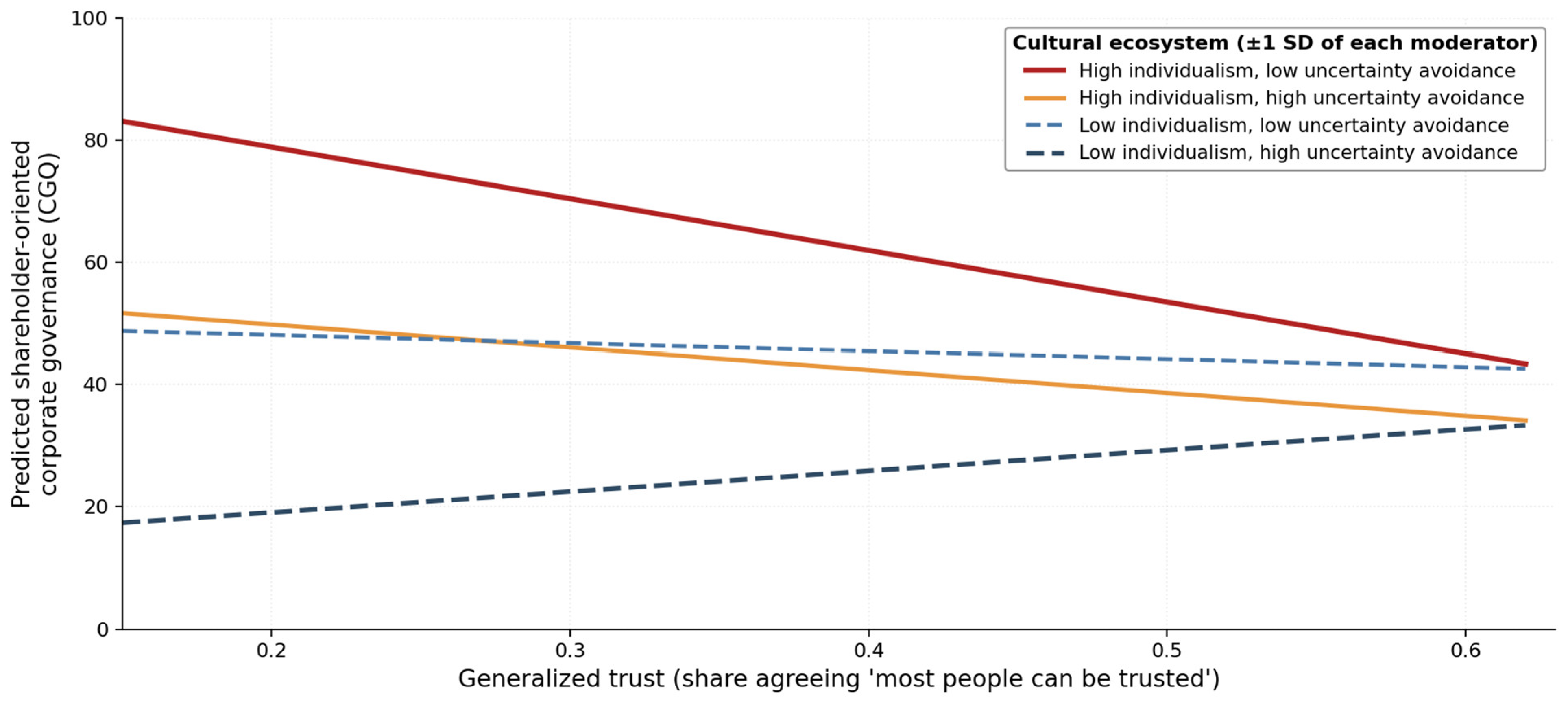
To make these estimates interpretable, we translate them into the metric of the data. In the baseline (Model 1), a one-standard-deviation increase in generalized trust (0.11) is associated with a 4.6-point reduction in the shareholder-oriented governance score, roughly one-fifth of a standard deviation of that score. Moving across the full observed range of trust, from the least- to the most-trusting society in the sample, corresponds to a decline of approximately 24 points, close to a full standard deviation. The conditional specifications show how this marginal effect is regulated by the surrounding culture. Evaluated at the corners of the cultural ecosystem in Model 4, a one-standard-deviation rise in trust is associated with a fall of about 9 governance points (roughly one-third of a standard deviation) in a high-individualism, low-uncertainty-avoidance setting, whereas in a low-individualism, high-uncertainty-avoidance setting, the estimated effect is slightly positive and statistically indistinguishable from zero. The system’s responsiveness to trust thus ranges from strong to effectively null across cultural configurations. These standardized magnitudes, rather than the lower-order coefficients alone, are the economically meaningful quantities, and they motivate the joint visualization in Figure 2.
Among the controls in Model 4, firm size (2.350, p < 0.01) and firm leverage (4.366, p < 0.05) are positively associated with shareholder-oriented governance, GDP per capita is negative and significant (−8.874, p < 0.01), and firm growth is weakly negative (−0.929, p < 0.10). The country-level institutional controls—the institutional environment index, relative stock-market size, and law dummy—are not statistically significant once standard errors are clustered at the country level, and firm performance is likewise insignificant. The attenuated significance of the country-level controls, relative to what naive standard errors would suggest, is exactly what the clustered framework anticipates for aggregate regressors and reinforces the importance of conservative inference in cross-country governance research.
Because the cultural variables are mean-centered on the estimation sample, the trust coefficient in the interaction specifications is the conditional marginal effect of trust at the sample-average level of the moderators; it is accordingly somewhat smaller than the unconditional baseline estimate and its magnitude is stable across specifications. As set out above, the economically meaningful quantities are the standardized marginal effects of trust evaluated across the cultural ecosystem.
Figure 2 renders the two moderation effects as a single system, plotting predicted shareholder-oriented governance against generalized trust for each of the four corners of the cultural ecosystem: the combinations of high and low individualism and high and low uncertainty avoidance (±1 standard deviation), generated from the full specification (Model 4), with all other covariates held at their sample means. Reading the four slopes together conveys the central systemic claim more directly than either moderator alone: the governance value of trust is not a fixed parameter but is regulated jointly by the surrounding cultural variety. Where individualism is high and uncertainty avoidance is low, the slope is steepest—a one-standard-deviation rise in trust is associated with roughly a 9-point fall in the governance score (about one-third of a standard deviation)—because autonomy-seeking actors face no countervailing demand for structural predictability and most readily shed formal controls. Where individualism is low and uncertainty avoidance is high, the slope is statistically indistinguishable from flat—the point estimate is slightly positive, with a confidence interval spanning zero—because the system’s intolerance of ambiguity sustains its formal scaffolding even as trust would otherwise render it redundant. The two intermediate corners fall predictably between these poles. The amplifying influence of individualism (the negative Trust × Individualism term) and the attenuating influence of uncertainty avoidance (the positive Trust × Uncertainty Avoidance term) are thus visible not as two separate stories but as opposing regulators—cultural forces that adjust the strength of the trust–governance coupling—acting on the same connective variable. The substitution capacity of trust is thus amplified along one cultural axis and suppressed along the other.
These empirical results directly operationalize our open-systems perspective. The interaction terms in our models (specifically Model 4) move beyond linear, isolated effects to capture the interdependence and non-linearity of the cultural ecosystem. The varying slopes depicted in Figure 2 are consistent with the substitution and restoration channels of adaptation theorized in Section 2.1: governance architectures vary systematically with the configuration of generalized trust, the drive for autonomy, and societal ambiguity. By demonstrating that the association between a systemic connector like trust and formal governance depends on the surrounding cultural regulators, the empirical model supports our claim that corporate governance is an adaptive socio-cultural configuration, rather than a static, universally applicable set of formal mechanisms.
Figure 2. The joint operation of the two cultural moderators. Each line traces the predicted level of shareholder-oriented corporate governance against generalized trust for one corner of the cultural ecosystem, defined by setting individualism and uncertainty avoidance jointly at ±1 standard deviation around their means. Predictions are generated from the full specification (Model 4, Table 4), with all other covariates held at their sample means. Table 5 reports the corresponding interval estimates. The trust–governance slope is steepest where individualism is high and uncertainty avoidance is low—the configuration in which the system most readily sheds formal control—and is shallowest—statistically indistinguishable from flat—where individualism is low and uncertainty avoidance is high, where the system retains its formal scaffolding even as trust rises.
Systems 14 00876 g002
Table 5. Conditional marginal effect of trust. Effect of a one-standard-deviation increase in generalized trust (0.111) on the CGQ score at ±1 SD and the mean of each moderator (other moderator at its mean); 95% CIs from country-clustered standard errors.
Effect of +1 SD Trust on CGQEstimate95% CI
Individualism, low (−1 SD)1.2[−2.7, 5.0]
Individualism, mean−2.8[−5.7, 0.1]
Individualism, high (+1 SD)−6.7[−11.5, −2.0]
Uncertainty avoidance, low (−1 SD)−5.4[−8.2, −2.7]
Uncertainty avoidance, mean−2.8[−5.7, 0.1]
Uncertainty avoidance, high (+1 SD)−0.2[−4.9, 4.5]
A Johnson–Neyman analysis indicates that the trust effect is statistically significant where individualism lies above, or uncertainty avoidance below, approximately the sample mean of the respective moderator; in low-individualism and high-uncertainty-avoidance configurations, it is indistinguishable from zero, consistent with attenuation that culminates in effective neutralization of the substitution channel.

4.3. Robustness and Sensitivity Analyses

The inference reported above already embeds the principal correction required for an aggregate-level regressor: country-level clustering. To probe the findings further, with respect to both the small number of clusters and the potential residual country-level confounding, we undertake three additional analyses, reported below. Because no external instrument for generalized trust is available and country fixed effects are precluded by the time-invariant nature of the cultural variables, we (i) re-assess inference using the wild cluster bootstrap [85], which does not rely on a large-cluster asymptotic approximation; (ii) bound the influence of unobserved confounders using the coefficient-stability approach of Oster [86]; and (iii) replace the legal-origin control with full legal-family fixed effects, absorbing the commonalities shared within legal families while preserving the cross-country variation that identifies the trust effect. Together, these analyses are designed to establish that the substitution effect and the joint operation of its two cultural moderators are not artifacts of the chosen inference or of any single omitted national characteristic.
Robustness of inference. Because the cultural variables vary across only 23 country clusters, we subject each hypothesis-bearing quantity—the substitution effect, and each moderating channel in the specification that identifies it—to the restricted wild cluster bootstrap [85], with Webb six-point weights and 9999 replications, computed on the pooled counterpart of each specification with country-clustered scores, the footing on which small-cluster bootstrap inference is developed. The hypothesis tests are upheld. The amplifying Trust × Individualism channel is significant under the bootstrap (Model 2, p = 0.029), as is the attenuating Trust × Uncertainty Avoidance channel (Model 3, p = 0.026); the bootstrap, which has limited power to separate two strongly collinear country-level moderators across so few clusters, does not resolve their individual contributions within Model 4, but a joint test rejects their joint absence decisively (p = 0.014), the statistic on which the paper’s system-level claim rests. The baseline substitution effect, significant at the one-percent level under country-clustered inference (z = −2.70), retains marginal significance under the bootstrap (p = 0.055) and is corroborated on designs the small-cluster critique cannot reach: the between-country estimation reported below recovers it at p = 0.02 with no clustering at all. Excluding Japan—which contributes 38 percent of the estimation sample and whose cultural configuration of low individualism and high uncertainty avoidance sits precisely where Hypothesis 3 predicts the trust effect to be weakest—strengthens the coefficient to −51.6 (z-based p = 0.002) and clears the bootstrap at p = 0.035, with both moderating channels likewise strengthening to p = 0.002 in their identifying specifications. The panel’s dominant cluster thus attenuates the sample-average substitution effect exactly as the framework predicts, and the full-sample estimate is accordingly a conservative reading of the effect where the mechanism operates. In the interaction specifications, the lower-order trust coefficient is the conditional effect of trust at the sample means of both mean-centered moderators—a single point on the moderation surface whose full shape, with interval estimates, is reported in Table 5 and Figure 2—and tests none of the hypotheses.
Coefficient-stability bounds. We next assess sensitivity to unobserved country-level confounding using Oster’s [86] approach, which infers the scope for omitted-variable bias from the joint movement of the trust coefficient and the model R-squared as controls are added. Moving from a trust-only specification to the fully controlled baseline raises the overall R-squared from 0.05 to 0.37 and moves the trust coefficient from near zero (0.12) to −41.3, the suppression pattern of Section 4.1: trust covaries positively with individualism, which is itself strongly positively associated with formal governance, so the two channels offset in the raw data and the substitution effect is identified only once the cultural ecosystem is modeled jointly. This structure makes the result unusually resistant to omitted-variable explanations, and this joint movement of coefficient and R-squared is precisely the variation Oster’s estimator exploits. Under the benchmark that selection on unobservables is no stronger than selection on the observed controls (δ = 1), with the maximum attainable R-squared set to 1.3 times the controlled value, the bias-adjusted coefficient is −55.6—further from zero than the estimate itself—and the identified set [−55.6, −41.3] excludes zero; even under the conservative bound R_max = 1, it remains −121. The degree of selection required to reduce the effect to zero is negative (δ = −2.9): because every observed control moves the coefficient away from zero, an unobserved confounder could restore the null only if it operated opposite in sign to the entire observed control set, the reverse of the usual concern. Because Oster’s framework is calibrated chiefly to coefficients that attenuate under controls, we rest the inference not on the conventional δ ≥ 1 threshold but on the placement of the entire identified set well away from zero.
Legal-origin confounding. Because country fixed effects would eliminate trust entirely, we instead absorb deeper commonalities with a coarser grouping that leaves the identifying variation intact. Replacing the legal-origin control with full legal-family fixed effects (English, French, German, and Scandinavian) leaves the substitution effect undiminished—indeed larger (−65.9, z = −2.46, p = 0.014; Table 6)—indicating that it is not an artifact of the broad legal-origin differences that dominate comparative governance research. The connective role of trust thus operates within legal families, not merely between them, consistent with the systemic claim that informal cultural regulation and formal legal structure are distinct layers of the same governance architecture. Excluding financial firms (banks, diversified financials, insurance, and real estate; 123 firm-years) likewise leaves the baseline essentially unchanged (−42.0 versus −41.3; Table 6).
Between-country (two-step) estimation. Because the cultural variables vary only across the 23 countries, we verify that the baseline result does not depend on the firm-level random-effects machinery by re-estimating it directly at the country level. In a first step, we regress shareholder-oriented governance on the firm-level controls together with industry and year indicators and retain the residual; in a second step, we average that residual to one value per country and regress these 23 country means on generalized trust and the two cultural dimensions. The pattern mirrors the firm-level estimates. Trust emerges clearly negative and significant even on 23 observations (coefficient −55.1, p = 0.02). The country-level estimate is larger in magnitude than the firm-level coefficient, indicating that the panel specification is the more conservative of the two and confirming that the documented relationship is genuinely a between-country regularity rather than an artifact of the estimator or of the disaggregated sample size. The baseline is likewise unchanged under a correlated-random-effects (Mundlak) specification that augments the model with firm-level means of the time-varying covariates (trust coefficient −42.2, z = −2.87).
Leave-one-country-out robustness. Because the trust effect and its two moderators are identified across only 23 countries, we re-estimated each of the three identifying specifications (Models 1–3) twenty-three times, omitting one country per pass. The results are stable in sign throughout. The baseline trust coefficient remains negative in all 23 subsamples and is significant at the five-percent level in 22, the amplifying Trust × Individualism interaction remains negative and significant in all 23, and the attenuating Trust × Uncertainty Avoidance interaction remains positive in all 23 and significant in 20. The few subsamples in which significance is not retained involve different countries in each case, so no single nation drives the documented relationships. Because Japan alone accounts for 38 percent of the estimation sample (1860 of 4837 firm-years), the subsample omitting it warrants explicit mention. With Japan excluded, the baseline trust coefficient strengthens from −41.3 to −51.6 (z = −3.16, p = 0.002); the amplifying Trust × Individualism interaction remains negative and significant (−2.0, z = −3.05, p = 0.002); and the attenuating Trust × Uncertainty Avoidance interaction likewise strengthens from 1.2 to 1.6 (z = 3.02, p = 0.002), each estimated in its identifying specification. The documented relationships are therefore not carried by the largest country in the panel; if anything, they are somewhat more pronounced in its absence.

5. Discussion

5.1. Theoretical Contributions

This study advances the theoretical conceptualization of corporate governance by shifting the analytical lens from a closed-system agency perspective to an open systems framework. Traditional agency models reduce the firm to a matrix of bilateral contracts policed through formal monitoring—an approach that struggles to explain the wide global variance in governance practice. By integrating open systems theory with classical agency logic, we show that corporate governance is better understood as a complex, adaptive architecture [84,87,88] whose internal control mechanisms are calibrated to the variety of the cultural environment in which it is embedded [40,69].
Prior scholarship has robustly established that formal legal origins and standalone cultural dimensions—such as individualism—are critical determinants of global governance variations. However, much of this foundational work, rooted in traditional institutional and agency theories, tends to model these factors linearly, treating informal institutions as isolated independent variables. The novelty of our open-systems framework lies in conceptualizing generalized trust not as a static cultural variable but as a dynamic ‘systemic connector’ whose governance role is jointly regulated by the surrounding cultural ecosystem. Each of the four objectives set out in the Introduction is answered by a specific empirical result:
  • Trust: negatively and significantly associated with shareholder-oriented governance (Table 4, Model 1), confirming the baseline substitution between informal trust and formal oversight (Objective 1).
  • Trust × Individualism: negative and significant (Model 2), showing that individualism amplifies the substitution (Objective 2).
  • Trust × Uncertainty Avoidance: positive and significant (Model 3), showing that uncertainty avoidance attenuates it (Objective 3).
  • Full model: both interactions jointly significant (Model 4; Figure 2), demonstrating the systemic interplay of the cultural regulators (Objective 4).
Read together, these results indicate that governance architecture is not merely a set of formal legal mechanisms but a complex, non-linear socio-cultural configuration in which formal oversight and informal trust act as fluid substitutes, regulated by a society’s specific tolerance for autonomy and ambiguity. The four paragraphs that follow elaborate upon each of these contributions in turn.
First, corresponding to our opening objective, we extend the literature on informal institutions by establishing that generalized trust operates as a systemic connector that substitutes for formal, shareholder-oriented control. Where agency theory treats monitoring as the default response to opportunism, our results show that the structural necessity for such monitoring decays as societal trust rises: trust supplies an alternative channel for absorbing the complexity that formal rules would otherwise have to encode. Framed through Ashby’s law of requisite variety [45]—whose recent extension to governance settings recasts control as the regulation of environmental variety [89]—high-trust systems match that variety through flexible social regulation rather than rigid codified control [44]. The architecture thereby economizes on the transactional friction that heavy formal governance imposes.
Second, addressing our second objective, we show that this substitution is not uniform but is amplified by individualism. In individualistic cultures, autonomy-seeking actors experience formal monitoring as systemic friction and shed it most readily once trust removes the threat of opportunism, steepening the trust–governance gradient. Individualism thus operates as a positive regulator on the connector, accelerating the system’s migration from control toward collaboration as trust accumulates.
Third, in keeping with our third objective, we identify uncertainty avoidance as a countervailing regulator that attenuates the same substitution. A cultural intolerance of ambiguity sustains formal rules not to deter the agent but to preserve procedural predictability and buffer the organization against environmental uncertainty. In this configuration, formal governance functions as a boundary-maintaining mechanism, so that even abundant trust fails to dissolve the formal scaffolding on which the system relies for stability.
Fourth, and most distinctively, we address our final objective by showing that a firm’s governance modus operandi—its position on the control–collaboration continuum—emerges from the joint operation of these forces rather than from any one of them in isolation. The result is an emergent system-level property of interacting components rather than the sum of separable effects [84,90]. The two moderators act on the same connective variable in opposite directions, and a joint test confirms that they operate together. Figure 2 renders the resulting surface concrete: the trust–governance slope ranges from the steep dismantling of control where individualism is high and uncertainty avoidance is low, to its near-complete retention where individualism is low and uncertainty avoidance is high. The contribution is therefore not a catalog of separate cultural effects but a demonstration that governance architecture is the equilibrium of a small system of interacting cultural regulators.
The robust negative association between generalized trust and formal shareholder-oriented governance primarily reflects a mechanism of substitution, where informal social regulation replaces the systemic drag of formal monitoring. However, our open-systems perspective reveals that this substitution is culturally contingent. Where individualism is high, the accelerated dismantling of formal controls goes beyond mere efficiency and is consistent with active cultural resistance to intrusive, monitoring-based governance. Conversely, where uncertainty avoidance is high, the substitution effect is blocked, resulting in a form of institutional complementarity; in these environments, informal trust and formal controls are maintained simultaneously to satisfy the system’s enduring demand for procedural predictability.
The mechanism driving this institutional complementarity is cultural rather than contractual. In cultures characterized by high uncertainty avoidance, the retention of formal governance is not driven by a fear of managerial opportunism—which generalized trust has already neutralized—but by an intense cultural aversion to ambiguity. While interpersonal trust provides relational security, it inherently lacks structural predictability. Therefore, the system purposefully retains formal control mechanisms to map out clear, predictable operational boundaries. In this specific configuration, formal rules are repurposed: they cease to function as restrictive agency monitors that threaten autonomy, and instead act as stabilizing scaffolding that shields the organization from environmental uncertainty. Thus, trust and formal control operate in tandem, satisfying the dual systemic needs for mutual stewardship and procedural predictability.
A methodological corollary deserves emphasis. Because trust is positively bound up with individualism, its governance role is invisible at the bivariate level and surfaces only once the cultural ecosystem is modeled as a whole. This suppression pattern carries a direct implication for the field: international corporate-governance studies that omit generalized trust risk omitted-variable bias, misattributing to formal or other cultural variables an effect that properly belongs to this informal institution.

5.2. Policy Implications

For practitioners and supranational bodies such as the Organisation for Economic Co-operation and Development (OECD) and the World Bank, the findings indicate that the architecture of corporate governance cannot be universally standardized [40,41]. Attempting to enforce a rigid, one-size-fits-all shareholder model can destabilize healthy, trust-based economies. A lower score on conventional formal-compliance metrics does not necessarily signal weakness; in high-trust, high-individualism environments, it often reflects an efficient, collaboration-based system in which formal controls have been rendered economically redundant by strong social cohesion. International policy should therefore favor systemic permeability, allowing local cultural filters to adapt global standards rather than supplant them.
It follows that when formulating governance mandates or assessing foreign investment risk, multinational stakeholders should evaluate the underlying ‘social software’ of the target environment. Imposing heavy formal compliance on a high-trust, highly individualistic subsidiary may erode intrinsic motivation and introduce systemic drag, whereas failing to establish clear, predictable reporting structures in an uncertainty-avoidant setting—however high its trust—can generate systemic anxiety. Effective organizational design requires aligning formal policy with the behavioral assumptions of the local cultural ecosystem.

5.3. Limitations and Future Research

The study’s principal limitation follows directly from its identification strategy. The effect of interest is a country-level association estimated from cross-country variation across 23 countries, and trust may remain correlated with unobserved national characteristics. We therefore interpret our estimates as robust conditional associations consistent with the proposed substitution mechanism, rather than as strictly causal effects. The sensitivity analyses described in Section 4.3—small-sample-robust (wild cluster bootstrap) inference, coefficient-stability bounds, and legal-family fixed effects—are intended to probe, though they cannot wholly eliminate, this concern. The modest number of country clusters likewise calls for the conservative and small-sample-robust inference we adopt.
A second limitation is the reliance on proxy measures. Indices such as Hofstede’s cultural dimensions, the World Values Survey trust measure, and the RiskMetrics/MSCI governance quotient capture only synthesized snapshots of complex human behavior. The operationalization of generalized trust in particular—a multifaceted construct whose definition remains contested [16]—through a single survey item is a significant limitation of the study; Section 3.2 sets out the construct-validity considerations that nonetheless support its use at the country level. We further note that the CGQ is a proprietary composite produced by RiskMetrics/MSCI, whose internal criterion weighting cannot be independently audited; we therefore rely on the vendor’s validated composite percentile, used as standard in the comparative-governance literature, rather than on its intermediate sub-indices. To the extent that such measurement introduces classical error, however, it attenuates the estimated relationships toward zero, so the associations we document are, if anything, conservative lower bounds on the underlying effects. Reverse causality is a limited concern in this setting, since the governance choices of individual firms cannot plausibly move a nation’s deep-seated and time-invariant level of generalized trust.
A further feature—which is also a methodological strength—is the historical 2003–2008 baseline. While older data may appear a weakness for contemporary markets, the cultural parameters of interest are the slow-moving deep structure of the system rather than its fast-moving surface. Concluding the sample before the 2008 crisis filters out the subsequent wave of reactive regulatory and ESG mandates, providing an uncontaminated view of the coupling between informal norms and formal governance. Three empirical lessons carry forward from this pre-crisis baseline to the design of resilient and sustainable governance systems in 2026 and beyond. First, because the cultural parameters we measure constitute the slow-moving deep structure of the system—stable over generational horizons [31]—the substitution and complementarity patterns documented here identify the enduring cultural constraints within which any contemporary reform, including the post-2008 wave of ESG and digital-compliance mandates, must operate. Second, the baseline supplies a counterfactual benchmark: departures of present-day governance configurations from the pre-crisis coupling estimated here indicate where formal mandates have been layered on top of, rather than aligned with, a country’s informal institutions—precisely the misalignment our framework identifies as a source of systemic friction and fragility. Third, the results caution that resilience is not synonymous with maximal formal control: in high-trust settings, redundant formal rules impose systemic drag, whereas in uncertainty-avoidant settings, formal scaffolding is itself a stabilizing resource, so sustainable governance design requires calibrating the formal–informal mix to the local cultural ecosystem, rather than converging on a single template. Future research should apply these interaction models to post-crisis and contemporary datasets, examine how modern digital-compliance and sustainability frameworks interact with foundational cultural ecosystems—for instance, by linking these cultural configurations to firms’ research-and-development and environmental-innovation investments [91]—and explore how acute systemic shocks temporarily override or permanently reshape the balance among trust, individualism, and uncertainty avoidance in corporate architectures. Finally, the necessary exclusion of the United States—whose CGQ is constructed from a different criterion set and benchmarked against a separate peer universe—means that the world’s largest capital market, and the prototypical shareholder-oriented governance system, lies outside the estimation sample. Although estimates retaining U.S. firms preserve the predicted signs of all three effects (Section 3.3), they are not comparable in level to the international specification. Extending the analysis to U.S. firms using governance indicators measured on an equivalent basis to those for other countries is therefore a particularly important avenue for future research. The United States combines very high individualism with comparatively low uncertainty avoidance, the cultural configuration in which the framework predicts the substitution capacity of trust to be strongest. It therefore offers a sharp out-of-sample test of the systemic model developed here.

6. Conclusions

This study offers three focused theoretical contributions at the intersection of systems theory and comparative corporate governance. First, by integrating open systems theory with classical agency models, it identifies generalized trust as a systemic connector between a firm’s governance architecture and its national cultural environment: across all specifications, trust is negatively and significantly associated with shareholder-oriented control, consistent with a substitution mechanism in which informal social regulation replaces formal monitoring. Second, it establishes that this substitution is culturally contingent rather than uniform—individualism amplifies it, while uncertainty avoidance attenuates it, preserving formal rules as stabilizing scaffolding even where generalized trust is high. Third, it demonstrates that a firm’s position on the control–collaboration continuum emerges from the joint operation of these cultural regulators rather than from any single dimension, suggesting that generalized trust belongs alongside legal origin and the established cultural dimensions as a country-level determinant in cross-country governance research.
The practical contributions follow directly and remain bounded by the study’s pre-crisis, 23-country design. For supranational standard-setters, the evidence cautions against uniform governance templates: lower formal-compliance scores in high-trust, individualistic environments may reflect an efficient reliance on informal regulation rather than governance weakness, whereas uncertainty-avoidant environments require predictable formal structures even when trust is abundant. For multinational firms and investors, the findings imply that governance mandates and foreign investment risk assessments should be calibrated to the informal institutional profile of each jurisdiction. Within these boundary conditions, resilient and sustainable governance is achieved through alignment between a firm’s formal mechanisms and the deep-seated informal institutions of its local environment, rather than through rigid global standardization.

Author Contributions

Conceptualization, V.O. and F.J.F.; data curation, V.O. and F.J.F.; formal analysis, V.O.; investigation, V.O.; methodology, V.O. and F.J.F.; project administration, V.O.; software, V.O.; validation, V.O. and F.J.F.; visualization, V.O. and F.J.F.; writing—original draft preparation, V.O. and F.J.F.; writing—review and editing, V.O. and F.J.F. All authors have read and agreed to the published version of the manuscript.

Funding

This research received no external funding. The APC was funded by Kuwait University.

Institutional Review Board Statement

Not applicable.

Informed Consent Statement

Not applicable.

Data Availability Statement

Data sharing is not available, as the data were retrieved from the following sources: The firm-level governance data (RiskMetrics/MSCI Corporate Governance Quotient) and accounting data (Compustat) are proprietary and licensed and cannot be redistributed by the authors; access conditions are described so that researchers holding the relevant licenses can reconstruct the sample. The country-level cultural and institutional inputs (World Values Survey, Hofstede, and the World Bank Worldwide Governance Indicators) are publicly available from their respective sources.

Conflicts of Interest

The authors declare no conflicts of interest.

Appendix A

Table A1. Country-level descriptive statistics (non-U.S. estimation sample: 23 countries, 1293 firms, 4837 firm-years). CGQ, trust, individualism, and uncertainty avoidance are country means (uncentered).
CountryFirm-YrsFirmsMean CGQTrustIndivid.Uncert. Avoid.
Australia3058365.50.469051
Austria641545.90.345570
Belgium621734.60.317594
Canada36910851.90.438048
Denmark661727.80.677423
Finland962254.40.596359
France2636360.50.197186
Germany2806555.10.376765
Greece1283214.60.2435112
Hong Kong2437037.50.412529
Ireland351178.60.367035
Italy1353751.30.297675
Japan186050129.50.394692
The Netherlands1212950.20.458053
New Zealand501361.20.517949
Norway541530.30.656950
Portugal42916.80.1027104
Singapore1433548.30.17208
Republic of Korea101038.30.281885
Spain1433730.30.205186
Sweden932335.90.687129
Switzerland1463668.90.546858
United Kingdom1294586.00.308935

References

  1. Denis, D.K.; McConnell, J.J. International corporate governance. J. Financ. Quant. Anal. 2003, 38, 1–36. [Google Scholar] [CrossRef]
  2. Adams, R.; Licht, A.N. Shareholderism around the World: Corporate Purpose, Culture, and Law. Manag. Sci. 2025, 72, 5416–5442. [Google Scholar]
  3. Griffin, D.; Guedhami, O.; Li, K.; Kwok, C.; Shao, L. National Culture and the Value Implication of Corporate Governance. J. Law Financ. Account. 2018, 3, 333–372. [Google Scholar] [CrossRef]
  4. Aguilera, R.V.; Jackson, G. Comparative and international corporate governance. Acad. Manag. Ann. 2010, 4, 485–556. [Google Scholar] [CrossRef]
  5. Griffin, D.; Guedhami, O.; Kwok, C.; Li, K.; Shao, L. National culture: The missing country-level determinant of corporate governance. J. Int. Bus. Stud. 2017, 48, 740–762. [Google Scholar] [CrossRef]
  6. Shen, J.; Wang, J.; Yang, Y.-R. The governance role of informal institutions: The effect of cultural values on corporate governance level. Manag. Audit. J. 2026, 41, 414–449. [Google Scholar] [CrossRef]
  7. Doidge, C.; Andrew Karolyi, G.; Stulz, R.M. Why do countries matter so much for corporate governance? J. Financ. Econ. 2007, 86, 1–39. [Google Scholar] [CrossRef]
  8. La Porta, R.; Lopez-de-Silanes, F.; Shleifer, A. The Economic Consequences of Legal Origins. J. Econ. Lit. 2008, 46, 285–332. [Google Scholar] [CrossRef]
  9. La Porta, R.; Lopez-de-Silanes, F.; Shleifer, A.; Vishny, R. Law and finance. J. Political Econ. 1998, 106, 1113–1155. [Google Scholar] [CrossRef]
  10. Shleifer, A.; Vishny, R.W. A survey of corporate governance. J. Financ. 1997, 52, 737–783. [Google Scholar] [CrossRef]
  11. Helmke, G.; Levitsky, S. Informal Institutions and Comparative Politics: A Research Agenda. Perspect. Politics 2004, 2, 725–740. [Google Scholar] [CrossRef]
  12. Crossland, C.; Hambrick, D.C. Differences in managerial discretion across countries: How nation-level institutions affect the degree to which CEOs matter. Strateg. Manag. J. 2011, 32, 797–819. [Google Scholar]
  13. Han, S.; Kang, T.; Salter, S.; Yoo, Y.K. A cross-country study on the effects of national culture on earnings management. J. Int. Bus. Stud. 2010, 41, 123–141. [Google Scholar] [CrossRef]
  14. Kirkman, B.; Lowe, K.; Gibson, C. A quarter century of culture’s consequences: A review of empirical research incorporating Hofstede’s cultural values framework. J. Int. Bus. Stud. 2006, 37, 285–320. [Google Scholar] [CrossRef]
  15. Li, J.; Harrison, R. National Culture and the Composition and Leadership Structure of Boards of Directors. Corp. Gov. Int. Rev. 2008, 16, 375–385. [Google Scholar] [CrossRef]
  16. Uttenthal, M. A conceptual analysis of trust. Soc. Sci. Inf. 2024, 63, 392–410. [Google Scholar] [CrossRef]
  17. Robinson, S.L. Trust and breach of the psychological contract. Adm. Sci. Q. 1996, 41, 574–599. [Google Scholar] [CrossRef]
  18. Bigley, G.; Pearce, J. Straining for shared meaning in organizational science: Problems of trust and distrust. Acad. Manag. Rev. 1998, 23, 405–421. [Google Scholar] [CrossRef]
  19. Rotter, J.B. Interpersonal trust, trustworthiness, and gullibility. Am. Psychol. 1980, 35, 1–7. [Google Scholar] [CrossRef]
  20. Inglehart, R. Modernization and Postmodernization: Cultural, Economic, and Political Change in 43 Societies; Princeton University Press: Princeton, NJ, USA, 1997. [Google Scholar]
  21. Aguilera, R.V.; Jackson, G. The cross-national diversity of corporate governance: Dimensions and determinants. Acad. Manag. Rev. 2003, 28, 447–465. [Google Scholar] [CrossRef]
  22. Estrin, S.; Prevezer, M. The role of informal institutions in corporate governance: Brazil, Russia, India, and China compared. Asia Pac. J. Manag. 2011, 28, 41–67. [Google Scholar]
  23. Aguilera, R.V.; Desender, K.; Kabbach de Castro, L.R.K. A Configuration Perspective on Comparative Corporate Governance. In SAGE Handbook of Corporate Governance; Clarke, T., Branson, D., Eds.; Sage Publications: New York, NY, USA, 2011. [Google Scholar]
  24. Hu, H.; Qi, M. New Evidence on National Culture and Corporate Financing: Does Institutional Quality Matter? Sustainability 2022, 14, 12689. [Google Scholar] [CrossRef]
  25. Nguyen, T.; Nguyen, A.; Nguyen, M.; Truong, T. Is National Governance Quality a Key Moderator of the Boardroom Gender Diversity–Firm Performance Relationship? International Evidence from a Multi-Hierarchical Analysis. Int. Rev. Econ. Financ. 2021, 73, 370–390. [Google Scholar] [CrossRef]
  26. Karolyi, G.A. The gravity of culture for finance. J. Corp. Financ. 2016, 41, 610–625. [Google Scholar] [CrossRef]
  27. Cahyadi, A.; Raneo, A.P.; Marwa, T.; Adam, M.; Szabó, K. Emerging Economies: An Investigation of National Culture and Sustainable Development. Economies 2024, 12, 226. [Google Scholar] [CrossRef]
  28. Adams, R.; Licht, A.N.; Sagiv, L. Shareholders and stakeholders: How do directors decide? Strateg. Manag. J. 2011, 32, 1331–1355. [Google Scholar] [CrossRef]
  29. Licht, A.N. Culture and Law in Corporate Governance. In The Oxford Handbook of Corporate Law and Governance; Gordon, J.N., Ringe, W.-G., Eds.; Oxford University Press: Oxford, UK, 2018; pp. 129–158. [Google Scholar]
  30. Sundaramurthy, C.; Lewis, M. Control and Collaboration: Paradoxes of Governance. Acad. Manag. Rev. 2003, 28, 397–415. [Google Scholar] [CrossRef]
  31. Beugelsdijk, S.; Welzel, C. Dimensions and Dynamics of National Culture: Synthesizing Hofstede With Inglehart. J. Cross Cult. Psychol. 2018, 49, 1469–1505. [Google Scholar] [CrossRef] [PubMed]
  32. Jensen, M.C.; Meckling, W.H. Theory of the firm: Managerial behavior, agency costs and ownership structure. J. Financ. Econ. 1976, 3, 305–360. [Google Scholar] [CrossRef]
  33. Jensen, M.C.; Meckling, W.H. Can the corporation survive? Financ. Anal. J. 1978, 34, 31–37. [Google Scholar] [CrossRef]
  34. Frey, B.S. Does monitoring increase work effort? The rivalry with trust and loyalty. Econ. Inq. 1993, 31, 663–670. [Google Scholar] [CrossRef]
  35. Davis, J.H.; Schoorman, F.D.; Donaldson, L. Toward a stewardship theory of management. Acad. Manag. Rev. 1997, 22, 20–47. [Google Scholar] [CrossRef]
  36. Whitener, E.M.; Brodt, S.E.; Korsgaard, M.A.; Werner, J.M. Managers as initiators of trust: An exchange relationship framework for understanding managerial trustworthy behavior. Acad. Manag. Rev. 1998, 23, 513–530. [Google Scholar] [CrossRef]
  37. Becerra, M.; Gupta, A.K. Trust within the Organization: Integrating the Trust Literature with Agency Theory and Transaction Costs Economics. Public Adm. Q. 1999, 23, 177–204. [Google Scholar]
  38. Casadesus-Masanell, R. Trust in agency. J. Econ. Manag. Strategy 2004, 13, 375–404. [Google Scholar] [CrossRef]
  39. John, M.; Kloyer, M.; Fleßa, S. Sustaining medical research—The role of trust and control. Health Econ. Rev. 2023, 13, 33. [Google Scholar] [CrossRef] [PubMed]
  40. Aguilera, R.V.; Filatotchev, I.; Gospel, H.; Jackson, G. An Organizational Approach to Comparative Corporate Governance: Costs, Contingencies, and Complementarities. Organ. Sci. 2008, 19, 475–492. [Google Scholar] [CrossRef]
  41. Belinfanti, T.; Stout, L. Contested Visions: The Value of Systems Theory for Corporate Law. Univ. Pa. Law Rev. 2018, 166, 579–631. [Google Scholar]
  42. Witting, C. THE CORPORATE GROUP: SYSTEM, DESIGN AND RESPONSIBILITY. Camb. Law J. 2021, 80, 581–612. [Google Scholar] [CrossRef]
  43. Kantabutra, S. Toward a System Theory of Corporate Sustainability: An Interim Struggle. Sustainability 2022, 14, 15931. [Google Scholar] [CrossRef]
  44. Luhmann, N. Vertrauen: Ein Mechanismus der Reduktion sozialer Komplexität; Ferdinand Enke: Stuttgart, Germany, 1968. [Google Scholar]
  45. Ashby, W.R. An Introduction to Cybernetics; Chapman & Hall: London, UK, 1956. [Google Scholar]
  46. DesJardine, M.R.; Zhang, M.; Shi, W. How Shareholders Impact Stakeholder Interests: A Review and Map for Future Research. J. Manag. 2023, 49, 400–429. [Google Scholar] [CrossRef]
  47. O’Connell, V.; AbuGhazaleh, N.; Whelan, G. Financial Reporting as a Source of Innovation-Relevant Competitive Intelligence. J. Open Innov. Technol. Mark. Complex. 2021, 7, 117. [Google Scholar] [CrossRef]
  48. Bradach, J.L.; Eccles, R.G. Price, authority, and trust: From ideal types to plural forms. Annu. Rev. Sociol. 1989, 15, 97–118. [Google Scholar] [CrossRef]
  49. Parsons, T. Politics and Social Structure; Free Press: New York, NY, USA, 1969. [Google Scholar]
  50. Guiso, L.; Sapienza, P.; Zingales, L. The value of corporate culture. J. Financ. Econ. 2015, 117, 60–76. [Google Scholar] [CrossRef]
  51. Pevzner, M.; Xie, F.; Xin, X. When firms talk, do investors listen? The role of trust in stock market reactions to corporate earnings announcements. J. Financ. Econ. 2015, 117, 190–223. [Google Scholar] [CrossRef]
  52. Hasan, I.; Hoi, C.K.S.; Wu, Q.; Zhang, H. Does social capital matter in corporate decisions? Evidence from corporate tax avoidance. J. Account. Res. 2017, 55, 629–668. [Google Scholar] [CrossRef]
  53. Chown, J. The Unfolding of Control Mechanisms inside Organizations: Pathways of Customization and Transmutation. Adm. Sci. Q. 2021, 66, 711–752. [Google Scholar] [CrossRef]
  54. Fukuyama, F. Trust: The Social Virtues and the Creation of Prosperity; Free Press: New York, NY, USA, 1995. [Google Scholar]
  55. Puranam, P.; Vanneste, B.S. Trust and governance: Untangling a tangled web. Acad. Manag. Rev. 2009, 34, 11–31. [Google Scholar] [CrossRef]
  56. Hofstede, G. Culture’s Consequences: International Differences in Work-Related Values; Sage Publications: Beverly Hills, CA, USA, 1980. [Google Scholar]
  57. Hofstede, G.H. Culture’s Consequences: Comparing Values, Behaviors, Institutions, and Organizations Across Nations; Sage Publications: Thousand Oaks, CA, USA, 2001. [Google Scholar]
  58. Cable, D.M.; Judge, T.A. Pay preferences and job search decisions: A person-organization fit perspective. Pers. Psychol. 1994, 47, 317–348. [Google Scholar] [CrossRef]
  59. Schuler, R.S.; Rogovsky, N. Understanding compensation practice variations across firms: The impact of national culture. J. Int. Bus. Stud. 1998, 29, 159–177. [Google Scholar] [CrossRef]
  60. O’Connell, V.; Lee, J.H.; O’Sullivan, D. The influence of CEO equity incentives on licensing. Eur. Manag. J. 2018, 36, 266–277. [Google Scholar] [CrossRef]
  61. Williamson, O.E. The Economic Institutions of Capitalism; Free Press: New York, NY, USA, 1985. [Google Scholar]
  62. Pitlik, H.; Rode, M. Individualistic values, institutional trust, and interventionist attitudes. J. Institutional Econ. 2017, 13, 575–598. [Google Scholar] [CrossRef]
  63. Bloom, N.; Sadun, R.; Van Reenen, J. The Organization of Firms Across Countries. Q. J. Econ. 2012, 127, 1663–1705. [Google Scholar] [CrossRef]
  64. Hofstede, G.H. The cultural relativity of organizational practices and theories. J. Int. Bus. Stud. 1983, 14, 75–89. [Google Scholar] [CrossRef]
  65. Hofstede, G. Dimensionalizing Cultures: The Hofstede Model in Context. Online Read. Psychol. Cult. 2011, 2, 8. [Google Scholar] [CrossRef]
  66. Jang, S.; Shen, W.; Allen, T.D.; Zhang, H. Societal individualism–collectivism and uncertainty avoidance as cultural moderators of relationships between job resources and strain. J. Organ. Behav. 2018, 39, 507–524. [Google Scholar] [CrossRef] [PubMed]
  67. Numagami, T.; Karube, M.; Kato, T. Organizational deadweight: Learning from Japan. Acad. Manag. Perspect. 2010, 24, 25–37. [Google Scholar] [CrossRef]
  68. Roberts, J. Trust and control in Anglo-American systems of corporate governance: The individualising and socialising effects of processes of accountability. Hum. Relat. 2001, 54, 1547–1572. [Google Scholar] [CrossRef]
  69. Katz, D.; Kahn, R.L. The Social Psychology of Organizations; Wiley: New York, NY, USA, 1966. [Google Scholar]
  70. Luhmann, N. Trust and Power; John Wiley & Sons: Chichester, UK, 1979. [Google Scholar]
  71. Chen, Y.; Dou, P.Y.; Rhee, S.G.; Truong, C.; Veeraraghavan, M. National culture and corporate cash holdings around the world. J. Bank. Financ. 2015, 50, 1–18. [Google Scholar] [CrossRef]
  72. Astvansh, V.; Duffek, B.; Eisingerich, A.B. How can companies recover from liability-invoking failures? Exploring the role of uncertainty avoidance in facilitating consumer compliance across national cultures. J. Int. Mark. 2023, 31, 1–18. [Google Scholar]
  73. Tran, Q.T. National culture, corporate governance and corruption: A cross-country analysis. Int. J. Financ. Econ. 2021, 26, 3852–3874. [Google Scholar]
  74. Cao, Z.; Li, Y.; Jayaram, J.; Liu, Y.; Lumineau, F. A meta-analysis of the exchange hazards–interfirm governance relationship: An informal institutions perspective. J. Int. Bus. Stud. 2018, 49, 303–323. [Google Scholar] [CrossRef]
  75. Moulton, B.R. An Illustration of a Pitfall in Estimating the Effects of Aggregate Variables on Micro Units. Rev. Econ. Stat. 1990, 72, 334–338. [Google Scholar] [CrossRef]
  76. Knack, S.; Keefer, P. Does social capital have an economic payoff? A cross-country investigation. Q. J. Econ. 1997, 112, 1251–1288. [Google Scholar] [CrossRef]
  77. Beugelsdijk, S.; Maseland, R.; van Hoorn, A. Are Scores on Hofstede’s Dimensions of National Culture Stable over Time? A Cohort Analysis. Glob. Strategy J. 2015, 5, 223–240. [Google Scholar] [CrossRef]
  78. Licht, A.N.; Goldschmidt, C.; Schwartz, S.H. Culture, Law, and Corporate Governance. Int. Rev. Law Econ. 2005, 25, 229–255. [Google Scholar] [CrossRef]
  79. Venaik, S.; Brewer, P. Avoiding Uncertainty in Hofstede and GLOBE. J. Int. Bus. Stud. 2010, 41, 1294–1315. [Google Scholar] [CrossRef]
  80. Kaufmann, D.; Kraay, A.; Mastruzzi, M. Governance Matters III: Governance Indicators for 1996–2002; World Bank: Washington, DC, USA, 2003. [Google Scholar]
  81. O’Connell, V. The information content of security prices on the Irish Stock Exchange. Br. Account. Rev. 1995, 27, 311–324. [Google Scholar] [CrossRef]
  82. Thompson, J.D. Organizations in Action: Social Science Bases of Administrative Theory; McGraw-Hill: New York, NY, USA, 1967. [Google Scholar]
  83. Belsley, D.A.; Kuh, E.; Welsch, R.E. Regression Diagnostics: Identifying Influential Data and Sources of Collinearity; John Wiley & Sons: New York, NY, USA, 1980. [Google Scholar]
  84. Anderson, P. Complexity theory and organization science. Organ. Sci. 1999, 10, 216–232. [Google Scholar] [CrossRef]
  85. Cameron, A.C.; Gelbach, J.B.; Miller, D.L. Bootstrap-Based Improvements for Inference with Clustered Errors. Rev. Econ. Stat. 2008, 90, 414–427. [Google Scholar] [CrossRef]
  86. Oster, E. Unobservable Selection and Coefficient Stability: Theory and Evidence. J. Bus. Econ. Stat. 2019, 37, 187–204. [Google Scholar] [CrossRef]
  87. von Bertalanffy, L. General System Theory: Foundations, Development, Applications; George Braziller: New York, NY, USA, 1968. [Google Scholar]
  88. Boulding, K.E. General Systems Theory—The Skeleton of Science. Manag. Sci. 1956, 2, 197–208. [Google Scholar] [CrossRef]
  89. Zwitter, A. Cybernetic Governance: Implications of Technology Convergence on Governance Convergence. Ethics Inf. Technol. 2024, 26, 24. [Google Scholar] [CrossRef]
  90. Simon, H.A. The Architecture of Complexity. Proc. Am. Philos. Soc. 1962, 106, 467–482. [Google Scholar]
  91. O’Connell, V.; AbuGhazaleh, N.M.; Browne, O.; McGeown, E. Enhancing Sustainability: The Impact of Research and Development Expenditure on Future Environmental Innovation in European Firms. Sustainability 2025, 17, 5412. [Google Scholar] [CrossRef]
Figure 1. The corporate governance system as an open system: components, boundary, systemic connector, and channels of adaptation. The solid arrow from generalized trust to firm governance architecture denotes the hypothesized substitution channel (H1, negative); dashed arrows denote the moderating influences of individualism (H2, amplifying the negative relationship) and uncertainty avoidance (H3, attenuating it); the solid arrow from the formal institutional layer denotes the direct influence of legal origin and the institutional environment. The dashed boundary demarcates the nation-state as the system boundary.
Systems 14 00876 g001
Table 3. Pearson correlation coefficients.
(1)(2)(3)(4)(5)(6)(7)(8)(9)(10)(11)(12)
1. Shareholder-Oriented CG1.00
2. Generalized Trust0.021.00
3. Uncertainty Avoidance−0.37−0.301.00
4. Individualism0.470.30−0.281.00
5. Law Dummy0.330.05−0.740.251.00
6. Institutional Environment0.160.27−0.430.190.291.00
7. Relative Stock Market Size0.010.13−0.45−0.320.440.211.00
8. GDP Per Capita−0.07−0.02−0.21−0.020.27−0.050.001.00
9. Firm Size0.09−0.110.160.01−0.16−0.11−0.100.001.00
10. Firm Performance0.080.04−0.070.090.070.050.02−0.020.011.00
11. Firm Leverage0.11−0.080.040.18−0.07−0.03−0.17−0.040.32−0.101.00
12. Firm Growth0.010.01−0.080.020.100.030.050.030.010.05−0.031.00
N = 4837. Generalized trust, individualism, and uncertainty avoidance are mean-centered; centering leaves the correlations unchanged. Given the sample size, coefficients above roughly |0.03| are significant at the 5% level.
Table 4. Generalized trust, cultural moderators, and shareholder-oriented corporate governance: panel random-effects estimates.
VariableModel 1Model 2Model 3Model 4
Generalized Trust−41.281 ***
(−2.701)
−34.806 ***
(−2.966)
−27.914 *
(−1.699)
−25.242 *
(−1.874)
Generalized Trust × Individualism −2.263 ***
(−3.263)
−1.875 **
(−2.430)
Generalized Trust × Uncertainty Avoidance 1.154 ***
(2.692)
0.918 **
(2.049)
Individualism0.522 ***
(5.892)
0.367 ***
(3.416)
0.608 ***
(5.274)
0.461 ***
(3.436)
Uncertainty Avoidance−0.327 ***
(−3.585)
−0.442 ***
(−4.431)
−0.295 ***
(−3.123)
−0.396 ***
(−3.644)
Law Dummy6.214
(0.944)
7.841
(1.115)
2.329
(0.379)
4.509
(0.654)
Institutional Environment−0.213
(−0.808)
−0.165
(−0.649)
−0.202
(−0.764)
−0.164
(−0.641)
Relative Stock Market Size−0.259
(−0.116)
−3.405
(−1.122)
0.950
(0.428)
−1.941
(−0.598)
GDP Per Capita−6.826 ***
(−2.610)
−9.307 ***
(−4.605)
−6.781 ***
(−3.003)
−8.874 ***
(−4.475)
Firm Size2.777 ***
(3.061)
2.471 ***
(2.946)
2.560 ***
(2.858)
2.350 ***
(2.792)
Firm Performance4.923
(0.823)
6.350
(1.095)
7.213
(1.226)
7.982
(1.394)
Firm Leverage3.635
(1.630)
3.832 **
(2.197)
4.315 **
(2.071)
4.366 **
(2.529)
Firm Growth−0.975 *
(−1.917)
−0.989 *
(−1.927)
−0.913 *
(−1.676)
−0.929 *
(−1.731)
Constant89.452 ***
(3.024)
119.611 ***
(4.478)
91.607 ***
(3.327)
116.456 ***
(4.234)
Observations4837483748374837
Number of Firms1293129312931293
R2 (overall)0.3740.3910.3960.404
Wald χ22073 ***2187 ***2322 ***2340 ***
Industry DummiesYesYesYesYes
Year DummiesYesYesYesYes
Country-Clustered SEYesYesYesYes
Robust z-statistics, clustered at the country level, in parentheses. *** p < 0.01, ** p < 0.05, * p < 0.1. All models include industry and year dummies and are estimated by firm-level random effects on 4837 firm-year observations across 23 countries.
Table 6. Additional robustness: legal-family fixed effects and exclusion of financial firms (baseline trust coefficient).
SpecificationTrust Coef.Inference
Legal-family fixed effects (English, French, German, Scandinavian)−65.9z = −2.46
p = 0.014
Excluding financial firms−42.0z = −2.86
p = 0.004
Baseline (for comparison)−41.3z = −2.70
p = 0.007
Disclaimer/Publisher’s Note: The statements, opinions and data contained in all publications are solely those of the individual author(s) and contributor(s) and not of MDPI and/or the editor(s). MDPI and/or the editor(s) disclaim responsibility for any injury to people or property resulting from any ideas, methods, instructions or products referred to in the content.