X-AI Techniques for Human–AI Teams: The Implementation-Design Framework



Abstract
1. Introduction
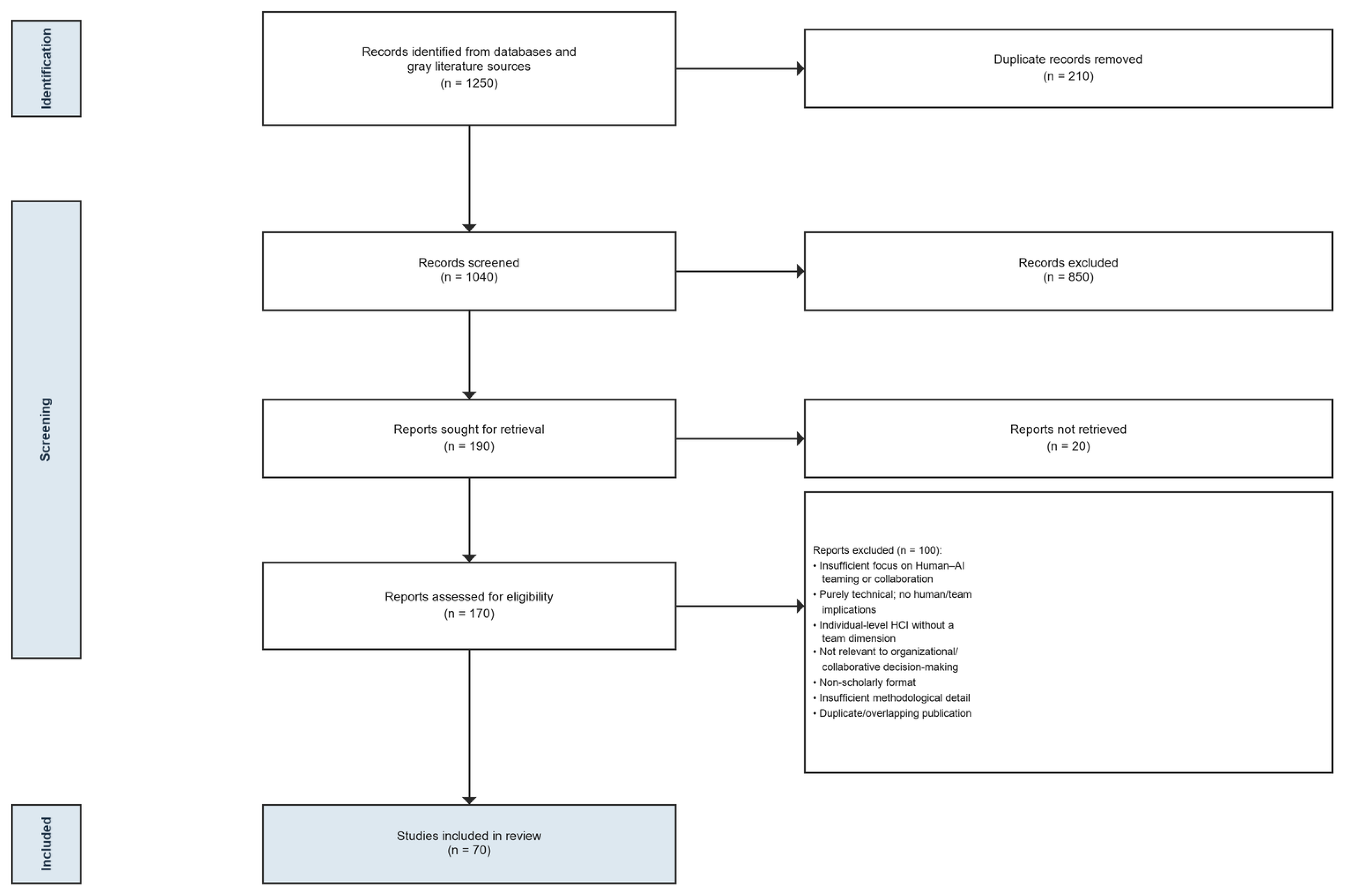
2. Methodology
2.1. Search and Appraisal
- Concept 1 (Explainable AI):“Explainable AI technique*” OR “X-AI” OR “XAI” OR “explain* AI” OR “AI explanation” OR “explanation user interface” OR (“explainable AI” N2 technique*).
- Concept 2 (Human–AI Teams):“Human-AI team*” OR (Human* N2 AI).
2.2. Screening Process
2.2.1. Stage 1: Title and Abstract Screening
- Did not focus on explainable AI or AI explanation mechanisms;
- Did not address human–AI collaboration, interaction, or teaming;
- Focused solely on technical algorithm development without human/team implications;
- Were unrelated to organizational, team, or collaborative contexts;
- Were non-scholarly materials (e.g., editorials, opinion pieces, book reviews).
2.2.2. Stage 2: Full-Text Screening
Inclusion Criteria
- Examined explainable AI, AI transparency, or AI explanation techniques.
- Addressed human–AI interaction, collaboration, or team-based contexts.
- Included empirical, conceptual, or theoretical contributions advancing understanding of human–AI teamwork.
- Were published in English.
- Were peer-reviewed journal articles, conference papers, or relevant scholarly dissertations.
- Were accessible (e.g., full text).
Exclusion Criteria
- Focused exclusively on algorithmic performance without human/team implications.
- Examined individual human–computer interaction without collaborative or team dimensions.
- Were purely technical engineering papers unrelated to organizational, behavioral, or team outcomes.
- Were non-peer-reviewed materials (unless included as relevant gray literature).
- Represented duplicate publications (in which case the most complete version was retained).
2.3. Data Extraction and Review Process
- Publication year and authors;
- Disciplinary field;
- Conceptualization of explainability;
- Team or collaboration context;
- Methodology (qualitative, quantitative, mixed methods, conceptual);
- Theoretical frameworks;
- Key findings related to human–AI collaboration (e.g., trust, decision-making, performance).
3. Review of the Literature
3.1. Definitions
3.2. Explainable Approaches
3.3. Explainable Techniques
3.3.1. X-AI at the Individual Level
3.3.2. X-AI Team/Group Level
3.3.3. Techniques at the Individual Level
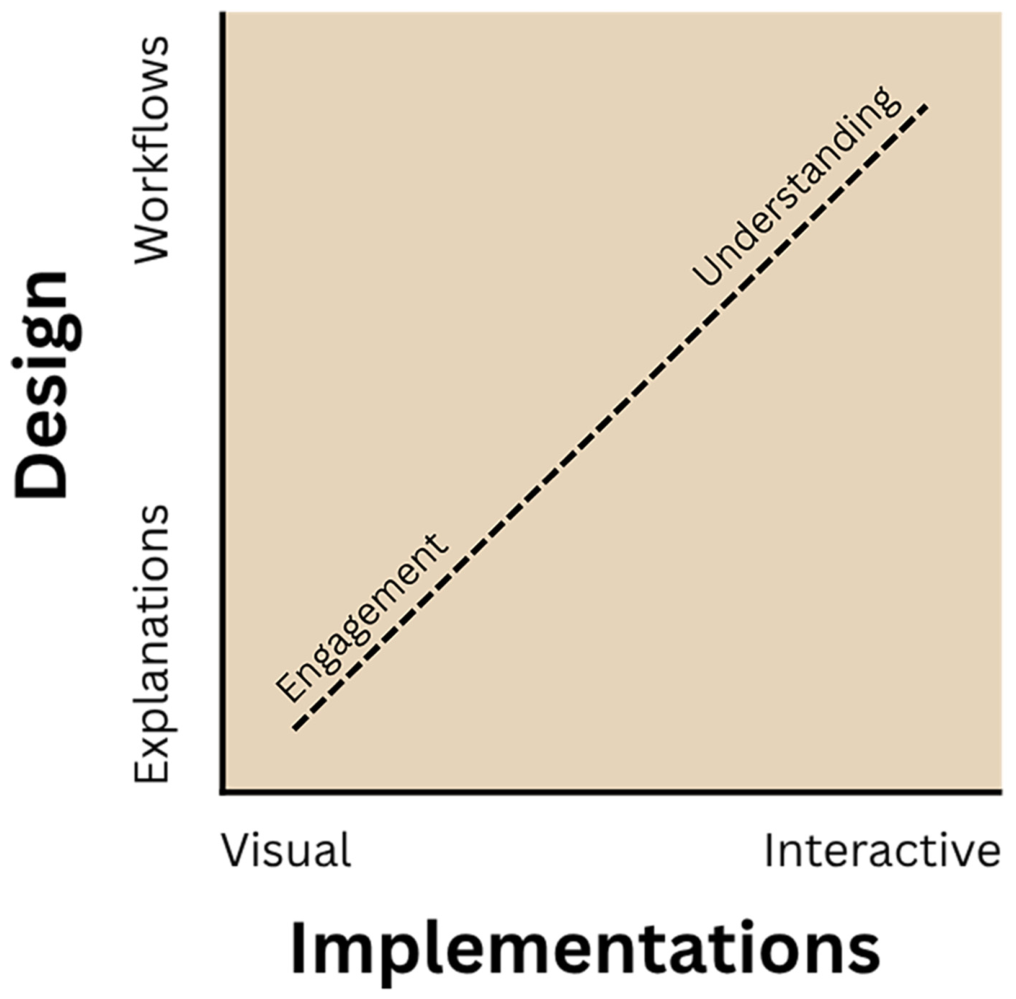
3.4. The Implementation-Design (I-D) Framework
3.4.1. Implementations
Visual
Saliency Maps
Interactive
3.4.2. Design
Explanations
Workflow
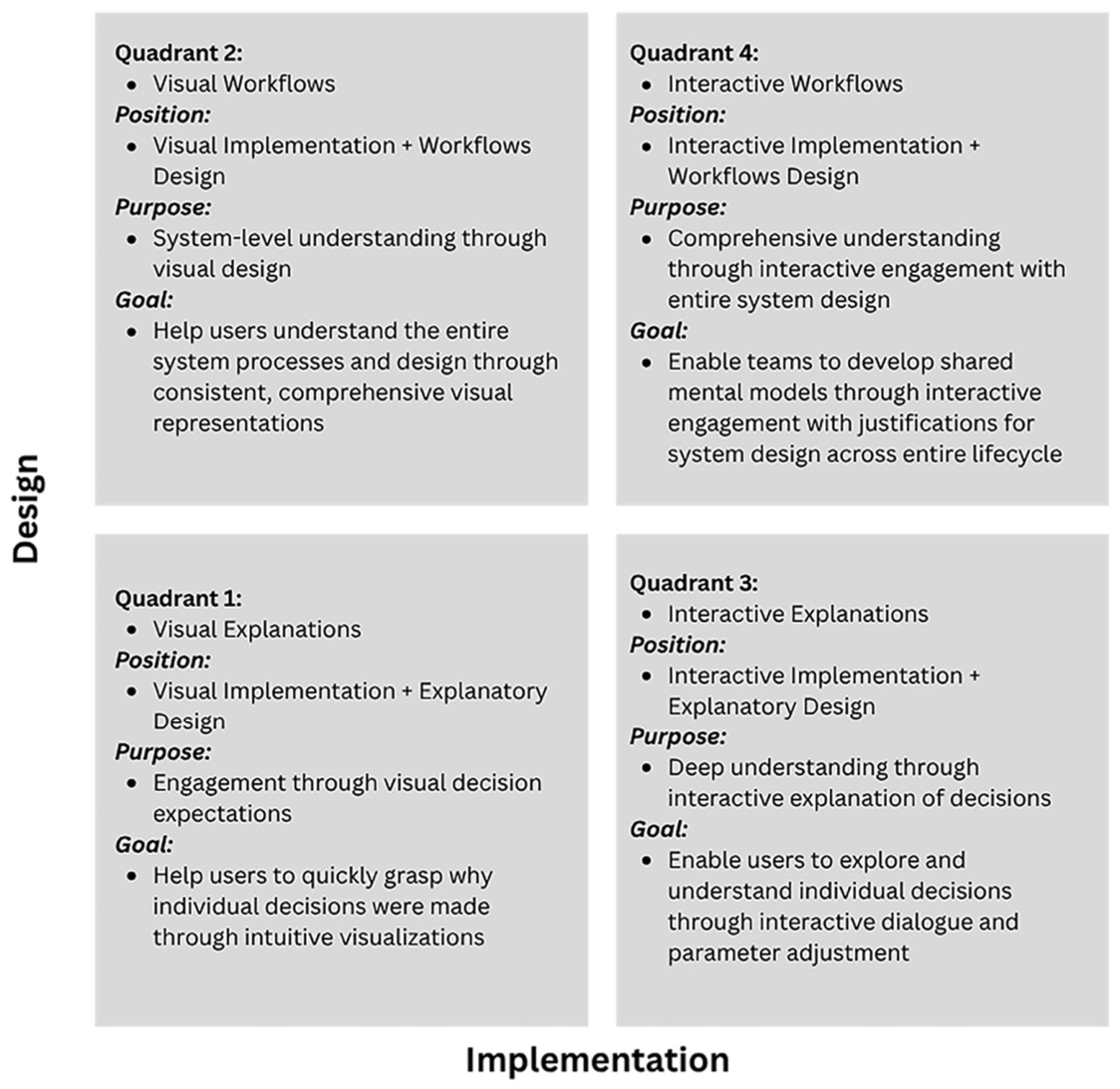
3.5. The Four Quadrants
3.5.1. X-AI Strategies for the Four Quadrants
3.5.2. Positioning the I-D Framework Among Existing Frameworks
4. Discussion
4.1. The I-D Framework to Support the Team Level of Analysis
4.2. From Individual Interpretability to Team Coordination
4.3. Explainability as an Interactional and Temporal Process
4.4. Designing for Human–AI Team Performance and Appropriate Reliance
4.5. Implications for Theory and Future Research
4.5.1. Team-Oriented Explainability
4.5.2. Distributed Cognition
4.5.3. Limitations and Status of the Framework
Supplementary Materials
Author Contributions
Funding
Data Availability Statement
Conflicts of Interest
Abbreviations
| AI | Artificial Intelligence |
| H-AI | Human Artificial Intelligence |
| X-AI | Explainable Artificial Intelligence |
References
- Nourani, M.; Roy, C.; Block, J.E.; Honeycutt, D.R.; Rahman, T.; Ragan, E.D.; Gogate, V. On the importance of user backgrounds and impressions: Lessons learned from interactive AI applications. ACM Trans. Interact. Intell. Syst. 2022, 12, 28. [Google Scholar] [CrossRef]
- Vössing, M.; Kühl, N.; Lind, M.; Satzger, G. Designing transparency for effective human-AI collaboration. Inf. Syst. Front. 2022, 24, 877–895. [Google Scholar] [CrossRef]
- Hauptman, A.I.; Schelble, B.G.; Duan, W.; Flathmann, C.; McNeese, N.J. Understanding the influence of AI autonomy on AI explainability levels in human-AI teams using a mixed methods approach. Cogn. Technol. Work 2024, 26, 435–455. [Google Scholar] [CrossRef]
- Kolajo, T.; Daramola, O. Human-centric and semantics-based explainable event detection: A survey. Artif. Intell. Rev. 2023, 56, 119–158. [Google Scholar] [CrossRef]
- McNeese, N.J.; Schelble, B.G.; Canonico, L.B.; Demir, M. Who/What Is my teammate? Team composition considerations in human-AI teaming. IEEE Trans. Hum. Mach. Syst. 2021, 51, 288–299. [Google Scholar] [CrossRef]
- Riedl, M.O. Human-centered artificial intelligence and machine learning. Hum. Behav. Emerg. Technol. 2019, 1, 33–36. [Google Scholar] [CrossRef]
- Spitzer, P.; Holstein, J.; Hemmer, P.; Vössing, M.; Kühl, N.; Martin, D.; Satzger, G. Human delegation behavior in human-AI collaboration: The effect of contextual information. Proc. ACM Hum. Comput. Interact. 2025, 9, CSCW101. [Google Scholar] [CrossRef]
- Westphal, M.; Hemmer, P.; Vössing, M.; Schemmer, M.; Vetter, S.; Satzger, G. Towards Understanding AI Delegation: The Role of Self-Efficacy and Visual Processing Ability. ACM Trans. Interact. Intell. Syst. 2025, 15, 5. [Google Scholar] [CrossRef]
- Amir, O.; Doshi-Velez, F.; Sarne, D. Summarizing agent strategies. Auton. Agents Multi-Agent Syst. 2019, 33, 628–644. [Google Scholar] [CrossRef]
- Gomez, C.; Unberath, M.; Huang, C.M. Mitigating knowledge imbalance in AI-advised decision-making through collaborative user involvement. Int. J. Hum.-Comput. Stud. 2023, 172, 102977. [Google Scholar] [CrossRef]
- Marrone, R.; Zamecnik, A.; Joksimovic, S.; Johnson, J.; De Laat, M. Understanding student perceptions of artificial intelligence as a teammate. Technol. Knowl. Learn. 2025, 30, 1847–1869. [Google Scholar] [CrossRef]
- Cabour, G.; Morales-Forero, A.; Ledoux, É.; Bassetto, S. An explanation space to align user studies with the technical development of Explainable AI. AI Soc. 2023, 38, 869–887. [Google Scholar] [CrossRef]
- Duan, W.; Zhou, S.W.; Scalia, M.J.; Yin, X.Y.; Weng, N.; Zhang, R.H.; Freeman, G.; McNeese, N.; Gorman, J.; Tolston, M. Understanding the evolvement of trust over time within human-AI teams. Proc. ACM Hum. Comput. Interact. 2024, 8, 521. [Google Scholar] [CrossRef]
- Hagras, H. Toward Human-Understandable, Explainable AI. Computer 2018, 51, 28–36. [Google Scholar] [CrossRef]
- Bienefeld, N.; Kolbe, M.; Camen, G.; Huser, D.; Buehler, P.K. Human-AI teaming: Leveraging transactive memory and speaking up for enhanced team effectiveness. Front. Psychol. 2023, 14, 1208019. [Google Scholar] [CrossRef] [PubMed]
- McNeese, N.J.; Demir, M.; Cooke, N.J.; She, M. Team situation awareness and conflict: A study of human–machine teaming. J. Cogn. Eng. Decis. Mak. 2021, 15, 83–96. [Google Scholar] [CrossRef]
- Schelble, B.G.; Flathmann, C.; Macdonald, J.P.; Knijnenburg, B.; Brady, C.; McNeese, N.J. Modeling perceived information needs in human-AI teams: Improving AI teammate utility and driving team cognition. Behav. Inf. Technol. 2025, 44, 2069–2092. [Google Scholar] [CrossRef]
- Shafiabady, N.; Akume, D.; Haghighat, M.; Ud Din, F.; Kabir, S.; Karim, A.; Zhou, J.; Alsharaydeh, E. Explainable AI for mortality prediction: A comparative study using the MIMIC-III dataset. BMJ Health Care Inform. 2026, 33, e101406. [Google Scholar] [CrossRef] [PubMed]
- Nguyen, P.A.; Din, F.U.; Krug, M.; Jones, R. Use of explainable AI (xAI) in dementia detection and prognosis: A scoping review. BMC Med. Inform. Decis. Mak. 2026, 26, 43. [Google Scholar] [CrossRef] [PubMed]
- Macaulay, A.; Din, F.U.; Nguyen, P.A.; Chiong, R.; Tully, P.J. Using explainable AI for assessment of depression: A systematic literature review. In Next-Gen Healthcare; Khalifa, N.E.M., Taha, M.H.N., Eds.; Springer: Berlin/Heidelberg, Germany, 2026. [Google Scholar]
- Hettikankanamage, N.; Shafiabady, N.; Chatteur, F.; Wu, R.M.X.; Ud Din, F.; Zhou, J. Explainable Artificial Intelligence (XAI): A Systematic Review for Unveiling the Black Box Models and Their Relevance to Biomedical Imaging and Sensing. Sensors 2025, 25, 6649. [Google Scholar] [CrossRef] [PubMed]
- Moustakidis, S.; Plakias, S.; Kokkotis, C.; Tsatalas, T.; Tsaopoulos, D. Predicting Football Team Performance with Explainable AI: Leveraging SHAP to Identify Key Team-Level Performance Metrics. Future Internet 2023, 15, 174. [Google Scholar] [CrossRef]
- Puram, P.; Roy, S.; Srivastav, D.; Gurumurthy, A. Understanding the effect of contextual factors and decision making on team performance in Twenty20 cricket: An interpretable machine learning approach. Ann. Oper. Res. 2023, 325, 261–288. [Google Scholar] [CrossRef]
- Silva-Aravena, F.; Núñez Delafuente, H.; Gutiérrez-Bahamondes, J.H.; Morales, J. A hybrid algorithm of ML and XAI to prevent breast cancer: A strategy to support decision making. Cancers 2023, 15, 2443. [Google Scholar] [CrossRef] [PubMed]
- Wulff, K.; Finnestrand, H. Creating meaningful work in the age of AI: Explainable AI, explainability, and why it matters to organizational designers. AI Soc. 2024, 39, 1843–1856. [Google Scholar] [CrossRef]
- Silva, A.; Schrum, M.; Hedlund-Botti, E.; Gopalan, N.; Gombolay, M. Explainable Artificial Intelligence: Evaluating the Objective and Subjective Impacts of xAI on Human-Agent Interaction. Int. J. Hum. Comput. Interact. 2023, 39, 1390–1404. [Google Scholar] [CrossRef]
- Senoner, J.; Schallmoser, S.; Kratzwald, B.; Feuerriegel, S.; Netland, T. Explainable AI improves task performance in human–AI collaboration. Sci. Rep. 2024, 14, 31150. [Google Scholar] [CrossRef] [PubMed]
- Taj, S.; Daudpota, S.M.; Imran, A.S.; Kastrati, Z. Aspect-based sentiment analysis for software requirements elicitation using fine-tuned bidirectional encoder representations from transformers and explainable artificial intelligence. Eng. Appl. Artif. Intell. 2025, 151, 110632. [Google Scholar] [CrossRef]
- Subramanian, H.V.; Canfield, C.; Shank, D.B. Designing explainable AI to improve human-AI team performance: A medical stakeholder-driven scoping review. Artif. Intell. Med. 2024, 149, 102780. [Google Scholar] [CrossRef] [PubMed]
- Barredo Arrieta, A.; Díaz-Rodríguez, N.; Del Ser, J.; Bennetot, A.; Tabik, S.; Barbado, A.; Garcia, S.; Gil-Lopez, S.; Molina, D.; Benjamins, R.; et al. Explainable artificial intelligence (XAI): Concepts, taxonomies, opportunities and challenges toward responsible AI. Inf. Fusion 2020, 58, 82–115. [Google Scholar] [CrossRef]
- Tabrez, A.; Leonard, R.; Hayes, B. Single-shot policy explanation to improve task performance via semantic reward coaching. Neural Comput. Appl. 2025, 37, 22315–22337. [Google Scholar] [CrossRef]
- Garibay, O.O.; Winslow, B.; Andolina, S.; Antona, M.; Bodenschatz, A.; Coursaris, C.; Falco, G.; Fiore, S.M.; Garibay, I.; Grieman, K.; et al. Six Human-Centered Artificial Intelligence Grand Challenges. Int. J. Hum. Comput. Interact. 2023, 39, 391–437. [Google Scholar] [CrossRef]
- Perlmutter, M.; Gifford, R.; Krening, S. Impact of example-based XAI for neural networks on trust, understanding, and performance. Int. J. Hum. Comput. Stud. 2024, 188, 103277. [Google Scholar] [CrossRef]
- Liberati, A.; Altman, D.G.; Tetzlaff, J.; Mulrow, C.; Gotzsche, P.C.; Ioannidis, J.P.A.; Clarke, M.; Devereaux, P.J.; Kleijnen, J.; Moher, D. The PRISMA statement for reporting systematic reviews and meta-analyses of studies that evaluate health care interventions: Explanation and elaboration. PLoS Med. 2009, 339, b2700. [Google Scholar] [CrossRef]
- Page, M.J.; McKenzie, J.E.; Bossuyt, P.M.; Boutron, I.; Hoffmann, T.C.; Mulrow, C.D.; Shamseer, L.; Tetzlaff, J.M.; Akl, E.A.; Brennan, S.E.; et al. The PRISMA 2020 statement: An updated guideline for reporting systematic reviews. Syst. Rev. 2021, 10, 89. [Google Scholar] [CrossRef] [PubMed]
- Booth, A.; Martyn-St James, M.; Clowes, M.; Sutton, A. Systematic Approaches to a Successful Literature Review; Sage: Newcastle upon Tyne, UK, 2021. [Google Scholar]
- Cheng, C.S.; Behzadan, A.H.; Noshadravan, A. Uncertainty-aware convolutional neural network for explainable artificial intelligence-assisted disaster damage assessment. Struct. Control Health Monit. 2022, 29, e3019. [Google Scholar] [CrossRef]
- Tabrez, A.; Agrawal, S.; Hayes, B. Explanation-based reward coaching to improve human performance via reinforcement learning. In Proceedings of the 2019 14th ACM/IEEE International Conference on Human-Robot Interaction (HRI), Daegu, Republic of Korea, 11–14 March 2019; pp. 249–257. [Google Scholar] [CrossRef]
- Paleja, R.; Ghuy, M.; Arachchige, N.R.; Jensen, R.; BGombolay, M. The utility of explainable AI in ad hoc human-machine teaming. In Proceedings of the 35th Conference on Neural Information Processing Systems (NeurIPS 2021), Atlanta, GA, USA, 6–14 December 2021. [Google Scholar]
- Endsley, M.R. Supporting human-AI teams: Transparency, explainability, and situation awareness. Comput. Hum. Behav. 2023, 140, 107574. [Google Scholar] [CrossRef]
- Mylrea, M.; Robinson, N. Artificial intelligence (AI) trust framework and maturity model: Applying an entropy lens to improve security, privacy, and ethical AI. Entropy 2023, 25, 1429. [Google Scholar] [CrossRef] [PubMed]
- Coussement, K.; Abedin, M.Z.; Kraus, M.; Maldonado, S.; Topuz, K. Explainable AI for enhanced decision-making. Decis. Support Syst. 2024, 184, 114276. [Google Scholar] [CrossRef]
- Morrison, K.; Spitzer, P.; Turri, V.; Feng, M.; Kühl, N.; Perer, A. The impact of imperfect XAI on human-AI decision-making. Proc. ACM Hum. Comput. Interact. 2024, 8, 183. [Google Scholar] [CrossRef]
- Mohseni, S.; Zarei, N.; Ragan, E.D. A multidisciplinary survey and framework for design and evaluation of explainable AI systems. ACM Trans. Interact. Intell. Syst. 2021, 11, 24. [Google Scholar] [CrossRef]
- Fernando, N.; Nakisa, B.; Ahmad, A.; Rastgoo, M.N. Adaptive XAI in high stakes environments: Modeling swift trust with multimodal feedback in human AI teams. arXiv 2025, arXiv:2507.21158. [Google Scholar]
- Merry, M.; Riddle, P.; Warren, J. A mental models approach for defining explainable artificial intelligence. BMC Med. Inform. Decis. Mak. 2021, 21, 344. [Google Scholar] [CrossRef] [PubMed]
- McGovern, A.; Gagne Ii, D.J.; Wirz, C.D.; Ebert-Uphoff, I.; Bostrom, A.; Rao, Y.; Schumacher, A.; Flora, M.; Chase, R.; Mamalakis, A.; et al. Trustworthy Artificial Intelligence for Environmental Sciences. Bull. Am. Meteorol. Soc. 2023, 104, E1222–E1231. [Google Scholar] [CrossRef]
- Sadeghi, Z.; Alizadehsani, R.; Cifci, M.A.; Kausar, S.; Rehman, R.; Mahanta, P.; Bora, P.K.; Almasri, A.; Alkhawaldeh, R.S.; Hussain, S.; et al. A review of Explainable Artificial Intelligence in healthcare. Comput. Electr. Eng. 2024, 118, 109370. [Google Scholar] [CrossRef]
- Zhang, R.; Duan, W.; Flathmann, C.; McNeese, N.; Freeman, G.; Williams, A. Investigating AI Teammate Communication Strategies and Their Impact in Human-AI Teams for Effective Teamwork. Proc. ACM Hum. Comput. Interact. 2023, 7, 281. [Google Scholar] [CrossRef]
- Zhang, G.L.; Chong, L.; Kotovsky, K.; Cagan, J. Trust in an AI versus a Human teammate: The effects of teammate identity and performance on Human-AI cooperation. Comput. Hum. Behav. 2023, 139, 107536. [Google Scholar] [CrossRef]
- Andrews, R.W.; Lilly, J.M.; Srivastava, D.; Feigh, K.M. The role of shared mental models in human-AI teams: A theoretical review. Theor. Issues Ergon. Sci. 2022, 24, 129–175. [Google Scholar] [CrossRef]
- Eisbach, S.; Mai, O.; Hertel, G. Combining theoretical modelling and machine learning approaches: The case of teamwork effects on individual effort expenditure. New Ideas Psychol. 2024, 73, 101077. [Google Scholar] [CrossRef]
- Chraibi Kaadoud, I.; Bennetot, A.; Mawhin, B.; Charisi, V.; Díaz-Rodríguez, N. Explaining Aha! moments in artificial agents through IKE-XAI: Implicit Knowledge Extraction for eXplainable AI. Neural Netw. 2022, 155, 95–118. [Google Scholar] [CrossRef] [PubMed]
- Yiu, C.Y.; Ng, K.K.H.; Li, X.; Zhang, X.; Li, Q.; Lam, H.S.; Chong, M.H. Towards safe and collaborative aerodrome operations: Assessing shared situational awareness for adverse weather detection with EEG-enabled Bayesian neural networks. Adv. Eng. Inform. 2022, 53, 101698. [Google Scholar] [CrossRef]
- Bansal, G.; Wu, T.; Zhou, J.; Fok, R.; Nushi, B.; Kamar, E.; Ribeiro, M.T.; Weld, D. Does the whole exceed its parts? The effect of AI explanations on complementary team performance. In Proceedings of the 2021 CHI Conference on Human Factors in Computing Systems, Yokohama, Japan, 8–13 May 2021; pp. 1–16. [Google Scholar] [CrossRef]
- Jia, S.C.; Li, Z.Y.; Chen, N.; Zhang, J.W. Towards visual explainable active learning for zero-shot classification. IEEE Trans. Vis. Comput. Graph. 2022, 28, 791–801. [Google Scholar] [CrossRef] [PubMed]
- Hemmer, P.; Schemmer, M.; Kuhl, N.; Vossing, M.; Satzger, G. On the effect of information asymmetry in human-AI teams. In Proceedings of the Conference on Human Factors in Computing Systems (CHI 2022), New Orleans, LA, USA, 29 April–5 May 2022. [Google Scholar]
- Sanneman, L.; Shah, J.A. Validating metrics for reward alignment in human-autonomy teaming. Comput. Hum. Behav. 2023, 146, 107809. [Google Scholar] [CrossRef]
- Pacia, D.M.; Ravitsky, V.; Hansen, J.N.; Lundberg, E.; Schulz, W.; Bélisle-Pipon, J.-C. Early AI lifecycle co-reasoning: Ethics through integrated and diverse team science. Am. J. Bioeth. 2024, 24, 86–88. [Google Scholar] [CrossRef] [PubMed]
- Sanneman, L.; Shah, J.A. The situation awareness framework for explainable AI (SAFE-AI) and human factors considerations for XAI systems. Int. J. Hum. Comput. Interact. 2022, 38, 1772–1788. [Google Scholar] [CrossRef]
- Gunning, D.; Aha, D.W. DARPA’s explainable artificial intelligence program. AI Mag. 2019, 40, 44–58. [Google Scholar] [CrossRef]
- Richter, A.; Schwabe, G. “There is No ‘AI’ in ‘TEAM’! or is there?”—Towards meaningful human-AI collaboration. Australas. J. Inf. Syst. 2025, 29, 1–11. [Google Scholar] [CrossRef]
- Le Guillou, M.; Prevot, L.; Berberian, B. Bringing together ergonomic concepts and cognitive mechanisms for human-AI agents cooperation. Int. J. Hum. Comput. Interact. 2023, 39, 1827–1840. [Google Scholar] [CrossRef]
- Federico, C.; Campagner, A.; Simone, C. The need to move away from agential-AI: Empirical investigations, useful concepts and open issues. Int. J. Hum.-Comput. Stud. 2021, 155, 102696. [Google Scholar] [CrossRef]
- Hemmer, P.; Schemmer, M.; Vössing, M.; Kühl, N. Human-AI Complementarity in Hybrid Intelligence Systems: A Structured Literature Review. In Proceedings of the Pacific Asia Conference on Information Systems (PACIS), Dubai, United Arab Emirates, 12–14 July 2021; pp. 1–14. [Google Scholar]
- Herrmann, T.; Pfeiffer, S. Keeping the organization in the loop: A socio-technical extension of human-centered artificial intelligence. AI Soc. 2023, 38, 1523–1542. [Google Scholar] [CrossRef]
- Mallick, R.; Flathmann, C.; Duan, W.; Schelble, B.G.; McNeese, N.J. What you say vs what you do: Utilizing positive emotional expressions to relay AI teammate intent within human-AI teams. Int. J. Hum.-Comput. Stud. 2024, 192, 103355. [Google Scholar] [CrossRef]
- Liang, Q.Y.; Gou, J.Q.; Wang, Z.; Dabic, M. Affordances and constraints of automation and augmentation: Lessons learned from development of a human-AI collaboration business simulation platform. J. Glob. Inf. Manag. 2024, 32, 1–27. [Google Scholar] [CrossRef]
- Umme, H.; Habib, M.K.; Bogner, J.; Fritzsch, J.; Wagner, S. How do ML practitioners perceive explainability? an interview study of practices and challenges. Empir. Softw. Eng. 2025, 30, 18. [Google Scholar] [CrossRef]
- Li, J.; Yeo, R.K. Artificial intelligence and human integration: A conceptual exploration of its influence on work processes and workplace learning. Hum. Resour. Dev. Int. 2024, 27, 367–387. [Google Scholar] [CrossRef]
- Jiehuang, Z.; Han, Y. EID: Facilitating explainable AI design discussions in team-based settings. Int. J. Crowd Sci. 2023, 7, 47–54. [Google Scholar] [CrossRef]
- Gomez, C.; Wang, R.; Breininger, K.; Casey, C.; Bradley, C.; Pavliak, M.; Pham, A.; Yohannan, J.; Unberath, M. Explainable AI enhances glaucoma referrals, yet the human-AI team still falls short of the AI alone. arXiv 2024, arXiv:1904.09829. [Google Scholar] [CrossRef]
- Tummala, V.S.; Burris-Melville, T.S.; Eskridge, T.C. AI as a team member: Redefining collaboration. J. Leadersh. Stud. 2025, 18, 67–80. [Google Scholar] [CrossRef]
- Gajcin, J.; Dusparic, I. Redefining Counterfactual Explanations for Reinforcement Learning: Overview, Challenges and Opportunities. ACM Comput. Surv. 2024, 56, 219. [Google Scholar] [CrossRef]
- Montealegre-López, N. Exploring the role of trust in AI-driven decision-making: A systematic literature review. Manag. Rev. Q. 2025. [Google Scholar] [CrossRef]
- Ren, Y.Q.; Deng, X.F.; Joshi, K.D. Unpacking human and AI complementarity: Insights from recent works. Data Base Adv. Inf. Syst. 2023, 54, 6–10. [Google Scholar] [CrossRef]
- Chen, A.H.; Lyu, A.R.; Lu, Y.B. Member’s performance in human-AI hybrid teams: A perspective of adaptability theory. Inf. Technol. People 2024, 39, 157–177. [Google Scholar] [CrossRef]
- Zheng, X.; Lu, J.; Kiritsis, D. The emergence of cognitive digital twin: Vision, challenges and opportunities. Int. J. Prod. Res. 2022, 60, 7610–7632. [Google Scholar] [CrossRef]
- Liu, Y.; Ji, T.; Guo, X.; Xu, X.; Polzer, J. A survey of cognitive digital twin and the potential use of LLMs. Manuf. Lett. 2025, 44, 1242–1253. [Google Scholar] [CrossRef]



| Category (Dimension) | Operational Definition | Classification Cues | Exemplar Study(ies) |
|---|---|---|---|
| Visual (Implementation) | Explainability delivered through static graphical representations of model behavior that support perceptual access and interpretation. | Saliency/attention maps, SHAP or feature-importance plots, partial dependence plots, decision-tree diagrams; user views but cannot manipulate the explanation. | [22,37] |
| Interactive (Implementation) | Explainability enacted through user participation, allowing users to query, manipulate, or contest explanations during task execution. | Counterfactual re-runs, parameter adjustment, on-demand or dialogic explanation, what-if exploration. | [38,39] |
| Explanation (Design) | Design oriented toward discrete, isolated accounts of specific outputs or predictions for end users. | Post-hoc feature attribution or example-based rationales delivered as standalone artifacts. | [26,33] |
| Workflow (Design) | Design that embeds explainability within decision processes, coordination structures, and the AI lifecycle over time. | Task/requirements analysis, timing- and role-aligned delivery, governance or maturity processes. | [40,41] |
| Technique | Context | Approach | Source |
|---|---|---|---|
| Case Based, Counterfactual, Decision Tree, Feature Importance | Virtual agents | Post hoc | [26] |
| IKE-XAI | Child development | Post hoc | [53] |
| SHAP, ICE, LIME | Decision-making | Post hoc | [42] |
| SHAP, LIME, ASTRID, G-Rex | Health education | Post hoc | [12] |
| Nonspecific | Hospitality | Post hoc | [2] |
| User-oriented visualizations, interfaces, and toolkits | Software development | Post hoc | [25] |
| Saliency Maps | Event detection | Model-specific | [4] |
| ICE, PDP | Event detection | Model-agnostic | [4] |
| Example-based Explanations | Energy sector | Local | [33] |
| LIME | Software engineering | Local | [28] |
| LIME, SHAP | Event detection | Local | [4] |
| The Distillation Technique; Propagation, Gradient, & Occlusion | Event detection | Global | [28] |
| SHAP | Decision support, aviation safety | Post hoc, model-agnostic | [54] |
| LIME | Team | Post hoc, local | [55] |
| Feature Importance Analysis | Framework development | Global or local | [41] |
| Attention Visualization | N/A | Local, model-specific | [41] |
| Decision Tree | Human–machine team | Ante hoc, local, global | [39] |
| SPEAR | Decision-making | Post hoc, model-specific, local | [38] |
| Counterfactual Analysis, Model Distillation | N/A | Post hoc, model-agnostic, local | [41] |
| SHAP | Sports | Post hoc, local, global | [22] |
| LIME, SHAP | N/A | Post hoc, local, global | [41] |
| IML | Sports | Post hoc, local, global | [23] |
| Quadrant | Strategy |
|---|---|
| Q1: Visual Explanations | Add visualization layer to existing model |
| Generate saliency maps, feature importance plots | |
| Create attention mechanism visualizations | |
| Design intuitive visual representations | |
| Q2: Visual Workflows | Design unified visual language for system |
| Create visualization ecosystem | |
| Document system processes visually | |
| Establish design standards for transparency | |
| Integrate visualizations throughout user experience | |
| Q3: Interactive Explanations | Implement interactive explanatory tools |
| Enable parameter adjustment and re-runs | |
| Support question-answering about decisions | |
| Create dialogue interfaces | |
| Adapt explanations to user inputs | |
| Q4: Interactive Workflows | Build justificatory explanation systems |
| Enable team dialogue about design assumptions | |
| Create shared visual representations | |
| Implement shared mental model development processes | |
| Support team learning behaviors |
| Framework | Primary Focus | Unit of Analysis | What It Organizes | Relation to I-D Framework |
|---|---|---|---|---|
| SAFE-AI [60] | Aligning XAI with situation-awareness requirements | Individual operator | SA-based information requirements for explanations | SA requirements map onto the I-D workflow (design) dimension |
| Endsley [40] | Transparency, explainability, and SA for human–AI teams | Individual and team | Cognitive requirements for observable, predictable AI | I-D operationalizes these requirements as implementation and design choices |
| Mohseni et al. [44] | Multidisciplinary design and evaluation of XAI | Individual (audience-specific) | Design goals and evaluation measures by audience | Shares audience sensitivity; I-D adds the implementation × design axes |
| XAI taxonomy [30] | Classifying explanation methods | Model-centric | Ante/post hoc, local/global, model-specific/-agnostic | Orthogonal: provenance of explanations vs. their operationalization |
| I-D framework (this study) | Operationalizing explainability for engagement and understanding | Individual to team | Implementation (visual↔interactive) × design (explanation↔workflow) | Integrating scheme proposed in this review |
Disclaimer/Publisher’s Note: The statements, opinions and data contained in all publications are solely those of the individual author(s) and contributor(s) and not of MDPI and/or the editor(s). MDPI and/or the editor(s) disclaim responsibility for any injury to people or property resulting from any ideas, methods, instructions or products referred to in the content. |
© 2026 by the authors. Licensee MDPI, Basel, Switzerland. This article is an open access article distributed under the terms and conditions of the Creative Commons Attribution (CC BY) license.
Share and Cite
Turner, J.; Parvaneh Shirazi, H.; Kim, H.; Du, J.; Jung, Y.; Xu, X. X-AI Techniques for Human–AI Teams: The Implementation-Design Framework. Systems 2026, 14, 862. https://doi.org/10.3390/systems14070862
Turner J, Parvaneh Shirazi H, Kim H, Du J, Jung Y, Xu X. X-AI Techniques for Human–AI Teams: The Implementation-Design Framework. Systems. 2026; 14(7):862. https://doi.org/10.3390/systems14070862
Chicago/Turabian StyleTurner, John, Hoda Parvaneh Shirazi, Heesun Kim, Jiajia Du, Yeonji Jung, and Xiaoyan Xu. 2026. "X-AI Techniques for Human–AI Teams: The Implementation-Design Framework" Systems 14, no. 7: 862. https://doi.org/10.3390/systems14070862
APA StyleTurner, J., Parvaneh Shirazi, H., Kim, H., Du, J., Jung, Y., & Xu, X. (2026). X-AI Techniques for Human–AI Teams: The Implementation-Design Framework. Systems, 14(7), 862. https://doi.org/10.3390/systems14070862