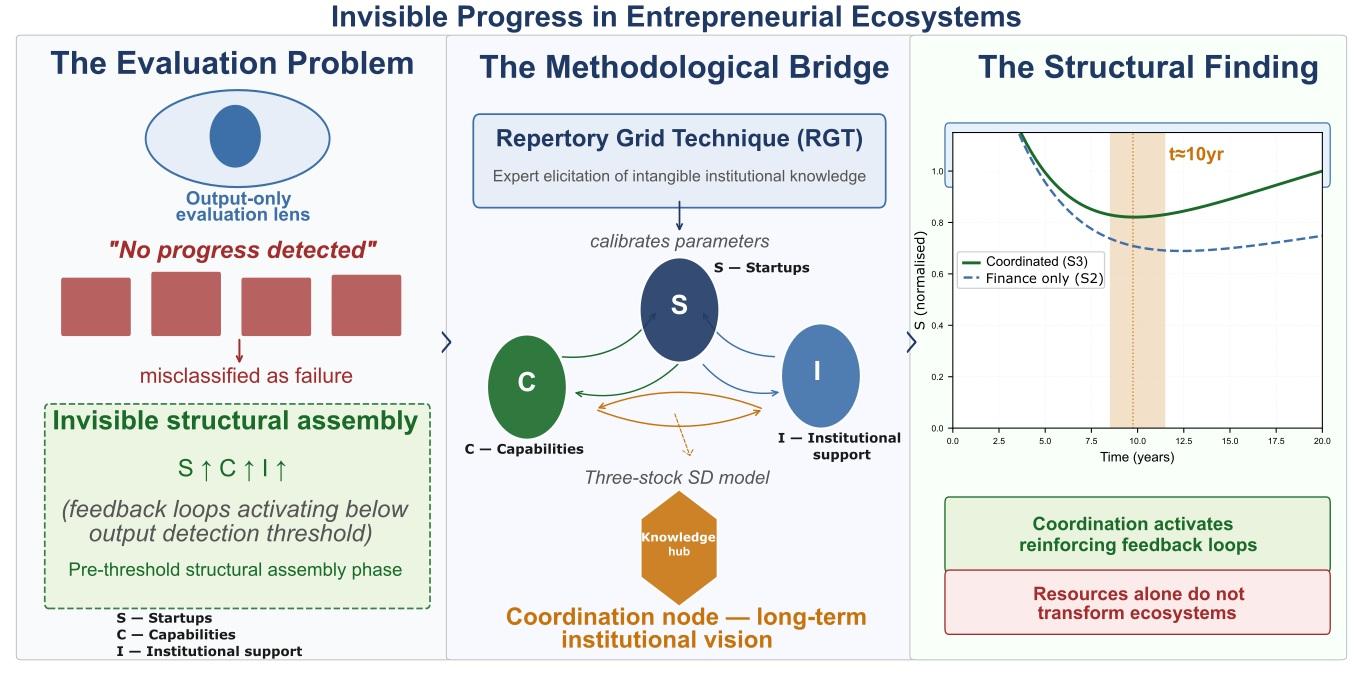
Invisible Progress in Entrepreneurial Ecosystems: Coordination Thresholds, Feedback Dominance, and the Structural Blind Spots of Policy Evaluation


Abstract
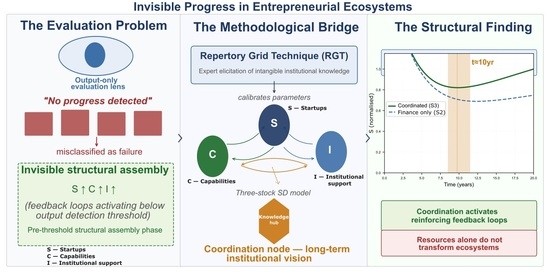
1. Introduction
2. Literature Review
2.1. Entrepreneurial Ecosystems as Feedback-Driven Systems
2.2. The Structural Role of Universities in Ecosystem Feedback
2.3. System Dynamics as a Framework for Ecosystem Feedback Analysis
2.4. Research Gap and Contribution
3. Research Design and Model Structure
3.1. Methodological Approach and Calibration Logic
3.2. Model Boundary and Stock Structure
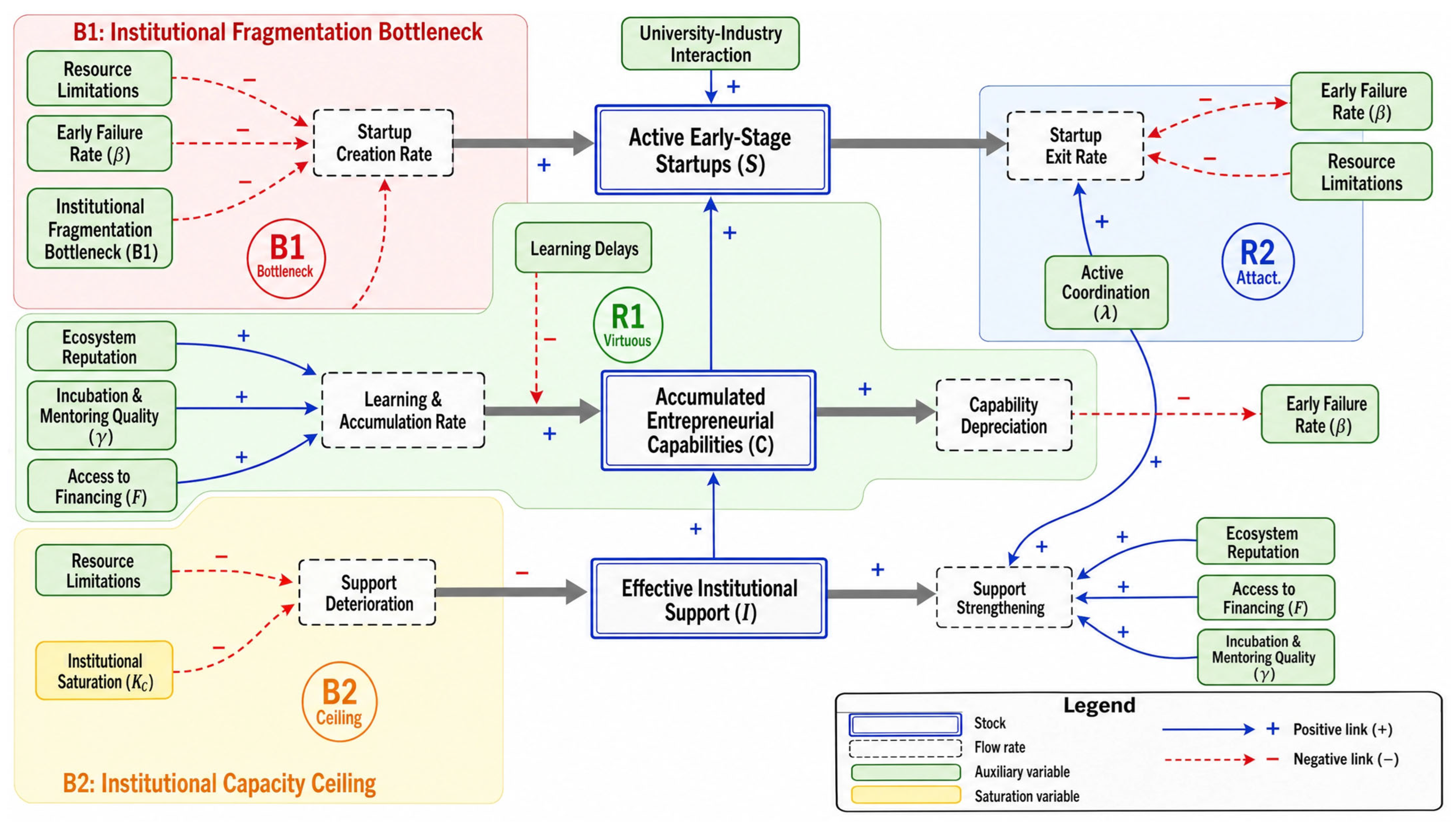
3.3. Feedback Loop Architecture
3.4. Validation and Robustness Strategy
3.5. Scenario Design
3.6. Comparative Parameterisation
4. Results
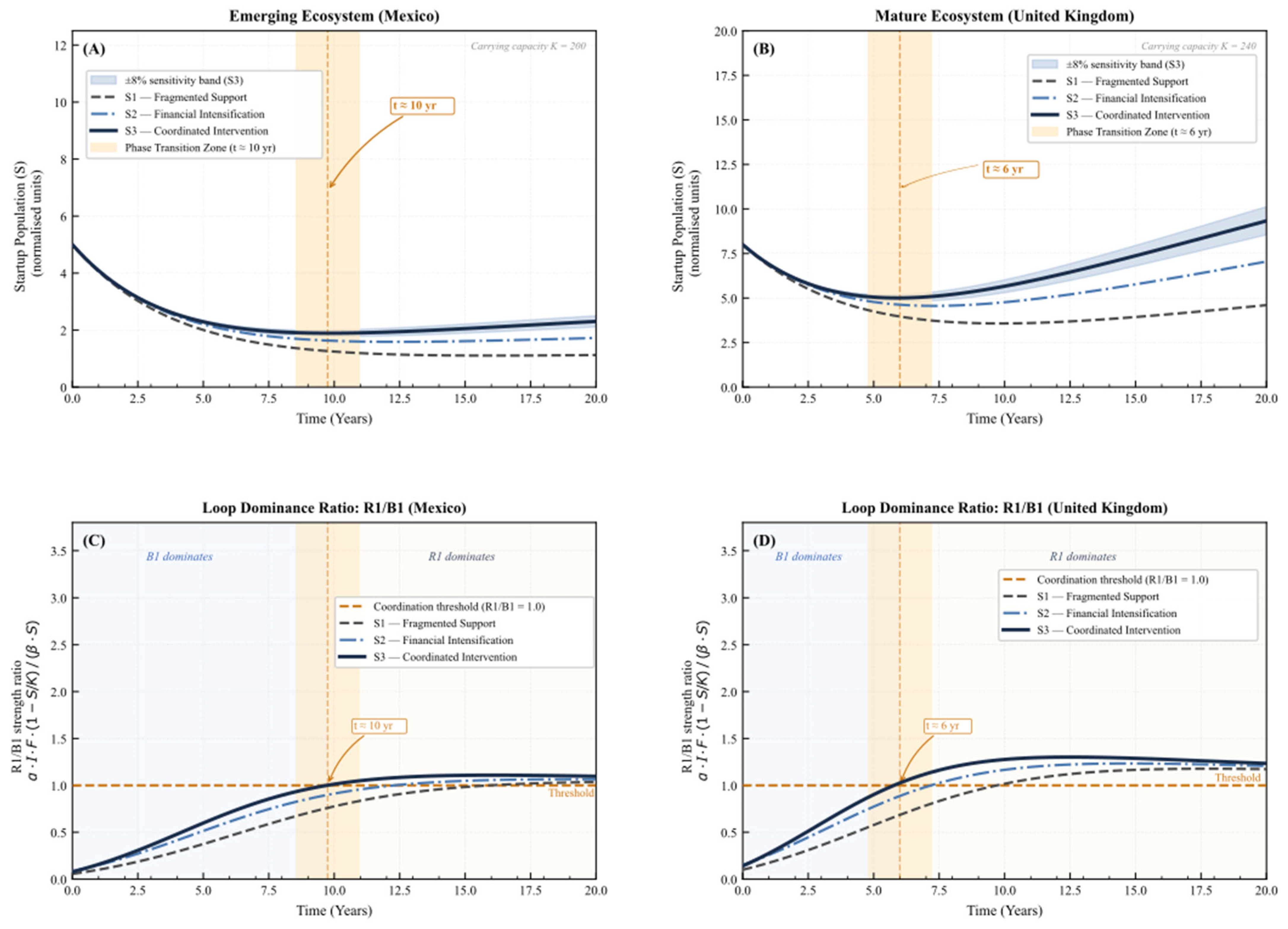
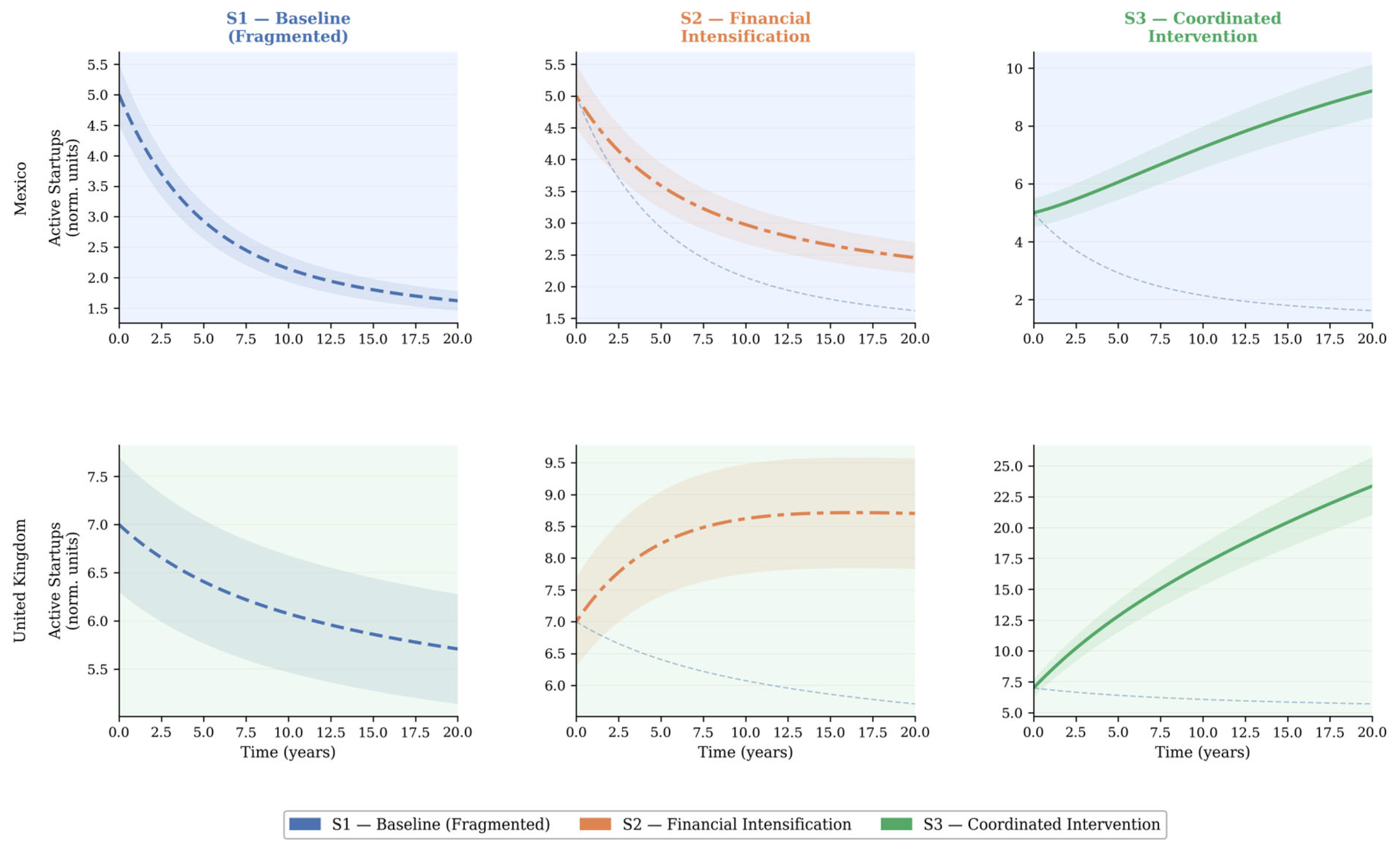
4.1. Startup Population Dynamics Under Three Scenarios
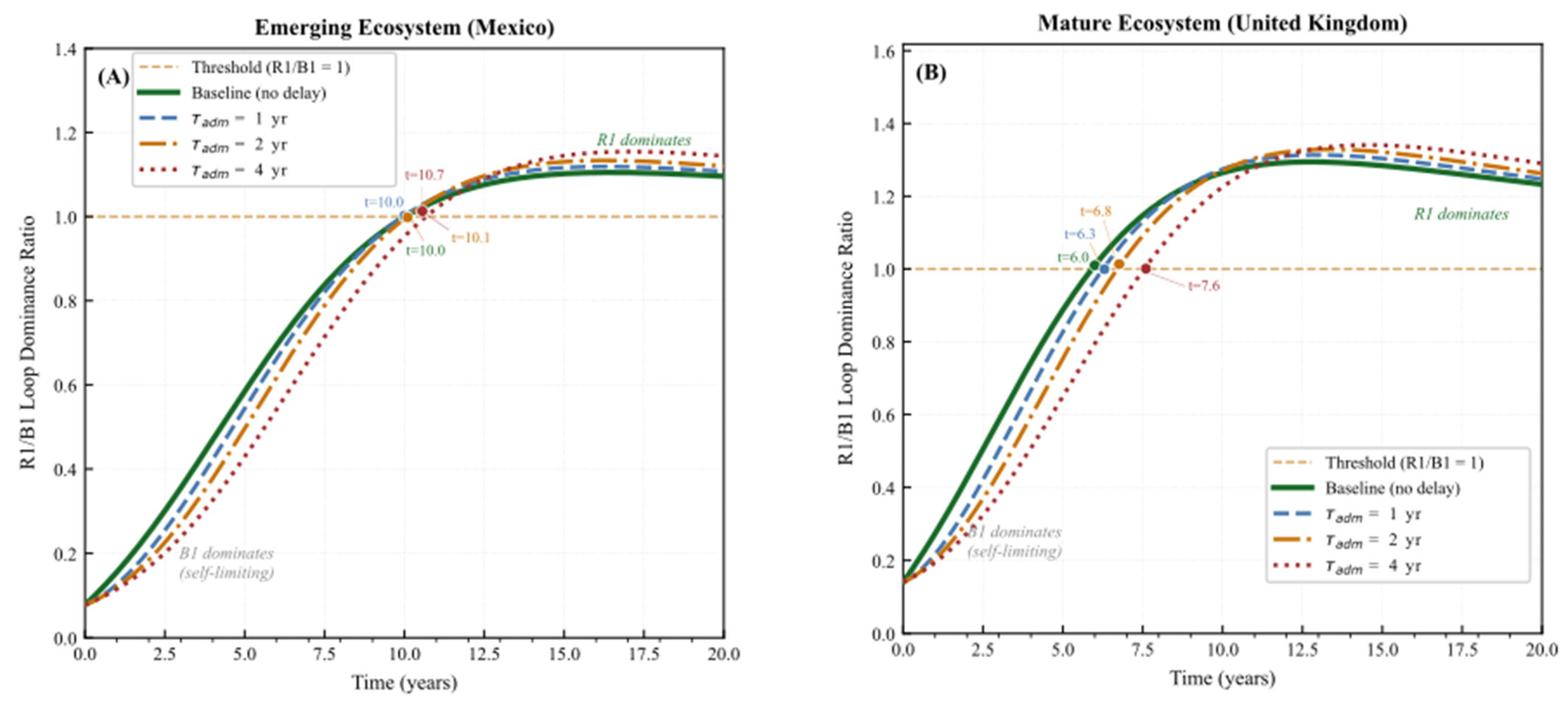
4.2. Coordination Threshold, Loop Dominance Transition, and Phase-State Analysis
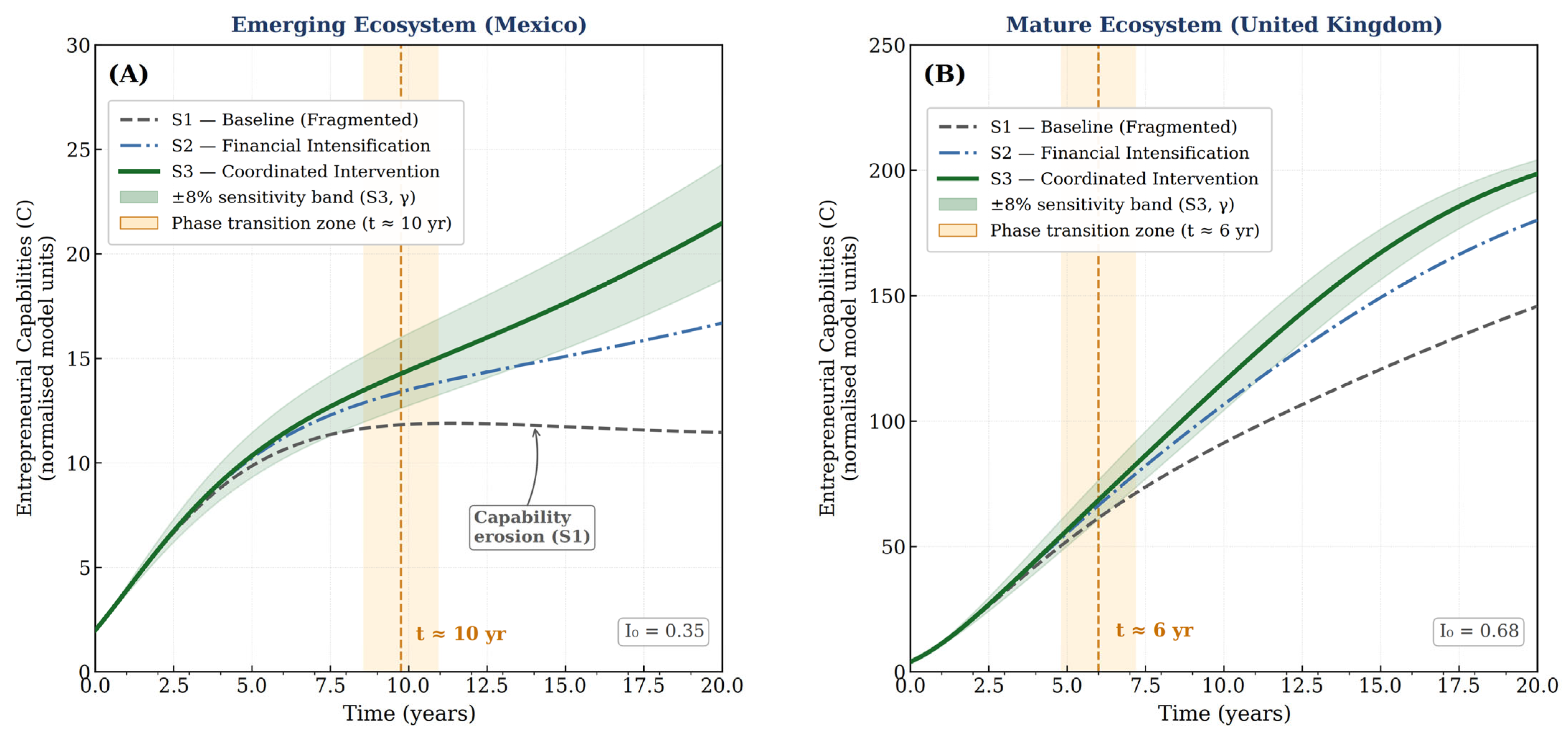
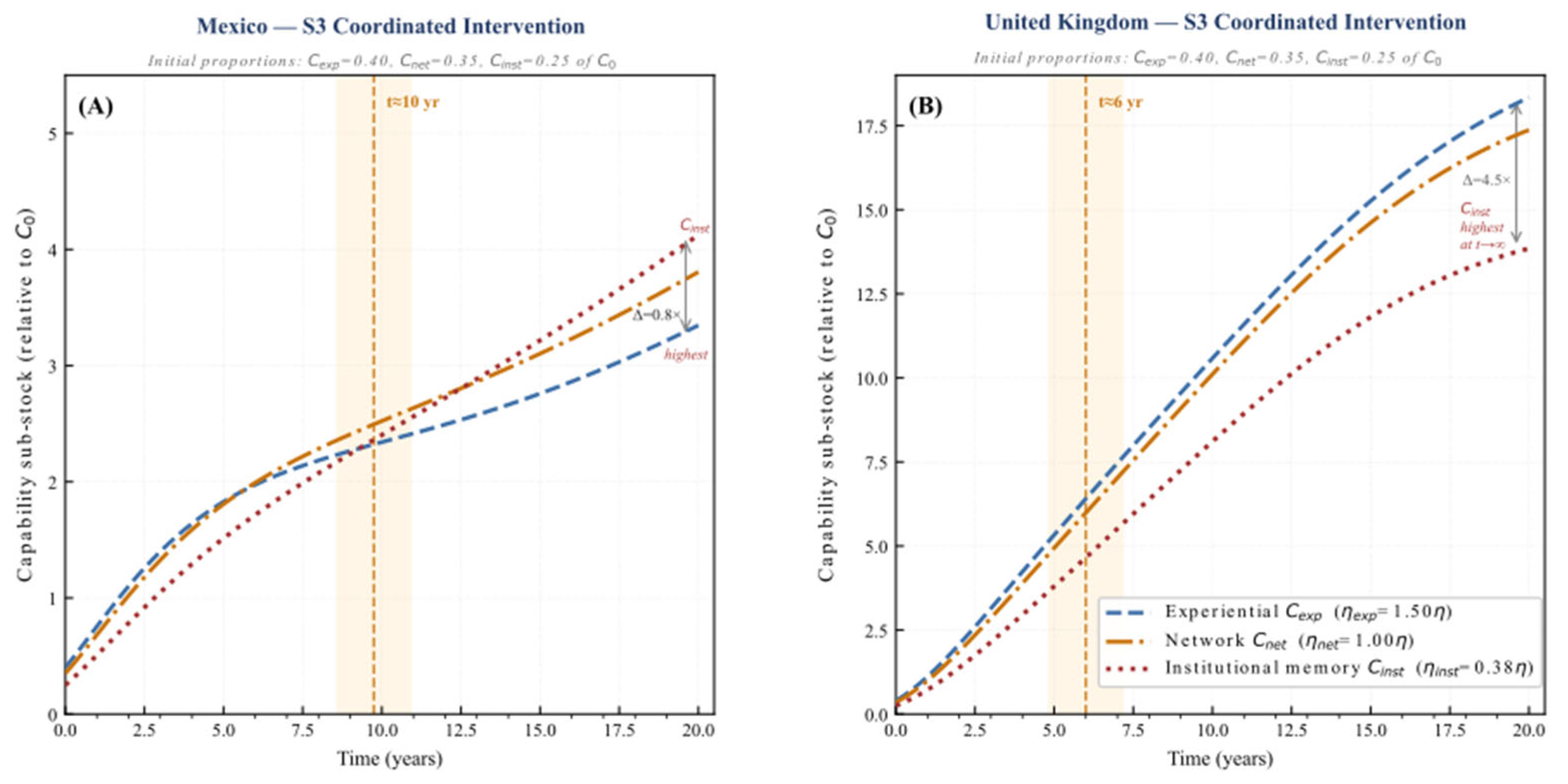
4.3. Entrepreneurial Capability Accumulation and Learning Delays
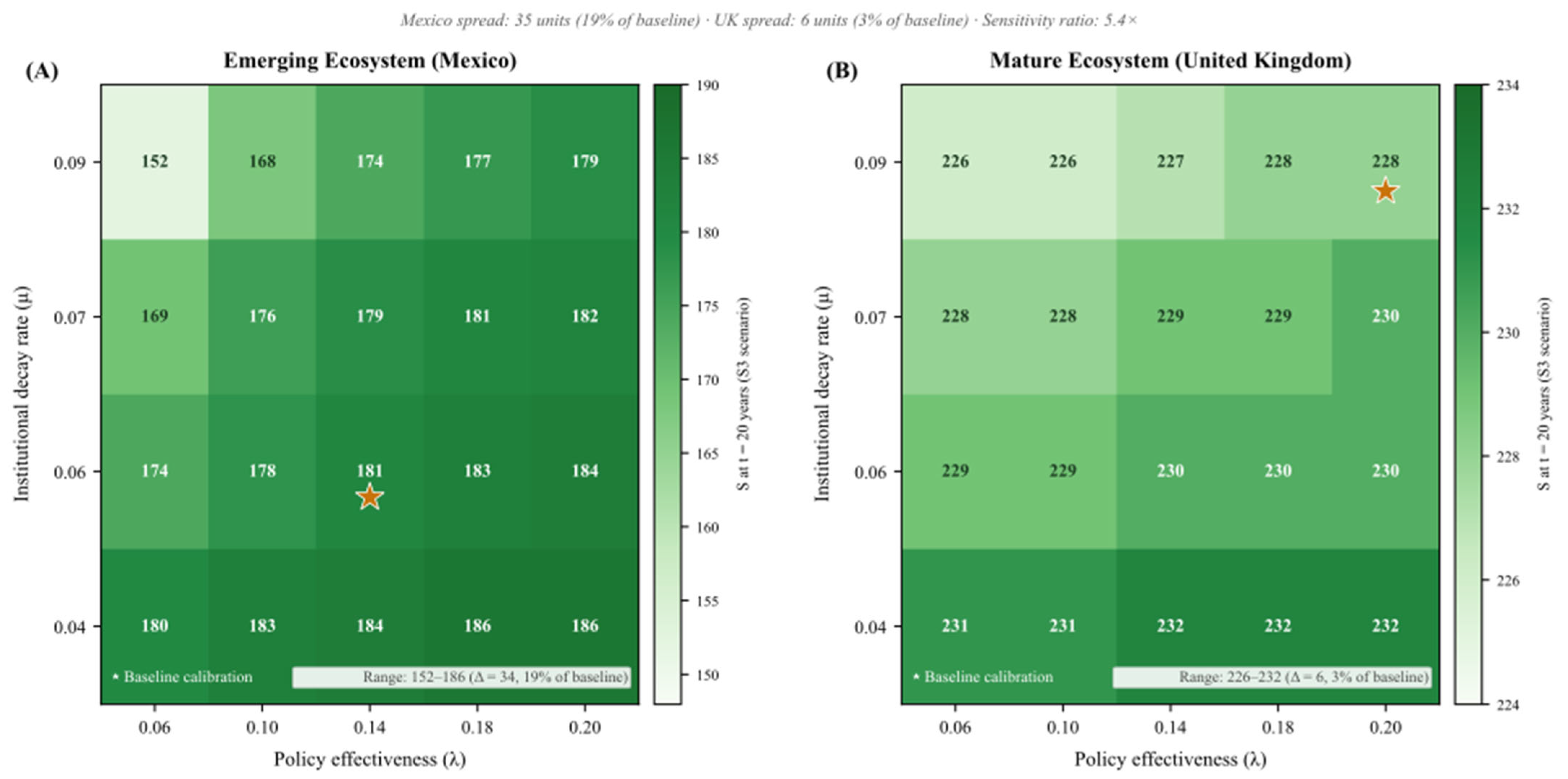
4.4. Comparative Structural Sensitivity: Mexico and the United Kingdom
5. Discussion
5.1. Why Resource Volume Is Insufficient: Ecosystem Trajectories Are Determined by Feedback Architecture
5.2. Interpreting the Mexico–United Kingdom Comparison: Coordination Thresholds Are Structurally Contingent
5.3. Operationalising the Diagnostic: Leading Structural Proxies
5.4. Conceptual Contributions to Systems Thinking and Ecosystem Policy Analysis
6. Implications for Policy and Practice
6.1. Practice Implications for Policymakers, Universities, and Intermediary Actors
6.2. Limitations and Future Research
7. Conclusions
Supplementary Materials
Author Contributions
Funding
Institutional Review Board Statement
Informed Consent Statement
Data Availability Statement
Acknowledgments
Conflicts of Interest
Abbreviations
| SD | System Dynamics |
| RGT | Repertory Grid Technique |
| S | Active startup population stock |
| C | Entrepreneurial capabilities stock |
| I | Institutional support stock |
| R1 | Reinforcing loop—Learning and capability formation |
| R2 | Reinforcing loop—Ecosystem attractiveness |
| B1 | Balancing loop—Exit pressure |
| B2 | Balancing loop—Institutional capacity ceiling |
| K | Startup carrying capacity |
| K6 | Institutional capacity ceiling |
| OECD | Organisation for Economic Co-operation and Development |
| GEM | Global Entrepreneurship Monitor |
| LAVCA | Latin American Private Capital Association |
| INADEM | Instituto Nacional del Emprendedor (Mexico) |
| TIS | Technological Innovation System |
| IQR | Interquartile range |
| RK4 | Fourth-order Runge–Kutta integration |
Appendix A. Extended Calibration Logic, Initial Conditions, and Parameter Ranges

| Parameter | Substantive Meaning | Central Value Logic | Mexico Central [IQR] | UK Central [IQR] | Interval Logic | Comparative Rationale |
|---|---|---|---|---|---|---|
| Institutional geometry parameters—calibrated via expert elicitation (RGT panel) with secondary validation | ||||||
| I0 | Baseline institutional support level at simulation start. Operationalises the pre-existing density and coordination quality of the support infrastructure. | Panel median of expert RGT ratings on a normalised scale. Cross-validated against GEM [14] ecosystem readiness indicators and OECD [28,29] institutional quality scores. | 0.35 [0.30–0.42] | 0.60 [0.55–0.68] | Expert interquartile range. Reflects disagreement across panel members on the effective strength of baseline support, not measurement error. | Captures the structural difference in pre-existing coordination infrastructure between a context with historically fragmented multi-agency support (Mexico) and one with a consolidated national delivery architecture (UK—Innovate UK, British Business Bank). The 0.25-unit gap (0.60/0.35 ≈ 1.71) represents a lower bound, given the documented visibility gap in informal Mexican support structures. |
| λ | Policy effectiveness coefficient. The rate at which public policy effort P is converted into effective institutional support I, modulating the inflow in the I stock equation. | Panel median, supplemented by a plausibility check verifying that the implied equilibrium I = λP/μ is consistent with observed I0 values and expert-elicited coordination quality ratings. | 0.14 [0.11–0.17] | 0.20 [0.17–0.23] | Expert interquartile range. The interval spans the range within which the qualitative threshold character of S3 is preserved (verified in sensitivity analysis). | Captures the institutional ability to convert policy intent into effective reinforcement. The UK’s higher λ (×1.43) reflects a more coherent programme delivery chain (consolidated calls, single-agency coordination) versus Mexico’s historically fragmented multi-secretariat structure. The single most threshold-sensitive parameter in the Mexican context: a −20% perturbation produces qualitative regime change in S3 (Table 4). |
| Capability accumulation parameters—behaviourally calibrated with expert-informed plausibility bounds | ||||||
| γ | Learning intensity parameter. Controls the rate at which active startup activity generates new ecosystem-level capabilities via the reinforcing R1 loop (dC/dt inflow). | Panel members assessed the speed of capability accumulation relative to observed ecosystem maturation timelines, cross-validated against Spigel and Harrison [41] empirical estimates of capability accumulation lags. | 0.20 [0.16–0.24] | 0.26 [0.22–0.30] | Expert interquartile range. Reflects genuine uncertainty in the speed of cumulative learning, not model instability; S3 threshold character is preserved across the full interval in both contexts. | Captures ecosystem learning speed and the efficiency with which active ventures generate spillover knowledge. The UK’s higher γ (×1.30) reflects a denser, more interconnected intermediary layer (accelerators, TTOs, alumni networks) that amplifies knowledge circulation. In the Mexican context, γ has proportionally larger leverage on the threshold crossing time because the system starts farther from K6. In the disaggregated sensitivity analysis, η_exp (experiential knowledge, ×1.50η) is the most rapidly eroding sub-dimension; η_inst (institutional memory, ×0.38η) is the most persistent. |
| η | Capability depreciation rate. Controls the rate at which accumulated capabilities C erode through talent emigration, programme discontinuity, and institutional memory loss (dC/dt outflow). | Expert judgement combined with contextual retention logic: panel members assessed the speed of ecosystem knowledge erosion in each context, anchored by observable proxies (researcher emigration rates, average programme tenure, organisational age of intermediaries). | 0.08 [0.06–0.10] | 0.06 [0.05–0.08] | Expert interquartile range. The interval is asymmetric by design. The lower bound represents the minimum depreciation consistent with observed ecosystem fragility; the upper bound represents the maximum consistent with sustained S2 capability growth. | Captures erosion of accumulated capability under institutional discontinuity. Mexico’s higher η (×1.33 relative to UK) reflects faster talent emigration (brain drain to the US), shorter average institutional tenure in support agencies, and the acute depreciation shock produced by the INADEM [25] dissolution. In the disaggregated sensitivity analysis, η_exp (experiential knowledge, ×1.50η) is the most rapidly eroding sub-dimension; η_inst (institutional memory, ×0.38η) is the most persistent. |
| μ | Institutional decay rate. The rate at which effective institutional support I erodes in the absence of sustained policy effort, capturing the structural fragility of the support infrastructure. | Expert judgement combined with policy continuity evidence: panel members assessed the speed of institutional support erosion between active policy cycles. Cross-validated against documented programme discontinuity rates in each context (INADEM records; Innovate UK programme tenure data). | 0.06 [0.05–0.08] | 0.05 [0.04–0.06] | Expert interquartile range. The interval reflects uncertainty in the average decay rate across policy cycles, not individual political events; episodic shocks (e.g., INADEM dissolution [25]) are captured in the central value rather than the interval bounds. | Captures vulnerability of support structures to deterioration. Mexico’s higher μ partly reflects political cycle exposure: inter-administration discontinuities compress years of accumulated institutional capacity into single rupture events (see Section 5 for the limitation of the continuous-decay formulation). The multivariate sensitivity analysis suggests that μ is the primary co-determinant of the Mexico–UK sensitivity asymmetry (5.4× ratio). |
| Structural ceiling parameter—synthetic calibration from expert elicitation and secondary intermediary density data | ||||||
| K6 | Institutional capacity ceiling. The structural upper bound on capability accumulation C imposed by the absorptive capacity of the existing intermediary infrastructure. Operationalises the B2 balancing loop. | Two-stage synthetic calibration: (1) expert panel positioned each context on a normalised saturation scale; (2) cross-validated against INADEM RNEI census (Mexico peak: ~120–140 active portfolio organisations) and UKBI/British Business Bank surveys (UK: 280–310 active incubators/accelerators, 2018–2020). Ratio K6_UK/K6_MX = 1.67 consistent with I0 ratio (1.71). | 150 [125–175] | 250 [210–290] | Plausible bounded interval derived from IQR of expert saturation estimates, bounded below by observed minimum active portfolio size and above by documented peak capacity. Sensitivity analysis indicates that threshold character is maintained across the full interval in both contexts. | Captures the absorptive limit of ecosystem capability accumulation under each institutional architecture. The 1.67× UK–Mexico ratio reflects a combination of greater intermediary density, higher average organisational age (implying greater absorbed learning capacity), and a more comprehensive formal data infrastructure. Because K6 is the ceiling of the R1–B2 interaction, it determines the long-run S3 plateau height: a 10% increase in K6 for Mexico raises the plateau by approximately 6–8%. |
| Element | Meaning in the Model | Mexico Value | UK Value | Interpretation and Boundary Rationale |
|---|---|---|---|---|
| Initial stock values—normalised units; values represent starting conditions at t = 0 | ||||
| S0 | Initial startup stock. The normalised population of active early-stage technology-based ventures at simulation start. | 5.0 | 8.0 | Reflects the observable difference in active early-stage startup density at the start of the simulation window. The Mexico value corresponds to the GEM [14] early-stage entrepreneurial activity rate adjusted for technology-orientation (approximately 2.1% of adult population in knowledge-intensive sectors). The UK value corresponds to the Innovate UK portfolio baseline and ONS business demography high-growth startup rate (approximately 3.4%). |
| C0 | Initial capability stock. The accumulated ecosystem-level entrepreneurial capability at simulation start, representing the existing stock of experiential knowledge, network capital, and institutional memory. | 2.0 | 4.0 | The team calibrated C0 proportionally to S0 and I0, setting it so that the initial C/K6 ratio reflects the expert panel’s assessment of ecosystem maturity relative to the structural ceiling. For Mexico, C0/K6 ≈ 0.013 (nascent accumulation phase); for the UK, C0/K6 ≈ 0.016 (modestly more advanced but still far from ceiling). The ratio C0_UK/C0_MX = 2.0 is consistent with the S0 ratio (1.6) and the I0 ratio (1.71), reflecting a coherent initial institutional geometry across all three stocks. |
| I0 | Initial institutional support stock. The starting level of effective institutional support infrastructure active at t = 0. | 0.35 [0.30–0.42] | 0.60 [0.55–0.68] | Same value as the calibrated I0 parameter (Table A1). Because I evolves dynamically from this starting condition under the governing equation dI/dt = λ·P − μ·I + φ·(S/S_ref), the initial condition also determines the speed of institutional adjustment in the early periods of the simulation. The [0.30–0.42] interval for Mexico partially reflects the documented visibility gap in informal support structures (Section 3.6). Treat the lower bound as a conservative floor. |
| Structural boundaries—parameters that define the ceilings and scope of the simulation | ||||
| K | Startup carrying capacity. The structural upper bound on the active startup population S, representing the maximum number of ventures the ecosystem can sustain given its market, talent, and institutional constraints. | 200 | 240 | Expert-calibrated upper bound on the sustainable startup population under each institutional configuration. The Mexico value reflects the panel’s assessment of the maximum ecosystem absorption capacity at current structural size; the UK value reflects a higher market depth and talent pool. Sensitivity analysis (Table 4) shows that the qualitative threshold character of S3 is maintained across ±20% perturbations to K in both contexts, suggesting that the central findings are not sensitive to moderate uncertainty in this parameter. K is not a hard ceiling in the model; the logistic saturation term (1 − S/K) approaches zero smoothly as S approaches K. |
| K6 | Capability ceiling. Maximum sustainable capability accumulation under each institutional architecture. Operationalises the B2 (Institutional Capacity Ceiling) balancing loop. | 150 [125–175] | 250 [210–290] | Same as calibrated parameter in Table A1. Reproduced here as a boundary assumption because K6 jointly determines both the long-run plateau of the S3 capability trajectory and the activation point of the B2 balancing loop. A K6 value at the lower end of the Mexico interval (125) delays the B2 loop activation by approximately 1.5–2 years relative to the central value; a value at the upper end (175) accelerates it by a similar margin. Neither perturbation alters the qualitative S3 > S2 > S1 ranking. |
| Simulation parameters—numerical and temporal specifications | ||||
| T (horizon) | Simulation horizon. Total simulated time in years. | 20 years | 20 years | Selected to capture at least one full threshold cycle: the pre-threshold accumulation phase (approximately 5–10 years in Mexico S3), the threshold crossing, and the post-threshold growth plateau. The horizon is consistent with established practice in long-horizon SD ecosystem models [30]. It is long enough to observe the R1–B2 handover dynamic while remaining within a planning horizon that policymakers can treat as strategically relevant. |
| Δt | Numerical time step. The integration step size used in the Euler method. | 0.25 yr | 0.25 yr | Chosen to balance numerical stability and interpretive resolution. A step of 0.25 years (one quarter) provides four data points per year, sufficient to resolve the inflexion dynamics of the S3 trajectory without excessive computational overhead. Numerical convergence analysis (Appendix D) compared Euler Δt = 0.25 against Euler Δt = 0.05 and fourth-order Runge–Kutta at Δt = 0.25. Maximum trajectory deviation: 0.18%; maximum inflexion-point timing difference: 0.50 years (one step). RK4 reports inflexion points 0.0–0.5 years earlier, confirming that the production Euler estimates are marginally conservative. |
Appendix B. Formal Delay Structure Considered but Not Implemented
| τ_adm (Years) | Mexico—Threshold Crossing (yr) | Mexico—Shift vs. Baseline | UK—Threshold Crossing (yr) | UK—Shift vs. Baseline |
|---|---|---|---|---|
| 0 (baseline) | 10.0 | — | 6.0 | — |
| 1 | 10.0 | +0.0 | 6.3 | +0.3 |
| 2 | 10.1 | +0.1 | 6.8 | +0.8 |
| 4 | 10.7 | +0.7 | 7.6 | +1.6 |
| Symbol | Meaning |
|---|---|
| D | Pending institutional activation stock |
| τₐᵈᵐ | Administrative delay parameter |
| I | Effective institutional support stock |

Appendix C. Disaggregated Capability Robustness Extension

| Capability Dimension | Substantive Meaning | Structural Role in the Extension |
|---|---|---|
| Experiential capability | Learning-by-doing and startup know-how | Strengthens venture survival and iterative learning |
| Network capability | Access to mentors, investors, and bridging ties | Improves opportunity circulation and coordination quality |
| Institutional memory | Durable routines and preserved knowledge | Stabilises ecosystem capability across policy discontinuity |
| Comparison | Result |
|---|---|
| Scenario ranking | Preserved in both contexts |
| Mexico under coordinated intervention | More quantitatively sensitive under disaggregation |
| United Kingdom under coordinated intervention | Less sensitive, structurally more buffered |
| Implication | Aggregate capability stock is parsimonious but conservative |
Appendix D. Numerical Convergence Analysis
| Scenario | S@t = 20 Euler Δt = 0.25 | S@t = 20 Euler Δt = 0.05 | S@t = 20 RK4 Δt = 0.25 | Δ from RK4 (S@t = 20) | Inflexion Euler Δt = 0.25 | Inflexion RK4 Δt = 0.25 | Δ Inflexion |
|---|---|---|---|---|---|---|---|
| MX—S1 (Baseline) | 2.96 | 2.96 | 2.96 | 0.08% | (no inflexion) | (no inflexion) | |
| MX—S3 (Coordinated) | 181.0 | 181.3 | 181.3 | 0.18% | 10.25 yr | 9.75 yr | 0.50 yr |
| UK—S3 (Coordinated) | 231.3 | 231.3 | 231.4 | 0.02% | 3.50 yr | 3.00 yr | 0.50 yr |
Appendix E. Expert Elicitation Protocol, Panel Composition, and Reliability Checks
| Group | n | Country | Primary Expertise | SD Familiarity | Session Format |
|---|---|---|---|---|---|
| MX-1 | 3 | Mexico | Technological entrepreneurship; university-based incubation; innovation management | Introduced via Centre for Systems Studies examples | Presential (Campus Monterrey); ~4 sessions per expert |
| MX-2 | 2 | Mexico | Technology management; startup ecosystem development; regional innovation policy | Introduced via Centre for Systems Studies examples | Presential (Campus Guadalajara); ~4 sessions per expert |
| UK-1 | 2 | United Kingdom | System dynamics; innovation systems; policy modelling | Specialist SD researchers | Presential (Hull); ~4 sessions per expert |
| UK-2 | 2 | United Kingdom | Entrepreneurial ecosystems; university–industry knowledge transfer; venture capital | Familiarised via pre-session materials | Presential (Cambridge); ~4 sessions per expert |
| UK-3 | 1 | United Kingdom | Technology entrepreneurship; regional innovation ecosystems; SME policy | Familiarised via pre-session materials | Presential (Northumbria); ~4 sessions per expert |
| Joint | All 10 | UK + Mexico | Cross-panel synthesis and final parameter convergence | — | Two virtual rounds (full panel); anonymous vote per parameter range |
| Phase | Focus | Materials Distributed | Output |
|---|---|---|---|
| 1 | Causal loop diagram review | Full CLD with node descriptions; glossary of SD constructs; two reference CLD examples from the Centre for Systems Studies literature | Expert annotations on loop structure, polarity plausibility, and boundary adequacy; agreed revisions to the CLD before parameter work began |
| 2 | Parameter elicitation and range assignment | Literature summary table with initial parameter estimates per context; Repertory Grid elicitation guide for intangible parameters (γ, I0, λ); blank range-assignment sheet | Individually completed range sheets; RGT constructs for intangible parameters; flagged items of disagreement for Phase 3 discussion |
| 3 | Integrated model review | Revised CLD incorporating Phase 1 feedback; draft Table 1 with provisional parameter ranges; simulation output graphs for baseline scenario | Validated model structure and consolidated parameter ranges; anonymously voted final ranges; signed-off Scenario 1 baseline trajectory plausibility |
| 4 | Virtual joint synthesis (×2 rounds, full panel) | All Phase 3 outputs; cross-context parameter comparison table; preliminary Scenario 2 and 3 simulation outputs | Final parameter ranges for Table 1; consensus on cross-context differential structure; approval of all three scenario configurations |
| Item | Value | Interpretation |
|---|---|---|
| Total constructs elicited | 65 | Full construct pool across both national panels |
| Constructs from Mexico panel | 27 | Reflects the Mexican ecosystem interviews |
| Constructs from UK panel | 38 | Reflects the UK ecosystem interviews |
| Initial blind reclassification rates | 84%/73% | Acceptable but imperfect first-round stability |
| Revised blind reclassification rates | 89%/86% | Supports the revised category scheme |
Appendix E.1. Elicitation Instrument and Disagreement Resolution
Appendix E.1.1. Triadic Comparison Elements
Appendix E.1.2. Construct-to-Number Translation
| Parameter | Scale Minimum | Scale Maximum | Low Anchor—Reference | High Anchor—Reference | Mid-Point Descriptor |
|---|---|---|---|---|---|
| γ—learning intensity | 0.10 (negligible) | 0.40 (transformative) | Isolated knowledge; minimal inter-firm spillovers | Dense alumni networks; high repeat-founder rate | Moderate spillovers; some ecosystem-level learning (pt 4) |
| η—capability depreciation | 0.02 (minimal) | 0.15 (rapid erosion) | Strong retention; institutional memory preserved across cycles | High talent emigration; frequent programme discontinuity | Moderate erosion; capability recovers between shocks (pt 4) |
| λ—policy effectiveness | 0.02 (negligible) | 0.25 (transformative) | Policy effort has negligible institutional effect | Policy effort produces near-immediate institutional response | Policy produces measurable but slow institutional change (pt 3) |
| μ—institutional decay | 0.02 (minimal) | 0.15 (rapid deterioration) | Stable institutions; low inter-cycle attrition | Acute fragility; institutions collapse between political cycles | Moderate decay; institutions weaken but recover (pt 4) |
| I0—baseline support | 0.10 (minimal) | 0.80 (comprehensive) | Sparse intermediaries; fragmented coordination | Dense, coherent institutional infrastructure | Partial infrastructure; coordination patchy (pt 4) |
| K6—capacity ceiling | 50 (minimal) | 400 (extensive) | Fewer than 20 active portfolio organisations | 300+ active incubators, accelerators, TTOs | Moderate intermediary density; 80–120 active organisations (pt 4) |
Appendix E.1.3. Disagreement Resolution
- Case 1—Mexico: Institutional Capacity Ceiling K6 (E7 = 195.0)
- Case 2—UK: Initial Institutional Support Stock I0 (E6 = 0.459)
| (a) | ||||||
| Expert | γ | η | λ | μ | I0 | K6 |
| E1 | 0.309 | 0.130 † | 0.143 | 0.066 | 0.330 | 105.0 |
| E2 | 0.272 | 0.093 | 0.118 | 0.074 | 0.382 | 134.4 |
| E3 | 0.318 | 0.102 | 0.105 | 0.056 | 0.455 | 137.3 |
| E4 | 0.364 | 0.070 | 0.097 | 0.056 | 0.304 | 120.3 |
| E5 | 0.266 | 0.084 | 0.077 | 0.104 † | 0.278 | 144.0 |
| Median | 0.309 | 0.093 | 0.105 | 0.066 | 0.330 | 134.4 |
| IQR | [0.272, 0.318] | [0.084, 0.102] | [0.097, 0.118] | [0.056, 0.074] | [0.304, 0.382] | [120, 137] |
| Range | 0.266–0.364 | 0.070–0.130 | 0.077–0.143 | 0.056–0.104 | 0.278–0.455 | 105–144 |
| CV (%) | 11.6% | 21.0% | 20.4% | 24.9% | 18.0% | 10.9% |
| Simulation value | 0.280 | 0.100 | 0.110 | 0.080 †† | 0.350 | 150 †† |
| (b) | ||||||
| Expert | γ | η | λ | μ | I0 | K6 |
| E6 | 0.312 | 0.042 | 0.255 | 0.065 | 0.459 † | 267.9 |
| E7 | 0.282 | 0.066 | 0.150 | 0.052 | 0.629 | 247.9 |
| E8 | 0.371 † | 0.042 | 0.182 | 0.043 | 0.625 | 180.7 |
| E9 | 0.289 | 0.042 | 0.220 | 0.052 | 0.600 | 317.8 |
| E10 | 0.256 | 0.066 | 0.258 | 0.035 | 0.577 | 294.6 |
| Median | 0.289 | 0.042 | 0.220 | 0.052 | 0.600 | 267.9 |
| IQR | [0.282, 0.312] | [0.042, 0.066] | [0.182, 0.255] | [0.043, 0.052] | [0.577, 0.625] | [248, 295] |
| Range | 0.256–0.371 | 0.042–0.066 | 0.150–0.258 | 0.035–0.065 | 0.459–0.629 | 181–318 |
| CV (%) | 12.9% | 22.8% | 19.7% | 20.3% | 10.8% | 17.9% |
| Simulation value | 0.350 †† | 0.060 | 0.240 | 0.040 | 0.680 †† | 250 |
Appendix F. Multivariate Sensitivity Analysis of Policy Effectiveness and Institutional Decay
| Mexico—S at t = 20 years (S3 scenario) | |||||
| μ\λ | λ = 0.06 | λ = 0.10 | λ = 0.14 | λ = 0.18 | λ = 0.20 |
| μ = 0.04 | 180 | 183 | 184 | 186 | 186 |
| μ = 0.06 | 174 | 178 | 181 ★ | 183 | 184 |
| μ = 0.07 | 169 | 176 | 179 | 181 | 182 |
| μ = 0.09 | 152 | 168 | 174 | 177 | 179 |
| United Kingdom—S at t = 20 years (S3 scenario) | |||||
| μ\λ | λ = 0.06 | λ = 0.10 | λ = 0.14 | λ = 0.18 | λ = 0.20 |
| μ = 0.04 | 231 | 231 | 232 | 232 | 232 |
| μ = 0.06 | 229 | 229 | 230 | 230 | 230 |
| μ = 0.07 | 228 | 228 | 229 | 229 | 230 |
| μ = 0.09 | 226 | 226 | 227 | 228 | 228 ★ |
References
- Isenberg, D.J. How to start an entrepreneurial revolution. Harv. Bus. Rev. 2010, 88, 40–50. [Google Scholar]
- Bailetti, T. Technology Entrepreneurship: Overview, Definition, and Distinctive Aspects. Technol. Innov. Manag. Rev. 2012, 2, 5–12. [Google Scholar] [CrossRef]
- Björklund, T.A.; Krueger, N.F. Generating resources through co-evolution of entrepreneurs and ecosystems. J. Enterprising Communities People Places Glob. Econ. 2016, 10, 477–498. [Google Scholar] [CrossRef]
- Spigel, B. The Relational Organization of Entrepreneurial Ecosystems. Entrep. Theory Pract. 2017, 41, 49–72. [Google Scholar] [CrossRef]
- Stam, E. Entrepreneurial Ecosystems and Regional Policy: A Sympathetic Critique. Eur. Plan. Stud. 2015, 23, 1759–1769. [Google Scholar] [CrossRef]
- Wurth, B.; Stam, E.; Spigel, B. Toward an Entrepreneurial Ecosystem Research Program. Entrep. Theory Pract. 2022, 46, 729–778. [Google Scholar] [CrossRef]
- Brown, R.; Mason, C. Looking inside the spiky bits: A critical review and conceptualisation of entrepreneurial ecosystems. Small Bus. Econ. 2017, 49, 11–30. [Google Scholar] [CrossRef]
- Mason, C.; Brown, R. Entrepreneurial ecosystems and growth-oriented entrepreneurship. Final Rep. OECD Paris 2014, 30, 77–102. [Google Scholar]
- Ceci, G.; Ancona, A.; Iovanella, A.; Veglianti, E. Entrepreneurial and innovation ecosystems: A scoping review on the complexity of nested configurations. J. Innov. Knowl. 2026, 14, 100973. [Google Scholar] [CrossRef]
- Díaz De León, E.; Guild, P. Using expert knowledge to envision future converging technologies. In Proceedings of the PICMET ’07—2007 Portland International Conference on Management of Engineering and Technology, Portland, OR, USA, 5–9 August 2007; pp. 878–882. [Google Scholar] [CrossRef]
- Díaz de León, E.; Guild, P. Using repertory grid to assess intangibles: Uncertainty reduction for lean start-ups in entrepreneurship. In Handbook of Qualitative Research Techniques and Analysis in Entrepreneurship; Edward Elgar Publishing: Cheltenham, UK, 2015; pp. 393–422. [Google Scholar] [CrossRef]
- Etzkowitz, H.; Leydesdorff, L. The dynamics of innovation: From National Systems and “Mode 2” to a Triple Helix of university–industry–government relations. Res. Policy 2000, 29, 109–123. [Google Scholar] [CrossRef]
- Forrester, J.W. System dynamics, systems thinking, and soft OR. Syst. Dyn. Rev. 1994, 10, 245–256. [Google Scholar] [CrossRef]
- GEM. Global Entrepreneurship Monitor 2021/2022 Global Report: Opportunity Amid Disruption; Hill, S., Ionescu-Somers, A., Coduras, A., Guerrero, M., Rosca, A., Eds.; Global Entrepreneurship Research Association: London, UK, 2022; Available online: https://www.gemconsortium.org/ (accessed on 6 June 2026).
- Guerrero, M.; Urbano, D. The development of an entrepreneurial university. J. Technol. Transf. 2012, 37, 43–74. [Google Scholar] [CrossRef]
- Hsien, C.; Evans, S. Operationalizing leverage points in business model design for sustainable systems change. Proc. Des. Soc. 2024, 4, 1299–1308. [Google Scholar] [CrossRef]
- Kantis, H.; Gonzalo, M.; Federico, J.; Garcia, S.I. Entrepreneurial ecosystems meet innovation systems: Building bridges from Latin America to the Global South. In Entrepreneurial Ecosystems Meet Innovation Systems; Edward Elgar Publishing: Cheltenham, UK, 2020; pp. 41–60. [Google Scholar]
- Arrow, K.J. The economic implications of learning by doing. Rev. Econ. Stud. 1962, 29, 155–173. [Google Scholar] [CrossRef]
- Sterman, J. System Dynamics: Systems Thinking and Modeling for a Complex World; Massachusetts Institute of Technology: Cambridge, MA, USA, 2002. [Google Scholar]
- OECD. OECD SME and Entrepreneurship Outlook 2019; OECD Publishing: Paris, France, 2019. [Google Scholar] [CrossRef]
- LAVCA. 2022 LAVCA Year in Review: Latin America Tech Investment; Latin American Private Capital Association: 2022. Available online: https://lavca.org/research/ (accessed on 6 June 2026).
- World Bank. Doing Business 2020: Comparing Business Regulation in 190 Economies; World Bank Group: Washington, DC, USA, 2020. [Google Scholar] [CrossRef]
- OECD. International Migration Outlook 2021; OECD Publishing: Paris, France, 2021. [Google Scholar] [CrossRef]
- Wilson, T. A Review of Business-University Collaboration; Department for Business, Innovation and Skills: London, UK, 2012.
- Diario Oficial de la Federación. Decreto por el que se Reforman, Adicionan y Derogan Diversas Disposiciones del Reglamento Interior de la Secretaría de Economía [Dissolution of INADEM—Instituto Nacional del Emprendedor]; Secretaría de Gobernación: Ciudad de México, Mexico, 2019. Available online: https://www.dof.gob.mx (accessed on 6 June 2026).
- OECD. Entrepreneurship at a Glance 2013; OECD Publishing: Paris, France, 2013. [Google Scholar] [CrossRef]
- Barlas, Y. Formal aspects of model validity and validation in system dynamics. Syst. Dyn. Rev. 1996, 12, 183–210. [Google Scholar] [CrossRef]
- Audretsch, D.B.; Fiedler, A. Power and entrepreneurship. Small Bus. Econ. 2023, 60, 1573–1592. [Google Scholar] [CrossRef] [PubMed]
- Tõnurist, P.; Hanson, A. OECD Working Papers on Public Governance No. 44; OECD Working Papers on Public Governance: Paris, France, 2020; pp. 1–146. [Google Scholar]
- Sterman, J.D. Business Dynamics: Systems Thinking and Modeling for a Complex World; MacGraw-Hill Company: New York, NY, USA, 2000. [Google Scholar]
- Kelly, G.A. The Psychology of Personal Constructs [Originally Published 1955, New York. Norton]; Routledge: London, UK, 1991. [Google Scholar]
- Meadows, D. Thinking in Systems: International Bestseller; Chelsea Green Publishing: White River Junction, VT, USA, 2008. [Google Scholar]
- Abson, D.J.; Fischer, J.; Leventon, J.; Newig, J.; Schomerus, T.; Vilsmaier, U.; von Wehrden, H.; Abernethy, P.; Ives, C.D.; Jager, N.W.; et al. Leverage points for sustainability transformation. Ambio 2017, 46, 30–39. [Google Scholar] [CrossRef] [PubMed]
- Autio, E.; Kenney, M.; Mustar, P.; Siegel, D.; Wright, M. Entrepreneurial innovation: The importance of context. Res. Policy 2014, 43, 1097–1108. [Google Scholar] [CrossRef]
- Díaz de León, E.; Guild, P.D.P.D. Using repertory grid to identify intangibles in business plans. Ventur. Cap. 2003, 5, 135–160. [Google Scholar] [CrossRef]
- Kieft, A.; Harmsen, R.; Hekkert, M.P. Toward ranking interventions for technological innovation systems via the concept of leverage points. Technol. Forecast. Soc. Change 2020, 153, 119466. [Google Scholar] [CrossRef]
- Koloffon Rosas, M. Partnerships for sustainable development: Measuring transformative potential through leverage points. Earth Syst. Gov. 2025, 25, 100265. [Google Scholar] [CrossRef]
- Ksouri-Gerwien, C.; Vorbohle, C. Business model prototyping and evaluation from an ecosystem perspective: An actor-based modeling framework for using system dynamics. Inf. Syst. E-Bus. Manag. 2026. [Google Scholar] [CrossRef]
- Riechers, M.; Fischer, J.; Manlosa, A.O.; Ortiz-Przychodzka, S.; Sala, J.E. Operationalising the leverage points perspective for empirical research. Curr. Opin. Environ. Sustain. 2022, 57, 101206. [Google Scholar] [CrossRef]
- Scott, S.; Hughes, M.; Ribeiro-Soriano, D. Towards a network-based view of effective entrepreneurial ecosystems. Rev. Manag. Sci. 2022, 16, 157–187. [Google Scholar] [CrossRef]
- Spigel, B.; Harrison, R. Toward a process theory of entrepreneurial ecosystems. Strateg. Entrep. J. 2018, 12, 151–168. [Google Scholar]
- Stam, E.; van de Ven, A. Entrepreneurial ecosystem elements. Small Bus. Econ. 2021, 56, 809–832. [Google Scholar] [CrossRef]
- Terstriep, J.; David, A.; Zaghow, L.; Vershinina, N.; Freiling, J. Power plays: Surfacing the hidden currents in entrepreneurial ecosystems. J. Bus. Ventur. Insights 2025, 24, e00584. [Google Scholar] [CrossRef]


| Symbol | Parameter | Mexico (Sim. Value [Interval]) | UK (Sim. Value [Interval]) | Empirical/Theoretical Basis |
|---|---|---|---|---|
| A. Context-invariant parameters—same calibration across institutional settings | ||||
| α | Startup formation responsiveness to coordinated institutional support and financing | 0.18 [0.12–0.24] | 0.22 [0.15–0.28] | [1,4,5]; behavioural calibration |
| δ | Returns-to-experience exponent governing increasing returns in capability accumulation | 0.55 [0.40–0.70] | 0.60 [0.45–0.75] | [1,18,19]; behavioural calibration |
| φ | Performance feedback coefficient from startup population to institutional support (R2 loop) | 0.09 [0.06–0.14] | 0.12 [0.08–0.18] | [5,6]; expert elicitation (RGT panel) |
| F | Financing availability scalar (scenario design—not subject to sensitivity analysis) | S1: 1.0/S2: 1.5/S3: 1.4 | S1: 1.0/S2: 1.5/S3: 1.4 | Scenario design; [20,21] |
| P | Policy effort multiplier (scenario design—not subject to sensitivity analysis) | S1–S2: 1.0/S3: 1.6 | S1–S2: 1.0/S3: 1.6 | Scenario design; [1] |
| Sᴿᵉᶠ | Reference startup population for performance feedback normalisation | 1.0 (fixed) | 1.0 (fixed) | Model scaling constant; [19] |
| B. Context-specific parameters—calibrated separately via RGT expert elicitation | ||||
| β | Natural exit rate of early-stage startups (market selection and resource depletion) | 0.22 [0.20–0.28] | 0.18 [0.15–0.22] | [14] discontinuation rates; [21,22] |
| γ | Learning intensity—rate at which active startup density generates ecosystem-level capabilities | 0.28 [0.24–0.32] * | 0.35 [0.31–0.40] | Expert elicitation (RGT panel); [4]; serial entrepreneur prevalence [14] |
| η | Capability depreciation rate (talent emigration, programme discontinuity, memory erosion) | 0.10 [0.08–0.12] | 0.06 [0.04–0.08] | [15,23] |
| λ | Policy effectiveness—rate at which policy effort translates into institutional support | 0.11 [0.08–0.14] | 0.20 [0.16–0.24] | Expert elicitation (RGT panel); [20,24] |
| μ | Institutional decay rate—deterioration of support without sustained policy effort | 0.08 [0.06–0.10] | 0.05 [0.03–0.06] | [9,25] |
| I0 | Baseline institutional support level at simulation start | 0.35 [0.30–0.42] | 0.60 [0.55–0.68] | [14,17,20,25,26] |
| K6 | Institutional capacity ceiling for capability accumulation (operationalises B2 loop) | 150 [125–175] | 250 [210–290] | Expert elicitation (RGT panel); [4]; derived proportionally to I0 differential |
| Symbol | Variable and Definition | Governing Equation | Feedback Loop Structure and Theoretical Basis |
|---|---|---|---|
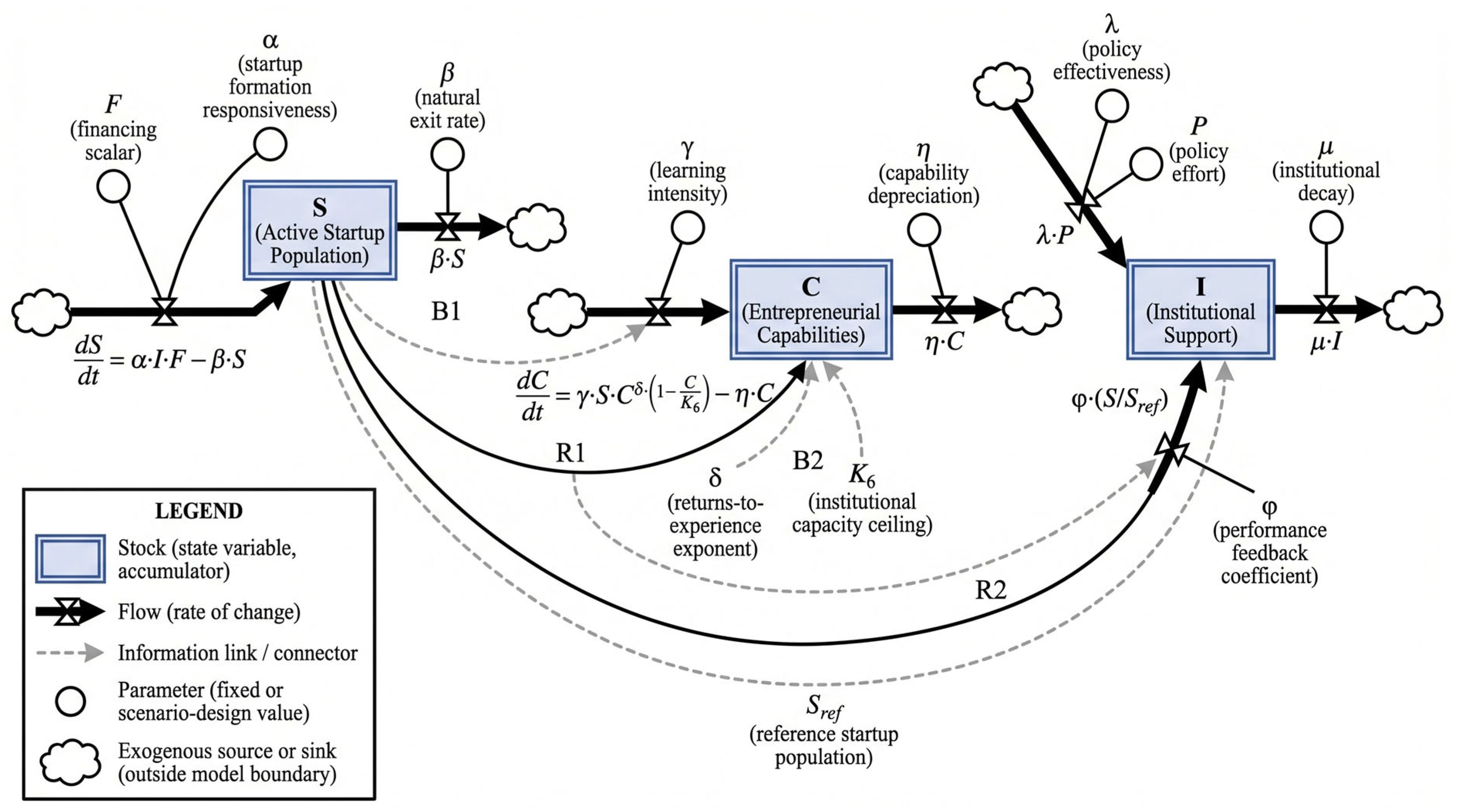
| S | Active startup population Total stock of active early-stage technology-based ventures at simulation time t (normalised units). | dS/dt = α·I·F·(1 − S/K) − β·S Creation: institutional support × financing (α·I·F). Exit: natural exit at rate β. | R1 (reinforcing)—S → C → ecosystem quality → S R2 (reinforcing)—S → I → S B1 (balancing)—Exit pressure counteracts creation when α·I·F < β·S The term (1 − S/K) in the creation rate introduces a logistic saturation effect: as S approaches the carrying capacity K, the effective creation rate declines smoothly toward zero, preventing unbounded exponential growth in the startup population. This term is the structural basis for the R1/B1 ratio’s numerator and ensures that the threshold condition R1/B1 = 1 is derivable directly from setting dS/dt = 0. Stam [1,4,27] |
| C | Entrepreneurial capabilities Aggregate ecosystem stock of three dimensions: experiential knowledge, network capital, and institutional memory (composite index, baseline = 1.0). Represented as a single stock for parsimony; see Section 3.2 for the disaggregation limitation. | dC/dt = γ·S·Cᵟ·(1 − C/K6) − η·C Learning inflow: bounded by institutional ceiling K6 (B2 loop). Depreciation: talent emigration and memory erosion at rate η. | R1 (reinforcing)—Learning loop: S → C → ecosystem quality → S B2 (balancing)—Institutional ceiling: accumulation slows as C → K6 The K6 ceiling prevents unbounded exponential growth and produces the S-curve in Figure 3. [4,18,28] |
| I | Institutional support Effective level of coordinated public, university, and intermediary support available to startups at time t (normalised units). Classified as a stock—not an auxiliary—because it accumulates over time and retains memory of prior policy investment. | dI/dt = λ·P − μ·I + φ·S/Sref Policy inflow: effort P scaled by effectiveness λ. Decay: institutional deterioration at rate μ. Performance feedback: growing S reinforces I via R2 loop. | R2 (reinforcing)—Performance feedback: S → I → S Higher μ in Mexico means policy effort must first offset ongoing deterioration before generating net institutional growth, raising the effective threshold. This is the primary mechanism driving the Mexico–UK differential in threshold geometry. Isenberg [1,8,29] |
| Test Category | Tests Performed | Outcome |
|---|---|---|
| Structural validity | Equation dimensional consistency; boundary adequacy review with expert panel; extreme-condition tests (I → 0; η → max; λ → 0) | All equations are dimensionally consistent; extreme-condition behaviour is qualitatively plausible in both contexts |
| Behavioural validity | Baseline trajectory plausibility confirmed by expert panel; behaviour reproduction under S1 matches qualitative pattern of observed low-growth equilibria in fragile ecosystems; S-curve shape under S3 consistent with published SD ecosystem models | Baseline and coordinated trajectories were judged credible by the panel in both national contexts |
| Robustness | Univariate parameter perturbations (±20%) across six parameters; multivariate grid over λ × μ (48 combinations); disaggregated capability robustness extension (Appendix C); numerical convergence comparison (Euler Δt = 0.25 vs. Δt = 0.05 vs. RK4) | Core qualitative scenario ranking preserved across all perturbations except one: λ − 20% in Mexico produces qualitative regime change in S3 (reported and discussed as a structural finding, not an anomaly) |
| Parameter | Perturbation | Effect on S (Mexico) | Effect on S (United Kingdom) | Qualitative Conclusion |
|---|---|---|---|---|
| I0 (baseline institutional support) | −20% | Large ↓ in all scenarios; S3 threshold delayed ~2 yr; Mexico’s S3 remains qualitatively intact | Moderate ↓; S3 still substantially outperforms S1; threshold character preserved | Results are consistent with I0 being a primary structural driver of the Mexico–UK response gap. Mexico’s threshold appears fragile to baseline erosion in the model, as the system begins closer to the B1-dominance boundary. The UK’s stronger I0 provides structural buffering that sustains threshold character under equivalent perturbation. |
| λ (policy effectiveness) | −20% | S3 loses threshold character entirely; converges toward S2 trajectory—no inflexion point | S3 threshold delayed but qualitatively preserved | Qualitative regime change in Mexico (not merely a quantitative shift). Under equivalent perturbation, the UK threshold is preserved while Mexico’s S3 collapses to S2 behaviour. This asymmetry is a structural property of baseline institutional geometry: Mexico operates closer to the B1/R1 boundary, so reduced policy coherence is sufficient to suppress threshold crossing. This finding directly supports Proposition 2: the coordination threshold level is not universal but depends on the prior institutional geometry of each ecosystem. |
| γ (learning intensity) | +20% | S3 inflexion accelerated by ~1.5 yr; S1/S2 modestly improved | S3 inflexion accelerated by ~1.0 yr; S1/S2 modestly improved | Learning intensity amplifies coordination effects in both contexts; proportionally larger leverage in Mexico because the system starts further from its capability ceiling K6. Investments in mentor network density and serial entrepreneur ecosystems yield disproportionate returns in emerging institutional contexts. |
| β (startup exit rate) | +20% | Substantial ↓ in S1 and S2; S3 partially buffered by reinforcing loops | Moderate ↓ in S1 and S2; S3 well-buffered; threshold character preserved | Under elevated β, the S3 trajectory shows greater resilience than S1 and S2 in both simulated contexts, as the reinforcing dynamics of R1 and R2 partially offset the increased outflow from S. S1 and S2 prove more sensitive to the perturbation, consistent with their lower degree of feedback activation. The pattern is consistent with, but does not confirm, the proposition that coordination architecture rather than resource volume is the primary determinant of resilience to adverse market conditions. |
| η (capability depreciation rate) | +20% | C plateau reduced ~15%; S3 inflexion delayed ~1.5 yr; S1/S2 minimally affected | C plateau reduced ~10%; S3 timing and threshold character largely preserved | Capability retention is more consequential in Mexico, consistent with the higher talent emigration rate embedded in the Mexican η calibration. The S-curve shape of the C trajectory is preserved, confirming that the K6 ceiling and the learning mechanism (γ·S·Cᵟ) are the dominant structural determinants of capability trajectories. |
| μ (institutional decay rate) | +20% | I stock recovers more slowly; S3 threshold delayed ~1 yr; coordination window narrowed | Modest effect on timing; S3 plateau and threshold character largely unaffected | Institutional continuity is a structural vulnerability in fragmented regimes. In Mexico, higher μ means more policy effort is consumed offsetting deterioration before net institutional growth occurs, narrowing the window for threshold crossing. The UK’s arms-length agency architecture (Innovate UK, British Business Bank) provides resilience through programme continuity, explaining asymmetric sensitivity. |
| Model Component | Structural Role | Observable Proxy Indicators | Operational Significance for Practice |
|---|---|---|---|
| Institutional Support (I) and Decay (μ) | Counteracting fragmentation to build baseline institutional density. | Proportion of active programmes with an uninterrupted operating history of three or more years. Stability of leadership tenure in key intermediary organisations anchoring the coordination network. | Resistance to Decay. High μ in Mexico requires sustained effort simply to offset institutional memory loss before net institutional growth can begin. Programmes that preserve continuity across political cycles directly counteract this structural vulnerability. |
| Policy Effectiveness (λ) | Converting policy effort into effective institutional reinforcement. | Number of documented cross-agency coordination agreements with operational accountability mechanisms. Programme budget execution rate—the proportion of allocated coordination funds disbursed within each fiscal year. | Threshold Sensitivity. Mexico is qualitatively fragile to λ: a 20% deterioration in policy effectiveness is sufficient to suppress threshold crossing entirely. This is the single most structurally consequential parameter in the Mexican context. |
| Capability Stock (C) and Learning (γ) | Accumulating slow-depreciating experiential knowledge and network capital. | Annual rate at which ecosystem alumni transition into mentoring or investor roles within the same ecosystem. Density of active mentoring relationships per cohort of new ventures. Proportion of new ventures founded by individuals with prior startup experience in the same ecosystem (repeat-founder rate). | The Learning Delay. The capability stock C rises only after the startup population S reaches sufficient density. Early stagnation in output counts does not signal failure if these proxies are rising—they indicate the R1 loop is gaining traction. |
| Loop Dominance Ratio (R1/B1) | Tipping point between self-limiting and self-reinforcing feedback regimes. | Sustained upward trend in two- and three-year cohort survival rates, controlling for financing levels. Ratio of serial entrepreneurs to first-time founders within active cohorts. | Structural Diagnostic. A rising R1/B1 ratio below unity signals the system is in structural assembly, not stagnation. The trajectory of the ratio—not its absolute level at any single point—is the relevant indicator of pre-threshold progress, supporting the case for continued coordination investment. |
Disclaimer/Publisher’s Note: The statements, opinions and data contained in all publications are solely those of the individual author(s) and contributor(s) and not of MDPI and/or the editor(s). MDPI and/or the editor(s) disclaim responsibility for any injury to people or property resulting from any ideas, methods, instructions or products referred to in the content. |
© 2026 by the authors. Licensee MDPI, Basel, Switzerland. This article is an open access article distributed under the terms and conditions of the Creative Commons Attribution (CC BY) license.
Share and Cite
Díaz de León López, E.; Palacios Rodríguez, R. Invisible Progress in Entrepreneurial Ecosystems: Coordination Thresholds, Feedback Dominance, and the Structural Blind Spots of Policy Evaluation. Systems 2026, 14, 814. https://doi.org/10.3390/systems14070814
Díaz de León López E, Palacios Rodríguez R. Invisible Progress in Entrepreneurial Ecosystems: Coordination Thresholds, Feedback Dominance, and the Structural Blind Spots of Policy Evaluation. Systems. 2026; 14(7):814. https://doi.org/10.3390/systems14070814
Chicago/Turabian StyleDíaz de León López, Enrique, and Roberto Palacios Rodríguez. 2026. "Invisible Progress in Entrepreneurial Ecosystems: Coordination Thresholds, Feedback Dominance, and the Structural Blind Spots of Policy Evaluation" Systems 14, no. 7: 814. https://doi.org/10.3390/systems14070814
APA StyleDíaz de León López, E., & Palacios Rodríguez, R. (2026). Invisible Progress in Entrepreneurial Ecosystems: Coordination Thresholds, Feedback Dominance, and the Structural Blind Spots of Policy Evaluation. Systems, 14(7), 814. https://doi.org/10.3390/systems14070814